Copyright to IJAREEIE www.ijareeie.com 6810
A Comparison of PID Controller Tuning
Methods for Three Tank Level Process
P.Srinivas
1, K.Vijaya Lakshmi
2, V.Naveen Kumar
3Associate Professor, Department of EIE, VR Siddhartha Engineering College, Vijayawada, India 1 Assistant Professor, Department of EIE, VR Siddhartha Engineering College, Vijayawada, India 2
Assistant Professor, School of Electronics Engineering, VIT, Vellore, India3
ABSTRACT: Automatic controllers are introduced for efficient control of the process industries. Proportional, Integral and derivative (PID) controllers are the most widely used controllers in the most process industries because of their robustness, easy implementation and simplicity. Various tuning methods like Ziegler-Nichols (Z-N) method, Cohen-Coon(C-C) method, Minimum error integral criteria method and Genetic Algorithms (GAs) have been suggested for optimum setting of PID controller parameters. In this paper the performance of Genetic algorithm based PID controller is compared with conventional PID controller for various tuning techniques in the case of three tank level process control system. This comparative study is carried out for set point tracking of three tank level process using computer simulation.
Keywords: PID controller, Ziegler-Nichols, Cohen-Coon, ISE, ITAE, IAE, Genetic Algorithm, Level process
I.INTRODUCTION
In many industrial process applications the liquid level control is of much importance, especially in oil and gas industries, waste water treatment plant & food processing industries. Three tank system relates to liquid level control problems generally existing in industrial surge tanks. For example, accurate mould level control in continuous bloom casting gained substantial benefits in steel producing companies [1].The general objective of the three tank level is to track the set point and stabilize the level in the tanks with less number of oscillations and minimum settling time. The final product quality depends on the accuracy of the level controller. The objective of the controller is to reach the target and be able to track a new set point values quickly. This control problem can be solved by a number of level control strategies ranging from conventional PID to Genetic algorithm based PID controllers[2],[3],[4].In level control applications the conventional Proportional-Integral-Derivative (PID) controller is generally used, but the tuning parameters of the controllers must be estimated by tuning technique either in frequency response or time response to attain the desired performances[5],[6].Many different tuning techniques have been proposed for attaining the desired control system response. These tuning techniques are developed based on one or more than one of the control objectives as selected criterion. Many new techniques are proposed by the academic control community. One new technique is Genetic Algorithm based tuning [7]. An advantage of the GA for auto tuning is that it does not need gradient information. With this advantage Genetic Algorithm (GA) based PID controller is presently implemented in many industrial automation applications [8].
The paper has been organized as follows: Section 2 describes the modeling of three tank system. Section 3 reviews various tuning methods of PID controller. Section 4 presents simulation of the process and PID controller for different tuning methods.
II.MODELINGOFATHREETANKLEVELCONTROLPROCESS
Three first order processes are connected in series behaves as a three tank liquid level system, and its structure is shown in Fig.1.
Copyright to IJAREEIE www.ijareeie.com 6811
Fig.1 Three tank liquid level process
q(t) : Liquid inflow rate in tank1
qo(t) : Liquid outflow rate in tank3
h1,h2 and h3 : Liquid level in tanks 1,2,3 respectively A1,A2 and A3 : Area(m2) of tanks 1,2,3 respectively For tank-1: q – q1 = A1(dh1/dt) ( 1 ) For tank-2: q1– q2 = A2(dh2/dt) ( 2 ) For tank-3: q2– q0 = A3(dh3/dt) ( 3 ) Where q1= h1/R1; q2= h2/R2 ; q0= h3/R3 and T1 = A1R1 ; T2= A2R2 ; T3 =A3R3 Therefore, the transfer function of the above three tank system is
G(s) = Q0(s) / Q(s) = 1 / (1+ T1s) (1+ T2s) (1+ T3s) ( 4 ) By considering T1= 1sec.,T2 = 0.5sec. and T3 = 0.33sec.,
the overall transfer function of the three tank system is represented as
G(s) =6/(s+1) (s+2) (s+3) ( 5 )
III.PIDCONTROLLERTUNINGMETHODS
Transfer function of the most basic form of PID controller is
GC(s) = P + I/s + D s = KC ( 1 + 1/ TI S + TDS ) ( 6 ) Where P = KC, I = KC/ TI and D = KCTD are tuning parameters of the PID controller.
Tuning methods of controller describe the controller parameters in the form of formulae or algorithms. They ensure that the resultant process control system would be stable and would achieve the desired objectives. In literature, a wide variety of PID controller tuning methods are proposed. These are broadly classified into three categories and these are - Closed loop methods
Ziegler-Nichols method
Modified Ziegler-Nichols method Tyreus - Luyben method
Copyright to IJAREEIE www.ijareeie.com 6812 - Open loop methods
Cohen and Coon method Fertik method
IMC method
Minimum error criteria (IAE, ISE, ITAE) method - Soft computing methods
Fuzzy Logic
Artificial Intelligence Genetic Algorithm
Evolutionary Programming
In Closed loop tuning methods the plant is operating in closed loop and controller tuning is performed during automatic state .In contrast the open loop techniques operate the plant in open loop and the controller tuning is done in manual state. In soft computing methods, tuning parameters are estimated based on the guiding principles i.e. uncertainty, tractability achievement approximation, robustness and minimum solution cost. In this paper the tuning methods considered for simulation are
Ziegler-Nichols method, Cohen and Coon method, Minimum error criteria (IAE, ISE, ITAE) method and Genetic Algorithm (GA) based tuning.
Ziegler-Nichols method: Ziegler-Nichols (ZN) tuning rule was the first tuning rule to provide a practical approach for PID controller tuning. Based on the rule, a PID controller is tuned by firstly setting it to the Proportional-only mode but varying the gain to make the process system in continuous oscillation (the edge of the stability).The corresponding gain is called as the ultimate gain Ku and the oscillation period is denoted as the ultimate period Pu.
A Simulink model for closed loop process with P-control is simulated to determine the above parameters. The ultimate gain Ku and the ultimate period Pu are also calculated analytically using Routh array. The key step of the Ziegler-Nichols tuning approach is to estimate the ultimate gain and period [9]. Then, the controller tuning parameters (P,I,D) are calculated from Ku and Pu using the Ziegler-Nichols tuning Table I.
TABLEI ZIEGLER-NICHOLS TUNING
Controller KC TI TD
P Ku /2
PI Ku /2.2 Pu/1.2 PID Ku /1.7 Pu/2 Pu/8
Cohen and Coon method: In this method control action is removed and an open loop transient is introduced by a unit step change in the signal to the process. At the output of the measuring element the step response is recorded
which is called as process reaction curve as shown in Figure 2.Then the dynamics of process is approximated by a first order plus transportation lag model, with following parameters
T = 1.5( t2 – t1) (7) Td = (t2- ᴦm) (8) Kp = Cs for unit step input (9) Where
t1 = time at which C=0.283 Cs t2 = time at which C=0.632 Cs C = the plant output.
Copyright to IJAREEIE www.ijareeie.com 6813
Fig.2 Typical process reaction curve
This technique that published by Dr C. L. Smith [10] gives a better approximation to process reaction curve by first order plus transportation lag process After estimation of three parameters of kp , T and Td, the tuning parameters can be obtained, using Cohen-Coon [11] relations given in Table II. These relations were derived empirically to provide closed loop response with a ¼ decay ratio. A Simulink model for open loop system is simulated for unit step input and kp , T and Td are determined from the open loop response.
TABLE II
COHEN-COON TUNING RULE
Controller KC TI TD
P T/ kpTd(1 + Td/3T)
PI T/ kpTd(9/10 + Td/12T) Td(30+3Td/T)/ (9+20Td/T)
PID T/ kpTd(4/3 + Td/4T) Td(32+6Td/T)/ (13+8Td/T) 4Td/ (11+2Td/T)
Minimum error criteria (IAE, ISE, ITAE) method: As mentioned before tuning for ¼ decay ratio often leads to oscillatory responses and also this criterion is developed by considering the closed loop response only at two points(the first two peaks). Another approach is to introduce controller design relation based on a performance index that considers the entire closed loop response. Some of the performance indices are
1) Integral of the absolute value of the error (IAE)
IAE= ∫ |e(t) |dt (10) 2) Integral of the square value of the error (ISE)
ISE= ∫ e2(t) dt (11) 3) Integral of the time weighted absolute value of the error (ITAE)
IATE= ∫ t |e(t) |dt (12)
where t is the time and e (t) is the error which is calculated as the difference between the set point and the output. Procedure to determine Controller tuning parameters: The following steps are taken to design PID controllers using the minimum error criteria (ISE, IAE, and IATE).
i) The three tank process model including the controller algorithms in Simulink is developed ii) A matlab m-file with an objective function that calculates the minimum error criteria is created. iii) A function of matlab optimization toolbox is used to minimize the minimum error criteria.
On each evaluation of the objective function, the process model develop in the Simulink is executed and the specified performance index and the corresponding tuning parameters (P, I, D) are determined using Simpson’s 1/3 rule [12]. Genetic Algorithm (GA) based tuning: The genetic algorithm is an optimization technique that fulfills a parallel, stochastic, but directed search to determine the fittest population. The GA-PID controller consists of a conventional PID controller with its parameter optimized by genetic algorithm. By executing the following three steps Genetic algorithm breeds computer programs to solve optimization problems.
Copyright to IJAREEIE www.ijareeie.com 6814 2) Perform the following sub steps iteratively on the population of programs until the criterion for the termination has been achieved:
a) Each program in the population is executed and fitness value using the fitness measure is applied. b) A new population of programs is created by applying the following operations.
Reproduction Crossover Mutation
3) The identified individual program is designated by result designation (e.g., the best-so far individual). This result may be a solution (or an approximate solution) to the problem. The specification of the designed GA technique is shown in Table III.
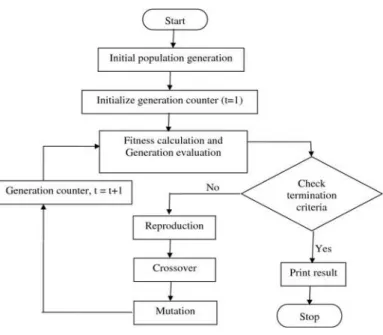
Figure 3 shows the flowchart of the parameter optimizing procedure using GA. For details of genetic operators and each block in the flowchart, one may consult literature [13][14][15].A matlab m-file is developed based on Genetic algorithm with the specifications given in Table III. Optimum values of controller tuning parameters with respect to time are estimated by executing the matlab file.
Fig.3 Flow chart for simulation of GA based PID controller
TABLE III SPECIFICATIONS OF GA Population Size 80 Crossover Rate 0.1 Mutation Rate 0.05 Chromosome Length 10 Precision of Variables 3 Generation Gap 1
IV.SIMULATIONRESULTS
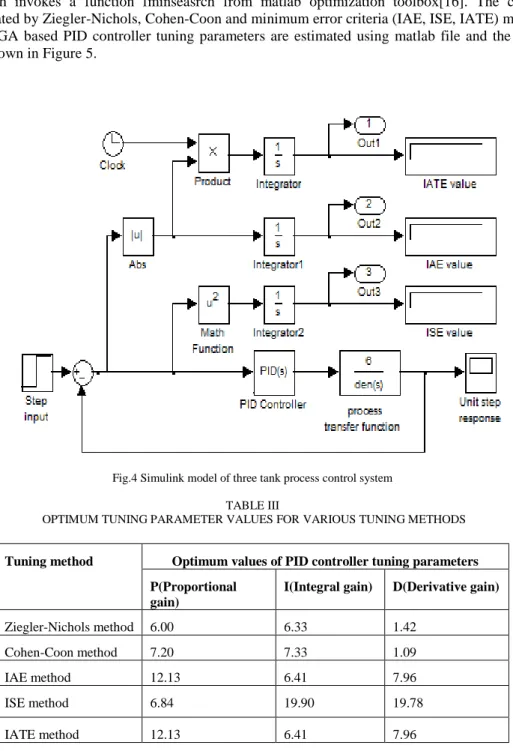
Figure 4 depicts the process model developed in Simulink to simulate the three tank process control system using trial and error method; the optimum tuning parameters of the controller in z-n and c-c methods are estimated from the simulation results of Simulink diagram. In minimum error criteria method(IAE,ISE,ISTE) optimum tuning parameters
Copyright to IJAREEIE www.ijareeie.com 6815 are estimated by declaring tuning parameters(P,I,D ) of controller in Simulink as global variables and executing the matlab file which invokes a function fminseasrch from matlab optimization toolbox[16]. The controller tuning parameters estimated by Ziegler-Nichols, Cohen-Coon and minimum error criteria (IAE, ISE, IATE) methods are listed in table III. The GA based PID controller tuning parameters are estimated using matlab file and the obtained tuning parameters are shown in Figure 5.
Fig.4 Simulink model of three tank process control system
TABLE III
OPTIMUM TUNING PARAMETER VALUES FOR VARIOUS TUNING METHODS
Tuning method Optimum values of PID controller tuning parameters
P(Proportional gain)
I(Integral gain) D(Derivative gain)
Ziegler-Nichols method 6.00 6.33 1.42
Cohen-Coon method 7.20 7.33 1.09
IAE method 12.13 6.41 7.96
ISE method 6.84 19.90 19.78
Copyright to IJAREEIE www.ijareeie.com 6816
Fig.5 Optimum tuning parameters of PID controller using Genetic Algorithm
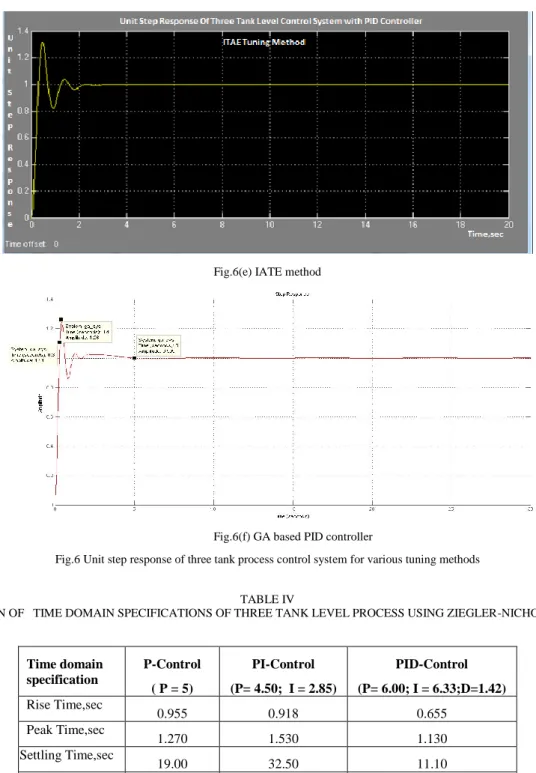
With these tuning parameters Comparison results obtained for P,PI and PID controllers by Ziegler –Nichols and Cohen –Coon methods for the three tank level processes for a unit step change in set point are shown in figures 6(a) and 6(b) respectively and the corresponding time domain specifications are listed in tables IV and V. In both tuning methods, PID controller gave better performance compared to P and PI controllers with reference to settling time, rise time, offset, ISE, IAE and IATE. Compared to Ziegler –Nichols and Cohen-Coon methods PID controller gave better performance in Ziegler-Nichols tuning method. Similarly with optimum tuning parameters the system responses for unit step input for remaining tuning methods are shown in figures 6(c) to 6(f). For comparison purpose the performance indices of three tank level process for unit step input by various PID tuning methods are listed in table VI. The simulation results indicate that unit step response presents better performance using GA based PID tuning method compared to other tuning methods.GA based tuning method gave minimum peak overshoot, minimum settling time and less integral square error.
Copyright to IJAREEIE www.ijareeie.com 6817
Fig.6(b) Cohen and Coon method
Fig.6(c) IAE method
Copyright to IJAREEIE www.ijareeie.com 6818
Fig.6(e) IATE method
Fig.6(f) GA based PID controller
Fig.6 Unit step response of three tank process control system for various tuning methods
TABLE IV
COMPARISON OF TIME DOMAIN SPECIFICATIONS OF THREE TANK LEVEL PROCESS USING ZIEGLER-NICHOLS METHOD
Time domain specification P-Control ( P = 5) PI-Control (P= 4.50; I = 2.85) PID-Control (P= 6.00; I = 6.33;D=1.42) Rise Time,sec 0.955 0.918 0.655 Peak Time,sec 1.270 1.530 1.130 Settling Time,sec 19.00 32.50 11.10 Peak Overshoot 1.263 1.630 1.450 Offset 0.166 0.000 0.000 ITAE 208.8 13.45 1.167 IAE 8.934 2.887 0.939 ISE 1.995 1.144 0.439
Copyright to IJAREEIE www.ijareeie.com 6819
TABLE V
COMPARISON OF TIME DOMAIN SPECIFICATIONS OF THREE TANK LEVEL PROCESS USING COHEN –COON METHOD
Time domain specification P-Control ( P = 5.56) PI-Control (P= 4.79; I = 4.66) PID-Control (P= 7.20; I = 7.33; D=1.09) Rise Time,sec 0.910 0.850 0.625 Peak Time,sec 1.400 1.450 1.100 Settling Time,sec 23.00 200.0 17.50 Peak Overshoot 1.314 1.860 1.635 Offset 0.150 0.000 0.000 ITAE 191.2 271.1 4.663 IAE 8.334 14.57 1.736 ISE 1.818 6.229 0.706 TABLE VI
COMPARISON OF PERFORMANCE INDICES OF THREE TANK LEVEL PROCESS USING PID TUNING METHODS
Time domain Specification Ziegler-Nichols (Z-N) method Cohen-coon (C-C) method
Minimum error criteria method Genetic
Algorithm (GA)
ITAE IAE ISE
Rise Time,sec 0.655 0.625 0.300 2.650 0.180 0.300 Peak Time,sec 1.130 1.100 0.460 4.280 0.282 0.400 Settling Time,sec 11.10 17.50 7.500 19.59 20.50 5.000 Peak Overshoot 1.450 1.635 1.316 1.350 1.428 1.260 Offset 0.000 0.000 0.000 0.000 0.000 0.000 ITAE 1.167 4.663 0.178 0.217 1.533 3.110 IAE 0.939 1.736 0.345 0.337 0.476 1.700 ISE 0.439 0.706 0.165 0.151 0.134 0.050 V.CONCLUSION
Optimum tuning parameters of PID controller are estimated by six tuning methods (Z-N method, C-C method, ISE, IAE, IATE and GA based PID method) for three tank level process for using Matlab/Simulink. Simulated results show that GA based PID controller results in quick response with smaller peak overshoot and integral square error. Moreover, this method has good ability to adapt to the tuning parameters for changes in process dynamics. To summarize, the GA based PID controller has been proved to be an efficient method in the three tank level control process. This method can be also used in a variety of non linear process control systems with large transportation lag processes. This paper will be extend in future to the evolutionary algorithms to determine optimum PID tuning parameters.
REFERENCES
[1] Graebe S.F., Goodwin G.C., “Control Design and Implementation in Continuous Steel Casting”, IEEE Control Systems, August 1995, pp.64-71. [2] Cheung Tak-Fal, LuybenW.L.,”Liquid Level Control in Single Tanks and Cascade of Tanks with Proportional-only and Proportional –
Integral Feedback controllers”,Ind.Eng.Chem.Fundamentals,vol.18, No.1,1979,pp. 15-2.
[3] Astrom, K., T. Hagglund, “PID Controllers; Theory, Design and Tuning”, Instrument Society of America, Research Triangle Park, 1995. [4] S.N.Sivanandam, S.N.Deepa, “Introduction to Genetic Algorithms”, Springer Publications Co., 2010.
[5] J.G.Ziegler and N.B.Nichols, “Optimum settings for automatic controller”, ASME Trans, Vol64, 1942, pp.759-768.
[6] W.K.Ho.C.C.Hang. and J.H.Zhou,”performance and gain and phase margins of well-known PI tuning formulas”, IEEE Transaction. Control
systemsTechnology, 1995.
Copyright to IJAREEIE www.ijareeie.com 6820
[8] A.H.Jones and M.L.Tatnall,”Online frequency domain Identification for Genetic tuning of PI Controllers”, Proceedings of ICSE, Coventry, 1994.
[9] J. G. Ziegler and N. B. Nichols, “Optimum settings for Automatic Controllers”, ASME Transactions, vol. 64, pp. 759–768, 1942. [10] Smith, C.A., A.B. Copripio;”Principles and Practice of Automatic Process Control”, John Wiley & Sons, 1985.
[11] Seborg, D.E., T.F. Edgar, D.A.Mellichamp; “Process Dynamics and Control”, John Wiley & sons, 1989.
[12] S.C.Chapra and R.P.Canale., “Numerical Methods for Engineers”, McGraw-Hill International Edition, New York, 1998.
[13] L.Hao, C. L. Ma and F. Li, “Study of Adaptive PID Controller Based on Single Neuron and Genetic Optimization”, The 8th International Conference on Electronic Measurement and Instruments ICEMI, Vol. 1, 2007, pp. 240-243.
[14] R. Koza, F. H. Bennett, A. David and K. Martin, “A Genetic Programming III: Darwinian Invention and Problem Solving”, Morgan Kaufmann, San Francisco, 1999.
[15] C. R. Reeves, “Using Genetic Algorithms with Small Populations”, Proceedings of the 5th International Con-ference on Genetic Algorithms, 1993.