THE MODERATING ROLE OF GOVERNMENT
SUPPORT ON THE EFFECT OF SME’S INTERNAL
FACTORS ON EXPORT PERFORMANCE
LEE MING HUOY
UNIVERSITI SAINS MALAYSIA
2018
THE MODERATING ROLE OF GOVERNMENT
SUPPORT ON THE EFFECT OF SME’S
INTERNAL FACTORS ON EXPORT
PERFORMANCE
by
LEE MING HUOY
Thesis submitted in fulfilment of the requirement for the degree
Master of Arts
ii
ACKNOWLEDGEMENT
Throughout the journey to complete this report, we found it an incredible experience of a lifetime. Strength and discipline are the most important factors for us and have become fundamental in the completion of the report.
First, we would like to take this opportunity to thank the Malaysian Ministry of Higher Education in supporting this research through the Fundamental Research Grant Scheme (FRGS). With the support of this grant that the research activities were carried out efficiently. At the same time, we would like to thank the Institute of Postgraduate Studies and School of Management from Universiti Sains Malaysia (USM) for allowing Lee Ming Huoy to pursue M.A. (Management) in the same area of this study.
Second, we would like to thank Puan Zarina Ali from Ministry of International Trade and Industry (MITI), Puan Anis Halini Abdul Halim from Malaysian Investment Development Authority (MIDA) and Encik Ali from E-Halal organisation providing valuable input to the report.
Last but not least, thank you to all participates which come from the selected company that participate in the data collection. Support and input given by them are important and valuable.
iii
TABLE OF CONTENTS
ACKNOWLEDGEMENT ii
TABLE OF CONTENTS iii
LIST OF TABLES viii
LIST OF FIGURES ix
ABSTRAK Xii
ABSTRACT xiv
CHAPTER 1 - INTRODUCTION
1.1 Research Background 3
1.1.1 Profile of Key Sector SMEs in Malaysia 6
1.1.2 GDP of Key Sector SMEs in Malaysia 9
1.1.3 The Relationship between Food Processing Industry,
Agriculture Sector and Manufacturing Sector 10
1.1.4 Technology Adoption Level among Malaysia SMEs 15
1.1.5 The Overview of Food Processing SMEs’ Export Market 18
1.2 Problem Statement 21
1.3 Research Question 23
1.4 Research Objective 24
1.5 Significance of Study 25
1.6 Organization of the Thesis 28
1.7 Definition of the term 29
1.7.1 Firm Characteristics 29
1.7.2 Management characteristics 29
1.7.3 Labour Productivity 30
1.7.4 Innovation 30
1.7.5 SME (Small and Medium Enterprise) 31
1.7.6 Government Support 31
1.7.7 1.7.8
Export performance Food Processing Industry
31 32
iv
CHAPTER 2 - LITERATURE REVIEW
2.1 Introduction 34
2.2 Food Processing SMEs in Malaysia 34
2.2.1 General SMEs definition 34
2.2.2 Characteristics of SMEs 37
2.2.3 Development of Food processing SMEs in Malaysia 39
2.3 Export Market for food processing SMEs 46
2.3.1 Export Strategies in food processing SMEs 58
2.4 Export Performance 59
2.4.1 Export Performance - Malaysia Context 59
2.4.2 Export Performance - Eastern Context 63
2.4.3 Export Performance - Western Context 67
2.5 Firm Characteristics 69 2.6 Management Characteristics 74 2.7 Labour Productivity 80 2.8 Innovation 87 2.9 Government Support 96 2.10 Theory Review 103
2.10.1 Internationalization Process Model 103
2.10.2 Resource-based View Theory 109
2.11 Research Gap 111
2.12 Conceptual Framework 113
2.13 Hypotheses Development 116
2.14 Summary of the chapter 123
CHAPTER 3 - RESEARCH METHODOLOGY
3.1 Introduction 124
3.2 Design and Procedure 125
3.3 Population and Sampling 126
3.3.1 Sample Size 128
3.3.2 Respondents 129
v
3.5 Measurement 132
3.5.1 Measurement of Export Performance 132
3.5.2 Measurement of Firm Characteristics 134
3.5.3 Measurement of Management Characteristics 135
3.5.4 Measurement of Labour Productivity 137
3.5.5 Measurement of Innovation 139
3.5.6 Measurement of Government Support 140
3.6 Analysing Measurement Model 142
3.6.1 Statistical Analysis 143
3.6.2 Descriptive Statistics 144
3.6.3 Goodness of Data 144
3.6.4 Exploratory Data Analysis (EDA) 144
3.6.5 Reliability Analysis 145
3.6.6 Test of Differences 146
3.6.7 Bootstrapping 146
3.6.8 Factor Analysis 146
3.6.9 Internal Consistency Reliability 148
3.7 Validity 149
3.7.1 Convergent Validity 150
3.7.2 Discriminant Validity 150
3.7.3 Hypotheses Testing Using Hierarchical Multiple Regression Analysis
151
3.7.4 Tests on Nonresponse Bias 151
3.8 Analysing the Structural Model 152
3.9 Pre-test 153
3.10 Pilot Test 154
3.11 Control Variable 157
vi
CHAPTER 4 - ANALYSIS AND FINDING
4.1 Introduction 159
4.2 Response rate 159
4.3 Demographics analysis 161
4.4 Common Method Bias 166
4.5 Goodness of Measurement 167 4.5.1 Construct Validity 167 4.5.2 Convergent Validity 168 4.5.3 Discriminant Validity 169 4.6 Structural Model 173 4.6.1 Direct Effect 173
4.6.2 Testing Moderation Analysis 176
4.7 Hypothesis Summary 181
4.8 Summary of the chapter 182
CHAPTER 5 - DISCUSSION & CONCLUSION
5.1 Introduction 183
5.2 Recapitulation of the Study Findings 183
5.3 Discussion 186
5.3.1 Relationship firm characteristics and export performance among food processing SMEs
186
5.3.2 Relationship of management characteristics and export performance for food processing SMEs
188
5.3.3 Relationship of labour productivity and export performance for food processing SMEs
191
5.3.4 Relationship of innovation and export performance for food processing SMEs
193
5.3.5 The moderating effect of government support on the relationship between management characteristics and export performance for food processing SMEs
195
5.3.6 The moderating effect of government support on the relationship between labour productivity and export
vii
performance for food processing SMEs
5.3.7
The moderating effect of government support on the relationship between innovation and export performance for food processing SMEs
201
5.3.8
The moderating effect of government support on the relationship between firm characteristics and export performance for food processing SMEs
203
5.4 Theoretical Contribution 204
5.5 Practical Implications 206
5.6 Limitations 208
5.7 Direction for Future Studies 210
5.8 Summary and Conclusion 212
REFERENCES 215
viii
LIST OF TABLES
Page
Table 1.1 Total Establishment and number of SMEs by sector in Malaysia
7
Table 1.2 Distribution of Total Employment by Size and Sector 7 Table 1.3 GDP of Economic Activity at Constant 2010 prices in
Percentages
8
Table 1.4 The Real GDP by Key Economic Activity 9
Table 1.5 SME GDP share by Key Economic Activity (constant 2010 prices)
10
Table 1.6 Distribution of SMEs in Agriculture Sector by Sub-Sector and Size
12
Table 1.7 Distribution of SMEs in Manufacturing Sector by Sub-Sector and Size
13
Table 1.8 Total export & import value (year 2011-2016) 19
Table 2.1 Major Export Products (the year 2015-2016) 44
Table 2.2 Major Import Products (the year 2015-2016) 45
Table 3.1 The Criteria of Food Processing Companies 127
Table 3.2 Selected Respondents based on states 129
Table 3.3 The outcome of First Pilot Test (25 Samples) 156
Table 3.4 The outcome of Second Pilot Test (40 Samples) 157
Table 4.1 Summary of total submission and total responses 160
ix
Table 4.3 Company Profile 163
Table 4.4 Summary of variables Reliability, Convergent Validity and Discriminant Validity
168
Table 4.5 Heterotrait-monotrait (HTMT) correlations 171
Table 4.6 Fornell & Larcker Test 171
Table 4.7 Direct Effect 174
Table 4.8 Moderating Variable Hypothesis Test 177
Table 4.9 Predictive Relevance 180
Table 4.10 Summary of Hypothesis Result 181
x
LIST OF FIGURES
Page
Figure 1.1 The constraint in SMEs Exporting 6
Figure 1.2 SME Value-added Growth of Sub-sectors in the Manufacturing Sector
14
Figure 1.3 The components of value-added of SMEs in Manufacturing Sector (%)
15
Figure 1.4 The Information and Communications Technology Adoption among SMEs in the Year 2014 and 2016
16
Figure 2.1 The New SME Definition Bases on Size & Sales Turnover
36
Figure 2.2 The target of Malaysian SMEs in economic contribution from Masterplan by comparing the achievement in the year 2014
43
Figure 2.3 The failure rate of Export Survival throughout the time 53
Figure 2.4 The Survival of SMEs in the Export Market 60
Figure 2.5 Element under firm, management characteristics and export marketing strategies towards export performance.
61
Figure 2.6 Imposing a geographical perspective on the three-stage 65 Figure 2.7 Conceptual Framework shows Firm Characteristics
relationship between Export Barriers
69
Figure 2.8 Element under firm’s characteristics towards export performance
70
Figure 2.9 Research Model of The Mediating Factors towards the relationship of Born Global Behaviours and International Performance
xi
Figure 2.10 Growth for SME GDP, SME Employment and SME Productivity, %
85
Figure 2.11 The productivity of Firms by Size 86
Figure 2.12 A conceptual framework of food Processing Industry's export performance factors
115
Figure 4.1 PLS Measurement Model of the Study 172
Figure 4.2 Structural model of the study 175
Figure 4.3 Interaction Effect between Management Characteristics and Export Performance
178
Figure 4.4 The interaction effect between productivity and export performance
xii
KESAN MODERATOR PERANAN SOKONGAN KERAJAAN PADA
KESAN FAKTOR DALAMAN PKS TERHADAP PRESTASI EKSPORT
ABSTRAK
Industri pemprosesan makanan dianggap sebagai perniagaan yang menambah nilai dalam ekonomi Malaysia. Penyelidikan ini menyediakan rangka kerja teoritis yang baru, untuk menerangkan hubungan antara ciri-ciri firma, ciri-ciri pengurusan, produktiviti buruh, inovasi dan kesan moderator sokongan kerajaan pada prestasi eksport PKS (Perusahaan Kecil and Sederhana) pemprosesan makanan di Malaysia. Dengan konsep baru ini, ia dapat membantu firma menentukan faktor kejayaan dalam prestasi exsport dan keberkesanan sokongan kerajaan terhadap PKS pemprosesan makanan. Hasilnya, prestasi eksport PKS pemprosesan makanan menunjukkan hubungan positif yang signifikan dalam ciri-ciri firma, ciri-ciri-ciri-ciri pengurusan, produktiviti buruh dan inovasi. Sokongan kerajaan sebagai kesan moderator, telah menunjukkan hubungan positif antara ciri-ciri pengurusan, produktiviti buruh dan prestasi eksport. Sokongan kerajaan memberi kesan penting dalam mengukuhkan hubungan secara positif, antara prestasi eksport PKS pemprosesan makanan dengan ciri-ciri pengurusan dan produktiviti buruh. Sokongan kerajaan melalui agensi kerajaan, telah menyediakan platform dan sumber yang mencukupi untuk memperluaskan rangkaian, kemahiran pengurusan dan kemahiran buruh. Hasil kajian juga menunjukkan sokongan kerajaan tidak memberikan pengaruh yang positif dalam ciri-ciri firma dan inovasi terhadap prestasi eksport. Tumpuan kerajaan terhadap kaedah dan usaha dalam meningkatkan ciri-ciri perusahaan dan inovasi perlu dipertingkatkan. Model
xiii
penyelidikan ini diuji dengan menggunakan teknik Partial Least Squared (PLS). Kaedah kuantitatif dipilih untuk melaksanakan kajian ini.
xiv
THE MODERATING ROLE OF GOVERNMENT SUPPORT ON THE EFFECT OF SME’S INTERNAL FACTORS ON EXPORT
PERFORMANCE
ABSTRACT
Food processing industry is considered as a value-added business to the Malaysian economy. This research address theoretical framework to describe the relationship between firm characteristics, management characteristics, labour productivity, innovation and moderating effect of government support for food processing SMEs export performance. The new conceptual framework, its help firms to determine the factors that contribute to the success in export performance and effectiveness of government support to food processing SMEs. Results indicate that food processing firms' export performance positively related to firm characteristics, management characteristic, labour productivity and innovation. With the moderating effect of government support, shows a significant positive relationship between management characteristic and labour productivity towards export performance. Government support is important to the strengthen food processing SMEs’ export performance, by helping to improve the firms’ management characteristics and labour productivity. The government support performs by government agencies create a platform and provide sufficient source to expand networking, management skills and labour skills. Hypothesis result shows government support not having a positive moderating effect on firm characteristics and innovation towards export performance, therefore effort from the government in providing effective support to firm characteristic and innovation is required. The
xv
research model is tested using the Partial Least Squared (PLS) technique. The quantitative method was employed in completing this thesis.
1
CHAPTER 1
INTRODUCTION
Food is one of the most important necessities for human survival and sustainability. Without sufficient food resources, human will face a food crisis. In future, food processing and farming industries are foreseen to be one of the world most important industries (Texas A&M AgriLife Communications, 2014) and also considered as emerging sector across the world (Durga & Tribuhuvan, 2015). Malaysia is a country which is rich in natural resources, with a tropical climate and free from major natural calamity. These factors have given Malaysia an advantage in the grow of agricultural activities. The food processing industry is one of the mainstream businesses for Malaysian SMEs (Hussain & Idris, 2010). Agri-products are the main source of raw materials and the backbone for the food processing industry.
Food processing industry can be divided into two categories. The first category is the primary processes food which directly consumes argi-product to create a brand new product; example sugarcane to sugar, packed milk, flour and rice (Durga & Tribuhuvan, 2015; Tell et al., 2016). Second, the value-added processed food which consumed primary processed food products such as flour, cereal, rice and others to produce brand new food products, commonly known as food processing industry, which producing tin food, snacks, candy, noodles and others (Durga & Tribuhuvan, 2015).
2
The demands for foods supply keep increasing to sustain food security (Elferink & Schierhorn, 2016), for certain countries importing food supply is the only way to ensure the stability of food security. This opens up a great opportunity for food exporter. Harvested crops, livestock or fisheries will easily rot or spoil in a short period of time. Raw material cannot be stored long-term without being processed. Unpredictable natural disasters, such as major flood will cause massive destruction of crops and livestock. Food security highlighted the importance of the food processing company, as the processing of the processed food is able to extend the lifespan of the food. By extending the food lifespan, massive waste of crops and livestock could be avoided. Exporting processed food to another country will not prevent a shortage of certain food product, but it can also increase the value when an oversupply from a bumper harvest can be maximised.
Sustaining and increasing export performance can help to reduce the country’s reliance on import food and improve food security. Currently, Malaysia still highly dependent on imported food. Improving the food processing firms’ export performance will help to increase the supply of finished goods, which will subsequently reduce the reliance on imported food and it will have positive economic effects. Increasing the capability of Malaysian food processing SMEs is a way to encourage the growth of Malaysian economy. The scope of this study comes with a framework that explores the factors which contribute toward the growth and performance of the export market for Malaysian food processing SMEs.
3 1.1 Research Background
The government has set a high expectation to achieve a high-income nation status. Hence, the Malaysian economy needs to achieve a higher level of growth to meet expectation. SME is the key sector that is able to contribute to the economic growth and the food processing SMEs have opportunities to perform better (Ahmed, 2012). There was about 5% growth in the year 2015 supported by a strong domestic demand, particularly private consumptions and the investment activities still have the space to improve; this is compared to the year 2014 where Malaysia experienced 6% of growth (Malaysia SME Corp, 2015, 2016). The decreased demands from the export market showed a negative impact on the net export value and soft grow on the Gross Domestic Product (GDP). In the year 2016, Malaysia was expected to generate a moderate growth of 4.0 - 4.5%, sustained by domestic (Malaysia SME Corp, 2016). In April 2017, MATRADE has reported that export contribution of SMEs still low currently, SMEs contribute nearly 17.8% of overall total Malaysia export value. MATRADE setting target to raise the export contribution to 23% in the year 2020 (MATRADE, 2017), SMEs is crucial for Malaysian economy as Malaysian SMEs contribute to nearly 36% of Malaysia's Gross Domestic Products (GDP) and 65% of country's employment.
A slow growth and low export contribution indicator for SMEs’ nett export value has initiated the move to define the moderating factor that strengthens the positive impact on independent variables and SMEs’ export performance growth. In
4
the year 2016, SMEs contribute 18.6% from the overall export value, manufacturing sector contributes 8.8% and agriculture sector contribute 0.3%. The moderating factor is the factor that directly affects the strength of the relationship between the independent variables and the firm’s export performance (Baron & Kenny, 1986). The pattern of food processing SMEs’ growth in the foreign market remains unclear and is currently being discovered.
Internal and external environment trend incessantly changes and currency fluctuated significantly from the year 2015 to the 1st quarter of the year 2016. Furthermore, with the implementation of the Goods and Services Tax (GST), caused more ambiguous circumstances. GST in fact, able to strengthen the fiscal position while it ensured continues support for domestic growth and protecting the well-being of society. In the new era, SMEs face challenges from internal and external factors to survive and adapt to the new setting and policies. By observing and analysing firm’s reactions and decisions in overcoming these changes, it will help us understand the growth pattern of a company. This research generates new ideas to a conceptual framework, which helps improve on SMEs’ growth in the export market for long term.
The annual report of Malaysia SME 2015/16 indicated that government has implemented few policies and allocated funds to assist Malaysian SMEs. Each budget allocated by the government to assist SMEs were aimed at improving the SMEs’ position in the export market (Malaysia SME Corp, 2015, 2016). For example, the
5
government provided technical knowledge training to improve labour productivity for SMEs. The expansion of the broadband capacity for the SMEs was also another gain for the companies, especially for online businesses. The acceleration of the development of entrepreneurship helped the SMEs to become more competitive in order to survive in the export market (Economic Planning Unit, 2015).
According to past research and existing statistics, the food industry is one of the important socioeconomic in Malaysia. Food processing sector contributes major portion among SMEs. Processed food products are exported to more than 80 countries, with an annual export value of approximately US$1.7 billion in the year 2010, contribute two-thirds of the total Malaysian food exports (Syed, Mohd Fauzi, Zizah, & Ahmad Khairy, 2011). Past research related to food processing SMEs’ found that this industry facing the barrier of growth from internal and external factors, however as summary financial and managerial resource are the key factors that created barriers for food processing to growth in term of export and overall performance.
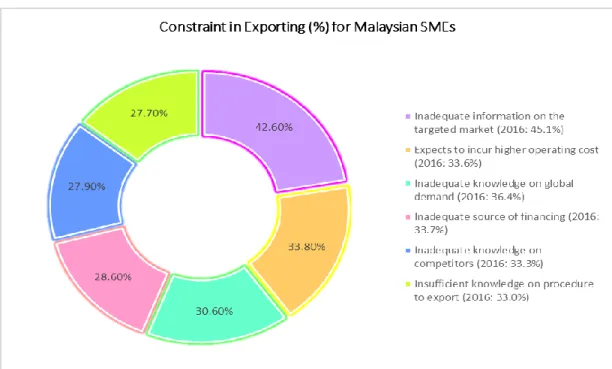
SME Corp report year 2016/17 conducted a survey of all registered SMEs under SME Corp to understand the constraints of SMEs in export activities. Figure 1.1, illustrates 42.6% of SMEs responded they are facing inadequate information on the targeted market. There are 33.8% of SMEs responded they experience higher operating cost. Follow by 30.6% of SMEs facing inadequate knowledge on global demand, 28.6% insufficient financial resources, 27.9% lacking information of
6
competitors and 27.7% of SMEs facing insufficient knowledge on the export procedure.
Figure 1.1: Constraint in SMEs Exporting (%)
Source: SME Corp. Malaysia Annual Report, 2017 (Q1 2017 SME Survey)
1.1.1 Profile of Key Sector SMEs in Malaysia
Table 1.1, below illustrates the total establishment of SMEs by sectors. The services sector is the largest number of SMEs establishment, followed by the manufacturing sector and agricultural sector. The services sector SMEs contribute 90% of the total number of SMEs, manufacturing sector owned 5.9%, and agricultural sector only owned 1.0%. Table 1.2 shows, the terms of total employment, manufacturing sector contributes most employment opportunities for local because with 5.9% of SMEs in the manufacturing sector has contributed 19.1% of employment (Malaysia SME Corp, 2015),
7
Table 1.1: Total Establishment and number of SMEs by sector in Malaysia
Source: Department of Statistics, Malaysia and SME Corp. Malaysia Annual Report 2016
Table 1.2: Distribution of Total Employment by Size and Sector
Sector Micro Small Medium Total
Employment Percentage of total Employment by sector Services 1,219,801 1,002,186 388,386 2,610,373 71.2% Manufacturing 67,891 360,299 270,522 698,713 19.0% Agriculture 13,718 24,864 40,195 78,777 2.1% Mining & Quarrying 274 1,454 4,037 5,765 0.2% Construction 65,153 89,277 121,201 275,631 7.5% Overall Status 1,366,838 1,478,080 824,341 3,669,259 100%
Source: Department of Statistics, Malaysia and SME Corp. Malaysia Annual Report 2016 Sector Total Establishments (a) Total SMEs (b) Percentage (%) of SMEs over Total
Establishments (b)/(a)*100 Percentage of total SMEs by sector Services 591,883 580,985 98.1 90.0% Manufacturing 39,669 37,861 95.4 5.9% Agriculture 8,829 6,708 76.0 1.0% Mining & Quarrying 418 299 71.5 0.1% Construction 22,140 19,283 87.1 3% Overall Total 662,939 645,136 97.3 100%
8
Table 1.3: GDP of Economic Activity at Constant 2010 prices in Percentages share
Source: Department of Statistics, under “Selected Agricultural Indicators 2015”
Table 1.3 illustrates that the service sector is one of the major contributors to economic growth, followed by manufacturing, agriculture and construction. Manufacturing and construction are sectors that resulted from the continuing growth and expansion. The agriculture sector is the third contributor in terms of total GDP, but the increment of the growth rate in agriculture remains low. In the year 2015, the rank of agriculture GDP slightly dropped and causing it to be the fourth major contributor economic sector within Malaysian SME.
The data shows in the Annual report of Malaysian SMEs 2015/16, the main contributor of GDP, services sectors that owned the share of 53.5% from the total GDP of SMEs in Malaysia (Malaysia SME Corp, 2015). Followed by the manufacturing sector which contributes 23% and 8.9% for the agriculture sector in term of total GDP. But as refer to the total number of SMEs in table 1.1, services sector owned the most number of firms, 90% of total number Malaysian SMEs involved in the services sector, and only 5.9% of SMEs are the manufacturer. This
Percentages Share to GDP by year
2010 2011 2012 2013 2014 2015
Services 51.2 52.0 52.5 53.2 53.5 53.5
Manufacturing 23.4 23.5 23.2 22.9 23.0 23.0
Agriculture 10.1 10.2 9.8 9.5 9.2 8.9
Construction 3.4 3.4 3.8 4.0 4.3 4.4
Mining & Quarrying 10.9 9.9 9.5 9.2 9.0 9.0
Plus: import duties 0.9 1.0 1.1 1.1 1.1 1.3
9
shown that manufacturing sector able to bring greater growth on Malaysian GDP and manufacturing sector much active in the export market as compare to other sectors (Malaysia SME Corp, 2015).
1.1.2 GDP of Key Sector SMEs in Malaysia
As the result reflect on table 1.4, construction contributing the more change and increase as compared to other sectors. Except for Agriculture, all sectors also show a significant growth over the first half of 2016. Overall all sectors are able to achieve the target of 4.0-4.5% of growth (Malaysia SME Corp, 2015). The growth for agricultural sector for the year 2016 is -6.0% of GDP growth as compared to the year 2015. Table 1.5 illustrates the growth of GDP share within the year 2010 and 2015 is 0.0%. The statistical data has proven that the agriculture sector is not performing well in comparison to other sections.
Table 1.4: The Real GDP by Key Economic Activity
Annual Growth (%)
2014 2015 1H 2016p 2016f
Agriculture 2.1 1.2 -6.0 -0.3
Mining & quarrying 3.5 4.7 1.4 3.5
Manufacturing 6.2 4.9 4.3 4.1
Construction 11.7 8.2 8.4 7.9
Services 6.6 5.1 5.4 4.4
Real GDP 6.0 5..0 4.1 4.0~4.5
p: preliminary / f: forecast based on BNM Annual Report 2015
Source: Department of Statistics, Malaysia & SME Corp. Malaysia Annual Report, 2016
10
Table 1.5: SME GDP share by Key Economic Activity (constant 2010 prices)
SME Contribution to GDP SME GDP
Growth 2010 (% share) 2015 (% share) Increase/decre ase in share CAGR1 2011-2014 Overall 32.2 36.3 +4.1 6.7 Agriculture 4.3 4.3 0.0 2.9 Services 19.6 21.4 +1.8 7.1
Mining & quarrying 0.0 0.2 +0.15 9.3
Construction 0.9 2.1 +1.2 10.9
Manufacturing 7.2 7.9 +0.7 6.7
Source: Department of Statistics, Malaysia & SME Corp. Malaysia Annual Report, 2016
1.1.3 The Relationship between Food Processing Industry, Agriculture Sector
and Manufacturing Sector
The growth of the agriculture sector is decreasing, but the agriculture sector is still one of the major contributors to the food processing industry. The agriculture sector feeds one of the most valuable industries in the manufacturing sector, which is the food processing industry. Hence, the decline of the agriculture sector will not bring a positive effect to the food processing industry, and it will be the same if the situation is reversed. Bearing in mind the close connection between the agriculture sector and the food industry, conducting this research to find possible solutions to increase the productivity of the food processing industry will have a direct impact on the growth of the agriculture sector.
It can be deduced from table 1.4 to table 1.5 that even though the agriculture sector does not perform outstanding with a zero percent growth rate, the agriculture
11
sector is still the third major contributors in term of Malaysia’s GDP. According to (Seung-Yong, 2010), the agriculture sector feeds the manufacturing sector, especially the food and beverage industry because there are linkages between the food processing industry and agriculture sector. Focusing on the food processing industry will eventually help the agriculture sector to grow in parallel.
The growth of the food processing industry will positively influence the growth of the agriculture sector. (Murthy & Dasaraju, 2012) also, agree that the food processing company is an industry that is interrelated with agriculture and manufacturing sector. The food processing company can be categorized under rice milling, sugar, canned food and various other types of food processing. Essentially, the food processing companies are companies that consume raw agriculture material and processed them into new food products (Murthy & Dasaraju, 2012).
Various developed countries have highlighted the hidden risk of reflectance in developing the agriculture sector (Omidvar, 2006). Malaysia should also be aware since it has yet to achieve encouraging development in the agriculture sector. Table 1.1 shows only 1.0% of the SMEs in Malaysia are involved in the agriculture sector. Table 1.6 illustrates that the distribution of SMEs in the agriculture sector according to sizes and sub-sectors; agriculture can be divided into four main sub-sectors such as crops, livestock, fisheries and forestry. Table 1.7 shows that most of these SMEs are small or macro size firms. Microenterprises are small in scale, not well established, and not capable enough to increase innovation, productivity and financial investment,
12
and 78.6% of the micro-enterprises in the manufacturing sector are reported to face an increase in the operation cost (Malaysia SME Corp, 2016).
Table 1.6: Distribution of SMEs in Agriculture Sector by Sub-Sector and Size
Source: Department of Statistics, Malaysia & SME Corp. Malaysia Annual Report, 2016
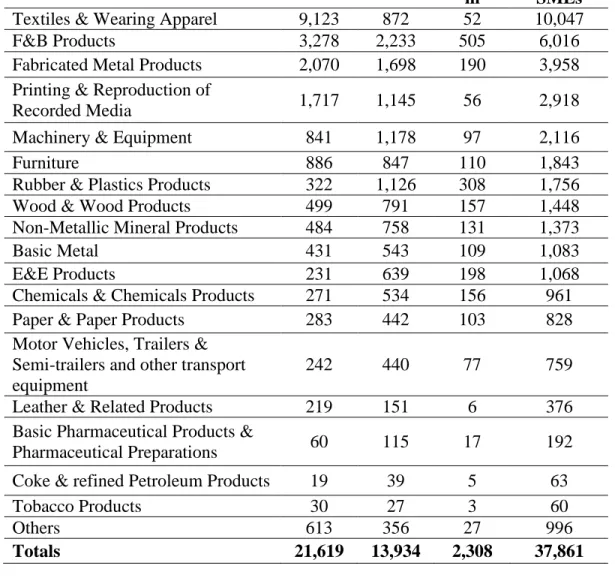
In table 1.7 illustrates, the total number of SMEs in the manufacturing sector. The food and beverage product is a sub-sector under the manufacturing sector and the second highest in terms of the total number of SMEs among all sub-sectors. A total number of 6,016 SMEs or 15.9% are from the food and beverage industry. The majority of the firms are micro and small-sized firms. The financial investment for development and innovation is believed to be slightly low and indirectly causing low productivity and managerial capabilities. The total number of SMEs under agriculture (6,708 SMEs) and manufacturing sub-sector; F&B products (6,016 SMEs) are nearly equal, but the contribution in terms of GDP, employment opportunities and export volume are different.
Sub Sector Micro Small Medium Total SMEs
Crops 2,678 1,413 634 4,725
Livestock 613 179 108 900
Fisheries 452 261 68 781
Forestry and Logging 32 88 182 302
13
Table 1.7: Distribution of SMEs in Manufacturing Sector by Sub-Sector and Size
Source: Department of Statistics, Malaysia & SME Corp. Malaysia Annual Report, 2016
The food and beverage industry is one of the most value added industry within the manufacturing sector. It contributes 16% from total manufacturing SMEs, but the annual growth percentage for the food and beverage industry is decreasing compared to the year 2014.
Sub Sector Micro Small Mediu
m
Total SMEs
Textiles & Wearing Apparel 9,123 872 52 10,047
F&B Products 3,278 2,233 505 6,016
Fabricated Metal Products 2,070 1,698 190 3,958
Printing & Reproduction of
Recorded Media 1,717 1,145 56 2,918
Machinery & Equipment 841 1,178 97 2,116
Furniture 886 847 110 1,843
Rubber & Plastics Products 322 1,126 308 1,756
Wood & Wood Products 499 791 157 1,448
Non-Metallic Mineral Products 484 758 131 1,373
Basic Metal 431 543 109 1,083
E&E Products 231 639 198 1,068
Chemicals & Chemicals Products 271 534 156 961
Paper & Paper Products 283 442 103 828
Motor Vehicles, Trailers & Semi-trailers and other transport equipment
242 440 77 759
Leather & Related Products 219 151 6 376
Basic Pharmaceutical Products &
Pharmaceutical Preparations 60 115 17 192
Coke & refined Petroleum Products 19 39 5 63
Tobacco Products 30 27 3 60
Others 613 356 27 996
14
Figure 1.2: SME Value-added Growth of Sub-sectors in the Manufacturing Sector Source: Department of Statistics, Malaysia & SME Corp. Malaysia Annual Report, 2016
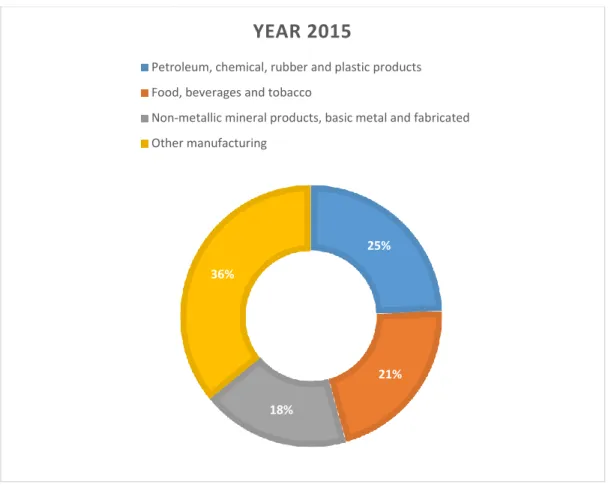
As illustrates in figure 1.2, the growth of food, beverages and tobacco sub-sectors showing a drop of annual growth as compared to the year 2014. The annual growth percentages as compare with other sub-sectors are the lowest with a 2.2% annual growth in the year 2015, also the lowest annual growth as compare to the previous year. Figure 1.3 shown food, beverage and tobacco are one of the value-added SME in the manufacturing sector.
0 2 4 6 8 10 12 14 2011 2012 2013 2014 2015 An n u al G ro w th % Year
Petroleum, chemical, rubber and plastic products Food, beverages and tobacco
Non-metallic mineral products, basic metal and fabricated Other manufacturing
15
Figure 1.3: The components of value-added of SMEs in Manufacturing Sector (%) Source: Department of Statistics, Malaysia & SME Corp. Malaysia Annual Report, 2016
1.1.4 Technology Adoption Level among Malaysia SMEs
The usage of internet technology among SMEs in the business operation is increased as compared to the year 2014. As for now, nearly 98% of SMEs are using the computer in their daily operation, 90.1% of SMEs using the internet as well and 78.2% of SMEs using social media as a platform to promote their company (refer figure 1.4). This means that SMEs in Malaysia start to accept and transform to modern business operation method. Increasing adoption of Information and Communications Technology helps SMEs to be innovation and reach resources.
25%
21% 18%
36%
YEAR 2015
Petroleum, chemical, rubber and plastic products Food, beverages and tobacco
Non-metallic mineral products, basic metal and fabricated Other manufacturing
16
Figure 1.4: The Information and Communications Technology Adoption among SMEs in the Year 2014 and 2016
Source: Department of Statistics, Malaysia & SME Corp. Malaysia Annual Report, 2016
Entrepreneurs have been experiencing a metamorphosis as the assumptions underlying the theory of entrepreneurship is challenged by the wake of the global economic meltdown (Chelliah, Lee, & Sulaiman, 2014). As the competition between the firms is getting tougher in the global market; internationalisation no longer a privilege for a strong capital company because a new and freshly setup company may be able to share a piece of the global market, especially ventures that fully utilise science, technology and engineering to exploit global market niches. However such firms are rarely from the agriculture sector. Innovation, capabilities and competitiveness in the agricultural food processing industries are still not showing enough maturity. Improvement and enhancement of Malaysian SMEs especially in
98.5 90.1 78.2 32.3 30.9 14.3 4.2 92.6 33.3 12.1 7.1 11.4 6.5 2.3 0 20 40 60 80 100 120
Computer / laptop / smartphone Internet service Social media E-commerce and e-payment Official company webpage Intranet Extranet
17
food processing need further research, to enable SME to be competitive and successful in the global market.
Development of new technology has inspired innovations in all sectors, including modern agriculture, in Asian countries such as Vietnam, China, India, Singapore and Malaysia (Harvie, 2004). In Finland, about 1,900 food companies are micro and small firms, and 15% of the micro and small size firms have a high innovation rate, and they are involved in export activities. They also form the fourth biggest industry in Finland (Hyrylä, 2010).
In the 21st century, the challenges for international business firms have increased significantly. Traditionally, the study of internationalisation had focused on large, well-established firms. However, after globalization and increased internet access, the barriers to trade had significantly reduced, and the networking between global firms had strengthened. These benefits generated a new dynamic economy world and rapid growth in international new ventures was witnessed (Bughin et al., 2011). Technology is always a field that garners interests from researchers all around the world, but agriculture and food processing field may not be as fascinating as the field of technology (Tell et al., 2016). More focus and attention should be provided to the Malaysian food processing SMEs that are willing to step into the global market as this may result in higher global market penetration and increased export sales.
18
Most impetus has been derived from the growing acceptance of the notion that entrepreneurs are able to rejuvenate organisations, spurs the expansion of business, creates new employment potential and fuels economic growth of a nation. The main challenge for the internationalisation of SMEs is mainly due to cost (Chelliah, Mohamed, & Yusliza, 2010; Johanson & Vahlne, 1977).
1.1.5 The Overview of Food Processing SMEs’ Export Market
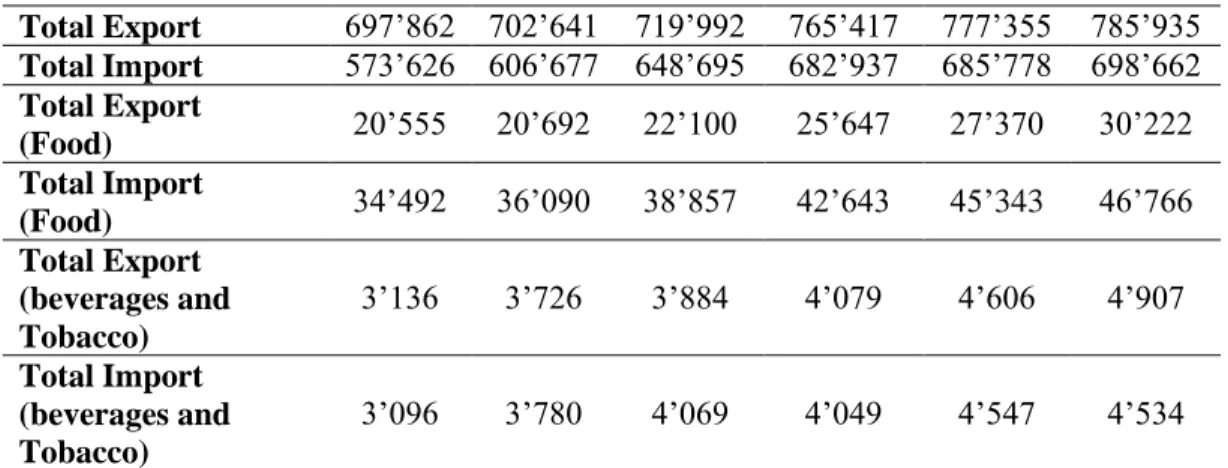
The export growth of SMEs is increasing as illustrated in table 1.8, suggesting that there is an increasing number of SMEs that are moving to internationalisation. However, the GDP contributed by the agriculture sector has reduced each year. The number of SMEs keep on growing in Malaysia, the number of high-tech products have also increased in the competitive market, which means Malaysia is showing positive economic development (Malaysia SME Corp, 2015). Skills and high technologies are able to reflect how well a country performs in developing innovation. Malaysian companies are establishing and involve slowly in the global market, this result from the increasing number of firms currently involved in the foreign market (Nik Abdullah & Mohd Zain, 2011).
Table 1.8 illustrates the export and import value for food manufacturing industry and overall SMEs across the year 2011 to 2016. In the data provided clearly stated that food manufacturing industry is facing an increasing number of export value where the export value but did not show significant increases across the year.
19
This also shows that the demand from the export market over our food processing industry still high. Therefore food processing industry can be considered as one of the potential industry that contributes to export performance and able to reduce import dependency.
Table 1.8: Total export & import value (year 2011-2016)
Export & Import Value (RM Million)
2011 2012 2013 2014 2015 2016 Total Export 697’862 702’641 719’992 765’417 777’355 785’935 Total Import 573’626 606’677 648’695 682’937 685’778 698’662 Total Export (Food) 20’555 20’692 22’100 25’647 27’370 30’222 Total Import (Food) 34’492 36’090 38’857 42’643 45’343 46’766 Total Export (beverages and Tobacco) 3’136 3’726 3’884 4’079 4’606 4’907 Total Import (beverages and Tobacco) 3’096 3’780 4’069 4’049 4’547 4’534 Percentage of Food, beverages and Tobacco from total export
3.39% 3.48% 3.61% 3.88% 4.11% 4.47%
Source: Ministry of Agriculture and Agro-based Industries (MOA), 2011-2016
Food as the daily need for human life, without a proper manage or arrangement, will create a crisis in future. As human populations are growing, shortage of food may soon come into concern. Agriculture development and food process technology have served as a long-term solution for food shortages (Texas A&M AgriLife Communications, 2014).
20
Agriculture product in Malaysia, such as palm oil and rubber used to be the major export material. However, in recent years, the competitiveness of the global market meant that there was no longer the case. Despite that agriculture, still, has potential to bring a more significant growth in the GDP. To gain back the local entrepreneurs' interest to participate in the agriculture sector, the government has implemented the 21st-century villages, by improving the living standards of farmers and introducing new farming technology (Economic Planning Unit, 2015). The results from the government’s effort still in progress, with the hope that the efforts could bring out immense change for the agriculture sector (Tell et al., 2016), by improving the growth of the food processing industry. This will positively impact the agriculture sector. As for the past research also found food processing SMEs will encounter issues from internal and external factors, availability tangible and intangible resources, organizational and managerial factors, which affect the growth and development of food processing SMEs (Syed et al., 2011).
21 1.2 Problem Statement
Manufacturing sector contributes 23% from total GDP one of the highest GDP in Malaysia and agriculture sector contributes 8.9% in terms of the total GDP (Malaysia SME Corp, 2015). The food processing industry has the potential to grow in the export market, but with the average growth of 0.22%, with the low export performance might not able to achieve MATRADE target for SMEs to contribute nearly 17.8% of overall total Malaysia export value. The lack of specific food security policy in Malaysia highlights the importance of the food processing companies (Alam, Siwar, Murad, & Toriman, 2011), which indirectly helps the country in maintaining sufficient food stock. Inconsistent supply of raw agriculture material is affecting the inventory management of food processing companies, lack of skilled and capable employees with low technological processing are also problematic (Ahmed, 2012).
From the year 2010 - 2014, the agriculture sector is the third main contributor in term of GDP, proving the importance of agriculture sector. The agriculture sector is proven with a slow trend of changes within the year 2013 – 2014 having 0% of growth. The food processing export trend is also showing poor growth. The agriculture sector is feeding food processing industry and the declining growth of agriculture sector in term of export value and GDP, will actually giving impact towards food processing companies.
22
The food industry is one of the key value-added component industry in manufacturing sector among SMEs where it contributes 21.3% of total number of SMEs in the manufacturing sector. The decrease of annual growth in export of food products might cause further decline of the current position of food industry performance.
Low control on the numbers of harvest crops and livestock due to unpredictable weather, require a higher level of control and management in material inventory by food processing companies. The managerial skill and employment knowledge in handling healthy supply chain among food processing companies is critical (Alam et al., 2011; Texas A&M AgriLife Communications, 2014).
Creating a workable model for the food processing industry will directly resolve the reason for the declining growth in the agricultural sector. As food processing industry is a part of the agriculture sector, even though it is difficult to distinguish it from the manufacturing sector. The better performance of the food processing industry will result in better growth in agriculture. Export performance improvement can be determined by food processing SMEs' internal factors. Internal factors can be categories into firm characteristics, management characteristics, labour productivity and innovation. To examine the relationship between internal factors and export performance, this study would like to further investigate the relationship of government support as moderator factor in the firm's export performance.
23 1.3 Research Question
Based on the fundamental ideas behind this study, together with the
background of the study and problem statement, five research questions have been identified:
1. Do firm characteristics have a positive relationship with the export performance of the food processing SMEs?
2. Do management characteristics have a positive relationship with the export performance of the food processing SMEs?
3. Does innovation have a positive relationship with the export performance of the food processing SMEs?
4. Does labour productivity have a positive relationship with the export performance of the food processing SMEs?
5. Does government support moderate the relationship between the firm’s
characteristics, management characteristics, productivity, innovation and export performance of the food processing SMEs?
24 1.4 Research Objective
The objective of this research is to investigate factors that contribute to the food processing companies’ export performance. To obtain the result, variables linked to the effects will be measured.
The research objectives of this study will be as follows:
1. To determine the relationship between firm characteristics and export performance among food processing SMEs.
2. To determine the relationship between the management characteristics and export performance of the food processing SMEs.
3. To determine the relationship between innovation and export performance of the food processing SMEs.
4. To determine the relationship between labour productivity and export performance of the food processing SMEs.
5. To investigate the moderating effect of government support on the relationship between the firm characteristics, management characteristics, productivity and innovation on the export performance of the food processing SMEs.