A Study on Computational Formal Verication
for Practical Cryptographic Protocol: The Case
of Synchronous RFID Authentication
Yoshikazu HanataniI1,2, Miyako Ohkubo3, Sin'ichiro Matsuo3, KazuoSakiyama2, and Kazuo Ohta2
1 Toshiba Corporation,Chofugaoka Komukai Toshiba-cho 1, Saiwai-ku, Kawasaki-shi, Kanagawa 212-8582, Japan [email protected]
2 The University of Electro-Communications,Chofugaoka 1-5-1, Chofu-shi, Tokyo 182-8585, Japan {hana,saki,ota}@ice.uec.ac.jp
3 The National Institute of Information and Communications Technology, 4-2-1 Nukui-Kitamachi, Koganei, Tokyo 184-8795, Japan {m.ohkubo,
smatsuo}@nict.go.jp
Abstract. Formal verication of cryptographic protocols has a long his-tory with a great number of successful verication tools created. Recent progress in formal verication theory has brought more powerful tools capable of handling computational assumption, which leads to more re-liable verication results for information systems.
In this paper, we introduce an eective scheme and studies on apply-ing computational formal verication toward a practical cryptographic protocol. As a target protocol, we reconsider a security model for RFID authentication with a man-in-the-middle adversary and communication fault. We dene three model and security proofs via a game-based ap-proach that, in a computational sense, makes our security models com-patible with formal security analysis tools. Then we show the combina-tion of using a computacombina-tional formal vericacombina-tion tool and handwritten verication to overcome the computational tool's limitations. We show that the target RFID authentication protocol is robust against the above-mentioned attacks, and then provide game-based (handwritten) proofs and their verication via CryptoVerif.
Keywords: RFID, authentication, privacy, formal proofs
1 Introduction
1.1 Background
Cryptographic protocols are widely used in real-life information systems, and serve as signicant components in fullling systems' complicated security re-quirements. To put a system into use, it must be demonstrated to have security sucient to satisfy the fundamental security requirements. Formal verication theory and tools provide a good method to meet this challenge, and many at-tempts have been made in their development over the last 30 years. As the use
of such theory and tools becomes more common, the framework for reliably us-ing them is beus-ing standardized in ISO/IEC 29128. In the standardizus-ing process of ISO/IEC 29128, the use and limitations of computational verication tools, which oer superior power and reliability, becomes a major issue [15]. Thus, we need much experiences of applying computational verication tool to real-life cryptographic protocols.
For example real-life protocol, a great number of low-power devices called RFID tags, which communicate over wireless channels, have entered into ev-eryday use by executing cryptographic protocols. In most cases, RFID tags are used for identifying goods, authenticating parties' legitimacy, detecting fakes, and billing for services; applications that demand secure authentication of each tag. If a tag's output is xed or related to a dierent type of authentication, pri-vacy issues also arise in which an adversary can trace the tag and the activity of the owner. Therefore, most research on RFID authentication protocols realizes the importance of tag-unforgeability and forward privacy. To verify the security and privacy of an RFID-authentication protocol, we must consider two aspects: security on wireless communication channels and computational security.
Though a large number of proposed secure protocols assume wired networks, the next consideration is how to deal with issues caused via wireless networks. In wireless network environments where RFID is used, the adversary has opportu-nities to conduct, for instance, man-in-the-middle or relay attacks. Connections are less stable than in a wired setting, so we have to consider robustness against communication errors. Formal verication is a good approach for dealing with such communication-related security issues, and its recent progress in crypto-graphic protocols helps achieve rigorous verication, even for the computational security of cryptographic building blocks. This rigor is needed to foster a high level of trust in actual RFID authentication protocols. However, for this appli-cation we do not have results that cover both communiappli-cation-related issues and computational security. We also need to construct a security model and deni-tion, secure protocol, and security proofs for such situations in order to reveal the security strength in actual use.
1.2 Our Contribution
In this paper, we show how we can apply computational verication theory and tool to real-life cryptographic protocol. The target protocol of this work is robust RFID-authentication protocol, which is tolerant against communication errors. The paper's main contributions are in two areas. (1) We provide a formal security model and denitions that deal with man-in-the-middle adversaries and commu-nication faults. This model is similar to key exchange protocol security models and suitable for rigorously estimating the success probability of attacks. (2) We prove the security and privacy of a robust RFID authentication protocol that satises the above model. We choose a hash-based scheme due to the extremely high computation cost in a public key-based scheme. The protocol is based on the OSK protocol [17] , which can provide forward privacy. Because OSK protocol is not free from desynchronization problem caused from communication errors, we
combine a mechanism that synchronizes the internal status of the tag and reader with OSK protocol to overcome it. We prove the security of our proposed scheme using CryptoVerif formal verication tool. There are limitations in formalizing of security notion of cryptographic protocols which are practical and useful in real-life setting. For example, though desynchronization and forward privacy are needed for practical sense for cryptographic protocols, we cannot easily formal-ize this environment. To solve this limitation, we combine the CryptoVerif and handwritten proof. We give formalizations of security notions without forward privacy and a simplied proposed protocol for CryptoVerif, and by using Cryp-toVerif show the protocol satises them. Next, By handwritten proof, we show the proposed protocol satises security notions with forward privacy if the sim-plied proposed protocol satises the security notions with forward privacy. This is evidently the rst work in the RFID arena that denes the security notion and in a computational sense shows the security via a formal verication tool. This is one practical direction for application of computational formal verication.
1.3 Related Works
Many schemes exist for secure RFID authentication that protects privacy; and these are summarized in [1]. For security models for RFID authentication, Juels and Weis rst proposed the privacy model [13]. Vaudenay then proposed a classication of security concepts for privacy regarding tag-authentication [19]. Paise and Vaudenay presented a classication of security concepts for mutual-authentication with privacy [18]. Hancke and Kuhn introduced a type of RFID authentication scheme that is robust against replay attacks and wireless settings using the distance-bounding protocol [11]. Because this protocol needs many rounds of communication we chose another construction.
A major contribution of this paper is proving the security of our scheme by using a formal verication tool. Security verication using formal methods has a long history dating back to the 1980s. Brusò et al. showed formal verication on privacy issues of the original OSK protocol by using ProVerif, which can conduct formal verication by assuming cryptographic building blocks as ideal [10]. Recently, combining computational diculty, a major concept in cryp-tography, and automated verication, a prime benet of the formal method, has become the subject of mainstream research in this area. Adabi and Rog-away pioneered work on the gap [3], and many works have subsequently been proposed. Practical tools such as CryptoVerif [8] [9], which we use in this paper, have also been proposed. Our result uses a game-based approach for representing the proof of a cryptographic protocol, and then uses a formal method to verify the (handwritten) proof.
2 Security Model and Denitions
2.1 RFID System
Communication: Communication between servers and clients is provided via a wireless network, upon which third parties can easily eavesdrop, and which can be cut or disturbed.
Client: We assume small devices like passive RFID tags as clients, called a set of tags. Clients are only provided a poor level of electronic power by servers and can only perform light calculations. Memory in the client is not resilient against tamper attacks.
Server: We assume PCs and devices readers as servers. Generally, an RFID system tag communicates with readers over wireless channels, and the readers then communicate with servers over secure channels. We assume that the com-munication between reader and server is secure by using ordinal cryptographic techniques such as secure socket layer (SSL) and virtual private network (VPN). We therefore describe the communications in an RFID system using two players: client and server.
2.2 Adversary Model
An adversary can acquire information by eavesdropping or accessing a tag. Let such information be given to the adversary by the oracles.
The following oracles (i.e., server oracle, tag oracle, and random oracle) are used for modeling an adversary against a mutual authentication algorithm. All information that a tag output are described in output of tag oracle T, and all information that a server output are described in output of tag oracleS. All calculation results of functions are described in output of random oracleR. So all information, that adversary can obtain by attacking, can be described by using oracleT,S, andR. I.e., information that adversary can obtain by attacking are given by oracles.
Server oracleS: This gives the adversary the same outputs as an honest server's output in the regular process of a mutual authentication algorithm. The adver-sary is allowed to request Send queries from the server oracle S. IfS receives a Send query, Send(∗), the same processes as the regular processes of an honest server are performed upon receiving a request(∗), and it then returns the output as an answer to the adversary. In the databaseS-List of S, all pairs of sidand
I/O ofS,(sid, Inputdata, Outputdata), are recorded.
Tag oracleT: This gives the adversary the same outputs as an honest tag's out-put in the regular process of a mutual authentication algorithm. The adversary is allowed to request Send queries from and Reveal queries to the tag oracleT. If T receives a Send query,Send(∗), the same processes as the regular processes of an honest tag are performed when it receives the request(∗), and it then returns the output as an answer to the adversary. IfT receives a Reveal query, it returns the session's key, skID,sid, and then in all sessions after the session the status
is set as Revealed. In the databaseT-List ofT, all pairs of sid and I/O ofT,
(sid, Inputdata, Outputdata), are recorded.
Random Oracle: Ideal Hash Functions (our proposed mutual authentication al-gorithm needs three hash functions:H0, H1, andH2)
We add information regarding electricity to the input of a tag in order to describe a situation in which a device uses external power to perform processes, such as with an RFID passive tag. In the model tag processes depend on the information on the external electricity. If a tag is given enough electricity, it processes completely and outputs a result. Otherwise, it processes as much as possible depending on the amount of external electricity and then cuts o.
2.3 Required Properties
There are some security requirements for secure mutual authentication using lightweight devices like RFID tags.
First, the basic properties are identication, authentication, and privacy, and then forward security and synchronization are extended properties. There are two perspectives on privacy issues. One is if a party identies the ID there are risks of breaching the privacy of products or people connected to tags. Another is that if the output of a tag can be identied, the tag can be used as a trac-ing tool. For instance, a tagged person (or an item such as a books glasses, or a bag) can be traced by tracing the tag output. From these two standpoints, indistinguishability is required; i.e., a tag's output must be indistinguishable from random values. For authentication requirements, there are two sides: client authentication and server authentication. Mutual authentication should satisfy both requirements. Since low cost is a requirement of small devices such as RFIDs many are not able to satisfy the further requirement of tamper resistance. This gives an adversary the chance to acquire the secret key in these devices by tam-pering, which poses the risk of the tag's past output being traced, identied, and/or forged (i.e., client privacy and/or authenticity are breached). To protect the history in tampered devices, the property of forward security is required. Synchronization is another important requirement since small devices such as RFIDs communicate wirelessly and wireless communication is easily lost. There-fore when desynchronization occurs, a (state-full) protocol requires the property of self-synchronization.
2.4 Security Denitions
In this section we show security requirements for mutual authentication using lightweight devices. Note that κ: is a security parameter: i.e., a key length of hash functions.
Denition 1. (Forward-secure[Client]Indistinguishability) :The simulator se-lectsb∈ {0,1}randomly, exceeds the Key Generation Algorithm, and then gives the generated security parameter and secret key to S andT. AdversaryAF I is allowed to accessS andT in no particular order. (In the case of a random oracle model, the adversary is also allowed to access the random oracle in no particular order.) AF I can at any time send a Test query with sid∗ to Tsid. A coin is ipped. If b= 0,T performs regular processes of the algorithm and returns the result to AF I. Otherwise, i.e., b = 1, T selects a random value in the output
space, and returns that random value to AF I. After AF I sends a Test query, AF I is again allowed to accessS andT in no particular order. At the end,AF I outputs˜b∈ {0,1}, and then stops.A
F I wins if˜b=band the status ofT atsid∗,
Tsid∗, is notRevealed.
AdvCINDA= Pr
[
tildeb=b∧Tsidis not revealedb R
← {0,1},~b← AS,T FI
]
The mutual authentication algorithm satises Forward-secure (Client) Indistin-guishability if |AdvCINDA−12|is negligible.
The above requirement provides the property of the tag's untraceability. Note that if the adversary cuts all responses from server to tag, the secret key in the tag cannot be updated. In such a case, if the tag is tampered, the tag can be traced. The above tag's tracing can be avoided by updating secret key EACH ses-sion whether previous sesses-sion is nished or not. However, the maximum number of key updating must be set for verication and calculation cost for verication should be increased since there are several participants as session keys for a tag. Additionally, Dos-like attack presented in [14] can be applied. Therefore, in the paper traceability when key updating is obstructed is out of scope. As a practical matter, obstructing key updating of a target tag is not so easy, if tag's output seems random value and is changed every session like the proposed protocol. While, we care about untraceability for secret key updating. Roughly speaking, untraceability dened above is satised, if it is indistinguishable be-tween (Tag/Server) outputs before key updating and after key updating. We can construct a protocol that satisfy this property with no limitation of the maxi-mum number of key updating and small cost for verication. Moreover, Dos-like attack can not be applied.
Denition 2. (Forward-secure [Client] Unforgeability) : The simulator selects
b∈ {0,1} randomly, exceeds the Key Generation Algorithm, and then gives the generated security parameter and secret key to S and T. Adversary AF U is allowed to access S and T in no particular order. (For a random oracle model, the adversary is also allowed to access the random oracle in no particular order.) AF U can at any time send a Test query withsid∗ toSsid.S normally processes the algorithm and communicates withAF U.AF U wins if the status ofS atsid∗,
Ssid∗, is Acceptedand the status of T atsid∗,Tsid∗, is not Revealed, and the output ofSsid has not been requested fromTsid.
AdvCUFA= Pr
[
Ssidis accepted∧Tsidis not revealed
∧Output ofSsid̸∈ T-List test(sid)← AS ,T CU
]
The mutual authentication algorithm satises Forward-secure (Client) Unforge-ability if AdvCUFAis negligible.
The above requirement provides the property of impossibility of the tag's impersonation.
Denition 3. (Forward-secure [Server] Unforgeability) : The simulator selects
b∈ {0,1} randomly, exceeds the Key Generation Algorithm, and then gives the generated security parameter and secret key to S and T. Adversary AF U is allowed to access S and T in no particular order. (In the case of a random oracle model, the adversary is also allowed to access the random oracle in no particular order.) AF U can at any time send a Test query with sid∗ toTsid.T normally processes the algorithm and communicates withAF U.AF U wins if the status of T atsid∗,Tsid∗, isAcceptedand the status of T atsid∗,Tsid∗, is not
Revealed, and the output ofTsid has not been requested from Ssid.
AdvSUFA= Pr
[
Tsidis accepted∧Tsidis not revealed
∧Output ofTsid̸∈ S-List test(sid)← AS ,T SU
]
The mutual authentication algorithm satises Forward-secure (Server) Unforge-ability if AdvFCSFAis negligible.
The above requirement provides the property of impossibility of the server's impersonation.
Denition 4. (Resiliency of Desynchronization) A mutual authentication be-tween an honest server and tag succeeds with overwhelming probability, indepen-dent of the result of previous sessions.
The above requirement provides the resistance property against DOS-like attacks, as presented by Juels [12].
3 Construction
In this section, we show a proposed mutual authentication scheme for lightweight devices like RFID tags.
3.1 Proposed Protocol and its Design Concepts
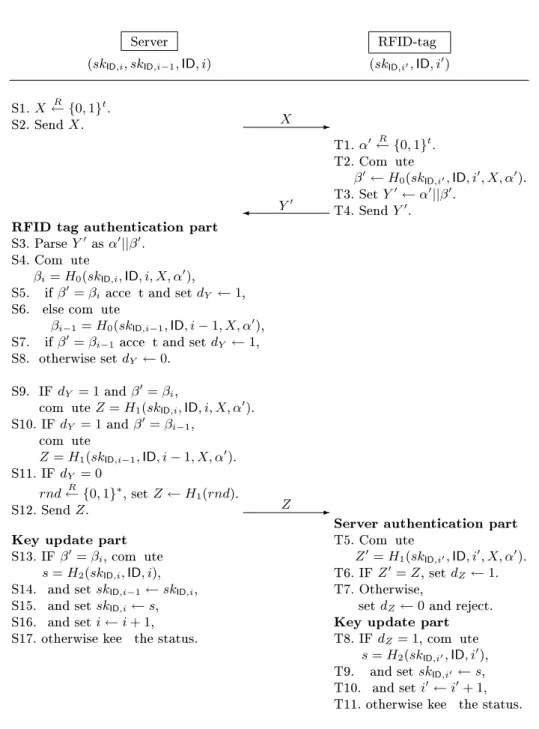
Our proposed protocol meets the security requirements set out in section 2. 4 The details of the protocol are shown in Fig. 1. In the gure, a lightweight device is described as an RFID-tag. Additionally,iis the times of key updating events
in Server; i.e., counts of key updating in Server.skID,i is thei-th secret key of a tag.IDis the tag's ID.i′ is the times of key updating events in Tag; i.e., counts
of key updating in Tag. Data generated in a tag are described with quotation mark, for example,Y′.5
The basic concept is combining the OSK protocol and key update mechanism from mutual authentication. LetH0andH2be hash functions (random oracles).
4 You can nd e-print version in [16]. Formally our protocol is published in this paper. 5 This gure put being easy to understand above optimization of a process. We will
show the description putting a top priority on optimization of a process before very long.
H0 and H2 work in the same manner as the output function and key update function in the OSK protocol, respectively. In this protocol, the tag executes as follows. First, the client (i.e., tag) is requested from the server, a secret key is then input, which is recorded in the tag's memory, to H2. The output is then input to H0. At the end, the tag outputs the calculated results of H0 to the server. The server receives the tag's output and then searches its database for the relevant secret key, which is shared with, and is unique data for each tag, to
H2and then inputs the output toH0 using the same processes.
To accomplish key updates in both the RFID tag and the server, we must cope with the problem of desynchronization. If only one side of the party up-dates its secret key, the protocol fails upon further authentication attempts. Such desynchronization not only causes failure of authentication, but also risks breach-ing privacy. We prevent desynchronization by usbreach-ing a key update in the mutual authentication which consists of two challenge-response protocols via hash func-tions. Key update is allowed just only if the result of verication is OK, AND the veried secret keys between tag and server are getting into synchronization. First, the server sends a random challenge, and then the tag calculates a re-sponse withH0. The second challenge-response is initiated by the tag. The tag sends the challenge with the calculated response inY′. The server calculates the
response by usingH1with the current secret or previous (old) secret. Note that the server stores both the current and previous secret key and which secret key is used depends on which one the server detects to calculate the received Y′.
The server only calculates the value with the previous secret key if it detects that the received Y′ is calculated using it, and, likewise, calculates the value
with the current updated secret key if it detects that the received Y′ is
calcu-lated using it. This mechanism deals with desynchronization by communication error. After that, the server sends the (second) response to the tag. Only when the tag conrms the response will it update the secret key. The basic security requirements are fullled with OSK-like construction, and desynchronization is solved by mutual authentication holding two secret keys, current and previous, on the server side.
3.2 Strong Points of the Proposed Scheme
Synchronization: The secret key is updated by both servers and clients, and if desynchronization occurs, the server can distinguish it and follow to the client's current state in the next session. This protocol can therefore solve the desyn-chronization problem.
Resiliency against DOS-like attack: Juels and Weis discussed the requirements of RFID protocols in [14]. They introduced the attack against a hash-chain-based scheme like a DOS-like attack against a server via the Internet. In the proposed scheme, the event in which the secret key updated in the tag proceeds only when the verication check is OK; and therefore a DOS-like attack cannot be applied to this scheme.
Saving computational cost of server: Generally, hash-based identication schemes like [17] require many server calculations in order to identify a tag (i.e., a client),
Server RFID-tag (skID,i, skID,i−1,ID, i) (skID,i′,ID, i′) S1.X ← {0R ,1}t. S2. SendX. X -T1.α′← {R 0,1}t. T2. Compute β′←H0(skID,i′,ID, i′, X, α′). T3. SetY′←α′||β′. Y′ T4. SendY′.
RFID tag authentication part S3. ParseY′ asα′||β′.
S4. Compute
βi=H0(skID,i,ID, i, X, α′),
S5. ifβ′=βiaccept and setdY ←1,
S6. else compute
βi−1=H0(skID,i−1,ID, i−1, X, α′), S7. ifβ′=βi−1 accept and setdY ←1,
S8. otherwise setdY ←0. S9. IFdY = 1andβ′=βi, computeZ=H1(skID,i,ID, i, X, α′). S10. IFdY = 1andβ′=βi−1, compute Z=H1(skID,i−1,ID, i−1, X, α′). S11. IFdY = 0 rnd← {R 0,1}∗, setZ←H1(rnd). S12. SendZ. Z
-Server authentication part
Key update part T5. Compute
S13. IFβ′=βi, compute Z′=H1(skID,i′,ID, i′, X, α′). s=H2(skID,i,ID, i), T6. IFZ′=Z, setdZ←1.
S14. and setskID,i−1←skID,i, T7. Otherwise,
S15. and setskID,i←s, setdZ←0and reject.
S16. and seti←i+ 1, Key update part
S17. otherwise keep the status. T8. IFdZ= 1, compute s=H2(skID,i′,ID, i′),
T9. and setskID,i′ ←s,
T10. and seti′←i′+ 1,
T11. otherwise keep the status. Fig. 1. Proposed protocol
and the server must compute 2m hash calculations for each tag, where m is a
maximum number of updates of the secret key. In the proposed scheme, a server and a tag can share the current state of the common secret key; therefore a server only needs to compute two hash calculations for each tag, and the server's huge computational cost can thereby be saved.
Resiliency against replay attack: In the proposed scheme, fresh randomnesses chosen by both a server and a tag are used; therefore a replay attack cannot be applied to it.
4 Security Verication using CryptoVerif and Security
Proofs
In this section, we show the security proof of the proposed protocol using Cryp-toVerif verication results.
4.1 Signicance of Results
Two types of cryptographic protocol security exist. Symbolic security, e.g., Dolev-Yao model, assumes that cryptographic primitives that construct the crypto-graphic protocol are ideally secure. Some symbolic security can be automatically checked using formal verication tools such as ProVerif [6]. However, the sym-bolic security might not correspond to the real system's security. On the other hand, in computational security, the vulnerability of cryptographic primitives is considered. Computational security expresses the security of the real system compared with symbolic security. Recently, some frameworks that verify com-putational security have been proposed, and formal verication tools such as CryptoVerif[7] were developed.
Formal verication of privacy for RFID systems has been discussed[10,4]. Brusò et al. [10] gave a formal model for RFID privacy, expressing unlinkability and forward privacy as equivalences in the applied pi calculus[2], and proved the privacy of the OSK protocol[17] using Proverif. Only [10,4] discussed symbolic security.
We introduce formal models for unlinkability (Client indistinguishability) and mutual authenticity (Client unforgeability and Server unforgeability) of the pro-posed protocol without key update functionality by the probabilistic polynomial-time process calculus, and prove its computational security using CryptoVerif. This is evidently the rst paper to show RFID system computational security by using a formal verication tool. Moreover, by manually using the formal veri-cation results we prove froward privacy and forward mutual authenticity of the proposed protocol with key update functionality.
4.2 Formalization of proposed protocol
Since indexes of alignment cannot be controlled in CryptoVerif, the key update property in the proposed protocol cannot be described. Therefore we omit the
key update and obtain the CryptoVerif result. Using the result, we then show the entire security proof by handwriting. Details are as follows. The proposed protocol is constructed using three kind of random oracles. The key updating algorithm uses a hash-chain. A new updated key is generated by a hash func-tion, i.e., the previous session's secret key is set as input of the hash funcfunc-tion, and its output is set as the new secret key. Since CryptoVerif does not permit control of indexes of a list of the hash function's output directly, we formalized the proposed protocol omitting the key updating algorithm and applied it to CryptoVerif. We set that in CryptoVerif, the adversary is not allowed to send
Revealqueries since there is no protocol that satises security requirements after
a session key is revealed. Instead of these queries, a state of revealing the secret key is described in which the adversary is given a secret key of the next session of a target session. With the above setting, the (simplied) proposed protocol can be applied to CryptoVerif. Using the CryptoVerif output, the entire security of the proposed protocol is shown in handwritten form. We rst introduce the description of the random oracle formalized by Blanchet, et al. [9], and then show formalization of a proposed protocol and the security requirements. Due to space limitations, this paper omits the details of CryptoVerif rules. This information is available in the CryptoVerif manual [5].
Formalization of random oracles The distribution of the random oracle's output is uniformly random. We assume ideal hash functions in the proposed protocol, i.e., random oracle. In the random oracle model, the adversary obtains the functions' results by making a request to the random oracles. The oracle has a list of pairs of input and output called a hash-list. When a random oracle receives a query, if the query was recorded in the hash-list, (meaning the query was not previously requested) the random oracle outputs the value recorded in the hash-list. If the query was not recorded in the hash-list (meaning this is the rst request of query), the random oracle outputs a random value and then records the input and output pair in the hash-list. Eq.(1) is a formalization of random oracles presented by Blanchet, et al. [9], where hash :bitstring →D. OH is a formalization of an oracle that receives a queryx, and outputshash(x), where the number of queries is at most qH.A =? B is a Boolean function that
outputs true whenA=B, and outputs false whenA̸=B.
foreach ih≤nhdoOH(x:bitstring) :=return(hash(x)) [all]
≈0foreach ih≤nhdoOH(x:bitstring) :=ndu≤nhsuchthat
(dened(x[u], r[u])∧x=? x[u])then return(r[u])
elser←R D;return(r)
(1)
Next, we describe the random oracleOH using the following rule that the
view of the output of a random oracle that receives inputxand outputshash(x) (at mostqH times), is the same as that of a random oracle, that receives input
xand, if there isx=x[u]in its list, outputsr[u], otherwise it chooses a random value r and outputs it. All inputs and chosen r are recorded as alignments in
chooses a valueruniformly, the value ofxis assigned tox[i], and the value ofr
is assigned tor[i]. In Eq.(1), a pair of(x[i], r[i]), of which index iis the same,
means a pair of input and output of the random oracle. As above, functions of a random oracle are described as alignments ofx[]r[]. In the proposed protocol, the following three random oracles are used.H0:key×IDs×index×nonce×
nonce→h0,H1:key×IDs×index×nonce×nonce→h1,H2:key×IDs×
index→key.OH0, OH1, OH2are processes that receive input and send output of a random oracle, wherekeyis a group of session keys,IDsis a group ofID, indexis a group of indexes of session keys, andnonceis a group oft-bit random
values.
Formalization of attack games Attack games consist of three processes Server, Tag, and Challenge and random oraclesH0, H1, H2. The processes Server and Tag are a formalization of a server and tag in the proposed protocol. Challenge is a formalization of the attacker's target, and depends on secu-rity requirements and that is the verier. The following are descriptions of the Server, Tag, and attack model. First we dene functions test1, test2, test3.
test1 : bool ×nonce×nonce → nonce, test2 : bool×h0×h0 → h0, test3 :
bool×h1×h1 →h1. test1(b, A, B)is a function for which ifb istrue, outputs
A, if b is f alse, outputsB for any A, B ∈ nonce, In the function, the view of
the process in which if input is b : bool, chooses A, B ←R nonce and outputs test(b, A, B), is same as that of the process in which if input isb:bool, outputs C←R nonce. The property is formalized as Eq.(2).test2andtest3are dened in the same way.
foreach it≤nt dotest1(b:bool) :=A, B R
←nonce;return(test1(b, A, B))[all] ≈0foreach it≤ntdotest1(b:bool) :=C
R
←nonce;return(C) (2)
Next, we formalize the processes of Server and Tag, as Eq.(3) and Eq. (4) respectively, where yield indicates a process of stopping and doing nothing.
foreach ip≤npdoServer:=input(); Xs R ←nonce; return(Xs); input(αs:nonce, βs:h0);ifβs ? =H0(SK0, ID, i0, Xs, αs)then return(H1(SK0, ID, i0, Xs, αs)) elseZrnd R ←h1;Zs←H1(SK1, ID, i1, Xs, αs); bs:bool←(βs ?
=H0(SK1, ID, i1, Xs, αs)); return(test3(bs, Zs, Zrnd)).
(3)
foreach ip≤npdoT ag:=input(Xt:nonce); αt R
←nonce; βt←H0(SK1, ID, i1, Xt, αt);return(αt, βt);
input(Zt:h1);ifZt
?
=H1(SK1, ID, i1, Xt, αt)thenyield.
(4) By using the above processes, an attack game is formalized as Eq.(5).
OH1|OH2|OH3|(input(i0:index, i1:index, i2:index);ID
R
←IDs; seed←R key;SK0←H2(seed, ID, i0);SK1←H2(SK0, ID, i1);
SK2←H2(SK1, ID, i2);return(ID, SK2)|(Server|T ag|Challenge)). (5)
Formalization of Client indistinguishability game Challengeon the Client
indistinguishability game is formalized as Eq.(6).
Challenge:=input(X∗:nonce); b∗← {R true, f alse};α∗←R nonce; β∗←H0(SK1, ID, i1, X∗, α∗);αrnd
R
←nonce; βrnd R
←h0; return(test1(b, α∗, αrnd), test2(b, β∗, βrnd));
(6) In the above attack game, ifsecrecy is shown when b is chosen inChallenge,
in the proposed protocol, the adversary cannot distinguish between Tag's out-put and random values. In this case, we can say that the protocol satises the property of Client indistinguishability.
Formalization of Client unforgeability game Challengeon the Client
un-forgeability game is formalized as Eq.(7).
Challenge:=input(); X∗←R nonce;return(X∗);
input(α∗:nonce, β∗:nonce);ifβ∗=? H0(SK0, ID, i0, X∗, α∗)then ndu≤npsuchthat(dened(Xt[u])∧X∗
?
=Xt[u])thenyield
else event bad
else ifβ∗=? H0(SK1, ID, i1, X∗, α∗)then ndu≤npsuchthat(dened(Xt[u])∧X∗
?
=Xt[u])then yield
else event bad.
(7)
The event event bad has occurred, only whenα∗, β∗ received byChallengeis
accepted and X∗ given to the adversary byChallenge have not been requested
to the Tag oracle. This means that the adversary successfully forges the Tag's output only when event bad occurs. Tag unforgeability is satised if the prob-ability of event bad is negligible.
Formalization of Server unforgeability game Challenge on Server
un-forgeability game is formalized as Eq.(8).
Challenge:=input(X∗:nonce); α∗←R nonce;β∗←H0(SK1, ID, i1, X∗, α∗); return(α∗, β∗); input(Z∗:h1);ifZ∗ ? =H1(SK1, ID, i1, X∗, α∗)then ndu≤npsuchthat(dened(αs[u], βs[u])∧α∗ ? =αs[u]∧β∗ ? =βs[u])
thenyieldelse event bad
(8)
The event event bad occurs, only whenZ∗received byChallengeis accepted
and,α∗, β∗ given to the adversary byChallengehave not been requested to the
Server oracle. This means that the adversary successfully forges server's output only when event bad occurs. Server unforgeability is satised if the probability of event bad is negligible.
4.3 Theorems
In section 2, we dened security notions to achieve not only basic but also ex-tended properties. As a result, the following theorems can be proven by using CryptoVerif.
Theorem 1. Forward-secure Indistinguishability
The proposed scheme is Forward-secure Indistinguishable, if hash functions
H0, H1, andH2 are random oracles.
Theorem 2. Forward-secure (Client)-Unforgeability
The proposed scheme is Forward-secure (Client)-Unforgeable if hash func-tionsH0, H1, and H2 are random oracles.
Theorem 3. Forward-secure (Server)-Unforgeability
The proposed scheme is Forward-secure (Server)-Unforgeable if hash func-tionsH0, H1, and H2 are random oracles.
4.4 Output of verication on CryptoVerif
Following are the result of CryptoVerif verication. We use a PC as follows, Intel(R) Core(TM)2 Duo CPU U9300 @ 1.20GHz, RAM 2.85GB. CryptoVerif is version 1.10pl1.
Client indistinguishability game result The adversary has an advantage in this game, which can be shown to be negligible by applying the following commands:auto,simplify,remove_assign all,auto, and transforming the game 34
times. Running time is about 45 seconds. The result is as follows.
RESULT Proved secrecy of b with probability2.∗nH0/|key|+3.∗nH1/|key|+ 7.∗nH2/|key|+np∗nH0/|key|+3.∗np/|h0|+np∗nH0/|nonce|+4.∗np∗np/|nonce|+
nH0/|nonce|+ 5.∗np/|nonce|+ 6.∗1./|key|
|key|,|h0|,|nonce|6are exponent functions of the security parameter,np, nH0, nH1, nH2 are polynomial functions of the security parameter. From the above
results, we can say that the advantage of breaking the secrecy ofbis negligible.
Client unforgeability game result The adversary has an advantage in this game, which can be shown to be negligible by applying the following commands:
auto,simplify,auto, and transforming the game 14 times. Running time is about
40 seconds. The result is as follows.
RESULT Proved event bad==> f alse with probability3.∗nH0/|key|+ 3.∗
nH1/|key|+ 7.∗nH2/|key|+np∗nH0/|key|+ 3.∗np/|h0|+np∗nH0/|nonce|+ 3.∗np/|nonce|+ 4.∗np∗np/|nonce|+ 2.∗1./|h0|+ 6.∗1./|key|
|key|,|h0|,|nonce|are exponent functions of the security parameter,np, nH0, nH1, nH2 are polynomial functions of the security parameter. From the above
results, we can say that the probability of event bad is negligible.
Server unforgeability game result The adversary has an advantage in this game, which can be shown to be negligible by applying the following commands:
auto and transforming the game 13 times. Running time is about 15 seconds.
The result as the follows.
RESULT Proved event bad ==> f alse with probability2.∗nH0/|key|+2.∗
np∗nH0/|key|+nH1/|key|+ 7.∗nH2/|key|+np/|h0|+np∗nH0/|nonce|+ 2.∗
np∗np/|nonce|+nH0/|nonce|+ 4.∗np/|nonce|+ 1./|h1|+ 6.∗1./|key| |key|,|h0|,|h1|,|nonce|are exponent functions of the security parameter,np,
nH0, nH1, nH2 are polynomial functions of the security parameter. As above
re-sults, we can say that the probability of event bad is negligible.
4.5 Proof Sketch
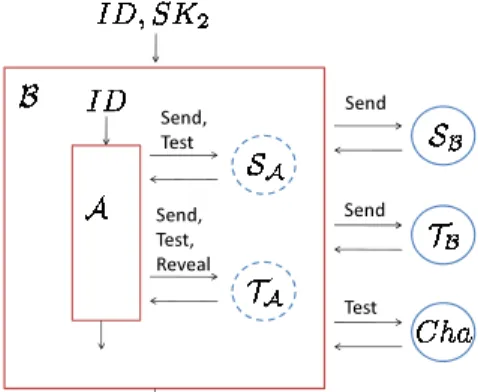
If there is an adversary A, that can break the proposed protocol, there is an adversary B that breaks the knocked-down one shown in the above session. We can show that the proposed protocol is secure by showing the above proof. A is allowed to access server oracle SA at most n times, and is also allowed to access tag oracle TA at most n times, and in total is allowed to access the random oracles at mostqHtimes. Mutual authentications between tag and server succeed at most ntimes; therefore the variations of session keys are at mostn.
Bis allowed to access the server oracle SB at mostntimes, and also is allowed to access the tag oracleTB at mostntimes, and totally is allowed to access the random oracles at mostqH times. We rst show how to construct withB. Fig.2
Send, Test Send, Test, Reveal Send Send Test
Fig. 2. Rough construction ofBby usingA.
is a rough construction of B by usingA. B executes the following, when given target ID and the next session keySK2of the target session,Bguessesi←R [1, n] that is the number of the session key thatAuses for its attack, sets the session key as SKi+1 ←SK2, and then sends a query to random oracleH2 with the
SKi+1 ←SK2 and acquires SKi+2, . . . SKn. Next,B givesID to A and runs A. B simulates Ssid
A and T sid
A as follows, letting sid = j||ssid. B transfers all queries to the random oracles fromAto the random oracles forB, and receives output from the random oracles forBand transfers the value toA.
Ifj < i, • Ssid
A : If he
∗ receives (), choosesXsid R
← {0,1}t, then outputsXsid.
∗ receivesαsid, βsid, choosesZsid R
←h1, then outputsZsid.
∗ receives a Test query, stop the simulation.
• Tsid A : If he
∗ receivesXsid′ , choosesαsid R
← {0,1}t, β sid
R
←h0, then outputs(αsid, βsid).
∗ receivesZsid′ , outputs ().
∗ receives Revealed queries, stop the simulation.
∗ receives a Test query, stop the simulation. Ifj=i,
• Ssid A : If he
∗ receives (), send () toSB and receivesXsid, then outputsXsid.
∗ receives αsid, βsid, send αsid, βsid to SB and receives Zsid, then outputs Zsid.
∗ receives a Test query, transfer the query to Challenge, and receives a
value, then outputs the received value.
• Tsid A : If he
∗ receivesXsid′ , sendXsid′ toTB, receives(αsid, βsid), then outputs(αsid, βsid).
∗ receivesZsid′ , sendZsid′ toTB, receives (), then outputs the ().
∗ receives a Revealed query, stop the simulation.
∗ receives a Test query, transfer the query toChallengeoracle, and receives
a value, then outputs the value. Ifj > i,
• Ssid A :If he
∗ receives (), choosesXsid R
← {0,1}t, then outputsX sid.
∗ receives αsid, βsid, calculateZsid usingSKj along the protocol, and
out-puts the calculated result.
∗ receives a Test query, stop the simulation.
• Tsid A : If he
∗ receives Xsid′ , calculate (αsid, βsid) using SKj along the protocol, then
outputs the calculated(αsid, βsid).
∗ receivesZsid′ , executes usingSKjalong the protocol, then outputs ().
∗ receives a Revealed query, outputsSKj.
∗ receives a Test query, stop the simulation.
If the guessedi is correct,Bcan set the target problem as a problem ofA's
target. Therefore if there exists an adversary A that successfully attacks with non-negligible probability, there exists an adversaryB that successfully attacks with non-negligible probability at least for the guessed i. (This is because if
the success probability of adversaryBat the guessedi is negligible, the success
probability of adversaryAis also negligible. It is1/nat least that the probability
that the i guessed by B is correct. Since the upper bound of queries, n, is a
polynomial function of the security parameter, the above proof means that if there is an adversary A, there is an adversary B that can succeed with non-negligible probability.
4.6 Note
The proposed protocol satises resiliency of desynchronization (Def.4) against an adversary that can only control the communicated data, because the proposed protocol satises the mutual authenticity. If the adversary can control not only the communicated data but also the number of steps that tag executes, the proposed protocol cannot satisfy the property of resiliency of desynchronization. If, however, the proposed protocol can satisfy this property by modifying it as follows, i.e., when the server receivesY from a tag, check the following formula
withskID,i′ andi′−1,
β′=? H0(skID,i′,ID, i′−1, X, α′)
as well as the verications in the original proposed protocol. By this modication, the server can detect the desynchronization of a session IDi. Proof against such
an adversary as that above is a topic for future work.
5 Conclusion
This paper, proposed a formal security model and denitions for an RFID au-thentication protocol that is robust against a man-in-the-middle adversary. An RFID authentication protocol from the OSK protocol and synchronization mech-anism was then put forth. The security of the protocol was proved by combining a handwritten proof and CryptoVerif results as well as by using a manual proof method in a game-based approach.
References
1. RFID security & privacy lounge. http://www.avoine.net/rd/.
2. Martín Abadi and Cédric Fournet. Mobile values, new names, and secure commu-nication. In POPL, pages 104115, 2001.
3. Martín Abadi and Phillip Rogaway. Reconciling two views of cryptography (the computational soundness of formal encryption). In IFIP TCS, pages 322, 2000. 4. Myrto Arapinis, Tom Chothia, Eike Ritter, and Mark Ryan. Analysing
unlinka-bility and anonymity using the applied pi calculus. In CSF, pages 107121, 2010. 5. Bruno Blanchet. CryptoVerif computationally sound, automatic cryptographic
protocol verier user manual. http://www.cryptoverif.ens.fr/.
6. Bruno Blanchet. An Ecient Cryptographic Protocol Verier Based on Prolog Rules. In 14th IEEE Computer Security Foundations Workshop (CSFW-14), pages 8296, Cape Breton, Nova Scotia, Canada, June 2001. IEEE Computer Society. 7. Bruno Blanchet. A computationally sound mechanized prover for security
proto-cols. Cryptology ePrint Archive, Report 2005/401, 2005.
8. Bruno Blanchet. A computationally sound mechanized prover for security pro-tocols. In IEEE Symposium on Security and Privacy, pages 140154, Oakland, California, May 2006.
9. Bruno Blanchet and David Pointcheval. Automated security proofs with sequences of games. In CRYPTO, pages 537554, 2006.
10. Mayla Brusò, Konstantinos Chatzikokolakis, and Jerry den Hartog. Formal veri-cation of privacy for RFID systems. In CSF, pages 7588, 2010.
11. Gerhard Hancke and Markus Kuhn. An RFID Distance Bounding Protocol. In Conference on Security and Privacy for Emerging Areas in Communication Net-works SecureComm 2005, pages 6773, Athens, Greece, September 2005. IEEE, IEEE Computer Society.
12. Ari Juels. RFID security and privacy: A research survey. Manuscript, September 2005.
13. Ari Juels and Stephen Weis. Dening strong privacy for RFID. Cryptology ePrint Archive, Report 2006/137, 2006.
14. Ari Juels and Stephen Weis. Dening Strong Privacy for RFID. In International Conference on Pervasive Computing and Communications PerCom 2007, pages 342347, New York City, New York, USA, March 2007. IEEE, IEEE Computer Society Press.
15. Shin'ichiro Matsuo, Kunihiko Miyazaki, Akira Otsuka, and David A. Basin. How to evaluate the security of real-life cryptographic protocols? - the cases of ISO/IEC 29128 and CRYPTREC. In Financial Cryptography and Data Security, FC 2010 Workshops, RLCPS, WECSR, and WLC 2010, Tenerife, Canary Islands, Spain,, volume 6054 of Lecture Notes in Computer Science, pages 182194. Springer, Jan-uary 2010.
16. Miyako Ohkubo, Shin'ichiro Matsuo, Yoshikazu Hanatani, Kazuo Sakiyama, and Kazuo Ohta. Robust RFID authentication protocol with formal proof and its feasibility. Cryptology ePrint Archive, Report 2010/345, 2010.
17. Miyako Ohkubo, Koutarou Suzuki, and Shingo Kinoshita. Cryptographic approach to privacy-friendly tags. In RFID Privacy Workshop, MIT, MA, USA, November 2003.
18. Paise Radu-Ioan and Serge Vaudenay. Mutual Authentication in RFID: Security and Privacy. In Proceedings of the 3rd ACM Symposium on Information, Computer and Communications Security ASIACCS'08, pages 292299, Tokyo, Japan, 2008. ACM Press.
19. Serge Vaudenay. On Privacy Models for RFID. In Advances in Cryptology -Asiacrypt 2007, volume 4833 of Lecture Notes in Computer Science, pages 6887, Kuching, Malaysia, December 2007. Springer-Verlag.