Extracting Knowledge from Raw IoT Data
Streams
Adnan Akbar
Submitted for the Degree of Doctor of Philosophy
from the University of Surrey
Institute for Communication Systems Faculty of Engineering and Physical Sciences
University of Surrey
Guildford, Surrey GU2 7XH, U.K.
December 2017
c
Summary
As sensors are adopted in almost every field of life, the Internet of Things (IoT) is triggering a massive influx of data. This large amount of data is of little value until it is processed intelligently to extract high-level knowledge which can be used to make decisions. The process of knowledge extraction from data streams is complex predomi-nantly due to heterogeneous data sources, unreliable networks and real-time processing requirements. Different recent studies have showed that solutions based on complex event processing (CEP) have the potential to extract high-level knowledge from these data streams. However, the use of CEP for IoT applications is still in early phase and faces many challenges.
First, CEP applications are intended to provide reactive solutions by correlating data streams using predefined rules as the events happen. As the notion of many IoT appli-cations is changing from reactive to proactive where complex events can be predicted before they actually happen, solutions based on CEP required an extension to address this issue. To this end, this work proposes a proactive method based on CEP and machine learning (ML) where historical data is exploited using ML part and combined with real-time flow of CEP to provide the basis for predictive event processing. Second, systems based on CEP deploy static rules and there is no means to update the rules according to the current context automatically. In order to address this issue, this the-sis proposed a novel method based on ML to find CEP rules automatically and update them according to the current context.
Third, in state-of-the-art CEP systems, events are correlated using absolute rules where a complex event detected is either true or false. Given the sporadic nature of IoT, missing and uncertain data is a common phenomenon and CEP systems of today are unable to take this inherent uncertainty of real-world events into account while taking decisions. This thesis addressed this issue by proposing a probabilistic event processing approach by extending state-of-the-art CEP by combining it with Bayesian networks (BNs). Finally, the size and complexity of the IoT data presents a generic challenge which is being addressed throughout in this thesis.
The above mentioned contributions were evaluated using real-world data collected from heterogeneous sources to prove the accuracy and reliability of the proposed methods. The feasibility and applicability of the proposed solutions were demonstrated by imple-menting it for real-world applications. The work presented in this thesis significantly improves state-of-the-art methods and provides a fundamental building block towards extracting knowledge from raw IoT data streams.
Key words: Big data, Complex event processing, Context-aware, Internet of Things, Machine learning, Predictive analytics.
Acknowledgements
Foremost, I would like to express my deepest gratitude to my supervisors Professor Klaus Moessner and Dr. Francois Carrez for their guidance and continuous support of my PhD study and research. Their extensive expertise, as well as enthusiasm, pas-sion, devotion and optimism have played a pivotal role in shaping the direction of my research.
I would also like to give my appreciation to my colleagues and friends, Waqas Rafique, Sameed Husain, Saad Anjum, Shahzaib Nabi, Hasan Malik, Junaid Mir, Atif Mir, Junaid Ali and Adnan Zafar for their constant support and help during the duration of my PhD.
Last but not the least, I would also like to acknowledge the unconditional love and support of my parents Dr Akbar Saeed and Rizwana Akbar, my wife Saleha Sarfraz and rest of the family which they have shown on me during the course of my PhD.
Nomenclature vii 1 Introduction 1 1.1 Overview . . . 1 1.2 Definitions . . . 3 1.3 Challenges . . . 5 1.4 Research Problem . . . 7 1.5 Research Methodology . . . 7 1.6 Research Contributions . . . 9 1.7 Publications . . . 11
1.8 Structure of the thesis . . . 13
2 Literature Review 16 2.1 Background . . . 16
2.1.1 Event Driven Simulation . . . 17
2.1.2 Networks . . . 18 2.1.3 Active Databases . . . 19 2.1.4 Middleware . . . 20 2.2 CEP concepts . . . 21 2.2.1 Events . . . 21 2.2.2 Complex Events . . . 21
2.2.3 Event Driven Architecture . . . 22
2.2.4 Generic CEP Architecture . . . 22
2.2.4.1 Filters . . . 23
2.2.4.2 Windows . . . 23 i
Contents ii
2.2.4.3 Joins . . . 24
2.2.4.4 Aggregation . . . 24
2.3 How CEP fits in IoT world ? . . . 24
2.3.1 Intelligent Transportation Systems . . . 26
2.3.2 Smart Homes . . . 27
2.3.3 Social Media . . . 28
2.3.4 Remote Health Monitoring . . . 29
2.3.5 Supply Chain Management . . . 30
2.3.6 Geofencing . . . 31
2.4 Challenges and Research Gaps . . . 32
2.4.1 Challenge 1: Predictive Event Processing . . . 32
2.4.2 Challenge 2: Automatic Rule Generation for Context-Aware Event Processing . . . 34
2.4.3 Challenge 3: Uncertainty in Event Processing . . . 36
2.4.4 Challenge 4: CEP and Big Data Management . . . 37
2.5 Discussion . . . 40
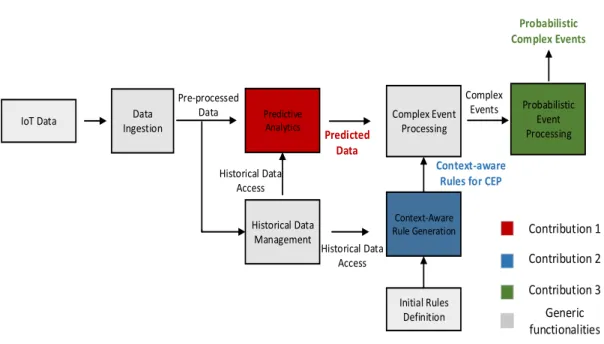
3 Overall System Framework 41 3.1 Data Ingestion . . . 41
3.2 Predictive Analytics . . . 42
3.3 Context-Aware Rule Generation . . . 43
3.4 Probabilistic Event Processing . . . 43
3.5 Complex Event Processing . . . 44
3.6 Use-case of ITS . . . 45
4 Predicting Complex Events 46 4.1 Introduction . . . 47
4.2 Proposed Solution . . . 49
4.2.1 Adaptive Moving Window Regression (AMWR) . . . 50
4.2.1.1 Selection of Regression Algorithm . . . 50
4.2.1.2 Optimum Training Window Size . . . 52
4.2.1.3 Adaptive Prediction Window . . . 54
4.2.2.1 Filtering . . . 55
4.2.2.2 Joins . . . 56
4.2.2.3 Windows . . . 56
4.3 Experimental Evaluation . . . 57
4.3.1 Dataset and Experimental Setup . . . 57
4.3.2 Evaluation . . . 59
4.3.3 Comparison with Benchmark Solutions . . . 63
4.3.4 Error Modelling . . . 66
4.4 Discussion . . . 69
5 Context-Aware Event Processing 71 5.1 Introduction . . . 71 5.2 Problem Definition . . . 73 5.3 Proposed Framework . . . 74 5.3.1 Adaptive Clustering . . . 75 5.4 Experimental Evaluation . . . 78 5.4.1 Evaluation . . . 81 5.5 Large-Scale Implementation . . . 83
5.5.1 The Hut Architecture . . . 83
5.5.2 A Hut Architecture Instance . . . 84
5.5.2.1 Ingestion - Secor . . . 85
5.5.2.2 Data Storage Framework - OpenStack Swift . . . 86
5.5.2.3 Batch Analytics Framework - Spark . . . 86
5.5.2.4 Data Retrieval - Spark SQL . . . 86
5.5.2.5 Machine Learning - Spark ML . . . 87
5.6 Demonstration of generality . . . 87
5.7 Discussion . . . 90
6 Handling uncertainty in Complex Events 91 6.1 Introduction . . . 92
6.2 Illustrative Scenario . . . 94
Contents iv
6.3.1 Traffic Data . . . 96
6.3.2 Twitter Data . . . 97
6.3.3 Weather Data . . . 101
6.4 Level 2: Probabilistic Event Processing . . . 102
6.4.1 What is a Bayesian Network . . . 103
6.4.2 Why Bayesian Network . . . 104
6.4.3 Bayesian Network for Intelligent Transportation System . . . 105
6.4.3.1 Probabilistic Inference . . . 106
6.4.3.2 Data Fusion and Analytics . . . 106
6.5 Results and Discussion . . . 107
6.6 Discussion . . . 111 7 Conclusion 114 7.1 Closing Remarks . . . 114 7.2 Future Work . . . 116 7.2.1 Algorithm Development . . . 117 7.2.2 Architecture Development . . . 117 7.2.3 Use-cases Development . . . 118 Bibliography 119
1.1 Characteristics of IoT data [75] . . . 2
1.2 Complex event processing for real-world applications . . . 3
1.3 Challenges for the use of CEP for IoT applications . . . 5
1.4 Research Methodology . . . 8
2.1 Background of event processing [23] . . . 18
2.2 Generic CEP architecture . . . 22
2.3 Event processing in the IoT world . . . 25
3.1 Overall System Framework . . . 42
3.2 Contribution 1 Functionalities . . . 43
3.3 Contribution 2 Functionalities . . . 43
3.4 Contribution 3 Functionalities . . . 44
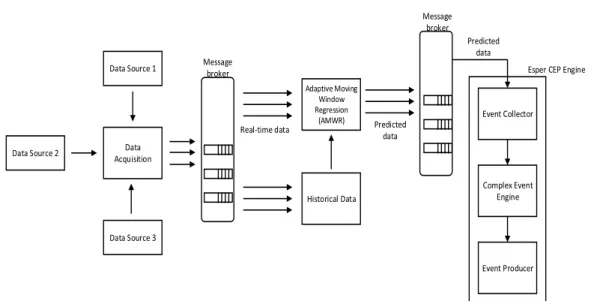
4.1 Proposed solution and block diagram . . . 49
4.2 Flowchart for Adaptive Moving Window Regression . . . 51
4.3 Temperature data [71] . . . 53
4.4 Selected locations for analytics . . . 58
4.5 Periodogram for traffic speed data for location 1 . . . 60
4.6 Prediction results on average traffic speed data from four different locations 61 4.7 Prediction results on average traffic intensity data from four different locations . . . 62
4.8 AMWR comparison with different models for traffic speed data . . . . 64
4.9 AMWR comparison with different models for traffic intensity data . . . 65
4.10 Capturing a congestion event . . . 66
4.11 Error modeling for location 1 . . . 68 v
List of Figures vi
5.1 Proposed framework and block diagram . . . 74
5.2 Flowchart for adaptive clustering . . . 76
5.3 Threshold values for weekdays . . . 79
5.4 Threshold values for weekends . . . 80
5.5 The Hut Architecture . . . 84
5.6 Instance of the Hut architecture . . . 85
5.7 Smart energy use case . . . 88
5.8 Appliances threshold values for monitoring current . . . 89
6.1 Proposed approach . . . 93
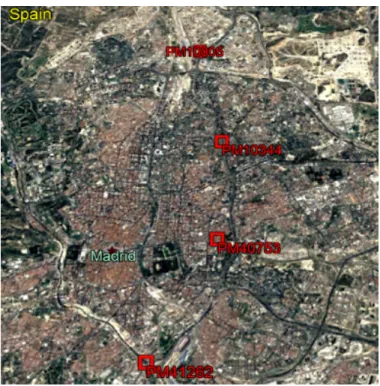
6.2 Monitoring locations for analytics with bounding boxes in Madrid city . 94 6.3 Proposed data flow for first level of analytics . . . 96
6.4 Traffic events table layout in cloud storage . . . 98
6.5 LCC events table layout in object storage . . . 100
6.6 Weather data stations for Madrid . . . 101
6.7 Weather events table layout in object storage . . . 102
6.8 Proposed Bayesian network . . . 105
6.9 An instant of all data combined in the form of table with unified time stamps . . . 106
6.10 Calculation of conditional probabilities . . . 109
6.11 Different scenarios for location 1 simulated for Bayesian network . . . . 110
2.1 Applications of CEP in IoT . . . 31
2.2 Challenges and research gaps . . . 39
4.1 Selected data locations . . . 59
4.2 Error accumulated over 1 month period with different training window sizes for locations 1 . . . 61
4.3 MAPE(%) for traffic speed data . . . 64
4.4 MAPE(%) for traffic intensity data . . . 65
4.5 Input standard deviation (σ) . . . 66
4.6 Error distribution parameters for traffic intensity . . . 67
4.7 Error distribution parameters for traffic speed . . . 69
5.1 Threshold values update for location 1 (weekdays) . . . 78
5.2 Threshold values update for location 1(weekends) . . . 81
5.3 Threshold values for Morning time period . . . 82
5.4 CEP rules evaluation for Madrid scenario . . . 82
6.1 Input data streams and derived events after level 1 analytics . . . 95
6.2 Conditional probability table for location 1 for morning time . . . 108
6.3 Evaluation for congestion prediction . . . 111
Chapter 1
Introduction
1.1
Overview
Sensors are by no means a new phenomenon: the first thermostat was invented in the 19th century and space exploration would not have been possible without them. What is revolutionary today about the Internet of Things (IoT) lies in connecting sensors to the internet followed by their recent adoption on an unprecedented scale, fuelled by several economic factors such as dramatic drop in the cost of sensors, network bandwidth and processing power. Moreover, unlike the Internet (of humans), the IoT allows data to be captured and ingested autonomously, avoiding the human data entry bottleneck. IoT data will arguably become the biggest big data (as projected by Gartner1), possibly overtaking enterprise, media and entertainment data.
The characteristics of the IoT data differ from conventional data sources in many ways. IoT networks are formed by heterogeneous devices including different sensors, smart phones and everyday connected objects. The type and structure of data transmitted by each device is different, making IoT data heterogeneous in a true manner. Most of these networks are deployed outdoor and are connected using less reliable wireless links in order to save energy. As a result, data provided by these devices can be sporadic, less reliable and even incomplete.
1
http://www.gartner.com/newsroom/id/3598917
Figure 1.1: Characteristics of IoT data [75]
Continuous data streams are ubiquitous in IoT. Supply chain, health care, energy management and transportation are among the few examples. Timely analysis of these streams can not only turn into profit (supply chain), but also result in increased citizen’s comfort (transportation), cost reduction (energy management) and can even save lives (healthcare). Furthermore, often the data volume is so high that it cannot be stored on disk or sent over slow network links before being processed. Figure 1.1 highlights the characteristics and challenges of the IoT data in the form of famous 4 V’s of big data [75].
These applications require methods which are capable of interpreting patterns, applying them to current situations and taking accurate decisions with minimal time latency. Data is in the form of real-time events requiring a paradigm shift in the methodology for analysing and inferring high-level knowledge. In order to extract high-level knowledge from such streaming data in real-time, an event driven architecture (EDA) [22] called complex event processing (CEP) has been proposed in recent years. The research area of CEP includes processing, analysing and correlating event streams from different data sources using distributed message-based systems to extract high-level or actionable knowledge in near real-time [59].
1.2. Definitions 3
Web
E commerce
Social Media
Smart city sensors
Databases
Complex Event Processing Disseminate
Base Events
Filter out irrelevant events
Detect patterns, relationships and trends
Enrich data, put in context
Disseminate Complex Events Response Dashboards Applications Inform Alarms Decision support
Event Captrure Disseminate and compute
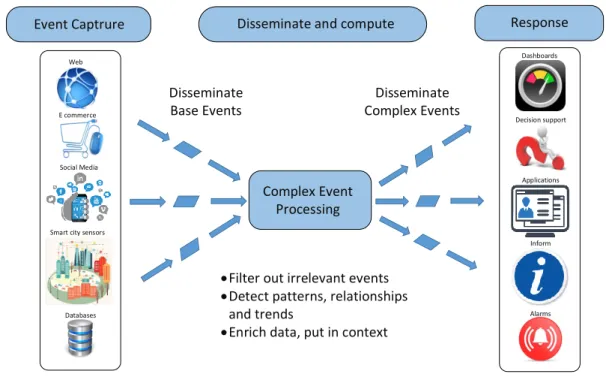
Figure 1.2: Complex event processing for real-world applications
patterns using pre-defined rules. The inherent distributed and scalable nature of CEP [16] fulfils many requirements for real-time IoT applications as evident by numerous examples; for instance analysing real-time traffic data for intelligent transportation system (ITS) [98] or providing automatic managing systems for smart buildings [12] [84]. Figure 1.2 shows some examples of real-world applications of CEP where data is generated in the form of events from heterogeneous sources and CEP provides the capability to analyse and detect complex events from these raw events in real-time. These complex events can be disseminated to other applications for either decision making or serve as an input for other systems.
1.2
Definitions
There are several terms used in this thesis which have different meanings in different contexts. In order to have a common understanding, these terms are defined here in the context it has been used in this thesis;
potential to contribute towards making decisions is treated as knowledge in this the-sis. For example a hot weather extracted from temperature sensor readings represents knowledge. Similarly, bad traffic extracted from traffic sensors is another example of knowledge.
latency: Latency is defined as the amount of time, data takes from being ingested into the system to being analysed to extract knowledge from it.
Large-scale/Big data: Large-scale data or Big data is referred in this thesis as the data sets which are voluminous and complex enough that it cannot be analysed using conventional methods.
Complexity: Complexity in this thesis is used in two different contexts; first, the complexity of data being produced and second, the complexity of the algorithm. The former relates to the heterogeneity of IoT data where different IoT data streams being generated at different rates need to be analysed and correlated whereas the latter is referred to an algorithm which is unable to analyse the input data in near real-time.
Proactive: Proactive is referred as looking into future where actions are taken in order to avoid the situation at first place.
Heterogeneous event processing: When data from different type of sensors or de-vices are combined to extract a complex event, it is referred as heterogeneous event processing.
Scalability: Scalability is referred in this thesis as a solution which can be made scal-able to address the requirements of large-scale applications. It should be noted that this thesis addresses scalability in terms of horizontal scaling where processing require-ments are distributed across different machines rather than using a single machine with high processing power.
1.3. Challenges 5
1.3
Challenges
Although CEP provides solutions to analyse complex data streams in real-time, it was not initially designed for IoT applications. CEP finds its background in financial ap-plications where the major focus is on processing high velocity data with minimal time latency. The real-time processing capability of CEP is a main factor which encouraged researches to explore it for IoT applications. However, the characteristics of IoT data pose different set of challenges, requiring extension of current CEP technology.
Predicting events using CEP Big data
management
CEP for IoT
Automatic and adaptive solutions Handling uncertainty in events Development of query language Processing power of CEP
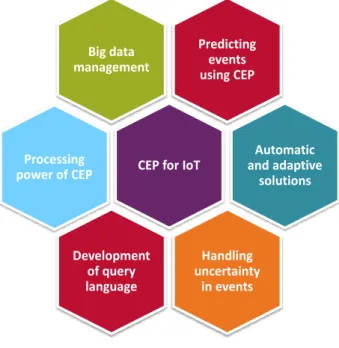
Figure 1.3: Challenges for the use of CEP for IoT applications
There are several challenges which CEP faces for its successful application to extract knowledge from IoT data streams [24]. Figure 1.3 presents an overview of these chal-lenges. There are few challenges which are related to the development of technology such as the processing power of CEP and the development of generic query language for writing CEP rules. The former involves increasing the processing power of CEP to analyse the ever increasing IoT data in real-time whereas the latter challenge is towards the development of generic query language so that CEP can be used by wider commu-nity in IoT for extracting knowledge. These challenges do not lie in the scope of this
thesis as the focus of this thesis is on the application of existing CEP technology for extracting high-level knowledge using methods from machine learning and probabilistic theory. A summary of identified challenges which are addressed in this thesis is below;
1) CEP has the potential to analyse data streams in real-time, however it lacks the predictive power provided by machine learning (ML) and statistical data analysis methods [30]. Most of the CEP applications are intended to provide reactive solutions by correlating data streams using predefined rules as the events occur, and do not exploit historical data [59]. But in many applications, early predic-tion of an event is more useful than detecting it after it has already occurred. For example, it is more useful to predict the traffic congestion as compared to detecting it when it has already occurred. Such information can help to take pre-ventive actions by traffic administrators to avoid a congestion in the first place. The advantage of predicting an event is more obvious if we imagine the gain of predicting Tsunami disaster as compared to detecting it after it has happened. TIBCO CEO Vivek Ranadive explained the importance of predicting events in his book “The Two-Second Advantage” [66] by stressing that a little informa-tion about the event before it happens is more valuable as compared to all the information after the event has happened.
2) In order to detect complex events, systems based on CEP require rules which have to be defined manually by the system administrators[49]. Based on this, there is an assumption that administrators have the required background knowledge which sometimes is neither available nor so precise. The manual setting of rules and patterns limits the use of CEP only to domain experts and poses a major drawback. And even though with prior expertise and knowledge, experts are prone to make errors in choosing optimized parameters for dynamic systems. Systems based on CEP deploy static rules and there is no means to update the rules automatically. In real-time dynamic IoT applications, the context of the application is always changing and the performance of CEP will deteriorate in such scenarios.
1.4. Research Problem 7
a complex event detected is either true or false [2] [86]. Even if a single event or condition is missing, a complex event will not be generated. Given the sporadic nature of IoT, missing and uncertain data is a common phenomenon and CEP systems of today are unable to take this inherent uncertainty of real-world events into account while taking decisions. This represents a major drawback considering the random and probabilistic nature of real-world events.
4) The largeness and the complexity of IoT data represents a generic challenge which should be considered while addressing all of the above mentioned challenges.
1.4
Research Problem
This research work addresses the following research question: ”How can high-level knowledge be extracted from raw IoT data?”
The research focus can be further sub-divided into following sub-problems.
• How can predictive analytics be applied to real-time data streams in IoT for predicting complex events with minimum time latency?
• How to provide adaptive context-aware methods for extracting complex events from real-time streaming data in IoT?
• How to provide fast and scalable data analysis solutions for extracting high-level knowledge from large-scale IoT data?
• How to handle uncertainty associated with real-world events in order to provide a reliable solution for complex IoT applications?
1.5
Research Methodology
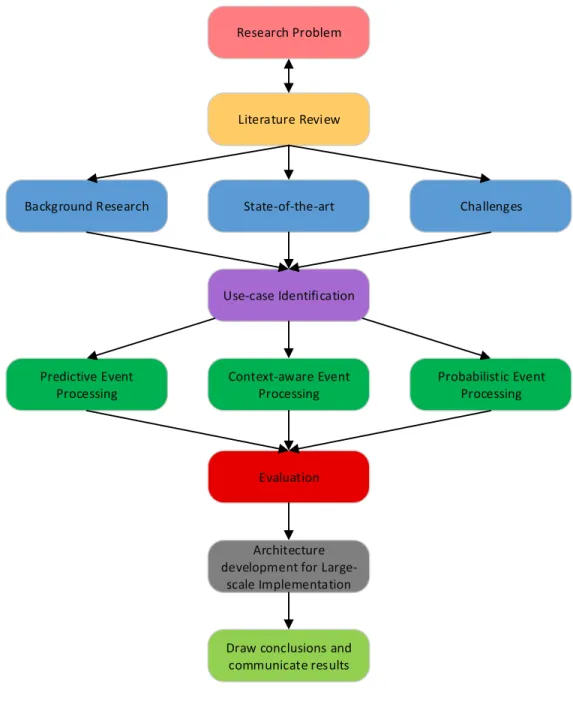
The methodology for this research consist of several steps as shown in the Figure 1.4. The first step involves identifying and formulating the research problem. After for-mulating the research problem, background study was carried on where complex event
Research Problem
Literature Review
Background Research State-of-the-art Challenges
Use-case Identification Predictive Event Processing Context-aware Event Processing Probabilistic Event Processing Evaluation Architecture development for
Large-scale Implementation
Draw conclusions and communicate results
Figure 1.4: Research Methodology
processing (CEP) was identified as the potential solution for extracting knowledge from IoT data streams. CEP was chosen because of its ability to extract temporal, causal and spatial patterns from heterogeneous data streams in near real-time. Literature was reviewed on the existing solutions based on CEP to identify four major research challenges in this direction. In order to demonstrate the application of this research, a
1.6. Research Contributions 9
use-case from intelligent transportation system (ITS) was chosen.
There were several reasons for choosing ITS use-case scenario for this research. First, it provides a big data problem in true meaning due to the amount of data being generated at city level; second, the availability of traffic data from Madrid city council constitutes an important factor and third, as ITS has the direct impact on the social and economical development of smart cities, it provides the perfect use-case for the demonstration of this research.
In the context of identified research challenges, three different methods were proposed, implemented and evaluated using the ITS use-case. After evaluation of proposed solu-tions, an architecture was developed for large-scale applications based on it to address the fourth challenge of managing the big data. Finally, the conclusions were drawn from this research and potential future directions were highlighted.
1.6
Research Contributions
The main objective of this research work is to propose and validate novel methods for extracting high-level knowledge from raw IoT data. The complexity, heterogene-ity, largeness and real-time processing requirements of IoT data make it a challenging task. The complex process of extracting high-level knowledge from raw IoT data is di-vided into following three main contributions. The three contributions directly mapped against the first three challenges whereas the fourth challenge is generic and addressed in all contributions.
1) Predictive Analytics for Complex IoT data streams
As a first contribution, this thesis proposes a novel architecture which exploits historical data using machine learning (ML) in conjunction with CEP in order to provide pro-active solutions for IoT applications. An adaptive prediction algorithm called adaptive moving window regression (AMWR) is proposed for dynamic IoT data and evaluated using a reworld use case with an accuracy ranging from 87 -96 %. The proposed al-gorithm can perform accurate predictions in near real-time due to reduced complexity
and can work along CEP in the proposed architecture. Furthermore, this work imple-mented the proposed architecture using open source components which are optimized for big data applications and validated on a use-case from intelligent transportation system (ITS). The proposed architecture is reliable and can be used across different fields in order to predict complex events.
Contribution 1 can be divided into following sub-contributions:
• Proposed and implemented a generic framework based on open source components for combining ML with CEP in order to predict complex events for proactive IoT applications;
• Proposed an adaptive prediction algorithm called adaptive moving window regres-sion (AMWR) for dynamic IoT data streams and implemented it on a real-world use-case of ITS achieving accuracy ranging from 87 -96 %. AMWR is based on a novel method for finding optimum size for training window by exploiting spectral components of time series data;
• Modelled the error introduced by the prediction algorithm using a parametric distribution and derived expressions for the overall error of the system, as the error propagates through the CEP.
2) Context-Aware Event processing for distributed IoT applications
The second contribution of this thesis provides context-aware event processing for large-scale IoT applications. In this regard, a novel approach is proposed for finding optimized parameters for CEP rules using machine learning methods which is adaptive with re-spect to current context. The proposed solution is demonstrated using real-world traffic data and was implemented in a scalable manner for large-scale IoT applications. Contribution 2 can be divided into following sub-contributions:
• Proposed and implemented a novel method based on machine learning for calcu-lating optimized parameters for CEP rules and update it according to the current context;
1.7. Publications 11
• Demonstration of proposed method using real-world use-case of intelligent trans-portation system (ITS) with an accuracy ranging between 79 - 85 %;
• Proposed theHut architecture for large-scale IoT applications based on the novel method and implemented it using open-source components optimized for big data applications.
3) Handling uncertainty in Event Processing
Final contribution of this thesis addresses the challenge of handling uncertainty in-herently present in all real-world events. An hierarchical event processing framework based on two levels of analytics was proposed where first layer provides a generic in-terface using a service oriented gateway to ingest data from multiple inin-terfaces in IoT systems, store it in a scalable manner and analyse it in real-time to extract high-level events whereas second layer is responsible for probabilistic processing of these high-level events. This work extends state-of-the-art CEP using Bayesian networks (BNs) in order to take uncertainty into account while detecting complex events.
Contribution 3 can be divided into following sub-contributions:
• Proposed a solution based on probabilistic graphical models in order to take uncertainty into account while detecting complex events using CEP. Explored the use of Bayesian networks and extended it with CEP for large-scale systems; • Validation of proposed solution on a real world scenario of intelligent
transporta-tion where multiple data streams including traffic, weather and social media data were used. Furthermore, developed a complete end-to-end solution and demon-strated the application of proposed solution for real-time management of urban traffic control.
1.7
Publications
The research work carried out during the course of this PhD has resulted in the following publications:
Journals
J.1 A. Akbar, A. Khan, F. Carrez and K. Moessner, “Predictive Analytics for Com-plex IoT Data Streams,” IEEE IoT Journal, PP(99):1-1, 2017. [In Press, Ac-cepted on 27 May, 2017, impact factor = 7.6]
J.2 P. Ta-Shma,A. Akbar, G. Gerson-Golan, G. Hadash, F. Carrez and K. Moessner “An Ingestion and Analytics Architecture for IoT applied to Smart City Use Cases,” IEEE IoT Journal, PP(99):1-1, 2017. [In Press, Accepted on 22 June, 2017, impact factor = 7.6]
J.3 G. Kousiouris, A. Akbar, J. Sancho, P. Ta-Shma, A. Psychas, D. Kyriazis and T. Varvarigou “An Integrated Information Lifecycle Management Framework for Exploiting Social Network Data to identify Dynamic Large Crowd Concentra-tion Events in Smart Cities ApplicaConcentra-tions,”Future Generation Computer Systems Journal, 2017. [In Press, Accepted on 10 July, 2017, impact factor = 3.9]
J.4 A. Akbar, G. Kousiouris, J. Sancho, P. Ta-Shma, F. Carrez and K. Moessner “Real-time Probabilistic Data Fusion for Large-Scale IoT Applications,” IEEE Access (under review)
J.5 A. Akbar, W. Rafique, F. Carrez and K. Moessner “Complex Event Processing for Internet of Things - An overview and Survey,”Sensors Journal(under review)
Conferences
C.1 A. Akbar, M. Nati, F. Carrez and K. Moessner, “Contextual occupancy detec-tion for smart office by pattern recognidetec-tion of electricty consumpdetec-tion data,” in
2015 IEEE Internation Conference on Communications (ICC), pages 561-566, June 2015.
C.2 A. Akbar, F. Carrez, K. Moessner and A. Zoha “Predicting complex events for pro-active iot applications,” in 2015 IEEE World Forum on Internet of Things (WF-IoT), pages 327-332, Dec 2015.
1.8. Structure of the thesis 13
C.3 A. Akbar, F. Carrez, K. Moessner, J. Sancho and J. Rico “Context-aware stream processing for distributed iot applications,” in 2015 IEEE World Forum on In-ternet of Things (WF-IoT), pages 663-668, Dec 2015.
1.8
Structure of the thesis
The rest of this thesis is organised as follows.
Chapter 2: Literature Review - The chapter starts with the brief introduction of the use of CEP for IoT data analytics followed by the background description of CEP tech-nology and how it evolved to its current form. It then discusses the different concepts of CEP technology and how it fits to IoT world. Furthermore, it describes the use of CEP as a potential solution for real-time analytics for different IoT applications. Finally, it highlights the major challenges for the application of the CEP for IoT data streams and discusses potential future research directions.
Chapter 3: Overall System Framework - This chapter presents an overview of the system framework in the context of major functionalities which were developed in this research. A high-level view of the contributions is also explained in this section.
Chapter 4: Predicting Complex Events - This chapter explains this thesis’s approach towards predicting complex events using ML and CEP. A novel time series prediction algorithm called adaptive moving window regression (AMWR) is proposed for dynamic IoT data streams and its performance is evaluated using real-world traffic dataset pro-vided by city of Madrid council. A qualitative comparison with other state-of-the-art regression algorithms is provided where AMWR outperforms other algorithms for dif-ferent scenarios. Furthermore, an hybrid solution is proposed based on the prediction algorithm and CEP where output of the prediction algorithm is fed as the input to CEP engine and implemented the proposed solution using different open source components. Moreover, error introduced by the prediction algorithm is modelled using a parametric
distribution and expressions for the overall error of the system were derived, as the error propagates through the CEP.
Chapter 5: Context-aware Event Processing - This chapter presents our work to-wards context-aware event processing for large-scale IoT applications. A novel method is proposed for event processing based on adaptive clustering and CEP which updates according to the current context. The performance of the proposed method is validated using traffic data provided by city of Madrid1. An ingestion and analytics architecture for large-scale IoT applications is proposed by extending the novel method. The pro-posed architecture provides a generic interface using a service oriented gateway to ingest data from multiple interfaces and IoT systems, store it in a scalable manner and analyse it in real-time to extract high-level events with respect to current context. Finally, the chapter is concluded by highlighting how the proposed approach solves the problem of context-aware event processing and provides an edge on existing technologies.
Chapter 6: Handling uncertainty in Event Processing - This chapter explains the proposed solution for handling uncertainty while detecting complex events using CEP. An hierarchical event processing framework is proposed based on two levels of ana-lytics where layer 1 provides a generic interface using a service oriented gateway to ingest data from multiple interfaces and IoT systems, store it in a scalable manner and analyse it in real-time to extract high-level events whereas layer 2 is responsible for probabilistic processing of these high-level events using Bayesian inference in order to take inherent uncertainty of events into account. A description is provided on the use of theHut architecture from previous contribution to ingest and analyse heterogeneous data streams including twitter and weather followed by the description of probabilistic event processing. Furthermore, a novel method based on the integration of Bayesian network with CEP is explained. Finally, the chapter is concluded by highlighting how the proposed approach solves the problem of probabilistic event processing and pro-vides an edge on existing technologies.
1
1.8. Structure of the thesis 15
Chapter 7: Future Work - This chapter summarises the major results achieved in this thesis and highlights important lessons learned from the research. It also discusses possible research directions for the future work.
Literature Review
Complex event processing (CEP) is an emerging technology with its concepts origi-nating from interdisciplinary research. In this regard, it is important to describe its background and components before highlighting the research challenges associated with the CEP. This chapter starts with a brief description of technologies that lead to the development of the CEP in section 2.1, followed by the explanation of different com-ponents and concepts related to the CEP in section 2.2. Section 2.3 describes the use of CEP for IoT applications with the help of different examples found in literature. Section 2.4 discusses the future research direction of the CEP for IoT applications and highlights the major challenges in this direction. Finally, the chapter is concluded by explaining the contributions of this thesis in the context of highlighted research challenges in section 2.5.
2.1
Background
Conceptualization of complex events is interdisciplinary research and find its roots in a wide range of systems operating under real-time constraints. The development of the CEP can be credited to following four technologies ;
1) Event-Driven Simulation 2) Networks
2.1. Background 17
3) Active Databases 4) Middleware
2.1.1 Event Driven Simulation
Event-driven simulation represents one of the earliest exploitation of events and use of event-driven computing. Generally, it refers to the use of events to drive the steps in computing with models to predict the behaviour of systems; where the system can be anything from a simple design of traffic lights controller to a more complex model of autonomous cars.
The development of event-driven simulation started in 1950s with the invention of com-puters. People started to use computers in order to model the design of their devices and predict their behaviour before actual manufacturing. They used computer programs to mimic the behaviour of actual systems and record their response with different input events. By the 1960s, most large manufacturing and aerospace companies had their own internal event driven simulation languages. A number of the early simulation lan-guages are shown in Figure 2.1. Simula67 [28] is one of the most popular among them due to its flexibility based on object-oriented design of modules.
The early development of CEP can be credited to the work carried by event driven simulations team at Stanford university including the use of event patterns and event abstraction [43]. At that time, the output of event driven simulators used to produce a single stream of events ordered in time as they were computed by the simulator. Most of the simulators did not have the capability to show sequentiality and parallelism of events in the system. Instead, it was the observer’s task to figure it out based on their own understanding. In contrast to it, a team of researchers at Stanford university while working on Rapide project led by David Luckham [43] applied CEP techniques for the first time in order to analyse the patterns of low-level events and extract more meaningful higher-level events. The higher-level events facilitate the observer and made their task easier. Furthermore, it reduces the human error by making the process automated. The number of events produced by simulations decrease exponentially as
Figure 2.1: Background of event processing [23]
the level of output events increase, which in turn magnifies the errors in the higher-level events making it easier to detect them.
Today event driven simulation is a big business. The design of almost any product is subjected to some degree of simulation before it is produced. For instance, designs for a new computer chips are subjected to extensive simulation at every design level before they reach the production phase. In fact, it is more costly to fix the error if it is detected further down the production line. The use of large-scale event driven simulations can be found in many other technology sectors such as communication networks or smart city simulations.
2.1.2 Networks
The development of event processing has also been a fundamental part of networking. The core idea is to use simple types of events in the form of network protocols to build
2.1. Background 19
communication between computers. The communication is in the form of packets, where a packet represents a sequence of bits encoding a small amount of data, with packet origin and destination in the network. In order to ensure that a packet arrives at the destination, computers use protocols to acknowledge the receipt of each packet or resend if an acknowledgement is not received within certain time limit.
At the lowest level, event processing in a communication network is simple message processing. Consider an example of sending an email through a network, first it is broken down into a set of packets where each packet is transmitted using the network protocols. At the destination, all the packets are reassembled into the original email. It involves a continuous activity within the network, which consist of various low-level events involved in sending and receiving the network packets.
In recent times, event processing is ubiquitous in the form of internet and mobile net-works. The processing and understanding of events at such a large scale has become an extremely complicated problem with several concerns, including quality of service, security concerns such as hijacking of events or cyber attacks and monitoring applica-tions
2.1.3 Active Databases
Event processing finds its roots in the development of active databases as well. Tra-ditional databases are passive by nature which means they are only responsive to the called queries. In contrast, active databases are capable of invoking other applications without waiting for queries [90]. For instance, an active employees database might initiate an action of generating a warning message to the employee after detecting that the number of absentees for the employee is greater than the threshold level set in the database rules. Active databases extend traditional databases with a layer of event pro-cessing rules called event-condition-action (E-C-A) rules together with event detection mechanisms [64].
The core idea behind the active databases is to extend the capabilities of traditional databases to make them more reactive and fulfil the increasing requirements of real-time processing. The amount of event processing in active databases is not as significant as
in networking or in simulations, still a major part of their functionality is being driven by events.
2.1.4 Middleware
The development of middleware technologies started in late 1980s and came into lime-light in 1990s. It exploded in different directions with the start of 21st century. The main purpose of the development of middleware is to conceal the complex details of the events and their transmission protocols from the users to provide a generic high-level communication interface. The development of middleware can be credited as the first step towards the hierarchical event processing [42].
The development of middleware has been in two major directions; synchronous com-munication based on remote procedure call (RPC) [56], and asynchronous communi-cation based on messages, known as message-oriented middleware (MOM) [19]. In synchronous communication, a request for a service (the remote call) has to be made and wait until the reply has been received (the service answer). New services could be added in the system through a registy component. Such RPC paradigms served as the main building blocks across different enterprises. The common object request broker architecture (CORBA) [62] is the classic example of synchronous communication for middleware. Although the service call and the service response can be viewed as the event communication, the major drawback associated with the synchronous communi-cation is that it wastes time in requests and responses, making it unsuitable for time sensitive applications.
In contrast to RPC, MOM middleware is based on asynchronous communication. The simplest example of MOM middleware is the publish/subscribe paradigm, most com-monly known as the pub-sub. The pub-sub architecture provides an API which allows applications to publish messages under specific topic. Similarly, applications can re-ceive the messages by subscribing to the topics using APIs provided. This is an example of the one-to-many communication architecture. It is intrinsically asynchronous, be-cause a publisher does not wait to get responses from subscribers, and subscribers can be engaged in other activities while messages on their subscribed topics list are
be-2.2. CEP concepts 21
ing published. The pub-sub architecture today serves as the backbone for many CEP networks. Other common middleware paradigms for transporting events include point-to-point event transmission and message queuing. Although the concepts of middleware did not contribute directly to the development of the CEP, it provides a building block for the reliable communication of events expediting the process of implementation of the CEP applications.
2.2
CEP concepts
2.2.1 Events
An event is defined as an occurrence within a particular system or domain; it is some-thing that has happened or is contemplated to happen in that particular domain. For example, in an intelligent transportation system (ITS), the driver applying brakes or a passenger boarding the bus are examples of different events. Similarly, in a smart office space, switching on any equipment represents an event. Few more examples of events are given below.
• A sensor generating a new recording, • A message that reports an RFID reading,
• A new comment or a like on social media picture, • A stock ticker message that reports a stock trade.
2.2.2 Complex Events
A complex event can be defined as any high-level event detected by the specific pattern of low-level events. It can be a temporal pattern of events, spatial patterns of events or a correlation of different events. For example, a complex event of fire in a building is detected by the correlation of low-level events of smoke and high temperature; similarly a temporal pattern of stock prices continuously falling indicates a complex event of a market crash.
2.2.3 Event Driven Architecture
Event driven architecture (EDA) is an architecture which supports design and imple-mentation of applications in which events are transmitted from decoupled services or components [22]. In EDA, node publish the events on a messaging service as the events happen and does not depend on the availability of requests. It uses messaging to com-municate between two or more applications. As the events happen, they are published so that the relevant subscribers can be notified and activated. CEP is an extension of such architectures.
2.2.4 Generic CEP Architecture
Target n Source 2 Source n Source 1 Target 1
Event Sources CEP Engine Event Targets
Pre-Processing Rule Based Inference Target 2 Post-Processing
Figure 2.2: Generic CEP architecture
A generic architecture of a CEP system is shown in Figure 2.2. The event sources are responsible for producing or sending the events to the CEP engine. They can be low-level events in the form of a raw sensor data, can be extracted high-level events after performing pattern matching mechanisms or even the output of any complex machine learning unit. The hierarchical event processing is built on this concept where the output of one operator can serve as the input for another. In this manner, a system can handle complex scenarios by building on the top of other low-level systems. Pre-processing is an important step as the CEP engine provides generic interface in order to take events from multiple event sources. Event sources can provide data in different formats and it needs to be converted into format understandable by the
2.2. CEP concepts 23
CEP engine. After the pre-processing step, events from different sources are combined, aggregated and correlated using temporal and spatial relations to detect meaningful patterns. CEPs perform these tasks with the help of different components which forms the basis of every CEP engine. These components are explained as follows;
2.2.4.1 Filters An event filtering is the basic functionality which supports other more complex patterns. Not every event is of interest for the consumers and a user might be interested in only specific events. Lets consider a simple example of a tem-perature sensor which generates a reading every second; if a user is only interested in the temperature greater than a specified threshold which is defined in the filter. Then if only the conditions becomes true, the event would be published to the observer.
2.2.4.2 Windows Windows provide a tool to extract limited number of events to analyse and infer a complex event from the stream at any given time. The two most basic types of windows are:
Time Window: The temporal relation between different events plays an important role in evaluating a complex event. For example 5◦C temperature change in a room in 1 hour will have different meaning as compared to the same temperature change in 1 minute. The former observation might result from the heater being switched on and the latter might be caused by a fire. The time window can be a fixed time window or a sliding time window. Basic arithmetic tasks like finding the maximum/minimum or the aggregated value also requires the definition of the time window.
Tuple Window: In contrast to the time window, the tuple window acts on the number of events defined. Aggregation of every five samples is a typical example of the tuple window operation.
2.2.4.3 Joins The functionality of joins is to correlate events from different streams using basic logical operations including boolean operators. For example if we have the data from a temperature sensor and a smoke sensor, a more complex event fire can be derived as
If (temp >Threshold&& Smoke == 1) =⇒ Fire.
2.2.4.4 Aggregation Most of the CEPs have built in aggregation functions such as sum, min, max and count to assist for simple analysis. More advanced platforms also offer statistical parameters such as standard deviation and variance. The aggregation functions always require a window to assign. Few versions of CEP offer extensions to write user defined aggregation functions. But care should be taken when writing a user defined function because computationally heavy functions can effect the streaming pipeline and hence the performance of the CEP.
The post-processing step is generally opposite of the pre-processing step where the CEP format is undone and target-specific format is created. The events could then be made available to the target as a push or a pull. Similarly as with the event sources, event targets can also vary from high-level decision making system to another CEP process. They can also be the input to more sophisticated machine learning processes.
2.3
How CEP fits in IoT world ?
IoT is significantly increasing the amount of data produced in every field of life. Intel-ligent transportation system (ITS), smart homes and automatic health monitoring are few of the IoT initiatives producing terabytes of data every day. The amount of data produced by social media applications is unparalleled to any other existing applications. The processing of such large data streams with the constraint of near real-time not only changes the use of traditional data mining tools but also affects the whole process of knowledge extraction and interpretation.
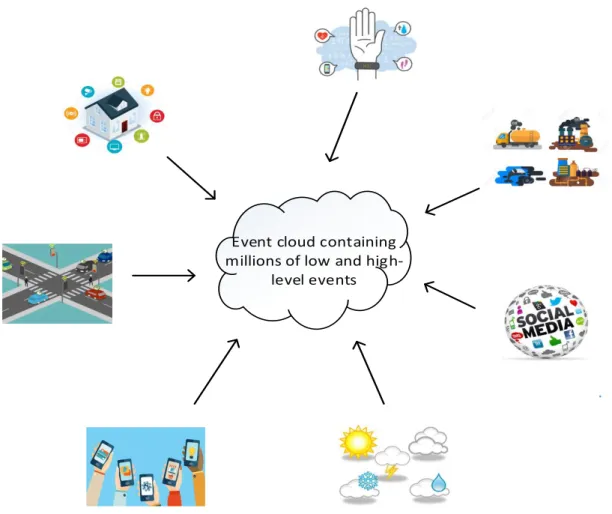
Figure 2.3 shows few IoT applications where event processing can be employed to extract high-level knowledge. These applications produce millions of low-level events
2.3. How CEP fits in IoT world ? 25
Event cloud containing millions of low and
high-level events
Figure 2.3: Event processing in the IoT world
which when analysed individually do not add significant amount of knowledge. CEP provides a perfect fit for analysing spatial and temporal patterns of low-level events to extract high-level events and hence reducing the number of events exponentially. High-level events can be used as input for hierarchical CEP or other sophisticated tools such as machine learning and artificial intelligence (AI) etc.
In this section, the use of CEP for IoT applications is briefly explained in the context of IoT data processing requirements. The development of technology in most of the cases is generic and can easily be applied to other IoT applications.
2.3.1 Intelligent Transportation Systems
The use of the CEP is increasing in many IoT applications due to its ability to process large volumes of events in near real-time. Intelligent transportation system is one of the most integral part of smart cities due to its social and economic impact on the standards of living. The increasingly high number of traffic sensors in cities along with the recent concept of crowd sensing [68] has resulted into amount of data being generated to a level where conventional data analysis methods are proving to be a limiting factor. This large amount of data generated has to be analysed with minimum time latency to manage traffic. The ability of the CEP to process data streams in near real-time makes it ideal candidate to provide solutions in this scenario.
One of the early work in this direction was mentioned by Dunken et al [21] where the authors proposed an event driven architecture (EDA) based on the CEP for analysing large traffic data to provide automatic solutions for decision support systems for the traffic management. They introduced the concept of event processing agents (EPAs) connecting streams of increasingly abstract types of events. They proposed a dis-tributed hierarchical architecture where several instances of EPAs were deployed in every layer. The proposed solution was implemented by using Esper CEP1 which is an open-source java based CEP system. In order to realize the distributed architecture, the authors have used message oriented middleware (MOM) as an event distribution service. Although they discussed the requirements of real-time data processing and correlating different data streams, but they did not support their solution with suffi-cient qualitative and quantitative evaluations. Another early work for using the CEP for traffic is shown in [77]. They used the data from different traffic sensors including loop detectors, radars and cameras and configured CEP rules with the help of domain experts to detect different complex events including congestion. Both of these research efforts demonstrate the application of the CEP as a potential solution for handling real-time fast data streams.
The number of sensors deployed in modern vehicles has also seen a significant rise and led to many research efforts intended to provide more contextual solutions for users. It
2.3. How CEP fits in IoT world ? 27
involves processing and fusion of data from multiple sensors in real-time which makes the CEP an ideal candidate. The authors in [78] propose an analytics solution for smart vehicles using Esper CEP and introduced the concept of Intra-vehicular context awareness (IvCA). The approach uses different on-board sensors to detect the on-board passengers and their activities. Such information can be used to provide more context-aware solutions like playing the favourite track of passengers or locking the door next to a minor. This work indicates a future trend where CEP capabilities are being implemented towards the edge near to the data source.
2.3.2 Smart Homes
Smart homes is another application area which has seen the significant rise in the use of sensor based solutions. The deployment of smart energy meters, occupancy sensors and environmental sensors is becoming common in many domestic and commercial buildings [57]. A common goal for all these deployments is to monitor and correlate data coming from different sensors in real-time and take actions accordingly. For instance, if heating unit is detected in ON state when there is no one at home, it should be switched off in order to save energy. CEP provides the capability to monitor and correlate this data in real-time using simple rule-based approach. In this regard, many examples are found in the literature where researchers have proposed solutions based on CEP for smart homes.
One of the early work in this direction is mentioned in [83], where authors highlighted the drawbacks of current semantic web technologies for real-time applications and discussed the gains of event-driven architecture in contrast to semantic web request-response architectures. Following the concepts of event processing network introduced by David Luckham [42], they provided the basics for a CEP framework with inference and reasoning capabilities to work with linked datasets and discussed its use for the real-time energy optimising service for the smart homes. They presented their solution at abstract level as technology was not matured enough at that time.
Another work mentioned in [82], where authors proposed a framework for energy mon-itoring and management in the factory in order to assist decision support systems.
They highlighted the difficulties to apply CEP in an industrial environment such as collecting data from different processes running in noisy environments, problems with synchronization of data, unnecessary data or redundant data and high volume of net-work traffic. They deployed distributed CEP with event processing agents running in an embedded hardware responsible for cleaning, filtering and extracting abstract events before transmitting it to the server. CEP running on server gathers data from different processes and calculates the manufacturing system performance according to defined energy KPIs in real-time. They demonstrated their solution by deploying the proto-type in machining line of a major European automotive manufacturer and showing how it increases energy efficiency and helped them in diagnosing failures reactively by analysing and correlating data streams in real-time.
Another work which proposed a distributed architecture for the deployment of CEP is discussed in [13] for smart buildings. Authors proposed a client server based archi-tecture and demonstrated that it can be used to separate pre-processing and reason-ing parts which will contribute towards less amount of data flow across the network, thereby, reducing the burden on the central server. They showed that CEP based ar-chitecture enables users to inject simple rules in order to contribute for applications such as managing lighting system using occupancy schedule and monitoring devices for malfunctioning. Environmental monitoring in buildings represent another appli-cation area where CEP has the potential to provide real-time solution for extracting knowledge as shown in [53]. They captured data from different environmental sensors measuring temperature, smoke and carbon monoxide and correlated it with occupancy sensors data using a CEP running in middleware to detect crowded places in real-time in the event of a Fire. Such information can be used by fire fighters to reduce damage and save human lives.
2.3.3 Social Media
Social networks, blogs, mobile services and applications generate large volumes of data that can be seen as ‘sensors’ of people’s moods, interests, relations, etc. The analysis on social media data have significant potential on different applications like poll analysis,
2.3. How CEP fits in IoT world ? 29
stock market predictions, public opinion analysis. Data is generated in the form of events where every new status or picture upload, every tweet, or every like/comment can be seen as an event. Event processing tools provide the capability to monitor, aggregate or correlate the data coming in the form of events with different sources. One of the goals of the analysis of social media data is to capture the hidden relation-ships between people and concept. One such application is mentioned in [48], where authors used CEP to find community relationships. They highlighted the increasing demands of processing data for social network graphs in near real-time for social ap-plications and proposed an architecture based on parallel CEP and graph processing called GraphCEP. They demonstrated their solution using two different use cases. First use case involved detecting top posts based on the likes and comments where second use case was targeted to find community relationships. Both use-cases involve analysing large and dynamic data in near real-time. In [73], authors have discussed that not many real-time public mood tracking frameworks over social media streams are avail-able. To address this issue, they proposed a hierarchical framework for real-time public mood time series tracking over Chinese microblog streams using CEP. They used text sentiment analysis to transform microblogs into emotional microblog events and later applied CEP operators like sliding windows and pattern matching to derive higher level events indicating public moods.
2.3.4 Remote Health Monitoring
Remote health monitoring is another potential application of CEP which has gained significant importance with the advent of IoT. It started with the use of discrete event simulations for healthcare applications [32] and as the technology evolved, it has found its applications for more real-world problems [85]. It involves deploying different sensors in the form of wearable devices collecting patients information to gain insights about the context and situation of patients. These devices generate fast data in near real-time which needs to be analysed as soon as possible in order to ensure safety of the patients. Every reading indicating heart rate, blood pressure or current blood sugar level represents an event which can be correlated with other events such as physical
activities of the patient, pollution level of their surroundings or dietary information to extract high-level knowledge.
2.3.5 Supply Chain Management
Supply chain management is also one of the major area which has experienced a sig-nificant impact with IoT. The monitoring of food and pharmaceutical products for ensuring their quality during the complete cycle of supply chain is an interesting ap-plication of IoT. However, the increasing number of connected devices and real-time monitoring requirements is one of the challenging factor in this regard. The ability of CEP to process data streams in near real-time makes it ideal candidate for such situa-tions as the authors proposed autonomous monitoring of sensitive goods in [72] using Esper CEP1. There solution was based on simple rules for continuously monitoring if the surrounding temperature for products lies within the prescribed range. It involved manual setting of threshold values for normal working range.
1
2.3. How CEP fits in IoT world ? 31
Table 2.1: Applications of CEP in IoT
literature application real-time processing heterogeneous event processing Scalability
Nicholas et al [68] ITS yes - yes
Jurgen et al [21] ITS yes yes yes
Bogdan et al [77] ITS yes yes
-Fernando et al [78] ITS yes yes
-Andreas et al [83] smart homes yes yes
-Konstantin et al [82] smart homes yes yes
-Ching et al [13] smart homes yes -
-Marina et al [53] smart homes yes yes
Ruben et al [48] social media yes yes yes
Si Shi et al [73] social media yes -
-Jun et al [32] Health - yes
-Di Wang et al [85] Health yes yes
-Septimiu et al [72] Supply chain yes - yes
Bogdan et al [81] Geofencing yes - yes
Table 2.1 summarises the application of CEP for extracting knowledge from IoT data streams. It is evident from the Table 2.1 that CEP is mostly deployed to meet the requirements of real-time data processing. Heterogeneous event processing is another important factor which makes CEP as a potential solution for different IoT applications. However, only few research efforts addressed the issue of scalability while deploying CEP based solutions.
2.3.6 Geofencing
CEP is a generic tool to analyse and correlate events which makes it suitable for variety of applications as evident by its use for providing a geofencing service in order to monitor physically disabled individuals [81]. As geofencing service involves continuous streams
of mobility data, CEP provides a perfect fit to analyse this data and continuously monitor the journey. The use of CEP also enables it to further integrate the service with event rich environments, such as those resulting from smart city infrastructure.
2.4
Challenges and Research Gaps
In the previous sections we have discussed how CEP addresses the requirements of data processing for different IoT applications. In this section, we highlight the challenges in CEP based solution while pointing out the gaps this thesis aims to close.
2.4.1 Challenge 1: Predictive Event Processing
Most of the CEP applications found in the literature are intended to provide reactive solutions by correlating data streams using predefined rules as the events happen and does not exploit historical data due to its limited memory [24]. However, in many applications, prediction of a forthcoming event is more useful than detecting it after it has already occurred. For example, it will be more useful to predict traffic congestion as compared to detecting it, so that traffic administrators can take preventive measures to avoid it. The advantages of predicting an event are more obvious if we imagine the gain of predicting natural disasters and disease epidemics.
On the other hand there are several methods found in literature based on ML and statistics which have the ability to provide innovative and predictive solutions in dif-ferent domains. For instance, predicting passengers travel time for ITS [91] and energy demand for buildings [100] are two of the many examples found in literature. However, these methods are unsuitable to analyse and correlate different data streams in near real-time due to the requirement of historical data for training. ML methods exploit historical data and apply diverse approaches such as probability, statistics and linear algebra to train the models in order to make predictions about the future. They have the potential to provide the basis for proactive solutions for IoT applications but lack the power of scalability and processing multiple data streams in real-time which is provided by CEP [31] .
2.4. Challenges and Research Gaps 33
In literature, CEP and ML have been explored extensively as separate research fields and were mostly targeted for different types of applications. CEP has been designed for processing and correlating high speed data on the fly without storing it [16]. Whereas ML methods are targeted for applications which are based on the historical data for knowledge extraction[79].
In recent years, the diverse requirements for processing data in IoT led to hybrid ap-proaches where predictive analytics (PA) methods based on ML and statistics are com-bined with CEP to provide proactive solutions. Initially, it was proposed in [30], where authors presented a conceptual framework for combining PA with CEP to get more value from the data. The approach of combining both methods lead to encouraging re-sults; however, they did not support their idea with any practical application. Another example is given in [93] where authors used probabilistic event processing network to de-tect complex events and then used these complex events to train multi-layered Bayesian model to predict future events. Their proposed prediction model employs expectation maximization (EM) algorithm [33]. EM being an iterative optimization algorithm has high computational cost. Its complexity increases exponentially as the training dataset increases, therefore making it unsuitable for large scale IoT applications. They demon-strated their solution on the simulated traffic data with the assumption of availability of statistical data of vehicles which is unlikely to be available in a real-world use-case. In [55], authors provide a basic framework for combining time series prediction with CEP to monitor food and pharmaceutical products in order to ensure their quality during the complete cycle of supply chain. The authors highlighted the open issues related to prediction component such as model selection and model update as new data arrives but they did not address these issues and left it for their future work. Another example of using time series prediction of data for CEP in order to provide predictive IoT solutions is mentioned in [5], where authors implemented neural network for prediction. They demonstrated their approach on the traffic data and used 60 days of data to train the neural network. Once trained, model parameters are static which is a major drawback. The statistics and behaviour of underlying data may change over time due to concept drift [89] which can effect the accuracy and performance of the neural network. Furthermore, the model is unable to update and adapt to
changes. In case of erroneous readings, errors will propagate and potentially will keep on increasing eventually effecting the reliability of the system. This thesis addresses the above mentioned challenges as a first contribution and explained the proposed approach in chapter 4.
2.4.2 Challenge 2: Automatic Rule Generation for Context-Aware
Event Processing
In order to detect complex events, systems based on CEP require rules which have to be provided manually by the system administrators. Based on this, there is an assump-tion that administrators have the required background knowledge which sometimes is neither available nor so precise. The manual setting of rules and patterns limit the use of CEP only for domain experts and poses a weak point. And even with prior expertise and knowledge, experts are prone to make errors in choosing optimized parameters for dynamic systems. Current systems based on CEP deploy static rules and there is no means to update the rules automatically. In real-time dynamic IoT applications, the context of the application is always changing and the performance of CEP will deteriorate in such scenarios.
In literature, there are quite a few examples where the researchers have applied the concepts of machine learning domain for optimizing the rules of CEP. One such example is given in [46], where authors discuss the possibility of applying machine learning techniques for finding the rules. They applied information gain ratio (IGR) to optimize the detection of already recorded events. Their system was application dependent and easily prone to fail in situations where prior knowledge about the events is unavailable. In [80], authors presented a mechanism for automating both the initial definition of rules and their update over time. Their proposed solution was based on iterating over two stages; rule parameter prediction and rule parameter correction. The first stage is based on updating parameters using an expert knowledge and the updated history of already materialized events while the second stage is based on expert feedback of actual occurences of complex events in order to fine-tune the rule parameters for the next prediction stage. They highlighted the issues of finding optimal rule parameters
![Figure 2.1: Background of event processing [23]](https://thumb-us.123doks.com/thumbv2/123dok_us/1370000.2683450/30.918.166.780.123.579/figure-background-of-event-processing.webp)