Minimum wages and collective bargaining: A framework for examining multiple intersections
(Damian Grimshaw and Gerhard Bosch)
Across Europe minimum wage rules play an important role in shaping the wage structure among the lowest paid but the character of effects depends on a raft of interlinkages and interactions with structures of collective bargaining and the interests and actions of unions and employers. On the one hand, we need to understand more clearly the competing approaches of government, unions and employers towards statutory minimum wage regulation. While a statutory national wage floor is supported by most European country governments (similarly, international data show it is implemented in 90% of ILO member countries), the motives and policy goals are mixed and this shapes the consequences of minimum wage setting. Also, employers and unions each display very varied outlooks towards minimum wages across Europe, creating complex trajectories of regulatory adjustment. In Germany, for example, the right of government to set a basic wage standard in the labour market is resisted by employers and some unions as stepping outside the accepted boundaries of public policy into areas of regulatory responsibility controlled by unions and employers. By contrast, unions and employers in the UK now accept the statutory wage floor as providing needed protection against damaging cost-led competition in markets where opportunities for joint wage regulation have substantially diminished since the late 1970s. On the other hand, we also need to interrogate more carefully how the different rules and other characteristics (such as level and form of implementation) of minimum wage systems create obstacles or opportunities for collective bargaining. Do different countries display distinctive interactions between minimum wage-setting and the collective bargaining of base rates? To what extent are processes of social dialogue incorporated in minimum wage-setting? Does greater stability and transparency of minimum wage policy facilitate collective bargaining processes and the ability for trade unions in particular to formulate longer-term actions around pay? Is there evidence of too high minimum wages crowding out collective bargaining, or too low minimum wages weighing down negotiated wages for low paid jobs?
This chapter presents a preliminary investigation of these issues for nine European countries – Croatia, Estonia, France, Germany, Hungary, Ireland, Spain, Sweden and the UK – providing a somewhat broader comparative country context for the subsequent detailed analysis of five countries in part III of the book.1 The chapter begins by exploring the diverse outlooks of governments, unions and employers towards statutory minimum wage regulation, followed by section 2, which sets out the full details of minimum wage rules, including data on relative levels, in the nine countries. Section 3 provides a very brief
1 In common with the rest of this book, the evidence and arguments in relation to Croatia, Germany, Hungary, Spain and the UK are sourced from five highly detailed national reports commissioned as part of this research project and authored by contributors to this book. Repeated referencing to these works is therefore not made. See bibliography for details of the reports.
overview of collective bargaining systems and section 4 analyses basic patterns between minimum wage and collective bargaining systems. Section 5 builds on these findings to set out a framework for identifying and assessing the alternative types of intersections between minimum wage systems and collective bargaining, identifying the roles of three key factors - social dialogue, government policy goals and compliance – in conditioning the country- and sector-specific outcomes. Section 6 applies this framework to the sample of nine countries and section 7 provides a chapter summary.
2.1. The outlook of government, employers and trade unions
While a majority of countries in Europe have established a statutory minimum wage, the operationalisation of the policy is likely to be a continuing source of conflict and tension. For evidence of this we can observe across Europe many instances of change in the direction of minimum wage policy, recurring debates over the appropriate method and size of uprating of the minimum and conflict over the relative weights of the interests of government, employers and unions with regard to shaping the objectives of minimum wage policy. In their international review of minimum-wage fixing criteria, Eyraud and Saget argue such conflicts are inevitable:
It is precisely because the minimum wage is a powerful and flexible instrument of economic and social policy that its use varies across countries, resulting in a host of different arrangements and national models. Nevertheless, this diversity gives rise to both problems and contradictions ... (2005: 2).
In part, evidence of the contested terrain of minimum wage policy reflects competing views about the role of government regulation in labour markets. The setting of a statutory minimum wage is one of a number of instruments of public policy at the disposal of governments – along with minimum working hours and minimum paid holidays for example – to set basic legal standards in the labour market. But the conventional mainstream economics view does not support this role. Instead, government intervention in wage-setting is believed to impede the private activities and decisions in the labour market by individual (and collective) bodies. This viewpoint was deployed to great effect in the UK during the 1980s and early 1990s and resulted in the abolition of wages councils that set sector-specific minimum wages (Blackburn 1988, Machin and Manning 1994). It also accounts for the very low levels of minimum wages set in former Communist countries in Europe in the early 1990s (Standing and Vaughan-Whitehead 1995).
The competing viewpoint – distilled from studies by heterodox economists, labour sociologists and industrial relations specialists (eg. Card and Krueger 1995, Freeman 1996, Kaufman 2010, Power 1999, Rubery and Edwards 2003) – is that minimum wage regulations form one of a battery of labour market institutions that help shape the rules of the game in the allocation, reward and movement of workers in the labour market. In this view, labour markets are complex entities embedded in a societal model of social, economic and political rules and norms; labour markets are bound to generate distorted outcomes because they are imperfect markets. As a result the argument that minimum wages distort market outcomes does not hold. Of course, one might nevertheless argue that labour markets lie on a
spectrum from more to less competitive. This may be true. However, the evidence in fact suggests that less regulated labour markets are not more likely to generate outcomes consistent with perfectly competitive labour markets. Several studies now show that in fact the weaker the institutional architecture in governing labour markets the further away are labour market outcomes from the textbook predictions (eg. Schettkat 2002, Teuling and Hartog 19982). While a surprising result for mainstream economists, Schettkat argues it is in fact ‘consistent with the view that labour markets are fundamentally imperfect markets and that the transaction costs to achieve the market-clearing equilibrium wage are high in decentralised bargaining systems. From a theoretical perspective, centralised bargaining may collect information and substitute for the auctioneer’ (2002: 13).
Aside from debates among economists about the role of labour market regulation, there are real-world tensions in adapting minimum wage policy with diverse economic policy goals of government (see figure 1). First, minimum wage policy may conflict with an approach to economic development that encourages growth of low-wage sectors, either to sustain low value-added industries that are important for regional income for example or as a mechanism to get the unemployed into work. Perceptions of such risks have changed, however, following 1990s studies (the ‘new economics’ of the minimum wage, Bhaskar and To 1999, Card and Krueger 1995, Machin and Manning 1994) that refute the mainstream economics view that a minimum wage necessarily causes significant negative employment effects. Second, minimum wage policy may be perceived as possibly undermining a low inflation target where there is a rising minimum wage coupled with large ripple effects further up the wage structure. Again, perceptions are likely to vary. The size of the inflation risk depends on the level of the minimum wage and its interaction with the country model of wage-setting. Freeman (1996: 645) argues that in countries with a minimum wage at a low-to-medium level and a pattern of weak collective bargaining ‘it is difficult to see how a minimum could set off general wage inflation’.
Alongside potential tensions, minimum wage policy may also be perceived as complementing governmental economic policy in several important respects. It may be perceived as promoting macroeconomic stability and full employment – as Kaufman (2010: 438-9) puts it, ‘first, to boost employment by augmenting aggregate demand; second, to prevent ruinous deflation and “destructive competition” in labour markets; and third, to maintain a better balance between spending and production.’ Redistributive government policy underpins the latter point and a minimum wage can promote a more equal society by raising the wage floor (Heymann and Earle 2010). A minimum wage also establishes a transparent floor to wage competition among firms and reduces (or prevents, depending on the level) the risk of workers living below subsistence income levels. The fewer the number
2 These two studies serve as a valuable counter to the neoclassical economics ‘law of one price’, which has fostered an enormous mainstream literature that identifies the ‘wage gaps’ between empirical reality and theoretically derived competitive labour market outcomes. Teulings and Hartog (1998) find that the unexplained variation in wage equations (when wages are regressed on individual human capital characteristics) is greater in the deregulated US and the UK than in the more regulated Norway and Sweden. Moreover, Schettkat (2002: table 3.1) demonstrates that these residuals correlate negatively (-0.84) with the centralisation of wage-setting institutions (using the Calmfors/Driffil ranking).
of workers living below subsistence, the less pressure on government to top up household income through means-tested benefit payments, such as in-work tax credits (Freeman 1996: 644-5, ILO 2010: 76, Metcalf 2009: 300, Sachdev and Wilkinson 1998) – although some institutional economists are ambivalent as to whether a statutory minimum wage or in-work benefits are the most appropriate form of intervention (Kaufman 20103). A higher minimum wage can also contribute to ‘making work pay’ and reduce incentives to remain on unemployment benefits. Indeed, the interaction with government social policy and tax policy is often overlooked in assessments of the merits of minimum wage regulation but has proven fundamental in several countries at particular points of time, including in Spain with the pre-2004 use of the minimum wage as an index for welfare payments and in Hungary when the government doubled the minimum wage in 2000/2001 largely in an effort to boost tax revenues (see below).
Figure 1. The competing interests of government, employers and unions towards minimum wage policy
Employers are typically assumed to be resistant to minimum wage legislation and opposed to policy interventions that raise the minimum relative to average or median earnings.
3 Kaufman (2010: 444-9) argues a statutory minimum wage is effective in part because it reduces the gap between the private and social cost of labour. However, other institutions may in certain situations be more efficient at achieving the same result and therefore ought to be considered for adoption. He cites the Earned Income Tax Credits found in the US, universal health insurance and pensions found in many European countries, job subsidy programs and universal collective bargaining (op. cit.: 448).
Minimum
wage
policy
Government policy •macroeconomic goals (eg. inflation
target)
•job growth/ economic development •tax/ tax credits policy
•welfare/ social policy •redistributive goals
Unions
•platform for collective bargaining •crowds out collective bargaining/
undermines union mark-up •fit with standard wage rule •fit with egalitarian pay bargaining
strategies
•absence/low level is catalyst for alternative 'living wage' campaigns
Employers •market-led wage-setting •cost constraints in competitive
sectors
•fit with 'quality enhancing' HRM •catalyst for niche product
Employers may be unwilling to accept any constraints on a voluntarist, or market-led, process of wage-setting which in their view enables them to match pay with the returns to individual productivity. Employers may also worry that it introduces pressures outside their control forcing them to pass on price rises to their base of customers. Many low-wage sectors are characterised by intense cost competition. Where this is characterised by international competition, or dependence on one or two powerful client businesses, or competition against firms operating illegally, several studies suggest employers may experience real difficulties passing on the costs associated with minimum wage policy changes (Edwards and Gilman 1999, Grimshaw and Carroll 2006, Ram et al. 2001).
Nevertheless, the opposite may also be the case. The bulk of employers may in fact welcome a properly enforced system of minimum standards that makes it difficult for low cost firms to compete on the basis of very low wages and/or informal payment methods. Also, in line with studies of experimental labour markets (Falk et al. 2005), they may anticipate that a minimum wage improves norms of fairness among workers, raising their commitment and contribution to firm performance in a manner that fits with Akerlof’s (1982) well-known economic model of a fairness ‘gift exchange’ between workers and their employer. A minimum wage may be a welcome catalyst for changes in approach towards employment organisation and product market approach. On the one hand, employers may perceive a minimum wage as a necessary component in their ‘quality enhancing’ approach to work organisation with investment in training and higher pay the ingredients for lower staff turnover and high productivity (McLaughlin 2010). On the other, some employers may respond to a newly introduced statutory minimum wage, or a significant rise in the minimum, by shifting into niche product markets where competition from cheap imported goods is less strong (Arrowsmith et al. 2003) or is led by quality, speed of service and creativity rather than cost (Bullock et al. 2001).
The principle of a statutory minimum wage can also be said to both complement and conflict with the interests of trade unions, most notably with regard to collective bargaining and pay equity strategies – the two dimensions that provide a focus for this book. A minimum wage set at a suitable level can provide a valuable platform for the establishment and strengthening of collective bargaining. By discouraging informal business operations and setting a basic legal standard in the labour market, unions in principle benefit from a wider pool of potential union members interested in improving their formal terms and conditions of employment. On the other hand, there are reasons why a minimum wage policy may also be perceived as undermining collective bargaining and inhibiting its spread among unorganised workers (Aghion et al. 2008). A statutory wage floor pitched too low may generate concerns among unions that it could pull down higher minimum rates negotiated in collective agreements. And where workers perceive a national minimum wage is effective in providing protection it may act as a disincentive among those in low wage jobs to join a trade union and/or make it difficult for unions to negotiate an attractive wage premium (Brown 2009: 442).
With respect to pay equity strategies, a minimum wage potentially dovetails with union strategies to compress the wage structure among members (especially since rising wage inequality is both a cause and a consequence of declining unionisation - Checchi et al. 2010:
102) and chimes with the Webbs’ notion of a common rule to wages and US unions’ strategy to standardise wages (Webb and Webb 1897, Metcalfe et al. 2001). It may also fit with a union’s strategic approach to wage equality, an issue we consider in detail in chapter 3. For example, a minimum wage potentially establishes a valuable benchmark against which a trade union may negotiate ‘bottom-loaded wage agreements’ to improve rates of low pay relative to pay earned by higher paid members (Heery 2000: 59). It can provide a standard against which a union may seek to establish an hourly wage premium of €1 or £1 in its collectively bargained rates of pay, for example, so as to persuade members of the benefits of union membership. Also, given women’s over-representation among the lowest paid, minimum wage policy may in certain circumstances complement union efforts to improve gender pay equity through gender equality bargaining (Dickens 2000, Rubery et al. 2005). Nevertheless, much depends on the relative value of the minimum wage and the direction of change. Where it is so low as to be perceived as either irrelevant to the general dynamics of the wage structure or incapable of providing for subsistence living standards for working families then alternative union pay equity strategies may prevail. These include ‘living wage’ movements that have emerged in the US, Australia and parts of the UK in part as a response to evidence that the statutory minimum wage falls below the income required for a basic standard of living.4
These varying and often competing views and interests among governments, employers and trade unions shape the trajectory of minimum wage policy and assist in an explanation of cross-national variation in the particular rules and processes implemented. The next section considers the details of these rules and processes in the nine countries selected for analysis.
2.2. Minimum wage systems in nine countries
Across the European Union, 20 of the 27 member states have some form of statutory minimum wage. Among the seven countries without national legislation multiple minimum wage levels are instead agreed by social partners in sector-based collective agreements, albeit with varying coverage of the workforce. As with all labour market rules (Freeman 1994), therefore, there is both considerable cross-national variety in minimum wage policy and practice and, as figure 2 illustrates, change in each country’s policy over time. This section reviews the differences in approach, as well as key moments of change, among the nine European countries selected for analysis.
Seven of the nine countries have a statutory national minimum wage (table 1). The two exceptions, Germany and Sweden, rely instead on different minimum rates negotiated in separate sectoral collective bargaining agreements; Germany also applies sector-wide minimum wages in several sectors through legally binding extensions. Among the group of seven countries, a statutory national minimum is in fact a relatively recent intervention in five countries; it is only a little over a decade old in Croatia, Ireland and the UK and two decades old in Estonia and Hungary. Differences in the age of this form of wage regulation, however, do not appear to be related to the variety of rules in place today.
As well as a standard, or adult, national minimum wage, many countries set alternative minimum wage rates for categories of workers who may be perceived as meriting special consideration. In most cases, the categories are defined in objective terms. For example, France, Ireland and the UK each specify youth rates, typically for workers aged 16 and 17 years old. The position of the UK is notable given its notion of an adult worker as a person aged 21 years old and over rather than the more conventional definition of 18 years old.5
Figure 2. Changing the rules of minimum wage policy: nine countries, 2001-2010
In some cases, the exceptional categories are more susceptible to changing definitions. For example, separate rates for jobs requiring skills and experience prevail in Hungary. During 2006-8 three tiers distinguished between a standard worker, a beginner-level skilled worker and a skilled worker with at least two years experience. Then, in response to employer criticisms this was simplified in 2009 to just two rates. Because the skilled minimum wage in Hungary is 22% higher than the standard rate6 there is a potential risk, which we explore in Part III of the book, that employers redesign jobs to reduce minimum wage payments. The rules in Croatia are also of interest since they set a separate ‘sub-minimum wage’ in four industries that are singled out for special attention due to their difficult economic conditions. This temporary sub-minimum was established in 2008 in the textile, clothing, wood processing and leather industries with the aim of reducing the possible job losses of a higher standard minimum wage.
5
In fact, until 2010 the UK government considered an adult worker as aged 22 years old and above, despite persistent recommendations over ten years from the independent Low Pay Commission to change the limit to 21 years.
6 When first introduced in 2006 the new minimum wage for skilled workers was only 5% higher than the standard minimum. However the agreement set out predetermined raises over a three-year period. The differential therefore steadily increased, reaching 22% during 2009 and 2010 (Neumann 2010: table 1).
Croatia:
New MW Act makes substantial changes 2010 2009 2008 2007 2006 2005 2004 2003 2002 2001 Croatia: MW linked to unemployment benefits Estonia: Agreement to raise MW to 41% of average wage by 2008 France: Decision to set up a new MW Commission in 2010 Hungary: Unprecedented rise in MW Hungary: New 3-tier MW system with 2 rates
for skilled workers
Hungary: Switch from 3 to 2-tier MW system Spain: MW delinked from welfare payments Spain: Government policy to raise MW during 2004-8 UK:
Low Pay Commission goal to raise MW relative to average
earnings 2003-7 UK: New youth MW for 16-17 year olds UK:
Adult rate extended to 21 year olds New apprentice MW
Germany: Industry minimum wages agreed for selected sectors during 2008-10
Sweden:
ECJ Laval case rules against construction workers’ trade union
Sweden:
New ‘Laval Law’ implemented
Ireland
Minimum wage earners exempted from income
tax Ireland MW increased without agreement of employers
Table 1 also presents the different nominal levels of the minimum wage. In 2010, there was a wide range in hourly rates, from €1.46 in Hungary to €8.86 in France7, which reflects both the cost of living of each country and the relative level of the wage floor compared to the
Table 1. Key characteristics of minimum wage systems in nine countries, 2010
Year established
Number of rates Standard rate/ (hourly
rate in Euros)1
Wage fixing process:
Frequency/ formula Process
Statutory national minimum wage
Croatia 19982 Two: standard rate and ‘subminimum’ for 4 industries
HRK2814 monthly
(€2.12)
Annual
Specific rule for uprating (but ambiguous)
Central Bureau of Statistics proclamation following automatic adjustment
Estonia 1991 One EEK4350 monthly and
EEK27 hourly (€1.73)
Annual
No automatic formula
Government decree following bipartite agreement
France 19703 Three: Adult; Youth (17 years); Youth (16 years)
€8.86 hourly At least annual
Automatic rise by CPI when inflation exceeds 2%, and half the rise of the PPP of manual workers’ pay
Government decree following recommendation by new Commission of independent experts (since 2008)
Hungary 1991 Two: universal and skilled
Ft73500 monthly and Ft423 hourly
(€1.46)
Annual, except 3-year arrangement in 2006-8
No automatic formula
Government decree following tripartite agreement
Ireland 2000 Four: adult; Youth (<18); trainees aged 18+; newly hired aged 18+
€8.65 hourly Varies – 15-20 months No automatic formula
Government decree with or without agreement from social partners
Spain 1963 One €633.30 monthly4 and €21.11 daily
(€4.20)
Annual
No automatic formula
Government decree following consultation with main unions and employer bodies
UK 1999 Four: adult, youth (18-20), youth (16-17), apprentice
€6.97 hourly Annual
No automatic formula
Government decree following recommendation by independent Commission of experts
Collectively agreed sectoral minima
Germany n.a. Multiple minimum rates by sector and by
n.a. Frequency varies depending on the collective agreement
Collective bargaining between unions and employers in some sectors; government makes
skill/region No formula minimum rate binding in some sectors Sweden n.a. Multiple minimum rates
by sector and by age/experience/ occupation
n.a. Annual (usually as part of 2-3 year pay deals)
No formula
Collective bargaining between unions and employers
No legal extension to uncovered sectors
Notes: 1. 2010 gross value (Euro exchange rates applicable in July 2010). Italicised figures have been converted from the annual (Spain) or monthly (Hungary, Croatia) rates to an hourly rate using European LFS data for average actual hours worked in the main job by full-time employees, second quarter 2009.
2. A form of minimum wage preceded the 1998 legislation known as the ‘guaranteed wage’ and was in operation during the socialist period and early transition years.
3. The SMIC was preceded by a different minimum wage, the SMIG, ‘Salaire Minimum Interprofessionnel Garanti’ (see www.cerc.gouv.fr/rapports). 4. In Spain, the annual statutory minimum wage (€8866.20 in 2010) constitutes 14 monthly payments.
average or median level of earnings, an issue we explore in chapter 3.8 There are also important country differences in the conceptualisation of the minimum wage in terms of a monthly, daily or hourly income guarantee. A monthly standard arguably meets the policy goal of establishing a minimum basic wage income for a full-time worker, with pro rata conditions for part-time workers adjusted for hours of work. A monthly minimum can be found in Croatia, Estonia, Hungary and Spain; it is the most common form of payment in the EU (Eurostat 2009). Indeed, in the case of Spain the fact that the minimum wage remained at a very low level for many years is partly explained by its popular interpretation as a monthly minimum income to prevent extreme poverty rather than as a benchmark for wage-setting. In contrast an hourly minimum wage applies an explicit notion that there ought to be a minimum reward for an hour’s work. This applies in France, Ireland and the UK, as well as Estonia and Hungary, which set both an hourly and a monthly minimum. In Germany and Sweden, the absence of a statutory national minimum wage means that it is not possible to report a single level. Instead there are multiple minimum wages set in the various sector-based collective agreements. A measure of the minimum wage level relative to median earnings (the Kaitz index) provides a better indicator for cross-national comparison. According to 2009 hourly wage data compiled from the OECD minimum wage database, France and Ireland (among the nine selected countries) have a high level minimum wage (60.1% and 51.1% of the median), the UK and Hungary a medium level minimum (46.1% and 47.8%) and Spain and Estonia a low level (44.1% and 41.3%) (figure 3). Data for Croatia are missing but a separate estimate suggests its minimum wage is at a medium level.9 Figure 3. The value of the statutory minimum wage (Kaitz index –median earnings), 2009
Notes: The estimation for the European average is a simple unweighted average for the 18 countries included. Median earnings refer to full-time employees only for all countries and generally include overtime and other supplementary pay. OECD data for France refer to
8 Country differences in prices can be controlled for by applying Purchasing Power Parities for household consumption expenditures, as presented in figure 3 of the Eurostat ‘Statistics in Focus’ (2008) publication.
9
Relative to average earnings the minimum wage in Croatia in 2009 is estimated at 36.2% (Nestić and Bakarić 2010) compared to an EU-19 country average of 37.4%.
0.25 0.30 0.35 0.40 0.45 0.50 0.55 0.60 Series1 0.360 0.413 0.430 0.441 0.442 0.449 0.453 0.454 0.461 0.472 0.478 0.482 0.490 0.508 0.511 0.519 0.537 0.601 0.472 CZ EE LU ES LT PO RO SK UK NL HU GR SI BE IE LV PT FR EU-18
its hourly data and for the UK Annual Survey of Hours and Earnings data (not the Labour Force Survey). Data for Croatia are not available on the OECD database.
Source: OECD earnings database, provided by Mark Keese.
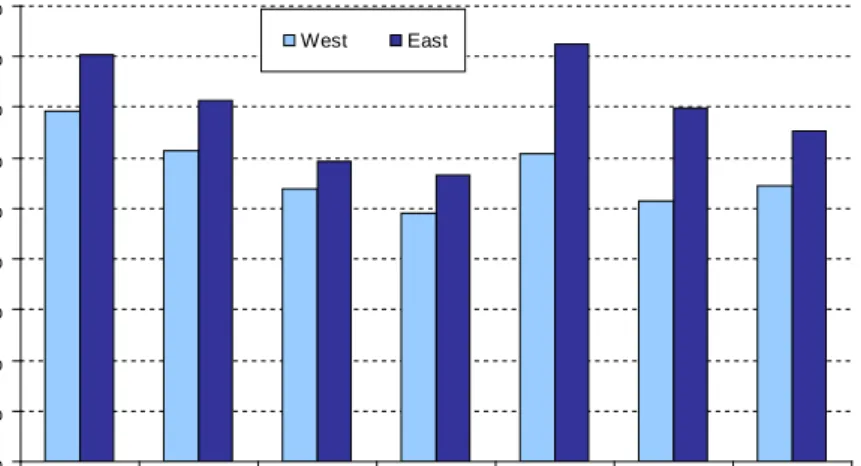
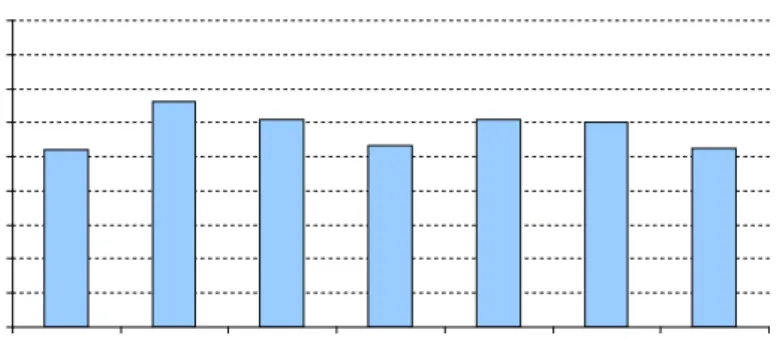
It is not possible to estimate a national Kaitz index for Sweden and Germany but it is possible to estimate the relative levels of sector minimum wages. The new binding collectively agreed minimum rates in the seven sectors in figure 4a include a lower rate for eastern Germany in five of the seven cases; a universal rate applies in the painting and varnishing and the waste management sectors. Nevertheless, the Kaitz index for eastern Germany is higher at 57% to 83% compared to 49% to 69% of average gross hourly earnings in western Germany. Thus although average earnings in eastern Germany are significantly below those in western Germany (€11.50 compared to €15.62 in 2008), the rates are set at a comparatively higher level in eastern Germany. In both regions, the lowest minimum rate is for the laundry sector, so this might therefore be taken as a proxy for the minimum wage floor so far agreed for the two regions of the German labour market – that is, 49% of average earnings in the west and 57% in the east.10 For Sweden, figure 4b presents data provided by Per Skedinger that updates work already published (Skedinger 2009). The lowest sectoral minimum is 49% of average earnings (in local government) and the highest among the seven shown is 66% in the bakery sector. It is unfortunately only possible to compare the results with those for Germany for the construction sector due to the mismatch of sectors: the value of the minimum wage in the construction sector in Sweden is 53%, considerably lower than the minimum agreed in Germany’s construction sector.
Figure 4. The value of sector-based minimum wages in Germany and Sweden (relative to average earnings)
a. Eastern and western Germany, 2010 (separate average earnings data for eastern and western Germany)
Note: 1. Hourly minimum rates are those agreed and implemented in 2010. We have used the most recently available average earnings data which are for 2008.
b. Sweden 2009
10 If we compare the minimum rates set for the two regions instead to the average earnings for the whole of Germany, the ratios are reversed with the sectoral minimum wages set for western Germany ranging from 51% to 72% of average German earnings, while the minimum rates set for eastern Germany only account for 44% to 64% of average German earnings. The MW values for laundries, the lowest paid sector, are 51% for western Germany and only 44% for eastern Germany. 0% 10% 20% 30% 40% 50% 60% 70% 80% 90%
Construction Electric trade Commercial cleaning
Laundries Painting & varnishing
Waste management
Care services
Source: Personal communication with Per Skedinger; see, also, Skedinger (2009).
Our nine-country comparison reveals a further variety of rules when we review the procedures for fixing a minimum wage (table 1). The first issue concerns the timescale for adjusting the minimum wage. All countries do this on an annual basis with the exception of Ireland. Since its introduction in 2000 the Irish minimum has been uprated after a period of anywhere from 15 months to 20 months, such that the date of uprating also varies from one year to the next (Nolan 2009: table 9.5). In the other countries, the timing is fixed; although in 2010 the French government changed the month for uprating from July each year to January in order to establish a more useful precedent for collective bargaining at sector and company levels (Eironline 2010).
Second, there are differences in the use of automatic indexation. Among the seven countries with a statutory minimum there is no automatic indexation in five countries. Even in the two countries with indexation, Croatia and France, in neither case can uprating be described as a scientific process; both sets of rules are in practice contingent upon, or supplemented by, political intervention. In Croatia, a new Act in 2008 intended to establish an automatic rule - that the minimum wage would be uprated each year such that the percentage rise in the Kaitz index (defined as the ratio of the minimum wage to average earnings of the previous year) matches the percentage rise in real GDP the previous year. Throughout 2009 and 2010, trade unions, employers and government arrived at different views as to what the formula implied, in large part caused by differences of interpretation of the Kaitz index. Also, there was debate over whether or not to cut the minimum wage in 2010 due to a decline in real GDP in 2009. In the end it was frozen. While Croatia’s Central Bureau of Statistics is expected to arrive at an independent recommendation of the minimum wage rise, in fact it did so only after consultation with government, seemingly accepting the government’s interpretation of the controversial indexation rule. In France, an automatic rule links the minimum wage both to the consumer price index (rises over 2%) and to at least half the annual rise in purchasing power of manual workers’ average hourly pay. This automatic linkage to prices and earnings growth is supplemented by a legally defined discretionary role of government, known as the coup de pouce. During 1997-2005 the coup de pouce was instrumental in boosting the minimum, but played no role at all during 2007-2010(Gautié 200911; Eironline 2010).
2.3. Collective bargaining in the nine countries
Table 2 provides a summary profile of the character of collective bargaining in the nine selected countries. The share of the workforce covered by collective bargaining varies widely from
11 And updated via personal communication with Jerome Gautié during 2010.
0% 10% 20% 30% 40% 50% 60% 70% 80% 90%
Engineering Bakery Slaughter-house
Construction Retail Hotels & restaurants
Local Government
approximately one in five workers in Estonia to near complete coverage in Sweden and France. Also, there is a fundamental difference between negotiations in countries with multi-employer wage bargaining compared to those with single-employer wage bargaining (Traxler et al. 2001). Where a sector agreement is in place, collective bargaining potentially takes place at both sector and company levels. Where one is not in place, as is usually the case in Croatia, Estonia, Hungary and the UK, then only the company level is relevant.
Table 2. General arrangements for collective bargaining in nine countries1
Sector level Company level Collective bargaining coverage2 Croatia Several examples but weak
compliance outside public sector
Predominant arrangement 61%
Estonia Few sector agreements Predominant arrangement 22% France Predominant arrangement
for small and medium-sized firms
Predominant arrangement for large firms
95%
Germany Predominant arrangement Strongly shaped by sector level agreement
63% Hungary Several examples but weak
compliance outside public sector and utilities
Predominant arrangement 35%
Ireland Few sector agreements (eg. construction)
Predominant arrangement (within the framework of national pact agreements until their collapse in 2009)
44%
Spain Predominant arrangement Only partially governed by sector agreement
80% Sweden Predominant arrangement Varying importance in
supplementing sector agreement
92% UK Not used outside public
sector
Predominant arrangement 34%
Source: 1. National reports and supplemented by Traxler et al. (2001); 2. ICTWSS database, 2006 data except 2005 for Hungary; Croatia data from Nestić and Bakarić (2010); Ireland data from EIRO ‘Ireland: industrial relations profile’ (2007).
Sector-level bargaining provides a potentially important forum for social dialogue and wage-setting. Under different forms, it is the predominant arrangement in Germany, Spain and Sweden, as well as for small and medium-sized firms in France. It also plays an important role in certain sectors (typically the public and construction sectors) in other countries, including Ireland and the UK. Sector agreements may cover the whole country or be limited to a particular region or province. Moreover, they may involve single-sector or multi-sector coordination (Marginson and Sisson 2006: ch3). Spain has the most complex and varied pattern of sectoral agreements. In some sectors, such as construction there is one national agreement, while in others there are dozens of agreements that each cover a particular province or locality, as well as, in some sectors, disaggregated segments of the sector – such as an agreement for bakery shops rather than a general retail agreement. There is a similarly strong tradition of sector agreements in Germany and, as we describe below, several of these have provided
the foundations for new legally binding sector-specific minimum wages, established under the Law on the Posting of Workers.
The interaction between sector- and company-level agreements depends on the procedural provisions that govern interaction between the two levels. These interactions tend to have a strong influence in Germany but a far weaker influence in Spain, Croatia and Hungary. This arises largely because the responsibilities of the different actors is not well defined in some sectors (Arrowsmith and Marginson 2008). The approach of trade unions towards company versus sector level bargaining is complex. They may seek to discourage company pay bargaining and lobby instead for new agreements to be negotiated at the sector level. Or, they may seek to establish improvements in conditions at a company level because negotiations at a sector level are more difficult and at risk of delays.
2.4. Analysing patterns of minimum wage and collective bargaining systems
Previous comparative studies make two general observations about the inter-relationship between a statutory minimum wage and the model of collective bargaining (EC 2008: ch3, Schulten 2006, Vaughan-Whitehead 2009a). First, countries with strongly coordinated collective bargaining and high levels of coverage tend not to have a statutory minimum. The group of European countries without a statutory minimum includes Austria, Denmark, Germany, Finland, Italy, Cyprus and Sweden.12 Also, while collective bargaining coverage in five of the six countries shown in figure 5 is at least 80%, this is not true of Germany, thus largely explaining why the issue of a statutory minimum wage has now risen to the top of the industrial relations agenda. For the others, strong collective bargaining has traditionally provided a functional equivalent to statutory protection, ensuring the lowest paid receive adequate protection (Schulten 2006: 12).
A second general observation about the relationship between minimum wages and collective bargaining is that among countries with a statutory minimum, the stronger the collective bargaining the higher the relative value of the minimum wage. The two institutions are thus to some extent complementary. The estimated correlation between the two variables shown in figure 6 is moderately positive at +0.46. Countries classified as having either an ‘inclusive’ or ‘dual’ model of industrial relations (following the definitions in Gallie 2007) tend to be in the upper right-hand corner of the graph with above-average collective bargaining and an above-average value of the minimum wage. Other countries classified as having an ‘exclusive’ industrial relations model are more likely to be located in the bottom left-hand corner of the graph. There are exceptions to this pattern. In particular, Spain (and Greece) has a relatively high level of collective bargaining coverage but sustains a relatively low value minimum wage for reasons we explore further below.
Figure 5. Collective bargaining coverage in countries with and without a statutory minimum wage, 2006
(EU-27 plus Croatia)
12 Austria implemented a new minimum wage in 2009 (a gross monthly wage of €1,000 or €14,000 per year accounting for the 14 monthly payments) as part of a national, cross-sectoral agreement negotiated by social partners. It is not a statutory requirement and this has raised questions regarding lack of coverage of workers in sectors and regions where social partners have not concluded a collective agreement (Hofbauer and Adam 2009).
Note: Data for Romania missing. 2006 data except Greece and Hungary (2005).
Source: ICTWSS (Visser 2009); except Croatia (Nestić and Bakarić 2010) and Ireland (eironline 2007); see appendix table A1.
Figure 6. The value of a statutory minimum wage and the level of collective bargaining coverage 0 10 20 30 40 50 60 70 80 90 100 DE CY DK FI SE IT AT A v er age LT LV EE BG UK HU PO SK CZ IE MA LU CR PT ES NL GR FR BE S I A v er age
Countries without a statutory
Note: Correlation between the variables of 0.457;
Countries are colour coded to fit type of collective bargaining: blue diamond = exclusive; green square is dual; and white triangle is inclusive;
Collective bargaining data refer to 2006, except 2007 for Ireland and 2005 for Greece and Hungary. Minimum wage data refer to 2009.
Source: OECD minimum wage database for ratio of minimum wage to mean earnings; Collective bargaining data from ICTWSS (Visser 2010) except Ireland collective bargaining data from eiro.online.
One reason for the positive relationship is that strong collective bargaining coverage is associated with a more compressed wage distribution, which in principle raises the relative level of low wages. This compression in bargained rates is likely to have an upwards effect on the setting of the minimum wage level as well (EC 2008: 83). It is also possible that social partners are in a stronger position to argue for a higher national minimum wage – either because this suits their pay equity strategy or, as the EC (2008) study argues, because it avoids low wage competition which might damage centralised wage agreements.13
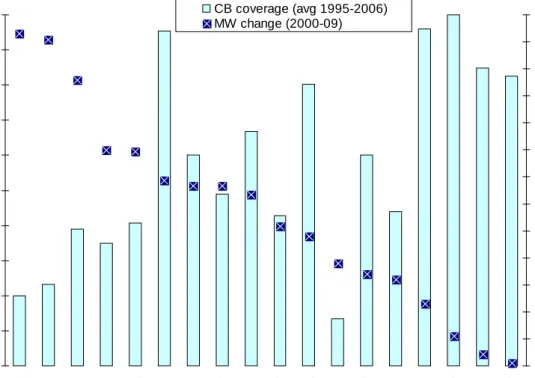
However, there is also a dynamic feature to these cross-national patterns, which may alter the positioning of countries. This concerns a third less well-known observation that the value of the minimum wage has tended to increase more in those countries with weak collective bargaining (figure 7). The data suggest a relatively strong negative relationship between the change in minimum wage value during 2000-2009 and the strength of collective bargaining coverage (averaged over the 1995-2006 period); an estimated correlation measure of -0.65. Seven out of eleven countries that experienced a rising minimum wage were countries with an ‘exclusive’ model of industrial relations –
13 Our findings complement the EC (2008) study which report various statistically significant correlations between the Kaitz index and industrial relations variables including employer density (0.741), union density (0.600) and bargaining centralisation (0.581). LT HU BE CZ EE GR ES FR SK IE LU LV NL PO PT SI UK 28 30 32 34 36 38 40 42 44 46 48 0 10 20 30 40 50 60 70 80 90 100
Collective bargaining coverage
R at io of m ini m um w age t o m ean ear ni ngs
that is, weak (and generally uncoordinated) collective bargaining coverage. We explore minimum wage trends in more detail in chapter 3.
Figure 7. Change in minimum wage value (2000-9) and strength of collective bargaining coverage (averaged over 1995-2006)
Note: Correlation between variables of -0.648;
The level of collective bargaining coverage is averaged over the period 1995-2006, except Croatia which refers to an estimate for 2010 (Nestić and Bakarić 2010);
The change in the minimum wage level refers to the difference in percentage points between the Kaitz index in 2000 and in 2009 – except Ireland, 2001-2009, and Slovenia, 2005-2009.
Source: OECD minimum wage database plus data for Croatia from (Nestić and Bakarić 2010); Collective bargaining data from ICTWSS (Visser 2009) except Croatia (Nestić and Bakarić 2010) and Ireland (eironline).
It appears that governments and/or social partners have intervened to improve the statutory minimum wage in a context of weak collective bargaining strength. France (along with Luxembourg and Portugal) is an exception, combining its dual model of industrial relations with a rising minimum wage. On the other hand, countries that have experienced declines in the minimum wage value during 2000-2008 tend to have a relatively high level of collective bargaining coverage. This group of countries includes Belgium (with its inclusive model of industrial relations) and the dual models of Slovenia, the Netherlands and Greece. As such, we might conclude that there is evidence of convergence trends in the level of the minimum wage, albeit with notable country exceptions.
**CUT here, separate chapter?
2.5. A framework for identifying intersections with collective bargaining
The inter-relationship between the dual wage-setting institutions of minimum wages and collective bargaining is complex, multi-layered and differentiated across countries. Moreover, as the detailed
0 10 20 30 40 50 60 70 80 90 100 LV EE HU UK PO FR LU CZ PT SK ES LT CR IE BE SI NL GR A v er age c ol lec ti v e bar gai ni ng c ov er age -4 -3 -2 -1 0 1 2 3 4 5 6 7 8 9 C hange i n v al ue of m ini m um w age CB coverage (avg 1995-2006) MW change (2000-09)
empirical analysis in part III of the book demonstrates, there is a wide heterogeneity of patterns within countries as a result of varying practices and experiences at sector, region and company levels. In this preliminary assessment, we set out the key building blocks for our subsequent detailed empirical analysis of the intersection of minimum wage rules and collective bargaining strategies and practices. The general argument is that different types of intersections, constituted by tensions and complementarities, provide different opportunities for government and social partners to design and apply pay equity strategies with respect to both minimum wage policy and collective pay bargaining in those sectors (and companies) exposed to minimum wage policy developments. We elaborate the first part of this argument relating to intersection types in the following two sections and turn to the implications for pay equity issues in chapter 3.
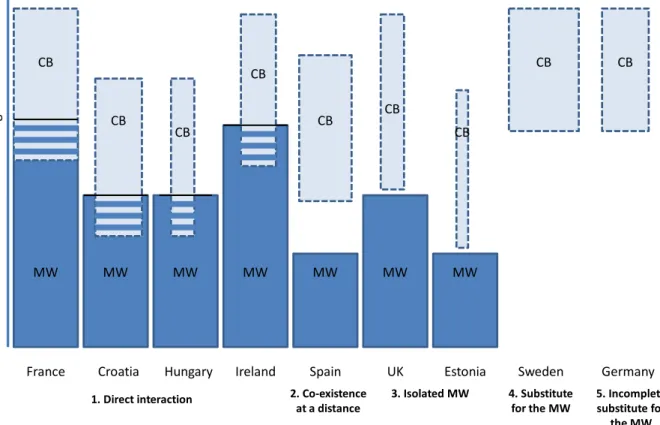
There are five types of intersections, each characterised by a particular relationship between the statutory minimum wage and wage rates (typically base rates or entry rates or pay) set in collective agreements and conditioned by the level of coverage of collective bargaining. These are summarised in figure 8. The first type, direct interaction, is characterised by an overlapping of the statutory minimum wage with wage rates negotiated in collective agreements. In some situations this may involve formal or informal use of the minimum wage as a platform base wage in collective agreements, while in others the minimum wage may in fact overtake collectively agreed wage rates. The latter situation may cause problems in the synchronisation of annual wage settlements and call into question the role of joint regulation as opposed to state intervention in setting entry wage rates for low-wage occupations, particularly since the sub-minimum wage rates set out in collective agreements do not conform with legislation.
The second type of intersection, ‘co-existence at a distance’, applies where the gap between the statutory minimum wage and base rates of pay in collective agreements is so wide that social partners regard the minimum age as either irrelevant or a threat to higher rates negotiated in collective agreements. An ‘isolated minimum wage’ describes a third intersection where the minimum wage is in fact the dominant influence on wage-setting at the bottom of the wage structure, with very limited input of collective bargaining – portrayed in figure 8 by a narrow column for collective bargaining. The fourth and fifth types of intersection are varying forms of ‘substitutes for the minimum wage’. The former is characterised by near complete coverage of collective bargaining that provides an effective substitute, whereas the latter is characterised by low to medium level coverage and thus does not provide a functional equivalent to a national statutory minimum wage and does not extend full wage protection to the low-wage workforce.
In the particular country and sector contexts that we explore in subsequent analysis, the qualitative nature of, and consequences arising from, these five types of intersections are largely shaped by three inter-related factors:
i) transparency of minimum wage policy and degree of engagement with social dialogue; ii) competing government policy objectives; and
iii) degree of regulatory compliance and use of informal/illegal wage practices
The first factor concerns procedures. Uncertainty and obscurity in minimum wage policy risk imposing unanticipated shocks to the labour market, whereas greater transparency and regularity in principle create greater opportunities for complementary wage bargaining by employers and trade unions. Relatedly, the role of social dialogue in the design and implementation of minimum wage policy also shapes the degree to which one might expect it to develop in step with collective bargaining practices. Where social dialogue is absent or weakly embedded, the likelihood that minimum wage policy responds to multiple and conflicting goals of government (see above) is stronger, risking dislocation or a disconnect with patterns of collective bargaining and the wage objectives of social partners. Where more firmly embedded, minimum wage policy can provide a valuable forum for social partnership, with positive spillovers for social dialogue processes in collective agreements.
The second factor reflects the observation that minimum wage policy is typically influenced by factors other than wage-setting issues. In particular, recent policy experience suggests tax and social policy goals are likely to influence intersections between minimum wages and collective bargaining. Where government seeks to raise tax revenues it may press for large rises in the statutory minimum wage in order, for example, to encourage unemployment benefit recipients to enter employment thereby increasing income tax revenue and reducing welfare payments, or where there is evidence of a large
MW MW MW CB CB CB Le ve l o f p ay 1. Direct
interaction 2. Co-existence at a distance 3. Isolated MW
4. Substitute for the MW CB 5. Incomplete substitute for the MW CB
spike of employees paid at or near the minimum wage as a straightforward means to increasing tax revenue (although job losses may upset this objective). By contrast, minimum wage rates may serve as an index for welfare payments (such as unemployment insurance or the state pension payment) and this provides government with an alternative set of reasons for dampening minimum wage rises. The third factor concerns compliance. In general, our discussion of intersections between the dual wage-setting institutions tends to assume a formal, legal approach to setting and declaring pay. However, all countries suffer problems of informality and illegality, to different degrees, leading to problems of misuse and avoidance of the statutory minimum wage. One problem is the practice by some employers and workers to present the minimum wage as the benchmark for declaring wage income for the payment of income tax and social security contributions; wage income in excess of the minimum wage is paid as ‘envelope pay’. A second problem is non-compliance with legislation in sectors and companies where collective bargaining is absent resulting in exploitative wages lower than the minimum wage. And a third problem arises from employer non-compliance with collectively agreed wage rates, such as, for example, the reclassification of skilled jobs so as to avoid the payment of higher wage rates resulting in possible over-use of the statutory minimum wage for workers deserving higher pay.
An assessment of each of these three factors in different countries and time periods aids our understanding of the possible tensions and complementarities generated at the intersection of collective bargaining and minimum wage policy. Critical to our subsequent empirical analysis (part III) is the proposition that the sector context also matters. Different sectors are likely to be associated with different types of intersections due to the distinctiveness of collective bargaining, production models and forms of work organisation. Countries regarded as having strong collective bargaining coverage may also be home to pockets of weak or absent protection, often in sectors or organisations where wages are low, resulting in a scenario of an ‘isolated minimum wage’ in those sectors. Conversely, trade unions may be very well organised in a handful of sectors (such as, for example, the public sector or construction and traditional manufacturing) and enjoy the intersection type ‘ co-existence at a distance’, despite relatively weak representation nationally. Also, competition in price-led product markets, coupprice-led with simple, Taylorist forms of work organisation may be expected to generate greater homogeneity of skills and relative compression of wages such that where a minimum wage rise impinges on the bottom collectively agreed wage rate (‘direct interaction’) it is likely to have a large ‘bite’ on the pay of the workforce. By contrast, sectors characterised by greater complexity of skill and tasks, accompanied by a targeted, or niche, product market approach, are likely to display a wider range of wage rates resulting in a different type of intersection with minimum wage policy even if base wage rates are low. With these multiple contingencies in mind, the next section summarises the types of intersections and inter-related factors found in the nine countries selected for study. We postpone until parts III and IV further consideration of sector effects,
2.6. Country sketches
Table 3 provides a summary of country characteristics, identifying in each case the intersection type (distinguishing the time period where appropriate) and the associated factors of relevance. As will become clear, the countries do not necessarily fit neatly with each of the five types (although some conform better than others). Having said that, figure 9 provides a best fit portrait of countries and
intersection types in the style of figure 8. We take up the question of how this framework applies to particular sectors in part IV.
Figure 9. A best fit portrait of countries by intersection type
France is illustrative of the first type of intersection, ‘direct interaction’. Its minimum wage policy generates the highest wage floor in Europe, closely interacts with base wage rates in many collective agreements and is the topic of popular social and political debate. Within each sector agreement, negotiation of the entire wage grid, which defines the wage rates for job categories (described by skill, experience, etc.), is in principle able to settle a pay rise that builds on the minimum wage settlement as a platform or pattern-setter, diffusing the wage rise up through the grid of wages. Social dialogue input in minimum wage setting is relatively strong and institutionalised. The government has traditionally directly consulted the tripartite National Collective Bargaining Commission14 which makes a recommendation (by consensus as well as majority/minority reports) on the minimum wage rise. In 2008, the French government established a new commission of independent experts that excludes trade union representatives with the remit to provide official advice to government and to the Bargaining Commission on the appropriate rate in light of economic conditions (that is, whether or
14
The Commission nationale de la négociation collective is headed by the Ministry of Labour and includes representatives from the five main national trade unions (Schmid and Schulten 2006: 125).
MW MW MW
CB
CB
CB
1. Direct interaction 2. Co-existence
at a distance 3. Isolated MW 4. Substitute for the MW 5. Incomplete substitute for the MW Low MW ---Me di um MW ---High M W
France Croatia Hungary
CB Ireland CB Spain CB MW MW UK MW MW CB Estonia CB Sweden Germany CB
not a coup de pouce (see above) is required). In 2009 and 2010 the expert commission voted unanimously against coups de pouce.15
The close direct interaction between the two wage-setting institutions, resulting in an overlapping of the high minimum wage with bottom pay rates set in many collective agreements, generates on the one hand concerns that the minimum wage is crowding out the traditional role of joint regulation (Gautié 2009) and on the other a perception that the minimum wage compensates for ‘trade unions’ lack of forcefulness in the lower pay segments’ (Schmid and Schulten 2006: 142). In 2005, for example, 53% of collective agreements in France had at least one wage rate below the statutory minimum (op. cit.: 167). This is not a new problem. In 1990, the Bargaining Commission issued recommendations to social partners to avoid the setting of wages below the minimum, but in fact the problem worsened during the 1990s (Schmid and Schulten 2006: 140). More recently, the French government implemented a new policy that grants social partners two years to renegotiate their collective agreement to raise bottom rates above the minimum with the threat of reducing significant subsidies for social security contributions16 if unsuccessful (Gautié 2009).
The ‘direct interaction’ intersection type also plays a dominant role in defining the inter-relationship between minimum wage policy and collective bargaining in Croatia (especially since 2008) and Hungary (since 2002). In both cases, minimum wages are closely aligned with bottom wage rates in a subset of collective agreements. In Croatia, while transparency in process has sometimes been lacking, social dialogue has played a clear role in shaping minimum wage regulation, although its importance has declined since its introduction. The statutory minimum wage was introduced in 1998 following a tripartite decision (although without participation of the largest employer organization) and realized as the ‘national collective agreement on the lowest wage’ concluded between employers and trade unions, which is immediately extended to all employers and employees by ministerial decree. More recently, tripartite talks resulted in the 2008 Minimum Wage Act, although this generated conflicting implications for social dialogue; it responded to union demands for stronger compliance and enforcement of minimum wage legislation but by instituting a legal indexation method for annual uprating (see above) it is said to have contributed to ‘lowering the incentives of social partners to negotiate further over that and other issues’ (Nestić 2009: 96).
Like France, there have also been tensions in Croatia, especially following the 2008 Act, regarding upratings in the minimum wage that take it significantly above many collectively negotiated rates of pay in sector and company agreements. In 2008, six out of eight private sector agreements registered a base rate below the statutory minimum; the lowest was recorded in the retail sector agreement at 34% below the minimum wage. Unlike the French state-led response to this ‘direct interaction’, in Croatia it appears to have generated particular wage practices within the framework of the collective agreement, including the negotiation of bottom-loaded wage settlements to maximise the increase in base rates and the payment of bonuses and other supplements (typically decided at company level) to the basic wage to meet the statutory minimum wage.
15 Gautié, personal communication (July 2010). 16
In 2005 (update??) employers could claim on a sliding scale up to 26% relief on gross pay of minimum wage earners (Schmid and Schulten 2006: 131).
Despite its short history, Hungary already has a legacy of radical change in minimum wage policy characterised by engagement with and withdrawal from processes of social dialogue, one-off substantial hikes in the minimum wage level and the introduction of additional minimum wages. Tripartite negotiations have played a role in shaping government decisions during the 1990s and between 2002 and 2011,17 but for the short period 2000-02 the then right-wing government acted unilaterally to substantially increase the minimum wage in a manner that was seen by many commentators to be out of step with the then labour market conditions (Kohl and Platzer 2007).18 The principle explanation for these interventions is competing government policy objectives; the intervention was designed in part to encourage unemployment benefit recipients to enter employment and also to increase tax revenue in response to the widespread practice of informal (or ‘envelope’) payments for earnings above the minimum wage19 (Neumann 2010).
A key achievement of trade unions in Hungary was the successful lobbying in 200520 for what was originally a three-tier system of minimum wages, subsequently modified to a two-tier system involving a second minimum wage for skilled jobs (see above). The list of jobs requiring skills in the retail sector, for example, is issued by the Ministry of the Economy and is subject to controversial changes as we show in part III. The higher skilled rate brings the two-tier statutory wage floor into closer interaction with base rates in collective agreements. In 2007, soon after implementation of the new skilled minimum wage, it was reported that negotiations in many sectors became heated. Employers believed the new higher rate to be unsustainable in low-wage sectors and the tripartite agreement included a clause that provided special authorisation for sector agreements to set skilled workers’ wages lower than the statutory minimum for skilled jobs but higher than the standard minimum wage (Neumann 2010: 14).
A fourth country example of the ‘direct interaction’ type of intersection is Ireland, in this case combining a relatively high minimum wage with medium strength collective bargaining coverage. While the Irish government reserves the right to exercise discretion in setting the minimum wage, social dialogue plays and has played a potentially key role. The context of high-level social partnerships (from the late 1980s to their collapse in 2009) influenced the introduction of the minimum wage in 2000. Social partnership also influences decisions about the timing and size of minimum wage increases since where national representatives of unions and employers agree on an increase the Minister is formally obliged to consider it; however, in the absence of an agreement, separate views are put to a Labour Court which then makes a recommendation to government (Nolan 2009: 282).
Overall, the absence of clear criteria informing minimum wage increases in Ireland and the irregularity of timing and scale of increases has generated considerable dissatisfaction among social
17
The minimum wage is negotiated and agreed by social partners in the Hungarian Tripartite Council for the Reconciliation of Interests and, moreover, takes advice from its subcommittee, the separate tripartite Wage and Collective Agreements Committee (Kohl and Platzer 2006: 201). In 2011, with the return of the right-wing government the tripartite council was abolished and the government once again assumed the prerogative of setting the minimum wage.
18
The government raised the monthly minimum wage from HUF25,500 to HUF40,000 in 2000 and then to HUF50,000 in 2001, nominal increases of 57% and 25% respectively (Neumann 2010: table 1).
19 Drawing on cross-national data, Tonin (2007, cited in Köllő 2009: 257) finds a positive correlation between the share of minimum wage earners and the estimated size of the informal economy.
20
The national trade union campaign was run on the slogan of ‘Skilled workers should be better valued’ (Neumann 2010: 11).
partners and contributed to industrial relations tensions. In his assessment, Nolan in fact calls for policy renewal, arguing for the British process to be transplanted to Ireland – ‘A smoother, more regular and more predictable uprating process would be seen as more satisfactory, and while unions would disagree on the desirable scale of increase they would also prefer such a process’ (2009: 287). Nolan’s (2009) case studies in hospitality, care and retail sectors point to an overlap of the statutory minimum wage with collectively agreed rates of pay, despite initial intentions by social partners when the minimum wage was first introduced to avoid this scenario. There is evidence of use of the minimum wage not only as the going rate, but also as a benchmark against which to pay a premium so as to avoid the perceived social stigma of working in a minimum wage job; evidence, in other words, of a direct interaction such that ‘the minimum wage has very quickly come to serve as a reference point for wages in the region of the earnings distribution above it’ (Nolan 2009: 287).
Table 3. Country summaries by type of intersection
Intersection type Key factors
France 1.Direct interaction (1990s-2000s) High MW level a platform for some wage grids and overlaps with base rates in many CB agreements.
- Change to process of MW fixing in 2008
- Problem of overlapping MW and base rates in collective agreements led to failed efforts by social partners to resolve problem (1990s) and government policy to incentivise renegotiation of collective agreements (2000s). Croatia 1.Direct interaction (post-2008)
Uprated MW created challenges of overlapping MW with base rates in CB agreements.
- Disputes about ‘automatic’ uprating process. Major problem of overlapping MW and base wage rates in collective agreements
- Compliance issues include ‘envelope payments’ used to top up minimum wages reported to the tax authorities
Hungary 1.Direct interaction (post-2002) Upratings in 2000-2001 and new skilled MW rate generated challenges for negotiation of skilled and unskilled wage rates in CB agreements.
- Radical changes in MW policy include major hikes in the level and temporary withdrawal from social dialogue (2000, 2001) and introduction of three-tier, then two-tier MW levels
- Competing government policy goals related to welfare and tax policies
- Problems of compliance include extensive practice of ‘envelope payments’
Ireland 1.Direct interaction
High level MW interacts with base wage rates in CB agreements and serves as a benchmark for wages in the region above the MW
- Opaque and problematic MW-fixing process; irregular timing and scale of upratings
- Government policy goal to address household poverty aligns with raising the MW; high MW aligns with pre-2008 motives to attract migrants to work in expanding low-wage sectors
- No apparent compliance problems Spain 2.Co-existence at a distance
MW plays negligible role in wage-setting practices due to both low level MW and strong and effective CB coverage.
- Government consultation with social partners but overall weak social dialogue input
- Until 2004, significant problem of competing government policy goals related to indexation with welfare payments - High compliance with CB wage rates
UK 3.Isolated minimum wage (post-1999) Medium level MW has a large impact on the wage structure due to weak and patchy CB coverage. Pockets of ‘direct interaction’, especially in public sector.
- Reputable and transparent MW fixing process including strong social dialogue input
- Competing government policy goals include the need to minimise in-work benefits spending
- Poor data collection on level of non-compliance, limited expenditure.