Smart e-Learning Systems with Big Data
Luca Caviglione and Mauro Coccoli
Abstract—Nowadays, the Internet connects people, multimedia and physical objects leading to a new-wave of services. This includes learning applications, which require to manage huge and mixed volumes of information coming from Web and social media, smart-cities and Internet of Things nodes. Unfortunately, designing smart e-learning systems able to take advantage of such a complex technological space raises different challenges. In this perspective, this paper introduces a reference architecture for the development of future and big-data-capable e-learning platforms. Also, it showcases how data can be used to enrich the learning process.
Keywords—e-learning, Internet of Things, Smart Cities, Big data.
I. INTRODUCTION
S
OCIETAL, economic and technological advancements are transforming the Internet into a multidimensional network connecting individuals, multimedia artifacts, places, events, and physical objects [1]. To this aim, the underlying techno-logical space mixes old and new paradigms, such as the Web and social media, smart-cities and Internet of Things (IoT). This generates a huge amount of information, which has to be processed and stored. Learning applications are excellent candidates for taking advantage of such a scenario [2], [3]. In fact, modern e-learning frameworks are increasingly charac-terized by data-intensive behaviors (see, e.g., [4] for a recent survey). We mention among the others the following patterns:i) students generate information when enroll a course or when complete assignments; ii) teachers and tutors generate non-negligible bits of information when posting or exchanging messages; iii) the used platform adds data for tracking the career and learning progresses of a student, and to organize courses and materials; iv) the interaction with a rich set of heterogeneous devices, social media sites, smart-cities-enabled environments or IoT nodes leads to highly volatile, mixed and bursty data volumes. Therefore, the data-intensive nature of future e-learning systems raises issues in terms of scalability, privacy and security [2]. At the same time, it also offers several opportunities for making the entire learning process more efficient and smarter. For instance, big data analytics can bring benefits to the whole education ecosystem, e.g., to adjust the career of students or to empower their learning abilities [5]. Another important example deals with social learning analytics, which tries to predict learning outcomes by means of a rich variety of perspectives about online interactions of students [6].
Unfortunately, the available bulk of information has to be gathered from a balkanized space, as it contains data coming
L. Caviglione is with National Research Council of Italy, Genoa, Italy (e-mail:[email protected]).
M. Coccoli is with Department of Informatics, Bioengineering, Robotics and Systems Engineering (DIBRIS), University of Genoa, Genoa, Italy, (e-mail: [email protected]).
from the physical world, online social networks and social media sites. This poses many difficulties especially in the col-lection phase (see [7] for the case of platforms like Facebook or Orkut). Moreover, understanding “how” the information possibly overlapping real and virtual representations has to be used is still an open research problem. As a consequence, the development of novel e-learning applications leveraging smart environments and big data-like sources requires technologies like cognitive computing, high-performance networking, mo-bile computing and cloud or fog frameworks [8].
In this perspective, this paper discusses potentials and challenges to be considered for engineering future learning ap-plications. The contribution of the work is twofold: introduce a reference architecture to guide the development of smart and big-data-capable e-learning platforms, and showcase how information can be used to enrich the learning process.
The remainder of the paper is structured as follows. Section II provides the background and surveys learning applications taking advantage of smart technologies and big data. Section III analyzes the problem space to be considered, while Section IV introduces the proposed reference architecture. Finally, Section V concludes the paper and provides some research directions.
II. BACKGROUND ANDRELATEDWORK
In general, the design of modern learning applications is a multi-disciplinary process embracing pedagogy, psychology, instructional design, and many fields of engineering. Focusing on the ICT viewpoint, the development of an e-learning system requires to define at least threecomponents:
1) Service architecture: it manages educational contents, students, teachers, and tutors. It is also responsible for the continuous assessment of the entire learning process. Possible architectural examples are Learning Management Systems or Massive Online Open Courses (MOOC) platforms;
2) Learning Objects: Learning Objects (LOs) represent the educational assets and heavily influence the structure of the entire hardware/software architecture. For instance, multimedia-intensive MOOCs may have strict band-width and real-time constraints, thus requiring scalability properties (see, e.g., [9] for a p2p-based approach); 3) Methodology: it defines the interaction between users
(e.g., students and teachers) and the platform. The methodology drives the choice of the learning approach, and the most popular flavors are collaborative knowledge building, computer supported collaborative learning or mobile learning.
In general, a LO includes: ad-hoc JavaScript functions as re-quired by the Sharable Content Object Reference Model, a set
of metadata duly organized in an XML manifest file, various resources compliant with the IEEE Learning Object Metadata standard, and an application profile. The most cutting-edge platforms exploit sophisticated video lessons often enriched with overlaid graphical effects or pointers to companion learn-ing materials, such as slides. In this case, big data can provide insights or usage trends that can help to develop innovative LOs leveraging social networks, semantic web, big data and cloud computing [10], [11]. The learning material should be also re-usable and suitable to support the selected learning strategy. For instance, many modern methodologies require some form of gamification, i.e., the adoption of game-based mechanisms such as leader boards or badges, to stimulate the engagement of students. Learning materials and LOs can be used according to two different learning paradigms. The first is called formal learning and it is managed by institutions such as schools and universities. The second is calledinformal learning and lets students act independently, for instance in specific lifelong learning programs or in the Web. However, investigating novel LOs or methodologies is outside the scope of our work (see, e.g., [12] for a discussion on such topics). Rather, we concentrate on the service architecture.
As today, the average e-learning environment already offers a comprehensive set of functionalities and it builds around a Web-based client-server model compliant with the Web Content Accessibility Guidelines of the W3C. Put briefly, the client side heavily exploits HTML5/CSS-3 to handle multimedia contents through the <object> element, while JavaScript is used to offer user-friendly and responsive Web interfaces. The server side usually relies upon technologies such as Apache, MySQL and PHP or Java applets/servlets implemented through Apache Tomcat.
The literature already proposes some works dealing with the integration of smart technologies and big data within learning applications. In more detail, [13] discusses opportunities of big data in education, with special reference to the academic scenario, while [14] showcases how learning analytics can be used to track students for counteracting academic issues. The work presented in [5] introduces the concept of big education, which is a big-data-driven paradigm to predict the academic performance of students by processing information such as learning attitudes or after-school activities, and to implement personalized educational paths to better reflect individual learning styles. As hinted, exploiting big data raises different challenges, e.g., to handle the volume of information and to develop data mining or machine learning techniques. To this aim, the work [15] shows how big data can be used to predict the performance of students, and [16] contains a detailed description of the design and development of an intelligent recommendation system for e-learning platforms. Besides, [17] investigates the importance of using information available from the Web to enrich the learning process.
An important aspect when considering big-data-capable learning applications concerns privacy. In this vein, [18] presents hazards that may arise when coupling big data with e-learning frameworks. In fact, the rich variety of personal information can be used to profile students as well as to infer political views or attitudes for commercial purposes. Since
privacy is often coupled to security, [2] proposes a minimal survey on the topic.
III. THEPROBLEMSPACE
Due to the complexity of the technological space where modern learning applications operate, both the academia and the industry investigated many architectural solutions, for instance to switch from a monolithic design to a more flexible service-oriented paradigm [19]. This has been also the focus of the IMS Global Learning Consortium, which is currently working towards the definition of a standard for Learning Tools Interoperability.
In more detail, current e-learning frameworks should face several issues to effectively take advantage of big data and features characterizing smart environments. As an example, elaborating the huge, mixed and volatile amount of infor-mation could be unfeasible for general frameworks running on commodity hardware. To this aim, an emerging solution adopts some form of service offloading. For instance, [20] investigates the creation of a Big-Data-as-a-Service template to natively take into account aspects related to computation, database management and data movement via RESTful Web services. Unfortunately, offloading or delegation could not be straightforward for the majority of e-learning frameworks, since: part of the software could need to be rewritten or engineered to support cloud services; sensitive data could re-quire very strict access policies, thus demanding for additional security layers; the code base could quickly become poorly maintainable, e.g., due to continuous adaptations required to support different/incompatible cloud providers; implementing an offloading paradigm as an add-on is less efficient than if natively built-in.
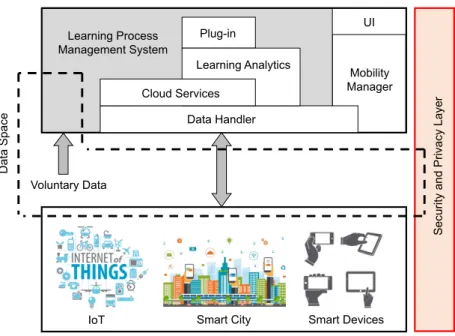
Therefore, to advance in the development of learning appli-cations able to take advantage of big data and features offered by the smart-* paradigm, a fundamental prerequisite concerns the identification of the issues to be addressed, which can be organized in the three-dimensional space as depicted in Figure 1. Specifically:
Physical Space: it groups all the entities belonging to the physical environment that can contribute to the learning pro-cess, e.g., IoT nodes, smart vehicles or measurement devices [21]. The physical space could also contain devices of end-users, for instance BYOD-based applications can be merged with smart components, such as building automation systems or specific machineries used for manufactory purposes [22]. Obviously, the Physical Space should not be limited to entities natively supporting the smart paradigm, and should be general enough to also consider legacy devices that can become data producer/consumer through a proper device driver. Such features are important for pursuing the ubiquitous learning vision [23].
Data Space: it embraces all the information that can be used for the learning process. This includes educational bits coming from the Physical Space (e.g., a measure from a device used in a laboratory setting or a feedback from an Industry 4.0 compliant machinery), voluntary or crowdsourced data, as well as “internal” information provided by the e-learning platform (e.g., the time spent by the student on a
IoT Smart City Smart Devices Physical Space Application Space D at a Sp ace Se cu rit y an d Pri va cy La ye r Voluntary Data Data Handler Learning Process Management System Mobility Manager UI Plug-in Learning Analytics Cloud Services
Fig. 1. The technological space characterizing learning applications and the proposed reference architecture.
specific assignment). Taming such a heterogeneous set of information is very challenging, as the flow of educational data could be a performance bottleneck or account for severe security/privacy fragilities [24], [25]. To better understand potentials of data-intensive learning applications, we mention possible use cases [26]: reveal deficiencies of a student with a per-concept granularity; understand online interactions and social equilibria; guide instructional designers and teachers in the organization of the course, especially by using session statistics and patterns to decide which portion of the Physical Space is more effective; help in determining the learning styles of students; perform learning decomposition to compare the impact of different educational interventions; improve the ef-fectiveness of the learning process by means of usage patterns provided by the Application Space; evaluate the feasibility of adopting “pluggable” features like, e.g., simulators.
Application Space: it contains all the software compo-nents responsible of implementing the e-learning service. The application space collects and concentrates all the avail-able information flows, and also provides proper stimuli for interacting with physical devices, nodes or smart devices. In this perspective, this space should also contain modules implementing protocol adapters, signaling flows or ad-hoc device drivers [21]. Concerning complexity, the application space could be a simple layer that grows according to the features to be handled (e.g., mobility). For the most demanding applications (e.g., computing-intensive virtual learning or big-data-driven approaches), it could require the integration with a wide array of software technologies, programming languages or computing platforms. For instance, frameworks such as Hadoop, Spark and MongoDB could not be sufficient for handling information required by the most demanding services [24]. Thus, more modern solutions like Apache Storm or
Apache Samza should be considered. Similar considerations could be made for guaranteeing trustworthiness requirements in modern learning applications and e-learning groups [25].
IV. TOWARDS AREFERENCEARCHITECTURE
In this section, we present the reference template for engi-neering or investigating future big-data-capable learning appli-cations. The most important building blocks needed to support a wide variety of features are depicted in Figure 1. We point out that the proposed architecture maps the “problem space” introduced in Section III and it enlightens that security should be pervasive and not only relegated in some architectural components.
Let us discuss in details the required core components for producing sophisticated courses or hands-on laboratories. Specifically:
• Learning Process Management System: it implements
the e-learning environment, e.g., it manages and delivers educational contents, and administers students, teachers and tutors. It also guarantees the continuous monitoring, evaluation and assessment of the learning process. As shown, this entity interacts with all the components of the layer and could not have clear boundaries, i.e., it can be implemented through a distributed architecture orchestrating several ad-hoc microservices. To handle big data and to offer proper performances and scalability features, the learning process management system could be tightly coupled with a cloud framework. In this vein, a proper engineering and platform-vendor agnostic design should be considered.
• Cloud Services: it offers the access to standard paradigms, i.e., Infrastructure-as-a-Service, Platform-as-a-Service,
and Software-as-a-Service. Besides, it provides a proper wrapper towards functionalities especially tailored for big data. Being able to use some form of virtualization guarantees the access to or control of real or simulated machineries, eScience or Science 2.0 laboratories for remote experiments, or hybrid cloud settings for data-intensive operations.
• Plug-in: as many other modern software, also the most complex learning applications implement some form of plug-in architecture to extend their functionalities. This is the case of modules offering features `a laserious games to achieve specific pedagogic objectives. In this case, the game logic should be able to access the functionalities of the Learning Process Management System.
• Learning Analytics: it provides methods to find out within the bulk information what is useful to advance in the learning process, and to reveal patterns for improving the learning experience of students. If the volume or the complexity of the algorithms prevent scalability, this module should be able to perform analysis with the aid of a cloud-based infrastructure.
• Data Handler: this layer is a core component of a data-centric learning application. Some of the most critical challenges that have to be faced are: performances when capturing data; the need of specific data handlers to coherently manage the heterogeneous sources of informa-tion ranging from sensors deployed in a smart building to measurements coming from a flying vehicle [27]; storage requirements and specific security policies if data have to be sent through the network or processed/stored by remote/additional entities; analysis and visualization services requiring to implement computationally expen-sive algorithms, especially for data mining or to deliver 3D/immersive learning environments [28].
• Mobility Manager: it is in charge of handling the signal-ing, triggers, stimuli and events to support the mobile learning paradigm [29]. According to the diffusion of smart devices, it should also support the interaction with Near Field Communication or Radio Frequency IDenti-fication tags used to identify points of interest or short-range wireless links like IEEE 802.15.4 [30].
• UI: it implements the user interface possibly by offering a proper degree of scalability, for both contents and devices. The UI should be also capable to adapt or scale according to the skills and the language of the learner, as well as to support physical impairments or disabilities.
A. From Data to Educational Data
As discussed in [31], data interoperability has been a long-time research topic for a wide range of computer-based appli-cations. Regarding e-learning, different standardization activi-ties have been done, for instance, IEEE Standard for Learning Technology culminated into IEEE 1484.11.1 for tracking the student interaction with a specific learning content. However, smart and big-data-driven learning applications should use a mixed set of information provided by an unpredictable variety of devices and external sources. As a consequence,
the engineering of educational data is the most important step towards the definition of an effective abstraction for learning applications. Then, modern frameworks have to provide inter-faces to open linked data (e.g., RDF, JSON, and XML) as well as query mechanisms for extracting customized information (e.g., SPARQL).
A possible solution is to use JSON to map data into a more abstract format that we could define as “educational data”. This approach can be used to unify information coming from physical objects or IoT nodes, together with datasets collected in other environments, possibly for educational purposes. As an example, Listing 1 considers the JSON containing the data generated by a weather station deployed by the Mu-nicipality for climate monitoring. The JSON is augmented with a reduced subset of the Dublin Core metadata, which clarifies how to use the different bits of information in an educational context, i.e., it drives the development of proper mapper/importers to be deployed in the learning application.
{
"source": "weather station", "description": {
"ID": 1010,
"position": [44.4075, 8.9321], "streetAddress": "Piazza De Ferrari", "city": "Genova", "state": "Italia" }, "data": [ {"type": "percentage", "description": "humidity", "value": 55 }, {"type": "number", "description": "temperature", "value": 22 }, ], "educationalDomain":
{"Contributor": "Genova Municipality", "Coverage": "Genova",
"Creator": "Civil Protection", [
{
"Type": "Dataset",
"Definition": "Humidity in Genova", "Subject": "Meteorology"
}, {
"Type": "Dataset",
"Definition": "Temperature in Genova", "Subject": "Meteorology"
} ] } }
Listing 1. JSON representation of data provided by a weather station.
The information included in the JSON depicted in Listing 1 can be further processed in order to match pedagogical require-ments when used during a class. Listing 2 provides an example in JavaScript pseudo-code. In more details, it implements a use case exploiting the APIs made available by geo-referencing services such as Google Maps. The e-learning framework can be used to create “markers” based on the "position"
tuple for the data source helping teachers to explain specific atmospheric phenomena or impact of the urbanization.
function loadMap() {
// Initialize Google Maps const mapOptions = { [..] } const map = new
google.maps.Map(
document.getElementById("map"), mapOptions);
//load JSON data
const weatherstation = <get JSON markers>; //Inizialize Google markers
new google.maps.Marker({
position: new google.maps.LatLng (weatherstation.position[0], weatherstation.position[1]), title: weatherstation.ID })
}
Listing 2. JavaScript pseudo-code for merging the educational data provided by a weather station with geo-localization information.
B. The Security and Privacy Layer
As discussed in [32], learning applications are character-ized by several security hazards, which are worsened by the presence of the rich and precise information nested within big data [2]. Recalling that security is pervasive, aspects dealing with physical security and privacy should be grouped in an abstract layer spanning through the entire architectural blueprint. Therefore, as depicted in Figure 1, the Security and Privacy Layer should have the following design requirements: • interact with third-party entities such as access con-trol servers, and packet filtering devices like firewalls and Intrusion Detection Systems to prevent attacks or to reduce cross-space vulnerabilities. In this case, an exploit available in the Physical Space could be used to undermine the Application or Data Spaces, or vice versa [33]. A possible example deals with the physical security of a student (e.g., he/she is operating a device in the physical space, for instance a heat, ventilation and conditioning system during a hands-on laboratory) that can be endangered by attacking the learning application; • since data can be enriched with physical locations, user habits, personal details and a wide variety of sensitive information, the level of security must be carefully as-sessed. Therefore, appropriate encryption or hashing to protect information, such as attended courses, personal records, and authentication credentials should be adopted, especially to protect against exfiltration attacks [34]. Sim-ilarly, the huge amount of information flowing through the architecture, as well as the mixed set of network protocols available (e.g., to allow user to connect through a browser or to support mobility) should be meticulously checked and secured;
• the distributed nature of the Internet (including wireless links, low-power and short-range communication tech-nologies) makes impossible to enforce security into a sin-gle point. Thus, the presence of ubiquitous communica-tion technologies is one of the most relevant motivacommunica-tions to consider security and privacy as a pervasive component without clear boundaries.
V. CONCLUSION
In this paper we presented potentials and challenges when developing learning applications using smart environments and big data. To this aim, we identified the space where modern services behave, and we proposed a reference architecture providing a sort of “design pattern” to systematically address technological issues. As shown, the data used in learning applications can be structured by using standard formats like JSON. In this manner, smart entities, such as weather sensors, can become valuable learning assets.
Future works aim at refining the proposed design as well as implementing a testbed to measure the performances of the proposed smart and big-data-capable e-learning framework. An important part of the ongoing research deals with the definition of a reusable set of software services for setting up a specific educational super-structure, which can gather huge amounts of unstructured information from the surrounding environment and link objects according to the context and educational objectives. For example, information provided by a computer numerical control machine will be coherently included in a lesson dealing with Industry 4.0.
REFERENCES
[1] N. Contractor, “The Emergence of Multidimensional Networks”, Journal of Computer-Mediated Communication, Vol. 14, pp. 743 - 747, April 2009.
[2] S. Manca, L. Caviglione, J. E. Raffaghelli, “Big data for Social Media Learning Analytics: Potentials and Challenges”, Journal of e-Learning and Knowledge Society, Vol. 12, No. 2, pp. 27 - 39, May 2016. [3] B, Kedzierska, J. Wnek-Gozdek, “Modern Didactics in Contemporary
Education”, International Journal of Electronics and Telecommunica-tions, Vol. 61, No.3, pp. 251-260, 2015.
[4] The New Media Consortium, “Horizon Report - 2017 Higher Ed-ucation Edition”, on-line: http://cdn.nmc.org/media/2017-nmc-horizon-report-he-EN.pdf [Last Accessed: Oct. 2017].
[5] L. Cen, D. Ruta, J. Ng, “Big Education: Opportunities for Big Data Analytics”, IEEE International Conference on Digital Signal Processing, Singapore, pp. 502-506, July 2015.
[6] S. B. Shum, R. Ferguson, “Social Learning Analytics”, Journal of Educational Technology & Society, Vol. 15, No. 3, pp. 3 - 26, July 2012.
[7] A. Singh, “Mining of Social Media Data of University Students”, Education and Information Technologies, Vol. 22, No. 4, pp. 1515-1526, July 2017.
[8] M. Coccoli, P. Maresca, L. Stanganelli, “The Role of Big Data and Cognitive Computing in the Learning Process”, Journal of Visual Languages & Computing, Vol. 38, pp. 97-103, Feb. 2017.
[9] L. Caviglione, F. Davoli, “Peer-to-Peer Middleware for Bandwidth Allocation in Sensor Networks”, IEEE Communications Letters, Vol. 9, No. 3, pp. 285-287, March 2005.
[10] M. Anshari, Y. Alas, L. S. Guan, “Developing Online Learning Re-sources: Big Data, Social Networks, and Cloud Computing to Support Pervasive Knowledge”, Education and Information Technologies, Vol. 6, No. 21, pp.1663-1677, 2016.
[11] M. Coccoli, I. Torre, “Interacting with Annotated Objects in a Semantic Web of Things Application”, Journal of Visual Languages & Computing, Vol. 25, No, 6, pp. 1012-1020, Dec. 2014.
[12] V. Mayer-Sch¨onberger, K. Cukier, “Learning with Big Data: the Future of Eeducation”, Houghton Mifflin Harcourt, 2014.
[13] B. Logica, R. Magdalena, “Using Big Data in the Academic Environ-ment”, Procedia Economics and Finance, Vol. 33, pp. 277-286, 2015. [14] B. Dietz-Uhler, J. E. Hurn, “Using Learning Analytics to Predict (and
Improve) Student Success: a Faculty Perspective”, Journal of Interactive Online Learning, Vol. 12, No. 1, pp. 17-26, Spring 2013.
[15] T. Yu, I. H. Jo, “Educational Technology Approach Toward Learn-ing Analytics: Relationship Between Student Online Behaviour and Learning Performance in Higher Education”, in Proceedings of the Fourth International Conference on Learning Analytics and Knowledge, Indianapolis, IN, USA, March 2014 pp. 269-270.
[16] M. El Mabrouk, S. Gaou, M. K. Rtili, “Towards an Intelligent Hybrid Recommendation System for e-learning Platforms Using Data Mining”, International Journal of Emerging Technologies in Learning, Vol. 12, No. 6, pp. 52-76, 2017.
[17] S. V. Kolekar, R. M. Pai, M. M. M. Pai, “Prediction of Learner’s Profile Based on Learning Styles in Adaptive e-learning System”, International Journal of Emerging Technologies in Learning, Vol. 12, No. 06, pp. 31-51, 2017.
[18] B. Habegger, O. Hasan, L. Brunie, N. Bennani, H. Kosch, E. Damiani, “Personalization vs. Privacy in Big Data Analysis”, International Journal of Big Data, pp. 25-35, 2014.
[19] D. Dagger, A. O’Connor, S. Lawless, E. Walsh, V. P. Wade, “Service-oriented e-Learning Platforms: from Monolithic Systems to Flexible Services”, IEEE Internet Computing, Vol. 11, No. 3, pp. 28-35, 2007. [20] Z. Zheng, J. Zhu, M. R. Lyu, “Service-generated Big Data and Big
Data-as-a-Service: an Overview”, in Proceedings of the 2013 IEEE International Conference on Big Data, Santa Clara, CA, USA, Oct. 2013, pp. 403-410.
[21] L. Berruti, L. Caviglione, F. Davoli, M. Polizzi, S. Vignola, S. Zappatore, “On the Integration of Telecommunication Measurement Devices within the Framework of an Instrumentation Grid”, in F. Davoli, N. Meyer, R. Pugliese, S. Zappatore (Ed.s), Grid Enabled Remote Instrumentation, Springer, pp. 283 - 300, 2009.
[22] S. C. Kong, Y. Song, “An Experience of Personalized Learning hub Initiative Embedding BYOD for Reflective Engagement in Higher Ed-ucation”, Computers & Education, Vol. 88, pp. 227-240, Oct. 2015. [23] D.-H. Shin, Y.-J. Shin, H. Choo, K. Beom, “Smartphones as Smart
Ped-agogical Tools: Implications for Smartphones as u-Learning Devices”, Computers in Human Behavior, Vol. 27, No. 6, pp. 2207-2214. [24] P. Ducange, R. Pecori, L. Sarti, M. Vecchio, “Educational Big Data
Mining: how to Enhance Virtual Learning Environments”, in M. Grana, J. Lopez-Guede, O. Etxaniz, A. Herrero, H. Quintian, E. Corchado. (Eds.), Advances in Intelligent Systems and Computing, Vol. 527, pp. 681 - 690, Oct. 2016.
[25] J. Miguel, S.Caball´e, F. Xhafa, J. Prieto, “A Massive data Processing Approach for Effective Trustworthiness in Online Learning Groups”, Concurrency and Computation: Practice and Experience, Vol. 27, No. 8, pp. 1988 - 2003, 2015.
[26] C. Romero, S. Ventura, “Educational data Mining: a Review of the State of the art”, IEEE Transactions on Systems, Man, and Cybernetics, Part C (Applications and Reviews), Vol. 40, No. 6, pp. 601-618, Nov. 2010. [27] L. Caviglione, “Introducing Emergent Technologies in Tactical and Disaster Recovery Networks”, International Journal of Communication Systems, Vol. 19, No.9, pp. 1045-1062, April 2006.
[28] P. Chen, C.-Y. Zhang, “Data-intensive Applications, Challenges, Tech-niques and Technologies: a Survey on Big Data”, Information Sciences, Vol. 275, pp. 314-347, Aug. 2014.
[29] M. Sharples, D. Spikol, “Mobile Learning”, in E. Duval, M. Sharples, R. Sutherland (Eds.), Technology Enhanced Learning, pp. 89-96, 2017. [30] L. Caviglione, M. Coccoli, A. Grosso, “A Framework for the Delivery of Contents in RFID-driven Smart Environments”, in Proc. of the IEEE International Conference on RFID-Technologies and Applications, Sitges, Spain, pp. 45-49, Sept. 2011.
[31] A. del Blanco, A. Serrano, M. Freire, I. Martinez-Ortiz, B. Fernandez-Manjon, “E-Learning Standards and Learning Analytics: can data Col-lection be Improved by Using Standard Data Models?”, IEEE Global Engineering Education Conference, Berlin, Germany, pp. 1255-1261, March 2013.
[32] G. Cardenas, R. E. Sanchez,“Security Challenges of Distributed e-learning Systems”, in F. F. Ramos, V. Larios Rosillo, H. Unger, (Eds.), Advanced Distributed Systems, Lecture Notes in Computer Science Vol. 3563, pp. 538-544, Springer, 2005.
[33] L. Caviglione, M. Coccoli, A. Merlo, “A Taxonomy-based Model of Security and Privacy in Online Social Networks”, International Journal of Computational Science and Engineering, Vol. 9, No. 4, pp. 325-338, 2014.
[34] W. Mazurczyk, L. Caviglione, “Information Hiding as a Challenge for Malware Detection”, IEEE Security & Privacy, Vol. 13, No. 2, pp. 89-93, Mar.-Apr. 2015.