Informati Respons Respons Respons on Request se to Informa se to Informa se to Informa 38 Resp ation Reques ation Reques ation Reques Informat ponses to I st 38a st 38b st 38c tion Reques nformation st 38 Request 388 38 38 38 38 8-1 8-2 8-9 8-10
Federal Review Panel Information Request 38
IR 38 – Mitigation for Effects on Grizzly Bear References:
EIS Guidelines, Section 1.3.1 EIS, Sections 2.7.2.8 and 2.9 Related Comments:
CEAR # 294 (Fish Lake Alliance) CEAR # 301 (Wilderness Committee) CEAR # 257 (Denny Wagg)
Rationale:
In Section 1.3.1 (p. 7), the EIS Guidelines state that “in assessing the environmental effects of the Project, it is essential to explain how the Project addresses the findings of the previous panel regarding significant adverse environmental effects, in particular, effects on”... “cumulative effects on the Southern Chilcotin grizzly bear population...”. This element of the Guidelines is relevant to the assessment of environmental effects of the Project because the Proponent is required to address the significant environmental effects determined by the previous panel in its report.
In the EIS (Section 2.9, p. 1507), Taseko indicated that it is “committed to participating in the provincial government bear population monitoring program as well as work with the provincial government to increase public education and awareness around preserving grizzly bear populations”. Taseko also notes (Section 2.7.2.8, p. 1091) that “with the implementation of proposed mitigation measures (e.g. minimization of clearing areas, reforestation of reclaimed areas, avoidance of non-pine forest types and wetlands), the residual loss of grizzly bear feeding habitat is predicted to be not significant”.
The Panel notes that the current EIS does not explain how the mitigation measures proposed would help this population.
Information Requested:
With regards to proposed mitigation for grizzly bear, the Panel requests that Taseko: a. Describe to what extent the proposed mitigation measures for grizzly bear will
Taseko Mines Limited Response to Information Request 38a
Information Request #38a
With regards to proposed mitigation for grizzly bear, the Panel requests that Taseko:
Describe to what extent the proposed mitigation measures for grizzly bear will minimize the cumulative effects on the South Chilcotin Ranges Grizzly Bear Population Unit.
Response Summary
Taseko is committed to the strict and rigorous implementation of all our mitigation measures, and the overarching Grizzly Bear Mortality Risk Reduction Plan presented in the 2012 EIS/Application, which is predicted to have medium to high effectiveness in minimizing cumulative adverse effects on the South Chilcotin Ranges Grizzly Bear Population Unit (GBPU). The greatest threat to grizzly bears in the South Chilcotin Ranges GBPU is increased mortality associated with road access, since grizzlies are more likely to encounter humans, and humans with guns, in areas with many roads. The key to addressing the greatest long-term threat to bears in the South Chilcotin Ranges GBPU is access management outside the footprint of the Project’s components, aimed at reducing regional road density and increasing the availability of core secure bear habitat (defined as >500 m from a road). Currently, without this Project, there is no coordinated effort in the Region to address this threat to grizzly bears.
Discussion
In the tables provided below, various mitigation measures and their effectiveness are detailed for:
Minimizing grizzly bear direct mortality risk associated with increased vehicle traffic along the access road
Minimizing grizzly bear indirect mortality risk associated with increased access along the transmission line
Minimizing the direct and indirect adverse effects related to grizzly bears at the mine site
Planning post-closure reclamation to reduce grizzly bear mortality at the mine site
These mitigation measures are identified in 2012 EIS/Application (see Table 2.7.2.8-12, Section 2.7.2.8 Grizzly Bear).
Effectiveness of mitigation measures designed to minimize grizzly bear direct mortality risk associated with increased vehicle traffic along the access road
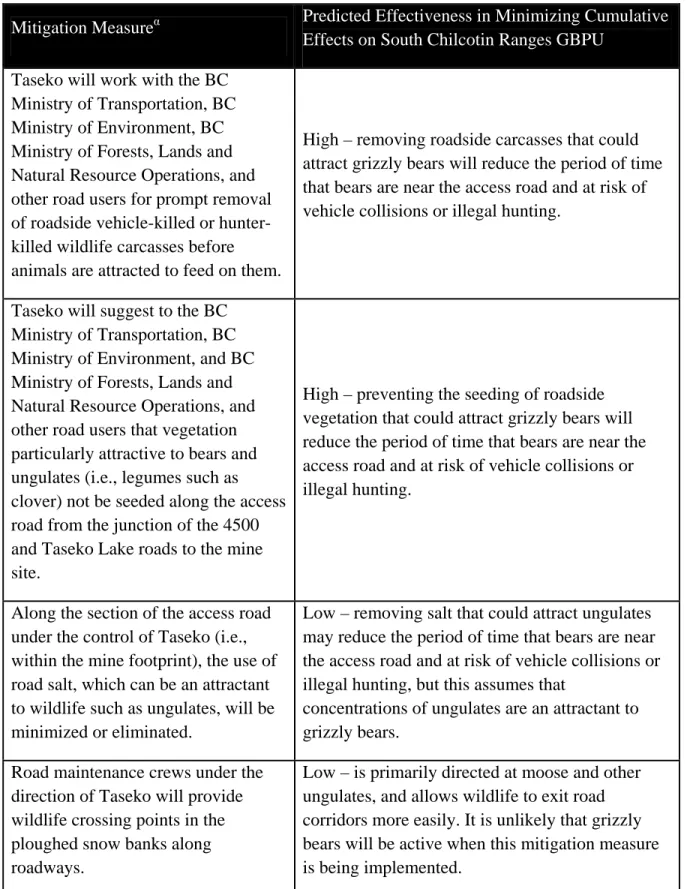
These mitigation measures are identified in Taseko’s proposed Grizzly Bear Mortality Risk Reduction Plan (2012 EIA/Application). Table 38A-1 lists these measures and a description of their predicted effectiveness with respect to minimizing direct mortality risk on the South
Taseko Mines Limited Response to Information Request 38a
Chilcotin Ranges GBPU due to increased vehicle traffic along the access road. The individual effectiveness of these measures ranges from low to high; however, implemented in concert, the effectiveness of these measures is predicted to be high.
Taseko Mines Limited Response to Information Request 38a
Table 38A-1. Predicted Effectiveness of Taseko’s Mitigation Measures Intended to Minimize Grizzly Bear Direct Mortality Risk from Increased Vehicle Traffic along the Access Road
Mitigation Measureα Predicted Effectiveness in Minimizing Cumulative
Effects on South Chilcotin Ranges GBPU Taseko will provide wildlife-related
driver awareness training to Project-related vehicle operators.
High – increasing the awareness of potential wildlife-vehicle collisions will increase driver compliance with posted speed limits and wildlife reporting procedures.
Taseko will work with the BC Ministry of Transportation, BC Ministry of Environment, and BC Ministry of Forests, Lands and Natural Resource Operations and other road users with radio-equipped vehicles to broadcast sightings of wildlife along the access road corridor.
High – providing timely and site-specific information on the presence of wildlife will increase driver alertness to potential hazards and compliance with posted speed limits.
Project-related traffic will adhere to posted speed limits along the entire length of the access road; this will be included in the wildlife-related driver awareness of contractors and
employees. In addition, on the mine site speed limits will be marked.
Moderate to high – on its own, signage only affects driver behaviour to a minimal degree; however, driver awareness training and radio-broadcasted wildlife sightings will increase compliance with posted speed limits. Slower vehicle speeds will greatly reduce the frequency of wildlife-vehicle collisions by providing more reaction time for both the animal and the vehicle to avoid a collision.
Taseko will work with the BC Ministry of Transportation, BC Ministry of Environment, and BC Ministry of Forests, Lands and Natural Resource Operations and other road users to require that passive wildlife warning/crossing signs be posted at potential high risk areas (e.g., riparian and wetland areas bisected by the access road).
Additional signs may be added over time if other high risk areas are identified.
Moderate to high – on its own, signage only affects driver behaviour to a minimal degree; however, driver awareness training and radio-broadcasted wildlife sightings will increase compliance with posted speed limits and alertness in high risk areas identified by signage.
Taseko will support initiatives to install wildlife fencing, ungulate guards or active signs at potential high risk collision areas, in
cooperation with the BC Ministry of Transportation, BC Ministry of Environment, BC Ministry of Forests, Lands and Natural Resource
Operations and other road users.
Low – short lengths of wildlife fencing would likely only result in shifting grizzly crossing areas from one location to another (i.e., the bears would just end-run the fence). Longer lengths of wildlife fencing would interrupt movement patterns and potential create more adverse effects than they mitigated.
Project-related wildlife-vehicle collisions will be recorded and regularly reviewed by Taseko. Project-related wildlife-vehicle collisions will be reported to the BC Ministry of Environment regional office in a timely manner.
High – monitoring the date, time and specific location of wildlife-vehicle collisions and near misses will provide valuable feedback to improve the driver awareness and signage programs. If a problem area is identified appropriate actions will be taken (e.g., notification of the BC Ministry of Transportation and Infrastructure, BC Ministry of Environment and other road users, posting of warning signs, site-specific speed limits). In some cases (e.g., bears), where the animal is injured rather than killed it may be necessary to report collisions immediately to the regional
Taseko Mines Limited Response to Information Request 38a
Mitigation Measureα Predicted Effectiveness in Minimizing Cumulative
Effects on South Chilcotin Ranges GBPU Taseko will work with the BC
Ministry of Transportation, BC Ministry of Environment, BC Ministry of Forests, Lands and Natural Resource Operations, and other road users for prompt removal of roadside vehicle-killed or hunter-killed wildlife carcasses before animals are attracted to feed on them.
High – removing roadside carcasses that could attract grizzly bears will reduce the period of time that bears are near the access road and at risk of vehicle collisions or illegal hunting.
Taseko will suggest to the BC Ministry of Transportation, BC Ministry of Environment, and BC Ministry of Forests, Lands and Natural Resource Operations, and other road users that vegetation particularly attractive to bears and ungulates (i.e., legumes such as clover) not be seeded along the access road from the junction of the 4500 and Taseko Lake roads to the mine site.
High – preventing the seeding of roadside vegetation that could attract grizzly bears will reduce the period of time that bears are near the access road and at risk of vehicle collisions or illegal hunting.
Along the section of the access road under the control of Taseko (i.e., within the mine footprint), the use of road salt, which can be an attractant to wildlife such as ungulates, will be minimized or eliminated.
Low – removing salt that could attract ungulates may reduce the period of time that bears are near the access road and at risk of vehicle collisions or illegal hunting, but this assumes that
concentrations of ungulates are an attractant to grizzly bears.
Road maintenance crews under the direction of Taseko will provide wildlife crossing points in the ploughed snow banks along roadways.
Low – is primarily directed at moose and other ungulates, and allows wildlife to exit road corridors more easily. It is unlikely that grizzly bears will be active when this mitigation measure is being implemented.
α
: Adapted from 2009 EIS/Application (Section 6.3.4.6 – 6.3.4.8) and from 2012 EIS/Application (see Grizzly Bear and Table 2.7.2.8-12, Section 2.7.2.8).
Effectiveness of mitigation measures designed to minimize grizzly bear indirect mortality risk associated with increased access along the transmission line
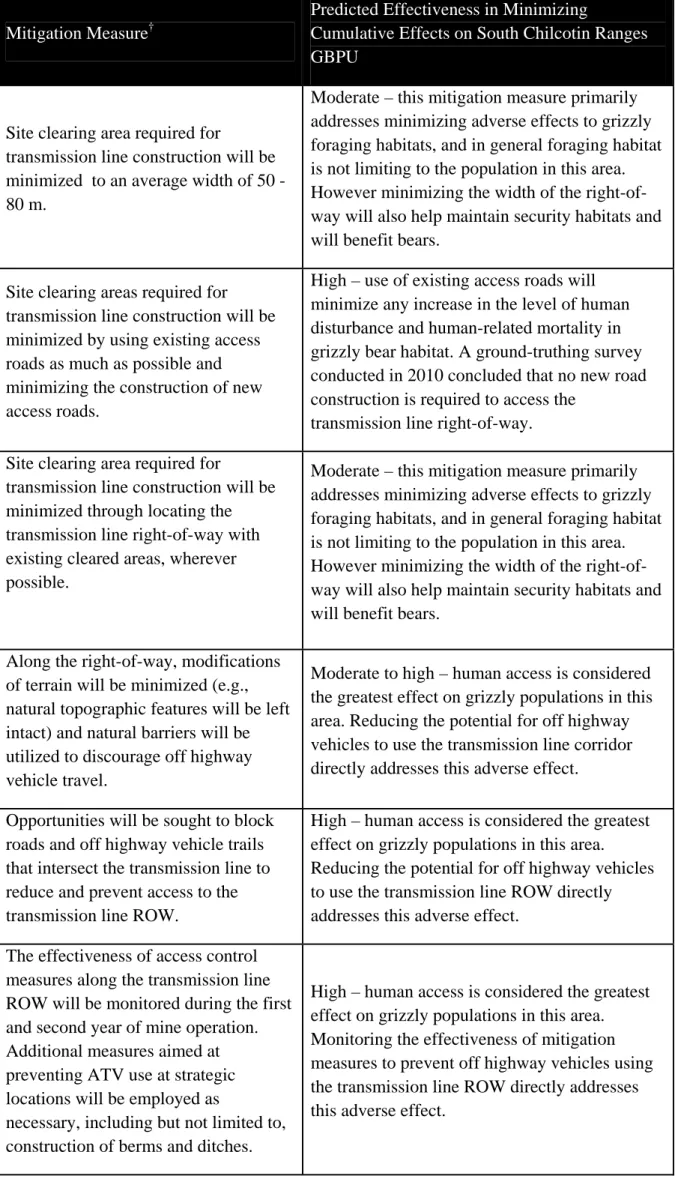
Table 38A-2 lists these measures and a description of their predicted effectiveness with respect to minimizing adverse cumulative effects on the South Chilcotin Ranges GBPU. The effectiveness of these measures ranges from moderate to high.
Taseko Mines Limited Response to Information Request 38a
Table 38A-2. Predicted Effectiveness of Taseko’s Mitigation Measures Intended to Minimize Grizzly Bear Indirect Mortality Risk from Increased Access along the Transmission Line
Mitigation Measure†
Predicted Effectiveness in Minimizing
Cumulative Effects on South Chilcotin Ranges GBPU
Site clearing area required for
transmission line construction will be minimized to an average width of 50 - 80 m.
Moderate – this mitigation measure primarily addresses minimizing adverse effects to grizzly foraging habitats, and in general foraging habitat is not limiting to the population in this area. However minimizing the width of the right-of-way will also help maintain security habitats and will benefit bears.
Site clearing areas required for transmission line construction will be minimized by using existing access roads as much as possible and minimizing the construction of new access roads.
High – use of existing access roads will minimize any increase in the level of human disturbance and human-related mortality in grizzly bear habitat. A ground-truthing survey conducted in 2010 concluded that no new road construction is required to access the
transmission line right-of-way. Site clearing area required for
transmission line construction will be minimized through locating the transmission line right-of-way with existing cleared areas, wherever possible.
Moderate – this mitigation measure primarily addresses minimizing adverse effects to grizzly foraging habitats, and in general foraging habitat is not limiting to the population in this area. However minimizing the width of the right-of-way will also help maintain security habitats and will benefit bears.
Along the right-of-way, modifications of terrain will be minimized (e.g., natural topographic features will be left intact) and natural barriers will be utilized to discourage off highway vehicle travel.
Moderate to high – human access is considered the greatest effect on grizzly populations in this area. Reducing the potential for off highway vehicles to use the transmission line corridor directly addresses this adverse effect.
Opportunities will be sought to block roads and off highway vehicle trails that intersect the transmission line to reduce and prevent access to the transmission line ROW.
High – human access is considered the greatest effect on grizzly populations in this area. Reducing the potential for off highway vehicles to use the transmission line ROW directly addresses this adverse effect.
The effectiveness of access control measures along the transmission line ROW will be monitored during the first and second year of mine operation. Additional measures aimed at preventing ATV use at strategic locations will be employed as
necessary, including but not limited to, construction of berms and ditches.
High – human access is considered the greatest effect on grizzly populations in this area. Monitoring the effectiveness of mitigation measures to prevent off highway vehicles using the transmission line ROW directly addresses this adverse effect.
†
Adapted from 2009 EIS/Application (Section 6.3.4.6 – 6.3.4.8) and from 2012 EIS/Application (see Grizzly Bear and Table 2.7.2.8-15, Section 2.7.2.8).
Taseko Mines Limited Response to Information Request 38a
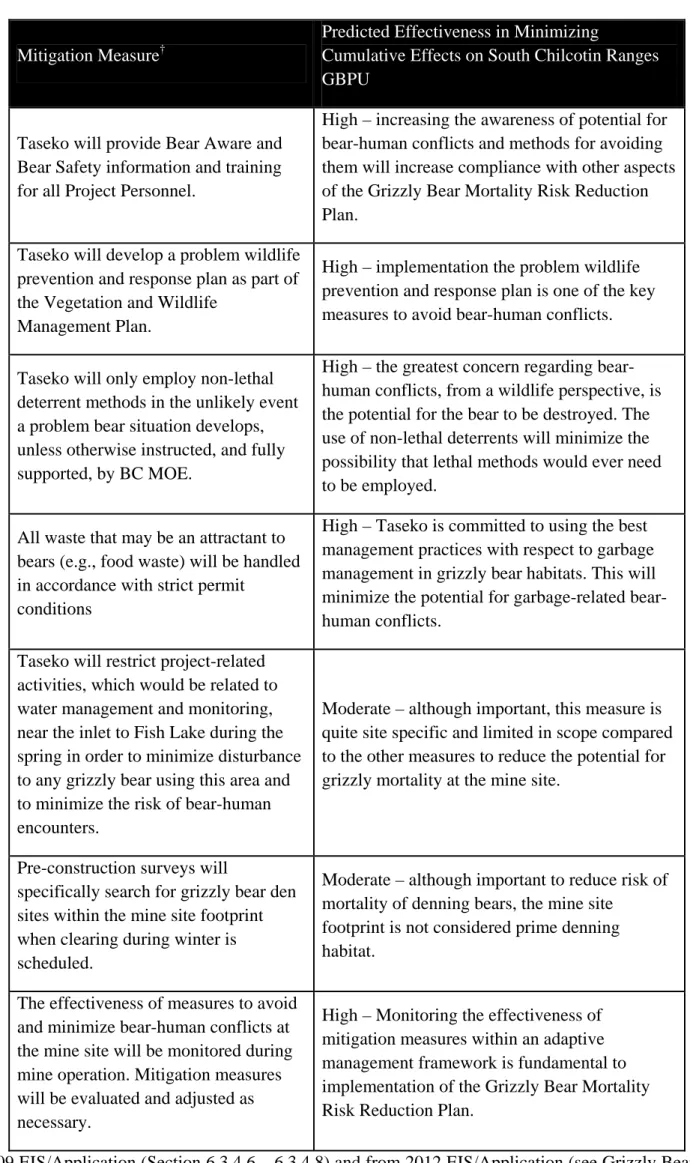
Table 38A-3 lists components of these mitigation measures and the Grizzly Bear Mortality Risk Reduction Plan applicable to the mine site and a description of their predicted effectiveness with respect to minimizing adverse cumulative effects on the South Chilcotin Ranges GBPU. Implementation of these measures is completely within the control of Taseko, the individual effectiveness of these measures ranges from moderate to high, and the predicted effectiveness of this suite of mitigation measures is expected to be high.
Table 38A-3. Predicted Effectiveness of Taseko’s Mitigation Measures Intended to Minimize Grizzly Bear Mortality Risk at the Mine Site
Mitigation Measure†
Predicted Effectiveness in Minimizing
Cumulative Effects on South Chilcotin Ranges GBPU
Taseko will provide Bear Aware and Bear Safety information and training for all Project Personnel.
High – increasing the awareness of potential for bear-human conflicts and methods for avoiding them will increase compliance with other aspects of the Grizzly Bear Mortality Risk Reduction Plan.
Taseko will develop a problem wildlife prevention and response plan as part of the Vegetation and Wildlife
Management Plan.
High – implementation the problem wildlife prevention and response plan is one of the key measures to avoid bear-human conflicts.
Taseko will only employ non-lethal deterrent methods in the unlikely event a problem bear situation develops, unless otherwise instructed, and fully supported, by BC MOE.
High – the greatest concern regarding bear-human conflicts, from a wildlife perspective, is the potential for the bear to be destroyed. The use of non-lethal deterrents will minimize the possibility that lethal methods would ever need to be employed.
All waste that may be an attractant to bears (e.g., food waste) will be handled in accordance with strict permit
conditions
High – Taseko is committed to using the best management practices with respect to garbage management in grizzly bear habitats. This will minimize the potential for garbage-related bear-human conflicts.
Taseko will restrict project-related activities, which would be related to water management and monitoring, near the inlet to Fish Lake during the spring in order to minimize disturbance to any grizzly bear using this area and to minimize the risk of bear-human encounters.
Moderate – although important, this measure is quite site specific and limited in scope compared to the other measures to reduce the potential for grizzly mortality at the mine site.
Pre-construction surveys will
specifically search for grizzly bear den sites within the mine site footprint when clearing during winter is scheduled.
Moderate – although important to reduce risk of mortality of denning bears, the mine site
footprint is not considered prime denning habitat.
The effectiveness of measures to avoid and minimize bear-human conflicts at the mine site will be monitored during mine operation. Mitigation measures will be evaluated and adjusted as necessary.
High – Monitoring the effectiveness of mitigation measures within an adaptive management framework is fundamental to implementation of the Grizzly Bear Mortality Risk Reduction Plan.
†
Adapted from 2009 EIS/Application (Section 6.3.4.6 – 6.3.4.8) and from 2012 EIS/Application (see Grizzly Bear and Table 2.7.2.8-15, Section 2.7.2.8).
Taseko Mines Limited Response to Information Request 38a
The final reclamation plan will include restoration of prime grizzly bear habitat on the mine site post-closure and to minimize cumulative effects on the South Chilcotin Ranges GBPU. Prime value grizzly bear habitat includes open areas for feeding with adjacent forested areas for cover (Parametrix 2005). Forested areas provide security cover and a lack of adequate cover can lead to increased grizzly bear mortality (Munro 1999). Security cover provides refuge from other bears (e.g. females with cubs need spatial separation from aggressive males) and from human induced disturbances. The predicted effectiveness of this mitigation measure is moderate to high, because use of these habitats depends on the maintenance of adjacent undisturbed forest patches and implementing appropriate access management controls (Cristescu 2013, Cristescu et al. 2012), both of which are only partially under the control of Taseko.
Taseko Mines Limited Response to Information Request 38b
Information Request #38b
Clarify and/or describe Taseko’s stated participation in provincial monitoring programs.
Response Summary
Taseko is committed to contributing to the provincial grizzly monitoring program within the Grizzly Bear Cumulative Effect Assessment Area for the mine site and transmission line. Taseko’s participation in the grizzly bear monitoring programs could be financial and/or in-kind, scope of which will be determined through discussions with the Province.
Taseko Mines Limited Response to Information Request 38c
Information Request #38c
Describe any plans to compensate for grizzly bear core habitat loss or the feasibility of such compensation if not already planned.
Response Summary
Taseko is committed to the development of a Habitat Compensation Plan (see response to IR32) which will include the compensation for core grizzly bear habitat loss. The focus will be on managing human access along linear features outside the mine site and transmission line ROW to improve habitat security and minimize displacement of grizzly bears. Measures to avoid increasing access within the ROW are presented in Table 38-2, above.
Access management, as a component of habitat compensation, continues to be a cornerstone of grizzly bear recovery efforts in the United States (US Fish and Wildlife Service 1993; US Forest Service 2011) and is also applicable to the fragmented landscapes of British Columbia and Alberta (Proctor et al. 2012).
There are various techniques for restricting human use of linear features including re-contouring roads, permanent road deactivation, permanent barrier installation, locked gates, and signage. While Taseko can use some of these techniques to manage access within our project footprint, access management in the regional context for compensation purposes will require a planning process involving government, industry, First Nations, and other stakeholders that balances the range of competing interests.
There are three landscape units intersected by the transmission line corridor that already have a linear feature density that exceeds the generally accepted 0.6 km/km2 threshold for grizzly bears (Section 2.7, Impact Assessment, page 1097). These landscape units would be the focus for access management and linear features removal compensation actions identified under the Habitat Compensation Plan. The goal would be to reduce the current density of linear features to below 0.6 km/km2, as measured at the landscape unit scale. With commitment from, and collaboration with, the Provincial Government, First Nations, and other stakeholders, this target can be achieved, resulting in a benefit to grizzly bears from this Project. Linear features removal and access management outside the transmission line ROW would include deactivation of roads and trails, and seasonal motorized vehicle closures under the BC Wildlife Act designed to protect grizzly bear sows and cubs during the spring forage period (April 1–June 15).
Taseko Mines Limited Response to Information Request 38c
References
Cristescu, B. 2013. Grizzly bear response to open-pit mining in western Alberta, Canada. PhD Thesis, University of Alberta, Edmonton, AB. 278 pp.
Cristescu, B., G.B. Stenhouse, M. Symbaluk and M.S. Boyce. 2012. Ecological effects of mine reclamation on grizzly bears. 36th Annual Mine Reclamation Symposium, British Columbia Technical and Research Committee on Reclamation, Kamloops, BC. Parametrix. 2005. Grizzly bear species account for the Montana DNRC Forested Trust Lands
Habitat Conservation Plan (revised 2010). Report prepared for the Montana Department of Natural Resources and Conservation Forest Management Bureau, Missoula, MT. Proctor, M., D. Paetkau, B.N. McLellan, G.B. Stenhouse, K.C. Kendall, R.D. Mace, W.F.
Kasworm, C. Servheen, C.L. Lausen, M.I. Gibeau, W.L. Wakkinen, M.A. Haroldson, G. Mowat, C.D. Apps, L.M. Ciarniello, R.M.R. Barclay, M.S. Boyce, C.C. Schwartz, C. Stobeck. 2012. Population fragmentation and inter-ecosystem movements of grizzly bears in Western Canada and the Northern United States. Wildlife Monographs 180:1– 46.
US Forest Service. 2011. Final supplemental environmental impact statement: forest plan amendments for motorized access management with the Selkirk and Cabinet-Yaak grizzly bear recovery zones. U.S. Forest Service, U.S. Department of Agriculture, Coeur d’Alene, ID.
US Fish and Wildlife Service 1993. Grizzly bear recovery plan. U.S. Fish and Wildlife Service, Missoula, MT. 81 pp.