Deep Interactive Text Prediction and
Quality Estimation in Translation
Interfaces
Christopher M. Hokamp
B.A., M.A.
A dissertation submitted in fulfilment of the requirements for the award of
Doctor of Philosophy (Ph.D.)
to the
Dublin City University
School of Computing
Supervisors:
Prof. Qun Liu
Prof. Josef van Genabith
Declaration
I hereby certify that this material, which I now submit for assessment on the programme of study leading to the award of Ph.D. is entirely my own work, that I have exercised rea-sonable care to ensure that the work is original, and does not to the best of my knowledge breach any law of copyright, and has not been taken from the work of others save and to the extent that such work has been cited and acknowledged within the text of my work.
Chris Hokamp
ID No.: 13211891
Acknowledgements
Over the last five years, I have been incredibly lucky to learn from and collaborate with many brilliant researchers.
I am particularly indebted to my supervisor Qun Liu. From my first day in the lab until the final throes of revision, he was a constant source of guidance, wisdom, and support. His feedback and insights during innumerable conversations helped my research to take form, and his inspirational work ethic helped me to push through some of the more difficult moments.
Josef van Genabith originally inspired me to begin my PhD, and his positive energy was a motivating force throughout my time in the EXPERT project.
Rada Mihalcea’s graduate course in NLP at the University of North Texas made me fall in love with this field. Rada is a brilliant teacher and mentor, and our conversations encouraged me to pursue a career in research.
My examiners Mikel Forcada and Jennifer Foster provided detailed constructive feed-back on this work, which helped immensely.
A big Irish cheers to all of my collaborators, and to the many friends from DCU, Un-babel, and the EXPERT project. Impromptu conversations and brainstorms frequently resulted in insights, shared knowledge, useful hacks, or actual publications. I feel really lucky to have met so many fun and dynamic people, who also happen to be crazy smart.
We had a blast during the four-year run of the DCU machine learning group — this was one of my favorite parts of my time at DCU. I would like to thank everyone who helped make our group an great resource for learning, especially my amazing labmate and neighbor Piyush Arora, Joachim Wagner, and Henry Elder.
I am eternally grateful to the EXPERT project, and to the ADAPT Centre. Their support for my research, and the nice environment in our lab at DCU made this work possible.
Finally, I would like to thank all of my family and friends, especially Merve and Maya, my parents Mark and Barbara, and Mehmet and Ay¸segül, for their love, support, and patience.
Contents
1 Introduction 1 1.1 Research Objectives . . . 3 1.2 Structure . . . 3 1.3 Contributions . . . 5 1.4 Publications . . . 5 1.4.1 Computer-Aided Translation . . . 51.4.2 Translation Quality Estimation . . . 6
1.4.3 Machine Translation and Machine Learning . . . 7
1.4.4 Other Publications . . . 7
2 Background 9 2.1 Translation and Human-Computer Interaction . . . 10
2.1.1 Mixed-Initiative CAT . . . 11
2.1.2 Modes of Interaction . . . 12
2.1.3 CAT Tasks . . . 13
2.2 Interfaces for Translation . . . 15
2.2.1 Interfaces for CAT Research . . . 18
2.2.2 Logging User Actions during Translation . . . 20
2.3 Deep Learning for Machine Translation . . . 21
2.3.1 Sequence to Sequence Models . . . 22
2.3.2 Recurrent Layers . . . 25
2.3.3 Training Deep Neural Networks with Backpropagation . . . 26
2.3.4 Neural Machine Translation . . . 28
2.4 Interactive Text Prediction . . . 31
2.4.1 IMT Mathematical Background . . . 33
2.4.2 Interactive Post-Editing . . . 38
2.4.3 User Interfaces for Interactive Translation . . . 40
2.4.4 Truncating Hypotheses to Maximize Expected Benefit . . . 42
2.4.5 Measuring IMT Performance . . . 43
2.5 Quality Estimation of MT . . . 44
2.5.1 Estimating Translation Quality at Sentence-Level and Word-Level 45 2.5.2 QE and CAT Tools . . . 47
2.5.3 Evaluating Word-Level Quality Estimation Models . . . 48
2.5.4 Word Level QE Model Types . . . 48
2.6 Automatic Post-Editing . . . 49
2.6.1 APE-Based QE Models . . . 51
2.7 Discussion . . . 51
3 HandyCAT: A Platform for Translation Process Research 52 3.1 Motivation . . . 53
3.1.1 Web Based CAT Tools . . . 54
3.1.2 To extend or to build from scratch? . . . 55
3.2 Design . . . 56
3.2.1 Component-Centric Design: A Type System for CAT Components 57 3.2.2 Formalizing Component-Centric Design . . . 58
3.2.3 Document Data Model . . . 58
3.3 Requirements . . . 60
3.4 Component Implementations . . . 63
3.5 Services and Microservices . . . 67
3.6 A Pilot Study On Text Prediction Using SMT Phrase Tables . . . 67
3.6.1 Experimental Design . . . 70
3.6.2 Results . . . 71
3.7 A Pilot Study on Post-Editing Actions . . . 73
3.7.2 Key Takeaways from PE Actions User Study . . . 79
3.8 Discussion . . . 79
4 Predicting Translation Quality at the Word-Level 81 4.1 Introduction . . . 81
4.1.1 Building Datasets for Word-Level QE . . . 84
4.1.2 Marmot: A Framework for Word-Level Quality Estimation . . . . 84
4.2 Investigating Model Types for Word-Level QE . . . 90
4.2.1 Feature-Based Models for Word-Level QE . . . 90
4.2.2 Deep Models for Word-Level Quality Estimation . . . 90
4.2.3 Adding Source Alignment Information . . . 92
4.2.4 Experiments . . . 93
4.2.5 Recurrent Models for Word-Level QE – Discussion . . . 95
4.3 Unifying Word Level Quality Estimation and Automatic Post-Editing . . 96
4.3.1 Factored Inputs for seq2seq . . . 98
4.3.2 Neural Models for APE and word-level QE . . . 99
4.3.3 APE-QE Experiments . . . 102
4.3.4 APE-QE Results . . . 104
4.4 Discussion . . . 106
5 Modeling Interactive Neural Machine Translation 108 5.1 Introduction . . . 108
5.2 Interactive Neural Machine Translation . . . 110
5.2.1 Accounting for Unknown Words . . . 111
5.3 Built-in Confidence Measures in NMT Systems . . . 112
5.3.1 Using Attention Weights to Determine Model Confidence . . . . 114
5.3.2 Experiments . . . 115
5.3.3 Results . . . 117
5.4 Learning Model Confidence . . . 118
5.4.1 Auxilliary Confidence Models . . . 118
6 Lexically Constrained Decoding 125
6.1 Beam Search for Sequence Generation . . . 128
6.2 Grid Beam Search . . . 130
6.2.1 Multi-token Constraints . . . 133
6.2.2 Generalizing Prefix-Constrained Translation . . . 133
6.2.3 Sub-word Units . . . 134
6.2.4 Efficiency . . . 134
6.3 Experiments . . . 135
6.3.1 Models . . . 135
6.3.2 Pick-Revise for Interactive Post Editing . . . 136
6.3.3 Domain Adaptation via Terminology . . . 137
6.3.4 Analysis . . . 139
6.4 Discussion . . . 139
7 Interactive Post-Editing 142 7.1 An Overview of Interactive Post-Editing . . . 143
7.2 IPE Integration with CAT . . . 145
7.2.1 UI Component Design . . . 145
7.2.2 IPE Server Design . . . 150
7.3 IPE User Study Design . . . 153
7.4 Results . . . 156
7.4.1 Evaluating the QE Model using Edit Logs . . . 159
7.4.2 Translator Feedback about the IPE Interface . . . 161
7.5 Discussion . . . 161 8 Conclusion 164 8.1 Contributions . . . 164 8.2 Future Work . . . 166 Bibliography 168 Appendices 188
A Model Configurations 1
A.1 NMT System Configurations for GBS Experiments . . . 1
A.1.1 English-German . . . 1
A.1.2 English-French . . . 1
Deep Interactive Text Prediction
and Quality Estimation
in Translation Interfaces
Christopher Mark Hokamp
Abstract
The output of automatic translation systems is usually destined for human consumption. In most cases, translators use machine translation (MT) as the first step in the process of creating a fluent translation in a target language given a text in a source language. However, there are many possible ways for translators to interact with MT. The goal of this thesis is to investigate new interactive designs and interfaces for translation.
In the first part of the thesis, we present pilot studies which investigate aspects of the interactive translation process, building upon insights from Human-Computer Interaction (HCI) and Translation Studies. We developed HandyCAT, an open-source platform for translation process research, which was used to conduct two user studies: an investigation into interactive machine translation and evaluation of a novel component for post-editing. We then propose new models for quality estimation (QE) of MT, and new models for es-timating the confidence of prefix-based neural interactive MT (IMT) systems. We present a series of experiments using neural sequence models for QE and IMT. We focus upon token-level QE models, which can be used as standalone components or integrated into post-editing pipelines, guiding users in selecting phrases to edit. We introduce a strong recurrent baseline for neural QE, and show how state of the art automatic post-editing (APE) models can be re-purposed for word-level QE. We also propose an auxiliary con-fidence model, which can be attached to (I)-MT systems to use the model’s internal state to estimate confidence about the model’s predictions.
The third part of the thesis introduces lexically constrained decoding using grid beam search (GBS), a means of expanding prefix-based interactive translation to general lexical constraints. By integrating lexically constrained decoding with word-level QE, we then suggest a novel interactive design for translation interfaces, and test our hypotheses using simulated editing. The final section focuses upon designing an interface for interactive post-editing, incorporating both GBS and QE. We design components which introduce a new way of interacting with translation models, and test these components in a user-study.
List of Figures
2.1 Interactive translation workflows, modeled after (Green, 2014). Explicit
interaction may occur on the left side of the figure, if the translator is
directly giving instructions to the MT system (see section 2.4). Implicit
interaction happens when the MT system on the right side retrains on data
obtained from the translation interface. Updates to the MT system may
happen instantly, or may be delayed. . . 12
2.2 The Transtype 2 CAT interface (image from Casacuberta et al. (2009)) . . 18
2.3 The MateCAT Interface, which is currently a commercial web-based CAT
tool. . . 19
2.4 An example of the translation options rendered in CAITRA during
inter-active translation (Image from Koehn (2009)). . . 19
2.5 The PET interface. . . 20
2.6 The OmegaT interface. . . 21
2.7 A fully connected feed-forward network with two layers and a single
out-put value (image from Koehn (2017)). . . 23
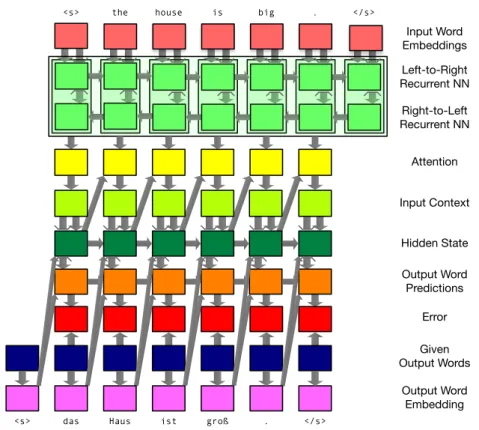
2.8 A schematic of an encoder decoder model with attention for NMT (image
from Koehn (2017)). . . 29
2.9 The "RNN-Search" (Encoder-Decoder with Attention) architecture
(im-age from (Bahdanau et al., 2014)). . . 30
2.10 Interactive translation . . . 32
2.11 Post-editing . . . 32
3.1 An individual component, consisting of a graphical element, local
3.2 An example translation unit in an XLIFF 2.0 DOM. . . 59
3.3 Top level abstract component areas . . . 61
3.4 The source and target areas in HandyCAT, highlighted in green. These
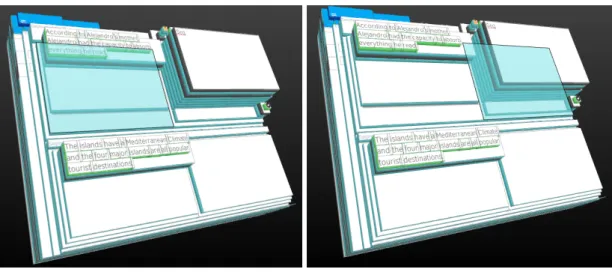
renderings are produced by the three-dimensional DOM visualizer
avail-able in Mozilla Firefox, and emphasize the nested component areas in
HandyCAT. . . 61
3.5 The graphical element corresponding to segment area components . . . . 63
3.6 A segment area component that renders a segment-level quality score
which the user must click before she can edit the target hypothesis. . . 64
3.7 The graphical element corresponding to source-area components . . . 65
3.8 Multiple target components on the same segment – user can switch
be-tween components using the selector. . . 65
3.9 The singleton element corresponding to the toolbar . . . 66
3.10 A target-side auto-complete component backed by a phrase table and
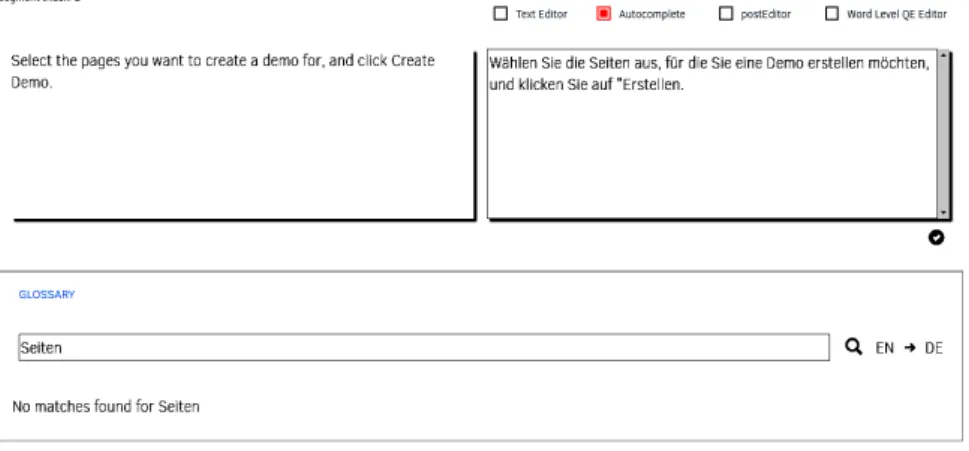
lan-guage model. . . 69
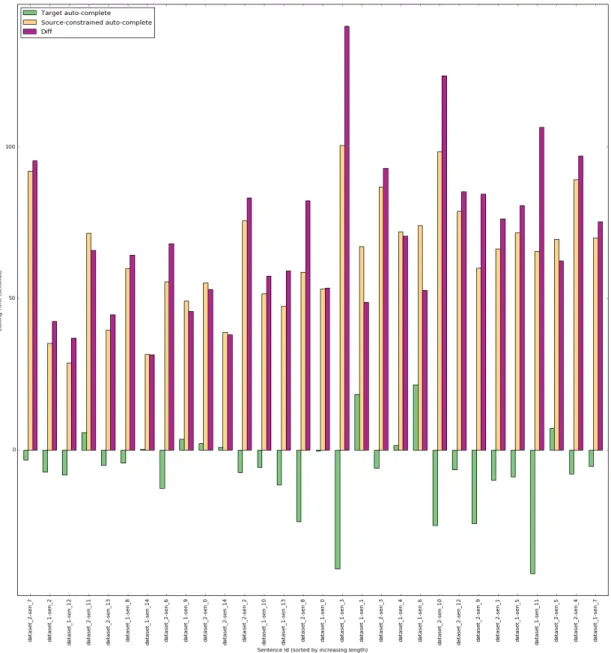
3.11 Average time per segment for each autocomplete type. Segments are
sorted by source length (ascending). . . 72
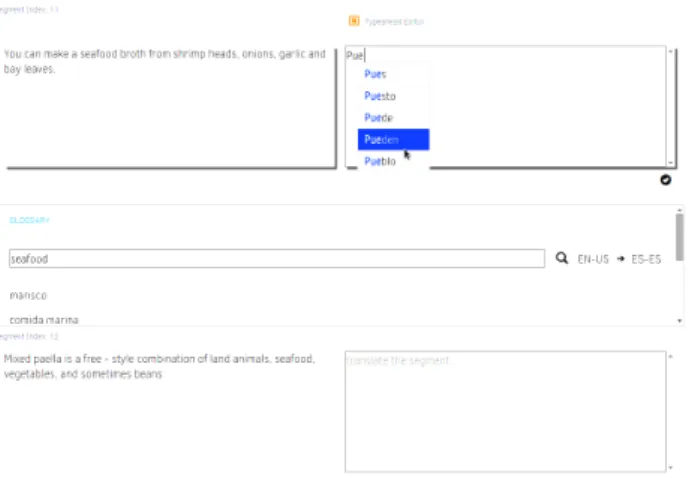
3.12 Screenshots of the dictionary-backed typeahead component used as the
contrastive setting in the post-editing actions user study . . . 75
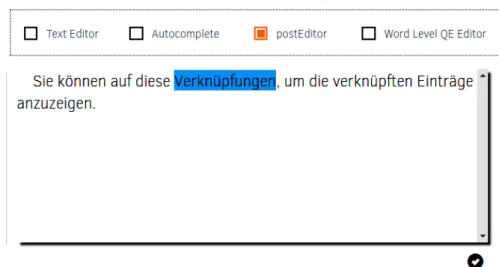
3.13 Screenshots of the INSERT, REPLACE, and MOVE modes in the
post-editing component . . . 76
4.1 The Post-Editing Cycle . . . 81
4.2 One possible interactive workflow for CAT, supported by both word- and
sentence-level quality estimation. . . 82
4.3 The data extraction pipeline used in MARMOT (from Logacheva et al.
(2016)) . . . 85
4.4 Schematic of an output layer which includes a maxout transformation. . . 92
4.5 Schematic of the Bidirectional Bilingual Language Model . . . 93
4.7 The flow of creating synthetic data for APE, proposed by
(Junczys-Dowmunt et al., 2016). The reference side of a parallel corpus is
trans-lated to the source language, using an MT system fromTRG→SRC. This "pseudo-source" is then translated back into the target language
us-ing a SRC →TRG MT system. The resulting "pseudo-hypothesis" should be close to the reference, but is likely to have noise introduced
by passing through two MT systems. . . 98
4.8 Schematic of the architecture of our factored NMT systems . . . 100
5.1 Attention-based NMT with prefix decoding. ¯hsis the sequence of source
states, ¯hp is the sequence of prefix states, which are initialized with the
final states of the source representation. The prefix hp is first encoded
by the target model, computing attention at each time step. The suffix
representation is then initialized with the final state of the prefix sequence,
and the model is asked to generate a suffix. . . 111
5.2 IMT F1, precision, and recall at different settings of alignment confidence
threshold for newstest2015-500 . . . 117
5.3 Histograms of values for correctly predicted tokens and incorrectly
pre-dicted tokens, for both the I-NMT softmax itself, and for the best
confi-dence model. . . 121
5.4 Gaussians of the values for correct and incorrect tokens, for the
confi-dence model and for the N-IMT softmax. . . 122
5.5 Visualizing the correlation between I-NMT softmax value and confidence
6.1 A visualization of the decoding process for an actual example from our
English-German MT experiments. The output token at each timestep
ap-pears at the top of the figure, with lexical constraints enclosed in boxes.
Generationis shown inblue,Startingnew constraints ingreen, and Con-tinuing constraints in red. The function used to create the hypothesis at
each timestep is written at the bottom. Each box in the grid represents a
beam; a colored strip inside a beam represents an individual hypothesis in
the beam’sk-best stack. Hypotheses with circles inside them areclosed, all other hypotheses areopen. (Best viewed in colour). . . 126
6.2 Different structures for beam search. Boxes represent beams which hold
k-best lists of hypotheses. (A) Chart parsing using SCFG rules to cover spans in the input. (B) Source coverage as used in PB-SMT. (C) Sequence
timesteps (as used in seq2seq models), GBS is an extension of (C). In (A)
and (B), hypotheses are finished once they reach the final beam. In (C), a
hypothesis is only complete if it has generated an end-of-sequence symbol. 129
6.3 Visualizing the lexically constrained decoder’s complete search graph.
Each rectangle represents a beam containingkhypotheses. Dashed (diag-onal) edges indicatestartingorcontinuingconstraints. Horizontal edges represent generating from the model’s distribution. The horizontal axis covers the timesteps in the output sequence, and the vertical axis covers
the constraint tokens (one row for each token in each constraint). Beams
on the top level of the grid contain hypotheses which cover all constraints. 130
6.4 Grid beam search for IMT. First the prefix is covered, then unconstrained
search continues until the EOS token is generated. . . 134
6.5 Grid beam search for suffix-based IMT. In this usecase, we know that a
constraint occures at the end of the sequence, and we ask the model to
generate the most likely prefix for our suffix. . . 134
7.1 The interactive post-editing cycle . . . 142
7.3 The IPE component in QE mode, green and red underlines indicate
au-tomatic quality judgements, color opacity indicates model confidence.
The QE labels are automatically recomputed each time the translation
is changed. . . 147
7.4 The IPE component in QE mode, user is inserting new text. . . 147
7.5 The IPE component in QE mode, quality labels are being recomputed after user has made a change . . . 147
7.6 The IPE component in CD mode, after the user has inserted a constraint. . 148
7.7 The IPE component in IPE mode, note the presence of both QE markup, as well as the "Update Translation" button at the bottom left. . . 149
7.8 Users’ experience with post-editing and translation software . . . 156
7.9 Users’ years of experience in translation, beliefs about the effect of MT on translator productivity. . . 157
7.10 Edit actions per setting for translator 1 . . . 157
7.11 Edit actions per setting for translator 2 . . . 157
7.12 QE and CD server responses per setting for translator 1 . . . 158
List of Tables
3.1 Some pros and cons of web-based applications . . . 55
3.2 Examples of interactive elements and data services in CAT tools . . . 57
3.3 Examples of CAT component interfaces . . . 62
3.4 Target-area components implemented in HandyCAT . . . 66
3.5 Examples of Data Services used by HandyCAT components – all of these services are our own implementations. Some are located within CAT itself, others are standalone projects that can be plugged into Handy-CAT . . . 67
3.6 Average sentence completion time for each dataset . . . 71
3.7 Average sentence completion time for each autocomplete type . . . 71
3.8 Descriptions of the four editing modes in the post-editing actions user study. 74 3.9 Distribution of users by session, project, and mode (data from (do Carmo, 2017)) . . . 77
3.10 Average editing speed (in seconds) per segment for each project and mode 78 3.11 Average duration by edit action type (i.e. the average time spent in a particular edit mode) in session B vs session D, in seconds. . . 78
3.12 Total number of events for each of the editing actions . . . 78
4.1 Source, MT hypothesis, Post-edited reference, and gold-standard binary QE labels obtained using TER. The example is taken from line 38 of the WMT 2016 QE test data. . . 84
4.3 The baseline features used in the WMT Word Level QE tasks. In theType column, features with type Globalare the same across every token in a sentence, whereasLocalfeatures are extracted for each word individually 87
4.4 Official results for the WMT15 Quality Estimation Task 2. Systems
whose results are significantly different with p = 0.05 are grouped by a horizontal line. Systemsin boldused the baseline feature set. Systems that used Marmot toolkit for feature extraction and/or model training are
indicated by a•. . . 89
4.5 Performance of WMT15 systems with and without the baseline features. . 89
4.6 BLM (baseline) is a bidirectional recurrent language model using only
target-language information. BBLM includes aligned source words in in
the input to the bidirectional model. BBLM+Maxout includes a Maxout
layer followed by two linear layers for a deeper output layer of the model.
Bold fonts are significant improvement over the BLM baseline. . . 93
4.7 Results of Linear Sequence Model and Ensemble Models: Q=QUETCH
feedforward model, BBLM=Bidirectional LM with source alignments.
* indicates our re-implementation of the best performing system from
WMT 15 . . . 94
4.8 Reported QUETCH scores vs. the implementation in (Martins et al.,
2016). The discrepancy in scores may be due to differences in training
configuration, or the pre-trained word embeddings used to initialize the
model. . . 94
4.9 Final weights for each model type after 10 iterations of MERT for tuning
objectives TER and F1-Mult. . . 102
4.10 Examples of the input for the five model types used in the APE and QE
ensembles. The pipe symbol ‘|’ separates each factor. ‘-’ followed by
4.11 Best BLEU score on dev set after each of the training stages. Generalis training with 4M instances,Fine-tuneis training with 500K + upsampled in-domain data,Min-Risk uses the same dataset as Fine-tune, but uses a minimum-risk loss with BLEU score as the target metric. . . 103
4.12 Results for all models and ensembles on WMT 16 development and test
datasets . . . 104
4.13 Official WMT 17 EN-DE Word Level QE task results. Our submissions
are labeled "DCU/SRC-APE-QE-TUNED" and "DCU/AVG-ALL".
Win-ning entries are marked with a•and are statistically significantly different from all others. WMT 16 submissions are highlighted with cyan, and we
list only the systems which outperformed the WMT 2017 baseline. . . 105
4.14 Official WMT 17 EN-DE Word Level APE task results. Our submissions
are labeled "DCU Primary" and "DCU Contrastive" . . . 106
5.1 NMT system baseline performance on WMT newstest datasets . . . 115
5.2 Neural IMT system prediction performance evaluated against reference
suffixes created from newstest*-500 datasets. The IMT F1 metric was defined in section 2.4.5. Suffix BLEU and suffix METEOR are computed
by comparing the IMT generated suffixes to the reference suffix for every
possibile (prefix, suffix) pair in each of the 500 instances. . . 115
5.3 Baseline IMT system performance on newstest2015_500, compared
against various pruning heuristics. Cutoff indicates a hard global cut-off length of 3, which was chosen by tuning on held-out data. Threshold
indicates a minimum alignment probability threshold for the best aligned
token (.388), Cutoff+Threshold indicates first extending the suffix until the optimal cutoff, then continuing extension of the suffix until a predicted
word falls below the alignment threshold. Best Possibleis the maximum achievable score that an oracle method could achieve under the current
5.4 The raw number of input operations that would be saved by using each
confidence model type to truncate hypotheses, along with the fraction of
the total operations in the dataset that would account for. "random"
in-dicates cutting off a hypothesis at a random point. Note that randomly
cutting off hypotheses still would save some operations because many
predictions do not match the reference, so cutting these off would keep
the user from needing to delete these incorrect tokens. . . 120
6.1 Results for four simulated editing cycles using WMT test data. EN-DE
uses newstest2013, EN-FR usesnewstest2014, and EN-PT uses the Au-todesk corpus discussed in Section 6.3.3. Improvement in BLEU score
over the previous cycle is shown in parentheses. * indicates use of our
test corpus created from Autodesk post-editing data. . . 137
6.2 BLEU Results for EN–DE, EN–FR, and EN–PT terminology experiments
using the Autodesk post-editing Corpus. “Random" indicates inserting
terminology constraints at random positions in the baseline translation.
“Beginning" indicates prepending constraints to baseline translations. . . 139
6.3 Manual analysis of examples from lexically constrained decoding
experi-ments. “-" followed by whitespace indicates the internal segmentation of
the translation model (see Section 6.2.3) . . . 140
7.1 The three fundamental operations in IPE, along with the actor(s)
(TranslatororModel) who can perform these operations. . . 145 7.2 Design requirements for the IPE UI component. . . 146
7.3 Description of the Post-Editing actions available in the IPE component. . 146
7.4 Design requirements for servers supporting the IPE interface. . . 150
7.5 The four interface configurations evaluated in the IPE user study. . . 154
7.6 Pearson correlation between per-segment edit distance for each segment
for translator 1 and translator 2 (without considering the editing mode).
This result shows that translators were in relative agreement about how
7.7 QE metrics comparing model predictions to the actual edits performed by
User 1, for the QE and IPE settings. . . 159
7.8 QE metrics comparing model predictions to the actual edits performed by
User 2, for the QE and IPE settings. . . 159
7.9 Pearson correlation between per-segment edit distance and segment-level
quality approximation. Translator 1 is not in good agreement with the
model, while translator 2 shows high correlation. . . 160
7.10 User feedback on the IPE interface. . . 160
List of Acronyms
AI artificial intelligence.
APE automatic post-editing.
API application programming interface.
CAT computer-aided translation.
CCD component-centric design.
CD constrained decoding.
CE confidence estimation.
CL computational linguistics.
DL deep learning.
DOM document object model.
DSL domain-specific language.
EOS end-of-sentence.
GBS grid beam search.
GPU Graphical Processing Unit.
GRU gated recurrent unit.
HTER human translation edit rate.
I-NMT interactive neural machine translation. IMT interactive machine translation.
IPE interactive post-editing.
IPT interactive-predictive translation. ITP interactive translation prediction.
JSON Javascript object notation.
KSMR keystroke-mouse ratio. KSR keystroke ratio.
LSP language service provider. LSTM long-short term memory.
MEMD maximum entropy/minimum divergence. MERT minimum error rate training.
ML machine learning. MLP multi-layer perceptron. MT machine translation.
NER named entity recognition. NLP natural language processing. NMT neural machine translation. NN neural network.
PB-SMT phrase-based statistical machine translation. PE post-editing.
PMI pointwise mutual information. POS part-of-speech.
PRIMT pick-revise machine translation.
QE quality estimation.
RNN recurrent neural network.
SCFG synchronous context-free grammar. seq2seq sequence-to-sequence.
SMT statistical machine translation. SRN simple recurrent network. SVM support vector machine.
TER translation error rate. TM translation memory. TSV tab-separated value.
UI user interface.
Chapter 1
Introduction
The output of automatic translation systems is destined for human consumption.
Be-fore the advent of modern machine translation systems, all translations were produced
by humans with knowledge of the particular pair of source language and target language.
Although human translators produce high-quality results, there is an upper bound in terms
of the throughput that a translator can achieve, and there will always be a finite number
of expert translators for any given language pair. The explosion of multilingual content
in the internet age, fueled by the globalization of modern markets, has driven the need to
increase the speed of translation services by several orders of magnitude. Over the last
three decades, automatic translation systems with the necessary efficiency profile have
been invented and deployed at global scale, but the quality of machine translation cannot
be relied upon in many real-world scenarios, and humans are likely to remain in the loop
for the foreseeable future.
In spite of its imperfections, machine translation (MT) has nevertheless become a
cen-tral part of translation workflows, because humans can intervene to control the final
out-put, or guide MT systems towards producing good translations. As MT has become
com-monplace, fast, affordable, and accessible, new ways of interacting with translation
sys-tems have begun to emerge. As a result, the translator’s task has differentiated into several
fine grained sub-tasks, each with its own intricacies and necessary skills. One of the goals
of this thesis is to investigate these different modes of interaction between humans and
automatic translation systems, by building tools that can be used to test diverse interactive
A second goal is to improve models of translation quality, and models which support
interactive translation, by exploring new designs, training paradigms, and algorithms.
Re-cent work in deep learning, translation quality estimation, and interactive machine
trans-lation has created new possibilities for integration of natural language processing tools
into user interfaces for translation; however, the quality of the output of these models
remains the major barrier to their widespread adoption and deep integration into all
trans-lation tools. We thus explore ways to improve models of transtrans-lation quality, and explore
new ways of guiding and controlling the output of MT models as translations are being
generated.
With these two main goal in mind, our high-level research objective becomes the
dis-covery and evaluation of models, algorithms, and interfaces that can allow translators to
make better use of MT. We take an integrative approach, investigating all parts of the
trans-lation pipeline, from developing and evaluating new MT and quality estimation models,
to creating new search algorithms which expand the possibilities for guiding the output
of these models, to exposing translation systems as real-time predictors, to designing and
testing the interfaces which allow interaction between humans and translation models.
On the machine learning side, we contribute new models for the word levelquality esti-mationof MT,automatic post-editing(APE), andinteractive machine translation(IMT), as well as intrinsic methods for estimating the confidence of a translation model about its
predictions. We also propose new ways of searching for optimal outputs from translation
models, allowing translators to provide any part(s) of a translation hypothesis, and then
query an MT system for the other parts. The latter case, which we refer to aslexically constrained decoding, generalizes the paradigm that has traditionally been called IMT, or Interactive-Predictive MT (Foster, 2002; Green, 2014), allowing MT models to
pro-duce outputs subject to multiple externally-specified lexical constraints. We show that
this technique can be useful in both interactive and fully-automatic translation scenarios,
and demonstrate several possible integration points into real-world translation workflows.
In the final part of the thesis, we combine lexically constrained decoding with QE models
to enable a new interactive modality for CAT, which we callinteractive post-editing().
real translation workflows, we also design a user interface for Computer Aided
Transla-tion that enables proof-of-concept implementaTransla-tions allowing interacTransla-tion between humans
and translation models. We conduct several user studies with our open-source interface,
testing new interactive scenarios and graphical component designs with real translators.
1.1
Research Objectives
Given the high level goals laid out above, we can now be more specific, and enumerate
three high-level research questions which guide this work:
RQ1: How can we test the integration of novel translation technologies within computer-aided translation interfaces?
RQ2: How can we improve the performance of models which estimate MT quality at the word level?
RQ3: Can we extend interactive MT beyond prefix decoding, and find a general framework which allows the specification of any kind of lexical constraints in MT output?
Throughout the thesis, we will try to find answers to each of these questions, and we
will also look for synergies between them, working toward a unified view of CAT
inte-grated with MT and models of translation quality.
1.2
Structure
The thesis has six core chapters, which are organized as follows:
Chapter 2reviews the background of this work, and gives the historical and academic context for the research conducted in this thesis. We give an overview of related work for
each of the chapters; however, individual chapters may also discuss related work, where
more detail on a specific topic is required. We try not to repeat content, so where a topic
is discussed in more depth in a particular chapter, we refer the reader to that portion of
Chapter 3presents HandyCAT, our platform for translation process research. Handy-CAT was designed as a flexible, web-based interface, particularly well-suited to the
imple-mentation and testing of new graphical components for translation. We discuss the design
philosophy and the practical implementation details of the interface, and propose an
gen-eral object-oriented design framework for CAT interfaces, which tries to extract some core
abstractions that all CAT tools have in common. The second part of this chapter presents
two pilot studies conducted in collaboration with translation studies researchers, which
investigated interactive autocompletion components, and components designed for
post-editing, building upon insights from human-computer interaction (HCI) and translation
studies research.
Chapter 4proposes new models for the quality estimation (QE) of MT, and presents a framework for extracting features for QE models. We then discuss a series of experiments
using neural sequence models. This chapter is focused upon token-level QE models,
which can be used as standalone components or integrated into post-editing pipelines,
guiding users in selecting phrases to edit, an idea we implement and test in chapter 7.
Chapter 4 concludes with a set of experiments that evaluate models designed to perform
both word-level QE and automatic post-editing (APE) simultaneously, introducing
exten-sions to state-of-the-art neural APE models which achieve high-quality results in both QE
and APE.
InChapter 5, we present models and experiments evaluating usecases for confidence prediction within prefix-based neural interactive machine translation. We show how an
neural machine translation (NMT) system can be easily converted into an
interactive-NMT (I-interactive-NMT) system, an approach which several research groups have recently
capi-talized upon. This chapter is focused upon the search for ways to maximize the utility
of I-NMT model output, by truncating predictions and delegating to the translator when
system confidence is low.
Chapter 6zooms out from MT-specific models, and introduces lexically constrained decoding, a general algorithm for forcing arbitrary lexical constraints to appear in the output of a large class of models which generate natural language conditioned upon some
to contain lexical constraints, and confirm the utility of our algorithm with experiments
on simulated interactive post-editing, and automatic domain adaptation of MT.
Chapter 7integrates word-level QE and lexically constrained decoding into our CAT interface, presenting a proof-of-concept design for interactive post-editing (IPE). Word level QE is used to guide translators toward the portions of the MT output which are
likely to need editing, while lexically constrained decoding is used to generate new
trans-lations which preserve any editing that a translator has already done. To the best of our
knowledge, our design is completely novel, and is the first tool to combine interactive
word-level QE, and an interactive MT model that can produce translations given user
constraints, into a real time CAT interface that can actually be used for translation. We
design and implement the IPE interface, and conduct a preliminary test of the tool in a
very small user study with professional translators.
1.3
Contributions
In a nutshell, the main contributions of this thesis are:
• Design and evaluation of new interfaces for interactive computer-aided translation
• New models for word-level quality estimation and automatic post-editing
• Evaluations of novel methods of modeling confidence in interactive machine trans-lation
• A framework for inserting hard lexical constraints into the outputs of sequence-to-sequence models
1.4
Publications
Here we list our peer-reviewed publications which are directly related to the contents of
this thesis, organized by their high-level topical categories:
1.4.1
Computer-Aided Translation
• Dave Lewis, Qun Liu, Leroy Finn, Chris Hokamp, Felix Sasaki, and David Filip. Open, web-based internationalization and localization tools. Translation Spaces, vol III, 3(1):99–132, 2014. doi: doi:10.1075/ts.3.05lew
• Chris Hokamp. Leveraging NLP technologies and linked open data to create better CAT tools.Localisation Focus - The International Journal of Localisation, 14, 2015. ISSN 1649-2358
• Chris Hokamp and Qun Liu. Handycat - an open-source platform for CAT tool research. InProceedings of the 18th Annual Conference of the European Association for Machine Translation, EAMT 2015, Antalya, Turkey, May 11 - 13, 2015, 2015. URLhttps://aclanthology.info/papers/W15-4934/w15-4934
1.4.2
Translation Quality Estimation
• Chris Hokamp, Iacer Calixto, Joachim Wagner, and Jian Zhang. Target-centric fea-tures for translation quality estimation. InProceedings of the Ninth Workshop on Sta-tistical Machine Translation, WMT@ACL 2014, June 26-27, 2014, Baltimore,
Mary-land, USA, pages 329–334, 2014. URLhttp://aclweb.org/anthology/W/
W14/W14-3341.pdf
• Ondˇrej Bojar, Rajen Chatterjee, Christian Federmann, Barry Haddow, Matthias Huck, Chris Hokamp, Philipp Koehn, Varvara Logacheva, Christof Monz,
Mat-teo Negri, Matt Post, Carolina Scarton, Lucia Specia, and Marco Turchi.
Find-ings of the 2015 Workshop on Statistical Machine Translation. In Proceedings of the Tenth Workshop on Statistical Machine Translation, pages 1–46, Lisbon, Por-tugal, September 2015. Association for Computational Linguistics. URL http: //aclweb.org/anthology/W15-3001
• Varvara Logacheva, Chris Hokamp, and Lucia Specia. Data enhancement and selection strategies for the word-level quality estimation. In Proceedings of the Tenth Workshop on Statistical Machine Translation, pages 311–316, Lisbon, Por-tugal, September 2015. Association for Computational Linguistics. URL http: //aclweb.org/anthology/W15-3039
• Varvara Logacheva, Chris Hokamp, and Lucia Specia. MARMOT: A toolkit for translation quality estimation at the word level. In Proceedings of the Tenth International Conference on Language Resources and Evaluation LREC,
Por-torož, Slovenia, 2016. URLhttp://www.lrec-conf.org/proceedings/ lrec2016/summaries/1054.html
• André F. T. Martins, Ramón Astudillo, Chris Hokamp, and Fabio Kepler. Unbabel’s participation in the WMT16 word-level translation quality estimation shared task.
In Proceedings of the First Conference on Machine Translation, pages 806–811, Berlin, Germany, August 2016. Association for Computational Linguistics. URL
http://www.aclweb.org/anthology/W/W16/W16-2387
• André Martins, Marcin Junczys-Dowmunt, Fabio Kepler, Ramón Astudillo, Chris Hokamp, and Roman Grundkiewicz. Pushing the limits of translation quality
esti-mation. Transactions of the Association for Computational Linguistics, 5:205–218, 2017. URLhttps://transacl.org/ojs/index.php/tacl/article/ view/1113
• Chris Hokamp. Ensembling factored neural machine translation models for auto-matic post-editing and quality estimation. InProceedings of the Second Conference on Machine Translation, pages 647–654. Association for Computational Linguistics, 2017. URLhttp://aclweb.org/anthology/W17-4775
1.4.3
Machine Translation and Machine Learning
• Chris Hokamp and Qun Liu. Lexically constrained decoding for sequence generation using grid beam search. InProceedings of the 55th Annual Meeting of the Associ-ation for ComputAssoci-ational Linguistics (Volume 1: Long Papers), pages 1535–1546, Vancouver, Canada, July 2017. Association for Computational Linguistics. URL
http://aclweb.org/anthology/P17-1141
1.4.4
Other Publications
The following peer-reviewed publications were published during the course of this thesis,
but their content is not directly related to the work presented here:
• Longyue Wang, Chris Hokamp, Tsuyoshi Okita, Xiaojun Zhang, and Qun Liu. The DCU discourse parser for connective, argument identification and explicit sense
Lan-guage Learning: Shared Task, CoNLL 2015, Beijing, China, July 30-31, 2015, pages 89–94, 2015. URLhttp://aclweb.org/anthology/K/K15/K15-2014. pdf
• Mahmoud Azab, Chris Hokamp, and Rada Mihalcea. Using word semantics to as-sist english as a second language learners. In NAACL HLT 2015, The 2015 Con-ference of the North American Chapter of the Association for Computational Lin-guistics: Human Language Technologies, Denver, Colorado, USA, May 31 - June
5, 2015, pages 116–120, 2015. URL http://aclweb.org/anthology/N/
N15/N15-3024.pdf
• Chris Hokamp and Piyush Arora. Dcu-semaniacs at semeval-2016 task 1: Synthetic paragram embeddings for semantic textual similarity. In Proceedings of the 10th International Workshop on Semantic Evaluation, SemEval@NAACL-HLT 2016, San Diego, CA, USA, June 16-17, 2016, pages 656–662, 2016. URLhttp://aclweb. org/anthology/S/S16/S16-1100.pdf
• Peyman Passban, Chris Hokamp, Andy Way, and Qun Liu. Improving phrase-based SMT using cross-granularity embedding similarity. In Proceedings of the 19th Annual Conference of the European Association for Machine Translation, EAMT 2017, Riga, Latvia, May 30 - June 1, 2016, pages 129–140, 2016. URL https://aclanthology.info/papers/W16-3403/w16-3403
Chapter 2
Background
This chapter introduces the essential background for the work in this thesis, highlighting
the connections between CAT tool design, interactive translation, and quality estimation
of MT. The topics we consider span the fields of computational linguistics (CL), machine
learning (ML), natural language processing (NLP), human-computer interaction (HCI),
and translation studies.
In order to organize the discussion, the chapter follows the overall organization of
the thesis, beginning by examining human factors in translation, and proceeding to an
overview of translation interfaces in general. We then give a brief introduction to deep
learning (DL) and neural machine translation (NMT), since recent progress in these areas
underpins most of the machine learning work presented in this thesis. We then move to
an overview of the algorithms and computational techniques used in interactive machine
translation and conclude with an overview of word level quality estimation (QE), and
2.1
Translation and Human-Computer Interaction
Translation interfaces provide a means for humans to transform text in one language into
text in another language. This transformation is achieved via an intricate series of actions
taken by the human user, involving some degree of planning ahead, followed by the actual
production of the translation, and possibly finishing with one or more revision passes.
From the point of view of human-computer interaction, we may be interested in both the
hows and the whys of the unfolding of this process:
Hows
• how do translators use the UI components that enable translation?
• how do translators use machine translation?
• how can we automate parts of the translation process? Whys
• why do translators perform certain actions in certain orders?
• why are some translation tasks more difficult than others?
• why are some interactions more efficient than others?
The field of translation studies views the translator as the central object of study,
at-tempting to understand the cognitive processes underlying translation, and the core
strate-gies that translators use (Lörscher, 1996; Chesterman and Wagner, 2002).
Computers are obviously ubiquitous in all areas of modern life, and over the last four
decades or so, translators have necessarily transitioned to working almost exclusively on
computers. Therefore, a subset of translation studies researchers have focused upon
study-ing the interactions between translators and their tools, connectstudy-ing translation studies with
HCI, or translator-computer interaction (TCI) (Kay, 1997; O’Brien, 2012; Bowker and
Fisher, 2010).
Automation is the fundamental reason that computers are useful to humans. By
more quickly, or with less effort. It follows that the primary measure of the effectiveness
of an interface should be the degree to which it enables users to perform a task more
quickly and with less effort when compared with alternative methods. In the specific case
of translation, we may assume that the translator’s goal is to perform the mapping from
source to target as easily and quickly as possible, and that the purpose of a translation
interface is to help the translator to achieve that goal. Of course, this simplistic view
assumes that the quality of the resulting translation will always be above some standard,
regardless of how it is produced. In other words, we believe that the translator will not
sacrifice the quality of the translation in order to complete a task more quickly, an as-sumption that may or may not be borne out in practice. However, with this asas-sumption in
place, we may proceed to define metrics which score translation interfaces by measuring
their utility to human translators.
Time-to-completion and ease of completion may be bundled together with the label
efficiency. Efficiency can be a purely time-based measure, meaning that more efficient approaches lead to faster completion of a translation task, or may incorporate measures
of cognitive load and quality of the output into account as well. Because cognitive load
is not directly measurable, some researchers have proposed metrics that are assumed to
correlate well with cognitive load, such as the number of keystrokes ("technical effort"),
or eye movements and fixation duration (Carl, 2010; Koponen et al., 2012; Federico et al.,
2012; Martínez-Gómez et al., 2014).
2.1.1
Mixed-Initiative CAT
The mixed-initiative model (Kay, 1997; Horvitz, 1999; Green, 2014) of CAT, introduces
an interactive model of the translation process, where the user and the translation
sys-tem(s) work together to achieve a shared goal, namely to produce a target translation that
preserves the meaning of the source text, while also conforming to the linguistic and
so-cial conventions of the target language. The degree to which this collaborative effort has
succeeded can be measured by comparing the efficiency of the mixed-initiative system
Figure 2.1: Interactive translation workflows, modeled after (Green, 2014). Explicit teraction may occur on the left side of the figure, if the translator is directly giving in-structions to the MT system (see section 2.4). Implicit interaction happens when the MT system on the right side retrains on data obtained from the translation interface. Updates to the MT system may happen instantly, or may be delayed.
2.1.2
Modes of Interaction
Interaction between translators and machine translation systems may take placeimplicitly
orexplicitly(Figure 2.1).
Implicit Interaction Implicit interaction refers to cases where users are unaware that an interface is adapting to or learning from their input and cases where users do not need
to modify anything about their use of an interface in order for adaptation to occur. In MT
research, implicit interaction approaches have focused upon the retraining of MT engines
given feedback from translation or post-editing (Ortiz-Martinez, 2011; Martínez-Gómez
et al., 2012; Ortiz-Martínez et al., 2010; Mathur et al., 2013; Dara et al., 2014; Denkowski
et al., 2014; Blain et al., 2015). In this line of research, the focus is not upon testing
new features in a user interface. Instead, the goal of online retraining is to immediately
update the model(s) of the translation system with each completed translation. If the
translation system successfully learns to create translations which require less effort for
the translator to edit, the translator can provide feedback in the form of new
post-edits more quickly, resulting in a positive feedback loop between translator productivity
and MT system quality.
Active learning(Settles, 2010; Mathur et al., 2013; Dara et al., 2014) allows an MT system to actively participate in its own retraining, by selecting the segments of the
trans-lators are then prompted to provide translations for these "high-entropy1" segments first,
and the system is then retrained on the new translations, so that the overall quality of the
MT system increases more rapidly than it would if the segments to translate were chosen
in document order, or in a random order.
Most research on implicit interaction does not actually test the proposed system with
human users, because the active learning process can be simulated by using a parallel
corpus, where the reference translations can be used as simulated post-edits of the SMT
system output. The metrics used to measure the quality of a system’s output over the
course of training, such as the edit distance between the model’s translation and a
refer-ence translation are assumed to correlate with the effort required to post-edit a translation,
and can be computed automatically (Dara et al., 2014).
Explicit Interaction
Explicit interaction refers to scenarios where users are consciously collaborating with predictive models in order to achieve a shared goal. This means the user is providing
input and receiving direct visual feedback on how they are influencing the translation
process. Explicit interaction scenarios may be validated by user studies (Barrachina et al.,
2009; Casacuberta et al., 2009; Koehn, 2009b; Green et al., 2014a), or by automatically
simulating users’ actions, making similar assumptions to those mentioned in the implicit
scenarios discussed above — see for example (Ueffing and Ney, 2005; Ortiz-Martinez,
2011).
In this thesis, we are primarily interested in explicit interaction. Our motivating
scenar-ios are circumstances where users are aware of the interactive nature of the task, and we
wish to design models which aid users in achieving an explicit goal.
2.1.3
CAT Tasks
We focus upon four high-level tasks that may be performed using a translation interface:
• Translation from scratch
• Interactive translation
1
The term entropy is used here because segments are often selected by choosing the candidates with the maximum perplexity according to the translation systems current language model.
• Post-editing
• Interactive post-editing
The following sections define each of these tasks in turn, while our implementations of
components that enable each of these interactive modalities are discussed in chapter 3.
Translation from scratch
In this scenario, translations are composed by typing characters on the keyboard, starting
from an empty prompt.
Interactive translation
Interactive translation, often calledinteractive machine translation(IMT), is an paradigm where the translator cooperates with a machine translation system to build a translation.
Instead of entering each character of the translation, the translator has the option to allow
the machine translation system to auto-complete portions of the translation. Importantly,
the output is always under the user’s control – in other words, the interface expects an
explicit user action before automatically-generated content can be inserted into the
trans-lation. Section 2.4 discusses IMT in more detail.
The terms interactive-predictive translation (IPT) and interactive translation predic-tion (ITP) have recently become popular, likely because they avoid some of the biases associated with the use of the term IMT as introduced above. In the context of this thesis,
these three terms (IMT, IPT, and ITP) have the same meaning — we are interested in
sce-narios where users interact with an intelligent system to compose translations (Torregrosa
et al., 2017; Green, 2014), but we do not make assumptions about the specific mode of
interaction until later chapters.
Post-editing
Whenpost-editing, a translator begins with a translation hypothesis, and must correct the hypothesis until it is a good translation. The hypothesis may be generated by a machine
translation system, or it may be a match from a translation memory, where the source side
of the translation memory entry is the same as or similar to the current source segment to
The post-editing process can lead to significant gains in translator productivity when
compared to translation from scratch (Koehn, 2009b; Specia, 2011b; Green et al., 2013;
Alabau et al., 2013b). However, post-editing can be a tedious task, both because it is
typically done in an interface which is designed for composition (writing new text), not
for editing (revising provided text), and because the MT systems integrated into
profes-sional CAT tools typically do not take user feedback into consideration, leading to the MT
system to make the same mistakes, regardless how often they are corrected (Denkowski
et al., 2014; Haffari and Sarkar, 2009; Green, 2014). There is also a direct dependency
between the MT system outputs, and the amount of post-editing necessary. It is therefore
important to ensure a minimum quality threshold for the MT output, as measured by the
average or predicted effort required to post-edit its translations, because a low-quality MT
system could make post-editing even slower than translation from scratch.
Interactive post-editing
Some recent work has used the term interactive post-editing (IPE) to label different
exten-sions to the post editing task, providing either new interactions which make post editing
more efficient, or new ways of automatically proposing suggestions to help translators
to fix errors that may occur anywhere in the translation hypothesis (Alves et al., 2016;
do Carmo, 2017). In addition, some new commercial translation tools, such as Lilt2, provide user-interfaces that are purpose built for post-editing, as well as incorporating
support for interaction between translators and MT models. In this thesis, we propose a
new version of IPE, which uses word-level quality estimation, and constrained decoding
in tandem to guide and assist translators during post editing (see chapter 7).
2.2
Interfaces for Translation
Tools for text-editing were some of the first graphical applications ever designed,
and modern versions of text-editing interfaces are doubtless the dominant means by
which new textual content is created in all major languages. Certain graphical affor-dances(Gaver, 1991; Greeno, 1994) are present in all graphical text editing tools, and all modern text editors implement a core set of common functionalities, such as highlighting
2
to edit spans of text, or automatic spell checking,
Although modern text editors such as Microsoft Word can be used to compose
transla-tions, they lack special functionality for inspecting, analyzing and interacting with source
sequences. The need totransform source language text into target language text, as op-posed to creating text in the target language, means that the translation interfaces are designed for a much narrower and more specialized task. Graphical interfaces designed
specifically for translation (CAT tools) provide specialized affordances for translation via
components designed to streamline the process of transforming text from one language to
another (Hutchins, 1998).
The translation memory (TM) was the original technology motivating the development
of specialized CAT tools (Hutchins, 1998; Melby, 1982). At its core, a translation
mem-ory is a database of source → target translations. CAT interfaces automatically search this database to find source segments which match the current segment being translated.
If a matching segment is found, the translator may simply use its corresponding target
language translation, instead of translating the source segment from scratch. Using a
database match is obviously more expedient than typing an entire translation, and may
have the additional benefit of ensuring consistency across documents or translation jobs.
The search for matching segments typically also allows for some degree of "fuzziness",
allowing translators to reuse partially matching segments which may require some
post-editing on the target side.
Surprisingly, research into CAT tools is much more recent than research on
fully-automatic machine translation (Hutchins, 1998; Kay, 1997). High-quality fully-automatic
translation between different languages is a long standing goal of artificial intelligence,
and has been a very active area of investigation since the early 1960s (Bar-Hillel, 1960;
Slocum, 1985). However, it took about two decades before researchers began serious
ef-forts to design tools to aid translators in their work. Some digital translation aids were
created during the late 1970s, and terminal-based tools were in relatively widespread use
by the mid-1980s; translator workbench software for personal computers started being
widely used in the early 1990s (Hutchins, 1998). The core components used in
engines, and terminology management software, as well as the split-screen interface
par-titioning, where source segments are shown above or to the left of target segments. An
object-oriented view of CAT tools, which tries to capture the key abstractions shared by
this class of interfaces, is discussed in more detail in Chapter 3.
Modern CAT interface research is conducted from two main perspectives. As
men-tioned in the previous section, researchers in translation studies generally approach CAT
research from an HCI standpoint, with the translator as the central object of
investiga-tion (Castilho and O’Brien, 2016; Vieira, 2014; O’Brien, 2011). The CAT interface is
thus the means by which data about the translator is collected, with the end goal being an
enhanced understanding of the cognitive processes underlying translation. In some cases,
HCI researchers also test the impact of new interactions or graphical components upon
translators, by measuring productivity or cognitive load. A related line of investigation
focuses upon scientific evaluation of the translation process from the standpoint of
cogni-tive science (Carl, 2010; Koponen et al., 2012; Läubli et al., 2013; Läubli and Germann,
2015; Green et al., 2014b). This work typically conducts users studies with the goals of
testing new interface components and/or modeling translator behavior.
On the other hand, MT and ML researchers working on interactive translation tools
generally focus upon the data services which support translators’ work, and the means
by which they can be integrated into CAT workflows (see section 2.4 and chapter 5 for
more detail). This involves testing proof-of-concept prototypes in user studies, or
sim-ulating user interaction with prototype components. For MT and ML researchers, CAT
is a testbed for validating new predictive models and algorithm designs – if the model is
good, this should be reflected in metrics correlated with translators’ productivity.
How-ever, as already discussed, in the case of IMT and active learning, most existing research
has used simulated user interaction to evaluate the effectiveness of the design (Ueffing
and Ney, 2007; Ortiz-Martinez, 2011; Dara et al., 2014; Denkowski et al., 2014). In some
cases, MT researchers have built real prototypes to test their ideas with human
transla-tors, but user studies are often not conducted, if the goal of the work is to introduce a new
2.2.1
Interfaces for CAT Research
In the following sections, we review some of the user interfaces and prototypes that have
been designed specifically for CAT research. We omit discussion of the major commercial
CAT tools such as SDL-TRADOS, because we wish to focus upon research interfaces
which have been used to test new functionalities for CAT in settings which are, at least
theoretically, replicable and extensible by future researchers.
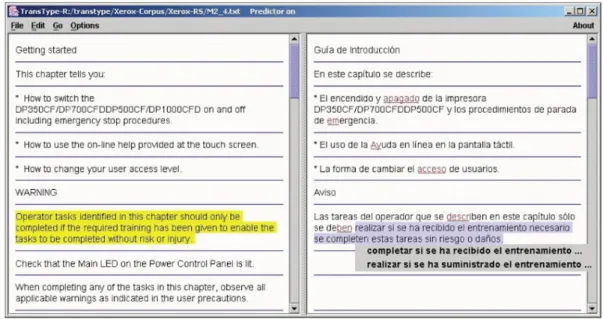
Transtype The Transtype project (Foster and Lapalme, 2000) conducted the first user-study on interactive machine translation, using an interface with the source sentence
dis-played in the top half of the window, and a composition area for the target translation in
the bottom half of the window. The composition area provided a drop-down autocomplete
containing ann-best list of suggestions for the next word in the translation.
Figure 2.2: The Transtype 2 CAT interface (image from Casacuberta et al. (2009))
Transtype2 The Transtype 2 interface extended the interactive translation environment of Transtype to work with an actual SMT system (Barrachina et al., 2009). Figure 2.2
shows a screenshot of the Transtype 2 CAT interface.
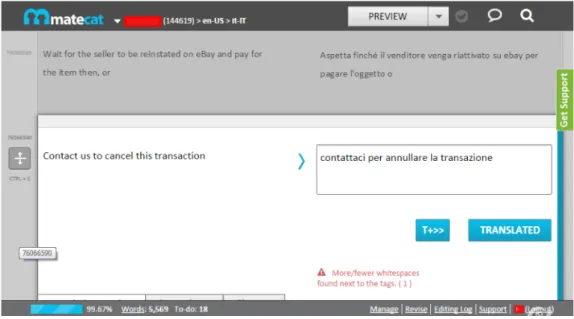
MateCAT and CasmaCAT MateCAT (Federico et al., 2014) is a web-based CAT tool, created by a consortium of academic and commercial partners during a project funded by
scenar-Figure 2.3: The MateCAT Interface, which is currently a commercial web-based CAT tool.
ios, while CASMACAT, a counterpart interface built upon the same underlying
implemen-tation, was developed specifically for CAT research (Alabau et al., 2014a). CASMACAT
incorporates support for instrumentation, such as keystroke logging, which is important
for experimentation. These tools are arguably the first mature open-source web-based
CAT tools. CASMACAT in particular has been the platform of choice for research papers
on diverse topics, including online learning (Alabau et al., 2014b), interactive machine
translation (Alabau et al., 2013a; Underwood et al., 2014), and the integration of eye
tracking into translation process analysis (Garcia Martinez et al., 2014). Figure 2.3 shows
a screenshot of MateCAT.
Figure 2.4: An example of the translation options rendered in CAITRA during interactive translation (Image from Koehn (2009)).
CAITRA CAITRA (Koehn, 2009c) was a unique interface for interactive translation. Translators see ranked suggestions below the translation window, where boxes correspond
to phrases, and rows correspond to the top paths through PB-SMT beam search.
Transla-tors compose the target translation by clicking on suggestions from the search lattice, or
by typing in the target area. Figure 2.4 shows an example of the translation alternatives
rendered by CAITRA.
Figure 2.5: The PET interface.
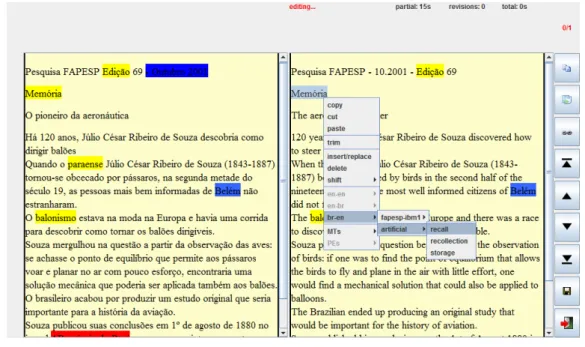
PET The Post-Editing Tool (PET) (Aziz et al., 2012) is a simple interface for collecting statistics on the post-editing process. PET provides a toolset for annotating analyzing
dif-ferent error types found in translation, as well as computing metrics such as edit-distance.
Figure 2.5 shows a screenshot of the PET tool.
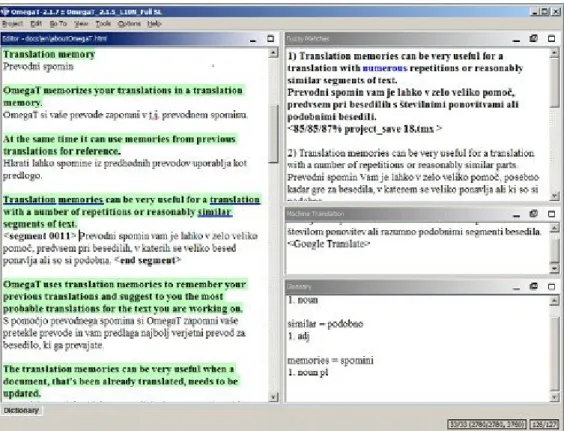
OmegaT OmegaT is a popular open-source CAT tool, which has also been used in some user studies that implement new components and interaction modalities (Torregrosa et al.,
2017). Figure 2.6 shows a screenshot of OmegaT.
2.2.2
Logging User Actions during Translation
Logging user behaviour is essential to CAT tool research. In additional to some logging
functionality in several of the CAT research interfaces discussed above, several tools have
been designed to help researchers log translator actions for analysis.
Translog Translog (Lykke Jakobsen, 1999) and Translog-II (Carl, 2012) are tools for recording and analyzing translators, created for the purpose of enabling sophisticated
Figure 2.6: The OmegaT interface.
iOmegaT and OmegaT-SessionLog iOmegaT (Moran et al., 2014) added instrumenta-tion for logging translator acinstrumenta-tions into OmegaT, and was used to collect data from
trans-lators in an industry setting. OmegaT-Sessionlog3 is an alternative logging plugin for OmegaT, which produces XML logs of translator actions.
2.3
Deep Learning for Machine Translation
Deep learning (DL) is a machine learning technique which allows continuous, distributed
representations to be learned directly from data. This area of machine learning has its
roots in work on modeling the activation patterns of actual neurons (McCulloch and Pitts,
1988) in the mid-1940s, and in models such as the perceptron (Minsky and Papert, 1969)
and the multi-layer perceptron (Rumelhart et al., 1986a), but has recently seen a massive
explosion in popularity across all areas of applied ML, and AI because of the flexibility
of the model types that may be specified, their high performance on many tasks, and the
exponential increase in available computational power, largely due to the use of Graphical
Processing Units (GPUs), which can do large matrix multiplication operations orders of
3
magnitude faster than CPUs.
Since the mid-1980s,feed-forwardnetworks4have been a popular model choice for ma-chine learning practitioners across many domains (Hornik et al., 1989), and are still used
in many scenarios today. However, beginning in the late 1980s,recurrent neural network
(RNN) architectures starting becoming a potential alternative architecture used to model
natural language. RNNs are more flexible with respect to variable length sequences, and
can outperform feed-forward models on some tasks (Elman, 1990; Bengio et al., 2003;
Sutskever et al., 2014b; Schmidhuber, 2015). The long-short term memory (LSTM) cell
(Hochreiter and Schmidhuber, 1997) and the more recent gated recurrent unit (GRU) cells
(Cho et al., 2014b) have equipped RNNs with the ability to handle longer sequences, and
to cope with long-distance dependencies in both inputs and outputs, important traits for
models which deal with natural language. Finally, the invention ofattention mechanisms
(Bahdanau et al., 2014; Luong et al., 2015) has led to further improvements, especially for
tasks which generate long sequences of text which are transformations of the input, such
as MT. The menagerie of deep architectures that are currently used for different tasks is
huge, and will only continue to expand as more researchers work on DL.
The word deep in DL refers to the fact that models are often composed of multiple layers of affine transformations followed by non-linear squashing functions, as opposed
to shallow models, which consist of a single layer. However, in practice, the term deep
learning is currently used to refer to most varieties of models based on neural networks,
regardless of the number of layers a model actually has.
Schmidhuber (2015) gives a very thorough review of the history of DL with neural
networks. Here we try to touch upon the key aspects of DL as it relates to the work in this
thesis — we try to provide pointers to the most relevant research if the reader is interested
in further exploring the very large body of work on this topic.
2.3.1
Sequence to Sequence Models
Sequence-to-Sequence (seq2seq) models (Sutskever et al., 2014c) have now become the de-facto approach of choice in many areas of NLP. These models are flexible,
straightfor-ward to implement, and scale well to very large datasets. The recent success of seq2seq
4
can largely be attributed to the effectiveness of the computational structure of LSTM and
GRU cells at capturing long-distance dependencies in sequences, and to the ability of
attention mechanisms to maintain good output for large or complex model inputs.
How-ever, despite the good performance of these relatively new techniques, it is important to
point out that researchers have been evaluating the use of RNNs for NLP, and specifically
for machine translation for over 20 years (Chrisman, 1991; Waibel et al., 1991; Ñeco and
Forcada, 1997; Castaño and Casacuberta, 1997), although with much smaller dataset sizes
than are currently used.
We will now give an overview of key building blocks of seq2seq models as relates to
the models used in this thesis. We then proceed to discuss the way these components may
be assembled in current state-of-the-art models used for NMT.
Figure 2.7: A fully connected feed-forward network with two layers and a single output value (image from Koehn (2017)).
Feed-forward Layers
The feedforward layer can be described as a linear transformation of a vector x, plus a bias5, when theb, i.e. f(x) = Wx+b followed by an element-wise non-linearityg()
whereg()is usually one of Eqs. 2.1a–2.1c:
logistic(x) = 1
1 +e−x (2.1a)
tanh(x) = e
x−e−x
ex+e−x (2.1b)
5Note that the purpose of the bias is to shift the linear function implemented by the parameters of the feedforward
layer. Some descriptions of neural networks omit the bias term if input data is normalized, or a layer uses a "global" normalization such as the softmax function (see below).
ReLU(x) = max(0, x) (2.1c) Note that we are usingxto denote a single element of the vector x, since each of these functions is an element-wise operation.
A single feed-forward layer can thus be described by Eq. 2.2:
feedforward(x) =g(f(x)) = ReLU(Wx+b) (2.2) Feedforward layers may be stacked to create deeper models:
h1 =ReLU(W1x+b1) (2.3a)
h2 =ReLU(W2h1+b2) (2.3b)
. . . (2.3c)
where the parameters Wi and bi are different for each layer. Stacking often leads to
better model performance, and the use of>1layers in a feedforward network yields the (theoretical) capacity to approximate