PURPOSE
The Chancellor's Management Information System has been designed to meet a variety of information needs identified by the Chancellor's Office. The identification process has taken into account both past experience, current, and anticipated needs. The use of the information in the database will be focused on issue identification, policy analysis, program evaluation, and planning.
DESIGN OBJECTIVES
Five basic design objectives underly the Chancellor's database.
1. Accountability the ability to respond to basic questions about the students being served, their demographic characteristics, the courses and services they are utilizing, their goals, and the outcomes they achieve through the community college system.
2. Integration of data the ability to link together related data elements to serve the basic questions discussed above. For example, it should be possible to relate basic student demographic data to course activity data to answer questions about the race and gender of unduplicated headcount of students enrolled in various occupational programs.
3. Quality of data the ability to provide accurate and consistent information on a timely basis.
Accuracy and consistency require editing and comparison of data in order to eliminate unreasonable information.
4. Longitudinal tracking the ability to follow the progress of students in meeting their goals, and evaluating institutional performance over time. Policy makers want the ability to measure the success of specific programs (e.g., matriculation) in achieving improved student performance. Such measurements require the ability to follow the performance of students over time.
5. Flexibility the ability to perform a variety of ad hoc analyses using a stable base of data. Emerging issues or changing circumstances should not necessarily be grounds for new data requirements being placed upon the districts.
Page 1.02 MAJOR CATEGORIES OF INFORMATION
The information system is designed to collect and organize information from three major areas of activities:
• Students;
• Faculty and staff;
• Courses
The Chancellor seeks to collect that data that can provide answers to fundamental questions related to each of the three areas listed. It would be impossible to list every possible question related to the three areas. It is more useful to review the data elements documented in the Dictionary. A review of the Dictionary will reveal the basic nature of information being sought. The use of common linking data elements (Social Security number, TOP and ASA codes, district and college number, etc.) and the use of data base software will allow data to be linked from the various categories in order to respond to a variety of questions.
CHANCELLOR'S OFFICE DATABASE OVERVIEW
As indicated, the Chancellor's Office Management Information System database is actually comprised of several databases that each represent a distinct, logical collection of data that are related together using common linking data elements and database software. The principal databases that represent the major areas of activity are the Student, Section, Course, and Employee databases. Each of these databases is logically broken down into smaller groups of data. For example, the Student database includes the Student Basic Demographic database, the Student DSP&S database, the Student Enrollment database and the Student Financial Aid database.
Each database stores a record for every occurrence of the entity that the database represents. For example, the Student Basic Demographic database represents the entity identified as: STUDENTS. Each record in this database stores demographic data for all students enrolled at every college in the state. College and student identifiers are used to identify individual students (records) at each college. Stored in every record, in addition to identifiers, are data elements that describe the entity. For example, stored in all records of the Student Basic Demographic database are student's gender, ethnicity, birthdate, etc.
The material on the following pages outlines the function of each database and each database sub-group. In addition, the manner in which the databases are related together and their associated data elements are described.
them. There are three possible relationships that can occur either among two or more databases or database sub-groups. They are:
(1) one to one, (2) one to many, (3) many to many.
An example of a "many to many" relationship exists between the Student and the Section databases (see following pages). For every student enrolled at a college during a given term, those students can be enrolled in one or more course sections. Likewise, every course section offered at the same college can have one or more students enrolled in it.
The lines below are used on the following pages to denote each of the possible relationships that can occur between each database and between each database sub-group. The arrows show the possible relationships that can occur between databases within the reporting period for the databases being related together. For example, a reporting period can consist of a semester or quarter, or in the case of financial aid, an academic year.
LEGEND
Denotes a one-to-one relationship Denotes a one-to-many relationship in the direction of the arrowhead Denotes a many-to-many relationship
Page 1.04 STUDENT DATABASE SECTION DATABASE COURSE DATABASE EMPLOYEE DATABASE PRINCIPLE DATABASES COLLEGE CDS CODES CIP CODES CALENDAR SUPPORT DATABASES
PARTIAL DATABASE STRUCTURE: Focal Position of the SECTION DATABASE Two things may be noted about the data structure as illustrated on this and the following page: First, the focus of the database structure is the SECTION DATABASE to which the COURSE, EMPLOYEE, and STUDENT DATABASES are directly joined. This reflects the central role in an educational institution played by a section: It is the offering of a course by an instructor to a group of students. COURSE DATABASE EMPLOYEE DATABASE STUDENT DATABASE SECTION DATABASE
Page 1.06 STUDENT DATABASE ENROLLMENT DATABASE SECTION DATABASE COURSE DATABASE
Second, the relation between the STUDENT, ENROLLMENT, SECTION, and COURSE DATABASES reflect the connection between the courses in which the student enrolls.
On the following pages the individual tables which make up the various databases are illustrated. Two of these tables serve the function of integrating the overall database structure; they act as the structural "glue." These interconnecting tables are:
1. The ASSIGNMENT table. This table links the Employee and Section databases. 2. The ENROLLMENT table. This table links the Section and Student databases, On the subsequent pages, the data elements associated with each table are listed. ____________________
STUDENT TERM TABLE SB08-27 ENROLLMENT (STUDENT SECTION) TABLE SX01-05 SECTION TABLE XB00-10 COURSE TABLE CB00-22 STUDENT BASIC TABLE SB00-07 STUDENT DSPS TABLE SD01-05 STUDENT AID APPL TABLE SF01-20 STUDENT ASSESMT TABLE SA01-06 STUDENT PBS TABLE PS01-02 STUDENT AID AWARDS TABLE SF21-22 EMPLOYEE DEMOGRAPHIC TABLE EB00-13 CALENDAR TABLE CC01-CC08 ASSIGNMENT SECTION-FACULTY TABLE XE01-04 SESSION-SECTION TABLE XF00-07 EMPLOYEE ASSIGNMENT TABLE EJ01-08 STUDENT MATRIC TABLE SM00-13 STUDENT VATEA TABLE SV01-08 STUDENT PROGRM AWARD TABLE SP01-04 STUDENT EOPS TABLE SE01-10 DATABASE TABLES
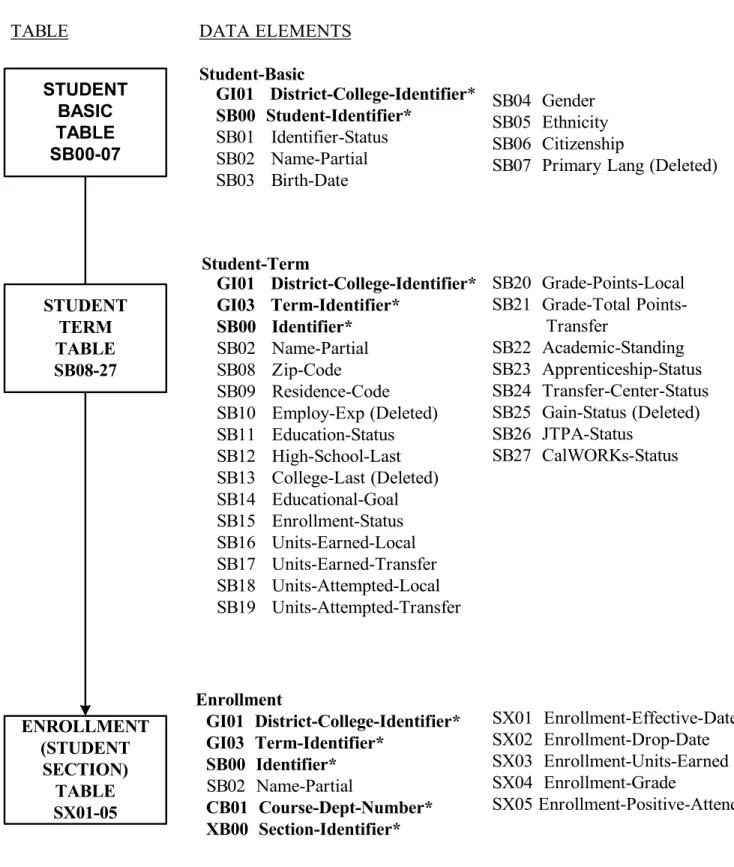
Page 1.08 STUDENT TERM TABLE SB08-27 STUDENT BASIC TABLE SB00-07 ENROLLMENT (STUDENT SECTION) TABLE SX01-05
STUDENT DATABASE: Part one: BASIC, TERM, and ENROLLMENT DATA TABLE DATA ELEMENTS
Student-Basic GI01 District-College-Identifier* SB00 Student-Identifier* SB01 Identifier-Status SB02 Name-Partial SB03 Birth-Date SB04 Gender SB05 Ethnicity SB06 Citizenship
SB07 Primary Lang (Deleted)
Student-Term GI01 District-College-Identifier* GI03 Term-Identifier* SB00 Identifier* SB02 Name-Partial SB08 Zip-Code SB09 Residence-Code SB10 Employ-Exp (Deleted) SB11 Education-Status SB12 High-School-Last SB13 College-Last (Deleted) SB14 Educational-Goal SB15 Enrollment-Status SB16 Units-Earned-Local SB17 Units-Earned-Transfer SB18 Units-Attempted-Local SB19 Units-Attempted-Transfer SB20 Grade-Points-Local SB21 Grade-Total Points-Transfer SB22 Academic-Standing SB23 Apprenticeship-Status SB24 Transfer-Center-Status SB25 Gain-Status (Deleted) SB26 JTPA-Status SB27 CalWORKs-Status Enrollment GI01 District-College-Identifier* GI03 Term-Identifier* SB00 Identifier* SB02 Name-Partial CB01 Course-Dept-Number* XB00 Section-Identifier* SX01 Enrollment-Effective-Date SX02 Enrollment-Drop-Date SX03 Enrollment-Units-Earned SX04 Enrollment-Grade SX05 Enrollment-Positive-Attendance
NOTE: These data elements belong to the table which links the Student and the Section databases, and so belong to both databases.
*Key Fields
________________________ LAST REVISION: 10/01/00
STUDENT DATABASE: Part Two: PROGRAM AWARDS, DSPS, BASIC SKILLS, and EOPS
TABLE DATA ELEMENTS
Student Program Award
GI01 District-College-Identifier* SP02 Award
GI03 Term-Identifier* SP03 Award-Date
SB00 Identifier* SP04 Co-Unique-Code
GI92 Record-Number-Identifier SB02 Name-Partial
SP01 Program-Identifier* Student-Disability
GI01 District-College-Identifier* SD05 Disability-Dept-
GI03 Term-Identifier* Rehab
SB00 Identifier* SB02 Name-Partial SD01 Primary-Disability SD02 Primary-Disability-Services-Contacts SD03 Secondary-Disability SD04 Secondary-Disability-Service-Contacts Student-Precollegiate-Basic-Skills GI01 District-College-Identifier* GI03 Term-Identifier* SB00 Identifier* SB02 Name-Partial PS01 PBS Units-Accumulated PS02 PBS-Unit-Limit-Waiver-Status Student-EOPS
GI01 District-College-Identifier* SE06 Care-Term-Of-Accept
GI03 Term-Identifier* SE07 Care-Marital-Status
SB00 Identifier* SE08 Care-Num-of-Depend SB02 Name Partial SE09 Care-TANF Duration SE01 Eligibility-Factor SE10 EOPS/CARE Withd Rea SE02 Term-Of-Acceptance SE03 End-Of-Term-EOPS-Status SE04 Units-Planned SE05 Care-Status STUDENT PROGRAM AWARD TABLE SP01-04 STUDENT DSPS TABLE SD01-05 STUDENT PRECOLLEGIATE BASIC SKILLS TABLE (PBS) PS01-02 STUDENT EOPS TABLE SE01-10
Page 1.010
STUDENT DATABASE: Part Two Continued: MATRICULATION, ASSESSMENT, and VTEA
TABLE DATA ELEMENTS
Student-Matriculation GI01 District-College-Identifier* GI03 Term-Identifier* SB00 Identifier* SB02 Name-Partial SM01 Goals SM02 Major SM03 Special-Services-Needs SM04 Orientation-Exempt-Status SM05 Assessment-Exempt-Status SM06 Counseling/Advisement-Exempt-Status SM07 Orientation-Services SM08 Assessment-Services-Placement SM09 Assessment-Services-Other SM10 Study-Skills-Evaluation-Servs (Deleted) SM11 Special-Services-Referral (Deleted) SM12 Counseling/Advisement-Services SM13 Academic-Follow-up-Services Student-Assessment
GI01 District-College-Identifier* SA06 Raw-Score
GI03 Term-Identifier* (Deleted)
SB00 Identifier*
SB02 Name-Partial SA01 Instrument
SA02 Assessment-Form (Deleted) SA03 Accommodation
SA04 Purpose SA05 Date
Student-VTEA
GI01 District-College-Identifier* SV07 Criminal-Offender
GI03 Term-Identifier* Status (Deleted)
SB00 Identifier* SV08 Tech-Prep-Status SB02 Name-Partial SV01 Vocational-Program-Plan-Status SV02 Funded-Status (Deleted) SV03 Econ-Disadv-Status SV04 Single-Parent-Status SV05 Displaced-Homemaker-Status SV06 Coop-Work-Experience-Educational-Type *Key Fields --- LAST REVISION: 10/01/00
STUDENT DATABASE: Part Two Continued: FINANCIAL AID APPLICANT and AWARD STUDENT MATRIC TABLE SM01-13 STUDENT ASSESSMENT TABLE SA01-06 STUDENT VTEA TABLE SV01-08
TABLE DATA ELEMENTS Student-Financial-Aid-Applicant GI01 District-College-Identifier* GI03 Term-Identifier* SB00 Identifier* SB02 Name-Partial SF01 Applicant-Status SF02 Time-Period SF03 Budget-Category SF04 Total-Budget-Amount SF05 Dependency-Status SF06 Household-Size SF07 Family-Status SF08 Income-AGI-Parent SF09 Income-AGI-Student SF10 Untax-Inc-Parent SF11 Untax-Inc-Student SF12 TANF-Status (Deleted) SF13 Contrib-Parent (Deleted) SF14 Contrib-Student (Deleted) SF15 Other-Resources (Deleted) SF16 Gross-Fin-Need (Deleted) SF17 Pell-Grant-Index SF18 Vet-Benefits-Status (Deleted) SF19 Work-Study-Hours (Deleted) SF20 Campus-Employ-Amt.(Deleted) Student-Financial-Aid-Award GI01 District-College-Identifier* GI03 Term-Identifier* SB00 Identifier* GI03 Term-Received SF21 Award-Type STUDENT FINANCIAL AID APPL TABLE SF01-20 STUDENT FINANCIAL AID AWARDS TABLE SF21-22
Page 1.012
SECTION DATABASE: SESSION, SECTION, and ASSIGNMENT
TABLES DATA ELEMENTS
Session
GI01 District-College-Identifier* XF06 Meeting-Time-Ending GI03 Term-Identifier* XF06 Meeting-Time-Ending CB01 Course-Dept-Number* XF07 Total Hours
XB00 Section-Identifier* XF00 Session Identifier* XF01 Instruction-Method XF02 Date-Beginning XF03 Date-Ending XF04 Days-Scheduled Section
GI01 District-College-Identifier* XB03 Date-Census-Second (Deleted) GI03 Term-Identifier* XB04 Contract-Education-Code GI02 District-College-Division* XB05 Units-Maximum
CB01 Course-Dept-Number* XB06 Units-Minimum
XB00 Section-Identifier* XB07 VTEA-Funded-Status (Del) XB01 Accounting-Method XB08 DSPS-Special-Status
XB02 Date-Census-First XB09 Wrk-Based-LearningActs
XB10 CVU/CVC Status
Faculty-Assignment
GI01 District-College-Identifier* XF00 Session-Identifier* GI03 Term-Identifier* XE01 Type
CB01 Course-Dept-Number* XE02 Percent XB00 Section-Identifier* XE03 FTE
EB00 Employee-Identifier* XE04 Hourly Rate
*Key Fields ____________________ LAST REVISION: 01/01/02 COURSE DATABASE:
SESSION
(SECTION)
TABLE
XF00-07
SECTION
TABLE
XB00-10
ASSIGNMENT
(SECTION-FACULTY)
TABLE
XE01-04
TABLE DATA ELEMENTS Course GI01 District-College-Identifier* GI03 Term-Identifier* CB00 Permanent-District-Identifier (Deleted) CB01 Department-Number* CB02 Title CB03 Top-Code CB04 Credit-Status CB05 Transfer-Status CB06 Units-Of-Credit-Maximum CB07 Units-Of-Credit-Minimum CB08 Basic-Skills-Status CB09 SAM-Priority-Code CB10 COOP-ED-Status CB11 Classification-Code CB12 Repeatability (Deleted) CB13 Special-Class-Status CB14 Can-Code CB15 Can-Seq-Code CB16 Same-As-Dept-Number 1 (Deleted) CB17 Same-As-Dept-Number 2 (Deleted) CB18 Same-As-Dept-Number 3 (Deleted) CB19 Crosswalk-CRS-Dept-Name CB20 Crosswalk-CRS-Number CB21 Prior-to-College-Level CB22 Noncredit-Category COURSE TABLE CB00-22
Page 1.014
TABLE DATA ELEMENTS
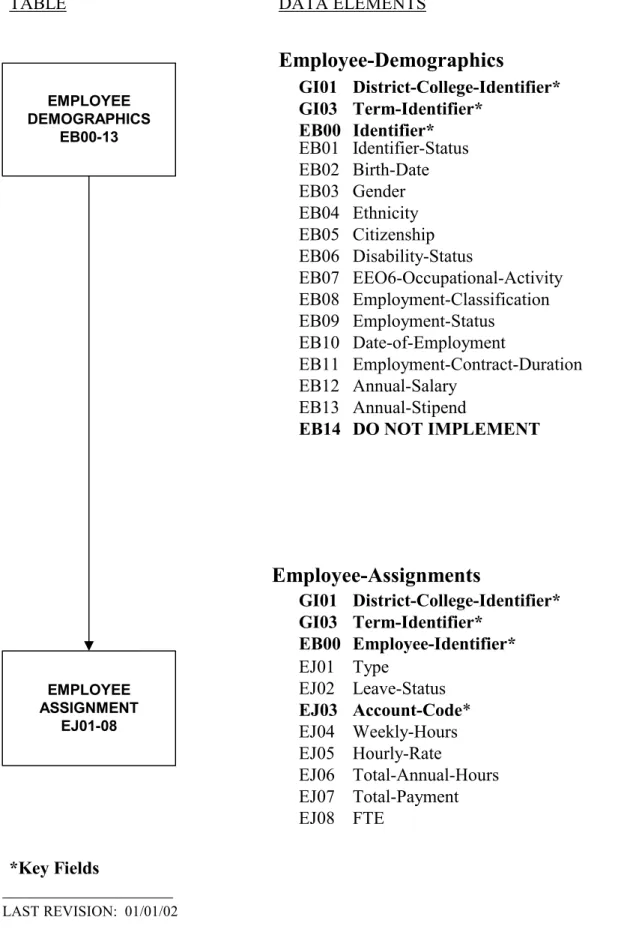
EMPLOYEE ASSIGNMENT EJ01-08 EMPLOYEE DEMOGRAPHICS EB00-13
Employee-Demographics
GI01 District-College-Identifier* GI03 Term-Identifier* EB00 Identifier* EB01 Identifier-Status EB02 Birth-Date EB03 Gender EB04 Ethnicity EB05 Citizenship EB06 Disability-Status EB07 EEO6-Occupational-Activity EB08 Employment-Classification EB09 Employment-Status EB10 Date-of-Employment EB11 Employment-Contract-Duration EB12 Annual-Salary EB13 Annual-StipendEB14 DO NOT IMPLEMENT
*Key Fields ___________________ LAST REVISION: 01/01/02 GI01 District-College-Identifier* GI03 Term-Identifier* EB00 Employee-Identifier* EJ01 Type EJ02 Leave-Status EJ03 Account-Code* EJ04 Weekly-Hours EJ05 Hourly-Rate EJ06 Total-Annual-Hours EJ07 Total-Payment EJ08 FTE
Employee-Assignments
RATIONALE FOR DATA ELEMENT CODE VALUES
A. Objectives for Data Element coding scheme:• Ensure consistency in coding all data elements;
• Provide rules which will act as a set of principles to guide the designer when creating a new set of codes for a new data element;
• Allow the user to apply rules that are "easy" to remember when interpreting data generated from ad-hoc queries;
• Develop a reporting system that is based on Positive Reporting.
Positive Reporting is founded on the principle of requiring a valid response for all data elements (i.e., blanks and spaces are not valid values). This is to ensure that no data element is omitted B. Data Element Classifications:
The data elements defined in the Data Element Dictionary fall into three classes of data: Alphanumeric, Numeric, and Dates.
• Alphanumeric:
•Numeric Codes (0-9):
This coding scheme implies an ordering or ranking of codes. This implied ordering orranking can occur for two reasons. First, the items of a data element may have a logical order or rank associated with them. In addition, numeric codes are used where there is a preferred ordering or ranking of data items on the input source documents or the output terminal displays and paper reports.
•Alpha Codes (A-Z):
There are three reasons for using alpha codes. First, if there are more than ten categories of data items and there are requirements to limit the size of the data element to one character, alpha codes may be used to accomplish this. Second, where it seems appropriate, alpha codes may be used to embed some intelligence into the data items. For example, data items for Student Gender (see SB04) are coded "F" for "Female" and "M" for "Male". And third, where it is desirable to code data items with no order or intelligence, alpha codes may be sequentially assigned for this purpose.
Page 1.016 • Numeric:
• Not to be confused with Numeric Codes (above), numeric data elements contain numeric values that will be used in some arithmetic calculations.
• Dates:
• Date data elements represent valid dates in the format YYMMDD, where YY = Year, MM = Month, and DD = Day. The birthdate has been changed to YYYYMMDD, where YYYY = Year, MM = Month, and DD = Day. The Chancellor’s Office will determine the century. The day must be within a range valid for that month. Also, leap year must be considered when reporting for February (i.e., 28 or 29 days).
C. Defaults:
There are circumstances or conditions that require the use of a default value when the coding of a data element is unknown or not applicable. (Note: Some data elements do not allow default values. Refer to the Data Element Dictionary to determine if a default value may be applied to a particular data element.)
The conditions that can occur in which default values are used.
• Unknown and Unreported: This occurs when the value for a particular data element is unknown because it could not be captured from the data source (i.e., a student did not fill out a survey item). Thus, the value for the data element is unknown and unreported.
• Not Applicable: This occurs when there are two data elements that can be reported for the same entity, and depending on their values, only one of those data elements is applicable, but not both. Data Elements that fall into this classification are said to be mutually exclusive of one another. That is, if a data element is reported so that it negates the application of another data element, they are said to be mutually exclusive.
For example, if a student drops a course, then the Enrollment Drop Date is coded with the appropriate date. If the student does not drop the course, the Enrollment Drop Date has no meaning for that Student Enrollment. Therefore, the Enrollment Drop Date would be coded as "Not Applicable." (i.e., "888888" since it is a date field.)
LAST REVISION: 10/01/00
The following table specifies the coding scheme that is used to represent each of the above default conditions for each data classification.
Codes Reported by Districts
Not Unknown
Data Class Applicable Unreported
Alphanumeric Y X
Numeric 8 9
Dates 8 9
D. General Guidelines for Coding the Unused portion of a Data Element:
These are general guidelines that are to be followed when developing applications that will generate codes or values for each data classification.
• Alphanumeric: Unless otherwise specified, these data elements should be left-justified with trailing blanks. NOTE: Some data element definitions call for other literals to be inserted in unused portions instead of blanks and also call for right-justification. See the data element dictionary for actual coding specifications.
• Numeric: Right-justified, decimal aligned with leading zeros before the first significant digit.
• Dates: Date fields are six-digits in the format of YYMMDD, where YY = Year,
MM = Month, and DD = Day. The birthdate has been changed to YYYYMMDD, where YYYY = Year, MM = Month, and DD = Day. The Chancellor’s Office will determine the century. The date should completely fill the field. If coding a date that has a month or day that is only one digit, insert a leading zero, i.e., January 1, 1988 would be