Data Level Inference Detection in Database Systems
Raymond W. Yip and Karl N. Levitt
Department of Computer Science
University of California, Davis
One Shields Avenue, Davis CA 95616
Abstract
Existing work on inference detection for database systems mainly employ functional dependencies in the database schema to detect inferences. It has been no-ticed that analyzing the data stored in the database may help to detect more inferences. In this paper, we describe our eort in developing a data level in-ference detection system. We have identied ve infer-ence rules that a user can use to perform inferinfer-ences. They are `subsume', `unique characteristic', `overlap-ping', `complementary', and `functional dependency' inference rules. The existence of these inference rules conrms the inadequacy of detecting inferences using just functional dependencies. The rules can be applied any number of times and in any order. These infer-ence rules are sound. They are not necessarily com-plete, although we have no example that demonstrates incompleteness. We employ a rule based approach so that future inference rules can be incorporated into the detection system. We have developed a prototype of the inference detection system using Perl on a Sun SPARC 20 workstation. The preliminary results show that on average it takes seconds to process a query for a database with thousands of records. Thus, our ap-proach to inference detection is best performed o-line, and would be most useful to detect subtle inference at-tacks.
1. Introduction
Inference is a method to subvert access control in database systems. An inference occurs when a user is able to infer some data without directly access-ing them. In multilevel database systems, early work on inference detection used a graph to represent the Copyright 1998 IEEE. Published inProceedings, 1998 IEEE
Computer Security Foundations Workshop, Rockport, Mas-sachusetts, June, 1998.
functional dependencies among the attributes in the database schema. An inference occurs when there are two or more paths among the attributes, and the paths are labeled at dierent classication levels [6, 2, 12]. The inference path is eliminated by upgrading some attributes along the path [15, 13]. Lunt [9] points out that some inference problems can be avoided by re-designing the database schema, and classifying the at-tributes properly. However, redesigning the database schema results in data duplication which leads to up-date anomalies. It also requires modications to the existing application programs. There is also work on incorporating external knowledge into the inference de-tection systems [18, 7, 16, 17, 3]. More recently, re-searchers suggest using data of the database to gener-ate a richer set of functional dependencies for inference detection. Hinke et al. use cardinality associations to discover potential inference paths [8]. Hale et al. in-corporate imprecise and fuzzy database relations into their inference detection system [5]. However, existing eorts still simply employ functional dependencies to detect inferences. As noted by SRI researchers, moni-toring user activities may lead to detecting more infer-ences [14]. By data level inference detection, we mean the system detects inferences by considering the data in the database, as opposed to the database schema only.
Inferences can also occur in discretionary access con-trol systems where users are explicitly granted access rights to access data (as in System R). It is not an obvious task to grant users the exact amount of ac-cess rights they need. In some cases, users are simply granted more access rights than they need in order not to hinder their work. To ensure the users do not misuse the database, we need to monitor their accesses.
A simple way to monitor user accesses is to exam-ine each user query, and reject any query that accesses sensitive data. However, it is possible for a user to use a series of unsuspicious queries to infer data in the database. Motro et al. address a similar problem, but
their work focuses on detecting aggregation instead of inference attacks [11]. In the statistical database secu-rity community, various techniques have been proposed to protect individual records, for example, query-set-size control, cell suppression, and data perturbation [1]. However, these techniques are not suitable for de-tecting inferences using general purpose queries.
In this paper, we describe our eort in developing a data level inference detection system. It is a static inference detection system where inferences are per-formed with respect to a snapshot of the database. We have identied ve inference rules that users can use to infer data: `subsume', `unique characteristic', `overlap-ping', `complementary', and 'functional dependency' inference rules. Users can apply these rules any number of times, and in any order to infer data. These inference rules are sound but not necessarily complete. Although we have no example that demonstrates incompleteness, more research eort is needed to determine if they are complete. We employ a rule based approach so that when a new inference rule is discovered, it can be in-corporated into the inference detection system. The existence of these inference rules conrms the inade-quacy of functional-dependency based inference detec-tion schemes. We have developed a prototype of the inference detection system to study its performance. The preliminary results show that on average the sys-tem takes a few seconds to process a query that returns hundreds of records from a database of ten thousand records. Thus, our approach to inference detection is best performed o-line, and would be most useful to detect subtle inference attacks.
This paper is organized as follows. In Section 2, we provide the intuition behind the ve inference rules. In Section 3, we introduce the notations used in this paper. In Section 4, we present the ve inference rules. In Section 5, we describe our implementation and the preliminary results. We give our conclusions in Section 6.
2. Overview of the Inference Rules
In this section, we provide the intuition behind the ve inference rules. The goal of our inference detection system is to detect if a user can indirectly access data using two or more queries. In particular, the system determines if the user can infer the return tuples from dierent queries corresponding to the same tuple in the database.The result of each user query is a set of return tuples 1. The user cannot identify each return tuple unless 1Unless otherwise stated, a set of return tuples is indeed a
the primary key of the tuple is also returned. How-ever, a certain group of attribute values of a tuple may uniquely identify the tuple. The unique identication rule handles this situation. Another way to identify a return tuple is to compare it with other return tuples that have already been identied.
There are two possible relationships between two sets of return tuples. One possibility is that for each return tuple t
1 of a query, there is a return tuple t
2 of the other query, such that t
1 and t
2 correspond to the same tuple in the database. The subsume infer-ence rule handles this case. Another possibility is that only some return tuples of a query correspond to some return tuples of another query. The overlapping in-ference rule identies the corresponding return tuples that are common to both queries. The complementary inference rule identies the corresponding return tuples by taking the \dierence" between two sets of return tuples. The functional dependency inference rule is introduced to simulate the schema level inference de-tection scheme.
Once the corresponding return tuples between two queries are identied, the user can generate inferred queries. The user knows the return tuples of an inferred query without directly issuing it to the database. For example, the user can infer a new query with returns tuples \common" to both queries, or a new query that returns tuples from one query but not from another query. The user can also combine several queries into a single query. We will discuss the eect of applying inference rules to unions of queries. Essentially, the ve inference rules cover the set intersection, dierence and union relationships between two sets of return tuples.
When the user issues a query, the inference detec-tion system compares it with previously issued queries and inferred queries, and applies inference rules when appropriate. An occurrence of inference will result in either the modications of the existing queries (for ex-ample, combining two corresponding return tuples), or the generation of new inferred queries. These may trig-ger further applications of the inference rules. Hence, the inference rules are applied repeatedly until there is no new inference occurs. This is a terminating process as the number of inferences that can occur is bounded by the size of the database. When two users are sus-pected of cooperating in performing inference, we can run the inference detection system against their com-bined set of queries.
multiset of return tuples. That is, duplicated return tuples are not removed
3. Preliminaries and Notation
We consider inference detection in a relational database with a single table. A database with multi-ple tables can be transformed into a universal relation [10]. We assume that the only way the user can learn about the data in the database is by issuing queries to it. That is the user does not rely on real-world knowl-edge to perform any inference. Such knowlknowl-edge might be added to the database as `catalytic relation' as sug-gested in [6].
Ai denotes an attribute in the table, andai denotes an attribute value from the domain ofAi. t[Ai] denotes the attribute value of a single tupletover the attribute Ai. A query is represented by a 2-tuple: (attribute-set, selection-criterion), where attribute-set is the set of at-tributes projected by the query, and selection-criterion is the logical expression that is satised by each return tuple of the query. No aggregation function (for exam-ple, maximum and average) is allowed in the attribute-set. In general,Qirefers to the queryfASi;SCig. jQij denotes the number of return tuples of Qi. fQig de-notes the set of return tuples ofQi. For each queryQi, ASi is expanded with an attribute Ai when `Ai =ai' appears in SCi as a conjunct. A queryQis a `partial query'if the user can determinejQj, but not all return tuples ofQ. `\', `[', and `n' stand for the set intersec-tion, union, and dierence operation respectively.
Now, we introduce several notions that are used throughout this paper.
Denition 1
A tuple t over a set of attributes AS `satises' a logical expression E if E is evaluated to true when each occurrence of Ai in E is instantiated with t[Ai], for all Ai in AS. t `contradicts' withE if E is evaluated to false.For example, the tuple (35, 60K) that is projected over (Age, Salary)satises E = (Age>30^Salary<70K); while the tuple (25, 50K) projected over the same set of attributes contradicts with E. The tuple (45K, Man-ager)projected over (Salary, Job) neither satises nor contradictsE. This is because after the instantiation, E becomes (Salary<70K) whose truth value is unde-termined.
Denition 2
Given two queries, Q 1 and Q 2, we say that Q 1 is `subsumed' by Q 2, denoted as Q 1 <Q 2, i 1. SC 1 !SC 2; or 2. for each tuplet1 in fQ 1 g,t 1 satises SC 2. where ! is the logical implication. `<' is a reexive, anti-symmetric, and transitive relation. A return tuple
t
1 `relates' to another return tuple t
2 if the two tu-ples are selected from the same tuple in the database. Hence, Q
1 <Q
2 implies that for each return tuple t
1 of Q
1, there is a return tuple t 2 of Q 2, such that t 1 relates tot 2.
When evaluating a logical implication, we need to consider the integrity constraints that hold in the database. Consider the following implication,
(age>18^age<35)!(age>20^age<50), which is false. Suppose the youngest person in the database is 22 years old. By adding this constraint to both sides of the implication, it becomes,
((age>18^age<35)^(age22))!
((age>20^age<50)^(age22))
(age22^age<35)!
(age22^age<50), which is true.
Now, we introduce the notion of `indistinguishable'.
Denition 3
A return tuplet1 ofQ1 is `indistinguish-able' from a return tuple t2 of Q2 i1. for all Ai in (AS 1 \AS 2), t 1[ Ai] =t 2[ Ai]; 2. t
1 does not contradict with SC
2; and 3. t
2 does not contradict with SC 1. t 1is `distinguishable' from t 2 if t 1 is not indistinguish-able from t 2. Intuitively, t 1 is indistinguishable from t 2 if it is not possible to conclude thatt
1and t
2are selected from two dierent tuples in the database. Two tuples that relate to each other are indistinguishable from each other, while two tuples that are indistinguishable from each other does not imply that they relate to each other.
Our system only detects inferences of the \right in-stances" of the data. Consider the following table,
Name Job Age Salary
John Engineer 29 60K
Paul Engineer 31 60K
Suppose the user knows that John is an engineer, and that there is an engineer who is 31 years old and earns 60K. A naive user may conclude that John earns 60K, assuming that John's age is 31. Although the user correctly infers the salary of John, this is not the right instance of the salary of John. In fact, when the user learns that John is indeed 29, the user will revoke this inference. In our model, a skeptical user will not make such hasty inferences.
Name Job Age Salary Department Oce
Alice Manager 35 60K Marketing 2nd Floor
Bob Secretary 35 45K Marketing 2nd Floor
Charles Secretary 40 40K Production 1st Floor
Denise Manager 45 65K Sales 2nd Floor
Figure 1. Sample database.
4. Inference Rules
In this section, we describe the ve inference rules. We illustrate the inference rules using the sample database as shown in Figure 1. The user is allowed to access all data in the database. However, it is sus-picious if the user can infer the salaries of employees. We assume the the security policy is to determine if the user infer the associations between `Name' and `Salary'. In general, the policy can specify detecting inferences of any association among the attributes. Un-less otherwise stated, all queries appear in the inference rules are not partial queries.
4.1. Subsume Inference
In this section, we describe the use of the `<' rela-tions to perform inferences.
Inference Rule 1 (Subsume)
Given two queries Q 1 and Q 2, such that Q 1 <Q 2.SI1
If there is an attribute A in (AS 2n AS
1), such that all return tuples ofQ
2take the same attribute value a over A, then for each return tuplet
1of Q 1, t 1[ A] =a. Q
1 may be a partial query.
SI2
If there is a return tuple t 1 ofQ
1 that is indis-tinguishable from one and only one return tuplet
2 of Q 2, then t 1 relates to t 2. Q 1 may be a partial query.
SI3
Let S be the set of return tuples of Q2 that are distinguishable from the return tuples ofQ
1. If jSj =(jQ 2 j,jQ 1
j), then two inferred queries are gen-erated: (AS
2; SC
2
^ : SC
1) with S as the set of return tuples, and (AS
2; SC 2 ^SC 1) with ( fQ 2 gn S) as the set of return tuples. IfjSj<(jQ
2 j,jQ
1 j), then an inferred partial query is generated: (AS
2; SC
2
^ : SC
1) with S as the partial set of return tuples.
Q 1
<Q
2 implies that for each return tuple t
1 of Q
1, there is a return tuplet
2of Q 2, such that t 1 relates to t
2. SI1 says that when all return tuples of Q
2 share a common attribute value, saya, over an attributeA,
the user can infer that each return tuple of Q 1 also take the attribute value a over the attribute A. For example, consider the following two queries:
Q
1 = (Age; Name = `Alice'), and Q
2 = (Department; Age <40). Q
1 returns a single tuple (35) which says that Alice is 35 years old. Q
2 returns two tuples (`Marketing') and (`Marketing') which shows that all employees at the age less than 40 work in the Marketing department. By SI1, Alice works in the Marketing department.
SI2says that ift
2is the only return tuple of Q
2that is indistinguishable from a return tuplet
1of Q 1, then t 1relates to t
2. Consider the following two queries: Q
3 = (Age; Name = `Charles'), and Q
4 = (Age, Salary; Age 40). Q
3 returns a single tuple t
3 = (40) which says that Charles is 40 years old. Q
4 returns two tuples (40, 40K)and (45, 65K) which says that there are only two employees who are at the age greater than or equal to 40. As Q 3 < Q 4 (since (40) satises SC 4) and (40, 40K) is the only return tuple of Q
4 that is indistin-guishable fromt
3, by SI2, Charles earns 40K.
SI3says that if a user identies all the return tuples of Q
2 that relate to the return tuples of Q
1, then the user can infer these two queries: (AS
2; SC
1 ^ SC
2) which includes return tuples of Q
2 that relate to the return tuples of Q1, and (AS
2; SC
2
^ : SC
1) which includes return tuples of Q
2 that do not relate to the return tuples ofQ
1. Continue from the above example onQ
3and Q
4, after the application of SI2, we generate the following two inferred queries:
Q
21 = (Age, Salary; Name = `Charles'
^ Age40), and
Q
22 = (Age, Salary; Name
6
=`Charles' ^Age40). Q
21 returns a single tuple (40, 40K), and Q
22 returns a single tuple (45, 65K). The two inferred queries to-gether contains more information than Q
2. For exam-ple,Q
22says that the employee who is at the age of 45 and earns 65K must be someone other than Charles.
4.2. Unique Characteristic Inference
(a) (b) T1 Q1 Q2 Q3 Q1 Q2 Q3 t21 t22 t31 t32 ... ... t11 t12 ...
Figure 2. Examples on overlapping inference.
Denition 4
A logical expression E is a unique char-acteristic of a tuple t i t is the only tuple in the database that satises E.For example, if Alice is the only manager at the age of 35, then (Job = `Manager' ^ Age = 35)is the unique characteristic of Alice in the database.
Inference Rule 2 (Unique Characteristic)
Given a tuple t
1 with unique characteristic C
1 in a database D, and another tuple t
2 with unique charac-teristic C 2 in D. If C 1 !C 2, C 2 !C 1, or C 1 $C 2 (that is C 1 !C 2 and C 2 !C 1), then t 1 relates to t 2 in D.
For example, the query
(Salary; Job = `Manager'^Age40)
returns a single tuple (60K). This query together with the above unique characteristic of Alice implies Alice earns 60K. Unique characteristic inference is a special case of the subsume inference. Suppose (AS
1; UC
1) returns a single tuple t
1, and ( AS 2; UC 2) returns a single tuplet 2. Then, UC
1is the unique characteristic of t
1, and UC
2 is the unique characteristic of t 2. If UC 1 ! UC 2, UC 2 ! UC 1, or UC 1 $ UC 2 holds, then by SI2,t 1 relates to t 2.
If all inferred queries are identied, unique charac-teristics are determined as follows,
1. if Qi returns all but one tuple t in the database, then the unique characteristic oft is (:SCi). 2. ifQi andQj have only one overlapping return
tu-ple t, thent has the unique characteristic (SCi^ SCj).
3. ifQi returns one more tuple t thanQj, then the unique characteristic of tis (SCi^:SCj).
where both Qi and Qj are not partial queries. The determination of the overlapping tuples between two queries is discussed in the Section 4.3.
4.3. Overlapping Inference
In this section, we describe the overlapping inference rule.
Inference Rule 3 (Overlapping)
Given n queries Q1,
:::,Qn, wheren3.
OI1
Let S be the set of return tuples of Q2 that are indistinguishable from the return tuples of Q
3. If Q 1 <Q 2, Q 1 <Q 3, jSj=jQ 1 j, and t 2 is the only return tuple of Q
2 that is indistinguishable from a return tuple t 3 of Q 3, then t 2 relates to t 3. Q 1 may be a partial query.
OI2
Let QS =fQ 2,:::,Qng. Suppose for each Qi in QS, Qi <Q
1, and the return tuples of
Qi are in-distinguishable from the return tuples of at most one other query in QS. Also, the total number of indistinguishable tuples in all queries in QS is equal to (2 (jQ
2
j+:::+jQnj,jQ 1
j)). For any two queries Qj and Qk in QS, if tj is the only re-turn tuple of Qj that is indistinguishable from a return tuple tk of Qk, then tj relates to tk. Q
1 may be a partial query.
OI3
When all relating tuples between Qi and Qj are identied, three inferred queries are generated (possibly partial): (ASi; SCi ^ : SCj), (ASj; SCj ^:SCi), and (ASi \ASj;SCi ^SCj). Figure 2(a) illustrates OI1. Each rectangle represents a set of return tuples of a query. The rectangles are drawn in such a way that return tuples that are se-lected from the same tuple in the database are aligned(a) (b) Q1 Q3 Q2 Q4 Q1 Q3 Q4 T1 T2 Q2 T1 T2
Figure 3. Examples on complementary inference.
horizontally. For example,t 11,
t 21, and
t
31correspond to the same tuple in the database. Suppose Q
1 <Q 2 andQ 1 <Q
3, and the number of indistinguishable tu-ples betweenQ 2and Q 3equals jQ 1
j. This implies that for each return tuplet
11of Q
1, there is a return tuple t
21of Q
2, and a return tuple t 31of Q 3, such that t 11 re-lates tot 21, and t 11relates to t 31; that is, t 21relates to t
31. We further illustrate OI1 by an example. Consider the following three queries,
Q
1 = (Name; Job = `Manager'
^Age = 35), Q
2 = (Salary; Job = `Manager'), and Q
3 = (Salary; Age = 35). Q
1returns a single tuple (Alice) which says that Alice is the only manager at the age of 35. Q
2 returns two tuples (60K) and (65K). Q
1 and Q
2 together implies that the salary of Alice is either 60K or 65K.Q
3returns two tuples (60K) and (45K). Q
1 and Q
3 together im-plies that the salary of Alice is either 60K or 45K. As Q 1 < Q 2 and Q 1 < Q
3, and there is only one return tuple ofQ
2that is indistinguishable from return tuples of Q
3, namely the tuple (60K). Hence, by OI1, Alice earns 60K. WhenQ
1implies three or more queries, OI1 is applied to two of them at a time.
Figure 2(b) illustrates OI2. Let T
1 be the set of return tuples of Q
1that relate to return tuples of Q 2. (jQ 1 j+jQ 2 j,jT 1
j) is the number of tuples in both Q
1 and Q
2 that do not relate to one another. When (jQ 1 j+jQ 2 j,jT 1 j) =jQ 3
j, the user can infer that for each return tuplet
1of Q
1that is indistinguishable from a return tuplet 2 of Q 2, t 1 relates to t 2. As the tuples that are indistinguishable from each other appear in exactly two queries, the number of indistinguishable tuples equals 2(jQ 1 j+jQ 2 j,jQ 3 j). We further illus-trate OI2 with the following three queries,
Q
1 = (Salary; Department = `Marketing' ^
Oce = `2nd Floor'), Q
2 = (Salary; Job = `Manager' ^
Oce = `2nd Floor'), and Q
3 = (Name; Oce = `2nd Floor').
Q
1returns two tuples (60K) and (45K) which says that the two employees who work in the Marketing depart-ment on the 2nd oor earn either 60K or 45K.Q
2 re-turns two tuples (60K) and (65K) which says that the two managers who work on the 2nd oor earn either 60K or 65K. Q
3 returns three tuples (Alice), (Bob), and (Denise) which says that Alice, Bob and Denise all work on the 2nd Floor. We have 1) Q
1 < Q 3, 2) Q 2 < Q
3, 3) there is only one return tuple of Q
1 that is indistinguishable from a return tuple of Q
2, namely the tuple f(60K)g(that is, the number of in-distinguishable tuples in bothQ
1 and Q 2 is 2), and 4) 2(jQ 1 j+jQ 2 j,jQ 3 j) = 2 (2 + 2 - 3) = 2. By OI2, the tuple (60K) of Q
1 relates to the tuple (60K) of Q
2. That is, the user can infer that the marketing manager who works on the 2nd oor earns 60K.
4.4. Complementary Inference
Complementary inference rule performs inferences by eliminating tuples that are not relating to one an-other.
Inference Rule 4 (Complementary Inference)
Given four queries, Q 1, Q 2, Q 3, and Q 4, where Q 1 < Q 2, and Q 3 < Q
4. Also, the return tuples of Q1 that relate to the return tuples ofQ3 are identied (for example using the overlapping inference rule), and sim-ilarly for those between Q2 and Q4. If one of the fol-lowing three conditions holds,
1. for each return tuple t 1 of
Q
1 that does not re-late to any return tuple ofQ
3, t
1 is distinguishable from all return tuples of Q
4, 2. Q 4 <Q 3, or 3. jQ 3 j=jQ 4 j, thenQ 0 1 <Q 0 2, where Q 0 1 = ( AS 1; SC 1 ^:SC 3), and Q 0 2 = ( AS 2; SC 2 ^:SC 4).
Figure 3(a) illustrates the case where condition (1) holds. Let T
1 be the set of return tuples of Q
1 that do not relate to any return tuple ofQ
3, and T
2be the set of return tuples of Q
2 that do not relate to any return tuple ofQ 4. As Q 1 <Q 2 and T 1 fQ 1 g, each tuple in T
1 relates to a return tuple of Q
2. Condition (1) says that each tuple in T
1 does not relate to any return tuple ofQ
4. Hence, each tuple in T
1 relates to a tuple in T
2. Figure 3(b) illustrates the case where condition (2) or (3) holds. Condition (2) or (3) implies thatQ 3 <Q 4and Q 4 <Q 3. By removing from Q 1and Q
2 the \same" set of return tuples, we have Q 0 1 <Q 0 2. We further illustrate this by an example. Consider the following four queries,
Q
1 = (Name; Department = `Marketing'), Q
2 = (Salary; Department = `Marketing' _
Oce = `2nd Floor'), Q
3 = (Name; Job = `Secretary'), and Q
4 = (Salary; Job = `Secretary'). Q
1 returns two tuples (Alice) and (Bob). Q
2 returns three tuples (60K), (45K), and (65K). As Q
1 < Q
2, both Alice and Bob earn either 60K, 45K, or 65K.Q
3 returns two tuples (Bob) and (Charles). Q
4 returns two tuples (45K) and (40K). As SC
3 = SC
4, both Bob and Charles earn either 45K or 40K. Now, we have Q1<Q2,Q 3 <Q 4, and Q 4 <Q
3, (Bob) is the only re-lated tuple betweenQ
1and Q
3(assuming the employee names are unique), (45K) is the only related tuple be-tweenQ
2and Q
4(it is the only indistinguishable tuple betweenQ
2 and Q
4). By the complementary inference rule,Q 0 1 <Q 0 2, where Q 0
1 = (Name; Department = `Marketing' ^
Job6=`Secretary') Q
0
2 = (Salary; Department = `Marketing' _
Oce = `2nd Floor'^Job6=`Secretary') Q
0
1 returns a single tuple (Alice), as it is the tuple re-turned by Q 1 but not by Q 3. Q 0
2 returns two tuples (60K) and (65K), as they are the tuples returned by Q
2 but not by Q
4. Therefore, the user can infer that Alice earns either 60K or 65K.
4.5. Functional Dependency Inference
The functional dependency inference rule employs the functional dependencies among the attributes to perform inferences. It simulates the uses of functional dependencies in schema level inference detection sys-tems.
Inference Rule 5 (Functional Dependency)
Given that attributeA
1 functional determines attribute A
2, and there exists a tuple
t, such thatt[A 1] = a 1and t[A 2] = a 2. If there is a tuple ti, such thatti[A 1] = a 1, then ti[A 2] = a
2. The same applies when A
1 or A
2 is a composite attribute (that is, a group of attributes). For example, if it is known that the attribute `Depart-ment' functionally determines the attribute `Oce', and in particular the Marketing department is located on the 2nd Floor. Then, whenever a user knows a per-son who works in the Marketing department, the user knows the oce of that person is located on the 2nd Floor. A similar rule exists for multivalue functional dependencies.
4.6. Inference with Union Queries
In this section, we discuss the use of a union of queries in inferences. Consider the following three queries, Q 1 = (Job; Age <50^Age>40), Q 2 = (Job; Age >45^Age<60), and Q 3 = (Job; Age >30^Age45). since the following implication holds,
(Age<50^Age>40)!
((Age>45^Age<60)_(Age>30^Age45)), Q
1 <(Q
2 [Q
3) holds. The inference rules can still be applied by treating (Q
2 [Q
3) as a single user query. We call such a union of queries a `union query'. In contrast, a user query is called a `simple query'. IfQu is a union query that consists Qi, :::, and Qj, then ASu= (ASi\:::\ASj), andSCu= (SCi_:::_SCj). The applications of the unique characteristic and func-tional dependency inference rules on a union query are the same as their applications on the simple queries of the union query. Hence, we only consider the applica-tions of the subsume, overlapping, and complementary inference rules on union queries.
Consider the applications of the subsume inference rule on union queries. Suppose (Q
2 [Q 3) <Q 1. This implies that (Q 2 <Q 1and Q 3 <Q 1). If the subsume inference rule is applicable due to (Q
2 [Q
3) < Q
1, then it is also applicable due to (Q
2 <Q 1) and ( Q 3 < Q
1). Hence, we do not need to consider the application of the subsume inference rule when the union query occurs on the left hand side of a `<' relation. Now, suppose Q
1
< Qu, where Qu is a union query. The application of SI1 on union queries is the same as when only simply queries are involved. To apply SI2, the user must has identied all the overlapping tuples among the simple queries ofQu that correspond to the return tuples of Q
1. The subsume inference rule can still be applied when the simple queries ofQuhave no common projected attribute.
Consider the applications of the overlapping infer-ence rule on union queries. Firstly, consider the appli-cation of OI1. If Qu < Q
1 is involved,
known to the user. If Q 1
< Qu is involved, the user must has identied all the overlapping tuples among the simple queries of Qu that relate to the return tu-ples of Q
1. Now, consider the application of OI2. If Qu <Q
1 is involved, the user must has identied all the overlapping tuples among the simple queries ofQu that relate to the return tuples of Q
1. If Q
1
<Qu is involved, jQuj must be known to the user. In either case, the attribute set of the union query cannot be empty.
To apply the complementary inference rule on union queries, the overlapping tuples of the simple queries in the union query must have been identied. Also the attribute set of the union query cannot be empty.
Finding all the eligible union queries that have the `<' relations with other queries is an NP-hard problem. This is because for each simple queryQ
1, we need to nd all union queries Qu such that Q
1
< Qu holds. This becomes the problem of nding a set of simple queries that together returns a set of tuples that covers another set of return tuples. If we can solve this prob-lem, we can also solve the set-covering problem which is known to be an NP-complete problem [4]. We have developed a prototype to study the performance of the inference detection system in practice. It is discussed in Section 5.
5. Implementation and Preliminary
Re-sults
We have developed a prototype of the inference de-tection system in about 4,000 lines of Perl code. We have implemented the subsume, unique characteristic, overlapping, and complementary inference rules. We run our experiments with randomly generated tables and user queries. Each table has Nattr number of at-tributes, and Nrec num number of records. The pri-mary key of the table is a single attribute. All at-tributes are of integer types. Each attribute value in the table is uniformly distributed between 0 and (Ndata dist Nrec num), where 0 < Ndata dist 1. We also randomly generateNquery numnumber of user queries. Each query projects Nproj number of at-tributes from the table. The selection criterion of each query is a conjunction of Ncond number of conjuncts. Each conjunct is of the form `Ai op ai', where Ai is an attribute from the table,opis one of the relational operations (>,,,<, and =), andaiis an attribute value. We only consider queries with the number of re-turn tuples falls between 1 and (Nset sizeNrec num), where 0<Nset size1. We approximate the evalua-tion of a logical implicaevalua-tionCi!Cjby checking if the tuples selected by Ci is also selected by Cj, and that
the set of attributes appears inCj is a subset of those appear inCi.
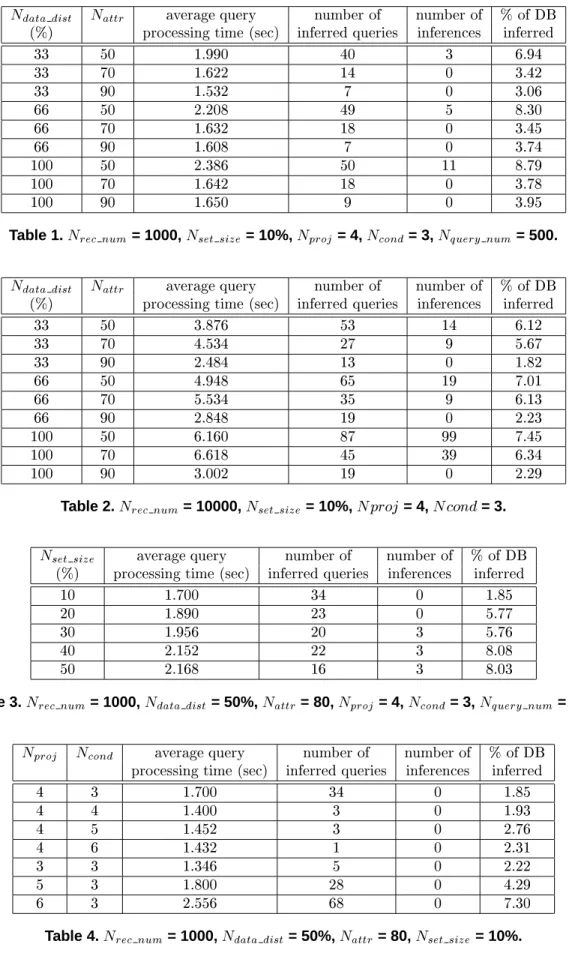
The preliminary results of running the inference de-tection system on a Sun SPARC 20 workstation are shown in Table 1{Table 4. In each experiment, we run the inference detection system against 500 user queries. We have collected data about 1) the average number of seconds used to process one query; 2) the number of inferred queries generated; 3) the number of times the inference rules are applied; and 4) the ratio between the number of attribute values of those individual records that have been identied by the user (either by directly accessing them using a query or by inferences) and the total number of attribute values in the database. The ratio is denoted as \% of DB revealed". For exam-ple, consider the two queries Q
1 and Q
2 in Section 4.1. These two queries together reveals that Alice is 35 years old, and she works in the Marketing department. Hence, the number of attribute values revealed to the user is 3 (namely Alice's name, Alice's age, and Alice's department). Note that although Q
2 returns two tu-ples, the user cannot determine whom these two tuples belong to; hence, they are not included as the attribute values that are revealed to the user. The total number of attribute values in the sample database is 24 (there are four records, each with 6 attribute values). Hence, the `% of DB revealed' by Q
1 and Q
2 to the sample database is (3 / 24)100%, or 12.5%.
Table 1 shows the results for Nrec num = 1000, Nset
size = 10%,
Nproj = 4, Ncond = 3, Nquery num = 500, Ndata dist takes the values of 33%, 66%, and 100%, and Nattr takes the values of 50, 70, and 90. The number of tuples returned by each query is about 30. It shows that the system performs better as Nattr increases. This is because the larger the number of at-tributes in the table, the lesser the chance that the `<' relations hold among queries. Also, the system per-forms better whenNdata dist decreases. The lower the distribution of the data, the more duplication of the data values, the lesser the chance a return tuple will be distinguishable from others, and hence the smaller number of occurrences of inferences. Table 2 shows similar results for Nrec num equals 10,000. The num-ber of tuples returned by each query is about 200.
Table 3 shows the results for Nrec num = 1000, Ndata dist = 50%,Nattr = 80, Nproj = 4, Ncond = 3, and Nquery num = 500, andNset size takes the values of 10%, 20%, 30%, 40%, and 50%. It shows that the system performs better whenNset sizedecreases. This is because the more the number of records returned by the queries, the more the number of occurrences of inferences, and also the more the number of inferred queries being generated.
Ndata dist Nattr average query number of number of % of DB (%) processing time (sec) inferred queries inferences inferred
33 50 1.990 40 3 6.94 33 70 1.622 14 0 3.42 33 90 1.532 7 0 3.06 66 50 2.208 49 5 8.30 66 70 1.632 18 0 3.45 66 90 1.608 7 0 3.74 100 50 2.386 50 11 8.79 100 70 1.642 18 0 3.78 100 90 1.650 9 0 3.95
Table 1.Nrec num= 1000,Nset size= 10%,Nproj= 4,Ncond= 3,Nquery num= 500. Ndata dist Nattr average query number of number of % of DB (%) processing time (sec) inferred queries inferences inferred
33 50 3.876 53 14 6.12 33 70 4.534 27 9 5.67 33 90 2.484 13 0 1.82 66 50 4.948 65 19 7.01 66 70 5.534 35 9 6.13 66 90 2.848 19 0 2.23 100 50 6.160 87 99 7.45 100 70 6.618 45 39 6.34 100 90 3.002 19 0 2.29
Table 2.Nrec num= 10000,Nset size= 10%,Nproj= 4,Ncond= 3. Nset size average query number of number of % of DB
(%) processing time (sec) inferred queries inferences inferred
10 1.700 34 0 1.85
20 1.890 23 0 5.77
30 1.956 20 3 5.76
40 2.152 22 3 8.08
50 2.168 16 3 8.03
Table 3.Nrec num= 1000,Ndata dist= 50%,Nattr= 80,Nproj = 4,Ncond= 3,Nquery num = 500.
Nproj Ncond average query number of number of % of DB
processing time (sec) inferred queries inferences inferred
4 3 1.700 34 0 1.85 4 4 1.400 3 0 1.93 4 5 1.452 3 0 2.76 4 6 1.432 1 0 2.31 3 3 1.346 5 0 2.22 5 3 1.800 28 0 4.29 6 3 2.556 68 0 7.30
Table 4 shows the results for Nrec num = 1000, Ndata dist = 50%,Nattr = 80,Nset size = 10%,Nproj takes the values of 3, 4, 5, and 6 while Ncond is kept constant at 3, and Ncond takes the values of 3, 4, 5, and 6 while Nproj is kept constant at 4. It shows that the system performs better whenNprojdecreases. This is because the more the number of attributes pro-jected by the queries, the more overlapping among the queries, and hence the more number of inferences can occur. Also, the system performs better when Ncond increases. This is because with a larger number of con-juncts in the selection criteria of the queries, there is lesser chance that the `<' relations hold among the queries, and hence the smaller number of occurrences of inferences.
In general, we expect to see the inference detection system performs better with the larger number of at-tributes in the table, the more duplication of attribute values in the database, the smaller number of records returned by queries, the smaller number of attributes projected by the queries, and the larger number of con-juncts in the selection criteria of the queries.
6. Conclusions
In this paper, we describe our eort in developing a data level inference detection system. We have identi-ed ve inference rules: subsume, unique characteris-tic, overlapping, complementary, and functional depen-dency inference rules. These rules are sound but they are not necessarily complete. The existence of these inference rules shows that simply using functional de-pendencies to detect inferences is inadequate. We have developed a prototype of the inference detection system using Perl on a Sun SPARC 20 workstation. The pre-liminary results show that the system on average takes seconds to process a query for a database of thousands of records.
Although in theory detecting inferences at data level is an NP-hard problem, in practice, there are cases where the use of such approach is practical. In par-ticular, this is the case when there is a limited amount of overlapping among the return tuples of the queries. We can further improve the system performance using distributed computing techniques. For example, the inference rules can be applied to the queries in paral-lel.
Instead of using the inference detection system to detect if a user has accessed particular data, we can also employ it as an anomaly detection system. For example, when a user has inferred certain amount of data in the database, it is reported to the security of-cer so that closer monitor to user activities will be
carried out.
Acknowledgements
The research reported in this paper is supported by the National Security Agency University Research Program under Contract DOD MDA904-96-1-0117, and by the CIA Oce of Re-search and Development under Contract 96F 154000-000. The authors would like to acknowledge the helpful comments made by the reviewers of this paper.References
[1] N. R. Adam and J. C. Wortmann. Security-control methods for statistical databases: A comparative study. ACM Computing Surveys, 21(4):515{556, De-cember 1989.
[2] L. J. Binns. Inference through secondary path anal-ysis. In B. M. Thuraisingham and C. E. Landwehr, editors, Database Security VI: Status and Prospects, pages 195{209. North-Holland, 1993.
[3] H. S. Delugach and T. H. Hinke. Wizard: A database inference analysis and detection system.IEEE Trans-actions on Data and Knowledge Engineering, 8(1):56{ 66, 1996.
[4] M. R. Garey and D. S. Johnson. Computers and Intractability: A Guide to the Theory of NP-Completeness. W.H. Freeman, 1979.
[5] J. Hale and S. Shenoi. Catalytic inference analysis: Detection inference threats due to knowledge discov-ery. In Proceedings of the 1997 IEEE Symposium on Security and Privacy, pages 188{199. IEEE Computer Society Press, 1997.
[6] T. H. Hinke. Inference aggregation detection in database management systems. InProceedings of the 1988 IEEE Symposium on Security and Privacy, pages 96{106. IEEE Computer Society Press, 1988.
[7] T. H. Hinke and H. S. Delugach. Aerie: An inference modeling and detection approach for databases. In B. M. Thuraisingham and C. E. Landwehr, editors,
Database Security VI: Status and Prospects, pages 179{193. North-Holland, 1993.
[8] T. H. Hinke, H. S. Delugach, and A. Chandrasekhar. Layered knowledge chunks for database inference. In T. F. Keefe and C. E. Landwehr, editors, Database Security VII: Status and Prospects, pages 275{295. North-Holland, 1994.
[9] T. H. Hinke, H. S. Delugach, and R. Wolf. A frame-work for inference-directed data mining. In P. Sama-rati and R. S. Sandhu, editors, Database Security X: Status and Prospects, pages 229{239. Chapman and Hall, 1997.
[10] T. H. Hinke, H. S. Delugach, and R. P. Wolf. Iliad: An integrated laboratory for inference analysis and detec-tion. In S. A. D. David L. Spooner and J. E. Dobson, editors, Database Security IX: Status and Prospects, pages 333{348, 1995.
[11] T. F. Lunt. Aggregation and inference: Facts and fal-lacies. InProceedings of the 1989 IEEE Symposium on Security and Privacy, pages 102{109. IEEE Computer Society Press, 1989.
[12] D. G. Marks. Inference in mls database systems.
IEEE Transactions on Knowledge and Data Engineer-ing, 8(1):46{55, February 1996.
[13] A. Motro, D. G. Marks, and S. Jajodia. Aggregation in relational databases: Controlled disclosure of sensitive imformation. In Proceedings of the Third European Symposium on Research in Computer Security, pages 431{445, November 1994.
[14] X. Qian, M. E. Stickel, P. D. Karp, T. F. Lunt, and T. D. Garvey. Detection and elimination of inference channels in multilevel relational database systems. In
Proceedings of the 1993 IEEE Symposium on Security and Privacy, pages 196{205. IEEE Computer Society Press, 1993.
[15] M. E. Stickel. Elimination of inference channels by optimal upgrading. In Proceedings of the 1994 IEEE Symposium on Research in Security and Pri-vacy, pages 168{174. IEEE Computer Society Press, 1994.
[16] M. E. Stickel, T. D. Garvey, T. F. Lunt, and X. Qian. Inference channel detection and elimination in knowledge-based systems. Technical report, SRI International, Octobet 1994.
[17] T.-A. Su and G. Ozsoyoglu. Data dependencies and inference control in multilevel relational database sys-tems. InProceedings of the 1987 IEEE Symposium on Security and Privacy, pages 202{211. IEEE Computer Society Press, 1987.
[18] B. Thuraisingham. The use of conceptual structures for handling the inference problem. In C. E. Landwehr and S. Jajodia, editors, Database Security V: Status and Prospects, pages 333{362. Elsevier Science Pub. Co., 1992.