EXPLOITING DOMAIN
KNOWLEDGE TO ENHANCE
OPINION MINING USING A
HYBRID SEMANTIC
KNOWLEDGEBASE-MACHINE
LEARNING APPROACH
A thesis by Rowida Abdulmajed Alfrjani submitted in
partial fulfilment of the requirements of Nottingham
Trent University for the degree of Doctor of Philosophy
Department of Computer Science & Technology
Nottingham Trent University
March 2018
II
Abstract
With the fast growth of World Wide Web 2.0, a great number of opinions about a variety of products have been published on blogs, forums, and social networks. Online opinions play an important role in supporting consumers make decisions about purchasing products or services. In addition, customer reviews allow companies to understand the strengths and limitations of their products and services, which aids in improving their marketing campaigns. The challenge is that online opinions are predominantly expressed in natural language text, and hence opinion mining tools are required to facilitate the effective analysis of opinions from the unstructured text and to allow for qualitative information extraction. This research presents a Hybrid Semantic Knowledgebase-Machine Learning approach for mining opinions at the domain feature level and classifying the overall opinion on a multi-point scale. The proposed approach benefits from the advantages of deploying a novel Semantic Knowledgebase approach to analyse a collection of reviews at the domain feature level and produce a set of structured information that associates the expressed opinions with specific domain features. The information in the knowledgebase is further supplemented with domain-relevant facts sourced from public Semantic datasets, and the enriched semantically-tagged information is then used to infer valuable semantic information about the domain as well as the expressed opinions on the domain features by summarising the overall opinions about the domain across multiple reviews, and by averaging the overall opinions about other cinematic features. The retrieved semantic information represents a valuable resource for training a Machine Learning classifier to predict the numerical rating of each review. Experimental evaluation revealed that the proposed Hybrid Semantic Knowledgebase-Machine Learning approach improved the precision and recall of the extracted domain features, and hence proved suitable for producing an enriched dataset of semantic features that resulted in higher classification accuracy.
III
Copyright Statement
This work is the intellectual property of the author. You may copy up to 5% of this work for private study, or personal, non-commercial research. Any re-use of the information contained within this document should be fully referenced, quoting the author, title, university, degree level and pagination. Queries or requests for any other use, or if a more substantial copy is required, should be directed in the owner(s) of the Intellectual Property Rights.
IV
Declaration
I declare that the presented work in this thesis is the original work of the author except where explicitly stated otherwise in the text. I declare that this thesis as well as the materials contained in the thesis have not been used in any other submission for an academic award.
Parts of the presented work in the thesis have been published in:
Paper 1: “A New Approach to Ontology-Based Semantic Modelling for Opinion Mining”, published in “2016 UKSim-AMSS 18th International Conference on Computer Modelling and Simulation (UKSim)”, Publisher: IEEE
Paper 2: “Exploiting domain knowledge and public linked data to extract opinions from reviews”, published in “2017 2nd International Conference on Knowledge Engineering and Applications (ICKEA)”, Publisher: IEEE
Paper 3: “A Hybrid Semantic Knowledgebase-Machine Learning Approach for Opinion Mining”, submitted to “Elsevier Data and Knowledge Engineering Journal” on 26/1/2018. Current status: Invited for Revision
V
Acknowledgement
First and foremost, Praise is to Allah, the Almighty for having guided me at every stage of my life and for giving me the strength and patience through all years of my PhD research.
I am grateful to the Libyan Government for the scholarship which enabled me to undertake a PhD research at the Nottingham Trent University.
I would like to express my sincere gratefulness and honour to my supervisor, Dr. Taha Osman, for his enriched knowledge, support and valuable guidance during all stages of my PhD research. Without his richness in experience, encouragement and continuous follow-up; this research would never have been.
I would like also to express my deep gratitude to my second supervisor, Dr. Georgina Cosma who was abundantly helpful and offered invaluable assistance, valuable feedback and suggestions; always having time to listen, always prepared to help and always open to discussion.
Many thanks to all my friends and relatives for their constant support and encouragement.
Special and lovely thanks to my parents, sisters and brothers for their encouragement and support even I am abroad far away from them. Thank you for giving me strength to reach for the stars and chase my dreams.
Last but not least, I owe gratefulness thanks to a very special person, my husband, Abubaker Brgeliel for his continued and unfailing love, support and understanding during all stages of my PhD research that made the completion of thesis possible. He was always around at times I thought that it is impossible to continue. I appreciate my baby boy Ayoub, my little girls Yakin, Ghofran and Rahma for abiding my ignorance and the patience they showed during my thesis writing. Words would never say how grateful I am to all of you.
VI
Dedication
To my dearly beloved mum and dad,
To my wonderful husband,
To my precious kids,
VII
Table of Contents
Abstract ... II
Copyright Statement ... III
Declaration... IV
Acknowledgement ... V
Dedication ... VI
Table of Contents ... VII
List of Tables ... X
List of Figures ... XI
1 Introduction ... 2
1.1 Research Motivation ... 3
1.2 Research Aim and Questions ... 6
1.3 Thesis Contributions ... 7
1.4 Thesis Organisation ... 8
2 Review of Opinion Mining Approaches ... 10
2.1 Lexicon-Based Approaches ... 10
2.2 Association Rule Mining Approaches ... 12
2.3 Machine Learning Approaches ... 13
2.4 Semantic Knowledgebase Approach ... 15
2.5 Chapter Summary ... 17
3 Semantic Modelling of the Problem Domain Knowledge ... 20
3.1 Conceptualising the Knowledge of a Problem Domain ... 23
3.2 Translating the Modelled Domain to a Semantic Knowledgebase ... 26
3.3 Chapter Summary ... 29
4 Domain Feature Extraction... 32
4.1 Related Work on Domain Feature Extraction ... 32
4.2 Design and Implementation of Domain Feature Extraction Phase ... 34
4.2.1 Populating the Semantic Knowledgebase ... 36
4.2.2 Pre-processing the Domain Reviews Using Natural Language Engine ... 39
4.2.3 A Novel Domain Feature Extraction Algorithm ... 43
4.3 Experimental Evaluation ... 48
VIII
4.3.2 Experimentation Methodology ... 49
4.3.3 Experimental Results of Domain Feature Extraction Task ... 49
4.4 Discussion... 52
5 Domain Feature-Sentiment Association ... 56
5.1 Related Work on Domain Feature-Sentiment Association ... 56
5.2 Design and Implementation of Domain Feature-Sentiment Association Phase 57 5.2.1 Extracting Sentiments from the Processed Domain Reviews ... 59
5.2.2 A Novel Domain Feature-Sentiment Association Algorithm ... 60
5.2.3 Features’ Sentiment Polarity ... 63
5.2.4 Enriching the Semantic Knowledgebase ... 64
5.3 Experimental Evaluation ... 66
5.3.1 Datasets ... 66
5.3.2 Experimentation Methodology ... 66
5.3.3 Experimental Results of Domain Feature-Sentiment Association Task . 67 5.3.4 Limitations of Domain Feature-Sentiment Association Task ... 69
5.3.5 Investigating Opinion Classification Based on Feature-Level Sentiment Analysis 70 5.4 Discussion... 71
6 Multi-point Opinion Classification based on a Hybrid Semantic Knowledgebase-Machine Learning Approach ... 74
6.1 Related Work on Opinion Classification ... 74
6.2 Design and Implementation of Multi-point Opinion Classification Phase ... 78
6.2.1 Generating Semantic Features ... 79
6.2.2 Generating Statistical Features ... 82
6.2.3 Training the Machine Learning Classifier ... 83
6.3 Experimental Evaluation ... 84
6.3.1 Datasets ... 85
6.3.2 Experimentation Methodology ... 85
6.3.3 Experimental Results of the Opinion Classification Task ... 86
6.4 Discussion... 89
7 Dynamics of the Population and Interrogation of the Problem Domain Knowledgebase ... 92
7.1 Inserting the Classification Results into the Domain Knowledgebase ... 92
IX
7.3 Chapter Summary ... 98
8 Conclusion and Future Work ... 100
8.1 Overview ... 100
8.2 Thesis Contributions ... 103
8.3 Future Work ... 108
X
List of Tables
Table 4.1 Example of a tokenised sentence ... 40
Table 4.2 Example of a tagged sentence ... 40
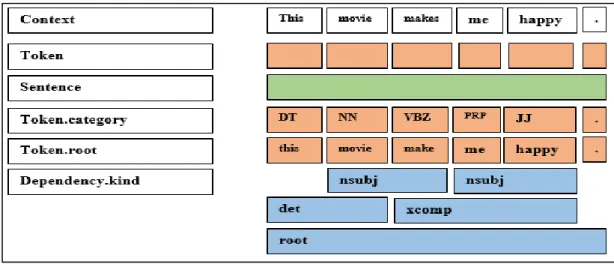
Table 4.3 Example of applying a syntax analyse on a sentence ... 41
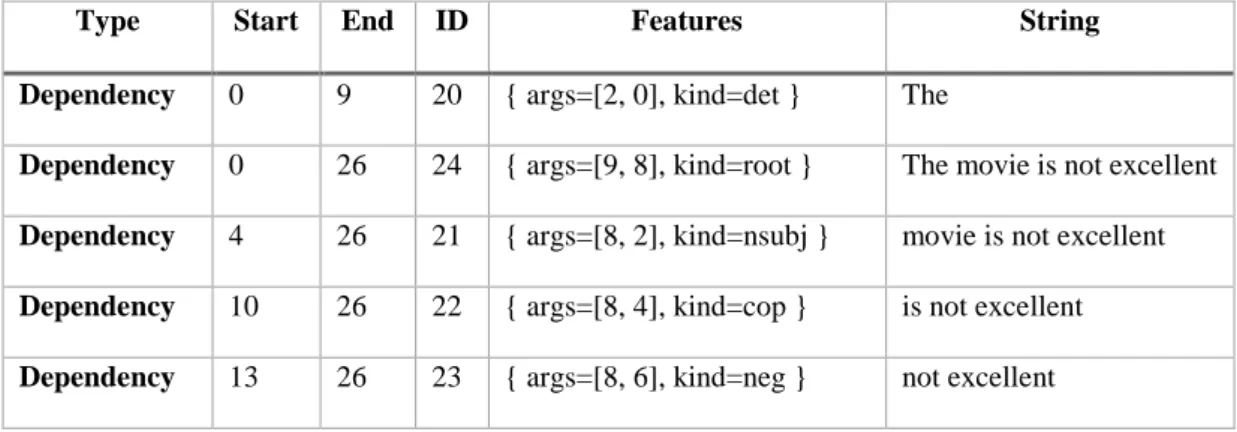
Table 4.4 Example of applying a dependency analyse on a sentence ... 41
Table 4.5 Recall of the domain feature extraction based on the coverage of three different knowledgebases ... 51
Table 4.6 Recall of domain feature extraction before and after deploying co-referencing resolution ... 52
Table 5.1 Example of grouped movie’s features and their relevant sentiment ... 61
Table 5.2 Dependency pattern rules ... 62
Table 5.3 Precision of the domain features-sentiment association ... 68
Table 5.4 Recall of domain feature-sentiment association ... 69
Table 5.5 Classification rules for 2-class, 3-class and 4-class classification ... 70
Table 5.6 Results of 2-class classification using classification rules ... 71
Table 5.7 Results of 3-class classification using classification rules ... 71
Table 5.8 Results of 4-class classification using classification rules ... 71
Table 6.1 Example of a generated semantic features matrix ... 82
Table 6.2 Example of a generated statistical features matrix ... 83
Table 6.3 Dataset characteristics ... 85
Table 6.4 Results of 3-class classification task ... 87
Table 6.5 Results of 4-class classification ... 87
Table 6.6 The accuracy of the classified reviews at 3-class classification by support vector machine and naïve bayes classifiers for the three datasets that have different number of features ... 88
Table 6.7 The accuracy of the classified reviews at 4-class classification by support vector machine and naïve bayes classifiers for the three datasets that have different number of features ... 88
Table 6.8 The percentage improvement of classifiers for 3-class classification when using the statistical-semantic dataset against statistical dataset ... 89
Table 6.9 The percentage improvement of classifiers for 4-class classification when using the statistical-semantic dataset against statistical and semantic dataset... 89
XI
List of Figures
Figure 3.1 A hybrid semantic knowledgebase-machine learning approach for opinion mining
at domain feature level ... 22
Figure 3.2 Movie-opinion-review domain concept map ... 25
Figure 3.3 A snapshot of the distribution of movie’s features within the movie-review knowledgebase ... 27
Figure 3.4 Marl ontology model ... 28
Figure 4.1 The architecture of domain feature extraction phase ... 35
Figure 4.2 Example of sparql construct query ... 38
Figure 4.3 A snapshot of populated semantic information into movie-review knowledgebase about the addiction movie ... 39
Figure 4.4 Example of a processed sentence linguistically and syntactically ... 42
Figure 4.5 Example of movie review ... 44
Figure 4.6 A snapshot of annotated feature by onto root gazetteer... 45
Figure 4.7 Example of jape rules for instance annotation ... 45
Figure 4.8 Low level diagram of using jape rules for co-reference resolution ... 47
Figure 4.9 Ask sparql query for examining the relevant and irrelevant domain features ... 48
Figure 4.10 Example of extracted domain features via the experiment EXP1, EXP2 and EXP3 ... 51
Figure 5.1 The architecture of domain feature-sentiment association phase ... 58
Figure 5.2 Example of annotated sentiment ... 59
Figure 5.3 Jape rules for associating sentiment with shifter ... 60
Figure 5.4 Example of descriptive and subjective statements ... 63
Figure 5.5 A concept map for the injected semantic information into the semantic knowledgebase ... 65
Figure 6.1 The architecture of the multi-point opinion classification phase ... 78
Figure 6.2 Example of querying the average polarity of a group of domain features ... 81
Figure 7.1 A snapshot of inserted prediction rate into movie-review knowledgebase for a review about 4 little girls (1997) movie. ... 93
1
2
1
Introduction
Opinions, often in the form of reviews, are increasingly being published on websites, blogs and social media outlets. Consumers often consult the opinion of others when considering whether to make a purchase. For instance, it is common to seek out the opinion of friends, favourite bloggers and reviewers when making a decision about purchasing a product, voting for a political candidate or choosing a movie. Analysing online customer reviews that have been published on E-commerce websites enable organisations to track the strengths and limitations of their products/services as a technique for improving products and services. Opinion mining is also increasingly being used in numerous applications such as analysing views on social media during presidential campaigns (Karami, Bennett and He 2018). Organisations invest considerable resources to collate and analyse online material in order to identify the underlying user trends regarding consumer sentiments, and use such information to improve their products and services and to shape their production strategies and marketing campaigns (Ibrahim, Wang and Bourne 2017). Google Analytics, Review Seer and Opinion Observer are examples of applications that perform opinion mining tasks on online contents such as: determining the overall polarity of the content, providing a structured summary of online reviews and comments, and providing a search engine for users to retrieve products based on their features as well as the sentiment polarity of the features (Vinodhini and Chandrasekaran 2012, Chakraborty and Pagolu 2014). The challenge is that online opinions are predominantly expressed in natural language text, images, videos, etc.; and hence opinion mining tools are required to facilitate the effective extraction and analysis of opinions from unstructured text, images, videos, etc. Such tools often adopt algorithms from the Natural Language Processing, Information Retrieval and Machine Learning disciplines.
3
1.1
Research Motivation
Opinion mining is commonly implemented by extracting contents for a specific domain (e.g. movie, music, car, hotel, cellular phone, restaurant and product) and performing opinion mining at various levels of text granularity: document, sentence or domain feature level. At document and sentence level, opinion mining aims to classify the overall sentiment orientation that is expressed in a document (Pang, Lee and Vaithyanathan 2002, Pang and Lee 2005) or a sentence (Pang and Lee 2004, Meena and Prabhakar 2007, Yu and Hatzivassiloglou 2003).
Opinion mining at the domain feature level is considered to be a challenging task because it requires deep understanding of the sentence structure and knowledge of the problem domain (e.g. movie reviews) in order to correctly classify domain features based on their polarity (Hu and Liu 2004, Somprasertsri and Lalitrojwong 2010). Particularly challenging is the extraction of the domain feature mentions (e.g. actress, show, script, story) from the reviews and associating each domain feature with its corresponding sentiment to determine its polarity score (e.g. the beauty of the script +1; Bulletproof Heart is not an excellent movie -1; The great Matt Craven will probably be forever remembered +1). Opinion mining at domain feature level can be further considered for enhancing the opinion classification task via summing or averaging the sentiment polarity score of each extracted domain feature to determine the numerical rating of the review (e.g. 4,3,2,1 and 0 for very positive, positive, neutral, negative, and very negative respectively).
Opinion mining research at domain feature level employs different approaches such as Machine Learning, Association Rule Mining and Semantic Knowledgebase approaches to primarily improve the outcome of the domain feature extraction task, which consequently enhances the performance of opinion classification task.
Machine Learning Approaches deliver significant results for domain feature extraction task using training datasets that have been manually annotated by a human expert. However, this can be an extremely time-consuming task as the required size of the training dataset (i.e. cover the domain feature) should be sufficiently large to bootstrap the learning algorithms, whereas, the automatic preparation cannot be accurate. Association Rule Mining approaches for domain feature extraction tasks do
4
not require manual or automatic preparation of dataset as they primarily rely on Natural Language Processing techniques to identify frequent nouns and noun phrases to be domain features. However, the extracted domain features tend to be frequent domain features, whereas infrequent domain features are ignored, which can result in a reduced recall rate. In addition, some of the extracted nouns and noun phrases may not be domain features even if these occur more frequently in the textual contents, and this can affect the precision of the domain feature extraction task. The Semantic Knowledgebase approaches are based on utilising domain knowledge to extract domain features from textual contents, which contains a conceptualized knowledge background of the domain. Such domain knowledge can be utilised to extract the frequent and infrequent domain features to improve the performance of domain feature extraction task. The Domain Knowledge captures the key concepts and relations of the problem domain’s environment, which is then populated with entities and facts/events that subscribe to the modelled concepts and relations (Dalvi, et al. 2015).
The World Wide Web Consortium (W3C) defines the Semantic Web1 as “the Semantic Web technologies provide a common framework that allows data to be shared and reused across application, enterprise, and community boundaries. It is a collaborative effort led by W3C with participation from a large number of researchers and industrial partners. It is based on the Resource Description Framework, which integrates a variety of applications using XML for syntax and URIs for naming”. Semantic Web technologies are considered ideal for modelling domain knowledge as they organise knowledge in a formalised semantic knowledgebase that provides efficient support for linking and sharing data between resources, and presenting data in a way that computer machines can process. In addition, the formalised semantic knowledgebase is capable of presenting the domain knowledge in a structured and consistent manner which facilitates the qualitative interpretation of domain specific contents in a way that people can understand. Moreover, Semantic Web technologies provide support for populating the semantically structured domain knowledgebase with relevant ground facts extracted from public-sourced Linked Open Data resources. Semantic Knowledgebase approaches have been deployed for domain feature extraction with promising success (Ali, Kim and Kim 2015). However, the success of
5
these techniques largely depends on the domain knowledge coverage, and the conducted investigation into the state-of-the-art approaches showed that the domain knowledge coverage is often limited. In addition, there is shortcoming in investigating the use of Open Linked Data resources for enhancing the performance of domain feature extraction task. Moreover, domain features that are extracted from a textual content might not have any subjective opinions about them as users maybe describe factual information about the extracted domain features as in “The Addiction movie is an American movie”. Most of the conducted related work have used syntactic parsing techniques (i.e. identify both descriptive and subjective phrases) without considering the utilisation of the domain knowledge to eliminate such non-opinionated domain features to enhance the domain feature-sentiment association task.
Hence, there is an opportunity of investigating whether exploiting the knowledge of the problem domain alongside with Linked Open Data resources can improve the performance of the domain feature extraction task, which consequently enhances the performance of opinion classification task.
Opinion classification is the process of classifying opinions into a binary classification (i.e. whether it is a positive or negative) or a multi-point scale (i.e. classify the polarity of the content at fine-grained level) such as very negative, negative, neutral, positive and very positive (Pang and Lee 2005).
The problem of classifying opinions using a multi-point scale (also referred to as the rating inference problem) has been an interesting research area in the recent years. Machine Learning approaches have been commonly applied for the process of opinion classification and are known to deliver outstanding performance, especially when they are trained using an effective dataset of features that have been manually annotated by a human expert who tends to enhance the annotation process with domain background knowledge. However, this can be an extremely time-consuming task as the required size of the training dataset should be sufficiently large to bootstrap the learning algorithms.
The Semantic Knowledgebase approach uses a knowledgebase that represents a shared understanding of the domain of interest, hence, the Semantic Knowledgebase approach can be used to enrich a dataset with semantic features, which can improve the performance of opinion classification task. However, the reported efforts as in
6
(Polpinij and Ghose 2008, Sulthana and Subburaj 2016) have mainly focused on binary classification tasks, i.e. identifying whether the content has a positive or negative opinion. Whereas there appear to be no studies that investigate the use of Semantic
Knowledgebase approaches to produce dataset of semantic features that are then used to build a Machine Learning classifier to classify the opinions on multi-point rating scale. Moreover, the challenge remains on developing approaches for extracting semantic features from the constructed knowledgebase and putting these into a suitable format for training a Machine Learning classifier.
The work presented in this thesis is also motivated by the finding that Semantic Knowledgebase approaches are an attractive, but yet under-researched, approaches for Opinion Classification applications. Hence, there is an opportunity of investigating whether combining a Semantic Knowledgebase approach with a Machine Learning approach (i.e. adding additional semantic features to a dataset of statistical features and use that to build a classifier) can result in higher classification accuracy for multi-point rating scale compared to using Machine Learning approaches alone.
1.2
Research Aim and Questions
The aim of this research is to develop a Hybrid Semantic Knowledgebase-Machine Learning approach to enhance the performance of opinion mining at domain feature level. In particular, improving the main tasks of opinion mining that include extracting domain features, associating them with their corresponding sentiments and opinion classification i.e. solving the rating inference problem on a multi-point scale.
The following research questions are established according to the aim of this research:
RQ1. How can the semantic modelling of the domain knowledge further contribute to improving the opinion mining at domain feature level, in particular to the domain feature extraction and opinion classification tasks?
RQ2. Can the domain knowledge improve the precision and recall of the feature extraction task?
RQ3. How can the semantically structured public datasets be exploited to improve the performance of domain feature extraction task?
7
RQ4. Given the fact that the target domain feature is presented by a single name or pronoun (i.e. termed non-explicit domain features), how can the semantically constructed knowledgebase be utilised with co-reference resolution to extract non-explicit domain features to further improve the domain feature extraction task? RQ5. Can the domain’s sentiment lexicon contribute to improve the domain
feature-sentiment association task?
RQ6. Is the aggregation of the domain features’ sentiment polarities based on Semantic Knowledgebase approach sufficient for the accurate classification of the review opinion?
RQ7. How can we use Semantic Knowledgebase approach to improve the quality of training features that are then used to build a Machine Learning classifier in order to improve the accuracy of opinion classification on a multi-point scale?
1.3
Thesis Contributions
The contribution of the proposed Hybrid Semantic Knowledgebase-Machine Learning approach can be summarised as follows:
• A new Domain Feature Extraction algorithm that improves the precision and recall of the extracted domain features. The Domain Feature Extraction algorithm utilises a comprehensive knowledge of the chosen domain (key concepts and their synonyms and ground facts) and public Linked Open Data sources such as DBpedia and Internet Movie Database.
• A novel Domain Feature-Sentiment Association algorithm that reduces false positive opinions (i.e. the domain feature-sentiment pairs) that objectively describe factual information using a generated sentiment lexicon for each domain feature.
• A new Opinion Classification algorithm that delivers enhanced opinion classification on a multi-point scale. The Opinion Classification algorithm generates an enriched set of semantic data from a semantically structured semantic knowledgebase, merges it with a statistical dataset, and then uses the combined data as input into Machine Learning algorithms. This is the
8
first study that presents an approach combining semantic and statistical data for classifying opinions on a multi-point scale.
• A novel comprehensive methodology for exploiting domain knowledge both in extracting opinion-related features and their associated sentiments using Semantic Knowledgebase approach, as well as exploiting the semantic domain knowledgebase to enrich the training dataset of the Machine Learning opinion classifiers and subsequently improve their accuracy.
1.4
Thesis Organisation
The remainder of the thesis is organised as follows:
Chapter 2 presents Review of Opinion Mining approaches.
Chapter 3 presents the architecture framework of the proposed Hybrid Semantic Knowledgebase-Machine Learning approach for opinion mining, and addresses the first research question RQ1 via introducing the methodology for the semantic modelling of the problem domain knowledge.
Chapter 4 addresses three research questions RQ2, RQ3 and RQ4 via introducing details of the conducted Domain Feature Extraction phase together with the experimental evaluation as well as the state-of-the-art related work on domain feature extraction task.
Chapter 5 addresses research questions RQ5 and RQ6 via introducing details of the conducted Domain Feature-Sentiment Association phase together with the experimental evaluation as well as the state-of-the-art related work on domain feature-sentiment association task.
Chapter 6 addresses the final research question RQ7 via introducing details of the conducted Multi-point Opinion Classification phase alongside the experimental evaluation and the related works on opinion classification on a multi-point scale. Chapter 7 illustrates dynamics of the population and interrogation of the developed domain knowledge.
Chapter 8 presents a conclusion of the conducted work in this research and the remaining future work.
9
10
2
Review of Opinion Mining Approaches
Opinion mining analysis has been used for various aspects in our daily life such as in marketing, brand monitoring and election results. In addition, opinion mining has been conducted on various domains, such as the product domain (Deng, Luo and Yu 2014, Cosma and Acampora 2016, Qiao, et al. 2017); and the tourism domain (Pang, Lee and Vaithyanathan 2002, Bhatnagar, Goyal and Hussain 2018). Studies have also been carried out on movie domain (Lunardi, et al. 2016, Manek, et al. 2017, Chakraborty, et al. 2018); hotel domain (Hu, Chen and Chou 2017) ; and in the music domain (Dalvi, et al. 2015).
This chapter discusses related literature on existing approaches to opinion mining process, which can be broadly categorised into Lexicon-Based, Association Rule Mining, Machine Learning, and Semantic Knowledgebase approaches.
2.1
Lexicon-Based Approaches
Lexicon-Based approaches for opinion mining are based on utilising dictionaries which contain sentiment terms and phrases along with the orientations and strength of the terms and phrases. Lexicon-Based approaches compute the overall polarity of the content based on sentiment term orientations and strength with respect to any associated modifier terms and negations (Greene 2007). Lexicon-Based approaches have demonstrated a successful performance for mining various domains’ contents (Liu 2012). Some studies incorporate part of speech tagging for sentiment terms within the utilised lexicon in order to enhance determining the score of disambiguation terms (Gezici, et al. 2013). Opinion mining has performed at document level on Spanish contents via summing the semantic orientation of phrases extracted from reviews (Cruz, et al. 2008). The semantic orientation of reviews was calculated based on comparing their similarity between positive and negative adjectives that were obtained from sentiment lexicon. The authors in (Palanisamy, Yadav and Elchuri 2013) developed a Lexicon-Based approach for classifying tweets as positive or negative,
11
where sentiments were discovered using a lexicon that was constructed from the Serendio taxonomy. The Serendio taxonomy contains positive and negative terms, stop terms and phrases. The authors pre-processed the contents by applying stemming and normalization, and then they identified emoticons and hashtag terms. Thereafter, the contents were classified based on the contextual sentiment orientation of the terms. The authors in (Taboada, et al. 2011) introduced a Semantic Orientation CALculator (SO-CAL) to extract sentiments from on-line contents and perform opinion mining at document level via utilisation of lexicon that contains annotated terms (adjectives, adverbs, nouns and verbs), as well as the semantic orientation for each term. In addition, intensification and negation terms were used that help to modify the polarity of each term. The SO-CAL system was demonstrated a consistent performance across various domains as it was aimed to be consistent and reliable via using the Mechanical Turk. The authors in (Mumtaz and Ahuja 2016) classified the online tweets as positive, neutral or negative using a lexicon that contains positive, negative and negation terms in which the polarity value of the tweet was calculated based on summing the score of each identified positive and negative terms and also by shifting the score of the terms that associated with a negation term. Tweets with a polarity value greater than zero were classified as positive; tweets with a polarity value which is less than zero were classified as negative; and tweets with a polarity value equal to zero were classified as neutral. The authors in (Muhammad, Wiratunga and Lothian 2016) used the Lexicon-Based approach to classify the contextual polarity of the content at local and global levels. The authors in (Krishnan, Elayidom and Santhanakrishnan 2017) have used a Lexicon-Based approach to analyse customers’ reviews about mobile phones that are published on Twitter and measure the popularity of the mobile phones based on user’s opinion on deciding whether buying the product or not. The authors in (Agarwal and Toshniwal 2018) have used the Lexicon-Based approach for calculating the sentiment of sports’ event fans over the time and establishing the relationship between the fans sentiments and players performance.
Lexicon-Based techniques work on an assumption that the collective polarity of a document or sentence is the sum of polarities of the individual words or phrases. Creating such words lists is often easier than labelling instances as less resources are required and no require for labelled datasets. However, Lexicon-Based approaches
12
demand powerful linguistic resources which is not always available. In addition, the major limitation of Lexicon-Based approach is incorrect sentiment scoring of opinion words by the existing lexicons, such as SentiWordNet as they may assign incorrect scores to most of the domain specific words. In this research, sentiment lexicons will be created for the problem domain to contain the sentiment polarity for each domain feature. The sentiment lexicons will be used only to extract sentiments from the text and assign to them their polarities and any adjacent shifters (negation or adverb) will be taken into account to moderate the sentiment’s score accordingly.
2.2
Association Rule Mining Approaches
Association Rule Mining approaches deal with the content as a bag of terms and perform opinion mining at the document level via aggregating the sentiment score of all the extracted terms from the content. An earlier study on opinion mining based on Association Rule Mining approach was published by the author in (Turney 2002), where rules miming were applied to extract two consecutive words from the contents that their POS tags match one of specified bigrams. After that, pointwise mutual information was used to calculate the polarity of the extracted bigrams and then averaging them to determine the overall polarity of the document. Adjective terms play an important role for classifying the sentiment of the content (Hatzivassiloglou and McKeown 1997, Kamps, et al. 2004), and using nouns and verbs in addition to adjectives can result in better determination of the sentiment orientation of the sentence (Riloff, Wiebe and Wilson 2003, Kim and Hovy 2004). Some researchers focused on using pre-identified seeds of positive and negative terms to calculate the value of point wise mutual information and determining the sentiment score of the extracted phrases (Turney and Littman 2003) or determining the sentiment score of the extracted terms (Baroni and Vegnaduzzo 2004); and then averaging the score to classify the sentiment orientation of the review. The work done by (Hu and Liu 2004) was based on generating a collection of sentiment terms from WordNet, which were then used to determine the polarity of the prevalent terms and to classify the polarity of sentences. The authors in (Taboada, et al. 2011) utilised adverb terms (such as very, quite, none, a little, somewhat) as well as the negation term “not” to adjust the determined polarity
13
of the extracted terms. The researchers in (Vilares, Alonso and Gómez-Rodríguez 2015) used syntactic dependencies to improve the association process between sentiment words and their corresponding adverbs or negations as well as dealing with the conjunction term “but” in order to increase the success of determining the polarity of the sentiment words. The authors in (Shih, et al. 2018) used Association Rule Mining approach to classify the situation of patients whether they with dementia or not based on generated rules from patients’ details such as Gender, age, type of dementia, number of days in hospital, and hospital medical expenses. The authors in (Jia, et al. 2018) used Association Rule Mining approach for cross-domain sentiment classification via defining the strong association rules between domain-shared words and domain-specific words in the same domain.
Association Rule Mining is a technique for finding interesting relationships or patterns hidden in large datasets. Association Rule Mining approaches rely on using rules that their generation is completely dependent on finding Frequent Item sets .However, the efficiency and accuracy of the Association Rule Mining approach depends on the defined rules as due to the noisy nature of the input datasets, the defined rules can be non-interesting, huge number or non-accurate. According to the authors in (Shridhar and Parmar 2017) “The principle disadvantages of the Association Rule Mining are the accompanying: obtaining non intriguing tenets, huge number of found principles, low calculation execution”. In this research, to find the relationship between a domain feature and its expressed sentiment (e.g. good movie) a set of dependency pattern rules will be defined based on the syntactical structure of the content to identify patterns that contain both domain feature and sentiment, which will be then associated together; and for more accurate association, domain sentiment lexicons will be used to discard the identified patterns that contain descriptive opinions.
2.3
Machine Learning Approaches
Machine Learning approaches are an interesting subject area of computer science where classifiers predict the target output based on learning the behaviour of a large collection of contents. Machine Learning approaches deal with the contents as a bag
14
of features in which a classifier such as Naïve Bayes, Support Vector Machine, Artificial Neural Networks, Maximum Entropy, etc. learn from the specified features the target class of the provided contents (Rebolledo, L’Huillier and Velásquez 2010). The class of the content can be a binary class [0 and 1] for negative and positive respectively, or can be a multi-class such as [0, 1, 2 and 3] for strong negative, negative, positive and strong positive respectively. To build the classifier a large collection of contents are required, which is commonly split into two groups. The first group is a “training dataset” and it is for training the classifier on differentiating the features of the contents, whereas the second group is a “testing dataset” and it is for evaluating the performance of the trained classifier (Sebastiani 2002, Li, et al. 2015). The majority of the literature on Machine Learning approaches for opinion mining at document and sentence level trained the adopted classifier on unigrams, bigrams or n-grams features of the contents where they found that unin-grams features have resulted in better performance than bigrams or n-grams features (Taboada, et al. 2011). Part of speech tagging, frequent terms, infrequent terms and word position are other kind of features that were also used for training three classifiers Naïve Bayes, Maximum Entropy and Support Vector Machine on a combination of features (Pang, Lee and Vaithyanathan 2002). Their results demonstrated that Support Vector Machines performed better classification than the other classifiers. The authors in (Yu and Hatzivassiloglou 2003) used polarity, terms, part of speech, bigrams and trigrams features to build a Naïve Bayes classifier for classifying sentences as positive or negative. Others have used features for training a classifier to classify the content such as sentiment terms, sentiment phrases, sentiment shifters, rules and syntactic dependency of the expressed opinions (Joshi and Penstein-Rosé 2009, Liu 2012). The study by (Pak and Paroubek 2010) was based on training three classifiers Support Vector Machine, Naïve Bayes and Conditional Random Field on a dataset which contains labelled features of sad and happy emoticons that are used in social media applications such as Twitter. The obtained results showed that Naïve Bayes classified the polarity of the content better than the other classifiers via using emoticons features. The authors in (Davidov, Tsur and Rappoport 2010) used hashtags as a labelled feature in addition to the sad and happy emoticons features to build a K-Nearest Neighbours classifier to classify tweets as positive or negative. The researchers in
(Martínez-15
Cámara, Martín-Valdivia and Ureña-López 2011) evaluated Naïve Bayes and Support Vector Machine classifiers to classify Spanish texts. Their study stated that Support Vector Machine performed best. The work done by (Tang, Qin and Liu 2015) was based on using a different type of features to build the classifier for opinion mining at document level, which are low-dimensional, real-valued and dense. The authors in (Bespalov, et al. 2011) proposed a Deep Neural Network classifier based on n-grams features and a low-dimensional latent semantic space features in order to enhance the performance of opinion mining at document level. The author in (Asghar 2016) evaluated the performance of opinion mining using a combination of four types of extracted features (unigrams, bigrams, trigrams and latent semantic indexing) with four types of Machine Learning algorithms which are: Naïve Bayes, Perceptron Neural Networks, Logistic Regression and Linear Support Vector Classifier. The authors in (Shubha and Suresh 2017) proposed a Machine Learning Bayes Sentiment Classification method to classify the content at document level via training a probabilistic Bayes classifiers on related opinion words that were extracted from user review comments.
Machine Learning approaches have been commonly applied for the process of opinion miming and are known to deliver outstanding performance, especially when they are trained using an effective dataset of features that have been manually annotated by a human expert who tend to enhance the annotation process with domain background knowledge. However, this can be an extremely time-consuming task as the required size of the training dataset should be sufficiently large to bootstrap the learning algorithms. In this research, we will benefit of the knowledge of the problem domain to provide a deep understanding of the structure and knowledge of the content to produce an enrich dataset of semantic features; which will be used to build a Machine Learning classifier for classifying the overall opinion on a multi-point scale.
2.4
Semantic Knowledgebase Approach
Semantic Knowledgebase approach is a new approach that has been used lately for opinion mining at domain feature level, and it is based on utilising a knowledgebase that contains a conceptualised knowledge background of the domain to primarily
16
extract domain features from the content and determine their polarity based on their corresponding sentiments. Domain Knowledge is knowledge about a domain’s environment, i.e. key concepts and their synonyms and ground facts, as well as the relation between them (Dalvi, et al. 2015). Such domain knowledge can be modelled via a concept map, translated into a knowledgebase that is then populated with relevant information to improve the processes of opinion mining process (Alfrjani, Osman and Cosma 2016). The authors in (Zhao and Li 2009, Penalver-Martinez, et al. 2014, Agarwal, et al. 2015a) translated the knowledge background of a chosen domain into a knowledgebase, and utilised this knowledgebase to extract domain features from pre-processed contents. However, their approaches are different to that of the authors in (Zhao and Li 2009) who constructed a knowledgebase that contains only the domain’s key concepts and their synonymous. Whereas, the authors in (Penalver-Martinez, et al. 2014) adopted a general domain knowledgebase, which contains some domain’s key concepts and their synonymous and collected ground facts from Internet Movie Database resources. The researchers in (Agarwal, et al. 2015a) proposed an approach based on constructing a knowledgebase for a specific domain using some concepts from the top four levels of ConceptNet knowledgebase, and then extended the knowledgebase with synonyms from WordNet. The work done by (Zhou and Chaovalit 2008) was based on modelling the movie domain concepts and then developing it into a knowledgebase, which was then used to extract movie domain’s key concepts from the content. The Semantic Knowledgebase approach has also be utilised to classify the polarity of whole documents based on different techniques such as summing or averaging the polarity of all extracted domain features. The authors in (Cambria, et al. 2010) utilised a common-sense reasoning with a combination with domain’s key concepts to build the knowledgebase that was used primarily to extract domain features. Thereafter, the extracted domain features were used to classify the contents at document level. The work done in (Poria, et al. 2013) was similar to that of the authors in (Cambria, et al. 2010) except that the developed knowledgebase was expanded with additional information about emotions (e.g. happy, sad, anger, joy, surprise and disgust) that were extracted from WordNet-Affect resource. The study by (Miao, Li and Zeng 2010) was based on integrating the domain’s knowledge with lexical and syntactic knowledge to classifying the content at document level. The
17
authors in (El-Halees and Al-Asmar 2017) used the domain knowledge to identify the relevant features from Arabic reviews in order to classify Arabic user-generated reviews that have different features with different opinion strengths.
Semantic Knowledgebase approaches rely on using the knowledge of the problem domain and the success of these techniques largely depends on the domain knowledge coverage, and the conducted investigation into the state-of-the-art approaches showed that the domain knowledge coverage is often limited. In this research, the main objective is to utilise a comprehensive domain knowledgebase and populate it with domain’s ground facts that are obtained from Linked Open Data resources in order to provide deep understanding of the free-textual contents, which is envisaged to improve the performance of opinion mining.
2.5
Chapter Summary
In this chapter, various opinion mining approaches have been reviewed such as Lexicon-Based, Association Rule Mining, Machine Learning and Semantic Knowledgebase approaches. Machine Learning approaches require labelled data for training a classifier, whereas, Lexicon-Based approaches do not require labelled datasets. However, Lexicon-Based approaches demand powerful linguistic resources which is not always available. Machine Learning approaches require sufficiently large size of labelled datasets which are used during the training process. Furthermore, Machine Learning classifiers which have been trained on predicting polarity in texts in one domain are not suitable for predicting sentiments in another domain. The advantage of Machine Learning classifiers is that once they are trained they can be applied to predict opinion from text without further human intervention. Association Rule Mining approaches rely on using rules and syntactic dependency. However, their efficiency and accuracy depend on the defining rules. Semantic Knowledgebase approaches rely on using the knowledge of the problem domain and the success of these techniques largely depends on the domain knowledge coverage. Performing opinion mining analysis by different approaches will produce different results and each approach has its own strengths and shortcoming. In this research, the proposed Hybrid Semantic Knowledgebase-Machine Learning approach combines the strengths of the
18
other approaches to deliver an approval method for opinion mining within determining problem domains.
19
20
3
Semantic Modelling of the Problem Domain
Knowledge
Opinion mining is commonly implemented by extracting contents for a specific domain (e.g. movie, music, car, hotel, cellular phone, restaurant and product) and performing opinion mining at various levels of text granularity: document, sentence or domain feature level. At document and sentence level, opinion mining aims to classify the overall sentiment orientation that is expressed in a document (Pang, Lee and Vaithyanathan 2002, Pang and Lee 2005) or a sentence (Pang and Lee 2004, Meena and Prabhakar 2007, Yu and Hatzivassiloglou 2003). At domain feature level, opinion mining aims to discover the expressed sentiments on the domain and/or its features (Hu and Liu 2004, Somprasertsri and Lalitrojwong 2010).
Discovering what exactly people liked and disliked about the domain and/or its features cannot be obtained via applying opinion mining at document or sentence level, which can in turn affect the accuracy of the overall determined sentiment (i.e. opinion classification). For example, in a sentence about a specific movie, “although the story was not great, the acting was amazing” clearly there are two movie’s features (i.e. story and acting) that their sentiment polarity are negative and positive respectively. Hence, using opinion mining at sentence or document level, the overall determined sentiment will be on the domain its self “movie”, whereas, the sentence is positive about the movie’s feature “acting”, but it is negative about the movie’s feature “story”. Therefore, realizing the importance of determining the sentiment polarity that expressed on a domain feature can help in resulting better overall determined sentiment (Liu 2012).
We hypothesise that we can improve the accuracy of the Machine Learning opinion classifiers by bootstrapping them with a rich training dataset generated by knowledge-based extraction of opinions (i.e. domain features associated with their sentiments). We envisage that for a particular problem domain, the training dataset can be further enriched by relevant ground facts extracted from semantically structured public datasets.
21
Opinion mining at domain feature level is a challenging problem because it focuses on extracting domain features from textual reviews and associating them with their corresponding sentiments. Such a task requires deep understanding of the structure and knowledge of the content in order to correctly extract domain features and their relevant sentiments and then determine the polarity of each sentiment.
The required domain knowledge represents the domain’s environment contains information such as key concepts and synonyms and ground facts, as well as the relation between them (Dalvi, et al. 2015). Information from a domain's semantic knowledgebase can be utilised to improve the performance of opinion mining process, in particular, the domain feature extraction task.
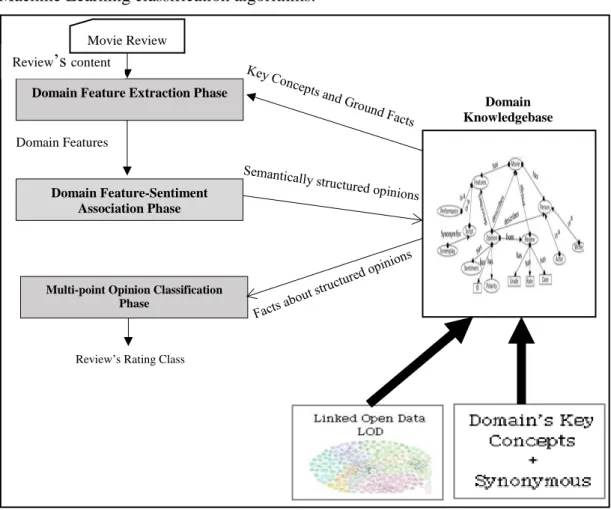
The modelling stage is the initial and critical stage for building a comprehensive framework that relies on knowledgebase modelling for opinion mining at domain feature level, which addresses our first research question RQ1 (How can the semantic modelling of the domain knowledge improve the domain feature extraction and opinion classification tasks?). Figure 3.1 illustrates the interface that interconnects the developed domain knowledgebase with the main phases of the proposed Hybrid Semantic Knowledgebase-Machine Learning approach: Domain Feature Extraction, Domain Feature-Sentiment Association and Multi-point Opinion Classification phases.
Domain Feature Extraction Phase: The purpose of this phase is to improve the precision and recall of extracting domain features. The main objective is to utilise a comprehensive domain knowledgebase that is populated with domain’s ground facts from Linked Open Data resources in order to provide a deep understanding of the free-textual contents. Another objective is to deploy co-referencing resolution to identify non-explicit domain features. The domain knowledgebase is used also to eliminate irrelevant (i.e. false positive) domain features.
Domain Feature-Sentiment Association Phase: The purpose of this phase is to improve the precision of the associated domain features with their corresponding sentiments. The main objective is to generate sentiment lexicons for domain features to identify subjective opinions and remove descriptive opinions.
Multi-point Opinion Classification Phase: The purpose of this phase is to improve the accuracy of the classified opinions on a multi-point scale by integrating
22
an enriched set of semantic features generated from the developed domain knowledgebase with a set of statistical features; the integrated data is then used to train Machine Learning classification algorithms.
Figure 3.1 A hybrid semantic knowledgebase-machine learning approach for opinion mining at domain feature level
In brief, the new Hybrid Semantic Knowledgebase-Machine Learning approach processes unstructured textual reviews, extracts domain features using a developed domain knowledgebase, and then associates the extracted domain features with relevant sentiments. Thereafter, the new Hybrid Semantic Knowledgebase-Machine Learning approach calculates the polarity for each associated feature-sentiment pair and inserts all the obtained semantic information into the developed domain knowledgebase. The developed domain knowledgebase is used by the new Hybrid Semantic Knowledgebase-Machine Learning approach to further produce a semantic feature dataset, which it is merged with a statistical dataset and then used as
Domain Knowledgebase Domain Feature Extraction Phase
Multi-point Opinion Classification Phase
Review’s Rating Class
Domain Feature-Sentiment Association Phase
Domain Features Review’s content
23
input to Machine Learning classifier that delivers multi-point scale rating for the processed reviews.
Constructing a semantic knowledgebase starts with modelling the domain knowledge before translating the knowledge map into formal ontologies that represent the schemata for populating the knowledgebase with structured information. The semantic structure of the knowledgebase provides for obtaining data from other public sources that use similar standards for data structuring such as Linked Open Datasets, which can be used, for instance, to populate the proposed use-case knowledgebase with dynamic ground facts about the problem domain (Omitola, et al. 2014)
Opinion mining of movie reviews is considered a challenging topic because movie reviews tend to include a rich set of domain features (actors, script, plot, etc.). Furthermore, the popularity of the movie domain provides for the opportunity to exploit the ever-increasing crowd-sourced Linked Open Data repository corresponding to the movie and celebrity industry (Gadekallu, et al. 2019).
Using movie reviews as the target problem domain, the next sections describe the proposed methodology for modelling the domain knowledge into a semantic knowledgebase that will be used in our proposed Hybrid Semantic Knowledgebase-Machine Learning approach for extracting and storing the expressed sentiments and associated domain features, and for retrieving semantic features to investigate whether combining it with statistical feature can improve the performance of opinion classification on a multi-point scale.
3.1
Conceptualising the Knowledge of a Problem
Domain
Conceptualising the domain’s knowledge is based on capturing its knowledge into concepts that are connected together using relations. In addition, the model should illustrate the external relations interrelating concepts from different domains. Our use-case scenario requires interfacing concepts from three domains: Movie, Opinion and Review. The proposed model, termed the movie-review model in this document, encompasses the interaction (relationships) between the three mentioned domains as shown in Figure 3.2, in which the problem domain for opining mining at domain feature
24
level is the Movie domain, whereas, the Opinion and Review domains are complementary domains that present the problem solution. Thus, the model can represent and associate generic information about the movie, opinions as well as its reviews. In addition, our movie-review model is presented in a structured way that allows it to source data from external Linked Open Data resources such as DBpedia and Internet Movie Database (Alfrjani, Osman and Cosma 2016).
The DBpedia knowledgebase is the best source for collecting such ground facts because it contains richer information about the movie domain than other knowledgebases. DBpedia is a knowledgebase that covers multi-domains and enriched with lots of structured ground facts for each domain. These ground facts are extracted from Wikipedia pages. The DBpedia knowledgebase is aimed to represent actual community agreement, to be decentralised, to be evolved automatically when Wikipedia changes and to support multi-languages. Moreover, the DBpedia knowledgebase is stored in the Resource Description Framework and it is available on the Web as one of the Linked Open Data resources which can be semantically retrieved and manipulated using the SPARQL query language (Bizer, et al. 2009).
Internet Movie Database is one of the largest sources of movie information. It is aimed to capture every pertinent details about each movie starting from names of its stars, directors, writers, editors, etc.; filmed location; language; plot; key words; names of its fans and reviewers. Although the contents of Internet Movie Database data is updated regularly, such information is presented in ad-hoc format; which means that this information cannot be retrieved using Linked Open Data resources but can be retrieved via accessing its page source programmatically (Peralta 2007).
Some of the current Semantic Knowledgebase approaches to opinion mining for movie reviews constructed a knowledgebase were restricted to the movie’s key concepts and their synonyms as in (Zhao and Li 2009), whereas other Semantic Knowledgebase approaches enriched the knowledgebase by adding more facts about movies that are found in Internet Movie Database as in (Penalver-Martinez, et al. 2014). Different from (Zhao and Li 2009, Penalver-Martinez, et al. 2014), the movie-review model stated in this thesis covers a comprehensive movie’s key concepts such as actor, writer, producer, editor, sound, script, twist, performance, special effect, footage, humour, movie theme, costumes, cinematography, emotion, scene, images,
25
ends, background, pacing, staging, story, plot, style and sets. In addition, the movie-review model is populated with ground facts about movies that are retrieved from both DBpedia and Internet Movie Database datasets.
Figure 3.2 Movie-opinion-review domain concept map
Highlights of the important relation modelling decisions are illustrated below:
• For each role related to movie there are sub concepts of PERSON concept such as WRITER, EDITOR, STAR
• For each group of movie’s feature there are sub concepts of FEATURES such as WRITING, EDITIING, CINEMATOGRAPHY, ANIMATION
• For each role related to movie, there is a property such as HAS-STAR property between a movie and a star, and HAS-WRITER property between a movie and a writer.
• There is a SYNONYM annotation for each concept and instance that has a synonym word.
• There is a DESCRIBE-OBJECT property between an opinion and a movie.
• There is a DESCRIBE-FEATURE property between an opinion and a movie’s feature.
• There is an HAS-SENTIMENT property between an opinion and a sentiment.
• There is a ABOUT property between a review and a movie.
26
3.2
Translating the Modelled Domain to a Semantic
Knowledgebase
In this research we utilised Semantic Web technologies to translate the domain conceptual model into a formal semantic ontology that represents the template box (T-Box) of the domain knowledgebase. The Semantic Web technologies are concerned with making unstructured data on the Web more understandable to computers via adding linguistic and semantic metadata to the web content (Berners-Lee, Hendler and Lassila 2001). Semantic Web technologies organise domain’s knowledge in formalised concept ontologies that provide efficient support for linking and sharing data between resources, and presenting data in a way that computer machines can process. In addition, Semantic Web technologies are capable of presenting the domain’s knowledge in a structured and consistent way which facilitates the qualitative interpretation of domain specific contents in a way that people can understand. Moreover, Semantic Web technologies provide support for populating the semantically structured domain knowledgebase with relevant ground facts from public-sourced Linked Open Data resources (Omitola, Ríos and Breslin 2015). The movie-review conceptual model was translated into a semantic ontology as follows:
1) For the Movie domain, we manually collected comprehensive knowledge of the movie domain with approximately 504 concepts related to movie domain as well as their synonyms and the relationships between them from the Movie Terminology Glossary in (Gartenberg 1989). Then, based on the movie-review conceptual model, we distributed the collected terms as classes (Concepts), instances (ground facts), object properties and annotations. The created primary classes in the movie-review knowledgebase are: MOVIE, FEATURES and PERSON. The class MOVIE is a simple upper class that contains all the individuals that characterise movie names. Each individual movie has datatype values such as released date and running time. The classes PERSON and FEATURES are upper classes that capture movie domain’s key concepts. For each role related to movie there are sub-classes of the class PERSON such as WRITER, EDITOR, STAR, DIRECTOR, CINEMATOGRAPHER, PRODUCER, which
27
represent names of people as individuals with respect to their roles in the movie. For example, the class STAR cantinas names of actors and actresses as individuals. For each group of movie’s features there are sub-classes of the class FEATURES such as WRITING, EDITIING, CINEMATOGRAPHY, ANIMATION, SPECIAL EFFECT, SOUND, MUSIC, etc. as shown in Figure 3.3. In addition, four more upper classes were created: AWARD, LOCATION, COUNTRY, and LANGUAGE to capture other semantic information about movies such as nominated award, filming location, and the original language. Moreover, the annotation synonyms is designed to annotate all synonym terms for each concept. For example, the terms “film, show and picture” are annotated as synonyms for the concept MOVIE, hence different terms can be mapped under one concept during extracting domain features from the reviews during opinion mining process.
Figure 3.3 A snapshot of the distribution of movie’s features within the movie-review knowledgebase
2) The class REVIEW was created to capture the semantic information about movie reviews that contain opinions. The class REVIEW contains reviews’ ID as individuals that have REVIEW-DATE as a datatype value, and reviewer’s name
28
via a REVIEWED-BY relation that interconnect the class REVIEW with the class PERSON.
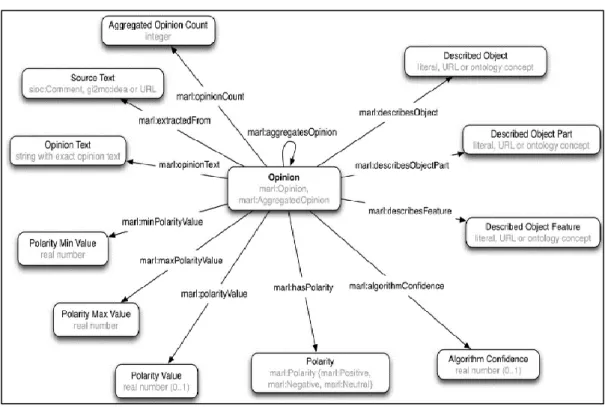
3) The class OPINION was created to capture all the individuals that characterise the expressed opinions in reviews via adopting the designed model of the Marl2 ontology as shown in Figure 3.4. Marl is a standardised data schema designed to address and to describe subjective opinions expressed on the textual reviews. 4) Opinion mining at domain feature level also focuses on extracting sentiment terms
that are used to express opinions, and for this reason the class SENTIMENT was created too. This class includes sentiment terms as individuals such as great, bad, good, interesting, etc. The class SENTIMENT is connected with the movie-review knowledgebase via creating a HAS-SENTIMENT relation between the class OPINION and the class SENTIMENT.
Figure 3.4 Marl ontology model
The advantage of utilising Semantic Web technologies to translate the domain conceptual model into a formal semantic ontology that represents the template box (T-Box) of the movie-review knowledgebase is that they provide for the formal (standardised) representation of the domain’s key concepts, their synonyms and
29
ground facts, and then link them using relations (i.e. object properties). For example, the ABOUT property links a review to movie, the EXTRACTED-FROM property links an opinion to a review, and the DESCRIBE-FEATURE property links between an opinion and a movie. In addition, Semantic Web Ontology Language (OWL) allows for representing complex relationship between concepts using “typed” object properties such as Functional, Inverse, Transitive, Symmetric and Reflexive relation, which improves the reasoning performed on the knowledgebase. For example, the relation actedIn is the inverse relation of hasStar, since if we state that the movie “Harry Potter” has a star “Hermione Granger”, then we can infer that “Hermione Granger” acted in the movie “Harry Potter”. Such information can be used to infer valuable semantic information about the main domain concepts (such as movie) as well as the expressed opinions on its constituent features. Therefore, it is possible to compute the overall opinions about a movie across multiple reviews as well as for the cinematic features (actors, script, sound effects, etc.). For example, all movies that have a positive screenplay review can be retrieved by firing one query against the movie-review knowledgebase.
The semantic structure of the knowledgebase provides for obtaining data from other public sources that use similar standards for data structuring such as Linked Open Datasets, which can be used, for instance, to populate the proposed use-case knowledgebase with dynamic ground facts about movies, actors etc., which can contribute to enhance the performance of domain feature extraction task. In this research, the population process is conducted regularly for each processed review as will be explained in the next chapter.
3.3
Chapter Summary
This chapter presented the architecture framework of the proposed Hybrid Semantic Knowledgebase-Machine Learning approach for opinion mining, and addressed the first research question RQ1 (How can the semantic modelling of the domain knowledge further contribute to improving the opinion mining at domain feature level, in particular to the domain feature extraction and opinion classification tasks?) via introducing the methodology for the semantic modelling of the problem domain