Thomas Jefferson University
Jefferson Digital Commons
Department of Occupational Therapy Faculty
Papers
Department of Occupational Therapy
5-2006
Level I fieldwork today: A study of contexts and
perceptions.
Caryn Johnson
Thomas Jefferson University, [email protected]
Kristie P. Koenig
Temple University
Catherine Verrier Piersol
Philadelphia University
Susan E. Santalucia
University of the Sciences in Philadelphia, Philadelphia,
Wendy Wachter-Schutz
Harcum College
Let us know how access to this document benefits you
Follow this and additional works at:
http://jdc.jefferson.edu/otfp
Part of the
Occupational Therapy Commons
This Article is brought to you for free and open access by the Jefferson Digital Commons. The Jefferson Digital Commons is a service of Thomas Jefferson University'sCenter for Teaching and Learning (CTL). The Commons is a showcase for Jefferson books and journals, peer-reviewed scholarly publications, unique historical collections from the University archives, and teaching tools. The Jefferson Digital Commons allows researchers and interested readers anywhere in the world to learn about and keep up to date with Jefferson scholarship. This article has been accepted for inclusion in Department of Occupational Therapy Faculty Papers by an authorized administrator of the Jefferson Digital Commons. For more information, please contact: [email protected].
Recommended Citation
Johnson, Caryn; Koenig, Kristie P.; Piersol, Catherine Verrier; Santalucia, Susan E.; and
Wachter-Schutz, Wendy, "Level I fieldwork today: A study of contexts and perceptions." (2006).
Department of
Occupational Therapy Faculty Papers.
Paper 41.
Level I Fieldwork Today:
A Study of Contexts and Perceptions
Caryn R. Johnson,
Kristie P. Koenig,
Catherine Verrier Piersol,
Susan E. Santalucia,
Wendy Wachter-Schutz
The last comprehensive examination of the Level I fieldwork experience was performed 15 years ago (Shalik, 1990) and addressed the different types of settings in which fieldwork occurred; amounts and types of super-vision; structure and scheduling of the Level I experiences; and the effects of supervising Level I students on productivity. Although every occupational therapy and occupational therapy assistant student encounters a number of Level I fieldwork opportunities, little is available describing the process and contexts of the Level I fieldwork experience today. This study, which examines 1,002 student reports on Level I fieldwork experiences, finds that Level I fieldwork today occurs in a wide variety of physical disability, pediatric, mental health, and emerging practice settings. Findings also indicate that, whereas most fieldwork educators are occupational therapy practitioners, more fieldwork educators are non–occupational therapists than in the past. Furthermore, although students reported opportunities to practice observation and communication across all settings, prac-tice of other clinical skills was specific to type of settings, and opportunities to pracprac-tice were limited. Student perceptions about opportunities for experiencing occupation-based practice, observation of theory in practice, and how students value different types of fieldwork experiences are addressed. In addition, this study explores the expansion of Level I fieldwork into emerging practice arenas and how students perceive those experiences.
Johnson, C. R., Koenig, K. P., Piersol, C. V., Santalucia, S. E., & Wachter-Schutz, W. (2006). Level I fieldwork today: A study of contexts and perceptions. American Journal of Occupational Therapy, 60,275–287.
Introduction
Level I fieldwork is an integral part of every occupational therapy student’s experi-ence, mandated by the Accreditation Council for Occupational Therapy Education (ACOTE®) (American Occupational Therapy Association [AOTA],
1999). The purpose of Level I fieldwork “is to introduce students to the fieldwork experience, and develop a basic comfort level with and understanding of the needs of clients” (p. 581) while providing students with opportunities to observe and par-ticipate in the occupational therapy process (AOTA, 1999). These broad guidelines allow for great flexibility in the design of Level I fieldwork, resulting in wide vari-ation from program to program regarding the types of sites, timing and schedul-ing of the fieldwork experience, course objectives, and types of supervision (Kautzman, 1987; Leonardelli & Caruso, 1986; Shalik, 1990).
As evidenced year after year in self-reflection assignments and classroom dis-cussion, students attach great value to their Level I fieldwork experiences, which often reaffirm their choice of occupational therapy as a career and may influence future career decisions and directions. A positive experience—in which the student actively participates, observes best practice, and is exposed to good role models and provided with opportunities to apply classroom learning—will move the student along the path to becoming a competent practitioner. Experiences lacking these elements may leave the student ill-prepared for the demands of Level II fieldwork and practice. The Level I experience also plays an important role in evaluating and promoting the development of professional behaviors that are crucial to successful performance as an occupational therapy practitioner (Koenig, Johnson, Morano, & Ducette, 2003).
Despite the obvious benefits of this wide range of options to fulfill a critical aspect of occupational therapy education, surprisingly little descriptive or systematic
Caryn R. Johnson, MS, OTR/L, FAOTA, is Academic Fieldwork Coordinator, Thomas Jefferson University, Jefferson College of Health Professions, Department of Occupational Therapy, 130 South 9th Street, Philadelphia, Pennsylvania 19107.
Kristie P. Koenig, PhD, OTR/L, is Assistant Professor, Temple University, Philadelphia, Pennsylvania. Catherine Verrier Piersol, MS, OTR/L, is Associate Professor and Program Director, Occupational Therapy Program, Philadelphia University, Philadelphia, Pennsylvania. She was Academic Fieldwork Coordinator at the time of this study.
Susan E. Santalucia, MS, OTR/L, was Academic Fieldwork Coordinator, University of the Sciences in Philadelphia, Philadelphia, Pennsylvania, at the time of this study. Wendy Wachter-Schutz, OTR/L, was Academic Fieldwork Coordinator, Harcum College, Bryn Mawr, Pennsylvania, at the time of this study.
research has been conducted regarding the fieldwork expe-riences. This lack of information generates important ques-tions about what is actually being experienced by students in Level I fieldwork today and how these experiences have changed over time.
Some of the aspects of practice that have changed over time include the physical and conceptual contexts. In order to appropriately prepare students for current practice, the fieldwork components of the curriculum should reflect this. Today’s students have the opportunity to experience occu-pational therapy practice in settings ranging from homeless shelters to neonatal intensive care units, with fieldwork edu-cators ranging from community workers to occupational therapists. Questions the authors chose to address in order to examine the characteristics of today’s fieldwork settings include the following:
• In what contexts, or settings, is Level I fieldwork occur-ring? Are these settings reflective of where today’s occu-pational therapists are practicing?
• Does Level I fieldwork today reflect changes in practice, such as the movement by practitioners into emerging practice settings?
• What types of qualifications do today’s fieldwork educa-tors have?
Comparing fieldwork today to fieldwork of the past will enable us to identify trends, explore current issues, and pre-pare for the future.
Student experiences with and perceptions of Level I fieldwork are likely to vary as widely as the range of students themselves. These perceptions are valuable to each educa-tional program and may be used for purposes of evaluating the current fieldwork program and guiding future develop-ment in areas such as course objectives, preparation of field-work educators, and selection of fieldfield-work settings. Many factors contribute to the way the student perceives his or her experience, such as comfort level with the supervisory experience; comfort with or interest in a particular setting or population; and whether the student has opportunities to actively participate or is limited to observation. And although occupation-based practice is taught as the gold standard in academic settings, students often report that they do not see such practice reflected in the clinical setting, creating a dissonance between what they are learning in the classroom and what they are seeing in practice. Questions the authors chose to address regarding student perceptions include the following:
• Are students being provided with opportunities for active participation where they can practice clinical skills in preparation for Level II fieldwork and practice?
• How are students experiencing occupation-based prac-tice? Theory in pracprac-tice?
• How do the type of setting and qualifications of the field-work educator influence students’ perceptions of Level I fieldwork?
This study—a snapshot of the Level I fieldwork expe-rience at the beginning of a new millennium—addresses the need to better understand the process and contexts of Level I fieldwork. It is designed to describe important qual-ities of the contemporary fieldwork experience, including types of settings where Level I fieldwork occurs, qualifica-tions of Level I fieldwork educators, and student percep-tions of the Level I fieldwork experience in traditional and emerging practice settings. Greater understanding of the Level I fieldwork experience has the potential to enable aca-demic programs to better prepare students for successful Level II experiences and transition into practice, and better prepare fieldwork sites and educators to train students in accordance with professional standards. This increased awareness may also help educators and practitioners reflect on the dissonance between what students are taught in school and actually see in practice. Finally, a fuller under-standing of fieldwork may be useful in guiding future devel-opment of educational policies and academic standards and identifying future areas of research.
Literature Review
Fieldwork Contexts: Supervision and Settings
Level I fieldwork was first referenced in the 1973 Essentials
and Guidelines of an Accredited Educational Program for the Occupational Therapist (often referred to as the Essentials)
(AOTA, 1975). The purpose of Level I fieldwork was to pro-vide students with “initial and basic experiences in directed observation and participation in selected field settings” (AOTA, 1975, p. 486). Supervision was to be provided by “qualified competent personnel, who may or may not be occupational therapy personnel” (AOTA, 1975, p. 486).
Over the last 30 years, very little has changed in the requirements for Level I fieldwork. The 1983 and 1991 Essentials and the 1998 Standards for an Accredited
Educational Program for the Occupational Therapist (often
referred to as the Standards) all concur that Level I field-work is required and its purpose is to enrich the student’s learning experience through observation and participation in the occupational therapy process (AOTA, 1983, 1991, 1995, 1999). Fieldwork educators may include, but need not be limited to, “psychologists, physician assistants, teach-ers, social workteach-ers, nurses, and physical therapists” (AOTA, 1999, p. 581). Being an occupational therapist has never been a requirement for Level I fieldwork educators. The latitude provided by this guideline has allowed students
exposure to a wide range of service providers and settings, as well as access to Level I fieldwork educators even when occu-pational therapy practitioners have been in short supply.
The vast majority of Level I fieldwork educators have been occupational therapists. In a nationwide Level I field-work study that addressed types of settings, scheduling, supervision, and the effects on productivity, Shalik (1990) found that in 95% of the 395 responses, the fieldwork edu-cators were occupational therapists. In addition, students tend to prefer fieldwork educators who were occupational therapists over non–occupational therapy fieldwork educa-tors (Heine & Bennett, 2003). Recent articles describing Level I fieldwork in emerging practice settings may be indicative of the increasing use of non–occupational thera-py fieldwork educators (LaGrossa, 2005; Moffett Boyd & Garbarini, 2001; Scott, 2000).
Guidelines pertaining to fieldwork settings have changed somewhat over the past 40 years. The 1998 Standards require that Level II fieldwork expose the student to a “variety of clients across the lifespan and to a variety of settings,” but specify only that Level I fieldwork should “enrich didactic coursework through directed observation and participation in selected aspects of the occupational therapy process” (AOTA, 1999, p. 581). For many years, the Essentials for occupational therapy programs required Level II fieldwork in physical dysfunction and psychosocial settings (AOTA, 1983, 1991, 1998; Council on Medical Education of the American Medical Association & AOTA, 1965); however, no such stipulations were made for Level I fieldwork. Some information can be gleaned from previous fieldwork studies. Shalik’s 1990 study revealed that in the late 1980s, 43% of Level I placements occurred in physical dysfunction settings, 55% of which were located in hospi-tals. Twenty percent occurred in psychosocial settings, 75% of which were in hospitals. Pediatric settings accounted for 19% (more than 55% of these were located in schools), and 10% occurred in other settings, including nursing homes, geriatric settings, and developmental disability settings, most of which were residential (Shalik, 1990). Academic programs reported that they required Level I fieldwork in specified areas. Eighty-eight percent of educational pro-grams required Level I fieldwork in psychosocial settings, 85% in physical dysfunction settings, 65% in pediatric set-tings, 28% in geriatric setset-tings, and 14% in other settings (Shalik, 1990).
In a 1986 study, Leonardelli and Caruso examined cost-effectiveness, supervisor time commitment for Level I fieldwork education, desirability of a uniform Level I evalu-ation tool, and issues related to training Level I fieldwork students from multiple programs. They also addressed the questions of who should develop the fieldwork objectives,
design the learning experience, and evaluate the students. Their survey was distributed nationally to academic pro-grams and fieldwork sites. A majority of the 66 respondents agreed that the academic program should be responsible for determining fieldwork objectives, that fieldwork educators should be responsible for designing the learning experiences and evaluating student performance, and that a universal evaluation tool would be useful. Cost-effectiveness was a concern among a majority of fieldwork educators, and pref-erences for student scheduling patterns varied widely. In a second survey, 47 of 99 respondents reported working in acute care facilities, 9 in long-term-care facilities, and the remainder in rehabilitation facilities or settings that were both acute and long-term-care (Leonardelli & Caruso, 1986). It was not stated which of these were physical dys-function, mental health, or pediatric facilities, and neither study referred to emerging practice settings.
Movement Into Emerging Practice Settings
Level I fieldwork experiences in emerging practice settings were first described in the occupational therapy literature in the mid-1970s (Cromwell & Kielhofner, 1976; Platt, Martell, & Clements, 1977). However, the impetus for more rapid expansion into nontraditional arenas did not occur until nearly 20 years later. In the 1990s, a need for alternative fieldwork strategies was identified because there was a shortage of Level I fieldwork sites (Cohn & Christ, 1995; Crist, 1991). Responses to this crisis included alter-native supervision models, such as group supervision (Crist, 1991; 1993; Yanoshak, Fuguet, & Rose, 1997) and devel-opment of fieldwork opportunities in emerging practice environments where students could be supervised by non–occupational therapy personnel or occupational thera-py faculty preceptors (Barnes, 1995; Drake, 1992; Hubbard, 2000; Moffett Boyd & Garbarini, 2001; Moffett Boyd & Garbarini, 2004; Rydeen, Kautzmann, Cowan, & Benzing, 1995; Scott, 2000).Changes in the direction of health care also contribut-ed to the interest and development of occupational therapy services in emerging settings (Cohn & Crist, 1995), and the 1998 Standards, for the first time, specified emerging prac-tice settings as a Level II fieldwork option and provided guidance regarding supervision and scheduling (AOTA, 1999). Leaders in fieldwork education called on academic programs and fieldwork educators to “provide practical [fieldwork] experiences addressing emerging issues such as quality of life, client self-determination, advocacy, health promotion, [and] disease prevention” in order to prepare students for the movement of health care services into the community (Cohn & Crist, 1995, p. 104).
Some academic programs partnered with community agencies to create innovative community-based fieldwork opportunities in settings such as day-care centers, Head Start programs, and halfway houses (Rydeen et al., 1995). This trend has continued, and is currently exemplified in the Scholarship of Practice program at the University of Illinois at Chicago, Duquesne University’s Practice–Scholar Program, and Thomas Jefferson University’s New Doors Model (Gourley, 2001; Kielhofner, 2002; LaGrossa, 2005). These programs identify needs in the local community where occupational therapy services have not been tradi-tionally provided, then form partnerships among the aca-demic program, occupational therapy practitioners, com-munity agencies, or fieldwork students to provide occupational therapy services to underserved populations. An occasional added benefit is the creation of new occupa-tional therapy positions in emerging practice settings (Kielhofner, 2002; LaGrossa, 2005). Although articles about innovative Level II experiences in settings such as shelters, transitional housing, and adult foster-care homes appear regularly in the occupational therapy periodicals (Follis & Nolen, 2001; Kerr, 1999; McCreedy, 1994), a sys-tematic examination of Level I fieldwork in emerging prac-tice arenas has not previously been undertaken.
Student Perceptions of Fieldwork
Most of the literature addresses how students, sites, and universities benefit from participating in fieldwork experi-ences, with little to indicate how the students perceive or value the experience. In novel settings such as remote rural schools, day-care settings, psychiatric day programs, sum-mer camps, and wellness centers, students developed cul-tural sensitivity (Moffett Boyd & Garbarini, 2001) and had opportunities to practice evaluation and treatment, prob-lem solving, management, leadership, collaboration with team members, clinical reasoning, group process skills, and consultation and program development skills (Moffett Boyd & Garbarini, 2004; Scott, 2000). As fieldwork in these emerging practice environments becomes increasing-ly common, it is important to examine the process of field-work in these settings and how students perceive and value these experiences.
One earlier study examined perceptions of Level I field-work by students, faculty members, and fieldfield-work educa-tors (Kautzmann, 1987). Respondents to a questionnaire were asked to rank their 10 most valued choices from a list of 24 fieldwork objectives based on 4 categories: student involvement in the treatment process, students’ under-standing of the program and facility, role of the occupa-tional therapist, and students’ growth as emerging health professionals. All three groups ranked objectives related to
student involvement in the treatment process most highly, although there were significant differences between groups on how they valued individual items within that category. Student responses indicated that they “want and expect hands-on experience, not just observation” (Kautzmann, 1987, p. 599). The sample size was small and limited to the state of Wisconsin.
Leonardelli and Caruso (1986) examined differences between how fieldwork settings and academic programs ranked a variety of Level I fieldwork objectives. Whereas academic programs ranked “hands-on” experience fourth out of 14, fieldwork educators ranked it sixth. Shalik (1990) indicated that most Level I students were passive observers rather than active participants and that students had less opportunity for active participation in physical disability and pediatric settings than in psychosocial and other set-tings. In contrast, more recent literature indicates that active participation is valued, expected, and encouraged. Heine and Bennett (2003) found that both occupational therapy and non–occupational therapy fieldwork educators encouraged active participation. In addition, Level I stu-dent evaluation forms often include a section concerning how the student implements treatment, or actively partici-pates, under the supervision of an occupational therapy practitioner.
Little in the literature spoke to students’ experiences with observing theory in practice or experiences with occu-pation-based practice. The ACOTE Standards (AOTA, 1999) and the new AOTA Fieldwork Performance Evaluations (AOTA, 2002) both emphasize the use of occu-pation-based practice, yet students continue to report observations of patients stacking cones and placing pegs in holes. Ranking of fieldwork objectives in terms of impor-tance indicated that academic faculty members and stu-dents ranked exposure to application of theory third of the top 10 objectives, whereas fieldwork educators ranked it as first out of 10 (Kautzmann, 1987). Although Kautzmann did not specifically identify participation in occupation-based practice as a fieldwork objective, she included items such as introduction to evaluation and treatment tech-niques, treatment philosophy of the facility, and patterns of practice in occupational therapy, all of which may be relat-ed to occupation-basrelat-ed treatment. Treatment philosophy of the facility and patterns of practice in occupational therapy did not rank among the top 10; however, introduction to evaluation and treatment techniques ranked second in importance to students, fourth for fieldwork educators, and eighth for academic faculty members. More recent litera-ture reveals student concerns about the use of activities they believed were meaningless to clients (Heine & Bennett, 2003), and reflects that there may be discrepancies between
how students are prepared academically and what they experience in fieldwork regarding occupation-based and evidence-based treatment (Baum, 2000).
Although several older studies yielded information about fieldwork settings, supervision, and student percep-tions, very little systematic study of Level I fieldwork exists in the recent literature, necessitating further study. The pur-pose of this study was to identify types of settings where Level I fieldwork is occurring today, the qualifications of individuals supervising Level I students, and student per-ceptions of Level I fieldwork in terms of the value of the experience and opportunities to participate in occupation-based practice, observe theory in practice, and practice clin-ical skills.
Method
Design
This research used a retrospective analysis to describe the settings and student experiences of Level I fieldwork for four occupational therapy programs and one occupational therapy assistant program. Data for the study were gathered from a questionnaire adopted by the five schools participat-ing in the study. Durparticipat-ing the 30-month study period from 1999 to 2002, a total of 1,002 evaluations of fieldwork experiences were collected. Multiple evaluations were col-lected from 498 occupational therapy students and 49 occupational therapy assistant students. The hour require-ments for each Level I fieldwork experience ranged from a low of 48 hours (1 day/week for 6 weeks) to a high of 80 hours (10 consecutive days), depending on the academic program, with the average Level I fieldwork consisting of 64 required hours. Specific fieldwork objectives varied from program to program, but all contained an emphasis on active participation and practicing clinical skills. Analysis consisted of descriptive statistics for demographic data and analyses of variance to compare students’ perceptions of fieldwork experiences.
Sample
The sample of convenience included 547 students (23 males and 524 females; M = 23.8 years, SD = 3.87) enrolled in four entry-level occupational therapy programs and one occupational therapy assistant program in a metropolitan area in the northeast United States. Students were assigned to Level I fieldwork sites by their respective academic field-work coordinators (AFCs). On completion of each Level I fieldwork experience, students completed the questionnaire and reviewed it with their supervisors on the last day of fieldwork. The completion of the questionnaire had no
impact on grade, but students were required to turn it in to the AFC, resulting in a 100% response rate. Each student was assigned an identification number. Because the student evaluation of the fieldwork experience was already an exist-ing part of each school’s course evaluation, informed con-sent was not required.
Procedures/Instrument
The instrument for this study, Student Evaluation of Level
I Fieldwork, or SELF (see Figure 1), was developed by the
AFCs from the five participating schools, for the purpose of collecting data about Level I fieldwork experiences from the students. The AFCs had an average of 6 years’ experi-ence in fieldwork coordination, giving them a high level of expertise. Existing instruments used by each participating school to evaluate the Level I fieldwork experience were reviewed by the AFCs and relevant content was included in the new instrument. The items on the instrument were reviewed for content validity, and demographic informa-tion was expanded to include qualificainforma-tions of the supervi-sor, position in the sequence of the fieldwork experiences, opportunity to practice clinical skills, and type of practice setting. Specific psychometric tests have not been complet-ed on the SELF.
The SELF consists of four sections: (a) supervision, (b) application of knowledge, (c) facility, and (d) clinical skills. All but one section (clinical skills) was scored using a 5-point Likert scale (1 = strongly disagree to 5 = strongly agree). The clinical skills section is designed to identify the clinical skills that students had an opportunity to actually practice and was coded as a dichotomous variable. A site code was assigned to each experience to categorize the types of settings students were experiencing.
Data Management and Analysis
Data and demographic information from the SELF were entered into a database using the Statistical Package for the Social Sciences (SPSS), version 12.0. All data were entered by research assistants who visually inspected the data and analyzed the data for errors. All data were entered with the exception of one question regarding the students’ perceived value of assignments, because of the program specificity of those items.
To analyze the setting data in a meaningful way and to assess group differences, the initial 21 site codes were col-lapsed to reflect the three traditional areas of practice (phys-ical disabilities, mental health, and pediatrics) and a fourth category labeled “emerging practice.” The five AFCs inde-pendently reviewed all sites that were used during the time period of the study and then reached 100% consensus on classification of the sites. A site was coded as an emerging
Philadelphia Region Fieldwork Consortium Student Evaluation of Level I Fieldwork
Student name _______________________________________________Supervisor name (print) ___________________________________________ Site name: __________________________________________________Site ID code: _______________________________Student Age:___________ Course number: _____________________________________________Student ID code : ___________________________Student Gender: [ M ] [ F ] Semester: [ 1 ] Fall [ 2 ] Spring [ 3 ] Summer
Year: [ 1 ] 1999 [ 2 ] 2000 [ 3 ] 2001 [ 4 ] 2002 [ 5 ] 2003 School: [ 1 ] TJU [ 2 ] TU [ 3 ] HC [ 4 ] PhU [ 5 ] USP Degree: [ 1 ] AS [ 2 ] BS [ 3 ] MS
Sequence: [ 1 ] 1st [ 2 ] 2nd [ 3 ] 3rd [ 4 ] 4th [ 5 ] 5th 1 = Strongly Disagree 2 = Disagree 3 = Neutral 4 = Agree 5 = Strongly agree
SUPERVISION
1. There was a well-planned Fieldwork I program 1 2 3 4 5
2. Supervisor provided adequate orientation 1 2 3 4 5
3. There were regularly scheduled feedback sessions 1 2 3 4 5
4. Supervisor provided positive reinforcement 1 2 3 4 5
5. Supervisor provided constructive feedback 1 2 3 4 5
6. Supervisor provided useful feedback on professional behavior and communication skills 1 2 3 4 5 7. Supervisor provided useful feedback on performance skills 1 2 3 4 5 8. Supervisor provided opportunities to discuss background information on patients/clients 1 2 3 4 5 9. Supervisor provided opportunities to discuss application of OT on patients/clients 1 2 3 4 5 10. Individual serving as primary supervisor 1= OTR 2= COTA 3= OT student 4= Non-OT 1 2 3 4 5 COMMENTS:
APPLICATION OF KNOWLEDGE
11. Skills attained in class were adequate for experience 1 2 3 4 5 12. Students observed theory demonstrated in practice 1 2 3 4 5 13. There were sufficient opportunities to try skills learned in class 1 2 3 4 5 14. There was opportunity to participate in occupation-based practice 1 2 3 4 5 15. There were opportunities for “hands-on” involvement 1 2 3 4 5
ASSIGNMENTS:
Indicate the value of written assignments.
1 = Worthless 2 = Minimal value 3 = Valuable 4 = Very valuable 5 = Exceptional
16. 1 2 3 4 5 17. 1 2 3 4 5 18. 1 2 3 4 5 19. 1 2 3 4 5 COMMENTS: FACILITY
1 = Strongly Disagree 2 = Disagree 3 = Neutral 4 = Agree 5 = Strongly agree
20. The environment was conducive to learning 1 2 3 4 5 21. There were adequate opportunities to interface with patients/clients 1 2 3 4 5 22. There were adequate interdisciplinary opportunities 1 2 3 4 5
23. This was a valuable experience 1 2 3 4 5
24. Should there be any additions to or deletions from the FWI program? 1 = yes 2 = no 1 2 3 4 5 Comments:
25. Do you feel the role of OT is (or could be) important to the total treatment program of the patient/client in this facility? 1 2 3 4 5 1 = yes 2 = no
COMMENTS:
CLINICAL SKILLS: Which clinical skills did you have an opportunity to practice (circle all that apply)?
26. A/PROM exercises 34. HR/BP/respirations 42. Wellness principles 27. ADLs 35. interviewing 43. Therapeutic use of self
28. chart review 36. MMT 44. Behavior management
29. communication skills 37. Observation 45. Patient/family education 30. documentation 38. leading groups 46. Other assessments: 31. feeding 39. Sensory integration 47. Other interventions: 32. fine/gross motor activities 48. splinting 49. Other:
33. Goniometry 50. transfers/mobility techniques COMMENTS:
GENERAL COMMENTS:
Student signature__________________________________________________Date ________________________________ Supervisor signature _______________________________________________Date ________________________________
© Philadelphia Region Fieldwork Consortium
practice setting if it met the following criteria: (a) no occu-pational therapist on site, (b) no Level II fieldwork students on site providing supervision, (c) potential existed for clients to benefit from occupational therapy services, and (d) potential existed for students to engage in program development or service learning. The addition of “emerging practice” in this study is reflective of the changes occurring in occupational therapy practice today (Moffet Boyd & Garbarini, 2001), as more occupational therapists enter this arena of practice.
Analysis of variance (ANOVA) was used to compare the dependent variables of students’ perceptions (including perceptions of supervision, opportunities to apply knowl-edge, and the learning environment within the facility) across the independent variables of setting (physical disabil-ities, mental health, pediatrics, and emerging practice) and the supervisor’s professional background (occupational therapist, occupational therapy assistant, Level II occupa-tional therapy student, and non–occupaoccupa-tional therapist). A series of one-way ANOVAs was performed to assess group differences. A two-way (fieldwork educator x setting) anal-ysis was not possible because of several empty cell means (i.e., no non–occupational therapy personnel supervised in a pediatric setting). Because of multiple comparisons, a Bonferroni correction procedure was also used to protect against Type I error with the corrected p value reduced to
.005. These analytic tasks allowed the investigators to describe and compare differences in the students’ percep-tions across the supervisor’s professional background and setting.
Results
This study first examined the characteristics of today’s field-work settings. Level I fieldfield-work continues to occur across a wide variety of settings. Table 1 identifies the types of set-tings where Level I fieldwork is occurring, including the tra-ditional practice settings of physical disabilities, mental health and pediatrics, as well as emerging practice. As can be seen in Table 1, there is considerable variety and student participation in emerging practice settings.
Information was also obtained on the qualifications of the fieldwork educators. In this regional sample, occupa-tional therapists supervised 82.6% of student experiences; professionals from other disciplines (nurses, social work-ers, community workers) were responsible for 11.6% of the supervision; Level II fieldwork students supervised 3.3%; and occupational therapy assistants supervised 2.5% of student experiences. One mental health site in the regional area relies exclusively on Level II fieldwork students to supervise all of their Level I students, which accounts for all of the students in the study supervised by Level II students.
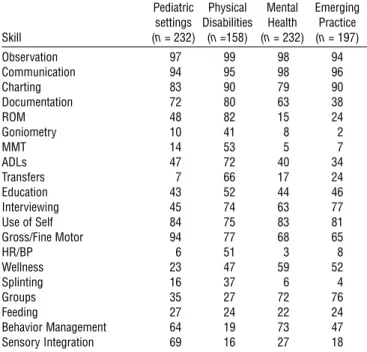
The second aspect of the study addressed student per-ceptions of the fieldwork experience. Summaries of data on clinical skills that Level I students had the opportunity to practice is presented in Table 2.
Comparison by setting indicates that observation and communication skills are the most commonly practiced skills across settings. Clinical skills that are practiced with a high level of frequency, but appear to be unique to practice setting, include: range of motion (82%) in physical disabil-ities; behavior management (73%) in mental health; fine and gross motor activities (94%) in pediatrics; and inter-viewing (77%) in emerging practice settings. Other skills typically required by practitioners in specific settings were practiced at a lower level of frequency. For example, only 41% of students in physical disability settings had an opportunity to practice goniometry. Of those students completing fieldwork in pediatric settings, only 27% had an opportunity to practice feeding.
To analyze how type of setting and fieldwork educator affect the students’ perceptions of their Level I fieldwork experience, a series of one-way ANOVAs with a pairwise comparison of means using Tukey’s honestly significant difference (HSD) was conducted to assess differences in perception in the two content areas of application of knowledge and facility. It should be noted that the vari-ables under study were negatively skewed significantly, indicating that most respondents scored the items in the higher range of scores, restricting the range of scores. A Table 1. Setting Types for Level I Fieldwork Experience (N = 1,002)
Physical Disabilities (n = 415) Mental Health (n = 158) Pediatrics (n = 232) Emerging Practice (n = 197)
General 34% Hospital 43% Community 44% Senior Centers 34%
Rehabilitation 22% Community 30% Schools 39% Assisted Living 20% Outpatient 19% MH/MR/DD 27% Hospital 17% Sheltered Workshops 18%
Home Health 8% Homeless Shelter 16%
Nursing Home 8% After-School Programs 10%
Hand Center 6% International 2%
Other* 3%
*Settings in the “Other” category included specialty sites exclusive to Traumatic Brain Injury, Spinal Cord Injury, and Assistive Technology.
Note. All programs were coded independently by each program and then checked for accuracy so that all sites that were used were coded in the same manner.
power transformation using squaring to reduce the negative skew was applied to the data, which resulted in a more nor-mal distribution.
Students’ perceptions of the opportunities they had to apply their knowledge, engage in occupation-based prac-tice, and observe theory in practice were influenced by both setting and type of fieldwork educator. In the application of knowledge items, a series of one-way ANOVAs indicated a significant effect for fieldwork educator and significant effect for setting. Specifically, the type of fieldwork educator had a significant effect on the students’ observations of the-ory in practice, F (3, 998) = 31.89, p < .001; participation in occupation-based practice, F (3, 998) = 11.54, p < .001; and opportunity for hands-on involvement, F (3, 998) =
7.04, p < .001. Post hoc testing indicated that students
supervised by non–occupational therapy personnel (M = 3.31) observed significantly less theory in practice when compared to those supervised by Level II fieldwork students (M = 4.09), occupational therapists (M = 4.13), and occu-pational therapy assistants (M = 4.20). Students supervised
by non–occupational therapy personnel (M = 3.80) also
perceived significantly less opportunity to engage in occu-pation-based practice than students supervised by Level II fieldwork students (M = 4.21) and occupational therapists (M = 4.27). Students supervised by occupational therapy assistants (M = 4.04) and non–occupational therapy per-sonnel (M = 4.26) perceived significantly less opportunity to practice clinical skills than those supervised by occupa-tional therapists (M = 4.53). Setting also had a significant
effect on opportunities to apply knowledge on Level I field-work. Setting had a significant effect on students’ observa-tions of theory in practice, F (3, 998) = 29.14, p < .001;
par-ticipation in occupation-based practice, F (3, 998) = 8.91, p
< .001; and opportunity to practice clinical skills, F (3, 998) = 6.12, p < .001. Post hoc testing indicated that students in
emerging practice settings (M = 3.53) observed
significant-ly less theory in practice when compared to those in men-tal health (M = 4.08), physical disabilities (M = 4.14), and pediatric settings (M = 4.22). Students in emerging practice
areas (M = 4.01) also perceived significantly less
opportuni-ty to engage in occupation-based practice than students in mental health (M = 4.25) and pediatric settings (M = 4.41). In addition, students in physical disability settings (M = 4.17) perceived significantly less opportunity to engage in occupation-based practice than students in pediatric set-tings (M = 4.41). Students in emerging practice (M = 4.39)
and physical disability settings (M = 4.41) perceived
signif-icantly less opportunity to practice clinical skills than students in pediatric (M = 4.61) and mental health settings (M = 4.63).
Items related to the learning environment within the facility, specifically students’ perceptions of the value of the experience, were affected by fieldwork educator and setting. Specifically, the type of fieldwork educator had a significant effect F (3, 998) = 9.68, p < .001 on students’ perceptions of the value of the experience, as did the type of setting F (3,
998) = 9.83, p < .001. A Tukey HSD test showed that stu-dents supervised by occupational therapists (M = 4.74) or
occupational therapy assistants (M = 4.88) indicated that
their Level I fieldwork was a significantly more valuable experience than students supervised by Level II fieldwork students (M = 4.48) or non–occupational therapy person-nel (M = 4.49). In addition, students who were in physical disability (M = 4.76) or pediatric settings (M = 4.81)
indi-cated a significantly more valuable experience than those in emerging practice settings (M = 4.56) or mental health (M = 4.61) settings. It is important to note that in general all students perceived their Level I fieldwork experiences as valuable, as indicated by the mean scores.
Discussion
Level I Fieldwork Settings
The results of this study reveal that Level I fieldwork is being conducted in all four types of settings: mental health, physical disabilities, pediatrics, and emerging practice, with the majority of experiences occurring in physical disability settings. The literature supports that this trend has been consistent at least since the late 1980s (Shalik, 1990). These Table 2. Percentage of Clinical Skills Practiced in
Level I Fieldwork Settings
Pediatric Physical Mental Emerging settings Disabilities Health Practice Skill (n = 232) (n =158) (n = 232) (n = 197) Observation 97 99 98 94 Communication 94 95 98 96 Charting 83 90 79 90 Documentation 72 80 63 38 ROM 48 82 15 24 Goniometry 10 41 8 2 MMT 14 53 5 7 ADLs 47 72 40 34 Transfers 7 66 17 24 Education 43 52 44 46 Interviewing 45 74 63 77 Use of Self 84 75 83 81 Gross/Fine Motor 94 77 68 65 HR/BP 6 51 3 8 Wellness 23 47 59 52 Splinting 16 37 6 4 Groups 35 27 72 76 Feeding 27 24 22 24 Behavior Management 64 19 73 47 Sensory Integration 69 16 27 18
Note. ROM = range of motion; MMT = manual muscle test; ADLs = activities
results are also consistent with the latest AOTA Member Compensation Survey, which indicates that the greatest number of occupational therapists are practicing in physical disability settings, followed by those practicing in school or early intervention settings (AOTA, 2001). The most recent practice analysis by the National Board for Certification in Occupational Therapy (NBCOT) also supports this distri-bution among entry-level occupational therapists (NBCOT, 2004). In contrast, the percentage of students completing fieldwork in emerging practice settings far exceeds the percentage of occupational therapists reporting practicing in community settings. This discrepancy may be a result of differences in how these practice arenas were defined for each of these studies, or it may suggest that edu-cational programs have identified unmet needs for occupa-tional therapy services and are preparing students for future practice in areas in which occupational therapy services are not yet established.
Fieldwork Educator Qualifications
Findings that occupational therapists provide the majority of supervision to occupational therapy and occupational therapy assistant students are consistent with the 1990 Shalik study. Surprisingly, in the current study, occupation-al therapy assistants provided supervision in only 2.5% of the experiences, whereas occupational therapy assistant stu-dents comprise 4.9% of the experiences. This was less than the supervision provided by Level II fieldwork students, and may be because of lack of willingness, opportunity, or administrative support. The results are somewhat alarming, given that occupational therapy students and occupational therapy assistant students can benefit from the wealth of knowledge and experience that occupational therapy assis-tants, who in Pennsylvania comprise approximately 36% of active NBCOT certificants (NBCOT, 2003), can provide. Questions arise as to why occupational therapy assistants are so minimally involved with Level I fieldwork education, and perhaps why they are so underused in general. Whereas further investigation is warranted to understand this nomi-nal involvement of occupationomi-nal therapy assistants, the new Educational Standards, which emphasize collaboration between occupational therapists and occupational therapy assistants (AOTA, 1999), may help to facilitate future involvement by occupational therapy assistants in fieldwork education and other professional activities.
Emerging Practice
Corresponding with the emergence of nontraditional prac-tice settings for occupational therapists and occupational therapy assistants, the literature and the results of this study
reveal that students are completing Level I fieldwork expe-riences in emerging practice arenas (Cohn & Crist, 1995). The frequency of supervision by non–occupational therapy personnel has more than doubled in the past 20 years, from 5% in the late 1980s (Shalik, 1990) to 11.6% today, reflect-ing the increase of Level I fieldwork experience in emergreflect-ing practice settings. Recognition of Level II fieldwork in emerging practice arenas by ACOTE in the 1998 Standards is likely to support continued growth of fieldwork opportu-nities in these areas (AOTA, 1999).
Interviewing was reported to be the most frequently practiced clinical skill in emerging practice settings, with students reporting opportunities to practice this skill 77% of the time. Given the nature of emerging practice settings, in which established evaluation and intervention tools are not always available or appropriate, students are encouraged to use the interview format in order to familiarize them-selves with the site and the service recipients. In addition, students are challenged to articulate the benefits of occupa-tional therapy in the practice setting (Moffett Boyd & Garbarini, 2001).
It is worth noting that whereas nearly 20% of all Level I placements took place in emerging practice settings, only about 3% to 4% of occupational therapists and occupa-tional therapy assistants report working in community/ other settings (AOTA, 2001). This finding suggests that whereas academic programs are introducing students to the growing but still limited area of emerging practice, we are simultaneously stimulating interest in emerging practice arenas so that our graduates will be empowered to create the jobs of the future.
Practice Opportunities and Student Perceptions
The results of our study indicate that students were pro-vided with opportunities to practice clinical skills in all types of settings. Students reported that they were most commonly able to practice observation and communica-tion skills across all types of settings. In physical disabili-ties, mental health, and pediatric settings, students report-ed practicing skills reflective of the specific type of setting. For example, in physical disability settings, range of motion was reported to be the most frequently practiced clinical skill, as was expected. However, students reported practicing manual muscle testing, heart rate and blood pressure measurement, goniometry, and splinting in 53% or less of their physical disabilities experiences. Similarly, students in pediatric settings reported practicing transfers, splinting, feeding, and activities of daily living in less than 50% of their experiences.
Based on these results, it appears that even though the Standards require participation—and students, academic
programs, and fieldwork educators value and encourage it—students may not be getting the opportunities to prac-tice the clinical skills necessary to begin to develop skill and confidence in these areas with “real” client populations dur-ing Level I fieldwork. Because fieldwork is designed to progress students through higher levels of skill and respon-sibility (AOTA, 2003), it follows that students who have opportunities to practice clinical skills and experience occu-pation-based practice in the Level I fieldwork experiences will be better prepared to practice occupation-based thera-py in their Level II fieldwork experiences. This limited opportunity to practice clinical skills may explain why stu-dents may be perceived as unprepared in Level II fieldwork settings where they are often expected to “hit the ground running.” It is important for fieldwork educators who plan clinical skills orientation and training for Level II fieldwork students to realize that Level I fieldwork frequently does not offer the student the opportunity to practice and gain con-fidence in certain clinical skills.
Regarding students’ perceptions of the value of their fieldwork experiences, the results indicate that differences existed based on fieldwork educator qualifications. Generally, students rated their Level I fieldwork experi-ences as valuable. Fieldwork experiexperi-ences were rated more valuable when students were supervised by occupational therapists and occupational therapy assistants, as compared to Level II fieldwork students and non–occupational ther-apy personnel. These findings would seem to indicate that students prefer being supervised by “real occupational ther-apists.” The high rankings in general, however, indicate that students were still able to appreciate the value of these experiences.
Reportedly, the type of fieldwork educator had a con-siderable effect on the student’s observation of theory in practice, participation in occupation-based practice, and opportunity for practicing clinical skills. Experiences in which non–occupational therapy personnel in emerging practice sites supervised students indicated less observation of theory, less opportunity to engage in occupation-based practice, and less opportunity to practice clinical skills. The lower frequency of observation of occupation-based prac-tice was unexpected, given that occupational therapy theo-ries and the essence of “occupation” are inherent to emerg-ing practice arenas. Since non–occupational therapy personnel do not necessarily use occupational therapy ter-minology or have the skills to identify theoretical concepts, it becomes incumbent on academic educators and field-work coordinators to assume responsibility for mentoring, preparing, and educating students for these experiences, enabling them to recognize occupation-based practice in non–traditional environments. Students also perceived less
opportunity to practice clinical skills when supervised by occupational therapy assistants. This finding also warrants further investigation.
Student perceptions of fieldwork experiences indicate that there were differences based on type of setting. The results indicate that the use of theory was observed more in mental health, physical disabilities, and pediatrics com-pared to emerging practice. More participation in occupa-tion-based practice and clinical skills was reported in men-tal health and pediatrics compared to physical disabilities and emerging practice settings. Given that the largest per-centage of fieldwork experiences (41.4%) occurred in phys-ical disability settings, this is of concern. More valuable experiences were reported in physical disability and pedi-atric settings compared to mental health and emerging practice settings. This perception may be reflective of the students’ anticipated area of practice. New graduates are more likely to practice in pediatric and physical disability settings than in mental health and emerging practice set-tings (NBCOT, 2004). Students may value a fieldwork experience more highly when they plan on practicing in that type of setting. Until more occupational therapists and occupational therapy assistants begin working in commu-nity settings and become available to train fieldwork stu-dents, supervisors will continue to be drawn from other pools of professionals. Although this supervision model may not be the students’ first choice in all situations, it nonetheless provides them with opportunities for promot-ing occupational therapy to other professionals, consumers, and the public; appreciating the role of the occupational therapist as an entrepreneur; and developing the ability to advocate for consumers and assist them in gaining access to occupational therapy services—all areas academic curricula are required to address (AOTA, 1999).
Study Limitations
Although the number of fieldwork experiences was large (N = 1,002), the study results are limited to one small area of the country; therefore, the results may not generalize to other geographic regions. The restricted range of scores (most students indicated a high degree of satisfaction with Level I fieldwork) may have positively skewed the data in that the students’ overall sense of satisfaction with the Level I fieldwork experience may have influenced their scoring in other areas. Therefore, results should be interpreted cautiously.
No validity or reliability testing was performed on the evaluation tool before implementation, which would have further supported the results. In addition, although all pro-grams in the study emphasized observation and participa-tion in the Level I fieldwork experience, course-related
Level I fieldwork learning objectives were not standardized between academic programs, which may have influenced how students interpreted and rated each item on the survey. Lastly, this study did not address temporal issues, including when the fieldwork experience occurred within the curriculum or the effect the length of the fieldwork experience may have had on opportunities to practice clin-ical skills.
Conclusion
Little has changed in Level I fieldwork requirements since 1973, but the characteristics of Level I fieldwork have changed. Level I fieldwork experiences continue to include physical disabilities, mental health (to a much lesser degree than previously), and pediatric settings (to a much greater degree than previously), with the majority of Level I field-work experiences occurring in physical disability settings. Emerging practice settings comprise a more significant por-tion of these experiences now than in the past, reflecting the current trend of occupational therapy expansion into non-traditional areas and its integration into occupational ther-apy curricula. The majority of students are supervised by occupational therapists, as opposed to occupational therapy assistants, Level II fieldwork students, or non–occupational therapy personnel.
Overall, this study found that students value Level I fieldwork independent of variables such as setting, type of supervisor, and degree of active participation in clinical skills. However, the findings indicated that students valued the experience more highly when provided with opportuni-ties to practice clinical skills, to observe theory in practice, and to participate in occupation-based practice. Based on the results and discussion, several implications emerge for academic educators and fieldwork coordinators as well as clinical fieldwork educators.
Academic educators and fieldwork coordinators need to continue to teach and promote occupation-based prac-tice to students and clinical fieldwork educators. Physical disability settings, although the most frequently reported experience, were rated lowest by students in terms of oppor-tunities to participate in occupation-based practice. Educating and providing examples for occupation-based practice in physical disability settings should be empha-sized. Academic programs can promote occupation-based practice by providing in-services to supervising therapists, designing Level I fieldwork assignments that focus on occu-pation-based intervention, and empowering students to dis-cuss and seek opportunities to participate in occupation-based practice during their Level I fieldwork experiences. For example, Level I fieldwork students can be encouraged
to formally interview clients to gain insight into the person’s illness experience, as well as their interests and routines. Using that information, the student could design an occu-pation-based intervention activity for the client. Fieldwork educators could be encouraged to provide opportunities to discuss their clinical reasoning process with students—to share the process they go through to create occupation-based activities within the context of their setting.
Academic fieldwork coordinators need to educate clin-ical fieldwork educators about the purpose of the Level I fieldwork experience, encouraging and supporting opportu-nities for hands-on involvement. Fieldwork educator train-ing workshops provided by academic programs both regionally and nationally can highlight the needs identified by this research and include content on how fieldwork edu-cators can facilitate active participation across settings. It is incumbent on the Level II fieldwork educator to assess, not assume, the student’s competence and provide education and training as indicated.
Of concern is the minimal number of occupational therapy assistants in the role of fieldwork educator. Occupational therapy assistants are an integral part of ser-vice delivery and should be encouraged and trained to supervise Level I fieldwork students. Academic fieldwork coordinators and fieldwork educators must collaborate to facilitate the involvement of more occupational therapy assistants in fieldwork education. Marketing that targets occupational therapy assistants regarding the importance and benefits of supervising fieldwork students—including documentation of continued competence and exposure through students to new and emerging concepts in tional therapy—could promote participation of occupa-tional therapy assistants in fieldwork supervision.
Lastly, students are successfully participating in Level I fieldwork experiences in a variety of emerging practice set-tings. The finding that students reported less participation in occupation-based practice in emerging practice settings was unexpected, since the emerging practice setting is often the clients’ natural environment where they typically engage in work, leisure, and self-care occupations. Although it is important for AFCs to continue placing students in sup-portive emerging practice settings and developing relation-ships with non–occupational therapy practitioners, addi-tional education and mentoring may be beneficial in order to foster students’ understanding of the relationship between occupational therapy theory and the inherent use of occupation in these settings.
Non–occupational therapy personnel who provide fieldwork education may also require formal education as to the nature of occupational therapy practice. Greater aware-ness can be achieved through fieldwork site visits or by
inviting willing participants to the academic setting. By educating non–occupational therapy fieldwork educators, faculty members and AFCs can not only facilitate a positive experience for their students, but can also increase the pub-lic’s awareness of occupational therapy.
This study has implications for future research. Given the geographic limitation of this study, replication in other parts of the country would be of interest. This study also found that students reported limited opportunities to prac-tice clinical skills during Level I fieldwork experiences. The impact this may have on their performance in Level II field-work could be investigated. In addition, the fieldfield-work edu-cator’s perceptions of Level I fieldwork would provide valu-able comparative information. Future research could also examine structural differences (i.e., amount of time, course objectives, placement by fieldwork coordinator versus self-placement) in Level I fieldwork and their impact on student experiences. ▲
Acknowledgments
The authors would like to thank the hundreds of fieldwork educators and students from Thomas Jefferson University, Temple University, Philadelphia University, University of the Sciences in Philadelphia, and Harcum College who contributed to the collection of this data and make the job of being a fieldwork coordinator such a wondrous one.
References
American Occupational Therapy Association (1975). Essentials of an accredited educational program for the occupational therapist. American Journal of Occupational Therapy, 29, 485–496.
American Occupational Therapy Association (1983). Essentials of an accredited educational program for the occupational therapist. American Journal of Occupational Therapy, 37, 817–823.
American Occupational Therapy Association (1991). Essentials and guidelines for an accredited educational program for the occupational therapist. American Journal of Occupational Therapy , 45, 1077–1084.
American Occupational Therapy Association (1995). Updated 1991 essentials and guidelines for an accredited educa-tional program for the occupaeduca-tional therapist (7/95). In AOTA Accreditation Council for Occupational Therapy Education: Accreditation Manual (pp. 1–12). AOTA: Bethesda, MD.
American Occupational Therapy Association (1999). Standards for an accredited educational program for the occupational therapist. American Journal of Occupational Therapy, 53, 575–582.
American Occupational Therapy Association (2001). AOTA 2000 member compensation survey. Bethesda, MD: Author.
American Occupational Therapy Association (2002). Fieldwork performance evaluation for the occupational therapy assistant and the occupational therapy student. Bethesda, MD: Author.
American Occupational Therapy Association (2003). The pur-pose and value of occupational therapy fieldwork education. American Journal of Occupational Therapy, 57, 644.
Barnes, M. A. (1995, December). Putting it all together: Occu-pational therapy in community contexts. Education Special Interest Section Newsletter 2(4), 3–5.
Baum, C. (2000, January 3). Reinventing ourselves for the new millennium. OT Practice, 12–15.
Cohn, E. S., & Crist, P. (1995). Back to the future: New approaches to fieldwork education. American Journal of Occupational Therapy, 49, 103–106.
Council on Medical Education of the American Medical Association and the American Occupational Therapy Association (1965). Essentials of an accredited curriculum in occupational therapy. New York, NY: American Occupational Therapy Association.
Crist, P. A. (1991, December). Fieldwork education: Possible solutions to current dilemmas. Education Special Interest Section Newsletter, 1(1), 3, 6.
Crist, P. A. (1993, March). Nontraditional and group fieldwork models: Their time has come. Education Special Interest Section Newsletter, 3(1), 3–4
Cromwell, F. S., & Kielhofner, G. W. (1976). An educational strategy for occupational therapy community service. American Journal of Occupational Therapy, 30, 629–633. Drake, M. (1992). Level I fieldwork in a day care for homeless
children. Occupational Therapy in Health Care, 8, 215–224. Follis, D., & Nolen, A. (2001, May 7). Our journey into the
community. OT Practice, 12–16.
Gourley, M. (2001, December 17). Innovative academic– community partnerships. OT Practice, 6–7.
Heine, D., & Bennett, N. (2003). Student perceptions of Level I fieldwork supervision. Occupational Therapy in Health Care, 17, 89–97.
Hubbard, S. (2000, December 18). A case example of remote supervision. OT Practice, 16–18.
Kautzmann, L. N. (1987). Perceptions of the purpose of Level I fieldwork. American Journal of Occupational Therapy, 40, 595–600.
Kerr, T. (1999, March 8). Do-it-yourself fieldwork inspired Michigan students. Advance for Occupational Therapy Practitioners, 30, 33.
Kielhofner, G. (2002, January 14). UIC’s scholarship of practice. OT Practice, 11–12.
Koenig, K., Johnson, C., Morano, C. K., & Ducette, J. P. (2003). Development and validation of a professional behavior assessment. Journal of Allied Health, 32(2), 86–91.
LaGrossa, J. (2005, March 7). Opening new doors in Philadelphia. Advance for Occupational Therapy Practitioners, 22–23, 51.
Leonardelli, C. A., & Caruso, L. A. (1986). Level I fieldwork: Issues and needs. American Journal of Occupational Therapy, 40, 258–264.
McCreedy, P. (1994, Dec. 22). Taking the path less traveled. OT Week, 16–17.
Moffett Boyd, M. E., & Garbarini, J. G. (2001, May 21). Helping build healthy communities through OT fieldwork. OT Practice, 17–21.
Moffett Boyd, M. E., & Garbarini, J. G. (2004, January 5). Creative links: Supporting the community while meeting strategic goals. OT Practice, 11–15.
National Board for Certification in Occupational Therapy, Inc. (2003, Spring). Active certificants by location. Report to the profession, 5.
National Board for Certification in Occupational Therapy, Inc. (2004). A practice analysis study of entry-level occupational therapist registered and certified occupational therapist assis-tant practice. OTJR: Occupation, Participation and Health, 24, supplement 1.
Platt, N. P., Martell, D. L., & Clements, P. A. (1977). Level I field
placement at a federal correctional institution. American Journal of Occupational Therapy, 31, 385–387.
Rydeen, K., Kautzmann, L., Cowan, M. K., & Benzing, P. (1995). Three faculty-facilitated, community-based Level I fieldwork programs. American Journal of Occupational Therapy, 49, 112–118.
Scott, S. B. (2000, May 22). Community-based fieldwork oppor-tunities: Level I and Level II experiences. OT Practice, 14–18. Shalik, L. D. (1990). The Level I fieldwork process. American
Journal of Occupational Therapy, 44, 700–707.
Yanoshek, M. C., Fuguet, L., & Rose, A. (1997). Group models: A creative approach to fieldwork education. InThe reference guide to fieldwork education and program development (pp. 68–76). Philadelphia: Philadelphia Region Fieldwork Consortium.
The Essential Guide to Occupational
Therapy Fieldwork Education
RESOURCES FOR TODAY’S EDUCATORS AND PRACTITIONERS
Edited by Donna M. Costa, MS, OTR/L
F
ieldwork education is a vital piece of every occupational therapy student’s education. In this comprehensive manual, occupational therapy fieldwork educators in both academic and clinical settings will learn how to prepare a student fieldwork manual for clinical sites and educate staff about the changes in fieldwork education over the past 10 years. Academic fieldwork coordinators, working to put together an effective fieldwork experience, will find resources to share with colleagues and new ideas to utilize.Order #1231-J
$59 AOTA Members
■$83 Nonmembers
A Must-Have Resource for Every Fieldwork Supervisor!
Call:
877-404-AOTA
■
Shop: www.aota.org (Books, Products, & CE)
B K -4 4 5 299 pages, 2004 ISBN: 1-56900-195-2 CD-ROM INCLUDED!