
Runtime Hardware Reconfiguration
in Wireless Sensor Networks for
Condition Monitoring
Vom Fachbereich Elektrotechnik und Informationstechnikzur Erlangung des akademischen Grades Doktor-Ingenieur (Dr.-Ing.)
genehmigte Dissertation von Dipl.-Ing. François Philipp aus Forbach, Frankreich Tag der Einreichung: 16. Juni 2014, Tag der Prüfung: 1. September 2014
Darmstadt — D 17 — 2014
1. Gutachten: Prof. Dr. Dr. h. c. mult. Manfred Glesner 2. Gutachten: Prof. Dr.-Ing. Christian Hochberger 3. Gutachten: Prof. Dr. Eduardo de la Torre
Runtime Hardware Reconfiguration in Wireless Sensor Networks for Condition Monitoring
Genehmigte Dissertation von Dipl.-Ing. François Philipp aus Forbach, Frankreich 1. Gutachten: Prof. Dr. Dr. h. c. mult. Manfred Glesner
2. Gutachten: Prof. Dr.-Ing. Christian Hochberger 3. Gutachten: Prof. Dr. Eduardo de la Torre Tag der Einreichung: 16. Juni 2014
Tag der Prüfung: 1. September 2014 Darmstadt — D 17
Bitte zitieren Sie dieses Dokument als: URN: urn:nbn:de:tuda-tuprints-41597
URL: http://tuprints.ulb.tu-darmstadt.de/4159 Dieses Dokument wird bereitgestellt von tuprints, E-Publishing-Service der TU Darmstadt
http://tuprints.ulb.tu-darmstadt.de [email protected]
Die Veröffentlichung steht unter folgender Creative Commons Lizenz:
Namensnennung – Keine kommerzielle Nutzung – Keine Bearbeitung 2.0 Deutschland http://creativecommons.org/licenses/by-nc-nd/2.0/de/
Erklärung zur Dissertation
Hiermit versichere ich, die vorliegende Dissertation ohne Hilfe Dritter nur mit den
an-gegebenen Quellen und Hilfsmitteln angefertigt zu haben. Alle Stellen, die aus Quellen
entnommen wurden, sind als solche kenntlich gemacht. Diese Arbeit hat in gleicher oder
ähnlicher Form noch keiner Prüfungsbehörde vorgelegen.
Darmstadt,
den
24. September 2014
Acknowledgments
A Ph.D. thesis is certainly a long, challenging but also rewarding work that cannot be accomplished without a high quality supervision and close accompaniment. In this sense, I believe that Prof. Manfred Glesner was thanks to his long and rich experience and his close relationships with his research assistants, one of the greatest source of advice and inspiration for the development of relevant scientific work. Therefore, my very first acknowledgment goes to him for the wise guidance and all opportunities he offered me during the time of my stay in the Microelectronic Systems Research Group, which resulted in the contributions presented in this document.
Similarly, I would like to sincerely thank Prof. Christian Hochberger from the Computer Systems Group of TU Darmstadt and Prof. Eduardo de la Torre from the Center for Industrial Electronics in Madrid for being the co-referees of my Ph.D thesis. I express my gratitude to all members of the examination committee for taking the time to consciously and rightly evaluate this work.
Nowadays, scientific innovations are often triggered by multi-disciplinary research projects. With the European project Maintenance on Demand and the LOEWE-Zentrum AdRIA, this requirement was largely fulfilled by offering exciting application scenarios in the domain of mechanical and structural engineering. I would like to thank Prof. Thilo Bein who was coordinating these projects and guiding my work towards a successful completion of their objectives. I thank all the persons who collaborated with me during these projects and particularly Dominik Elsberkirch and Manuel Andreu in MoDe as well as Andreas Engel in AdRIA. Thank you to Prof. Saman Halgamuge and all his coworkers for the fruitful partnership built during the DAAD collaborative project with the University of Melbourne. A large part of this work would not have been possible without the help of Javier Martinez, with whom I started one of the most productive collaborative work.
A Ph.D. thesis is also an everyday fight that could not be won without a constant support of coworkers and colleagues. This time at the Microelectronic Systems Research Group allowed me developing new friendships and constructive collaborations which were the source of many parts of this work. I thank Heiko Hinkelmann for his wise supervision during my diploma thesis and the opportunity he gave me by recommending me to work on the Maintenance on Demand project. The early stages of the thesis were the results of a great collaborative work with Faizal Arya Samman and Ping Zhao. I am thankful to my colleagues Ramkumar Ganesan, Sebastian Pankalla, Leandro Moller and particularly Surapong Pongyupinpanich and Christopher Spies who share many memories and good times with me. Thank you to Yuan Fang, Lufei Shen, Alex Schönberger and all colleagues from the Integrated Electronic Systems group who started they journey towards the doctoral degree with me. I also thank Pablo Guerrero from the Databases and Distributed Systems group, Kristof Van Laerhoven from the Embedded Sensing Group and all co-organizers of the Wireless Sensor Networks labs and seminars, which always were an interesting and enriching experience. Administrative work would have been much more difficult without the help of Silvia Hermann and Brigitte Kuntzsch. I of course thank all the students who worked with me during the time of the thesis. I am very proud that I had the chance to accompany them during their studies.
Outside the work, the support of the close family and friends is primordial to keep the motivation level and the enthusiasm high. Many thanks to my mother who illustrated the cover page of this document, to my father for his support and his constant care about the advancement of the work and all other members of my family who shared with me the happy and hard events of life which occurred during these last couple of years. Finally, I address my last and strongest thank you to Lang Yu, who illuminated my daily life with love and cheerfulness.
Abstract
The integration of miniaturized heterogeneous electronic components has enabled the deployment of tiny sensing platforms empowered by wireless connectivity known as wireless sensor networks. Thanks to an optimized duty-cycled activity, the energy consumption of these battery-powered devices can be reduced to a level where several years of operation is possible. However, the processing capability of currently available wireless sensor nodes does not scale well with the observation of phenomena requiring a high sampling resolution. The large amount of data generated by the sensors cannot be handled efficiently by low-power wireless communication protocols without a preliminary filtering of the information relevant for the application. For this purpose, energy-efficient, flexible, fast and accurate processing units are required to extract important features from the sensor data and relieve the operating system from computationally demanding tasks. Reconfigurable hardware is identified as a suitable technology to fulfill these requirements, balancing implementation flexibility with performance and energy-efficiency.
While both static and dynamic power consumption of field programmable gate arrays has often been pointed out as prohibitive for very-low-power applications, recent programmable logic chips based on non-volatile memory appear as a potential solution overcoming this constraint. This thesis first verifies this assumption with the help of a modular sensor node built around a field programmable gate array based on Flash technology. Short and autonomous duty-cycled operation combined with hardware acceleration efficiently drop the energy consumption of the device in the considered context.
However, Flash-based devices suffer from restrictions such as long configuration times and limited resources, which reduce their suitability for complex processing tasks. A template of a dynamically reconfigurable architecture built around coarse-grained reconfigurable function units is proposed in a second part of this work to overcome these issues. The module is conceived as an overlay of the sensor node FPGA increasing the implementation flexibility and introducing a standardized programming model. Mechanisms for virtual reconfiguration tailored for resource-constrained systems are introduced to minimize the overhead induced by this genericity.
The definition of this template architecture leaves room for design space exploration and application-specific customization. Nevertheless, this aspect must be supported by appropriate design tools which facilitate and automate the generation of low-level design files. For this purpose, a software tool is introduced to graphically configure the architecture and operation of the hardware accelerator. A middleware service is further integrated into the wireless sensor network operating system to bridge the gap between the hardware and the design tools, enabling remote reprogramming and scheduling of the hardware functionality at runtime.
At last, this hardware and software toolchain is applied to real-world wireless sensor network deploy-ments in the domain of condition monitoring. This category of applications often require the complex analysis of signals in the considered range of sampling frequencies such as vibrations or electrical currents, making the proposed system ideally suited for the implementation. The flexibility of the approach is demonstrated by taking examples with heterogeneous algorithmic specifications. Different data processing tasks executed by the sensor node hardware accelerator are modified at runtime according to application requests.
Kurzfassung
Die Integration miniaturisierter heterogener elektronischer Bauteile hat der Einsatz winziger drahtlos angebundener Erfassungsplattformen, sogenannte drahtlose Sensorknoten, ermöglicht. Der Energiever-brauch dieser Komponenten kann dank optimierter Betriebszeiten soweit reduziert werden, dass eine batteriebetriebene Laufzeit über mehrere Jahre möglich ist. Allerdings skaliert die Rechenkapazität der bisher vorliegenden Sensorknoten bei Beobachtung von Ereignissen, die eine hohe Abtastauflösung benötigen, schlecht. Eine große Menge von Sensordaten kann ohne eine Vorfilterung der für die Anwen-dung relevanten Merkmale nur ineffizient durch drahtlose stromsparende Kommunikationsprotokolle verarbeitet werden. Daher werden energieeffiziente, flexible, schnelle und genaue Recheneinheiten benötigt, um wichtige Merkmalen aus den Sensordaten lokal zu extrahieren, ohne das Betriebssystem mit rechenintensiven Tasks zu belasten. Rekonfigurierbare Hardware ist als eine geeignete Zieltechnologie an-erkannt, um diese Anforderungen durch eine Balance zwischen Implementierungsflexibilität, Performanz und Energieeffizienz zu erfüllen.
Obwohl der statische und dynamische Leistungsverbrauch derField Programmable Gate Arrays(FPGAs) sich oft als nachteilig für Anwendungen mit sehr niedrigem Energieverbrauch darstellte, kommen neueste, auf einem nichtflüchtigen Speicher basierende, programmierbare Logikbausteine als mögliche Lösung, die diese Nachteile aufheben, in Frage. Diese Doktorarbeit überprüft zuerst diese These mit Hilfe eines modularen Sensorknotens, der auf einem Flash-basierenden FPGA aufgebaut ist. Die Kombination einer kurzen und autonomen Betriebsperiode mit Hardwarebeschleunigung ergibt eine effiziente Reduzierung des Leistungsverbrauchs für den betrachteten Anwendungsbereich.
Allerdings weisen Flash-basierende Bausteine unter Beschränkungen wie lange Konfigurationszeiten und begrenzte Ressourcen auf, die ihre Tauglichkeit für komplexe Datenverarbeitungsaufgaben reduziert. Eine Vorlage einer dynamisch rekonfigurierbaren Architektur, die auf grob-granularen Funktionseinheiten basiert, wird in einem zweiten Teil dieser Arbeit als potentielle Lösung vorgestellt. Das Rechenmodul wird als ein Overlay des FPGAs realisiert und verbessert die Implementierungsfreiheit mit Hilfe eines standardisierten Programmierungsmodells zur Laufzeit. Für ressourcenbeschränkte Geräte angepasste Mechanismen werden eingeführt, um das Modul virtuell zu rekonfigurieren und den durch diese Konfig-urierbarkeit erzeugten Zusatzaufwand zu minimieren.
Diese Architekturvorlage erschließt den Entwurfsraum und vereinfacht die anwendungsspezifische Anpassung der Plattform. Dennoch müssen diese Funktionalitäten durch entsprechende Designwerkzeuge für automatische Erzeugung von Designdateien auf niedriger Ebene unterstützt werden. Hierzu wird ein Softwarewerkzeug eingeführt, um die Architektur und den Ablauf der Hardwarebeschleuniger graphisch zu konfigurieren. Zusätzlich wird ein Middleware-Dienst im Betriebssystem des Sensornetzwerks integriert, um die Kluft zwischen der Hardware und den Designwerkzeugen zu schließen. Dies ermöglicht eine Umprogrammierung aus der Ferne und Ablaufplanung der Hardwarefunktionalität zur Laufzeit.
Zuletzt wird diese Hardware- und Software-Werkzeugkette mit relevanten Anwendungen im Bereich der Zustandsüberwachung bewertet. Die komplexe Analyse von Signalen im betrachteten Abtastfre-quenzbereich, wie Schwingungen oder elektrische Ströme, wird für solche Anwendungen oft benötigt. Das vorgestellte System ist somit für die Implementierung bestens geeignet. Die Flexibilität des Konzepts wird mit Hilfe von Algorithmen mit heterogenen algorithmischen Anforderungen gezeigt. Auf Anwen-dungsanfrage können unterschiedliche Datenverarbeitungsaufgaben auf der Sensorknotenhardware zur Laufzeit beschleunigt werden.
Contents
Affidavit I Acknowledgments V Abstract VII Kurzfassung IX Table of Contents XI List of Symbols XVList of Abbreviations XVII
List of Figures XXI
List of Tables XXV
I
Context and Motivation for Reconfigurable Hardware in Wireless Sensor
Networks
1
1 Introduction 3
1.1 Background . . . 3
1.2 Research scope and objectives . . . 4
1.3 Thesis outline . . . 4
2 High-Bandwidth Sensing Wireless Networks 9 2.1 Origins of wireless sensor networks . . . 9
2.1.1 Bell’s law . . . 9
2.1.2 Moore and more . . . 10
2.1.3 Ubiquitous computing . . . 11
2.2 The design space of wireless sensor networks . . . 12
2.2.1 Operation of a wireless sensor network . . . 12
2.2.1.1 General principle . . . 13
2.2.1.2 System-level metrics . . . 14
2.2.2 Sensing . . . 15
2.2.3 Processing . . . 17
2.2.3.2 In-network processing . . . 19
2.2.3.3 Operating systems for wireless sensor networks . . . 20
2.2.4 Wireless communication in wireless sensor networks . . . 21
2.2.5 Energy consumption of a wireless sensor node . . . 23
2.2.5.1 Limits of wireless communication and in-networking processing for high-bandwidth sensing on standard motes . . . 27
2.3 Conclusion . . . 29
3 Reconfigurable Hardware for Low-Power Embedded Systems 31 3.1 Features of reconfigurable hardware systems . . . 32
3.1.1 Technology . . . 33
3.1.2 Granularity . . . 34
3.1.3 Reconfiguration processes . . . 36
3.2 Estimating the power consumption of reconfigurable hardware devices . . . 37
3.3 Low-power duty cycling for FPGAs . . . 39
3.4 Conclusion . . . 41
3.4.1 Summary of the considerations on reconfigurable hardware . . . 41
3.4.2 Outlook on the following part . . . 41
II
Design of a Framework Enabling Reconfigurable Hardware Acceleration in
Wireless Sensor Networks
43
4 FPGA-based Hardware Acceleration for Wireless Sensor Nodes 45 4.1 Related work . . . 454.1.1 Wireless sensor nodes using an FPGA for SoC prototyping . . . 46
4.1.2 Wireless sensor nodes with standalone FPGA . . . 48
4.1.3 Wireless sensor nodes with a co-processing unit based on programmable logic . . . 49
4.1.4 General considerations on related work . . . 51
4.2 Design of a modular FPGA-based low-power mote . . . 53
4.2.1 Core architecture . . . 53
4.2.2 The HaLOEWEn platform . . . 54
4.2.2.1 Main board . . . 54 4.2.2.2 Extensions . . . 55 4.2.2.3 Software . . . 57 4.2.3 MoDe LPSIP . . . 58 4.3 Performance evaluation . . . 58 4.3.1 Power consumption . . . 60
4.3.2 Autonomous control of sleep mode . . . 61
4.3.3 Hardware abstraction layer . . . 62
4.3.4 Application examples . . . 64
4.3.4.1 FFT processing . . . 64
4.3.4.2 Localization . . . 68
4.3.4.3 Combined channel coding and cryptography . . . 70
4.4 Conclusion . . . 72
5 Design of a Virtually Reconfigurable FPGA Overlay Architecture for Resource-Constrained Devices 73 5.1 Introduction . . . 73
5.2 Related work . . . 76
5.2.1 Low-power coarse-grained reconfigurable architectures . . . 77
5.2.2 Virtually reconfigurable hardware . . . 77
5.2.3 Dynamic reconfiguration for Flash-based devices . . . 78
5.3 Template architecture . . . 78
5.3.1 Overview . . . 78
5.3.2 Producer-consumer transactions and interconnect . . . 79
5.3.3 Sensor interfaces . . . 80
5.3.4 Memory elements . . . 82
5.3.5 Processing elements . . . 83
5.3.5.1 Reconfigurable multiply-accumulate unit . . . 83
5.3.5.2 CORDIC unit . . . 84 5.3.5.3 ALU unit . . . 85 5.3.5.4 Other units . . . 88 5.3.6 Reconfiguration layer . . . 88 5.3.6.1 Difference-based reconfiguration . . . 89 5.3.6.2 Context flow . . . 91 5.3.6.3 Meta-reconfiguration . . . 93
5.3.7 Clock and power management . . . 93
5.4 Evaluation . . . 94
5.4.1 Resources . . . 94
5.4.2 Performance . . . 96
5.5 Conclusion . . . 98
6 Tools for Generation and Online Dissemination of Dynamically Reconfigurable Hardware Accelerators 99 6.1 General overview . . . 100
6.2 Graphical configuration interface . . . 101
6.2.1 Related work . . . 101
6.2.2 Architecture editor . . . 102
6.2.3 Data flow editor . . . 104
6.2.4 Evaluation . . . 106
6.2.5 Methodology for application-specific customization and programming of the archi-tecture . . . 106
6.3 Middleware for configuration management . . . 110
6.3.1 Related work . . . 110 6.3.2 General overview . . . 110 6.3.3 Middleware components . . . 111 6.3.4 Event-based reconfiguration . . . 112 6.3.5 Middleware commands . . . 114 6.3.6 Implementation . . . 115 6.3.7 Application examples . . . 116 6.4 Conclusion . . . 118
III Application of Wireless Sensor Networks Strengthened with Reconfigurable
Hardware to Condition Monitoring Systems
121
7.1 Concept . . . 124
7.1.1 General overview . . . 124
7.1.2 Condition monitoring of the damping system . . . 125
7.2 Motivation for on-demand reconfiguration . . . 129
7.3 Implementation and results . . . 129
7.4 Conclusion . . . 134
8 Diagnosis of Induction Motors 135 8.1 Concept . . . 135
8.1.1 Detection of broken bars . . . 135
8.1.2 Detection of dynamic eccentricity . . . 139
8.1.3 Detection of inter-turn short circuit . . . 139
8.2 Motivation for on-demand reconfiguration . . . 142
8.3 Implementation and results . . . 142
8.3.1 Implementation on HaLOEWEn . . . 143
8.3.2 Diagnosis results . . . 145
8.4 Conclusion . . . 146
9 Conclusion 147 9.1 Contributions of the work . . . 147
9.2 Outlook . . . 148
9.3 Final conclusion . . . 149
IV Appendix
151
A HaLOEWEn Design Files 153 B Details of implemented algorithms 159 B.1 High-Diffusion . . . 159B.2 Range-extended CORDIC . . . 162
B.3 Corrected fixed-point Fast Fourier Transform . . . 163
References 167
List of Own Publications 185
Supervised Theses 189
List of Symbols
Symbol Unit Definition
a - Constant angle e2π3i in Fortescue transformation
ai - Address value in address generators
Ai A Wavelet approximation at leveliof the current signal
C - Cost function of a state estimation using a wireless sensor network
CD - Damping ratio of the shock absorber
dW SN s Delay of the wireless sensor network
Di A Wavelet details at leveliof the current signal
E J Energy consumption
f Hz Clock frequency
fbb Hz Frequency of spectral components induced by broken bars
fd y n Hz Frequency of spectral components induced by dynamic eccentricity
fs Hz Machine supply frequency
I A Electric current
Ia,Ib,Ic A Phases of the electrical motor
I0,I1,I2 A Symmetrical components
H - Frequency response
KS N·m-1 Spring stiffness
KT N·m-1 Tire radial stiffness
Kx y - Correlation factor
L - Number of physical phenomenons observed by the wireless sensor network
M - Number of nodes in the wireless sensor network
MS kg Sprung mass of a vehicle
MU kg Unsprung mass of a vehicle
nb1,nb2 - Broken bars harmonic indexes
nd,nr,nst - Harmonic indexes related to dynamic eccentricity
N - Number of sensor nodes cluster
p - Number of pole pairs
P W Power consumption
R - Number of rotor bars
s - Slip of the machine
S - State of a physical phenomenon
Sx y m2·s-3 Cross spectrum of two acceleration sequences
Sy y m2·s-3 Power spectrum of a sequence of acceleration values
ˆ
S - Estimated state of an observed physical phenomenon
tS s Time when a state was observed
tSˆ s Time when a state has been estimated TSi→Sj s Duration of a transition between states
TW SN s Time resolution of the wireless sensor network
Tc y c s Duration of one processor cycle
T12 - Transmissibility of the damping system
U - Set of raw sensor values
Table continued
Symbol Unit Definition
VDD V Supply voltage
X - Set of values sent by a sensor node
X1 m Vertical displacement of the vehicle body
X2 m Vertical displacement at the wheel hub α - Switching activity factor
"W SN - Approximation error of the wireless sensor network
λ bit·s-1 Sensing rate ξ m Road excitation ω rad·s-1 Radian frequency
List of Abbreviations
ACM ActiveCurrentMeasurment ADC Analog-DigitalConverterAdRIA Adaptronics,Research,Innovation,Applications AES AdvancedEncryptionStandard
ALU ArithmeticLogicUnit
API ApplicationProgrammingInterface ASIC Application-SpecificIntegratedCircuit BLE BluetoothLowEnergy
CGRA CoarseGrainedReconfigurableArchitecture CMOS ComplementaryMetal-Oxide-Semiconductor CORDIC COordinateRotationDIgitalComputer COTS CommercialOff-The-Shelf
CPLD ComplexProgrammableLogicDevice CPU CentralProcessingUnit
CRC CyclicRedundancyCheck DSP DigitalSignalProcess-ing ,-or DWT DiscreteWaveletTransform ECG Electrocardiography
EMG Electromyography
FEC ForwardErrorCorrection FFT FastFourierTransform FIFO First-InFirst-Out
FPGA FieldProgrammableGateArray FPU Floating-PointUnit
GECO2 GraphicalEnvironment forCOnfiguration andGEneration of bitstreams for aCOarse-grained dynamically reconfigurable architecture
GPS GlobalPositioningSystem GUI GraphicalUserInterface
HAL HardwareAbstracionLayer
HaLOEWEn Hardware-acceleratedLOwEnergyWirelessEmbedded Sensor-Actuatornode HDL HardwareDescriptionLanguage
I/O Input/Output
I2C Inter-IntegratedCircuit IC IntegratedCircuit IoT InternetofThings IP IntellectualProperty JTAG JoinTestActionGroup
LPSIP Low-PowerSensorInterfacePlatform LSB LessSignificantBit
MAC Medium-AccessControl MCU MicrocontrollerUnit
MEMS MicroelectromechanicalSystems MoDe MaintenanceonDemand
MSB MostSignificantBit OS OperatingSystem PAN PersonalAreaNetwork
PDR PartialDynamicReconfiguration PE ProcessingElement
PER PacketErrorRate
PLD ProgrammableLogicDevice PLL Phase-LockedLoop
PWM PulseWaveModulation RAM Random-AccessMemory RF RadioFrequency
ROM Read-OnlyMemory
RSSI ReceivedSignalStrengthIndicator
RX Reception
SoC System-on-Chip
SRAM StaticRandomAccessMemory TX Transmission
UART UniversalAsynchronousReceiver-Transmitter UWB Ultra-WideBand
VCD ValueChangeDump
VHDL Very-High-Speed Integrated CircuitsHardwareDescriptionLanguage Wi-Fi WirelessFidelity
List of Figures
1.1 Overview of the thesis structure . . . 5 2.1 Evolution of computer classes according to Bell’s law [Bel08] Wireless sensor networks
emerge in the 2000’s . . . 10 2.2 Generic architecture of a mote enabled by the technological trends for integrated electronic
systems . . . 12 2.3 Schematic representation of the general functionality of a sensor network [GK07] . . . 13 2.4 Design of wireless sensor networks for low and high bandwidth sensing . . . 17 2.5 Design alternatives to handle high-bandwidth sensing in wireless sensor networks [Mar+06] 20 2.6 Energy efficiency, data rate and peak power consumption of selected wireless
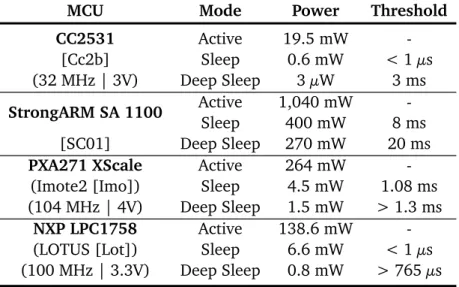
communica-tion standards . . . 23 2.7 Typical current consumption profile of aduty-cycledmote [Wan+13a] . . . 24 2.8 State transition latency and power [SC01] . . . 26 2.9 Example for high-bandwidth sensing . . . 28 2.10 Schematic representation of the effect of high-bandwidth sensing and enhanced
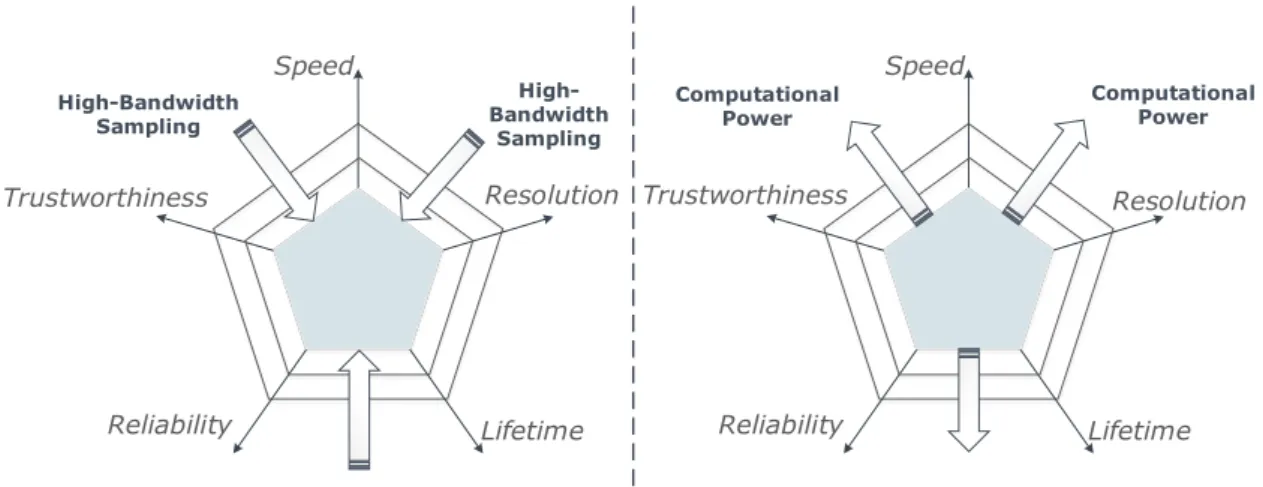
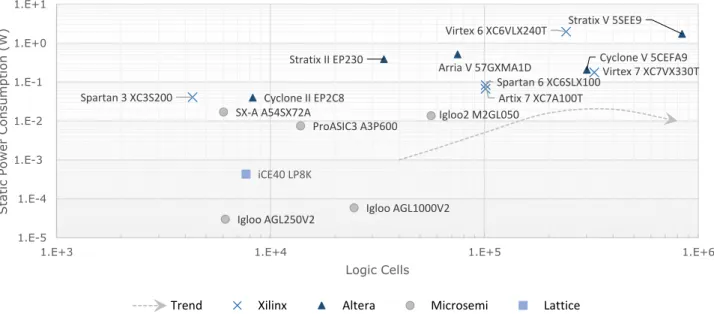
computa-tional power on WSN metrics . . . 29 3.1 Generic cells of a reconfigurable hardware system . . . 33 3.2 Static power consumption and logic density of recent FPGA devices . . . 34 3.3 Generic architecture of a coarse-grained reconfigurable architecture (derived from [KM11]) 35 3.4 Design flow for accurate FPGA power estimation . . . 38 3.5 Power consumption breakdown of a memory-intensive application on different devices . . 38 3.6 Low-power duty cycling solutions for FPGAs . . . 39 4.1 Architecture alternatives for FPGA-based wireless sensor nodes . . . 46 4.2 Applications of FPGA-based wireless sensor nodes . . . 52 4.3 Design space of FPGA-based wireless sensor nodes . . . 53 4.4 Generic architecture of the FPGA-based sensor node . . . 54 4.5 Block diagram of the HaLOEWEn main board . . . 55 4.6 Photo of HaLOEWEn version 3 and HaLOEWEn logo . . . 56 4.7 Task distribution on HaLOEWEn . . . 58 4.8 Block diagram of the LPSIP platform . . . 59 4.9 Photos of LPSIP modules . . . 60 4.10 Setup for the measure of power consumption . . . 60 4.11 FPGA startup delay . . . 61 4.12 Concept for internal wake-up process on FPGAs with Flash*Freeze technology . . . 62 4.13 Low-level placement of ring oscillators components on an Igloo FPGA . . . 63 4.14 MCU-FPGA Interface . . . 64 4.15 FPGA design for simple FFT processing . . . 65 4.16 Comparison of different implementations for FFT processing on the wireless sensor node . 66 4.17 Board-level distribution of power consumption . . . 68 4.18 FPGA design for localization accelerator . . . 69 4.19 FPGA design for high-diffusion accelerator . . . 71 5.1 Levels of hardware dynamic reconfiguration . . . 76
5.2 Architecture of the coarse-grained overlay based on two clusters . . . 79 5.3 Levels of reconfiguration enabled by the virtually reconfigurable architecture . . . 80 5.4 Example of producer-consumer interconnect . . . 81 5.5 Architecture of reconfigurable Multiply-Accumulate unit . . . 84 5.6 Architecture of the CORDIC unit . . . 86 5.7 Architecture of a {2, 2, 1}ALU unit . . . 87 5.8 Block diagram of the configuration controller . . . 89 5.9 Threshold percentage of the number frames to reconfigure to make difference-based
reconfiguration more efficient than full reconfiguration . . . 91 5.10 Example of reconfiguration process for a filtering task . . . 92 5.11 Task-level reconfiguration . . . 93 5.12 Customization of the architecture template for three types of applications . . . 95 5.13 Performance evaluation of the overlay architecture . . . 97 6.1 General overview of the configuration tools . . . 101 6.2 (GECO)2concept for HDL parameterization . . . 103 6.3 Screenshot of the (GECO)2graphical user interface . . . 105 6.4 Methodology for architecture and algorithm design . . . 109 6.5 Block diagram of the middleware components . . . 112 6.6 Event and configuration tables . . . 113 6.7 Duration and energy costs of configuration data transmission . . . 117 6.8 Tool-flow for generating and running hardware reconfigurable tasks on the sensor node . 119 7.1 Typical flowchart of a distributed condition monitoring application running on a sensor
node (inspired from [Kul10]) . . . 124 7.2 Overview of the MoDe condition monitoring infrastructure [Bei12] . . . 125 7.3 Concept for transmissibility measurement . . . 126 7.4 Transmissibility function of the damping system during the test drive [Bei+14] . . . 128 7.5 Test measurements on a passenger vehicle . . . 130 7.6 FPGA overlay for the condition monitoring of the shock absorber with LPSIP . . . 131 7.7 LPSIP hardware with Continental BSZ04D wheel acceleration sensors . . . 131 7.8 Computation of Welch’s modified periodogram on the vertical acceleration time series . . 132 7.9 Time-space partitioning of the damper condition monitoring tasks on the overlay architecture133 7.10 Breakdown of time spent for the damper condition monitoring tasks (time is given in
milliseconds) . . . 134 8.1 Spectral analysis of the induction motor currents (Part 1) . . . 136 8.2 Spectral analysis of the induction motor currents (Part 2) . . . 137 8.3 Pictures of the experimental setup . . . 139 8.4 Alternative techniques for the detection of broken bars (Part 1) . . . 140 8.5 Alternative techniques for the detection of broken bars (Part 2) . . . 141 8.6 Concept for motor Condition Monitoring . . . 143 8.7 Time-space partitioning of the motor condition monitoring tasks on the overlay architecture144 8.8 Breakdown of time spent for the motor condition monitoring tasks (time is given in
milliseconds) . . . 145 9.1 Miniaturized implementation of the HaLOEWEn platform . . . 149 A.1 HaLOEWEn schematics - FPGA page 1/2 . . . 154 A.2 HaLOEWEn schematics - FPGA page 2/2 . . . 155 A.3 HaLOEWEn schematics - Power . . . 156 A.4 HaLOEWEn schematics - RF SoC . . . 157
B.1 Flow chart of theHigh Diffusionalgorithm . . . 160 B.2 Results of NIST pseudo-randomness tests for the High-Diffusion algorithm . . . 161 B.3 8-FFT decimation in frequency with perfect shuffle address pattern . . . 163 B.4 Error correction for fixed-point FFT . . . 165
List of Tables
2.1 Evolution of CPU specifications for microcontrollers from selected general purpose motes 10 2.2 Type of COTS sensors commonly used in wireless sensor networks applications . . . 16 2.3 Amount of data generated by different sensors [WC02] . . . 16 2.4 Specifications of CPUs for high-bandwidth sensing motes . . . 18 2.5 Selected communication standards for wireless sensor networks . . . 22 2.6 Comparative overview of energy costs for basic operations on TmoteSky1[Meu+08] . . . . 25 2.7 Power consumption and threshold active time for selected MCUs . . . 26 3.1 Power consumption and threshold shutdown times for SRAM and Flash FPGAs . . . 40 4.1 Research works using FPGAs for mote architecture prototyping . . . 47 4.2 Research works using FPGAs as standalone processing unit . . . 48 4.3 Research works using FPGAs for CPU extension . . . 50 4.4 Main features of the HaLOEWEn platform . . . 56 4.5 Main features of the LPSIP platform . . . 59 4.6 Power consumption of HaLOEWEn in different operation modes . . . 61 4.7 Transition metrics for the FPGA on HaLOEWEn . . . 63 4.8 Resource consumption of the 1024-FFT design . . . 67 4.9 Resource consumption of the localization accelerator . . . 69 4.10 Performance evaluation for the localization process . . . 69 4.11 Resource consumption of the High-Diffusion core . . . 71 4.12 Performance evaluation for combined encryption and forward error correction . . . 71 5.1 Resource utilization of selected cores for Igloo AGL1000 FPGAs . . . 75 5.2 Configuration of the interconnect . . . 80 5.3 Resource consumption for one cluster interconnect with identical amount of producers and
consumers on each line . . . 81 5.4 Configuration of sensor interfaces . . . 82 5.5 Configuration of address sequencers . . . 83 5.6 Resource consumption for one address sequencer . . . 83 5.7 Configuration of reconfigurable Multiply-Accumulate unit . . . 84 5.8 Resource consumption for the reconfigurable Multiply-Accumulate unit . . . 85 5.9 Configuration of CORDIC . . . 85 5.10 Resource consumption for the CORDIC unit . . . 86 5.11 Configuration of the ALU array . . . 87 5.12 Resource consumption for the ALU unit . . . 88 5.13 Resource consumption for the configuration controller . . . 90 5.14 Instructions of the configuration controller . . . 92 5.15 Resource utilization of the example architectures . . . 96 6.1 Components available in the (GECO)2HDL library . . . 107 6.2 List of elementary functions available in the (GECO)2DSP library . . . 108 6.3 Summary of the middleware commands . . . 114 7.1 Resource consumption of the FPGA overlay used for damper condition monitoring . . . 130
7.2 Performance metrics for the damper condition monitoring tasks . . . 133 8.1 Nameplate and constructive parameters of the studied motor . . . 138 8.2 Resource consumption of the FPGA overlay for the motor condition monitoring . . . 143 8.3 Performance metrics of the motor condition monitoring tasks . . . 144 8.4 Estimation results for a motor suffering from dynamic eccentricity . . . 145 8.5 Estimation results for a motor with broken bars . . . 146 8.6 Estimation results for a motor suffering from inter-turn short circuit . . . 146 B.1 CORDIC modes of operation . . . 162
Part I.
Context and Motivation for
Reconfigurable Hardware in
Wireless Sensor Networks
1 Introduction
1.1 Background
Hundreds of tiny electronic devices capturing physical phenomena and collaborating to monitor complex systems and interact with the environment: wireless sensor networks are an important step towards an ubiquitous world where electronics component are vanishing in our surroundings while constantly observ-ing and evaluatobserv-ing them. As a result of numerous major innovations in the domains of microelectronics, communication engineering and sensor technology, the emergence of this new class of computing systems created a big wave in the scientific community by offering a new range of multi-disciplinary challenges to solve. From energy harvesting systems to routing protocols via novel integrated sensors, a whole spectrum of topics has been deeply investigated by the scientific community during the past decade with a focus on optimizingenergy-efficiency. The restrictions on the energy budget of such platforms have created a need for very low power systems which can complete complex tasks with a minimum amount of resources. Not only the underlying technology of wireless sensor networks has attracted much interest, but also their application potential in domains as various as geology, biomedicine or agriculture. Wireless sensor networks have become a universal topic where almost all domains of engineering can find a benefit or give a new contribution.
While the technology has now reached a level of maturity suitable for large-scale commercialization as it has been proven by the success of recently founded companies such as Libelium [Liba] or Memsic [Mem], there is still room to improve the capability and the reliability of these systems for opening new application domains. Large-scale monitoring of low-rate environmental parameters such as temperature, light, humid or gas concentration are mastered with installations lasting for several years of operation using a simple battery power supply. Standardized communication protocols such as ZigBee [Zig08] have facilitated the deployment of networks in all kinds of environment, varying from mobile wearable sensors to harsh industrial constraints.
However, a problem which is often pointed out as the bottleneck of wireless sensor networks is the high energy costs of the wireless communication. Although wireless connectivity is the main powerfulness of these systems, maximizing the energy-efficiency of a wireless sensor node often requires a minimization of the radio activity. The low throughput and low range of low-power radios become particularly critical when the sensed signal is getting more complex and the amount of data to transmit is more important. While recent progress has been made for improving the energy-efficiency of wireless transceivers with the introduction of standards such as Bluetooth Low Energy [Blu10], a more viable solution for long term installations resides in distributing the analysis of sensor data among the sensor nodes and finding an optimal communication-computation trade-off.
Simple microcontrollers are however not suitable to efficiently handle complex data processing tasks. Although multi-processor systems are becoming necessary in general purpose high-performance computing, they do not scale well for very low power systems such as wireless sensor nodes. A preferable solution to minimize energy consumption is the integration of application-specific hardware accelerators. The time and energy spent for data processing tasks implemented with specialized digital logic can be reduced to several orders of magnitude when compared to pure software solutions. Nevertheless, the broad range of wireless sensor networks applications implies that a certain level of flexibility is available in the underlying hardware, so that the same infrastructure can be reused for multiple purposes. Recent advances in the design of programmable logic devices have drastically reduce the power consumption of these chips, which can be arbitrarily configured with complex data processing circuits. Reduced static and
dynamic power consumption combined with high logic density make these devices a promising option for flexible hardware acceleration. Reconfigurable hardware emerges then as a potential solution to provide a sufficient level of computation power to the sensor node while leaving enough freedom for the implementation of applications in fundamentally different domains.
1.2 Research scope and objectives
This thesis investigates the potential of integrating low-power programmable logic in the architecture of wireless sensor nodes. The utilization of reconfigurable hardware is considered at several level of abstractions, from the technology choice up to the utilization in real-world applications and the development of appropriate development tools. As such, the thesis covers multiple complementary disciplines such as low-power embedded systems design, reconfigurable computing, computer-aided design, signal processing or cryptography. In particular, this thesis gives answers to the following questions:
• What range of wireless sensor networks applications could benefit from reconfigurable
hard-ware acceleration ? Concrete issues with current deployments and potential improvements need
to be identified. The impact of hardware acceleration on system-level metrics will be evaluated and the different types of wireless sensor nodes based on reconfigurable hardware are categorized.
• How to include reconfigurable hardware in the architecture of a wireless sensor node while
keeping a minimal power consumption ? The power consumption overhead typically introduced
by reconfigurable hardware is often seen as critical for very low-power applications. To deal with this problem, low-power design techniques are applied to define suitable modes of operation where this overhead stays negligible. The approach will be validated by building hardware prototypes implementing typical tasks from wireless sensor networks applications and taking on-board power measurements. It is foreseen to reduce the power consumption to a level that has not yet been reached by state-of-the-art wireless sensor nodes using reconfigurable hardware.
• Which programming model is suitable to obtain the best profit from the reconfigurable
hard-ware ? Solutions to overcome the arduous task of application-specific hardware description are
required. The multiplicity of wireless sensor networks applications implies the availability of a programming environment where the hardware and software components can be rapidly deployed. A new generic model which can be customized for the desired data processing algorithms is in-troduced. This model combines the design techniques for reducing power consumption with an overall flexibility enabling the implementation of a large range of data processing tasks. This level of flexibility is notably achieved by supporting dynamic hardware reconfiguration at runtime: hardware accelerated tasks running on the sensor node can be replaced and activated at any time. Special mechanisms are introduced to make this feature compatible with the restrictions induced by wireless sensor networks. This framework is supported by a special design flow reducing the overall development time and system complexity.
• How does a generic framework for reconfigurable hardware acceleration scale with
real-world applications ?Application scenarios relevant for an industrial context are taken to illustrate
how reconfigurable hardware acceleration can improve existing installations or enable new types of deployments that were previously not feasible. Even if it is not only limited to this domain, the thesis is focusing on applications related to the condition monitoring of electro-mechanical systems since they can benefit from the proposed infrastructure particularly well.
1.3 Thesis outline
To answer these questions, this thesis has been split into three main parts addressing respectively a more detailed description of the background and motivation of this thesis (Part I), the development of the set of
Hardware
Architecture
Tools
Applications Chapter 5 : Design of a Virtually
Reconfigurable FPGA Overlay Architecture for
Resource-Constrained Devices
Chapter 6 : Tools for Generation and Online Dissemination of Dynamically Reconfigurable Hardware Accelerators
Chapter 7 : Condition Monitoring of a Shock Absorber for Predictive
Maintenance
Chapter 9 : Conclusion The Third Generation Wireless
Sensor Networks
Chapter 3 : Reconfigurable Hardware for
Low-Power Embedded Systems Chapter 2 : High Bandwidth Sensing Wireless Networks Chapter 8 : Diagnosis of Induction Motors
hardware concepts and tools supporting the usage of reconfigurable hardware on a wireless sensor node (Part II) and the application and evaluation of the complete framework to concrete scenarios. The overall structure of the thesis is illustrated by Figure 1.1: based on the different constraints and features of wireless sensor networks, a modular hardware is built as the foundation of the proposed infrastructure. This base is abstracted by a generic architecture reusable with application-specific customizations. Configuration and deployment tools are then introduced to fully exploit this architecture and the underlying hardware. Based on these components, complex applications can be efficiently implemented, deployed and evaluated.
The following paragraphs give a short summary of the chapters composing these different parts:
Part I: Context and Motivation for Reconfigurable Hardware in Wireless Sensor Networks
• Chapter 2 introduces the area of wireless sensor networks by describing its operation in a generic way. The main constraints and requirements of such systems are identified. Being the core aspect of this thesis, the chapter is focusing on state-of-the-art features related to processing and duty cycled operation. Challenges and open issues related to distributed processing and high sensor data bandwidth are emphasized.
• Chapter 3 reports recent advances in the domain of reconfigurable hardware applied to low-power embedded systems. Development and architectural challenges are identified and confronted with the ones from wireless sensor networks, notably in terms of duty-cycled operation.
Part II: Design of a Framework Enabling Reconfigurable Hardware Acceleration in Wireless Sen-sor Networks
• Chapter 4 describes the development of a wireless sensor node hardware with embedded pro-grammable logic. Unexplored architectural features of state-of-the-art wireless sensor nodes based on field-programmable gate arrays (FPGAs) are identified and new platforms are designed to exploit their potential benefit. The hardware is evaluated for different scenarios typical for the considered range of applications.
• Chapter 5 introduces a template design to overcome certain technological restrictions of the proposed sensor node programmable hardware. A generic architecture and systematic mechanisms exploiting dynamic reconfiguration of coarse-grained reconfigurable operators are implemented to maximize the re-utilization of the available hardware resources while keeping a high-level of energy-efficiency. The chapter describes the different types of operators and components available to customize the hardware accelerator as well as the reconfiguration mechanisms targeting a minimization of the resource usage, reconfiguration delay and amount of configuration data. Example architectures are generated to illustrate and evaluate the template design.
• Chapter 6 presents the software development and management tools that have been developed to reduce the design time of the hardware accelerator. At first, the functionalities of a graphical interface assisting the static and dynamic configuration of the template architecture are described. A design flow based on the composition of elementary function blocks is proposed. A second software component which is running on the main processor embedded on the platform is then introduced. This component implements a set of generic services for the management of configuration data on the sensor node and within the network.
Part III: Application of Wireless Sensor Networks Strengthened with Reconfigurable Hardware to Condition Monitoring Systems
• Chapter 7 addresses the implementation of a set of signal processing algorithms with the proposed infrastructure for the condition monitoring of a road vehicle’s shock absorber. Developed in the frame of a European research project with industrial partners, this chapter illustrates the capability of the proposed architecture to be adapted for scenarios with a high computational complexity and requiring a high reliability.
• Chapter 8 describes another application in the domain of condition monitoring of electrical machines. A system able to detect faults of an induction motor by analyzing features of the current signal in both frequency and time domain is implemented. The reconfigurability of the platform is exploited to analyze the sensor signals with different types of algorithms which can be dynamically selected according to the current operation of the motor. It is shown that the framework provides enough flexibility to implement algorithms producing results with high accuracy.
At last, Chapter 9 concludes this thesis by summarizing the important contributions and giving directions for future work.
2 High-Bandwidth Sensing Wireless Networks
All emphasize low-cost components operating on shoestring power budgets for years at a time in potentially hostile environments without hope of human intervention.
J. Hill & al., “The Platforms Enabling Wireless Sensor Networks”. In:Communications of the ACM, June 2004, Vol. 47, No. 6
Contents
1.1 Background . . . . 3 1.2 Research scope and objectives . . . . 4 1.3 Thesis outline . . . . 4
This introductory chapter describes the current development status of wireless sensor networks by first giving an historical perspective explaining their rising popularity. This section is followed by a description of the general operation principle of these systems. This analysis will emphasize aspects where computational power plays a particularly important role, notably in cases where an important amount of sensor data is generated.
2.1 Origins of wireless sensor networks
Different perspectives exist to explain the emergence of WSNs as a fascinating research topic in multidisci-plinary domains as well as a fast growing market with a wide range of application areas. In this section, some of these views are reviewed and aspects relevant for the motivation of this work are identified.
2.1.1 Bell’s law
In 2007, Gordon Bell established his law on the evolution of computer classes [Bel08]. These classes are defined as sets of computing technologies in a common price range supported by “a programming environment[...], a network, and a user interface”. Every decade, a new class of computers appears from a fractional set of an older class, which reached a technological maturity through fast-evolving performance improvement (Figure 2.1). The newly created class benefits from lower prices and form factors, which enable a new market penetration. Thus, tiny networked sensors called wireless sensor nets appeared as a new class around 2002. They include miniaturized devices known as Motes. Millimeter-scaled systems known asSmart Dustappeared already in 2001 [War+01] but they are still costly and undergoing intensive research to develop the technologies suitable for a broader usage [Lee+13]. If production costs can be minimized, they will follow Bell’s law as the most recent computer class.
A second trend of Bell’s law is the performance improvement at a constant price level within a computer class. However, this technological evolution is slow compared to the penetration of a newly introduced class. To stay competitive and attractive, a technology must undergo constant improvement while sustaining its price range. Eventually, a class will disappear to benefit the newer class, which offers a
Price 1940 1950 1960 1970 1980 1990 2000 2010 Personal Computers 10.000 € 100 € 1 € 1.000.000 € 100.000.000 €
Figure 2.1.:Evolution of computer classes according to Bell’s law [Bel08] Wireless sensor networks emerge in the 2000’s
broad new market. The performance improvement within the class of WSNs is one of the main aspect tackled by this thesis. Developing new generations of high-performance motes at low price will sustain the technological relevance of this computer class and eventually open directions for new applications.
2.1.2 Moore and more
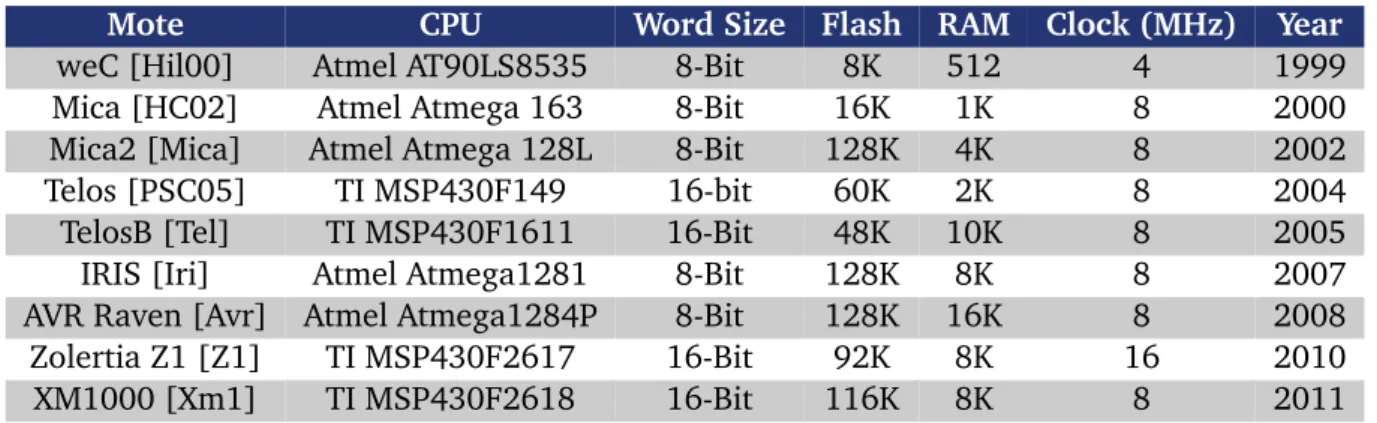
The main trigger of the technological improvement within all computer classes is Moore’s Law [Moo98]. The integration of a huge number of transistors in smaller silicon areas allows a simultaneous reduction of the cost and size of chips while their computational capability is improved. For WSNs, Moore’s law enabled the integration of small-scaled microcontrollers able to implement complex signal processing tasks and communication protocols on a tiny, autonomous device. The progress in Moore’s law will continue to reduce the size, price and power consumption of such microcontrollers while improving their information processing capability. Table 2.1 shows the improvement of central processing unit (CPU) characteristics of selected general-purpose motes. These motes are either historically relevant, or popular, commercially available devices. In one decade, each characteristic is tendentially improved.
Mote CPU Word Size Flash RAM Clock (MHz) Year
weC [Hil00] Atmel AT90LS8535 8-Bit 8K 512 4 1999
Mica [HC02] Atmel Atmega 163 8-Bit 16K 1K 8 2000
Mica2 [Mica] Atmel Atmega 128L 8-Bit 128K 4K 8 2002
Telos [PSC05] TI MSP430F149 16-bit 60K 2K 8 2004
TelosB [Tel] TI MSP430F1611 16-Bit 48K 10K 8 2005
IRIS [Iri] Atmel Atmega1281 8-Bit 128K 8K 8 2007
AVR Raven [Avr] Atmel Atmega1284P 8-Bit 128K 16K 8 2008
Zolertia Z1 [Z1] TI MSP430F2617 16-Bit 92K 8K 16 2010
XM1000 [Xm1] TI MSP430F2618 16-Bit 116K 8K 8 2011
Beyond the miniaturization of digital information processors, wireless sensor networks also benefited from the technological trend known asMore than Moore[Ard+10; Int05]. Within this movement, the increasing heterogeneity of integrated circuits (ICs) is addressed. The diversification of the types of circuits available in a single chip or package open a very large spectrum of applications. In particular two types of microsystems played a crucial role for the emergence of WSNs. Advances in low-power complementary metal-oxide-semiconductor (CMOS) radio frequency (RF) ICs made the realization of a broad family of new low-power radio transceivers possible. Technologies which are nowadays commercially successful like ZigBee or Bluetooth are the best examples of the important role that CMOS RF ICs played for this penetration. Such RF transceivers are now directly available in mixed-signal System-on-chips (SoCs). Popular examples of such chips include Texas Instruments’s CC2530 [Cc2b] or Atmel’s ATMEGA128RFA1 [Atm], combining respectively an 8051 central processing unit (CPU) and an AVR microcontroller with an IEEE 802.15.4 transceiver. Thanks to a tight coupling between the radio and the CPU, the power consumption and the form factor of such chips are further reduced.
Similarly, the integration of sensing elements into chips contributed to the elaboration of such het-erogeneous systems. Analog-Digital Converters (ADCs) and temperature sensors are standard elements for WSN-enabled SoCs [Cc2b]. Sensors based on microelectromechanical systems (MEMS) such as accelerometers, microphones, gyroscopes or pressure sensors are widely used in WSN applications since they provide rich context about the environment at the cost of a few square millimeters. Analog Devices’s ADIS16229 [Adi] is for example one of the few available products integrating a MEMS accelerometer, a signal processing digital core and an RF transceiver in a single package.
Integrated power electronics also largely contributed to the success of WSNs. Optimizing energy and power consumption on a battery-powered sensor node is one of the most critical challenges in the WSN research. Power management circuits are essential components of motes to achieve ultra-low-power consumption. CMOS RF transceivers notably require reliable and efficient power amplifiers to meet their stringent performance requirements. In some cases, energy harvesting modules can be used in synergy with the mote power unit to potentially provide a lifetime over several years of operation. The original Smart Dust project was for instance integrating a millimeter-scaled solar cell [War+01]. Motes with piezo-MEMS based vibrational energy harvesters are nowadays commercially available [Dre10].
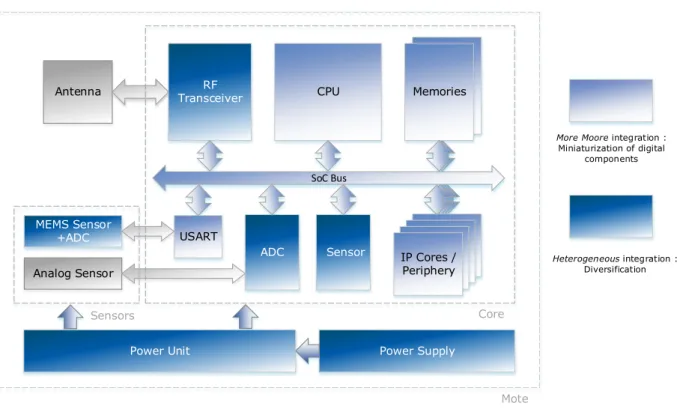
All together, these technological advances build the hardware skeleton of a mote (Figure 2.2). Around the digital brain, sensors, RF circuitry and a power management unit enable the functionality of au-tonomous wireless sensing networks [Aky+02]. Integrating these elements into a single chip at minimal cost is the road-map to the RFSmart Dust[CLP06] as it was defined in 2000 [Rab+00] and updated in 2006 [Rab+06] by Rabaeyet al.for the PicoRadio project. Eventually, all features of a mote will fit on a few square millimeters chip enabling a seamless and ubiquitous deployment in our environment.
2.1.3 Ubiquitous computing
A further perspective supporting the rise of WSNs is the concept of ubiquitous computing. In his article “The Computer for the 21st Century”[Wei99], Mark Weiser foresaw in 1999 the invisible penetration of a huge number of a new generation of computing systems in our daily life. Wireless connectivity coupled to a reduced size and cost will help to make these devices vanish in our background environment. This technology will serve our everyday purposes with specialized components without the frustration of interfacing a complex machine.
WSNs and the infrastructure known as the Internet of Things (IoT) are today the best examples fulfilling this vision. Intelligent, connected objects are completely integrated in our environments. From smart houses, to wearable computing, not only we do not notice these embedded devices any more, but their size make them unnoticeable. A large number of modern systems are automated by sensor and actuators networks, but there is still a limit for a certain range of applications whose complexity is too high to be supported by tiny embedded devices. It is then a worthy research goal to raise this limit and distribute always more intelligence in the electronic devices being part of our surroundings.
Memories Storage Storage Storage Power Unit CPU SoC Bus Memories IP Cores / Periphery RF Transceiver ADC USART Power Supply Antenna MEMS Sensor +ADC Sensor Analog Sensor Core Sensors Mote
More Moore integration : Miniaturization of digital
components
Heterogeneous integration : Diversification
Figure 2.2.:Generic architecture of a mote enabled by the technological trends for integrated electronic systems
Making the underlying technology “invisible” is one aspect of ubiquitous computing defined by Mark Weiser that this thesis takes closely into account. Abstracting the features of the hardware and enabling the possibility to autonomously adapt or change its behavior without a manual human intervention is a key aspect for a large scale adoption of this technology.
2.2 The design space of wireless sensor networks
Emerging from these paradigms, wireless sensor networks appear as a large congregation of tiny embedded devices communicating over wireless links. The key elements of each device are sensors, a processing engine, a communication interface and a power supply unit. Each electronic unit is anodeof the network. Low-power communication protocols and data processing algorithms are jointly used to collect and process the sensor data acquired by each node. A sensor network will then provide heterogeneous information about the physical or environmental condition of the observed system. In the simplest form of a wireless sensor network, one or several physical quantities are measured across time and space. Typical examples of physical quantities monitored by WSNs include temperature, humidity, barometric air pressure, gas concentration, light or moisture.
In this section, the general aspects of WSNs are described while emphasizing the main challenges relevant for the scope of this thesis. We start from a generic approach to go into more detailed aspects. An information processing point of view is adopted rather than considerations on communication networks as it is frequently the case in the domain of WSN, since it is fundamentally more relevant for the original purpose of a WSN. Beside the definition of founding principles, metrics and properties are introduced to enable evaluation and comparison of WSN deployments.
Physical Phenomenon ObservationProcess SL Si Mote 1 Mote j Mote M Uj ... ... ... ... Sensor Communication Network RF Xj Data Collector ...
Sensing Processing Communicating Energy Source
Harvester Powering
Analysis
Figure 2.3.:Schematic representation of the general functionality of a sensor network [GK07]
2.2.1.1 General principle
The general functionality of a WSN can be described by the schematic representation of Figure 2.3 [GK07]. Three core aspects govern the operation of the system :sensing,processingandcommunicating. Thereafter, the role of each of these functionalities is individually abstracted. The primary target of any WSN is to observe or characterize a physical phenomenon. This phenomenon is describable by a set of variables
{Si}1≤i≤L=S. Each variableSi is a numerical indicator of the phenomenon or more generally represents
a given state of this phenomenon. The variables{Uj}1≤j≤M represent the raw valuessensedby each mote through an observation process. EachUj is a disturbed observation of a combination of the phenomenon state variables{Si}1≤i≤L.
In addition to the raw measurements, each mote receives a variable set Vj including information provided by other motes of the network and application parameters. A combination of Uj and Vj is processedby each mote to create a measurement Xj. {Xj}1≤j≤M are shared within the communication
network to collaboratively create new information. Groups of motes sharing their observations are denoted as clusters. By fusing the data, a cluster of motes will output the set of variables{Yk}1≤k≤N. The
valuesYkare collected on a central node of the network known as thesink. Eventually, when information is available on a sufficiently long time, the data accumulated on the sink is analyzed to retrieve the physical phenomenon states{Si}1≤i≤L. The proximity between the WSN estimated {Sˆi}1≤i≤L and the original{Si}1≤i≤L defines theaccuracyof the WSN. The closeness of these variables represent the ability
of the WSN to observe the considered phenomenon correctly. In this sense, a WSN can be considered as a measuring tool, whoseapproximation errorcan be expressed as:
"W SN =kSˆ−Sk. (2.1)
The optimal operation of a WSN will then allow determining all {Sˆi}1≤i≤L at minimal costs while
sustaining an accuracy fulfilling the requirements of the application. Real costs induced by a WSN are specific to each application. In general, when considering wireless communication and autonomous operation of the motes, these costs include energy consumption, infrastructure costs, delay, etc.
The physical phenomenon observed is usually changing over time. S, respectivelySˆ, can therefore be expressed as a discrete sequenceS[n],n≥0, respectivelySˆ[n],n≥0, whose indexes nare increasing with time. This implies that the process of estimatingSˆhas to be repeated over time in order to follow
the fluctuations of the physical phenomenon on long time periods. IfC[n]is defined as the cost function for estimatingSˆ[n], the general optimization problem of a WSN can be formulated as:
min ∞ X n=0 C[n] subject to ∀n≥0,kSˆ[n]−S[n]k ≤"W SN[n] (2.2)
As each estimation may have different costs and accuracy requirements, a WSN must be evaluated on its complete operation time, leading to consider the sum of all costs. Improving theefficiencyof a WSN involves reducing the costC[n]of estimatingSˆ[n]for alln≥0.
The general ideal operation of a WSN is to retrieve Sˆ with the smallest approximation error while spending for example the minimal amount of energy, in the shortest time and with the minimal amount of hardware costs.
This optimization problem leads to two fundamental directions in WSN research: one one hand, the minimization of the cost function is the center of interest. The multiplicity of parameters impacting this function result in a large number of sub-problems to solve. Optimizing the operation of the communication network was a particularly important focus in academia [KW07a]. On the other hand, one wish to obtain a description as accurate as possible from the underlying physical phenomenon,i.e. maintaining the approximation error low [MKS12]. This approach is more application-centric but leads to an even high number of technical challenges.
2.2.1.2 System-level metrics
For all the different kinds of application scenarios that can be built on this model, these relatively abstract optimization goals can be turned into measurable figures of merits defining the quality of service of the WSN [KW07b]. These parameters are commonly used in the literature to evaluate a WSN [Xia08]. Although a concrete formulation is only possible with a given application, a generic definition can be given based on the previous model. One of the most fundamental metric is theaccuracy. It can be defined as the average approximation error on observations made during a certain period of time:
"W SN = 1 m m X n≥0 "W SN[n] = 1 m m X n≥0 kSˆ[n]−S[n]k. (2.3)
The accuracy first depends on the ability of the sensing infrastructure (type, number, resolution, accuracy and location of sensors) to reflect the state of the observed physical phenomenon. In terms of information processing, the accuracy of the WSN is affected if the raw data are not directly transmitted to the sink, e.g.because the amount of data is too important. In this case, the accuracy depends on the ability of the processing infrastructure to extract the relevant features from the acquired data. This can vary according to the complexity of the data processing algorithms and the numerical resolution of the processing unit. Efficient processing capability plays here also a central role for the improvement of this metric.
ThedelaydW SN[n]of the WSN represents the time difference between the observation time ofS[n],
tS[n], and the timetˆS[n]whenSˆhas been determined :
dW SN[n] =tSˆ[n]−tS[n] (2.4)
The delay usually depends on the time required to process and route the sensor data to a central node. For time-critical applications, it is desirable that this delay stays minimum. Intrinsically, this delay depends on the amount of data that needs to be processed or transfered within the network. In particular, the delay is strongly related to the size of the data setsXj,Vj andYj as the bandwidth and the throughput of WSN is limited. Reducing this amount of data is then a mandatory steps towards a minimum delay. On the other
hand, the delay might be largely dominated by the time spent for processing if not enough computational power is available. In both cases, an efficient processing infrastructure is necessary to limit the amount of data flowing through the network and minimize computation times.
Similarly, thetime resolutionTW SN of the WSN corresponds to the minimum achievable time interval between two successive evaluations ofS.
TW SN =min
n {tS[n+1]−tS[n]} (2.5)
Here again, this metric depends on the processing capability and throughput of the network. If a node is too busy with handling data at time stepn, the data corresponding to time stepn+1needs to be queued and processed at a later point in time. This metric can be related to thejitter, which is generally defined as the variation in delay [Xia08].
The WSN lifetime is the time during which it is possible to obtain estimations Sˆ while keeping a set of other system-level metrics over a specific threshold, e.g. when the WSN is not able to deliver results with a sufficient accuracy or under a certain amount of time. Typically, the lifetime of the WSN is over when nodes playing a central role in the network fail or run out of energy. In a global sense, the
energy-efficiencyof the WSN is the average amount of energy which is spent by battery-powered nodes
to obtain an estimateSˆ. In order to improve both metrics, reducing the average energy consumption of each node,i.ethe power consumption, is crucial. This requires a maximum efficiency for all components of the node, from the radio transceiver to the sensors via the processing core. More details on energy consumption models for a wireless sensor node will be given in the section 2.2.5 of this chapter.
Further metrics can be defined for a WSN [KW07b] such asreliability,i.e. the percentage of estimations staying over a given accuracy threshold, thetrustworthiness,i.e. the probability that the delivered data has not been distorted by a malicious component, or thescalability,i.e. the ability to maintain a level of accuracy and a long lifetime independently from the size of the network. For almost all metrics, two fundamental aspects are playing a major role: the amount of data wirelessly exchanged within the network and the capability of the node to process information efficiently. If these features are optimized, the WSN is likely to reach a high quality level.
Now that the essential features of WSNs are defined, the following sections will address distinct aspects of WSN design, notably with regard to the key elements composing a wireless sensor node,i.e. the sensors, the processing unit and the communication unit.
2.2.2 Sensing
Sensors are the interface between the mote processing unit and the observed phenomenon. The sensing operation will deliver digitalized information from a physical effect. The size and price requirements of motes usually implies that low-cost, off-the-shell sensors are preferred to high-end devices. Lower quality sensor signals can be compensated by a preprocessing of the data on the mote. Operations such as de-noising and spike removal are therefore common in WSNs [GK07]. An aspect playing a fundamental role in the design of a WSN is the bandwidth of the sensing process. The amount of sensed data highly depends on the nature of the observed phenomenon and on the desired accuracy of the WSN. High amount of data will impact the type of hardware used and the approach for wireless communication since the data has to be processed and transmitted within the network [WC02].
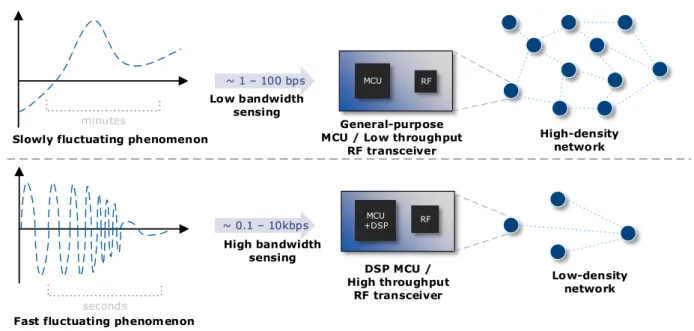
Table 2.2 gives a non-exhaustive overview of commercial off-the-shelf (COTS) sensors used in typical WSN applications. The separation in the table marks a differentiation between general-purpose, low-bandwidth sensing devices and high-low-bandwidth sensing devices [Hil+04]. This distinction is taken relatively to the bandwidth of the communication network used to transmit the data. For low-power WSNs, the bandwidth of the RF channel is usually in the range of 100 kilobits per second up to 1 Megabit per second. When sensor data is sampled at a range within one order of magnitude of this bandwidth, the communication channel is likely to be overloaded and processing the data becomes mandatory.
Sensor Sampling rate Application example Photodiode 0.1 Hz - 1 Hz Intelligent light control
CMOS Light 0.1 Hz - 1 Hz Color se
![Figure 2.3.: Schematic representation of the general functionality of a sensor network [GK07]](https://thumb-us.123doks.com/thumbv2/123dok_us/1079183.2643639/41.892.103.809.126.415/figure-schematic-representation-general-functionality-sensor-network-gk.webp)
![Figure 2.5.: Design alternatives to handle high-bandwidth sensing in wireless sensor networks [Mar+06]](https://thumb-us.123doks.com/thumbv2/123dok_us/1079183.2643639/48.892.89.781.510.830/figure-design-alternatives-handle-bandwidth-sensing-wireless-networks.webp)
![Figure 3.3.: Generic architecture of a coarse-grained reconfigurable architecture (derived from [KM11])](https://thumb-us.123doks.com/thumbv2/123dok_us/1079183.2643639/63.892.124.785.116.460/figure-generic-architecture-coarse-grained-reconfigurable-architecture-derived.webp)
