AFRICAN DEVELOPMENT BANK
Reference No.: Language: English
Distribution: Original: French
Public Administration Reform Support Programme - Phase IV
(PARAP IV)
Country: Kingdom of Morocco
APPRAISAL REPORT
May 2010 Appraisal Team e E Team Leader Team Members: Sector Director: Country Director: Division Manager:Mr. E. DIARRA, Principal Financial Economist, OSGE.2 Mr. A. BA, Principal Economist, ORNB
Mr. A. YAHIAOUI, Chief ICT Expert, OINF.3
Mr. M. DIOMANDE, Financial Management Officer, ORPF.2 Mr. W. RAIS, Financial Analyst, MAFO
Mr. A. TARSIM, Consulting Economist, OSGE.2 Mr. C. NWAHBA, Consulting Economist, OSGE.2 Ms. R.Y. COFFI, Chief Procurement Coordinator, ORPF.1 Mr. G. NEGATU, Director, OSGE
Mr. I. LOBE NDOUMBE, Director, ORNB Ms. M. KANGA, Division Manager, OSGE.2 Peer Review
E
Mr. I. KOUSSOUBE, Chief Economist (ORWB) Mr. R. KANE, Chief Economist (CMFO) Mr. O. SOMALI, Consulting Economist (ORNB)
Table of Contents
List of Tables - List of Boxes - List of Figures i
List of Annexes - List of Technical Annexes i
Fiscal Year - Currency Equivalents ii
Acronyms and Abbreviations iii
Loan Information Sheet iv
Programme Summary v
Programme Logical Framework vii
I – THE PROPOSAL 1
II – COUNTRY AND PROGRAMME CONTEXT 1
2.1 Government’s Development Strategy and Medium-Term Reform Priorities 1 2.2 Recent Socio-economic Developments, Prospects, Constraints and Challenges 2
2.3 Status of Bank Portfolio 5
III – PROGRAMME JUSTIFICATION, KEY DESIGN ELEMENTS AND SUSTAINABILITY 5 3.1 Links with the CSP, Analytical Works Used in Programme Preparation and Prerequisites 5 3.2 Collaboration and Coordination with Other Donors 6
3.3 Outcomes and Lessons from Similar Operations 6
3.4 Relations with Other Bank Operations in the Country 7 3.5 The Bank’s Comparative Advantages and Value-Added 7 3.6 Compliance with Good Practice Principles Regarding Conditionalities 8
IV – THE PROPOSED PROGRAMME 8
4.1 Programme Goal and Objectives 8
4.2 Programme Components, Objectives and Expected Outcomes 9
4.3 Status of Implementation of Programme Reforms 19
4.4 Financing Requirements and Arrangements 20
4.5 Programme Beneficiaries 21
4.6 Impact on the Business Environment 21
4.7 Impact on Poverty and Gender 21
4.8 Environmental Impact 21
V – PROGRAMME IMPLEMENTATION, MONITORING AND EVALUATION 22
5.1 Implementation Arrangements 22
5.2 Monitoring and Evaluation Arrangements 22
VI – LEGAL DOCUMENTS AND AUTHORITY 22
6.1 Legal Documents 22
6.2 Conditions Precedent to Bank Group Intervention 22
6.3 Compliance with Bank Group Policies 23
VII – RISK MANAGEMENT 23
VIII – RECOMMENDATION 24
____________________________________________________________________________________ This report was prepared by Mr. E. DIARRA, Principal Economist (OSGE.2) following a joint preparation mission with the World Bank and the European Union to Rabat in October 2009 and the Bank’s appraisal mission in April 2010. It also benefited from contributions by the Country Economist, ORPF and MAFO colleagues, as well as Consultants employed and exchanges with World Bank and European Union Economists. Questions on this report should be referred to Mr. G. NEGATU, Director, OSGE (Extension 2077) and Ms. M. KANGA, Division Manager, OSGE.2 (Extension 2251).
List of Tables
List of Boxes
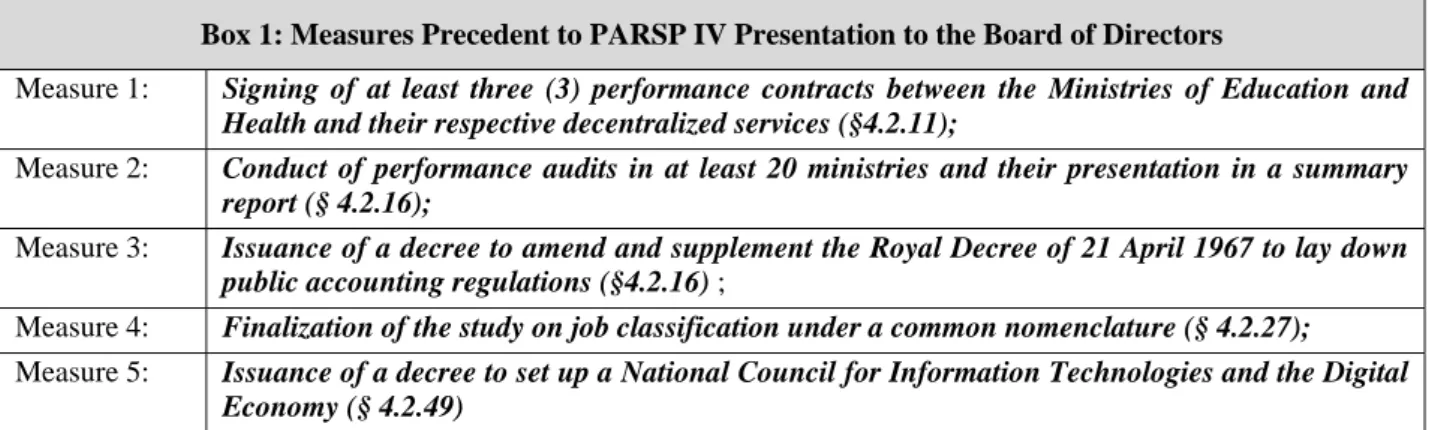
Box 1 Measures Precedent to PARSP IV Presentation to the Board of Directors
List of Annexes
List of Technical Annexes
Table 1 Budget Balance and Financing Requirements 2010-2012 Table 2 Programme External Financing by Source
Annex 1 Letter of Development Policy
Annex 2 Matrix of 2010-2011 Programme Measures Annex 3 Note on Relations Between the IMF and Morocco
Annex 4 Trends in Key Macro-economic and Financial Indicators Annex 5 Conditions Precedent to Budget Support
Annex 6 Comparative Matrix of Measures of the Four PARSP Phases Annex 7 Development Indicators
Annex 8 Comparative Socio-economic Indicators
Annex 1 List of Analytical Works
Annex 2 List of Ad hoc Reform Steering Committees
Annex 3 List of Sector Strategies Developed by the Government of Morocco Annex 4 Descriptive Note on the Integrated Expenditure Management (IEM)
System
Annex 5 Note on Wage Bill Trends in Morocco
Annex 6 Position Paper on Moroccan 2013 Digital Strategy Annex 7 e-Procurement Descriptive Note
Fiscal Year January - December Currency Equivalents (May 2010) UA 1 = DH (Moroccan Dirham) 12.57 UA 1 = EUR (Euro) 1.14
Acronyms and Abbreviations
ADB African Development Bank ADF African Development Fund
BADR Computerized Customs Network Base
BAM Bank Al-Maghrib (Central Bank of Morocco) CFAA Country Financial Accountability Assessment
CSP Country Strategy Paper
DEPTTI Department of Posts, Telecommunications and Information Technologies
DH Moroccan Dirham
EU European Union
FDI Foreign Direct Investment
FOMAP Public Administration Modernization Fund GDP Gross Domestic Product
GoM Government of Morocco
GPEEC Jobs, Staff and Skills Management Planning HRIS Human Resources Information System IEM Integrated Expenditure Management IGF General Inspectorate of Finance IGM General Inspectorate of Ministries IMF International Monetary Fund
IMGE Integrated Management of Government Employees INDH National Human Development Initiative
LOF Organic Finance Law
MEC Modulated Expenditure Control MEF Ministry of Economy and Finance MET Ministry of Equipment and Transport
MICNT Ministry of Industry, Trade and New Technologies MMSP Ministry of Public Sector Modernization
MTEF Medium-Term Expenditure Framework
PARSP Public Administration Reform Support Programme PEFA Public Expenditure and Financial Accountability PER Public Expenditure Review
REC Strategic Staffing Framework
TGR Trésorerie générale du Royaume (General Treasury) TOFE Table of Government Financial Operations
TOFT Treasury Flow of Funds Table UA Unit of Account
LOAN INFORMATION SHEET
Client Information Sheet
BORROWER: KINGDOM OF MOROCCO
EXECUTING AGENCY: Ministry of Economy and Finance (Budget Department)
Financing Plan
Source Amount Instrument
ADB EUR 100 million ADB Loan World Bank EUR 73.7 million IBRD Loan European Union EUR 73 million Grant Information on ADB Financing
Loan currency Euro
Interest rate type: Floating base rate with a fixed rate option Base rate (floating) 6 months - EURIBOR
Interest rate margin 40 basis points (bp)
Financial margin: Recalculated twice per annum (1 February and 1 August)
Commitment charge None Other charges None
Duration 20 years maximum Grace period 5 years maximum
Activities Date
1. Approval of Design Note 14 April 2010 2. Negotiation of Loan Agreement 31 May 2010 3. Board Presentation 30 June 2010
4. Effectiveness July 2010
5. Disbursement August 2010
6. Supervision March 2011
PROGRAMME SUMMARY
Programme Overview
1. Programme Name : Public Administration Reform Support Programme - Phase IV (PARSP IV)
- Geographical coverage : Nationwide
- Time frame : 12 months
- Programme cost : Not applicable
- Financing : EUR 100 million (ADB) EUR 73.7 million (WB) EUR 73 million (EU) - Operational instrument : General budget support
- Sector : Economic and financial governance
2. The Bank loan will be disbursed in a single tranche. Because of the widening budget deficit in 2010 due particularly to the countercyclical policy conducted by the Government to cushion the effects of the global economic crisis, the proposed financial support of about EUR 100 million will help the Government to cover the budget deficit estimated in 2010 at EUR 2.67 billion or 4.5% of GDP, excluding privatization revenue. It will be disbursed in a single tranche in 2010.
Expected Programme Outcomes and Beneficiaries
3. The goal of PARSP IV is to promote strong economic growth and sustainable development, thus strengthening the competitiveness of the economy while ensuring medium-term macro-economic viability. Its specific objectives are to improve Government efficiency in budget and human resource management, consolidate and control the civil service wage bill and streamline administrative procedures by developing electronic Government.
4. The overall expected outcomes at the end of implementation of the Programme are: (i) consolidation of the macro-economic framework and control of inflation, budget deficit and wage bill; (ii) enhancement of Government efficiency in budget and human resource management; and (iii) streamlining of administrative procedures by strengthening e-Government.
5. The final beneficiary of the programme is the entire Moroccan population that will benefit from improved standard of living resulting from employment- and income-generating sustainable economic growth. The intermediate beneficiaries are Government services, households and private economic operators.
Needs Assessment and Relevance
6. The PARSP is an institutional reform implemented in successive phases that the Bank as well as other co-financiers (World Bank and European Union) have agreed to support. After Phase 3 which was successfully completed, Phase 4 which is PARSP IV will essentially help to complete the various reform segments and thus deepen the modernization of Moroccan public administration.
7. Because of the widening budget deficit in 2010 due particularly to the effects of the global economic crisis and the countercyclical policy conducted by the Government, the
estimated EUR 100 million financial support to be granted will enable the Government to cover the budget deficit. Disbursement will be in a single tranche.
8. The proposed programme is relevant: the main conditions for the success of the programme have been met: sound programme ownership by the country; close coordination and risk sharing with co-financiers; fulfilment of general and technical prerequisites for this type of programme; compliance with good practice principles regarding conditionalities, including implementation of measures precedent to programme presentation to the Board of Directors; and design of a results-based monitoring/evaluation mechanism. The area of intervention of the PARSP IV, namely public administration, is relevant in relation to the Government’s Programme priorities reflected in the Letter of Development Policy and those of Morocco’s 2007 – 2011 CSP.
The Bank’s Value Added
9. The Bank is strongly committed to backing the public administration reform process in Morocco, with the support it provided to PARSP II and III. As a result, it has acquired valuable experience in this domain on which it capitalized in designing the PARSP IV. In addition, it has already financed about ten reform support operations in several sectors in Morocco (notably in the education, health, transport, drinking water and financial sectors). As such, it has in-depth knowledge of the various sectors of Moroccan administration enabling it to play an important role in designing and monitoring the implementation of PARSP IV. In this respect, it has been able to maintain a high-level quality dialogue with the authorities to better target reforms.
Institutional Development and Knowledge Acquisition
10. The PARSP IV will contribute to the institutional development of the public administration and private sector. Analytical work as well as the various draft instruments examined in formulating the programme helped to build up knowledge which was used to enhance the programme design.
RESULTS-BASED LOGICAL FRAMEWORK
HIERARCHY OF
OBJECTIVES EXPECTED OUTCOMES SCOPE
PERFORMANCE INDICATORS
INDICATIVE TARGETS
AND TIME FRAMES ASSUMPTIONS/RISKS
1. Goal
Promote strong economic growth and sustainable development, thus strengthening the competitiveness of the economy while ensuring medium-term macro-economic viability
Impact:
Strong economic growth and sustainable development
Beneficiaries:
Moroccan population
Private sector
Indicators:
Average real GDP growth rate
Anticipated Long-term Developments – Time Frame
Average annual growth rate increases from 4.2% over the 2005-2009 period to more than 5% over the 2010-2014 period
Assumptions
Sustained macro-economic stability
Improvement of the business climate
Average investment rate Average annual investment rate rises from 27% of GDP over the 2005-2009 period to above 30% over the 2010-2014 period
Control of inflation Average inflation rate
Source: Ministry of Economy and Finance (MEF); Bank Al-Maghrib (BAM)
Average inflation rate drops from 3% over the 2005-2009 period to 2.2% over the 2010-2014 period
2. Programme Objectives
(A) Improve Government efficiency in budget resource management
(B) Improve Government efficiency in human resource management
(C) Consolidate and control the civil service wage bill (D) Enhance the efficiency
Effects
(A) Sustainable budget deficit
Beneficiaries
Government
Households
Private economic operators
Impact Indicators
Overall budget deficit, excluding privatization Current expenditure/GDP ratio Anticipated Medium-term Developments – Time Frame
Reduction of budget deficit from 2.3% of GDP in 2009 to 2% in 2011
Current expenditure/GDP ratio decreases from 21.2% in 2009 to 20.7% in 2011
Assumptions
Programme impact will be achieved
Risks
- Delay and weakness of economic recovery in the Euro Zone due to the global economic crisis
- Impact of the vagaries of the weather on rural income and on domestic demand
(B) Control of staff and skills Generalization of the use of planning tools in the human resource management process
Generalization of GPEEC tools within ministries in the human resource management process in 2011
(C) Control of the civil service wage bill
Wage bill/GDP ratio Wage bill/GDP ratio stabilized in 2011 at its 2009
HIERARCHY OF
OBJECTIVES EXPECTED OUTCOMES SCOPE
PERFORMANCE INDICATORS
INDICATIVE TARGETS
AND TIME FRAMES ASSUMPTIONS/RISKS
of public administrative services by streamlining procedures and developing e-Government
level (10.3%)
Mitigative measures
- Monitoring of the national and international economic environment and implementation of actions within a public-private framework of understanding by the Strategic Intelligence Committee
- Monitoring of the macro-economic framework by the working group created for that purpose
- Mitigation of the impacts of the vagaries of the weather on the agricultural sector under the Green Morocco Plan
(D) Streamlining and
computerization of administrative procedures
Number of public services accessible online
Source: MEF; MMSP and MICNT
Number of public services available online increases from 10 in 2009 to 13 in 2011
3. Inputs
AMOUNTS ADB EUR 100 million WB EUR 73.7 million EU EUR 73 million
Outputs
(A) Implementation of measures to improve Government efficiency in budget resources management
Beneficiaries
Moroccan population Private sector Public and para-public sectors
Households
Output Indicators
(A) See matrix of measures
Anticipated Medium-term Developments
(A)See matrix of measures
Operational Assumption
Sustained institutional capacity for implementation of reforms
(B) Implementation of measures to improve Government efficiency in human resource management
(B)See matrix of measures (B) See matrix of measures
(C) Implementation of measures to consolidate and control the civil service wage bill
(C) See matrix of measures (C)See matrix of measures
(D) Implementation of measures to streamline administrative
procedures and develop e-Government
REPORT AND RECOMMENDATION OF THE AFRICAN DEVELOPMENT BANK GROUP MANAGEMENT TO THE BOARD OF DIRECTORS CONCERNING A PROPOSAL FOR THE GRANT OF A LOAN TO THE KINGDOM OF MOROCCO
TO FINANCE THE PUBLIC ADMINISTRATION REFORM SUPPORT PROGRAMME – PHASE IV
I. THE PROPOSAL
1.1 This proposal concerns the grant of a EUR 100 million loan to the Kingdom of Morocco to finance the Public Administration Reform Support Programme - Phase IV (PARSP IV) in Morocco. It is a budget support to be implemented from June 2010 for a 12-month period ending on 30 June 2011. It is a response to the request submitted to the Bank in April 2010 by the Government and a follow-up to the series of three public administration reform support programmes backed by the Bank and other multilateral donors, namely the World Bank and the European Union. The PARSP IV is based on the strategic orientations of the Government’s medium-term development programme. Its design took into consideration the principles of the Paris Declaration on Aid Effectiveness, as well as good practice principles regarding conditionalities. It is in line with the Bank’s 2009-2011 Country Strategy Paper mid-term review orientations which place emphasis on strengthening the governance system and upgrading economic and corporate infrastructure. By supporting Government efforts in these areas, the Bank is promoting the improvement of public finance management and the business climate, thus contributing to creating an environment more conducive to the development of private sector activities and ensuring sustained and sustainable economic growth.
1.2 The preparation of the Programme in October 2009 and its appraisal in April 2010 were carried out in close collaboration with the World Bank and the European Union which are co-financiers of the programme. The PARSP IV is a follow-up to the reforms undertaken by the previous operations and should help to consolidate the results obtained and deepen the reform process initiated to modernize and enhance the efficiency of public administration. The Programme goal is to promote strong economic growth and sustainable development, thus strengthening the competitiveness of the economy while ensuring macro-economic viability. Its specific objectives are to improve Government efficiency in budget and human resource management, consolidate and control the civil service wage bill and streamline administrative procedures by developing e-Government. Its implementation should lead notably to: (i) strong growth with a 5% average annual growth rate over the 2010-2014 period as against 4.2% over the 2005-2009 period; (ii) revival of investment with a 30% average annual investment rate over the 2010-2014 period, compared to 27% over the 2005-2009 period; and (iii) greater control of inflation with an inflation rate which should drop from a 3% annual average over the 2005-2009 period to 2.2% over the 2010-2014 period.
II COUNTRY AND PROGRAMME CONTEXT
2.1 Government’s Development Strategy and Medium-Term Reform Priorities
2.1.1 In recent years, Morocco has undertaken far-reaching structural and sector reforms that contributed to laying the foundation for a modern economy that is open to the external world. The reforms, which covered various domains, were aimed particularly at consolidating macro-economic stability, strengthening public finance management, modernizing the financial sector and improving the business environment and the efficiency of public administration. The Government that emerged from the September 2007 legislative elections has reiterated its commitment to pursue the reforms while deepening their content
under the Economic and Social Programme (ESP), the major orientations of which reflect a policy centred on growth, social proximity and human development.
2.1.2 The Government’s efforts under the ESP focused on modernizing the administration, strengthening fair taxation and implementing new sector strategies,
particularly in agriculture, transport, energy, water, health, education and vocational training. These reforms are aimed at increasing public and private sector productivity. With the recent deterioration of the global economic environment, these strategic thrusts are even more topical and the Government intends to pursue their implementation by accelerating reforms which will be supported by the development of major worksites around structuring projects, particularly in the area of infrastructure, the modernization and upgrading of which are one of its major priorities.
2.2 Recent Socio-economic Developments, Prospects, Constraints and Challenges
Socio-economic context
2.2.1 The Moroccan economy has shown proof of some resilience despite an international environment marked by the propagation of the effects of the global economic crisis. On the whole, the fundamentals of the economy remained solid, owing to a stable macro-economic framework and reflecting the efforts made over preceding years to consolidate public finances and diversify the productive base of the economy. It is also worth noting that the establishment of a Strategic Intelligence Committee in February 2009 with sector and thematic working groups (macro-economy, tourism, remittances by Moroccans residing abroad (MRA), industry and phosphates) furthered the establishment of consultative and proactive mechanisms which contributed to reducing the effects of the economic crisis. The measures taken by the Committee prioritized several components, including job security, and enabled access by enterprises to bank financing, support to exports and training for operators of sectors most affected by the crisis.
2.2.2 In 2009, the GDP growth rate virtually stood at its 2008 level, that is 5.0% compared to 5.6%, as a result of the buoyancy of the primary sector whose growth rate is estimated to be 26%i. In contrast, non-farm activities, which are more vulnerable to the international environment and fluctuations in world demand for Moroccan products, showed a moderate
2.3% growth rate, well below the trend observed over the past five years. Domestic consumer demand also played a key role in growth, tapping from the spin-offs of the good crop year, the falling unemployment rate (9.1% at the end of the year) and Government’s efforts to support purchasing power especially by reducing income tax and raising salaries (+5%). The growing domestic demand was also attributable to a high increase in public investments which rose from DH 109 billion in 2008 to DH 135 billion in 2009 (+26%). The inflation rate dipped to nearly 1.8% in 2009, after a 3.9% increase in 2008 as a result of soaring world prices that year. The decline in inflation in 2009 was due to the fall in food prices from 7% in 2008 to 1%.
i
The figures relating to macro-economic data are those provided during the appraisal mission and should be considered as provisional.
2.2.3 The budget situation worsened in 2009, after excellent public finance performance in recent years, due particularly to an expansive policy to sustain growth.
In 2008, the budget surplus stood at 1.6% of GDP, reflecting high tax revenue, the level of which helped to offset the sharp increase in grants expenditures resulting from
skyrocketing world oil and food prices. However, in 2009, the public finance situation was characterized by a steep rise in capital spending (+22% compared to 2008) to sustain growth, even as tax revenue dropped by 9.1% due to the adjustment of the income tax rate schedule and the downturn in non-farm sectors. Public finance therefore showed a 2.3% deficit. However, this situation, coupled with the continuation of efforts to consolidate medium-term public finance sustainability through active debt management, enabled the Treasury to stabilize the debt ratio, rising from 47.3% of GDP in 2008 to 47.4% of GDP in 2009. Furthermore, the Moroccan economy suffered the impact of the significant decrease in foreign direct investments (FDI) in 2009 (-28.6% compared to 2008), after a sustained increase in such investments over the past five years (8% annual average).
2.2.4 In 2009, the sluggishness of Morocco’s exports due to the global recession, in particular in the Euro Zone, its major trading partner, had a strong negative impact on the country’s external position. Although the current account deficit improved slightly, it remained significant, declining from 5.2% in 2008 to 4.4 % of GDP in 2009, in reflection of the decrease in exports (-35%), tourist revenue (-8.8%) and remittances by Moroccans residing abroad (-9.2%).
However, the 26.5% decrease in the value of imports in 2009 owing to falling commodity and food prices, particularly of petroleum products and wheat, offset the significant drop in exports. Gross reserves in months of imports therefore fell from 7.5 in 2008 to 6.9 in 2009. The Moroccan dirham has virtually remained stable for a year now both against the Euro (+0.55%) and the Dollar (-2.60%).
2.2.5 At the social front, Morocco has made progress in terms of human development, thanks to poverty reduction programmes and structural reforms in the health, education and vocational training sectors. The reforms supplement those undertaken within the framework of the National Human Development Initiative (INDH) which, since its launching in 2005, has created a dynamic that promotes the involvement of all players through the implementation of well-targeted poverty reduction projects. In particular, the projects target people with specific needs such as street children and vulnerable women. In this respect, the development of microcredit and income-generating activities has been prioritized as efficient instruments for combating poverty and exclusion. The emergence of a network of associations and the establishment of public structures responsible for promoting an inter-dependent
economy have helped to provide an appropriate alternative for social development in Morocco. This mechanism has helped to reduce the poverty rate to 9% in 2008, compared to 14% in 2001.
2.2.6 However, although real progress has been made, much still has to be done to sustainably improve the relatively weak social indicators. This is particularly true for the illiteracy rate among the population aged 10 and above - which is 40% compared to the African average of 33.2% (this represents about 12 million illiterate people). In some cases, the illiteracy rate is above 60% in rural areas and 75% for rural women. In general, Morocco has attained some Millennium Development Goals (MDG) in human development and achieved a “creditable” attainment rate in others, which will be fully attained before 2015. The other challenge to be met involves creating conditions for strong and sustained growth to enable the Government to achieve the objective of reducing unemployment among young graduates from 23% in 2009 to 7% by 2012.
Prospects and Constraints
2.2.7 Morocco’s short- and medium-term economic prospects should improve gradually, although they are heavily dependent on external factors. Although sluggish, the expected growth in the Euro Zone should contribute to a gradual recovery of the country’s goods and services exports, as well as remittances by Moroccans residing abroad (the remittances constitute a key pillar of domestic demand). Continuation of fiscal efforts to stimulate growth through domestic demand will also have beneficial effects on non-agricultural GDP, the growth of which could stabilize at around 4% in the short term. This will be boosted by the ripple effect of the gradual recovery of the phosphates sector on economic activity and exports. In that regard, the external current account deficit should remain stable at about 4% in 2010 and 2011 while economic growth would stand at 3.2% in 2010 and then edge up to 4.5% in 2011.
2.2.8 However, it is obvious that the Moroccan economy is still plagued by major constraints due mainly to low competitiveness of its exports as well as their high concentration on European markets. Indeed, the deterioration of the current transactions balance from 2007, beyond changing international circumstances, poses a problem of loss of competitiveness, in particular in relation to competing countries of Eastern Europe. This situation raises major challenges that Morocco must address in order to strengthen its position as a growth pole and business platform. To that end, the country must pursue the sound macro-economic and fiscal policies undertaken in recent years in order to safeguard the productivity gains achieved. The Government’s commitment to accelerate structural reforms to support the implementation of sector strategies (infrastructure development, Industrial Emergence Pact, Green Morocco, etc.) will contribute to consolidating economic diversification and strengthening the country’s growth and export potential.
2.2.9 Concerning the business environment, Morocco’s Doing Business ranking has improved from the 130th position in 2009 to 128th in 2010, thanks especially to the creation of a private credit office to improve access to credit. Compared to other countries of the region, it occupies the 12th positionii. Furthermore, with a 4.1 competitiveness index, Morocco occupies the 5th position in the ranking of Africa Competitiveness Report 2009.
ii
2.3 Bank Portfolio Status
2.3.1 As at 30 March 2010, the Bank’s portfolio in Morocco comprises 17 operations for net commitments totalling EUR 1 389.6 million. It is dominated by the transport (31%), energy (29%) and water and sanitation (17%) sectors, which attests to the priority accorded under the CSP (2007-2011) to infrastructure, representing 77% of the amount of net commitments. At the end of March 2010, cumulative disbursements amounted to UA 615.25 million, i.e. 44.27% disbursement rate.
2.3.2 In February 2010, the Board considered the report on the review of the Bank’s portfolio in Morocco and was satisfied with its good performance rated at 2.6, an improvement over the preceding 2007 performance review rated at 2.4. Furthermore, the portfolio does not comprise any risky project. This result reflects the implementation of the recommendations of the 2007 review and the strengthening of dialogue between the Bank and Moroccan authorities. However, it should be pointed out that some operations are plagued by long delays in entry into force, the persistence of which may undermine the progress made in portfolio performance.
III. PROGRAMME JUSTIFICATION, KEY DESIGN ELEMENTS AND
SUSTAINABILITY
3.1 Links with the CSP, Analytical Work Used in Programme Preparation and
Pre-requisites
3.1.1 Links with the CSP: the PARSP IV is in keeping with the strategic orientations
of the Government’s Programme which supports the enhancement of governance and the business environment. It is also in keeping with the orientations of the 2009-2011 country strategy mid-term review which places emphasis on strengthening the governance system and upgrading economic and corporate infrastructure. By supporting Government efforts in these areas, the Bank is contributing to creating an environment more conducive to the development of private sector activities and enhancement of corporate competitiveness.
3.1.2 Pre-requisites for implementing a budget support: in 2009, Morocco had a 4.20
CPIA and fulfilled the required general and technical conditions for budget support. In general, the country enjoys excellent political and economic stability and Government’s commitment to carry out reforms. On the economic front, Morocco’s performance in recent years has been remarkable and reflects the efforts made to improve the macro-economic framework and implement reforms geared towards enhancing competitiveness and diversifying the productive base. Technically, Morocco also meets the basic pre-requisites regarding the existence of a medium-term programme, a reliable public finance management system and proven institutional capacity (Annex 15).
3.1.3 At the fiduciary level, the reliability of low-risk financial management was confirmed in 2007 following a World Bank review of progress made in implementing the recommendations of the Country Financial Accountability Assessment (CFAA 2007). The Public Expenditure and Financial Accountability report (PEFA 2009) indicates that significant improvements have been made in Morocco in the internal control of Government services and bodies. Some weaknesses are still to be corrected, particularly in handling public procurement complaints and full use of open tendering for contracts above the fixed threshold of DH 200 000 (87% of contracts in 2006). The Country Procurement Assessment Review (CPAR 2008) which is an update of the 2005 report concluded that the overall public
procurement risk remains low and that the reforms initiated under the PARSP regarding: (i) results-based budget management; (ii) the Medium-Term Expenditure Framework (MTEF); (iii) budget decentralization; (iv) expenditure control; and (v) strengthening of the public procurement system, etc. were conducted at a sustained pace and enhanced the efficiency and reliability of the country’s budget and accounting system despite their concurrency.
3.1.4 Furthermore, in March 2010, the international rating agency, Standard & Poor’s, upgraded Morocco’s rating to the “Investment grade” category for long- and short-term debt. The agency upgraded the rating of the sovereign credit of the foreign currency long-term debt from “BB+” to “BBB-” and that of the long-term local currency debt from “BBB” to “BBB+” with stable prospects. According to Standard & Poor’s, such upgrading of the quality of the Kingdom’s debt reflects strong political stability, good financial health and the commitment of the Moroccan authorities to pursue their reform programme.
3.1.5 Regarding institutional capacity, the Government in previous programmes
demonstrated its capacity to mobilize development partners around programmes whose parameters it perfectly mastered, thus showing proof of capacity to own and coordinate
such programmes. To manage and implement investment projects and reform programs, the Moroccan administration has adequate human managerial capacity and a well-structured administrative mechanism that enable it to perform its public service missions in a generally satisfactory manner. The Ministry of Economy and Finance, which is responsible for managing this programme, has high-level technical competences to successfully undertake and monitor/evaluate the planned reforms.
3.1.6 Analytical works: the results of analytical work recently undertaken by the Bank, the country itself and other external bodies and partners were used in designing the programme. These include the mid-term review of the 2009-2011 Country Strategy, IMF 2010 Article IV consultations and the 2009 Public Expenditure and Financial Accountability (PEFA 2009). Technical Annex I presents the detailed list of the analytical work.
3.2 Collaboration and Coordination with Other Donors
3.2.1 Collaboration and coordination with the World Bank and the European Union, co-financiers of PARSP IV, are in conformity with the orientations of the Paris Declaration on Aid Effectiveness as they jointly carried out programme identification and preparation missions, and prepared a joint matrix of reform measures. The programme was also designed in compliance with the other orientations of the Paris Declaration such as aid alignment on national priorities and use of country systems (allocation of resources directly to the national Budget).
3.3 Outcomes and Lessons from Similar Operations
3.3.1 The Bank has financed many budget support programmes in Morocco, including three Public Administration Reform Support Programmes (PARSP I, II, III), five Financial Sector Support Programmes (PASFI I to IV and PADESFI), the Medical Coverage Support Programme (Phases I and II) and more recently the Education System Emergency Plan Support Programme. The completion reports of most of these programmes established the country’s good performance in implementing the programmes.
3.3.2 The implementation of various programmes funded by the Bank in Morocco helped to draw lessons, notably including consideration of difficulties associated with the fulfilment of disbursement conditions contingent on the passage of bills. In addition, the Government and programme partners should better coordinate measures and conditions implementation monitoring during programme execution. These main lessons were taken into account in designing the PARSP IV by emphasizing, among other things, the need to reduce the number and scope of Programme conditions presented to the Board of Directors.
3.3.3 The main lessons from implementing the previous PARSPs, documented in the different completion reports including the most recent one, namely the PARSP III report which was finalized and transmitted to the Board in 2010, revealed the importance of: (i) improving internal communication between Government services and the coordination of the different centres implementing programme components (Ministry of Economy and Finance, Ministry in charge of Public Sector Modernization, etc.) in order to better consolidate the reforms and further enhance their ownership; and (ii) supporting the reforms, within the context of the budget support, with additional technical assistance so as to further accelerate their implementation pace.
3.4 Relations with Other Bank Operations in the Country
3.4.1 The public administration reform is at the centre of the Government’s economic and social development programme since its implementation largely contributes to strengthening macro-economic stability and enhancing corporate competitiveness, thereby creating conditions for sustained growth that creates employment. Hence, PARSP IV is consistent with the other Bank portfolio operations in Morocco which, on the whole, place emphasis on upgrading infrastructure and structural reforms to promote an enabling environment for private sector development and ensure diversified growth. From that viewpoint, there is need to underline the complementarity between PARSP IV and the Financial Sector Modernization Support Programme (PADESFI) approved by the Board in December 2009. These two programmes build on each other, with objectives focusing on the enhancement of governance and improvement of the business climate. Lastly, the PARSP IV also builds on previous PARSP phases and endeavours to consolidate the achievements of reforms undertaken by seeking to: (i) promote a modern administration capable of contributing to enhancing the competitiveness of the national economy; (ii) improve public service quality; and (iii) streamline administrative procedures (Annexe 6). In so doing, the PARSP IV will help to improve the implementation by Government ministries and bodies of other projects financed by the Bank in Morocco.
3.5 The Bank’s Comparative Advantages and Value-Added
3.5.1 During the CSP mid-term review, the Moroccan authorities and the Bank agreed to strengthen their cooperation in the area of reforms, considering the Bank’s long experience in this area. This decision takes into consideration the Bank’s success in providing support to the different PARSP phases as well as its many operations in the form of reform support programmes in several sectors (education, health, transport, water, finance, etc.). On the basis of the experience acquired, the Bank has in-depth knowledge of the Moroccan administration, thus enabling it to play a key role in preparing and monitoring of the PARSP IV implementation. In this respect, it has been able to maintain high-level quality dialogue with the authorities to better target the reforms. The Bank has also emphasized the need for new intervention pillars particularly in e-Government. To that end, it has held discussions with the Government to identify the areas of technical assistance that the Bank could support in order
to speed up and deepen the streamlining of administrative procedures which is an essential factor in enhancing the quality of public service delivery.
3.6 Compliance with Good Practice Principles Regarding Conditionalities
3.6.1 Good practice principles regarding conditionalities, notably those relating to ownership, coordinated accountability framework, adaptation of the framework to country context, selection of disbursement conditions for outcomes and predictability of financial support were taken into account in designing and formulating PARSP IV.
3.6.2 The Bank, the World Bank and the European Union – all supporting the PARSP IV - held sustained consultations during the different programme preparation and appraisal missions to strengthen synergy and consistency of their respective operations. An accountability framework, in this case a common matrix of measures and performance indicators, was put in place in a coordinated manner by the Government and various donors to harmonize disbursement conditions and modalities for assessing progress made under the programme. These consultation efforts are backed by strong country ownership of the programme, characterized by Government’s commitment to rise up to the challenges of modernizing Moroccan public administration.
IV. THE PROPOSED PROGRAMME
4.1 Programme Goal and Objectives
4.1.1 The goal of PARSP IV is to promote strong economic growth and sustainable development, thus strengthening the competitiveness of the economy while ensuring medium-term macro-economic viability. Its specific objectives are to improve Government efficiency in budget and human resource management, consolidate and control the civil service wage bill, and streamline administrative procedures by developing e-Government. 4.1.2 Faced with a rapidly growing wage bill burden in relation to budget resources (Technical Annex 5), the Government underlined the need for a drastic reform of public administration with the support of the international community. The Public Administration Reform Support Programme (PARSP) was prepared within this context in 2002 to remedy the three major dysfunctions of Moroccan public administration, namely: (i) lack of budget resource management tools for establishing multi-year results-based public expenditure programming; (ii) excessive concentration of services, decision-making powers and resources at the central level; and (iii) mismatch between human resources and the needs of the administration. This Programme therefore provided for the gradual implementation of reforms with the support of the Bank, the World Bank and the European Union.
4.1.3 The previous three PARSPs enabled Morocco to achieve significant outcomes in the modernizing its public administration. To remedy the lack of budget management forecasting tools and reduce the high level of concentration of decision-making powers, about ten ministries were provided with MTEFs, the practice of flexible budgeting was established and an increasing number of performance contracts were signed between some ministries and their decentralized services. The major effects of this measure were a capital expenditure commitment rate of about 97% in 2008 compared with 93.85% in 2003 and a gradual reduction of the share of the wage bill in GDP from 10.7% in 2007 to 10.3% in 2009. To better streamline Government human resource management, 22 ministries finalized their Strategic Staffing Frameworks (REC) and launched their Jobs, Staff and Skills Management
Planning (GPEEC) frameworks. The introduction of a component under the last PARSP (PARSP III) devoted to administrative streamlining, through the development of e-Government, led, among other things, to the posting of all competitive bid solicitations of all ministries on the public procurement portal.
4.1.4 PARSP IV, which covers the 2010-2011 period (PARSP IV comes in the wake of PARSP I and II which focused on the implementation of reforms on an experimental basis in some ministries, and PARSP III that increased the number of target ministries and sustained the rate of reduction of the wage bill), is a continuation of the reforms undertaken by the previous operations and should help to consolidate their achievements and deepen the reform process.
4.2 Programme Components, Objectives and Expected Outcomes
4.2.1 PARSP IV comprises four main components: (A) improve Government efficiency in budget resource management; (B) improve Government efficiency in human resource management; (C) consolidate and control civil service wage bill; and (D) streamline administrative procedures and develop e-Government.
COMPONENT A: Improve Government Efficiency in the Budget Resource
Management
4.2.2 This Programme component consists in putting in place modern budget management tools capable of enhancing the effectiveness of spending and based on transparency, flexibility and accountability. In this respect, the four reform thrusts retained seek to: (i) carry out multi-year expenditure programming to increasingly reflect medium-term sector policies and strategies; (ii) strengthen the autonomy and empowerment of sector ministries and their respective decentralized services so as to enhance, through closer proximity between the Government and users of public services, the effectiveness of spending both in its design and execution phases; (iii) ensure better budget implementation and monitoring/evaluation by introducing results-based budgetary instruments and procedures and strengthening performance control; (iv) create a new public finance legal framework by adopting a new organic finance law which takes into consideration the new results-based budget management reforms.
Sub-component A.1: Greater visibility of policies and their medium-term budgetary implications, placing budget allocation decisions in a multi-year framework
4.2.3 Initial context and justification: the major problem in this area was the lack of budget management tools for multi-year results-based public expenditure programming. 4.2.4 Responses and achievements of previous PARSPs: the solution to this problem has been to use medium-term expenditure frameworks (MTEFs) at both the global and sector levels. In this regard, the set objective is to adopt a globalized MTEF prepared on the basis MTEFs of ministries, inter-sector priorities and financial requirements fixed in the Treasury Funds Flow Table (TOFT). To that end, the Government has decided on a twofold priority: the establishment in the different ministries of sector MTEFs based on their respective sector strategies and the preparation of three-year-rolling TOFTs. Actions implemented under the previous PARSPs focused on: (i) the preparation and dissemination of a procedures manual
serving as a methodological guide for sector MTEF preparation; (ii) the preparation of 2008-2010 MTEFs by nine ministries; and (iii) the preparation of a 2008-2008-2010 TOFT (Annex 6). 4.2.5 Challenges to be addressed: regarding MTEFs, the main challenges are: (i) their extension to all eligible ministries and the eventual preparation of a consolidated MTEF; (ii) enhancement of the MTEF quality through more accurate consideration of the relevant sector strategies and further reinforcement of MTEF consistency with the TOFT; and (iii) defining the MTEF preparation schedule to ensure readiness at the start of the finance bill preparation, instead of preparing both at the same time. For its part, the TOFT remains essentially a tool within the Ministry of Economy and Finance whereas its dissemination to ministries with an MTEF would give them, at the start of the preparation of their MTEFs, better visibility of the resources that they could have over the three-year period.
4.2.6 Actions planned under PARSP IV: two main actions are planned under PARSP IV. The first concerns the preparation of the 2009-2011 TOFT. The second involves the preparation of the 2010-2012 MTEFs for five additional ministries, with the assistance of an ad hoc working group. This will raise the number of ministries with an MTEF to fourteen. At the same time, the Government intends to pursue its efforts to extend MTEFs to all eligible ministries and to better incorporate MTEFs into sector strategies, while enhancing their consistency with the TOFT and the finance bill preparation schedule.
4.2.7 Expected outcomes: multi-year public expenditure forecasting will be incorporated into the finance bill preparation process. Consequently, budget allocations will be more effective because they are multi-year and based on targeted multi-year fiscal objectives of ministries (the objectives themselves are based on sector strategies) (Technical Annex 3). Sub-component A.2: Strengthening the responsibility of decentralized services in budget programming and execution, with focus on results and accountability
4.2.8 Initial context and justification: the excessive concentration of services, decision-making powers and resources at the central level was a major impediment to the smooth functioning of public administration.
4.2.9 Responses and achievements of previous PARSPs: the responses provided by the PARSP focused on two main thrusts: (i) generalization of flexible budgeting together with performance indicators; and (ii) increased empowerment of decentralized services in budget management. The issue is to grant, through the flexible budgeting principle, greater budget management autonomy to ministries as well as their decentralized services. Based on a higher level of aggregation of capital expenditures and recurrent expenditure (excluding salaries) under a budget chapter, flexible budgeting enables the ministry to effect budget resource reallocations within a group of items without the prior authorization of the Ministry of Economy and Finance. However, such flexibility granted to the ministry is accompanied with accountability because the latter is obliged to produce performance indicators which will be subsequently audited. In terms of achievements of the previous PARAPs, it is worth noting that flexible budgeting was extended gradually to all eligible ministries. Regarding the increased empowerment of decentralized services, the set objective is to enhance the operational efficiency of regional and provincial decentralized services in both budget preparation and execution in order not only to enhance access to public services but also the quality of such services. To that end, the Government, under the previous PARSPs,
demonstrated its will to make decentralization a priority through the signing of an MTEF circular which improves and streamlines credit decentralization procedures.
4.2.10 Challenges to be addressed: the main challenge is to translate into concrete actions the will to ensure decentralization through, among others: (i) a broad-based contractualization approach between ministries and their respective decentralized services; and (ii) the development and implementation of a decentralization strategy.
4.2.11 Actions planned under PARSP IV: as part of contractualization, the Government has encouraged the signing of performance contracts between ministries and their respective decentralized services. In this respect, it undertook to sign a minimum of three pilot performance contracts for the Ministry of Education and the Ministry of Health. With regard to the decentralization strategy, the Government had provided for two major actions: (i) development of a decentralization strategy and adoption of a decentralization manual; and (ii) development and implementation of decentralization master plans in five ministries.
However, in January 2010, His Majesty the King of Morocco set up an advisory commission to develop a new decentralization/regionalization strategy before end 2010. The development of this strategy should be based on the following fundamental principles: (i) the preservation of the unity of the State, nation and territory; (ii) the setting up of solidarity mechanisms to strengthen complementarity and inter-regional cohesion; (iii) the equitable and harmonious distribution of powers and resources to promote effective co-existence between local authorities, the Government and the authorities concerned; and (iv) the adoption of large-scale decentralization. Accordingly, this new strategy not only addresses the concerns of the Government’s initial draft decentralization strategy but also clearly transcends those concerns. Consequently, the implementation of the initial strategy was suspended pending the finalization of the new one. Concerning flexible budgeting, the measure retained under PARSP IV is to: (i) extend flexible budgeting to all eligible ministries. Regarding decentralization, the measure retained is to: (ii) sign a minimum of three performance contracts between the Ministries of Education and Health and their respective decentralized services.
4.2.12 Expected outcomes: flexible budgeting and deepening of budget decentralization through the signing of performance contracts between ministries and their respective decentralized services should not only help to increase the budget execution rate but also improve the efficiency of public services provided owing to effective consideration of local realities and greater proximity to users. In this respect, the share of flexible investment credits in the total credits of eligible ministries is expected to increase from 96% in 2009 to 99% in 2011, thus raising the rate of execution of public investment spending from 73.8% in 2009 to 75% in 2011.
Sub-component A.3: Improving the performance of ministries through the introduction of internal auditing, evaluation and performance control
4.2.13 Initial context and justification: the actions included in this sub-component seek to address two main concerns: (i) long delays in the payment of expenditures; and (ii) absence or poor control of the performance of ministries within the framework of the new approach to decentralized and results-based budget management. Indeed, the flexibility introduced through the generalization of flexible budgeting and contractualization via the signing of performance contracts between ministries and their decentralized regional and provincial services is expected to speed up expenditure execution. Similarly, given that flexibility
includes the definition of performance indicators, it was necessary to control the status of implementation of such indicators.
4.2.14 Responses and achievements of previous PARSPs: to reduce delays in
expenditure payment, the key response consists in the gradual replacement of the traditional a priori (ex-ante) expenditure control system by an a posteriori (ex-post) expenditure control system. In this regard, procedures manuals relating to: (i) public procurement control; and (ii) commitment accounting have already been prepared and disseminated. Similarly, a study on public expenditure control was finalized with a view to issuing a decree instituting a new public expenditure control system. To strengthen performance auditing, a public sector performance audit manual that complies with international auditing standards (IAS) was adopted in December 2006. On the basis of this manual, IGF and 32 IGM inspectors were trained in performance auditing.
4.2.15 Challenges to be addressed: with regard to expenditure control, the aim is to implement a new system based on a posteriori control through modulated expenditure control (MEC). The challenge with regard to performance control is to extend performance audits to all eligible ministries, while enhancing the quality of such audits and the capacity of IGMs. 4.2.16 Actions planned under PARSP IV: with regard to expenditure control, the Programme measure is to: (i) issue a decree relating to public expenditure control. The degree of a priori control to be entrusted to ministries depends on their individual capacity to play their new role as authorizing bodies. In this regard, the Government has, through IGF, undertaken to evaluate the capacity of all ministries to determine the degree of a priori control to be entrusted to them. Regarding performance auditing, the response is to institutionalize performance audits and entrust the task to the General Inspectorate of Finance (IGF). The second Programme measure is to: (ii) sign a minimum of four partnership agreements between IGF and IGMs to improve their capacity in performance auditing. Thus, on the basis of such capacity and in a bid to evaluate the performance of ministries, the Government undertook to: (iii) carry out performance audits in at least 20 ministries and to present them in a summary report. Furthermore, the Programme intends to (iv): apply a new accounting plan through the issuing of a decree to amend and supplement Royal Decree No. 330-66 of 10 Moharrem 1387 (21 April 1967) to lay down general public accounting regulations. Lastly, the Programme seeks to: (v) operationalize the integrated expenditure management (IEM)
system (Technical Annex 4). This new system will serve as a platform for the rapid monitoring of expenditure processing between sector ministries and the Ministry of Economy and Finance, as well as between central and decentralized services.
4.2.17 Expected outcomes: the main expected outcome is a reduction of average capital investment payment time frames from 4.2 days in 2009 (6.7 days in 2008) to 3 days in 2011. Similarly, from the qualitative standpoint, the reforms are expected to: (i) strengthen results-based budget management; and (ii) improve the reliability of accounting information and hence transparency in budget execution.
Sub-component A.4: Reforming the organic finance law (LOF)
4.2.18 Initial context and justification: the different budget reforms implemented (MTEF, flexible budgeting, decentralization, performance evaluation and audits, etc.) call for the setting up of a legal public finance framework that includes the different changes made. The reform of the finance law falls within this framework.
4.2.19 Responses and achievements of previous PARSPs: the Government has put in place a platform for reflection on the reform of the finance law.
4.2.20 Challenges to be addressed: the main challenge concerns the formulation of the new finance law based on best international practices and the strengthening of Parliament’s powers over the authorization and monitoring of budget execution.
4.2.21 Actions planned under PARSP IV: the Government intends to apply international benchmarking on recent developments in best practices for amending the finance law. Pending the finalization of the new decentralization/regionalization strategy demanded by His Majesty the King of Morocco, it is necessary to suspend the preparation of the new finance law so that it can take the said strategy into account.
4.2.22 Expected outcomes: the platform for reflection put in place will serve as a basis for the preparation of the new finance law.
COMPONENT B: Improving Government Efficiency in Human Resource Management
4.2.23 This Programme component concerns the design of modern human resource management tools to enhance the efficiency of the structure as well as the career management system of the Moroccan civil service. In this respect, the two reform thrusts retained under this programme seek to: (i) reformulate the human resource management system by furthering forecasting and placing competence and performance at the heart of the new mechanism; and (ii) promote professional development in the civil service.
Sub-component B.1: Preparation of the new human resource management system
4.2.24 Initial context and justification: one of the main dysfunctions of the Moroccan civil service was the mismatch between human resources and the real needs of the administration. Job classification, which is based on special rules and regulations (70 in total), introduced a major discrepancy between the post held and the job description of the post. Thus, promotion within this management system which is based on grades is not determined by performance or merit. Likewise, the proliferation of special rules and regulations impedes mobility and fuels competition between the different corps for salary increases. As a result, the specific salary increases granted to different corps in the form of benefits have significantly increased the wage bill which attained 11.7% of GDP in 2005.
4.2.25 Responses and achievements of previous PARSPs: to completely overhaul the system, the Government’s response focused on four key thrusts: (i) introduction of Jobs, Staff and Skills Management Planning (GPEEC) within the human resource management system; (ii) implementation of a new job classification system; (iii) setting up of a new remuneration system; and (iv) harmonization of computerized human resource management systems (HRIS) of Government services through the implementation of an e-HR programme.
- Jobs, Staff and Skills Management Planning (GPEEC). This system has a dual significance because it seeks to: (i) substitute the notion of job with that of grade by assigning a profile to each post and, in so doing, helps to classify jobs under a common nomenclature; and (ii) adopt human resource management planning. To that end, strategic staffing frameworks (RECs) have already been prepared for eight ministries (MEF, MMSP, Agriculture, General Affairs, Infrastructure, National Education, Water and Forestry Resources, Justice, National Security and Health) which represent more than 80% of the entire
civil service in terms of job diversity and staff. The GPEEC was also launched in these pilot ministries that had completed their RECs.
- Job classification. The introduction of RECs helps to implement a new system based on job families. To that end, a study on the classification of jobs under a common nomenclature was launched.
- New remuneration system. The aim is to implement a new remuneration system based on the new job classification. In the current remuneration system, the structure of the wage bill (basic salary and benefits) is dominated by benefits which, in some cases, attain 70% of the salary. The new system will help to prevent distortions introduced through salary increases resulting from the granting of benefits to different corps. Thus, it will help to check growing and uncontrolled salary increases and ensure better wage bill predictability. In this respect, the Government has initiated a study on the development of a new remuneration system based on a new job classification (the Government has recruited a consulting firm to carry out the study).
- e-HR Programme for the harmonization of the human resource management systems (HRIS) of Government services. The computerization of the human resource management (HRM) system is essential for better staffing and staff mobility control. However, some ministries use manual management systems while those with computerized management systems use software packages that differ from one ministry to another. Therefore, it is necessary to computerize human resource management in all ministries and harmonize the computer systems used to better connect them. Doing so will provide the administration with a coherent and integrated visibility of its staffing. In this respect, the Government has carried out a study on existing HRISs in ministries and launched a study on the development of a common framework for the harmonization of HRISs.
4.2.26 Challenges to be addressed: these mainly involve: (i) extending jobs and skills management planning to all ministries; (ii) finalizing ongoing studies; and (iii) implementing the recommendations of the studies.
4.2.27 Actions planned under PARSP IV: regarding jobs and skills management planning, the Government plans to: (i) complete RECs in all eligible ministries; (ii) generalize GPEECs in these ministries; and (iii) develop evaluation tools and establish evaluation indicators based on RECs. Concerning job classification and the new remuneration system, the aim will be to complete: (i) the study on job classification under a common nomenclature; and (ii) the first two phases of the study on the new remuneration system (Diagnosis of Current Situation and Technical Adjustments), on the basis of which the design of scenarios for a new remuneration system will be launched. Regarding the e-HR Programme, the Government intends to: (i) finalize the study on the development of a common database and implement the database; and (ii) launch a feasibility study on a public administration human resource information centre.
4.2.28 Expected outcomes: in qualitative terms, the main outcomes of the reforms introduced will include: (i) improved mobility and transparency in human resource management in public administration; (ii) a more transparent and equitable remuneration system; and (iii) greater and broader visibility of staffing and salaries at Government level. In quantitative terms, the common job classification nomenclature will cover 90% of eligible civil servants before end 2010.
Sub-component B.2: Introduction of continuous training
4.2.29 Initial context and justification: before the implementation of the PARSP, continuous training in the civil service was provided in a disorderly manner and characterized by the absence of a clear guideline. Within the context of the new human resource management system put in place, in particular GPEECs and the new promotion, mobility and redeployment system, continuous training is considered an important tool for improving public administration performance through more effective tailoring of training to specific needs that have been identified. Thus, there is need to: (i) develop training plans; and (ii) allocate more resources for training. In addition, the professional development plan is an integral part of GPEEC tools.
4.2.30 Responses and achievements of previous PARSPs: in 2005, the Government Council issued a decree to organize the continuous training of civil servants and State employees on the basis of which a professional development strategy was formulated. Therefore, the Government has increased the resources earmarked for professional development, which accounted for 0.5% of the wage bill in 2007, to 1% as from 2009.
4.2.31 Challenges to be addressed: these include adopting a professional development strategy in line with the decree issued by the Government Council.
4.2.32 Actions planned under PARSP IV: (i) adoption of the professional development strategy by the Public Service Commission; and (ii) preparation of professional development plans by all eligible ministries in line with the strategy.
4.2.33 Expected outcomes: all ministries should have put a professional development plan in place before 2010. This should help to increase: (i) the proportion of civil servants who have received training from 42% in 2009 to 50% in 2011; and (ii) the annual average number of training days per civil servant from 2 days in 2009 to 3 days in 2011.
COMPONENT C: Consolidation and control of the civil service wage bill
4.2.34 The civil service wage bill in Morocco attained high proportions of GDP in the mid-2000s following a steady increase since the early 1990s. In 2005, it represented 11.7% of GDP, one of the highest rates in the world. This wage bill is one of the factors that explain the widening Government budget deficit. To reduce this structural deficit, it was necessary to control Government recurrent expenditure and wage bill. Against that backdrop, the Government embarked on the elimination of major sources of budget rigidity by: (a) implementing the Early Retirement Programme (ERP) in 2005; (b) streamlining the number of civil servants by eliminating vacancies and limiting the creation of new posts; and (c) modernizing human resource management (Technical Annex 5).
Sub-component C.1: Strengthening monitoring and control of the wage bill
4.2.35 Initial context and justification: to enhance the monitoring and control of the civil service wage bill, it was necessary to allow sector ministries to manage their own staff according to their HRM decisions. One Government priority was to develop an accurate wage bill forecasting model to reduce discrepancies between the wage bill included in the budget and the one implemented.
4.2.36 Responses and achievements of previous PARSPs: first, an early retirement programme was implemented in 2005. After the successful implementation of this programme, MEF set up a committee to monitor wage bill trends and design a model to be