Detection of Rename Local Variable Refactoring Instances in Commit
History
Mohammad Matin Mansouri
A Thesis in The Department
of
Computer Science and Software Engineering
Presented in Partial Fulfillment of the Requirements For the Degree of Master of Science (Software Engineering) at
Concordia University Montréal, Québec, Canada
January 2018 c
Concordia University
School of Graduate Studies
This is to certify that the thesis prepared
By: Mohammad Matin Mansouri
Entitled: Detection of Rename Local Variable Refactoring Instances in Com-mit History
and submitted in partial fulfillment of the requirements for the degree of
Master of Science (Software Engineering)
complies with the regulations of this University and meets the accepted standards with respect to originality and quality.
Signed by the final examining commitee:
Chair Dr Volker Haarslev Examiner Dr Joey Paquet Examiner Dr Weiyi Shang Supervisor Dr Nikolaos Tsantalis Approved by
Dr Volker Haarslev, Graduate Program Director
10 January 2018
Dr Amir Asif, Dean
Abstract
Detection of Rename Local Variable Refactoring Instances in Commit History
Mohammad Matin MansouriDetecting refactoring instances occurred in successive revisions of software systems can provide wealthy information for several purposes, e.g., to facilitate the code review process, to devise more accurate code merging techniques, to help the developers of API clients to ease their adaptation to API changes, and to enable more accurate empirical studies on the refactoring practice. In the literature there are several techniques proposed for refactoring detection, supporting a wide variety of refactoring types. Yet, almost all of them have missed an extensively-applied refactoring type, i.e., Rename Local Variable refactoring. In addition, all these techniques rely on similarity thresholds (which are difficult to tune), or need the systems under analysis to be fully built (which is usually a daunting task), or depend on specific IDEs (which drastically limits their effectiveness and usability). In this thesis, we extend the state-of-the-art refactoring detection tool, RefactoringMiner, by defining necessary rules and extending its core algorithms to tailor it for accurately detecting Rename Local Variable refactoring instances. We have evaluated the proposed technique on two large-scale open-source systems, namely dnsjavaand Tomcat. Our comparison with REPENT, the state-of-the-art tool in detecting Rename Local Variable refactoring instances, shows that our approach is superior in terms of precision and recall. Moreover, to automatically create areference corpus of refactoring instances which is required for the evaluation, we have built a fully-automated infrastructure (calledRefBenchmark) that is able to invoke several refactoring detection tools and find the agreements/disagreements between their results.
Acknowledgments
This work would not have been possible without the continuous support of my advisor, Dr. Nikolaos Tsantalis. His guidance, knowledge, and mentorship helped me to overcome research obstacles, and more importantly, to grow to become a better person. My deepest gratitude hence goes to him.
I would like to thank my examining committee members, Dr. Joey Paquet and Dr. Weiyi Shang, for their invaluable comments toward improving the thesis. Also, I would like to express my gratitude to Drs. Rigby and Shang for their magnificent courses which greatly helped me throughout my Master’s studies.
I am grateful to Dr. Davood Mazinanian and Dr. Laleh Eshkevari who aided me with their priceless support throughout my research. In addition, I would also like to thank my labmates, Asif AlWaqfi, Mehran Hasani, and Tahmid Ahmad, who made my student life truly joyful. My special thanks go to a true friend, Shahriar Rostami Dovom, who was always there for me, in both fun and difficult times.
Nothing can express my gratitude to my family, especially my mother, for their love and constant encouragement, without whom I would never have enjoyed so many opportunities in life.
Contents
List of Figures viii
List of Tables ix 1 Introduction 1 1.1 Motivation . . . 2 1.2 Problem Statement . . . 4 1.3 Contributions . . . 6 1.4 Thesis Organization . . . 7 2 Related Work 8 2.1 Refactoring Detection in the IDE . . . 8
2.1.1 Identifying Complete Refactorings in IDE . . . 9
2.1.2 Automated Refactoring Completion in the IDE . . . 10
2.2 Refactoring Construction From the Change History . . . 11
2.2.1 Demeyer et al. [DDN00] . . . 11
2.2.2 Van Rysselberghe and Demeyer [RD03] . . . 11
2.2.3 Antoniol et al. [APM04] . . . 12
2.2.4 Godfrey and Zou [GZ05] . . . 12
2.2.5 Weißgerber and Diehl [WD06b] . . . 13
2.2.6 Xing and Stroulia [XS06b] . . . 13
2.2.7 RefactoringCrawler(Dig et al. [DCMJ06]) . . . 14
2.2.8 RefacLib(Taneja et al. [TDX07]) . . . 15
2.2.9 ChangeDistiller(Fluri et al. [FWPG07]) . . . 16
2.2.10 Ref-Finder(Prete et al. [PRSK10, KGLR10]) . . . 16
2.2.11 RefDiff(Silva and Valente [SV17]) . . . 17
2.3.1 renaming detector(Malpohl et al. [MHT00, MHT03]) . . . 18
2.3.2 DiffCat(Kawrykow and Robillard [KR11]) . . . 19
2.3.3 REPENT(Arnaoudova et al. [AEP+14]) . . . . 20
2.4 Limitations of Current Approaches . . . 21
2.5 Chapter Summary . . . 22
3 Approach 23 3.1 Background . . . 24
3.1.1 RefactoringMiner . . . 24
3.1.2 Refactoring Detection inRefactoringMiner . . . 32
3.2 Detecting Rename Local Variable Refactoring Instances . . . 34
3.2.1 Exceptional Cases . . . 38
3.3 Chapter Summary . . . 40
4 Evaluation 41 4.1 Reference Corpus Construction . . . 42
4.1.1 Subject Systems . . . 43
4.1.2 Automated Reference Corpus Construction . . . 43
4.1.3 Systematic Manual Validation of the Detected Refactorings . . . 44
4.2 Results . . . 45
4.2.1 RQ1: How accurate is our technique in detecting instances of Rename Local Variable refactorings? . . . 46
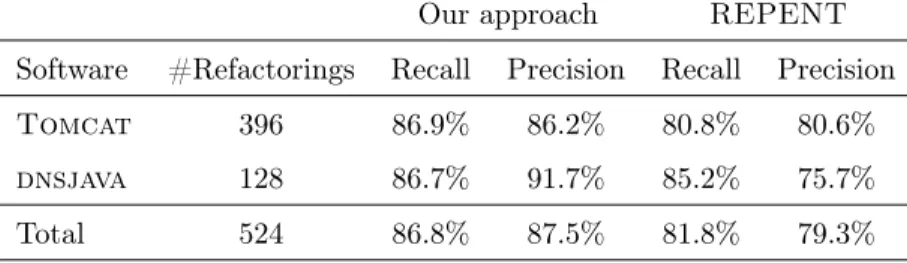
4.2.2 RQ2: How does our technique perform compared toREPENT? . . . 46
4.2.3 RQ3: What is the efficiency of our technique? . . . 47
4.3 Discussion . . . 48
4.3.1 Limitations of REPENT . . . 48
4.3.2 Limitations of Our Approach . . . 51
4.4 Threats to Validity . . . 53
4.4.1 Internal Validity . . . 53
4.4.2 External validity . . . 54
4.5 Chapter Summary . . . 55
5 RefBenchmark: Automated Accuracy Computation Framework for Refactor-ing Detection tools 56 5.1 Design . . . 57
5.1.2 Evaluator . . . 60 5.2 Chapter Summary . . . 61
6 Conclusions and Future Work 62
List of Figures
1 Drastic relocation of statements leads to a False Positive inREPENT . . . 5
2 Representation of a method body as a tree. . . 26
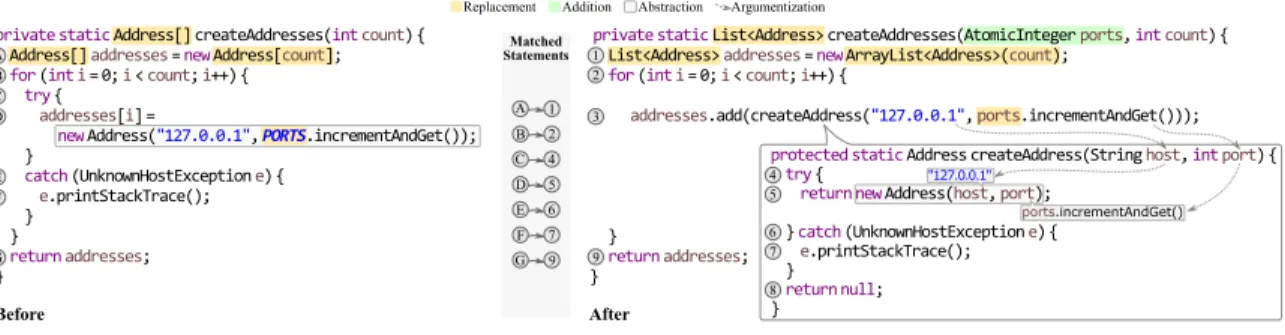
3 Statement matching for anExtract Methodrefactoring in project hazelcast. . . . 29
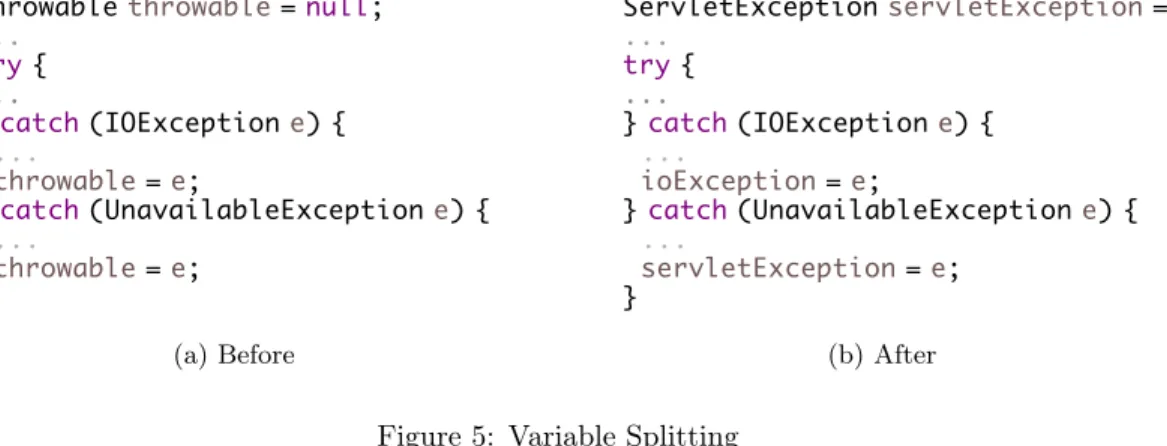
4 Renaming Ambiguity (Same Variable in the Extracted Method) . . . 35
5 Variable Splitting . . . 36
6 Renaming Ambiguity (Renaming in the Extracted Method) . . . 37
7 Renamed Variables in Different Lexical Scopes . . . 38
8 Method Invocations with Possible Non-Optimal Argument Replacement . . . 39
9 The distribution of the time taken for our technique . . . 47
10 Drastic relocation of statements leads to a False Positive inREPENT . . . 49
11 Split local variable creates a False Positive inREPENT . . . 50
12 Chain of extracted methods creates False Negatives in our approach . . . 52
13 Radical changes in the code creates False Negatives in our approach . . . 52
14 Design of RefBenchmark . . . 57
15 Class diagram for the Providers inRefBenchmark . . . 60
List of Tables
1 Characteristics of the Subject Systems . . . 43
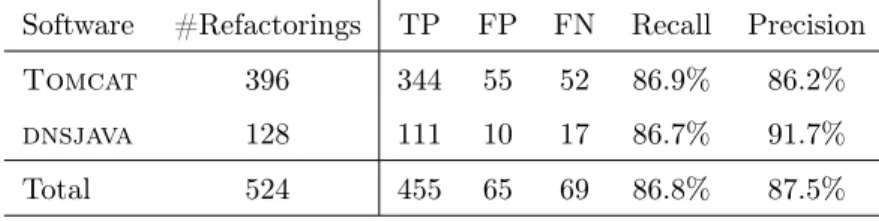
2 The accuracy of our technique . . . 46
3 The accuracy of REPENT . . . 46
Chapter 1
Introduction
The termrefactoringwas first coined by Opdyke in his PhD thesis [Opd92], and is defined as “the process of changing a software system in such a way that it does not alter the external behavior of the code, yet improves its internal structure [Fow99]”. Refactoring transformations involve renaming, moving, splitting, and joining program entities (e.g., local variables, fields, methods, classes, and packages) towards a higher-quality code. It is generally believed that avoiding refactoring incurs technical debt, which in turn increases the maintenance cost in the long run [BL76]. Several empir-ical studies have shown that refactoring indeed contributes positively to the improvement of design quality of software systems [KMPY06, MSAS06, RSG08, CKO10, BCG+10]. A study at Microsoft
revealed that 22% of developers initiate refactorings because of poor readability, and 11% because of poor maintainability [KZN14]. Moreover, 43% of developers mentioned that they actually perceived better code readability, and around 30% perceived improved code maintainability after refactor-ing. According to this study, developers spend about 10% of their time in each month working on refactoring (roughly 13 hours per month).
There is a long list of different refactoring types. A well-known catalogue of refactorings is provided by Fowler [Fow99], which includes 72 structural changes for improving code quality. De-velopers can apply these refactorings on the source code in different situations with different moti-vations [STV16]. Several studies have tried to come up with techniques forautomatically identifying refactoring opportunities in code [Dal15, BDLMO14]. For example, some approaches find code smells as the opportunities for applying refactorings. For instance, a well-known code smell is a Long Method, i.e., a method that fulfills more than one functionality and therefore is overly com-plicated to understand and maintain. A Long Method code smell can be eliminated by applying Extract Method refactoring. A recent study, however, showed that code smells are not the main motivations for applying refactorings [STV16].
Applying refactoring transformations can be a challenging, error-prone, and time-consuming task. While developers usually tend to perform refactoringsmanually[VCN+12, MHPB12, STV16]), most
modern IDEs includeautomated refactorings as a standard feature to apply these transformations automatically, and check somepreconditions to make sure that the changes are indeed safe to apply. Murphy-Hill and Black [MHB08] discovered two tactics of applying refactorings. Developers might apply floss refactoring, where the developer uses refactoring as a means to reach a specific goal, such as adding a feature or fixing a bug. In this case, refactorings are interleaved with other changes. On the other hand, in root canal refactoring, the main goal of the developer is to apply refactorings to improve the quality of the code. Murphy Hill et al. [MHPB12] showed that floss refactoring is a more common practice.
No matter how or why refactorings are done in the code, it has been shown that refactorings are indeed a very frequent development activity [XS06a, MHPB12].
The rest of this chapter will explain the motivation, problem statement, and the contribution of our thesis in details.
1.1
Motivation
Refactoring detectionis the process of computing a (likely) set of refactorings that developers applied on the source code. Typically, refactoring detection tools take as input to successive versions (i.e., releases) or revisions (i.e., commits) of the source code, and infer the refactoring operations that took place in between, by analyzing the changes in the source code. There are several use cases for refactoring detection:
Change comprehension and code review It is often required that the developers of a software system understand what refactorings other developers have done to the code, especially during the code review process. For example, when looking at a textual Diff provided by version con-trol systems, it is very difficult to distinguish the refactorings from other types of changes (e.g., bug fixes or feature additions) [KR11, DBG+15] as refactorings are usually interleaved with
other changes [MHPB12, NVC+12, STV16]. A technique for extracting meaningful refactoring
information from the changes, like ReviewFactor[GSMH14, GSWMH17] or
ChangeDis-tiller[ASK14], can improve code review experience and accuracy. In addition, such a tech-nique can also help in automatically documenting the applied refactorings, e.g., in the commit messages, since it has been shown that developers do not tend to list the refactoring operations they perform on the code in their commit messages [MHPB12].
Code merging Global refactorings (i.e., refactorings that span across the boundaries of a file or a module) can result in changes in several parts of the code. When using version control
systems, such global changes can easily lead to merge conflicts when, for example, an entity is renamed in several places of the code that another developer is also currently working on. A refactoring-aware version control system likeMolhadoRef [DMJN08] on the other hand, can avoid such merge conflicts, by automatically detecting the refactorings and resolving the conflicts occurring because of them.
Client adaptation A library can undergo several refactorings, some of which might break its public API, currently used by several clients. Indeed, a previous study showed that more than 80% of the breaking changes to the APIs are because of refactorings [DJ06]. As a result, a technique for detecting these changes and reporting it to the clients would be needed. For example,RefactoringCrawler[DCMJ06] was introduced with this goal in mind. As a step further, refactoring detection tools have been used in automated techniques for client library adaptation [HD05, BTF05, DCMJ06, XS07].
Code completion Since the automated refactoring tools are underused [VCN+12, MHPB12, STV16],
an approach that can detect an incomplete refactoring in the IDE can suggest to the developer to automatically complete a refactoring operation in progress [GDMH12, FGL12].
Improving the identification of bug-introducing changes Recent studies have shown that refac-torings, such as file/directory renaming, parameter reordering, and variable/parameter re-naming, affect significantly the accuracy of algorithms used for identifying bug-introducing changes [DRW14, dCMS+16], since this kind ofsemantically equivalent changes can be misin-terpreted as changes introducing a bug. The SZZ algorithm designed by Śliwerski et al. [SZZ05] and subsequent improved versions [KZPW06, WS08], which have been used in a large number of empirical studies, can use refactoring detection tools to avoid flagging changes that do not change system behavior (i.e., refactorings) as bug-introducing.
Improving software traceability Recent studies have shown that refactorings removing redun-dant information, such as the Extract Method refactoring used for eliminating duplicated code (also known as software clones), affect negatively the performance of automated tracing tools based on information retrieval [MN13, MN14], because code clones actually serve a positive purpose for traceability link recovery. As a result, tracing tools can use refactoring detection tools to recover broken traceability links due to applied Extract or Pull Up Method refactorings in the history of a project.
Empirical stduies Refactoring detection tools have been used in several empirical studies. For in-stance, Weißgerber and Diehl [WD06a] usedRefVis[GW05] to investigate the error-proneness of refactorings. Kim et al. [KCK11] used theMKrefactoring reconstruction technique [KNG07]
to investigate the effect of refactoring on bug fixing. Rachatasumrit and Kim [RK12] used Ref-Finder [PRSK10, KGLR10] to investigate the impact of refactoring on regression testing.
Bavota et al. [BCL+12] used
Ref-Finderto investigate to what extent refactoring activities
induce faults. Bavota et al. [BLP+15] used
Ref-Finder to investigate whether refactoring
activities occur on code components having poor quality metrics or being affected by code smells. More recently, Palomba et al. [PZODL17] used Ref-Finder to investigate the rela-tionship between different types of code changes (i.e., bug fix, feature addition, and general maintenance) and refactorings. The accuracy of the employed refactoring detection tools is a critical factor affecting the conclusions of these studies. Missing refactorings (false negatives) is a serious threat to the generalizability of empirical studies. Detecting incorrect refactorings (false positives) is even more severe, as it makes the conclusions of the empirical study wrong.
For all the aforementioned use cases, it becomes clear that there is a great need for refactoring detection tools having high accuracy, being able to operate at different levels of change granularity (i.e., commit and release level), and being able to scale enough to analyze a large number of commits over a short period of time (i.e., for the use case of extracting refactoring operations from the entire commit history of a project).
1.2
Problem Statement
While refactoring detection has been a very active line of research [DDN00, APM04, GW05, GZ05, WD06b, DCMJ06, XS06b, PRSK10, KGLR10, FGL12, GDMH12, NCV+13, SV17, GSWMH17],
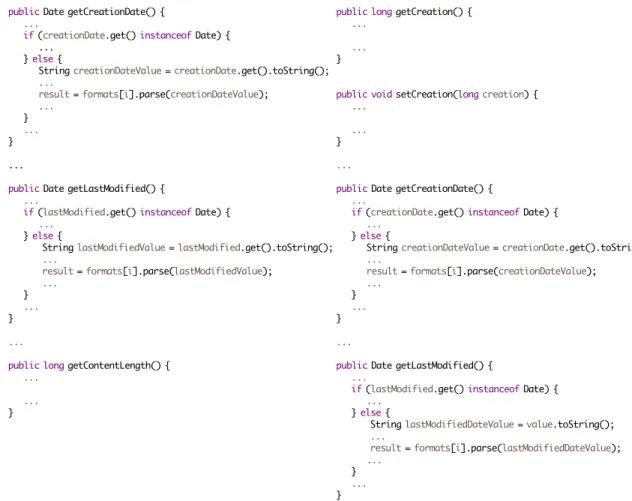
as we will see in Section 2, almost all of the proposed techniques in the literature are not able to detect instances of Rename Local Variable refactoring. Moreover, the few techniques that are able to identify the instances of Rename Local Variable refactoring have several limitations that negatively affect their precision (i.e., what portion of the identified instances are correct) and recall (i.e., what portion of all real Rename Local Variable refactoring instances occurring in the code are correctly identified). For example,REPENT[AEP+14], which is the state-of-the-art tool in detecting Rename Local Variable instances, relies on textual Diff to map lines across the two revisions of the code. The mapped lines are used as input to identify Rename Local Variable refactoring instances. This can cause several problems, particularly when the changes are more radical. The textual Diff in these cases can easily map lines that do not contain renamed variables. Figure 1 demonstrates such a scenario where drastic changes in the location of the source code leads to report an incorrect instance of Rename Local Variable refactoring byREPENT.
In this example, REPENT reports that the local variable lastModifiedValue in method
public Date getCreationDate() {
...
if (creationDate.get() instanceof Date) { ...
} else {
String creationDateValue = creationDate.get().toString();
...
result = formats[i].parse(creationDateValue);
...
}
...
} ...
public Date getLastModified() {
...
if (lastModified.get() instanceof Date) {
...
} else {
String lastModifiedValue = lastModified.get().toString();
...
result = formats[i].parse(lastModifiedValue);
...
}
...
}
...
public long getContentLength() {
... ...
}
public long getCreation() {
... ...
}
public void setCreation(long creation) {
... ...
}
...
public Date getCreationDate() {
...
if (creationDate.get() instanceof Date) {
...
} else {
String creationDateValue = creationDate.get().toString();
...
result = formats[i].parse(creationDateValue);
...
}
...
}
...
public Date getLastModified() {
...
if (lastModified.get() instanceof Date) {
...
} else {
String lastModifiedDateValue = value.toString();
...
result = formats[i].parse(lastModifiedDateValue);
...
}
...
}
Figure 1: Drastic relocation of statements leads to a False Positive inREPENT
As it is observed, the method getLastModified() still exists in the target revision, and the lo-cal variable lastModifiedValue defined in the old revision of this method has been renamed to
lastModifiedDateValue in the new revision. Similarly, the method creationDateValue() still exists in the new revision of the code, but notice that the local variable creationDateValue has not been renamed. It is clear thatREPENTincorrectly detects this Rename Local Variable refac-toring instance because it uses textual Diff for finding the renaming candidates, since the textual Diff does not know about the structure of the code and incorrectly maps the lines containing the
lastModifiedValueandcreationDateValue local variables solely based on textual similarity. In addition to such limitations, to the best of our knowledge, none of the proposed techniques is accompanied by an implemented tool. In Section 2, we will discuss the disadvantages of each of the proposed techniques for detecting Rename Local Variable refactoring instances in more depth.
It has been shown that rename refactorings are the most applied refactorings by software de-velopers [MHPB12], and particularly, Rename Local Variable is the second most applied rename refactoring, after Rename Method refactoring [AEP+14]. We argue that detecting Rename Local
Variable refactoring instances is as important as identifying other types of refactorings in the his-tory of software systems, and that’s why we are particularly interested in devising a technique for it. Many of the aforementioned reasons for detecting other types of refactorings hold for Rename Local Variable refactoring, e.g., improving change comprehension, improving merging techniques, improvingbug-inducing commits analysis, and improving the validity ofempirical studies. In gen-eral, research has paid special attention to rename refactorings to improve the accuracy of Diff and merge algorithms [LAK+17]. Also, as we will see in Chapter 2, there are several works in the
litera-ture that aimed at studying rename refactorings [KR11, AEP+14], yet sinceno tool was available to detect the instances of Rename Local Variable, the authors had to build their own rename detection approaches. We will compare our technique with one of these tools in Chapter 4.
1.3
Contributions
Particularly, this thesis makes the following contributions:
• We aim at complementing the current research in refactoring construction by improving the state-of-the-art refactoring detection technique, namely RefactoringMiner [STV16, TME+18] to support the detection of Rename Local Variable refactorings. Refactoring-Miner has been successfully used in previous research [STV16], and due to its superior ap-proach in refactoring construction (compared to the existing techniques) it will be certainly used in more future studies. As a result, improving it by supporting more refactoring types will have a great impact. We discuss in depth the reasons we decided to build our algorithm upon
RefactoringMinerin Chapter 3. We have improved the core statement matching algorithm
of RefactoringMiner, and introduced the necessary rules applied by a post-processing al-gorithm intoRefactoringMinerfor detecting Rename Local Variable refactoring instances.
• In order to automate the comparison of the results of one refactoring detection tool to other ex-isting tools, we have designed a comprehensiveaccuracy computation tool based on refactoring detection tool agreement. This tool is able to read the results of multiple refactoring detection tools, build a unified model of the detected refactorings, compare the results of those tools using the populated models, and construct a reference corpus of refactorings (i.e., a dataset of refactoring instances that we are certain they have occurred in the commit history of one or more repositories), and report the accuracy of the tools against the constructed reference corpus. The resulting reference corpus can be easily used by other researchers. In addition to Rename Local Variable refactoring, this tool models a wide variety of other refactoring types. It is possible to extend this tool to support more detection tools and more refactoring types. This tool has been successfully used in other research works [TME+18] for comparing
the precision and recall of competitive refactoring detectors. More details about this tool are given in Chapter 5.
• We make available the most complete reference corpus for the Rename Local Variable refac-torings to date. All these refacrefac-torings have been manually investigated by the author of this thesis and an independent researcher.
1.4
Thesis Organization
There have been many approaches introduced in the literature for refactoring construction, and we discuss the most important contributions that we are aware of in Chapter 2. Chapter 3 is dedicated to explaining howRefactoringMinerworks and how the proposed approach fits into it, including our improvements on theRefactoringMiner’s statement matching algorithm, the proposed rules, and the introduced post-processing algorithm for detecting instances of the Rename Local Variable refactoring. In Chapter 4, we present the accuracy of RefactoringMiner and compare it with the state-of-the-art tool in detecting rename refactorings, namelyREPENT, and discuss about the results of the comparison. In Chapter 5, we provide details about ouraccuracy computation toolthat we call RefBenchmark, which we used to compare the results of our approach with REPENT. Chapter 6 concludes the thesis and discusses some possible future works.
Chapter 2
Related Work
There are various approaches for identifying refactoring operations in the source code. Some ap-proaches performlive refactoring detection by analyzing the edits a developer is performing on the source code while working in the IDE (Section 2.1). Other approaches performpost-mortem refac-toring detection by analyzing the changes that end up in the repository after a commit (Section 2.2). Finally, we present approaches specialized in identifying Rename Local Variable refactorings, and compare them with our proposed solution (Section 2.3).
2.1
Refactoring Detection in the IDE
The proposed technique in this thesis focuses on identifying the instances of rename local variable refactorings by analyzing the source code history of software systems. However, any type of refac-toring can be also detected by monirefac-toring changes performed on the code within the IDE. This allowslive detection of the refactorings. It is important to study these approaches to understand the advantages that they can provide and their limitations, and to compare the techniques used in inferring the refactorings with our approach.
In general, there are two categories of tools that identify refactorings in the IDE. The first category includes tools that identifycomplete refactorings, while the second category includes the techniques that identifyincomplete refactorings (i.e., the refactorings that are just initiated by the developer), and then suggest to the developer to automatically complete the refactoring. In the following subsections, we present these techniques in more detail.
2.1.1
Identifying Complete Refactorings in IDE
Negara et al. extendCodingTracker[NVC+12], a tool that translates fine-grained code edits (e.g.,
typing characters) to AST node operations, i.e., add, delete, and update AST nodes, to aggregate a sequence of these operations to infer high-level changes, and then refactorings [NCV+13]. The
tool supports identification of the following refactorings: Encapsulate Field,Rename Class,Rename Field,Rename Method,Convert Local Variable to Field,Extract Constant, Extract Method,Extract Local Variable, Inline Local Variable, and Rename Local Variable. The tool was used to study whether refactorings end up in the version control systems, or whether developers use automated tools for applying refactorings.
Ge and Murphy-Hill proposed GhostFactor [GMH14], which identifies manually-performed refactorings in the IDE and checks them against preconditions to make sure that the behavior of the code remains the same after applying the refactorings. GhostFactorlistens to the events in the IDE and saves snapshots of the edited files. The approach compares the latest snapshot with a given number of previous snapshots and parses them to their ASTs. GhostFactorcan be fed with different refactoring detection approaches that work with the ASTs. The authors provide their own algorithms for detecting three kinds of manual refactorings, namely Extract Method, Change Method Signature, andInline Method. The algorithms look merely at the changes in the ASTs, and uses thresholds to detect similar entities involved in the refactorings.
Ge at al. introduced ReviewFactor[GSWMH17], a tool that allows code reviewers to distin-guish refactorings and other changes in the code. ReviewFactorfirst mines IDE logs for detecting automated refactorings that have occurred on older versions of the code. Then, it replays those refactorings on the version of the code before the code review, to create an intermediate version of the code. Then, ReviewFactorcompares this intermediate version with the version under code review to find manual refactorings done on the code. ReviewFactorextends GhostFactorby adding software entity mapping, a technique for detecting added/removed/changed entities across the two versions of the code. The mapped entities between the two versions are the ones that have the same entity type (for example, they are both class declarations) and their respective parents are a pair of mapped entities.
After mapping the elements across the two versions, ReviewFactor builds a mapping tree where pairs of mapped entities are nodes, which are hierarchically organized to reflect the parent-child relationship of the entities in the original source code. These mapping trees are then compared to subtrees that model refactorings to detect refactoring candidates. The approach then computes the ratio of the text distance and the average length of the entities’ underlying source code in the refactoring candidates. This indicates that the changed software entities in a subtree that models a refactoring instance are cohesively related. If the computed ratio is lower than a threshold, the
changed entities are reported as a refactoring. ReviewFactor supports five refactoring types: Rename Type,Rename Method,Move Method,Extract Method andInline Method.
2.1.2
Automated Refactoring Completion in the IDE
BeneFactor [GDMH12] “automatically detects an ongoing manual refactoring [within the IDE],
reminds the developers that automatic refactoring is available, and can finish the manual refactoring after the developer’s explicit invocation, without requiring her to undo any code changes”. The authors conducted a formative study and observed how developers refactor code in a lab setting. They discovered different patterns or workflows for some refactoring types. BeneFactor detects refactorings by monitoring changes in the IDE, after certain events (e.g., save), and compares the sequence of events with the discovered workflows. The more the sequence of the changes is similar to a refactoring workflow, the higher the confidence of the sequence of changes to be actually a refactoring. When this confidence is higher than a pre-selected threshold, BeneFactor tells the developer that the change might be a refactoring and suggests to complete it. BeneFactorsupports the following types of refactoring: Rename Field, Extract Method,Extract Constant, Extract Local Variable,Inline Local Variable,Introduce Parameter,Change Method Signature, and Pull Up Field.
Similarly, WitchDoctor [FGL12] tries to identify the sequence of changes that can lead to a refactoring and suggest auto-completion for them. The approach first monitors the events in the IDE, including low level keystrokes, and matches a sequence of these events to an AST node operation (for example, a sequence of code changes is translated to insertion of a method invocation in the AST). WitchDoctoravoids using an AST diff approach since, during code development, in many situations the code is not parsable until the developer finishes the changes. The approach then uses a pattern matching algorithm to find patterns in the AST node operations, to detect possible refactorings. The refactorings are defined using a declarative specification, similar to
Ref-Finder [PRSK10, KGLR10] (discussed in Section 2.2). When a matching pattern is found, and
the pattern contains enough information for a refactoring to be done,WitchDoctor suggests to the developer to complete the refactoring. If the developer chooses to complete the refactoring,
WitchDoctor rolls back the changes manually done by the developer leading to a refactoring,
and invokes the IDEs refactoring engine to complete the refactoring. The supported refactorings are Rename Local Variable,Rename Field,Rename Class,Rename Method,Extract Local Variable, and Extract Method.
2.2
Refactoring Construction From the Change History
2.2.1
Demeyer et al. [DDN00]
Demeyer et al. [DDN00] intention behind refactoring detection was to help reverse engineers to un-derstand how and why software has evolved. Their approach uses four heuristics based on changes in metrics (e.g., method size, class size, and inheritance) for finding refactorings across different versions of the software. The approach calculates the values for these metrics for the modified parts of the source and target revisions and assesses the difference between the computed values. The ap-proach is able to find four classes of refactorings, namelySplit into Superclass/Merge with Superclass, Split into Subclass/Merge with Subclass, Move [functionality] to Other Class (Superclass, Subclass or Sibling Class), andSplit Method/Factor Out Common Functionality. The authors evaluate their approach against three software systems (namely,Visualworks, HotDraw, andRefactoring Browser which are developed in Smalltalk), and show it is capable of detecting refactoring instances, and discuss the false positives that are found.
In contrast to our approach, Demeyer et al. [DDN00] only use metrics to find refactoring instances, therefore, this approach needs to specify thresholds. Metrics are not always good representatives for complex changes in the source code. For example, if the same number of classes are added and removed across two revisions, the metric-based approach can fail in correctly determining the change, and thus, it can miss some of the refactorings, while our AST-based approach can detect them. In addition, the authors mention that their approach can fail in the presence of rename refactorings [DDN00], while our technique is immune to this problem.
2.2.2
Van Rysselberghe and Demeyer [RD03]
Van Rysselberghe and Demeyer [RD03] argue that we can improve the approaches of building soft-ware by studying the evolution of successful softsoft-ware systems. Having this in mind, the authors study the move method refactoring on the history of a large system, namely Tomcat. The authors use clone detection to identify the methods which are moved across different revisions of the system. The proposed approach can only find one type of refactoring. Moreover, the accuracy of the proposed approach depends on the accuracy of the employed clone detection technique. All clone detectors have several configuration options, e.g., the percentage of similarity that two clone pairs should have to be reported as clones, which is defined as a threshold. This makes the entire approach threshold-based.
2.2.3
Antoniol et al. [APM04]
Antoniol et al. [APM04] propose an approach, inspired from Information Retrieval techniques, to detect changes in the classes across versions of a system, e.g., when a class is replaced with another one, or when it was split into two classes, or when two classes were merged into one. Inspired from the Vector Space Model in information retrieval, the authors represent classes in two revisions of the code as vectors of theTF-IDF weights of the identifiers appearing in the classes. The similarity between the classes is calculated using the cosine similarity of the vectors corresponding to the classes, and it is used for identifying class-level changes. For example, if a classA is split into two classesA’and B, the vectorsAand A’ + Bshould be similar, i.e., the cosine of the angle between them should be greater than a threshold. The approach was validated against 40 releases of an open-source project, namelydnsjava.
2.2.4
Godfrey and Zou [GZ05]
Godfrey and Zou [GZ05] useorigin analysis for detecting split and merge transformations between two revisions of source code, at the function and file levels. To detect these changes, the approach first analyzes functions and extracts their attributes (e.g., LOC, the number of variables, etc.) and relationships (callers and callees of each function) in both revisions. The approach then finds similar entities in the two versions to detect split/merge transformations based on the extracted attributes and relationships. The authors use a linear ranking mechanism and the user can examine the best entity matches. Finally, by conducting a study onPostgreSQL, the authors show that the presented approach can detect files and functions split/merge activities throughout the history of the software. In this case study, the foundmerge transformations including Full and Partial Clone Elimination, Service Consolidation(i.e., when two or more functions that perform different services but called at the same time by the same clients are merged into a new, larger function), andParameterization(i.e., when two similar functions are combined into a new function by adding a parameter to distinguish different functionalities). In addition, the split transformation which was found in the case study was a Pipeline Expansion (i.e., when a function is broken down into two, each of which accepting the same input as the original method and generating part of the output that it used to generate). Although our work is similar to this study in the sense that both aim at finding refactorings by analyzing source code repositories, the proposed approach by Godfrey and Zou is completely different from ours. The authors use code attributes and metrics to find refactoring instances while we employ an AST-based approach. Moreover, our approach does not need any human intervention in the detection process.
2.2.5
Weißgerber and Diehl [WD06b]
Weißgerber and Diehl [WD06b] proposed a technique where refactoring activities are found by first identifying candidates whose pairs of code elements, like classes and methods, have similar signatures. Then, for each refactoring candidate, the approach uses a clone detection tool, namely
CCFinder[KKI02], to compare the bodies of the code elements.
The authors manually inspected the commit messages of two open-source projects to find docu-mented refactorings to compute the recall, and used random sampling to estimate the precision of their approach. Their technique is able to detect the following refactorings: Rename Method, Hide or Unhide Method (which happens when the visibility of a method within a class has become more or less restrictive), Add or Remove Parameter, Move Class, Move Interface, Move Field, Rename Class, and Move Method.
As mentioned, using a clone detector in a technique means that the approach is threshold-based, and will be sensitive to the configurations of the used clone detector. Moreover, it has been shown that using commit logs for identifying refactorings is not reliable, since developers usually do not mention refactoring activities in commit log messages [MHPB12]. As a result, there could be many refactorings that are missed due to the use of commit logs for constructing the ground truth (i.e., the actual refactorings that occurred in the source code).
2.2.6
Xing and Stroulia [XS06b]
Xing and Stroulia [XS06b] argue that finding refactorings in the history of the code is the best way to understand the software design rationale. They introduce an approach (developed in a tool called
JDEvAn [XS08]) to detect refactorings based on the UMLDiff algorithm [XS05]. The tool first
extracts facts from the source code and creates a structural model of the system and stores then in a PostgreSQL database. Then,UMLDiffis used to analyze the extracted facts from two versions of a system to detect the differences. UMLDiffuses similarity thresholds for mapping entities from one revision to another to detect the entities that are moved, renamed, added, removed, or remained unchanged in the system. These differences are also stored in the database, and are queried to detect the refactoring instances.
The authors conducted two case studies on HTMLUnit and JFreeChart. The results show that
JDEvAn finds all the documented refactorings. The identified refactorings areConvert Top-Level
Push-Down Method/Field/Behavior, Move Method/Field/Behavior, Rename Subsystem/Package/-Class/Method/Field Add/Remove Parameter,Information Hiding,Generalize/Downcast Type, Ex-tract/Inline Subsystem/Package/Class/Subclass/Superclass/Method, Extract Interface, Form Tem-plate Method, Replace Inheritance with Delegation and the reverse, Die-hard and Legacy Classes, Convert Anonymous Class to Inner,Introduce Factory Method,Introduce Parameter Object, Encap-sulate Field, and Preserve Whole Object.
While we use a similar approach in modeling the revisions of software systems, our detection approach is different fromJDEvAn. JDEvAnusesUMLDiff, andUMLDiffis threshold-based, but we avoid any threshold in our technique. Also,UMLDiffis known to have problems in detecting move or rename method changes [XS06b].
2.2.7
RefactoringCrawler
(Dig et al. [DCMJ06])
Dig et al. [DCMJ06] proposed RefactoringCrawler for detecting refactoring instances in the code, with the goal of identifying changes in the components’ interfaces. The authors argue that by detecting the applied refactorings in the component’s source code, we can automatically update the clients which depend on the component to comply with the new interface. The detection process consists of two major phases, namelysyntactic andsemanticanalysis.
In the syntactic analysis phase,RefactoringCrawlerparses the source code into a lightweight AST, where the parsing stops at the declaration of methods and fields in classes. Then the approach builds a tree, in which the nodes represent source-level entities (e.g., packages, classes, methods, and fields). Nodes are arranged hierarchically in the tree based on their fully qualified names (e.g.,
package.Classis a child of the nodepackage). The nodes are later connected using the references between the entities, converting the tree to a graph.
Next, inspired from Information Retrieval techniques, Shingle Encoding [Bro97] is used to find refactoring candidates based on the entities’ similarity in the graph. Shingles are “fingerprints” for strings (e.g., method bodies) and enable the detection of similar code fragments much more robustly than the traditional string matching techniques that are not immune to small deviations like renamings or minor edits.
Then, for each candidate pair of the matched entities, the semantic analysis detects those pairs that are refactored using seven strategies that are based on the similarity of references in the graph (e.g., method calls, imported packages, and method parameter(s)).
The evaluation of this approach shows that it can find more than 85% of the applied refactorings on real-world components. RefactoringCrawleris able to detect the instances of seven refactor-ing types, namelyRename Package, Rename Class, Rename Method, Pull-Up Method, Push-Down Method, Move Method, andChange Method Signature.
Similar to our approach,RefactoringCrawleruses an AST-based approach for analyzing the source code; however, it only identifies refactorings which can change the way a component can be accessed (i.e., public API changes). Moreover, using Shingles might lead to miss some refactorings, as the similarity measure needs a threshold. This is also the same for the similarity calculated between the entity references in the semantic analysis. In addition,RefactoringCrawlerneeds the project revisions to be built for the analysis. In practice, this is a challenging task, given that usually only a small portion of the change history of software systems can be successfully compiled [TPB+17].
The precision of RefactoringCrawler was calculated by manually looking at the reported refactorings. To compute the recall of RefactoringCrawler, the authors manually investigated the release notes of three projects to discover the actual refactorings that occurred in the source code, and see whether their approach is able to find them. However, this might lead to an incomplete reference corpus. It has been shown that only 21% of the release notes contain information about the refactorings, and they are usually general statements specifying the refactored components, and do not mention the types of refactoring performed [MBP+17].
2.2.8
RefacLib
(Taneja et al. [TDX07])
One of the issues ofRefactoringCrawleris that the approach relies on the references between the entities in the source code, e.g., method calls. In an API, there could be a large number of methods that are not called by other methods within the same system, since they are public interfaces for the API that are supposed to be used by the API clients. As a result, RefactoringCrawlercannot detect refactorings that occurred for these methods.
To solve this problem, Taneja et al. [TDX07] proposed RefacLib, which improves Refactor-ingCrawlerby using a heuristic-based analysis, replacing the semantic analysis done by Refac-toringCrawler. RefacLibgathers facts from the source code and Javadoc comments, and
com-putes similarity measures to assign an overall score that reflects the likelihood of a candidate to be a refactoring. As an example of a heuristic, RefacLib looks at the names of the two potentially matching entities, by breaking down them to their subparts (e.g.,performUpdatestoperformand
Updates), and assigning a similarity score between the two sets of subparts. The score is computed based on different measures that reflect, for example, whether there is a complete match between the subparts, or between the synonyms of the subparts.
RefacLib supports the following refactorings: Change Method Signature, Rename Class, Push Down Method,Rename Package,Rename Method,Pull-Up Method, andMove Method. By running
RefacLib on the same subject systems that RefactoringCrawler was evaluated with, it was
observed that RefacLib performs generally better than RefactoringCrawler. However, both approaches suffer from the fact that there is a need for defining thresholds.
2.2.9
ChangeDistiller
(Fluri et al. [FWPG07])
Fluri et al. proposeChangeDistiller to identify changes across different versions of the source code. ChangeDistilleraugments a tree differencing algorithm, proposed by Chawathe et al. [CRGMW96], to adapt it to the changes that can take place in the source code ASTs. To match two leaf nodes of two ASTs,ChangeDistillerusesbi-gram similarity between the source code corresponding to the leaf nodes. Two leaf nodes are matched if this similarity is greater than a threshold. For the inner nodes, ChangeDistiller computes the number of matched leaves in the subtrees rooted under each inner node, normalized by the maximum number of leaves in these subtrees. If this ratio is greater than a threshold, the inner nodes are marked as matched.
The output of this step is a set of basic tree edit operations (e.g., added/removed/moved/updated nodes) which are stored in a database. ChangeDistillerhas a taxonomy of more abstract source code changes based on these basic edit operations [FG06], which are extracted by querying the database.
The authors used three open-source projects to examine the accuracy of ChangeDistiller in correctly identifying source code changes. They fed ChangeDistiller with the source code of these projects from different revisions, having configured ChangeDistiller with the original configuration. A subset of the results was selected and two users looked at them independently to manually classify the changes in them.
ChangeDistilleris able to detect several types of changes in the code (e.g., when the parent
of a statement is changed), but it can also identify some simpler refactorings, e.g.,Rename Method, Rename Parameter, andReturn Type Change. However, it cannot detect the instances of Rename Local Variable, and it still needs to be configured using thresholds.
2.2.10
Ref-Finder
(Prete et al. [PRSK10, KGLR10])
Prete et al. [PRSK10, KGLR10] introduced Ref-Finder to overcome the limitations of previous approaches in detecting refactorings in the history of software systems. Ref-Finderis able to detect atomicandcomplex refactorings. Refactorings likemove method ormove attribute are atomic, while complex refactorings are the ones that consist of atomic refactorings. Ref-Finder supports most of the refactorings (63 of 72) introduced by Fowler [Fow99]. The complete list of refactorings and their corresponding detection rules is given in a technical report [PRK10]. Among these refactorings, Rename Local Variable is missing.
Ref-Findermodels the versions of the software as logic predicates that represent code entities,
their containment relationships, and structural dependencies. Refactorings are encoded as logic rules. For some rules, the similarity between two methods is needed, which is defined using a threshold.
Querying this model can reveal refactorings that occurred across the two versions of the system. To evaluate Ref-Finder, the authors run it on the examples of the Fowler’s refactoring book, and two software systems. To find the correct refactorings, the authors runRef-Finderwith a low threshold and manually validated the reported refactorings. The authors then runRef-Finderwith a higher threshold and compare the two sets of refactorings to compute the recall. The precision is calculated by manually validating a random set of reported refactorings.
The authors report that Ref-Finder has a high precision and recall (74% and 96%, respec-tively). However, later studies have reported a much lower accuracy forRef-Finder(precision of 27% [KHFG16] and 35% [SGMHJ13], recall of 24% [SGMHJ13]). This could be explained by the fact that the reference corpus used for evaluating the performance ofRef-Finderwas created using the tool itself (with a lower threshold). The tool may miss cases if the used algorithm has problems, and as a result the reference corpus will not be complete.
Another major limitation of this approach is due to the definition of the logic rules. Some of the rules are too general and therefore might introduce several false positives. Moreover,Ref-Finder needs the versions of the systems under analysis to be built, and this is not practical due to the small portion of the commits that can be built [TPB+17].
2.2.11
RefDiff
(Silva and Valente [SV17])
Silva and Valente [SV17] proposedRefDiff, which uses heuristics based on static analysis and code similarity to detect 13 refactoring types on consecutive revisions of the code. These refactoring types includeRename Type,Move Type,Extract Superclass,Rename Method,Pull-Up Method,Push-Down Method, Move Method,Extract Method,Inline Method, Pull-Up Field, Push-Down Field, andMove Field.
First,RefDiffparses the revisions of the project analysis to generate higher level models from them, which capture the information about the source code entities. The entities of interest are types, methods, and fields. Then, RefDiff tries to find relationships between the entities of the two revisions (e.g., whether two types or methods are the same). Some of the relationships need the involved entities to be similar to a certain percentage (in other words, more than a certain threshold).
RefDiffrepresents a source code fragment as a bag of tokens, and computes the similarity of the
code entities using a variation of the TF-IDF weighting scheme (similar to the Antoniol et al.’s approach [APM04], while Antoniol treatsidentifiers in classes as “words”, heretokensare treated as words).
To determine the similarity threshold values, and to achieve the best compromise between the precision and recall, the authors applied a calibration process on a randomly-selected set of ten commits from ten different open-source projects, for which the applied refactorings are known and
have been confirmed by the project developers themselves [STV16]. The authors evaluated the accuracy of their tool using a reference corpus of seeded refactorings applied by graduate students in 20 open-source projects.
Similar to RefDiff, our approach also relies on detecting differences in the entities before and after refactoring, by creating an abstract model of the system. However, we do not rely on any similarity threshold for detecting the instances ofRename Local Variable refactoring (or any other type of refactoring).
2.3
Rename Local Variable Refactoring
As discussed in the introduction of this thesis, detecting the instances of Rename Local Variable refactoring has several applications. However, from the mentioned techniques for detecting refac-toring operations in the history of software systems, only WitchDoctor[FGL12] and Negara et al.’s approach [NCV+13] (which is based on
CodingTracker [NVC+12]) support detecting the
instances of Rename Local Variable refactoring. Unfortunately, both these techniques detect refac-torings within the IDE, and not using the change history of software systems.
However, there are other works in the literature where a technique for identifying the instances of renaming in identifiers in general, and Rename Local Variable refactorings in particular, from the history of systems was required as a means to study different phenomena (e.g., merging in version control systems, or empirical studies on how developers rename code entities). Here, we briefly discuss these works.
2.3.1
renaming detector
(Malpohl et al. [MHT00, MHT03])
Malpohl et al. [MHT00]) proposed one of the first approaches for detecting renamed identifiers in the source code to facilitate the merging of files in version control systems. The approach, called
renaming detector, first parses the input files to ASTs. The def-uses of the identifiers is then
detected by employing Symbol Analysis, similar to what a compiler does when generating symbol tables. The approach then identifies sequences of tokens in the old version of the system that map to a sequence of tokens in the new version. Then, the approach compares the identifiers in the two versions by comparing the token sequences around the identifier definitions. Three kinds of similarities are considered, “declaration similarity” (i.e., whether the tokens surrounding an identifier in a variable declaration or method signature match in the two versions), “implementation similarity” (i.e., how much the sequence of tokens in the bodies of two methods are similar), and “reference similarity” (i..e, whether the token sequences around theuses – or references – of an identifier are similar). Finally, the approach uses an expert system to weight the relevance of each similarity for each possible pair
of identifiers to find the pairs that correspond to one another. The authors, however, do not provide information on how the rules of the expert system are defined, but it appears that the expert system uses thresholds on the three mentioned similarity measures to decide about whether a paired match is actually a rename or not.
2.3.2
DiffCat
(Kawrykow and Robillard [KR11])
Kawrykow and Robillard [KR11] argue that while change-based differencing approaches can provide much more useful information in comparison to text-based methods, there is still room to improve change-based approaches. The authors discussnon-essential changes, i.e., minor code changes which can affect the accuracy of the existing change-based differencing approaches. For example, the authors considerRename-Induced Modificationsas non-essential changes, e.g., the renamings applied on method invocations due to renaming the invoked method. Other non-essential changes include Trivial Type Updates, Local Variable Extractions, Trivial Keyword Modifications, Whitespace and Documentation-Related Updates, and Local Variable Renames. Such changes decrease the accuracy of the change-based differencing approaches.
To help in alleviating the effect of non-essential approaches in differencing approaches, Kawrykow and Robillard introduce DiffCat to detect non-essential changes in the repository of a software system. DiffCat uses the infrastructure provided bySemDiff[BR09] (a change analysis tool for studying framework evolution) to get a set of files changed in two software revisions. DiffCatuses a Partial Program Analyzer to resolve the type bindings of the expressions in the ASTs of the changed files. It then usesChangeDistiller[FWPG07] to identify structural changes across the ASTs and augments the identified changes with various methods. For example, ChangeDistillerdoes not identify all the instances of the rename field refactoring, particularly when the textual similarity between the fields after refactoring is not high, andDiffCatattempts to improve this by iterating over all the reported insert-delete pairs in each class and checking whether all the references to a field are consistently replaced with the renamed identifier. The authors, unfortunately, do not explain how exactlyDiffCatdetects the instances of theRename Local Variable refactoring in this step.
After detecting the renamed identifiers,DiffCatrolls them back (i.e., it replaces them with the original names), with the intuition that renames affect the detection of other non-essential changes.
DiffCat finally runs ChangeDistiller again on the rolled-back version to find non-essential
changes.
The authors conducted an empirical study on seven open source systems and showed that between 2.8% and 22.9% of the changed lines contain non-essential changes, and most of the non-essential differences were induced by rename refactorings or trivial updates involvingthiskeyword.
2.3.3
REPENT
(Arnaoudova et al. [AEP
+14])
Arnaoudova et al. [AEP+14] argue that identifier renaming can improve the understandability of the
source code, and therefore, they conduct a survey on identifier renaming. The authors ask various questions regarding renaming identifiers from 71 developers, out of which some were the developers of five Java software systems. The study finds that:
1. 39% of the developers perform renaming activities at least few times a week.
2. Developers rename identifiers along with other development activities such as changing the functionality, performing other refactoring, and adding new functionality.
3. 35% of the developers believe that renaming has a cost and requires time and effort. Also, 32% of the participants consider that the renaming is a costly activity depending on a particular case.
4. Developers postpone the renaming activity due to different reasons (e.g, its potential impact on other systems or the possibility of introducing bugs).
Based on the results of this study and the fact that a small percentage of identifier renamings are documented, the authors propose an approach, namely REPENT, to identify the instances of identifier renaming across the revisions of a software system. REPENTautomatically classifies the detected renaming based on a taxonomy that comprises four dimensions:
Entity kinds what entity is being renamed, e.g., a type or a local variable,
Form of renaming whether the renaming issimple(i.e., change applies to one word),complex(i.e., changes apply on more than one parts in the identifier name), formatting only (i.e., changes in the letter cases or letter separators), and term reordering (i.e, changes in the positions of the terms in the identifiers).
Semantic change e.g., whether the renaming changes the meaning of the previous name or pre-serves it,
Grammar change e.g., part of speech changes, like change the word from singular form to plural.
To find the instances of identifier renaming in the source code,REPENTcompares each modified file in the consecutive software revisions by applying Unix contextdiff algorithm. The result of this comparison is a mapping between the source lines of code in the old and new files. REPENTthen maps the entities in these files using the Abstract Syntax Trees and the line mapping from the previous step. This leads to creating an initial set of candidate renamings for each file.
Next, REPENT tries to eliminate false positives from this list of candidates. To do so, it calculates a similarity score for each candidate pair using their def-uses, and removes the candidates for which the similarity score is below a threshold. For each of the candidates, all the def-use statements corresponding to the first identifier (i.e., in the old file) are compared with all the def-use statements of the second one, using the normalized Levenshtein edit distance. A mapping between the def-use statements of the first and second identifiers that maximizes the sum of the similarity scores between the statements is chosen, and this sum reflects the similarity score for the candidate rename refactoring.
After filtering out false positives and forming the final set of candidates,REPENTclassifies the renames using the aforementioned taxonomy. It splits the names of camel case candidate identifiers (e.g,isValidis spitted into two parts: isandvalid). Then, REPENTtries to map each part of the first and second identifiers, using WordNet and the Stanford Part-of-Speech Analyzer to fulfill the classification.
To evaluate REPENT, the authors test it against five Java open-source projects. The results show that REPENT can find the rename identifier instances cases with a precision and recall of 88% and 92%, respectively.
2.4
Limitations of Current Approaches
The mentioned approaches for detecting refactorings in the IDE have the advantage that they can find refactorings that do not end up to the version control systems, i.e., shadowed refactorings. A study showed that a large amount of changes are in fact shadowed by other changes [NVC+12]. As
mentioned, several studies also showed that the refactorings can also interleave other changes, which will negatively affect the performance of the approaches that rely on the history of systems to detect refactoring activities [MHPB12, NCV+13, STV16].
At the same time, all these techniques need special plug-ins for each IDE to be applicable. This drastically limits the scenarios where they are usable. Any approach that uses the history of the software for detecting instances of refactorings, including our approach, does not rely on any specific IDE, which makes it useful in a broader range of applications.
The approaches that were discussed in Section 2.2 and find refactorings in the change history of a software system, all use some kind of similarity thresholds, which are usually tedious to calibrate, and might not be generalizable. Unlike these techniques, our proposed approach does not require similarity thresholds.
In addition, some of these techniques (e.g.,Ref-Finder [PRSK10, KGLR10]) require the soft-ware systems under analysis to be fully-built. As mentioned, it has been shown that in practice
only a small portion of commits can be built in the history of software systems [TPB+17]. Some other approaches rely on Partial Program Analyzers (e.g.,DiffCat[KR11]), of which the accuracy is affected in the absence of external dependencies. Our approach, in contrast, does not need the system to be built or the type bindings of the expressions and works only based on information collected from the Abstract Syntax Trees of the system versions under analysis.
Since REPENT is considered the state-of-the-art technique in detecting instances of Rename Local Variable refactorings in the history of a software system, we evaluated the accuracy of our approach against that of REPENT, as it will be discussed in Chapter 4.
2.5
Chapter Summary
In this chapter, we looked at the existing approaches for detecting refactorings in the evolving code, and discussed some of the problems that they have. In the next chapter, we describe our approach in identifying the instances of Rename Local Variable refactorings in the change history of systems.
Chapter 3
Approach
Our approach in detecting instances of Rename Local Variable refactorings has been implemented on top of RefactoringMiner[TME+18], a tool that allows to detect various types of refactorings
in the history of software systems (excluding Rename Local Variable refactorings). There are several reasons justifying the selection of RefactoringMiner as the basis of our approach, including:
1. RefactoringMinerprovides a complete infrastructure for cloning Git-based repositories and includes a rich API to work with consecutive revisions of the repository under analysis.
2. It provides an abstract model of the system under analysis and detects high and low-level changes in that model. The refactorings are inferred by analyzing the detected changes. The model frees us from dealing directly with abstract syntax trees, while it still allows us to have access to AST nodes where needed. This means that it is rather easy to define new detection rules for refactoring types which are not yet supported.
3. It does not depend on any specific IDE to be executed, and can be used as a standalone program, in contrast to several other refactoring construction approaches, such asRef-Finder that depends on the Eclipse IDE.
4. The model generation and differencing are fast and scalable. We will discuss the scalability of our approach in Chapter 4.
5. RefactoringMiner has been successfully used in previous research for conducting a large-scale empirical study to understand why developers perform refactorings in their code [STV16], the impact of refactoring on code smells [CGM+17], and the impact of refactoring on quality
We have done several enhancements on RefactoringMiner to adapt it with our needs for detecting instances of Rename Local Variable refactorings, which we will discuss in the following subsections. First, we will briefly show how the core of RefactoringMinerworks.
3.1
Background
3.1.1
RefactoringMiner
RefactoringMineraccepts a Git-based repository of a Java software system and checks out1
con-secutive revisions of its source code. In each of these two concon-secutive revisions (i.e., a commit and its parent in the directed acyclic graph that models the commit history in Git repositories), Refac-toringMiner inspects only the added/removed/changed files to detect the refactoring operations that occurred. This is in contrast to other existing refactoring detection approaches, such as Ref-Finder [KGLR10],RefactoringCrawler [DCMJ06], and JDEvAn [XS08], where the analysis
includes all the files in two snapshots/revisions of a Java project. This improves significantly the efficiency of RefactoringMiner.
Each of the added/removed/changed files across the two revisions are then parsed to their ASTs using Eclipse’s JDT parser. JDT uses a Partial Program Analyzer and is able to parse Java files that might even have compiler errors. In addition, JDT parser is able to resolve type bindings for each of the expressions in the generated ASTs. Type bindings can drastically empower any static source code analysis technique. For example, in the context of refactoring identification in software repositories, we need to understand which entities in the source code (e.g., source code statements) are added or removed, and which ones have remained intact or slightly changed, i.e., the mapped entities. The mapped statements, for example, might be found much easier by looking at the type bindings of the composing expressions first. In other words, if two statements are composed of expressions with different type bindings, they are most likely non-matching statements, rather than corresponding to the same statement that has been modified between the two revisions.
However, to completely resolve type bindings within the source code, the parser should be aware of the location of all the external dependencies of the project, in addition to the Java runtime library files (i.e., it should have a complete environment). Particularly for external dependencies, they should be compiled (or downloaded pre-compiled as jarfiles). This is usually done automatically in the presence of a build system (e.g., Maven) when compiling the source code, which is usually a time-consuming task.
When analyzing the history of software systems, compiling each revision to have a complete
1Since check-out is an expensive operation, we are currently working on improving the efficiency of
Refactoring-Minerby using Git’s internal representation of the files, i.e., the Blobs.
environment for binding-aware parsing is not always feasible. Recent studies have shown that only a small portion of commits can be successfully built [TPB+17], as mentioned before.
As a result, RefactoringMiner is designed to operate without resolved type bindings. This extends the applicability of RefactoringMinerto a much wider spectrum, such as the detection of refactorings on partial code, the detection of refactorings at commit time, etc.
In each revisionr,RefactoringMiner extracts the following entities from the source code:
• T Dr: The set of type declarations (i.e., classes, interfaces, enums) which are changed inr. For
a child commit, this set includes the type declarations inside the changed/added Java files, while for a parent commit, this set includes the type declarations inside the changed/removed Java files. Each element td of the set is a tuple of the form (p, n, F, M), where p is the parent of td, n is the name of td, F is the set of fields declared inside td, and M is the set of methods declared inside td. For a top-level type declaration pcorresponds to the package of the compilation unit tdbelongs to, while for a nested/inner type declarationpcorresponds to the package of the compilation unittd belongs to concatenated with the name of the type declaration tdis nested under.
• Fr: The set of fields inside the type declarations ofT Dr. It contains tuples of the form(c, t, n),
where c is the fully qualified name of the type declaration the field belongs to (constructed by concatenating the package name pwith the type declaration namen),t is the type of the field, andnis the name of the field.
• Mr: The set of methods inside the type declarations of T Dr. It contains tuples of the form
(c, t, n, P, b), wherecis the fully qualified name of the type declaration the method belongs to,
t is the return type of the method,n is the name of the method,P is the ordered parameter list of the method, and bis the body of the method (could be nullif the method is abstract or native).
• Dr: The set of all directories in r as returned by commandgit ls-tree. Each directory is
represented by its pathp.
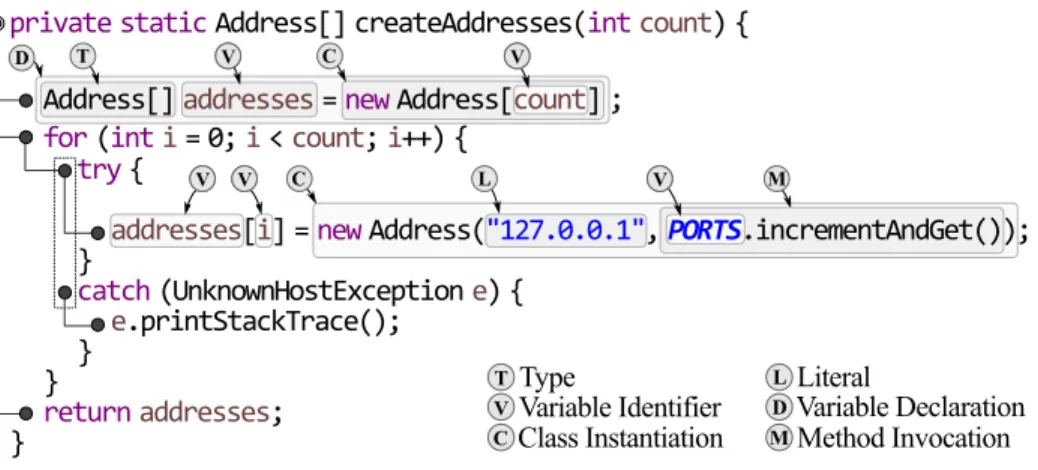
The body of a method is represented as a tree capturing the nesting structure of the code, where each node corresponds to a statement, similar to the representation used by Fluri et al. [FWPG07]. The statements are divided into two categories: composite statements andleaf statements.
Composite statements are the statements that contain other statements within their body, such asfor,while,do-while,if,switch,try,catch,synchronized block, andlabel. Compos-ite statements are represented as parent nodes in the tree representing the body of a method,
and contain the statement’s type and the expression(s) appearing within parenthesis before the statement’s body.