Project and Construction
Management Guidelines
U.S. Department of Transportation
Federal Transit Administration
This document is disseminated under the sponsorship of the Department of Transportation in the interest of information exchange. The United States Government assumes no liability for its contents or use thereof.
The United States Government does not endorse products or manufacturers. Trade or manufacturers' names appear herein solely because they are considered essential to the object of this report.
Form Approved OMB No. 0704-0188
Public reporting burden for this collection of information is estimated to average 1 hour per response, including the time for reviewing instructions, searching existing data sources, gathering and maintaining the data needed, and completing and reviewing the collection of information. Send comments regarding this burden estimate or any other aspect of this collection of information, including suggestions for reducing this burden, to Washington Headquarters Services, Directorate for Information Operations and Reports, 1215 Jefferson Davis Highway, Suite 1204, Arlington, VA 22202-4302, and to the Office of Management and Budget, Paperwork Reduction Project (0704-0188), Washington, DC 20503.
1. AGENCY USE ONLY (Leave
blank) 2. REPORT DATE February 2016 3. REPORT TYPE AND DATES Original September 1990 Updates June 1996, May 2003, July 2011 and March 2016 4. TITLE AND SUBTITLE
Project and Construction Management Guidelines: March 2016 5. PROJECT ID NUMBER
6. AUTHOR(S)* Kam Shadan, lead author for this update, with support
William Plumpton (Gannett Fleming), Michael Eidlin (Kal Krishnan Consulting Services), David Sillars (Sillars), Paul Krogh (K2 Construction Consultants), Dain Pankratz (Boyd Caton & Grant), and Robin Hazy (Raul V. Bravo + Associates)
7. PERFORMING ORGANIZATION NAME(S) AND ADDRESS(ES) Gannett Fleming, Inc.
San Bruno Office Park 881 Sneath Lane, Suite 210 San Bruno, California 94066
8. PERFORMING ORGANIZATION REPORT NUMBER
9. SPONSORING/MONITORING AGENCY NAME(S) AND ADDRESS(ES)
U.S. Department of Transportation Federal Transit Administration 1200 New Jersey Avenue, S.E. Washington, DC 20590
10. SPONSORING/MONITORING AGENCY REPORT NUMBER
11. SUPPLEMENTARY NOTES * Assisted by: Lee Hamre (H.C. Peck & Associates), and Kate Berrigan (Gannett
Fleming)
12a. DISTRIBUTION/AVAILABILITY STATEMENT
Available online at http://www.fta.dot.gov 12b. DISTRIBUTION CODE
13. ABSTRACT (Maximum 200 words) This update of the document published in September 1990 and updated in June
1996, May 2003, and July 2011 reflects FTA project development, grants, and project management requirements. It incorporates the experience of FTA’s Project Management Oversight Program research and technical assistance
initiatives, and new or updated Circulars and legislation, including changes due to the Moving Ahead for Progress in the 21st Century Act. Additional guidance is provided on safety and security considerations and certification process, project risk assessment and allocation, project controls, project delivery approaches, financing, real estate acquisition, dispute resolution, quality assurance/quality control, value engineering, public communications, and identifies additional sources of guidance, training, and assistance.
The Guidelines describe the transit capital project development process, general project management principles, and the application of those principles in the planning, design, construction/equipment procurement, and testing/start-up phases. While emphasizing Major Capital Projects and New Starts projects, information on the Small Starts program is also provided. Regardless, the principles and practice discussed have applicability to any capital transit project.
14. SUBJECT TERMS Transit Capital Projects, Project Management,
Construction Management, Project Control Project Planning, Finance, Risk Assessment Quality Assurance Quality Control, Safety and Security
Management Plan Safety Certification Design/Build, Real Estate Acquisition
15. NUMBER OF PAGES 341 16. PRICE CODE 17. SECURITY CLASSIFICATION OF REPORT Unclassified 18. SECURITY CLASSIFICATION OF THIS PAGE Unclassified 19. SECURITY CLASSIFICATION OF ABSTRACT Unclassified 20. LIMITATION OF ABSTRACT: None
ACKNOWLEDGEMENTS
The 2016 Project and Construction Management Guidelines Update project was sponsored and managed by FTA’s Office of Engineering led by Chris Nutakor and Dale Wegner. The lead author for this Guidelines update was Kam Shadan, P.E., Vice President of Gannett Fleming, Inc., a national engineering and construction management firm with specialized expertise in transit project planning, design, and construction. Additional specialized inputs were provided by William Plumpton (Gannett Fleming), Michael Eidlin (Kal Krishnan Consulting Services), David Sillars (Sillars), Paul Krogh (K2 Construction Consultants), Dain Pankratz (Boyd Caton & Grant), Robin Hazy (Raul V. Bravo + Associates) and Lee Hamre (H.C. Peck & Associates), and most particularly Kate Berrigan (Gannett Fleming), Chief Editor.
Throughout this update, FTA’s Dale Wegner provided direction on content modifications. Selected FTA subject matter experts were asked to review various sections of the initial draft of the Guidelines and offer comments, and did so to varying degree with comments taken into consideration.
ACKNOWLEDGEMENTS ... i TABLE OF CONTENTS... ii
LIST OF FIGURES... viii
LIST OF TABLES ... viii
LIST OF ACRONYMS... ix Chapter 1 INTRODUCTION ... 1-1
1.1 Purpose and Scope of the Guidelines ...1-1 1.2 Reasons for the Guidelines Update ... 1-2 1.3 Format and Content Summary ... 1-3 Chapter 2 – TRANSIT CAPITAL PROJECT DEVELOPMENT PROCESS ... 2-1
2.1 Overview ... 2-1 2.1.1 Major Capital Projects ...2-2 2.1.1.1 Automatic Pre-Award Authority and Letters of No Prejudice...2-5 2.1.2 Capital Projects Not Classified as Major Capital Projects ...2-7 2.1.2.1 Transit Asset Management Practices ...2-8 2.1.2.2 Bus Maintenance Facilities ...2-8 2.1.2.3 Vehicle Procurements ...2-8 2.1.2.3.1 Transit Vehicles Procurement: ...2-10 2.1.2.3.2 Regulatory References ...2-10 2.1.2.3.3 Vehicle Procurement Deliverables ...2-11 2.1.2.3.4 Buy America Requirements for Revenue Service Vehicles ...2-13 2.1.2.3.5 Pre-Award Audit Requirements ...2-14 2.1.2.3.6 Post Delivery Audit Requirements ...2-16 2.1.2.4 Multimodal Transfer Facilities ...2-16 2.1.2.5 Bus Rapid Transit (BRT) Projects ...2-16 2.1.2.6 New Technology Procurements ...2-17 2.2 Project Development Elements of Sound Transportation Planning ...2-17 2.2.1 Systems Planning ...2-17 2.2.2 Alternatives Analysis ...2-20 2.2.3 Project Management Plan (PMP) ...2-21 2.2.4 Rail Modernization Planning ...2-25 2.2.5 Bus Maintenance Facility Planning ...2-27 2.2.6 Project Risk Analysis and Procurement Planning ...2-27 2.2.7 Environmental Planning ...2-32 2.2.7.1 Scoping ...2-35 2.2.7.2 FTA’s Expanded Use for Categorical Exclusions ...2-36 2.2.7.3 Section 4(f) of the U.S. Department of Transportation Act of 1966 ...2-37 2.2.7.4 The National Historic Preservation Act of 1966 ...2-40 2.2.7.5 FTA’s Environmental Justice Policy Guidance ...2-41 2.2.7.6 MAP-21 and Changes to the Environmental Review Process ...2-42 2.2.7.7 FTA Guidance on Corridor Preservation ...2-44
2.2.8 Financial Planning ...2-45 2.2.9 FFGA and Other Grant Requirements ...2-47 2.2.9.1 Full Funding Grant Agreement (FFGA) ...2-47 2.2.9.2 Other Requirements ...2-47 2.2.10 Joint Development Planning/Coordination with Transit Project Planning ...2-48 2.2.11 Safety and Security Management Plan (SSMP) ...2-50 2.2.11.1 Introduction and Background to the SSMP ...2-50 2.2.11.2 Authority for and Elements of an SSMP ...2-51 2.2.11.3 SSMP Content ...2-53 2.2.11.4 Safety and Security Considerations When An SSMP Is Not Required ...2-55 2.2.11.5 State Safety Oversight Agency Considerations...2-55 2.3 Engineering and Design ... 2-56 2.3.1 Definition of Sufficient Level of Engineering ...2-56 2.3.2 Project Development (PD) ...2-57 2.3.3 Engineering Phase ...2-64 2.3.4 Construction And Equipment/Materials Procurement Phase ...2-66 2.3.5 Recovery Plan ...2-67 2.3.6 Testing and Start-Up Phase ...2-67 2.3.7 Revenue Service Phase ...2-68 2.3.7.1 Operation and Maintenance ...2-68 2.3.7.2 System Performance Monitoring/Assessment ...2-68 2.3.7.3 Before and After Study ...2-69 2.3.7.4 Capital Replacement Planning ...2-70 2.3.7.5 State Safety Oversight (SSO) ...2-71 Chapter 3 – GENERAL MANAGEMENT PRINCIPLES FOR TRANSIT CAPITAL
PROJECTS ... 3-1 3.1 Introduction ... 3-1 3.2 Project Sponsor and Project Organization ... 3-3 3.2.1 Project Sponsor Authority, Requirements, and Organization ... 3-3 3.2.2 Project Organization, Staffing, and Training ...3-7 3.2.3 Work Breakdown Structure ...3-10 3.3 Financial Requirements/Resources ...3-12 3.3.1 Capital Plan ... 3-13 3.3.1.1 Project Capital Plan ...3-13 3.3.1.2 Force Account ...3-16 3.3.1.3 Subsequent Modernization Cost ...3-16 3.3.1.4 Contingencies ...3-17 3.3.1.5 Capital Funding ...3-17 3.3.1.6 Alternative Funding Source ...3-18 3.3.1.7 Financing Techniques ...3-20 3.3.1.8 Funding Source Forecasts ...3-21 3.3.1.9 Borrowing, Debt Levels, and Ratings ...3-21 3.3.1.10 Federal Funding Shortfalls ...3-21 3.3.1.11 Agency-Wide Capital Plan ...3-22 3.3.1.12 Project Budget ...3-22 3.3.2 Operating Plan ...3-22 3.3.2.1 Operation and Maintenance Costs (O&M Costs) ...3-23 3.3.2.2 Operating/Maintenance Funding Considerations ...3-25 3.3.3 Cash Flow Analysis ...3-25
3.4 Scheduling ... 3-26 3.4.1 Scheduling Principles ...3-26 3.4.2 Scheduling Process ...3-27 3.4.3 Integrated Master Project Schedule...3-30 3.4.4 The Construction and/or Procurement Schedule(s) ...3-31 3.5 Controlling the Project ... 3-34 3.5.1 FTA Requirements ...3-34 3.5.2 Integrating Time and Cost ...3-34 3.5.3 Controlling Costs ...3-36 3.5.4 Controlling Project Configuration and Changes ...3-38 3.5.5 Risk Assessment and Management ...3-42 3.5.5.1 Projects Involving Construction of Tunnels ...3-44 3.5.5.2 Risk Identification ...3-45 3.5.5.3 Risk Assessment ...3-46 3.5.5.4 Risk Response...3-49 3.5.5.5 Alternative Project Delivery/Contracting Methods ...3-51 3.5.6 Project Documentation and Reporting ...3-54 3.5.7 Available Technology for Project Management ...3-56 3.5.8 Managing Hazards and Threats ...3-57 3.5.8.1 Hazard Analysis and Management ...3-58 3.5.8.2 Hazard Identification ...3-59 3.5.8.3 Hazard Measurement ...3-59 3.5.8.4 Hazard Probability (Likelihood or Frequency) ...3-59 3.5.8.5 Risk Determination ...3-60 3.5.8.6 Hazard Resolution (or Mitigation) ...3-61 3.5.8.7 Threat and Vulnerability Management...3-61 3.5.8.8 Threat Identification ...3-62 3.5.8.9 Defining Vulnerability ...3-62 3.5.8.10 Threat Severity ...3-63 3.5.8.11 Threat Probability (Likelihood or Frequency) ...3-63 3.5.8.12 Criticality ...3-64 3.5.8.13 Countermeasure Recommendations ...3-65 3.6 Procurement, Contracts, and Related Topics ...3-65 3.6.1 Procurement...3-65 3.6.2 Consultant and Contractor Selection and Contract Types ...3-67 3.6.3 Dispute Resolution ...3-68 3.6.4 Partnering – Construction Contracts ...3-69 3.6.5 Claims Management ...3-69 3.6.6 Alternative Project Delivery Methods and Overall Contracting Plan ...3-71 3.6.6.1 Best-Value Procurement System ...3-73 3.6.6.2 Build America Transportation Investment Center (BATIC) ...3-74 3.6.7 Contracting Considerations Related to Risk Management ...3-75 3.7 Quality Assurance/Quality Control ... 3-76 3.7.1 FTA Quality Assurance/Quality Control Guidelines Summary ...3-76 3.7.2 Project Quality Assurance/Quality Control Requirements ...3-77 3.7.3 Alternative Organizational Structures ...3-80 3.7.4 Total Quality Management/International Organization for Standardization ...3-80 3.8 ADA Compliance... 3-81 3.9 Communications ... 3-83 3.9.1 Project Coordination...3-84 3.9.2 Audience ... 3-84 3.9.3 Program Responsibility ...3-85 3.9.4 Transit Riders ... 3-85
Chapter 4 – MANAGING THE PROJECT DURING THE ENGINEERING DESIGN PHASE 4-1
4.1 Introduction ... 4-1 4.2 Design Team Organization/Contracts ...4-2 4.3 Construction Procurement Considerations ... 4-3 4.3.1 Construction Contract Bid Documents and Requirements ... 4-4 4.3.1.1 Consideration of Formally Advertised Contract Procurement ...4-6 4.3.1.2 Non-Traditional Procurement Methods ... 4-6 4.3.1.3 Pre-Qualification ...4-7 4.3.1.4 Issues and Opportunities for Industry Reviews in Contract Procurement... 4-7 4.3.2 Subcontracting and the Utilization of Small and Disadvantaged Firms ... 4-8
4.3.2.1 Utilization of and Compliance Assurances Relative to Small and
Disadvantaged Businesses ... 4-8 4.4 Design Criteria and Standards ... 4-9 4.4.1 Establishment of Operating Performance and Facilities Requirements ...4-9 4.4.1.1 Perform Surveys ...4-9 4.4.1.2 Conduct System Studies ...4-10 4.4.1.3 Select Way and Structure Types ...4-11 4.4.1.4 Develop Station Preliminary Plans ...4-13 4.4.1.5 Develop Yard and Shop Criteria ...4-14 4.4.1.6 Design Criteria for Fixed Guideway System Components ...4-16 4.4.1.7 Computer-Assisted Design and Drafting ...4-20 4.4.2 Applicable Codes and Standards ...4-21 4.4.3 Honoring Mitigation Commitments made during the NEPA Process ...4-24 4.5 Real Estate Acquisition ... 4-24 4.5.1 Early Real Estate/Right-of-Way (ROW) Activities ...4-25 4.5.2 Real Estate Acquisition-Implementation Phase ...4-27 4.5.3 Relocation Process Considerations ...4-28 4.5.4 Contaminated Property (including Brownfields) ...4-29 4.6 Negotiation of Third-Party Agreements ...4-29 4.6.1 Governmental Jurisdictions ...4-31 4.6.2 Utilities... 4-31 4.6.3 Railroad and Other Transportation Entities ...4-31 4.6.4 Environmental Compliance ...4-34 4.6.5 Joint Development ...4-35 4.7 Completion of Engineering ... 4-35 4.7.1 Design Coordination...4-35 4.7.2 System Integration ...4-36 4.7.3 Design Reviews ...4-36 4.7.3.1 Initial Design Reviews ...4-38 4.7.3.2 Completion of Engineering Reviews ...4-40 4.7.4 Construction Planning and Constructability Reviews ...4-41 4.7.5 Peer Reviews ...4-42 4.7.6 Value Engineering ...4-42 4.7.6.1 Definition and Requirements of Value Engineering ...4-42 4.7.6.2 Timing of Value Engineering Studies ...4-43 4.7.6.3 The Value Engineering Workshop Team...4-43 4.7.6.4 The Value Engineering Workshop ...4-43 4.7.7 Quality Assurance/Quality Control in Design ...4-45 4.7.8 Design Management for Alternative Delivery Projects ...4-45 4.7.8.1 Design Review for Alternative Delivery Projects ...4-45 4.7.8.2 Value Engineering for Alternative Delivery Projects ...4-46
Chapter 5 – MANAGING THE PROJECT DURING THE PROCUREMENT AND CONSTRUCTION PHASES ... 5-1 5.1 Introduction ... 5-1 5.2 Developing a Plan for Managing Construction ...5-1 5.2.1 Organization and Staffing; Responsibilities and Authorities ...5-1 5.2.1.1 Interface Points ...5-2 5.2.1.2 Relationship to Project Delivery Method Used ...5-4 5.2.1.3 Construction Manager Approach ... 5-5 5.2.1.4 Design/Build Approach ... 5-5 5.2.1.5 Resident Engineer ... 5-6 5.2.2 Project Labor Agreements (PLAs) ... 5-6 5.2.3 Interface with Utilities ... 5-7 5.2.4 Interface with Transit Operations ... 5-8 5.2.5 Community Relations and Public Information ...5-9 5.2.6 Quality Assurance/Quality Control ...5-10 5.2.7 Change Control and Management ...5-11 5.2.8 Configuration Management...5-13 5.2.9 Delays ... 5-14 5.2.10 Claims Avoidance and Management ...5-14 5.2.10.1 Dispute Resolution ...5-15 5.2.10.2 Partnering ...5-17 5.2.11 Documentation (Progress Reporting, Maintenance of Records) ...5-17 5.2.12 Contractor Payments ...5-19 5.2.13 Project Closeout ...5-20 5.3 Contractor Requirements ... 5-21 5.3.1 Permits ... 5-21 5.3.2 Safety Plan... 5-21 5.3.3 Security Plan ... 5-21 5.3.4 Quality Plan ... 5-22 5.3.5 Submittals of Shop Drawings or Contract Data Requirements ...5-22 5.3.6 Submission of Requests for Information ...5-22 5.3.7 Schedule ... 5-22 5.3.8 Progress Reporting and Invoices ...5-22 5.3.9 Record Drawings and Documentation ...5-24 5.3.10 Operation and Maintenance Manuals and Training ...5-24 5.3.11 Testing and Inspection ...5-24 5.3.12 Closeout Activities...5-24 5.4 Construction Safety ... 5-25 5.4.1 Safety Program Management ...5-26 5.4.2 Pre-Construction Survey to Identify Potential Hazards ...5-27 5.4.3 Construction Hazard Control ...5-27 5.4.4 Employee Orientation and Training ...5-29 5.4.5 Safety Inspections and Audits...5-29 5.4.6 Accident Reporting and Investigations...5-29 5.4.7 Use of Contract Incentives ...5-29 5.5 Construction Security ... 5-30 5.5.1 Security Program Management ...5-30 5.5.2 Construction Safety and Security Manual ...5-31 5.5.3 Construction Breach Control ...5-32 5.5.4 Employee Orientation and Training ...5-32 5.5.5 Breach and Crime Reporting and Investigations ...5-32 5.6 Insurance ... 5-33 5.6.1 Conventional or Contractor-Controlled Insurance Program...5-33 5.6.2 Coordinated (Owner Controlled or Wrap-Up) Insurance Program ...5-34 5.6.3 Partner-Controlled Insurance ...5-35
Chapter 6 – MANAGING THE PROJECT DURING THE TESTING AND START-UP PHASES 6-1
6.1 Introduction ... 6-1 6.2 Test Program Planning ... 6-2 6.3 Test Program Elements ... 6-3 6.3.1 Contractually Required Testing...6-3 6.3.2 System Integration Testing ...6-4 6.3.3 Operational Tests ... 6-5 6.4 Management of Rail Activation ... 6-6 6.4.1 Agreements... 6-7 6.4.2 Establishment/Modification of Operating Organization ... 6-7 6.4.3 Procedures, Rulebooks, and Manuals ... 6-7 6.4.4 Recruitment of Personnel ...6-8 6.4.5 Training ... 6-8 6.4.6 Pre-Revenue Operations ...6-9 6.4.7 Post-Delivery Audit for Rolling Stock ...6-9 6.5 Safety Oversight ...6-10 6.6 Security Oversight ... 6-11 6.7 Safety and Security Certification ... 6-11 6.8 Emergency Preparedness... 6-13 6.9 Public Relations and Marketing ... 6-14 6.10 Initial Revenue Service ... 6-15 REFERENCES ... R-1 INDEX…….. ... I-1 Appendix A – Cost Estimation Methodology ... A-1 Appendix B – Project Contingency (General Overview) ... B-1 Appendix C – Checklist – Readiness to Enter Engineering ... C-1 Appendix D – Checklist – Readiness to Execute SSGA/FFGA ... D-1 Appendix E – Project Sponsor’s Guide to FTA New Starts Project Risk Review . E-1 Appendix F – Utility Relocation Agreements ...F-1
LIST OF FIGURES
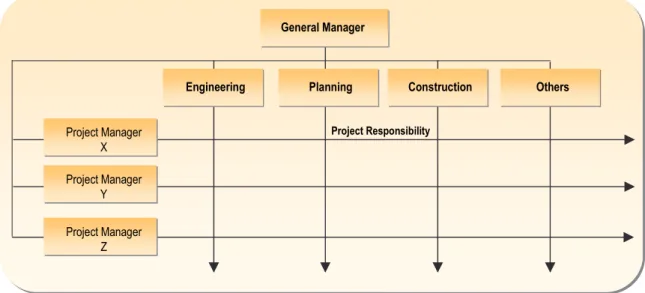
Figure 2-1. MAP-21 New Start/Core Capacity and Small Starts Planning and Project Development Process ...2-5 Figure 2-2 The NEPA Process ...2-34 Figure 2-3. Safety and Security Core Management Functions ...2-50 Figure 3-1. Matrix Organization ...3-6 Figure 3-2. Matrix Organization with a Project Office ...3-7 Figure 3-3. Example of a WBS ...3-11 Figure 3-4. Components of a Financial Plan ...3-13 Figure 3-5. Risk Management Process...3-42 Figure 3-6 Cost Impacts and Mitigation Capability By Phase ...3-43 Figure 4-2. "Plan, Do, Check, Act" Cycle ...4-45
LIST OF TABLES
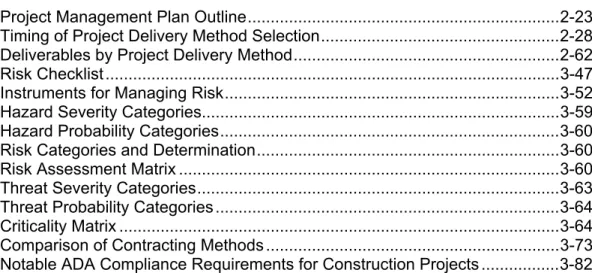
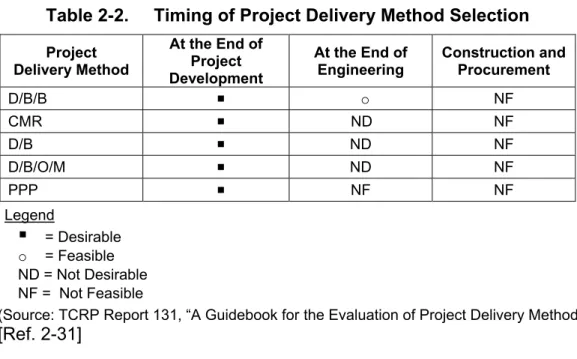
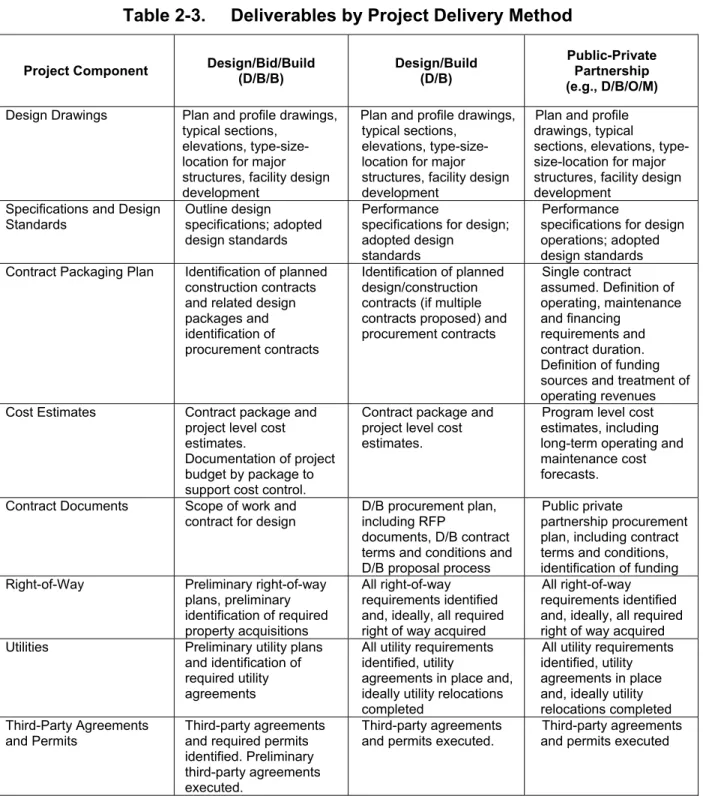
Table 2-1. Project Management Plan Outline...2-23 Table 2-2. Timing of Project Delivery Method Selection...2-28 Table 2-3. Deliverables by Project Delivery Method ...2-62 Table 3-1. Risk Checklist...3-47 Table 3-3. Instruments for Managing Risk...3-52 Table 3-4. Hazard Severity Categories...3-59 Table 3-5. Hazard Probability Categories...3-60 Table 3-6a. Risk Categories and Determination ...3-60 Table 3-6b. Risk Assessment Matrix ...3-60 Table 3-7. Threat Severity Categories ...3-63 Table 3-8. Threat Probability Categories...3-64 Table 3-9. Criticality Matrix ...3-64 Table 3-10. Comparison of Contracting Methods ...3-73 Table 3-11. Notable ADA Compliance Requirements for Construction Projects ...3-82
A&E Architect(ure) and Engineer(ing)
AA Alternatives Analysis
AACE Association for the Advancement of Cost Engineering International AAR Association of American Railroads
ADA Americans with Disabilities Act AGT Automated Guideway Transit AIT Arts-in-Transit AP Acquisition Plan
APTA American Public Transportation Association ASCE American Society of Civil Engineers
ATC Alternative Technical Concept BAFO Best and Final Offer
BFMP Bus Fleet Management Plan BOO Build-Own-Operate BOT Build-Operate-Transfer BRT Bus Rapid Transit
BTO Build-Transfer-Operate CADD Computer Assisted Design and Drafting CBTC Communications Based Train Control
CCB Change Control Board
CCT Community Coordination Team CCTV Closed Circuit Television
CE Categorical Exclusion
CEQ Council on Environmental Quality CFR Code of Federal Regulation
CII Construction Industry Institute CIG Capital Investment Grant
CIL Certifiable Items List
CM Construction Manager/Management
CMAA Construction Management Association of America CMAQ Congestion Mitigation and Air Quality
CM/GC Construction Manager/General Contractor CMR Construction Manager At Risk
CPM Critical Path Method
CPTED Crime Prevention Through Environmental Design CSI Construction Specifications Institute CSSM Construction Safety and Security Manual
CSSP Contractor Safety and Security Plan CURT Construction Users Roundtable CVS Certified Value Specialist
D/B Design/Build D/B/B Design/Bid/Build
DBE Disadvantaged Business Enterprise DBIA Design Build Institute of America D/B/O/M Design/Build/Operate/Maintain DBOM/F Design Build Operate Maintain/Finance DEIS Draft Environmental Impact Statement DHS Department of Homeland Security DTM Digital Terrain Model
EEO Equal Employment Opportunity EIS Environmental Impact Statement
EJ Environmental Justice
EMI Electromagnetic Interference EPA Environmental Protection Agency
ESA Environmental Site Assessment FAA Federal Aviation Administration FAR Federal Acquisition Regulations FARA Federal Acquisition Reform Act FFGA Full Funding Grant Agreement FHWA Federal Highway Administration FLSC Fire-Life Safety Committee
FMCSS Federal Motor Carrier Safety Standards FMO Financial Management Oversight FMP Fleet Management Plan
FMVSS Federal Motor Vehicle Safety Standards FONSI Finding of No Significant Impact
FRA Federal Railroad Administration FTA Federal Transit Administration GAN Grant Anticipation Note
GBR Geotechnical Baseline Report GDR Geotechnical Data Report GEC General Engineering Consultant
GIR Geotechnical Interpretive Report GMD Geotechnical Memorandum for Design GMP Guaranteed Maximum Price
GPP Geotechnical Program Plan HAR Hazard Assessment and Resolution HOV High Occupancy Vehicle
HUD Department of Housing and Urban Development HVAC Heating Ventilation and Air Conditioning
IMPS Integrated Master Project Schedule
ISO International Organization for Standardization
ISTEA Intermodal Surface Transportation Efficiency Act of 1991 ITP Integrated Test Plan
ITS Intelligent Transportation Systems LONP Letter of No Prejudice
LPA Locally Preferred Alternative LRT Light Rail Transit
LUC Local User Council
MAP-21 Moving Ahead for Progress in the 21st Century (Public Law 112-141) MCP Major Capital Project
MDBF Mean Distance Between Failures MIS Major Investment Study
MOW Maintenance of Way
MP Monitoring Procedures for FRA
MPO Metropolitan Planning Organization
NAA Non-Attainment Area
NEPA National Environmental Policy Act NHPA National Historic Preservation Act NPRM Notice of Proposed Rulemaking
NS New Start
NTD National Transit Database NTI National Transit Institute NTP Notice to Proceed
OBS Organization Breakdown Structure O&M Operating (ion) and Maintenance
OBS Organizational Breakdown Structure
OCIP Owner Controlled Insurance Program or Plan OGT Office of Grants and Training
OLI Operation Lifesaver, Inc.
OSHA Occupational Safety and Health Administration OSR Operating Spares Ratio
PCGA Project Construction Grant Agreement PDM Precedence Diagram Method
PD Project Development
PERT Program Evaluation and Review Technique PHA Preliminary Hazard Analysis
PLA Project Labor Agreement
PM Project/Program Manager/Management PMI Project Management Institute
PMO Project Management Oversight
PMOC Project Management Oversight Contractor PMP Project Management Plan
PRO Pre-Revenue Operations
PTC Positive Train Control
PTMS Public Transportation Facilities & Equipment Management System PVR Peak Vehicle Requirements
QA Quality Assurance
QC Quality Control
RAC Rail Activation Committee RAM Rail Activation Manager
RAMP Real Estate Acquisition and Management Plan RAN Revenue Anticipation Note
RAP Rail Activation Plan
RCMP Risk and Contingency Management Plan
RE Resident Engineer
RFI Request for Information RFP Request for Proposal RFQ Request for Qualifications RIP Reliability Improvement Program ROD Record of Decision
ROI Return on Investment
ROW Right of Way or Rights of Way {also sometimes seen as R/W) RSD Revenue Service Date (formerly Revenue Operations Date) RTP Regional Transportation Plan
SAVE Society of American Value Engineers SBE Small Business Enterprise
SC Safety Certification
SCC Standard Cost Categories
SCORC System Change and Operations Review Committee SCP Situational Crime Prevention
S/DBE Small/Disadvantaged Business Enterprise
SEPP System Security and Emergency Preparedness Plan SIT System Integration Test
SITC System Integration Test Committee SGR State of Good Repair
SOW Scope of Work
SSCP Safety and Security Certification Plan
SSCRC Safety and Security Certification Review Committee
SSCVR Safety and Security Certification Verification Review (or Report) SSGA Small Starts Grant Agreement
SSMP Safety and Security Management Plan SSO State Safety Oversight SSOA State Safety Oversight Agency SSP System Security Plan
SSPP System Safety (and/or Security) Program Plan SSPS System Safety Program Standards
SSRR Safety and Security Readiness Review STB Surface Transportation Board
STIP Statewide Transportation Improvement Program, System Integration Test Plan STP Surface Transportation Program
TAM Transit Asset Management
TCRP Transit Cooperative Research Program TDP Turnkey Demonstration Program TECP Tax Exempt Commercial Paper
TIFIA Transportation Infrastructure Finance and Innovation Act TIP Transportation Improvement Program
TOD Transit-Oriented Development TPMS Transit Performance Monitoring System TrAMS Transit Award Management System TQM Total Quality Management
TSA Transportation Security Administration TSI Transportation Safety Institute
TSM Transportation System Management TVA Threat and Vulnerability Analysis
URA Uniform Relocation Assistance and Real Property Acquisition Policies Act of 1970 USACE United States Army Corps of Engineers
USC United States Code USCG United States Coast Guard
USPAP Uniform Standards of Professional Appraisal Practice
VE Value Engineering
VECP Value Engineering Change Proposal WBS Work Breakdown Structure
CHAPTER 1 INTRODUCTION
1.1 Purpose and Scope of the Guidelines
This Project and Construction Management Guidelines document (hereafter referred to as the Guidelines) has been developed under Federal Transit Administration (FTA) sponsorship to assist those involved in advancing transit capital projects to achieve implementation success in terms of the project scope, function, schedule, cost, safety, and quality.
The Guidelines were originally published in September 1990 and subsequently updated in June 1996 and again in May 2003 and July 2011. They summarize FTA requirements, best practices, and research results in the management of transit capital project development. The Guidelines are designed for use by FTA Project Sponsors (also used to mean owner or transit agency) and their consultants, as well as by FTA staff and Project Management Oversight (PMO) Contractors (PMOCs). FTA maintains oversight for the grants that it awards, but assigns the grant administration and project management responsibility to the Project Sponsors. FTA assigns the responsibility for oversight of nearly all capital grants to the appropriate FTA Regional Office.
Dedicated use of the Guidelines should continue to contribute to effective project management on the part of the Project Sponsor, and effective oversight and guidance by FTA and the PMO contractor. Each project
phase should: (1) start with inputs or a baseline, (2) have a process that refines the project definition and generates outputs that, (3) become the inputs or baseline for the subsequent phase.
By defining the requirements for each project phase along with sound approaches to their accomplishment, these Guidelines help the Project Sponsor to define requirements, allocate resources, perform project activities, manage project capital assets, monitor progress, and make adjustments, as required, to obtain the proper information and assure that timely decisions are made utilizing risk-informed and performance-based project management. Adherence to the Guidelines should minimize scope changes, schedule slippages, cost overruns, and quality problems, and contribute to fully meeting all of the performance objectives of the transit
Transit Asset Management
The Moving Ahead for Progress in the 21st Century (MAP-21) Act established a State of Good Repair (SGR) grant program under which the Project Sponsor must set targets for the condition of project capital assets – including equipment, rolling stock, infrastructure, and facilities. The Project Sponsor then reports on the condition of its system, any change in condition since the last report, and progress towards meeting its targets. A national Transit Asset Management (TAM) system serves as a resource to the Project Sponsor for developing and reporting on its project TAM Plan. The TAM plan should include, at a minimum, capital asset inventories, condition assessments, and
Participation in Project Planning and Design
Project Sponsor participants in the FTA Transit Construction Program Workshops have been of equal opinion that there is a need for transit operations and construction staff to be involved in planning and design of New Starts as well as modernization and/or expansion of transit systems. This coordination is essential to ensure that plans are feasible from transit operations, project construction, and revenue service start-up standpoints. Involvement by the local community also is essential at every stage of project development.
Because a sound management and control plan should be implemented early in the life of a project, the Guidelines encompass the planning phase, in addition to the design and construction phases, where the greatest level of effort is expended.
For completeness, the operational or revenue service phase is also presented to encourage a comprehensive life cycle management approach. This approach systematically assesses the relationship between the constructed transit capital project and operational realities to determine future system needs, both modernization and expansion.
The Guidelines address the full range of issues and present management principles applicable to all FTA-funded capital projects. These include projects that could encompass a variety of modes (e.g., rail, bus, other fixed guideway); improvement types (e.g., equipment, facility); system evolutions (e.g., newly developed, expanded, modernized); and Project Sponsor capacities, capabilities, and maturities (e.g., newly constituted or established with experienced staff). The Guidelines document is complemented by the FTA’s Construction Project Management Handbook, designed for agencies executing a significant project for the first time with little or no internal capital projects staff.
1.2 Reasons for the Guidelines Update
This Guidelines update seeks to incorporate the requirements of Public Law 112-141, Moving Ahead for Progress in the 21st Century (MAP-21). It incorporates changes in regulations and policies, particularly in renewed emphasis on streamlining project development and implementation process cost containment through continuous risk identification, assessment and mitigation practices, and the experience gained over the intervening period from a variety of sources, including the following:
Transit Construction Workshop recommendations
Other FTA and industry-sponsored research, guidance, and best practices
The results of wider use of non-traditional project delivery and development
approaches Updates of the:
o Grant Management Requirements
o Full-Funding Grant Agreements Guidance
o Program Guidance for Metropolitan Planning and State Planning and Research
o Elderly Individuals and Individuals with Disabilities Program Guidance and
Application Instructions
o Capital Investment Program Guidance and Application Instructions
o Safety Management Systems and Processes
o Buy America Regulations
Applicable research and training initiatives of FTA, including National Transit
Institute (NTI) courses on Management of Transit Construction Projects and Design/Build Project Development
FTA publication of Circular 5800.1, providing a complete picture of requisite safety
and security policies and guidelines to reflect the increasing attention devoted to the topic of Safety and Security Management Guidance for Major Capital Projects Additional experience with Financing Techniques for Public Transit
Updated guidance for Land Acquisition and Relocation Assistance for Transit Projects, including railroad ROW acquisition
FTA real estate acquisition matters
Other new FTA regulations, circulars, rules, and guidelines related to topics addressed in the Guidelines
Transit and other industry approaches to contemporary project and construction
management topics from such sources as the Project Management Institute, American Society of Civil Engineers (ASCE), American Public Transportation Association (APTA), and the Design-Build Institute of America (DBIA), to name a few
The update process also provided an opportunity to review the structure and format of the Guidelines to improve its effectiveness. The following section summarizes these changes.
1.3 Format and Content Summary
From a thorough review of the previous Guidelines, and suggestions made by some of the FTA’s Project Management Oversight Contractors working daily in the arena of transit capital projects implementation, an outline was developed that includes the following changes to date:
Discussion has been further expanded on the Planning Phase in Chapter 2, the
Transit Capital Project Development Process, to identify and reinforce the data and decision-making that is intrinsic to and should take place in that phase.
Chapter 3, General Management Principles for Transit Capital Projects, identifies
additional areas of importance and correlates them to the risk-informed, performance-based requirements for a robust project management framework. Three detailed, phase-oriented chapters follow: Managing the Project During the
Design Phases (Chapter 4), Managing the Project During the Procurement and Construction phase (Chapter 5), and Managing the Project During the Testing and Start-Up Phase (Chapter 6). References to Preliminary Engineering and Final Design were deleted to comply with MAP-21 Act Project Development (PD) and
reinforcement of the transitional requirements between the phases being discussed within Chapter 2.
Applicable provisions of FTA’s Interim Policy Guidance of August 2015 are
included.
Sufficient level of engineering and design for each project phase is defined.
Small Starts projects and other smaller
projects not considered Major Capital Looking for More Information?
Projects (MCPs) are treated, primarily in Throughout Guidelines chapters,
Chapters 2 and 3. the pointer symbol (
) is a visual Document references are incorporated, cue that the author has listed analong with tips using text boxes and/or additional source(s) of information. the pointer symbol as shown at right.
The remaining chapters of the Guidelines are summarized and presented as follows:
Chapter 2 – Transit Capital Development Process, addresses the primary categorization of projects and types of grants associated with each, with emphasis on FTA's funding process and grant requirements. Rail vehicle procurement is expanded upon in this chapter. For each development phase, the major work program elements that are vital to understanding the Basis for Design and that thereby influence effective project management are reviewed, noting significant milestones and decision points, with their interfaces highlighted. The primary elements and their foundation for sound transportation planning and project development phases are addressed, and include the following Phases:
Project Development
o Systems planning o Alternatives analysis
o Engineering & design in support of the environmental review
o Environmental review
Engineering
Construction and Equipment/Materials Procurement
Testing and Start-Up
Revenue Service
This chapter reinforces the role of the Project Sponsor as the responsible party for project management and describes the FTA requirements that the Project Sponsor needs to recognize and put into practice for effective project stewardship and management. The FTA requirements that apply during the project development phase and prior to an FTA capital grant funding commitment are designed to provide assurances that issues of project scope, cost estimation, environmental impacts, implementation process, schedule, and local funding commitments have been thoroughly addressed and resolved. These requirements aim to create a realistic project Basis for Design that the Project Sponsor may use to manage the project more successfully, should it advance to subsequent phases.
Incentives are another tool FTA uses to encourage effective Project Sponsor project management. For a Major Capital Project (MCP), the Full Funding Grant Agreement (FFGA) concept makes the Project Sponsor financially responsible for cost overruns and attaining the Revenue Service Date (RSD). In this manner of grant funding, Project Sponsors have the incentive to establish a realistic project baseline and to implement policies, practices, and procedures that are risk-informed, performance-based, means and methods of project control.
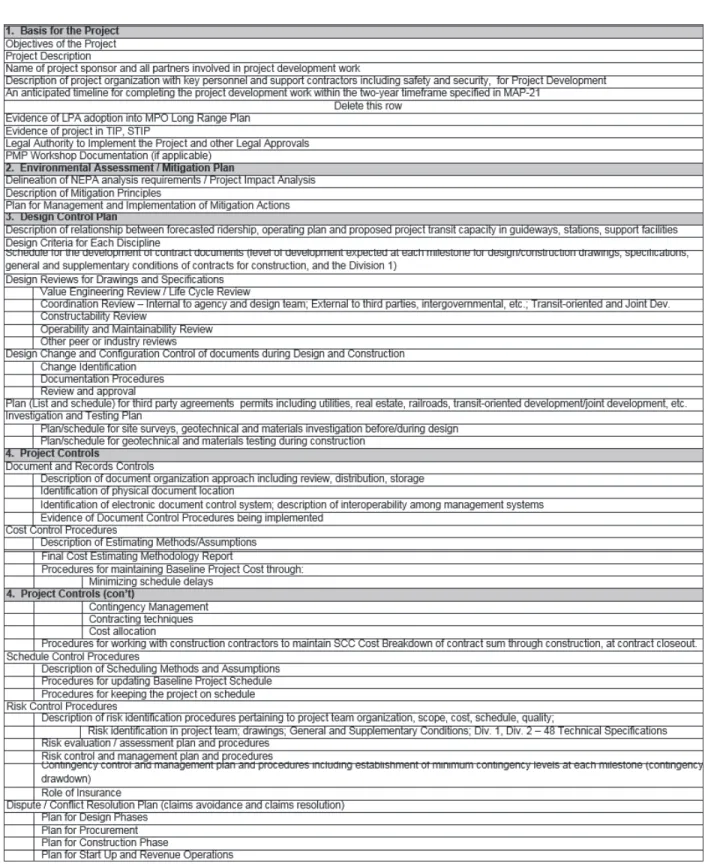
A Project Sponsor should apply the management principles and guidance embodied in this document to its unique project environment through the development of a Project Management Plan (PMP). Chapter 2 covers specific regulatory requirements for the PMP. A PMP, which is required by statute for MCPs, provides a functional, financial, and procedural route map for the Project Sponsor to effectively and efficiently manage on-time, within-budget, and at the highest quality and safety level in its unique project environment.
This Chapter includes definition of sufficient level of engineering for each phase of the project,
Chapter 3 – General Management Principles for Transit Capital Projects, outlines the general principles for managing the transit capital project development process throughout each of the phases of project implementation. In addition to the traditional project management requirements for managing scope, budget (including financing), schedule, and quality, effective project management requires the application of other management skills such as procurement management, continuous risk assessment and management, safety and security analyses and management, and internal and external communications management. Because transit capital projects are publicly funded and often have significant urban development impacts, these projects have many more legal and regulatory requirements than a privately developed project.
Chapter 3 groups the general principles for managing transit capital projects into the following functional categories:
Project Sponsor and project organization Financial requirements/resources Scheduling
Controlling the project
Procurement, contracts, and related topics Quality assurance/quality control (QA/QC) Safety and security
Communications – Internal and External
Chapter 3 purposely presents the project management principles in a general manner. The implementing agencies will have the responsibility to apply the general principles along with the specific guidance provided for the different project phases. FTA and its Project Management Oversight (PMO) and Financial Management Oversight (FMO)
compliance with FTA requirements and to assess the Project Sponsor’s efforts to achieve management objectives (within budget, on schedule, safely, and highest quality products). Consequently, these Guidelines are intended to be firm in their definition of management principles and objectives, flexible in their application of standard and alternative approaches and techniques, and dynamic in their ability for FTA and Project Sponsors to consider new approaches and techniques in the future.
Chapter 4 – Managing the Project During the Engineering Design Phase, recommends specific management approaches for transit capital projects during design. The chapter expands upon topics with regard to procurement planning, contracting options, and National Environmental Policy Act (NEPA) compliance. Additional discussion provides the basis and application of design development and control requirements that best ensure control of project deliverables and a focus on “designing to budget” and maintaining the integrity of the project’s Basis for Design.
Chapter 5 – Managing the Project During the Procurement and Construction Phases, recommends specific management approaches for transit capital projects during the Construction and Equipment/Materials Procurement Phase. A key ingredient this chapter highlights is for the continuance of risk-informed and performance-based project management and maintaining the integrity of the Basis for Design, much as these objectives are emphasized during the Design Phase. For the Construction and Procurement Phase, however, the Guidelines emphasize the Project Sponsor care that must be exercised to ensure delivery of the project elements in conformance with contract plans and specifications to achieve the project goals.
Chapter 6 – Managing the Project During the Testing and Start-Up Phases, recommends specific management approaches for transit capital projects during the Testing and Start-Up Phase. This phase is the period in which rigorous component inspection and testing is done, preceding integrated project testing and certifications that the system is safe and revenue service for the general public may begin.
.
Appendices to enhance the effectiveness of the Guidelines include: Index of selected key words and phrases
References that correspond to the [Ref.__] notations in the text
Topical discussion papers, checklists and other guidance to aid in project management
CHAPTER 2 – TRANSIT CAPITAL PROJECT
DEVELOPMENT PROCESS
2.1 Overview
It takes a lengthy and rigorous process to plan, design, program, and implement a transit capital project, particularly a major transit capital project. This process includes the following activities:
Analysis of the existing transportation system in order to determine the need for
improvements
Evaluation of alternatives in terms of design and operational criteria, costs,
benefits, and impacts, and the preparation of the necessary environmental documents to ensure compliance with the National Environmental Policy Act (NEPA)
Financial planning to identify costs, funding requirements (initial capital funding
and cash flow, and ongoing operational expenses) and sources (non-Federal and Federal)
Reaching agreements with third parties and regulatory agencies Determining the optimal project delivery approach
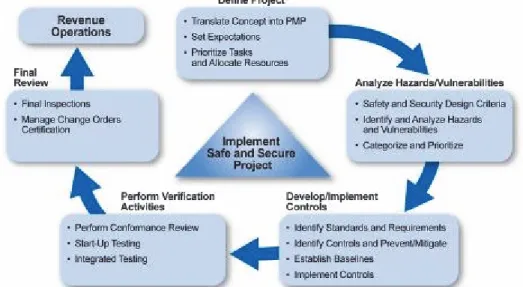
Preliminary hazard analysis (PHA) and a threat and vulnerability analysis (TVA) to develop design criteria that assure that safety and security are built into the project prior to the Engineering Phase and construction, so that costs and community issues do not escalate during later phases of the project
Safety and Security Management including safety and security certification of the project
Design necessary to achieve the desired performance in concert with all project design criteria and environmental and financial constraints
Acquisition of the required ROW
Construction of the improvement in accordance with the contract documents, plans and specifications
Testing and start-up to assure that the system is safe and secure and meets operational requirements
Continual monitoring during operations to assess system performance and identify requirements for additional improvements, such as modernization or expansion The time frame and specific requirements to implement transit capital projects vary greatly depending on the type of improvement being considered. With regard to financing, for example, most projects will involve capital programming and competition for a limited amount of public funds. FTA capital assistance generally requires a continuous, comprehensive, and cooperative Metropolitan Planning Process (see the booklet entitled The Transportation Planning Process: Key Issues [Ref. 2-1] published by the FTA and FHWA). In the case of New Starts (NS) fixed guideway projects, the FTA requires a very rigorous project justification process subsequent to such a project being selected for
The degree of environmental impact also affects the implementation process. An NS project, for instance, has numerous positive and negative impacts related to route alignment, station locations, real estate acquisition and related relocations, land use implications, construction, and traffic generation. Effectively mitigating the adverse potential impacts of a project requires a process of public involvement to gather input and achieve support, especially to create stable sources of local funding.
A set of typical definitions, requirements, inputs, outputs, major milestones, and decision points associated with each of the transit capital project development phases is presented in the following sections. While these parameters may vary depending on the nature of the project, it is important for a Project Sponsor to determine the specific requirements associated with each project as a means of establishing a basis for effective project management. As the phases of project development are interrelated, proper attention to the management principles and external requirements at the earliest stage can eliminate potential problems that could result in schedule slippage and cost overruns in subsequent phases. FTA, under Congressional direction as a major funding source for public transportation, is committed to ensuring that a Project Sponsor has a process of project management that results in successful implementation of the desired project at the lowest cost. This requires a management process that is risk-informed and performance-based to control scope, quality, cost, schedule, safety and security, and project risk.
The following sections describe the FTA designation of MCPs that require special project management attention, and other projects that Project Sponsors develop with less direct Federal oversight.
2.1.1 Major Capital Projects
These definitions are essential to understanding the FTA capital project management requirements and the role of PMOCs resulting from the passage of MAP-21 Public Law 112-141) and the associated FTA statute, 49 U.S.C. Chapter 53 (as amended October 1, 2012). [Ref. 2-2]:
New Starts Project: A new fixed guideway system or an extension to an existing
fixed guideway system. FTA New Starts funding is provided through the Section 5309 grant program.
o Small Starts Project: A Section 5309 capital investment program that contains
less than $100 million of Capital Investment Grant (CIG) funding with a total project cost of less than $300 million. Guidance for New Starts, Small Starts, and Core Capacity Programs is contained in FTA’s August 2015 Final Interim Policy Guidance for the Capital Investment Grant Program [Ref. 2-3].
Core Capacity Improvement Program: A Core Capacity project involves
substantial corridor-based investment in an existing fixed guideway system where the proposed project corridor:
o Is located in a corridor that is at or over capacity or will be in five years.
o Will increase capacity by 10 percent.
Full Funding Grant Agreement (FFGA): A means for providing Section 5309
funds to projects with a Federal share of $25 million or more. FFGAs establish terms and conditions for the Federal financial participation in an NS project. Project Construction Grant Agreement (PCGA): A means for providing Section
5309 funds to Small Starts projects with a Federal share of less than $75 million. PCGAs establish terms and conditions for the Federal financial participation for Small Starts projects [Ref. 2-4].
Fixed Guideway: Any public transportation facility that utilizes and occupies a
separate ROW or rails. This includes, but is not limited to, heavy rail, light rail, commuter rail, automated guideway transit (AGT), people movers, and exclusive facilities for buses, e.g., bus rapid transit (BRT).
Project Management Oversight (PMO) Program: A Congressionally mandated
continuous (or sometimes periodic) review and evaluation of various processes to ensure each project is in compliance with statutory, administrative, and regulatory requirements; that FTA national and Project Sponsor goals are reached; and to improve FTA and the Project Sponsors’ project management processes and components. Oversight should be viewed as an increased emphasis on monitoring the adequacy of Project Sponsor management capability/capacity and management systems to ensure proper planning, technical, financial, and administrative control, which will result in improved Project Sponsor compliance with statutory and administrative requirements. PMO includes review of the PMP, project estimates, and schedules; and facilitating risk assessment and/or mitigation to assure that a project is within prescribed scope, schedule, and budget. PMO can be undertaken with FTA and/or contractor staff. The FTA Administrator may assign Project Management Oversight Contractor (PMOC) services when one or more of the following conditions apply:
o The Project Sponsor is using FTA capital funds.
o The project is an MCP (see MCP definition below).
o The FTA administrator determines that it is in the best interest of the
government.
Major Capital Project (MCP): This is defined as a project that:
o Involves the construction of a new fixed guideway or an extension to an existing
fixed guideway.
o Involves the rehabilitation of an existing fixed guideway with a total project cost
in excess of $100 million, or
o The FTA Administrator determines it to be an MCP because the PMO program
may benefit the Project Sponsor. Typically, this means a project that involved all of the following:
▫ Generally is expected to have a total project cost of $100 million or more for
▫ Is not exclusively for the routine acquisition, maintenance, or rehabilitation
of vehicles or other rolling stock.
▫ Involves new technology.
▫ Is of a unique nature for the Project Sponsor, and/or involves a Project
Sponsor whose experience indicates that the implementing agency may benefit from the oversight or technical assistance available through the PMO Program.
Project Management Plan (PMP): An overarching document that demonstrates
a Project Sponsor’s authority and its management capacity and capability to implement and maintain a new transit capital project together with any existing public transit system elements. PMPs and sub-plans are required to be submitted initially prior to Project Development (PD) and updated through subsequent project phases. PMPs are required for all MCPs.
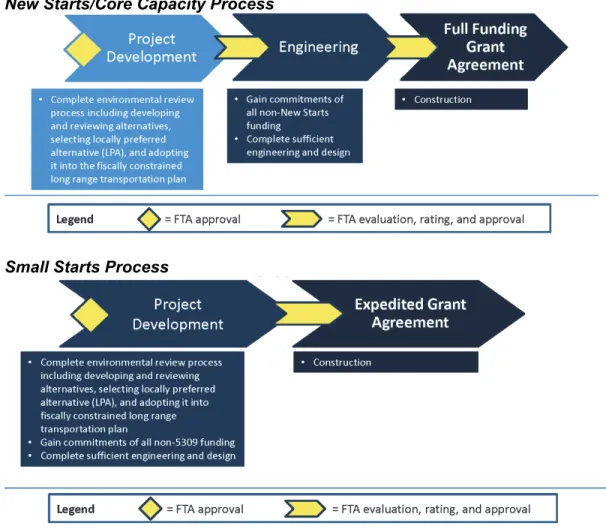
Figure 2-1 depicts the NS project planning and PD process under MAP-21 [Ref. 2-5], which includes key Project Sponsor activities, and FTA actions and decision points. PMOCs are normally assigned to NS projects within six months prior to the completion of NEPA compliance. This figure depicts the process typical for the Design/Bid/Build (D/B/B) contract delivery method, and may also be appropriate for Design/Build (D/B) contracting wherein a partial notice to proceed (NTP) could be used to initiate the Engineering Phase, with full construction at a later NTP. Planning and project development for NS and Core Capacity projects is a continuum of analytical activities carried out as part of the metropolitan planning and NEPA review processes. Systems planning results in the identification and prioritization of transportation corridors in greatest need of more detailed planning and analysis. Alternatives analysis (AA) focuses on a specific transportation corridor need (or set of needs), identifies alternative actions to address these needs, and generates information needed to select an option for further engineering and implementation. AA typically results in the selection of a locally preferred alternative (LPA) and initiation of the environmental review process under NEPA. Once an LPA is selected and adopted in the region's long-range plan and the NEPA process initiated, the Project Sponsor may request FTA entrance into the PD Phase.
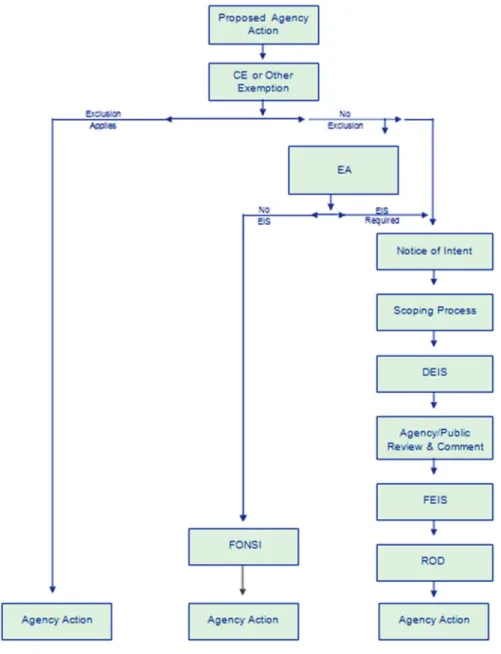
PD includes additional engineering analysis and results in the completion of all environmental requirements, with the preparation of a final Environmental Impact Statement (FEIS), environmental assessment (EA) or Categorical Exclusion (CE). The environmental process is completed when FTA issues the Record of Decision (ROD), Finding of No Significant Impact (FONSI) or confirms the CE. The PD Phase must be completed within two years, and FTA has expressed its intent to issue few extensions to the two-year time frame. The next stage of development for NS and Core Capacity projects is Engineering. Entry into the Engineering Phase is the first opportunity for FTA to evaluate and rate a project, prior to giving its approval. The FTA sets the maximum amount of Federal funding for the project when it approves the project’s entry into Engineering. It is during the Engineering phase that candidate projects are considered by FTA for an FFGA. In the case of Small Starts projects, the project moves from PD Phase to the award of a Small Starts Grants Agreement (SSGA).
New Starts/Core Capacity Process
Small Starts Process
Figure 2-1. MAP-21 New Starts/Core Capacity and Small Starts Planning and Project Development Process
2.1.1.1 Automatic Pre-Award Authority and Letters of No Prejudice
Although an FFGA is important to MCPs, FTA has established automatic pre-award authority that enables a Project Sponsor to proceed with aspects of the capital project prior to FTA making a capital grant and/or an FFGA. These pre-award authorities, the Letter of No Prejudice, and Early Systems Work Agreements are discussed below. Under existing practice, FTA extends automatic pre-award authority for the acquisition of real property and real property rights and associated relocations for a New Start, Core Capacity, or Small Starts project upon completion of the NEPA process for that project. The NEPA process is complete when FTA signs an environmental ROD or FONSI or makes a CE determination.
FTA extends pre-award authority for non-construction activities upon entry into Engineering for NS and Core Capacity projects. The intent of this authority is to facilitate procurement of long-lead time items or items for which market conditions play a significant role in the acquisition price. The following list of non-construction activities is illustrative rather than exhaustive:
Procurement of rails, ties, and other specialized equipment The procurement of commodities
Demolition
FTA does not extend additional pre-award authority for Small Starts in the PD Phase. FTA reminds Project Sponsors that the procurement of vehicles must comply with all Federal requirements including, but not limited to, competitive procurement practices, the Americans with Disabilities Act (ADA), and the Buy America Act. Project Sponsors should discuss the procurement of vehicles with FTA in regards to Federal requirements prior to exercising pre-award authority.
Because Small Starts projects are not subject to approval into Engineering, they must complete the NEPA requirements and obtain a Letter of No Prejudice (LONP) for the following activities to remain eligible for reimbursement or as credit toward local match:
Procurement of vehicles, rails, ties, and other specialized equipment The procurement of commodities
Demolition
Project Sponsors should contact their FTA Regional Office for a determination of pre award authority for activities that are not listed here but meet the intent described above. FTA reminds Project Sponsors and the public that local funds expended by the Project Sponsor pursuant to and after the date of the pre-award authority are eligible for reimbursement or as credit toward local match only if FTA later makes a grant or grant amendment for the project. Local funds expended by the Project Sponsor prior to the date of the pre-award authority are not eligible for credit toward local match or reimbursement.
The aforementioned automatic pre-award authority provisions reduce the need for LONPs. FTA will still consider LONPs for activities not covered by automatic pre-award authority. FTA will, following the completion of the requirements under NEPA, expedite the issuance of LONPs, when appropriate, by no longer performing a detailed review of the cost and scope of the request in every instance. Rather, a limited review will be performed in those cases that are of a more routine nature, especially those involving an experienced sponsor.
Before incurring costs for a project element not covered by automatic pre-award authority, the Project Sponsor must first submit a written request for an LONP, accompanied by adequate information and justification, to the appropriate regional office and obtain written approval from FTA.
FTA typically updates its guidance on pre-award authority, LONPs, and other program information annually by notices published in the Federal Register. The most recent update as of November 2015 was FTA Fiscal Year (FY) 2015 Apportionments, Allocations, and Program Information, 80 CFR 26, February 9, 2015.
FTA approval of an LONP for an NS or Small Starts project is determined on a case-by case basis. Federal funding for a New or Small Starts project is not implied or guaranteed by an LONP.
Specifically, when requesting an LONP, the applicant shall provide sufficient information to allow FTA to consider the following items:
a. Description of the activities to be covered by the LONP.
b. Justification for advancing the identified activities. The justification should include an accurate assessment of the consequences to the project scope, schedule, and budget should the LONP not be approved.
c. Allocated level of risk and contingency for the activity requested.
d. Status of procurement progress, including, if appropriate, submittal of bids for the activities covered by the LONP.
e. Strength of the capital and operating financial plan for the NS project and the future transit system.
f. Adequacy of the Project Management Plan.
g. Resolution of any readiness issues that would affect the project, such as land acquisition and technical capacity to carry out the project.
These policy and procedural matters have ramifications. First, an LONP is not an indication by FTA that the project is a promising candidate for either an FFGA or SSGA. Second, the Project Sponsor assumes virtually all risks. LONPs allow a Project Sponsor to incur costs using non-federal resources, with the understanding that the costs incurred subsequent to the issuance of the LONP may be reimbursable as eligible expenses or eligible as credit toward the local match only if FTA approves the project for funding at a later date. Federal funding is not implied or guaranteed by an LONP. This level of FTA oversight has expedited the delivery of NS and Small Starts projects, but also requires diligence on the part of Project Sponsors to ensure that public funds are expended wisely. In addition to the above processes, the potential Project Sponsor should be aware that the FTA will conduct its own assessment of the financial capacity of grant applicants through Financial Management Oversight. [Ref. 2-6].
2.1.2 Capital Projects Not Classified as Major Capital Projects
The following subsections describe types of transit capital projects that are not considered MCPs and, therefore, not automatically subject to continuous FTA oversight and PMO involvement. Despite the absence of PMO for these projects, Project Sponsors should
projects will involve modifications to an existing transit system, the continuing operation of which must be carefully considered during planning, design, construction, and start-up. Such projects must also be included in the Regional Transportation Plan (RTP), the Transportation Improvement Program (TIP), and the Statewide Transportation Improvement Program (STIP). MAP-21 requires the Project Sponsor to use the Transit Award Management System (TrAMS) for the management of grants [2-7].
FTA capital funding provided for fixed guideway modernization, bus, and bus-related projects is detailed in 49 U.S.C. § 5307, 5336, and 5340/MAP-21 Sections 20007 and
20026.
2.1.2.1 Transit Asset Management Practices
Transit asset management (TAM) [Ref. 2-8] is the process of implementing capital improvements to maintain existing fixed guideway systems in a “state of good repair” (or SGR) [Ref. 2-9] to provide efficient and effective service. Projects can involve a variety of elements related to track, structures, stations, traction power substations and distribution, signals, communications, yards, and shops. Except in situations where the modernization is minor, all changes in facilities’ design or location should include a PHA and TVA prior to Engineering and the development of construction bid requirements. The safety and security certification process should also be described and necessary plans included in contract documents.
The asset management process is vital to effective maintenance of a fixed guideway system. More information on this transit asset management topic are reflected in DOT/FTA TAM practices as prescribed by MAP-21 [Ref. 2-10, 2-11].
2.1.2.2 Bus Maintenance Facilities
Construction of a completely new bus maintenance facility, or major modernization of an existing facility can be a complex undertaking due to the desire to organize and optimize the bus operating and maintenance (O&M) processes to produce maximum efficiency. For new facilities, the site acquisition and development process can be difficult because of the perceived negative impacts of such a facility. The FTA Construction Project Management Handbook was developed and updated to assist in guiding Project Sponsors in the development and construction of such facilities. The transit asset management process (as discussed above) is applicable to all bus facilities, inclusive of fixed transit stops, transfer facilities, etc.
2.1.2.3 Vehicle Procurements
Rail system vehicle procurements are most often accomplished in conjunction with a new start or a major extension; the exception is for the replacement of aging railcars or overhauling them to extend their useful life. For larger fixed guideway systems, replacement can be a significant undertaking costing hundreds of millions of dollars and, at the discretion of the Administrator, warranting FTA oversight. Bus system vehicle
replacements are a more routine process due to the much shorter life expectancy of the vehicles, resulting in more frequent procurement and less likely FTA oversight.
FTA requires that a Fleet Management Plan (FMP) be prepared (New Starts) or updated for existing transit agencies for all bus and rail systems in support of NS projects. The FMP is intended to ensure that Project Sponsor has presented a sound basis and an accurate estimation of Peak Vehicle Requirements (PVR) and Operating Spares Ratio (OSR) for the fleet. While specifics of development of PVR and OSR for bus fleets are less formal, for rail fleets FTA Circular 9030 states:
An operator of a rail system must have in its file available upon request by FTA a fleet management plan that addresses operating policies (level of service requirements, train failure definitions and actions); peak vehicle requirements (service period and make-up, e.g., standby trains); maintenance and overhaul program (scheduled, unscheduled, and overhaul); system and service expansions; rail car procurements and related schedules; and spare ratio justifications. [Ref. 2-12]
Each plan should consider a minimum time frame of ten years from the date of the initial analysis. Plans should include:
An Introduction A Definition of Terms
A Description of the Existing System
Any Future Expansion Plans
Demand Forecasting for Revenue Vehicles
▫ Determine peak passenger demand.
▫ Define and adopt passenger load standards and calculate load factors.
▫ Determine vehicle run times.
▫ Calculate the number of cars required during peak periods.
▫ Establish PVR.
▫ Determine use of any gap or ready reserve trains.
▫ Calculate number of spare rail cars required.
▫ Determine total fleet demand and spare ratio.
Plans, inclusive of strategic, administrative and technical means and methods for reducing operating costs and increasing vehicles service reliability
The Project Sponsor’s reliability program, past performance and plans to improve vehicles reliability and operations efficiencies
Section on plans for improvements in the utilization of assets
Report on vehicles reliability such as Mean Distance Between Failures (MDBF), with references to the performance of various vehicles in the fleet reported in the FMP
Introduction of the concept of “design for maintenance,” e.g., requiring the car
builder to design quick-disconnects to drop a truck of a railcar in two hours or replace an air-conditioning unit in an hour
Updates should be performed upon any major changes to the fleet operation. As Project Sponsors progress through phases from PD to design and implementation, additional substantive detail should be included in the FMP as appropriate.
2.1.2.3.1 Transit Vehicles Procurement:
All agency vehicle procurements are to be performed in conformance with applicable regulations and guidance, and must ensure compliance with vehicle specifications, system design criteria, industry “best practices” and manufacturing approaches, etc., to meet vehicle program requirements.
FTA encourages Project Sponsors to procure vehicles of existing “proven” designs and/or combine their vehicle procurements with other agencies for economies of scale in sharing the upfront design and development costs.
Project Sponsor’s procurements of road and rail vehicles should ensure that the vehicles being procured:
Meet the agency’s intended use and satisfy the transit system ridership projections and objectives
Represent sustained performance and “life cycle cost” for the product to be selected
Meet the regulatory, mandated requirements; including ADA, FMVSS, etc.
Include the “best value” while incorporating appropriate technologies to provide
for:
o Safety and security
o Emergency evacuation, tools and First Aid kits that could include heart
defibrillators
o Vehicle car body material preferences (stainless or carbon steels, aluminum,
or composites)
o Traction power, hybrids, propulsion and automatic controls
o Quality standards and controls
o Passenger comforts and amenities
o Workmanship
o Economy of operation
o Design for vehicle minimum life expectancy (25 years for rail vehicles, 5 to 12
years for buses, depending on their size and design, and appropriate vehicle life for ferries and other vehicles not specifically identified by FTA)
▫ Weight control and balance
▫ Reliability
▫ Maintainability including targets to perform selected maintenance tasks in specified time
▫ Interchangeability
▫ Suitability for the purpose intended
2.1.2.3.2 Regulatory References
Vehicle Specifications should provide the clear understanding of the agency’s intent dependent upon the procurement methodology chosen. The Vehicles should be