On the Effectiveness of System API-Related Information
for Android Ransomware Detection
Michele Scalasa,∗, Davide Maiorcaa,, Francesco Mercaldob,, Corrado Aaron Visaggioc,, Fabio Martinellib,, Giorgio Giacintoa,
aDepartment of Electrical and Electronic Engineering, University of Cagliari, Piazza dArmi 09123, Cagliari, Italy bInstitute of Informatics and Telematics, National Research of Council, Pisa, Italy
cDepartment of Engineering, University of Sannio, Benevento, Italy
Abstract
Ransomware constitutes a significant threat to the Android operating system. It can either lock or encrypt the target devices, and victims are forced to pay ransoms to restore their data. Hence, the prompt detection of such attacks has a priority in comparison to other malicious threats. Previous works on Android malware detection mainly focused on Machine Learning-oriented approaches that were tailored to identifying malware families, without a clear focus on ransomware. More specifically, such approaches resorted to complex information types such as permissions, user-implemented API calls, and native calls. However, this led to significant drawbacks concerning complexity, resilience against obfuscation, and explainability. To overcome these issues, in this paper, we propose and discuss learning-based detection strategies that rely on System API information. These techniques leverage the fact that ransomware attacks heavily resort to System API to perform their actions, and allow distinguishing between generic malware, ransomware and goodware. We tested three different ways of employing System API information, i.e., through packages, classes, and methods, and we compared their performances to other, more complex state-of-the-art approaches. The attained results showed that systems based on System API could detect ransomware and generic malware with very good accuracy, comparable to systems that employed more complex information. Moreover, the proposed systems could accurately detect novel samples in the wild and showed resilience against static obfuscation attempts. Finally, to guarantee early on-device detection, we developed and released on the Android platform a complete ransomware and malware detector (R-PackDroid) that employed one of the methodologies proposed in this paper.
Keywords: Malware, Android, Ransomware, Machine Learning, Security
1. Introduction
The termransomwarerefers to attacks that lock the vic-tim’s device or encrypt its data, by asking a sum of money to restore the compromised functionality. Despite the in-creasing diffusion of cloud-based technologies, users still store the majority of their data directly on their devices. For this reason, such attacks are particularly devastating, as they could destroy sensitive data of private users and companies (which often neglect to make backups of sen-sitive data). According to Symantec, the number of ran-somware variants increased in 2017 by 46%, with massive outbreaks such as the one concerning Ukrainian companies
(Petya/NotPetya). Hence, it is not surprising to see that
the same trend applied to mobile ransomware, with more than 42,000 samples blocked in 2017 [1].
∗Corresponding author
Email addresses: [email protected](Michele Scalas), [email protected](Davide Maiorca),
[email protected](Francesco Mercaldo), [email protected](Corrado Aaron Visaggio), [email protected](Fabio Martinelli), [email protected](Giorgio Giacinto)
Mobile ransomware typically features different charac-teristics in comparison to its X86 counterpart. As perform-ing data encryption typically requires high-level privileges (especially to write on areas that are directly managed by the kernel), most attacks only lock the target device by making victims believe that their data are encrypted, or by warning them that the police currently control them for their actions (a strategy directly inspired byscareware -based approaches).
To counteract such attacks, Machine Learning has been increasingly used (especially combined with static anal-ysis) both by researchers and anti-malware companies, either to perform direct detection or to generate signa-tures. While the goal of static detection systems is often to discriminate between generic malware and legitimate files (as in [2, 3, 4, 5, 6]), some recently-released ones focus on further identifying malware families, in partic-ular ransomware-related ones (also known as ransomware-oriented detection) [7, 8, 9]. The reason for such a choice is that ransomware infections may lead to permanent data loss, making their early detection critical.
families is that they rely on different types of information extracted from multiple parts of the apps (e.g., bytecode, manifest, native libraries, and so forth [3, 7, 8, 4, 9]), which leads to use large amounts of features (even hundreds of thousands). While this approach is tempting and may seem to be effective against the majority of attacks in the wild, it features various limitations. First, it is unclear which features are essential (and needed) for classification, an aspect that worsens the overall explainability of the sys-tem (i.e., why the syssys-tem makes mistakes and how to fix them). Second, increasing the types of features extends the degrees of freedom of a skilled attacker to perform tar-geted attacks against the learning algorithm. For example, it would be quite easy to mask a specific IP address, if the attacker understood that this has a vital role for detec-tion [2]. Finally, the computadetec-tional complexity of such systems is enormous, which makes them unfeasible to be practically used in mobile devices, an important aspect to guarantee offline, early detection of these attacks.
In a previous work [10], we proposed a detection methodology (R-PackDroid) that allowed to discriminate between ransomware, generic malware, and legitimate files by focusing on a small-sized feature set, i.e., System API packages. The idea of our work was to overcome the limi-tations described above by showing that it was possible to solve a machine learning problem with a limited number of features of the same type. However, System API-based in-formation does not only include packages but also classes and methods (particularly employed in other works, es-pecially mixed with other feature types [3, 9]) that bet-ter define the behavior of APIs. Intuitively, using finer-grained information leads to better accuracy and robust-ness in comparison to other approaches. In this paper, we explore such a possibility by progressively refining the System API-based information employed in our previous work [10]. In particular, we inspected the capabilities of multiple types of System API-related information to dis-criminate ransomware from malware and goodware. More specifically, we aimed to provide an answer to the following Research Questions:
• RQ 1. Does the use of finer-grained information re-lated to System API (i.e., classes and methods) im-prove detection performances in comparison to more general System API packages?
• RQ 2. Is System API-based information suitable to detect novel attacks in the wild?
• RQ 3. Does using System API-based information provide comparable performances to other approaches that employ multiple feature types?
• RQ 4. Is System API-based information resilient against obfuscation attempts?
To answer such Research Questions, we explored three types of System API-based information: the first one only
used information related to System API packages (as al-ready shown in [10]), the second one analyzed System API classes, and the third one employed information related to System API methods. We evaluated the performances of the three systems on a wide range of ransomware, malware and goodware samples in the wild (including previously unseen data). Moreover, we tested all systems against a dataset of ransomware samples that have been obfuscated with multiple techniques (including class encryption).
The attained results showed that all System API-based techniques provided excellent accuracy at detecting ran-somware and generic malware in the wild, by also show-ing capabilities of predictshow-ing novel attacks and resilience against obfuscation. More specifically, using finer-grained information even improved the accuracy at detecting pre-viously unseen samples, and provided more reliability against obfuscation attempts. From a methodological per-spective, such results demonstrate that it is possible to de-velop accurate systems by strongly reducing the complex-ity of the examined information and by selecting feature types that represent how ransomware attacks behave.
Finally, to demonstrate the practical suitability of Sys-tem API-based approaches on Android devices, we ported to AndroidR-PackDroid(the package-based strategy orig-inally proposed in [10] and further explored in this work). Our application, which can detect both ransomware and generic malware in the wild, shows that methodologies based on System API can be implemented with good com-putational performances even in old phones, and its a demonstration of a full working prototype being deployed on real analysis environments. R-Packdroidcan be down-loaded for free from the Google Play Store1.
With this work, we claim that it is possible to create ef-fective, deployable, and reasonably secure approaches for ransomware and malware detection by only using specific feature types. Hence, we believe that the attention of re-search should be shifted to finding effective and explain-able feature types to make detection even more accurate and robust.
Paper structure. Section 2 provides the basic con-cepts of Android apps; Section 3 discusses the essential characteristics of Android ransomware and describes the key-intuitions behind using System API calls as critical in-formation; Section 4 provides a description of the related work in the field; Section 5 describes the employed detec-tion methodologies; Secdetec-tion 6 illustrates the experimental results attained with all the methodologies, as well as a comparison between our systems and other approaches in the wild; Section 7 describes the implementation details
ofR-PackDroidand its computational performances;
Sec-tion 8 discusses the limitaSec-tions of our work, which is finally concluded by Section 9.
2. Background on Android
Android applications are zipped.apk(i.e., Android ap-plication package) archives that contain the following ele-ments: (i)TheAndroidManifest.xmlfile, which provides the application package name, and lists its basic compo-nents, along with the permissions that are required for specific operations; (ii) One or more classes.dex files, which are the true executable of the application, and which contain all the implemented classes and methods (in the form of Dalvik bytecode) that are executed by the app. This file can be disassembled to a simplified format called
smali;(iii)Various.xmlfiles that characterize the
appli-cation layout;(iv)External resources that include, among others, images and native libraries.
Although Android applications are typically written in Java, they are compiled to an intermediate byte-code format called Dalvik (which is further referred to
as DexCode), whose instructions are contained in the
classes.dex file. This file is then further parsed at
in-stall time and converted to native ARM code that is ex-ecuted by the Android RunTime (ART). This technique allows to greatly speed up execution in comparison to the previous runtime (dalvikvm, available till Android 4.4), in which applications were executed with a just-in-time ap-proach (during installation, theclasses.dexfile was only slightly optimized, but not converted to native code).
3. Android Ransomware
The key point presented in this work is that the static extraction of System API-based information can be effec-tive at detecting ransomware. More specifically, System APIs encapsulate many of the key actions performed by such attacks. To better reinforce this concept, in the fol-lowing, we describe the basic actions performed by An-droid ransomware. The majority of ransomware-based at-tacks for Android are based on the goal of locking the device screen while asking the victim for money in order to unlock it. According to the taxonomy proposed by [11], there are multiple ways to do so: (i)by resorting to a hi-jacking activity (i.e., a screen that the user visualizes and with which she can interact) that is continuously shown;
(ii) by setting up specific parameters of specific API calls;
(iii) by disabling certain buttons, such home or back. Locking is generally preferred to other data encryption strategies because it does not require to operate on high-privileged data. Indeed, accessing specific areas of the An-droid internal memory would only be possible with root permissions. Conversely, locking the device does not re-quire particularly high privileges, and would allow the at-tacker to ensure his goal (i.e., scaring the victim) with minimum effort. The majority of locking screens show the victim writings and images related to police activities or pornographic material. There are, however, samples that also perform data encryption. According to [11], only four ransomware families possess the ability of encrypting
1 2i n v o k e - v i r t u a l { v9 } , L a n d r o i d / a p p / a d m i n / D e v i c e P o l i c y M a n a g e r ; - > l o c k N o w( ) V 3m o v e - o b j e c t v9 , v0 4m o v e - o b j e c t v10 , v1 5 6... 7 8m o v e - r e s u l t - o b j e c t v9 9m o v e - o b j e c t v10 , v7 10c o n s t / 4 v11 , 0 x0 11i n v o k e - v i r t u a l { v9 , v10 , v11 } , L a n d r o i d / a p p / a d m i n / D e v i c e P o l i c y M a n a g e r ; - > r e s e t P a s s w o r d( L j a v a / l a n g / S t r i n g ; I ) Z
Listing 1: Part of the onPasswordChanged() method belonging to a locker-type ransomware sample.
data: Simplocker, Koler, Cokri andFobus. In particu-lar, some of these families employ a customized encryption algorithm, while others resort to standard algorithms.
As locking and encryption actions require the use of multiple functions that involve core functionalities of the system (e.g., managing entire arrays of bytes, displaying activities, manipulating buttons and so on),attackers tend to use functions that directly belong to the Android System API. It would be extremely time consuming and inefficient to build new APIs that perform the same actions as the original ones.
As an example of this behavior, consider the DexCode snippet provided by Listing 1, belonging to a locker-type ransomware2. In this example, it is possible to observe that the two function calls (expressed by
invoke-virtual instructions) that are actually used
to lock the screen (lockNow) and reset the password
(resetPassword) are System API calls, belonging to
the class DevicePolicyManager and to the package
android/app/admin. The same behavior is provided
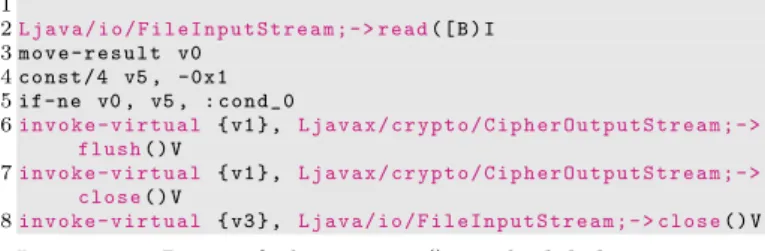
by Listing 2, which shows the encryption function em-ployed by a crypto-type ransomware sample3. Again, the functions to manipulate the bytes to encrypt belong to the System API (read and close, belonging to the
FileInputStream class of the java/io package; flush
and close, belonging to the CipherOutputStream class
of thejavax/cryptopackage).
In an Android application, based on Java, multiple methods are associated with classes that belong to pack-ages. Because of these characteristics, it is possible to en-code and represent System API information by either us-ing packages, classes, or methods. More specifically, meth-ods and classes better detail the functionality performed by the single API, but their number is significantly higher in comparison to packages. Hence, a solution that would employ the analysis of API methods would be far more complex than one that analyzes packages.
2MD5: 0cdb7171bcd94ab5ef8b4d461afc446c 3MD5: 59909615d2977e0be29b3ab8707c903a
1 2L j a v a / i o / F i l e I n p u t S t r e a m ; - > r e a d( [ B ) I 3m o v e - r e s u l t v0 4c o n s t / 4 v5 , - 0 x 1 5i f - n e v0 , v5 , : c o n d _ 0 6i n v o k e - v i r t u a l { v1 } , L j a v a x / c r y p t o / C i p h e r O u t p u t S t r e a m ; - > f l u s h( ) V 7i n v o k e - v i r t u a l { v1 } , L j a v a x / c r y p t o / C i p h e r O u t p u t S t r e a m ; - > c l o s e( ) V 8i n v o k e - v i r t u a l { v3 } , L j a v a / i o / F i l e I n p u t S t r e a m ; - > c l o s e( ) V
Listing 2: Parts of the encrypt() method belonging to an encryption-type ransomware sample.
4. Related Work
Most of Android malware detectors typically discrimi-nate between malicious and benign apps, and we refer to them as generic malware-oriented detectors. However, as the scope of this work is mostly oriented to ransomware detection, this Section will be mainly focused on describ-ing systems that aim to detect such attacks ( ransomware-oriented detectors) specifically. A brief description of the other detectors will be provided at the end of this Section. The most popular and publicly available ransomware-oriented detector is HelDroid, proposed by Andronio et al. [7]. This tool includes a text classifier (based on NLP features) that works on suspicious strings used by the ap-plication, a lightweight smali emulation technique to de-tect locking strategies, and the application of taint track-ing for detecttrack-ing file-encrypttrack-ing flows. The system has then been further expanded by Zheng et al. [8] with the new name of GreatEatlon and features significant speed improvements, a multiple-classifier system that combines the information extracted by text- and taint-analysis, and so forth. However, the system is still computationally de-manding and it still strongly depends on a text classifier: the authors trained it on generic threatening phrases, sim-ilar to those that typically appear in ransomware or scare-ware. This strategy can be easily thwarted by employing, e.g., string encryption [12]. Moreover, it strongly depends on the presence of a language dictionary for that specific ransomware campaign.
Yang et al. [16] proposed a tool to monitor the activity of ransomware by dumping the system messages log, in-cluding stack traces. Sadly, no implementation has been released for public usage.
Song et al. [15] proposed a method that aims to dis-criminate between ransomware and goodware using pro-cess monitoring. In particular, they considered system-related features representing the I/O rate, as well as the CPU and memory usage. The system has been evaluated with only one ransomware sample developed by the au-thors, and no implementation is publicly available.
Cimitile et al. [13] introduced an approach to detect ran-somware that is based on formal methods [17, 18](by using a tool calledTalos), which help the analyst identify mali-cious sections in the app code. In particular, starting from the definition of payload behavior, the authors manually
formulated logic rules that were later applied to detect ransomware. Unfortunately, such a procedure can become extremely time-consuming, as an expert should manually express such rules.
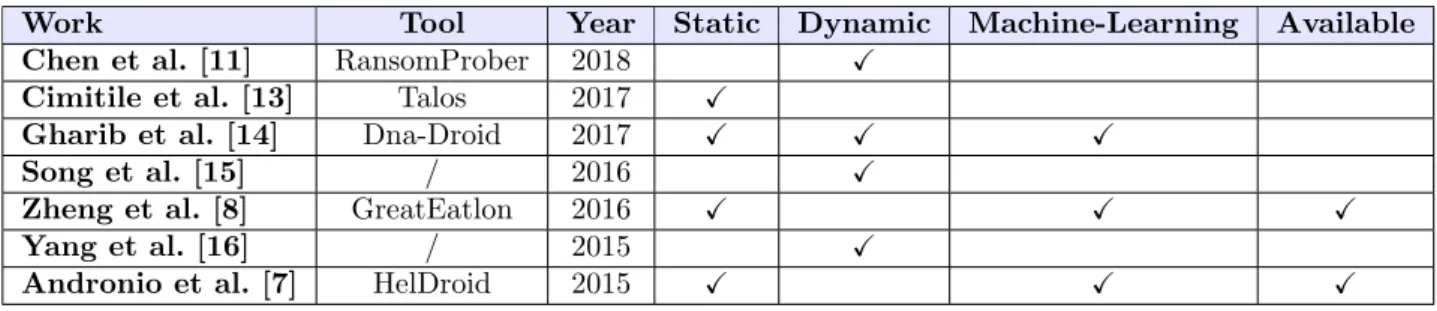
Gharib et al. [14] proposedDna-Droid, a static and dy-namic approach in which applications are first statically analyzed, and then dynamically inspected if the first part of the analysis returned a suspicious result. The system uses Deep Learning to provide a classification label. The static part is based on textual and image classification, as well as on API calls and application permissions. The dynamic part relies on sequences of API calls that are com-pared to malicious sequences, which are related to malware families. This approach has the drawback that heavily ob-fuscated apps can escape the static filter, thus avoiding to be dynamically analyzed. Finally, Chen et al. [11] pro-posed RansomProber, a purely dynamic ransomware de-tector which employs a set of rules to monitor different aspects of the app execution, such as the presence of en-cryption or anomalous layout structures. The attained re-sults report a very high accuracy, but the system has not been publicly released yet (to the best of our knowledge). Table 1 shows a comparison between the state-of-the-art methods for specifically detecting or analyzing Android ransomware. It is possible to observe that there is a cer-tain balance between static- and dynamic-based methods. Some of them also resort to Machine-Learning to perform classification. Notably, only HelDroid and GreatEatlon are currently publicly available.
Concerninggeneric malware-oriented detectors, Arp et al. [3] proposed Drebin, a machine learning system that uses static analysis to discriminate between generic mal-ware and trusted files. They extracted various features from both the Manifest file and the Android executable, including IP addresses, suspicious API calls, permissions, and so forth. Tam et al. [19] introduced a system to per-form dynamic analysis and detection of Android malware by analyzing the system calls performed by the applica-tion. Avdieenko et al. [20] used taint analysis to detect anomalous flows of sensitive data, a technique that al-lowed to detect novel malware samples without previous knowledge. Yang et al. [21] analyzed malicious apps by defining and extracting the context related to security-sensitive events [22, 23]. In particular, the authors de-fined a model of context based on two elements: activa-tion condiactiva-tions (i.e., what makes specific events occur) and guarding conditions (i.e., the environmental attributes of a specific event).
Aresu et al. [24] clustered Android malware by using the network HTTP traffic generated by those applications. Such clusters can be used to generate signatures that al-low discriminating between malware and legitimate appli-cations. Canfora et al. [25] experimentally evaluated two techniques for detecting Android malware: the first one is based on Hidden Markov Model (HMM), and the sec-ond one exploits Structural Entropy. The attained results showed that both techniques could be suitable for Android
Table 1: An overview of the current state-of-the-art, ransomware-oriented approaches.
Work Tool Year Static Dynamic Machine-Learning Available
Chen et al. [11] RansomProber 2018 X
Cimitile et al. [13] Talos 2017 X
Gharib et al. [14] Dna-Droid 2017 X X X
Song et al. [15] / 2016 X
Zheng et al. [8] GreatEatlon 2016 X X X
Yang et al. [16] / 2015 X
Andronio et al. [7] HelDroid 2015 X X X
malware detection.
Chen et al. [4] proposed StormDroid, a static and dy-namic machine-learning based system that extracts infor-mation from API-calls, permissions and behavioral fea-tures. Ahmadi et al. [5] proposed IntelliAV, a generic malware-oriented detector that is publicly available. Such a detector provides a level of dangerousness for each app but does not directly specify the family nor the type of attack.
Garcia et al. [9] proposed RevealDroid, a static sys-tem for detecting Android malware samples and classi-fying them in families. The system employs features ex-tracted from reflective calls, native APIs, permissions, and many other characteristics of the file. The attained results showed thatRevealDroidwas able to attain very high ac-curacy, resilience to obfuscation. However, the number of extracted features can be extremely high and depends on the training data.
Zhang et al. [26, 27] leveraged machine learning-based solutions that employed dependency graphs extracted by observing network events. In particular, in [26], they pro-posed a traffic analysis method that employed scalable al-gorithms for the detection of malware activities on a host. Such a detection was performed by exploring request-level traffic and the semantic relationships among network events. The attained results showed high accuracy at de-tecting spyware, DNS bot, and data exfiltrating malware. In [27], they employed a learning-based solution that an-alyzed information extracted from the dynamic analysis of the network events generated by Android malware. In particular, they profiled the traffic generated by benign ap-plications and modeled (through graphs called triggering relation graphs) the triggering relationship of the gener-ated network events (i.e., how such events are relgener-ated to each other) to identify anomalous, malicious ones. The authors demonstrated that these graphs could be particu-larly useful to detect suspicious network requests.
Finally, for the sake of completeness, we mention here other recent works that have analyzed the topic of ran-somware detection on X86 (in particular, on Windows platforms) by employing dynamic analysis techniques to perform early detection of the attack. Using such tech-niques avoid possible damages to the operating system and its files. [28, 29, 30, 31].
5. Methodologies
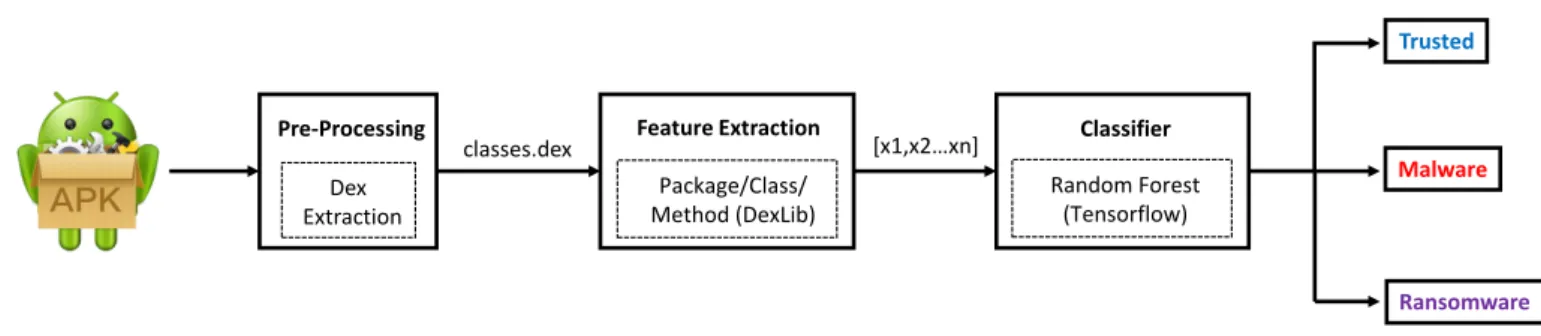
We now describe the general structure of systems that employ System API information to identify ransomware, also known asransomware-oriented detectors. While the majority of learning-based detection systems combine var-ious types of information to detect as many attacks as pos-sible,ransomware-oriented detectors tailor their detection on a smaller set of information (System API) that is typi-cally employed in ransomware. However, as System APIs are also widely used in generic malware and legitimate files, this information type also allows detecting other attacks that differ to ransomware. In this way, it is possible to create a powerful, wide-spectrum detector that features a much lower complexity in comparison to other approaches. Typically, such systems take as input an Android applica-tion, analyze it and return three possible outputs: ran-somware,generic malwareortrusted. The analysis is performed in three steps:
• Pre-Processing. In this phase, the application is analyzed to extract its DexCode. The required infor-mation is extracted by only inspecting the executable code and does not perform any analysis on other ele-ments, such as the application Manifest. Only specific lines of code, which will be described later in this Sec-tion, will be sent to the next module.
• Feature Extraction (System API). In this phase, the code lines received from the previous phase are further analyzed to extract the related System API
information (either packages, classes, or methods). Theoccurrence of such pieces of information is then counted, thus producing a vector of numbers (feature vector) that is sent to a classifier.
• Classifier. Classification is carried out through a su-pervised approach, in which the system is trained with samples whose label (i.e., benign, generic malware or ransomware) is known. Such technique has been used in previous works with excellent results [3, 2, 9]. In particular, our approaches employ Random Forest classifiers, which are especially useful to handle multi-class problems, and which are widely used for malware detection. The complexity of such classifiers depends
on the number of trees that compose them. Such a number must be optimized during the training phase. The structure above is graphically represented in Figure 1. In the following, we provide more details about each phase of the analysis, by focusing in particular on the type of features that can be extracted from the application.
5.1. Preprocessing and Feature Extraction
The general idea of the first two phases is performing static analysis of the Dalvik bytecode contained in the classes.dex file. The goal is retrieving the System API information employed by the executable code of the ap-plication. The choice of System API information is related to two basic ideas:
• Coherence with actions. Most ransomware writers resort to System APIs to carry out memory- or kernel-related actions (for example, file encryption or mem-ory management). Focusing on user-implemented APIs (as it happens, for example, with Drebin [3]) exposes the system to a risk of being evaded by sim-ply employing different packages to perform actions.
• Independence from Training. System API calls are features independent of the training data that are used. As a consequence, it is less likely that appli-cations are not correctly analyzed only because they employ never-seen-before APIs.
• Resilience against obfuscation. Using heavy ob-fuscation routines typically lead to injecting system API-based code in the executable, which can be ex-tracted and analyzed, allowing to detect suspicious files.
Pre-processing is hence easily performed by directly ex-tracting the classes.dex file from the .apk app. Since .apk files are essentially zipped archives, such an opera-tion is rather straight-forward.
Once pre-processing is complete, theclasses.dexfile is further analyzed by the feature extraction module, which inspects the executable file for allinvoke-type instructions (i.e., all instructions related to invocations) contained in
theclasses.dexcode. Then, each invocation is inspected
to extract the relevant API information for each method-ology, according to a System API reference list that de-pends on the operating system version (in our case, An-droid Nougat - API level 25 - a widely-used API set). Only the API elements that belong to the reference list are an-alyzed. In this paper, we consider three different method-ologies, based on, respectively, package, class, and method extraction. If a specific API element is found, its occur-rence value is increased by one.
In the following, we provide a more detailed description of the methodologies employed in this paper, by referring to the example reported in Listing 3. The code is parsed
in three ways, according to each feature extraction strat-egy. For each example, we used a very small subset of the employed reference API.
• Packages Extraction. In this methodology, we extract the occurrences of the System API pack-ages (a total of 270 reference features), in the same way of our previous work [10]. In the example of Listing 3, we used a subset composed of three ref-erence API packages: java/io, java/crypto and
java/lang. The fourinvokeinstructions are related
to the javax/crypto and java/io packages, which are counted respectively twice. Thejava/lang pack-age is never used in this snippet. Hence, its value is zero.
• Classes Extraction. In this methodology, we ex-tract the occurrences of the System API classes (a to-tal of 4609 reference features). Notably, such classes belong to the System API packages of the previous methodology (and, for this reason, their number is significantly higher than packages). In the example of Listing 3, we used a subset composed of two ref-erence API classes: java/io/FileInputStream and
javax/crypto/CypherOutputStream, each of them
appearing twice.
• Methods Extraction. In this methodology, we extract the occurrences of the System API methods (a total of 36148 reference features). These methods belong to the System API classes of the previous methodology, leading to a very consistent number of features. This strategy is very similar to other ones employed by other systems (e.g.. [3, 9]), which have used these features together with user-implemented APIs and other features. In the example of Listing 3, we used a subset composed of four reference API methods: java/io/FileInputStream/read,
javax/crypto/CypherOutputStream/flush,
javax/crypto/CypherOutputStream/close and
java/io/FileInputStream/close. Each API call
appears only once. Note that, although there are two methods named close, they belong to two different classes, and they are therefore considered as different methods.
6. Experimental Evaluation
In this Section, we report the experimental results at-tained from the evaluation of the three API-based strate-gies. Note that, for the sake of simplicity and speed, we did not run the experiments on Android phones, but on an X86 machine. However, we built a full, working im-plementation of one of the three approaches, which can be downloaded from the Google Play Store (see next Section). The rest of this Section is organized as follows: we start by providing an overview of the dataset employed in our
Pre-Processing Dex Extraction Feature Extraction Package/Class/ Method (DexLib) Classifier Trusted Malware Ransomware classes.dex [x1,x2…xn] Random Forest (Tensorflow)
Figure 1: General Structure of a System API-based, ransomware-oriented system.
1 2C o d e 3 4L j a v a / i o / F i l e I n p u t S t r e a m ; - > r e a d( [ B ) I 5m o v e - r e s u l t v0 6c o n s t / 4 v5 , - 0 x 1 7i f - n e v0 , v5 , : c o n d _ 0 8i n v o k e - v i r t u a l { v1 } , L j a v a x / c r y p t o / C i p h e r O u t p u t S t r e a m ; - > f l u s h( ) V 9i n v o k e - v i r t u a l { v1 } , L j a v a x / c r y p t o / C i p h e r O u t p u t S t r e a m ; - > c l o s e( ) V 10i n v o k e - v i r t u a l { v3 } , L j a v a / i o / F i l e I n p u t S t r e a m ; - > c l o s e( ) V 11 12F e a t . V e c t o r s 13 14P a c k a g e s - [2 2 0] 15 16C l a s s e s - [2 2] 17 18M e t h o d s - [1 1 1 1]
Listing 3: An example of feature extraction by considering a small number of reference features.
experiments. Then, we describe the results attained by four evaluations. The first one aimed to establish the gen-eral performances of API-based approaches by considering random distributions of training and test samples. The second one aimed to show how API-based approaches be-haved when analyzing samples released after the training data. The third one aimed to show a comparison between our API-based approaches and other systems that em-ployed mixed features. Finally, we evaluated the resilience of API-based approaches against obfuscation techniques and evasion attacks.
6.1. Dataset
In the following, we describe the dataset employed in our experiments. Without considering obfuscated appli-cations (which are going to be discussed in Section 6.3), we obtained and analyzed 39 157 apps, which are organized in the three categories we mentioned in Section 5.
6.1.1. Ransomware
The 3017 samples used for our ransomware dataset were retrieved from theVirusTotalservice4 (which aggregates
4http://www.virustotal.com
the detection of multiple anti-malware solutions) and from
theHelDroiddataset5[7]. With respect to the samples
ob-tained fromVirusTotal, we used the following procedure to obtain the samples: (i) we searched and downloaded the Android samples whose anti-malware label included the wordransom;(ii)for each downloaded sample, we ex-tracted its family by using the AVClass tool [32], which essentially combines the various labels provided by anti-malware solutions to create a unique label that identifies the sample itself; (iii) we considered only those samples whose family was coherent to ransomware behaviors, or was known to belong to ransomware.
Table 2: Ransomware families included in the employed dataset. Family Samples Locker 752 Koler 601 Svpeng 364 SLocker 281 Simplocker 201 LockScreen 122 Fusob 120 Lockerpin 120 Congur 90 Jisut 86 Other 280
In general, our goal was obtaining a representative cor-pus of ransomware to ascertain the prediction capabilities of API-based techniques. For this reason, the dataset in-cludes families that perform both device locking (such as
Svpeng and LockScreen) and encryption (such as Koler
and SLocker). For a better description of the families
above, please see Section 3.
6.1.2. Malware and Trusted
We considered a dataset composed of 17 744 Android malware samples that do not belong to the ransomware
category, taken from the following sources: (i) Drebin dataset, one of the most recent, publicly available datasets of malicious Android applications6 (which also contains the samples from the Genome dataset [33]);(ii)Contagio, a popular free source of malware for X86 and mobile;
(iii) VirusTotal. These samples were chosen to verify whether even non-ransomware attacks could be detected with features that are particularly effective at classifying ransomware samples.
In order to download trusted applications, we resorted to two data sources: (i) we crawled the Google Play market using an open-source crawler7; (ii) we extracted a num-ber of applications from theAndroZoodataset [34], which features a snapshot of the Google Playstore, allowing to access applications without crawling the Google services easily. We obtained 18 396 applications that belong to all the different categories available on the market. We chose to focus on the most popular apps to increase the proba-bility of downloading malware-free apps.
6.2. Experiment 1: General Performances
In this experiment, we evaluated the general perfor-mances of System API-Based methods (described in Sec-tion 5) at detecting ransomware and generic malware. To do so, for each strategy, we randomly split our dataset by 50%, thus using the first half to train the system and the second half to evaluate the system. The number of trees of the random forests was evaluated by performing a 10-fold cross-validation on the training data. We repeated the whole process 5 times, and we averaged the results by also determining the standard deviation, in order to understand the dependence of the system on the training data.
Considering the multi-class nature of the problem, we represented the results by calculating the ROC curve for each API-based strategy in two different cases:
• Ransomware against benign samples. The cru-cial goal of our work is detecting ransomware attacks and, more importantly, to avoid them being consid-ered as benign files. A critical mistake would most likely compromise the whole device by locking it or encrypting its data. For this reason, it is essential to verify whether ransomware attacks can be confused with benign samples.
• Generic malware against benign samples. Even if System API-based strategies were employed to de-tect ransomware, they could also be used to classify generic malware (see Section 5). Hence, the goal here is to verify, from a practical perspective, if System API-based information can correctly detect other non-ransomware attacks and distinguish them from legit-imate files.
6
https://www.sec.cs.tu-bs.de/~danarp/drebin/
7https://github.com/liato/android-market-API-py
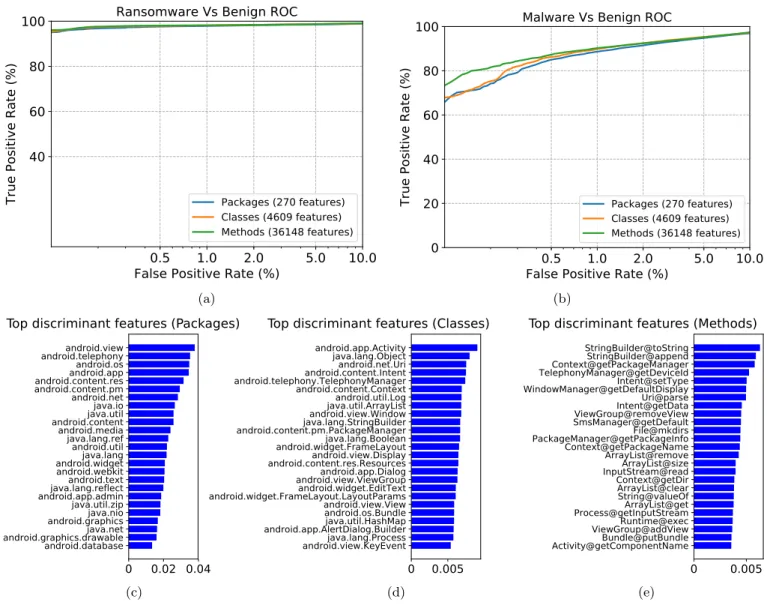
Results are reported in Figure 2. Parts (a) and (b) show the ROC curves that describe the performances attained on ransomware and generic malware detection by the three System API-based methods (packages, classes, methods). By observing these curves, we can deduce the following facts:
1. All System API-based techniques were able to pre-cisely detect more than 97% of ransomware samples with only 1% of false positives. Because our dataset included a consistent variety of families, we claim that all strategies can detect the majority of ransomware families in the wild. Worth noting, there are no dif-ferences in results between using packages, classes or methods. This result means that, concerning gen-eral performances, using finer-grained features does not improve detection.
2. All System API methods featured good accuracy with relatively low false positives (around 90% at 1%, more than 95% at 2%) at detecting generic malware. While using class-related features did not bring significant improvements to detection, using methods allowed for a 10% improvement for false positive values inferior to 0.5%.
To better understand the results attained by our strate-gies, parts (c), (d) and (e) report a ranking of features used by the classifier for each strategy (respectively, pack-ages, methods, and classes), according to their discrimi-nant power. The feature ranking is calculated according to the features Information GainIG, given by the follow-ing formulation:
IG(T, a) =H(T)−H(T|a) (1)
whereH(T) is the overall entropy for the whole dataset T andH(T|a) is the average entropy obtained by splitting the setT using the attributea. The higher is the gain, the more relevant the feature is.
As a result, note how the information gain for each fea-ture is not so high, meaning that the system does not par-ticularly overfit on specific information and that the final decision is taken by considering a combination of multi-ple features. At the same time, each feature value is re-duced, in comparison to packages, by one magnitude for classes and methods. In other words, using more features allows for distributing the importance of the analyzed in-formation through more elements. This characteristic is two-faced: while it makes the overall behavior of the sys-tem less interpretable, it may increase the effort that an attacker has to make to evade the system.
Analyzing the most discriminant methods can give a clearer idea of which information is used to classify applications. Features are related to string building (e.g., the ToString method), Array management (e.g.,
ArrayList@size,ArrayList@remove), creation of folders
0.5
1.0
2.0
5.0 10.0
False Positive Rate (%)
40
60
80
100
True Positive Rate (%)
Ransomware Vs Benign ROC
Packages (270 features)
Classes (4609 features)
Methods (36148 features)
0.5
1.0
2.0
5.0 10.0
False Positive Rate (%)
0
20
40
60
80
100
True Positive Rate (%)
Malware Vs Benign ROC
Packages (270 features)
Classes (4609 features)
Methods (36148 features)
(a) (b)
Top discriminant features (Packages) Top discriminant features (Classes) Top discriminant features (Methods)
0 0.02 0.04
android.view android.telephonyandroid.os android.app android.content.res android.content.pmandroid.net java.io java.util android.contentandroid.media java.lang.refandroid.util java.lang android.widgetandroid.webkit android.text java.lang.reflect android.app.adminjava.util.zip java.nio android.graphicsjava.net android.graphics.drawableandroid.database0 0.005
android.app.Activityjava.lang.Object android.net.Uri android.content.Intent android.telephony.TelephonyManagerandroid.content.Context android.util.Log java.util.ArrayList android.view.Window java.lang.StringBuilder android.content.pm.PackageManagerjava.lang.Boolean android.widget.FrameLayoutandroid.view.Display android.content.res.Resourcesandroid.app.Dialog android.view.ViewGroupandroid.widget.EditText android.widget.FrameLayout.LayoutParamsandroid.view.View android.os.Bundlejava.util.HashMap android.app.AlertDialog.Builderjava.lang.Process android.view.KeyEvent0
0.005
StringBuilder@toStringStringBuilder@append Context@getPackageManager TelephonyManager@getDeviceIdIntent@setType WindowManager@getDefaultDisplayUri@parse Intent@getData ViewGroup@removeView SmsManager@getDefaultFile@mkdirs PackageManager@getPackageInfoContext@getPackageName ArrayList@removeArrayList@size InputStream@readContext@getDir ArrayList@clearString@valueOf ArrayList@get Process@getInputStreamRuntime@exec ViewGroup@addViewBundle@putBundle Activity@getComponentName (c) (d) (e)Figure 2: Results for the experiment 1. In the first row, we report the ROC curves (averaged on 5 splits) attained by the three System API methods for ransomware (a) and generic malware (b) against benign samples. In the second row, we report the top-25 features, ordered by the classifier information gain (calculated by averaging, for each feature, the gains that were obtained by training the 5 splits), for each methodology ((c) for packages, (d) for classes, (e) for methods).
and so forth. These features may be easily associated both to ransomware and malware behavior, and the same be-havior is shown on classes and packages.
A careful examination of the feature ranking may also help to understand why specific samples are regarded as false positives or false negatives. In particular, detection is performed by weighting the information provided by a combination of the most discriminant features. For this reason, in some cases, specific ransomware (or generic mal-ware) samples may contain discriminant features that are distributed differently to the malicious training distribu-tion. For example, thetoStringcall may appear, on aver-age, 5 times on ransomware, but one specific sample may feature it only 1 time. This phenomenon may occur for various reasons, including the possibility that an attacker may be using customized variants of System API
infor-mation to avoid detection (see Section 8). Likewise, the techniques used to create the sample (e.g., repackaging) may have an impact on the distribution of the features. Further refinement of the feature list (or a change of the weights of specific feature) may help to reduce the amount of misclassified samples.
6.3. Experiment 2: Temporal Performances
In this experiment, we assessed the capabilities of Sys-tem API-based methods at detecting ransomware samples that were first seen (according to the creation date of the
classes.dexexecutable belonging to each application)
af-ter the data that were used as training set. This assess-ment is useful to understand if, without constant upgrades to its training set, such methods would be able to detect novel, unseen ransomware samples.
0.0
0.2
0.4
0.6
0.8
1.0
Accuracy
01 09/2017
10/2017
11/2017
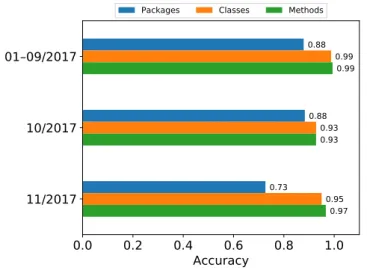
0.88 0.88 0.73 0.99 0.93 0.95 0.99 0.93 0.97 Packages Classes MethodsFigure 3: Results of the temporal evaluation for the System API-based strategies. The accuracy values are reported for the three System API-based detection. The training data belong to 2016, while the test data is composed of ransomware released in different months of 2017.
For this assessment, we included in the training set (along withall generic malware and trusted samples) ran-somware samples that were first seen before a date Dtr,
and we tested our system on a number of ransomware sam-ples that were released on a dateDtefor whichDte> Dtr
(we chose the ROC operating point of the system corre-sponding to a false positives value of 1%). We performed our tests by choosing different values ofDte, where Dtr is
December 31st, 2016. Concerning test data, we point out that the samples (which were extracted by theVirusTotal service) were unevenly distributed through the months. More specifically, the number of ransomware samples that were submitted to theVirusTotalservice was significantly different for each month of 2017. In particular, we could retrieve only a little amount of samples whose first release date was between January and September 2017. Con-versely, we could obtain a consistent amount of samples whose Dte was October and November 2017. Therefore,
we grouped the samples gathered in subsequent months to obtain temporal ranges with similar amounts of testing data. We considered three main ranges for Dte: (i)
Jan-uary to September 2017;(ii)October 2017;(iii)November 2017.
Results are provided in Figure 3, which shows that by training the system with data retrieved in 2016, class-and method-based strategies could accurately detect ran-somware test samples released in 2017. However, the package-based strategy struggled at detecting the test-set from November 2017. Notably, in comparison with class-and method-based strategies, the package-based approach showed almost a 10% accuracy loss when analyzing sam-ples released till October, and more than 20% accuracy loss for samples released in November. Conversely, the other two methods exhibited stable accuracy on each temporal
range. This result is particularly interesting, as it shows that the prediction of novel samples can be significantly improved by employing finer-grained features. However, the results attained by package-based features are never-theless encouraging, as they showed that even a reduced number of features could attain good performances at de-tecting novel attacks. Overall, this experiment further confirmed that System API-based strategies could predict new ransomware attacks with good accuracy, even on test data released. In this case, using finer-grained features brings a consistent advantage to detection.
6.4. Experiment 3: Comparison with Other Approaches
This section proposes a comparison between Sys-tem API-based strategies and other state-of-the-art ap-proaches. We were particularly interested in comparing our approach to other publicly available ones, with a spe-cial focus on those who were specifically designed to de-tect ransomware. Additionally, we considered those ap-proaches that, albeit not explicitly designed to detect ran-somware, could tell if the analyzed sample is malicious or not. In particular, almost all of the analyzed tools (except
forTalos[13] - which does not employ Machine Learning)
discriminate between two classes (malware and benign or ransomware and benign), while our approaches discrim-inate between three classes (ransomware, malware, and benign). Hence, it is interesting to observe how increas-ing the number of classes may impact the precision of the analysis.
We performed a temporal comparison of all systems on the ransomware samples released in 2017 (for a total of 512 samples) by using as training (when possible) all data released until 2016.
The state-of-the-art approach that is closest to what we proposed in this paper (while being publicly available8)
is GreatEatlon [8]. Notably, it was not possible for us
to control the trained model of the system (it was only possible to choose among a restricted set of classifiers), or to train it with new data. Nevertheless, the system was released in 2016, meaning that data that was first seen in 2017 was for sure not included in its training set. Although not specifically tailored to ransomware detection, we also tested the performances ofRevealDroid(which is publicly available9 [9]) on the same test data. In this case, we could train the system with the same data used in our systems, which allowed us to provide a fairer comparison. Finally, we also tested the performances of the Android version of
IntelliAV (available on the Google Play Store) [5]. As
inGreatEatlon, we could not control the training data of
the system. Moreover, as IntelliAV reports three levels of risk for each app (safe, suspicious, risky), we considered as malicious also the files that were labeled as suspicious by the system.
8https://github.com/necst/heldroid
As classifier forGreatEatlon we chose Stochastic Gra-dient Descent (SGD), since this was the classifier that best performed on our test samples. Concerning RevealDroid, we chose the linear SVM classifier, as this was the one that provided the best results in the original work [9].
IntelliAV only employed Random Forests. Results are
reported in Table 3.
The attained results show that System API-based tech-niques obtained very similar performances toRevealDroid (which could only, however, classify samples either as mal-ware or benign). Such results are particularly interesting if we consider thatRevealDroidextracted a huge number of features (more than 700,000) from multiple characteristics of the file, including native calls, permissions, executable code analysis, which also depended on the training data. With a much simpler set of information, we were able to obtain very similar performance concerning accuracy. This result is especially interesting from the perspective of ad-versarial attacks, as using fewer features for classification can make the system more robust against them (the at-tacker can manipulate less information to evade the sys-tem) [35]. The performances attained by System API-based approaches were also better thanIntelliAV, which employed a combination of different features (including permissions, user-defined API, and more). System API-based strategies also performed significantly better than
GreatEatlon, which based its detection also on
informa-tion extracted from strings and language properties. No-tably, using methods significantly improved the accuracy performances in comparison to packages and classes, in line to what obtained from Experiment 2. Finally, we an-alyzed the performances attained byTalos[13]10, a static analysis tool that employs logic rules to perform detec-tion (hence, without machine learning). The attained re-sults were very encouraging, but they strongly depended on the set of rules that have been (manually) established to perform ransomware detection. Conversely, System API-based approaches did not require any manual definition of the detection criteria. Additionally, the analysis times
of Talos are significantly slower than the ones attained
by methods proposed in this work (an average of 100 sec-onds per application, 400 times slower than ours - see Sec-tion 7.1).
6.5. Experiment 4: Resilience against Obfuscation
The goal of this experiment was assessing the robustness of System API-based strategies against obfuscated sam-ples, i.e., understanding whether the application of com-mercial tools to samples could influence the detection ca-pability of the systems. This evaluation is important, as commercial obfuscation tools are quite popular nowadays since they introduce good protection layers against static analysis (e.g., to avoid pieces of legitimate applications to
10We directly obtained Talos from the authors, as it is not
cur-rently publicly available.
be copied). Previous works showed that attackers could exploit this aspect by obfuscating malware samples with such tools, thus managing to bypass anti-malware detec-tion [12].
In this experiment, we primarily focused on obfuscated samples whose original (i.e., non-obfuscated) variant was already included in the training set. Such a choice was made because we wanted to assess if obfuscation was enough to influence the key-features of System API-based methods, thuschanging the classifiers’ decision for a sam-ple whose original label was malicious.
To this end, we employed a test-bench of ransomware obfuscated with the toolDexProtector11, a popular, com-mercial obfuscation suite that allows for protecting An-droid applications through heavy code obfuscation. Al-though such a tool is mostly used for legitimate purposes (e.g., protection of intellectual properties), it can also be used by attackers to make malicious applications harder to be detected. Out of the 3017 ransomware samples, we could obfuscate 2668 samples (the remaining could not be obfuscated due to errors of the obfuscation software) with three different strategies (for a total of 8004 obfuscated samples). The strategies employed to obfuscate samples were the following:
• String Encryption. This strategy encrypts strings that are related to const-string instructions, and injects a user-implemented method that performs de-cryption at runtime.
• Resource Encryption. It encrypts the external resources contained in the res and assets folders. To do so, it adds System API information to the
classes.dex file, in order to properly manage the
encryption routines.
• Class Encryption. This strategy encrypts user-implemented classes, and injects routines that allow to perform dynamic loading of such classes.
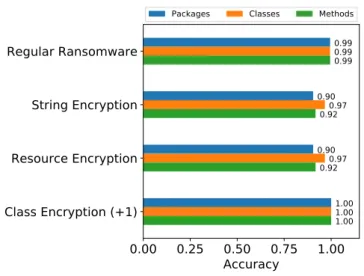
Figure 4 reports the accuracy attained by the three Sys-tem API-based strategies against the obfuscated samples. Such results show that all the detection strategies (with-out significant differences between each other) are resilient against obfuscation attempts. However, Class Encryption deserves separate consideration. This strategy employs heavy obfuscation, and it was explicitly performed to de-feat static analysis. Typically, none of the static-based techniques that analyze the executable file should be able to detect such attacks correctly. However, this obfusca-tion strategy introduces a very regular sequence of System API-based routines that manage runtime decryption of the executable contents.
For this reason, it is sufficient to inject only one sam-ple inside the training set to make all obfuscated samsam-ples
Table 3: Detection performances for System API-based strategies, GreatEatlon, IntelliAV, RevealDroid and Talos on 512 ransomware test files released in 2017, by using training data from 2016. We use the ND (Not Defined) to indicate that a certain tool cannot provide the corresponding label for the analyzed samples.
System Benign Generic Malware Ransomware
Talos 3 0 509
System API (Methods) 7 12 493
System API (Classes) 10 15 487
System API (Packages) 11 32 469
GreatEatlon 118 N D 394 RevealDroid 0 512 N D IntelliAV 18 494 N D
0.00 0.25 0.50 0.75 1.00
Accuracy
Regular Ransomware
String Encryption
Resource Encryption
Class Encryption (+1)
0.99 0.90 0.90 1.00 0.99 0.97 0.97 1.00 0.99 0.92 0.92 1.00 Packages Classes MethodsFigure 4: Accuracy performances attained on ransomware sam-ples that have been obfuscated with three different techniques. The accuracy values are reported for the three System API-based detection.
to be detectable. Hence, we added the +1 mark to Class Encryption. Notably, this may create false positives when legitimate samples are obfuscated with the same strategy. Nevertheless, it is sporadic to find such applications, as Class Encryption strongly decreases the application per-formances [12], and much simpler obfuscation techniques are generally used.
7. Implementation and Performances
Although many solutions have been proposed in the wild to detect ransomware and generic malware, almost none (with the exception, for example, of [5]) was ported to An-droid devices, often due to the complexity of the proposed approaches. However, an offline, on-device solution is very useful to perform early detection of applications down-loaded, for example, from third-party markets (which are more subjected to malware attacks). For this reason, and also to demonstrate the suitability of System API-based approaches, we ported the simplest of the three
strate-gies (Package-based) with the name of R-PackDroid (as it implements the same approach introduced in our previ-ous work [10]). This implementation scans for any down-loaded, installed and updated applications, and it classifies them as ransomware, malware or legitimate. If an appli-cation is found as malicious, the user can immediately re-move it.
R-PackDroid has been designed to work on the largest
amount of devices possible. Hence, during its develop-ment, we focused on optimizing its speed and battery con-sumption. For this reason, we avoided any textual parsing of bytecode lines (which can be attained by transform-ing the.dex file to multiple.smali files with ApkTool). Therefore, we resorted to DexLib, a powerful parsing li-brary part of the baksmali12 disassembler (and used by
ApkToolitself), to directly extract method calls and their
related packages. This library allowed to obtain a very high precision at analyzing method calls and significantly reduces the presence of bugs or wrong textual parsing in the analysis phase.
The classification model has been implemented by using
Tensorflow13, an open source, machine learning
frame-work which has been designed to be also used in mobile phones. In particular, we adapted its Random Forest im-plementation (TensorForest) to the Android operating system. Notably, our Android application only performs classification by using a previously trained classifier. The training phase is carried out separately, on standard X86 architectures. This choice was made to ensure the max-imum easiness of use to the final user, thus reducing the risk of invalidating the existing model.
Figure 5 shows an example of the main screen of
R-PackDroid. The application is parsed either when it
is downloaded from any store, or when the user decides to scan it (or to scan the whole file system). Each applica-tion is identified by a box, whose color is associated with the application label (green for trusted, red for malware and violet for ransomware). After getting the result, by clicking on each box related to the scanned application, it
12https://github.com/JesusFreke/smali 13https://www.tensorflow.org/
Figure 5: An example of the AndroidR-PackDroidscreen.
is possible to read more details about the packages that it employs, as well as general information such as the app hash and size. Moreover, if the user believes that the re-sult reported by R-PackDroidis wrong, she can report it by simply tapping a button (a privacy policy to accept is also included). To this scope, we resort to the popular service FireBase14. R-PackDroid is available for free on the Google Play Store (for the moment, Android versions until 7.1 are supported).
7.1. Computational Performances
We analyzed the computational performances of
R-PackDroid by running it both on X86 and Android
en-vironments. In particular, we focused on extracting the time interval between the.apkloading and the generation of the feature vector for 100 benign samples (grouped by their.apksize)15. The choice of benign samples was made because they are typically more complex to be analyzed in comparison with generic malware and ransomware. We first ran our experiments on a 24-core Xeon machine with 64 GB of RAM. The attained results, shown in Figure 6, proved that our system could analyze even huge applica-tions in less than 0.2 seconds.
To evaluate the performances of R-PackDroidon a real Android phone, we ran the same analysis on a Nexus 5, a 5-years-old, 4-core device with 2 GB of RAM, equipped with the 6.0.1 version of Android. Results are reported
14https://firebase.google.com/
15The elapsed time to classify a sample, i.e., to read its feature
vector and get the final label, is negligible.
0-1
1-2
2-5
5-10
10-50
Sample Size (MB)
0.0
0.1
0.2
0.3
0.4
0.5
Elapsed Time (s)
Figure 6: Analysis performances on a X86 workstation, with the elapsed time in seconds, for different.apksizes.
in Figure 7. Even if the analysis times were slower than X86 machines, and even if we were using, in this case, the slowest version of the algorithm, the average analy-sis time for very large apps was slightly more than 4 sec-onds. This result was very encouraging, and it showed that
R-PackDroidcould be safely used even on old phones. The
higher dispersion of the time values, in comparison to the ones attained in the previous picture, was possibly caused by the presence of other background processes in the de-vice.
Finally, it is also important to observe that the analysis time is not strictly proportional to the .apk size, as the file may contain additional resources (e.g., images) that increase the.apksize, without influencing the size of the
DexCode itself. For this reason, it was not surprising to
see the attained average values did not necessarily increase with the.apksize.
0-1
1-2
2-5
5-10
10-50
Sample Size (MB)
0
2
4
6
8
Elapsed Time (s)
Figure 7: Analysis performances on a real device, with the elapsed time in seconds, for different.apksizes.
8. Discussion and Limitations
The results attained in Sections 6 and 7 can be summa-rized with the following findings:
• Finding 1. System API-based information could be effectively used, alone, to properly distinguish ran-somware from generic malware and legitimate appli-cations.
• Finding 2. Using finer-grained information (classes and methods), albeit involving more features in the analysis, brought significant improvements to ac-curacy when detecting previously, unseen samples. Moreover, using API-methods allowed for more ac-curacy under low false positives values.
• Finding 3. System API-based approaches could ob-tain comparable performances to other approaches that involved more features of different types.
• Finding 4. System API-based approaches guaran-teed robustness against typical obfuscation strategies such as string encryption. However, by including a few obfuscated samples in the training set, it was also possible to detect heavy, anti-static obfuscation tech-niques such as class encryption.
• Finding 5. System API-based approaches were well suitable to be ported and implemented on mobile devices, with excellent computational performances even on very large applications.
We point out that it would be possible to evade the proposed System API-based approaches by replacing System-related packages/classes/methods with semanti-cally equivalent, user-implemented ones. For example, at-tackers may have two possibilities to replace System API-based methods: (i)creating copies of the original instruc-tions of the methods and injecting them into fake methods;
(ii) re-implementing the methods by using customized in-structions/logic. However, these two approaches may fea-ture some critical limitations. In the first approach, the attacker is forced to import the copies of the instructions to thedexcode (as the methods become user-implemented). However, the imported codes may contain further refer-ences to other System API-based methods, which would need to be replaced. Therefore, this procedure may be-come unfeasible, considering the high variety of calls that can be invoked. The second approach may be hard to implement if the methods to be replaced are very sophisti-cated (e.g., methods related to cryptography or the execu-tion of activities). We observe that the first approach can be more effective when replacing System API-based pack-ages, as their variety is significantly lower in comparison to methods.
There would also be the possibility that a skilled at-tacker attempts to evade System API-based detection al-gorithms by performing Adversarial Machine Learning at-tacks, such as test-time evasion [36, 2]. In this scenario, the
goal would be evading the classifier detection with a mini-mal number of changes by performing fine-grained modifi-cations to the features of the analyzed test samples. How-ever, this strategy may be challenging to be performed in practice. The problem, also known in the literature as
Inverse Feature Mapping [36, 37, 38], is constructing the real sample that implements the modifications made to the feature vectors. As the changes to the feature vector would involve the injection or removal of specific System API-based information, they may not be feasible for the reasons we mentioned in the previous paragraph. We plan to inspect the adversarial-related aspects of System API-based methods, as well as the practical creation of evasive samples, in future work.
It is also worth noting that since Android Oreo (8.0), Google introduced new defenses against background pro-cesses that are typical of ransomware (e.g., the ones that directly lock the device). However, this does not exclude other malicious actions on the application level. For this reason, it is always better to have an additional system that can detect attempts at performing malicious actions. Finally, we also point out that, during our tests, we found samples that could not be analyzed due to crashes and bugs of the DexLib library, and that have therefore been excluded from our analysis. However, their percent-age (regarding the whole corpus that we analyzed) is neg-ligible (less than 1% of the whole file corpus).
9. Conclusions
In this work, we provided a detailed insight into how System API-based information could be effectively used (also on a real device) to detect ransomware and to dis-tinguish it from legitimate samples and generic malware. The attained experimental results demonstrated that, by using a compact set of information tailored to the detec-tion of a specific malware family (ransomware), it was possible to achieve detection performances (also on other malware families) that were comparable to systems that employed a much more complex variety of information. Moreover, System API-based information also proved to be valuable to detect obfuscated samples that focused on hiding user-implemented information. Notably, although it is tempting to combine as many information types as possible to detect attacks (or to develop computationally heavy approaches), it may not be the only, feasible way to construct accurate, reliable malware detectors. For this reason, we claim that future work should focus on develop-ing reliable, small sets of highly discriminant features that cannot easily be manipulated by attackers (with a partic-ular reference to machine learning attacks). Moreover, a clear understanding of the impact of each feature on the classifier detection (also known asexplainability) can help analysts understand the classifiers errors and to improve their detection capabilities.