Jeffrey M. Chwieroth
Professional ties that bind: how normative
orientations shape IMF conditionality
Article (Accepted version)
(Refereed)
Original citation:
Chwieroth, Jeffrey M. (2014) Professional ties that bind: how normative orientations shape IMF conditionality. Review of International Political Economy, 22 (4). pp. 757-787. ISSN 0969-2290 DOI: 10.1080/09692290.2014.898214
© 2014 Taylor & Francis
This version available at: http://eprints.lse.ac.uk/56796/ Available in LSE Research Online: September 2015
LSE has developed LSE Research Online so that users may access research output of the School. Copyright © and Moral Rights for the papers on this site are retained by the individual authors and/or other copyright owners. Users may download and/or print one copy of any article(s) in LSE Research Online to facilitate their private study or for non-commercial research. You may not engage in further distribution of the material or use it for any profit-making activities or any commercial gain. You may freely distribute the URL (http://eprints.lse.ac.uk) of the LSE Research Online website.
This document is the author’s final accepted version of the journal article. There may be differences between this version and the published version. You are advised to consult the publisher’s version if you wish to cite from it.
1 Professional Ties that Bind: How Normative Orientations Shape IMF Conditionality
Jeffrey M. Chwieroth
Professor of International Political Economy London School of Economics Department of International Relations
Houghton Street London WC2A 2AE Tel: [+44] (0) 20 7955 7209 Fax: [+44] (0) 20 7955 7446 E-Mail : [email protected]
Home page: http://personal.lse.ac.uk/Chwierot/
Abstract The staff play a key part in designing IMF conditionality, and yet the literature provides a narrow view of their motivations. This article shows how the design of IMF conditionality is linked to the normative orientations of the staff and their common
professional training. Professional ties from similar training help to bind the staff together around a shared set of normative orientations that inform the IMF’s policy goals. When borrowing country officials do not share these orientations, the staff are motivated to tighten conditionality. This behavior also fits with staff concerns about time-inconsistency and moral hazard. I find robust statistical support for this argument using a dataset based on the professional ties that exist between the IMF staff and borrowing country officials. Yet conditionality is not found to be more lenient when country officials share the normative orientations of the IMF staff. Staff concerns about time-inconsistent preferences and moral hazard likely weigh against more lenient treatment where normative adherence is stronger.
Keywords: International Monetary Fund, organizational culture, conditionality, ideas, professions, developing countries
2 The International Monetary Fund’s (hereafter IMF or Fund) use of conditionality is highly controversial. Critics claim IMF conditionality has a one-size-fits-all logic that constrains the policy options available to borrowing countries (Easterly 2001; Stiglitz 2002; Gabor 2010; Weisbrot et al. 2009; Van Waeyenberge et al. 2010; Rainer and Raudla 2013). Others direct similar criticisms toward bilateral and multilateral agreements on trade and investment (Wade 2003; Gallagher 2005; 2011; Shadlen 2005; Grabel 2010; Broad and Cavanagh 2014). These criticisms share a concern that these institutions are infused with a normative bias that has severely limited the space for alternative policy goals in developing countries.
Some emerging market officials share this view as well as a perception that IMF conditionality, with its alleged bias toward Western interests, tends to be applied in an uneven manner.1 Countries of importance to the West are perceived to receive favourable treatment, while others receive tougher conditions. Recent IMF lending to countries in the Eurozone has only served to heighten such criticisms and negative perceptions. Questions about the potential biases associated with IMF conditionality, and more broadly about the behavior of international organizations (IOs), are thus of much importance to scholars and policymakers.
For scholars, questions about the behaviour of international organizations are situated within a broader debate between rationalists and constructivists (Barnett and Finnemore 2004; Hawkins et al 2006). Rationalists and constructivists both see potential biases arising the policies of IOs, but they highlight different sources of such behavior. While rationalists emphasize the material interests and incentives of shareholders, borrowing countries, and organizational staff, constructivists tend to highlight the worldviews and norms of these actors. Notwithstanding some recent constructivist inroads, rationalism tends to be the
1
See also Independent Evaluation Office (2007a; 2010) and Steinwand and Stone (2008) on the IMF’s uneven treatment of countries.
3 predominant approach in the now extensive literature on IMF conditionality (Steinwand and Stone 2008). This scholarship often attributes preferential treatment found in IMF conditionality to the geopolitical and economic interests of powerful shareholders (Dreher and Jensen 2007; Kang 2007; Stone 2008; 2011; Copelovitch 2010).
Along with the interests of powerful shareholders, the IMF staff also exercise a great deal of influence over the design of conditionality (Mussa and Savastano 1999; Barnett and Finnemore 2004; Martin 2006). The key judgment the staff make in designing conditionality is assessing the credibility of a borrowing country’s intentions to fulfil its policy commitments. Here rationalist arguments focus solely on the technocratic considerations or organizational imperatives motivating staff judgments.
I argue that the manner in which the IMF staff evaluate the credibility of borrowing country policy commitments is subject to a range of influences, including but not limited to considerations and imperatives featured in rationalist accounts. Building on constructivist analyses of IOs (Barnett and Finnemore 2004; Momani 2005b; Broome 2010; Chwieroth 2010), I contribute a new argument on the determinants of conditionality that emphasizes the normative orientations of the IMF staff. I contend that a borrowing country’s affinity for the IMF staff’s normative orientations shapes the binding nature of conditionality. As such, the argument here extends Woods (2006) suggestion that conditionality is partly shaped by the adherence of borrowing country officials to IMF norms.
The international normative environment is an important influence on the design of conditionality (Pop-Eleches 2008; 2009). In addition to technocratic considerations and organizational imperatives, the judgments of the IMF staff also reflect their normative orientations, which are heavily influenced by their common professional training from Anglo-American economic departments (Babb 2003; Barnett and Finnemore 2004; Woods 2006). This common training helps to instil the IMF staff with a particular way of
4 understanding the policies necessary to stabilize economies, providing at least one mechanism through which professional ties emerge among actors. As Cortell and Peterson observe (2006:260), “staff who share a common professional identity are likely…to develop a similar ‘logic of appropriateness’ as their professional roles become the lenses through which they view the IO’s [international organization] mandate.”
Professional ties emerging from common training thus inform how the staff evaluate the credibility of borrowing country policy commitments. Weak professional ties undermine staff confidence that the government shares their normative orientations. When borrowing country officials appear unsympathetic to the staff’s normative orientations, and thus demonstrating a weaker commitment to IMF policy goals, the staff may perceive a greater need to make any policy adjustments explicitly binding. Weaker normative adherence to IMF policy goals thus induces more stringent conditionality. By raising the costs of reneging on IMF policy goals, tighter conditionality provides a stronger commitment device to shape the direction of policy reform.
I use a dataset of the professional training characteristics of over 200 IMF staff members and over 400 officials from 32 developing country officials to test this argument. The results provide strong evidence that professional ties shape the binding nature of IMF conditionality. In cases where professional ties between the staff and borrowing country officials are weak, countries receive more binding conditions in their IMF programs. However, stronger professional tries do not lead to more lenient treatment. Staff concerns about time-inconsistency and moral hazard may offset the inclination to provide preferential treatment where normative adherence is stronger.
5 Scholarship on IOs is often situated as divided between rationalists and constructivists. In explaining the motivations of shareholders, borrowing countries, and organizational staff, rationalist approaches tend to focus on material interests and incentives. While insightful, these arguments tend to suffer from one of two shortcomings. The first is to ignore staff preferences entirely, focusing instead on the political interests and structures of shareholder and borrowing countries. The second shortcoming is to account for staff preferences only with reference to technocratic considerations or organizational imperatives.
The literature on IMF lending, which is largely rationalist in orientation, has not been immune to these shortcomings. Existing scholarship, which highlights technocratic considerations (Bird and Rowlands 2003; Martin 2006:142), the geopolitical and economic interests of powerful states (Dreher and Jensen 2007; Kang 2007; Stone 2008; 2011; Copelovitch 2010), domestic political features (Vreeland 2003) as well as organizational imperatives within the IMF (Willett 2002; Dreher and Vaubel 2004), provides few answers as to how the normative orientations of the staff may shape the design of IMF conditionality. The argument here aims to rectify this shortcoming in the literature by highlighting the importance of the worldviews and norms of those on either side of an IMF loan. I offer a conditional theory of how normative adherence to IMF policy goals informs staff judgments about the credibility of a borrowing country’s policy commitments, and hence the design of conditionality.
Country representatives on the IMF Executive Board approve all loans, but they have delegated considerable authority and agenda-setting power in designing conditionality to the staff (Mussa and Savastano 1999; Barnett and Finnemore 2004). The Board considers only those loans that the staff have designed and submitted to them, and it has almost never rejected or modified a loan proposal (Southard 1979; Martin 2006). Of course, as Stone (2008; 2011) and others (Oatley and Yackee 2004; Dreher and Jensen 2007; Kang 2007;
6 Copelovitch 2010; Breen, 2012) have shown, this does not mean that governments fail to influence the design of IMF programs. Powerful states, including but not limited to the United States, are capable of influencing the design of loan programs through informal contacts with the management and staff throughout the loan negotiation process. Moreover, when designing a program the staff must take into account the preferences of powerful member states if a program is to secure approval from the Executive Board. Yet programs are often the product of the staff, particularly when the preferences of powerful member states display considerable heterogeneity (Martin 2006; Copelovitch 2010).
In addition to this agenda-setting power, organizational procedures, though somewhat standardized, also leave the staff, particularly those in the regionally organized area departments responsible for relations with member states, with considerable discretion in the design of IMF programs. IMF guidelines on conditionality, first outlined in 1979, explicitly state that there can be no general rule as to the number and content of binding conditions because of the diversity of challenges and institutional arrangements in borrowing countries (IMF 1998).2 Moreover, while IMF management (the Managing Director and Deputy Managing Directors) makes the final decision about the design of a program, like the Board, it rarely makes any changes to the features agreed by the area department mission (Mussa and Savastano 1999:12).
The literature identifies two primary determinants of staff preferences: technocratic considerations and organizational imperatives. The former sees macroeconomic conditions determining the design of conditionality (Bird and Rowlands 2003). The latter views staff incentives to maximize their resources or the likelihood of program success as a leading determinant of conditionality (Willett 2002; Dreher and Vaubel 2004). When demand for IMF resources grows, the staff may use this as an opportunity to gain greater influence
2
This guideline on conditionality has been reaffirmed in each subsequent review, the most recent of which was in 2012.
7 through more stringent conditionality. Alternatively, the staff may engage in “hurry up” lending during reviews of the organization’s financing capacity as a way to generate pressure on its member states to provide it with more resources. Such lending may lead to the relaxation of conditionality so as to entice more borrowers.
Much of this literature omits another possibility, which is that the normative orientations found in the IMF’s organizational culture may also be an important determinant of the design of conditionality (Barnett and Finnemore 2004; Momani 2005b). The shared socializing experience of professional training in Anglo-American economics departments - which rests of a theoretical core stressing market efficiency and rationality - has helped instil in the Fund staff a shared way of forming policy judgments (Babb 2003; Barnett and Finnemore 2004; Momani 2005a; Woods 2006; Chwieroth 2010). Common professional training exposes and socializes individuals to particular technical knowledge (causal understandings) and normative conceptualizations (standards of behaviour) by promoting, both implicitly and explicitly, a particular set of beliefs. “Professional training,” observe Finnemore and Sikkink (1998:905), “does more than simply transfer technical knowledge, it actively socializes people to value certain things above others.”
These technical knowledge and normative conceptualizations - which Johnston (2005) calls “cognitive worldviews” and “constitutive norms” - provide a common lens through which IMF economists develop shared diagnoses about the problems economies face, the kinds of information relevant to understanding these problems, and the array of possible and appropriate policies to remedy them. As DiMaggio and Powell (1983:153) observe, “[Those] drawn from the same universities and filtered on a common set of attributes…will tend to view problems in a similar fashion, see the same policies, procedures and structures as normatively sanctioned and legitimated, and approach decisions in much the same way.” Indeed, as discussed below, a wealth of evidence from surveys of economists reveals the
8 importance of the socializing experience associated with professional training. By acquiring positions within relevant bureaucracies, these like-minded professionals shape organizational policy through what Dimaggio and Powell (1983) call “normative isomorphism.”3
Some caveats are in order before proceeding. I do not claim that professional ties necessarily require either common professional training or shared policy beliefs. As the literature on network ties and linked ecologies suggests, such ties can emerge from a range of sources including but not limited to those explored here (Abbott 2005; Kahler 2009; Seabrooke and Tsingou 2009). Moreover, not all individuals are socialized by their professional training experience. Behind the pattern of shared beliefs emerging from professional training there might be some individuals who were socialized into these beliefs and others whose prior beliefs led them to self-select into particular academic programs.
Yet even those individuals who did self-select into particular academic programs were likely exposed to new technical knowledge and normative conceptualizations that, at the very least, reinforced their prior beliefs or led them to extend their beliefs in a way they had not yet considered. Over time the belief structure of these individuals likely became increasingly robustly embedded in a particular set of shared beliefs, with such beliefs being constantly reshaped and redefined via interaction with other members of the group who shared them. Moreover, while it would be an overstatement to claim that common professional training produces a set of completely homogenous beliefs within the IMF, it, along with organizational procedures encouraging conformity, have helped create a common set of general assumptions about “how things are done” within the IMF that are generally shared by most staff.
I argue that the staff draw on their common professional training to design conditionality. This training shapes the contours of the adjustments that the staff are likely
3
9 to view as necessary to encourage more disciplined macroeconomic policies and to remove structural impediments to economic growth. The Fund staff thus believe that program success is dependent on certain policies.
When a government requests an IMF program the staff must assess the credibility of its policy intentions in forming their expectations and making judgments about how to design conditionality.4 Governments face a time-inconsistency problem. Even governments that want to implement policy reforms – and therefore have a long-run incentive to pursue such measures – face incentives to renege on these intentions and assume greater risk in order to achieve short-term political or economic objectives. Thus, the staff must evaluate a government’s policy intentions as well as the credibility of these intentions, and consider how this shapes the potential for moral hazard.
Here professional ties may make this task easier as it communicates that the policy team may (or may not) have some affinity for the IMF’s policy goals and thus have stronger (or weaker) intentions to reform. Weaker professional ties between government officials and the Fund staff may provide a signal that the borrowing country is unsympathetic to the IMF’s policy goals. Thus, when the professional characteristics of the IMF staff and borrowing country officials display little similarity, the Fund is likely to extend loans with more binding conditions so as to help cement more credible policy commitments and reform. Put simply, if borrowing country officials do not share the policy beliefs of the IMF, the staff insist upon more constraints.
This behavior fits with staff normative orientation and concerns about time-inconsistency and moral hazard but aligns less easily with organizational imperatives to maximize the likelihood of program success. The staff may believe that program success is dependent on certain policies and thus requires tighter conditionality for borrowers
4
10 unsympathetic to the IMF’s policy goals. Yet programs with a higher number of binding conditions experience a greater tendency to fail (Bird and Willet 2004; Bird 2009). As such, this behavior may prove counterproductive and create organizational pathologies within the IMF (Barnett and Finnemore 2004; Momani 2005a).
How might the IMF staff treat borrowers where professional ties with government officials appear stronger? Woods (2006) suggests the IMF may be inclined to support sympathetic interlocutors in borrowing countries. Others go further by arguing that the IMF plays favorites by providing preferential treatment in the design of conditionality to those countries whose officials share the organization’s policy preferences (Nelson 2014b). Credible commitment arguments suggest that borrowing country officials that share the policy beliefs of the IMF would require fewer constraints. Hence, one might conjecture that the Fund would be inclined to treat borrowers more leniently where professional ties are stronger.
The presence of these similarly trained officials may communicate that the government shares the IMF’s policy goals and thus can be trusted to follow the IMF’s preferred set of policies. Chwieroth (2013a), for instance, finds that the IMF provides larger loans to countries where government officials share professional ties with the staff. If this logic also applies to policy conditionality, then we would expect the Fund to provide loans with fewer binding conditions to borrowers where country officials share stronger professional ties with the staff.
TESTING THE ARGUMENT
In this section, I assess how professional ties shape the design of IMF conditionality. The data set comprises annual data on 81 IMF non-concessional loans extended to 22 developing countries from 1983 to 1998 under the Stand-By and Extended Fund Facility
11 programs.5 I measure conditionality using a count of the number of binding conditions included in an IMF program when it is first approved. These data, which originate from Copelovitch (2010), provide a widely used measure of the overall stringency of conditionality (Gould 2006; Dreher and Jensen 2007; Stone 2011; Breen 2012).
I focus on performance criteria, which are the most binding form of conditionality.6 These criteria are mandatory quantitative or structural conditions, such as limits on government debt or privatising state-owned enterprises, which borrowers must be implement to access IMF resources. In the data set the mean number of performance criteria included in IMF loans has shown little variation over time (approximately six). However, there has been notable divergence across various borrowers, with the number ranging from 0 to 14.
I use data from Chwieroth (2013a) to test the argument. Measuring policy beliefs is a challenging task, and my approach (Chwieroth 2007; 2010; 2013a) and that of others (Kogut and MacPherson 2008; Weymouth and MacPherson 2012) has been to use the professional training characteristics of policymakers as a proxy for normative consensus. While there may be better approaches for capturing shared beliefs, such as direct surveys of IMF and country officials, these are empirically near impossible. However, there is abundant evidence from surveys of economists that provides support for the validity of this approach, as it reveals common professional training to be an important socializing experience in generating shared beliefs (Colander and Klamer 1987; Klamer and Colander 1990; Colander 2008; Fourcade 2009). This evidence also shows that even though consensus does not extend to all areas of
5 Data availability constraints on IMF staff profiles prevent the time-series of the analysis from extending beyond 1998. However, this time frame does permit analysis of the period when the IMF was most active in its lending to developing countries. Countries in the conditionality regression include: Argentina, Brazil, Chile, Costa Rica, Ecuador, Egypt, El Salvador, Guatemala, Indonesia, Jordan, Mexico, Morocco, Panama, Peru, Philippines, Thailand, Turkey, Tunisia, Uruguay and Venezuela. The full data set, which includes countries that did not borrow from the IMF, comprises 443 observations and 32 countries. This larger sample is used in the program participation specification.
6 I also sought to explore the determinants of the number of prior actions, another element of IMF
conditionality. However, a large number of countries had programs where the number of prior actions equals zero. As a result, the use of fixed effects reduced the sample size to a number where the models would not converge.
12 economics, that there tends to be less variation in beliefs among Anglo-American economists compared to that between Anglo-American-trained economists and those trained elsewhere, particularly as it relates to a theoretical core based on assumptions about rational and efficient markets.
The data from Chwieroth (2013) provide detailed coding of the professional training characteristics of the IMF area department staff responsible for program design and the borrowing country chiefs of government, finance ministers, and heads of the central bank with primary responsibility for negotiating and implementing the program. For the IMF I construct a sample of 208 area department staff members from 1983 to 1998 that was created from telephone directories found in the IMF Archives and supplemented by the IMF Communications Department. I use these data to create a value specific to individual area department chains of command responsible for the design of each particular program. This value enables assessment of whether variation in IMF conditionality is due in part to within-Fund variation in normative adherence to certain tenets. Area-specific values are generated for each country-year for each of the IMF departments in the sample: Africa, Asia, Europe, Middle East and North Africa, and the Western Hemisphere.7
For borrowing country officials I construct a sample of 410 chiefs of government, finance ministers, and heads of the central bank from 32 developing countries from 1983 to 1998.8 I identify economic policymakers from the Current World Leaders Almanac, the CIA’s Chiefs of State and Cabinet Members of Foreign Governments Directory and Keesings Record of World Events, and the websites of the finance ministries and central banks of
7 The measure also takes into account the creation of two departments to manage relations with Europe (European 1 and European 2) and two departments to manage relations with Asia (South East and Pacific and Central Asia) in the 1990s.
8 Countries include: Argentina, Bolivia, Brazil, Chile, China, Colombia, Costa Rica, Dominican Republic, Ecuador, Egypt, El Salvador, Ethiopia, Ghana, Guatemala, Haiti, Honduras, India, Indonesia, Iran, Iraq, Israel, Jordan, Korea, Liberia, Malaysia, Mexico, Morocco, Myanmar, Nicaragua, Nigeria, Panama, Pakistan, Paraguay, Peru, Philippines, Singapore, South Africa, Sri Lanka, Syria, Thailand, Tunisia, Turkey, Uruguay, and Venezuela.
13 various countries. Responses to emails and faxes from some finance ministries and central banks supplemented these sources. I then code whether IMF staff members and borrowing country officials received a Master’s degree or Ph.D. from an American or British economics department. Data on professional training characteristics were obtained from Digital Dissertations, Index to Theses in Great Britain and Ireland, LexisNexis Executive, and various documentary sources (such as International Who’s Who and Who’s Who in Central Banking). 9
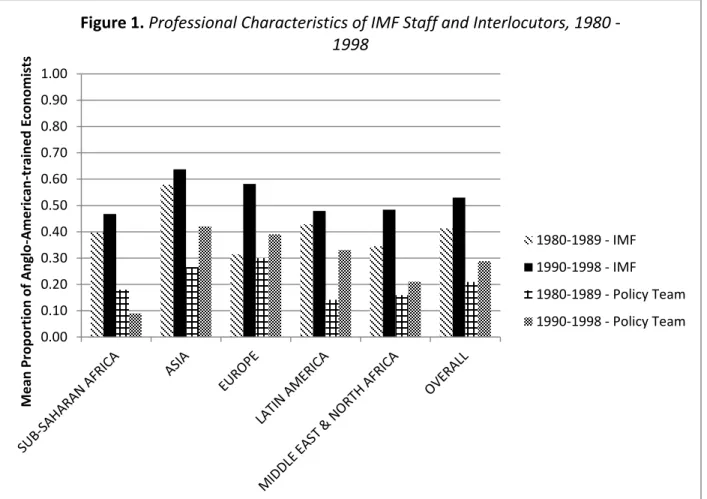
I employ these data to create three variables: (1) Anglo-American staff, which indicates the proportion of area department staff who received professional training in economics in the United States or the United Kingdom; (2) Anglo-American policy team, which indicates the proportion of borrowing country officials (chiefs of government, finance ministers, and heads of the central bank) who received professional training in economics in the United States or the United Kingdom; and (3) Professional ties, which is then the interaction effect of these two variables.
[INSERT FIGURE 1 HERE]
Figure 1 plots the mean area-specific values for the American staff and Anglo-American policy team variables in the 1980s and 1990s. It shows that Anglo-Anglo-American economists became increasingly represented across all IMF area departments in the 1990s, with the largest concentrations in those covering Asia and Europe. Overall, Anglo-American economists also became more prevalent in borrowing country policy teams in the 1990s, though their concentration was highest in Europe and Latin America and over time there was a decline in their numbers in sub-Saharan Africa.
The constitutive terms of the interaction, the Anglo-American staff and Anglo-American policy team variables, assess how IMF conditionality is affected when the other
9
See <http://www.lib.umi.com/dissertations/seach>; <http://www.these.com>; <http://global.lexisnexis.com/>; <http://www.worldwhoswho.com/>.
14 term of the interaction takes on a value of zero. As such, the Anglo-American staff variable in part captures how IMF conditionality is influenced by the presence of borrowing country officials who do not share the staff’s beliefs. It thus has a substantively important interpretation. On the other hand, the Anglo-American policy team is statistically and substantively of little importance since the Anglo-American staff variable never takes on a value of zero in the sample. The interaction effect itself captures the influence of shared professional ties between borrowing country officials and the IMF staff.
I also control for alternative explanations found in the literature. I consider economic variables that capture the technocratic considerations that may shape IMF lending. These variables include a country’s reserve position, monetary conditions, overall debt, and debt profile.10 These data are from the World Bank’s World Development Indicators. I also include a binary variable from Reinhart and Rogoff (2008) that takes on a value of one if a country experienced a banking crisis. As a proxy for global financial conditions and the scarcity of private international capital, I include the nominal U.S. Treasury bill rate. These data are from the IMF’s International Financial Statistics.
I also account for political influences on IMF lending. There is great deal of evidence that suggests the U.S. uses its influence within the IMF to selectively advance its geopolitical and financial interests. As a proxy for the intensity of U.S. geopolitical interests, I follow convention in the literature by using United Nations (U.N.) voting affinity scores for countries vis-à-vis the United States (Oatley and Yackee 2004; Broz and Hawes 2006; Dreher and Jensen 2007). These scores range from -1 to 1, with higher values indicating closer geopolitical alignment. I also follow other work in using country lending exposure data by U.S. commercial banks to proxy American financial interests (Broz and
10
I take the natural log of the variables capturing a country’s reserve position, overall debt, and debt profile because each is positively skewed.
15 Hawes 2006; Stone 2008; 2011). These data are from the Bank for International Settlements (2007).
Following Vreeland (2003), I also seek to control for domestic political constraints in borrowing countries by including the natural log of the number of veto players. I also include two dummy variables measuring left-right government partisanship as well as an indicator of the quality of the policymaking bureaucracy that ranges from 0 to 4, with higher values indicating greater quality. The Database of Political Institutions (Beck et al. 2001) and the International Country Risk Guide provide these data.
I also take into account organizational imperatives, which may lead the IMF to provide more lenient conditions when it has more resources available and when its member states are undertaking a quota review that could boost its resources. To address these possibilities I use the IMF’s liquidity ratio, which is the sum of outstanding loans divided by total quota resources, and a dummy variable indicating the years in which a quota review is underway. These data are from Dreher and Vaubel (2004). Table 1 provides summary statistics for all variables, including those used in the robustness checks discussed below.
[INSERT TABLE 1 HERE]
I also take into account the issue of non-random selection, which arises from the fact that countries participating in IMF programs are systematically different than the overall population (Steinwand and Stone 2008). I employ propensity score matching as a way to match each “treated” observation (a country-year with an IMF program) with a “control” observation (a country-year without an IMF program) based on the observed covariates that are as similar as possible. This “nearest neighbour” algorithm generates a propensity score for each observation ranging from zero to one. Inclusion of this propensity score, which captures the predicted probability of IMF program participation, helps to minimize selection bias I also take into account temporal dependence by using the country-specific number of
16 years since the last IMF program, its square, and its cube (Carter and Signorino 2010).11 In the conditionality specification I replace this measure with an alternative one that captures the number of years since a country last borrowed from the IMF, which controls for potential temporal dependence in event count models (Beck et al. 1998).
[INSERT TABLE 2 HERE]
I estimate a logit model to produce the propensity scores included in the subsequent conditionality specification. Then, since the data do not show evidence of overdispersion, I use a Poisson model with country fixed effects and robust standard errors to estimate the conditionality specification. Table 2 presents the results.12
I first present a baseline model, in which I exclude the professional characteristics variables. I then introduce the professional characteristics variables in subsequent models. Models 1 and 2 explore the pattern of IMF program participation. While there is an extensive literature on the subject, it is a less theoretically appropriate dependent variable since requests for financing are rarely rejected. Macroeconomic factors related to large public sector debt burdens appear to influence country participation in IMF loans. Professional ties between the staff and borrowing country officials, U.S. geopolitical and financial interests, and organizational imperatives do not appear significant at the selection stage.
Models 3 and 4 in Table 2 report the results of alternative specifications of the conditionality regressions. Some of the control variables are significant in the expected direction. The IMF appears less likely to impose stringent conditionality when a borrower government faces more veto players. There is also evidence that organizational imperatives surrounding quota reviews increase the stringency of conditionality, which may be due to
11 The results are similar for the program participation specification if I instead use the cubic splines approach of Beck et al. (1998); and for the subsequent conditionality specification if I instead: (1) exclude the propensity score; (2) include a count of the number of years; (3) include a measure of debt outstanding to the IMF as a proportion of a country’s IMF quota; and (4) include year fixed effects.
12
17 efforts on the part of the staff to present themselves as a responsible manager of IMF resources (Copelovitch 2010:62n33).
The results do not provide support to those who suggest U.S. interests have a decisive influence on IMF conditionality. This result may be due to distributional conflict among IMF member states seeking different policy outcomes, with the U.S. unable to prevail in securing more lenient treatment in countries where its interests are intense, but where other leading member states have weaker interests and oppose such action on moral hazard grounds (Copelovitch, 2010). None of the other control variables manage to attain statistical significance.
The results do provide strong support for the argument offered here. As expected, the results from Model 4 indicate that the coefficient on Anglo-American staff variable is positively and significantly related to the number of performance criteria. However since it appears in this specification as an interaction with Anglo-American policy team, it is difficult to assess the magnitude and significance of its effect from the coefficient alone. The preferred method to interpret the effect of interaction terms and the constitutive variables is through graphical presentation of the relationship between changes in the variables constituting the interaction term and the outcome of interest (Brambor et al. 2006; Berry et al. 2012).
[INSERT FIGURE 2 HERE]
I therefore use Figure 2 to plot the marginal effect of American staff as Anglo-American policy team varies from its minimum to maximum values. The figure also includes a histogram illustrating the distribution of the Anglo-American policy team variable. Figure 2 shows a statistically significant effect for Anglo-American staff, but only at the lower end of the distribution of American policy team. The marginal effect of Anglo-American staff declines in magnitude and statistical significance as Anglo-American policy
18 team increases. At the left end of the graph, weaker professional ties to borrowing country officials lead the IMF staff to increase the number of binding conditions, whereas at the right end of the graph there is no evidence to suggest stronger professional ties have a statistically or substantively significant effect. The histogram shows that there are a sizeable number of observations that fall in the range of statistical significance.
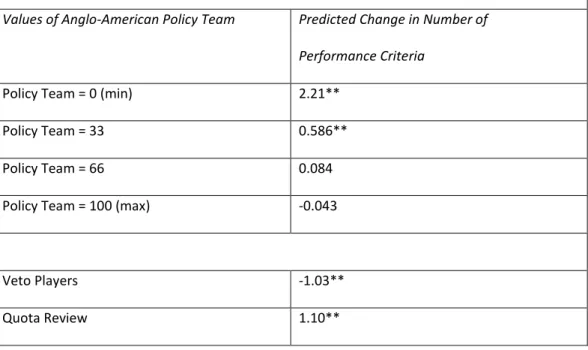
[INSERT TABLE 3 HERE]
Table 3 provides a sense of the magnitude of this effect by presenting substantive quantities of interest that illustrate the impact of a one standard deviation increase in Anglo-American policy staff, conditional on varying levels of Anglo-Anglo-American policy team, holding all other variables constant at the means. This table of first differences thus shows the predicted change in the number of performance criteria as Anglo-American policy team increases. As the quantities illustrate, a one standard deviation increase in Anglo-American staff, leads to a substantial tightening in IMF conditionality but only at low levels of Anglo-American policy team. The effect at the minimum value of Anglo-American policy team is found to exceed that exerted from a one standard deviation increase in the veto player measure and from the presence of an IMF quota review.
These results are consistent with the argument that the staff tighten conditionality when borrowing country officials appear unsympathetic to IMF policy goals. Empirical examples are provided by IMF negotiations with Argentina in the mid-1980s and Egypt in the late 1990s.13 In each of these cases the staff applied strict treatment to government officials, with whom they shared few professional ties, because of doubts as to their commitment to IMF policy goals (Boughton, 2001; Momani, 2004). Both programs ended in failure.
13 In Argentina (1984), Anglo-American staff was 52.95 and Anglo-American policy team was 0. In Egypt (1996), Anglo-American staff was 53.85 and Anglo-American policy team was 0. In each case, the IMF approved loans (Argentina: 10 conditions; Egypt: 7 conditions) that were more stringent than those provided in the mean borrowing country.
19 Stronger alignment of policy goals, as suggested by the presence of professional ties, does not appear to lead borrowers to receive lenient treatment. What accounts for this finding? One possibility is to consider how, in addition to normative orientations, concerns about time-inconsistency and moral hazard also shape staff behavior. These concerns generate serious misgivings about more lenient conditionality since it would provide any government (present or future) with greater discretion to reverse policy reforms and assume greater risk. More stringent conditionality arising from weaker normative adherence aligns with these concerns. More lenient conditionality originating from stronger normative adherence does not.
While larger loans carry rejection costs that provide an incentive for any present or future government to act in accordance with IMF policy goals (Vreeland 2003), more lenient conditionality would provide a government with greater capacity to act independently and thus assume additional risk since the conditionality contract could not be easily rewritten. In addition, reformist officials sharing IMF policy goals may oppose more lenient treatment as a way of binding the opposition (both in the present and the future) (Vreeland 2003). These influences thus weigh against more lenient treatment for borrowers where officials appear sympathetic to IMF policy goals, thus offsetting the effect of stronger normative adherence. As a result, we observe stronger professional ties having no statistically or substantively significant effect on the design of conditionality.
The IMF negotiations with Indonesia in the late 1990s provide an empirical example. Here, despite shared professional ties, rather than providing more lenient treatment, IMF and some country officials worked together to design a loan that would bind opposing elements in the government to policy reform and that led the number of binding conditions to conform to
20 other loans provided at the time (Stone, 2011: 170-173; IEO, 2003:12-13).14 This suggests that while the IMF staff prioritize their normative orientations, they also give due consideration to other concerns that may weigh against providing more lenient treatment. The IMF staff and borrowing country officials may also share a preference for limiting the scope for future governments to abandon their policy goals (Vreeland 2003).
As suggested earlier, much of the existing literature depicts IMF conditionality as a reflection of preferences of powerful member states and IMF management. Thus, it is worth considering the extent to which these findings may reflect these preferences. Management, which is often seen as agent of powerful member states, may be broadly supportive of
conditionality designed on the basis identified in the results, but it also faces additional incentives to seek excessive insurance against failure in all programs (Willett 2002). This may bias management to err on the side of working to streamline conditionality so as to increase the likelihood of program success, even in cases where professional ties are weak. Thus, if management does err on the side of seeking to encourage the staff to limit conditionality for all borrowers, the results are inconsistent with this expectation. However, the results are in line with Momani’s (2005b) finding that management efforts to streamline conditionality prior to the recent global financial crisis failed largely due to their lack of resonance with the organization’s normative orientations.15
Powerful states, for their part, are likely to be broadly supportive of using conditionality to encourage policy reform, particularly in cases where the intentions of country officials do not appear to align with the policy goals of the IMF and where their geopolitical and financial interests are less intense. For instance, some suggest that during
14 In Indonesia (1997/1998), Anglo-American staff was 60/65 and Anglo-American policy team was 66.6/66.6. The IMF approved loans with 10 (1997) and 9 (1998) binding conditions that showed little deviation from those loans provided to the mean borrowing country during the Asian financial crisis.
15
The IMF Independent Evaluation Office (2007b:24) also finds ‘there is no evidence of a reduction in the number of structural conditions following the introduction of the streamlining initiative.’
21 the Cold War socialist and leftist governments received tougher conditionality (Hayter 1971; Payer 1974). Thus, in some countries, the influence and inclination of powerful countries and the staff to apply more stringent conditionality may co-exist and be difficult to disentangle. The strong version of this argument is that powerful countries push the staff to tighten conditionality against “unfavourable” governments, while the weak version of this argument is that the staff take into account the preferences of powerful states and then act in accordance with them.
I use various measures of the intensity of member state preferences as way to help disentangle their impact on staff behaviour. Using these measures there is at best weak evidence to support the conjecture that the results partially reflect statist influence to discriminate against “unfavourable” governments in countries where the interests of powerful states are weak. In the sample there are 59 cases in which Anglo-American staff takes on a higher value (above its median) and Anglo-American policy team takes on values at the low end of its distribution where the effect is significant in Figure 2. These cases cluster in Latin America (37 cases) and the Middle East and North Africa (12 cases), with Uruguay (1997), Venezuela (1996), Egypt (1996) and Jordan (1996) as recent examples. Yet most of these cases are not particularly collinear with weak U.S. geopolitical and financial interests. U.S. geopolitical interests, as measured by the U.N. voting affinity measure, are weak (in the first quartile) in only fourteen of the 59 cases, while its financial interests are of low intensity, including one where its geopolitical interests are also weak, in only nine of the 59 cases.
The voting affinity measure also likely overstates the number of cases in which U.S. geopolitical interests are actually weak, since a number of these cases, such as Egypt (1991) and the Philippines (1986, 1986, 1989, 1991, and 1998), play important roles in U.S. foreign policy but generally vote against it in the U.N. General Assembly (Stone 2011:165-166). In many of the cases where professional ties are weak it is thus easier to conclude that staff
22 motivations for seeking reform may be stronger than statist pressure to impose more binding conditionality. In fact, in some of these cases, such as Egypt, U.S. officials insisted, despite staff objections, for greater leniency to be given in the design of conditionality (Momani 2004).
I also carry out a number of tests to assess the robustness of these results. First, I consider alternative measures of U.S. interests that feature in the literature, such as U.S. military aid, economic aid, and exports.16 Second, I also consider measures of the geopolitical and financial interests of other leading IMF member states, including Britain, France, Germany, and Japan. Third, following Achen (2005), I consider a reduced-form
specification that includes only the two control variables that were found to be significant in Table 2. As Table 4 shows, the sign and significance of the Anglo-American staff coefficient does not change in any of these specifications.
I also assess whether the results may be contingent on regime type. I use two different measures of democracy; one from Polity IV, another from Cheibub, Gandhi, and Vreeland (CGV) (2009) to identify regime type. I then divide the sample into democratic and non-democratic countries, which greatly depletes the number of observations and only permits estimation of the reduced-form specification. The results from this limited examination provide some evidence that the finding holds in both democratic and non-democratic regimes.
Taken together, all of these results provide strong confirmation that the design of IMF conditionality depends in part on the extent to which staff and borrowing country officials share professional ties. These results are in line with the arguments offered here.
16
The data on U.S. military aid is from the Federation of American Scientists Arms Sales Monitoring Project. The OECD’s Statistical Compendium provides the data on U.S. economic aid. U.S. trade data is from the IMF’s Direction of Trade.
23 Normative adherence appears to be a crucial determinant of conditionality, particularly in borrowers where country officials seem unsympathetic to IMF policy goals.
CONCLUSION
Much of the recent literature on IMF conditionality has focused on shining light on the degree to which member states exert influence over IMF lending. Yet, while insightful, this literature often provides a somewhat narrow depiction of the role the staff play in designing IMF programs. When their role is considered, in most cases the staff are depicted either as technocrats who design programs based on economic models and data, or as bureaucratic actors who respond to organizational imperatives.
While not denying the importance of these factors, this article offers a new argument and evidence that points to the IMF’s organizational culture and staff professional training as also having a critical influence on the design of IMF programs. Others have investigated various related questions about organizational culture and the inner workings of the IMF, but we thus far have little systematic analysis as to how these factors shape the design of conditionality. This article shows that weak professional ties between the staff and borrowing country officials lead to the application of more stringent conditionality. Yet, interestingly, professional ties, while helping to bind individuals together around a set of shared beliefs, do not make the application of conditionality less binding. Staff concerns about time-inconsistency and moral hazard may offset the inclination to play favorites due to stronger normative adherence.
These findings have several important implications for studies of IMF conditionality and IOs more generally. First, it extends the body of literature that takes seriously the role of organizational culture and internal dynamics as an important influence on IO behaviour (Barnett and Finnemore 2004; Momani 2005b; Weaver 2008; Broome 2010; Chwieroth
24 2010). It moves beyond simply asserting “professional identity matters” by identifying some mechanisms through which it is likely to be influential.
Second, with its emphasis on normative orientations and cultural predispositions, rather than formal rules and procedures, this study also contributes to the recent behavioural turn in the study of IOs that emphasizes informal governance (Stone 2011; Kleine 2013). The analysis here shows that informal governance operates in IOs not, as much of this recent behavioural literature suggests, simply via state influence but also through the evolving configuration, incentive structure, and normative orientations of their staffs. The analysis also confirms the logic of arguments about the manner in which epistemic communities (Adler and Haas 1992; Haas 1992), network ties (Kahler 2009); linked ecologies (Seabrooke and Tsingou 2009), and normative resonance (Cortell and Davis 1996; 2000; Johnston 2008) shape the terms of international cooperation. It also raises questions about precisely how and under what conditions governments may use cabinet appointments to lessen the stringency of conditional lending. For instance, recent developments, such as the appointment of Lucas Papademos as Greece’s prime minister in November 2011, can be interpreted in part as an effort to ease relations with official creditors by signalling stronger normative adherence.
By shining light on how normative orientations of the staff co-exist with other factors shaping IMF conditionality, this article suggests that a fuller understanding of how IOs work requires close attention to evolving normative orientations of their staffs. Indeed, if normative orientations and professional ties matter for IMF lending, they also likely matter for other forms of conditional lending and for other IOs. Conditional bilateral lending, such as the Millennium Challenge Account, also may be susceptible to the influences outlined here (Parks 2012). Professional ties also likely matter for other IOs, such as the World Health Organization and the World Trade Organization. Although previous research demonstrates
25 that professional ties shape the content of these organization’s policy prescriptions (Cortell and Peterson 2006), this study suggests these ties may also influence terms by which they interact with member states.17 For instance, professional ties may bias the forecasts of these and other IOs in the same way that member state interests and other factors have been shown to shape those of the IMF (Dreher et al. 2008).
A third, related implication is that normative orientations condition the relationship between IOs and domestic policy reform. The intrusiveness of IMF conditionality is in a part of function of the normative orientations of the staff and borrowing country officials. These orientations thus play an important part in strengthening our understanding of how IOs shape economic and political outcomes by empowering reformers and marginalizing opponents (Vreeland 2003; Woods 2006; Dai 2010).
The findings here also speak to policy discussions about the IMF. Critics of the IMF are likely to view the findings as supporting their claim that conditionality is biased in its application of a one-size-fits-all logic that lacks sensitivity to contextual features varying across borrowers. To the extent that conditionality is more stringent for borrowers with officials who appear unsympathetic to IMF policy goals, then it suggests conditionality may suffer from a normative bias and that the policy space of some borrowers may therefore be unduly more severely constrained than others.
The findings here suggest this asymmetric treatment may not, as is commonly depicted, result from statist influence alone. Normative orientations and cultural dispositions of the IMF also appear important. These orientations and dispositions may be consistent with the interests of powerful states but this does not mean they are attributable solely to them. As Woods (2006:56) observes, “[The] set of ideas [shared by the Fund staff] is not a
17
26 direct reflection of the interests of the most powerful members of the organization, even though powerful members get to influence it.”
Finally, the findings here have interesting implications for understanding IMF lending since the global financial crisis, including its involvement in the Eurozone. The IMF has seen remarkable changes in its policy beliefs since signs of the crisis first emerged in 2007. The Fund has not become a stronghold of heterodox economic convictions. But it has become increasingly tolerant, even acceptant of policy measures, such as capital controls, that were once considered heresy (Grabel 2011; 2014; Chwieroth 2013b; 2014).18 As such, the argument here would lead us to expect greater flexibility in IMF lending to the extent that the Fund has broadened the range of policy goals it deems appropriate.
In fact, since the onset of the crisis the IMF has reduced the number of structural conditions in its loans (IMF 2011b; 2011c).19 While the number of quantitative performance criteria has remained stable since 2002, the discontinuation of structural performance criteria in 2009 has led to some progress in streamlining conditionality. Nonetheless, the number and depth of conditions in loans to Eurozone countries (especially Greece) has increased compared to other recent borrowers.
In addition to the interests of powerful shareholders, such as Germany, the involvement of the European Commission and the European Central Bank (ECB), which together with the IMF form the so called “Troika,” has complicated the design of conditionality and financial rescue packages in the Eurozone. The IMF, as the junior partner contributing the smallest share of resources, has had to coordinate with these actors and work to accommodate their preferences. Among these various actors, Germany, the Commission, and the ECB have offered much stronger support of “Washington Consensus”-style policies than the IMF staff (Lütz and Kranke 2013). The IMF’s lending policies in the Europe (and
18
For an opposing view, see Cline, Ford, and Vernengo (2010) and Gabor (2012). 19
27 elsewhere) have been more flexible and, at least compared to past crises and to those policies endorsed by key actors in Europe, also less contractionary (IMF 2009; 2011a; see also Edwards and Hsieh 2011; Kattel and Raudla 2013:432fn13; 440; Lütz and Kranke 2013).20 The Fund has not adopted an “anything goes” orientation in the Eurozone or elsewhere, and the extent of its normative change remains tentative and piecemeal (Weisbrot et al. 2009; Van Waeyenberge et al. 2010; Grabel 2011). Yet the characterization of the IMF as a one-size-fits-all promoter of orthodox economic policies seems outdated. Recent developments suggest that the normative orientations of the IMF staff remain a critical determinant of the design of conditionality. Incremental normative change within the Fund, such as that featured in Chwieroth (2013b) and Vetterlein and Moschella (2014), may enhance policy space for borrowers, even while co-financing operations with powerful shareholders and regional institutions like the Commission and ECB may complicate the application of greater flexibility in particular countries.
20
28
REFERENCES
Abbott, A. (2005) “Linked Ecologies: States and Universities as Environments for Professions,” Sociological Theory 23(3): 245-274.
Achen, C.H. (2005). “Let’s Put Garbage-can Regressions and Garbage-can Probits Where They Belong,” Conflict Management and Peace Science 22 (4):327-339.
Adler, E. and Haas P.M. (1992) “Conclusion: Epistemic Communities, World Order, and the Creation of a Reflective Research Program,” International Organization 46 (1): 367-390. Babb, S. (2003) “The IMF in Sociological Perspective: A Tale of Organizational Slippage,” Studies in Comparative International Development,” 38 (2):3-27.
Bank for International Settlements. (2007). Historical Time Series. Available at:
http://www.bis.org.statistics/histstats9.htm (accessed 9 January 2007).
Barnett, M. and Finnemore, M. (2004). Rules for the world: International organizations in global politics. Ithaca, NY: Cornell University Press.
Beck, N., Katz, J.N. and Tucker, R. (1998). “Taking Time Seriously: Time-Series-Cross-Section Analysis with a Binary Dependent Variable,” American Journal of Political Science 42 (4): 1260-1288.
Beck, T., Clarke, G., Groff, A., Keefer, P. and Walsh, P. (2001). “New Tools in Comparative Political Economy: The Database of Political Institutions,” World Bank Economic Review 15 (1): 165-176.
Berry, W.D., Golder, M., Milton, D. (2012). “Improving Tests of Theories Positing Interactions,” Journal of Politics 74 (3):653-671.
Bird, G. (2009). “Reforming IMF Conditionality: From ‘Streamlining’ to ‘Major Overhaul,’” World Economics 10 (3): 81-104.
Bird, G. and Dane, R. (2003). “Political Economy Influences Within the Life-Cycle of IMF Programmes,” World Economy 26 (9): 1255-1278.
Bird, G. and Willett. T.D. (2004). “IMF Conditionality, Implementation and the New Political Economy of Conditionality,” Comparative Economic Studies 46 (3): 423-450. Boughton, J. (2001). Silent Revolution: The International Monetary Fund, 1979-1989. Washington, DC: IMF.
Brambor, T., Clark, W.R. and Golder, M. (2006). “Understanding Interaction Models: Improving Empirical Analysis,” Political Analysis 14 (1): 63-82.
29 Breen, M. (2012). “IMF Conditionality and the Economic Exposure of its Shareholders. European Journal of International Relations,” DOI: 10.1177/1354066112448257.
Broad, R, and Cavanagh, J. (2014). “The Global Fight Against Corporate Rule," The
Nation. Available at:
http://www.thenation.com/article/177930/global-fight-against-corporate-rule# (accessed 20 February 2014).
Broome, A. (2010). The Currency of Power: The IMF and Monetary Reform in Central Asia. Basingstoke: Palgrave Macmillan.
Broz, J.L. and Hawes, M.B. (2006). “Congressional Politics of Financing the International Monetary Fund,” International Organization 60 (2):367-399.
Carter, D. and Signorino, C.S. (2010). “Back to the Future: Modeling Time Dependence in Binary Data,” Political Analysis 18 (3): 271-292.
Cheibub, J.A., Gandhi, J., and Vreeland, J.A. (2010). “Democracy and Dictatorship Revisited,” Public Choice 143 (1/2): 67-101.
Cline, N., Ford, K., and Vernengo, M. (2010). “Because I Said So: The Persistence of
Mainstream Policy Advice,” Journal of Philosophical Economics, 3 (2): 97-121.
Chwieroth, J. (2007). "Testing and Measuring the Role of Ideas: The Case of Neoliberalism in the International Monetary Fund," International Studies Quarterly, 51 (1): 5-30.
Chwieroth, J. (2010). Capital Ideas: The IMF and the Rise of Financial Liberalization. Princeton, NJ: Princeton University Press.
Chwieroth, J. (2013a). "'The Silent Revolution:' How the Staff Exercise Informal Governance over IMF Lending," Review of International Organizations, 8 (2):265-290. Chwieroth, J. (2013b). “Controlling Capital: The International Monetary Fund and Transformative Incremental Change from within International Organisations,” New Political Economy DOI: 10.1080/13563467.2013.796451.
Chwieroth, J. (2013b). “Controlling Capital: The International Monetary Fund and Transformative Incremental Change from within International Organisations,” New Political Economy DOI: 10.1080/13563467.2013.796451.
Chwieroth, J. (2014). “Managing and Transforming Policy Stigmas in International Finance: Emerging Markets and Controlling Capital Inflows after the Crisis,” Review of International Political Economy, DOI: 10.1080/09692290.2013.851101.
Colander, D. (2008). The Making of an Economist, Redux. Princeton, NJ: Princeton University Press.
Colander, D. and Klamer, A. 1987. “The Making on an Economist,” Journal of Economic Perspectives 12 (4): 95-111.
30 Copelovitch, M. (2010). The International Monetary Fund in the global economy: Banks, bonds, and bailouts. Cambridge, UK: Cambridge University Press.
Cortell, A.P. and Davis, J.W. (1996). “How Do International Institutions Matter? The Domestic Impact of International Rules and Norms,” International Studies Quarterly 40 (4): 451-478.
Cortell, A.P. and Davis, J.W. (2000). “Understanding the Domestic Impact of International Norms: A Research Agenda,” International Studies Review 2 (1): 65-87.
Cortell, A.P. and Peterson, S. (2006). “Dutiful Agents, Rogue States, or Both? Staffing, Voting Rules, and Slack in the WHO and WTO, in D.G. Hawkins, D.A. Lake, D.L. Nielson, and M.J. Tierney (eds.) Delegation and Agency in International Organizations. Cambridge, UK: Cambridge University Press.
Dai, X. (2010). International Institutions and National Policies. Cambridge, UK: Cambridge University Press.
DiMaggio, P.J. and Powell, W.W. (1983). “The Iron Cage Revisited: Institutional Isomorphism and Collective Rationality in Organizational Fields,” American Sociological Review, 48 (2):147-160.
Dreher, A. and Jensen, N.M. (2007). “Independent Actor or Agent? An Empirical Analysis of the Impact of U.S. Interests on International Monetary Fund Conditions,” Journal of Law and Economics 50 (1):105-124.
Dreher, A. and Vaubel, R. (2004). “The Causes and Consequences of IMF Conditionality,” Emerging Markets Finance and Trade 40 (3):26-54.
Dreher, A., Marchesi, S. and Vreeland, J.R. (2008). “The Political Economy of IMF Forecasts,” Public Choice 137 (1): 145-171.
Easterly, W. (2001). The Elusive Quest for Growth: Economists’ Adventures and Misadventures in the Tropics. Cambridge: MIT Press.
Edwards, K., and Hsieh, W. (2011). “Recent Changes in IMF Lending,” Reserve Bank of
Australia Bulletin – December Quarter, Available at:
http://www.rba.gov.au/publications/bulletin/2011/dec/8.html (accessed 20 February 2014).
Fang, S. and Stone, R.W. (2012). “International Organizations as Policy Advisors,” International Organization, 66 (3):537-569.
Finnemore, M. and Sikkink, K. (1998). “International Norm Dynamics and Political Change,” International Organization, 52 (4):887-917.
Fourcade, M. (2009). Economists and Societies: Discipline and Profession in the United states, Britain, and France, 1890s to 1990s. Princeton: Princeton University Press.
Gallager, K, ed. (2005). Putting Development First: The Importance of Policy Space in the
31
Gallagher, K. (2011) “Losing Control: Policy Space for Capital Controls in Trade and Investment Agreements,” Development Policy Review, 29(4): 387-413.
Gabor, D. (2010) “The International Monetary Fund and its New Economics,” Development
and Change, 41 (5): 805-830.
Gabor, D. (2012) “Managing Capital Accounts in Emerging Markets: Lessons from the Global Financial Crisis,” Journal of Development Studies, 48(6):714-731.
Gould, E. (2006). Money Talks: The International Monetary Fund, Conditionality, and Supplementary Financiers. Palo Alto: Stanford University Press.
Grabel, I. (2010). Cementing Neoliberalism in the Developing World: Ideational and Institutional Constraints on Policy Space, in S.R. Khan and J. Christiansen (eds), Towards New Developmentalism: Market as Means Rather than Master. London, UK: Routledge. Grabel, I. (2011). “Not Your Grandfather’s IMF: Global Crisis, ‘Productive Incoherence’ and Developmental Policy Space,” Cambridge Journal of Economics 35 (5):805-830.
Grabel, I. (2014). “The Rebranding of Capital Controls in an Era of Productive Incoherence,” Review of International Political Economy, DOI: 10.1080/09692290.2013.836677.
Haas, P.M. (1992). “Epistemic Communities and International Policy Coordination,” International Organization 46 (1): 1-35.
Hawkins, D.G, Lake, D.A., Nielson, D.L., and Tierney, M.J. (eds.) (2006). Delegation and Agency in International Organizations. Cambridge, UK: Cambridge University Press. Hayter, T. (1971). Aid as Imperialism. Baltimore, MD: Penguin Books.
Ho, D.E, Imai, K., King G. and Stuart, E.A. (2007). “Matching as Nonparametric Preprocessing for Reducing Model Dependence in Parametric Causal Inference," Political Analysis, 15(3): 199-236.
Independent Evaluation Office. (2003). IMF and Recent Capital Account crises: Indonesia, Korea, Brazil. Washington, DC: IMF.
Independent Evaluation Office. (2007a). IEO Evaluation of IMF Exchange Rate Policy Advice. Washington, DC: IMF.
Independent Evaluation Office. (2007b). An IEO Evaluation of Structural Conditionality in IMF-supported Programs. Washington, DC: IMF.
Independent Evaluation Office. (2010). IMF Interactions with Member Countries. Washington, DC: IMF.
International Monetary Fund. (1998). Selected Decisions and Selected Documents of the International Monetary Fund, 33rd Issue, Washington, DC: International Monetary Fund.