Elizabeth A. Hogenson. Virtual Remembrance: Holocaust Institutions and Their
Websites. A Master’s Paper for the M.S. in L.S. degree. March, 2011. 51 pages. Advisor: Christopher Lee.
At the core of every Holocaust institution, whether it be a museum or an archive is remembrance and memorializing. This mission is often fulfilled through community outreach and education, and is a process that requires the participation of the public. The advent of the Internet has given these institutions a new tool through which to perpetrate memorializing. Through studying the websites of Yad Vashem, The United States Holocaust Memorial Museum, Simon Wiesenthal Center Museum of Tolerance, The Fortunoff Video Archive, and The Shoah Foundation, we can see and better understand how the Internet can be used for Holocaust Memorializing. The results of studying these sites show that these institutions are using tools like YouTube to extend the reach of their video testimonies and user content generated databases to collect names and information about victims of the Shoah. Other historical repositories can improve their access and outreach by observing Holocaust institutions.
Headings:
Holocaust Yad Vashem
Holocaust History Museum
Fortunoff Video Archive for Holocaust Testimonies Simon Wiesenthal Center
by
Elizabeth A. Hogenson
A Master’s paper submitted to the faculty of the School of Information and Library Science of the University of North Carolina at Chapel Hill
in partial fulfillment of the requirements for the degree of Master of Science in
Library Science.
Chapel Hill, North Carolina March 2011
Approved by
Introduction
Education is at the heart of memorializing the Holocaust, whether it is carried
out through institutions or individually. Holocaust institutions, such as museums and
archives, are tasked with preserving the memory of the Holocaust and disseminating
information about its events and consequences. These institutions, museums,
archives, and research foundations, usually have an assortment of materials including
art, primary documentation and recorded testimonies of survivors; the diversity of
materials exclude these institutions from being pegged as exclusively an archive or
place for exhibit. The varieties of materials also pose challenges for presentation,
preservation and access. At the core of each of these institutions is a mission of
education and outreach, which thus informs their decisions and has resulted in some
remarkable web tools. These institutions also exist to collect and share materials
related to the Holocaust, so that people will continue to know of its horrors and in
hopes that this knowledge will prevent future atrocities. No Holocaust institution
exists for the single purpose of housing Holocaust related artifacts and documents, as
they all also endeavor to make their information and documents accessible to the
public. The Internet has provided them with new and innovative tools through which
to educate and reach the public.
Holocaust institutions have used a variety of tools to enhance their web
presence and resources available to patrons. Online resources can be as mundane as
interactive databases. In some cases the website is intended as a supplement to
patrons’ visits, and in others as a research tool for those who cannot visit the physical
site. Holocaust archives have been at the forefront of the remarkable trend of public
participation in the archival process. The use of interactive tools and social
networking extends their reach beyond sites like YouTube. Many of their websites
have databases that allow users to add information about the artifacts, mostly notably
Yad Vashem’s name database, in collaboration with Google. Holocaust
memorializing and the creation of these collections has always been an interactive
process, heavily relaying on the participation and content generated by the public.
The web simply offers a new dimension and tool to the process of remembrance.
This paper will explore five Holocaust institutions of varying sizes and
collections. These are Yad Vashem, The United States Holocaust Memorial
Museum, The Simon Wiesnethal Museum of Tolerance, The Yale University
Fortunoff Video Archives, and the Shoah Foundation. While there are many other
Holocaust museums and archives, these five seem to have the most interesting and
innovative online presences and therefore can shed light on how Holocaust
institutions are and can use the Internet to their advantage. Further, they are also
important, internationally respected, institutions and house notable and significant
collections. Museums are included in this study of archival resources, because
Holocausts museums usually have large archival holdings that are incorporated into
the exhibits and are also made accessible to researchers; it is often hard to say where
the museum ends and the archives starts. As will be explored below, each of these
accessible, while trying to [word is missing here] its archival resources into the
process.
In order to select the sites for my final evaluation, I used a series of questions
to assess a variety of Holocaust-related historical repositories. I wanted to know
about the breadth of the site’s offerings, transparency of purpose and creator,
interactive features, intended audience, and other significant features. Most
importantly, though, was detecting clear intention to make material available online
or to enhance the experience of the physical institution through a website. There are
many Holocaust archives and museums around the world, ranging from large national
and educational repositories to local and private collections. My research has
suggested that the size of the institution is not the only factor determining web
presence. Rather, it is dependent on the intuitions’ commitment to its web content
and endowment (though, money is becoming increasingly less important, with the
increase in free and low-cost web solutions). Some of the sites I chose to cut, such as
the International Tracing Service in Bad Arolsen, Germany, were eliminated even
though their online archival databases of names are impressive, simply because a
similar one, that of Yad Vashem, has a stronger web presence and is currently
working to increase its offerings. The five institutions presented here are by no
means the best or only sites worth exploring, they simply offer interesting reflections
on the subject of Holocaust institutions and the use of the Internet.
Holocaust archives are not the only historical repositories to have interactive
websites and impressive web content, so what makes them distinctive and worthy of
community or other groups who wish to highlight human-rights issues, is a
collaborative and interactive process. It requires the participation not only of the
victims in generating content, but also input from the general population in order to
keep the memory alive. It has evolved to become a community history process.
Furthermore, the heavy reliance upon video testimonies raises special preservation
needs and exhibition issues that are not found in such large volume with regard to
other historical events. These aspects, the collaborative history and community
involvement and reliance upon film, makes the Holocaust a unique archival and
museum study. There is no other historical event present in the archival and museum
world that poses these same challenges and opportunities. The nature of the events,
the variety of documentation, and process of memorializing facilitate the varied ways
that Holocaust educational and archival materials have developed. While one may be
able to find other events that are similar, the process will be on a much smaller scale,
and not international in its scope. Through exploring Holocaust institutions we can
learn about improving access and engaging audiences with history.
Literature Review
Most of the literature on Holocaust archives focuses on the relationship
between archival materials and memory. The authors ponder on how testimonies, in
particular, affect memory and transmission of the Holocaust. Little attention is given
to archival practices in mediating and shaping this process. Archives, whether digital,
traditional, or at museums, are the keepers of these memories. Without the formal
accessibility. While documentaries such as Shoah (1985), and the increased presence
of web content offer alternatives means of distributing and sharing the memories, the
traditional repository remains the center for preservation and distribution. The
importance of sharing the memories and documentation of Holocaust in order to
ensure memorializing is often overlooked in the literature, treating the process of
memory and archives as a symbiotic and passive interaction. Not only is the
dissemination of materials not passive, the presence of the Internet gives institutions
another tools through which to spread the memory of the Shoah. A failure to utilize
web tools is a failure to fulfill the primary purpose of Holocaust institutions --
remembrance.
Despite the abundance of literature on archival access, it continues to be an
unresolved problem. Rapidly changing technologies and limited resources are only
part of the challenge. “Access is a primary mission, not an incidental result,”
Prelinger writes in his 2009 article, “Points of Origin: Discovering Ourselves through
Access” (p. 171). Use justifies archives. Prelinger notes that archivists often lack the
authority to make big decisions that would improve access, or that those in positions
of authority lack the imagination necessary to work around budget constraints. Funds
are no longer an excuse, according to Prelinger, who recommends relocating funds,
partnering with other institutions or simply using inexpensive or free tools. Further,
access is tied to preservation, and digital access is another way to preserve materials.
Some archivists may shrink away from tools like YouTube and other new media and
social network tools, because they may be perceived as a hodgepodge of odd videos
archivists (Prelinger, 2009). As the Fortunoff Archive’s use of YouTube will show
later in this paper, this is far from the truth. Access is an issue of supreme importance
to archives, and, in the case of Holocausts archives, helps them to fulfill their mission.
Holocaust remembrance and testimonies focusing on the survivors and
victims are so ubiquitous that it is easy to forget that these had to emerge from the
once unknown masses of people who were a part of that tragedy. Initially, the
histories of the Holocaust written in the 1950s focused on the perpetrators rather than
the victims. Oral testimonies were collected as a last resort in legal proceedings
against war criminals. Prior to that, memoirs and testimonies were collected and
circulated on a local scale in the 1940s, and were not intended for audiences outside
of the Jewish community (Kushner, 2001). The early testimonies focused on the
geographic aspect of the destruction, and there was little interest in and concern for
the experience of individuals. A transformation occurred in the late 20th century, and
testimonies of individuals became an essential part of understanding the events of the
Holocaust as a moral arena of human behavior. In recent years, the rush to record the
memories of the survivors has resulted in neglecting reflection on the purpose of
collecting. The true value of the testimonies lies not in their content, but in the
uniqueness of each individual experience and the rejection of silence that plagued
Holocaust victims for so too long (Kushner, 2001).
There are over a million pages of archival material pertaining to the Holocaust
in the National Archives in Washington, D.C. As a result, the National Archives has
become an international center for the study of the Holocaust. Perpetrators of
are also documents of observers and victims, among which are The Nuremberg Trial
records, along with over 18,000 documents. The finding aid for the collection was a
joint endeavor with Yad Vashem (Jerusalem) and Yivo (New York). Mendelsohn
wrote in his 1980 article, “The Holocaust: Rescue and Relief Documentation in the
National Archives,” that the majority of the papers and research citing documents
from the National Archives were drawn from the documents of the perpetrators.
Mendelsohn notes that there are many other important documents in the collection
that do not receive the proper attention. He is particularly concerned with the lack of
attention given to documents on rescue attempts, and transforms his article into an
extended finding aid to those documents. He details parts of the collection as well as
pointing future researchers to the appropriate finding aids.
The extent of the records is too exhaustive for Mendelsohn to detail in his
article, but he hopes that drawing attention to these records will lead researchers to
other holdings in the collection. He concludes that,
In addition to articles such as this one, which introduces researchers to the holdings of a particular archives, a more comprehensive finding aid must be produced. Only the cooperation of all the archives that hold pertinent records can accomplish such an objective by pooling their resources to produce a computer-assisted index of finding aids as the first step in this direction. Such an index would greatly facilitate shedding light on some unknown territory and could become the forerunner of a general index to records on the Holocaust; it would help us also to move to a better understanding of the Holocaust (1980, p. 249).
The problem being addressed by Mendelsohn is a pre-Internet problem. With the
availability of archive and museum OPACs, researchers are likely able to find more
records than ever before. However, an online catalog and collection can still distort
archives and museums, the creators are choosing to highlight certain parts of the
collection. It will be worth observing if a greater web presence and more content
available online (primary and secondary) has improved the use of archives and the
diversity of Holocaust scholarship. Further, the majority of interest in Holocaust
materials, currently, seems to be focused on testimonies.
Artistic expressions are an important part of Holocaust memorializing, and are
commonly found in Holocaust institutions. Artists have produced criticism of
Holocaust archives and their role in the process of memorializing. While artistic
commentary ranges from the peculiar to the prosperous, it is worthy of some
consideration. Archives occupy a privileged position in the canon of Holocaust
remembrance, in that their document holdings, testimonies and other autobiographical
accounts, and historical records, are considered the most reliable and consequently
the most valued Holocaust sources (Van Alphen, 2009). In his instillation pieces, the
artist Christian Boltanski draws the connection between the systemization of the
Nazis and the organization of archives. Similarly, the artist Ydessa Hendeles also
offers commentary by highlighting in his work the cold and disjointed context of
archives and museums. While these interpretations may seem to be reactionary,
archivists and curators would do well to reflect on the purposes and methodologies of
what they do. “Although Holocaust archives are also seen as memorials of the
Holocaust, the memories stored in it are ultimately judged on the basis of what we
learn from them, that is, how useful they are” (Van Alphen, 2009, p. 151). Van
Alphen, in his 2009 article, “Visual archives and the Holocaust: Christian Boltanski,
is categorized and filed away. Categories like geographic region and religious beliefs
are assigned to each testimony, and the human factor is reduced to labels and
metadata. Categories do not have to be dehumanizing, nor do archives have to be
cold distant repositories. The websites of the institutions to be examined illustrate
how archival collections can be used to engage patrons and move beyond boxes and
labels. Video testimonies, in particular, highlight the life and movement of Holocaust
remembrance.
Archives can be mediators of reconciliation in the case of serious criminal
acts. Holocaust archives confront the same challenges of representations as other
repositories dealing with genocide. Archival records are essential to persecuting
criminals of wide scale crimes against humanity, and the prosecution and punishment
of these criminals is an important part of reconciliation (Adami, 2007). Prior to 1945,
there was no generally-accepted standard for prosecuting perpetrators of war crimes
and genocide. The prosecution of Nazis after World War II was essential to
establishing the precedents that led to the establishment of the International Criminal
Court (ICC) and its record keeping system. Creating sound record keeping systems is
necessary for avoiding historical revisionism, and having an unshakable document
base is necessary for prosecution and the pursuit of justice (Adami, 2007).
Human-rights archives, like the ICC’s International Criminal Tribunal for Rwanda (ICTR),
have added to the learning about this process and as the international justice system
continues to amass records that have been essential in prosecuting criminals involved
in the Yugoslavia and Rwanda conflicts.
memory of the victims and survivors, support prosecution, document the extremes of repression and chronicling how the individual had power against the state (Adami, 2007, p. 217).
The archival practices of “living” archives that collect testimonies, like the ICTR, can
help shed understanding on Holocaust archives, just as Holocaust archives have
helped establish standards and precedence for human-rights archives. Video
testimonies, like those taken for the Nuremberg Trial, can have lasting value, not only
to scholars and future generations, but also in providing nuance that is often missing
from written records. They allow the past to continue to speak, long after the
individuals are gone (Adami, 2007). Archives play an important role in the judicial
system, which can endure long after the events themselves have passed.
Archival records are often used in the Holocaust education process. How the
Holocaust is taught is the product of what information is available and what social
norms and trends are applied to the subject at that time. Educators are limited by
what information is available to them as well as by the current standards as to what
are the socially acceptable forms of presenting the history of the Holocaust.
Particularly on the subject of the Holocaust, knowledge is not neutral and is subject to
interpretation (Stevick & Gross, 2010). Further, educators have a tendency to
oversimplify the Holocaust, as the context and the motivation are often too complex
to be explained in a short period of time (Stevick & Gross, 2010). Archival materials
have the potential to remedy these issues. Over-reliance on archival documents and
testimonies can result in presenting an account without context, whereas presenting
the archival materials within the historical context is likely to enhance the student’s
have the opportunity to influence the educational trends of the Holocaust; they have
the potential to improve the quality of education and expand the scholarship of
students across the globe.
The documentation of the Holocaust takes on many forms, and is sometimes
unconventional and unexpected. Those who lived through that period in the ghettos
of European cities sometimes created their own archives by preserving documents
and reels of film in milk canisters that were later uncovered from mass graves.
However, we are more familiar with video testimonies and memoirs of the survivors
produced after the events of WWII. For example, Lanzmann’s 1985 film Shoah,
entirely composed of Holocaust survivor testimonies, brings into question the nature
of the archive, by removing archival footage from its archive context. Friedman
suggests in his 2007 article, “The Anti-Archive? Claude Lanzmann’s Shoah and the
Dilemma of Holocaust Representation,” that Lanzmann has created the anti-archive.
Most importantly, the film offers a new interpretation of a document and how a
document can be used.
If the memory of the Holocaust is to hold meaning for future
generations…and if this memory will necessarily be formed through
encounters with textual and visual representations (and thus dependant on the archive), the capacity of the archive to hold both the evidence of the event and its expressive responses become central to the task of working through
traumatic history (Friedman, 2007, p. 113).
Holocausts archives and museums expanding through the Internet further this
opportunity to edit and give context, and in the process, the document attains new life
and meaning. The unusual nature of film documentation necessitates that the purpose
of archives and other cultural repositories be brought into question. Further, modern
nature of our interactions with and our assumptions about archives and their access
into a new era.
Arendt’s Eichmann in Jerusalem: A Report on the Banality of Evil (1963)and
Lanzmann’s Shoah changed the way that collective memory of the Holocaust was
discussed and perceived. They changed the nature of the document in the context of
remembrance (Hirsch & Spitzer, 2009). The transformation occurred by introducing
the authority of witness testimony as a vital part of the process of Holocaust
memorializing and scholarship. Testimonies have become such an integral part of
Holocaust remembrance and education that today we barely pause to question their
role or origin. I attended high school in Israel where every year for Holocaust
Remembrance Day a Holocaust survivor would speak to my school. I never
questioned the tradition; it seemed only natural to use available resources. If one
lives near Philadelphia, would they not take a field trip to Independence Hall when
learning about the American Revolution? In the same way, these first-hand accounts
were like a historical visit, but the memory is transmitted through a first-hand account
and not through the historic site.
The Internet has allowed for virtual field trips. The sites discussed in this
paper, Yad Vashem, United States Holocaust Memorial, The Museum of Tolerance,
The Fortunoff Video Archives, and The Shoah Foundation, have all worked towards
improving access and extending their educational efforts to the Internet. Some of the
questions that guided my search were: What content of the institution is available
online (Videos, primary documentation, primary photos, objects, educational
creator of the content is? Is there a searchable database and or an OPAC? How much
information about the institution is available? Does the site set forth a statement of
purpose? When was the site created? When was it last updated? How often is it
updated? Overall, what is the quality of the content? What is the extent and breadth
of its offerings? Is there any way to contact and or interact with the institutions? And,
how does it field visitor questions? Using these questions to evaluate the sites, I
selected the five and then proceeded to analyze their websites as educational and
memorial tools. My findings suggest that Holocausts institutions are using the
Internet to expand their educational efforts, and, at times, are doing so in innovative
and engaging ways.
Yad Vashem
Yad Vashem (hand and name) was established in Jerusalem, Israel in 1953.
The institution was created as part of a Keneset (Israel’s parliament) resolution to
foster remembrance of the Shoah (Hebrew term for the Holocaust). The institution’s
mission has four aspects: commemoration, documentation, research and education. It
is now the world’s largest repository of Holocaust documents. Yet Yad Vashem is
more than an archive or a museum; it aims to be a living memorial to the victims of
the Holocaust by giving them names and voices. The physical complex combines art
and historical documents to create an experience for the visitors. Its archives, the
largest of its kind, has “…125 million pages of documentary evidence, films, and
420,000 photographs, as well as more than 100,000 survivor testimonies…” (Yad
http://www1.yadvashem.org/yv/en/about/documentation.asp?CSRT=1156043784988
8077861,). The Library collects publications related to the Holocaust, holding more
than 112,000 titles in 50 languages.
The process of remembering and memorializing the Holocaust has changed
over time, and the transformation of Yad Vashem illustrates the development of
historical interpretation trends (Goldman, 2006). Like other similar institutions, Yad
Vashem combines architectural features, landscaping and art installments to facilitate
the experience of Shoah memorializing. The Museum is a not a static site, allowing
each generation to memorialize the Holocaust as it sees fit. While Yad Vashem now
stands as a revered national center for remembrance of the victims and survivors of
the Holocaust, the development of a national dialogue about the horrors of the
Holocaust was a painful process. For a time, the nation of Israel suffered a collective
case of voluntary amnesia and rejection of the Holocaust. It was not socially
acceptable, in the early days of the State of Israel, to speak of the Holocaust, and
many Jews who were not from Europe even approached the subject with some
skepticism. In 1953 the Knesset passed the Yad Vashem Law, creating the Martyrs'
and Heroes' Remembrance Authority tasked with collecting materials related to the
Holocaust (2011, http://www1.yadvashem.org/yv/en/about/institute/publications.asp).
The Museum, thus, became a national and, eventually, international center for
catharsis and remembrance.
The first phase of artistic installations in the 1950s glorified the Jewish
warrior, as a rejection of victimization (Goldman, 2006). Over time, the narrative
and 1980s the topic of the Holocaust was more openly discussed in public forums.
The memorials became more abstract, as can be seen in Moshe Safdie’s Children’s
Memorial, 1997; a hall of mirrors, endlessly reflecting five lights (Goldman, 2006).
These changes reflect an engagement with some of the more conceptual aspects of the
Holocausts, such as trying to comprehend such an insurmountable evil. There was a
significant transition of Holocaust remembrance from the private to the public, which
reached its fruition in the 1990s (Goldman, 2006). The increased availability of the
Internet has helped more public displays of Holocaust remembrance to continue to
grow and flourish.
Websites offer an opportunity for virtual remembrance. Memorializing
should not be limited to the physical spaces that have been designated for
remembrance, and can be anywhere where the Internet is available. In an effort to
fulfill its mandate, Yad Vashem began collecting the names of Holocaust victims in
1954. Yad Vashem estimates that it currently holds 3.8 million names. The Central
Database of Shoah Victim’s Names went online in 2004, after the digitization process
started in the 1990s. The Database is dependent upon user-generated content. Users,
individuals or institutions, can either add Pages of Testimony (new entry) or add
content to existing entries through feedback forms (figures 1-4). The new content is
then sent for review by Yad Vashem staff for historical accuracy before being added
to the Central Database. The Database also includes Stories Behind the Names, an
educational feature that allows searchers to explore the individual entries more
in-depth, by linking to documents relevant to historical and geographic information in
talks about the importance of remembrance, and a guide for launching a community
outreach program to encourage others to participate in adding to the Database.
In 2009, Yad Vashem teamed up with Google to make the database searchable
from Google’s search engine. The first step was the creation of a YouTube channel.
The Database stage began with,
… [A]bout 130,000 photographs in full resolution, stored on a Google server, with the option for users to add commentary, including historical backgrounds and personal family stories. The long-term goal is to include Yad Vashem’s larger archive of millions of documents, including survivor testimonials, diaries, letters and manuscripts (Kraft, 2011,
http://www.nytimes.com/2011/02/13/world/middleeast/13holocaust.html?_r= 1&scp=1&sq=yad%20vashem&st=cse).
During the digitization process, photos were “…scanned using optical character
recognition, which identifies any text in the pictures, making it searchable” (Kraft,
2011). The database can be searched Latin, Hebrew and Cyrillic characters, however
the research results are returned in English. Making the website and the database
internationally accessible on all levels is a work in progress.
In addition to the remarkable names Database, which offers a primary
research tools to visitors of the website, Yad Vashem also has selections from its
Archives available online. The photo archives cross-posts with the Database, since
130,000 of its 214,000 photos are related to entries in the Database (figure 5). Some
130,000 photos are available to search and view separately from the Database. The
archives are an essential part not only of the displays of the museum, but also in
creating the digital content. Without the photo archives, the content of the Database
would not be as comprehensive. Further, the text-recognizing scanner allows data to
Technology and archival materials are wedded to create an interactive memorial. The
archives and the Database participate in creating the ultimate in new media and
elevating its potential beyond social networking to historical remembrance.
The living memory of the Holocaust is rapidly disappearing, and
efforts have been underway for at least a decade to preserve these memories. Orally
transmitting memory from person to person is unreliable, and therefore mechanical
forms are implemented to preserve the memory in the original voice. For this process
to be successful, a culture of memory transmitting must be created. Video archives of
survivors’ testimonies constitute one such culture.
Mass cultural technologies… are making available not simply technologies of memory to replace living memory, but strategies and arenas within which an alternative living memory gets produced in those who did not live through the event (Landsberg, 1997, p. 66).
These “prosthetic memories,” circulated through mass culture, alter the holder’s
relationship to the past and future. Therefore, the repositories become transformative
and transferntial sites, granting access to knowledge that cannot be acquired through
study but only experience (Landsberg, 1997, 66). This is met with a growing trend
towards “experience” history, which can be facilitated and achieved through mass
media (Landsberg, 1997). By this it is meant that museums are utilizing resources
like video testimonies to facilitate in the users experience of first-hand history and
historical emersion. Through the memories of the survivors, the patron can feel that
her or she was there.
Video testimonies can be used in creating historical immersion experiences,
which produce emotions “…knowledge, responsibility and empathy,” while
experience of viewing testimonies in museum settings (using them in displays) and in
archives, but how is the experience changed or mediated by the web? Increasingly,
archives are making a portion of their testimonies available for viewing online. The
videos can be embedded in the archive’s site, thus controlling the surrounding. Sites
like YouTube are often used to host the content. The Fortunoff archive, for example,
makes its videos available through YouTube, thus removing the formality of the
archive’s site (image 8). Using sites like YouTube can have the effect of making the
experience more casual for the user, which can have mixed results. Some patrons
may appreciate having some of the tension dissipated by the informal environment,
while others may feel uncomfortable confronting such a heavy topic in the same place
where he just watched a rock music video. The Fortunoff archive has made some
efforts to control the environment, by disabling comments and confining the
Fortunoff videos to the playlist kept within the Yale University channel. Creating its
own YouTube channel is also a way for an archive to maintain control of its content,
since, while journeying off into the World Wide Web, the metadata that was added by
the institution will not be separated from the video. By posting its videos itself, the
Fortunoff archives ensure that its digital videos available on the Internet can be traced
back to the institution with ease. Nonetheless, it seems that, overall, the benefits of
posting videos on YouTube outweigh any negative effects of the informal and social
The United States Holocaust Memorial Museum
The United States Holocaust Memorial Museum, Washington, D.C., which
was inaugurated in 1993, was created by an Act of Congress to perpetuate the living
memory of the Holocaust and memorialize its victims. The Museum is a
public-private initiative, aiming to teach “…millions of people each year about the dangers
of unchecked hatred and the need to prevent genocide” (United State Holocaust
Memorial Museum, http://www.ushmm.org/museum/about/). The Museum has a
variety of materials on its website to target diverse audiences including resources for
educators, professional researchers, students, and the general public. In addition to
the museum, the institution also has a library and archives, which mostly consist of
donated items from individuals (rather than from collectors or governments). The
archives are not limited to documents, but also include art and artifacts pertaining to
World War II and the Holocaust and its victims. In addition to offering education on
the Holocaust, the Museum also seeks to increase awareness of genocide.
The architect of the United States Holocaust Memorial Museum, James Freed,
expounds upon how much thought was put into creating the physical space of the
museum in his article “The United States Holocaust Memorial Museum.” A great
deal of thought was put into both unifying and disjointing the museum from its
surroundings in downtown Washington, D.C. The building needed to fit seamlessly
with the landscape, but also separate the visitors from their modern urban setting and
create a unique experience (Feed, 1989). Creating an experience for the visitors is
important, as it transforms the museum from a mere informational session. Freed
memory, or an exposition of emotion… I want to leave it open as a resonator of
emotions” (Freed, 1989, p. 73). The Museum, like others of its kind, is an experience
and this experience can be carried beyond the walls of the building.
The website can become an integral part of the experience of visiting the
museum and so it must also be carefully curated. In an institution the size of the US
Holocaust Memorial Museum, creating a website or an exhibit is always a
collaborative process, where many people contribute. There may be an “architect” of
the website, envisioning how it will develop, but many people are involved in the
process of putting the actual content together. At the same time, it is important to
maintain the voices of the victims of the Holocaust. The US Holocaust Memorial’s
website is not as transparent as others about its creators or the process behind the
content. This, though, is in keeping with the sense that the products of the U.S.
Holocaust Memorial are the result of a collaborative effort.
The website offers a feature called “Curators’ Corner,” which features short
slide shows with audio commentary highlighting different aspects of the collection
narrated by archivist and curators (figures 9-10). This feature fosters a sense of
transparency and can make the visitor to the site feel more connected to the archival
and preservation process. The archives consist of more than 42 million pages of
records, which can be searched through the online catalog. Finding aids and guides
are also available through the website (figures 11-12). These sorts of features are
integral to creating the interactive aspects of the website. Even though the library and
of them allows the visitor sitting far-away to feel more connected to the institution
and the process of learning and discovery.
The website is as much of a learning tool as it is a portal for information about
the institution and its resources. The institution’s outreach efforts are not limited to
U.S. citizens or those that can visit the physical facility. Its website is available in
French, Spanish, Italian, Russian, Turkish, Portuguese (Brazil), Arabic, Farsi, Urdu,
Greek, Indonesian, and Chinese. It also offers a Holocaust encyclopedia and online
exhibits. In order to help place the Holocaust into its geographic context, the museum
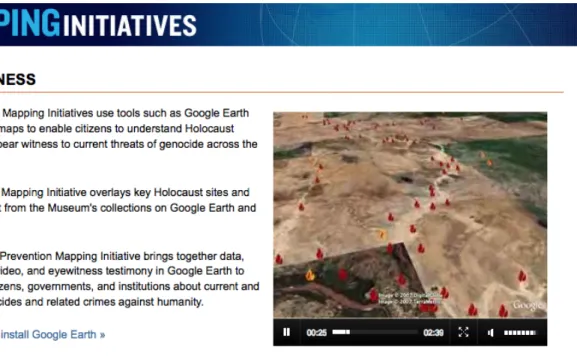
is in the process of creating an interactive map using Google Earth and Maps (figure
13). The point of these materials is to offer comprehensive and reliable Holocaust
information to people in locations that may not have access to unbiased Holocaust
literature and resources. As in other institutions we have explored, the Museum’s
mission and experience does not need to end where its grounds stop.
The Simon Wiesenthal Center and Museum of Tolerance
The Simon Wiesenethal Center is a Jewish humans rights organization based
in Los Angeles, California. Its branch projects include the Museum of Tolerance,
with its flagship site opened in 1993 in Los Angeles, with another one in New York
City and a third planned for Jerusalem; and the production company Moriah Films.
The Museum of Tolerance (MOT) “…is a human rights laboratory and educational
center dedicated to challenging visitors to understand the Holocaust in both historic
and contemporary contexts and confront all forms of prejudice and discrimination in
http://www.museumoftolerance.com/site/c.tmL6KfNVLtH/b.4866027/k.88E8/Our_H
istory_and_Vision.htm). It is hoped that through the museum experience, visitors
will not only be reminded of the past but also moved to action to prevent future
atrocities (2011,
http://www.museumoftolerance.com/site/c.tmL6KfNVLtH/b.4866027/k.88E8/Our_H
istory_and_Vision.htm). The organization is in the process of developing a virtual
museum.
Each branch of the organization has its own site, with supporting materials
and features. The sites are designed to supplement visitors’ trips to the MOT, and not
as stand-alone educational resource tools. The Action Lab allows visitors to continue
to think and interact with their experiences after leaving the MOT (figures 14-15).
From this page, visitors can express their thoughts on tolerance or learn about local
projects for encouraging tolerance in their communities. Those interested in the
Jewish world or tolerance related issues in current events, can also visit the Simon
Wiesentahl Center’s website where they can watch videos and read articles on these
subjects. The Center also has a library and archives, which are open to the public and
include a circulating collection. For those who cannot visit the archives in person,
there are the digital archives. The keyword searchable catalog returns digital images
and detailed descriptions of the items in the archives (figures 16-17). From the
records, patrons can request the image and, in the case of photographs, add names if
they recognize the subject (figure 17). This sort of virtual collaborative metadata and
information gathering is seen in other Holocaust archives, and seems to be an integral
As we have seen, websites and interactive media exhibits are increasingly
becoming integral parts of museums, particularly Holocaust museums where
extensive website have been created with exhaustive resources. London’s Science
Museum Curator, Suzanne Keene, has argued that web interfaces, particularly with
museums, will make knowledge more important than the collections themselves.
Keene contends, “People will be able, so to speak, to help themselves to the
information that the collections embody without mediation or interpretation”
(Reading, 2003, p. 67-8). Anna Reading explored the role of digital media in
constructing the social memory of the Holocaust. Internationally, Holocaust
museums draw large groups, mostly of students, and serve as institutions of
community learning and remembrance (Reading, 2003). Reading also found that the
most popular Holocaust websites are those that are agencies of museums and other
publicly-recognized repositories, suggesting that the public prefers information with
some appearance of authority (Reading, 2003).
Reading conducted research using the Los Angeles Simon Wiesenthal
Museum of Tolerance and its Multi-media Learning Center (MMLC), (installed in
2002) which is accessible to both visitors to the museum and to anyone with Internet
access. The intention, in addition to making history more interactive, is to extend the
learning process beyond the walls of the museum. Reading found that, while the
MMLC is very popular outside, the museum visitors in the museum exhibited
reluctance in approaching and interacting with the MMLC stations. In addition to
using the stations in groups, Reading noted that there was gender divide as to how the
2003). Logging-on to the website from home, after a visit to the museum, Reading
observed, is like a souvenir of the visit; it allows the museum patron to revisit the
experience (Reading, 2003). MOT is currently working towards creating an online
museum, which would be an extension of the MMLC project.
The Fortunoff Video Archive at Yale University
The Fortunoff Video Archive at Yale University is the product of a 1979
grassroots project by the Holocaust Survivors Film Project, based out of New Haven,
Connecticut. The collections were transferred to Yale University in 1981. The
archive contains more that 4,400 testimonies, and the number continues to grow, as
part of an ongoing oral history project with 37 affiliates around the world.
Testimonies are cataloged and indexed according to geographic locations and topics
discussed during the interview. With over 10,000 hours of video, and interviews
ranging from half an hour to over 40 hours in length, preservation and access are both
difficult and critical issues, especially because so much of the collection is on volatile
media technology such as VHS videotapes. Funding from the National Endowment
for the Humanities and the Jacob and Hilda Blaustein Foundation have allowed for
the restoration and reformatting of 2,761 videos, as well as the testing of a robotic
preservation system. Currently, plans are underway to migrate the entire collection to
digital formats, both for preservation and access (Yale University Library, 2009,
http://www.library.yale.edu/testimonies/about/index.html).
The study of the video testimonies in the Fortunoff Video Archive for
examined the value of Holocaust testimonies for the study of trauma and memory.
He found that these testimonies offer a unique opportunity for researchers because
they constitute “…remembering for the purpose of remembering” (Kraft, 2006, p.
312). Further, the subject is not distracted by the scientist, and has had 40-years to
reflect upon the event. Of significance to social historical memory is the observation
that, “…many survivors are more likely to reveal guarded information to prepared
stranger than to friends or even family” (Kraft, 2006, 312). Relationships are
important for living memory, and video testimonies offer an expansion of this
relationship.
This article illustrates the importance of Holocaust testimonies for the
discipline of archives. The creation of these video testimonies provides the survivors
or witnesses an opportunity to share their stories in a controlled environment. The
conditions under which the video was filmed are not of immediate importance to the
archivist, who should be occupied with making decisions about access and how that
will influence the use of the materials. Increasingly, the Fortunoff videos are being
made available online, removing their use from the controlled environment of the
archive.
Edited videos can be viewed online through the Yale University YouTube
Channel (figure 8). The programs are in three categories: thematically organized,
single-witness, and short testimony excerpts. The 16 available videos run from 12
minutes to an hour and a half in length, totaling 8 hours of content. The selections are
frequently updated; for example, a visit to the page on March 7, 2011, showed that it
several months before, I can attest that the selection has changed, and that videos are
no longer presented in multiple parts but as single videos. Clearly, this is a constant
work in progress. The YouTube Channel’s flexibility and ease of revision therefore
demonstrate its advantages over the tradition archive, in addition to reaching a wider
audience and providing external storage of video content. Other advantages include
keeping count of the number of views of each individual video as well as total views
for the Channel, and allowing users to subscribe to the Channel so that they can be
notified whenever the content is updated. While the University may be able to offer
such services internally, offering them through YouTube gives the user a greater
sense of control and makes the process feel more social.
Although the YouTube Channel offers many advantages to the archive, the
choice to offer edited content deserves some attention. It’s not uncommon to think of
archives as authentic historical documentation, presented as it was intended.
Museums, on the other hand, are accepted as curated experiences, presenting a certain
view or aspect of history. However, archives are not “pure” or untouched historical
repositories. Decisions are made by the creator and the archivist to collect, preserve
and arrange the documents in a specific order. Holocaust testimonies, whether they
come to us in a documentary or through a museum exhibit, have most likely been
edited or present only a small segment of an otherwise lengthy testimony.
Considering that many of the testimonies are very long, it would be impractical or
difficult to place entire multi-hour testimonies on YouTube. At present, if one were
to navigate to the YouTube channel by some mechanism other than through the
edited. While it may be that the average online viewer would guess that the videos
were edited or represented a selection of a larger collection, especially since the
general public is accustomed to receiving its Holocaust testimonies in edited form,
this notion may never occur to all of those watching the videos. When offering these
archival sources to the general public, it helps to offer additional explanatory
educational materials.
The University of Southern California Shoah Foundation
The University of Southern California Shoah Foundation Institute began
collecting video testimonies in 1994, and now has more than 52,000 interviews in its
collection. It recently began a massive project to digitize this large collection which
provides a good example of state-of-the-art preservation of film collections.
Acknowledging that its holding of videotapes would become increasingly likely to
deteriorate and corrupted over-time, the project is a time-sensitive one if the tapes are
going to be preserved for future generations. For this reason, in 2007 the Shoah
Foundation began transporting videos from its East Coast storage location to its
facilities on the University of Southern California campus (USC Shoah Foundation
Institute for Visual History and Education, 2011,
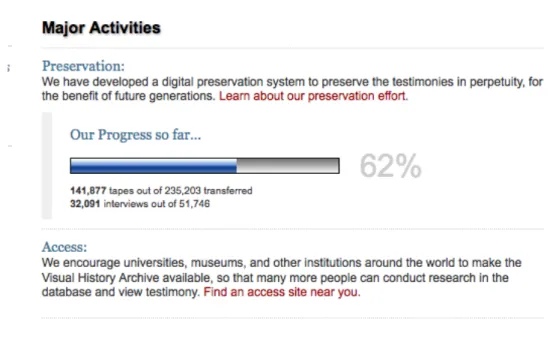
http://college.usc.edu/vhi/preservation/). Progress towards completion of the
digitization can be followed on the Foundation’s homepage (figure 18). The videos
are being digitized using Sun Microsystems (now Oracle America), which utilizes
robots to digitize the collection and add metadata. Sam Gutman, Chief Technology
preserve, and access all the testimonies collected by the Institute for Tolerance
Education...” (2010, http://college.usc.edu/vhi/preservation/). The Sun-based
architecture is composed of a storage system and server, which can hold 135
terabytes. The server allows the Institute to share its digital collections with other
institutes around the world through the Internet, without shipping or risking damage
to the original videos.
Access is at the heart of the Institute’s mission. Kim Simon, Interim
Executive Director, said, “The fact that the preservation is so state-of-the-art allows
us to optimize what we’re doing educationally, and allows us to optimize what we’re
doing from an access perspective” (2010, http://college.usc.edu/vhi/preservation/).
The Institute offers offsite access to its collections to other institutions, with Internet2.
Additional access and streaming of materials is offered to private individuals for a
fee. Families can also purchase a DVD or VHS of a family member’s testimony
(figure 19). The digitization project is not only making more of the Institute’s content
widely available, but also accessible at faster rates. According to Amy Beisel,
Associated Director, Academic Outreach and Research, the videos are of interest not
just to students of the Holocaust and 20th century, but also to the field of visual
literacy and media studies (2010, http://college.usc.edu/vhi/preservation/). The
archives appeal to a variety of people, and also are of interest from a technical
perspective because of their exceptionally innovative facilities.
The Shoah Foundation operates differently from other research and archival
institutions in that its main purpose is to provide materials to researchers in off-site
Foundation, or whether it evolved overtime. Either way, its operational policies, most
notably its preservation methods, revolve around its efforts to make the collections
more accessible and available to researchers around the world. Like other Holocaust
institutions, the Shoah Foundation is constantly trying to improve its access. Not
every institution has the resources of the Shoah Foundation or can secure a grant to
fund such a massive project. Also, the type of materials (digital, print, etc.) can also
influence access decisions. The presence of a large amount of video testimonies in
the Holocaust pantheon of materials presents the institutions with challenges that are
mostly faced by broadcasting and film archives. Holocaust archives are committed,
though, to offering access, and therefore have taken the opportunity or the challenge
of trying innovative ways to make their materials available to the public.
Conclusions
These Holocaust institutions’ websites have many similarities and differences.
The similarities stem from their commitment to memorializing the Holocaust and
ensuring access to their materials. The differences are largely the result of diverse
institutional practices and functions. The U.S. Holocaust Memorial and Yad
Vashem’s websites are most similar in terms of their scopes and contents. This can
largely be attributed to the fact that they are institutions of comparable size that were
both created under government directives. They both offer extensive online
educational resources as well as some access to their archival materials. The U.S.
Holocaust Memorial has more branch projects, like the Steven Spielberg film
general, whereas Yad Vashem’s collections and offerings are more focused. Yad
Vashem’s most notable online feature, the name Database, is not unique in the
Holocaust web efforts, but it is the only one of its size and in collaboration with
Google. The Database, being dependent on user generated content, is similar to other
Holocaust archival collections.
Collaboration and community involvement are fundamental processes in
Holocaust memorializing. This involvement is not limited to visiting the institutions
and holding commemorative ceremonies; the institutions also ask the public to
become involved in the archival process. This approach sprang out of need, because
those affected by the Holocaust can authoritatively provide information about the
victims. Online archives allow patrons to get involved in the archival process by
allowing patrons to add information about photographs and other primary documents.
Holocaust institutions are as much a community recovery process as they are places
to preserve the memories and artifacts of the event. These sorts of community driven
archival initiatives give voice to the victims, and, like the video testimonies, can
empower the survivors.
A common item in the Holocaust institutions is the video testimony. Each of
the institutions explored here has a collection of video testimonies, and in the case of
the Fortunoff Video Archive, it is the archive’s entire holdings. Video testimonies
have generated interesting studies and musing on the importance of memory. Only
recently, though, has a great deal of attention been given to the preservation of and
access to these videos. Both the Fortunoff Archive and the Shoah Foundation are
make more of their content available online. Furthermore, Fortunoff and Yad
Vashem have both utilized YouTube to distribute their testimonies. Virtual exhibits,
but particularly embedded testimonies, raise questions about the effects of the
environment on the user’s experience.
Each of these websites can be viewed as a carefully curated museum or
archive. From the colors to the fonts, everything has been selected in order to ensure
ease of use and a professional and authoritative looking website. The MOT’s website
is intended to be used as a supplement to a visit, whereas the Shoah Foundation’s
website is designed knowing that most users of its archival content will be doing so
remotely. These sorts of factors will play into decisions for designing and selecting
content for the websites. Just as these institutions’ websites reflect how patrons are
expected to interact with the physical location, the U.S. Holocaust Memorial and Yad
Vashem’s websites reflect their commitment to outreach and education. These
websites aim to be authoritative sources of information about the Holocaust. The
institution’s access mission ultimately informs the online content.
Without access, an archive might as well be a climate controlled storage
locker. Holocaust repositories have a social contract with the victims of the
Holocaust to ensure access and preservation of its materials. Preserving and sharing
the memories of the Holocaust are their reasons for existing. The process of
memorializing the Holocaust is not only the responsibility of institutions and requires
the participation of the public. These Holocaust institutions have used the Internet to
engage the public in the process of memorializing, both through education and
Holocaust memorializing, and Holocaust institutions are using them efficiently and
innovatively.
The missions of all of these institutions, in addition to keeping the memory of
the Holocaust alive, include the goal that the patrons will be moved to action as a
result of the experiences and knowledge they gain from their visits to the facility or
website. The lesson: “Never again!” makes the importance of the proper preservation
and management of these collections vital, not only to the institutions discussed
Figures
Figures 4. Form for submitting new entries to the Yad Vashem Database. Retrieved from:
http://www.yadvashem.org/wps/portal/!ut/p/.cmd/cs/.ce/7_0_A/.s/7_0_FQ/_s.7_0_A/ 7_0_FQ
Figure 5. Yad Vashem’s Photo Archive. Retrieved from:
Figure 6. Yad Vashem’s online library catalog. Retrieved from: http://www6.yadvashem.org/library/listResult.do?language=en
Figure 8. Fortunoff’s YouTube playlist. Retrieved from:
Figure14-15. Museum of Tolerance Action Labs. Retrieved from:
Figure 18. Shoah Foundation progress towards digitization, available on the homepage. Retrieved from: http://college.usc.edu/vhi/
Bibliography
Adami, T. (2007). “Who will be left to tell the tale?” Recordkeeping and international
criminal jurisprudence. Archival Science, 7(2), 213-221.
Ardent, H. (2006). Eichmann in Jerusalem: a report on the banality of evil. New
York: Penguin Books.
Freed, J. I. (1989) The United States Holocaust memorial museum. Assemblages,
9(Jun), 58-79.
Friedman, E. R. (2007). The Anti-Archive? Claude Lanzmann’s Shoah and the
Fortunoff Video Archive for Holocaust Testimonies. (1990). Guide to Yale University
Library Holocaust video testimonies. New York: Garland Pub.
Goldman, N. (2006). Israeli Holocaust memorial strategies at Yad Vashem: From
silence to recognition. Art Journal, 65(2), 102-122.
Hirsch, M. and Spitzer, L. (2009). The witness in the archive: Holocaust
studies/memory studies. Memory Studies, 2, 151-170.
Jaeger, J. (2010). Holocaust resources on the web: Finding some of the best sites.
C&RL
News, (February), 80-87.
Josias, A. (2011). Toward an understanding of archives as a feature of collective
memory, Archival Science, (January 18).
Kraft, D. (February, 12, 2011). Israeli archive and Google team up to put Holocaust
stories at fingertips. The New York Times. Retrieved from:
http://www.nytimes.com/2011/02/13/world/middleeast/13holocaust.html?_r=
1&scp=1&sq=yad%20vashem&st=cse
Kraft, R. N. (2006). Archival memory: Representations of the Holocaust in oral
Kushner, T. (2001). Oral history at the extremes of human experience: Holocaust
testimony in a museum setting. Oral History, 29(2), 83-94.
Landsberg, A. (1997). America, the Holocaust, and the mass culture of memory:
Toward a radical politics of empathy. New German Critique, 71
(Spring-Summer), 63-86.
Lanzmann, C. (producer and director). (2003). Shoah. Hollywood, CA: New Yorker
Video.
McDonald, C. (2006). Reconciling Holocaust scholarship and personal data
protection: Facilitating access to the international tracing service archive.
Fordham International Law Journal, 30(4), 1360-1391.
Mendelshohn, J. (1980). The Holocaust: Rescue and relief documentation in the
national archives. Annals of the American Academy of Political and Social
Science, 450(Jul), 237-249.
Prelinger, F. (2009). Points of origin discovering ourselves through access. The
Moving Image, 9(2), 164-175. DOI: 10.1353/mov.2010.0005.
new technologies in Holocaust museums. Media Culture Society, 25, 67-85.
Schenkloewski-Kroll, S. and Tractinsky, A. (2006). Archival description, information
retrieval, and the construction of thesauri in Israeli archives. Archival Science,
6, 69-107.
Simon Wiesenthal Center. (2011). The Museum of Tolerance: A Simon Wiesenthal
Center Museum. Retrieved from:
http://www.museumoftolerance.com/site/c.tmL6KfNVLtH/b.4865925/k.83A7
/Whats_Happening_at_the_MOT.htm
Stevick, E. D., and Gross, Z. (2010). Epistemology and Holocaust education: History,
memory, and the politics of knowledge. Prospects, 40, 189-200.
United States Holocaust Memorial Museum. (n.d). “Collection and Archive.” U.S.
Holocaust Memorial Museum. Retrieved from:
http://www.ushmm.org/research/collections/
The USC Shoah Foundation Institute for Visual History and Education. (2010).
“Testimony Services.” USC College. Retrieved from:
http://college.usc.edu/vhi/testimonyservices.php
Ydessa Hendeles and Peter Forgacs. Intercultural Aesthetics: A World
Perspective, 137-155.
Yad Vashem The Holocaust Martyrs' and Heroes' Remembrance Authority. (2011).
Yad Vashem. Retrieved from: http://www.yadvashem.org/
Yad Vashem The Holocaust Martyrs' and Heroes' Remembrance Authority. (2011).
“About Yad Vashem.” Yad Vashem Retrieved from:
http://www1.yadvashem.org/yv/en/about/index.asp
Yale University Library. (December 1, 2009). “About the Archive: Introduction.”
Yale University Library: Fortunoff Video Archive for Holocaust Testimonies.