Monte D Evans. A New Approach to Journal and Conference Name Disambiguation through K‐Means Clustering of Internet and Document Surrogates. A Master’s Paper for the M.S. in I.S degree. April, 2009. 54 pages. Advisor: Catherine Blake
Bibliometrics has a long history in Information Science. The validity of any
bibliometric analysis depends on accurate citations. We introduce an approach that combines author names and Internet document surrogates with K‐means clustering to disambiguate journal and conference titles automatically. To evaluate the quality this approach we used records from the Digital Bibliography & Library Project (DBLP). We found there are 2.54±1.52 authors per articles. A manual analysis of 125 articles selected at random from the 1.18 million DBLP citations revealed only seven article pairs from the same publication venue. We describe the changes in cluster properties as the number of articles increases from 100 to 25,000. Our findings suggest that additional features are required to disambiguate journal and conference names accurately. As 60.86% of the DBLP articles are published at conferences future efforts should focus on conference name disambiguation.
Headings:
A NEW APPROACH TO JOURNAL AND CONFERENCE NAME
DISAMBIGUATION THROUGH K-MEANS CLUSTERING OF INTERNET AND DOCUMENT SURROGATES
by Monte D. Evans
A Master’s paper submitted to the faculty of the School of Information and Library Science of the University of North Carolina at Chapel Hill
in partial fulfillment of the requirements for the degree of Master of Science in
InformationScience.
Chapel Hill, North Carolina
April 2009
Approved by
Table of Contents
Table of Figures ... 2
Table of Equations ... 3
Table of Tables ... 4
1 Introduction ... 5
1.1 Definitions... 6
2 Background ... 8
3 Related Work...10
3.1 String Matching and Word Sense Disambiguation Methods ...11
3.2 Machine Learning Algorithms ...13
3.3 Internet surrogates...14
4 Methodology ...17
4.1 Candidate Features ...17
4.1.1 Primary Author Name... 18
4.1.2 Co‐authors ... 19
4.1.3 Base URL... 19
4.1.4 Article title ... 20
4.2 Preprocessing and Data Collection ...21
4.2.1 Collecting citation information... 21
4.2.2 Representing the Host Frequency... 25
4.2.3 Collecting Base URL Features... 27
4.3 Clustering ...28
4.3.1 Methods ... 28
4.3.2 Clustering Vectors ... 29
5 Results...30
5.1 Manually Evaluated Clusters ...30
5.2 Varying the number of articles ...39
5.3 Visualizing clustering performance ...42
6 Discussion...44
6.1.1 Limitations and Future Work... 45
7 Conclusions ...46
Table of Figures
Figure 1: DBLP Entity Relationship Schema...21
Figure 2: XML Import Parser Example ...23
Figure 3: Oracle Feature Selection...29
Figure 4: Example of Entity Encoding Issues...35
Figure 5: Sample 100 elements with K = 10...43
Figure 6: Sample 100 elements with K = 100 ...43
Figure 7: Sample 2,500 elements with K = 10 ...43
Figure 8: Sample 2,500 elements with K = 100 ...43
Figure 9: Sample 25,000 elements with K = 10 ...43
Table of Equations
Table of Tables
Table 1: Citation Distribution Information in DBLP ...19 Table 2: DBLP Distinct Format Distribution ...20 Table 3: DBLP Most Prolific Authors ...21 Table 4: Sample A ‐ Manual Analysis of Clusters from a Random Set of Journals and
Conferences...31 Table 5: Sample B ‐ Manual Analysis of Clusters from Same Journal...36 Table 6: Manual Analysis Summary Statistics ...39
1
Introduction
In a letter to Robert Hooke, Sir Isaac Newton stated “If I have seen further it is by standing on the shoulders of giants” (Merton 1993). Scientific research and discovery is largely based upon a gradual refinement of others work and ideas, a process Kuhn calls "normal science" (Kuhn 1970). Therefore, having accurate citation information is a matter of the utmost importance to a researcher and his or her ability to have the greatest possible breadth of knowledge available.
Bibliometrics, a term coined by Alan Pritchard in 1969, is the application of quantitative analysis and statistics to publications such as journal articles and their accompanying citations (Pritchard 1969; Hauptly 2008). One key challenge in bibliometrics is the accurate identification of journal titles. Garfield, arguably the creator of the field of bibliometrics and the inventor of the ISI impact factor for journal publications, indicated the difficulties with journal names to create a corpus of citations in his 1972 paper on citation analysis:
An immensely irksome problem was the inconsistency with which different authors and editors abbreviate journal titles in their references... Some idea of the work involved in this standardization can be had from the fact that there were more than 100,000 different abbreviations for the 12,000 individual journal titles cited in the 3‐month sample.
Journals merge; they split into new journals, or into “sections” that may be published separately or together. They change titles, with or without continuing their numbering of volumes and issues. Some journals appear in one or more translations; some such translations are complete, other selective, and some are similar, other differently, numbered. (Garfield 1972)
Garfield’s analysis directly addresses the difficulty in maintaining the consistency and accuracy of journal names in citations. He shows that his corpus consists of an average of eight different journal title permutations for each journal (inconsistencies exacerbated by a factor of eight) in 1972. The Web of Science has over 23,000 journals, 110,000 conference proceedings, and 9,000 websites (Thomas Reuters 2008) thus, manual disambiguation to resolve incorrect journal and
conference names is untenable. More than thirty years ago, Garfield stated that the problem of journal name correction and disambiguation is simply insoluble and authors should begin using the full journal title whenever possible. Despite this recommendation, authors have continued to use abbreviated journal titles. For example, the abbreviation is Astron. J is for both the Astronomical Journal and the Astronomy Journal. Additionally, the Annals of Physics and Annalen der Physik are abbreviated Ann. Phys.
Our goal is to explore the effectiveness of clustering documents to disambiguate journal titles via their author (see Section 4.1.1) and co‐author features (see Section 4.1.2) as well as the use of Internet surrogates and the associated Internet address of the server that hosts the surrogates (see section 4.1.3).
1.1 Definitions
• Article/document ‐ A single instance of a written paper from a journal or conference proceeding. The article or document can include editorials, reviews, proceeding notes, research findings, or any other information located within the venue of a journal or conference.
• Bibliometrics ‐ The application of mathematics and statistical methods to books and other media of communication (Pritchard 1969). Bibliometric measures show citation rates, author impact, and journal impact (De Solla Price 1976).
• Bibliometric coupling ‐ A single item of reference used by two papers is defined as a unit of coupling between the two papers (Kessler 1963). Bibliometric coupling defines the similarity between two documents as the number of references that two articles have in common.
• Citation ‐ A reference to a published or unpublished source of information such as a book, article, web page, or other document. Citations include
information pertaining to: the author, location of the document, volume, page range, and year of publication.
individual article but a sufficiently large sample of cited articles mitigates this random "noise" (Schildt, Zahra and Sillanpää 2006).
• Journal and conference name: The unified title for a serials collection. Journal listings as defined by the Online Computer Library Center (OCLC) specification for the Machine Readable Cataloging (MARC) 130 field, created by the primary publisher, or the official name for a conference, not including the year, as provided by the hosting institution or publisher.
2
Background
Bibliometrics is the application of mathematics and statistical methods to books and other media of communication that is used to discover patterns and trends over a corpus and evaluate how authors impact specific disciplines. However, the quality of bibliometric analysis depends on accurate journal and author names. Without a coherent and systematic approach to disambiguation of journal and author names, bibliometrics may misrepresent an author’s impact. Since scholars depend on the correctness of information obtained through
bibliometric analysis, including the process of bibliometric coupling ‐‐ measuring the number of references two papers have in common to test for similarity ‐‐ having accurate data is paramount (Turnbull 1998).
Torvik, et al. 2005; Yang, et al. 2006). We applied disambiguation techniques similar to those in the aforementioned works, but to journal and conference names rather than author names. A citation can consist of several features including, but not limited to, authors, year of publication, name of journal or conference, page ranges, format, and location of resource. Scientific disciplines exclude certain information, for instance, chemistry citations may exclude article titles, and
literature published in Medline before 2002 did not include the full representation of the author’s name (Torvik, et al. 2005).
This study explores the use of Internet document surrogates obtained
through online search engines coupled with author and co‐author features to create clusters of related articles that have the same journal and conference names
automatically. Document surrogates include electronic PDF versions of the article, the article's abstract page, or related websites such as the author's homepage.
conference names, for example, the abbreviation "Ann. Phys." Applies to three distinct journal names, the Annals of Physics, Annales de Physique, and Annalen der Physik (Garfield 1972). A simple translation table would be unable to resolve these ambiguities. It is necessary to locate the article's original source and examine the surrounding context to evaluate the name of the article's journal or conference accurately.
3
Related Work
Journal and conference disambiguation is an example of the more general disambiguation problem that has been studied since the 1960's. Disambiguation and identification techniques are numerous; and include string matching and word sense disambiguation, machine learning algorithms, and the use of external
information surrogates. We will briefly discuss the first two implementations and then focus extensively on the last implementation. The reader is advised to refer to the referenced articles for additional background information on the former two techniques.
The study of bibliometrics is one central facet of research in the information and library science community. Bibliometric analysis emerged from the initial work of Eugene Garfield and his creation of the Science Citation Index in 1960. Garfield describes citations as "brief representations of the documents they identify"
innovation and identify the evolution within sub‐groups of what Kuhn refers to as "Revolutionary Science" (Kuhn 1970).
Small's work in co‐citation analysis shows that circular citation references between authors (Small 1973) reflect peer recognition and indentify
"microevolutions" within sub‐disciplines (Small 2003). Researchers also utilize automatic techniques and agglomerative clustering algorithms, creating linkages between citations to show relationships between authors (Morris and Van der Veer Martens 2008). The section below describes three key methods to disambiguate authors: word sense disambiguation, machine learning algorithms, and Internet surrogates.
3.1 String Matching and Word Sense Disambiguation Methods
Researchers reduce ambiguity in natural language through the creation of automatic disambiguation techniques known as "lexical association" and "lexical preference". These two methods tokenize sentences into a structured context and allow researchers to create equivalency tables based on the placement of the words within the sentences (e.g. nouns phrase, verbs, past participles). These techniques rely on the use of thesauri and meta‐dictionaries to create the equivalency tables
(Brill and Resnik 1994; Baker, et al. 1994).
Brill created a greedy search using WordNet's noun database to resolve prepositional phrase attachments. Through the aid of a supervised training dataset and a comprehensive set of rules, he could accurately predict and annotate
Baker used the KANT (Knowledge‐based, Accurate Natural‐language
Translation) natural‐language translator in an attempt to produce sentences devoid of ambiguity through transformations that did not require any post‐processing. She used a standard markup language to annotate the composition of each sentence and then used heuristic measures to reduce ambiguous phrases. For example, if the system encountered the phrase "The parts must be put back together" it would transform the sentence to "The parts must be reassembled", thus removing ambiguity.
The annotation approach provides researchers with numerous advantages. A subset of the English language follows a set of grammatical rules that allows
tokenization‐based systems to identify and disambiguate more than 50% of the article (Baker, et al. 1994). Knowing that a term could be a noun or a verb allows researchers to disambiguate it more readily. The term tokenization process is replicable and requires only a limited understanding of the process. Additionally, the system's output is understandable and interpretable without the aid of
computers, reducing the complexities involved in decoding information stored in machine‐structured formats.
found in English. Tokenization and tagging systems are appropriate for relatively known and predictable corpora, however they are not an elegant a solution for corpora with large amounts of unknown data or non‐structured data such as citations.
3.2 Machine Learning Algorithms
Another method of bibliometric disambiguation is the use of machine learning algorithms. These algorithms use features from a citation such as the journal title or conference name, co‐authorship, and domain of research to automatically group, or cluster, similar articles together (Torvik, et al. 2005). Learning algorithms include Bayesian classifiers, hidden Markov Models, spatial clustering, and vector analysis.
The input dataset affects the performance of machine learning algorithms. For instance, Bayesian algorithms employ simple probabilistic classifiers and exhibit better performance when using a limited training corpus with a new and unseen textual dataset. In contrast, K‐means clustering partitions data into a user‐defined number of clusters based on the similarity of the data, using the smallest distance between two vectors as a partitioning metric.
by allowing the algorithm to use similarity metrics to detect patterns within the dataset.
3.3 Internet surrogates
Researchers have introduced methods that use Internet surrogates to supplement a machine‐learning algorithm's primary corpora. These researchers use a combination of features from the documents, such as the article's title, to collect surrogate documents from online search engines and other external data sources. These surrogates introduce new information to the learning algorithms thus allowing them access to data outside the scope of the original corpus. Gideon and Yarowsky (2003) create an unsupervised personal name
disambiguation system that can distinguish the real world referent of a given name in context. The system uses a language independent bootstrapping process to collect bibliographic facts about the authors using Internet search engines. The system uses the results from the search engines to identify bibliographic patterns pertaining to an author such as their date of birth, location of residence, or field of study. Gideon et al clusters these bibliographic patterns together, producing clusters of keywords (occupation, age, field of study) and the corresponding referent (such as Jim Clark ‐ Netscape Founder versus Jim Clark ‐ Car Salesman in Kansas) (Gideon and Yarowsky 2003).
provided by the Internet Data Base and Logic Programming website (now known as the Digital Bibliography & Library Project), given an author Ai they can accurately
identity false citations by another author Aj, even if the authors share identical name
spellings. Lee's approach is to create relational models based on terms within the citation and to combine data mining approaches, such as Naive Bayes, String‐based Distance Metrics, and Support Vector Machine, to indentify unique authors within a citation.
This study of journal and conference name disambiguation is closely based upon research presented in a paper by (Tan, Kan and Lee 2006). Like the preceding author, Tan used the DBLP database to solve the issue of mixed citation. However, unlike Lee who uses the Internet corpora exclusively, Tan submits the title of each article to a search engine. He then uses the relevant URL weighted by its Inverse Host Frequency (see Section 4.1.3) as features to compute the similarity between two citations using cosine similarity. Finally, he uses hierarchical agglomerative clustering to derive the k‐clusters that represent the disambiguated authors. Tan uses Internet search surrogates as the training set for his unsupervised
classification algorithm.
clustering implementation. The Yang author disambiguation approach, including the use of web surrogates, was statistically better than the Tan approach when comparing the same citations and using the same recall evaluative metrics. The advantages to these approaches are that over time the corpus transforms, allowing for new data and article permutations. The learning
algorithms are exposed to new information as soon as it becomes available to the online search engines, thus affording the classifiers the possibility to determine similarities in a greater number of documents. This enables researchers to expand the domain of their initial study, to allow for the retrieval of documents from external disciplines or subject areas. Additionally, the corpus will "evolve" over time, provided that as new research emerges within a field, it becomes accessible to the electronic source and the learning classifiers.
However, Internet surrogates are not without problems. The use of Internet surrogates may increase the recall measure for a particular query. Recall is the number of relevant documents retrieved by the system divided by the total number of existing relevant documents (see Equation 1). An increased recall measure can introduce irrelevant information into the corpus, thus affecting decisions based upon the quality of the dataset. Internet surrogates can also make the application of certain statistical methods difficult due to the possible increased number of false
positives. Furthermore, certain clustering techniques such as K‐means rely on a user‐defined cluster size and an increase in spurious information could make clusters less meaningful.
Internet surrogates must be carefully obtained, evaluated, and added to the corpus to minimize false positives. The aforementioned articles use features from the original corpus that are most likely to produce relevant surrogates. Researchers have been using data from these surrogates to supplement meta‐information about documents already in their corpus, using search engines such as Google and Yahoo. It is imperative that the use of Internet surrogates to enhance or supplement a data collection does not introduce additional ambiguity.
4
Methodology
Our goal is to explore the effectiveness of document clustering to
disambiguate journal title via their author and co‐author features as well as the base Internet Protocol (IP) address of the server that hosts these articles (see Section 4.1.3). In contrast to the works presented in Section 3.3 that explore author name disambiguation, the process of journal and conference name disambiguation poses additional challenges described in the discussion section (see Section 6).
4.1 Candidate Features
considered to introduce to the clustering process, including features that we did not use in this study.
4.1.1 Primary Author Name
publication were incorrectly merged into one author entry (Jaffri, Glaser and Millard 2008).
4.1.2 Co‐authors
Disambiguation studies by Yang and Han suggest that authors appear to write articles with a small group of other authors, and this co‐author relationship is an important feature in disambiguating a primary author (Han, Zha and Giles 2005) and (Yang, et al. 2006). We can use this co‐author relationship as a clustering feature and improve the data partitioning process because vectors with highly similar co‐authors are geometrically similar. Co‐authors have the same ambiguity issues as that of the primary author, however the Yang study suggests this is a non‐ issue. Moreover, Torvik, et al. (2005) suggests that some journals, such as articles in Medline until 2002, did not record the full first name of any author of an article, so the inclusion of co‐author information may negatively affect clustering performance.
4.1.3 Base URL
Tan et al. introduced the idea of using metadata from servers that host
articles as a clustering feature (Tan, Kan and Lee 2006). As authors begin to publish their articles electronically, the system described by Tan can use URLs to
would appear. Using this factor of article similarity in journals the base URL should predict related articles.
The base URL suffers from issues that can adversely affect the performance of a machine‐learning algorithm. For example, web resources can have URLs such as http://www.acm.org and http://delivery.acm.org that appear different, but may provide identical content. Special care is necessary when including URL information (see section 4.2). Although the effectiveness of using URLs remains unclear, several recent studies indicate positive results (Han, Zha and Giles 2005; Lee, et al. 2005; Elmacioglu, et al. 2007). The Elmacioglu article was able to achieve a purity
measure of 0.73 when using URLs of author's personal homepages for the purpose of disambiguation.
4.1.4 Article title
The article's title is a useful metric in determining the relationship between authors and co‐authors (Torvik, et al. 2005). Title information often appears in multiple citations along with a list of attributes, such as the author's name. Information retrieval techniques, such as term weighing and frequency, could
4.2 Pre‐processing and Data Collection
We describe the process of collecting lists of citations to introduce to the K‐ means clustering algorithm. We also present the tools and techniques we use to pre‐process the data to ensure uniformity.
4.2.1 Collecting citation information
The citations used for this study are provided by the Digital Bibliography & Library Project (DBLP) database. The DBLP provides access to citations from hundreds of journals, books, conferences proceedings, and even PhD theses. We used the February 2009 version of the database containing 1,180,280 unique citations from 692,534 distinct authors. This dataset does not explicitly
Figure 1: DBLP Entity Relationship Schema
disambiguate author names, so this figure does not account for author conflation. The DBLP dataset is available in a compressed 550 megabyte XML file that includes most of the structure necessary to reassemble the bibliometric components found in the online version of the DBLP (http://www.informatik.uni‐trier.de/~ley/db/). For this study, we created a database to separate the DBLP into citations, papers,
authors, editors, and publication records (see Figure 1 for the complete schema). We created a series of command line PHP scripts to extract the XML data, parse the DBLP database's structure, and populate a MySQL database with the resulting information. This process allows the data to exist in a relational format, suitable for logical querying with standard SQL‐commands. The information in the MySQL database includes articles, conference proceedings, books, collections, PhD and master theses, as well as online resources, such as home pages and
departmental websites.
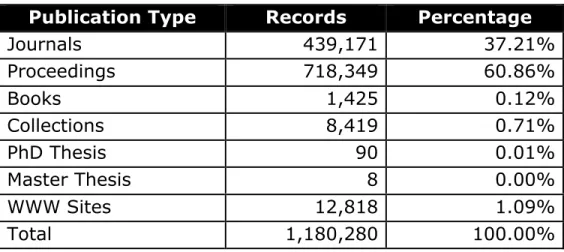
After completing the extraction process, the following grouping of citations emerged (see Table 1), where 60% of all citations used during our random selection process are likely citations from conference proceedings. To produce a collection of citations that would form clusters based on the journal or conference name requires the selection of a non‐biased random data sample of all of the citations.
We created a script to select random citations without replacement, from the DBLP database (see Figure 2 for import example). We used these random citations as input to the clustering algorithm.
$ php select_article.php
Please enter the number of articles to select: 100
100 random articles selected. (Showing co-authors and URLs): 1 (21015) syntax-based semi-supervised named entity tagging 2 (771260) a locally-organized parser for spoken input
3 (927006) an nc algorithm for the clique cover problem in cocomparability graphs and its application
4 (602981) facetransfer: a system model of facial image rendering 5 (734008) home page
6 (985385) polynomial decomposition algorithms
Figure 2: XML Import Parser Example
Table 1: Citation Distribution Information in DBLP
Publication Type Records Percentage
Journals 439,171 37.21%
Proceedings 718,349 60.86%
Books 1,425 0.12%
Collections 8,419 0.71%
PhD Thesis 90 0.01%
Master Thesis 8 0.00%
WWW Sites 12,818 1.09%
Total 1,180,280 100.00%
For each random article, we extracted the following features: the article’s unique identifier; the title of the article; and the first five authors by the order they are listed in the article's citation. The distribution of unique journal, conference, etc. that an article is published is listed in Table 2. The collection contains documents with as few as one author and no co‐authors to as many as 115 co‐authors in a single article. We determined that there are authors per citation in the DBLP collection.
Based on this information, we decide to use the first five authors, anticipating that this would be sufficient for accurate clustering without introducing noise into the dataset due to empty or null co‐author values (e.g. most citations have a maxium of two authors). Although we acknowledge that one distinct author entity may represent several different individuals, the system uses the author's first initial and complete last name. We then standardize these names to lower case to maintain consistency and re‐order the name such that "Smith, John F." becomes “j smith”.
Table 2: DBLP Distinct Format Distribution
Publication Type Records Percentage
Journals 713 4.37%
Proceedings 2,586 15.83%
Books 78 0.48%
Collections 41 0.25%
PhD Thesis 90 0.55%
Master Thesis 8 0.05%
WWW Sites 12,818 78.47%
Total 16,334 100.00%
4.2.2 Representing the Host Frequency
As stated in Section 4.1, these experiments explore the degree to which author and co‐author names along with the base URL of the servers that host the article can be used with a clustering algorithm to predict the journal or conference name. The article's base URL presented several challenges in accurately selecting the most appropriate, representative, and informative URLs to represent the article. Akin to any classical information retrieval problem, we must ensure that we did not collect a list of the URLs resulting in increased recall that introduces "noise" into the algorithm. Noisy data would include URLs that do not provide useful information as to the primary location of the servers that hosts the article online. We modeled a modified form of the term frequency x inverse document frequency (tf‐idf), where we divide the document frequency of the URL selection by the log of the inverse URL frequency. However, instead of using terms from the corpus, we are using the unique Internet Protocol address of the server that hosts the article.
Table 3: DBLP Most Prolific Authors
Rank Name DBLP Evans
1 Yu, Philip 535 535
2 Wang, Wei 482 481
3 Chin‐Chen Chang 480 469
4 Elisa Bertino 468 466
5 Thomas S. Huang 458 459
6 Edwin R. Hancock 437 438
7 Grzegorz Rozenberg 433 431
8 Sudhakar M. Reddy 431 428
9 Wen Gao 416 416
10 Alberto L. Sangiovanni‐Vincentelli 414 415
Tan, Elmacioglu, and Yang were the first to propose URLs, while attempting to determine which websites act as harvesting agents collecting a substantial number of articles (articles, conference proceedings, etc) but were not the primary hosting source for these documents (Tan, Kan and Lee 2006; Elmacioglu, et al. 2007; Yang, et al. 2006). We have adapted a similar approach, but offer additional features to reduce the ambiguities that exist in uniquely identifying a URL. Simply using the URL of an article is insufficient, to a computer (and a casual observer) because although the URLs http://www.acm.org and http://delivery.acm.org look different, both URLS are hosted on the same machine.
We can perform a reverse Domain Name Service (DNS) lookup to produce the IP address of the machine that hosts both of these websites, each of which returns 63.118.7.37. Although the process of reverse DNS resolution is not without issues, we assert that the use of DNS resolution should be sufficient to detect
duplicate URLs adequately.
Web hosting companies employ a feature called round‐robin load balancing where they use of multiple IP address to enable users to view one‐of‐many servers that host the website and deal with web traffic efficiently. For instance, when we query the IP address of the server that hosts http://www.google.com, it returns three entries for the server's location: 74.125.67.100, 74.125.45.100, and 209.85.171.100. Each of these addresses is valid, displays the Google.com homepage, and is distributed according to their geographic proximity to the computer's IP address.
Resolving the ambiguity involved with load‐balanced websites requires querying for the available IP addresses to the reverse DNS lookup call. We order each of these unique IP address numerically and then search the database to locate a previous match. If no matches exist, we add the first address in numerical order to the database. Unlike the referenced articles above, this DNS resolution alteration should reduce some of the noise associated with modern load‐balancing practices. We performed 297,952 searches that resulted in 19,770 unique base IP addresses. Finally, for a hostname h that has a frequency f(h), we calculated the inverse host frequency to be where:
Equation 2: Inverse Host Frequency Equation
4.2.3 Collecting Base URL Features
random citations from the DBLP database (see section 4.2.1) to submit as a query to the Yahoo search engine via an automated programming interface (API). The Yahoo search returns a listing of the top‐ten searches matching our query, including the URL for each site. We resolve each of these URLs to their base components (e.g. http://www.website.edu/path/file.html base URL is www.website.edu), perform a reverse DNS lookup with the website's IP address, and consult our inverse host frequency database to calculate the “rarity” of the server, based on data within our corpus. For each address that does not have an entry in the inverse host frequency table, we assign it an arbitrarily low ranking value of one. We then sort the array by the inverse host frequency, adding “rare” domains first and then save this data to an XML file for later processing by a K‐means clustering implementation. We perform several random citation trials consisting of sample datasets of 100, 250, 1000, 2500, and 25,000 unique citations, and two independent samples with 125 articles used for a manual inspection and analysis of the clusters (see Section 5.1).
4.3 Clustering
K‐means clustering operates over ten features: the first five authors of an article and the first five base IP addresses of the unique server hosting the article. Our study uses the Oracle Data Miner implementation of the K‐means clustering algorithm.
4.3.1 Methods
unbiased, the only identifiable information we included during the import process was the MySQL internal database primary key, which does not correlate with the journal title. This allowed us to evaluate the performance of the clusters, without influencing the clusters with external document metadata.
4.3.2 Clustering Vectors
As stated in section 4.2.3, we used five different sample datasets consisting of 100, 250, 1000, 2500, and 25,000 unique citations. Since each of the datasets use the same randomized selection process, each datasets should contain the same proportion of citation from each of the sources listed in Table 1. Each of these five datasets included the five authors and the five IP address feature. Attributes “Author4” and “Author5” are labeled as sparse because 20% or more of the data within these two attributes contain null values (see Figure 3), which is not surprising when the mean number of authors within the corpus is 2.54. The
following parameters were set in the K‐means algorithm: create up‐to‐100 clusters, use the Euclidean‐based distance, and iterate through the dataset 20 times. Finally, we used a size‐based split criterion to ensure that one cluster did not dominate during the partitioning phase.
5
Results
We present the clusters produced by the Oracle Data Miner as well as a spatial representation of the overall system's clustering performance. We manually inspected two different samples of 125‐articles clustered by the K‐means algorithm using a user‐specified k‐value of fifty (see section 5.1). We review these sample datasets, including encoding representations, data consistency, and observed trends in sections 5.2 and 5.3.
5.1 Manually Evaluated Clusters
The first sample, sample A (see Table 4) used the random sampling method presented in Section 4.2.1 to select the candidate articles. The algorithm created fifty clusters using the clustering features described in Section 4.3.2. We manually examined each of the K‐means algorithm's clusters. If the clustering approach worked, each cluster should include a set of articles that have the same journal or conference name.
The values bolded in Table 5 represent an exact match for an author or IP address and values in italics indicate highly likely candidates because of a high level of data similarity. For instance, the IP address 171.64.68.10 and 171.64.75.45 are not the same address, but share many of the same base address characteristics; they are within 65,534 addresses of each other and have the same class B subnet.
resulting in seven article pairs that were from the same journal or conference (denoted in orange); the algorithm did not have access to the journal or conference names. The clustering algorithm did not place any of the matching articles in the same cluster. Overall, this sample A contains few articles with highly likely candidate features (less than 12%), but we anticipated this lack of similarity because the remaining articles are drawn different journals and conferences. Table 4: Sample A ‐ Manual Analysis of Clusters from a Random Set of Journals and Conferences
IP A IP B IP C Author A Author B
Journal / Conference
Name
165.123.34.126 130.82.101.38 128.2.203.164 j yang q li
International Journal of Computer Vision
134.84.135.153 129.97.86.229 141.51.167.67 d cuesta‐frau m
hern¿¿¿¿ndez‐
fenollosa conf/iciar
193.2.123.5 136.199.54.125 130.82.43.1 m kannen m leischner
*1 HMD ‐ Praxis Wirtschaftsinfor m.
193.194.158.174 64.79.161.47 136.199.54.125 j cowie l oteniya conf/iceis
130.82.101.132 141.51.167.67 136.199.54.125 p wognum r jardim‐gon¿¿¿¿alves conf/ispe 146.48.87.136 143.167.100.186 94.23.23.174 p clough a al‐maskari conf/clef 208.69.40.118 64.14.68.65 134.76.74.100 d wishart r yang In Silico Biology
130.203.133.36 129.130.10.48 128.220.13.101 t amtoft a banerjee Sci. Comput. Program.
c louwrens s solms conf/sec
202.41.92.139 128.2.203.164 137.132.80.51 j jouannaud e kounalis conf/lics 136.199.55.186 139.6.138.20 s schierholz e windisch IWBS Report
157.193.140.25 195.134.65.118 140.98.194.135 a barbieri g colavolpe
IEEE
Transactions on Wireless Communications 132.241.82.63 128.171.194.70 72.246.48.32 m walji j zhang *2 conf/hicss 144.124.0.99 158.125.1.136 128.101.35.199 q meng m lee Neurocomputing 78.46.52.79 72.246.48.32 137.226.34.227 g gui h kienle conf/iwpc 72.9.156.208 150.65.5.208 130.64.20.7 h yoshida t shigenobu conf/kes 69.5.195.211 128.220.138.120 98.131.133.89 m roula a bouridane conf/isbi 149.132.176.38 159.149.130.205 148.4.2.231 h van a trentini conf/seke
130.203.36.210 130.49.220.23 114.240.114.60 s kim n vijaykrishnan conf/islped 146.193.39.30 130.161.37.202 128.32.244.168 j fernandes m silva conf/iscas 129.10.32.93 203.159.0.13 129.81.224.51 v deligiannis s manesis conf/etfa 140.112.18.7 216.47.152.246 202.141.68.6 a shrivastava m kumar conf/vlsid 169.237.114.218 212.201.44.37 128.120.246.26 s park l linsen IEEE Trans. Vis. Comput. Graph. 155.98.65.24 132.67.252.100 128.2.203.164 h connamacher m molloy conf/focs 152.66.70.16 130.161.254.58 137.132.80.57 g patan¿¿¿¿ m russo Inf. Sci.
131.114.9.224 209.62.47.32 140.116.82.34 j verd¿¿¿¿ j garc¿¿¿¿a
SIGARCH Computer Architecture News 192.150.18.101 96.7.106.53 171.67.22.33 a laursen j olkin conf/compcon 130.237.225.198 78.47.80.59 128.171.224.100 m palm¿¿¿¿r a naeve conf/iccs 204.111.14.150 130.235.64.101 165.123.34.126 s crudge f johnson *3 JASIST 128.248.155.210 130.126.140.41 128.105.7.26 r iyer z kalbarczyk conf/dsn 64.207.133.151 195.82.124.124 158.182.9.1 y fung c li conf/iat 128.230.109.13 63.84.220.233 141.217.48.33 w shi z tang conf/hipc 210.32.0.229 132.198.19.37 130.233.215.199 g ge c lam J. Comb. Theory, Ser. A 78.136.19.25 64.34.197.170 216.87.188.9 c greco conf/cmg
j segen conf/ijcai
s agostino Theor. Comput. Sci. 129.107.52.7 130.239.40.24 74.220.219.64 s hegner conf/pods 193.63.84.78 130.75.87.35 93.93.131.33 w adams Artif. Intell. Law
12.155.161.151 171.64.73.43 94.23.23.174 d gay p levis
ACM Trans. Embedded Comput. Syst. 128.9.160.27 209.216.212.21 64.170.98.32 i bisio m marchese Computer Networks
209.195.157.80 64.74.98.80 194.9.84.183 d cojocaru a karlsson
208.113.208.243 139.140.14.91 141.218.143.20 l arge l toma conf/spaa 128.100.48.11 160.45.137.85 143.239.201.140 j beck m fox Artif. Intell. 128.32.48.151 205.157.169.120 203.92.211.161 y chang y kang conf/ijcnn 216.10.195.47 38.113.1.102 131.96.101.178 p howard null conf/fjcc 137.148.142.62 128.97.92.177 171.67.22.33 w mccartney n sridhar conf/sensys 216.245.180.101 66.220.18.178 203.248.159.9 f eisenbrand f grandoni *5 conf/icalp 212.67.202.199 128.232.233.16 209.73.187.137 p math¿¿¿¿ null J. Complexity
141.66.176.200 91.198.174.203 213.212.74.227 a maiti m maiti Int. J. Comput. Math. 209.132.201.31 65.214.43.44 78.129.155.6 p chow w jia conf/pdpta 128.240.150.127 206.180.225.34 129.97.7.159 j fetzer null *6 Commun. ACM 130.65.86.46 208.237.178.123 128.30.52.51 f bry m kraus conf/ah 66.33.196.210 160.45.117.200 171.64.74.243 c gr¿¿¿¿pl h pr¿¿¿¿mel Discrete Applied Mathematics
130.73.108.4 128.120.246.26 130.203.135.66 x zhang Int. J. Hum.‐Comput. Stud. 207.136.10.135 139.78.113.1 128.178.156.38 p cremonese s giordano conf/imsa 193.136.19.20 129.7.174.100 67.18.147.42 ¿¿ ribeiro j fernandes conf/ecbs 192.18.97.62 192.150.18.101 72.5.124.55 a zamulin conf/dagstuhl 143.229.6.44 164.76.102.53 143.89.44.246 r krovetz conf/sigir 128.2.108.203 137.104.129.136 152.2.1.217 b raphael conf/egice
157.1.32.51 146.176.222.142 128.200.9.26 i satoh Cluster Computing
213.191.194.4 198.65.11.82 143.210.72.22 d guelev
Electr. Notes Theor. Comput. Sci.
146.186.90.90 129.186.52.80 130.232.203.6 t laihonen Eur. J. Comb. 205.157.169.118 155.245.93.1 130.194.64.145 k jr. IEEE Computer 208.68.167.134 67.196.156.31 128.112.132.86 j warner *3 JASIST
170.149.173.130 96.7.97.62 66.235.120.98 v agrawal J. Electronic Testing
69.20.66.162 69.20.70.239 169.145.6.65 j jeng conf/wecwis
81.169.145.86 69.49.101.51 207.173.206.25 a prior J. Symb. Log.
131.130.1.78 128.84.158.74 128.135.11.125 v plisko Ann. Pure Appl. Logic 64.13.192.193 209.34.241.68 198.45.25.111 e prabhakar conf/lisa
128.200.64.26 192.88.209.244 129.7.240.35 c kahn conf/nspw
216.235.79.13 64.191.203.30 8.5.0.172 r charette *6 Commun. ACM 134.2.14.42 192.150.186.14 128.119.240.19 a rosenberg conf/awoc
141.51.167.67 202.96.51.220 136.199.54.125 t schraml e schoop
*1 HMD ‐ Praxis Wirtschaftsinfor m.
80.82.137.233 206.131.241.137 171.66.120.76 t suda y yemini
141.211.144.188 209.237.233.125 171.66.120.20 k li b sanctuary Journal of Chemical Information and Computer Sciences
208.70.245.189 65.79.173.117 128.197.153.21 m jafari m zhou
IEEE
Transactions on Systems, Man, and Cybernetics, Part B
128.195.1.83 63.252.83.127 130.65.150.51 t kunert h kr¿¿¿¿mker conf/hci 209.132.230.51 131.215.229.145 76.12.178.82 p dechpichai p davy conf/aiprf
69.5.195.195 208.113.243.93 130.159.187.223 n shulman m feder
IEEE
Transactions on Information Theory 192.12.69.4 66.218.77.68 128.148.32.110 c friedrich m houle conf/gd 134.117.27.24 192.20.225.32 128.205.32.53 s akl b bhattacharya *7 Parallel Algorithms Appl. 193.136.166.90 129.120.87.240 128.192.251.7 a kishimoto n sturtevant conf/atal 91.210.88.245 143.106.12.174 207.56.179.232 r carr w hart conf/gecco 65.55.194.74 149.169.31.10 206.130.107.51 c lucarz m mattavelli *4 conf/icmcs 140.208.31.101 63.118.7.100 217.115.194.84 b bergen g wellein *7 Parallel Algorithms Appl. 137.45.3.1 128.238.24.12 93.93.131.33 j chase e oakes conf/sigcse 192.87.172.73 156.56.94.2 141.58.125.71 v huynh m ryoke conf/ifsa 216.218.185.154 174.36.28.11 210.150.254.122 z wu h li conf/aina 128.194.146.101 128.174.244.220 128.220.13.101 d challou d boley conf/icra 128.32.192.116 129.49.108.11 128.196.27.130 m dror y lee Int. J. Comput. Geometry Appl. 130.237.32.143 130.243.85.68 129.88.43.46 m t¿¿¿¿rngren d chen conf/euromicro
129.174.69.30 129.174.1.15 129.174.1.13 r michalski l kerschberg J. Intell. Inf. Syst. 12.180.48.226 134.214.142.10 198.81.200.2 c grasset‐simon g damiand Pattern Recognition
64.46.130.10 140.98.194.139 89.31.1.164 e falletti f sellone
Wireless Communications and Mobile Computing 137.110.119.52 75.126.86.8 140.98.194.146 t pande d love conf/globecom 131.204.2.251 148.129.75.8 128.197.153.21 p balasubramanian g wyner *2 conf/hicss 133.25.90.34 192.1.100.20 114.240.114.60 r huang j ma conf/ispan 128.111.221.123 128.120.246.26 206.131.241.137 f jr. m kubo conf/vr
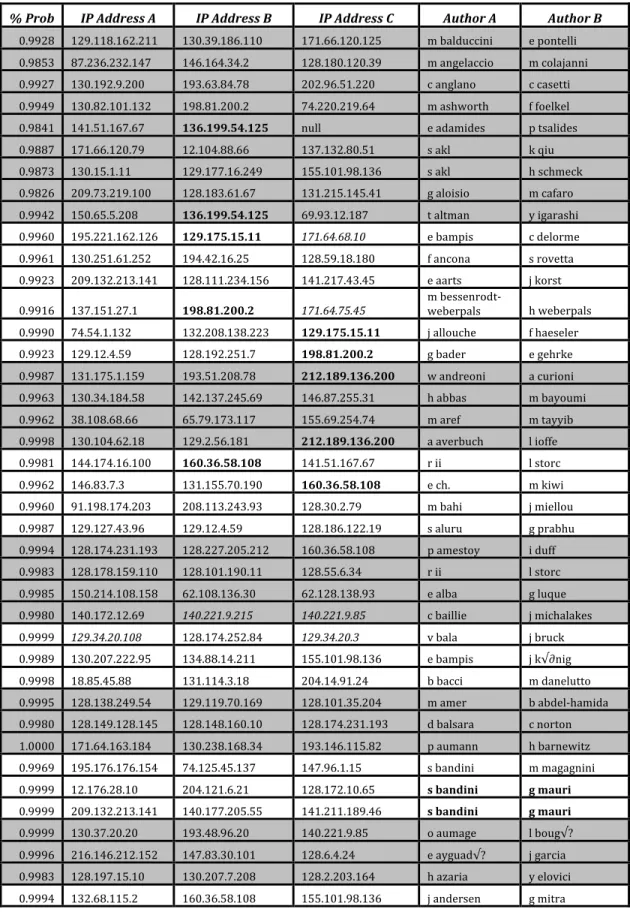
was that we selected the articles at random from the journal Parallel Computing. Again, we performed a manual inspection of each of the final clusters, and indicated exact matches from an author or IP address in bold and likely features used for clustering in italic. Seven different article pairs exists from the same journal or conference, the mappings are as follows:
*1 HMD ‐ Praxis Wirtschaftsinform
*2 Hawaii International Conference on System Sciences
*3 Journal of the American Society for Information Science and Technology *4 International Conference on Multimedia Computing and Systems
*5 International Colloquium on Automata, Languages and Programming *6 Communications of the ACM
*7 Parallel Algorithms and Applications
The question marks in the author or journal and conference names indicate a Unicode conversion error during the data pre‐processing phase (see Figure 4 for example and refer to Section 6.1.1 for implications).
Sample B created fewer one article clusters (42% of all clusters) than Sample A, which had more individual article clusters (60%). Sample B also produced 18‐ exact matches used to assign articles into the same clusters, as opposed to only 2‐ exact matches in Sample A, because articles in Sample B are more likely to be written by the same author. In contrast to Sample A, seven clusters in sample B contain articles on related topics.
<incollection mdate="2003-12-04" key="books/idea/siau2003/TrujilloLS03"> <author>Juan Trujillo</author>
<author>Sergio Luján-Mora</author> <author>Il-Yeol Song</author>
<title>Applying UML For Designing Multidimensional Databases And OLAP Applications.</title>
<pages>13-36</pages> <year>2003</year>
<booktitle>Advanced Topics in Database Research, Vol. 2</booktitle> <url>db/books/collections/Siau2003.html#TrujilloLS03</url>
</incollection>
Table 5: Sample B ‐ Manual Analysis of Clusters from Same Journal
% Prob IP Address A IP Address B IP Address C Author A Author B
0.9928 129.118.162.211 130.39.186.110 171.66.120.125 m balduccini e pontelli 0.9853 87.236.232.147 146.164.34.2 128.180.120.39 m angelaccio m colajanni 0.9927 130.192.9.200 193.63.84.78 202.96.51.220 c anglano c casetti 0.9949 130.82.101.132 198.81.200.2 74.220.219.64 m ashworth f foelkel 0.9841 141.51.167.67 136.199.54.125 null e adamides p tsalides 0.9887 171.66.120.79 12.104.88.66 137.132.80.51 s akl k qiu 0.9873 130.15.1.11 129.177.16.249 155.101.98.136 s akl h schmeck 0.9826 209.73.219.100 128.183.61.67 131.215.145.41 g aloisio m cafaro 0.9942 150.65.5.208 136.199.54.125 69.93.12.187 t altman y igarashi 0.9960 195.221.162.126 129.175.15.11 171.64.68.10 e bampis c delorme 0.9961 130.251.61.252 194.42.16.25 128.59.18.180 f ancona s rovetta 0.9923 209.132.213.141 128.111.234.156 141.217.43.45 e aarts j korst
0.9916 137.151.27.1 198.81.200.2 171.64.75.45 m bessenrodt‐weberpals h weberpals 0.9990 74.54.1.132 132.208.138.223 129.175.15.11 j allouche f haeseler 0.9923 129.12.4.59 128.192.251.7 198.81.200.2 g bader e gehrke 0.9987 131.175.1.159 193.51.208.78 212.189.136.200 w andreoni a curioni 0.9963 130.34.184.58 142.137.245.69 146.87.255.31 h abbas m bayoumi 0.9962 38.108.68.66 65.79.173.117 155.69.254.74 m aref m tayyib 0.9998 130.104.62.18 129.2.56.181 212.189.136.200 a averbuch l ioffe 0.9981 144.174.16.100 160.36.58.108 141.51.167.67 r ii l storc 0.9962 146.83.7.3 131.155.70.190 160.36.58.108 e ch. m kiwi 0.9960 91.198.174.203 208.113.243.93 128.30.2.79 m bahi j miellou 0.9987 129.127.43.96 129.12.4.59 128.186.122.19 s aluru g prabhu 0.9994 128.174.231.193 128.227.205.212 160.36.58.108 p amestoy i duff 0.9983 128.178.159.110 128.101.190.11 128.55.6.34 r ii l storc 0.9985 150.214.108.158 62.108.136.30 62.128.138.93 e alba g luque 0.9980 140.172.12.69 140.221.9.215 140.221.9.85 c baillie j michalakes 0.9999 129.34.20.108 128.174.252.84 129.34.20.3 v bala j bruck 0.9989 130.207.222.95 134.88.14.211 155.101.98.136 e bampis j k√∂nig 0.9998 18.85.45.88 131.114.3.18 204.14.91.24 b bacci m danelutto 0.9995 128.138.249.54 129.119.70.169 128.101.35.204 m amer b abdel‐hamida 0.9980 128.149.128.145 128.148.160.10 128.174.231.193 d balsara c norton 1.0000 171.64.163.184 130.238.168.34 193.146.115.82 p aumann h barnewitz 0.9969 195.176.176.154 74.125.45.137 147.96.1.15 s bandini m magagnini 0.9999 12.176.28.10 204.121.6.21 128.172.10.65 s bandini g mauri
0.9999 209.132.213.141 140.177.205.55 141.211.189.46 s bandini g mauri
0.9999 129.125.14.65 152.1.24.47 128.193.4.112 a attanasio j cordeau 0.9995 152.81.144.29 193.136.28.36 194.9.84.183 j bahi s contassot‐vivier 0.9999 130.216.27.139 193.255.135.33 128.101.168.25 a amoura e bampis 0.9995 66.39.124.177 63.166.183.125 72.44.51.239 d audet y savaria 0.9994 66.207.207.52 209.61.228.48 128.178.33.38 i ahmad y he 1.0000 130.18.14.28 130.18.208.30 128.174.239.11 i banicescu r cari√?o 0.9997 130.64.1.83 153.106.4.23 134.76.74.100 m atiquzzaman p srimani 1.0000 128.175.14.182 128.174.231.193 128.200.85.19 a averbuch e gabber 0.9999 130.74.120.3 129.72.2.182 150.214.109.5 a averbuch m israeli 1.0000 164.67.86.89 204.134.131.27 129.177.16.246 s altekar a ray 0.9998 128.150.4.107 160.91.4.41 142.58.111.32 p altevogt a linke 0.9995 17.112.152.32 198.9.3.30 131.243.2.154 m ashworth a lyne 1.0000 131.193.181.116 131.193.78.84 194.9.84.183 w allcock j bester 0.9999 144.37.1.95 209.143.129.164 144.202.252.20 m aboelaze d lee 0.9999 87.236.232.169 72.5.124.61 132.239.51.65 m atiquzzaman m banat 0.9995 128.83.68.3 213.52.141.23 128.252.153.11 z du f lin 1.0000 192.43.228.130 192.5.53.208 156.56.104.10 g antoniu l boug√? 1.0000 94.124.120.11 165.123.34.126 128.59.66.9 i ahmad s akramullah 0.9997 66.84.34.170 205.155.65.42 129.7.240.35 i ahmad m dhodhi 1.0000 96.7.103.107 128.172.12.202 128.46.154.95 g balboni g cabodi 0.9997 137.151.45.6 134.197.40.3 160.36.56.64 p amodio l brugnano 0.9999 194.81.203.9 137.151.45.6 193.136.28.36 m angelaccio m colajanni 0.9999 131.215.105.115 149.28.120.34 193.136.28.36 e babolian l delves 0.9999 130.161.210.5 129.177.16.246 128.101.191.158 p amodio n mastronardi 0.9999 130.161.210.5 128.100.4.14 13.1.64.42 j ag√?√≠ j jim√?nez 1.0000 132.175.81.3 129.132.46.11 132.175.81.4 p arbenz m becka 0.9999 131.193.32.20 165.112.6.70 131.123.41.85 p arbenz w gander 1.0000 129.12.4.59 212.138.39.90 152.78.68.142 c askew d carpenter
0.9995 128.255.45.58 202.141.25.100 129.244.40.44 j allwright d carpenter
1.0000 155.247.166.60 128.59.66.9 132.66.48.13 c arapis s gibbs 0.9998 202.57.163.117 212.189.136.200 147.96.1.15 j baker m shirel 0.9889 146.164.34.2 137.151.45.6 160.36.58.108 g alaghband 0.9997 129.72.2.182 150.214.109.5 141.51.167.67 m alef 0.9998 129.72.2.182 128.36.229.30 141.51.167.67 m alef 1.0000 128.227.74.66 140.221.8.232 192.20.225.32 r aiex s binato 1.0000 169.229.131.81 155.98.27.201 144.214.130.198 g al‐rawi j cioffi 1.0000 130.209.240.1 171.66.122.240 193.63.84.78 j al‐sadi k day 0.9966 151.189.20.30 141.211.144.27 132.68.32.15 i bar‐on 0.9982 159.226.92.9 155.247.28.2 81.19.179.36 z bai 0.9983 130.39.187.21 134.193.2.78 147.96.1.15 m alsuwaiyel
1.0000 128.55.6.34 160.91.4.41 194.9.84.183 r aversa b martino
1.0000 129.6.13.40 216.47.152.246 198.82.184.164 m alabdulkareem s lakshmivarahan 1.0000 144.174.16.100 192.18.99.187 129.24.24.13 m ayed j gaudiot 1.0000 64.82.97.56 128.6.68.133 195.83.132.161 d baz
1.0000 193.52.245.34 193.230.3.106 194.225.73.180 h ahrabian a nowzari‐dalini 1.0000 132.194.10.4 141.217.48.33 208.110.160.59 j annot
1.0000 150.214.108.33 150.214.108.158 130.82.101.38 e alba f luna 1.0000 128.42.17.41 69.72.138.172 165.124.180.106 h amman 1.0000 129.24.244.30 17.254.2.129 141.142.2.216 o axelsson v eijkhout 1.0000 198.128.246.10 212.189.136.200 160.91.4.41 i ahmad 1.0000 128.95.22.12 89.105.124.116 129.177.16.246 l adams e ong 1.0000 64.202.163.202 130.237.232.226 198.128.246.10 g almasi 1.0000 131.120.251.40 128.32.31.195 129.128.206.32 z baolin l wenzhi 1.0000 65.79.173.117 198.82.185.31 128.101.35.207 g alaghband
1.0000 131.202.244.5 128.9.176.20 129.115.28.4 w amme e zehendner 0.9843 137.158.59.4 209.217.33.166 137.222.102.8 s bangay j gain
0.9775 143.84.24.63 206.210.75.203 202.141.25.96 v annamalai c krishnamoorthy 0.9638 129.59.1.212 140.177.205.52 67.18.199.2 e adamides p tsalides 0.9890 134.245.248.200 152.78.189.29 129.12.4.59 c addison v getov 0.9842 147.251.3.47 128.42.205.122 152.2.1.217 r aversa a mazzeo 0.9773 208.109.122.176 130.37.20.20 128.174.239.11 f arbab p ciancarini 0.9680 67.192.251.145 216.128.29.26 209.40.98.58 g almasi g paul 0.9680 128.32.63.27 128.148.32.110 129.110.10.36 h alnuweiri v prasanna 0.9680 209.21.91.170 63.118.7.17 130.126.139.25 n bahoshy d evans 0.9653 149.28.120.34 129.177.16.246 203.255.181.238 c baillie g pawley 0.9731 128.83.68.134 129.114.58.17 129.177.16.249 m baker k bowler 1.0000 130.245.142.129 132.177.4.32 192.101.104.50 c baillie 0.9863 128.248.155.51 192.138.151.104 129.127.43.96 j bakker
0.9865 130.238.168.34 64.170.98.32 63.84.220.237 b arafeh
0.9824 212.189.136.200 128.197.26.35 142.58.111.32 d barth
0.9658 192.48.178.165 128.30.2.140 132.68.32.15 p arbenz
0.9865 128.156.250.69 74.205.45.163 129.6.13.90 d banks
0.9854 128.4.10.31 81.252.67.151 129.237.125.27 j feo
0.9865 192.203.218.58 136.142.82.188 130.126.142.6 h barada
0.9847 129.64.2.21 198.81.200.2 128.180.120.39 s agostino
0.9650 192.5.53.208 209.242.166.3 129.34.20.3 t axelrod
0.9865 76.12.178.82 96.7.100.187 129.7.240.35 m dow