THE EFFECTS OF BOX OFFICE AND HOME ENTERTAINMENT REVENUE PERFORMANCE ON EQUITY VALUATIONS IN THE FILM INDUSTRY
John W. Onderdonk
An honors thesis submitted to the faculty of the Kenan-Flagler Business School at the University of North Carolina at Chapel Hill
Chapel Hill 2019
Approved by_________________________________
ABSTRACT
John W. OnderdonkThe Effects of Box Office and Home Entertainment Revenue Performance on Equity Valuations in the Film Industry
(Under the direction of Riccardo Colacito, Ph.D.)
The film industry relies on a variety of different revenue streams that contribute to the
overall financial success or failure of film companies. These companies derive the
majority of their revenue from box office and home entertainment sales. The purpose of
this research is to evaluate the effects of box office and home entertainment revenue
performance on the equity valuations of companies in this industry. Using estimation
techniques commonly found in finance literature, this study concludes that box office
performance significantly impacts the equity valuations of film companies over both
short-term and long-term periods. This study also reveals the effects of news on investor
sentiment, demonstrates the cyclicality of company performance in the film industry, and
proposes profitable trading strategies to capitalize on box office performance data. Using
estimation techniques under similar circumstances, this study did not find a significant
ACKNOWLEDGEMENTS
The successful completion of this thesis was ultimately made possible by the
overwhelming support I have received over the years from far more educators, friends,
and family members than I could possibly list. Thank you all. I would also like to
recognize some specific individuals for their key contributions to the completion of this
work:
• Dr. Riccardo Colacito, Thesis Advisor, for your constant guidance and support
throughout this process. Your passion for education and your commitment to the
success of your students is truly inspiring.
• Dr. Patricia Harms, Proposal Advisor, for your dedication to bringing out the
best in your students and equipping me with the tools necessary to conduct
original research.
• Anonymous data provider, for graciously providing me with the resources
necessary to perform a fundamental component of my analysis. Thank you to all
involved.
Finally, I would like to thank my parents (Todd and Sarah) and my brothers (Colin and
Daniel). You have always encouraged me and motivated me to make the best of every
opportunity, and none of this would have been possible without your loving support all
TABLE OF CONTENTS
ABSTRACT ... ii
ACKNOWLEDGEMENTS ... iii
TABLE OF CONTENTS ... iv
LIST OF TABLES ... vi
LIST OF FIGURES ... vii
LITERATURE REVIEW ... 1
Introduction ... 1
Box Office and Home Entertainment as Segments of the Film Industry ... 2
Innovations and Disruptions in Home Entertainment ... 6
The Use of Finance Estimation Techniques to Price Assets ... 8
The Role of Exogenous Factors in Asset Pricing ... 11
Conclusion ... 14
DATASET OVERVIEW ... 16
Introduction ... 16
Historical Stock Price Data ... 16
Historical Box Office Performance Data ... 17
Research Method 2: Box Office and Home Entertainment Factor Portfolios ... 22
RESEARCH ... 28
Introduction ... 28
Section 1: Stock Price Performance of Opening Weekend “Hits” vs. “Flops” ... 29
Section 2: Factor Portfolio Analysis of Monthly Box Office Revenue ... 38
Section 3: Factor Portfolio Analysis of Home Entertainment Revenue ... 51
Section 4: Alternate Investment Strategies Using Box Office Factor Portfolios ... 57
CONCLUSION ... 62
FUTURE RESEARCH OPPORTUNITIES ... 65
The Effect of Budget-Adjusted Box Office Performance on Equity Valuations ... 65
The Effect of Consumer Product Revenue on Equity Valuations ... 66
LIST OF TABLES
Table 1 Opening Weekend Box Office Returns ...36
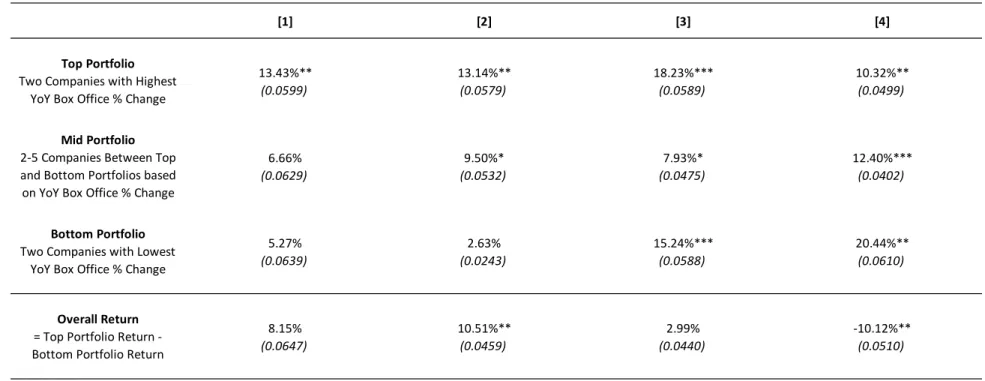
Table 2 Box Office Annualized Contemporaneous Returns – 3 Portfolios ...42
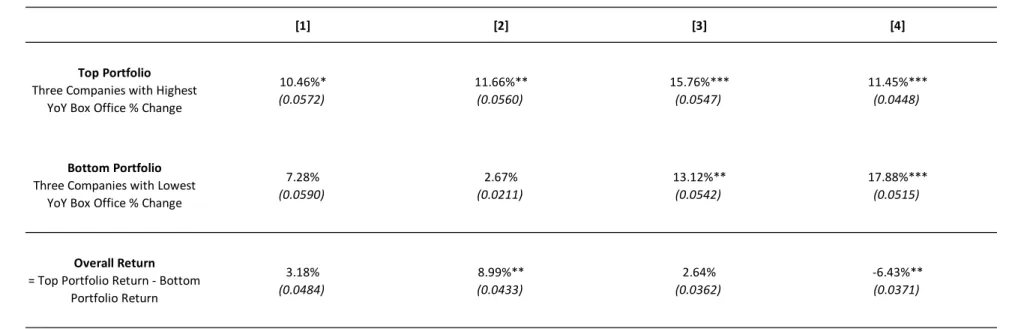
Table 3 Box Office Annualized Contemporaneous Returns – 2 Portfolios ...43
Table 4 Box Office Annualized Conditional Returns – 3 Portfolios ...47
Table 5 Box Office Annualized Conditional Returns – 2 Portfolios ...48
Table 6 Home Entertainment Annualized Conditional Returns ...53
Table 7 Box Office / Home Entertainment Correlations ...56
Table 8 One-Month Box Office Annualized Conditional Returns – 3 Portfolios ...59
LIST OF FIGURES
Figure 1 “Hit”-Minus-“Flop” Portfolio Performance ...30
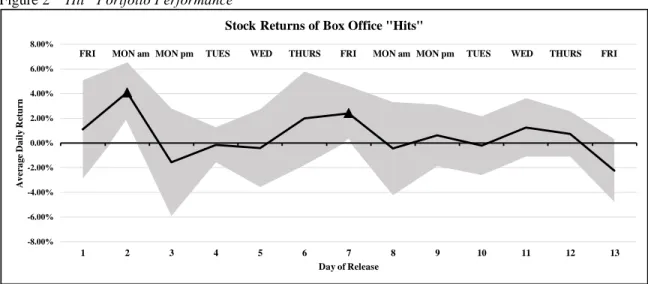
Figure 2 “Hit” Portfolio Performance ...30
LITERATURE REVIEW
Introduction
Characterized by perpetual creative destruction, the business world constantly
replaces old technology with new technology to create competitive advantage and adapt
to changing consumer preferences. Established industries and companies within those
industries must match or exceed the innovations of new ventures in order to stay
competitive and maintain market position. The film industry faces similar pressures from
new innovations and competitive threats. Industry disruption due to the widespread
adoption of streaming from companies like Netflix and Hulu has reduced demand for
traditional home entertainment products, such as DVDs and Blu-Ray Discs. This
declining demand for product offerings has prompted film companies to adjust their
product mixes to reduce costs and increase consumer willingness to pay, resulting in
rising profit margins for these companies.1 Given the niche nature of the home
entertainment industry, academic researchers have not explored the joint effect of
declining home entertainment demand and rising profit margins on actual profitability or
investor expectations regarding profitability. Therefore, the joint effect of declining sales
and rising profit margins is currently ambiguous to industry outsiders.
Due to the sparse nature of previously conducted research on the film industry,
repositories to explain the state of the industry. The estimation techniques that I will use
to demonstrate the relationships between box office revenue, home entertainment sales,
and stock price performance are commonly used in finance academic literature, and I will
chronicle the progression of scholarly research in the field. Through my research, I aim to
use these common finance estimation techniques to yield novel insights in a relatively
unexplored industry.
This review of popular press and academic literature provides an assessment of
relevant information regarding the film industry and finance estimation techniques. In the
following sections, this review will analyze (1) the box office and home entertainment
segments of the broader film industry, (2) innovations and disruptions in the home
entertainment industry, (3) the use of finance estimation techniques to price assets
according to observable characteristics, (4) the role of exogenous factors in asset pricing,
and will include (5) a conclusion to draw connections between the disparate elements of
this literature review.
Box Office and Home Entertainment as Segments of the Film Industry
The film industry is divided into multiple segments that generate revenue for film
companies. Business functions within the film industry include box office,
merchandising, home entertainment, and television licensing. Due to consolidation in the
entertainment industries, large media conglomerates (e.g., Disney, Comcast
NBCUniversal, and Fox) typically own and control each functional segment for the films
they produce and opt to license intellectual property for use in consumer products. This
domestic film industry, (b) the historical role of home entertainment specifically in the
broader industry, and (c) shortcomings of traditional performance measures.
Additionally, this section will rely somewhat heavily on popular press and online data
repositories due to limited academic research on this industry.
Domestic film industry
The domestic film industry is comprised of a few companies with a broad array of
revenue streams that outsiders typically estimate according to a single metric.
Consolidation within the industry has led to the formation of conglomerates with many
different business units. In the film industry, six major companies made up a combined
77% of box office revenue from 1995 through 2018: Walt Disney Studios, Warner Bros.,
Sony/Columbia Pictures, 20th Century Fox (recently acquired by Disney), Universal
Pictures, and Paramount Pictures (Richter, 2018). Though films generate many ancillary
revenue streams, the public typically judges the success or failure of a film solely by its
opening weekend box office performance (Young, Gong, Stede, Sandino, & Du, 2008, p.
9). This three-day period for a film determines its value from a contractual standpoint
with regard to licensing deals for television, merchandising, streaming, etc. (Young et.
al., 2008, p. 9). Additionally, because of its public availability, industry insiders use this
box office metric as a predictive tool to estimate internal and external performance of
ancillary revenue streams and make business decisions accordingly.2 As Powers (2015)
revenue assumptions are often unreported, and “investments are not even necessarily
priced by outsiders” (p. 1). Though judging success according to a single metric
seemingly diminishes the importance of a film’s ancillary revenue streams, these
additional sources of revenue make a huge impact on the industry’s bottom line. In 2017,
for instance, domestic box office revenue totaled $10.51B across the industry while home
entertainment sales grossed $20.49B (McCourt, 2018). Despite the apparent materiality
of a film’s diverse array of revenue streams, financial performance in the film industry
continues to face judgment according to a single metric.
Home entertainment segment
The home entertainment segment, though often viewed as secondary to the box
office segment, has a long history of product innovation that demonstrates the importance
of its financial performance to the overall film industry. Home entertainment’s storied
history began in 1977 when Magnetic Video first utilized JVC’s 1976 VHS technology to
release feature-length films that could be viewed at home for $50-75 per copy (Epstein,
2015). The next significant technological advancement took place in 1997 when home
entertainment companies introduced DVD players and discs to provide better picture and
sound quality along with endless reusability (Epstein, 2015). Home entertainment
companies further enhanced this superior picture and sound quality with the release of
Blu-Ray discs in 2006, and Apple eliminated the need for physical media altogether with
its Apple TV streaming service in 2007 (Epstein, 2015). Lionsgate became the first
movie studio to release the latest and most superior home entertainment technology—4K
offerings today include both digital media (e.g., subscription video-on-demand, digital
purchases, digital rentals) and physical media (e.g., DVD, Blu-Ray, 4K, physical rentals).
Subscription streaming comprises the largest share of the market, followed by physical
media purchases (McCourt, 2018). The film industry has invested significantly in
innovating new home entertainment technologies to provide a better viewing experience
for consumers, which demonstrates the financial importance of the home entertainment
segment to the broader film industry.
Shortcomings of traditional performance measures
As detailed in a previous subsection, film industry analysts place disproportionate
emphasis on box office revenue to evaluate film financial performance despite the
materiality of other industry segments, such as home entertainment. If actual performance
of the film industry’s ancillary revenue streams deviates significantly from the
performance expected from a given film at a given box office level, then the research of
Young et. al. (2008) would suggest analysts might not detect the deviation. According to
the market size statistics from McCourt (2018), this limitation in publicly available
knowledge could cause dramatic misestimation in aggregate financial performance for a
film. Researchers have not yet explored whether or not actual performance from the
ancillary revenue streams of a film directly affects sentiment regarding the financial
Innovations and Disruptions in Home Entertainment
The home entertainment segment of the film industry has changed dramatically
since its advent in 1977 due to technological innovations and disruptions to the industry.
Two significant disruptions affected the way in which customers view media in the home.
In 1985, Blockbuster opened its first store in Dallas, TX, allowing customers to rent
physical media for brief periods of time to watch and return (Epstein, 2015). In 2007,
Netflix started streaming movies online, which allowed consumers to watch movies
instantly with no physical media required (Rodriguez, 2017). Both of these disruptions
strongly affected home entertainment companies and forced them to adapt their business
models to survive in the new environment.
Blockbuster’s rental disruption
In 1985, Blockbuster started siphoning revenues from film companies through its
rental system that disincentivized the purchase of home entertainment products.
Customers who only wanted to watch a movie once after its theatrical release could do so
at a much lower cost than purchasing the movie outright. Instead of fighting this trend,
film companies saw the disruptive force of Blockbuster as an opportunity to generate
revenue from price-sensitive customers who would be willing to pay for a rental but not
for a purchase. They entered into strategic revenue-sharing alliances in which they sold
movies in bulk to Blockbuster at a discount and collected a percentage of rental revenues,
which ultimately generated higher sales for both Blockbuster and the film companies
(Carr, Muthsamy, & Owens, 2012, p. 69). Through these partnerships, home
industry disruption. Though Blockbuster eventually declared bankruptcy due to the
significant decline in physical rental (McCourt, 2018), Family Video, one of
Blockbuster’s competitors, has maintained a thriving rental business with over 700 stores
by creating a fun, family-friendly shopping experience and servicing areas of the country
without high-speed internet (Fink, 2018).
Netflix’s streaming disruption
With the advent of Netflix’s streaming service in 2007, home entertainment faces
a threat to physical media altogether. Like the traditional film industry, subscription
streaming is a highly concentrated industry dominated by a few large competitors. Netflix
leads the industry with 74% U.S. household penetration in 2018, followed by Hulu and
Amazon with 36% and 28% penetration, respectively (Engleson, 2018). In 2017, $9.55B
of domestic home entertainment revenue came from subscription streaming, increasing
31% from 2016 (McCourt, 2018). DVD and Blu-Ray sales, on the other hand, accounted
for only $4.72B, decreasing 14% from 2016 (McCourt, 2018). Home entertainment
companies obtain payments to license content to streaming services, but this source of
revenue has swiftly undercut physical media consumption (Hilderbrand, 2010, p. 27-28).
As with the competitive challenge Blockbuster presented in 1985, film companies
are trying to adapt their business models to survive in a world dominated by subscription
streaming and with physical media usage in sharp decline. Though physical unit sales are
which has lowered the cost-per-unit due to the lack of production and distribution costs
associated with digital media. They have also promoted higher-priced, higher-margin
physical media formats, such as Blu-Ray and 4K Ultra HD, by demonstrating the
enhanced sound and picture quality of those formats relative to subscription streaming.3
Film companies, thus, take a multi-pronged approach to maintaining profitability despite
the rapid adoption of subscription streaming. However, no published research exists
regarding how revenue fluctuations in the home entertainment industry affect investor
sentiments regarding profitability. As discussed previously, the lack of publicly available
sales information leads to the overemphasis of box office performance to indicate
financial performance for films.
The Use of Finance Estimation Techniques to Price Assets
This section of the Literature Review will detail the development of prominent
asset pricing techniques that estimate returns according to observable characteristics.
Investors and finance professionals have attempted to price companies according to
observable characteristics for decades by finding significant relationships between
company characteristics and stock price movement. In contrast with the previous two
sections of this literature review, the academic literature on asset pricing models and
finance estimation techniques is extensive. This section will explore (a) the development
of prominent asset pricing models, (b) an example of the process for identifying an
additional significant factor, and (c) the purpose of finance estimation techniques.
Development of prominent asset pricing models
Asset pricing models seek to estimate returns to a given financial instrument
based on one or more factors. Jensen, Black, & Scholes (1972) put forth the first
generally accepted asset pricing model—called the Capital Asset Pricing Model
(CAPM)—that attempts to value securities as a function of their “systematic,” or
“market,” risk. The model only accounts for systematic risk in determining the price of a
security because they assumed that idiosyncratic risk can be removed through a
well-diversified portfolio. The fundamental finding of the model is that the beta of a stock—
which is the covariance of the returns of that stock with the return of the market divided
by the variance of the market—determines the risk premium of the stock. As beta
increases, the expected return of the stock increases. Subsequent researchers found that a
single-factor model that only considers market risk does not capture risk factors that
would be evident in a multi-factor model.
Fama & French (1992) critiqued the research of Jensen, Black, & Scholes,
arguing that the simple relationship between an asset’s beta and its average return
disappears with more recent data from 1963 to 1990. They do not support the finding that
average stock returns are positively related to market beta. Instead, they argue that, in the
period from 1963 to 1990, a firm’s size and book-to-market equity “capture the
cross-sectional variation in average stock returns associated with size, E/P, book-to-market
equity, and leverage” (p. 450). These two factors can be used as a proxy for risk in
market excess return, (2) return on small-cap stocks minus return on large-cap stocks, and
(3) return on value stocks minus return on growth stocks. The resulting three-factor
model explains excess returns on a cross-section of stocks that would be viewed as
abnormal by the research of Jensen, Black, & Scholes. Fama & French (1993) essentially
expanded on the work of Jensen, Black, & Scholes by adding two additional factors to
make the asset pricing model more robust.
Example of the process for identifying an additional statistically significant factor
After Fama & French (1993) created a multifactor asset pricing model,
subsequent researchers sought to improve the model further by adding additional factors.
Jegadeesh & Titman (1993) examined the role that “momentum” plays in generating
excess returns for stocks, finding that previous “winners” in the market exhibit a
statistical tendency to become future “winners.” Grinblatt, Titman, & Wermers (1995)
affirm this research by demonstrating that mutual funds following momentum strategies
exhibit excess returns over time. Carhart (1997) constructed a “4-factor model using
Fama and French's (1993) 3-factor model plus an additional factor capturing Jegadeesh
and Titman's one-year momentum anomaly” (p. 61) to create a more robust four-factor
model. In light of new research, Fama & French (1996) examined their original
three-factor model and concluded that their model failed to account for excess returns due to
momentum. Researchers during this time typically viewed momentum as a relevant factor
driving returns exclusively at the individual security level. Moskowitz & Grinblatt
(1999), on the other hand, argued that momentum strategies for individual stocks become
reside. In other words, industry momentum almost entirely explains the momentum effect
at the individual security level. The identification of momentum and further debate
regarding its role in explaining asset return anomalies illustrate that new observable
characteristics can be combined with previously accepted factors in an attempt to
estimate asset returns.
Purpose of estimation techniques
The substantial amount of research in finance literature regarding momentum and
other factors in asset pricing models demonstrates that stock returns can be estimated
according to observable characteristics. Estimation techniques like those of Fama &
French (1992) can demonstrate whether or not a significant relationship exists between a
given observable characteristic and fluctuations in stock price. As evidenced by the
evolution of asset pricing models through the decades, prominent researchers constantly
use estimation techniques to look for new observable characteristics that affect stock
prices, and they often disagree about the most predictive asset pricing models.
The Role of Exogenous Factors in Asset Pricing
Researchers have explored the effects of observable characteristics on asset prices
to a great extent. Most of these observable characteristics are financial metrics specific to
given companies, such as size, valuation, recent performance, etc. However,
The role of demand shocks in affecting asset prices
Demand shocks are sudden events that increase or decrease a consumer’s desire
for a particular good or service in the market. One example of a negative demand shock
is the reduction in demand for physical media as a result of Netflix’s entry into digital
streaming in 2007. Lucas (1978) presented an asset pricing model that placed the equity
premiums of assets on the supply side of the economy while assuming consumption
demand to have no volatility. Bansal & Yaron (2004) rebutted this model, arguing that
consumption demand is also stochastic (subject to shocks), and it arguably plays a more
integral role in determining the equity premium of an asset. Continuing the line of
thinking of Bansal & Yaron (2004), Albuquerque, Eichenbaum, Luo, & Rebelo (2016)
argue that the fact that conventional asset pricing models place all uncertainty onto the
supply side of the economy while neglecting demand uncertainty creates a weak
correlation between stock returns and observable fundamentals. They ascribe the majority
of the equity premium to demand shocks. Recent research indicates that exogenous
demand shocks affect the risk premium associated with a stock and, therefore, its price.
The role of news events in affecting asset prices
Significant news events or coverage also affect asset prices. Engle & Ng (1993)
explore the relationship of news—good or bad—to asset price volatility. Though none of
their models perfectly capture the asymmetrical effect of new information on stock price
volatility, their study found conclusively that negative news coverage affects volatility
with greater magnitude than positive news coverage. Furthering this research on the
increase in Google search volume predicts higher stock prices in the next two weeks as
the market absorbs new information followed by an eventual stock price reversal within a
year. Their study of search volume also indicated strong first-day performance and
long-term underperformance of a sample of IPO stocks. These studies show that news
powerfully affects stock prices for extended periods of time after the initial coverage as
the market incorporates new information.
Innovations affecting asset prices
Economists have recently found that levels of innovation can be measured and
demonstrated to affect asset prices. Kogan, Papanikolaou, Seru, & Stoffman (2017)
explored the role that technological innovation plays in spurring economic growth. In
their research methodology, they use newly collected data on patents issued to U.S. firms
from 1926 to 2010 as a proxy for technological innovation, and, expanding on the work
of Engle & Ng (1993), they compare stock price responses to patent news as a means to
show the effect of patents on economic growth. Kogan et. al. found that innovation “is
associated with substantial growth, reallocation, and creative destruction” (p. 706). They
discovered a significant relationship between patents (as a proxy for innovation) and
stock prices as a proxy for firm growth. As a result, they conclude that technological
innovation accounts for significant medium-run fluctuations in aggregate economic
growth. This research and the research in the prior subsections demonstrate that
Conclusion
The domestic home entertainment industry is a large, multi-billion-dollar segment
of the broader domestic film industry. Due to the use of traditional industry performance
metrics, such as box office revenue, and the lack of publicly available data on home
entertainment sales, analysts estimate the performance of home entertainment and other
ancillary revenue streams for a given film largely based on opening weekend box office
revenue. The inability of this metric to provide accurate estimates could severely misstate
the aggregate financial performance of a film because of the sizable percentage of
revenue coming from outside the box office.
Due to industry disruption through streaming, the market for home entertainment
has experienced a negative demand shock. The popular press has documented these
industry changes extensively, and home entertainment companies have introduced new
innovations to increase retail prices, cut costs, and maintain increasing profitability.
According to the academic research documented in this literature review, the stock prices
of home entertainment companies should theoretically fluctuate as a result of these
changes to the industry. However, the use of box office performance as a proxy for
aggregate film performance potentially obscures the actual fluctuations in demand and
profitability resulting from these industry changes.
Finance estimation techniques, as detailed in this literature review, can indicate
whether a significant relationship exists between box office revenue or home
entertainment sales and the stock price performance of film companies. In the context of
finance literature, box office revenue and home entertainment sales represent “observable
determine whether or not a relationship exists. A lack of a significant relationship
between home entertainment sales and stock returns could potentially indicate the
ineffectiveness of using box office performance as the sole performance metric for a film
because home entertainment sales do directly affect profitability and should, therefore,
affect stock prices. The relationships between box office revenue, home entertainment
sales, and the stock price performance of film companies have not been investigated
DATASET OVERVIEW
Introduction
In this section, I detail the specifics of datasets that I use to demonstrate the
effects of box office performance and home entertainment performance on the equity
valuations of film companies. To determine the effects of box office and home
entertainment performance on film company stock prices, I use (a) historical stock price
data, (b) historical box office revenue data, and (c) historical home entertainment revenue
data. I detail the sources and specifics of these datasets in the following section.
Historical Stock Price Data
In this study, I use historical stock price data from May 2001 through November
2018. My dataset contains daily opening prices and daily closing prices adjusted for
dividend payments spanning that duration. Most stock price data used in this study comes
from S&P Capital IQ, which I used as the default source for my price data. However,
some companies from 2001 through 2018 have undergone mergers that resulted in the
de-listing of the companies from exchanges. Though S&P Capital IQ can pull historical data
from companies that currently exist, it cannot retrieve data from companies, such as Time
Warner, that have recently been acquired and are no longer listed on an exchange. In such
instances, I used Investing.com because they publish records of historical data on
Historical Box Office Performance Data
I use Box Office Mojo as the source of my box office data. Box Office Mojo is
often used by industry insiders due to the reliability of its data reporting.4 For Section 1,
which examines the stock returns of box office “hits” versus box office “flops” as defined
by opening weekend performance, I use their datasets “Biggest Opening Weekends”
(+$50M) and “Worst Openings” (3,000+ theaters), which yield data on 235 films and 200
films, respectively. These openings were adjusted to 2019 dollars prior to being ranked.
In Section 2, which examines box office revenues on a monthly basis by
company, I use Box Office Mojo once again based on their monthly year-to-date (YTD)
box office revenue numbers by company. I manually converted these monthly YTD
revenue numbers to monthly revenue numbers (e.g., by subtracting January YTD from
February YTD, etc.) before performing analysis.
Historical Home Entertainment Performance Data
My home entertainment dataset comes courtesy of a data analysis group that
graciously provided me with their dataset free of charge for exclusive use in this research
paper. For the protection of their data, they wish to remain anonymous. The dataset
includes home entertainment revenue by week for seven major film companies dating
back to January 2011. For the purpose of this study and of an equitable comparison with
box office performance, I aggregated the home entertainment data from weekly sales into
RESEARCH METHODOLOGY
Introduction
The purpose of this section is to outline the methods that I will employ to answer
the following research question: How do box office and home entertainment revenue
performance affect the equity valuations of film companies? Because the following
methodology references industry- and finance-specific terminology that may not be
familiar to all readers, grasping the following list of terms and their definitions is crucial
to understanding both the research methodology and the outcome of the study:
• Box Office: A channel through which media is consumed during its theatrical
release.
• Durbin-WatsonStatistic: A test for autocorrelation in the residuals of a regression.
• Home Entertainment: A channel through which media is consumed
following its theatrical release. Home entertainment for the purpose of this
study involves all associated revenue streams (i.e., purchase, rental,
streaming).
• Factor Portfolio: A portfolio of stocks formed by sorting companies
according to a given observable characteristic (or factor).
• Rebalancing: The re-sorting of factor portfolios according to the given
observable characteristic at a specified time interval.
• Public Data: Data that is easily accessible and available free of charge to
the public.
• Serial Correlation (Autocorrelation): Correlation between a given variable
and a lagged version of itself. The standard errors must be adjusted to
compensate for the existence of serial correlation in regression.
• Sharpe Ratio: The return of an asset above the risk-free rate over a
specified period divided by the standard deviation in returns over that
same period.
𝑆ℎ𝑎𝑟𝑝𝑒 𝑅𝑎𝑡𝑖𝑜 = 𝑅𝑖 − 𝑅𝑓 𝜎𝑖
• Significance: A finding that the effect of a given variable is unlikely to
have been zero with 90%, 95%, or 99% confidence.
To answer this study’s research question most effectively, I will (1) examine the
changes in stock prices of companies that released films with the best and worst opening
weekend performances of all time in the days immediately following release and (2)
construct factor portfolios to examine the effects that overperformance and
underperformance in both box office and home entertainment revenue have on the equity
valuations of film companies under different circumstances and periods of time.
Office Mojo on the films that had the best and worst domestic openings in history.
This methodology will reveal the extent to which opening weekend box office
performance impacts investor expectations for company profitability. The
following subsections will detail (a) the reasoning behind this methodology
selection, (b) an overview of the methodology, and (c) objectives for the
methodology.
Reasoning behind methodology selection
This approach will reveal how investors react in response to “news
events” pertaining to box office performance. According to Box Office Mojo,
when a film is released, box office estimates for the weekend are provided by the
film studios as early as Sunday morning on the weekend of release. The
difference in stock price between the Friday Close and the Monday Open of a
company that just released a smash success “hit” film, or a catastrophically
poor-performing “flop” film, could likely be attributed to changes in market
expectations regarding the performance of that film. By showing how the stock
prices of these companies move in the first two weeks of release, I can
demonstrate how investor expectations regarding the profitability of these film
companies change in a predictable manner in the cycle of each film release.
Overview of the methodology
In this methodology, I will use two sets of quantitative data as outlined in
stock price data. For both the box office “hits” data and the box office “flops”
data, I will calculate the stock price return of each company in the first 13 days of
release for each given film. “Day 2” will denote the return from Friday Close to
Monday Open on the first weekend of release, and “Day 8” will denote the return
from Friday Close to Monday Open on the second weekend of release. All other
days will denote the returns of the stocks from open to close on standard
weekdays. The average annual return for each day of release will be calculated as
a simple sum of the total returns for each category divided by the number of years
in the sample. Additionally, I will construct a “Hit”-Minus-“Flop” (HMF)
portfolio that holds the stocks of the “hit” releases and shorts the stocks of the
“flop” releases. Based on the results of these portfolios, I will highlight potential
trading strategies that could be implemented to yield profitable outcomes for
investors. These trading strategies will be evaluated based on their historical
Sharpe Ratios, and I will use the average 3-Month Treasury Constant Maturity
Rate from the St. Louis FRED over the sample period as the “risk-free rate of
return.”
One limitation of this methodology is that, based on my criteria for
defining “hits” and “flops,” each calendar year has relatively few titles being
released in those categories. Until 2012, the annual returns for the “flop” portfolio
were particularly erratic due to the relatively few “flop” films being released per
the dataset in this regard, my analysis in total includes 115 “hit” films and 125
“flop” films.
Finally, I will calculate the standard errors for the returns on each day of
release to determine significance at confidence levels of 90%, 95%, and 99%.
This exercise will differentiate the significant portfolio returns from those not
distinguishable from zero.
Objectives of the methodology
Through this methodology, I will seek to determine how the news of
extreme overperformance or underperformance at the box office affects the stock
prices of film companies in the immediate days following release. This
methodology will demonstrate the degree to which investors pay attention to box
office reports and whether the market incorporates this news into equity
valuations of film companies. Additionally, by constructing the HMF portfolio, I
will be able to better distinguish the returns that are specifically due to box office
performance from returns due to irrelevant factors affecting the stock prices in the
industry. Finally, I hope to use this methodology to propose profitable trading
strategies that investors could employ based on box office data in the days
following the release of a new “hit” or “flop” film.
Research Method 2: Box Office and Home Entertainment Factor Portfolios
In Research Sections 2, 3, and 4 of this paper, I will construct factor portfolios
periods. With this methodology, I will be using three quantitative datasets. In Sections 2
and 4, which deal exclusively with box office performance, I will use publicly available
box office performance data by studio and by month from Box Office Mojo, and I will
use historical stock price data. In Section 3, which deals exclusively with home
entertainment performance, I will use a proprietary home entertainment dataset from an
anonymous data provider as well as historical stock price data. The following subsections
will detail (a) the reasoning behind this methodology selection, (b) an overview of the
methodology, and (c) objectives for the methodology.
Reasoning behind methodology selection
I will construct these factor portfolios in a similar fashion to those
constructed by Fama & French (1993). With regard to box office revenue
performance, constructing factor portfolios using total box office revenue will
allow me to determine how over- and underperformance for the entire slate of a
given studio affects investor expectations for profitability over varied periods of
time. This approach will lead to a more comprehensive analysis of holistic
company performance than the examination of select films on opening weekend
as in Research Section 1. Constructing factor portfolios in a similar fashion with
home entertainment revenue will allow me to compare the effects of box office
revenue on investor sentiment to the effects of home entertainment revenue on
volatility. In short, generating factor portfolios that are sorted according to an
observable characteristic will yield insights regarding the effect of that
characteristic on the equity valuations of the underlying companies over time.
Overview of the methodology
The approaches for the methodologies concerning box office revenues and
home entertainment revenues will be similar in many ways with only a few
differences. In both cases, I will develop factor portfolios sorted by
year-over-year (YoY) percentage change in revenue for the respective sorting period. The
justification for sorting according to YoY percentage change as opposed to
percentage change from the previous period is that the film industry features
strong seasonal cyclicality in revenues, meaning that YoY percentage change
would be a more appropriate performance comparison metric. I will examine
sorting period lengths of one, three, six, and 12 months in both the box office and
home entertainment revenue factor portfolios. The “top” portfolio in each instance
will include the top two or top three companies as judged by YoY percentage
change in revenue, and the “bottom” portfolio in each instance will include the
bottom two or three companies as judged by YoY percentage change in revenue.
In tables using only two companies in each portfolio, I will include a “mid”
portfolio containing the returns from all of the companies in between the two
extremes. These portfolios will be rebalanced on a monthly basis according to the
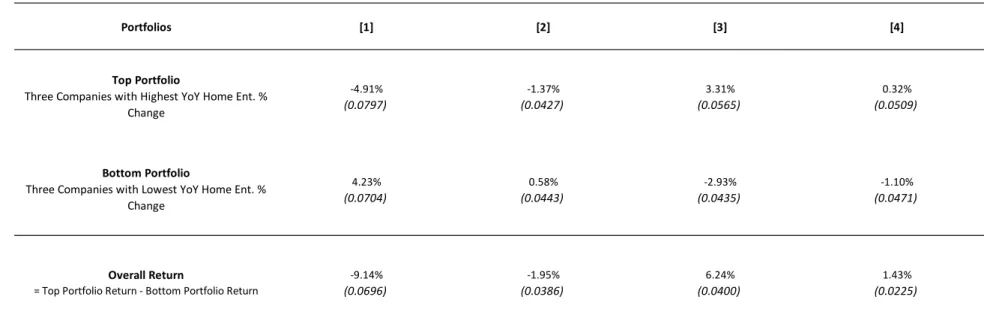
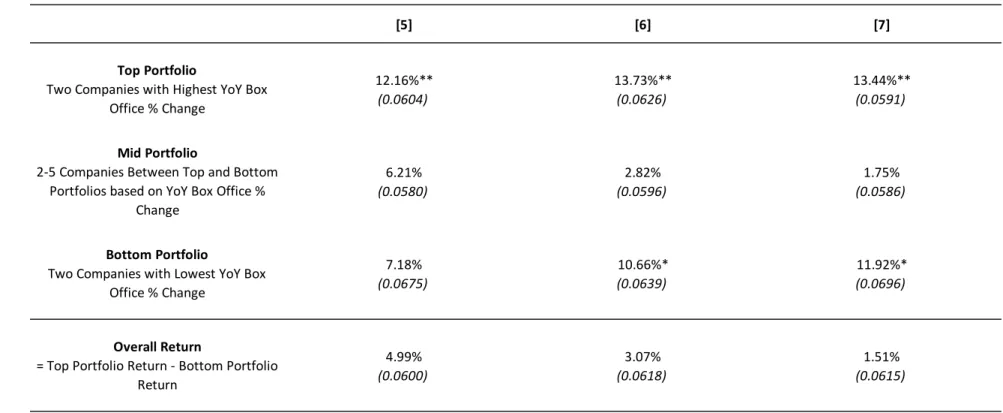
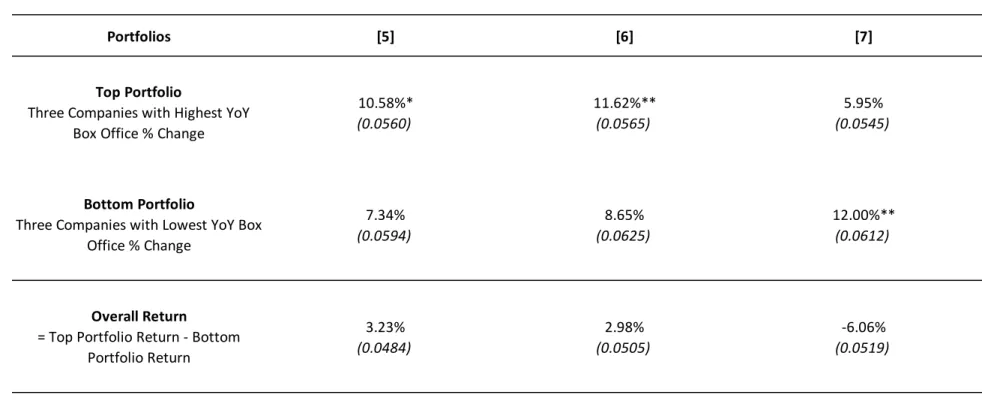
In addition to the varied lengths in sorting periods, I will also vary the
lengths and starting points of the portfolio holding periods, which will determine
the periods for return calculations. In all cases, I will examine the holding period
returns both contemporaneously with the sorting period and conditionally
according to the sorting from the prior period. Additionally, I will examine
holding period lengths that directly match the sorting period lengths (i.e., one,
three, six, and 12 months), and I will examine holding period lengths of one
month regardless of the sorting period length. I will undertake these factor
portfolio constructions identically for both box office and home entertainment
revenues, though I will withhold certain results due to universally insignificant
findings for particular criteria.
Key differences in the methodologies of the box office revenue and home
entertainment revenue sections emerge from differences in the datasets. The Box
Office Mojo dataset contains data from May 2001 through November 2018, and,
due to changing industry dynamics, features between seven and 12 publicly traded
companies in each period. The proprietary home entertainment dataset, on the
other hand, contains data from January 2011 through November 2018 with a
constant level of seven publicly traded companies per period. One key difference
in the construction of the factor portfolios is that the “mid” portfolio will contain a
varied number of companies in each period for box office performance compared
lower standard errors of returns relative to those of the home entertainment factor
portfolios, ceteris paribus.
One concern regarding the factor portfolio methodology—in which
holding periods sometimes span multiple months, but returns are reported on a
monthly basis—is the introduction of serial correlation. In instances where the
Durbin-Watson statistics for the returns of factor portfolios indicate the presence
of serial correlation, I will provide heteroskedasticity-adjusted standard errors
using Stata’s “newey” command and a lag value of ⌈ √# 𝑜𝑏𝑠𝑒𝑟𝑣𝑎𝑡𝑖𝑜𝑛𝑠3 ⌉. These
adjusted standard errors will be used to determine significance of returns at
confidence levels of 90%, 95%, and 99%.
Objectives of the methodology
The primary objective of this methodology that I will employ in Research
Sections 2, 3, and 4 is to determine the effect of total box office and home
entertainment revenue performance on equity valuations of film companies over
varied periods. By constructing factor portfolios, I will be able to distinguish the
excess returns due to box office and home entertainment performance from
returns due to extraneous factors affecting the stock prices in the industry.
Additionally, this approach will be more comprehensive in including films other
than the extreme “hits” and “flops” for each company than the approach taken in
Research Section 1. Furthermore, by examining the sorting periods and returns
over longer periods, we can observe any cyclicality emerging from the film
subsequent periods. Finally, through this methodology, I hope to highlight
profitable trading strategies that investors can employ to capitalize on over- and
RESEARCH
Introduction
The following sections detail the research that I performed in order to understand
how changes in film industry revenue and news updates affect investor expectations for
profitability of the underlying companies. Section 1 explores the roles that opening
weekend box office “hits” and box office “flops” have on the stock prices of the film
companies that released them. This section will demonstrate that positive and negative
news shocks pertaining to the core film business affect investor sentiment. In Section 2, I
similarly examine box office revenues, but I construct factor portfolios that sort film
companies based on box office performance over longer periods of time. This second
section showcases the ways in which box office performance affects the stock prices of
film companies, and it also reveals the cyclicality of performance in the industry. In
Section 3, I construct identical factor portfolios using home entertainment revenue
instead of box office revenue. This third section demonstrates that home entertainment
performance does not significantly affect investor sentiment or correlate with box office
performance, corroborating both the cyclicality of the industry and the notion that
industry outsiders place disproportionate emphasis on box office revenue as a metric for
performance. Finally, Section 4 includes alternative investment strategies using factor
Section 1: Stock Price Performance of Opening Weekend “Hits” vs. “Flops”
Overview
In this section, I examine the effects that positive and negative news events have
on investor expectations for profitability. According to Box Office Mojo, opening
weekend box office performance is a metric that is reported for wide-release films on
Sunday mornings between 9:00am and 10:00am PST on the weekend of the film’s
release. The studios provide estimated Friday and Saturday box office revenues with a
projection for Sunday’s revenues. On the Monday following opening weekend, the
studios report actual weekend box office revenues at 1:00pm PST. Studios also report
box office revenue in the first week on the second Friday of release. This information is
publicly available and easily accessible, leading to changes in stock prices for companies
whose films overperform or underperform at the box office.
I aggregated the daily stock price returns following the release of a new film for
two distinct sets of films from 2012 through 2018:
1. Wide-release films in the highest 235 opening weekend box office revenue
performances of all time
2. Wide-release films in the lowest 200 opening weekend box office revenue
performances of all time
In this section, I examine stock price performance in the days following release for the
best- and worst-performing films of all time, and I propose trading strategies that could
Figure 1 “Hit”-Minus-“Flop” Portfolio Performance
Figure 2 “Hit” Portfolio Performance
Figure 3 “Flop” Portfolio Performance
-10.00% -5.00% 0.00% 5.00% 10.00% 15.00%
1 2 3 4 5 6 7 8 9 10 11 12 13
A v era g e D a il y R eturn
Day of Release
Stock Returns of "Hit"-Minus-"Flop" Portfolio
-8.00% -6.00% -4.00% -2.00% 0.00% 2.00% 4.00% 6.00% 8.00%
1 2 3 4 5 6 7 8 9 10 11 12 13
A v era g e D a il y R etur n
Day of Release Stock Returns of Box Office "Hits"
-8.00% -6.00% -4.00% -2.00% 0.00% 2.00% 4.00% 6.00% 8.00%
1 2 3 4 5 6 7 8 9 10 11 12 13
A v era g e D a il y R eturn
Day of Release Stock Returns of Box Office "Flops"
0.00% 10.00% 20.00% 30.00% 40.00% 50.00% 60.00% 70.00% 80.00% 90.00% 100.00%
FRI MON am MON pm TUES WED THURS FRI MON am MON pm TUES WED THURS FRI
A v era g e D a il y R etur n
Day of Release Stock Returns of Box Office "Hits"
0.00% 10.00% 20.00% 30.00% 40.00% 50.00% 60.00% 70.00% 80.00% 90.00% 100.00%
FRI MON am MON pm TUES WED THURS FRI MON am MON pm TUES WED THURS FRI
A v era g e D a il y R etur n
Day of Release Stock Returns of Box Office "Hits"
0.00% 10.00% 20.00% 30.00% 40.00% 50.00% 60.00% 70.00% 80.00% 90.00% 100.00%
FRI MON am MON pm TUES WED THURS FRI MON am MON pm TUES WED THURS FRI
A v era g e D a il y R etur n
Stock price performance of opening weekend “hits”
In first thirteen days following the release of a film with an opening weekend box
office performance in the top 235 of all time by total gross revenue, the companies
releasing the film experience positive stock price returns at two different points in time.
Figure 2tracks the average annualized stock price performance of these box office “hits”
in the first thirteen days of release (“average daily return” in Figure 2). The companies
releasing these films first experience an average annual stock return of 4.09% from the
Friday Close to the Monday Open on the first weekend of release. During this time
period, on Sunday morning, movie studios release projected total weekend box office
revenue. The market has already incorporated this information by the time the weekend
ends, and the aggregate Monday return is indistinguishable from zero. Equivalently,
investors waiting for the official weekend totals on Monday afternoon are likely too late
to capitalize on the positive news effect for that weekend. The second instance of positive
returns occurs on the Friday after opening weekend, which coincides with the release of
the first week’s total box office revenue. The stock prices of these companies rise by an
average of 2.41% annually on this Friday. Returns in the second week after a film’s
release are not significant.
The market is sensitive to the positive performance of high-grossing films during
the early stages of release. However, the stock price in the first two weeks of release only
reflects the positive performance of the films at specific times when new information
information as the positive news of the good performance of these films becomes widely
available.
Stock price performance of opening weekend “flops”
In first thirteen days following the release of a film with an opening weekend box
office performance in the bottom 200 of all time by total gross revenue, the companies
releasing the film experience a negative stock return at two points in time and a positive
stock return at one point in time. Figure 3tracks the aggregate stock price performance of
these box office “flops” in the first thirteen days of release. The stock price returns
through the first week of release for the companies that produce these films remain
unchanged as a result of their poor performance during the first week. These companies
then experience an average annual return of -1.88% on the second weekend of release
(Friday Close to Monday Open) and an average annual return of -1.73% on the second
Monday of release. These companies likely experience a delay in the negative returns
from their underperformance because negative box office underperformance news is
disseminated much less widely than positive box office overperformance news. Market
participants, and people in general, are likely to be more immediately aware of the
movies that are succeeding at the box office than they are of the movies that are failing.
Because the research of Engle & Ng (1993) would predict that negative news of box
office “flops” would affect the returns with greater magnitude than the positive news of
the box office “hits,” it is fair to assume that the films performing poorly at the box office
had a limited marketing campaign, did not generate social media engagement, and, as a
in negative returns is that box office “flops” earn a higher percentage of their total
revenue in opening weekend (34%) than box office “hits” (31%). As such,
underperformance in the first weekend suggests even more dramatic underperformance in
subsequent weekends. Investors hoping for a second-weekend rebound in revenue
performance will likely find the opposite effect.
Interestingly, companies that released movies performing in the bottom 200 of all
time by total gross revenue in the opening weekend experience an average annual return
in their stock price of 3.53% on the Thursday in the second week of release. A potential
explanation for this resurgence in stock price is that the production companies could be
“cutting their losses” and removing the movies from the theaters in order to reduce their
costs. The minimum contractually-agreed theatrical run for most movies is two weeks,
and movies that do not make it to the third weekend are typically losing money for the
studios and the theaters by the time they are pulled. A strong positive correlation exists
between box office revenue and theatrical run length (Fahey, 2015), and a movie being
removed from theaters after only two weeks could be seen by investors as a prudent
financial decision on the part of the film companies to minimize their losses.
Additionally, due to the cyclicality of revenues in the film industry, it could be the case
that film companies releasing weaker films will have a natural propensity to release a
stronger film in the following two weeks, which could in part explain the positive returns.
In summary, the market appears to be less immediately and consistently sensitive
due to the lesser news volume emerging from underperforming films. It appears that
these films in the first weekend of release get ignored by both investors and theatergoers
alike, but investors seem to take note in the second week of release, leading to an initial
decline in stock prices followed by a late-week resurgence potentially due to stop-loss
decision making on the part of the film company and/or due to the release of
higher-caliber films.
Stock price performance of “Hit”-Minus-“Flop” Portfolio
Figure 1 shows the returns of a hypothetical “Hit”-Minus-“Flop” (HMF) portfolio
that holds the stocks of the companies that had releases in the top 235 opening weekend
box office performances of all time while shorting the companies that had releases in the
bottom 200 of all time, subtracting the returns of the poor performers from the high
performers. In the first thirteen days of release for each given film, this portfolio features
positive returns on one day and negative returns on one day with the rest of the days
having returns statistically indistinguishable from zero. From Friday Close to Monday
Open on opening weekend, this portfolio returns an average of 6.29% annually. As
previously mentioned, film studios release opening weekend projections on Sunday
morning, which is during this period of high return. The market incorporates this news
into the prices of these stocks by the open on Monday, meaning that a portfolio waiting
for the release of the official box office numbers on Monday to employ such a strategy
would be too late and miss the spike in returns.
The HMF portfolio features negative returns on the Thursday in the second week
the HMF portfolio features an average annual return of -2.81%, which could indicate that
investors assume the strong performance from the “hits” is already “priced in” to the
company’s valuation while the market could have had an overreaction to the “flop” films,
creating an attractive buying opportunity, especially if the companies minimize their
losses by pulling the films from theaters. The key takeaway from the HMF portfolio is
that the market pays close attention to the opening weekend performances of wide-release
films and swiftly incorporates that information into the valuations of the respective
production companies. This example also illustrates the quickness with which news that
is not explicitly associated with a quarterly update or formal financial report can affect
36
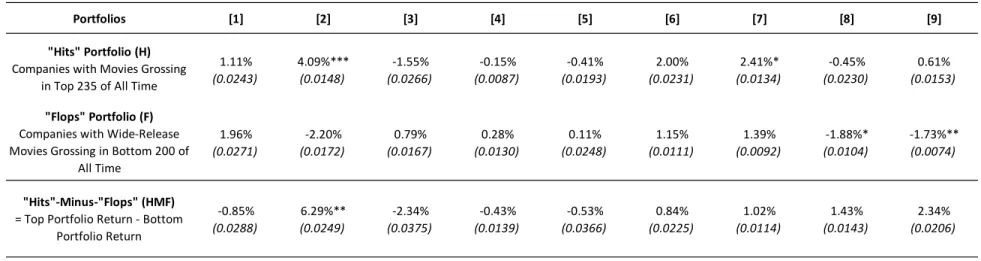
Table 1 Opening Weekend Box Office Returns
Opening Weekend Box Office Returns
(Average Annual Returns from January 2012 through December 2018)Portfolios [1] [2] [3] [4] [5] [6] [7] [8] [9]
1.11% 4.09%*** -1.55% -0.15% -0.41% 2.00% 2.41%* -0.45% 0.61%
(0.0243) (0.0148) (0.0266) (0.0087) (0.0193) (0.0231) (0.0134) (0.0230) (0.0153)
1.96% -2.20% 0.79% 0.28% 0.11% 1.15% 1.39% -1.88%* -1.73%**
(0.0271) (0.0172) (0.0167) (0.0130) (0.0248) (0.0111) (0.0092) (0.0104) (0.0074)
-0.85% 6.29%** -2.34% -0.43% -0.53% 0.84% 1.02% 1.43% 2.34%
(0.0288) (0.0249) (0.0375) (0.0139) (0.0366) (0.0225) (0.0114) (0.0143) (0.0206)
[1] = This column features average annual returns from Friday Open to Friday Close on the first day of release with the standard errors of the returns in parenthesis below. [2] = This column features average annual returns from Friday Close to Monday Open on the first weekend of release with the standard errors of the returns in parenthesis below. [3] = This column features average annual returns from Monday Open to Monday Close on the first day after opening weekend with the standard errors of the returns in parenthesis below. [4] = This column features average annual returns from Tuesday Open to Tuesday Close on the second day after opening weekend with the standard errors of the returns in parenthesis below. [5] = This column features average annual returns from Wednesday Open to Wednesday Close on the third day after opening weekend with the standard errors of the returns in parenthesis below. [6] = This column features average annual returns from Thursday Open to Thursday Close on the fourth day after opening weekend with the standard errors of the returns in parenthesis below. [7] = This column features average annual returns from Friday Open to Friday Close on the fifth day after opening weekend with the standard errors of the returns in parenthesis below. [8] = This column features average annual returns from Friday Close to Monday Open on the second weekend of release with the standard errors of the returns in parenthesis below.
[9] = This column features average annual returns from Monday Open to Monday Close on the first day after the second weekend of release with standard errors of the returns in parenthesis below.
*, **, and *** denote statistical significance at the 90%, 95%, and 99% levels, respectively.
"Hits" Portfolio(H)
Companies with Movies Grossing in Top 235 of All Time
"Flops" Portfolio (F)
Companies with Wide-Release Movies Grossing in Bottom 200 of
All Time
"Hits"-Minus-"Flops" (HMF)
= Top Portfolio Return - Bottom Portfolio Return
Potential trading strategies from opening weekend box office performance
Multiple profitable trading strategies emerge from this analysis of opening
weekend box office returns featured in Table 1, including potential for long-only
strategies, short-only strategies, and long-short strategies. Three examples of strategies
that provide high risk-adjusted returns are (1) holding stocks of companies that release
movies in the top 235 from Friday Close to Monday Open on opening weekend, (2)
holding stocks of companies that release movies in the top 235 while shorting stocks of
companies that release movies in the bottom 200 from Friday Close to Monday Open on
opening weekend, and (3) holding stocks of companies that release movies in the top 235
from Friday Close to Monday Open on opening weekend while shorting stocks of
companies that release movies in the bottom 200 from Friday Close to Monday Close one
week after opening weekend.
The first strategy, which is displayed in Table 1, will receive an average annual
return of 4.09% from holding the “hit” stocks from Friday Close to Monday Open. The
annual standard deviation of this long-only strategy is 3.93%, which implies a Sharpe
Ratio of 0.91 assuming a risk-free rate of return of 0.53%.
The second strategy, which is a function of the HMF strategy outlined in the
previous subsection and in Table 1, will receive an average annual return of 6.29%. The
annual standard deviation of this long-short strategy is 6.60%, which implies a Sharpe
Ratio of 0.87 assuming a risk-free rate of return of 0.53%.
The annual standard deviation of this long-short strategy is 5.56%, which implies a
Sharpe Ratio of 1.29 assuming a risk-free rate of return of 0.53%.
Conclusion
The main result of this analysis using opening weekend box office performance is
that the market swiftly incorporates positive news regarding opening weekend
overperformance into the equity valuations of the companies releasing the films. These
films see significant appreciation in their stock prices even before the official weekend
revenue performance numbers are released. The market takes approximately one week to
incorporate the negative news of opening weekend box office underperformance, and the
companies releasing these films see depreciation in their equity valuations during the
second weekend of release and the Monday thereafter. This delayed effect could emerge
from smaller volume of negative news as well as the likelihood of continued box office
revenue underperformance in the second weekend of release. These findings regarding
market reactions to opening weekend box office performance can be used to develop
trading strategies that generate significant annual returns.
Section 2: Factor Portfolio Analysis of Monthly Box Office Revenue
Overview
In the previous section, I examined the effects of box office over- and
underperformance on a short time scale to isolate and highlight the specific points in the
cycle of a film’s initial release at which investors adjust their assumptions regarding the
time frame and looking at overall studio performance rather than performance specific to
one film at a brief point in time. Constructing factor portfolios that are sorted according
to YoY percentage box office revenue change and holding the top portfolio while
shorting the bottom portfolio will reveal the degree to which the market awards excess
returns to companies that generate high box office revenue over their lower-performing
counterparts over varying durations. Extending the duration of the sample of performance
and returns also reveals the cyclicality of performance in this industry due to the limited
nature of premium content and inability for firms to smooth their revenue receipts over
long periods of time. In this section, I demonstrate the effect that box office performance
has on the stock prices of film companies both (a) contemporaneously and (b)
conditionally, and I (c) propose additional trading strategies that could be employed to
capitalize on the effect that box office performance has on stock prices over longer
periods of time.
Contemporaneous factor portfolio returns
Table 2 and Table 3 demonstrate the contemporaneous returns of factor portfolios
sorted by YoY percentage change in box office revenues for periods of one month, three
months, six months, and 12 months. These tables illustrate that better performance at the
box office translates to higher returns in stock price over the same period for certain
durations of time. This finding is consistent with both the research of Powers (2015),
Table 2 groups the companies based on box office performance into three
portfolios: “top,” “mid,” and “bottom.” The “top” portfolio contains the top two
companies for each given period, the “mid” portfolio contains the three-to-five middle
companies, and the “bottom” portfolio contains the bottom two companies. Holding the
“top” portfolio and shorting the “bottom” portfolio yields significant positive
contemporaneous returns with portfolio sorting periods of three, six, and 12 months. The
strongest contemporaneous returns occur with a sorting period of three months. This
sorting period features an annualized return of 14.04%, and the portfolios exhibit
monotonically increasing returns ascending from the worst-performing to the
best-performing portfolio. Though the portfolios with sorting periods of six and twelve
months also feature significant positive returns, these annualized returns are not as high,
and the returns do not increase with monotonicity from the worst performers to the best
performers. A plausible explanation for the superiority of the three-month sorting period
is that the cyclicality of the industry results in periods of high box office revenue being
followed by periods of low box office revenue. Sorting across periods of time longer than
three months will be less indicative of the true high-performing studios because the box
office revenue of those studios will drop once their high-performing movies complete the
theatrical run and the studios do not release similarly high-performing content during the
following several months.
Table 3 details an identical exercise with the exception that the portfolio
groupings were adjusted to include three constituents in the “top” portfolio and three
constituents in the “bottom” portfolio, eliminating the “mid” portfolio. With these
significant positive returns when holding the “top” portfolio and shorting the “bottom”
portfolio. As with the previous exercise, the three-month sorting period produces the
highest returns.
The contemporaneous factor portfolios further illustrate that investors pay
attention to box office revenues, and a high YoY percentage change in box office revenue