Linda L. Daniel. The Effects of Email on an Academic Library’s Reference Service. A Master’s paper for the M.S. in L.S. degree. April, 2003. 64 pages. Advisor: David W. Carr.
This paper compares traditional letter and email correspondence sent to the Reference Department at Duke University’s Perkins Library to analyze the effects of email on reference correspondence. A random sample was taken from traditional letter
correspondence from 1962 to 1978 and email correspondence from 2000 to 2003. The analysis focuses on the changes in demographics, content, and interactions revealed in the two types of correspondence.
The study finds that email has significantly affected academic reference service. The statistics for gender, location, and affiliation of correspondents have significantly changed. The content of reference correspondence has also been altered as email
questions have become more limited in scope than questions posed in traditional letters. The types of interactions between correspondents and reference librarians have not significantly changed with the use of email. Academic institutions should expect increased demands for remote reference assistance. By building on the lessons of the past, librarians can create an email service where people can ask questions, be treated with respect, and be given access to information with the use of appropriate resources.
Headings:
Academic libraries – Reference services Electronic mail messages
THE EFFECTS OF EMAIL ON AN ACADEMIC LIBRARY’S REFERENCE SERVICE
by Linda L. Daniel
A Master’s paper submitted to the faculty of the School of Information and Library Science of the University of North Carolina at Chapel Hill
in partial fulfillment of the requirements for the degree of Master of Science in
Library Science.
Chapel Hill, North Carolina April, 2003
Approved by
Table of Contents
List of Tables………... 3
Introduction………. 4
Literature Review……… 9
Guiding Questions………... 19
Methodology……….….. 22
Results………. 29
Conclusions………. 51
Reference List………. 55
List of Tables
Table 1 Relationship of Gender and Type of Correspondence…… 30 Table 2 Relationship of Type of Correspondence and Gender…… 31 Table 3 Affiliation of Email Correspondents………... 32 Table 4 Relationship of Type of Correspondence and Location….. 35 Table 5 Relationship of Location and Type of Correspondence….. 36 Table 6 Relationship of Content and Type of Correspondence…... 37 Table 7 Relationship of Content and Affiliation……….. 38 Table 8 Relationship of Content and Location………. 39 Table 9 Interaction Analysis………. 41 Table 10 Relationship of Gender of Correspondents and Bales’
Category #9: Asks for Suggestion………... 42 Table 11 Relationship of Bales’ Category #1: Shows Solidarity
and Bales’ Category #6: Gives Orientation………. 45 Table 12 Relationship of Bales’ Category #6: Gives Orientation
and Bales’ Category #7: Asks for Orientation……… 46 Table 13 Relationship of Bales’ Category #4: Gives Suggestion
and Bales’ Category #9: Asks for Suggestion………. 47 Table 14 Relationship of Bales’ Category #7: Asks for Orientation
Introduction
Academic reference librarians have provided reference services to users by correspondence as a standard component of public service for many decades. The emergence of the Internet in the 1980s and its growth and acceptance during the 1990s have brought tremendous changes to the services provided by reference librarians. Today, email offers many new opportunities for providing services to library users. The use of email and the Internet has changed the whole concept of “remote” to mean
something that is much more accessible. With the use of the Internet, information and potential answers to reference questions may be more quickly available and more easily transmitted. This shift may have affected who uses remote reference, what types of questions are asked, how users and reference librarians interact, and how librarians search.
In this time of great technological change, the library’s traditional missions to provide access to information and high quality service are still relevant. Librarians are needed more than ever before to help users navigate the tremendous amount of available information and to humanize the process of computer-mediated communication.
interaction with the users on direct and indirect levels” (p. 275). This belief that the reference librarian is the intermediary between a growing store of information and the user continues to be strong (Moore, 1996). The concept of individual personal service is an important element of both written correspondence and email.
The Internet has changed the way students and scholars do research. According to Doran (1996), before the use of computers, people followed a linear approach to searching. Topics and sources were examined sequentially and their formats and locations were fixed. The use of the World Wide Web and the on-line catalog allows searching in many directions at the same time. People’s expectations for how quickly information should be accessible have also changed. A computer’s ability to retrieve and process information rapidly has raised people’s expectation to find answers quickly and on-line. The changes in expectations and attitudes have affected both librarians and users.
Email, as a means of communication, is a quick and efficient method of
Bushallow-Wilbur, DeVinney, & Whitcomb, 1996). Eileen G. Abel (1996) points out that email is considered “less formal, more spontaneous, and more ephemeral” (p. 349) than traditional mail.
Electronic reference, in general, can also be good for public relations. It demonstrates to users that the library wants to make itself available in every way. It appeals to users who like to use computer-based tools. According to the Association of College and Research Libraries (1997), remote library users are entitled to the same services and resources provided for students and faculty in traditional campus settings. Libraries with up-to-date electronic services appear to be on the cutting edge of
information services.
This study will analyze and compare the correspondence received by letter and by email at the Reference Department at Duke University’s Perkins Library. The libraries of Duke University are comprised of the William R. Perkins Library and its seven branches. As of June 30, 2002 these libraries contained over 5.2 million volumes and have an annual materials budget of more than twelve million dollars. In addition, the collection includes eleven million manuscripts, and over two million public documents (Bryan, 2000).
Perkins Library, the central library in the Duke University system, was opened in 1930. It now houses books, journals, and online resources supporting the humanities and social sciences, as well as a large collection of United States federal and state documents. The library is a depository for United States, North Carolina, and European documents.
The Reference Department was formed in 1937 and started with an initial staff of three librarians. Today, eighteen people share responsibilities for staffing the desk and answering reference questions. The Reference Department offers a wide variety of services to people affiliated with Duke University. Librarians help find information on specific topics; develop search strategies for research papers; search catalogs, databases, the Web, and indexes; locate facts and statistics; answer questions about the services and resources of the Duke libraries; provide instruction on the use of the library and the Internet; and maintain hundreds of the library’s Web pages. From July 2000 to June 2001, the Reference Department completed 31,282 reference transactions.
at [email protected], began in 1995. These email records are available from 2000 to the present.
There have been a number of studies on the use of email reference service in libraries. However, there are no studies that compare written and email correspondence. There is no literature that examines the content of written correspondence to an academic library from a user’s perspective and analyzes the interaction between the correspondent and the reference librarian. My study is unique because it compares pre- and post-Internet access within the same academic library with detailed records from both eras.
Literature Review
Scholars have studied a number of different aspects of email correspondence to better understand its use. A survey of the literature reveals a number of studies that have examined the use of the written reference interview, the users of email reference, and the types of questions asked. These studies describe current systems or give suggestions about how particular aspects of library service might be improved.
Studies of the Email Reference Interview
communicating with remote users and can combine some of the best qualities of written communication and face-to-face reference service. These conclusions are based upon literature reviews and certainly offer a benchmark to which reference librarians can strive.
Eileen G. Abels (1996) revealed the difficulties of conducting an effective email reference interview in a study of the email reference process at the College of Library and Information Services at the University of Maryland. The three-phased project began with student intermediaries working on-line with student clients to answer real reference questions. Abels concluded that the most effective approach to a reference interview was to use a systematic way of responding that posed all related questions in an organized manner. Substantive reference questions can be successfully negotiated electronically when a systematic approach is used to conduct the reference interview but requests that lack specificity and require extensive negotiation are better suited to verbal
communication. As a result, a prototype of a remote request form was designed that consisted of three sections: personal data, subject to be searched, and constraints on search results.
In this study, Abels arrived at logical conclusions but her research methods are somewhat questionable. Her use of college students as librarians and clients, to simulate email reference interviews, was not a realistic recreation of a reference service at an academic library. Not all of the interviews were conducted using email so the results were not consistent. Too many variables were present in each phase of the experiment.
need for more in-depth research to reveal how libraries can design systems that account for the information seeking patterns expressed in email reference requests and how to build a good interview into the process so that users’ needs are understood.
Studies of Email Users
A number of studies have examined email reference questions to determine the specific types of questions asked and who asks questions electronically. Bushallow-Wilbur et al. (1996) studied the use of electronic mail reference service in three units at the State University of New York at Buffalo to determine patron demographics and question classification. Naomi Lederer (2001) analyzed two years of Colorado State University’s email letters for numbers, types of questions, who sent the question, and to whom the question was sent. (A summary of how these studies coded email reference questions is given in Appendix A.) All of these studies traced the evolution of email reference during the 1990s and clarified some of the early questions about its use.
There is also research on the information seeking behaviors of users. This body of research proposes that information seeking is an individual process. In seeking
information, an individual is trying to find meanings that fit into what that person already knows (Dervin, 1983). This is a dynamic state of knowledge. The user’s level of
understanding of the problem changes his ability to articulate his needs. This process is not linear or logical as it incorporates actions, feelings, and thoughts about both process and content. There appears to be a gap between the way a traditional system presents information and the user’s ability to use information (Kuhlthau, 1991). Dervin and Nilan (1986) postulated that most studies are defined by a system’s needs rather than a user’s needs. Since that time, there has been a slow shift as more emphasis has been placed on human interaction in information systems. We are beginning to understand that for a library system to work well, it has to respond to both the cognitive and affective dimensions of a person’s information seeking behavior.
Duff and Johnson (2001) examined the content of email messages for clues about how users of archives seek information. They believed the email question, as it is given in the user’s own words, is an expression of what the user considers relevant in his search for information. An understanding of these elements and how a user structures his
Grogan (1992) identified eight types of questions that can be divided into two broad categories: limited help questions and open-ended questions. Duff and Johnson analyzed each category and created a cross-tabulation between the “wants” and the “givens” of each inquiry. This showed what element was most often used to describe each
information request. Their study yielded interesting results as the terms people use, when they express a need for information, varied from category to category. For example, a service request included the call number or the title 100% of the time while a citation was given 50% of the time, and the source of the citation was given less that 10% of the time. The research found that people use proper names, dates, places, subject, form, and
occasionally events when they pose their queries. The study concluded that an information retrieval system based on users’ needs would allow searchers to find information based on these types of terms.
In the 1990s, there were also a number of studies undertaken at archival
element, such as place or date. Karen Collins (1998) studied reference questions asked at two archives with historical photographic collections. Questions were again broken down into categories with their identifying elements. These studies were all conducted at archival repositories and included various methods of communicating needs, not just email or written correspondence. (A summary of how these studies coded reference questions is given in Appendix B.)
Studies of the Interactions Between Correspondents and Reference Librarians
Merriam-Webster’s Collegiate Dictionary (1998) defines an interaction as a “mutual or reciprocal action or influence.” If a librarian is to not just transfer information but to truly practice a humane profession, the reference interview and the interaction between the correspondent and the reference librarian must rely upon the development of a human relationship, even if it is brief. The development of this relationship and how its interactions are interpreted is an integral part of this study.
A number of psychologists and behaviorists have developed schemes for coding the interactions that occur between members of a group. Robert Bales (1950) developed a scheme for coding interactive behavior called “Interactive Process Analysis.”
1. Shows solidarity: raises others' status, provides help or rewards. 2. Shows tension release: jokes, laughs, or shows satisfaction.
3. Shows agreement: gives passive acceptance, understands, complies, or concurs.
4. Gives suggestion: offers direction while implying autonomy for other. 5. Gives opinion: provides evaluation, analysis, or expression of feeling
or wish.
6. Gives orientation: provides information, repetition, clarification, or confirmation.
7. Asks for orientation: requests information, repetition, or confirmation. 8. Asks for opinion: requests evaluation, analysis, or expression of
feeling or wish.
9. Asks for suggestion: requests direction, possible ways of action. 10. Disagrees: gives passive rejection, formality, or withholds help. 11. Shows tension: asks for help, or withdraws.
12. Shows antagonism: deflates other’s status, defends, or asserts self. Bales based his categories on his belief that communication follows a ‘normal’ sequence where questions (categories 7-9) are followed by a group of attempted answers (categories 4-6). The answers are followed either by a positive social-emotional response (categories 1-3) or a negative social-emotional response (categories 10-12).
• Orientation: categories 6 & 7 • Evaluation: categories 5 & 8
• Control: categories 4 & 9
• Decision: categories 3 & 10
• Tension: categories 2 & 11 • Integration: categories 1 & 12
Bales’ Interactive Process Analysis has been adapted for use in an extensive number of studies. Schoch and White (1997) developed a variation of Bales’ IPA to code the communication patterns of participants in consumer health electronic discussion groups. Their analysis focused on coding messages by problem orientation and by function. Schoch and White’s analysis is particularly interesting as it showed that communication behaviors vary according to one’s personal involvement with a disease.
Other researchers have used Bales’ interaction schema to analyze different types of electronic communications. Rice and Love (1987) investigated the socio-emotional content of computer-mediated communication (CMC) systems. They examined both the nature of communication content and its structure by analyzing transcripts from a computerized bulletin board of a national public computer conference. They concluded that a CMC system involving users who do not otherwise know each other may have a reasonable amount (30%) of socio-emotional content.
Emails and letter correspondence are examples of two person groups.
appropriate to the study of the influence of email on reference service. One major feature is the fact that a group of two can only form a majority if both sides agree on the issue. Each person is under pressure to behave in such a way so that the other will not
withdraw. In Hare, Borgatta and Bales’ study, the low rates of showing agreement and antagonism and the high rates of asking for information and opinion were equated with the necessity of trying to be persuasive while avoiding evaluative comments.
The interactions between the individuals in the reference process determine the
cohesiveness of the relationship between the correspondent and the reference librarian. The satisfaction a library user has with the reference process is not only
dependent upon their satisfaction with the answer they receive but also how pleased they are with their group experience. User studies reveal that participants in a group are more satisfied if they feel included in the discussion, messages include orientation so the interactions stay focused, feedback occurs between group members, there is motivation to contribute to the group, and participants are comfortable with the hierarchy or roles of its members (Marston & Hecht, 1988; Ellis & Fisher, 1994).
Conclusions
Studies on the use of email reference service in academic libraries have shown that the coding of email questions is often difficult because of the complexity of the requests, may be defined by a library system’s needs rather than a user’s needs, and often does not reveal how a user approaches a search for information. A literature review does not reveal any studies that compare written and email correspondence.
There also seems to be a gap in the literature about how email has affected
academic reference correspondence and how it may have affected the interaction between the user and the reference librarian. The studies have focused on what communication patterns exist among computer users who participate in listservs or used electronic reference. My research complements these studies as it will attempt to give a historical perspective to how small group communication between staff and correspondents in an academic reference department may have changed over time.
By examining the correspondence sent to an academic reference library, I hope to provide information that will allow reference librarians to better understand some of the changes brought about by the use of email and the Internet. This increase in
Guiding Questions
My examination of the effects of electronic mail at Duke University Library’s reference service was guided by a number of interrelated questions. These questions focus on who corresponds with the Reference Department, what types of information are being exchanged, and what types of interactions occur between the librarian and the correspondent so that information can be shared. These questions are important because they may help elucidate how reference services can be made more effective. For
example, it is important for any library to clearly understand who it wants its constituents to be and who actually uses its services. Without this knowledge, a library cannot
develop programs and services to meet its mission and cannot accurately measure its effectiveness. A central question for this study is: How has email affected who writes to the Reference Department to ask a reference question? Comparisons of gender,
affiliation, and location will give a better understanding of who uses this service. Are men or women more likely to correspond with their questions and has this changed with
the use of email? Does proximity affect who uses email reference service? Are more users outside of the United States using email reference since the “Ask a Librarian”
Duke University? How do librarians deal with the questions asked by users who are not
affiliated with the university?
Email has become the dominant way that users correspond with the Reference Department at Duke University. The number of email questions sent to the “Ask a Librarian” service has risen dramatically in the past few years. In 1999, the Reference Department received 522 email questions. This number compares to 522 email questions received just in the first two months of 2003.
The reference question is the stimulus to the action that occurs in any reference transaction. There are many types of questions asked by remote users but the content of the questions, for the purposes of this study, can be categorized by the amount of help a user needs. Does the content of email correspondence differ from the content of
traditional letter correspondence? Electronic technology has affected many facets of our daily lives. It has affected how we think about information and how we search for
answers to our questions. Have the types of questions asked by remote users become more specific and require less time to answer since users have access to the on-line
catalog, Web pages, and search engines that can provide information?
Remote access to information has encouraged students and researchers to think differently about how they do research. For some, the on-line system has become the place to do research rather than a research tool to be used in conjunction with other types of searches. Has the level of scholarship of remote reference questions been affected by the availability and use of the Internet?
The way in which the questions are asked and the information is provided affects the relationship between the user and the librarian. According to Fisher and Ellis (1994), cohesiveness and productivity are interrelated. It is important for there to be cohesion within a group in order for the group to be productive and accomplish its task.
The letters are a wealth of information about the interaction process. In analyzing these letters, what types of supportive language is used by the reference librarian to
encourage cohesion and allow users to express themselves and feel comfortable with the
reference process? Are there steps that can be followed to promote cohesiveness
between the reference librarian and the user in reference correspondence? Do both
email and traditional letters contain the same types of interactions? Do they follow the
same phases of group decision-making? Are there differences in the number of task and
socio-emotional messages depending on the way the messages are communicated?
These questions are complex and cannot be completely answered by this study. But, this analysis may give librarians greater insight into email reference service. The development of a profile of the remote users of the Duke University Reference
Department’s “Ask a Librarian” service, an analysis of the types of questions asked, and an evaluation of the interaction between librarians and correspondents, may allow academic librarians to better understand, from the users’ point of view, the use of email reference service.
Methodology
In order to study a representative sample of the letters sent by traditional letter and by email, my plan was to select a simple random sampling of both types of letters.
Statistics kept by the Reference Department showed there were 8400 email letters to Duke University’s “Ask a Librarian” service from January 1999 to February 2003. Due to the way that some of the early letters were archived, only 6600 were actually
accessible. There were approximately 4800 letters from July 1962 to December 1978 available for study. My plan was to select every tenth letter and every fifteenth email to get a sample size of approximately 8% of the total collection.
A unit of analysis for this study was defined as an email or a letter that elicits a response from a librarian. Since it was important that each piece of correspondence contain an inquiry and a response in order to be considered a mutual action,
A pilot study was conducted to verify that the coding definitions were clear and could be applied. Two coders independently coded twenty-five letters and twenty-five emails to establish inter-coder reliability. Of the 1150 codes assigned in the pilot study, there was a coding difference of 1% between the two coders for the total number of codes. The differences were discussed and were used to amend the descriptions of the coding schema to reflect mutually agreed upon modifications to the original coding criteria.
My study coded correspondence on three distinct levels. The first level of inquiry was to determine the demographics of the people who corresponded with the Reference Department. The second level examined the content of the messages and the third level analyzed the interaction between the correspondent and the librarian. The results were then entered into the statistical analysis software SPSS and the data were analyzed using Pearson’s chi-square test for independent samples.
Demographic Analysis
The coding for the demographic level was determined by the questions asked of the correspondent on the electronic “Ask a Librarian” form used for email reference correspondence. (See Appendix C for a copy of the “Ask a Librarian” form.) The correspondent’s affiliation with Duke University was coded to show whether the correspondent was:
• Duke Faculty or Staff • Duke Student
• Not Affiliated with Duke • Unknown
On the “Ask a Librarian” form, it was assumed that correspondents truthfully answered the questions. In the letters, only if a correspondent mentioned their Duke affiliation could it be determined for this analysis.
The study also recorded the geographic location of the correspondent. For email, the line from the “Ask a Librarian” form that the correspondent used to indicate location and the address lines of the letters were used to determine this information. The location of the correspondent was coded into the following categories:
• On Campus
• Off-campus, But in NC • In the US, But Not in NC
• Outside the US
• Unknown
The gender of the correspondent was also recorded to determine if the percent of men and women correspondents had changed with the advent of electronic mail, and if their interactions had changed. The determination of the gender was dependent on being able to make a decision based on the correspondent’s first name. Unisex names were coded as “unknowns.”
Content Analysis
identified eight types of questions that fall into two broad categories: limited help questions and open-ended questions. Limited help questions include:
• Administrative and directional inquiries: where things are located and how
things are done in a particular institution; • Author/title inquiries: holdings transactions; and • Fact-finding enquiries: ready reference.
Questions as diverse as “How do I set up my computer as a proxy server,” “I am looking for a poem called ‘Sailing to Byzantium,”’ and “What was the population of Durham, North Carolina in the year 1998” are all examples of limited help questions. Many of these questions can be answered by using the card catalog, the on-line catalog, or ready reference tools.
The pilot study revealed that the limited help category needed to be expanded to include questions about how to do specific on-line searches for information and also questions forwarded to someone else. Correspondence was either forwarded because a research specialist could better answer the question or because the email question did not come from a person affiliated with Duke or concern a Duke library.
Questions that are not self-limiting and demand more extended assistance from the reference librarian are called open-ended questions. Open-ended questions include:
• Material finding inquiries: questions that are subject or search queries;
• Mutable inquiries: questions that start as fact finding and become material
finding inquiries;
• Unanswerable questions: questions whose answers are logically
impossible, questions not practically able to be answered, or questions with no answer.
Each letter may include more than one inquiry. Each query was coded as to whether it was a limited help question or an open-ended question. Due to the nature of written inquiries, each letter may include more than one type of question. A unit of analysis that contained both open and limited questions was coded as an open question since the librarian had to give more extended assistance in order to complete the
interaction. The advantage for study purposes of this coding was that it was based on the nature of the response required from the reference librarian.
Interaction Analysis
This study also examined the interaction that occurs between the correspondent and the reference librarian. I used a systematic method of coding interactive behavior developed by Robert Bales (1950) called “Interaction Process Analysis,” described earlier. Interaction Process Analysis focused on categorizing communication by the type of interaction and then analyzing its social-emotional areas and task areas. As described in the literature review, Bales identified twelve categories with which to code and record the process of interaction.
coded in all categories but it could not be coded twice in the same category. The messages were then compared by percentage to the total number of traditional letters or emails depending on its method of transmission.
The task and socio-emotional dimensions of the interactions were also tabulated. The task dimension refers to the work the user and the librarian are to perform. The socio-emotional dimension refers to the relationship between the user and the librarian and how they feel about one another. This analysis was used to describe the presence of a defined task and socio-emotional messages in email and traditional letter
correspondence to see if format influences the functions of the messages used in written correspondence.
The pilot study revealed that the coding scheme used by Bales’ Interaction Process Analysis needed some adjustment in order to be most useful for coding the interactions between correspondents by traditional letter and by email. Several categories needed specific clarification in order for their implementation to be consistent and to make them more applicable to the interactions that occur in correspondence. Changes were made to category 1 (gives solidarity), category 4 (gives suggestion), category 5 (gives opinion), and category 6 (gives orientation).
reference correspondence. As described by Ellis and Fisher (1994), these three phases include:
• An emphasis on orientation (description of the situation);
• An emphasis on evaluation (deciding what attitudes should be taken
toward the situation); and
• An emphasis on control (deciding what to do about the situation).
Bales’ coding scheme was adapted for this study of correspondence. (See Appendix D for a detailed summary of the coding scheme used in this analysis.)
Conclusions
Results
A random sampling was conducted of traditional reference letters and emails kept by Duke University’s Reference Department. The plan was to select every tenth letter from July 1962 to December 1978 and every fifteenth email from January 2000 to February 2003. The only criteria for selection were that there had to be a written
response included with the letter of inquiry and the inquiry had to be a reference question. If a letter did not fulfill these requirements, the next acceptable letter in chronological order was selected. The number of traditional and email letters archived without
responses and the number of non-reference correspondence reduced the sample size from original estimates. The final sample size consisted of 197 traditional letters and 196 email letters.
Demographics: Gender
A comparison between the type of correspondence used to send an inquiry to the Reference Department and the gender of the correspondent indicates a significant
Table 1: Relationship of Gender and Type of Correspondence
Type of Correspondence
Gender Traditional Letter E-mail Total
Male 106 62 168
% of Total 63% 37% 100%
Female 84 95 179
% of Total 47% 53% 100%
Unknowns removed and N of valid cases = 347.
It is true that there were more men than women in academia during the 1960s-1980s, so it is likely that there would be more men than women writing letters to a university reference department. The number of women writing letters is actually artificially high since a number of them were secretaries or librarians who were writing on behalf of someone else. Table 2 shows the relationship of type of correspondence and gender. This analysis of the preference by gender for type of correspondence reveals a strong male preference for writing traditional letters.
Table 2: Relationship of Type of Correspondence and Gender
Gender Type of
Correspondence Male Female Total
Traditional Letter 106 84 190
% of Total 55.8% 44.2% 100%
Email 62 95 157
% of Total 39.5% 60.5% 100%
Total 168 179 347
% of Total 48.4% 51.6 100%
Pearson Chi-Square value of 9.144 with 1 df, significance at the .002 level; unknowns removed; and N of valid cases = 347.
Second, the percentage of women writing reference questions increased
dramatically from 44.2% of the total number of traditional letters received, from 1962 to 1978, to 60.5% of the total number of emails received from 2000 to 2003. One reason that this may have occurred is because the number of women attending schools of higher education changed significantly between 1960 and 2000. According to education
statistics, the number of women with four or more years of college education rose from 5.8% of the United States population in 1963 to 23.6% in March 2000. Many of the reference letters were written by people seeking information to use in their academic research. It may be that the number of women writing reference emails has increased due to this change in educational achievements. It may also be possible that women are more comfortable writing email reference questions than men. This hypothesis is beyond the scope of this study and is an area for further research.
As mentioned earlier, this increased the number of women who corresponded by letter. The advantage that email gives for information to be exchanged quickly has removed the need for an intermediary whose function is to type for someone else. This is one example of how the effects of email extend beyond the walls of the library and are indicative of changes throughout the service industry that have been brought about by the use of email.
This analysis does show that gender is a factor that needs to be considered in the context of understanding computer-mediated communication in reference service. Gender differences in format preferences, language, and interactions are revealed in the analysis of the data collected for both traditional letters and email.
Demographics: Affiliation
The next level of analysis used to understand the demographic characteristics of traditional letter and email correspondents was the stated affiliation that the
correspondent had with Duke University. The affiliation of the people who corresponded by email can be analyzed. However, the number of traditional letter correspondents who mentioned their Duke University affiliation was so low (2.5%) that an analysis of the affiliation of the traditional letter writers cannot accurately be made.
Table 3: Affiliation of Email Correspondents
Affiliation Type of
Correspondence Faculty/Staff Duke
Duke Student
Alumnus Not Affiliated
Total
Email 35 54 12 93 194
% of Total 18.0% 27.8% 6.2% 48.0% 100%
In looking at email, it is significant that of 194 email letters, 48% were from people who were not affiliated with Duke University. This percentage shows that a person’s lack of affiliation is not a barrier to access. Duke University (2003) has a disclaimer on its “Ask a Librarian” Web page that states:
We regret that we can only answer reference questions from members of the Duke community or questions about Duke University and its library collections. If you are not affiliated with Duke, please contact your local public library or use the Internet Public Library [http://www.ipl.org/div/askus/].
Instead of refusing to help, the reference librarian who responds to an “Ask a Librarian” inquiry from a non-affiliated correspondent will often use this disclaimer and also make some suggestions about how or where the user may search for information that does not involve the use of Duke University resources. It is clear that the “Ask a Librarian” Web page attracts the attention of many people not affiliated with the university who are browsing the Web for assistance or amusement. This disclaimer does not deter users when they submit their questions, nor is this disclaimer used as an actual refusal to give reference assistance.
information they need in order to do their work. For example, they may send teaching assistants to the library to retrieve books or articles they need for their classes or their research.
Only 6.2% of the emails received were from alumni. The relatively low number of alumni who make use of the “Ask a Librarian” assistance may point to a lack of knowledge about the service. This is an area where promotion and advertising would be warranted so as to increase participation. According to licensing agreements, alumni do not qualify for access to university databases but other aspects of the library’s collection are available and access to them through the reference librarian could be useful. This service would be of assistance to alumni and would help maintain a positive connection between the university and its graduates.
Demographics: Location
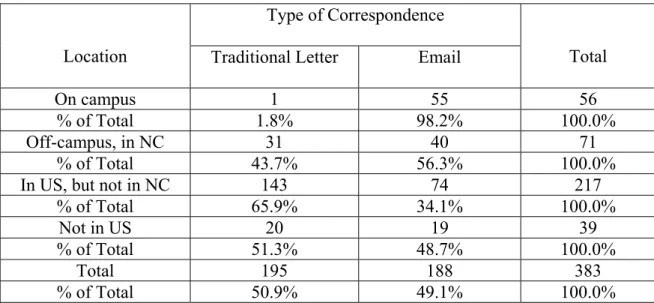
A comparison between the location of the correspondents and the way they correspond with their reference questions reveals that the total percent of people who were on campus and wrote the Reference Department was 1.8% for those who wrote by traditional letter and 98.2% for those who wrote by email. In the era of traditional letter writing, people who lived or worked on campus did not choose to write letters to the department. Assuming that the need for on campus reference assistance has remained constant, this would lead to the conclusion that students and faculty, before the use of email, chose to pose their questions face-to-face with a librarian or by telephone.
traditional letters writers was 43.7% and the number of email writers was 56.3%. The number of correspondents who lived or worked outside the United States also remained reasonably constant. The number of traditional letters writers was 51.3% and the number of email writers was 48.7%. The following table gives the numbers and percentages for all locations by type of correspondence.
Table 4: Relationship of Type of Correspondence and Location
Type of Correspondence
Location Traditional Letter Email Total
On campus 1 55 56
% of Total 1.8% 98.2% 100.0%
Off-campus, in NC 31 40 71
% of Total 43.7% 56.3% 100.0%
In US, but not in NC 143 74 217
% of Total 65.9% 34.1% 100.0%
Not in US 20 19 39
% of Total 51.3% 48.7% 100.0%
Total 195 188 383
% of Total 50.9% 49.1% 100.0%
Pearson Chi-Square value of 75.075 with 3 df, significance at the <.0001 level; unknowns removed; and N of valid cases = 383.
There was a dramatic shift between traditional letter correspondents and email correspondents who were in the United States, but not in North Carolina. Comparisons show that 65.9% of the correspondence from this location came by letter while 34.1% came by email. Before the use of email, it may be that the cost of interstate long distance telephone calls encouraged people outside of North Carolina to write letters to the
It is interesting to note that the number of email inquiries from people who are off-campus, and in North Carolina, is lower than either the number from on campus or the number from within the United States, but not in North Carolina. The high number of inquiries from out-of-state reflects that Duke University has a strong national reputation. However, Duke University’s close proximity to a number of other in-state academic libraries that also offer email reference services to North Carolina residents may also be a factor in the relatively small number of off-campus, in-state inquiries. In addition, many in-state residents have a strong affiliation with the University of North Carolina system and may prefer to send their questions to one of the public universities.
Table 5: Relationship of Location and Type of Correspondence
Location of Correspondent Type of
Correspondence campus On Off-campus, in NC In US, but not in NC Not in US Total
Email 55 40 74 19 188
% of Total 29.2% 21.3% 39.4% 10.1% 100%
Letters 1 31 143 20 195
% of Total .5% 15.9% 73.3% 10.3% 100%
Pearson Chi-Square value of 75.075 with 3 df, significance at the <.0001 level; unknowns removed; and N of valid cases = 383.
Content
more extended assistance from the reference librarian were coded as open questions. The data reveals a significant difference between the content of questions asked by traditional letter and those asked by email. Table 6 shows that of the open questions, 62.3% came by traditional letter while 37.7% came by email. These statistics reverse themselves for limited help questions as 35.9% came by letter and 64.1% came by email.
Table 6: Relationship of Content and Type of Correspondence
Type of Correspondence
Content Traditional Letter Email Total
Open 132 80 212
% of Total 62.3% 37.7% 100.0%
Limited 65 116 181
% of Total 35.9% 64.1% 100.0%
Total 195 196 393
% of Total 49.9% 50.1% 100.0%
Pearson Chi-Square of 27.123 with 1df, significance at the <.0001 level; and N of valid cases = 393.
This shift has significant implications for academic reference departments. Many of the limited help questions asked by email require the use of the on-line catalog, the library’s reference pages, and ready reference tools. The development of an easily accessible collection of ready reference books, the creation of Web resources, and a database of answers to frequently asked questions makes the librarian’s job of answering email questions much quicker. It may also indicate that today email is most effectively used to answer limited questions and a face-to-face interview may be needed to
encourage a user’s critical thinking and deeper exploration of resources.
decrease in the number of open questions indicate a change in the overall level of scholarship at the university or have face-to-face research consultations replaced correspondence as a way to ask in-depth questions of reference librarians? Are the questions posed to by email to academic reference librarians becoming more similar to those posed to public librarians?
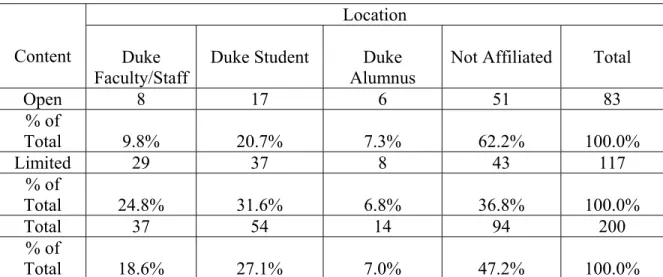
An analysis of the relationship of content and affiliation is primarily an examination of the content of email questions since only 2.5% of the traditional letter writers identified their affiliation. Table 7 shows this analysis. Duke faculty and staff, Duke students, and Duke alumni asked more limited help questions by email than open-ended questions. These groups do not use email as the way to ask in-depth questions of the reference staff. It may be that they set up research consultation with librarians, visit the reference desk in person to ask more open-ended questions, or use other methods to do research.
Table 7: Relationship of Content and Affiliation
Location Content Duke
Faculty/Staff
Duke Student Duke Alumnus
Not Affiliated Total
Open 8 17 6 51 83
% of
Total 9.8% 20.7% 7.3% 62.2% 100.0%
Limited 29 37 8 43 117
% of
Total 24.8% 31.6% 6.8% 36.8% 100.0%
Total 37 54 14 94 200
% of
Total 18.6% 27.1% 7.0% 47.2% 100.0%
People who are not affiliated with Duke University are more likely to use email to ask open questions than limited help questions. This may indicate that people browsing the Web have few resources or skills to use to find answers to their questions, they may be looking for a quick and inexpensive way to do research, or the convenience of the email service attracts users with broad interests who have not narrowed their questions.
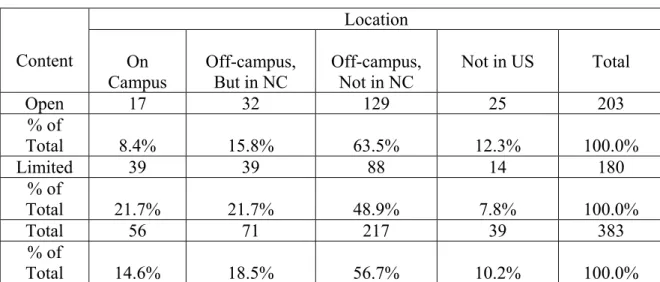
The comparison of content to location, shown in Table 8, indicates a similar trend. Correspondents who are in the United States, but not in North Carolina, account for 56.7% of the total correspondence. Of these, 63.5% are open questions and 48.9% are limited questions. Questions from people in North Carolina are more likely to be limited rather than open questions.
Table 8: Relationship of Content and Location
Location Content On
Campus
Off-campus, But in NC
Off-campus, Not in NC
Not in US Total
Open 17 32 129 25 203
% of
Total 8.4% 15.8% 63.5% 12.3% 100.0%
Limited 39 39 88 14 180
% of
Total 21.7% 21.7% 48.9% 7.8% 100.0%
Total 56 71 217 39 383
% of
Total 14.6% 18.5% 56.7% 10.2% 100.0%
Pearson Chi-Square of 18.869 with 3df, significance at the <.0001 level; unknowns removed; and N of valid cases = 383.
things are located or how something is done at Duke, or are fact-finding inquiries. Questions from outside of North Carolina are more likely to demand more extended assistance from a reference librarian in order to be answered.
Interaction Process Analysis
The analysis of the interactions between the correspondent and the reference librarian focused on identifying any significant differences between traditional letters and email, with an emphasis on the intention of the communication. There were four levels of analysis. First, the messages were analyzed by coding them into the nine categories adapted from Bales’ Interaction Process Analysis. Second, the analysis compared the variables of gender, location, affiliation, and content to the nine categories to see if there were any patterns within the interactions. Third, the categories were then grouped by problem orientation so as to code the process of the reference inquiry and fourth, the messages were categorized by socio-emotional or task orientation to determine the function of the communication.
For the interaction process analysis, a unit was defined as a letter or email that elicited a response from a librarian. The letter of inquiry and the response were coded as one unit. Each unit contained multiple messages and could be coded for multiple
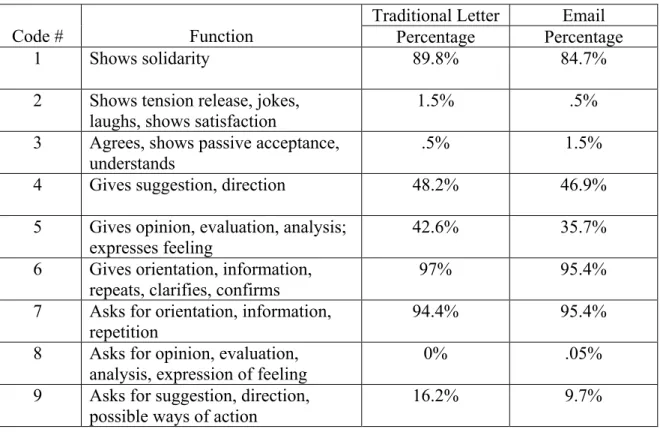
The methods of correspondence are strikingly similar when they are broken down on this level. The categories for showing solidarity (traditional letter: 89.8%; email 84.7%), giving orientation or information (traditional letters: 97%; email 95.4%), giving suggestion or direction (traditional letters: 48.2%; email 46.9%), and asking for
orientation or information (traditional letters: 94.4%; email 95.4%) are particularly similar. Only two categories show a percentage difference of more than 6%. They are: category #9 that codes messages that ask for suggestion or direction (traditional letters: 16.2%; email: 9.7%) and category #5 that codes messages that give opinion or express feeling.
Table 9: Interaction Analysis
Traditional Letter Email
Code # Function Percentage Percentage
1 Shows solidarity 89.8% 84.7%
2 Shows tension release, jokes,
laughs, shows satisfaction 1.5% .5%
3 Agrees, shows passive acceptance, understands
.5% 1.5%
4 Gives suggestion, direction 48.2% 46.9%
5 Gives opinion, evaluation, analysis; expresses feeling
42.6% 35.7% 6 Gives orientation, information,
repeats, clarifies, confirms
97% 95.4% 7 Asks for orientation, information,
repetition
94.4% 95.4%
8 Asks for opinion, evaluation,
analysis, expression of feeling 0% .05%
9 Asks for suggestion, direction,
Earlier research on gendered language has shown that males and females tend to have different characteristic on-line styles of communication. Herring (1994) concluded that women tend to be more supportive and ask for personal orientation while men tend to be more adversarial in their interactions. Thomson and Murachver (2001) examined gender differences in language used in emails sent by people to others of the same sex. They concluded that women are more likely to ask more questions, ask for more
suggestions, and give more compliments. Although the sample size in this analysis is small, the results are consistent with these studies. The relationship between the gender of the correspondents and those who ask for some type of suggestion is shown in Table 10. Women were approximately twice as likely as men to ask for a suggestion as part of their correspondence, 17.3% of women and 8.9% of men asked for a suggestion in their correspondence.
Table 10: Relationship of Gender of Correspondents and Bales’ Category #9: Asks for Suggestion
Type of Interaction
Gender Other Categories Asks for Suggestion Total
Female 148 31 179
% of Total 82.7% 17.3% 100.0%
Male 153 15 168
% of Total 91.9% 8.9% 100.0%
Total 301 46 347
% of Total 86.7% 13.3% 100.0%
Pearson Chi-Square of 5.305 with 1df, significance at the .021 level; unknowns removed; and N of valid cases = 347.
pointed out that building a supportive environment is one of the best ways to encourage cohesion in a group. The use of supportive communication occurs when group members respect and encourage one another. The interactions that are coded for Bales’ category #1, shows solidarity, are clear examples of communication that develop a supportive relationship between the correspondent and the librarian. The high percentage, 89.8% for traditional letters and 84.7% for email, shows that correspondence in either format tends to contain words of solidarity.
The similarities and differences of how goodwill was established and the
compliments and gratitude exchanged within the content of traditional letters and emails are note worthy. The email correspondent often included a brief thank you at the end of their inquiry. The use of an exclamation point after the thank you was a prevalent use of punctuation. In the traditional letters, a thank you from the correspondent was also common but the wording was more formal and more descriptive. The following quotes are typical examples. “Any help you could render I would greatly appreciate” (September 17, 1965). “Please accept my thanks in advance for your able assistance” (March 10, 1966). “Thanking you for your attention to this small inquiry” (August 19,
1973). Exclamation points after the words of goodwill were never used.
traditional letters did not thank the correspondent for contacting the library, but in a number of cases they would offer further assistance. Again, the wording used was more descriptive. “I am indeed sorry that our search had no better results. If we can ever assist you again, please let us know” (February 2. 1973). “I hope that we have been of some assistance in the preparation of your manuscript” (August 31, 1973). In a response to another librarian, “Please forward to your patron our best wishes for the success of her/his research” (April 7, 1976). All of these examples show that the intentions of the writers of reference correspondence are similar despite the difference in format but the language used to create a supportive environment has definitely changed.
The high percentages of people who write to the reference department and ask for orientation or information and the high percentages of those who are given orientation are not surprising. The intent of reference service is to provide assistance to people and the question is the stimulus for this interaction.
Relationships Between Categories of Interaction
There is a significant relationship between those messages that show solidarity and those that give orientation. Comparisons, shown in Table 11, revealed that 98.3% of the messages that give orientation (provide information, repetition, clarification, or confirmation) also show solidarity (raise others’ status, provide help or rewards). This development of supportive communication helps to create an environment of trust and respect between the correspondent and the librarian. The exchange of information coupled with a feeling of solidarity makes the interaction more personal and creates a feeling of cohesion that tends to make the process more productive.
Table 11: Relationship of Bales’ Category #1: Shows Solidarity and Bales’ Category #6: Gives Orientation
Type of Interaction
Type of Interaction Other Categories Gives Orientation Total
Other 8 41 49
% of Total 16.3% 83.7% 100.0%
Gives Solidarity 6 338 344
% of Total 1.7% 98.3% 100.0%
Total 14 379 393
% of Total 3.6% 96.4% 100.0%
Pearson Chi-Square of 26.548 with 1df, significance at <.0001 level; and N of valid cases = 393.
Table 12 shows the relationship between asking and being given some form of orientation. It cannot be assumed that the correspondent received the answer to their request but 96% of the interactions that included a request for orientation also provided orientation. This rather obvious and expected result indicates that the reference
Table 12: Relationship of Bales’ Category #6: Gives Orientation and Bales’ Category #7: Asks for Orientation
Type of Interaction
Type of Interaction Other Categories Asks for Orientation Total
Other 4 10 14
% of Total 28.6% 71.4% 100.0%
Gives Orientation 15 364 379
% of Total 4.0% 96.0% 100.0%
Total 19 374 393
% of Total 4.8% 95.2% 100.0%
Pearson Chi-Square of 17.778 with 1df, a significance at <.0001 level; and N of valid cases = 393.
By contrast, the relationship between those messages that ask for suggestions and those that give suggestions reveals the opposite response. Table 13 shows that only 17% of the messages that ask for a suggestion receive a suggestion. Librarians may perceive this type of request as a request for orientation, instead of a desire for a suggestion. This analysis is further supported by the data given in Table 14 that shows the relationship between messages that ask for orientation and those that ask for a suggestion. Only 11% of the messages that asked for orientation also asked for a suggestion. Correspondents tend to approach a reference service with a question and want to be given orientation or information rather than a suggestion. This is true for both open-ended questions and for limited help questions.
Table 13: Relationship of Bales’ Category #4: Gives Suggestion and Bales’ Category #9: Asks for Suggestion
Type of Interaction
Type of Interaction Other Categories Asks for Suggestion Total
Other 186 19 205
% of Total 90.7% 9.3% 100.0%
Gives Suggestion 156 32 188
% of Total 83.0% 17.0% 100.0%
Total 342 51 393
% of Total 87.0% 13.0% 100.0%
Pearson Chi-Square of 5.220 with 1df, significance at the .022 level; and N of valid cases = 393.
Table 14: Relationship of Bales’ Category #7: Asks for Orientation and Bales’ Category #9: Asks for Suggestion
Type of Interaction
Type of Interaction Other Categories Asks for Suggestion Total
Other 9 10 19
% of Total 47.4% 52.6% 100.0%
Asks for Orientation 333 41 374
% of Total 89.0% 11.0% 100.0%
Total 342 51 393
% of Total 87.0% 13.0% 100.0%
Pearson Chi-Square of 27.800 with 1df, significance at <.0001 level; and N of valid cases = 393.
Problem Orientation
The differences between the problem orientation of messages sent by traditional letters and email are a matter of degree and do not show a change in emphasis dependent on their format. Both traditional letters and email have a high percentage of messages that focused on orientation. Table 15 shows that 49% of the traditional letter writers and 51.5% of the email writers used an orientation message in their correspondence. An orientation message included either the asking or giving of information, repetition,
(asking or giving opinion), control (asking or giving suggestion), and integration
(showing solidarity) than the email messages but again the comparisons are one of degree rather than difference. This indicates that the process of how a correspondent and a reference librarian approach and deal with a reference question has not changed significantly with the use of email.
Table 15: Correspondence Grouped by Problem Orientation
Traditional Letter Email
Problem Orientation Total # Percentage Total # Percentage
Orientation 377 49.0 374 51.5
Evaluation 84 10.9 71 9.8
Control 127 16.5 111 15.3
Decision 1 0.1 3 0.4
Tension-Management 3 0.4 1 0.1
Integration 177 23.0 166 22.9
Notes: Orientation: categories 6 & 7, Evaluation: categories 5 & 8, Control: categories 4 & 9, Decision: categories 3 & 10, Tension-Management: categories 2 & 11, Integration: categories 1 & 12.
The Function of Messages
The differences between the function of the messages of traditional letters and email are also a matter of degree rather than a significant change. Table 16 shows that both formats have 100% orientation to task while 91.8% of traditional letters and 85.2% of email contain emotional messages. Neither group contained any negative socio-emotional messages.
function of the messages in reference correspondence indicates the presence of these factors. Reference question tasks tend to be defined, positive feedback occurs, and there are clear roles for the group members. The depth of these messages was not analyzed in this study but their occurrence indicates that the written reference process contains the elements needed for both members of the group to be satisfied with the interaction.
Table 16: Correspondence Grouped by Function of Message
Traditional Letter Email
Function Total # Percentage Total # Percentage
Socio-emotional 179 91.8% 167 85.2%
Positive 179 91.8% 167 85.2%
Negative 0 0% 0 0%
Task 195 100.0% 196 100.0%
Questions 195 100.0% 193 98.5%
Answers 195 100.0% 196 100.0%
Notes: Socio-emotional messages: categories 1-3, 10-12, positive messages: categories 1-3, negative messages: categories 10-12; Task messages: categories 4-9, question messages: categories 7-9, answer messages: categories 4-6.
Other Observations
information was left to the written discretion of the correspondent. The appearance of the traditional letter was more reflective of the personality of the correspondent.
The content of written reference correspondence was analyzed based on whether the inquiries were open or limited help questions. Although the subjects of the inquiries were not analyzed, one difference was noted in the types of questions asked by traditional letter and by email. In traditional letter correspondence, 10.3% of the inquiries concerned genealogy while 0% of the email contained genealogy questions. Today, the Rare Book, Manuscripts, and Special Collections Library at Duke University receives many written inquiries related to family history research. This specialization within the library has affected the focus of the work of the Reference Department and also affects the types of questions.
Conclusions
Email has affected academic reference service in significant ways. Email allows information to be quickly transferred from one person to another. It offers the
opportunity for a reference librarian to conduct a reference interview in ways not possible in a traditional letter. Email has reduced barriers and made reference service more
available. Computers have changed how people do research, as there are more ways and places to search for information. Email is a tool that offers many possibilities for
improving reference service. An increased understanding of how email affects communication will allow librarians to take advantage of its potential and better serve their users.
Email service at Duke University has affected the demographics of
Email has brought a significant difference in the content of the questions asked in reference correspondence. Email questions tend to be ones that can be quickly answered using ready reference tools or the on-line catalog. Questions asked in traditional letters tended to demand more extended assistance from reference librarians.
The patterns of behavior observed in traditional letter and email reference correspondence show that the types of interactions have not changed significantly with the use of email reference. The function of the individual messages, the process of how a correspondent and a reference librarian approach and deal with a reference question, and the presence of task and socio-emotional messages are statistically comparable. It is interesting to note that in almost all instances, the percentage for types of interaction is higher for traditional letters than the percentage for email correspondence. There have been changes in the occurrence of the interactions but the changes are a matter of degree rather than a significant shift.
The traditional letters and email letters reveal the same patterns of helping. In order to create positive interactions, correspondents and librarians tend to follow these steps:
Phase 1: The emphasis is on solidarity (creation of supportive
communication). This occurs at the beginning and/or at the end of the interactions.
Phase 2: The emphasis is on orientation (description of the situation).
Phase 3: The emphasis is on evaluation (what attitudes should be taken toward the situation).
The implementation of this cyclical approach to decision-making allows the
correspondent and the reference librarian to make decisions and effectively perform tasks, in order to answer reference inquiries.
Academic institutions should expect increased demands for remote reference assistance. The number of emails has increased dramatically over the past few years and will continue to increase as people become more and more computer literate. This analysis reveals that academic libraries may prepare for this trend by implementing the following suggestions:
• Creating good ready reference collections. The easy accessibility of often
used print and electronic resources will save staff time as they answer the increasing number of limited help questions.
• Developing Web pages to target answers to frequently asked questions.
This will also save staff time and will encourage the education of Web users.
• Creating an effective email form that encourages correspondents to give
pertinent information. At a minimum, this includes name, location, affiliation, inquiry, and background information that puts the request in context.
• Promoting electronic reference services to encourage their use by students,
staff, faculty, and alumni. With increasing tuition costs, this will make better use of university resources and increase user satisfaction.
• Training staff to use patterns of behavior that will encourage supportive
• Encouraging students, staff, faculty, and alumni to use research
consultations with reference librarians to pursue more in-depth research topics. Email can effectively be used to answer limited help questions and open-ended questions with a limited scope.
It is important to remember that email correspondence is an interaction between the correspondent and the reference librarian. User satisfaction will determine the success of a remote reference service. Only librarians can create an email service where people can ask questions, be treated with respect, and be given access to information with the use of appropriate technologies and resources. This is the challenge and the
opportunity for academic librarians to build on the understanding and wisdom of the past in order to make public service more effective.
Reference List
Abels, E.G. (1996). The email reference interview. RQ, 35, 345-358.
American Library Association. (1979). A commitment to information services; Developmental guidelines 1979. RQ, 18, 275.
Association of College and Research Libraries. (1997). ACRL guidelines for extended academic campus library services. College & Research Libraries News, 58, 98-102.
Bales, R. (1950). Interaction process analysis: a method for the study of small groups.
Cambridge: Addison-Wesley.
Bates, M., Wilde, D., & Siegfried, S. (1993). An analysis of search terminology used by humanities scholars: The getty online searching project report number one.
Library Quarterly, 63, 15.
Bearman, D. (1989/90). User presentation language in archives. Archives & Museum Informatics, 3, 3.
Bristow, A. (1992). Academic reference service over electronic mail. College & Research Libraries News, 53, 631-2, 637.
Bristow, A., & Buechley, M. (1995). Academic reference service over electronic mail: An update. College & Research Libraries News, 56, 359-371.
Bryan, J.M. (2000). The campus guide: Duke university. NY: Princeton Architectural Press.
Bushallow-Wilbur, L., DeVinney, G., & Whitcomb, F. (1996). Electronic mail reference service: A study. RQ, 35, 359-371.
Collins, K. (1998). Providing subject access to images: A study of user queries.
American Archivist, 61, 36-55.