Sharif University of Technology
Scientia IranicaTransactions B: Mechanical Engineering http://scientiairanica.sharif.edu
Eects of viscous dissipation and convective heating on
convection ow of a second-grade liquid over a
stretching surface: An analytical and numerical study
M. Bhuvaneswari
a, S. Eswaramoorthi
b, S. Sivasankaran
a;, S. Rajan
c,
and A. Saleh Alshomrani
aa. Department of Mathematics, King Abdulaziz University, Jeddah 21589, Saudi Arabia.
b. Department of Mathematics, Dr.N.G.P. Arts & Science College, Coimbatore 641048, Tamil Nadu, India. c. Department of Mathematics, Erode Arts & Science College, Erode 638009, Tamil Nadu, India.
Received 17 May 2017; received in revised form 13 December 2017; accepted 9 April 2018
KEYWORDS Second-grade uid; Convective boundary; Heat generation; Suction/injection; Viscous dissipation.
Abstract. The eects of viscous dissipation and convective boundary condition on the two-dimensional convective ow of a second-grade liquid over a stretchable surface with suction/injection and heat generation were investigated. The governing partial dierential equations were reduced into a dimensionless coupled system of nonlinear ordinary dierential equations by appropriate similarity transformation. Then, they were solved analytically by Homotopy Analysis Method (HAM) and numerically by fourth-order Runge-Kutta method with shooting technique. The HAM and numerical results of the local skin friction and local Nusselt number were compared for various emerging parameters. It was found that the momentum boundary layer thickness grew by raising the value of the viscoelastic parameter.
© 2019 Sharif University of Technology. All rights reserved.
1. Introduction
The study of boundary layer ow of a viscoelastic liquid over a stretching surface plays a signicant role in manufacturing processes including hot rolling, crystal growing, glass blowing, production of synthetic sheets, thermal insulation, thermal control of nuclear reactors, thermal oil recovery, lm cooling, design of thrust bearing, and design of radial diusers. MHD boundary layer ow and energy transfer of a viscoelastic liquid over a stretchy sheet were investigated by Cortell [1]. Several authors investigated the convective ow and energy transfer behavior of viscoelastic liquid with dierent physical situations, see [2-8]. In nature, heat
*. Corresponding author.
E-mail address: [email protected] (S. Sivasankaran) doi: 10.24200/sci.2018.20414
transfer is an important process in many technical and industrial applications such as drying, damage of crops because of freezing, food processing, removal of nuclear fuel debris, underground disposal of radioactive waste materials, etc. Because of these applications, several researchers engage with analyzing the heat transfer process in dierent physical contexts. Some of the important studies that underline such concept can be found in references [9-14].
The problem of free convective ow of a heat gen-erating/absorbing liquid was studied by Chamkha [15]. He found that the thermal boundary layer thickness increased with the rise of the heat generation or absorption parameter. The heat generation eect on boundary layer ow with dierent uids has been investigated in some papers [16-21]. Hayat et al. [22] analyzed convective ow of a second-grade liquid over a stretchy wall with convective surface condition. They found that the energy transfer eects were absent when
Biot number was zero. Few studies, e.g., [23-26], have investigated the boundary layer ow with convective boundary condition.
So far, no attempt has been made to carry out energy transfer analysis on a second-grade liquid over a stretchy surface with viscous dissipation, internal heat generation/absorption, and convective surface condi-tion. Hence, we study this problem both analytically using the homotopy analysis method and numerically using Runge-Kutta method.
2. Mathematical formulation
We consider two-dimensional convective boundary layer ow and energy transfer of a second-grade liquid along a stretchy surface. The surface is stretched with a velocity uw(x) = bx, where b is a real number.
It is presumed that the liquid is heat generated or absorbed internally. Also, viscous dissipation is taken into consideration. We choose x-axis along the stretchy surface and y-axis normal to the stretching surface. The governing equations for continuity, momentum, and energy can be written in the following form [2,22]:
@u @x+
@v
@y = 0; (1)
u@u@x + v@u@y = @@y2u2 +1 @u
@x @2u
@y2 + u
@3u
@x@y2
+@u@y@@y2v2 + v@@y3u3
; (2)
u@T@x + v@T@y = m@ 2T
@y2 +
cp @u @y 2
+c1
p
u@u@y@x@y@2u +v@u@y@@y2u2
+cQ
p(T T1);(3)
where u and v are the components of velocity, x and y are the coordinates, T is temperature, is density of the uid, 1 is the second-grade parameter, Q is
the coecient of internal heat absorption (< 0) or generation (> 0) of the uid, cp is specic heat, is
kinematic viscosity, and m is thermal diusivity.
The velocity and thermal boundary conditions can be expressed as follows:
u = uw(x) = ax; v = vw; k@T@y = hc(Tf T );
at y = 0;
u ! 0; v ! 0; T ! T1;
as y ! 1;
where a is a positive constant, k is thermal conductivity of the uid, vw is suction velocity (> 0) or injection
velocity (< 0), hcis heat transfer coecient, and Tf is
temperature of the hot uid. We dene:
= r
a
y; u = axf0();
v = paf(); = T T1
Tf T1: (4)
Substituting Eq. (4) into Eqs. (2) and (3), we obtain: f000+ ff00 f02+ K 2f0f000 f002 ffiv= 0; (5)
00+ Prf0+ PrEcf002+ PrEcK f0f002 ff00f000
+ PrHg = 0; (6)
with boundary conditions:
f(0) = fw; f0(0) =ab = c; 0(0) = Bi[1 (0)];
f0(1) = 0; (1) = 0;
where K = 1a
is viscoelastic parameter, Pr = m
is the Prandtl number, Ec = u2w
cp(Tf T1) is the Eckert
number, Hg = acQp is heat generation (> 0) and absorption (< 0) parameter, fw= pvwa is suction (>
0) and injection (< 0) parameter, c = b
a is stretching
ratio, Bi = hc
k a
1
2 is Biot number, and Re = uwx
is
local Reynolds number.
The local skin friction coecient (Cf) and the local Nusselt number (Nu) are dened as:
Cf = 2w u2
w; Nu =
xqw
k(Tf T1);
where w is wall shear stress and qw is the heat ux,
which are given by:
w= @u @y y=0+ 1
u@x@y@2u +v@@y2v2 2@v@y@u@y
y=0;
qw= k
@T @y y=0 :
Accordingly, the dimensionless form of local skin fric-tion coecient and the local Nusselt number are:
1 2CfRe
1
2 = (1 + 3K) f00(0);
Nu=Re12 = 0(0):
3. Solutions
3.1. HAM solution
Figure 1. h curves of f00(0) and 0(0) with
K = 0:2; c = 0:3; fw= 0:5; Ec = 0:3; Hg = 0:5, and
Bi = 0:5.
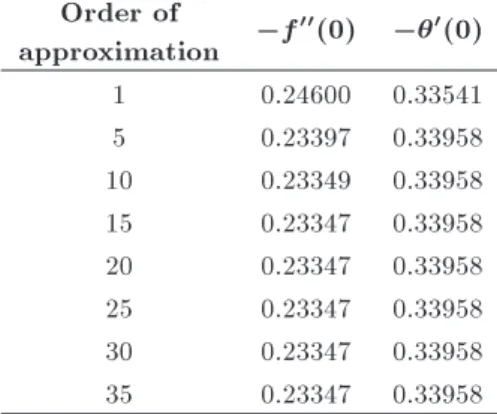
Table 1. Convergence of homotopy analysis solution for dierent orders of approximation when K = 0:2, c = 0:3, fw= 0:5, Ec = 0:3, Hg = 0:5, and Bi = 0:5.
Order of
approximation f
00(0) 0(0)
1 0:24600 0:33541 5 0:23397 0:33958 10 0:23349 0:33958 15 0:23347 0:33958 20 0:23347 0:33958 25 0:23347 0:33958 30 0:23347 0:33958 35 0:23347 0:33958
dierential equations (5) and (6) is obtained by using homotopy analysis method. In HAM, rst, we choose the initial approximations as f0() = fw+ c(1 e )
and 0() = Bie1+Bi. The auxiliary linear operators are
Lf = d
3f
d3 ddf and L = d 2
d2 . After substituting
the mth order deformation equations, the resulting system is solved using HAM with the 15th order of approximations. All the symbolic computations are carried out by MATLAB.
The solutions strongly depend on the auxiliary parameters hf and h. In order to see the rates for
admissible values of hf and h, the h curves of the
functions f00(0) and 0(0) are plotted in Figure 1. The
gure indicates that the ranges of admissible values of hf and h are 1:4 hf 0:6 and 1:8
h 0:5, respectively. If we choose the values of
auxiliary parameter (h) from this range, we acquire more precise results. Further, the series converges in the whole region of when hf = h = 1:0.
Table 1 presents the order of approximations which are necessary for a convergent solution. It is clear that the
15th order of approximation is sucient for the velocity and temperature proles.
3.2. Numerical solution
Eqs. (5) and (6) are highly nonlinear ordinary dier-ential equations. It is critical to solve these equations. The resulting system of equations with the boundary conditions (7) is numerically solved using Runge-Kutta fourth-order method with initial guessing f00(0) and
0(0). This process is repeated until we get the required
degree of accuracy. The analytical and numerical results are compared in Tables 2 and 3. They assure our analytical and numerical results.
4. Results and discussion
In this section, we present the graphical results for velocity prole (f0()), temperature prole (()), local
skin friction 1 2CfRe
1 2
, and local Nusselt number
Nu=Re12
with dierent values of viscoelastic param-eter, Eckert number, suction/injection paramparam-eter, heat absorption/generation parameter, stretching ratio, and Biot number and xed value of Prandtl number (Pr = 1:0).
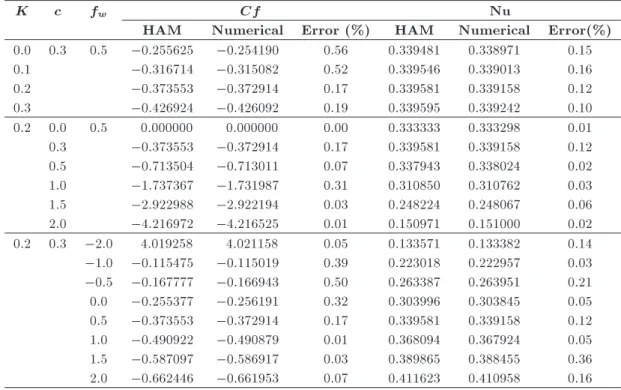
Table 2 shows the local skin friction and Nusselt number for various values of K, c, and fw. It is
observable that the local skin friction diminishes on raising the values of K, c, and fw. It is also clear
that the local Nusselt number increases on raising the values of K and fw. The heat transfer rate is enhanced
for slow stretching c 0:3; after this, energy transfer rate diminishes. Table 3 represents the local Nusselt number for various values of Hg and Bi. It is seen that the local Nusselt number rises by raising the Biot number. The heat transfer rate diminishes in the heat absorption case, because the uid absorbs the heat and reduces the energy transfer rate along the boundary. The high heat transfer rate in internal heat generation case is visualized for Hg 0:5.
Figure 2(a) and (b) displays the variations of suction (fw > 0) and injection (fw < 0) parameters
in velocity prole. It is seen from these graphs that the uid velocity decreases on increasing the suction parameter. However, the velocity increases with increase in the injection parameter. Therefore, we can control the boundary layer ow using suction. The suction stabilizes the boundary layer growth and the injection destabilizes the boundary layer growth. Figure 3(a) and (b) shows the eects of heat generation (Hg > 0) and heat absorption (Hg < 0) parameters on temperature prole. It is found that the temper-ature increases with increase in the heat generation parameter. However, temperature is a decreasing function of heat absorption parameter. The outcome of internal heat generation is the rise in the rate of energy
Table 2. The local skin friction coecient and the local Nusselt number for dierent values of K, c, and fwwhen
Ec = 0:3, Hg = 0:5, and Bi = 0:5.
K c fw Cf Nu
HAM Numerical Error (%) HAM Numerical Error(%) 0:0 0:3 0:5 0:255625 0:254190 0:56 0:339481 0:338971 0:15
0:1 0:316714 0:315082 0:52 0:339546 0:339013 0:16
0:2 0:373553 0:372914 0:17 0:339581 0:339158 0:12
0:3 0:426924 0:426092 0:19 0:339595 0:339242 0:10
0:2 0:0 0:5 0:000000 0:000000 0:00 0:333333 0:333298 0:01
0:3 0:373553 0:372914 0:17 0:339581 0:339158 0:12
0:5 0:713504 0:713011 0:07 0:337943 0:338024 0:02
1:0 1:737367 1:731987 0:31 0:310850 0:310762 0:03
1:5 2:922988 2:922194 0:03 0:248224 0:248067 0:06
2:0 4:216972 4:216525 0:01 0:150971 0:151000 0:02
0:2 0:3 2:0 4:019258 4:021158 0:05 0:133571 0:133382 0:14 1:0 0:115475 0:115019 0:39 0:223018 0:222957 0:03 0:5 0:167777 0:166943 0:50 0:263387 0:263951 0:21 0:0 0:255377 0:256191 0:32 0:303996 0:303845 0:05 0:5 0:373553 0:372914 0:17 0:339581 0:339158 0:12 1:0 0:490922 0:490879 0:01 0:368094 0:367924 0:05 1:5 0:587097 0:586917 0:03 0:389865 0:388455 0:36 2:0 0:662446 0:661953 0:07 0:411623 0:410958 0:16
Table 3. The local Nusselt number for dierent values of Hg and Bi when K = 0:2, c = 0:3, fw= 0:5, and Ec = 0:3.
Hg Bi Nu
HAM Numerical Error (%) 1:0 0:5 0:362380 0:361992 0:11
0:7 0:350318 0:351846 0:44
0:5 0:339581 0:338957 0:18
0:3 0:325061 0:325001 0:02
0:0 0:286097 0:285952 0:05
0:3 0:101896 0:101657 0:23
0:5 0:836841 0:835927 0:11
0:7 6:589394 6:590428 0:02
0:5 0:0 0:000000 0:000000 0:00 0:1 0:090796 0:091582 0:87 0:5 0:339581 0:338953 0:18 1:0 0:516477 0:516090 0:07 1:5 0:625004 0:624991 0:00 2:0 0:698378 0:697753 0:09 2:5 0:751299 0:749852 0:19 3:0 0:791272 0:790581 0:09 4:0 0:847646 0:846928 0:08 5:0 0:885499 0:884398 0:12 10:0 0:972341 0:971573 0:08
transport to the liquid, thereby raising the temperature of the liquid. However, heat absorption is to diminish the rate of energy transport to the liquid, thereby decreasing the temperature of the liquid. The eect of
Eckert number on temperature prole is displayed in Figure 4. It is determined that the thermal boundary layer thickness increases on increasing the Eckert num-ber. That is, the enthalpy inside the boundary layer increases by raising the values of Ec and this produces thicker thermal boundary layer.
Figure 5 shows the various values of Biot number on temperature prole. The uid temperature is zero for Bi = 0, that is, the heat transfer coecient is zero here. It is observed that the uid temperature and thermal boundary layer thickness increase on increasing the Biot number (heat transfer coecient). Figure 6(a)-(c) show the variation of local skin friction for dierent values of viscoelastic parameter, stretching ratio parameter, and suction/injection parameter. It is observed that the local skin friction decreases on raising the values c, fw, and K. The local skin friction
slowly decreases when raising the values of fw up to
fw= 0:5, and it decreases rapidly on increasing fw.
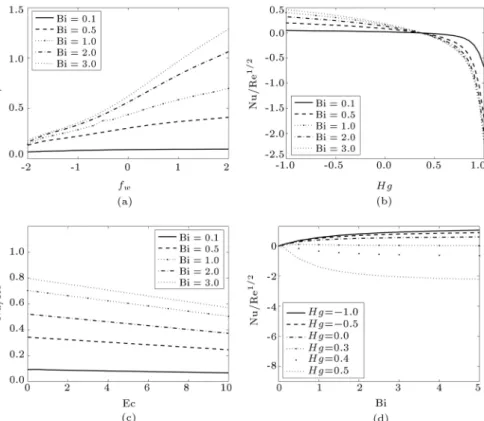
Figure 7(a)-(d) shows the variation of the lo-cal Nusselt number for various combinations of suction/injection, heat generation/absorption, Eckert number, and Biot number. It is observed from Fig-ure 7(a) that the surface temperatFig-ure gradient in-creases on increasing the Biot number. The increment in Nusselt number with Bi is higher in the presence of suction than in the presence of injection. The heat transfer rate is almost constant at low Biot number (Bi = 0) on increasing fw. However, heat transfer rate
Figure 2. Velocity prole for dierent values of (a) suction parameter (fw> 0) and (b) injection parameter (fw< 0);
c = 0:3; Ec = 0:3; Hg = 0:5, and Bi = 0:5.
Figure 3. Temperature prole for dierent values of (a) heat generation parameter (Hg > 0) and (b) heat absorption parameter (Hg < 0); K = 0:2; c = 0:3; fw= 0:5; Ec = 0:3, and Bi = 0:5.
Figure 4. Temperature prole for dierent values of Eckert number (Ec) with K = 0:2, c = 0:3, fw= 0:5,
Hg = 0:5, and Bi = 0:5.
Bi. It is seen from Figure 7(b) that the local Nusselt number decreases on raising the values of Hg. This is because surface temperature gradient diminishes on increasing Hg. The heat transfer rate vanishes when Hg = 0:371. It is found that the critical value of Hg is 0.371. At this point (Hgcrit = 0:371), the
Figure 5. Temperature prole for dierent values of Biot number (Bi) with K = 0:2; c = 0:3; fw= 0:5; Ec = 0:3, and
Hg = 0:5.
local Nusselt number vanishes. Therefore, the internal heat generation rate is equal to surface temperature at Hgcrit = 0:371. Therefore, there is no energy
transport between the surface and liquid medium. This is an important result for thermal engineering applications. Before Hgcrit = 0:371, the decrease
Figure 6. Variation of the local skin friction for dierent values of K, c, and fw.
Figure 7. Variation of the local Nusselt for dierent values of fw, Ec, Hg, and Bi with K = 0:2 and c = 0:3.
in heat transfer rate is signicantly small and after that, it is very high. The Nusselt number decreases exponentially when Hg approaches unity. The heat transfer rate is reduced slowly on increasing Hg up to Hg = 0:5. However, after that, heat transfer rate decreases exponentially. It is found from Figure 7(c) that the higher values of Eckert number suppress the heat transfer rate. The rate of decrement in Nusselt number with Ec increases for higher values of Biot number. It is concluded from Figure 7(d) that the local Nusselt number decreases on increasing Hg. In heat absorption case, the local Nusselt number is enhanced with increasing the values of Biot number. The local Nusselt number rapidly decreases with increasing the low values of Biot number for the heat generation case.
5. Conclusions
The present study elaborated the eects of viscous dis-sipation and convective heating on the boundary layer ow and heat transfer of a second-grade liquid. The governing boundary layer systems were transformed into a set of ordinary dierential equations with the help of similarity variables. Then, these equations were solved analytically by using homotopy analysis method and numerically by using the Runge-Kutta 4th order method. The following results were concluded from the study:
The momentum boundary layer thickness was con-trolled by the suction and it increased by increasing the injection;
The thermal boundary layer thickness was enhanced in the presence of heat generation parameter and it decreased when increasing the heat absorption parameter;
The thermal boundary layer thickness increased with the help of the Eckert and Biot numbers due to the heat dissipation;
The heat transfer rate increased with increase in the Biot number, and suction/injection parameters, and decreased with increase in the Eckert number and heat generation/absorption parameter.
References
1. Cortell, R. \Eects of viscous dissipation and work done by deformation on the MHD ow and heat transfer of a viscoelastic uid over a stretching sheet", shape Physics Letters A, 357(4-5), pp. 298-305 (2006).
2. Shawaqfah, M.S., Damseh, R.A., Chamkha, A.J. and Zgoul, M. \Forced convection Blasius ow of second-grade visco-elastic uid", Int. J. Heat Tech., 25(1), pp. 145-149 (2007).
3. Abel, M.S. and Mahesha, N. \Heat transfer in MHD viscoelastic uid ow over a stretching sheet with variable thermal conductivity, non-uniform heat source and radiation", Appl. Math. Model., 32(10), pp. 1965-1983 (2008).
4. Ahmad, A. and Asghar, S. \Flow of a second grade uid over a sheet stretching with arbitrary velocities subject to a transverse magnetic eld", Appl. Math. Letters, 24(11), pp. 1905-1909 (2011).
5. Kecebas, A. and Yurusoy, M. \Numerical solutions of unsteady boundary layer equations for a generalized second grade uid. J. Theor. Appl. Mech., 49(1), pp. 71-82 (2011).
6. Khan, Y., Hussain, A., and Faraz, N. \Un-steady linear viscoelastic uid model over a stretch-ing/shrinking sheet in the region of stagnation point ows", Scientia Iranica, 19(6), pp. 1541-1549 (2012). 7. Eswaramoorthi, S., Bhuvaneswari, M., Sivasankaran, S., and Rajan, S. \Eect of radiation on MHD convective ow and heat transfer of a viscoelastic uid over a stretching surface", Procedia Eng., 127, pp. 916-923 (2015).
8. Mishra, S.R., Pattnaik, P.K., Bhatti, M.M. and Abbas, T. \Analysis of heat and mass transfer with MHD and chemical reaction eects on viscoelastic uid over a stretching sheet", Indian J. Phys., 91(10), pp. 1219-1227 (2017).
9. Lee, J., Kandaswamy, P., Bhuvaneswari, M. and Sivasankaran, S. \Lie group analysis of radiation natural convection heat transfer past an inclined porous surface", J. Mech. Sci. Tech., 22(9), pp. 1779-1784 (2008).
10. Beg, O.A., Uddin, M.J., Rashidi, M.M., and Kavyani, N. \Double-diusive radiative magnetic mixed con-vective slip ow with Biot and Richardson number eects", J. Engin. Thermophys., 23(2), pp. 79-97 (2014).
11. Ellahi, R., Bhatti, M.M., and Vafai, K. \Eects of heat and mass transfer on peristaltic ow in a non-uniform rectangular duct", Int. J. Heat Mass Transf., 71, pp. 706-719 (2014).
12. Niranjan, H., Sivasankaran, S., and Bhuvaneswari, M. \Analytical and numerical study on magnetoconvec-tion stagnamagnetoconvec-tion-point ow in a porous medium with chemical reaction, radiation, and slip eects", Mathe. Prob. Eng., Article ID 4017076, pp. 1-12 (2016). 13. Sheikholeslami, M. and Rashidi, M.M. \Non-uniform
magnetic eld eect on nanouid hydrothermal treat-ment considering Brownian motion and thermophore-sis eects", J. Braz. Soc. Mech. Sci. Eng., 38(4), pp. 1171-1184 (2016).
14. Sheikholeslami, M. and Bhatti, M.M. \Forced con-vection of nanouid in presence of constant magnetic eld considering shape eects of nanoparticles", Int. J. Heat Mass Transf., 111, pp. 1039-1049 (2017). 15. Chamkha, A.J. \Hydromagnetic three-dimensional
free convection on a vertical stretching surface with heat generation or absorption", Int. J. Heat Fluid Flow, 20(1), pp. 84-92 (1999).
16. Patil, P.M., Roy, S., and Chamkha, A.J. \Double diusive mixed convection ow over a moving vertical plate in the presence of internal heat generation and a chemical reaction", Turkish J. Eng. Envir. Sci., 33, pp. 193-205 (2009).
17. Bhuvaneswari, M., Sivasankaran, S., and Kim, Y.J. \Lie group analysis of radiation natural convection ow over an inclined surface in a porous medium with internal heat generation", J. Porous Media, 15(12), pp. 1155-1164 (2012).
18. Mukhopadhyay, S. and Layek, G.C. \Eects of vari-able uid viscosity on ow past a heated stretching sheet embedded in a porous medium in presence of heat source/sink", Meccanica, 47(4), pp. 863-876 (2012).
19. Ganga, B., Saranya, S., Vishnu Ganesh, N., and Abdul Hakeem, A.K. \Eects of space and temper-ature dependent internal heat generation/absorption on MHD ow of a nanouid over a stretching sheet", J. Hydrodyn., 27(6), pp. 945-954 (2015).
20. Kasmani, R.M., Sivasankaran, S., Bhuvaneswari, M., and Siri, Z. \Eect of chemical reaction on convective heat transfer of boundary layer ow in nanouid over a wedge with heat generation/absorption and suction", J. Appl. Fluid Mech., 9(1), pp. 379-388 (2016).
21. Karthikeyan, S., Bhuvaneswari, M., Sivasankaran, S., and Rajan, S. \Soret and Dufour eects on MHD mixed convection heat and mass transfer of a stagnation point ow towards a vertical plate in
a porous medium with chemical reaction, radiation and heat generation", J. Appl. Fluid Mech., 9(3), pp. 1447-1455 (2016).
22. Hayat, T., Shehzad, S.A., Qasim, M., and Obaidat, S. \Flow of a second grade uid with convective boundary conditions", Ther. Sci., 15(2), pp. S253-S261 (2011).
23. Makinde, O.D. \Similarity solution for natural con-vection from a moving vertical plate with internal heat generation and a convective boundary condi-tion", Ther. Sci., 15(1), pp. S137-S143 (2011). 24. Shehzad, S.A., Alsaedi, A., and Hayat, T. \Three
dimensional ow of Jeery uid with convective sur-face boundary conditions", Int. J. Heat Mass Transf., 55(15-16), pp. 3971-3976 (2012).
25. Merkin, J.H. and Pop, I. \The forced convection ow of a uniform stream over a at surface with a convective surface boundary condition", Commun. Nonlinear Sci. Numer. Simulat., 16(9), pp. 3602-3609 (2011).
26. Eswaramoorthi, S., Bhuvaneswari, M., Sivasankaran, S., and Rajan, S. \Soret and Dufour eects on vis-coelastic boundary layer ow, heat and mass transfer in a stretching surface with convective boundary condition in the presence of radiation and chemical reaction", Scientia Iranica B, 23(6), pp. 2575-86 (2016).
Biographies
Marimuthu Bhuvaneswari received MSc, MPhil, and PhD degrees from Bharathiar University, Coimbat-ore, India. She received Post-Doctoral Fellowship twice from National Cheng Kung University, Taiwan, and twice from Sungkyunkwan University, South Korea. Then, she worked as a research fellow at University of Malaya, Malaysia. Her areas of interest are numerical and analytical methods for PDE and radiation, heat, and mass transfer.
Sheniyappan Eswaramoorthi is an Assistant Pro-fessor in the Department of Mathematics at Dr. N. G. P. Arts and Science College, Coimbatore, Tamilnadu, India. He obtained his MSc, MPhil, and PhD degrees from Bharathiar University, Coimbatore, India. His areas of interest are boundary layer ow, and heat and mass transfer.
Sivanandam Sivasankaran received his MSc, MPhil, and PhD degrees from Bharathiar University, India. Then, he received Post-Doctoral Fellowship from Na-tional Cheng Kung University and NaNa-tional Taiwan University, Taiwan. He was a Research Professor at Yonsei University, South Korea. Also, he was an As-sistant Professor at Sungkyunkwan University, South Korea, and Senior Lecturer at University of Malaya, Malaysia. Presently, he works at King Abdulaziz University, Saudi Arabia. He is an Associate Editor of two journals and a member of the editorial boards of several international journals. His areas of interest are convective heat and mass transfer, CFD, nanouids, micro-channel heat sinks, and porous media.
Subbarayagounder Rajan is an Associate Professor and the Head of Mathematics at Erode Arts and Science College, Erode, Tamilnadu, India, having 25 years of teaching experience at both undergraduate and postgraduate levels. He received his MSc in 1984 from Madras University, and MPhil in 1995 and PhD in 2005 from Bharathiar University, India. His areas of interest are computer algebra systems and applications of dierential equations.
Ali Saleh Alshomrani is an Assistant Professor of Mathematics at King Abdulaziz University, Saudi Arabia. He received MSc and PhD degrees from Heriot Watt University, Edinburgh, United Kingdom. His areas of interest are numerical methods, dynamical systems, and applied analysis.