Physician-level Predictors of Overuse of Cancer Screening Tests: A Systematic Review
By
Sam Glaubiger
A Master’s Paper submitted to the faculty of the University of North Carolina at Chapel Hill
in partial fulfillment of the requirements for the degree of Master of Public Health in the Health Care and Prevention Program
Chapel Hill
2015
[Signature]_______________________________
Advisor
[Printed name]______________________________
Date
[Signature]_______________________________
Second Reader
[Printed name]______________________________
Table of Contents
Abstract for Master’s Paper……….…………3
Introduction……….4
A) Importance of Cancer Screening………4
B) Variation in Screening………5
C) Physician Overuse of Screening……….7
Methods………...9
A) Key Questions………9
B) Eligibility Criteria………..9
C) Search Strategy………10
D) Study Selection………10
E) Data Abstraction………..11
Results……….…..12
A) Study Characteristics………...……12
B) Evidence of physician over screening……….16
C) Characteristics of Physicians involved in Overtesting………18
D) Internal/External Validity and Risk of Bias………....22
Discussion……….23
References……….28
Abstract A) Introduction
Guidelines exist in regard to cancer screening for the purpose of maximizing patient
benefit and minimizing harms. Despite this, there still exists the ability to screen outside of the
guidelines. This characterizes physician overuse of screening which might exist for a number of
reasons based on the clinical scenario and characteristics of the physician and practice setting.
B) Methods
I conducted a systematic review of the recent literature to show evidence of physician
overtesting with regard to cancer screening. I looked further to see if there existed physician
characteristics that were associated with an increased level of screening.
C) Results
After reviewing 622 unique abstracts identified via search algorithm and 4 abstracts
identified by hand searching, four studies met inclusion criteria. Each study investigated a
different cancer (prostate, ovarian, breast, and colon). In each of the studies, a portion of the
physicians surveyed were found to over screen. Three of the four studies found certain provider
characteristics that were associated with an increased likelihood of over screening.
D) Conclusion
In addition to identifying physician over screening for cancer, this review also has
uncovered physician characteristics that may be associated with such over testing. This
information, along with future investigations into physician characteristics associated with over
testing will provide information to direct programs to target these physicians and to make
Introduction
A. Importance of Cancer Screening
Cancer is the second leading cause of death in the United States.1 It is estimated that
almost 600,000 people will die from cancer in 2015. The three cancers that are projected to cause
the most deaths in 2015 are lung (158,000), colon (49,700), and breast (40,300). The cost to the
American health care system for all cancer treatment in 2011 was found to be approximately
$88.7 billion.2 Added to the financial onus of cancer are the human costs in terms of emotional
distress, anxiety and grieving of patients, family members and friends.
The advent and wide use of screening tests for cancer permitting early detection and
treatment results in decreased cancer mortality and morbidity but also results in profit-incentive
driven development of ever more costly screening technologies.3 The potential to detect cancer
in an early and often more treatable stage has encouraged the development of more sophisticated
serological, radiological, and immunological tests.4 Cancer screening for common malignancies
such as colon, lung, prostate, and breast cancer has increased due to the rise in the total
population, increasing age of the population, and improved insurance coverage, as well as the
introduction of new testing technologies. Secondary gains from increased testing include
financial incentives and increased notoriety of major diagnostic centers and their respective
research teams. These gains from testing have accelerated the rise in early cancer detection
activity. For instance, in 2010, the CDC5 estimated based on household interviews conducted
between 1987 and 2013 that 67% of women over age 40 had a mammogram in the last two
years. It has also been estimated that about 10% of mammograms result in false positives
BRCA genotypes8 are examples of improved albeit even more costly tests being developed and
utilized.
In parallel with the increasing availability of cancer screening tests, professional
organizations such as the American Cancer Society (ACS),9 as well as federal agencies such as
the United States Preventive Services Task Force (USPSTF)10 and Center for Medicare and
Medicaid Services (CMS),11 have developed and continue to refine guidelines which describe
appropriate uses of these tests. These guidelines are revised as more data on use of the older
tests are collected and the development of newer tests occurs. In addition to providing a
framework for recommended screening, these agencies help to prevent excessive testing which is
defined as testing outside accepted guidelines resulting in minimal or no patient benefit but
causing substantial patient harms. More recently, guidelines have helped to control costs by
limiting or denying reimbursement and sometimes penalizing providers for testing outside the
guidelines.
B. Variation in Screening
At the center of the decision to screen is the physician’s analysis of the patient’s
presentation. After considering patient characteristics such as age, sex, prior medical history,
family history, previous testing all in the context of the recommended guidelines, it would appear
that the decision to screen would be straightforward.
Decisions at variance with guidelines, however, may be made in a variety of
circumstances related to the guidelines themselves, the patient or the physician alone, or in
combination with the patient and others. For example, the guidelines may not be clear or
consistent. CMS approves low dose CT scanning (LDCT) for patients up to the age of 77,11
the USPSTF 2009 recommendation for mammography screening,10 shared decision making
(SDM) between the physician and the patient is encouraged and has been shown to be a useful
modality in other areas of oncology.12
In general, the patient’s evaluation of clinical risk is both an analytic and emotional one
based on the patient’s perception of the risk of the test and the risk of the outcome without
testing.13 Many patients view screening as an innocuous exercise although they do have a strong
emotional response to the risk of cancer. Even after discussion of the potential harms of
screening mammography such as false positives, emotional stress, additional testing including
biopsy, patients often opt for mammography contrary to scientific evidence based data.14 In a
similarly paradoxical fashion, it has been demonstrated that attempts to education patients to the
low risk of a procedure often have the opposite effect of fixing and emphasizing the risks.15 An
85-year-old female whose daughter refused mammography and died of breast cancer might
demand mammography in a SDM session despite guidelines and physician advice. Extreme
dread of colonoscopy may prevent a patient’s accepting his or her physician’s recommendation
for a colonoscopy indicated by the guidelines for colon cancer screening.
Individual physician-specific related factors may introduce variability into the decision
to screen for cancer. Despite the above, the physician remains the most important
“decision-maker” and usually is primarily responsible for the final decision. Physicians are expected to be
knowledgeable, analytic, and rational in their ability to come to the best decision for the patient.
Initially, it might also be assumed that the same decision would be reached by different
physicians evaluating the same patient or the same clinical vignette. Physician characteristics
such as age, race, sex, fatigue, family or personal history of cancer, educational experience,
biases of unknown cause for or against testing, or positive or negative financial incentives may
result in physician decisions at odds with established guidelines. In addition physicians are not
devoid of emotion. For example, a physician whose wife died from breast cancer may well be
biased towards mammography for his patients despite the guidelines. A non-smoker 70 year old
physician whose non-smoker brother was diagnosed with non small cell lung cancer (NSCLC) at
age 65 may well demand a LDCT from his physician despite USPSTF guidelines to the contrary.
They are, after all human, and although their frame of reference may not be the same as the their
patients’, they are subject to the same factors as patients in their analysis and emotional
perception of risk of testing and risk of illness.
C. Physician Overuse of Screening
Physician overuse of screening is be defined as screening directed by physicians outside
of the accepted guidelines, which is unlikely to result in patient benefit or an actual increase in
patient harms.16 As a result of the development and increased use of screening techniques, some
investigators have suggested there may be a growing overuse of these modalities by physicians.17
Physician overuse of screening tests may occur for a variety of reasons including ignorance or
misunderstanding of the guidelines, secondary gain, peer pressure, bias, variation in training,
screening equipment ownership and availability, patient preference and personal characteristics
such as age, sex, education, clinical experience, and location.18
One area of overtesting occurs with the inappropriate continuation of screening when life
expectancy decreases due to age or comorbidities. The failure to appropriately discontinue
periodic cancer testing occurs when the patient’s life expectancy is less than the anticipated
survival should a cancer be detected.19 Identification of such cancers, which have little clinical
is termed overdiagnosis. This occurs either when tumors that would otherwise not become
symptomatic are identified or when other severe illness would compromise the patient’s life
more quickly than the newly identified cancer.21 When this overdiagnosis is not recognized, it
can lead to overtreatment. As this group of patients increases in proportion as the population
ages, overtesting of this variety may be expected to increase as well.
Excess testing may lead to various patient harms in four different ways as identified by
Harris et al. Physical harm may occur during the screening process such as radiation exposure
during lung cancer screening with CT imaging, during the workup for a positive result such as a
surgical biopsy, or during treatment for cancer when most patients (80%) do not experience an
increased life expectancy. The next type of harm is psychological resulting from a looming
cancer diagnosis, a patient’s uncertainty about their health, or the unnecessary stress from
treatment for benign disease. The third type of harm is financial strain on the patient and his or
her family due to treatments and absenteeism from work. Lastly, there is harming resulting from
time spent undergoing procedures and treatments that could have been spent elsewhere such as
false positive findings, increased cost, emotional distress to the patient and relatives, as well as
further testing including biopsies.22 Overtesting also represents a misallocation of essential health
care resources resulting in decreased availability funds for indicated services thereby harming
individuals other than those being screened inappropriately.23
It is therefore important to determine if physicians adhere to the guidelines in their
decisions and if not, what factors are associated with non-adherence. This systematic review will
evaluate adherence of physicians to the guidelines governing cancer screening and, in particular,
whether there is a tendency for over screening for certain cancers and if specific physician
Methods
A. Key Questions
This systematic review attempted to answer the two key questions below using cohort
studies, cross-sectional studies, and other systematic reviews. The topic refinement methodology,
literature search strategies, inclusion and exclusion criteria, data extraction, evidence synthesis,
and quality assessment methods are described below.
Key questions:
1. Are there identifiable groups of physicians that exhibit a propensity to overuse cancer
screening (e.g. colonoscopy, mammography, PSA)?
2. What characteristics help define physicians who appear to over test?
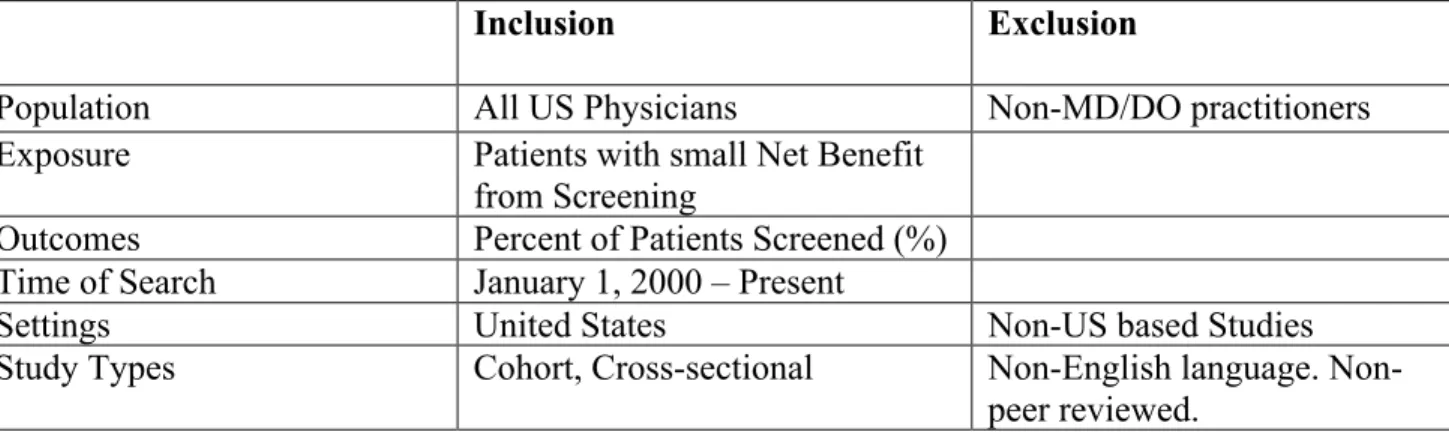
We used a modified PICOTSS algorithm (Populations, Exposures, Outcomes, Timing,
Settings, and Study Designs) to frame the questions to be answered in this review (see Table 1
below). Given that the nature of this review is descriptive as well as that the studies to be
included vary widely in outcomes and interventions, the analytic portion of the PICOTTS
framework was altered.
B. Eligibility criteria
The population of interest was all licensed physicians practicing in the US. The exposure
of interest is patients that exhibit small potential for net benefit from screening. The primary
outcome used was percentage of patients in each study of interest that underwent screening. The
dates of the study trials were ultimately refined to include 2000 to present in order to capture
relevant data with high sensitivity. The study types included were cross-sectional and cohort
Table 1: PICOTTS
Inclusion Exclusion
Population All US Physicians Non-MD/DO practitioners
Exposure Patients with small Net Benefit
from Screening
Outcomes Percent of Patients Screened (%)
Time of Search January 1, 2000 – Present
Settings United States Non-US based Studies
Study Types Cohort, Cross-sectional English language.
Non-peer reviewed.
C. Search strategy.
The search strategies were developed by an expert information technologist in
collaboration with the research team. Only English-language articles were included and no date
limitations were applied to the search initially. On May 4, 2015 we performed a systematic
search of the PUBMED database using the search string outlined below:
PUBMED: May 4, 2015. Found 620 results:
- mass screening[mesh] OR early detection of cancer[mesh]) AND (life expectancy[mesh] OR unnecessary procedures[mesh]
D. Study Selection
After identifying articles by the search strategy, I reviewed the studies by title to ascertain
relevant papers. The search was narrowed based on title relevance, after which all abstracts were
reviewed. The studies were investigated for inclusion/exclusion by three reviewers (myself
included). To be included in the final review, studies must have meet criteria 1 and 2:
1) Collected descriptive data from physicians
E. Data Abstraction
I collected information from the selected articles regarding physician-screening rates for
prostate, breast, ovarian, and colon cancer into a tabular outcomes data form to abstract relevant
information from each article selected. This included the following information: study population
characteristics and recruitment methods, study setting and design, interventions, comparator
groups, instruments used to measure outcomes, and overall results. Given the nature of the
research questions of the review and various different neoplasms investigated in the review
articles, several different measurement tools were utilized across the studies. Most studies
reported an outcome related to overall screening rates of physicians in the study.24
The studies included were reviewed by myself and rated qualitatively on their internal
and external validity. The basis of the ratings was the USPSTF procedure manual criteria for
assessing individual studies as well as the ADA Research Committee on Cross-sectional Study
Designs to the present studies in this review. A study was determined to have ‘good’ internal
validity if conclusions could be logically drawn from the results, the researchers used adequate
sampling methods, and if there was a reasonable attempt to eliminate confounding variables. A
rating of ‘fair’ was given if one of the above was lacking or inadequate. ‘Poor’ was assigned to
studies in which conclusions did not logically follow from the research data, sampling was in
error in some aspect, and important confounders were not taken into account.25 A study was
determined to have ‘good’ external validity if the study population and results could be
comparable to the US population of physicians or at least a large subset of physicians at large.
‘Fair’ external validity was given for a study in which the study physician population could be
assigned a rating of ‘poor’ external validity if the study population was too specific to apply
results broadly to a larger physician population.26
Results:
A. Study Characteristics
The search strategy discovered a total of 622 unique articles that were screened by title
and abstract. Hand searching identified 4 additional articles. I performed a full text review of 15
articles. Four studies were included that met the inclusion criteria. All four studies to inform the
first key question of the review, and one of these studies informs the second key question. Figure
Figure 1: PRISMA Flow Diagram for Literature Search
ê
ê
ê
Each of the 4 studies used in the review looks at physician screening in regard to a
different cancer (colorectal, prostate, breast, and ovarian). The studies included were grouped
into 2 categories. The first category met criteria 1 and 2 (see study selection section). The second
category of study met all three criteria.
PubMed Search: 620 Articles
After Title Review: 39 Articles
After Abstract Review: 15 Articles