Applying Perspective Taking and Social Influence to Exercise Narratives Matthew Little
Acknowledgements
Abstract
The present study examines factors related to the entertainment-education strategy in addition to revisiting Ajzen's (1991) theory of planned behavior in a narrative context. Entertainment
education is a health communication strategy that involves educating and persuading individuals regarding health issues by incorporating health information with a story. In addition, when readers identify with a character in a narrative, they are more likely to adopt the character's attitude, beliefs, and goals. The present study employs Batson et al.'s (1997) method on
Applying Perspective Taking and Social Influence to Exercise Narratives
Although the benefits of exercise are well documented in the physical (Blair & Morris, 2009) and psychological (Hassmén, Koivula, & Uutela, 2000) domains of health, health officials continue to face the fact that over 60% of American adults report not engaging in regular
physical activity and 25% report not being active at all (U.S. Department of Health and Human Services, 1996). Thus, it is fair to conclude that although regular exercise has major benefits, most of the American population find it difficult to adopt a physically active lifestyle that could potentially improve their psychological well-being and overall health. Social psychologists have approached this problem by applying theories of attitude and belief change along with those of goal setting to increase the likelihood of individuals beginning and maintaining a physically active lifestyle.
The purpose of this study is to examine how narratives can be manipulated based on theories of persuasion and behavior change to influence participants’ attitudes, beliefs, and ultimately their intentions, regarding exercise. One aspect that will be studied in this experiment is how taking on the perspective of a character and identifying with him may affect one’s attitudes and beliefs. Another aspect involves examining how participants’ attitudes and beliefs are influenced by reading about a character who receives different forms of social influence while making the decision to exercise (social support vs. social pressure).
Theory of Planned Behavior
theory states that one of the major predictors of an individual’s behavior is his or her intention to perform the behavior. In turn, the theory defines three major determinants of one’s intentions: An individual’s attitudes toward the behavior, subjective norm, and perceived behavioral control. Attitudes towards the behavior refer to how one evaluates the specific behavior as either
favorable or unfavorable. Subjective norm refer to the individual’s perception of social pressure to (more specifically, the perception that significant others think one should) perform the behavior. Perceived behavioral control is defined as an individual’s perception of how easy or difficult it will be for him or her to perform the behavior.
Subjective norm and social support. Godin and Kok (1996) evaluated eighteen studies which tested the effectiveness of the theory of planned behavior in the exercise domain. In these studies, it was found that attitudes, subjective norm, and perceived behavioral control accounted for 42% of the variance observed in intentions to exercise. Further examination showed that in nearly all the studies, attitudes and perceived behavioral control were significant determinants of intentions. However, subjective norms was a significant determinant of intentions in only about one-third of the studies. This finding suggests that more potent social influences other than subjective norm may affect one’s intentions. Support for this proposition was provided by a correlational study by Courneya, Plotnikoff, Hotz, and Birkett (2000), which found that social support was a stronger predictor of intentions to exercise than subjective norm, after controlling for other theory of planned behavior variables.
Social support is generally defined as aid, assistance, help, or support that one receives from others. Weiss (1974) offered a more detailed definition which included major
discriminant validity between social support and subjective norms, indicating that they have relative independence in the exercise domain and each taps a separate aspect of social influence.
With this distinction in mind, the results from the study by Courneya et al. (2000) suggest that individuals forming an intention to exercise may be more heavily influenced by perceived social support rather than perceived social norms. The present study aims to take an experimental approach to determine if perceived social influence can be manipulated such that perceived social support for a role model within a narrative results in improved attitudes, beliefs, and intentions regarding exercise than perceived social pressure.
Self-efficacy. Ajzen’s study of perceived behavioral control was greatly influenced by a Bandura’s (1991) study on self-efficacy, in which he defined self-efficacy as “people’s beliefs about their capabilities to exercise control over their own level of functioning and over events that affect their lives” (p. 257). Although self-efficacy was not listed as a determinant of
intentions previously in the discussion of the theory of planned behavior, this construct still plays a large role in predicting intentions via the determinant of perceived behavioral control. Ajzen (2002) demonstrated that perceived behavioral control is comprised of separable subcomponents which include self-efficacy and controllability. Ajzen (2002) defined controllability as an
individual’s “beliefs about the extent to which performing the behavior is up to the actor” (p. 672).
In the health domain, Pertl et al. (2010) demonstrated in a correlational study that self-efficacy was a significant predictor of subjects’ intentions to apply sunscreen while
Entertainment-Education
Entertainment-education (EE) is a rising health communication strategy that has been implemented in recent years. EE programs seek to educate people about health issues by
incorporating important health information (such as symptoms and treatments for a disease) with entertaining stories. In addition to educating individuals about health issues, EE seeks to promote healthy and prosocial behaviors as well (Moyer-Gusé, 2008). EE often employs narratives, television, and radio programs as mediums to convey health information and influence
individuals’ attitudes and beliefs. Mechanisms such as transportation (when an individual is so absorbed into a story that her or her attitudes and beliefs are influenced) and identification (when an observer takes on the identity, goals, and perspective of a character) allow EE to arouse less resistance to persuasive messages conveyed through a narrative than traditional persuasive messages (Moyer-Gusé, 2008). In particular, narratives often provide characters whom readers can identify with and view as role models for desired behaviors.
In the context of physical activity, most people are aware of the physical and
Social Cognitive Theory
Bandura (1989; 1994) has stated that self-efficacy can be increased through vicarious experiences provided by social models. Social cognitive theory posits that when an observer sees similar others performing a challenging behavior, the observer’s own self-efficacy will increase with regards to the behavior. According to social cognitive theory, not only can one’s self-efficacy be increased via social modeling, but individuals can learn (knowledge, values, cognitive skills, and behaviors) vicariously as well by observing models (Bandura, 2004). Learning through vicarious reinforcement was demonstrated by Bandura, Ross, and Ross (1963) in which children imitated a model’s aggressive behavior after the model was rewarded for it. Bandura (2001) indicates that when learning behaviors through observing a model, both vicarious reinforcement and identification with the model play a role.
Slater and Rouner (2002, p. 178) described identification as a process “in which an individual perceives another person as similar or at least as a person with whom they might have a social relationship.” Bandura and Huston (1961) demonstrated that if an observer considers him/herself to be similar to a model, the observer is more likely to perform a behavior learned from the model. It is important to note that potential models for observers are not strictly limited to those individuals with whom observers can directly interact. The media provides a wide range of models from which observers can learn behaviors.
Cohen (2001) applied the process of identification to the media context, in which models can be fictitious characters from narratives, television programs, etc. Cohen defined
an individual identifies with a character in a persuasive message, the source itself becomes more attractive and the individual becomes more susceptible to persuasion.
Identification with characters shares similar underlying mechanisms with those related to perspective taking. Batson, Early, and Salvarani (1997) described perspective taking as the process in which an individual imagines how another person perceives a situation and how that other person feels about it. When an individual imagines how another person is perceiving a situation and how he or she feels about it, the individual is in this sense, taking on the identity, goals, and perspective of a character as previously described by Cohen (2001). In the study by Batson et al. (1997), the researchers demonstrated that when subjects were instructed to take on the perspective of a character in need, the subjects reported higher empathy for the character than subjects instructed to remain objective.
Bandura (2002) discusses how cognitive empathy and identification can influence vicarious experiences. He states that vicarious activation is dependent on an individual’s capability to empathize with a model. For instance, when a model displays joy or distress, an observer will respond with similar emotions and attitudes only if he or she can empathize with the model. With this in mind, empathy may serve as a mediator of observational learning. In addition, Wilkin et al. (2007) found that individuals who identified with characters in an EE television program also reported significantly higher behavioral intentions. This framework suggests that if an observer can empathize (by identifying) with a character more, observational learning will be more effective in the context of persuasion.
Narrative Persuasion and Transportation
and Brock (2000) documented perhaps one of most important mechanisms which allow persuasion through narratives: transportation. Green and Brock described the experience of transportation as “the extent (to which) individuals are so absorbed in a story or transported into a narrative world, (that) they may show effects of the story on their real-world beliefs” (p. 701). When readers feel that they have been immersed into a story, they may report feeling as if they can relate to the characters emotionally (emotional component), visualize the setting in detail (imagery component), and even lose track of events going on around them (cognitive
component). These experiences relate to transportation, such that when readers become so
absorbed in a story that they feel that they have become part of the story and that events affecting the characters emotionally are affecting them as well.
Green and Brock (2000) demonstrated some consequences to being transported into a narrative. A major consequence of transportation in a persuasive narrative is that whether the narrative is fictional or nonfictional, participants will report similar changes in attitudes and beliefs. Thus, the truth status of the persuasive message does not influence how persuaded people will be, if they are transported. A second major consequence of being transported is that readers will report attitudes and beliefs that are more consistent with those implied in the narrative. Lastly, Mazzocco, Green, Sasota, and Jones (2010) found that the effects of transportation do not extend to persuasive messages conveyed in a rhetorical manner, as they did to messages in narratives.
A persuasive narrative was chosen for the present study in order to influence attitudes and beliefs regarding exercise based on findings by Mazzocco et al. (2010), such that the effects of transportation only occurred while reading narratives and did not extend to messages conveyed
and underlying mechanisms involved with EE, such as transportation and identification with
characters, while also manipulating the type of social influence.
Research Plan
The present study will attempt to integrate these theoretical perspectives by examining how narratives in the exercise context can influence factors relating to the theory of planned behavior by Ajzen (1991) such as self-efficacy (a main subcomponent of perceived behavioral control), attitudes, and subjective norms, with the addition of social support. The aim of this study is to examine how influencing these factors will ultimately affect an individual’s intentions to exercise. This study will utilize a 2 by 2 factorial design.
In this study, one variable we will be manipulating is perspective taking, such that
subjects will either be asked to remain objective or take on the perspective of the character while reading the narrative. According to Bandura (2002), because empathy acts as a mediator for observational learning, subjects who will empathize and identify with the model more will be influenced by the vicarious learning experience more than those who do not empathize. Based on Bandura’s (1989) discussion on increasing self-efficacy, it is predicted that those with a stronger vicarious experience will report increased self-efficacy, and in turn, a higher intention to
exercise. Thus, we predict that there will be a main effect of perspective taking on participants’ attitudes and beliefs regarding exercise.
pressure to exercise. Thus, we predict that there will be a main effect of social influence on participants’ attitudes and beliefs regarding exercise.
Method Participants
Participants for the study were 140 undergraduate students (38 males, 102 females) from the University of North Carolina at Chapel Hill who were recruited from the UNC Human Participant Research Website’s participant pool. Participants in our study received an hour of participation credit as compensation toward the research requirement in their Introductory Psychology course. The race of participants was predominantly Caucasian (n = 83), followed by Asian (n = 26), and African American (n = 15).
Because the overall purpose of this study was to examine factors that may influence people’s intentions to exercise, the population of interest was limited to those who do not meet the Centers for Disease Control and Prevention’s recommended amount of exercise in order to derive health benefits. According to the Centers for Disease Control and Prevention, adults need at least 150 minutes of moderate-intensity aerobic activity (i.e., walking fast) or 75 minutes of vigorous-intensity aerobic activity (i.e., running) every week (2011). Thus, an eligibility criterion was put in place such that participants were recruited on the basis that they do not exercise regularly (on average of 3 times a week or more).
Measures and Procedure
signed a consent form if they agreed to participate. Once forms were collected, participants were asked to begin the study on their computers.
Stimuli were presented and responses were collected through an online Qualtrics survey. In the first section of the survey, participants received the manipulations of stimuli via
instructions regarding the narrative and the narrative itself. The second section of the survey contained the dependent variables.
Perspective taking manipulation. Participants began the Qualtrics survey and were randomly assigned instructions to either remain objective and detached or to take on the
perspective of the main character and imagine how he feels. The instructions used were adapted from a study by Batson et al. (1997) for the exercise context. This manipulation was intended to influence the participants’ identification with the main character, based on the hypothesis that when a reader identifies more strongly with a character in a persuasive narrative, he or she will be more susceptible to persuasion. For this manipulation, excerpts for the perspective taking versus objective instructions are as follows, respectively: “Try to imagine how the main
character feels about the events and interactions happening to him and how they have affected his life,” versus “Try to be as objective as possible about the events and interactions happening to the main character and how they have affected his life.” The full instructions for both
conditions can be found in the Appendix.
Narrative manipulation. Participants were randomly assigned to read one of two narratives. Both narratives were roughly 1,600 words and followed nearly identical plots which followed the account of a university student named Cameron and his experience exercising with his roommate Max. The second manipulation was the type of social influence Cameron
manipulated by framing each narrative around Cameron’s thoughts with regard to exercising, in addition to the actions and expectations of other characters in the narrative. For example, the social support narrative included the sentence “Although the run had been quite a challenge, he was thankful to have a friend with him who endured the same struggle that he did,” while the social pressure narrative read “Although the run had been quite a challenge, Cameron was sure that he would be able to earn the respect of those important to him.” The entire social support and subjective norm narratives can be found in the Appendix.
Dependent Variables
Once participants finished reading the narrative, they were presented with ten sections with items and instructions on how to answer each set. Sections were arranged in such a way that the main dependent variables (theory of planned behavior, social provisions) of the study were presented first (after thought listings), while measures involving personality traits were presented afterwards so that they would not influence the main dependent variables.
Thought listing. The first section asked participants to take a couple of minutes to list all the thoughts they had while reading the narrative, whether they were positive, negative, or neutral.
Theory of planned behavior. The second section was a set of 21 items measuring
individual components of the theory of planned behavior. The scale was developed in accordance with Ajzen’s (1991) recommendations. This section included 4 individual subscales, each of which measured the components of the theory of planned behavior except for behavior.
differentials (bad-good, healthy-unhealthy, pleasant-unpleasant, worthless-valuable, negative-positive, favorable-unfavorable, necessary-unnecessary, boring-interesting) which utilized a 7-point scale.
Perceived behavioral control. The second subset of items measured participants’
perceived behavioral control, which involved the two subcomponents of self-efficacy (perceived ease or difficulty in performing a behavior) and controllability (one’s perceived control over performing a behavior). This subset contained 6 items, 3 for each subcomponent. Each item was either a statement or a question. Participants responded by answering these items on a 7-point Likert scale. Controllability was measured by questions such as “How much control do you have over exercising regularly?” (1 = None, 7 = Very Much), while self-efficacy was measured by statements such as “For me to begin exercising regularly, it would be” (1 = Very Difficult, 7 = Very Easy).
Subjective norm. The third subset of items measured participants’ subjective norms, or their perceived pressure to comply with the behavior (exercise). This subset contained 4 items, in which participants responded to statements such as “Most people whose opinions I value would approve of me exercising more often” on a 7-point Likert scale (1 = Strongly Disagree, 7 = Strongly Agree).
Social provisions. The third section included 16 items (from the social integration, reassurance of worth, reliable alliance, and guidance subscales) to measure participants’
perceived social support regarding exercise. This scale was adapted from Cutrona and Russell’s (1987) Social Provisions Scale to fit the exercise context. Participants were asked to indicate how much they agreed with statements such as “When I think about exercise and fitness, there are people I can depend on to help me if I really need it” on a 4-point Likert scale (1 = Strongly Disagree, 4 = Strongly Agree).
Transportation. The fourth section included 13 items on narrative transportation regarding the narrative they had just read. This scale was originally developed by Green and Brock (2000). Participants were asked to indicate how much they agreed with statements such as “While I was reading the narrative, I could easily picture the events in it taking place” on 7-point Likert scales (1 = Not At All, 7 = Very Much).
Manipulation check. The fifth section included 8 questions which served as a
manipulation check. These questions asked participants whether they were instructed to remain objective or imagine how the character felt, the extent to which they remained objective, the extent to which they tried to imagine the character’s point of view, and how much did they think the main character felt pressured/supported. Other recall questions were included to ensure participants were closely following the narrative (e.g. “What was the name of the main character’s roommate?”).
much they agreed with them, such as “I tend to understand the reasons why Cameron does what he does” (1 = Not At All, 7 = Very Much).
Character and behavior evaluations. The seventh section included a scale on how participants evaluated Cameron along with a scale on how they evaluated physical activity. The character evaluation scale employed 4 semantic differentials (wise-foolish, good-bad, pleasant-unpleasant, attractive-unattractive) while the behavior evaluation scale used 7 semantic
differentials (wise-foolish, right-wrong, safe-unsafe, positive-negative, necessary-unnecessary, moral-immoral, risky-unrisky). Each of these were rated on a 7-point scale.
Transportability. The eighth section included a scale measuring participants’ transportability. This measure is different from the previous measure of transportation, as transportability is a measure of individual differences in the tendency to be transported. This scale included 19 items, developed by Green (1996). Participants responded to statements such as “While I am reading stories, I can easily picture the events in them taking place” on a 7-point Likert scale (1 = Not At All, 7 = Very Much).
Past behavior. The ninth section asked participants to indicate their past behavior within the past year regarding exercise. The items were multiple choice questions which asked in time intervals of how often they exercised at moderate intensity or higher on average in a week. The intervals started from the past month, since the semester began, in the past six months, and in the past year. Answer choices ranged from 0 times to 5 or more times a week. This measure was useful in order to control for past behavior which may have influenced participants’ responses.
about the study before participating in it, and if so, what had they heard. Participants were also allowed to leave comments regarding the study in an open-ended question.
Once participants completed the demographics section, they were given a debriefing form by the experimenter which informed them in full detail of the study’s true objective and goals. Once the participants had received their debriefing forms, they were given the opportunity to ask any questions before leaving the session.
Results
Before analyzing data, we first omitted data from participants who failed our
manipulation check regarding their instructions for perspective taking. Participants failed the manipulation check by either incorrectly recalling, or being unable to recall, the instructions they were given prior to reading the narrative. Furthermore, although we asked that only participants who do not exercise regularly sign up for our study, we found that some participants who exercised quite often still participated in our study. Thus, we also omitted the data from
participants who reported exercising at least 4 or more times on average per week. In addition, all participants were able to recall the names of the characters in the narrative and the activity they engaged in, thus no data was omitted on this basis.
Of the original 140 participants, 113 were included in the final analyses. Of these 113 participants, there were 32 in the perspective taking-social support condition, 25 in the
perspective taking-subjective norm condition, 27 in the objective-social support condition, and 29 in the objective-subjective norm condition.
Our main analyses were performed to examine any predicted main effects and
significant main effects of perspective taking and type of social influence, along with any significant interaction effects for each measure of interest. For all of our analyses, an alpha level of p < .05 was used to determine significance and p < .10 for marginal significance.
The first portion of our preliminary analyses examined how perspective taking influenced participants’ reports of transportation and identification. These scores were computed by taking the mean score across the items. Both transportation (Cronbach’s α = .73) and identification (Cronbach’s α = .87) demonstrated acceptable reliability. We then conducted between-subjects ANOVAs to determine if there was a main effect of perspective taking on these variables.
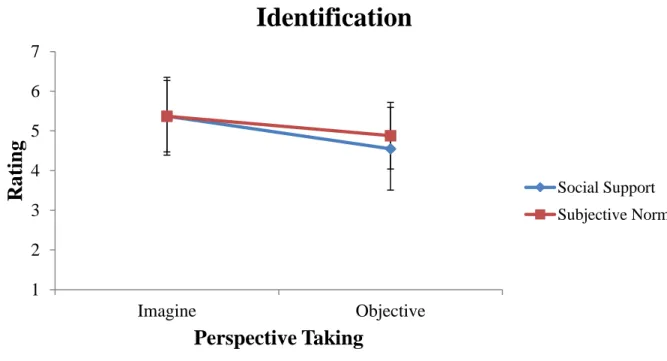
Results showed a significant main effect of perspective taking on transportation, F(1, 108) = 14.54, p < .001. As predicted, those who took on Cameron’s perspective reported higher transportation (M = 4.88, SD = .71) than those who remained objective and detached (M = 4.39, SD = .64). There was no significant main effect of type of social influence nor was there a significant interaction effect on transportation. A significant main effect of perspective taking on identification was also found, F(1, 109) = 13.43, p < .001. Those who took on the perspective of Cameron reported higher identification (M = 5.37, SD = .90) than those who remained objective and detached (M = 4.72, SD = .95). There was no significant main effect of type of social influence nor was there a significant interaction effect on identification. These results suggested that our manipulation of perspective taking was successful. These findings are displayed in Figure 1 and Figure 2, respectively.
The second portion of our preliminary analyses examined how the type of social
influence affected participants’ responses regarding how much they felt Cameron was pressured to exercise and how much they felt Cameron was supported in his decision to exercise. A
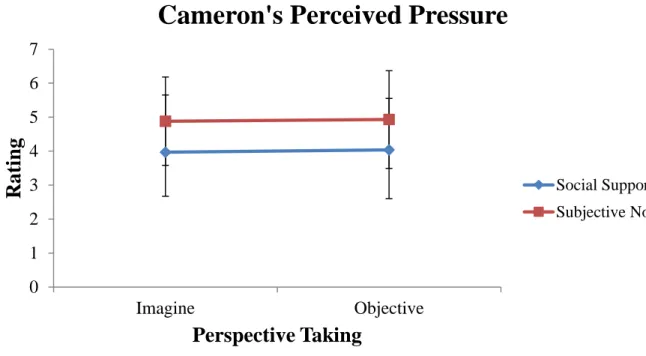
= 10.18, p < .01. As expected, participants who read the subjective norm narrative reported Cameron as receiving more pressure (M = 4.91, SD = 1.36) than those who read the social support narrative (M = 4.00, SD = 1.59). There was no significant main effect of type of perspective taking nor was there a significant interaction effect on perceived pressure. In addition, contrary to our expectations, there were no significant main effects nor was there a significant interaction effect on perceived support. Both of these findings are displayed in Figure 3 and Figure 4, respectively.
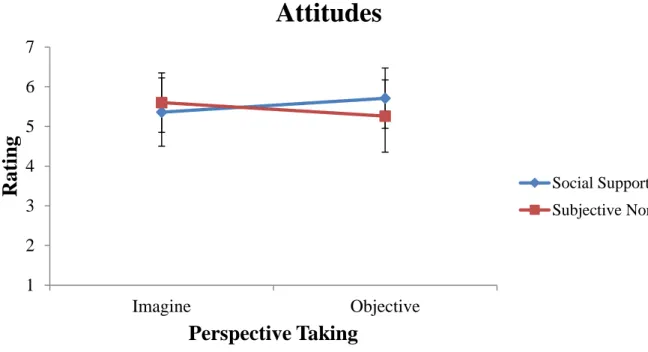
narrative (M = 5.71, SD = .76) had more favorable attitudes toward exercising than those who read the subjective norm narrative (M = 5.26, SD = .91). This finding is displayed in Figure 5.
For perceived behavioral control, when transportability was used as a covariate, there was a marginally significant interaction effect between perspective taking and type of social
influence, F(1, 108) = 3.03, p = .085. For participants who read the subjective norm narrative, perspective taking had no significant effect, F(1, 108) = .67, p = .42. For participants who read the social support narrative, the simple main effect of perspective taking approached marginal significance, F(1, 108) = 2.72, p = .10. Specifically, among participants who read the social support narrative, those who remained objective and detached reported higher perceived behavioral control (M = 5.52, SD = .44) than those who took on Cameron’s perspective (M = 5.27, SD = .73). This finding is displayed in Figure 6.
We then examined how perspective taking and type of social influence affected
participants’ responses to the social provisions measures. Scores for each scale were computed by summing each item score together. In the case of social support, scores were computed by summing all of the subscales together. Scales for social integration (α = .82), reassurance of worth (α = .75), reliable alliance (α = .77), guidance (α = .80), and overall social support (α = .92) demonstrated acceptable reliability. We then conducted between-subjects ANOVAs to determine if there were any significant main effects of perspective taking and type of social influence on these variables, in addition to any significant interaction effects.
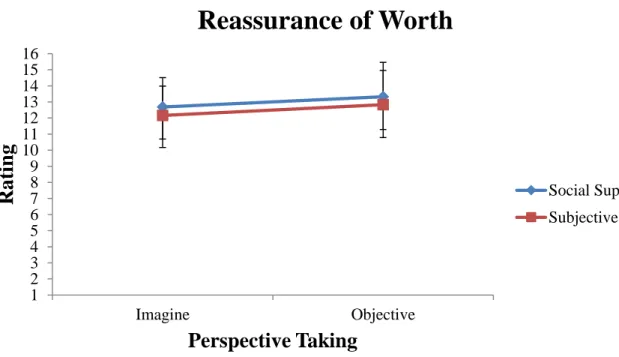
our predictions, participants who remained objective and detached (M = 13.07, SD = 2.08) reported higher scores of reassurance of worth than those who took on perspective of Cameron (M = 12.46, SD = 1.90). This finding is displayed in Figure 7.
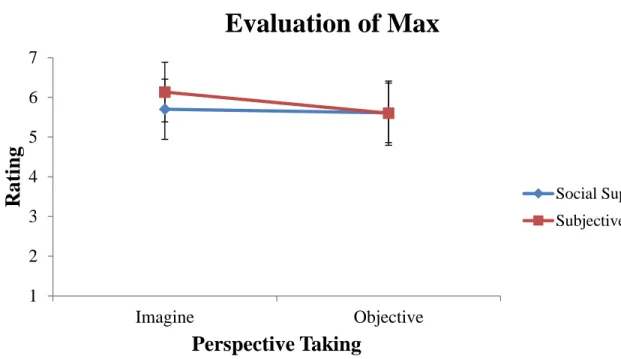
Lastly, we examined how perspective taking and type of social influence affected participants’ evaluations of the characters (Cameron and Max) and exercise. These scores were computed by taking the mean score across the items. Cameron’s evaluation (α = .71), Max’s evaluation (α = .75), and exercise evaluation (α = .75) each demonstrated acceptable reliability. We then conducted between-subjects ANOVAs with to determine if there were any significant main effects of perspective taking and type of social influence on these variables, in addition to any significant interaction effects.
For Cameron’s evaluation, results showed a significant main effect of perspective taking, F(1, 109) = 8.13, p < .01. Participants who took on Cameron’s perspective (M = 5.32, SD = .81) reported more favorable evaluations of him than those who remained objective and detached (M = 4.88, SD = .74). In addition, results showed a significant main effect of type of social influence on Cameron’s evaluation, F(1, 109) = 6.60, p < .05. Participants who read the social support narrative (M = 5.29, SD = .77) reported more favorable evaluations of Cameron than those who read the subjective norm narrative (M = 4.89, SD = .79). These findings are displayed in Figure 8. No significant interaction effect was found for Cameron’s evaluation.
on Max’s evaluation. Lastly, for participants’ evaluation of exercise, there were no significant main effects of perspective taking or type of social influence, nor was there a significant interaction effect.
Discussion
The purpose of this study was to examine how manipulating type of social influence and perspective taking can influence the effects of which persuasive narratives have on people’s attitudes and beliefs towards exercise. In addition, we were interested in examining any interactions between these two manipulations that led to differences in attitudes and beliefs. Because the theory of planned behavior posits that attitudes, subjective norm, and perceived behavioral control lead to the formation of an intention, the present study aimed to investigate if these attitudes and beliefs could be influenced in such a way that would also lead to an increase in intention to exercise.
Manipulation Checks
We first examined whether or not the participants in our study who took on the
perspective of Cameron reported being more transported and identified with Cameron, as these mechanisms lead to increased susceptibility to persuasion. As expected, this was indeed the case. However, those who took on the perspective of Cameron only reported slightly higher scores of transportation and identification than those who remained objective. Thus, although our
manipulation of perspective taking was successful, it was unclear whether or not the increases in transportation and identification were large enough to lead to significant differences in attitudes and beliefs.
those who read the subjective norm narrative detected much more pressure in the narrative than those who read the social support narrative. However, when examining whether or not the manipulation led to a significant difference in perception of support in the narrative, it was surprising to find that there was no significant difference. Because there was a significant difference in perceived pressure but no significant difference in perceived support, it may be useful to relabel the “type of social influence” manipulation in this study as social support versus social support + social pressure.
Participants in both narrative conditions reported that Cameron received a high amount of support, suggesting that pressure was perceived as a form of social support as well. The lack of a significant difference in ratings of social support was not expected, as Courneya and McAuley (1995) had demonstrated discriminant validity between subjective norm and social support. When taken together, these two findings suggest that while participants who read the subjective norm narrative felt Cameron had received more pressure to exercise than those who read the social support narrative, participants felt that he was equally supported in both variations. Thus, this manipulation was only partially successful.
Theory of Planned Behavior, Social Provisions, and Character/Behavior Evaluations Because participants who took on the perspective of Cameron reported higher transportation and identification, we expected them to be more likely to adopt Cameron’s attitudes and beliefs regarding exercise than those who remained objective. However, there was no significant main effect of perspective taking on any measures other than reassurance of worth (marginal), Cameron’s evaluation, and Max’s evaluation. The absence of a main effect was surprising, as social cognitive theory posits that identifying with a role model will lead an observer to adopt the model’s attitudes, beliefs, and goals (Bandura, 2004). In addition, Green and Brock (2000) stated that when a reader is transported into a narrative world, the reader is more likely to report attitudes and beliefs that are consistent with those implied in the narrative.
The lack of a main effect of perspective taking on almost all measures suggests that the significant differences in transportation and identification were not large enough to lead to significant changes in attitudes and beliefs regarding exercise. The lack of a main effect of perspective taking may be explained by the possibility that by reading a transporting narrative about a university student (who served as a role model participants could identify with) who decided to exercise, participants who received either set of instructions may have been equally persuaded, or may not have been persuaded at all. However, because we did not have a control group (with participants who did not read any narrative), we are unable to conclude with
certainty whether or not participants were persuaded by the narrative. We are inclined to believe that participants were indeed persuaded by the narrative, based on thoughts participants listed after reading the narrative (see Appendix for sample thoughts).
about having people in their lives who recognized their abilities and competence regarding physical activity than those who took on Cameron’s perspective. Because Cameron exercised with a friend who respected his ability to complete a run, we expected that participants who took on Cameron’s perspective would be more likely to feel there are people who respect their
exercise abilities than those who remained objective. However, this was not the case. This finding may be explained by one of three explanations: 1. Imagining Cameron’s perspective led participants to feel that people in their lives do not recognize their exercise abilities as much as those who remained objective. 2. Remaining objective and detached led participants to feel that people in their lives recognize their exercise abilities much more than those who took on Cameron’s perspective. 3. A combination of the previous two explanations. Unfortunately, without a control group with participants who did not receive instructions on whether to stay objective or imagine Cameron’s perspective, we are unable to determine which explanation is correct.
The lack of a significant main effect of type of social influence on all measures was less surprising, due to the partial failure to successfully manipulate type of social influence. Because participants felt that Cameron received equal amounts of support in both the subjective norm and social support narratives, they did not entirely perceive the contrast between social support and social pressure we aimed to implement through the narrative manipulation.
than those who read the subjective norm narrative. This finding suggests that when remaining objective and detached, participants will have less favorable attitudes of exercising when a role model exercises to comply with social pressure than when a model is supported in his or her decision to exercise, without social pressure.
Whether participants read the social support or subjective norm narrative, those who imagined Cameron’s perspective reported no difference in how they rated attitudes regarding exercise. This finding suggests that when taking on the perspective of a role model, one will not adopt better or worse attitudes regarding exercise, independent of whether they received social support or social pressure. This result may be explained by Batson et al.’s (1997) findings in that perspective taking will lead to empathizing with a character. Thus, it is possible that participants who took on Cameron’s perspective empathized with him and his decision to exercise such that their attitudes regarding exercise were not influenced by whether he received social support or social pressure.
Cameron’s perspective may have increased their belief in how difficult it would be to begin exercising compared to those who remained objective.
A possible explanation for why there was no significant difference among participants who read the subjective norm narrative is that the presence of social pressure in the narrative reminded participants of (social and health) consequences of beginning to exercise. If this is the case, being reminded of the consequences of exercising (e.g. earning approval from others, increased attraction, etc.) may have distracted participants from thoughts of how difficult
beginning to exercise would be. However, because these findings were marginally significant, it is difficult to confidently state an explanation for these results.
As predicted, significant main effects of perspective taking and type of social influence were found when participants evaluated Cameron. When participants took on Cameron’s perspective, he was evaluated more favorably than when participants remained objective. This finding is in line with those by Batson et al. (1997), in that participants who took on Cameron’s perspective empathized with him more, leading to a more favorable evaluation, compared to those who remained objective and detached. When participants evaluated Max, a significant main effect of perspective taking indicated that when participants imagined Cameron’s
perspective, Max was evaluated more favorably than when participants remained objective. This result is also in line with Batson et al.’s findings, such that when participants empathize with Cameron, they are more likely to evaluate a friend who exercises with him more favorably than if they remained objective.
When participants read the social support narrative, they evaluated Cameron more favorably than those who read the subjective norm condition. This finding suggests that
with social pressure. However, because he was viewed more favorably when he only received social support, this finding suggests that participants felt this way because Cameron was initiating a healthy behavior on his own accord, independent of social pressure.
Limitations and Future Directions
One of the largest weaknesses of this study was the failure to successfully manipulate type of social influence such that participants perceived a narrative as either social support or subjective norm, without any themes of the other. As discussed, this failure of manipulation is perhaps one of the major reasons we did not observe significant differences in attitudes, beliefs and intentions. This issue made it so that the narratives were perceived as social support and social support + social pressure, rather than social support and social pressure, respectively. Thus, future studies should emphasize presenting social support and subjective norm in a mutually exclusive manner. For instance, to remove the presence of social support from the subjective norm narrative in this study, we could modify the narrative such that Max pressures Cameron into running, but Max does not run with him.
Another major weakness of this study was the sample size. Although our target number of participants for this study was 200, only 140 participated in our experiment. In addition, due to participants either failing the manipulation check or not meeting our criterion regarding how often they exercise, our sample size was reduced to 113. Furthermore, females disproportionately overrepresented the population of study in our sample. Future studies should emphasize a larger and more diverse sample size such that each condition has more participants, in addition to having enough participants for more conditions, such as a control condition.
Perhaps the largest weakness of this study which prevented us from drawing more
which participants did not read a narrative, we were unable to determine the extent to which participants’ attitudes, beliefs, and intentions were influenced by just reading a narrative, irrespective of what condition they were in. Thus, future studies should include at least one control group so that further analyses to determine the efficacy of the narratives.
Other future directions include incorporating physical activities that are perceived as more enjoyable than running, such as yoga, Frisbee, martial arts, and weightlifting. Other aspects of social influence should be explored. While this study primarily focused on a student running with his roommate, future studies could incorporate group physical activities (group running, team-based sports, etc.) as well as individual exercise activities to examine how other aspects of social dynamics can influence attitudes and beliefs. In addition, other mediums of entertainment-education such as radio and television programs should be incorporated into future studies to determine if a medium such as television is best for portraying certain activities such as martial arts while a narrative may be ideal for running.
Lastly, a minor limitation of this study was that we were unable to measure participants’ behavior to determine if they actually did decide to exercise more often. Although the purpose of this study was to examine effects of perspective taking and type of social influence on attitudes, beliefs, and intentions, changes in these constructs do not benefit an individual unless they actually perform the behavior intended. Thus, future studies should attempt to measure whether or not participants perform the behavior of interest and whether or not the behavior is sustained over time.
Implications and Conclusions
significant differences in intentions to exercise, the thought listings (see Appendix) suggest that a good amount participants were persuaded to form the intention to exercise due to their ability to identify with Cameron, which is in line with the findings from Wilkin et al. (2007). The findings also suggest that by utilizing narrative transportation, physical activity can be portrayed in an appealing light to people who do not exercise regularly. For all intents and purposes, it would seem the narratives and perspective taking manipulations presented were an effective technique to form exercise intentions.
The interaction effects observed in this study lead to noteworthy implications as well. With regards to attitudes, people seem to have more positive attitudes of exercising if they (without empathizing) observe another person exercising who is not motivated by social consequences. However, once an observer empathizes with someone who is exercising, social influence regarding exercise becomes irrelevant when evaluating exercise as favorable or unfavorable. With regards to perceived behavioral control, one must exercise caution when portraying the challenges of physical activity. If an observer takes on the perspective of someone who is exercising and experiencing fatigue, the observer is more likely to feel that beginning to exercise would be more difficult for him or her, than if the observer remained objective.
However, if social pressure is present such that the observer is reminded of the consequences of performing the behavior, perceived ease or difficulty in performing the behavior will not be significantly different if one takes on the perspective of a model or remains objective.
References
Ajzen, I. (1991). The theory of planned behavior. Organizational Behavior and Human Decision Processes, 50(2), 179-211. doi:10.1016/0749-5978(91)90020-T
Ajzen, I. (2002). Perceived behavioral control, self-efficacy, locus of control, and the theory of planned behavior. Journal of Applied Social Psychology, 32(4), 665-683.
doi:10.1111/j.1559-1816.2002.tb00236.x
Ajzen, I., & Fishbein, M. (1980). Understanding attitudes and predicting social behavior. Englewood Cliffs, NJ: Prentice-Hall.
Bandura, A. (1989). Social cognitive theory. In R. Vasta (Ed.), Annals of child development. Vol. 6. Six theories of child development (pp. 1-60). Greenwich, CT: JAI Press.
Bandura, A. (1991). Social cognitive theory of self-regulation. Organizational Behavior and Human Decision Processes, 50(2), 248-287. doi:10.1016/0749-5978(91)90022-L Bandura, A. (1994). Self-efficacy. In V. S. Ramachaudran (Ed.), Encyclopedia of
human behavior (Vol. 4, pp. 71-81). New York: Academic Press. (Reprinted in H. Friedman [Ed.], Encyclopedia of mental health. San Diego: Academic Press, 1998). Bandura, A. (2001). Social cognitive theory of mass communication. Media Psychology, 3(3),
265-299. doi:10.1207/S1532785XMEP0303_03
Bandura, A. (2002). Reflexive empathy: On predicting more than has ever been observed. Behavioral and Brain Sciences, 25(1), 24–25.
Bandura, A., & Huston, A. C. (1961). Identification as a process of incidental learning. The Journal of Abnormal and Social Psychology, 63(2), 311-318. doi:10.1037/h0040351 Bandura, A., Ross, D., & Ross, S. A. (1963). Vicarious reinforcement and imitative learning.
The Journal of Abnormal and Social Psychology, 67(6), 601-607. doi:10.1037/h0045550 Batson, C., Early, S., & Salvarani, G. (1997). Perspective taking: Imagining how another feels
versus imagining how you would feel. Personality and Social Psychology Bulletin, 23(7), 751-758. doi:10.1177/0146167297237008
Blair, S. N., & Morris, J. N. (2009). Healthy hearts—and the universal benefits of being physically active: physical activity and health. Ann Epidemiol, 19(4), 253-256. doi:10.1016/j.annepidem.2009.01.019
Centers for Disease Control and Prevention. (2011). How much physical activity do adults need? Physical Activity. Retrieved from
http://www.cdc.gov/physicalactivity/everyone/guidelines/adults.html
Cohen, J. (2001). Defining identification: A theoretical look at the identification of audiences with media characters. Mass Communication & Society, 4(3), 245-264.
doi:10.1207/S15327825MCS0403_01
Courneya, K. S., & McAuley, E. (1995). Reliability and discriminant validity of subjective norm, social support, and cohesion in an exercise setting. Journal of Sport & Exercise
Psychology, 17(3), 325-337.
Courneya, K. S., Plotnikoff, R. C., Hotz, S. B., & Birkett, N. J. (2000). Social support and the theory of planned behavior in the exercise domain. American Journal of Health Behavior, 24(4), 300-308.
to theory and research. Reading, MA: Addison-Wesley.
Godin, G., & Kok, G. (1996). The theory of planned behavior: A review of its applications to health-related behaviors. American Journal of Health Promotion, 11(2), 87-98.
doi:10.4278/0890-1171-11.2.87
Green, M. C. (1996). Mechanisms of narrative-based belief change (Master’s thesis). Ohio State University: Columbus.
Green, M.C., & Brock, T.C. (2000). The role of transportation in the persuasiveness of public narratives. Journal of Personality and Social Psychology, 79(5), 701-721.
doi:10.1037/0022-3514.79.5.701
Hassmén, P., Koivula, N., & Uutela, A. (2000). Physical exercise and psychological well-being: A population study in Finland. Preventive Medicine, 30(1), 17-25.
doi:10.1006/pmed.1999.0597
Mazzocco, P. J., Green, M. C., Sasota, J. A., & Jones, N. W. (2010). This story is not for
everyone: Transportability and narrative persuasion. Social Psychological and
Personality Science, 1(4), 361-368. doi: 10.1177/1948550610376600
Motl, R. W., Dishman, R. K., Saunders, R. P., Dowda, M., Felton, G., Ward, D. S., & Pate, R. R. (2002). Examining social-cognitive determinants of intention and physical activity among Black and White adolescent girls using structural equation modeling. Health Psychology, 21(5), 459-467. doi:10.1037/0278-6133.21.5.459
Moyer-Gusé, E. (2008). Toward a theory of entertainment persuasion: Explaining the persuasive effects of entertainment-education messages. Communication Theory, 18(3), 407-425. doi:10.1111/j.1468-2885.2008.00328.x
(2010). Differential effects of self-efficacy and perceived control on intention to perform skin cancer-related health behaviours. Health Education Research, 25(5), 769-779. doi:10.1093/her/cyq031
Slater, M. D., & Rouner, D. (2002). Entertainment-education and elaboration likelihood: Understanding the processing of narrative persuasion. Communication Theory, 12(2), 173-191. doi:10.1093/ct/12.2.173
U.S. Department of Health and Human Services. (1996). Physical activity and health: A report of the Surgeon General. Atlanta, GA: U.S. Department of Health and Human Services, Centers for Disease Control and Prevention, National Center for Chronic Disease Prevention and Health Promotion.
Weiss, R.S. (1974). The provisions of social relationships. In Z. Rubin (Eds.), Doing unto others (pp. 17-26). Englewood Cliffs, NJ: Prentice Hall.
Appendix Perspective Taking Manipulations/Instructions
Perspective taking. While you are reading this narrative, try to imagine how the main character feels about the events and interactions happening to him and how they have affected his life. Try not to concern yourself with attending to all the information presented. Just concentrate on trying to imagine how the main character in the narrative feels.
Objective and detached. While you are reading this narrative, try to imagine how the main character feels about the events and interactions happening to him and how they have affected his life. Try not to concern yourself with attending to all the information presented. Just concentrate on trying to imagine how the main character in the narrative feels.
Type of Social Influence Manipulations/Narratives
bus for him. Luckily, Cameron was able to squeeze onto the bus and lean against the railings to catch his breath as the doors closed behind him.
--
As Cameron stepped off the bus and began walking toward the brick pathway to his high-rise dorm building, he couldn’t help but notice what a gorgeous day it was. Up until that
morning, the entire week had been rainy and chilly. Cameron walked slowly down the walkway, soaking in the warm sunlight while a light breeze brushed against his face. If there was ever such a thing as being in harmonic equilibrium with nature, this was it, Cameron thought. He flashed his flex pass at the door and walked in towards the elevator, leaving the sunny and glorious outdoors behind him. After such a long week, Cameron planned on ending it by relaxing in his room and playing Xbox. But as Cameron took the elevator up to the sixth floor, he almost felt guilty about staying inside on the first lovely afternoon in a while. While walking on the balcony towards his room, Cameron gazed at the horizon. Suddenly, he noticed a student jogging his way up the hill to the intersection near his building. The jogger’s T-shirt was so soaked that his sweat stain nearly reached his waistline. His face was red with fatigue while huffing and puffing, nearly out of breath. But he didn’t stop until he made it to the top of the hill, where he then took a break while waiting for traffic to pass. Once the traffic signal changed, the jogger slowly began moving again as he turned the corner behind the dorm building until Cameron could no longer see him.
clearance section at the outlet store. But despite the two always swearing to become more active, Xbox seemed to always take precedence. Cameron peeked under Max’s bed and recognized his roommate’s pair of red and white Nike Free Runs. It was at that moment that Max opened the door, having just returned from his chemistry lab. Max greeted Cameron with a typical Friday statement.
“Hey Cam, are you still down for some Call of Duty Zombies? After a week with two exams and a lab report, there’s nothing I’d love more than unwinding by laying waste to zombies.”
Cameron considered this for a moment—slaying zombies was tempting, but the warmth from the sunlight entering his room through the open suite door called out to him. Max noticed his unprecedented hesitation.
“What’s going on, Cam? You mentioned this morning that we would have all afternoon for zombies. Did something come up?”
Cameron pondered for a moment if he should tell Max what was on his mind. “Actually, I was thinking about putting to use the Nike Free Runs we bought in the winter, because it’s finally a glorious day.” He paused. “But you know what? Who needs sunshine when you have Call of Duty zombies to kill? When duty calls, we have to answer!” Cameron began setting up his Xbox 360.
Cameron looked up from the Xbox. “I guess we’re going for a run! We can always do zombies when we get back. But for now, let’s see what these new kicks can do! I’ve heard there are some trails that go along behind the dorms and into the woods, I say we go explore them.”
The idea of exploration and possible adventure sealed the deal for Max. “I’m in! Let me change into some running clothes and we’ll get moving, but I just hope you can keep up!”
--
“So which way are we heading?” Max inquired, as he and Cameron exited the dorm building. Cameron pointed towards the direction in which he last saw the sweat-drenched jogger.
“I hear the park trails are really nice around this time of year. Let’s see if we can find our way through them.” Cameron led the way as they began jogging at a relaxed pace. Soon enough, they arrived at the entrance to a trail secluded from the rest of campus and headed in. Multiple sunrays shone through the branches of the overarching trees, while the woods as a whole provided enough shade to keep the pair cool. Cameron was quite surprised with Max’s endurance, despite not having exercised in months, but then he remembered that Max played soccer in high school. Although Cameron was beginning to feel some hints of fatigue, he was glad that Max was there with him to keep him moving. For a while, the guys jogged alongside a stream in the woods. Cameron had to constantly watch where he was putting his feet on the ground, as there were so many roots and rocks that he didn’t want to trip.
“So what was it that suddenly made you want to go for a jog today?” Max asked. By now, Cameron’s face felt like a waterfall because of how humid it was and he noticed that his breathing was getting heavier.
classes and going to lectures made me feel kind of like a robot, so I figured that going out and moving a bit would put me in a better mood.” At this point, the two noticed a sign at an upcoming fork in the trail pointing towards the right, indicating the way back toward campus. While Cameron was uncertain if he’d be able to make it back nonstop without taking a break, Max began chatting with him again. The topics they discussed ranged from how unfair Max’s chemistry lab TA was to arguing over whether Lord of the Rings or the original Star Wars was a better trilogy. They then noticed a pair of girls running towards their direction; the guys did their best not to appear tired as they ran by the girls.
Before they knew it, the guys had returned to campus with only a couple meters left before the end of the trail. Cameron was surprised at his ability to actually finish the loop through the woods; apparently his conversation with Max took his mind off the heaviness his legs felt. As they finally reached their dorm building, Cameron nearly collapsed but was able to find his way to a bench. While Max was already cooling down and stretching, Cameron needed a few minutes to recuperate and catch his breath. He rested his elbows on his knees as he looked up at his surroundings. Cameron then noticed the same jogger from before, running back towards campus from the trails. Cameron thought that he must have the heart of a horse to run almost twice the amount of time they had.
“How do you feel, Cam?” Max asked as he handed Cameron a water bottle. Cameron chugged nearly the entire bottle before responding.
“Not too bad, actually. Tired, but accomplished. Like I’ve taken the first step in the right direction.”
week and my exams than I did before.” Max smiled as he returned to stretching. Come to think of it, Cameron was also feeling a bit of euphoria since they finished. “Come on, man, get back up on your feet and stretch a bit before your muscles get too tight,” Max said as he gestured
Cameron to reach for his toes. Cameron slowly lifted himself up from the bench and breathed deeply before reaching down. Although the run had been quite a challenge, he was thankful to have a friend with him who endured the same struggle that he did. A thought then occurred to Cameron. He looked back up at Max before speaking.
“How about we try doing this more often?”
Subjective norm narrative. “Okay class, we’ll stop there for today. Have a wonderful weekend!” Cameron had been waiting for his calculus instructor to utter those words for the past fifty minutes, and they couldn’t have come any sooner. Finally, the weekend had arrived! Five minutes ago, Cameron could barely keep his eyes open to pay attention to his calculus lecture, but now that he was fully awake, he quickly shoved his calculus notebook into his book bag. Cameron always sat near the door, allowing him to rush out of the classroom faster than anyone else. But the rush wasn’t over then. Cameron swerved in and out between other students as he made his way out of the math and physics department building as fast as he could to catch the bus back to his dorm building located on south campus. As soon as Cameron made it outside, he recognized the bus approaching from down the street. After ensuring his laptop was securely fastened in his book bag, he dashed to the bus stop across from where his lecture was. With so many people already waiting at the stop, he was unsure if there would be enough space on the bus for him. Luckily, Cameron was able to squeeze onto the bus and lean against the railings to catch his breath as the doors closed behind him.
As Cameron stepped off the bus and began walking toward the brick pathway to his high-rise dorm building, he couldn’t help but notice what a gorgeous day it was. Up until that
morning, the entire week had been rainy and chilly. Cameron walked slowly down the walkway, soaking in the warm sunlight while a light breeze brushed against his face. If there was ever such a thing as being in harmonic equilibrium with nature, this was it, Cameron thought. He flashed his flex pass at the door and walked in towards the elevator, leaving the sunny and glorious outdoors behind him. After such a long week, Cameron planned on ending it by relaxing in his room and playing Xbox. But as Cameron took the elevator up to the sixth floor, he almost felt guilty about staying inside on the first lovely afternoon in a while. While walking on the balcony towards his room, Cameron gazed at the horizon. Suddenly, he noticed a student jogging his way up the hill to the intersection near his building. The jogger’s T-shirt was so soaked that his sweat stain nearly reached his waistline. His face was red with fatigue while huffing and puffing, nearly out of breath. But he didn’t stop until he made it to the top of the hill, where he then took a break while waiting for traffic to pass. Once the traffic signal changed, the jogger slowly began moving again as he turned the corner behind the dorm building until Cameron could no longer see him.
despite Cameron always swearing to become more active, Xbox always seemed to take precedence. Cameron peeked under Max’s bed and recognized his roommate’s pair of red and white Nike Free Runs. It was at that moment that Max opened the door, having just returned from his chemistry lab. Cameron greeted Max with a typical Friday statement.
“Hey Max, are you still down for some Call of Duty Zombies? After a week with two exams and a lab report, there’s nothing I’d love more than unwinding by laying waste to zombies.”
Max considered this for a moment—as slaying zombies was tempting and he had been avoiding the Xbox all week in order to complete his assignments.
“Actually, I was thinking about going for a run today. I know that I typically run on Saturdays, but it’s finally a glorious day and I was hoping to enjoy the outdoors. What do you say, want to join me for a jog?” This was the first time Max actually invited Cameron to run with him.
Seeing Cameron’s confusion, Max felt Cameron needed some further convincing. “Come on, man, we can always do zombies when we get back. Every time your parents visit, they mention that you should be exercising more. Plus, you know that ladies are drawn to fit guys who don’t spend every afternoon playing Xbox.” After looking back at his unworn pair of shoes from his mom, Cameron slowly but surely gave in.
“You know what? Let’s do it. I was actually just thinking about putting to use the Nike Free Runs we got in the winter. Let me change into some running clothes and we’ll get moving, but just promise not to laugh when you find out how slow I am!”
“So, which way are we heading?” Cameron inquired, as he and Max exited the dorm building. Max pointed toward the woods behind their dorm building.
“I hear the park trails are really nice around this time of year. Let’s see if we can find our way through them.” Max led the way as they began jogging at a relaxed pace. Soon enough, they arrived at the entrance to a trail secluded from the rest of campus and headed in. Multiple
sunrays shone through the branches of the overarching trees, while the woods as a whole provided enough shade to keep the pair cool. Cameron was quite surprised with Max’s endurance and how relaxed he seemed to be. Although Cameron was beginning to feel some hints of fatigue, he kept up the pace because he did not want to disappoint Max. For a while, the guys jogged alongside a stream in the woods. Cameron had to constantly watch where he was putting his feet on the ground, as there were so many roots and rocks that he didn’t want to trip.
“So besides me pushing you, what was it that finally got you to go for a jog today?” Max asked. By now, Cameron’s face felt like a waterfall because of how humid it was and he noticed that his breathing was getting heavier.
of girls running towards their direction; the guys did their best not to appear tired as they ran by the girls.
Before they knew it, the guys had returned to campus with only a couple meters left before the end of the trail. Cameron was surprised at his ability to actually finish the loop through the woods; apparently his desire to keep up with Max allowed him to endure the heaviness his legs felt. As they finally reached their dorm building, Cameron nearly collapsed but was able to find his way to a bench. While Max was already cooling down and stretching, Cameron needed a few minutes to recuperate and catch his breath. He rested his elbows on his knees as he looked up at his surroundings. Cameron then noticed the same jogger from before, running back towards campus from the trails. Cameron thought that he must have the heart of a horse to run almost twice the amount of time they had.
“How do you feel, Cam?” Max asked as he handed Cameron a water bottle. Cameron chugged nearly the entire bottle before responding.
“Not too bad, actually. I feel like I’m beginning to live up to what’s expected of me. Like I’ve taken the first step in the right direction.”
“Do you mind if I run with you more often?” Sample Thought Listings
“The thoughts of post-workout made me feel like I should start exercising again because it's always nice.”
“I should exercise more often. Videogames can take away from physical activity. Exercise can be fun and enjoyable.”
“It made me want to go for a run.” “I felt inspired to go work out.”
“It made me want to go for a run. I had the same New Year’s resolution and have not kept it like I wanted.”
“I should probably exercise more / I would feel more healthy / I think that I need to take
advantage of the things UNC has to offer like trails and the gyms / Running would probably help give my day more direction”
“I should start running outdoors more often. / Where are the trails at UNC?”
“I liked how they put everything aside and actually went out for a physical activity. I feel as though I should do this more often. I’ve realized I do not really spend time outdoors and that I really should. It will help me feel better and help me relax after my exams. I think if I had a bud like max to go out and run with it shouldn’t be a big problem.”
“It was good to see Cameron finally taking a step toward being more active. It's also inspires me to do the same in some way.”
“The first thought that came to mind is that I need to be one of the guys out there running. / If it were hot outside I would probably go for a run today, but this story inspired me to go to the gym later on.”
“I put myself in the main character's place and realized that I should exercise more when the opportunity arises”
“I could probably start running as one of the first steps in a healthier lifestyle.” “It sounded like a beautiful day for a run and I wanted to join them!”
Tables
Table 1. Means of Dependent Variables by Perspective Taking and Type of Social Influence
Conditions
Perspective Taking Objective
α Items Social Support Subjective Norm Social Support Subjective Norm Dependent
Variables M (SD) M (SD) M (SD) M (SD)
Manipulation Checks
Transportation 4.87 (0.76) 4.89 (0.66) 4.24 (0.53) 4.54 (0.71) .73 13 Identification 5.37 (0.90) 5.37 (0.98) 4.55 (1.04) 4.88 (0.84) .87 9 Perceived Pressure 3.97 (1.68) 4.88 (1.30) 4.04 (1.51) 4.93 (1.44) -- 1 Perceived Support 6.09 (0.89) 6.36 (0.81) 5.96 (0.90) 6.21 (0.98) -- 1 Theory of Planned Behavior
Attitudes 5.36 (0.86) 5.60 (0.75) 5.71 (0.76) 5.26 (0.91) .79 8 Subjective Norm 4.80 (0.91) 5.12 (0.94) 4.93 (1.21) 5.03 (1.10) .60 4 Self-efficacy 4.58 (1.13) 4.83 (0.89) 5.01 (0.74) 4.75 (0.90) .62 3 Controllability 5.95 (0.83) 6.08 (0.60) 6.05 (0.51) 5.85 (0.83) .75 3 PBC 5.27 (0.73) 5.45 (0.62) 5.52 (0.44) 5.30 (0.75) .66 6 Intentions 4.92 (1.03) 5.17 (0.69) 5.16 (0.98) 4.91 (1.26) .77 3 Social Provisions
Social Integration 13.13 (2.09) 13.08 (1.82) 13.63 (2.13) 13.07 (1.89) .82 4 Reassure Worth 12.69 (1.82) 12.16 (1.99) 13.33 (2.13) 12.83 (2.04) .75 4 Reliable Alliance 13.53 (2.17) 13.24 (2.05) 13.74 (1.95) 13.31 (2.02) .77 4 Guidance 13.69 (2.22) 13.16 (2.08) 13.74 (1.95) 13.55 (2.21) .80 4 Social Support 53.03 (7.08) 51.64 (6.92) 54.44 (7.50) 52.76 (6.71) .92 16 Evaluations
Figures
Figure 1. Comparative mean difference values of transportation for each condition, by perspective taking and type of social influence. A significant difference was found due to perspective taking (p < .001).
Figure 2. Comparative mean difference values of identification for each condition, by perspective taking and type of social influence. A significant difference was found due to perspective taking (p < .001).
Figure 3. Comparative mean difference values of Cameron’s perceived pressure for each
condition, by perspective taking and type of social influence. A significant difference was found due to type of social influence (p < .01).
Figure 4. Comparative mean difference values of Cameron’s perceived support for each condition, by perspective taking and type of social influence. No significant differences were found. 0 1 2 3 4 5 6 7 Imagine Objective
R
a
ti
ng
Perspective Taking
Cameron's Perceived Pressure
Social Support Subjective Norm 1 2 3 4 5 6 7 Imagine Objective
R
a
ti
ng
Perspective Taking
Cameron's Perceived Support
Social Support