Regulating will-writing
CONTENTS
Foreword 1
1 Executive Summary 2
2 Introduction 8
3 Market Picture 12
4 Quality 19
5 Sales practices 34
6 Storage 45
7 Mental capacity 49
8 Fraud 54
9 Consumer detriment 58
10 Remedies 66
11 Recommendations 80
Annex 1 – LSB commissioning letter 81
Annex 2 – Contributors 84
Annex 3 – General law 85
Notes 87
Foreword
This report – the second major piece of advice sought from the Legal Services Consumer Panel by the LSB – covers an area which increasingly affects us all: the preparation of wills. Whilst historically, though each of us will need the services of a funeral director in due course, for many the need for a will was slight. Fewer owned houses, and many couples only either had each other, or their joint children, to inherit their assets.
Today life is more complicated, with major changes in family structures. Co-habiting parents; step-, fostered- or adopted children; a higher incidence of owner occupation and even the growth of second homes; and concerns about expensive care in later life – all make it of greater importance for people‟s wishes for disposal of their assets (or custody of their children) after their death to be properly
documented and carried out.
So whilst this issue grows in importance, there are three unique features of this market which lead any consumer advocate to be concerned. One is that most people only make this purchase once, so are “unsophisticated” users of this particular service. Secondly, wills can involve very sensitive and emotional issues, which make any client a little vulnerable. And thirdly – perhaps most importantly – any problems with the will are likely to be spotted only after the client‟s death. Furthermore, the potential detriment – financial and emotional – from an incorrect or inappropriate will can be very serious.
There were therefore good reasons to look at this. Sadly, the results of the research took us by surprise. The poor quality of too many wills left us with little doubt that standards across the whole industry need to be raised in the quality of will-writing, but also covering sales practices.
Having considered all the options, the Panel is clear that it is only by regulating will-writing that detriment will be prevented and standards improved. This does not mean giving solicitors a monopoly. As now, anyone should be able to offer will-writing services. The difference is that providers should have to satisfy regulators as to their competence and commitment to client care before they are allowed to do so.
The Report‟s recommendation to the LSB is therefore for regulation to demand improved training, reaccreditation, providers to be subject to conduct rules, robust storage requirements and access to redress for clients and beneficiaries.
We look forward to the continuing debate on this issue, and hope that this thoughtful and comprehensive report assists in the development of a policy response to the problems it has identified.
Dr Dianne Hayter
1 Executive Summary
About this investigation
1.1. Like many legal activities, there are no restrictions on providing will-writing services to consumers. This means that anyone can set up a business to provide wills. But will-writing is unusual because alternatives to solicitors – banks,
independent financial advisors, charities, trade unions, will-writing companies and providers of paper and online
self-completion wills – have made significant inroads into the market. Together, they are estimated to account for one-third of wills prepared last year.
1.2. There has been longstanding debate about whether will-writing should be regulated. Parliament last considered the issue during the passage of the Legal Services Act, but accepted the view of Ministers that there was insufficient evidence of consumer detriment to justify this move. Following the decision to regulate will-writing companies in
Scotland, and mounting concern south of the border, last year the Legal Services Board asked us for advice on the current and potential problems that consumers face, the impact on testators and
beneficiaries and whether new solutions are needed, including the advantages and disadvantages of various ways of
regulating will-writing.
1.3. Assembling a robust evidence base in this market is challenging. Consumers lack the knowledge to spot problems with the quality of wills, so these might not be discovered until many years after the will was prepared. It is also difficult to shine a
spotlight on sales practices which take place in the privacy of the home. The limited nature of the evidence base is something that policymakers need to accept when assessing the case for intervention; it is impossible to be entirely certain about the scale of detriment, but this cannot excuse inaction.
1.4. Nevertheless, the Panel collected evidence from a range of sources:
A shadow shopping exercise (a form of mystery shopping) with 101 wills; A survey of 500 recent will purchasers; Nearly 400 case studies from members of the public, lawyers and others; Submissions to a call for evidence from a range of organisations;
Interviews with providers; and Complaints data from the Legal Ombudsman
The case for intervention
Risks to consumers
1.5. Inherent features of will-writing services place consumers at risk of detriment. Consumers lack the knowledge to identify technical problems or assess whether the additional services offered are necessary or represent good value for money. The reliance on extracting good information about the consumer‟s circumstances and preferences, combined with the range of possible ways to deal with these in the will, means there is potentially wide scope to give bad advice. Selling services in the
home is uniquely suited to inducing consumers to buy, as people cannot walk away from the transaction and the home environment has special emotional significance. Providers can exploit the personal nature of making a will, at worst using the close knowledge gained of the consumer‟s affairs to commit fraud.
1.6. Will-writing services present unusual risks due to who is affected. Some consumers are in vulnerable circumstances: people who lack mental capacity have specific needs in relation to wills; and older people are a target market for providers. The people most affected by a will are those named in the document, including the beneficiaries and any dependants. They are poorly placed to prevent problems with wills and the remedies available to them are limited in practice.
1.7. The severity of possible harm also makes will-writing services particularly risky. This can involve many hundreds of pounds for consumers buying more complex wills or additional services. Beneficiaries can face huge financial implications because of defects in the will, for example the assets going to unintended people, a higher tax bill or sale of the family home. Charities are also highly reliant on legacy income. Problems with a will can also have very personal consequences, triggering or inflaming family disagreements or causing uncertainty for children.
Evidence of detriment
1.8. The main focus of the investigation was will-writing companies as this is where greatest concern lies. Our evidence suggests they provide a valuable
alternative to solicitors as they tend to be cheaper and the key element of their business model – providing wills and related services in the home – appeals to consumers due to the flexibility of service. The best will-writing companies at least match the service provided by solicitors,
for example the instruction-taking
interview is longer and members of one of the main trade associations face stricter competence checks. The vast majority of consumers – 90% – would recommend their will-writing company to others. 1.9. The high overall levels of satisfaction
extend to solicitors and other providers. However, there is also much evidence of consumer detriment. Of most concern is the poor technical quality of wills, as this potentially causes the most serious harm. 1.10. Our main areas of concern are:
Quality – one in four wills in the shadow shops were failed with more than one in three of all assessments scoring either poor or very poor. The same proportion of wills prepared by solicitors and will-writing companies were failed. Wills were almost just as likely to fail when the client had simple or complex circumstances. Key problems where the will was not legally valid or did not meet the client‟s stated requirements, were: inadequate treatment of the client‟s needs; the client‟s requests not being met; potentially illegal actions; inconsistent or contradictory language; insufficient detail; and poor
presentation. Key problems relating to poor advice include: cutting and pasting of precedents; unnecessary complexity; and use of outdated terminology.
Sales practices – there is an
undercurrent of sales pressure that plays on people‟s fears and a lack of transparency about what consumers are committing to and the costs. The case studies demonstrate that
consumers can end up paying enormous sums for services they do not need or which they could find far cheaper elsewhere. There are specific concerns – relating to quality, value and pressure selling – about trusts which claim to protect a surviving
spouse from selling their home in order to pay for the costs of care home fees. Storage – a recurring theme in the case studies is beneficiaries being unable to trace wills due to will-writing companies becoming insolvent and disappearing without trace. There are no safeguards where such companies are not part of a self-regulatory scheme; and
Rogue minority – a rogue element in the unregulated sector which is engaged in sharp practices including very aggressive selling, gross
overcharging and fraud. Solicitors and will-writing companies interviewed were both of the view that a rogue minority operates in the sector.
1.11. The evidence suggests a need to raise standards across the market as the quality of wills prepared by solicitors is also disappointing. We have identified opportunities to strengthen the Legal Practice Course (where the compulsory will-writing elements are fairly minimal) and to introduce reaccreditation. The joint regulators‟ education and training review provides a good forum for discussion about ensuring ongoing competence. Remedies
1.12. The Panel‟s aim is to propose a package of remedies that will deliver robust
consumer protection whilst preserving the benefits of a competitive market and ensuring high levels of will ownership. In this, we are aware of the legitimate desire of the better regulation agenda to properly consider alternatives before deciding to introduce regulation. We are also
conscious of the need to avoid unintended consequences. In this market, the main risk is that regulation reduces the number of people who make a will, due to higher prices or by deterring providers whose services are more appealing to
consumers than solicitors.
Alternatives to regulation
1.13. The three main alternatives are consumer information, self-regulation and
enforcement of existing legislation. 1.14. General education campaigns would not
help consumers to identify defective wills – the main issue to correct. However, there is a need to make consumers better aware of the suitability of online services as these received the highest proportion of fail marks in the shadow shopping, but wills sold over the internet are difficult to regulate. Giving information to consumers has more potential for dealing with poor sales practices. As consumers buy will-writing services rarely, disclosure of key terms at the time of purchase is likely to be more effective than general education campaigns. Adequate disclosure rules are already in place in the regulated part of the market and in one industry code. 1.15. There are many trade associations in the
unregulated sector, but two main ones. The Institute of Professional Willwriters (IPW) has about 200 members and its code of practice is recognised under the Office of Fair Trading approved codes scheme. The Society of Willwriters (SWW) has about 2,000 individual members and so is the larger scheme in the sector. It is unknown what proportion of will-writing companies belongs to neither.
1.16. Our analysis is that the IPW scheme offers key added protections in the areas of pre-entrance checks on technical competence and business probity, and stronger disclosure rules around cross-selling of services including sales of executor services. Self-regulation has made some progress, but our view is that all will-writers should have to demonstrate they are technically competent before being able to offer will-writing services. The IPW‟s own view is that self-regulation is not a viable solution in the sector.
1.17. Consideration of enforcing existing legislation should be approached from multiple angles. Firstly, the person who has suffered detriment, i.e. testators or beneficiaries. Secondly, whether it is possible for such persons to take action privately, or whether they must rely on public authorities, such as local authority trading standards services, to take enforcement action on their behalf. 1.18. Where solicitor clients identify quality
problems, these may be addressed by the provider and, in some circumstances, the Legal Ombudsman. However, where, more commonly, defects come to light after the death, remedies available to beneficiaries exist but the high costs put these out of reach for most people. This is especially true for cases that go to court where the losing party pays the costs of both sides. Contested probate cases are likely to be removed from the scope of legal aid.
1.19. Many of the poor sales practices outlined in the report may constitute breaches of existing consumer legislation. The most relevant law is the Consumer Protection Regulations, but consumers do not have a private right of action, i.e. as individuals they cannot take companies to court, only public authorities can do this. This places a heavy reliance on public enforcement. Evidence suggests that a relatively small number of companies are responsible for the worst problems, indicating the market is ripe for targeted enforcement action. Some trading standards services have achieved notable prosecutions dealing with large-scale abuses. However, there is a serious doubt as to whether local services, each determining their own priorities, will decide to deploy their limited resources on this issue rather than on the many other possible consumer problems. Even where trading standards do act, compensation for individual consumers is
not guaranteed, particularly where the offender has no realisable assets. 1.20. Fraud is, of course, a criminal activity.
However, whereas for regulated providers beneficiaries can make a claim on a compensation fund, this is not available for will-writing companies.
Regulatory options
1.21. There is therefore a compelling case to intervene to protect consumers of will-writing services. This is based on: the risks to consumers due to innate features of the market; the potential severity of harm, including to clients in vulnerable circumstances; and the strong evidence of consumer detriment, especially in relation to the poor quality of wills. The nature of the detriment suggests that preventative, rather than remedial measures, are needed. This is because quality problems are normally only discovered after the client has died, the financial and personal harm to beneficiaries can be severe, and beneficiaries have limited remedies available to them.
1.22. Two regulatory approaches were
considered: to establish a new bespoke regulatory regime for will-writing
companies; or to work within the
parameters of the Legal Services Act by making will-writing a reserved activity. Although the first option would produce a solution tailored to the unique challenges of the market, the costs are likely to be prohibitive and it would fail to deal with the problem of an unlevel playing field.
1.23. The Panel proposes that will-writing services should be made a reserved legal activity. Any business – not just a
solicitors firm – satisfying an approved regulator‟s entry standards could provide will-writing services. The starting point for a regulatory scheme could be the IPW code. Around this core should be added greater monitoring of the quality of wills
and some regulatory arrangements that apply to solicitors, such as falling within the Legal Ombudsman‟s jurisdiction. As a co-regulatory approach, this idea has the benefit of expert provider input that self-regulation offers. Economies of scale also mean it is likely to be more cost-effective. 1.24. Another key advantage is that the Legal
Services Act was designed flexibly to enable approved regulators to tailor their systems to the needs of different legal activities. This means that will-writing companies would not need to meet all the regulatory requirements placed on
solicitors. Thus reservation could potentially match the flexibility of a bespoke regulatory regime.
1.25. The boundaries and ingredients of a regulatory scheme would need to be carefully developed following consultation. However, the Panel has identified some core ingredients of such a scheme:
Scope – the commission, sale and preparation of will-writing and related services for fee, gain or reward; Education – a requirement to pass an entrance exam or other means of demonstrating competence.
A requirement to appoint a Head of Legal Practice and Head of Finance and Administration;
Conduct rules – the IPW code of practice provides a good starting point; Ongoing compliance – annual CPD requirements and periodic
reaccreditation;
Monitoring compliance – to include mystery shopping as part of the toolkit; Redress – indemnity insurance,
contributions to a compensation fund and subject to the jurisdiction of the Legal Ombudsman; and
Discipline – a range of sanctions
Recommendations
The Panel‟s advice to the Legal Services Board is as follows: Will-writing services should be made a reserved activity;
The scope of regulation should include the commission, sale and preparation of will-writing and related services for fee, gain or reward.
The core elements of the regulatory scheme should include:
- Education – a requirement to pass an entrance exam or other means of
demonstrating competence.
- A requirement to appoint a Head of Legal Practice and Head of Finance and
Administration;
- Conduct rules, using the IPW code of practice as a starting point;
- Ongoing compliance: annual CPD requirements and periodic reaccreditation;
- Monitoring compliance – to include mystery shopping as part of the toolkit;
- Redress – indemnity insurance, contributions to a compensation fund and
bringing will-writing within the jurisdiction of the Legal Ombudsman; and
- Discipline – a range of sanctions
The OFT should coordinate enforcement action targeted at the rogue element of the will-writing industry, working in partnership with local trading standards services; The SRA should consider whether the mandatory aspects of the will-writing part of the
Legal Practice Course should be strengthened; and
The Joint Regulators‟ Education and Training Review should consider the lessons of will-writing, particularly on the issues of specialisation and ensuring the ongoing competence of lawyers.
2 Introduction
Why this report matters
2.1. Writing a will is the only way to ensure that the money and possessions people accumulate in their lifetime are distributed according to their wishes on their death. Research1 shows strong public support for the entitlement to inherit, although less than half of adults have made a will. 2.2. It is essential that the will works as
intended since defects may not be discovered until it is too late to correct them. Lacking knowledge of the law, consumers have little choice but to place their trust in providers to get things right. Further, as decisions about inheritance are a very personal matter, it is important that consumers are treated fairly and their vulnerability is not exploited.
2.3. Consumers may spend significant sums on wills and related services. However, a poorly drafted will impacts most on the intended beneficiaries, at a time when they are grieving. At worst, a will may be deemed invalid and have the same effect as there being no will at all. The rules of intestacy then apply, possibly frustrating the deceased‟s wishes. This can have serious financial implications, trigger or inflame personal conflicts and cause uncertainty for the most vulnerable, including children.
Mounting concern
2.4. There are no restrictions on who may provide will-writing services. This is true of many activities, such as giving advice on an employment claim or a divorce, which do not have to be provided by regulated
lawyers. Will-writing is unusual because it is one of the few areas where the
dominance of solicitors has been eroded. Estimates suggest that solicitors prepare only two-thirds of wills.2 The alternatives include banks and other financial services providers, charities, trade unions and will-writing companies.
2.5. The desirability of regulating will-writing was last considered during the passage of the Legal Services Act 2007. Parliament decided there was insufficient evidence of consumer detriment to justify adding will-writing to the list of reserved activities. The Act, however, did include flexibility to bring new activities into regulation without the need for primary legislation, by giving the Legal Services Board (LSB) power to recommend such a step to the Lord Chancellor. At the time, there was a feeling this issue had not been resolved and an expectation that the LSB would return to it in due course.
2.6. Since then, there has been mounting concern about some will-writing
companies, in relation to the quality of wills and poor sales practices. The successful prosecution of Willmakers of Distinction for fraudulent trading and the theft of over £400,000 of clients‟ money, and alleged abuses by other companies exposed by a BBC Panorama
programme, brought the issue into the public eye. Within the regulatory
community, representatives of solicitors and will-writing companies have pressed for regulation. In his Legal Regulation Review, Lord Hunt of the Wirral recommended that the Solicitors
Society should „discuss with the LSB the possibility of extending the edges of the regulatory "net" to cover will-writing and all probate work‟.3
In 2010, will-writing was made a reserved activity in Scotland producing an inconsistent regulatory environment for British businesses. This investigation
2.7. In September 2010, the LSB asked the Consumer Panel to provide advice about the provision of will-writing services. Evidence was requested on the problems, both current and potential, experienced by consumers wishing to write a will. The LSB wanted to know the size of each problem, its cause and the impact on the testator, executors and beneficiaries. The Panel was invited to consider whether existing consumer protections were capable of addressing consumer harm or whether new solutions were needed, including the advantages and
disadvantages of various ways of regulating will-writing. The LSB‟s commissioning letter is reproduced in Annex 1.
2.8. This investigation‟s primary focus is on will-writing companies. However, the terms of reference made clear that all providers were encompassed, including solicitors. This is helpful, firstly, because it allows us to identify where improvements might be made to the current regulatory framework, and secondly, it enables us to infer where regulation might address any problems we identify in the unregulated part of the market.
2.9. The investigation is limited to will-writing and related services purchased by the „testator‟ (the client whose will it is). The delivery of probate and estate
administration services is outside of scope except where the selling of such services forms part of a will-writing package. We have received some evidence about estate administration and have passed
this to the LSB to help them decide whether to include this in any further investigation.
2.10. The wider context for the investigation is the LSB‟s project to rationalise the scope of regulation. Research by Professor Stephen Mayson4 has highlighted that the list of reserved activities is an accident of history rather than the result of a clear policy rationale. Therefore, the legal services landscape is not based on a sound analysis of which activities need to be regulated to protect consumers. In light of this, the LSB is developing criteria for decisions about the scope of regulation – including the circumstances in which it might recommend that the list of reserved activities be amended. The LSB will use its examination of the case for regulating will-writing to test its proposed approach. The Consumer Panel’s approach
Assessing the consumer interest
2.11. There is a broad consensus, including professional and consumer bodies, in favour of regulating will-writing.
Supporters point to the potentially serious consequences of a badly drafted will, which is difficult for clients to spot, and the lack of compensatory arrangements. They argue that skill is required to prepare a competent will and hence a minimum level of training is needed. Proponents of regulation also highlight the evidence of unfair commercial practices, often targeted at older people, and the limited success of self-regulation in controlling such abuses. In addition, representatives of solicitors complain of an unlevel playing field. Equally, some will-writing trade associations argue that regulation would improve their legitimacy and so enhance their ability to compete.
2.12. The opposing view is that unnecessary restrictions on who may provide will-writing services would not be in the
consumer interest. Regulation could limit choice, dampen innovation and increase prices. Costlier services might erect access to justice barriers that dissuade people from writing a will. Opponents also argue that there is only anecdotal
evidence of consumer detriment, which trading standards services could tackle. They claim that self-regulation has gained traction with Office of Fair Trading (OFT) approval of the Institute of Professional Willwriter‟s (IPW) code of practice. 2.13. These arguments were used during the
passage of the Legal Services Act. What was missing was a robust evidence base to support change. This point was
stressed by the LSB in setting the terms of reference for our investigation. They warned: “The LSB will not jump into recommending regulation that would restrict the type of providers that may deliver will-writing services. We will only do so if there is compelling evidence of systemic failure and that existing tools cannot provide adequate protection for consumers in light of these failures.”5
2.14. The Consumer Panel recognises that regulation offers vital consumer protection, but that unnecessary regulation can have harmful effects for consumers. Therefore, we have invested in establishing an evidence base to help us determine whether the nature and scale of detriment justifies intervention and which solutions are likely to deliver the best consumer outcomes.
Establishing the evidence base
2.15. The sources for the investigation were: Consumer research – IFF Research carried out a shadow shopping exercise and a survey with 500
consumers who had made a will in the last two years (the „consumer survey‟).
Call for evidence – 18 organisations responded to a call for evidence issued in September 2010.
Case studies – as part of the call for evidence, members of the public, lawyers and others contributed case studies of problems to help us build a picture of the consumer experience. Nearly 400 cases were received. Legal Ombudsman – provided details of complaints about will-writing services during October 2010 to April 2011. Business interviews – IFF Research conducted in-depth interviews with 100 solicitors and will-writers.
2.16. In order to examine quality issues, the LSB, its funding partners – the OFT and the SRA – and the Panel commissioned IFF Research to conduct a shadow shopping exercise using 101 consumers. These were recruited to make wills using a mixture of will-writing companies,
solicitors and other providers. The sample included individuals with both simple and complex needs. An expert panel of different provider types assessed the wills. The sample size means that the findings should be treated as indicative rather than representative.
2.17. The anonymised case studies cited represent the Panel‟s reasonable efforts fairly to summarise the responses received. The opinions expressed in the case studies are those of the respondents and not those of the Panel. The Panel has made no attempt to check the accuracy of the assertions made by respondents as to law or fact. They should be seen as
indicative of the issues and not as representing standard industry practice. 2.18. An independently prepared research
report from IFF on both elements of the consumer research and the business interviews is available on the Panel‟s website. The submissions to the call for
evidence and anonymous summaries of case studies may also be found there. Structure of the report
2.19. Chapter 3 sets out the current market picture describing: consumer behaviour; the structure of the market and existing regulatory requirements.
2.20. Chapters 4 to 8 report on the different problems experienced:
Chapter 4 – the quality of wills Chapter 5 – sales practices Chapter 6 – storage
Chapter 7 – mental capacity Chapter 8 – fraud
2.21. Chapter 9 pulls the evidence together to provide an overall assessment of the various risks facing consumers and the scale of detriment.
2.22. Chapter 10 examines possible solutions, including alternatives to regulation and regulatory options.
2.23. Chapter 11 makes recommendations. Thank you
2.24. The Consumer Panel is grateful to the many individuals and organisations who gave of their time generously.
2.25. We are particularly grateful to the expert panel for assessing the quality of wills. 2.26. A special note of thanks is due to the
individual consumers who participated in the shadow shopping exercise, and, in particular, those members of the public who submitted case studies during our call for evidence. We appreciate the courage it took to relive often painful circumstances in order to help others avoid being affected by similar problems in future.
3 Market Picture
Introduction
3.1. This chapter describes the market, including:
Consumer behaviour – ownership of wills across the population and usage of providers;
Market structure – the business models of different providers; and
Regulatory requirements – the rules that apply to the different providers. Consumer behaviour
Levels of will ownership
3.2. Survey estimates of the number of people with a will vary between 36%-48%. There are no significant differences in will
ownership in England compared to Wales. The Panel‟s annual tracker survey6
suggests that 7.8% of consumers
purchased a will in the last two years. This suggests that approximately 1.8 million wills are prepared annually.
3.3. The most recent comprehensive survey of will ownership was conducted by Cardiff University.7 Its findings are consistent with numerous studies which suggest that age, marital status and financial worth are key variables related to making a will:
Age – the proportion of people with a will increases steadily with age; 6% of those aged 16 to 24 compared with 82% of those aged 75 or over.
Marital status – widowed and married people are more likely to make wills whilst cohabiting and single people are
least likely to do so. Among younger people, those with children are more likely to make a will.
Financial worth – will ownership is greater among those with higher value estates; 9% of those with assets valued up to £10,000 have a will compared to 80% of those with assets valued at more than £500,000.
3.4. The Law Commission has for the first time produced statistics on the number of people who die intestate (without a will), based on data from HMRC and the Probate Service. In the year November 2007-October 2008, the Probate Service dealt with 254,370 estates of which 42,060 were intestate – 16.5%. It cannot be conclusively stated that 83.5% of the population make a will by the time they die because these figures do not include those estates where probate is not
required (such as small estates or estates which pass by joint ownership). These newly available statistics provide a sharp contrast to the number of people who currently have a will.
3.5. The data demonstrates a strong
correlation between size of estate and a will: the median value of an intestate estate is £56,000 compared with
£160,000 when there is a will, with almost one third of intestate estates valued at less than £25,000. Age is another key characteristic: those dying intestate (median age 73) are on average younger than those with a will (median age 83).
Usage of different providers
3.6. Consumers may choose to write their own will or seek the services of a range of commercial or not-for-profit providers. Table 1 provides data from surveys by the Law Society8 and the National Consumer Council9 indicating consumer preferences and how these have changed over time. 3.7. As expected, most consumers use
solicitors. However, alternatives account for a significant and growing minority. Usage of will packs or online services has also risen significantly. This is likely to reflect new online services offered by major retailers working outside of legal services regulation.
3.8. The survey suggests that 35% of people shop around before selecting a provider. Of these, 51% do an online search and 17% use a price comparison website. These figures are higher than for other legal needs; the Panel‟s Tracker Survey10
suggests that one in five consumers shop around across legal services.
3.9. The Panel‟s qualitative consumer research on quality in legal services indicates that preferences depend on the consumer‟s situation. Using unregulated providers was seen as acceptable in
simple circumstances, but any complexity would require a solicitor, to provide the reassurance that the advice was watertight.
3.10. The IFF consumer survey suggests choice is influenced by perceived advantages associated with different providers. For example, previous use, local offices and recommendation are the factors most strongly influencing selection of solicitors. Flexibility of service delivery and a cheap price are the key drivers for using will-writing companies. Those attracted to self-completion options are attracted by a cheap price and ease of use.
3.11. Similarly, perceived disadvantages explain why different providers are rejected. For solicitors the strongest reason is price. Price is also the strongest rejection factor for will-writers, but just over one-third (36%) cited concerns about their reliability. A further fifth were unsure as to how qualified they were to write wills. 15% had doubts about whether wills would be legally binding. Therefore, credibility issues appear to be holding back will-writing companies from making further inroads into the market.
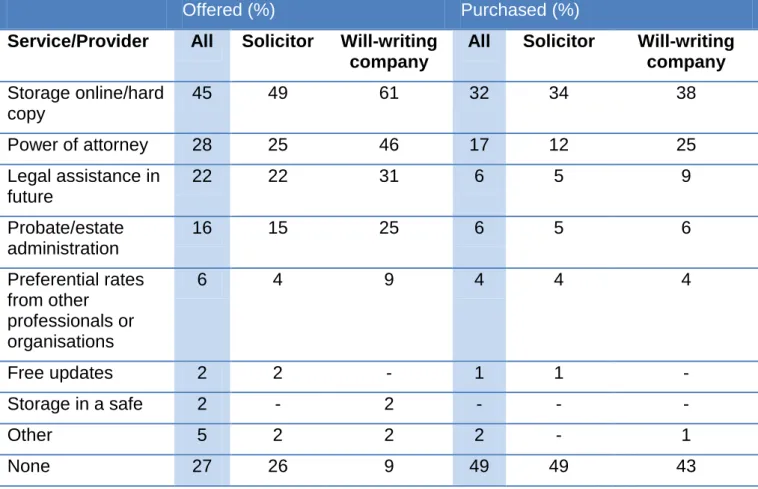
Table 1 – Consumer usage of will providers
Provider type Law Society (2010) NCC (2007)
Solicitor 67% 74%
Will-writing company 10% 8%
Will pack or online service 13% 8%
Financial services provider 7% 5%
Market structure
3.12. Details on each of the main types of will provider are presented below. Wills are also sold in a number of ways, for example on the provider‟s premises, in the home or online. A summary table is provided on page 18.
3.13. Alternative Business Structures (ABS)11 may change the market from October 2011. For example, will-writing services may become more attractive to providers if they can also offer in-house probate services (obtaining a Grant of Probate is a reserved activity). More than half of those participating in the business interviews – both solicitors and will-writing companies – believed that ABS is the biggest
challenge the industry faces.
Will-writing companies
3.14. The absence of regulation and thus any register means it is not possible to give a definitive number of will-writing
companies. The IPW is aware of 750 firms, of which most are sole practitioners. The Society of Will-writers (SWW) has 2,000 members (it counts on an individual rather than firm basis).
3.15. Many providers work part-time either in addition to another business activity or as a sole source of business. Most
companies have been operating for 5-20 years, but far more will-writing companies than solicitors have been operating under 5 years (16 out of 47, compared to 3 out of 50).
3.16. Consumers using will-writing companies are more likely to pay £50 or under for their will (16%) than solicitors‟ clients (7%), while consumers using solicitors are more likely to pay more than £50 but less than £150 (45%) than the clients of will-writing companies (37%). This perhaps indicates that will-writing companies are more likely than solicitors to operate at the
„bottom end‟ of the market in terms of price, while solicitors are more likely to position themselves as „mid-market‟. At the „top end‟ there is little to choose between the two types of provider. 3.17. The differentiating feature of will-writing
companies is visiting the client‟s home (some solicitors also offer home visits). Some employ instruction-takers to note the client‟s wishes while someone else prepares the will. The business interviews suggest that there is a higher focus
amongst will-writing companies on selling additional services to consumers.
Approximately one-fifth offer commission to incentivise staff compared to only one out of the 50 solicitor firms interviewed.
Solicitors
3.18. SRA practice data for May 2011 indicates that 5,285 solicitor firms - 48% of all firms - provide will-writing services. Firms of all sizes are involved in the market, although smaller firms are proportionately more likely to be. For example, 1,793 sole practitioners and 2,455 firms with 2-4 partners are in the market, but so are 98 firms with 26-80 partners and 30 firms with more than 81 partners.12
3.19. In the business interviews, most solicitors‟ length of involvement with will-writing was in excess of 20 years (34 out of 50) in stark contrast to will-writing companies (3 out of 47). Solicitors tend to prepare fewer wills per year than will-writing companies, as most practices offer a range of legal work. For example, 44% of solicitors prepare fewer than 199 wills each year compared to 34% of will-writing
companies. Solicitors are also more likely to prepare simple wills than will-writing companies (58% v 43%) and less likely to prepare complex wills (22% v 34%). 3.20. Wills are traditionally prepared following a
face-to-face interview in the solicitor‟s office although some solicitors offer home
visits and some large firms provide online services. Solicitors also win contracts from financial services providers and trade unions to prepare large volumes of wills, for example Thompsons prepares 13,000 wills a year for trade union clients and Irwin Mitchell has prepared over 500,000 wills for its own clients and those of its corporate partners. This „behind-the-scenes‟ work means that solicitors
prepare more wills than the market share figures indicate and some firms together account for a large proportion of this market share.
Financial services providers
3.21. The British Bankers Association informed us that many of their members offer will-writing services through an in-house unit or through a firm of solicitors.
3.22. Major retail brands, such as Halifax Legal Services, the Cooperative Legal Services, the AA and Saga have been at the
forefront of providing online will-writing services (see DIY will providers below). 3.23. Building societies and independent
financial advisors also provide will-writing services. It is not possible to give further details as their trade associations did not respond to the call for evidence. However, we observe some building societies offer wills through both solicitor firms and will-writing companies.
Self-completion wills
3.24. Wills are one example of a growing range of fixed-fee document services that can be purchased either in a shop or online. 3.25. Paper-based self-completion kits are sold
in stationers or to download online. LawPack is the leading provider of DIY will kits which are priced at £9.99. The company says its kits are regularly checked and updated by barristers and solicitors to ensure they are legally valid
and easy to complete. Template forms are provided, along with guidance to aid their completion.
3.26. Search engines generate a wide range of online will-writing services. The websites use interactive software to automatically generate wills based on a series of templates using information provided by the user. The services include guidance materials for users to draw on. Some services include a „try before you buy‟ facility which enable customers to review the document before committing to a purchase. Typically the will is checked by a professional before being sent to the customer for it to be signed and
witnessed, although some services give the choice of excluding a professional review. A brief trawl found prices for single wills in the range of £30-90.
Other providers Charities
3.27. A trawl of websites of ten large national charities revealed few prepare wills for consumers, but instead provide online and telephone advice about the process. Some charities have relationships with particular firms, for example Irwin Mitchell provides wills for Age UK and the MS Society promotes totallyfreewills.com. 3.28. Each November, the Will Aid initiative
enables people to have a basic will
professionally drawn up by a solicitor who will not charge their usual fee. Instead they will ask for a donation to one of nine charities. In 2010, Will Aid raised more than £1.5 million in donations.
Trade unions
3.29. A trawl of 50 union websites listed on the TUC website showed that 20 advertise free or discounted will services to
members as part of a general package of legal services. Typically solicitors drawn
from the union‟s panel of firms prepare the will based on a self-completion questionnaire. The Panel understands that the solicitors employ paralegals to draft the wills, while non-standard wills, that is for members who need inheritance tax advice or have complex needs, are drafted by solicitors at a discounted rate. Regulatory requirements
3.30. Will providers are subject to different sectoral regulatory requirements. In addition, all providers are subject to general consumer law.
3.31. Consumers exhibit low awareness of regulatory requirements. A Law Society survey found that 61% of respondents believed that „will drafting is always subject to regulation‟.13
The Consumer Panel‟s report, Quality in legal services, similarly found that consumers assume all legal services are regulated.14 The
shadow shops found consumers are very unlikely to check whether providers have some form of accreditation. Even those who do check tend to concede that the various accreditation or quality marks mean little to them, and there is a degree of suspicion about „invented‟
accreditations.
Will-writing companies
3.32. Some will-writing companies belong to one or more of the sector‟s trade associations. The two main bodies are IPW and SWW.
3.33. The IPW has achieved approval for its code of practice from the OFT under its Consumer Codes Approval Scheme (CCAS). The IPW describes seven benefits for consumers:
An examination for everyone giving advice to consumers and signing off documents;
All advisors are checked with the Criminal Records Bureau;
Professional Indemnity Insurance (of at least £2 million) and Public Liability Insurance (of at least £2 million); Clear contractual terms that must be given to every customer before they become obligated to the service including cancellation rights and requirements for consumers to be advised of their rights to cancel; Any payments taken in advance of work being completed must be
protected to ensure that in the event of service failure, the consumer receives either a refund or the work is completed elsewhere;
A clear complaints procedure including the option for a consumer to turn to an independent arbitration service run for the IPW by the Chartered Institute of Arbitrators; and
Compliance checking of member firms by the IPW, through analysis of
customer feedback forms, compliance visits to members and further analysis of IPW compliance monitoring by the OFT.
Solicitors and other authorised persons
3.34. All legal work conducted by solicitors, regardless of whether it is a reserved activity, is regulated by the SRA. The SRA also prohibits solicitors from setting up separate unregulated businesses to conduct certain unreserved legal
activities. These policy decisions, which are not legislative requirements, mean that will-writing is brought within the SRA‟s regulatory ambit. Features of the regulatory regime include:
A code of practice setting out the level of service and conduct that consumers can expect to receive;
Professional indemnity insurance and access to a compensation fund to protect against negligence and fraud; Minimum requirements with respect to training and CPD;
Monitoring of the performance of firms using a risk-based approach
3.35. Other authorised persons undertake will-writing, such as legal executives and notaries. The Council for Licensed Conveyancers regulates the provision of probate services. Its policy is to regulate any unreserved legal services directly related to the reserved activities within its jurisdiction; this includes will-writing.
Financial services providers
3.36. Financial services firms are regulated by the Financial Services Authority (FSA). At the heart of the FSA‟s regulatory regime is Treating Customers Fairly, which sets out the outcomes consumers can expect from financial firms. Consumers also have access to the Financial Ombudsman Service which may award redress up to £100,000.
Provider Market share Approx. Wills p/a*
Principal delivery channels
Price for single will
Regulation Redress
Solicitors 67% 1,228,207 Local offices
Online
£100-200 SRA Legal Ombudsman
(£30,000) Insurance and Compensation Fund Will-writing
companies
10% 183,314 In the home £50-100 Voluntary
self-regulation
Conciliation and arbitration as part of self-regulation Insurance as part of self-regulation Self-completion
will providers
13% 238,309 Stationers
Online
£10 £30-90
None None
Financial services providers
7% 128,320 In branch
Online
£75-100 FSA Financial
Ombudsman Service (£100,000) Other
(last four columns relate to trade unions)
4% 73,326 Self-completion
questionnaire sent to solicitors
£free or discount on solicitor rates
No sectoral regulation, but wills prepared by solicitors
Legal Ombudsman where prepared by solicitors
4 Quality
Introduction
4.1. This chapter considers the quality of wills and associated issues. The desired outcomes are that wills are legally valid, clear and reflect the client‟s wishes. Further, where professional advice is given, the will is tailored to the client‟s circumstances and deals with the estate effectively in accordance with the client‟s informed instructions.
4.2. The discussion below covers:
The elements of a good quality will; Evidence of quality problems;
Trusts which seek to protect against care home fees;
Education and training; and Online wills
What makes a good will?
4.3. At its most fundamental, a good will must satisfy some basic tests in order to be a valid legal document and so be capable of obtaining probate. For example, it must be signed by the testator and two witnesses in the presence of each other (who must not be beneficiaries). Some defects can cause problems when obtaining probate but may not be fatal, for example when the will has been amended or is undated. 4.4. A good will must also get some basic
technical things right. Some standard clauses should be included where
relevant, for example a residuary estate or guardians for children. The will should follow exactly the client‟s instructions. The drafting should ensure that the clauses
deliver their intended effect. The document should also be clear, in two senses: the meaning is unambiguous to minimise the possibility of disputes after the death; and the will should be clearly written so that the client can understand it. 4.5. Where consumers get a professional to
write their will, in addition to the elements above, a good will should also be tailored to their personal circumstances. There are a series of elements to this:
The will should be as simple and straightforward as possible in order to produce the desired outcomes, without any unnecessary complexity;
The provider should build a full knowledge of the client‟s relevant financial and personal affairs and apply technical knowledge in a range of areas in order to identify solutions that would deliver their wishes effectively; Issues and potential scenarios that clients might not have considered should be highlighted;
Providers should help clients to think through their options and make a decision that they are comfortable with. This reflects that consumers may know the broad outcome they want, such as to divide various assets fairly between the children, but not know how they can best achieve this; and
Good client care skills build trust in the advisor to handle sensitive issues and assist in extracting information about consumers‟ needs and preferences. 4.6. Consumers are free to reject advice given
possible will is not produced. Ultimately, however, the provider has to respect the client‟s decision as making a will involves very personal choices.
4.7. Consumers should be free to decide not to obtain any advice when getting a will. Here there is a wider market objective: consumers should make an informed choice about the degree of professional input they wish to purchase based on an understanding of the added value that different levels of information and advice can provide. For example, a
self-completion will should be legally valid and deliver the consumer‟s stated wishes, but may not deal with the estate in the most efficient way possible. However, as long as the first two basic tests are fulfilled it is a matter for consumers to make an
informed decision about whether they can afford or wish to pay for bespoke advice. Providers should be upfront about the limitations of their service to support consumers in making such choices. 4.8. When consumers do get advice, they can
legitimately expect a bespoke will which deals with their estate efficiently. For example, where the value of an estate is likely to exceed the inheritance tax threshold, they should be alerted to this. Where consumers get advice to reduce exposure to inheritance tax, the advice should have this effect. Where a provider is not competent to give suitable tax
advice they should decline to act and refer the consumer elsewhere. This distinction – when advice is purchased – is critical to assessing the quality of wills.
4.9. The number of people who would benefit from advice due to their circumstances is rising as a result of rising home ownership and more complex family relationships. In a Society of Trust and Estate Practitioners (STEP) survey, a large majority of firms reported seeing an increase in complex families resulting in a growing number of people requiring specialist advice.15
Evidence of quality problems
4.10. Below we report on evidence with respect to the elements of quality described above split into two parts: whether the will is valid and follows the client‟s instructions; and the quality of advice. The main evidence is the shadow shopping exercise. Other sources include official data, the IFF consumer surveys, surveys of practitioners and the case studies. 4.11. The findings of the shadow shops are
provided in Table 2. The assessors awarded a „pass‟ when they considered the will was both legally valid (it would obtain probate, with an affidavit if needed) and its overall quality was of passable, good or excellent standard. A „fail‟ was given when the will was assessed as
either being not legally valid or of poor or very poor overall quality. The assessors did not know what type of provider made the will. Due to the sample size, the findings should be treated as indicative. 4.12. In total, one in four wills were failed.
Furthermore, just over one-third of all assessments had a rating of poor or very poor. However, there were a few wills – just eight of the entire sample – assessed as not legally valid. One quarter of all wills were failed on the grounds of poor overall quality. Overall, about the same
proportion of simple and complex wills was failed. Although the sample size makes comparisons difficult, solicitors were more likely to be failed on simple wills and will-writing companies were more likely to be failed on complex wills. This is a disappointing set of results. 4.13. There are some differences in the overall
results by type of provider. The findings for solicitors and will-writing companies were identical – each getting around one in five fails. Three in ten self-completion wills were failed, with online routes being responsible for most of these
will prepared by banks and affiliate groups was failed. Again, it should be
emphasised that this is a qualitative sample and so the results should be treated as indicative.
Valid will and client‟s instructions followed
4.14. Where the expert panel assessed the wills to have failed on the grounds of not being legally valid or not meeting the client‟s requirements as expressed in the testator questionnaire, IFF classed these failings into six wider categories:
Inadequacy – where the content of the will does not account for an estate fully, fails to make adequate provision or neglects to take certain outcomes into consideration;
Requirements – where the client‟s requests have not been met (as
specified in the testator questionnaire) through omission or conflicting
specification;
Legality – where the actions specified in the will are potentially illegal;
Inconsistency – where the language, logic and/or content of the will is contradictory;
Detail – where items, people and requests are described in insufficient detail; and
Presentation – where the language and format of the document is lacking.
Table 2 – Summary of shadow shops expert panel assessments
Overall Assessment
Execution Quality Overall
Total
Channel Pass Fail Pass Fail Pass Fail
Solicitor 40 1 32 9 32 9 41
Complex 20 1 17 4 17 4 21
Simple 20 0 15 5 15 5 20
Specialist will-writer 22 2 19 5 19 5 24
Complex 14 1 11 4 11 4 15
Simple 8 1 8 1 8 1 9
Bank or affiliate group 9 1 9 1 9 1 11
Complex 4 1 4 1 4 1 5
Simple 5 0 5 0 5 0 5
Paper self-completion 6 2 5 3 5 3 8
Complex 3 1 3 1 3 1 4
Simple 3 1 2 2 2 2 4
Online self-completion 16 2 10 8 10 8 18
Complex 6 1 3 4 3 4 7
Simple 10 1 7 4 7 4 11
Total 93 8 77 24 75 26 101 Rating Count
Excellent 10 Good 81 Passable 107 Poor 82 Very Poor 21
Other data
4.15. The Probate Service is a public office which checks the validity and execution of wills when assessing applications for grants of representation. It reports that very few wills presented for probate are actually invalid, but does see a small but significant number of poor quality wills, where they need to carry out further work to ensure the will is valid. Of course, a will may be legally valid and pass probate yet not reflect the client‟s wishes, so this point addresses only one dimension of quality. 4.16. One of the main issues seen by the
Probate Service relates to poorly drafted appointment clauses (identifying who will be the executor) and attestation clauses (statements by witnesses about how the will was made). As poor drafting is not discovered until after the death, which may be many years later, it can be difficult to locate the draftsman to obtain further evidence to demonstrate the will is valid. The Probate Service does not have any
breakdown by type of provider and points out the above shortcomings can be found on wills drawn up by solicitors, will-writing companies or home-made wills.16
4.17. The volume of contested wills provides a possible indicator since wills may be disputed on validity grounds. However, wills may be contested for a range of other reasons and it is not possible to provide a breakdown. Further, external factors, such as the economic climate, can influence the likelihood of claims. Table 3 shows that High Court cases have fluctuated during 2005-09 making it difficult to identify a discernible trend. The real number of cases is likely to be much higher as these figures do not include out-of-court settlements. The law firm
Seddons estimates there were 50,000 disputes in 2007 based on a survey in which one in ten respondents had challenged a will. On average, disputes take 12 months to resolve, but most cases yield a payoff of under £250 per person.17
Table 3 – High Court cases related to trusts, wills and probate
Nature of proceedings 2005 2006 2007 2008 2009
Contested probate actions 115 73 185 106 152
Disputes relating to Trust property 27 10 3 13 44
Variation of Trusts 8 2 - 19 34
Inheritance (provision for dependants) 15 10 43 80 110
Guardianship of minors‟ estate - - 8 5 1
Charities - 1 - 3 10
Other applications 318 214 237 365 216
4.18. In a STEP survey, 60% of members had come across will-writers whose wills were invalid due to basic mistakes. Problems outlined included: problems with
witnesses, basic typing errors, trust errors, the use of standard clauses and lack of legal knowledge. 84% of members who responded had come across one will containing drafting errors in the last year, with more than 72% coming across multiple wills containing errors.18 4.19. In the regulated part of the sector, the
Legal Ombudsman accepted 55 cases for investigation in its first six months about failure to follow instructions. This is likely to be the tip of the iceberg as most problems, if spotted, should be resolved internally when the client complains to the provider.
Case studies
4.20. The case studies include some examples of wills being invalid because they were not properly signed or witnessed. There were also cases of sloppy drafting that could cause problems at probate, for example names being misspelt, clauses not being numbered and the relationship of relatives being incorrectly described. 4.21. There were also examples of avoidable
basic drafting mistakes. These include omission of standard clauses, such as no mention of a residuary estate, failure to appoint guardians for children, or not stating what should happen if the testator is predeceased by the beneficiaries. Another aspect is failure to follow the client‟s instructions by not distributing the estate to relatives in the proportions that the client had instructed.
4.22. Other problems in the case studies include wills that defeat the client‟s intentions due to ambiguous drafting or technical mistakes. In one case the structure of the will was in the wrong
Case studies – Technical errors
I saw a will that was set over twelve pages long, which was inordinately complex for a relatively straightforward will. The executors of the will, Mr and Mrs C, are described as daughter and son-in-law of the deceased, when they are in fact daughter and son-in-law of the deceased‟s partner. Mrs C is not the deceased‟s child, although Mr S is his son. The real issue is that having granted a life interest in the half share in the property, the residuary trusts give that half share outright to the
deceased‟s partner - clearly not intended. The mirror image will is drafted in the same way. The will permits the property trustees (the deceased‟s step family) to appoint the property fund in its entirety to the
deceased‟s partner outright. This power could of course be used to disinherit the deceased‟s son, Mr S, completely. The will was witnessed by Mr C, who is the husband of Mrs C, they are both executors and property trustees under the terms of the will. The will-writers are no longer trading.
(Individual lawyer)
I saw married clients whose will purported to leave life insurance policies in trust. It was only discovered after the husband‟s death that the trust in the will was invalid as it failed to provide for any beneficiaries. This may end up costing the widow or her estate many thousands of pounds in
inheritance tax. Upon pursuing this with the will-writing company, they denied responsibility by saying the will was prepared by their franchisee, for which they had no current address.
order, giving an unexpected result. Another case involved a failure to recognise that the legal definition of children includes adopted children but not foster children, although thankfully the error was spotted in time. Similarly, wills failed to work as intended because they contained contradictory clauses or trusts were created which did not work, for example to prevent sale of the home to pay for care home fees (see paragraphs 4.32-4.34 below).
4.23. A specific problem relates to checking that the will is properly executed. Execution does not have to take place in the
presence of the provider. In the business interviews, a small but significant minority of solicitors and will-writing companies stated that they ensure the act of signing and witnessing takes place under their supervision. It is impossible to eliminate this problem in situations where there is no professional supervision, but it can be mitigated by providing clear information to consumers about the steps they need to take. The business interviews indicate that virtually all solicitors and will-writing companies issue guidelines to clients.
Poor advice
4.24. This is the hardest aspect on which to gather evidence as it is difficult to accurately reconstruct the interaction between provider and client. A limitation of the research approach for the shadow shopping is that the wills could only be assessed based on the client‟s
instructions rather than the questions asked by the provider.
4.25. A key part of providing good advice is the instruction-taking process, as a will can only take account of the information provided by the client. In the business interviews, both will-writing companies and solicitors saw this as the main challenge: asking the right information of clients to build a comprehensive picture of
their circumstances; and obtaining unambiguous and complete information from the client. In hindsight many of the shadow shoppers were not happy with the level and quality of communication they had with their provider, specifically with regards to questions about personal circumstances that could affect the will. 4.26. However, the IFF consumer survey found
strong scores in this area. This included clear, accurate and comprehensive explanation before the process started and high recall of key information about assets and personal circumstances that providers should cover in an interview. Clients of will-writing companies were more likely to have spent over an hour discussing their personal circumstances (47% compared with 16% for solicitors), while solicitors‟ clients were more likely to spend half an hour or less (54% versus 29% for will-writing companies).
Respondents who spent longer providing information about their personal
circumstances tended to be more satisfied with the overall quality of their will.
4.27. A theme in the shadow shopping, STEP survey and case studies was wills being assembled by providers by cutting and pasting precedents from software packages, where a lack of legal
knowledge meant the document when put together did not work as intended. Whilst this might work for a simple will, it may fail to deal with more complex circumstances. 4.28. During the course of the investigation,
allegations about a technical problem with wills drafted using a widely used software product was brought to our attention. This meant that wills designed to protect against care home fees would not work, potentially forcing the surviving spouse to sell their home in order to pay these fees. Our understanding is that the problems were caused by a combination of misuse of the software and the software‟s design.
Although the software has been updated, there may be a large number of wills that will not work. We have been informed that some providers have notified their clients and rectified the wills, but others have not. The Panel is concerned that potentially thousands of consumers will be affected but completely unaware of the problem. The matter has been brought to the attention of the OFT.
4.29. A recurring theme in the case studies evidence was unnecessary complexity to deal with straightforward circumstances. Examples were wills of many pages length that could have been far shorter and done the same job, tax mitigation measures despite the client having
modest assets, and other trusts for which the client had no need. In some cases this appears to have been a deliberate ploy to charge the maximum possible fees. However, a more innocent explanation is unconscious gold-plating on the provider‟s behalf. In other words, preparing a will to deal with all foreseeable scenarios even if these are highly unlikely, or devising an elaborate trust to resolve a problem when a far simpler device would deliver an identical result.
4.30. A related issue is where clients are not able to understand their will. The IFF consumer survey found that 14% of respondents did not fully understand the content of their will. This figure was only 5% for those purchasing an online will. More positively, in nearly all occasions when the provider took the consumers through their will respondents said they did so in a way that enabled them to understand it sufficiently.
4.31. A contributory factor is the style of
language used, which is often archaic and obtuse. The terminology used in wills dates back many centuries. Reducing confusion over terms was one of the most common areas for improvement
suggested by the shadow shoppers. A
Case studies – Cut and paste jobs
I have come across numerous
examples of very badly drafted wills. It is clear from these that the firms or individuals concerned simply select clauses from a computer package without any understanding of the law or the effects of the document they have drafted. A man in his forties died in an accident shortly after his will was made. I am acting for his widow in respect of an Inheritance Act claim. There is confusion and muddle about the rights of the life tenant and the drafting makes it clear that the author really had no idea of the background law.
(Individual notary)
I came across a very poorly drafted will that included ambiguous provisions that failed to take account of the particular circumstances of the testator and her estate. The will appeared to have been compiled by cutting and pasting
clauses without any understanding of the terms of those clauses and their interaction with each other. Due to the ambiguity I wanted to call for
production of the will file, however the will-writing company had gone out of business and the will-writer himself could not be located. Ultimately an agreement was reached between the beneficiaries as to the division of the assets in the estate but a great deal of time was wasted and unnecessary administration costs arose as a result of the inadequacies of the original will. (Individual lawyer)