
On the behaviour of barnacles I. The relation of cirral and other activities to temperature
20
0
0
Full text
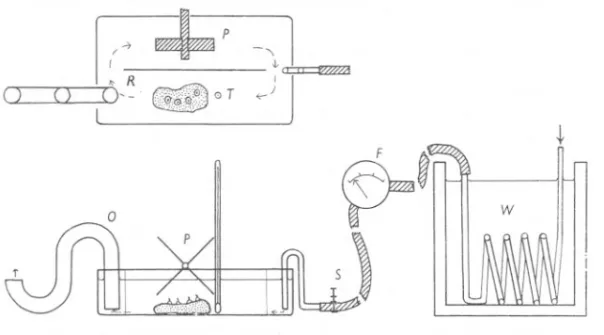
(2) A. J. SOUTHWARD. 4°4. of the cirri is simple to measure, but the experimental conditions necessary for uninterrupted beating are exacting. A barnacle is very sensitive to changes of temperature and illumination and to mechanical shocks; any of these stimuli may cause it to withdraw the cirri and close the terga and scuta. Specimens may also keep the terga and scuta closed in perfectly still water. If, however, a current of water is made to flow over the shell, sooner or later the valves part slightly, and a single cirral ramus may be cautiously put out; eventually rhythmic beating may start. Up to a certain current speed, which differs from species to species, the stronger the current, the less is the barnacle's response to other stimuli. A current of water thus assists the maintenance of regular beating. At high current speeds many species stop beating, and hold the cirri outstretched in the current for periods of up to several minutes (cf. Crisp, 195°), with occasional twisting movements from side to side. This reaction to strong currents can be termed the extension response. At even higher speeds, the terga and scuta may close again (closing response). A further difficulty in assessing the cirral activity of barnacles is that at least two different types of beat may be shown by different specimens, or even the same specimen, under apparently identical conditions. The type of beat shown at times by all species and specimens can be termed the normal beat: the cirri are almost fully withdrawn into the shell between each extended phase, and the effect of increased temperature is to shorten the extended phase. Another type of beat has so far been observed only in Balanus balanoides,' B. crenatus and Elminius modestus: in this beat, which can be termed the fast type, the closed phase is reduced or absent, and the extended phases follow so closely upon each other as sometimes to give the impression of a mere waving to and fro. EXPERIMENTAL CONDITIONS. Barnacles were brought back to the laboratory attached to small pieces of rock, and were kept continuously immersed in running water. Some specimens had to be kept for several days before examination, and there was thus some risk of acclimatization to laboratory temperatures. In the later experiments specimens were examined within 48 h of collection, being meanwhile kept out of water in a cool damp place. The cirral activity was observed in a shallow glass trough containing about 75° ml. of water, partially divided down the middle by a Perspex partition (Fig. 1).1 Sea water from the aquarium supply was filtered through coarse silk mesh, passed through a large coil of glass tubing immersed in a large, thermostatically controlled water-bath, and supplied to one end of the trough through a flow-meter. Excess water overflowed at a constant level at the other end of the trough. The temperature of the running water was varied by heating 1. A slightly different apparatus was used for observations at Port Erin..
(3) OF BARNACLES. I. BEHAVIOUR. 4°5. or coolingthe water bath, and its rate offlow controlled between 0 and 500 mI. per minute by a screw-clamp. The barnacles were placed on the near side of the partition and viewed through a lens or dissecting microscope. On the far side of the trough was a paddle-wheel which could be driven, when required, by an electric motor controlled by a variable resistance. For some species the rate of flow of the water supplied through the heat exchange coil was sufficientto stimulate the cirri, but other species needed a stronger current, set up by means of the paddle-wheel, before regular beating could be obtained.. 0. a. ~+p I:~ lO--. 0. _0T. -,. _t. 1. Jj". -@~. ~. ~~. w. 5) Fig. I. Diagram of apparatus used for investigating the cirral activity of barnacles. Above: trough in plan; below: side view of whole apparatus. F, flowmeter; 0, constant level outflow; P, paddle wheel; R, Perspex partition; S, screw-clamp on inlet tube; T, thermometer, scale about !th natural size; W, thermostatic water-bath and heat exchange coil, not on the same scale.. The frequency of beating was measured by recording with a stop-watch the time in seconds for ten complete openings and closings of the valves accompanied by protrusion of the cirri. The results were converted to the number of beats per 10sec as this was the most convenient unit for later calculation of the standard deviation. All the results are quoted in these units. About ten specimens were tested at each temperature, and to ensure that so many were active it was necessaryto have from two to five times this number in the trough (cf.' Cole & Allison, 1937). The mean frequencies of beating given below therefore represent the averageactivity of thosebarnaclesactive, and not the activity of the whole sample. All temperatures are expressed in degrees Centigrade. The water was heated or cooled slowly (about 5° per hour), and the temperature readings were taken closeto the barnacles. The apparatus fluctuated 27-2.
(4) A. J. SOUTHWARD. 406. in temperature by up to 0.50 during each experiment, but more rigorous control was not consideredworth while, since in comparisonwith the intrinsic variation between individual barnacles the effects of such fluctuation were negligible. Results have therefore been grouped at the mean temperature of each experiment. It will be noted that most speciesshowed a large standard deviation, which at sometemperatures approached the range of the observations. Each barnacle has its own frequency of beat which is only generally related to that of its fellows. A further probable cause of the great deviation from the mean may be the existenceof severalage-groups in the samples, for, as will be shown in TABLE I. Species Chthamalus stellatus (Poli) Balanus balanoides (L.) Balanus perforatus Bruguiere Balanus crenatus Bruguiere Elminius modestus Darwin. SPECIES OF BARNACLES INVESTIGATED Where collected Rum Bay, Plymouth (a) Brixham, outer harbour (b) Pon Erin bay Wembury, nr. Plymouth Sutton harbour, Plymouth Sutton harbour, and Henn Point, nr. Plymouth. Tidelevel H.W.N. M.T.L.. Speed of watercurrent in apparatus 5-10 em/see 0.1--0.2 em/see. M.T.L. L.W.N.. 0.1--0.2 em/see 0.5 em/see. L.W.N.. 0.5 em/see, plus bursts of 5 em/see 0.5 em/see, plus bursts of 5 em/see. L.W.N.. a later paper, older barnacles beat more slowly than younger specimens. As far as possible the observations were confined to the predominant age-group in the population, excluding recently settled individuals. For most species this meant that specimensof approximately 1-2 years of agewere investigated, but it was difficultto separate the age-groupsperfectly by size and appearance (see Southward, 1955). In each species,also, the sampleswere taken from the optimum tide-level (Table I), and it is possible that different frequencies of beating would be shown by specimens from other tide-levels. RANGE AND FREQUENCY OF CIRRAL BEAT. The two common barnacles, Chthamalus stellatus and Balanus balanoides, showed quite different cirral behaviour even when compared at their optimum temperatures. The majority of individuals of both species remained closed in still water. But, while B. balanoides would set up rhythmic movements with a water current of only 0.1 em/see (= to a flow of 100 ml./min), Chthamalus sometimes needed currents up to 10 em/see (=to 10,000 ml./min) to induce beating. At the latter speed Balanus balanoides tended to close the valves, while Chthamalus, especially the younger individuals, frequently showed the extension response..
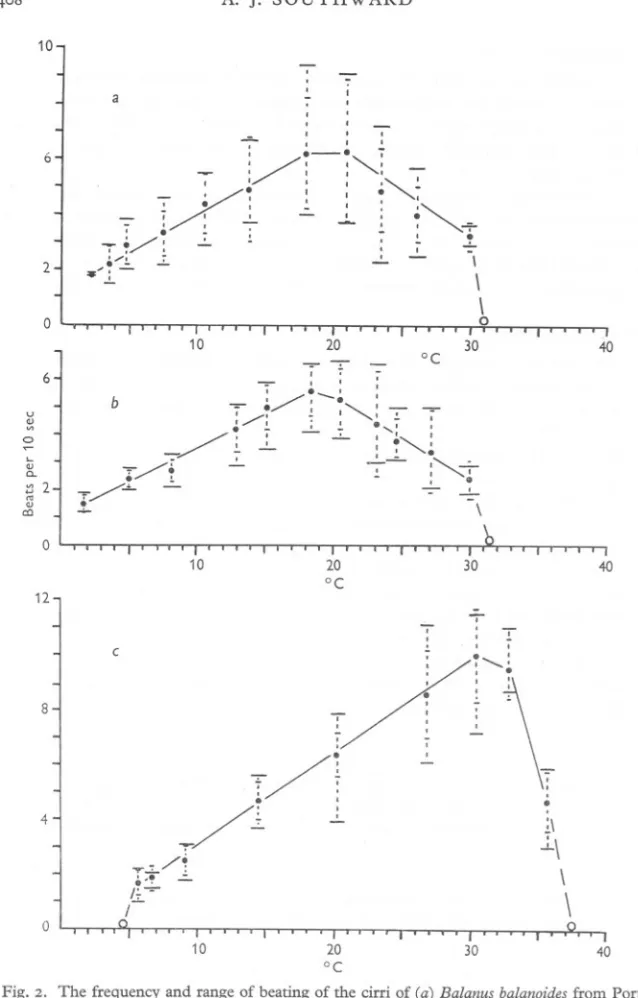
(5) BEHAVIOUR. OF BARNACLES. I. 4°7. Chthamalus stellatus Even high current velocities would not induce Chthamalus to beat the cirri below 5°. Above this temperature the frequency of beating increased almost linearly with temperature to a maximum of 10 beats/IO sec at 30° (Table II; Fig. 2C). The frequency declined at 33° and fell off sharply at 36°, while all beating ceased at 37'5°. As the normal temperature range experienced by this barnacle in Britain when beating the cirri (i.e. sea temperature) ranges from a mean of 6° in February to a mean of 16° in Augus.t, the species is quite clearly operating at the lower limit of its optimum range.! In winter, when the inshore water can drop below 6°, it may experience difficulty in feeding and respiring. Balanus balanoides. The northern barnacle B. balanoides continued to beat the cirri down to 1'8°, and would probably remain active below this temperature. At temperatures above 2° the frequency of beating increased linearly to maxima of 6'2 (Port Erin) and 5.6 (Brixham) beats/Io sec at 17° (Table III; Fig. 2a, b). Above 17° the beating became more variable, although the mean frequency declined fairly steadily down to 30°. All beating ceased beyond 31-31'5°. The slight difference in mean frequency and standard deviation between the Port Erin and Brixham material was probably due to the inclusion of more agegroups in the former sample. The widest range of monthly mean sea temperatures in Britain is 4-17°, found on the east coast. While B. balanoides is thus operating very near its upper optimum limit in Britain, there is no evidence that high temperatures have any detrimental effect on the species. It is, however, possible that the superiority of Elminius modestus in south-east England, is related to the latter species' tolerance of a wider range of temperatures than Balanus balanoides, as well as to its greater fecundity (Crisp & Chipperfield, 1948). Balanus perforatus Specimens of B. perforatus from Wembury were examined on two occasions, in November and June. The differences between the two sets of measurements are greater than was found with B. balanoides from different localities, but are in some part due also to a difference in age and size of the earlier sample. . It was not possible to induce this species to beat the cirri below 6°. Above 6° the mean frequency of beating increased fairly linearly to 25° (Table IV; 1 Note: the sea temperatures discussed on this page, and on subsequent pages are derived from the following sources: Admiralty, 1946; Air Ministry, 1949; Deutschen Seewarte, Hamburg, 1927; International Council, 1933; Lumby, 1935; Proudman, Lewis & Dennis, 1937..
(6) A. J. SOUTHWARD. 408. 10 I I I I I. a. I. --,. 2. ~./l +/:. I. I. i0. I. .l.. /1. .. /. .-:. -,. . .-', ,. 7. 6. :/:. 0. -I. ...:... -. ~ I. ',,'. I :,., :,~ .. -I. I I. I. , I. :.... .. I. 0. ,-"""""...-. I. - I. -. .. i... :. 7\. .~J... -. \ \0. 0. 10. 20. . ./:-.,. 6. ~. 0. I. b. u. '". d). ~. /0. -/. '-. '" a.. j'" 2. °C. I. '/o. .!.. !. 1---,-. -;!.. 0. "/...:.... T/. ../. I. : -.. .,1 ". ",",I. !... I. .." ./~...!... ~~. ,. 40. 0. I. I. 30. :I. ~,,~. I","-=-. !.. -=-. 1-""':' 0. ~. ... 7. \. 0. 10. 20 °C. 30. 40. 12. "-. .: i. c. 8. /. T:. 7' /1 4. 0. ~./ ~./; r-,~ ~ I"10. -r/ -'-. .. I . 0. II. I. ~. \. :.. 7 ~ " I 1.-. I:0 -. 20 °C. ~. .: :I :I. ~. I . ~:' \ ~\ \. 30. 40. Fig. 2. The frequency and range of beating of the cirri of (a) Balanus balanoides from Port Erin, (b) B. balanoides from Brixham, and (c) Chthamalus stellatus from Plymouth. In this, and subsequent figures, the large open circles denote absence of cirral beat; small open circles refer to single observations only; the small dots mark the mean frequency of beat at each temperature; and the range of observations and the standard deviation at each temperature are shown by large and small cross-lines respectively on either side of the mean..
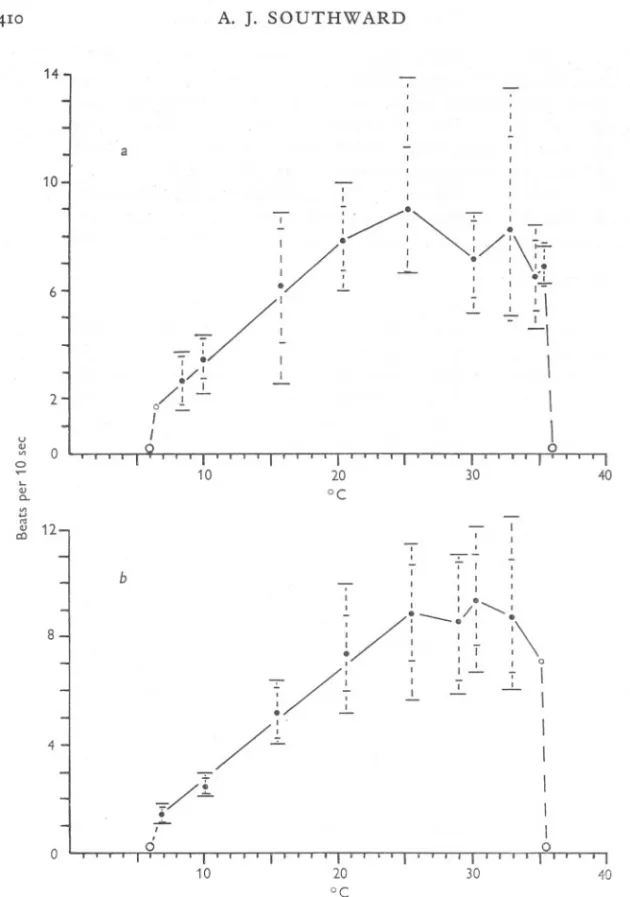
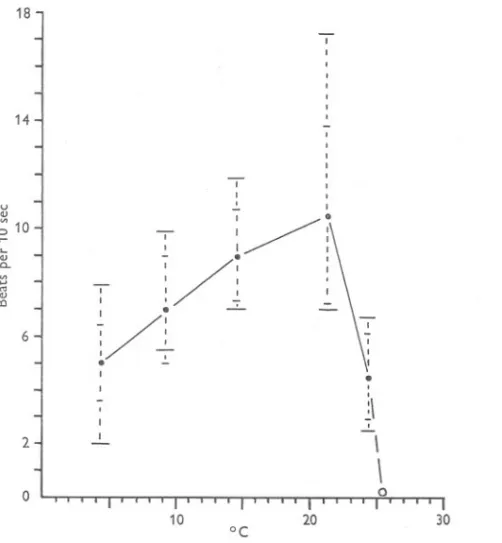
(7) BEHAVIOUR. OF BARNACLES. I. 4°9. Fig. 3). Above 2So the beating varied considerably in both sets of measurements, generally tending to decline, although the secondary peaks of activity at 30 and 33° should be noted. Both series declined sharply at 3So, and beating ceased at 3S'S-36°. The slightly higher mean frequencies shown by the June series may represent some acclimatization to summer conditions, but the variability at these temperatures prevents any certain correlation. Like Chthamalus, Balanus perforatus is at the lower end of its optimum range in Britain, where it normally experiences mean sea temperatures of from 7 to 16°, and may also have difficulty in feeding and respiring during the winter. Balanus crenatus For B. crenatus, and for Elminius also, the most regular cirral movement was obtained by occasional stimulation with currents of S cm/sec in addition to the regular current of o'S cm/sec (obtained with water flow of soo ml./min). The actual counts of frequency, however, were made with the regular flow only. Balanus crenatus showed a comparatively rapid beat at low temperatures, and there was every sign that it would continue beating below the minimum temperature of 4° obtainable at the time. The mean frequency of beating increased more or less linearly with temperature from 4° to a maximum of over 10 beats/IO sec at 21° (Table V; Fig. 4). Above 21° the beating slowed down, and all cirral movement ceased at 2S,so..The great range of frequency of beat at the higher temperatures is noteworthy; to some extent it was due to the ability of some specimens to show the two types of beat already mentioned. This barnacle is operating quite near its upper optimum limit in Britain, for temperatures above 20° may be experienced during the summer in the sheltered waters favoured by the species. Yet the same species is reported from tropical and subtropical localities by Darwin (18S4) and Gruvel (190S). The cirral behaviour of the British specimens suggests that the species is here near the southern limit of its distribution, and supports previous doubts of the validity of the warm-water records (Pilsbry, 1916). Either the tropical records refer to another species, or B. crenatus shows a number of varieties adapted to different temperatures, such as are found in Aurelia aurita (Mayer, 1914). It is possibly significant in this connexion that in Britain the species is generally restricted to M.L.W.S.or below, and that above this level it is found only beneath stones or in the shade of thick growths of seaweed. These are all measures that would reduce the effect of the high temperatures that may be found on the shore in sunny weather. Elminius modestus Specimens of E. modestus were examined in February and in June. The February samples were obtained from two localities (see Table I), but the results have had to be combined to cover the whole range of temperature. Beating of the cirri could not be obtained below 2°; above this level the mean.
(8) A. J. SOUTHWARD. 410. 14. a 10. , I. .. :I. /. : /. 2. I. -=- I. -. -\. I. -. I. ,-. I \ \ 0. 0. 10. .... OJ. 20 °c. Co. '" .... '". ~. I. J. u a. :~t/t I\ ~ . I I, -::~.! .!... , :I I. I. -=-. ~ ./' I 0/ -,-. ~. 7.L. 6. -:. 7/. ~. ,. 12. I ~. ,. b. 7. ,. /. ~. ;-. I. -, .,. I. :. 8. .-~. " I' " I. ~--~/I"""""". I. / :. .!... ;. 40. 30. I. I. ''. \. I' ,. '. ~. :'. I. I..!. 1..". : '. 0. :- I. 4. ~/;. -. -. . -:-. ;;-/ f. 0 10. 20 °C. 30. 40. Fig. 3. The frequency and range of cirral beat of Balanus perforatus, (a) in November, (b) in June. For explanation of symbols refer to Fig. 2..
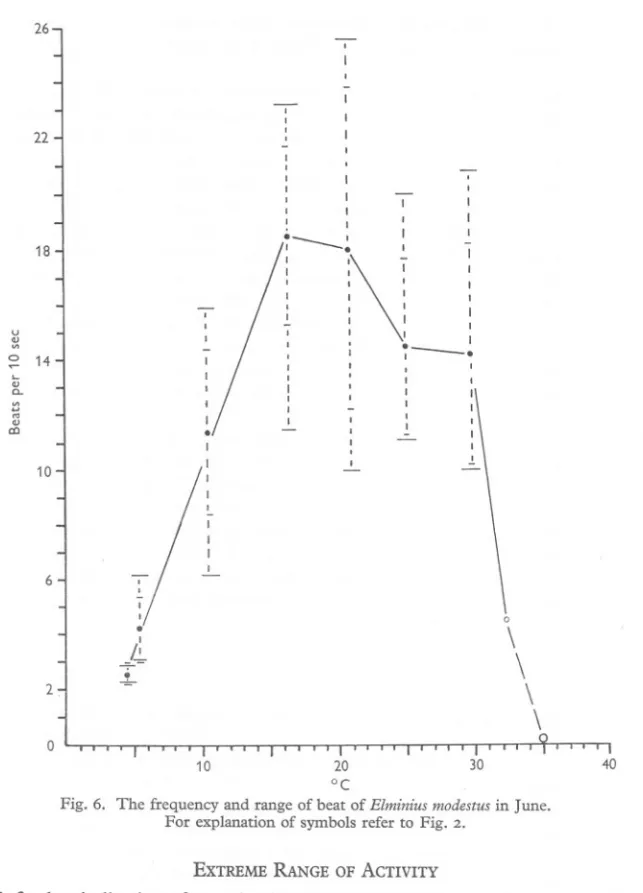
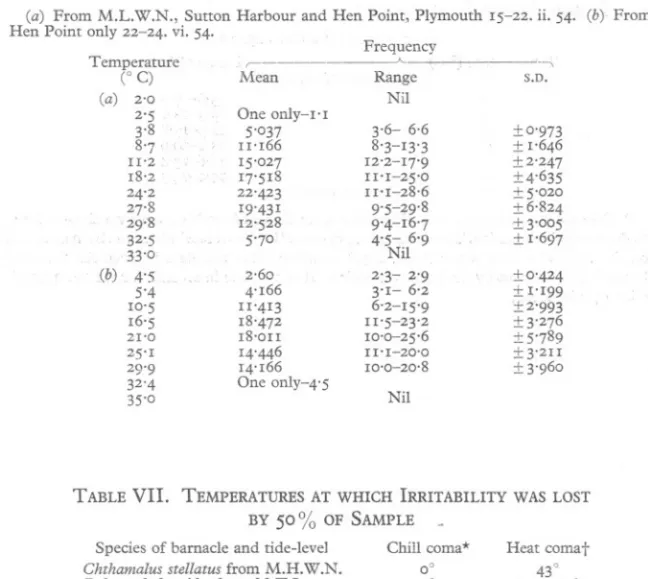
(9) OF BARNACLES. I. BEHAVIOUR. 4II. frequency of beating rose very rapidly to maxima of 22 beats/IO sec at 24° in February, and 18'5 beats/Io sec at 16'5:' in June (Figs. 5 and 6). Beating then slowed down, declined sharply at 30° and ceased altogether at 33-35°. The difference in position of the maximum in each series is due to the two types of beat shown under apparently identical conditions. The June specimens showed a decline in the proportion of fast beat above 16°, while the February material 18. -. 14. I. U QJ. ~ 10. ..,. :. I. "-. 7. QJ. a.. '" .... '" QJ c:J. --. I. 6. ~I I I. /. . I. I. /. ~II. ~. /. ~. :" ,\. I. ' -~. I. ;. --. I I. -;-. 2. 0 10. °C. 20. 30. Fig. 4. The frequency and range of cirral beat of Balanus crenatus. For explanation of symbols refer to Fig. 2.. showed a quite high proportion of fast beat up to 24°. Although the fast and normal beats can be distinguished by appearance, numerically their frequencies overlap and are difficult to separate. The wide deviation is probably also ascribable to the occurrence of the two types of beat. On the east coast of England Elminius may at times experience temperatures at the lower limit of its optimum range, and may sometimes be at a disadvantage compared with Balanus balanoides..
(10) A. J. SOUTHWARD. 412. 30. ... 26. 1 I I. I. .. 22. , I. J. I. 1. I. I. /. I. u. ~ 0 ~. ./. ~14. -I. ~ .... '". -. OJ ca. I 1 1. .. 1. 7 1. 1 I. ~ '. 'I. I. 1. I. 1. -1. '. I I. 18. \. ' 1. .. 1 II I I. I I I. I'. .. I. I. 1. -. I 1 1. 10. I -l... ., 6. . I t. I. " .I. I I. ,. 1. .. 2-/. I. °. I. 0. I. 0. 10. Fig. 5.. 20 °c. 30. The frequency and range of beat of EZminius modestus in February. For explanation of symbols refer to Fig. 2.. 40.
(11) OF BARNACLES. I. BEHAVIOUR. 413. 26. 22 I I. 18. ~--~. u. '.,a.. 14. v> ... '" .,. 0 I. \. ~. :. : I. 0 I. 0 0. 0 I. I I. 0 0. I I. I 0. .-. 0. I. I. ~. 0. I I. :.. 0. .I I. a::>. I. 10. I I II I 0 I I .!.. I I I. 6 I I. °. .'. \. 0. /~. 2. \. !. \ \. 0 10. 20 30 °C Fig. 6. The frequency and range of beat of EZminius modestus in June. For explanation of symbols refer to Fig. 2. EXTREME RANGE OF ACTIVITY. A further indication of an animal's adaptation to the temperature range of its environment can sometimes be obtained by determining the upper and lower temperatures at which it loses irritability. When the point of heat coma or chill coma is reached it is reasonable to assume some temporary damage to other vital activities. These points were determined for the barnacles under investi-.
(12) A. J. SOUTHWARD. 414. gation by slowlychanging the temperature of the surrounding water until the normal reaction to touch, namely a closing of the terga and scuta, failed to occur. Chthamalus,. Balanus balanoides, B. perforatus and Elminius did not react to. touch after an hour or more at 0°, but owing to difficulty in controlling temperatures at this level more precise information is not available. It is probable that some species can resist lower temperatures for shorter periods. The points at which 5°. % of. the samples showed heat coma were easier to. investigate. The barnacles, still attached to small pieces of rock, were placed in 5°0 mI. of water, aerated with compressed air, and the temperature raised by heating the vessel in a small water-bath. The temperature was raised 1° per min, and direct observations with thermocouples showed that there was no lag greater than 0'1° between the barnacle and the surrounding medium. As might be expected from its range of cirral activity, B. balanoides was the first of the four species investigated to succumb to coma, at 35-37° in different experiments (Table VII). The remaining species followed in the order of their upper limit for cirral activity, Chthamalus being noteworthy in resisting coma above 40°. These temperatures were experienced under water; on the shore they could be experienced only while exposed to the air, when the effect of desiccation would also be present. Towards high-water mark temperatures of up to 38° have been registered by thermocouples placed in the mantle cavity of barnacles during warm weather, although lower temperatures are more common over most of the British summer. It is interesting to note that of the two southern species Chthamalus stellatus and Balanus perforatus, the former, which occurs much higher up the shore and is therefore exposed longer to the heat of the sun out of water, has the higher point of heat coma. REPRODUCTIVE ACTIVITY. Many barnacles appear to be cross-fertilizinghermaphrodites, and two of the species were observed copulating during the investigations of cirral activity. Both Balanus crenatusand Elminius, the former in February, the latter in June, continued to copulate down to 4° and up to IS°. The behaviour of the species was not affectedin the least by the change in temperature, or by the temperature level within this range. Moreover, Dr Crisp informs me (personal communications)that he has observed copulation in Balanus balanoides at 17°, when the sea temperature in the normal habitat was about 8-10°. It appears probable, therefore, that the temperature limits for copulation, and possibly fertilization, are the same as those for cirral activity. Any limiting effect on reproduction by temperatures within these limits must operate on some other stage. The process of copulation seems closely connected with cirral activity..
(13) BEHAVIOUR. O'F BARNACLES.. I. 415. Both rhythmic beating of the cirri and penis extensionare stimulated by water movement, and beating seemsto be a necessarypreliminaryto penis extension. As observed in the course of the present work, the cirri first undergo a few rhythmic movements after stimulation, becomingmore and more outstretched and stiffly-heldas the penis unrolls; then both the unrolled penis and the cirri bend over towards the barnacle in the female phase and the penis is inserted into the mantle cavity of the latter. Usually the cirri are held flat, facing upwards, so that what is morphologicallythe ventral side of the animal is uppermost. As the penis is withdrawn and begins rolling up again, rhythmic beating recommences, although the valves may close after a few moments. DISCUSSION. The Range of Activity Some of the barnacles studied show a relation between the range of temperatures over which the cirri are active and the geographical distribution of the species. For example, the two southern species Chthamalus stellatus and Balanus perforatus were active from 5° and 6° to 38° and 35° respectively, and did not show any adverse effect of heat on the frequency of beating until nearly 30°. Neither occur in places where the mean sea temperature is lower than 5° or 6° in the winter months, but both venture into the tropics to places where the summer sea temperature may exceed 25°. The northern barnacle B. balanoides, on the other hand, was active from below 2° up to only 31° and the frequency of beating was affected by heat at 17°. This species ranges well within the arctic circle to places where subzero sea temperatures may be experienced in winter, but in Europe it does not occur where the monthly mean sea temperature exceeds 18° in the summer. In addition to the higher minimum temperature for cirral activity in Chthamalus and Balanus perforatus, the rate of beating (and probably of feeding) of these species was markedly lower than that of B. balanoidesat and below 10°. In Britain B. perforatus is absent from, and Chthamalus is scarce in, those areas where the mean sea temperature is much below 10° for several months in the year (i.e. those places where the accumulated temperature deficit below 10° is more than 10 month-degrees). The evidence suggests that where these barnacles occur together and are in competition, the temperature of the water is an important factor governing the success or otherwise of the species. The activity of the above three species, then, is related to their distribution: the same cannot at present be said for Balanus crenatus. The British specimens of this species, judging from their behaviour in the laboratory, are more fitted to a distribution like that of B. balanoides, and the supposed tropical specimens must be either a different species or a physiologically adapted race. That the behaviour of a species may vary in different geographical localities seems at.
(14) 4I6. A. J. SOUTHWARD. first sight affirmed by the differences shown between the British specimens of B. balanoides examined in the present work and some North American specimens examined by Cole, 1929 (see Table VIII). Although both the British and Maine barnacles were active below 2°, the former showed the first signs of the adverse effect of high temperature at 17°, while the Maine specimens were not affected until 23°. But, while the Maine barnacles ceased beating at 27° the British specimens carried on cirral activity to 3I °. The range of monthly mean sea temperatures in Maine is about 4-17°, not different from that experienced in some parts of Britain. If the difference in range of activity of these two sets of barnacles is due to physiological adaptation, such adaptation cannot have any relation to present climatic conditions in either locality. The matter is dealt with further below. It would be interesting to know the range of cirral activity of Elminius modestus in its original locality, Australasia. Although the British-bred specimens began to show the first signs of the adverse effect of heat between 20 and 25°, which agrees well with the highest monthly sea temperatures experienced in the native habitat (ca. 24°), they were able to carryon beating to 2°. This ability to withstand relatively low temperatures, while explaining the species success in establishing itself in eastern England and the Low countries (Hartog, 1953), does not appear to have any relation to the monthly mean sea temperatures experienced in Australasia in the winter (lowest, 7°). It is possible, therefore, that the species has acclimatized itself to European conditions.. The Rate of Activity It is interesting that such similar animals should show so great a variation in the frequency of beating of the cirri. To some extent, as noted above, the differences are related to the geographical ranges of the species. A further part of the difference may well be an adaptation to colder or warmer temperatures than the animal experiences elsewhere in its distribution (cf. Fox, 1939), but until observations are made at other localities this cannot be determined. Such an adaptation, however, would not seem to explain the differing frequencies of beat of the British and Maine specimens of Balanusbalanoides. As already noted, present sea temperatures in Maine differlittle from those in some parts of Britain: yet the frequency of beating of the Maine specimens was some two or three times faster, at a given temperature, than the British specimens examined in the present work (cf. Tables III and VIII). The differences in both range and frequency suggest that the two sets of barnacles are distinct varieties if not different species. It is intriguing to note that the whole pattern of behaviour of the B. balanoidesfrom Maine is much more like that of the British B. crenatus. In spite of the differencesin frequency of beat, all the barnacles indigenous. l ~.
(15) BEHAVIOUR. OF BARNACLES.. I. 417. to Britain showed a temperature coefficient (QlO) of between 2 and 3 up to their points of maximum activity. The immigrant Elminius modestus, however, showed a coefficient as high as 5 at some temperatures. This appears to have been due to a changeover from the normal to the fast beat with increasing temperature, i.e. a behaviour coefficient superimposed on the usual coefficient of a metabolism-coupled process. Unfortunately not enough specimens were examined at the time to show whether this was definitely the case. The phenomena of two different types of beat under identical conditions is dealt with in a later paper (Southward, 1955). SUMMARY. The range of temperatures over which the cirri were active, and the frequency of beating of the cirri at different temperatures, were measured in five species of barnacles from the British intertidal zone. The range of temperatures at which copulation took place, and the extreme range of temperatures over which the animal remained irritable, were also investigated in some of the species. The observed temperature range and frequencies of cirral beat differed in each species, but in the three barnacles common on the open coast were related to the geographical distribution of the particular species. The species of southern distribution, Balanus perforatus and Chthamalus stellatus, had a more rapid cirral beat at high temperatures, and continued active to much higher temperatures, than the northern species Balanus balanoides. Conversely, at low temperatures the latter had a greater frequency of cirral beat, and continued active to much lower temperatures, than the southern species. The range and frequency of cirral beat of the British B. balanoides differed greatly from those observed by Cole (1929) for the species in North America. It is possible that the specimens belong to physiological races or even different species. Of those barnacles more common intertidally in sheltered waters, B. crenatus showed an even narrower range of temperatures over which the cirri were active than did B. balanoides. It is suggested that the supposed tropical specimens of this species belong to a physiologically adapted race, or else previous doubts cast on the validity of the tropical records are wellfounded. The immigrant Elminius modestus, also more common in sheltered waters, showed a wider range of temperatures for cirral activity than Balanus crenatus. It was active at lower temperatures than were the native southern species, and at higher temperatures than were the native northern species, and over the whole of its range showed a much greater frequency of cirral beat than any of the native species examined. This behaviour, taken together with its great fecundity, could explain the success of Elminius in competition with the native barnacles..
(16) 418. A. J. SOUTHWARD. Most of the investigationswere carried out while I was holding a D.S.I.R. Senior Research Award at Plymouth; some observations at Port Erin were made while University of Liverpool Research Fellow there. I am indebted to Dr D. J. Crisp for invaluable criticisms of the typescript, and for stimulating discussions on this work. REFERENCES ADMIRALTY, LONDON,1946. World Climatic Chart, Sheets I and II. AIR MINISTRY,LONDON,1949. Monthly Sea Surface Temperatures of North Atlantic Ocean. COLE, W. H., 1929. The relation between temperature and the pedal rhythm of Balanus. J. gen. Physiol., Vol. 12, pp. 599-608. 1932. The sensitivity of the cirri and the variability of their movements in the barnacles Balanus tintinnabulum and B. balanoides. J. expo Zool. Vol. 63, pp. 143-53. COLE, W. H. & ALLISON,J. B., 1937. Responses of the barnacle to some strong electrolytes and to urea, glucose, and glycerol. Physiol. Zool., Vol. 10, pp. 4°5-11. CRISP,D. J., 195°. Breeding and distribution of Chthamalus stellatus. Nature, Land., Vol. 166, p. 311. CRISP, D. J. & CHIPPERFIELD,P. N. J., 1948. Occurrence of Elminius modestus Darwin in British waters. Nature, Land., Vol. 161, p. 64. DARWIN,C., 1854. A Monograph on the Sub-Class Cirripedia: Balanidae, Verrucidae, etc., 684 pp. London: Ray Soc. DEUTSCHEN SEEWARTE, HAMBURG,1927. Atlasfur Temperatur, Salzgehalt und Dichte der Nordsee und Ostsee. Fox, H. M., 1939. The activity and metabolism of poikilothermal animals in different latitudes. V. Proc. zool. Soc. Lond., A, Vol. 109, pp. 141-56. GRUVEL,A., 19°5. Monographie des Cirrhipedes au Thicostraces. 472 pp. Paris. HARTOG,C. DEN,1953. Immigration, dissemination and ecology of Elminius modestus Darwin in the North Sea, especially along the Dutch Coast. Beaufortia, Amsterdam, Vol. 4, pp. 9-20. INTERNATIONAL COUNCIL,1933. Atlas de temperature et salinite de l'eau de surface de la Mer du Nord et de la Manche. Copenhagen. KITCHING,J. A., 195°. The distribution of the littoral barnacle, Chthamalus stellatus, around the British Isles. Nature, Land., Vol. 165, p. 820. LUMBY,J. R., 1935. Salinity and temperature of the English Channel. Atlas of Charts. Fish. Invest., Land., Ser. 2, Vol. 14, no. 3. MAYER,A. G., 1914. The effects of temperature upon tropical marine animals. Pap. Tortugas Lab., Vol. 6, pp. 3-24. MOORE,H. B. & KITCHING,J. A., 1939. The biology of Chthamalus stellatus (Poli). J. Mar. bioi. Ass. U.K., Vol. 23, pp. 521-41. ORTON,J. H., 1920. Sea-temperature, breeding and distribution in marine animals. J. Mar. bioi. Ass. U.K., Vol. 12, pp. 339-66. PILSBRY,H. A., 1916. The sessile barnacles (Cirripedia) contained in the collections of the U.S. National Museum. Bull. U.S. nat. Mus., Vol. 93, pp. 1-366. PROUDMAN, J., LEWIS, H. M. & DENNIS,A. L., 1937. On the temperature of the surface waters of the Irish Sea. Phil. Trans. A, Vol. 236, pp. 261-3°2. SOUTHWARD, A. J., 195°. Occurrence of Chthamalus stellatus in the Isle of Man. Nature, Land., Vol. 165, p. 408..
(17) BEHAVIOUR. OF BARNACLES. I. 419. SOUTHWARD, A. J., 1951. The distribution of Chthamalus stellatus in the Irish Sea. Nature, Land., Vol. 167, p. 410. 1955. On the behaviour of barnacles. II. The influence of habitat and tidelevel on cirral activity. J. Mar. bioi. Ass. U.K., Vol. 34, pp. 423-33. SOUTHWARD, A. J. & CRISP,D. J., 1952. Changes in the distribution ofthe intertidal barnacles in relation to the environment. Nature, Land., Vol. 17°, p. 416. 1954a. Changes in the distribution of the intertidal barnacles Chthamalus stellatus Poli, and Balanus balanoides L. in the British Isles. J. animo Bcol" Vol. 23, pp. 163-77. 1954b. The distribution of certain intertidal animals around the Irish Coast. Proc. R. Irish Acad., Vol. 57, B, No. I, pp. 1-29. TABLE II.. FREQUENCY OF BEATING OF THE CIRRI, AS NUMBER OF BEATS PER 10 SEC, OF CHTHAMALUS STELLATUS From H.W.N". Rum Bay, Plymouth, November 1953. Frequency. Temperature (° C) 4'6 5'7 6,8 9'2 14'5 20'3 26'9 3°'5 32'9 35'7 37'5. TABLE III.. A (. Mean 1,660 1'90 2'470 4'70 6'355 8'633 10'188 9'475 4'750. S.D.. Range Nil 1'0- 2'2 1'5- 2'2 1,8- 3'1 3'7- 5'6 3'9- 7'9 6'1-11'1 7'2-12'5 8'7-11'0 3'0- 5'9 Nil. :!:O'50 :!:O'538 :!:o'544 :!:o'653 :!:o'815 :!:1'571 :!:1'747 :!:1'10 :!:1'091. FREQUENCYOF BEATINGOF THE CIRRI, AS NUMBER OF BEATS PER 10 SEC, OF. BALANUS BALANOIDES. (a) From M.T.L., Port Erin, Isle of Man, 15 to 22. iv. 53. (b) From M.T.L., Brixham, 26. i. to 3. ii. 54. Frequency rMean. ARange. 2'3 3'6 4'8 7'5 10'7 13'9 18'1 21'0 23'5 26'1 3°'0 31'0. 1,833 2'20 2'890 3'350 4'433 4'944 6'183 6'30 4'933 4'043 3'250. 1'8-1'9 1'5-2'9 2'0-3'8 2'2-4'6 2'9-5'5 3'7-6'7 4'0-9'4 3'7-9'1 2'3-7'2 2'5-5'7 2'9-3'6 Nil. :!:o'065 :!:O'729 :!:O'717 :!:O'779 :!: 1'089 :!: 1'918 :!:2'069 +2,608. 1,8 5'0 8'2 13'0 15'2 18'4 20'5 23'1 24'6 27'2 30'0 31'5. 1'480 2'360 2,666 4'181 5'040 5'550 5'290 4'4° 3'780 3'433 2'40. 1'2-1'9 2'0-2'8 2'1-3'3 2'9-5'1 3'5-5'9 4'1-6'6 3'9-6'7 3'0-6'6 3'1-5'0 2'1-5'0 1'9-2'9 Nil. :!:O'254 :!:O'324 :!:O'427 :!:0'766 :!:O'820 :!:o'950 :!: 1'162 :!:I'929 :!:o'834 :!: 1'47° :!:O'70. Temperature (° C) (a). (b). 28. jOURN.. -,. S,D.. ;: 1'563 :!: 1'016 :!:o'495. MAR, BIOL, ASSOC, VOL. 34,. 1955.
(18) A. J. SOUTHWARD. 420. TABLE IV.. FREQUENCY OF BEATING OF T~E CIRRI, AS NUMBER OF BEATS PER 10 SEC, OF From. L.W,N.,. BALANUS. Wembury:. PERFORATUS. (a) 19. xi, 53; (b) 17, vi. 54, Frequency. Temperature (° C) (a) 6'0 6'5 8'4 10'0 15'8 20'4 25'2 3°'1 32'8 34'7 35'4 36'0 (b) 6'0 6'9 10'1 1S'5 20.6 ,25'5 29'0 3°} 33'2 35'2 35'5. TABLE V.. "-. rMean. ----, S,D,. Range Nil. One onlY-;-I'7 2'70 3'542 6'189 7'93° 9'030 7'177 8'30, 6'625 7'014. 1'350 2'45° 5'15° 7'425 8'916 8'6II 9'436 8'85° One onlY-7'1. 1,6- 3,8 2'2- 4'4 2,6- 8'9 6'0-10'0 6'7-13'9 5'2- 8'9 5'1-13'5 4,6- 8'5 6'3- 7'7 Nil. :!:0'912 :!:o'748 :!:2'196 :!: 1'237 :!:2'345 :!: 1'387 :!:3'427 :!: 1'3°7 :!:o'835. Nil 1'1- 1'8 2'1- 3'0 4'1- 6,6 5'2-10'0 5'7-II'5 6'0-II'1 6'7-II'9 6'0-12'5. :!:O'309 :!:O'301 :!:o'892 :!: 1'383 :!: 1'798 :!:2'170 :1:1'664. f. 2132. Nil. FREQUENCY OF BEATING OF THE CIRRI, AS NUMBER OF BEATS Plm 10 SEC, OF BALANUS CRENATUS From M,L.W,N". Temperature (° C) 4'3 9'2 14'5 21'3 24'3 25'5. rMean 5'025 7'021 9'010 10'53° 4'460. Sutton Harbour, Plymouth, Frequency ~. 16, iii, 54, ~. Range. S,D,. 2'0- 6'9 5'5- 9'9 7'O-II'9 7'0-17'2 2'5- 6'7 Nil. :!: 1'442 :!:2'049 :!: 1'729 :!: 3'365 :!: 1'65°.
(19) BEHAVIOUR TABLE VI.. OF BARNACLES.. I. 421. FREQUENCY OF BEATING OF THE CIRRI, AS NUMBER OF BEATS" PER 10 SEC,OF ELMINIUSMODESTUS. (a) From M.L.W.N., Sutton Harbour and Hen Point, Plymouth 15-22. ii. 54. (b) From Hen Point only 22-24. vi. 54. Temperature (° C) (a) 2'0 2'5 3'8 ' ' 8'7' ". U'2 18'2 24'2 27.8 29'8 32'5 33'0 (b).. 4'5 5'4 10'5 16'5 21'0 25'1 29'9 32'4 35'0. TABLE VII.. Frequency ------A-. rMean. Range Nil. One OnlY-I'I 5'037 u'I66 15'027 17'518 22'423 19'431 12'528 5'70 2,60 4'166 U'413 18'472 18'ou 14'446 14'166 One onlY-4'5. S.D.. 3,6- 6,6 8'3-13'3 12'2-17'9 U'I-25'0 U'I-28'6 9'5-29'8 9'4-16'7 4'5- 6'9 Nil. :t 0'973 :t 1'646 :t2'247 :t 4'635 :t 5'020 :t 6'824 :t 3'005 :t 1'697. 2'3- 2'9 3'1- 6'2 6'2-15'9 U'5-23'2 10'0-25'6 U'I-20'O 10'0-20'8. :to'424 :t 1'199 :t 2'993 :t 3'276 :t 5'789 :t 3'2U :t 3'960. Nil. TEMPERATURES AT WHICH IRRITABILITY WAS LOST BY 50. % OF SAMPLE. Species of barnacle and tide-level Chthamalus stellatus from M.H.W.N. Balanus balanoides from M,T.L. B. pe~foratus from M.L.W.N. Elminius modestus from M,L.W.N.. Chill coma* 0° 0° 0° 0°. Heat comat 43° 35 to 37° 38 to 40° 36 to 38°. * After more than an hour; owing to the difficulty in controlling temperatures at this level shorter periods could not be observed; it is possible that some species can withstand lower temperatUres. t Instantaneous, at a rate of heating of 1° per min; direct measurement with thermocouples in the mantle cavity showed no lag greater than 0' I ° between the water and the barnacle,. 28-2.
(20) A. }. SOUTHWARD. 422. TABLE VIII. FREQUENCY OF BEATING OF THE CIRRI, AS NUMBER OF BEATS PER 10 SEC, OF SPECIMENS OF BALANUS BALANOIDES AT MT DESERT ISLAND, MAINE, SUMMER 1929 Recalculated from Cole, 1929,* Temperature. (° C). Range of beat Some activity b~low 2°. 5 9 13 17 21 26 27. 5'6- 7'9 9'3-12'0 12'9-17'8 15'1-20'9 16'6-23'4 19'0-24'5. beating ceased. * Cole did not give any tables: these figures are derived from his graphs which were fitted to the Arrhenius equation. The abscissae are given as 'log 100 x rate' which has been assumed, on the basis of a later paper (Cole, 1932) in which some raw data is given for the same barnacles, to mean really the log of the reciprocal of the time in seconds for ten beats multiplied by a hundred..
(21)
Figure

+6


Related documents
Twenty-five percent of our respondents listed unilateral hearing loss as an indication for BAHA im- plantation, and only 17% routinely offered this treatment to children with
Solubility data for solid dispersion complexes prepared for ratio optimization trial using nicotinamide as a carrier and SDS as a surfactant via solvent evaporation method was
(2013), henceforth LCE, proposes: i) an expansion of the Feltham and Ohlson (1999) (FO) model, which already considered risk aversion, to incorporate dynamic expectations about
The number of sunflower plants per plot, plant height, calatidian diameter, number of broomrape attack plants, average number of broomrape stems per host plant
The prematurely born infant almost in variably develops iron deficiency anemia unless supplemental iron is given. The ade quacy of iron nutrition of the mother,15 perinata!
In the present study, we developed a simple and rapid method for the simultaneous measurement of plasma concentrations of four first-line drugs (pyrazinamide,
There are infinitely many principles of justice (conclusion). 24 “These, Socrates, said Parmenides, are a few, and only a few of the difficulties in which we are involved if
Metformin hydrochloride microspheres of formulation F-4 was optimized on the basis of in-vitro drug release pattern, entrapment efficiency, percentage buoyancy..
