CODEN [USA]: IAJPBB ISSN: 2349-7750
INDO AMERICAN JOURNAL OF
PHARMACEUTICAL SCIENCES
http://doi.org/10.5281/zenodo.1050439Available online at: http://www.iajps.com Research Article
FORMULATION AND EVALUATION OF FLOATING
MICROSPHERES OF METFORMIN HYDROCHLORIDE
Surendranath Betala
1*, M.Mohan Varma
2, K.Abbulu
3*
1Sri Vasavi Institute of Pharmaceutical Sciences, Tadepalligudem, Andhra Pradesh. India
2Sri Vishnu College of Pharmacy, Bhimavaram, Andra Pradesh. India
3
CMR College of Pharmacy, Hyderabad, Telangana, India
Abstract:
Metformin hydrochloride is a hypoglycemic agent used for the treatment of non-insulin dependent Diabetes mellitus. It is a BCS class III drug having high solubility and poor permeability. Plasma half life ranges from 1.5 to 3 hours and oral bioavailability is 50 to 60 %. Hence require frequent oral administration for adequate treatment of Diabetes. In order to extend the gastric retention time, oral sustained release dosage form was develop in the form of microspheres using different polymers (sodium CMC, HPMC K100M). All the formulations were evaluated for in-vitro dissolution, entrapment efficiency, and percentage buoyancy. Metformin hydrochloride microspheres of formulation F-4 was optimized on the basis of in-vitro drug release pattern, entrapment efficiency, percentage buoyancy. The percentage yield of optimized formulation was 72%, entrapment efficiency was 70.56%, percentage buoyancy was 86% and the cumulative percentage drug release after 11 hours was found to be 90%. The optimized formulation was tested for its stability for 6 months as per ICH guidelines and the formulation found tom be stable during the test period.
Keywords: Hypoglycemic agent, Diabetes mellitus, Entrapment efficiency, Microspheres.
Corresponding author:
Surendranath Betala,
Sri Vasavi Institute of Pharmaceutical Sciences,
Tadepalligudem, West Godavari,
Andhra Pradesh, India-534101
Email: [email protected]
Phone: 91-9866910906
Please cite this article in press as Surendranath Betala et al., Formulation and Evaluation of Floating Microspheres of Metformin Hydrochloride, Indo Am. J. P. Sci, 2017; 4(11).
INTRODUCTON:
Microspheres are small spherical particles, with diameters in the micrometer range (typically 1 μm to 1000 μm (1 mm)). Microspheres are sometimes referred to as microparticles. Microspheres can be manufactured from various natural and synthetic materials. Glass microspheres, polymer microspheres and ceramic microspheres are commercially available. Solid and hollow microspheres vary widely in density and, therefore, are used for different applications. Hollow microspheres are typically used as additives to lower the density of a material. Solid microspheres have numerous applications depending on what material they are constructed of and what size they are.[1]
TYPES OF MICROSPHERES [1, 2]
1. Bio adhesive microspheres
Adhesion can be defined as sticking of drug to the membrane by using the sticking property of the water soluble polymers. Adhesion of drug delivery device to the mucosal membrane such as buccal, ocular, rectal, nasal etc can be termed as bio adhesion. The term “bioadhesion” describes materials that bind to biological substrates’, such as mucosal members. Adhesion of bioadhesive drug delivery devices to the mucosal tissue offers the possibility of creating an intimate and prolonged contact at the site of administration. [3, 4, 5]
This prolonged residence time can result in enhanced absorption and in combination with a controlled release of drug also improved patient compliance by reducing the frequency of administration. Carrier technology offers an intelligent approach for drug delivery by coupling the drug to a carrier particle such as microspheres, nanospheres, liposomes, nanoparticles, etc., which modulates the release and absorption of the drug. Microspheres constitute an important part of these particulate drug delivery systems by virtue of their small size and efficient carrier capacity.
2. Magnetic microspheres
This kind of delivery system is very much important which localizes the drug to the disease site. In this larger amount of freely circulating drug can be replaced by smaller amount of magnetically targeted drug. Magnetic carriers receive magnetic responses to a magnetic field from incorporated materials that are used for magnetic microspheres are chitosan, dextran etc.The different type are Therapeutic magnetic microspheres are used to deliver chemotherapeutic agent to liver tumor. Drugs like proteins and peptides can also be targeted through this system. Diagnostic microspheres. Magnetic drug transport technique is
based on the fact that the drug can be either encapsulated into a magnetic microsphere or conjugated on the surface of the microsphere. The accumulation of carrier at the target site allows them to deliver the drug locally.
3. Floating microspheres
In floating types the bulk density is less than the gastric fluid and so remains buoyant in stomach without affecting gastric emptying rate. The drug is released slowly at the desired rate, if the system is floating on gastric content, increases gastric residence and fluctuation in plasma concentration. It also reduces chances of striking and dose dumping and produces prolonged therapeutic effect. Drug (ketoprofen) given through this form.[1,6,8]
4. Radioactive microspheres
Radio emobilisation therapy microspheres sized 10-30 nm are of larger than capillaries and gets tapped in first capillary bed when they come across. They are injected to the arteries that lead to tumor of interest. So these radioactive microspheres deliver high radiation dose to the targeted areas without damaging the normal surrounding tissues. It differs from drug delivery system, as radio activity is not released from microspheres but acts from within a radioisotope typical distance and the different kinds of radioactive microspheres are α emitters, β emitters, γ emitters.[12]
5. Muco adhesive microspheres
Muco adhesive microspheres which are of 1-1000mm in diameter and consisting either entirely of a muco adhesive polymer or having an outer coating of it and coupling of mucoadhesive properties to microspheres has additional advantages, e.g. efficient absorption and enhanced bioavailability of the drugs due to a high surface to volume ratio, a much more intimate contact with the mucus layer, specific targeting of drug to the absorption site achieved by anchoring plant lectins, bacterial adhesions and antibodies, etc. on the surface of the microspheres. Mucoadhesive microspheres can be tailored to adhere to any mucosal tissue including those found in eye, nasal cavity, urinary and gastrointestinal tract, thus offering the possibilities of localized as well as systemic controlled release of drugs.
6. Polymeric microspheres [9,10,11]
The different types of polymeric microspheres can be classified as
polymers prolongs the residence time when contact with mucous membrane due to its high degree of swelling property with aqueous medium , results gel formation. The rate and extent of drug release is controlled by concentration of polymer and the release pattern in a sustained manner. The main drawback is, in clinical use drug loading efficiency of biodegradable microspheres is complex and is difficult to control the drug release.
(b) Synthetic polymeric microspheres:
The interest of synthetic polymeric microspheres are widely used in clinical application, moreover that also used as bulking agent, fillers, embolic particles, drug delivery vehicles etc and proved to be safe and biocompatible. But the main disadvantage of these kind, are tend to migrate away from injection site and lead to potential risk, embolism and further organ damage. Polyethylene, polystyrene and expandable microspheres are the most common types of polymer microspheres. [13,14]
MATERIALS AND METHODS:
Table 1: Materials used for the study
INGREDIENTS SUPPLIER
Metformin hydrochloride
Yarrow chem. Products Mumbai. Hydroxy propyl
methyl cellulose K100M
Ozone International Mumbai.
Sodium Carboxy methyl cellulose
Ozone International Mumbai.
Sodium bicarbonate S.D. Fine chemicals Ltd, Mumbai.
Calcium chloride S.D. Fine chemicals Ltd, Mumbai.
Sodium alginate Loba Chemie Pvt .Ltd.Mumbai.
DRUG PROFILE [24,25]
Empirical formula: The Empirical formula of
Metformin HCl is C4H11N5 HCl.
Molecular weight: 165.63.
Description:
A biguande hypoglycemic agent used in the treatment of non-insulin dependent diabetes mellitus not responding to dietary modification. Metformin
improves glycemic control by improving insulin sensitivity and decreasing intestinal absorption of glucose.
Melting point: 223-226 0 C
Structure:
Fig1 : Metformin Hydrochloride structure
Chemical name:
1-carbamimidamido-N,N-dimethylmethanimidamide.
Pharmacokinetics:
After oral administration Metformin Hydrochloride is freely soluble. Half-life of Metformin Hydrochloride salt is 4-6 hours. The oral bioavailability of the drug is 50-60 % under fasting conditions.
Formulation of Sustained Release Microspheres
Procedure: The following steps involved in
preparation of Metoprolol microspheres.
1. Preparation of Polymer Solution by dissolving in distilled water.
2. Dissolve Drug (Metformin Hydrochloride) in above Solution.
3. Sonicate the Drug-Polymer Solution for proper mixing.
4. Above solution was added drop wise by a 26G hypodermic needle into 50ml of 5% w/v CaCl2 solution.
5. Formed Metoprolol Microspheres were stirred in the cross linking agent for 1hr at 100rpm.
6. Wash the Microspheres with de-ionized water and dried at 80oC for 2 hour.
7. Transfer prepared Microspheres to desiccators to maintain the constant Humidity conditions.
All Formulations were prepared by Ionic Gelation method using different polymers. [7,15,16]
Table 2: Formulations composition
Formulations Metformin HCl
(mg)
HPMC-K100 M(mg)
Sodium Carboxy methyl cellulose(mg)
Sodium bicarbonate(mg)
F1 F2 F3 F4
500 500 500 500
100 100 50 50
100 50 100
50
100 100 100 100
RESULTS AND DISCUSSIONS: Preformulation Studies [17,20,21]
Drug Excipient compatibility studies:
The compatibility of drug and formulation components is important prerequisite before formulation. It is therefore necessary to confirm that the drug does not react with the polymers and excipients under experimental conditions and affect the shelf life of product or any other unwanted effects on the formulation.
The compatibility study between the drug and the polymer was done by I.R studies. No major peak shift
was observed in the I.R graphs in major functional groups. Based on the compatibility studies obtained by I.R studies, the polymer HPMC K100 M, sodium CMC were taken for the optimization of the formulation, which is compatible with the drug.
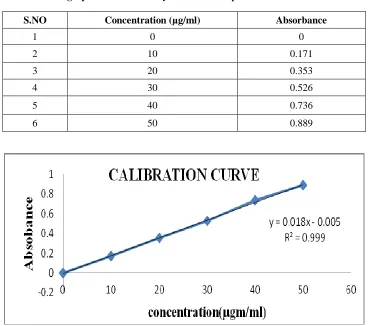
Calibration Curve
Standard curve of Metformin Hydrochloride by using pH 1.2 HCl buffer
Table 3: Data for standard graph of Metformin Hydrochloride in pH 1.2 HCl buffer at λ max 233 nm
S.NO Concentration (µg/ml) Absorbance
1 0 0
2 10 0.171
3 20 0.353
4 30 0.526
5 40 0.736
6 50 0.889
Evaluation Tests:
Particle Size
:
Fig 3: SEM of formulated Microspheres
Percentage Yield:
Table 4: Percentage yield of different formulations
Inference: Fromthe above table the percentage yield of prepared Microspheres was found to be more for the formulation F- 4 (72 %)
Entrapment Efficiency: [17,20,21]
In calculation of entrapment efficiency first measure amount of drug loaded in the total microspheres. For this U.V visible spectrophotometer is used for the analysis of drug.
Table No.5: Entrapment efficiency of the different formulations
Formulations Observed drug (mg) Total amount taken
(mg)
Entrapment efficiency(%)
F-1 45 100 67.5
F-2 47 100 65.8
F-3 46 100 69
F-4 49 100 70.56
Inference: From the above table Entrapment efficiency was found to be more for the formulation F – 4 i.e. (70.56 %).
Percentage Buoyancy:
Table 6: Buoyancy percentage of different formulations
S.NO Formulation code Percentage buoyancy
1 F-1 81.66
2 F-2 83.33
3 F-3 85.1
4 F-4 86
Inference: From the above table the percentage buoyancy was found to be more for the formulation F -4.
Formulations Total weight taken
(mg)
Total weight of microspheres (mg)
Percentage yield (%)
F-1 1100 750 68.1
F-2 1050 700 66.6
F-3 1050 750 71.4
Table 7: Dissolution kinetics for formulation F-4.
Time(hrs) Absorbance Conc. (μg/ml) Cumulative %
drug release % drug un released Log% released Log% unreleased 0.5 1 2 3 4 5 6 7 8 9 10 11 0.124 0.250 0.292 0.414 0.521 0.580 0.662 0.743 0.783 0.845 0.878 0.899 5.3 14.5 16.5 23 26.5 32 37.5 45 46 47 48.5 50 9.5 26.1 29.7 41.4 47.7 57.6 67.5 81 82.8 84.6 87.3 90 90.5 73.9 70.3 58.6 52.3 42.4 32.5 19 17.2 15.4 12.7 10 0.9777 1.4166 1.4727 1.6170 1.6785 1.7604 1.8293 1.9084 1.9180 1.9273 1.9410 1.9542 1.9566 1.8686 1.8469 1.7678 1.7185 1.6273 1.5118 1.2787 1.2355 1.1875 1.1038 1
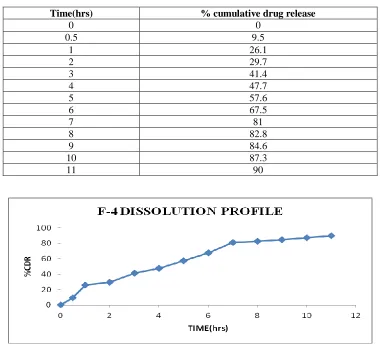
Table 8: Cumulative % drug release for the formulation F -4
Time(hrs) % cumulative drug release
0 0
0.5 9.5
1 26.1
2 29.7
3 41.4
4 47.7
5 57.6
6 67.5
7 81
8 82.8
9 84.6
10 87.3
11 90
Comparative Dissolution Profile
Table 9: Comparative dissolution profile for formulation F1 – F4
S.NO F-1 % CDR F-2 % CDR F-3 % CDR F-4 % CDR
1 0 0 0 0
2 11.08 12.1 19.9 9.5
3 18 21.6 21.6 26.1
4 27 26.1 31.5 29.7
5 31.5 37.8 39.6 41.4
6 37.8 45 46.8 47.7
7 46.8 50.4 54 57.6
8 52.2 59.4 71.1 67.5
9 56.7 69.3 75.6 81
10 67.5 71.1 79.2 82.8
11 73.8 74.7 82.8 84.6
12 75.6 80.1 85.5 87.3
13 81 81 88.2 90
Fig 5: Comparative dissolution profile for formulation F1-F4.
Inference: From the above fig the dissolution profile for the formulation F-4 was found to be have the more cumulative % drug release.
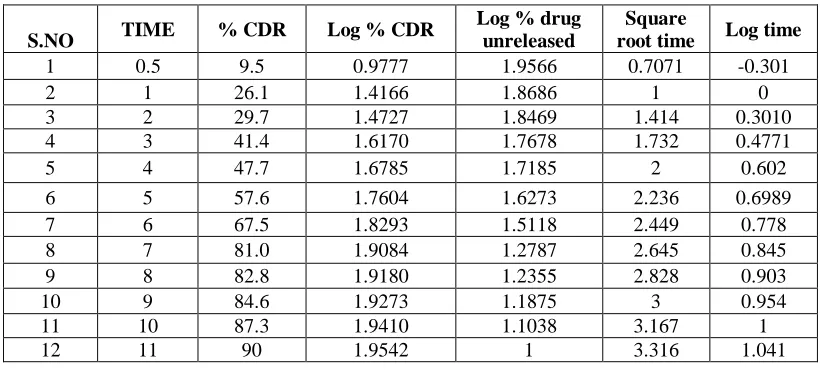
Dissolution – Application of Kinetics of F-4
Table10: Application of kinetics for dissolution profile of formulation F-4.
S.NO TIME % CDR Log % CDR
Log % drug unreleased
Square
root time Log time
1 0.5 9.5 0.9777 1.9566 0.7071 -0.301
2 1 26.1 1.4166 1.8686 1 0
3 2 29.7 1.4727 1.8469 1.414 0.3010 4 3 41.4 1.6170 1.7678 1.732 0.4771
5 4 47.7 1.6785 1.7185 2 0.602
6 5 57.6 1.7604 1.6273 2.236 0.6989 7 6 67.5 1.8293 1.5118 2.449 0.778 8 7 81.0 1.9084 1.2787 2.645 0.845 9 8 82.8 1.9180 1.2355 2.828 0.903
10 9 84.6 1.9273 1.1875 3 0.954
11 10 87.3 1.9410 1.1038 3.167 1
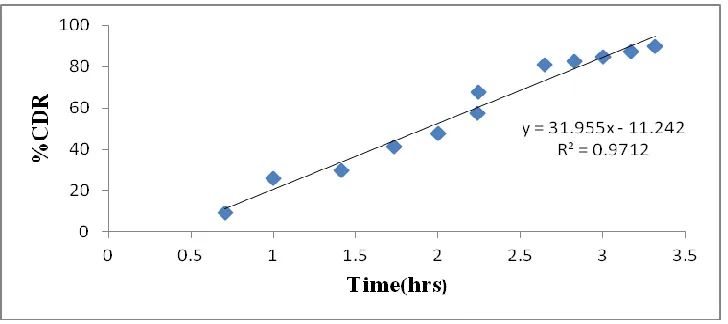
Zero Order Plot
Fig 6: Zero order plot for optimized formulation F-4
First Order Plot
Fig 7: First Order Plot for optimized formulation F-4
Inference: From the above graphs the R2 value is (0.977) and for zero order plot R2 value is ( 0.957) which indicating that the order of release was first order.
Higuchi’s Plot
Korsemeyer- Peppas Plot
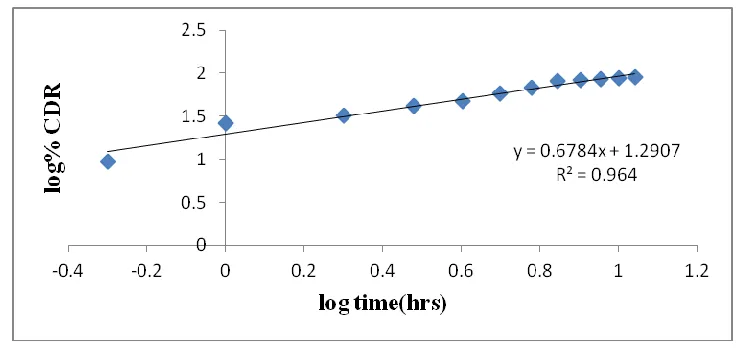
Fig 9: Korsemeyer -Peppas plot for optimized formulation F-4
Inference: As per the above plot Fig No. 17 and Fig No. 18. The R2 value for Higuchi (0.974) and for Korsemeyer - Peppas plot (0.964), showing that the mechanism of drug release from the formulation was found to be Diffusion controlled release.
Stability studies:[27,28]
The accelerated stability study for the formulation at 40 ± 20 C and 75 ± 5 % RH was conducted for the 3 months, which includes the testing of parameters like identification of physical characters, identified by IR studies, dissolution profile and assay throughout period.
CONCLUSION:
The present study reported the development of Metformin Hydrochloride (Anti diabetic drug) loaded floating microspheres with polymers HPMC K100 M, sodium CMC. Sodium bicarbonate gas generating agent along with calcium chloride as gelling agent was essential to achieve In-vitro buoyancy. The drug release from the floating microspheres was sufficiently controlled. The floating microspheres prepared were found to be spherical and free flowing.
Drug release kinetics performed for ideal formulations, fitted best with zero order plot and Korsemeyer-Peppas equation based on the highest “ R2 ” value. The R2 value of Korsemeyer-Peppas equation indicated non-Fickian diffusion controlled released. The selected formulations were subjected to stability studies which indicated that the formulation were stable and retained their pharmaceutical properties at room temperature and 45 0C / 75 % RH over a period of 3 month. Based on the results the best formulation F4 can successfully be employed as a controlled release floating drug delivery system. The floating Microspheres can control the fluctuations in the plasma drug concentration,
increase the gastric residence time and eventually improve the bioavailability of the drug. Floating Microspheres were prepared using Ionotropic gelation method. From the findings obtained, it was concluded that:
Compatibility studies revealed no interactions between the drug and polymers used.
Formulated Microspheres gave satisfactory result for various physic- chemical evaluations like physical appearance, surface morphology, entrapment efficiency, percentage drug loading, percentage buoyancy and In-vitro drug release.
The prepared beads showed required drug release in about 12 hours as aimed for.
From the research, it can be concluded that Metformin Hydrochloride can be formulated as Microspheres for the desired use in treatment of Diabetes Mellitus.
REFERENCES:
1.Chein Y.W, Novel Drug Delivery System : Fundamentals and applications , 2nd ed: Marcel Dekker ; New York : (1992) pg.No:4-56.
2. Biopharmaceutics and pharmacokinetics a Treatise D.M. Brahmankar, Sunil B. Jaiswal pg.No:488 3.A.V. Yadav H. mote, Development of Biodegradable starch for Intranasal Delivery , Indian Journal of Pharmaceutical Sciences, (2008), 70(2) ; 170-174.
H.Berkel, R.F. Holcomle , m.Middle, blcooks and R.Kannam , Non-steroidal anti-inflammatory drug and colorectal cancer , epidermal Rev; (1996) ; 18: 205-217.
5.J.P,Soarse, J.E.Santos, J.O.Chierce and E.T.G Cavatheiro , Thermal behaviour of alginic acid and its sodium salt , ECL. Quimsao Paulo (2004) ; 29: 53-56.
6. Desai S, Bolton S. A Floating Controlled Release system : In-vitro and In-vivo evaluation , J. Pharm Res., (1986) : 3; P.208 -213.
7.Patel H, Patel R, Patel G. Ionotropic Gelation Technique for Microencapsulation of Antihypertensive drug. WebmedCentral pharmaceutical sciences 2010;1(10).
8. Ghodake J.D , Vidhate J.S , Shinde D.A , Kadam A.N. “Formulation of Floating Microsphere containing Anti-diabetic Drug”. International Journal of PharmTech Vol.2, no.1 , pp 378-384. (2010). 9.Sreenivasulu.S, Harish Nayari M, Brijesh Yadav, Narayana Charyulu R, Satyanarayana D, and Subramanayam E.V.S. Formulation and in vitro evaluation of gastric oral floating Microspheres of
Metformin Hcl. Indian
j.pharm.Educ.Res2008;42(2):174-183.
10. Vinod KR, Sri AP, Banji D, Anbazhagan S, Vasa S, Sandhya S. Formulation and in vitro characterization of lansoprazole floating gastroretentive microspheres by modified non aqueous solvent evaporation method. Der Pharm. Chemica. 2010; 2(5): 419-425.
11. Manish Patel P , Patel MM, Patel KN, Patel DR, Patel UL. Designing and evaluation of microspheres of verapamil hydrochloride, effect of methocel. Research journal of pharmaceutical dosage forms and technology.2009;1:22-28.
12.GattaniY.S.,Floating Multiparticulate drug delivery systems: an overview, International Journal of Pharma and Bio Sciences, 2010 Vol(2) .
13.TanwarYS, Naruka PS, Ojha GR. Development and evaluation of floating microspheres of verapamil hydrochloride. Brazilian Journal of Pharm. Sci. 2007; 43(4): 529–534
14. Jain AK, Jain CP. Buoyant microspheres of Famotidine: An Approachable Dosage form for Gastric treatment. J. Young Pharm. Dec. 2009; 1(1): 20-23
15.Senthilkumar SK, Jaykar B, Kavimani S. Formulation, Characterization and Invitro evaluation of floating microsphere containing Rabeprazole sodium. JITPS. 2010; 1(6): 274-282.
16.Karthikeyan D, Karthikeyan M, Ramasamy C. Development of floating microspheres to improve oral bioavalibity of cefpodoxime proxetil. Acta Pharm. Sciencia. 2010; 52: 101-104.
17. Ghodake. P , Patil Sangamesh A, Belhekar Anaga A, Halligudi Shivraj B, Aminabhavi Tejraj M. preparation and evaluation of floating microspheres with Metformin Hydrochloride. Journal of pharmacy Research.2007; 105:2764-2771.
18. Srivastava AK, Ridhurkar DN, Wadhwa S. Floating microspheres of cimetidine: Formulation, and characterization and in vitro evaluation. Acta Pharm. 2005; 55: 277-285.
19. Kale RD and Tayade PT. a multiple unit floating drug delivery system of piroxicam using Eudragit, HPMC, EC polymers Indian Journal of Pharmaceutical Sciences. 2007,69:120-123.
20. Shashikant Barhate D, Yogesh Rupnar S, Rupesh Sonvane M and Rahulkumar Rahane D. Formulation and evaluation of floating of floating microspheres of Ketorolac Trometamol. International Jounal of Pharma Research and Development. 2009;1:1-8. 21. Yuveraj Singh Tanwar, Pushpendra singh Naruka, Garima Rani Ojha Development and evaluation of floating microspheres of Verapamil hydrochloride . brailian Journal of Pharmaceutical Sciences. 2007;4:529-534.
22. Narasaiah, Pasha ST, srinivasan S, Ray S. Design and Optimization of a Multiparticulate Gastroretentive Dosage Form Sumanatriptan Succinate floating tablets. Journal of Pharmaceutical Science and Technology . 2009; 1: 40-47.
23. Rokhade Ajit P, Patil Sangamesh A, Belhekar Anaga A, Halligudi Shivraj B, Aminabhavi Tejraj M. preparation and evaluation of cellulose acetate butyrate and poly(ethylene oxide) blend microspheres for gastroretentive floating delivery of Repaglinide. Journal of Applied Polymer science. 2007;105:2764-2771
24. http\Drug Bank Metformin (DB00331).mht. 25.http://www.fda/drugd/metformin.com.
26. Hand Book of Pharmaceutical Excipients fifth Edition. Raymond c. Rowe. Paul J.Sherkey and Sian C Owe. Pg.No: 334 , 665.
27. Leon Lachman, Herbet A. Lieberman, Joseph L. Kanig, “The Theory and Practice of Industrial Pharmacy” , Varghese Publishing house, Third Edition, pg: 101-104.