JEEECCS, Volume 1, Issue 1, pages 33 - 43, 2015
Automatic Systems for Wastewater pH
Control- A Comparative Study
Mădălina Cărbureanu
Department of Control Engineering, Computers and Electronics Petroleum-Gas University
Ploieşti, Romania [email protected]
Abstract – This paper presents the development, at the simulation level, of three automatic systems for wastewater pH control. These systems were built using conventional control methods (Proportional-Integral-Derivative – PID) and also advanced control techniques (fuzzy logic, artificial neural networks-ANN and adaptive neuro-fuzzy inference systems-ANFIS). For each of the developed systems it is achieved a description and a presentation of the simulations results. The goal of this paper is the analysis of the developed systems performance, using specific criteria within a comparative study.
Keywords- pH; automatic system; control; PID; fuzzy logic; ANN; ANFIS
I. INTRODUCTION
For processes control, conventional methods are used (PID, Gain-Scheduled PI/PID) along with advanced methods, some of these belonging to artificial intelligence (AI) domain, such as: fuzzy logic, adaptive neuro-fuzzy inference systems (ANFIS), artificial neural networks (ANN) and knowledge based methods (expert systems - ES and data mining techniques). The behavior (the high nonlinearity) of the studied process, namely the wastewater pH neutralization process from a wastewater treatment plant (WWTP), determines the usage of a conventional control method or an advanced one.
Among the conventional control methods, the most used is PID algorithm for which various applications in treatment processes control are presented in literature. According to this algorithm, a conventional continuous controller generates the command through the current error processing [1, 2]. As the majority of the treatment processes are nonlinear, the usage of PID algorithm raises a number of issues. For instance, in the case of wastewater pH neutralization process, the problems are related to: the high nonlinearity, the extremely high gain (Kp) in the pH neutral zone (pH≈7) and the high precision of the neutralizing agents dosage, with direct consequences on the actuators (dosage pumps).
In literature it is presented a set of PID algorithm applications in treatment processes control. So, in the
papers [3, 4, 5 and 6], the PID-based algorithm was applied for pH neutralization process control, proving to be ineffective due to the process high nonlinearity. The proposed solution, to compensate this PID disadvantage, was the combination of PID algorithm with AI techniques or with cascade control. In the papers [7, 8 and 9], the PID-based algorithm was also applied to the control of the activated sludge treatment process. Also in this case, PID was ineffective due to the process nonlinearity and the lack of process knowledge, the solution being the usage of PID combined with fuzzy logic. Shaw in paper [10] states that PI/PID controllers are operating with maximum efficiency when the controlled process is linear and does not cope with the nonlinearity of the treatment processes. So, for high nonlinear processes it is recommended the usage of nonlinear controllers, instead of linear ones [2, 11 and 13].
The Gain-Scheduling PID algorithm was developed to compensate the disadvantages of traditional one. This type of control is possible only when the controlled process is very well known, fact very hard to achieve in the case of some of the wastewater treatment processes (such as pH neutralization and the biological processes). Some examples from literature of Gain– Scheduled PID usage in wastewater processes control, especially in pH control are presented in papers [13, 14, 15 and 16].
In literature is presented a set of fuzzy logic applications in wastewater treatment processes control, such as: the control of chemical (pH neutralization process) and biological processes (activated sludge process, anaerobic digestion, and aeration process), from a WWTP [17, 18, 19, 20, 21, 22 and 23].
The neuro-fuzzy methods, namely the adaptive neuro-fuzzy systems (ANFIS) were developed from the need to compensate the disadvantage of fuzzy systems (the permanent updating process of MFs and of a consistent data base is time consuming). A solution was the addition of the artificial neural networks to fuzzy systems, because of their capacity to adapt, being obtained the so-called adaptive neuro-fuzzy systems. According to [24, 10, 25, 26 and 27], the ANFIS present multiple advantages, from which the most important is the usage of an ANN (that comes with the capacity to adapt) in the automatic process development of the fuzzy inference system (FIS), respectively in the rules and MFs development. This approach has gain more popularity in the industrial domain. According to literature, the ANFIS are applied in chemical processes control from a WWTP and also at continuous stirred tank reactors (CSTR) level [28, 29, 30, 31 and 32].
Due to their many advantages, the ANN can be trained to become process estimated models, can model and control environmental processes with essential nonlinearities, are equipped with a set of intelligent features (learning, adaptation, fault tolerance and abstraction) and are used to solve complex problems from various areas (including chemical engineering), especially in the control of wastewater treatment processes [10, 12, 33, 34 and 35]. In literature, it can be found a number of applications of ANN in wastewater treatment process modeling, prediction, monitoring and control [36, 37 and 38].
The knowledge based methods (the expert systems and data mining techniques) are also applied in processes control. Some of the ES advantages are [39, 40 and 41]:
The combination with other methods (fuzzy logic, ANFIS).
Can work as a controller similar with a fuzzy controller.
Can maintain a knowledge base about the WWTP processes and abnormal situations.
Are a very useful tool in the operation, management, design and control of the technological processes.
Are effective in the case of treatment processes with significant disturbances.
The data mining (DM) techniques can be used in the monitoring and control of wastewater treatment processes (the anaerobic process, wastewater pH neutralization) and also in various projects, as Telemac [42, 43, 44 and 45].
Other applications of DM were identified in papers [46], [47], [48] and [49], this technique being used in:
knowledge discovery (rules extraction), environmental database management, analysis of a plant emissary pollution level, efficiency analysis of a WWTP mechanical step and in the quality analysis of a WWTP effluent.
The paper is organized as follows:
A short description of the wastewater pH neutralization process from the studied industrial refinery.
The development of an automatic system (AS) using PID algorithm, named SRApHPID for wastewater pH control and the interpretation of the simulations results.
The development of an automatic system using fuzzy logic, named FuzzypHControl for pH control and the interpretation of the simulations results.
The development of an automatic system using artificial neural networks, named ANNpHControl for pH control and the interpretation of the simulations results.
A comparative study of the developed systems.
II. THE WASTEWATER PH NEUTRALIZATION PROCESS
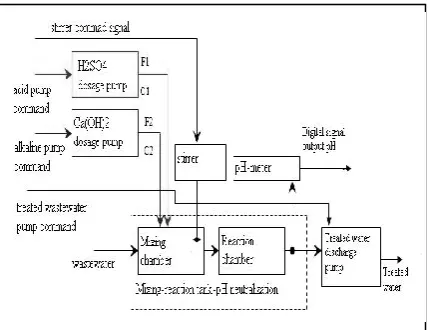
In the considered Romanian refinery, the wastewater pH neutralization process takes place in the chemical step of the Wastewater Chemical and Biological Treatment Plant (WCBTP), respectively in an admixture-reaction tank. According to the plant operating manual, the hydrated lime (Ca(OH)2), with a concentration (C2) of 10% is used as a chemical agent to neutralize an acid pH and the sulfuric acid (H2SO4), with a concentration (C1) of 95% for neutralizing an alkaline pH [50]. In the first compartment of the admixture-reaction tank it takes place the mechanical mixing of the wastewater with the chemical agents, while in the second one the pH neutralization process occurs. After that, the neutralized wastewater is directed to the plant biological step [50]. In table 1 the following parameters are presented: F1 – the H2SO4 flowrate with concentration C1 (95%), F2 – the Ca(OH)2 flowrate with concentration C2 (10%) and the volume of the admixture-reaction tank (V -liters).
TABLE I. CHEMICAL STEP REACTANTS PARAMETERS [50,51]
F1
[liters /hr]
C1
[%] F2
[liters /hr]
C2
[%] V
[%] [mol/
[liters] [%]
[mol/ [liters]
[25 -
300] 95 17.74
[5000-
7000] 10 1.5 40 00
Figure 1. Wastewater pH neutralization process block diagram
For the process of wastewater pH neutralization from the studied Romanian refinery a mathematical model from literature was chosen, respectively the mathematical model presented in paper [52]. The main equations of the model are:
In equations (1) and (2), F1 represents the acid stream flowrate with concentration C1, F2 represents the alkaline stream flowrate with concentration C2, V is the pH neutralization compartment volume, while α and β are the concentrations of acid and alkaline components in neutralization basin [50, 51].
As was shown in paper [51], the pH neutralization process has a strong non-linear behavior within the entire F1 and F2 domain and the reactants dosage precision is very high, with direct consequences on the actuators (dosage pumps).
III. THE SRAPHPID AUTOMATIC SYSTEM DEVELOPMENT
The automatic system SRApHPID PID-based was developed using MATLAB 7.9/Simulink environment. Actually, was implemented a PI controller (derivative Td component was set to zero), adjusted for both operating situations (acid and alkaline pH control). The goal was to verify if there is or not a pair of tuning parameters (KR, Ti) available on the entire pH domain.
In the case of SRApHPID adapted for alkaline pH control was considered F2 constant and F1 variable, while in the case of acid pH control, was considered F1 constant and F2 variable. The control law that was used in this case is given by relation (3).
The architecture of SRApHPID automatic systems, presented in figure 2, has the following components: pH set point (pH=7), the PID controller, the process
model, the flowrates F1 and F2 and the measured pH value at the process output.
Figure 2. SRApHPID arhitecture
First, it was made the tuning of the PID controller in various points of the pH domain, respectively were determined the controller tuning parameters (KR, Ti) for alkaline and acid pH domains. The tuning parameters, presented in paper [51], were determined using relations (4) and (5).
K
Rx K
p=0.9
(4)
=
(5)
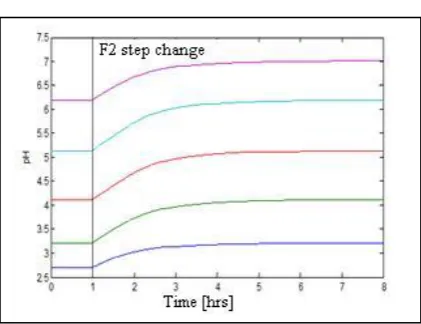
Figures 3 and 4 describe the results of the simulations made with SRApHPID system for both cases (alkaline and acid pH), using the tuning parameters presented in paper [51].Figure 4. Simulated process response times at F2 step change (SRApHPID results for acid pH control)
As it can be observed in figure 3 and figure 4, the SRApHPID automatic system ensures null steady state error (est) and response times between 5 and 6 hours (alkaline pH case) and around 5 hours (acid pH case), using the determined tuning parameters [51]. This response times can be improved through KR adjusting (the increasing of its value) or Ti adjusting (the decreasing of its value). The results obtained using the adjusted tuning parameters (presented in table II and table III) for alkaline and acid pH are those presented in figure 5 and figure 6.
TABLE II. SRAPHPID(ALKALINE PHCASE) SIMULATIONSRESULTS-ADJUSTEDTUNNING
PARAMETERS
No. transient time [hrs] Initial parameters Adjusted parameters transient time [hrs]
1 5h50min 5h37min
2 7h12min 6h2min
3 6h25min 5h39min
4 6h29min 5h50min
5 6h57min 4h54min
6 6h3min 5h23min
TABLE III. SRAPHPID(ACID PHCASE)SIMULATIONS RESULTS-ADJUSTEDTUNNINGPARAMETERS
No. Initial parameters transient time [hrs]
Adjusted parameters transient time [hrs]
1 5h26min 4h15min
2 5h32min 4h31min
3 5h39min 4h22min
4 5h32min 4h9min
5 5h28min 4h9min
Figure 5. SRApHPID (alkaline pH case) simulations results using the adjusted parameters
Figure 6. SRApHPID (acid pH case) simulations results using the adjusted parameters
IV. THE FUZZYPHCONTROL AUTOMATIC SYSTEM DEVELOPMENT
In this section is presented the automatic system FuzzypHControl, based on a fuzzy controller RpHFuzzy of Sugeno type, system developed using Fuzzy Logic Toolbox from Matlab 7.9/Simulink.
In the figure 7 the FuzzypHControl system architecture is presented, a system that has the following components:
The pH set point (pHi=7);
A fuzzy controller (RpHFuzzy) of Sugeno type, with one input (the error defined as the difference between pH set point (pHi) and the pH value at the process output e=pHi-pH) and one output represented by the pump opening degree (EE_opening_degree) for hydrated lime Ca(OH)2 dosage;
An actuator (EE), namely the dosage pump for hydrated lime (Ca(OH)2), for acid pH adjustments. It must be mentioned that the control of an alkaline pH was also made through the command of the same actuator, because in practice, in almost all situations, the alkaline neutralization agent is used, the acid neutralization agent (H2SO4) being very expensive and corrosive.
The process represented by a mathematical model from literature, for wastewater pH neutralization process [52].
Figure 7. SRA FuzzypHControl arhitecture
For developing the fuzzy Sugeno type controller (RpHFuzzy), with the architecture from the figure 8, was used the Fuzzy Logic Toolbox from MATLAB. For the controller Simulink implementation was used the Fuzzy Logic Controller with Rule viewer block.
Figure 8. RpHFuzzy controller arhitecture
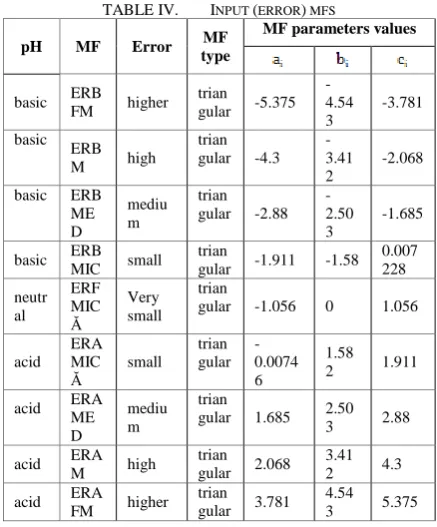
In table IV the membership functions (MFs) are presented for the controller input (error).
TABLE IV. INPUT (ERROR) MFS
pH MF Error MF
type
MF parameters values
basic ERB
FM higher trian
gular -5.375 -4.54 3
-3.781
basic ERB M high
trian gular -4.3
-3.41 2
-2.068
basic ERB ME D
mediu m
trian gular -2.88
-2.50 3
-1.685
basic ERB MIC small
trian
gular -1.911 -1.58 0.007 228
neutr al
ERF MIC Ă
Very small
trian
gular -1.056 0 1.056
acid ERA MIC Ă small
trian gular
-0.0074 6
1.58
2 1.911
acid ERA ME D
mediu m
trian
gular 1.685 2.50 3 2.88
acid ERA M high
trian gular 2.068
3.41 2 4.3
acid ERA
FM higher trian gular 3.781
4.54
3 5.375
The output EE_opening_degree (the controller command) is described in table V. The negative sign represents the controller method to indicate the pH domain in which the process is at the current time.
TABLE V. OUTPUT (EE_OPENING_DEGREE) MFS
pH MF MF value
BASIC EEpHB4 -0.0213
BASIC EEpHB3 -0.0142
BASIC EEpHB2 -0.0071
BASIC EEpHB1 -0.007
NEUTRAL EEpH 0.00707
ACID EEpHA1 0.01415
ACID EEpHA2 0.0142
ACID EEpHA3 0.0213
ACID EEpHA4 0.0284
TABLE VI. FUZZYRULES
No. error EE_opening_ degree
1
i f
ERBFM
t h e n
EEpHB4
2 ERBM EEpHB3
3 ERBMED EEpHB2
4 ERBMICA EEpHB1
5 ERFMICA EEpH
6 ERAMICA EEpHA1
7 ERAMED EEpHA2
8 ERAM EEpHA3
9 ERAFM EEpHA4
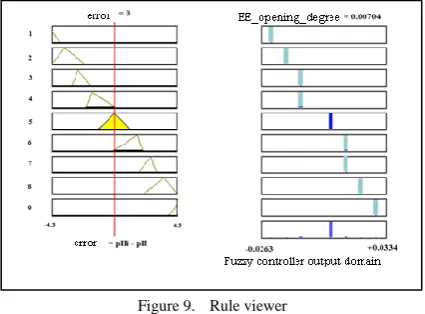
After implementing the fuzzy rules from table VI, the obtained rules viewer from figure 9 represents a map of the whole fuzzy inference process.
Figure 9. Rule viewer
Figure 10 represents, in a compact way, all the information from the process and shows, under a graphical form (Surface Viewer), the
EE_opening_degree dependence on the input error.
Figure 10. RpHFuzzy controller Surface Viewer
The graphic from figure 10 can be interpreted as follows:
When the error=0 (pHi=pH), the Ca(OH)2 dosage pump opening degree is 0.00704.
When error= - 4, meaning that the wastewater pH is 11 (strong basic), the command C= -0.0175.
When error= 4, meaning the wastewater pH is 3 (strong acid), the command C=0.0246.
In table VII and figure 11 are presented the results of the simulations supplied by FuzzypHControl automatic system for the case of acid pH control (was considered F1=260liters/hr (constant) and the starting value for F2 being 6150 liters/hr).
TABLE VII. FUZZYPHCONTROL SIMULATIONS RESULTS FOR ACID PHCONTROLCASE
No.
simulation pH domain
Transient time (Ttr)
1 2.70 7 5hrs36min
2 3.22 7 4hrs55min
3 4.11 7 3hrs45min
4 5.14 7 2hrs28min
5 6.19 7 1hr48min
Figure 11. FuzzypHControl automatic system response times (transient times Ttr) for acid pH control case
As it can be observed in table VII and the figure 11, the FuzzypHControl automatic system supplies very good results from any point of acid pH domain, meaning that the pH set point was reached and the error is zero.
In the table VIII and the figure 12 are presented the results of the simulations provided by FuzzypHControl automatic system for the case of alkaline pH control (F1=260liters/hr was considered a constant) and the starting point for F2 being 6149liters/hr).
TABLE VIII. FUZZYPHCONTROLSIMULATIONS RESULTSFORALKALINE PHCONTROLCASE
No.
simulation pH domain
Transient time (Ttr)
1 8.06 7 22min
2 9.77 7 34min
3 10.81 7 1hr28min
4 11.76 7 2hrs40min
5 12.85 7 4hrs12min
Figure 12. FuzzypHControl automatic system response times (transient times Ttr) for alkaline pH control case
As it can be observed in table VIII and figure 12, the FuzzypHControl supplies good results from any alkaline pH domain point, namely the pH set point was reached and the error is null.
Therefore, the automatic system FuzzypHControl having implemented the developed fuzzy controller RpHFuzzy, assures the acid and alkaline pH control from any pH domain point. Using fuzzy logic, was developed a controller that works on the entire pH domain, a thing difficult to achieve using PID control, because of the process high nonlinearity.
V. THE ANNPHCONTROL AUTOMATIC SYSTEM DEVELOPMENT
The automatic system ANNpHControl, that uses an artificial neural network controller (ANN Controller), was developed using the Neural Network Toolbox from MATLAB 7.9/Simulink. The ANNpHControl system architecture is presented in figure 13, a system that has the following components:
An ANN controller with two inputs (the pH set point pHi=7 and the measured pH value at the process output). The controller output is represented by the Ca(OH)2 dosage pump command (F2).
An actuator (EE), namely the dosage pump for hydrated lime (Ca(OH)2) necessary for the control of an acid pH. It must be mentioned that the control of an alkaline pH was also achieved through the command of the same actuator, for the same reasons mentioned in the case of fuzzy control.
The process represented by the wastewater pH neutralization process mathematical model.
The used ANN was trained (by Levenberg-Marquardt algorithm) and validated (the validation data followed the training data) to represent the process dynamics. The error (the difference between the process output and the ANN output) was used as the ANN training signal. It was generated a number of one hundred training data sets, while the number of epochs for training the ANN was one hundred. An ANN very well trained was obtained, therefore it was used as the controller of the ANNpHControl automatic system.
Figure 13. ANNpHControl system arhitecture
In table IX the simulation results supplied by ANNpHControl system are presented. First of all, it was considered the acid pH control case (F1 constant, F1=260 liters/hr) and the starting point for F2 was set to 6150 liters/hr. As it can be observed in figure 14 and in table IX, the control system assures null steady state error (est) and the response times between one and six hours.
TABLE IX. ANNPHCONTROL SIMULATIONSRESULTS FORACID PH CONTROLCASE
No.
simulation pH domain
Transient time (Ttr)
1 2.70 7 6hrs
2 3.22 7 5hrs32min
3 4.11 7 4hrs27min
4 5.14 7 3hrs4min
5 6.19 7 1hrs
Figure 14. ANNpHCONTROL automatic system response times (transient times) for acid pH control case
As it can be observed, the ANNpHControl system supplies good results from any pH domain point, namely the pH set point is reached and assures null error.
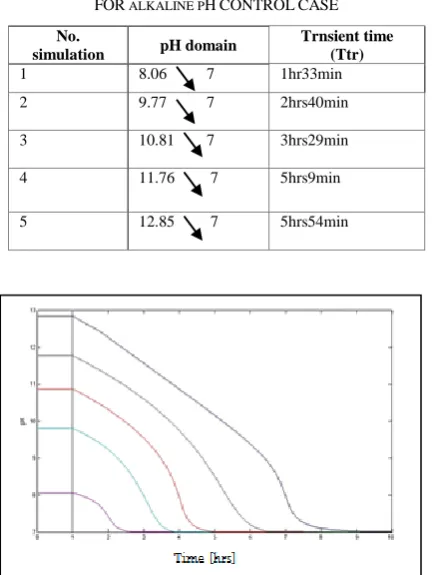
As it can be observed in table X and figure 15, the ANNpHControl system assures null steady state error (est) and response times between one and six hours.
TABLE X. ANNPHCONTROL SIMULATIONSRESULTS FOR ALKALINE PHCONTROLCASE
No.
simulation pH domain
Trnsient time (Ttr)
1 8.06 7 1hr33min
2 9.77 7 2hrs40min
3 10.81 7 3hrs29min
4 11.76 7 5hrs9min
5 12.85 7 5hrs54min
Figure 15. ANNpHCONTROL automatic system response times (transient times) for alkaline pH control case
The ANNpHControl system, having implemented the developed ANN controller, assures the alkaline pH control from any pH domain point.
Therefore, it was developed a controller (ANN Controller) based on an ANN, that works on the entire pH domain. This is an advantage of using ANN controllers, unlike the PID ones, that are very difficult to implement to operate on the entire domain of a controlled parameter.
VI. A COMPARATIVE STUDY OF THE DEVELOPED SYSTEMS
In this section is achieved a comparative study (presented in table XI) of the developed systems for wastewater pH control, using conventional techniques (PID algorithm) and also artificial intelligence techniques (fuzzy logic, ANN and ANFIS). The systems performance analysis was achieved using the following criteria: the steady state error (est), the supplied transient times (Ttr), the systems controller operating on the entire pH domain, the solving of the wastewater pH neutralization process nonlinearity problem, the usage of heuristics in the system controller development process and the time consumption associated to the development process of the analyzed systems.
It must be mentioned that the system ANFISpHControl, developed by the author, was
presented in paper [51], where are also presented the results of the simulations.
TABLE XI. COMPARATIVE STUDY OF THE DEVELOPED SYSTEMS AS Criteria SRA pHPID FuzzypH Control ANN pH Control ANFIS pH Control
est null null null null
T
tr [h rs] D escri p ti o nhigh smaller than those supplied by SRApHPID
better than those supplied by SRApHPI D, but not better than those supplied by FuzzypHC ontrol and ANFISpH Control
smaller than those supplied by SRApHPI D; similar to those supplied by FuzzypH Control A ci d p H 4hrs9mi n…4hrs
31min 1hr48min...5
hr36min 1hr...6hr
1h54min... 5hrs38min A lk al in e p H 4hrs54 min...6h
rs2min 4hr38min 22min... .5hrs54min 1hr33min.. 25min...4hrs40min
The controller operating on the entire pH domain
no yes yes yes
The neutralizat ion pH process nonlinearit y solving
no yes yes yes
Heuristics
usage no yes yes yes
System developing process Time consumi ng Time consuming Time consuming
Is not time consumin g
Another disadvantage of the system SRApHPID is the fact that, in its development process, is not used the heuristic knowledge of the human expert in domain. There are known only the control law that is used, the fact that Td parameter can be equal with zero and the way of determining the tuning parameters. Only through a very good knowledge of the wastewater pH neutralization process (at a detailed level), a powerful controller can be developed and that works on the entire domain of the controlled parameter (pH). This fact is available also in the case of Gain-Scheduling PID, which implies the detailed and beforehand knowledge of the process operating.
The system FuzzypHControl ensures a quality control for acid and alkaline pH, meaning that the pH set point was reached, the error was zero, and the transient times are considerably smaller as opposed to the ones supplied by SRApHPID. The most important advantage of the FuzzypHControl system is the usage of a fuzzy logic controller (RpHFuzzy), also developed by the author. Through this controller that works on the entire domain of the controlled parameter (pH), it is solved the neutralization process nonlinearity problem. Another advantage is the usage of heuristics (the human expert’s knowledge in domain) in the fuzzy controller development. Therefore, it was no need for a rigorous process modeling. It was sufficient a fuzzy rule base defined by the human expert in domain, through which was achieved a very good description of the controlled process. The disadvantage of the FuzzypHControl system is represented by the fact that the fuzzy controller (RpHFuzzy) developing process was time and effort consuming.
The ANNpHControl system ensures a pH control with better performance than the SRApHPID system, but not better than that supplied by FuzzypHControl and ANFISpHControl systems. The advantage, as in the case of FuzzypHControl and ANFISpHControl systems, it is given by the operating of the developed controller (ANN Controller) on the entire parameter (pH) domain. It was observed that the developed controller works better when it has a training data set big enough at its disposal. The system developing process was time consuming, because the time period dedicated to ANN training was high, but once the training was achieved, good results were obtained.
The ANFISpHControl system, developed by the author in paper [51], ensures a very good performance control (null error, small transient times). The transient times are much smaller than the ones supplied by the SRApHPID system and similar to the ones supplied by FuzzypHControl system. As in the case of FuzzypHControl system, the adaptive neuro-fuzzy controller (R-ANFIS) developed by the author, works on the entire domain of the controlled parameter (pH). This way, the process nonlinearity problem was solved. In addition to using heuristic knowledge under a training data set form (obtained through the detailed knowledge of the pH neutralization process), the advantages of using adaptive neuro-fuzzy systems (obtained by joining ANN to fuzzy systems) are brought together. The system process developing was not time and effort consuming, due to adding ANN
(theirs capacity to learn and to adapt) to fuzzy systems. The automatically generated fuzzy system parameters (the rules and the membership functions) were calculated through learning (training) methods using training data sets. In this way, the FuzzypHControl system disadvantage is removed, if we can say so, namely the explicit (manual) building of the rules base and of the controller input and output membership functions.
VII. CONCLUSIONS
As was stated in [51], the pH neutralization process from a refinery plant is a complex one, because of its dynamic behavior and mostly of its high non-linearity. Because of these characteristics, the pH control by means of conventional techniques (Proportional-Integral-Derivative – PID or Gain-Scheduling PID) is not suitable for such a process. A solution, as it was shown in the present paper and in paper [51], is represented by the usage of artificial intelligence techniques, such as: fuzzy logic, artificial neural networks (ANN) and adaptive neuro-fuzzy inference systems (ANFIS).
Regarding the PID control, it was concluded that it is very difficult to identify a pair of tuning parameters (KR, Ti) available on the entire pH domain. This fact makes the process of PID controller development effort and time consuming, more than others methods. So, it is not recommended the usage of PID control for such a process, because on each domain is available another pair of tuning parameters.
By using AI techniques, can be developed controllers (fuzzy, ANN and ANFIS controllers) that work on the entire parameter domain (in this case, pH). This type of controllers, as a component of the developed automatic systems, assure a quality control (the pH reaches the pH set point, the supplied error is small and the transient times Ttr correspond to those registered in the studied plant), as results from the comparative study (Table XI).
It was observed that the usage of adaptive neuro-fuzzy systems, respectively the usage of neuro-neuro-fuzzy systems, respectively the usage of neuro-fuzzy controllers obtained through a Sugeno type fuzzy logic system developing, training and testing were proved to be a good solution for the wastewater pH neutralization process control.
The neuro-fuzzy control process relies exclusively on the user experience in the domain and on the human expert level of knowledge regarding the analyzed process. This fact requires from the author a raised level of knowledge of the analyzed process (the wastewater pH neutralization process from the studied industrial plant).
As a final conclusion, from the automatic systems developed by the author in this paper and in paper [51], the system that proved to be the most performing for the process of wastewater pH neutralization is ANFISpHControl. The quality control supplied by this system recommends the usage of adaptive neuro-fuzzy systems for high nonlinear process control (such as the pH neutralization process). In addition to this, the adaptive neuro-fuzzy systems can be combined with other AI techniques, like knowledge based systems (expert systems and data mining techniques). An example of this type of system was developed by the author in paper [51]. The author used this approach in developing the neuro-fuzzy expert system named SENFpHCTRL for wastewater chemical treatment processes control.
REFERENCES
[1] V. Cîrtoaje, S. Frâncu, and A. Băieşu, Electronics and automation elements, Petroleum-Gas Press, 2003, pp. 112-114.
[2] S. Mihalache, S., Elements of control engineering, Matrix Rom Press, 2008, pp. 33-42.
[3] M. A., Henson, D. E., Seborg,., “Adaptive nonlinear control of a pH neutralization process”, Control Systems Technology, IEEE Transactions, Vol. 2, No. 3, 1994, pp.169-182. [4] A., Ishak, M., Hussain and E., Elkanzi, “Modeling and
control studies of wastewater neutralization process”,
Proceeding to Brunei International Conference on Engineering&Technology, Bandar Seri Begawan, 9-11 Oct., 2001, pp. 221-231.
[5] J., Kang, M., Wang and Z., Xiao, “Modeling and control of pH in pulp and paper wastewater treatment process”, J. Water Resource and Protection, Vol. 2, 2009, pp.122-127.
[6] A., Popov, A., Farag and Werner, H., “Tuning of a PID controller using a multiobjective optimization technique applied to a neutralization plant”, In Proc. IEEE Conf. Decision Control, 2005, pp. 7139-7143.
[7] Nonlinear PI control for dissolved oxigen tracking at wastewater treatment plant, http:// www.nt. ntnu .no/users /skoge/ prost/ proceedings /ifac2008 /data /papers /0477. pdf, accessed September 2015.
[8] Multivariable PID control of an Activated Sludge Wastewater Treatment Process, http:// www. Intechopen .com/ download /get /type /pdfs/id/15193 , accessed August 2015.
[9] Model based control of wastewater treatment plants, http:// citeseerx. ist. psu. Edu / viewdoc /download ?doi = 10 .1.1. 50. 2386 & rep = rep 1&type=pdf , accessed September 2015.
[10] I., Shaw, Fuzzy control of industrial systems. Theory and applications, Kluwer Academic Publishers, 1998, pp.77-85. [11] V. Marinoiu and N. Paraschiv, Chemical processes control,
Automatizarea proceselor chimice, vol. I+II, Technical Press, Bucharest, 1992, pp.320-325.
[12] Robescu, D. et al., The automatic control of wastewater treatment processes, Technical Press, Bucharest, 2008, pp. 339-347.
[13] C., Chan and C., Yu, “Autotuning of Gain- Scheduled pH control: An Experimental Study”, Ind. Eng. Chem. Res., vol. 34, no. 5, 1995, pp. 1718-1729.
[14] S. Gnoth, et al., “Simple adaptive pH control in bioreactors using gain-scheduling methods”, Applied Microbiology and Biotechnology , vol. 85, no. 4, pp. 955-964.
[15] J. Lin and C. Yu, “Automatic tuning and gain scheduling for pH control”, Chemical Engineering Science, vol. 48, no. 18, 1993, pp. 3159-3171.
[16] S. Regunath and V. Kadirkamanathan, “Design of a pH control system using fuzzy non-uniform grid scheduling and evolutionary programming”, Applied Soft Computing, vol. 1, no. 1, 2001, pp. 91-104.
[17] R. Benz, S. Menzl and M. Stuhler, ,”A self adaptive computer based pH measurement and fuzzy control system”, Wat Res. vol. 30, no. 4, 1996, pp. 981–991.
[18] M. Cărbureanu, “The Wastewater pH Control Using an
Artificial Intelligence Technique”, Petroleum-Gas University
of Ploiesti Bulletin, Technical Series, vol. LXIV, no. 3, 2012, pp. 83-93.
[19] M. J. Fuente, et al., “Fuzzy control of a neutralization process”, Engineering Applications of Artificial Intelligence, vol. 19, no. 8, 2006, pp. 905-914.
[20] T. Jose, A. Rahul, A. and S. Isaac, “pH neutralization in CSTR using model reference neural network and fuzzy logic adaptive controlling schemes”, International Journal of Advancements in Research & Technology, vol. 2, no. 1, 2013, pp. 1-6.
[21] B. Kelkar and B. Postlethwaite, “Fuzzy-model based pH control”, IEEE International Conference on Fuzzy Systems, vol. 1, 1994, pp. 661-666.
[22] M. Pishvaie and M., Shahrokhi, “Control of pH processes using fuzzy modeling of titration curve”, Fuzzy Sets and Systems, vol. 157, no. 22, 2006, pp.2983-3006.
[23] S. Noor, W. Khor and M. Ya’acob, “Fuzzy logic control of a nonlinear pH-neutralisation in wastewater treatment plant “, International Journal of Engineering and Technology, vol. 1, no. 2, 2004, pp. 197 – 205.
[24] J. Jang and C.T. Sun, “Neurofuzzy modeling and control”, Proceedings of the IEEE, vo. 83, no. 3, 1995, pp. 378-406. [25] Neuro-fuzzy systems, http://www. ac.tuiasi. ro/ ro/ library
/curs DIAGNOZA web / p3 _cap2_web.pdf, accessed 5 September 2015.
[26] Fuzzy and Neuro-Fuzzy Modelling and Control of Nonlinear Systems, http://www.nalanda.nitc.ac. in/nitcresources/ ee/ research/mohandas/proceed/14.pdf, accessed 15 August 201 5.
[27] MATLAB/Fuzzy Logic Toolbox, MathWorks, http://www .mty. itesm .mx/ dtie / centros/csi/materias/ia4002-1/docs/Fuzzy_Toolbox.pdf, accessed September 2015. [28] A. Aoyama, “A fuzzy neural-network approach for nonlinear
process control”, Engineering Applications of Artificial Intelligence, vol. 8, no. 5, 1995, pp. 483-498.
[29] V. Balas, P, Hristova and L. Jain, L., coauthors N. Paraschiv, , M. Oprea, M. Cărbureanu, M. and M. Olteanu, Innovations in Intelligent Machines-5.Computational Intelligence in Control Systems Engineering, Computational Intelligence Techniques for Chemical Process Control (Chapter 7) , Series Title Studies in Computational Intelligence, Series Vol. 561, Publisher Springer Berlin Heidelberg, Copyright Holder Springer –Verlag Berlin Heidelberg, 2014, pp. 191-226 . [30] L. Blahov and J. Dvoran, “Neuro-fuzzy control of chemical
technological processes”, Proceedings of the 17th Int. Conf. on Process Control, Slovakia, 2009, pp. 268-272.
[31] M. Cărbureanu, “Wastewater pH Control Using Artificial Intelligence Techniques- A Comparative Study”, Petroleum-Gas University of Ploiesti Bulletin, Technical Series, vol. LXV, no. 2, 2013, pp. 49-56.
[32] W. Chen, N. Chang and W. Shieh, “Advanced hybrid fuzzy-neural controller for industrial wastewater treatment”, Journal of Environmental Engineering, vol. 127, no. 11, 2001, pp. 1048-1059.
[33] K. Hunt, K., D. Sbarbaro, and P. Zbikowski, “Neural Networks for Control Systems – a survey”, Automatica, vol. 28, no. 6, 1992, pp. 1083-1112.
[35] R. Rustum and A. Adeloye, Artificial Intelligence modeling of wastewater treatment plants. Theory, applications and limitations, VDM Verlag Dr. Muller GmbH & Co, 2011, pp. 99-193.
[36] H. Cordova and A. Wijaya., “Self-Tuning Pid Neural Network Controller to Control Nonlinear pH Neutralization in WasteWater Treatment”, IPTEK, The Journal for Technology and Science, vol. 18, no. 3, 2007, pp. 89-95.
[37] S. Doherty, “Control of pH in chemical processes using artificial neural networks”, PhD Thesis, School of Engineering, Liverpool John Moores University, 1999. [38] H. Lacar, S. Olano, and E. Dadios,” Neural network controller
for pH neutralization process”, INHENYERIYA: An International Journal of Engineering, vol. 3, no. 1, 2003, pp. 25-32.
[39] M. Barnett, “Knowledge –based expert system applications in waste treatment operation and control”, ISA Transactions, vol. 31, no. 1, 1992, pp. 53-60.
[40] J. Mikosz, “Application of Expert Systems in Wastewater Treatment In:Wastewater Sludge and Solid Waste Management”, Raport no.9, M. Hopkowics, B. Hultman, J. Kurbiel, E. Plaza (Editors), TRITA-AMI REPORT 3088, 2001, pp. 137, 2001.
[41] A. Punal, E. Roca, and J.M. Lema, “An expert system for monitoring and diagnosis of anaerobic wastewater treatments plants”, Water Research,vol. 36, no. 10, 2002, pp. 2656-2666. [42] M. Cărbureanu, “An Expert System for Wastewater pH Control”, Proceeding of International Conference of Scientific Paper –AFASES, Brasov, EBSCO Publishing, ASCEDU- ASSOCIATION for RESEARCH and EDUCATION, 2012, pp. 777-781.
[43] M. Dixon, J. Gallop, S. Lambert and J. Healy, “Experience with data mining for the anaerobic wastewater treatment process”, Environmental Modelling & Software, vol. 22, no. 3, 2007, pp.315-322.
[44] M. Dixon, et al., “Data mining to support anaerobic WWTP monitoring”, Control Engineering Practice, vol. 15, no. 8, 2007, pp. 987-999.
[45] Telemac, http://www.ercim.eu/activity/projects/telemac.html, accessed 2 September 2015.
[46] M. Cărbureanu, “The Efficiency Level Analysis for the Wastewater Mechanical Treatment Process using Data Mining and Fuzzy Logic”, Petroleum-Gas University of Ploiesti, Mathematics-Informatics-Physics Series, vol. LXI, no. 2, 2009, pp.59-66.
[47] M. Cărbureanu, “Pollution Level Analysis of a Wastewater Treatment Emissary using Data Mining”, Petroleum-Gas University of Ploiesti, Mathematics-Informatics-Physics Series, vol. LXII, no. 1, 2010, pp. 69-78.
[48] M. Cărbureanu, “A System for Monitoring the Effluent’s Quality of an Industrial Wastewater Treatment Plant,” The 5th International Conference on Manufacturing Science and Education -MSE 2011 -Creative Thinking in Engineering and Academic Education, MSE 2011 Conference Proceedings, 2011, pp. 409-412.
[49] K. Gibert, M. Sanchez-Marre, and I. Rodriguez-Roda, “GESCONDA: An intelligent data analysis system for knowledge discovery and management in environmental databases”, Environmental Modelling & Software, vol. 21, no. 1, 2006, pp. 115-120.
[50] Operating Manual of the ECBTAR Wastewater Treatment from the Romanian Refinery, 2010.
[51] M. Cărbureanu, “The Development of a Neuro-Fuzzy Expert System for Wastewater pH Control”, Journal of Control Engineering and Applied Informatics, vol. 16, no. 4, 2014, pp. 30-41.
[52] R. Ibrahim, Practical Modelling and Control Implememtation Studies on a pH Neutralization Process Pilot Plant, PhD Thesis, Department of Electronics and Electrical Engineering, Faculty of Engineering, University of Glasgow, 2008. [53] M. Hamed, M., M. Khalafallah and E. Hassanien, “Prediction
![TABLE I. CHEMICAL STEP REACTANTS PARAMETERS [50, 51]](https://thumb-us.123doks.com/thumbv2/123dok_us/7807670.2085418/2.595.289.511.617.698/table-i-chemical-step-reactants-parameters.webp)