629
© 2018 by the Serbian Biological Society
Characterization and expression analysis of growth regulating factor (GRF) family genes
in cucumber
Yong Zhou1,2, Lingli Ge3, Guanghua Li1, Lunwei Jiang1 and Yingui Yang3,*
1 College of Science, Jiangxi Agricultural University, Nanchang 330045, China
2 Key Laboratory of Crop Physiology, Ecology and Genetic Breeding, Ministry of Education, Jiangxi Agricultural University, Nanchang 330045, China
3 College of Agronomy, Jiangxi Agricultural University, Nanchang 330045, China
*Corresponding author: [email protected]
Received: April 14, 2018; Revised: May 21, 2018; Accepted: May 22, 2018; Published online: May 31, 2018
Abstract: The growth regulating factor (GRF) family is a conserved class of transcription factors involved in various
bio-logical processes in plants. However, there have been only a few studies of the GRF family genes in cucumber, Cucumis sativus (Cs). In this study, we identified and characterized 8 CsGRF genes in cucumber. Two highly conserved domains, QLQ and WRC, were identified to be present in all CsGRF proteins. In addition, three less conserved domains (FFD, TQL, and GGPL) were also detected in some CsGRF members. Based on phylogenetic analysis, the GRF genes from cucumber, Arabidopsis, tomato, rice and maize could be classified into 10 groups, and CsGRFs were clustered closer with the GRF genes from dicots (Arabidopsis and tomato) than with those from monocots (rice and maize). Promoter analysis revealed that the CsGRF genes were involved in cucumber growth and development as well as in responses to various hormones and stresses. Transcriptome data showed that the CsGRF genes have distinct expression patterns in different tissues, especially in ovaries and leaves. Expression profiling analysis indicated that all CsGRF genes were responsive to salt and drought stress treatments. These results demonstrate that the cucumber GRF gene family may function in organ development and plant stress responses.
Key words: cucumber; growth regulating factor (GRF); gene family; expression analysis; abiotic stress
How to cite this article: Zhou Y, Ge L, Li G, Jiang L, Yang Y. Characterization and expression analysis of growth regulating factor (GRF) family genes in cucumber. Arch Biol Sci. 2018;70(4):629-637.
INTRODUCTION
GRFs are plant-specific transcription factors (TFs) widely distributed in the genomes of all known seed plants [1].In previous studies, GRF family genes were identified in different plant species, such as Arabi-dopsis [2], rice [3], maize [4], Chinese cabbage [5], cucumber, melon and watermelon [6], Chinese pear, poplar and grape [7], citrus [8], common bean [9], oilseed rape [10], tea plant [11], and tomato [12]. These reports showed that all of the GRF proteins harbor two types of N-terminal domains, named QLQ (Gln, Leu, Gln) and WRC (Trp, Arg, Cys). The QLQ domain can act as a transcriptional coactivator by interacting with the SNH domain of GRF interact-ing factors (GIFs) to form plant-specific transcrip-tional complexes [13,14]. The WRC domain contains
a nuclear localization signal and a zinc finger DNA binding motif, which is capable of binding to DNA [2,15]. In addition, some GRF proteins also contain less-conserved TQL (Thr, Gln, Leu), FFD (Phe, Phe, Asp) and GGPL (Gly, Gly, Pro, Leu) domains in their C-terminal regions [9, 11, 12].
GRF proteins play crucial roles in various bio-logical processes, such as the development of leaf [2,13,16], root [17,18], stem [15], and floral organ [19-21], as well as seed formation [22,23] and hormone signaling [15,24]. As the first identified GRF gene,
OsGRF4 modulated tissue and organ size, resulting in significantly larger grain, longer panicle and lower seed shattering, and enhanced grain yield [22,24,26-28]. In Arabidopsis, grf mutants exhibited smaller and narrower leaves, while overexpression of some
GRF genes resulted in larger leaves than wild-type [2,16,29]. Ectopic expression of BrGRF8 in Arabidopsis
also resulted in increases of the sizes of the leaves and other organs by regulation of cell proliferation [5].
GRF proteins also function in responses to various abiotic stress conditions such as salt, drought, heat and cold [12,30]; however, the roles of plant GRF family genes in stress responses remain elusive. Although a previous study reported 8 GRF family genes in cucum-ber [6], to date there has been no report about the mo-lecular and expression characterization of the cucum-ber GRF gene family. In this study, we examined the phylogenetic relationships and promoter sequences of cucumber GRF genes, as well as their expression profiles in different tissues and in response to differ-ent abiotic stresses. The results indicated that GRF
genes might have differential functions during tissue development and responses to various abiotic stresses, and they provide a foundation for further elucidation of the functions of GRF members in cucumber.
MATERIALS AND METHODS
Identification and protein properties of CsGRFs
The sequences of Arabidopsis and rice GRF proteins were downloaded from TAIR (http://www.Arabi-dopsis.org/) and TIGR (http://rice.plantbiology.msu. edu/), respectively, according to previous studies [2,3]. A BLASTP search was performed using these protein sequences in the Cucumber (Chinese Long) Genome Database (http://cucurbitgenomics.org/organism/2) to identify putative GRF proteins. After removal of redundant sequences, the remaining putative GRF protein sequences were subjected to online database searches of SMART (http://smart.embl-heidelberg. de/) and Pfam (http://pfam.sanger.ac.uk/) to confirm the conserved QLQ and WRC domains. Finally, the candidate GRF proteins were named based on their distributions on the seven cucumber chromosomes according to a previous study [6]. The ProtParam tool (http://web.expasy.org/protparam/) was used to
ana-lyze the theoretical molecular weight (MW), isoelec-tric point (pI), and grand average of hydropathicity (GRAVY) of the deduced CsGRF proteins.
Multiple sequence alignment and phylogenetic analysis
Multiple sequence alignment of GRF protein se-quences from cucumber, Arabidopsis, and rice was performed using Clustal Omega (http://www.ebi. ac.uk/Tools/msa/clustalo/) [31] and displayed using the Genedoc software. For a phylogenetic analysis of the plant GRF gene family, the full-length GRF pro-tein sequences from cucumber, Arabidopsis, tomato, rice, and maize were aligned with Clustal Omega and a phylogenetic tree was then generated using the MEGA 7.0 software by the neighbor-joining method with 1,000 bootstrap replicates [32].
Analysis of promoter regions
To investigate the cis elements in the promoter regions of CsGRF genes, 1000-bp upstream sequences of the transcriptional start site of the CsGRFs were chosen to identify the cis elements in the putative promoter regions using the PlantCARE tool (http://bioinformat-ics.psb.ugent.be/webtools/plantcare/html) [33].
Expression profiling of CsGRFs by transcriptome data
Genome-wide transcriptome data from differ-ent tissues were downloaded from a public re-pository database (https://www.ncbi.nlm.nih.gov/ sra/?term=sra046916). The tissue expression profiles of the CsGRF genes were retrieved and analyzed ac-cording to previous studies [34,35] and displayed as scaled and centered fragments per a kilobase-exon model per million mapped reads (FPKM) of values by the pheatmap package in R software.
Plant materials and treatments
Two-week-old seedlings of cucumber (Cucumis sativus
RNA isolation and quantitative RT-PCR (qRT-PCR)
Total RNA from seedlings samples was extracted us-ing Trizol reagent (Tiangen, China) accordus-ing to the manufacturer’s instruction. The first-strand cDNA was synthesized using the SuperscriptIII RNase H-Reverse Transcriptase kit (Invitrogen, USA) following the manufacturer’s instructions. qRT-PCR was per-formed in triplicate using the SYBR Green Master Mix (Tiangen, China) as described previously [36]. The cucumber actin gene (CsAct3) was used as an internal control and the relative expression level was calculated using the 2-ΔΔCT method [37], and the
ex-pression of control plants (without treatment, 0 h) was normalized to 1. The primers used for qRT-PCR are listed in Table S1.
RESULTS
Identification and characterization of GRF proteins in cucumber
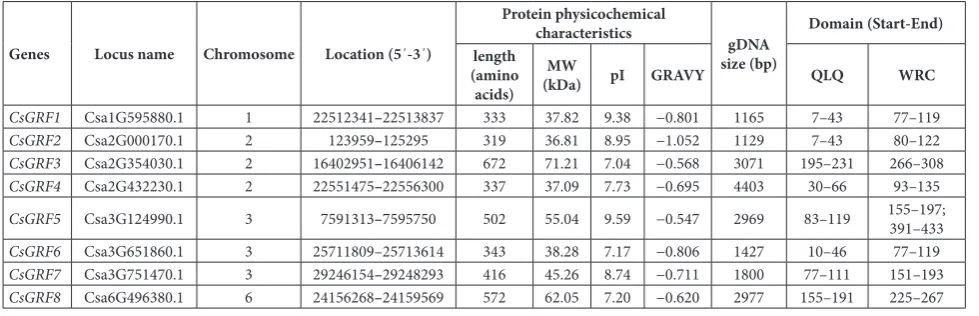
Eight candidate cucumber GRF proteins (CsGRFs) were identified and named according to a previous study [6]. Chromosome 2 and 3 contained 3 CsGRF
genes each, whereas one CsGRF gene was observed in chromosomes 1 and 6 (Table 1). The CsGRF genes varied in length from 1129 bp (CsGRF2) to 4403 bp (CsGRF4), and encoded proteins ranged from 319 (CsGRF2) to 672 (CsGRF3) amino acids in length. Analysis of the physical and chemical characteristics of CsGRF proteins showed that the CsGRFs had MW ranging from 36.81 (CsGRF2) to 71.21 (CsGRF3) kDa,
the pI ranged from 7.04 (CsGRF3) to 9.59 (CsGRF5), and GRAVY was from -1.052 (CsGRF2) to -0.547 (Cs-GRF5) (Table 1). The GRAVY values of CsGRF pro-teins were lower than 0, indicating that all the CsGRFs were hydrophilic proteins.
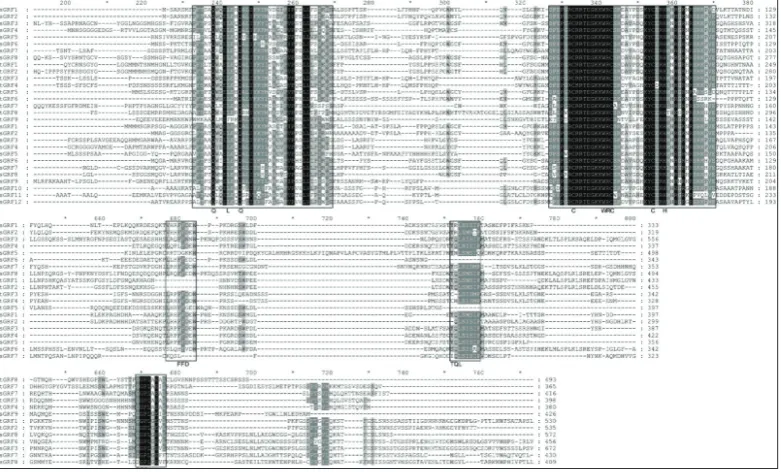
Nearly all the CsGRF proteins contained one QLQ domain and one WRC domain in the N-terminal re-gion, whereas CsGRF5 contained one QLQ domain and two WRC domains (Table 1). To investigate the conserved domains in GRF proteins, we performed a comparative analysis of the full-length deduced amino acid sequences of GRF proteins from cucumber, Ara-bidopsis and rice. As shown in Fig. 1A, the Q-L-Q residues were highly conserved in nearly all the GRF proteins from cucumber, Arabidopsis and rice, with the exception of AtGRF9, which contained F in place of L. This phenomenon was also observed in the GRF proteins of Solanum lycopersicum [12] and Camellia sinensis [11]. A zinc finger motif (CCCH) was present within the WRC domain in all CsGRF, AtGRF and OsGRF proteins. In addition, three short stretches of amino acid residues termed as FFD, TQL and GGPL domains were also found in the C-terminal region of some GRF proteins in cucumber, Arabidopsis and rice (Fig. 1B and C), and these domains might serve as transactivation domains [1], suggesting that they may have specific functions.
Phylogenetic analysis of GRF proteins from different plant species
To further elucidate the phylogenetic relationships of GRF family proteins in cucumber and other plant
Table 1. A complete list of 8 CsGRFs identified in this study.
Genes Locus name Chromosome Location (5΄-3΄)
Protein physicochemical
characteristics gDNA
size (bp)
Domain (Start-End) length
(amino acids)
MW
(kDa) pI GRAVY QLQ WRC
CsGRF1 Csa1G595880.1 1 22512341–22513837 333 37.82 9.38 −0.801 1165 7–43 77–119
CsGRF2 Csa2G000170.1 2 123959–125295 319 36.81 8.95 −1.052 1129 7–43 80–122
CsGRF3 Csa2G354030.1 2 16402951–16406142 672 71.21 7.04 −0.568 3071 195–231 266–308
CsGRF4 Csa2G432230.1 2 22551475–22556300 337 37.09 7.73 −0.695 4403 30–66 93–135
CsGRF5 Csa3G124990.1 3 7591313–7595750 502 55.04 9.59 −0.547 2969 83–119 155–197; 391–433
CsGRF6 Csa3G651860.1 3 25711809–25713614 343 38.28 7.17 −0.806 1427 10–46 77–119
CsGRF7 Csa3G751470.1 3 29246154–29248293 416 45.26 8.74 −0.711 1800 77–111 151–193
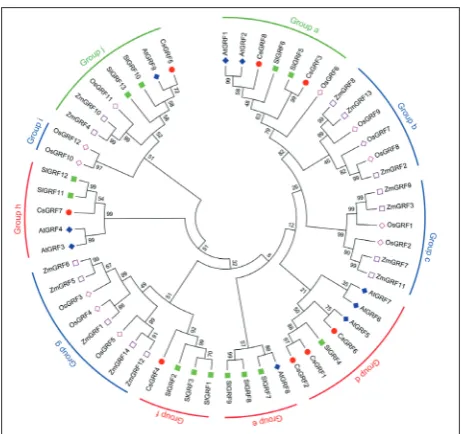
species, we constructed a phylogenetic tree with the GRF protein sequences from four other plant species including Arabidopsis (9 AtGRFs), rice (12 OsGRFs), tomato (13 SlGRFs), and maize (14 ZmGRFs). Phylo-genetic analysis suggested that all the 56 GRF proteins were clustered into ten groups (a-j), and each group had 2-8 members with high bootstrap (Fig. 2). Of these, only two groups (a and j) contained GRFs from both monocot and dicot species. All of the 8 CsGRFs were distributed in 5 groups and clustered together with GRF members from Arabidopsis and tomato. For example, CsGRF3 and CsGRF8, which were clustered with 2 AtGRFs, 2 SlGRFs and 1 OsGRF, belonged to group a (Fig. 2). Group j was comprised of CsGRF5, which was clustered with 1 Arabidopsis, 2 tomato, 1 rice and 2 maize GRF proteins (Fig. 2), while groups d, f and h, which were composed of other CsGRFs, only contained GRFs from dicot species.
Analysis of cis elements in the promoter regions of
CsGRF genes
Cis-acting regulatory elements are important molecular switches involved in the regulation of gene
transcrip-tion during plant growth and development as well as in the responses to various hormones and stresses [38]. To identify the presence of cis elements in the promoter regions of CsGRF genes, a 1.0-kb promoter region of each CsGRF gene was retrieved and a comprehensive cis
element analysis was performed using PlantCARE. The
cis elements related to plant stress, hormone responses and developmental processes are shown in Fig. 3 and Table S3. Numerous cis elements related to plant stress and hormone response were identified, implying that
CsGRF genes might be involved in response to various stresses and hormones. Essentially, 3 TC-rich repeats and 4 TCA elements, which might account for plant responses to various defenses and salicylic acid (SA), were present in the promoters of CsGRF4 and CsGRF8, respectively. In addition, several cis elements related to developmental processes such as meristem-specific regulation (CAT-box and CCGTCC-box), circadian control (circadian), zein metabolism regulation (O2-site), cell cycle regulation (MSA-like), and endosperm-specific elements (GCN4_motif and Skn-1_motif) were found in some CsGRF promoter regions (Fig. 3 and Ta-ble S3), implying that CsGRF genes have development-specific expression.
Expression analysis of CsGRF genes in cucumber tissues
To better understand the functions of CsGRFs in growth and development of cucumber, their FPKM values of transcriptome data in different developmen-tal tissues (ovaries, tendrils, roots, stems, leaves, male and female flowers) were retrieved and analyzed ac-cording to our previous study [34].The results showed that some CsGRFs were strongly transcribed in ova-ries. For example, CsGRF1 and CsGRF8 had prefer-ential accumulation of transcripts in unexpanded ovaries,and CsGRF5 displayed the highest expres-sion in fertilized ovaries, while CsGRF3 was the most abundantly transcribed in unfertilized ovaries (Fig. 4). In addition, the highest expression of CsGRF2 was observed in both fertilized and unfertilized ovaries, but it was not detected in unexpanded ovaries. Ad-ditionally, CsGRF4 and CsGRF6 exhibited the highest expression in leaves, and relatively lower expression in unfertilized and fertilized ovaries. In particular, the expression of CsGRF7 was only detected in roots (Fig. 4). These results indicated that CsGRFs might be involved in the development of specific tissues and growth periods in cucumber.
Expression profiles of CsGRF genes in response to salt and drought stresses
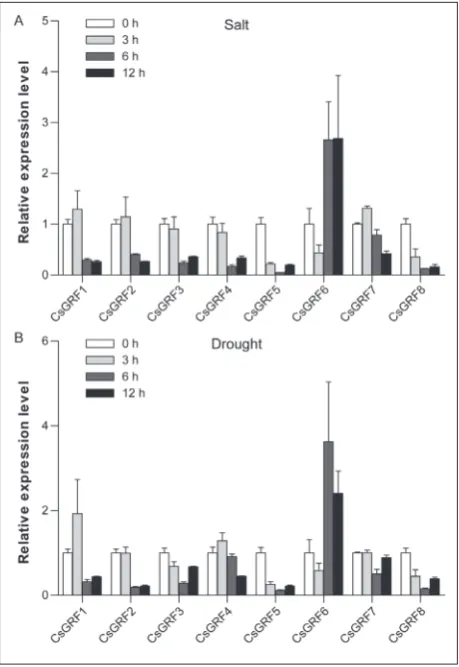
To examine the potential functions of CsGRF genes in response to abiotic stress, the transcript levels of these genes were determined in seedlings under salt and drought stress conditions. Under salt treatment, the expression of CsGRF5, CsGRF6 and CsGRF8 markedly decreased at 3 h, while that of CsGRF7 increased (Fig. 5A). However, nearly all CsGRFs were downregulated at 6 h and 12 h, with the exception of CsGRF6, whose transcription level showed a drastic increase (Fig. 5A). After 3 h of drought treatment, the expression of CsGRF3 and CsGRF8 sharply decreased, while that of other genes had no significant change (Fig. 5B). In addition, the expression of nearly all CsGRF genes significantly decreased under drought treatment at
Fig. 4. Expression patterns of CsGRF genes in different develop-mental tissues of cucumber. The spectrum from blue to red shows the relative expression level of each gene from 0 to 1.
Fig. 2. Phylogenetic tree of GRF proteins from cucumber,
Ara-bidopsis, tomato, rice and maize. The phylogenetic tree was
con-structed using the neighbor-joining method as implemented in MEGA 7.0 with the full-length GRF protein sequences. The GRF proteins can be classified into 10 groups (a-j). Bootstrap values from 1,000 replicates and the protein IDs are displayed in Table S2.
12 h and 24 h, while that of CsGRF6 was remarkably induced (Fig. 5B). These results showed that CsGRF
genes were involved in responses to salt and drought stresses.
DISCUSSION
In this study, we conducted a comprehensive analysis of the GRF family genes in cucumber and we iden-tified 8 CsGRFs. The number of GRFs was smaller than that in some other plant species, such as Arabi-dopsis (9 members) [2], citrus (9 members) [8], pear (9 members) [7], rice (12 members) [3], tomato (13 members) [12], maize (14 members) [4], whereas it was larger than that in tea plant (6 members) [11]. This phenomenon may be attributed to gene duplica-tion events of the GRF gene family. For example, one
segmental duplication (BdGRF3 and BdGRF6) was identified among the GRF genes in Brachypodium dis-tachyon [39]. Four ArabidopsisGRF genes and 8 pear
GRF genes were found in the duplication regions of their genomes [7], while no CsGRF genes were located in the duplication region of cucumber genome.
All CsGRF proteins contain one QLQ domain and one WRC domain, except for CsGRF5, which contains one QLQ domain and two WRC domains, similar to GRF12 in Chinese cabbage [5], GRF10 in tomato [12] and GRF6 in tea plant [11]. In addition, the FFD and TQL domains are conserved in nearly all CsGRF proteins with the exception of CsGRF5 and CsGRF6 which lack the FFD and TQL domains, respectively. Moreover, CsGRF3, CsGRF7, CsGRF8 and some GRF members from Arabidopsis and rice shared a GGPL domain in their C-terminal regions, which is consist-ent with the results of previous studies [5,11]. These results suggest that CsGRF proteins are evolutionarily conserved in plants. In addition, phylogenetic analy-sis showed that the GRF proteins from cucumber,
Arabidopsis, tomato, maize and rice can be divided into 10 groups, with only 2 groups (group a and j) containing clusters of GRFs from both monocot and dicot species, indicating that these GRF proteins may have evolved either before (groups a and j) or after (groups b-i) the divergence of monocots and dicots. Moreover, CsGRFs seem to have a closer relationship with GRF proteins in dicots (Arabidopsis and tomato) than with those in monocots (rice and maize). For example, most of the CsGRFs were clustered in the groups with dicot species only. Phylogenetic analysis showed that CsGRF6 and AtGRF5 belong to the same group (group d); interestingly, both lack the TQL do-main. Although CsGRF3, CsGRF5 and CsGRF8 were located in the groups with monocot species only, they also clustered together with GRFs from tomato and
Arabidopsis.
GRF proteins are plant-specific TFs involved in normal plant growth, such as leaf, stem, flower and seed development [5,8,14,19,25]. In this study, the expression patterns of the CsGRF genes in different tissues showed some spatial differences, indicating their diverse roles in growth and development of cucumber. For example, the CsGRF genes, except CsGRF4 and CsGRF7, were expressed in different growth periods of ovary develop-ment and shared a common cis-element Skn-1_motif, Fig. 5. Expression of CsGRF genes in response to salt (A) and
which is required for endosperm expression. Another
cis element involved in endosperm expression, the GCN4_motif, was also found in the promoter regions of CsGRF1 and CsGRF2. In Arabidopsis, GRF genes are highly expressed in developing pistils, and overexpres-sion of miR396 results in pistil abnormality through directly mediated cleavage of its GRF targets, which disrupts the formation of the GRF/GIF complex [21]. A recent report also demonstrated that the GRF-GIF duo regulates the meristematic and pluripotent competence of carpel margin meristems and the archesporial cell lineage in Arabidopsis [19]. These results indicate that some CsGRF genes may play essential roles in ovary development. In addition, CsGRF6 showed the high-est expression in leaves, and clustered together with
AtGRF5 in the same cluster of group d. AtGRF5 is re-quired for the development of appropriate leaf size and shape and promotes cell proliferation in leaf primordia [16]. Hence, CsGRF6 and AtGRF5 may have similar functions in leaf development.
The expression of GRF genes has been reported to be regulated by various abiotic stresses [9,12,30]. In this study, all CsGRF genes exhibited differential accumulation or downregulation in response to salt and drought stresses, indicating that they may play essential roles in the response to abiotic stress. How-ever, most CsGRF genes were downregulated, which is different from the responses of SlGRF genes to salt and drought stresses [12]. A previous study showed that AtGRF7 acts as a repressor of a wide range of osmotic stress-responsive genes, presumably by pre-venting growth inhibition under normal conditions [30]. Hence, the downregulated CsGRF genes under salt and drought stresses may play negative roles in the stress response. In addition, some closely related genes may have similar expression patterns in response to salt and drought stresses. For example, CsGRF1, Cs-GRF2 and SlGRF4were in the same cluster of group d; CsGRF1 and CsGRF2 were sharply downregulated by salt and drought stresses at 6 h and 12 h. Similar expression patterns were also observed for SlGRF4
under salt and drought treatments, implying simi-lar functions of these genes in response to salt and drought stresses. It is worth noting that the expres-sion of CsGRF6 was significantly affected by salt and drought treatments, and CsGRF6 harbors a MBS cis
element that might be involved in drought-stress
tolerance [40]. In addition, the promoter in CsGRF6
was also predicted to possess a W-box, which is the cognate cis element for WRKY proteins and is widely present in the promoter region of stress-related genes [41, 42]. These results suggest that CsGRF6 may act as a positive regulator involved in salt and drought stress. Further functional characterization of the stress-re-sponsive CsGRF genes will lay the foundation for a better understanding of the potential mechanisms against abiotic stresses in cucumber.
CONCLUSIONS
We performed a detailed analysis of the phylogenetic relationships and cis elements in the promoter regions, and of the expression of CsGRF genes in cucumber. Our results provide the foundation for a better un-derstanding the roles of GRF genes in responses to environmental stresses and help reveal the functions of this important gene family in specific developmen-tal processes.
Funding: This work was funded by the Special Funds for Col-laborative Innovation of Jiangxi Modern Agricultural Scientific Research (JXXTCX2015005-002).
Author contributions: YY conceived and designed the study. YZ, LG and GL performed the experiments. YY and YZ wrote the paper. LJ, YY and YZ revised the paper. All authors read and approved the manuscript.
Conflict of interest disclosure: The authors declare that they have no conflict of interest.
REFERENCES
1. Omidbakhshfard M, Proost S, Fujikura U, Mueller-Roeber B. Growth-regulating factors (GRFs): a small transcription factor family with important functions in plant biology. Mol Plant. 2015;8(7):998-1010.
2. Kim JH, Choi D, Kende H. The AtGRF family of putative transcription factors is involved in leaf and cotyledon growth
in Arabidopsis. Plant J. 2003;36(1):94-104.
3. Choi D, Kim JH, Kende H. Whole genome analysis of the
OsGRF gene family encoding plant-specific putative
tran-scription activators in rice (Oryza sativa L.). Plant Cell Physiol. 2004;45(7):897-904.
5. Wang F, Qiu N, Ding Q, Li J, Zhang Y, Li H, Gao J. Genome-wide identification and analysis of the growth-regulating fac-tor family in Chinese cabbage (Brassica rapa L. ssp. pekinen-sis). BMC Genomics. 2014;15:807.
6. Baloglu MC. Genome-wide in silico identification and com-parison of Growth Regulating Factor (GRF) genes in
Cucur-bitaceae family. Plant Omics. 2014;7(4):260-70.
7. Cao Y, Han Y, Jin Q, Lin Y, Cai Y. Comparative genomic anal-ysis of the GRF genes in Chinese pear (Pyrus bretschneideri Rehd), poplar (Populous), grape (Vitis vinifera), Arabidopsis
and rice (Oryza sativa). Front Plant Sci. 2016;7:1750. 8. Liu X, Guo LX, Jin LF, Liu YZ, Liu T, Fan YH, Peng SA.
Iden-tification and transcript profiles of citrus growth-regulating factor genes involved in the regulation of leaf and fruit devel-opment. Mol Biol Rep. 2016;43(10):1059-67.
9. Büyük İ, Aras S. Genome-wide in silico identification, char-acterization and transcriptional analysis of the family of growth-regulating factors in common bean (Phaseolus
vul-garis L.) subjected to PEG-induced drought stress. Arch Biol
Sci. 2017;69(1):5-14.
10. Ma JQ, Jian HJ, Yang B, Lu K, Zhang AX, Liu P, Li JN. Genome-wide analysis and expression profiling of the
GRF gene family in oilseed rape (Brassica napus L.). Gene. 2017;620:36-45.
11. Wu Z, Wang W, Zhuang J. Developmental processes and responses to hormonal stimuli in tea plant (Camellia sinen-sis) leaves are controlled by GRF and GIF gene families. Funct Integr Genomics. 2017;17:503-12.
12. Khatun K, Robin AHK, Park JI, Nath UK, Kim CK, Lim KB, Nou IS, Chung MY. Molecular characterization and expres-sion profiling of tomato GRF transcription factor family genes in response to abiotic stresses and phytohormones. Int J Mol Sci. 2017;18(5):1056.
13. Kim JH, Kende H. A transcriptional coactivator, AtGIF1, is involved in regulating leaf growth and morphology in Ara-bidopsis. Proc Natl Acad Sci U S A. 2004;101(36):13374-9. 14. Kim JH, Tsukaya H. Regulation of plant growth and
develop-ment by the GROWTH-REGULATING FACTOR and GRF-INTERACTING FACTOR duo. J Exp Bot. 2015;66(20):6093-107.
15. van der Knaap E, Kim JH, Kende H. A novel gibberellin-induced gene from rice and its potential regulatory role in stem growth. Plant Physiol. 2000;122(3):695-704.
16. Horiguchi G, Kim GT, Tsukaya H. The transcription factor AtGRF5 and the transcription coactivator AN3 regulate cell proliferation in leaf primordia of Arabidopsis thaliana. Plant J. 2005;43(1):68-78.
17. Hewezi T, Maier TR, Nettleton D, Baum TJ. The Arabi-dopsis microRNA396-GRF1/GRF3 regulatory module acts as a developmental regulator in the reprogramming of root cells during cyst nematode infection. Plant Physiol. 2012;159(1):321-35.
18. Rodriguez RE, Ercoli MF, Debernardi JM, Breakfield NW, Mecchia MA, Sabatini M, Cools T, De Veylder L, Benfey PN, Palatnik JF. MicroRNA miR396 regulates the switch between stem cells and transit-amplifying cells in Arabidopsis roots. Plant Cell. 2015;27(12):3354-66.
19. Lee SJ, Lee BH, Jung JH, Park SK, Song JT, Kim JH. GROWTH-REGULATING FACTOR and
GRF-INTER-ACTING FACTOR specify meristematic cells of gynoecia and anthers. Plant Physiol. 2018;176(1):717-29.
20. Liu H, Guo S, Xu Y, Li C, Zhang Z, Zhang D, Xu S, Zhang C, Chong K. OsmiR396d-regulated OsGRFs function in floral organogenesis in rice through binding to their targets OsJMJ706 and OsCR4. Plant Physiol. 2014;165(1):160-74. 21. Liang G, He H, Li Y, Wang F, Yu D. Molecular mechanism of
microRNA396 mediating pistil development in Arabidopsis. Plant Physiol. 2014;164(1):249-58.
22. Li S, Gao F, Xie K, Zeng X, Cao Y, Zeng J, He Z, Ren Y, Li W, Deng Q, Wang S, Zheng A, Zhu J, Liu H, Wang L, Li P. The OsmiR396c-OsGRF4-OsGIF1 regulatory module determines grain size and yield in rice. Plant Biotechnol J. 2016;14(11):2134-46.
23. Liu J, Hua W, Yang HL, Zhan GM, Li RJ, Deng LB, Wang XF, Liu GH, Wang HZ. The BnGRF2 gene (GRF2-like gene from Brassica napus) enhances seed oil production through regulating cell number and plant photosynthesis. J Exp Bot. 2012;63(10):3727-40.
24. Che R, Tong H, Shi B, Liu Y, Fang S, Liu D, Xiao Y, Hu B, Liu L, Wang H, Zhao M, Chu C. Control of grain size and rice yield by GL2-mediated brassinosteroid responses. Nat Plants. 2015;2:15195.
25. Kuijt SJ, Greco R, Agalou A, Shao J, t Hoen CC, Overnas E, Osnato M, Curiale S, Meynard D, van Gulik R, de Faria Maraschin S, Atallah M, de Kam RJ, Lamers GE, Guiderdoni E, Rossini L, Meijer AH, Ouwerkerk PB. Interaction between the GROWTH-REGULATING FACTOR and KNOTTED1-LIKE HOMEOBOX families of transcription factors. Plant Physiol. 2014;164(4):1952-66.
26. Sun P, Zhang W, Wang Y, He Q, Shu F, Liu H, Wang J, Yuan L, Deng H. OsGRF4 controls grain shape, panicle length and seed shattering in rice. J Integr Plant Biol. 2016;58(10):836-47. 27. Hu J, Wang Y, Fang Y, Zeng L, Xu J, Yu H, Shi Z, Pan J, Zhang D, Kang S, Zhu L, Dong G, Guo L, Zeng D, Zhang G, Xie L, Xiong G, Li J, Qian Q. A rare allele of GS2 enhances grain size and grain yield in rice. Mol Plant. 2015;8(10):1455-65. 28. Duan P, Ni S, Wang J, Zhang B, Xu R, Wang Y, Chen H, Zhu
X, Li Y. Regulation of OsGRF4 by OsmiR396 controls grain size and yield in rice. Nat Plants. 2015;2:15203.
29. Debernardi JM, Mecchia MA, Vercruyssen L, Smaczniak C, Kaufmann K, Inze D, Rodriguez RE, Palatnik JF. Post-tran-scriptional control of GRF transcription factors by microRNA miR396 and GIF co-activator affects leaf size and longevity. Plant J. 2014;79(3):413-26.
30. Kim JS, Mizoi J, Kidokoro S, Maruyama K, Nakajima J, Nakashima K, Mitsuda N, Takiguchi Y, Ohme-Takagi M, Kondou Y, Yoshizumi T, Matsui M, Shinozaki K, Yamaguchi-Shinozaki K. Arabidopsis growth-regulating factor7 functions as a transcriptional repressor of abscisic acid- and osmotic stress-responsive genes, including DREB2A. Plant Cell. 2012;24(8):3393-405.
32. Kumar S, Stecher G, Tamura K. MEGA7: molecular evolu-tionary genetics analysis version 7.0 for bigger datasets. Mol Biol Evol. 2016;33(7):1870-4.
33. Lescot M, Dehais P, Thijs G, Marchal K, Moreau Y, Van de Peer Y, Rouze P, Rombauts S. PlantCARE, a database of plant cis-acting regulatory elements and a portal to tools for
in silico analysis of promoter sequences. Nucleic Acids Res.
2002;30(1):325-7.
34. Zhou Y, Hu L, Ye S, Jiang L, Liu S. Genome-wide identifi-cation of glutathione peroxidase (GPX) gene family and their response to abiotic stress in cucumber. 3 Biotech. 2018;8(3):159.
35. Baloglu MC, Eldem V, Hajyzadeh M, Unver T. Genome-wide analysis of the bZIP transcription factors in cucumber. PLoS One. 2014;9(4):e96014.
36. Zhou Y, Liu S, Yang Z, Yang Y, Jiang L, Hu L. CsCAT3, a catalase gene from Cucumis sativus, confers resistance to a variety of stresses to Escherichia coli. Biotechnol Biotec Eq. 2017;31(5):886-96.
37. Livak KJ, Schmittgen TD. Analysis of relative gene expression data using real-time quantitative PCR and the 2-ΔΔCT Method.
Methods. 2001;25(4):402-8.
38. Lv GY, Guo XG, Xie LP, Xie CG, Zhang XH, Yang Y, Xiao L, Tang YY, Pan XL, Guo AG, Xu H. Molecular character-ization, gene evolution, and expression analysis of the fruc-tose-1, 6-bisphosphate aldolase (FBA) gene family in wheat
(Triticum aestivum L.). Front Plant Sci. 2017;8:1030.
39. Filiz E, KOÇ İ, Tombuloğlu H. Genome-wide identifi-cation and analysis of growth regulating factor genes in
Brachypodium distachyon: In silico approaches. Turk J Biol.
2014;38(38):296-306.
40. Yamaguchi-Shinozaki K, Shinozaki K. Arabidopsis DNA encoding two desiccation-responsive rd29 genes. Plant Physiol. 1993;101(3):1119-20.
41. Brand LH, Fischer NM, Harter K, Kohlbacher O, Wanke D. Elucidating the evolutionary conserved DNA-binding specificities of WRKY transcription factors by molecular dynamics and in vitro binding assays. Nucleic Acids Res. 2013;41(21):9764-78.
42. Chi Y, Yang Y, Zhou Y, Zhou J, Fan B, Yu JQ, Chen Z. Protein-protein interactions in the regulation of WRKY transcription factors. Mol Plant. 2013;6(2):287-300.
Supplementary Data
Supplementary Table S1. Primers used for qRT-PCR in this study. Available at: http://serbiosoc.org.rs/NewUploads/Uploads/ Zhou%20et%20al_2844_Table%20S1.doc
Supplementary Table S2. GRF protein IDs used for phylogenetic tree analysis.
Available at: http://serbiosoc.org.rs/NewUploads/Uploads/ Zhou%20et%20al_2844_Table%20S2.doc
Supplementary Table S3. The predicted promoter elements of CsGRF genes.