Research Article
a
April
2018
Special Issue: National Conference on Emerging Trends in Engineering 2018
Conference Held at Sri Venkatesa Perumal College of Engineering & Technology, Puttur, A.P., India
Computer Science and Software Engineering
ISSN: 2277-128X (Volume-8, Issue-4)
Adiabatic Switching Techniques for Designing Efficient
Energy Logic Circuits Using CMOS
A. Amala1,M. Leelavathi2, D. Moulika3
1
M.Tech, Assistant Professor, Sri Venkatesa Perumal College of Engineering and Technology Dept of ECE,
2
M.Tech, Assistant Professor, Sri Venkatesa Perumal College of Engineering and Technology Dept of ECE,
3
M.Tech, Assistant Professor, Sri Venkatesa Perumal College of Engineering and Technology, Dept of ECE,
Abstract— The Energy dissipation in conventional CMOS circuits can be minimized through adiabatic technique. By adiabatic technique dissipation in PMOS network can be minimized and some of energy stored at load capacitance can be recycled instead of dissipated as heat. But the adiabatic technique is highly dependent on parameter variation. With the help of TSPICE simulations, the energy consumption is analyzed by variation of parameter. In analysis, two logic families, ECRL (Efficient Charge Recovery Logic) and PFAL (Positive Feedback Adiabatic Logic) are compared with conventional CMOS logic for inverter and 2:1 multiplexer circuits. It is find that adiabatic technique is good choice for low power application in specified frequency range.
Index Terms— Adiabatic switching, energy dissipation, power clock, equivalent model.
I. INTRODUCTION
The term “adiabatic” describe the thermodynamic processes in which no energy exchange with the environment, and therefore no dissipated energy loss. But in VLSI, the electric charge transfer between nodes of a circuit is considered as the process and various techniques can be applied to minimize the energy loss during charge transfer event .
Fully adiabatic operation of a circuit is an ideal condition. It may be only achieved with very slow switching speed. In practical cases, energy dissipation with a charge transfer event is composed of an adiabatic component and a non-adiabatic component.
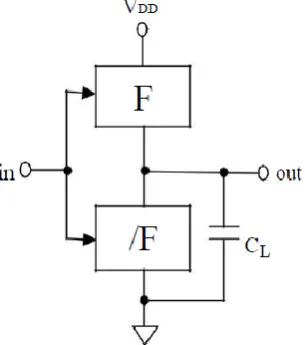
In conventional CMOS logic circuits (Fig.), from 0 to VDD transition of the output node, the total output energy CLVDD
2
is drawn from power supply. At the end of transition, only 12CLVDD2 energy is stored at the load capacitance. The half of
drawn energy from power supply is dissipated in PMOS network (F). From VDD to 0 transition of the output node, energy
stored in the load capacitance is dissipated in the NMOS network (/F) .
Adiabatic logic circuits reduce the energy dissipation during switching process, and reuse the some of energy by recycling from the load capacitance . For recycling, the adiabatic circuits use the constant current source power supply and for reduce dissipation it uses the trapezoidal or sinusoidal power supply voltage .
Fig. Conventional CMOS logic circuit with pull-up (F) and pull-down (/F) networks.
II. DISSIPATION MECHANISMS IN ADIABATIC LOGIC CIRCUITS
The equivalent circuit used to model the conventional CMOS circuits during charging process of the output load capacitance. But here constant voltage source is replaced with the constant current source to charge and discharge the
ISSN(E): 2277-128X, ISBN: 978-93-87396-07-4, pp. 152-157
Fig. Equivalent model during charging process in adiabatic circuits.
Energy dissipation in resistance R is [1],
Since Ediss depends upon R, so by reducing the on resistance of PMOS network the energy dissipation can
be minimized. The on resistance of the MOSFET is given by the first order approximation is ,
R = μCOXW VGS − Vth −1L
Where μ is the mobility, COX is the specific oxide capacitance, VGS is the gate source voltage, W is the width,
L is the length and Vth is the threshold voltage.
Ediss also depends upon the charging time T, If T>> 2RC then energy dissipation will be smaller than the conventional
CMOS.
The energy stored at output can be retrieved by the reversing the current source direction during discharging process instead of dissipation in NMOS network.
III. ADIABATIC LOGIC FAMILIES
There are the many adiabatic logic design technique are given in literature but here two of them are chosen ECRL and PFAL , which shows the good improvement in energy dissipation and are mostly used as reference in new logic families for less energy dissipation.
A. Efficient Charge Recovery Logic (ECRL)
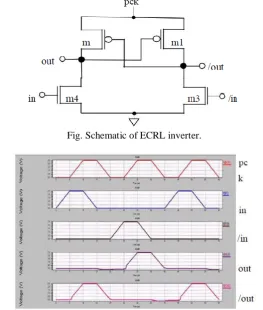
The schematic and simulated waveform of the ECRL inverter gate is shown in Fig.3 and Fig.4 respectively. Initially,
input „in‟ is high and input „/in‟ is low. When power clock (pck) rises from zero to VDD, since F is on so output „out‟
remains ground level. Output „/out‟ follows the pck. When pck reaches at VDD, outputs „out‟ and „/out‟ hold logic value
zero and VDD respectively.
ECRL uses four phase clocking rule to efficiently recover the charge delivered by pck. For detailed study follow the reference.
Fig.Schematic of ECRL inverter.
ISSN(E): 2277-128X, ISBN: 978-93-87396-07-4, pp. 152-157
The schematic and simulated waveform of the ECRL 2:1 Multiplexer is shown in Fig.5 and Fig.6 respectively.
Initially, select input „s‟ is high and power clock (pck) rises from zero to VDD, output „out‟ will select the input „b‟. If
select input „s‟ is low and power clock (pck) rises from zero to VDD, output „out‟ will select the input „a‟. When pck
reaches at VDD, outputs „out‟ and „/out‟ hold logic values. This output values can be used for the next stage as an inputs.
Now pck falls from VDD to zero, high outputs return its energy to pck hence delivered charge is recovered.
Fig. Schematic of ECRL 2:1 Multiplexer.
B. Positive Feedback Adiabatic Logic (PFAL)
The schematic and simulated waveform of the PFAL inverter gate is shown in Fig.7 and Fig.8 respectively. Initially,
input „in‟ is high and input „/in‟ is low. When power clock (pck) rises from zero to VDD, since F and m4 are on so output
„out‟ remains ground level. Output „/out‟ follows the pck. When pck reaches at VDD, outputs „out‟ and „/out‟ hold logic
value zero and VDD respectively. This output values can be used for the next stage as an inputs.
Now pck falls from VDD to zero, „/out‟ returns its energy to pck hence delivered charge is recovered. PFAL uses four
phase clocking rule to efficiently recover the charge delivered by pck. For detailed study follow the reference .
Fig.Schematic of PFAL inverter
Fig. Simulated waveform of the PFAL inverter gate
The schematic and simulated waveform of the PFAL 2:1 Multiplexer is shown in Fig.9 and Fig.10 respectively.
Initially, select input „s‟ is high and power clock (pck) rises from zero to VDD, output „out‟ will select the input „b‟. If
ISSN(E): 2277-128X, ISBN: 978-93-87396-07-4, pp. 152-157
When pck reaches at VDD, outputs „out‟ and „/out‟ hold logic values. This output values can be used for the next stage
as an inputs. Now pck falls from VDD to zero, high outputs return its energy to pck hence delivered charge is recovered.
Fig. Schematic of PFAL 2:1 Multiplexer
Fig.Simulated waveform of the PFAL 2:1 Multiplexer
IV. IMPACT OF PARAMETER VARIATIONS ON THE ENERGY CONSUMPTION
Energy consumption in adiabatic circuits strongly depend on the parameter variations . The impact of parameter variations on the energy consumption for the two logic families is investigated with respect of CMOS logic circuit, by means of TSPICE simulations. Simulations are carried out at 250nm technology node. The W/L ratio of the PMOS and NMOS
A. Transition Frequency Variation
The energy dissipation per cycle versus switching frequency of the two adiabatic logic families and CMOS for the inverter logic.. Thus the simulations are carried out only at useful range of the frequencies to show better result with respect to CMOS
B. Load Capacitance Variation
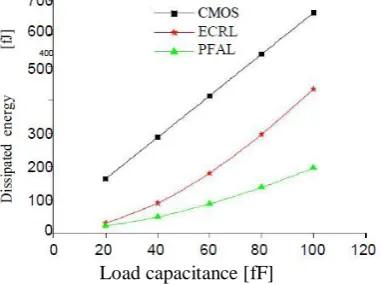
The energy dissipation per cycle versus load capacitance of the two adiabatic logic families and CMOS for the inverter logic. Fig. shows the energy dissipation per cycle versus load capacitance of the two adiabatic logic families and CMOS for the 2:1 multiplexer. The Figures show that adiabatic logic families having better energy savings than CMOS logic over wide range of load capacitances. PFAL shows better energy shavings than ECRL at high load capacitance.
ISSN(E): 2277-128X, ISBN: 978-93-87396-07-4, pp. 152-157
Fig.Energy consumption per cycle versus load capacitance for an inverter at VDD = 2.5V and frequency = 100 MHz.
Load capacitance [fF]
Fig.Energy consumption per cycle versus load capacitance for a 2:1 multiplexer at VDD = 2.5V and frequency = 100
MHz.
C. Supply Voltage Variation
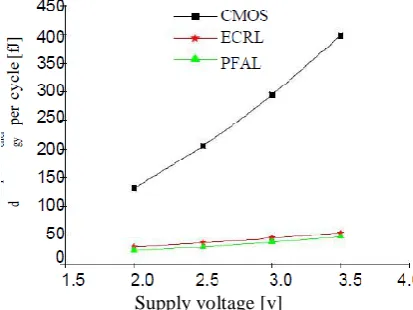
The energy dissipation per cycle versus supply voltage of the two adiabatic logic families and CMOS for the inverter logic. Fig. 16 shows the energy dissipation per cycle versus supply voltage of the two adiabatic logic families and CMOS for the 2:1 multiplexer. It is seen that supply voltage decreases, the gap between
CMOS and logic families is reduced. But ECRL and PFAL still shows large energy savings over wide range of supply voltage.
Supply voltage [v]
Fig.Energy consumption per cycle versus supply voltage for an inverter at load capacitance = 20fF and frequency = 100
MHz.
Supply voltage [v]
Fig. Energy consumption per cycle versus supply voltage for a 2:1 multiplexer at load capacitance = 20fF and frequency = 100 MHz..
V. CONCLUSION
ISSN(E): 2277-128X, ISBN: 978-93-87396-07-4, pp. 152-157
REFERENCES
[1] W. C. Athas, L.J. Svensson, J.G. Koller, N. Tzartzanis, and E. Chou, “Low power digital systems based on
adiabatic-switching principles,” IEEE Trans. VLSI Systems, vol. 2, no. 4, pp. 398-407, Dec. 1994.
[2] J. S. Denker, “A review of adiabatic computing,” in IEEE Symp. on Low Power Electronics, pp. 94-97, 1994.
[3] A. P. Chandrakasan, S. Sheng, and R. W. Brodersen, “Low-power CMOS digital design,‟‟ IEEE J. Solid-State
Circ., vol. 27, no. 4, pp. 473-484, Apr. 1992.
[4] A. G. Dickinson and J. S. Denker, “Adiabatic dynamic logic,” IEEE J. Solid-State Circuits, vol. 30, pp. 311–
315, Mar. 1995.
[5] J. G. Koller and W. C. Athas, “Adiabatic switching, low energy computing, and the physics of storing and
erasing information,” IEEE Press, in Pmc. Workshop on Physics and Computation, PhysCmp ’92. oct. 1992.
[6] T. Gabara, “Pulsed Power Supply CMOS,” Technical Digest IEEE Symposium Low Power Electronics, San
Diego, pp. 98- 99, Oct. 1994.
[7] B. Voss and M. Glesner, “A low power sinusoidal clock,” In Proc. of the International Symposium on Circuits