Available online throug
ISSN 2229 – 5046
MHD FLOW THROUGH POROUS MEDIA PAST AN IMPULSIVELY STARTED VERTICAL
PLATE WITH VARIABLE TEMPERATURE AND CONSTANT MASS DIFFUSION
IN THE PRESENCE OF HALL CURRENT
U. S. RAJPUT, NEETU KANAUJIA*
Department of Mathematics and Astronomy, University of Lucknow, Lucknow – (U.P.), India.
(Received On: 23-01-16; Revised & Accepted On: 21-02-16)
ABSTRACT
I
n the present paper, MHD flow through porous media past an impulsively started vertical plate with variable temperature and constant mass diffusion in the presence of Hall current is studied. The fluid considered is an electrically conducting, absorbing-emitting radiation but a non-scattering medium. The Laplace transform technique has been used to find the solutions for the velocity profile and Skin friction.The velocity profile and Skin friction have been studied for different parameters like Schmidt number, Hall parameter, magnetic parameter, mass Grashof number, thermal Grashof number, Prandtl number, and time. The effect of parameters is shown graphically and the value of the skin-friction for different parameters has been tabulated.
Keywords: MHD, Heat transfer, Mass transfer, Hall current, Skin friction.
INTRODUCTION
The study of MHD flow problems has achieved remarkable interest due to its application in MHD generators, MHD pumps, petroleum engineering, biomechanics, irrigation engineering and aerospace technology. Such problems frequently occur in petro-chemical industry, chemical vapour deposition on surfaces, cooling of nuclear reactors, heat exchanger design, forest fire dynamics and geophysics.
The flows of fluids through porous medium are very important particularly in the fields of agricultural engineering for irrigation processes in petroleum technology to study petroleum transport in chemical engineering for filtration and purification processes. Ram et al. [1] have studied Hall effects on heat and mass transfer flow through porous medium. Raptis et.al [2] have studied flow of a viscous fluid through a porous medium bounded by a vertical surface. Raptis along with Kafousias et al. [3] have further studied heat transfer in flow through a porous medium bounded by an infinite vertical plate under the action of magnetic field. M. Rangamma, et al. [4] have studied Hall effect on unsteady MHD flow past along a porous flat plate with thermal diffusion, diffusion thermo and chemical reaction. Singh [6] have studied Heat and mass transfer in MHD boundary layer flow past an inclined plate with viscous dissipation in porous medium. Further, Sulochana [7] have studied Hall Effects on unsteady MHD three dimensional flow through a porous medium in a rotating parallel plate channel with effect of inclined magnetic field. Rajput and Sahu[5] effects of chemical reactions on free convection MHD past an exponentially accelerated infinite vertical plate through a porous medium with variable temperature and mass. We are considering MHD flow through porous media past an impulsively started vertical plate with variable temperature and constant mass diffusion in the presence of Hall current. The effect of Hall current on the velocity has been observed with the help of graphs, and the skin friction has been tabulated. MATHEMATICAL FORMULATION
We consider an unsteady viscous incompressible electrically conducting fluid past an impulsively started vertical plate. The plate is electrically non-conducting. A transverse uniform magnetic field
B
is assumed to be applied on the flow. Initially, at timet
≤ 0 the temperature of the fluid and the plates are same asT
∞and the concentration of the fluid is∞
C
. At time t > 0, temperature of the plate is raised toT
wand the concentration of the plate is raised toC
w.Corresponding Author: Neetu kanaujia*
Using the relation
∇
•
B
=
0
, for the magnetic fieldB
=
(
B
x,
B
y,
B
z)
, we obtainB
y(sayB
0), thenB
=
(
0,
B
0, 0 ,
)
where
B
0is the externally applied transverse magnetic field. Due to Hall effect, there will be two components of the momentum equation, which are as under. The usual assumptions have been taken in to consideration.2 2
* 0
2
(
)
(
)
2(
)
,
(1
)
B
u
u
g
T
T
g
C
C
u
mw
u
t
y
m
K
σ
υ
υ
β
β
ρ
∞ ∞
∂
=
∂
+
−
+
−
−
+
−
∂
∂
+
(1)2 2
0
2 2
(
)
,
(1
)
B
w
w
w mu
w
t
y
m
K
σ
υ
υ
ρ
∂
∂
=
−
−
−
∂
∂
+
(2)2 2
,
C
C
D
t
y
∂
∂
=
∂
∂
(3)2
2
.
P
T
k
T
t
ρ
C
y
∂
=
∂
∂
∂
(4)
The following boundary conditions have been assumed:
(
)
020
0 :
0,
0,
,
, for all the value of y
0 :
,
0,
,
at y
0
0,
0,
,T
as y
w w
t
u
w
C
C T
T
u t
t
u
u w
C
C T
T
T
T
u
w
C
C
T
υ
∞ ∞ ∞ ∞ ∞ ∞≤
=
=
=
=
>
=
=
=
=
+
−
=
→
→
→
→
→ ∞
(5)Here u is the velocity of the fluid in x- direction, w - the velocity of the fluid in z- direction,
m
is the Hall parameter, g – acceleration due to gravity,β
- volumetric coefficient of thermal expansion, β*- volumetric coefficient ofconcentration expansion, t- time,
C
∞- the concentration in the fluid far away from the plate, C - species concentration in the fluid ,C
w- species concentration at the plate, D - mass diffusion,T
∞- the temperature of the fluid near the plate,w
T
- temperature of the plate, T - the temperature of the fluid , k - the thermal conductivity,υ
−
the kinematic viscosity,ρ
- the fluid density,σ
- electrical conductivity,µ
- the magnetic permeability, K - the permeability of the medium, and CP - specific heat at constant pressure. Herem
=
ω
eτ
e withω
e- cyclotron frequency of electrons ande
τ
- electron collision time.To write the equations (1) - (3) in dimensionless from, we introduce the following non - dimensional quantities:
2 2
0 0 0 0
2 2
0 0 0
3 3
0 0
,
,
,
, Pr
,
,
,
,
(
)
(
)
(
)
,
,
,
(
)
P w w r w wyu
C
B
tu
Ku
u
w
u
w
y
Sc
M
t
K
u
u
D
k
u
g
T
T
g
C
C
C
C
T
T
G
Gm
C
u
u
C
C
T
T
σ υ
µ
υ
υ
ρ
υ
υ
βυ
∞βυ
∞ ∞θ
∞∞ ∞
=
=
=
=
=
=
=
=
−
−
−
−
=
=
=
=
−
−
(6) Here the symbols used are:u
- dimensionless velocity,w
- dimensionless velocity, θ - the dimensionless temperature,C
- the dimensionless concentration, Gr - thermal Grashof number,m
G - mass Grashof number,
µ
- the coefficient of viscosity, Pr - the Prandtl number, Sc - the Schmidt number, M - the magnetic parameter.The dimensionless forms of Equations (1), (2), (3) and (4) are as follows
2
2 2
(
)
1
,
(1
)
r m
u
u
M u
mw
G
G C
u
t
y
θ
m
K
∂
=
∂
+
+
−
+
−
∂
∂
+
(7)2
2 2
(
)
1
,
(1
)
w
w
M w mu
w
t
y
m
K
∂
=
∂
−
−
−
∂
∂
+
(8)2
2
1
,
C
C
t
Sc y
∂
=
∂
2 2
1
,
Pr
t
y
θ
θ
∂
=
∂
∂
∂
(10)with the corresponding boundary conditions:
0,
0,
0,
0,
0 , for all value of y
0,
1,
0,
,
1 at y
0
0,
0,
0,
0 as y
t
u
C
w
t
u
w
t C
u
C
w
θ
θ
θ
≤
=
=
=
=
>
=
=
=
=
=
→
→
→
→
→ ∞
(11) Dropping the bars and combining the Equations (7) and (8), we get
2
2 2
1
(1
)
1
q
q
M
Gr
GmC
mi
q
t
y
θ
m
K
∂
=
∂
+
+
−
−
+
∂
∂
+
(12)2
2
1
,
C
C
t
Sc y
∂
=
∂
∂
∂
(13)2 2
1
,
Pr
t
y
θ
θ
∂
=
∂
∂
∂
(14)where
q
=
u
+
iw,
with corresponding boundary conditions0 :
0,
0,
0, for all value of y
0 :
1,
,
1, at y
0
0,
0,
0, as y
t
q
C
t
q
t C
q
C
θ
θ
θ
≤
=
=
=
>
=
=
=
=
→
→
→
→ ∞
, (15)
2
1 2 13 1 13 14
1
1
{
(1 Pr
)}
(
)
{
(1 Pr)}
2
4
a y a y a y
q
e
A
y Gr A
at
a e
A
e
B
A
a
− −=
+
− −
+
−
+
−
2 21 1 1
1 11 12
Pr 4 14
2
Pr 1 Pr 1 Pr
17 1
1
(1
)
2
Pr
{ 1
Pr
}
2
Pr {1
[
]}
2
1
Pr
2
1
Pr 1
Pr
1
2
[
]
2
2
at aSc aSc
a y Sc Sc Sc
y t at a y at S
Gm
e
A
e
B
e
B
a
y
B
at
a
e
t
y
Erf
t
Gr
y
a
e
B
y
Sc y
Gm
Erfc
e
a
t
π
π
π
− − + − + − + − − + − + − +
+
−
+
+
+
−
− +
+
+
−
−
−
+
−
−
−
+
1 2 118 19
1
a aSc
Sc y y
c − +Sc
B
e
− +ScB
+
+
(16) 2 2 Pr 4Pr
Pr
Pr
2
2
y t
y
y
t y
t
Erf
e
t
θ
π
−
=
+
−
(17)
2
Sc y
C
Erfc
t
=
(18)
The expressions for the constants involved in the above equations are given in the appendix. Skin friction
Separating
0
y
dq
dy
=
into real and imaginary parts, the dimensionless skin – friction component 0x
y
du
dy
τ
=
=
and0
z
y
dw
dy
τ
=
=
can be computed.RESULTS AND DISCUSSION
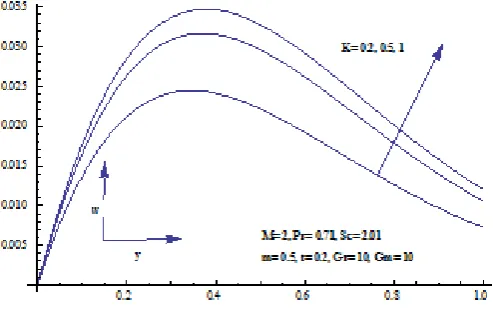
The numerical values of velocity and skin friction are computed for different parameters like, thermal Grashof number Gr, mass Grashof number Gm, magnetic field parameter M, Hall parameter m, Prandtl number Pr, Schmidt number Sc, permeability of the medium K, and time t. The values of the main parameters considered are Gr=10, 20, 30, M= 2, 3, 4, m= 1, 5, Gm= 10, 20, 30, Pr = 0.71, 7, Sc= 2.01, 5, 10 ,K =0.2, 0.5, 1and t=0.15, 0.2, 0.25.Figures (1), (2), (6), (7) and (8) show that primary velocity is increased when m, Gm, Gr, t and K is increased. Figures (3), (4) and (5) show that primary velocity is decreased when M, Sc and Pr are increased. And figure (10), (11), (12), (14) and (15) show that the secondary velocity is increased when Gm, M,Sc, Gr, t and K are increased. Figure (9), and (13) show that secondary velocity is decreased when m, and Pr are increased.
Figure-1: Velocity profile u for different values ofm.
Figure-2: Velocity profile for different values ofGm
Figure-4: Velocity profile for different values ofSc.
Figure-5: Velocity profile for different values of Pr.
Figure-6: Velocity profile u for different values of Gr.
Figure-8: Velocity profile u for different values of K.
Figure-9: Velocity profile w for differentvalues of m.
Figure-10: Velocity profile w for differentvalues of Gm.
Figure-11: Velocity profile w for different values ofSc.
Figure-12: Velocity profile w for different values ofGr.
Figure-13: Velocity profile w for different values of Pr.
Figure-15: Velocity profile w for different values ofK. Table – 1: skin friction
m Gr Gm M K Sc Pr t
τ
xτ
z 0.5 10 10 2 0.2 2.01 0.71 0.2 -0.5383 0.1734 0.5 10 10 2 0.2 2.01 7 0.2 -0.6869 0.1703 0.5 20 10 2 0.2 2.01 0.71 0.2 -0.2169 0.1778 0.5 30 10 2 0.2 2.01 0.71 0.2 0.1043 0.1823 1 10 10 2 0.2 2.01 0.71 0.2 -0.4084 0.2233 5 10 10 2 0.2 2.01 0.71 0.2 -0.1924 0.0901 0.5 10 20 2 0.2 2.01 0.71 0.2 1.2427 0.2031 0.5 10 30 2 0.2 2.01 0.71 0.2 3.0239 0.2328 0.5 10 10 3 0.2 2.01 0.71 0.2 -0.7123 0.2502 0.5 10 10 4 0.2 2.01 0.71 0.2 -0.8808 0.3213 0.5 10 10 2 0.2 5 0.71 0.2 -0.9352 0.1612 0.5 10 10 2 0.2 10 0.71 0.2 -1.2147 0.1547 0.5 10 10 2 0.2 2.01 0.71 0.15 -0.8893 0.1545 0.5 10 10 2 0.2 2.01 0.71 0.25 -0.2480 0.1895 0.5 10 10 2 0.5 2.01 0.71 0.2 0.1642 0.2031 0.5 10 10 2 1 2.01 0.71 0.2 0.4253 0.2153 CONCLUSION
Some conclusions of the study are as under:
1. Primary Velocity increases with the increase in thermal Grashof number, Hall parameter, mass Grashof number, permeability of the medium, and time.
2. Primary Velocity decreases with the increase in magnetic field parameter and Prandtl number, and, Schmidt number.
3. Secondary velocity increases with increase in thermal Grashof number, mass Grashof number, time, permeability of the medium, and magnetic field parameter.
4. Secondary Velocity decreases with the increase in Hall parameter, Prandtl number, and Schmidt number. 5.
τ
x decreases with increase in Schmidt number, magnetic field parameter, and it increases when thermalGrashof number, mass Grashof number, Hall parameter, permeability of the medium, Prandtl number, and time are increased.
τ
zincreases with increase in thermal Grashof number, mass Grashof number, time, permeability of the medium, and magnetic field parameter, and it decreases when Prandtl number, Hall parameter, Schmidt number are increased.Appendix
2 1
2
2
1
,
2
2
a y
at
y
at
y
A
Erf
e
Erfc
t
t
−
+
=
+
+
112
1
2
at
y
A
Erf
t
−
= +
2 12
2
,
2
a y
at
y
A
e
Erfc
t
+
=
(
2)
11 12
13
2
1
,
a y a y
e
e
A
A
A
y
−
+
+
−
=
1Pr
2
1 Pr
,
2
a
Efr
t
y
B
t
−
− +
=
2Pr
2
1 Pr
2
a
Efr
t
y
B
t
+
− +
=
112
1
,
2
aSc
Efr
t
y
Sc
B
t
−
− +
=
122
1
,
2
aSc
Efr
t
y
Sc
B
t
+
− +
=
2 Pr 2 Pr
1 Pr 1 Pr
13
1
1 2a a
y y
B
= − −
e
− +−
B
+
e
− +B
, 14
Pr
2
1
2
Pr
y
Erf
t
B
y
π
− +
=
, 152
Pr
1 Pr
,
2
a
Efr
t
y
B
t
−
− +
=
162
Pr
1 Pr
,
2
a
Efr
t
y
B
t
+
− +
=
2 Pr 2 Pr
1 Pr 1 Pr
17
1
15 16,
a a
y
B
= +
e
− ++
B
−
e
− +B
182
1
,
2
a
t
Sc y
Sc
B
Erf
t
−
+
=
192
1
,
2
a
t
Sc y
Sc
B
Erfc
t
+
+
=
2(
1
)
1
,
1
M
a
im
m
K
=
−
+
+
REFERENCES1. Ram P C Singh C B and Singh U, (1984) Hall effects on heat and mass transfer flow through porous medium, Astrophysics Space Science, 10, 45-51.
2. Raptis A and Kafousias N,. “Heat transfer in flow through a porous medium bounded by an infinite vertical plate under the action of magnetic field”. International Journal of Energy Research 6:241-245, (1982).
3. Raptis A and Perdikis C (1983) “Flow of a viscous fluid through a porous medium bounded by a vertical surface”, Int. J. Eng. Sci. 21, 1327–1330.
4. Muthucumaraswamy R and Manivannan K (2007), Mass transfer effects on vertical oscillating plate with heat flux Theoret. Appl. Mech., Vol.34, No.4, pp. 309{322, Belgrade}.
5. Rajput U S and Sahu P K, (2012), Effects of chemical reactions on free convection MHD past an exponentially accelerated infinite vertical plate through a porous medium with variable temperature and mass diffusion. Elixir Appl. Math., Vol. 43, 6560-6527-5962.
6. Singh P K, (2012), Heat and Mass Transfer in MHD Boundary Layer Flow past an Inclined Plate with Viscous Dissipation in Porous Medium, International Journal of Scientific & Engineering Research, Volume 3, Issue 6, June.
7. Sulochana P, Hall Effects on Unsteady MHD Three Dimensional Flow through a Porous Medium in a Rotating Parallel Plate Channel with Effect of Inclined Magnetic Field, American Journal of Computational Mathematics, 2014, 4, 396-405.
Source of support: Nil, Conflict of interest: None Declared