ISSN-L: 2501 - 1235 Available on-line at: www.oapub.org/edu
doi: 10.5281/zenodo.2819668 Volume 5 │ Issue 9 │ 2019
CHRONIC EFFECT OF
INSPIRATORY MUSCLE TRAINING TO MAXIMAL
EXPIRATORY PRESSURE IN SEDENTARY HEALTHY BOYS
Saadet Öztütüncü, Mustafa Özdali
Gaziantep University, Physical Education and Sport Department,
Performance Laboratory, Gaziantep, Turkey
Abstract:
The aim of this study was to investigate the effect of inspiratory muscle training on maximal expiratory pressure (MEP) in healthy sedentary boys. For this purpose, 20 healthy sedentary boys aged 12 years were randomly assigned to two groups as inspiratory muscle training group (IMT, n = 10) and control group (CG, n = 10) who did not perform any training. 30x2 breath exercises were performed as inspiratory muscle training for 4 weeks and 3 days a week for 40% maximal inspiratory pressure (MIP). The MEP test was applied to all subjects 1 day before and after 4 weeks. The data were analyzed in SPSS 22.0 program. The mean of the percentage change with 2x2 mixed factor ANOVA and LSD correction tests were investigated with Mann Whitney U test. As a result of the statistical analysis, a significant difference was found between the IMT pre-and post-test results at the MEP value (p <0.05). In addition, it was observed that IMT showed a significant increase when compared to CG (p <0.05). In conclusion, it can be said that inspiratory muscle training affects the maximal expiratory pressure positively in healthy sedentary boys.
Keywords: respiratory, pulmonary, children, training, mouth pressure
1. Introduction
oxygen to survive. The respiratory system plays an active role in determining the level of work and performance in our lives. The effective and efficient way of this system enables the individual to improve his / her performance in life. In order to be more efficient in daily life and the amount of inhaled oxygen, the muscles that help breathing should be strong and work properly. Maximal expiratory pressure is one of the indicators of respiratory muscle strength. Increasing the muscle strength of breathing will help to restore the musculature and relaxation relationship of these muscles and increase the amount of inhaled oxygen (Santos et al., 2012; Gosselink et al., 2000; Harver et al., 1989).
The aim of this study is to investigate the effects of inspiratory muscle training on maximal expiratory pressure in healthy sedentary boys.
2. Method
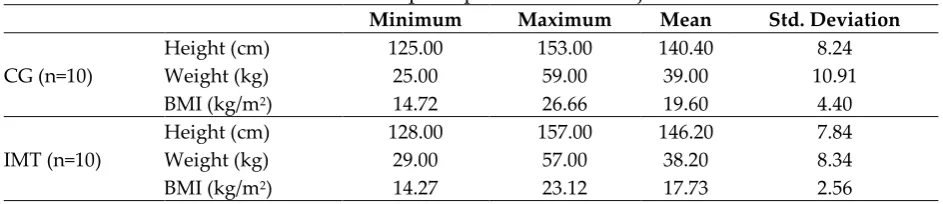
Our study was designed according to the pre-test-post test design with control group. A total of 20 healthy male, 12 years old, were included in the study (Table 1). To determine the number of subjects GPower 3.1. A priori test was applied to the program. Voluntary consent was obtained from the subjects and their parents before the study. The study was conducted in accordance with the Declaration of Helsinki and the approval of the Ethics Committee was obtained from the Clinical Research Ethics Committee of Gaziantep University (Protocol no: 2018/293). Subjects were composed of inspiratory muscle training group (IMT, n = 10) and control groups (CG, n = 10) who would not participate in any training. Subjects were randomized to groups. Maximal expiratory pressure measurements were performed one day before and after 4 weeks of administration.
Table 1: Descriptive parameters of subjects
Minimum Maximum Mean Std. Deviation
CG (n=10)
Height (cm) 125.00 153.00 140.40 8.24
Weight (kg) 25.00 59.00 39.00 10.91
BMI (kg/m2) 14.72 26.66 19.60 4.40
IMT (n=10)
Height (cm) 128.00 157.00 146.20 7.84
Weight (kg) 29.00 57.00 38.20 8.34
BMI (kg/m2) 14.27 23.12 17.73 2.56
BMI body mass index
2.1 IMT training protocol
2.2 MEP measurement protocol
Electronic respiratory pressure gauge is used for MEP measurement. Measurements were made using nasal plugs. For MEP; maximum inspiration was made to the person and the person was asked to expire to the closed airway and to maintain it for 1-3 seconds. The measurement was repeated until the 5 cmH2O difference remained
between the two best measurements and the best result was recorded in cmH2O (Özdal,
2016).
2.3 Statistical protocol
SPSS 22.0 program was used for statistical operations. Meanness of percentage change with 2x2 mixed factor ANOVA and LSD correction tests were analyzed with Mann Whitney U test after normality and homogeneity test. Values were presented as mean and standard deviation and were examined at 0.05 significance level.
3. Results
Table 2: Comparison of groups’ MEP parameters between pre- and post-tests CG (n = 10) IMTG (n = 10)
MEP (cmH2O)
Pre-test 68.30±11.08 67.00±9.74
Post-test 70.10±13.71 101.00±8.17a
Difference 5.00±11.93 19.20±12.74b
% Difference 5.67±4.45 27.72±7.37
a. significance between pre- and post-test of group; b. significant difference between groups; MEP maximal expiratory pressure
The mean pre-test MEP was 68.30 ± 11.08 cmH2O and the mean post-test MEP was 70.10 ± 13.71 cmH2O. As a result of the 2x2 ANOVA test, there was no significant difference in CG MEP between pretest and posttest (p> 0.05). While the average of IMT MEP was 67.00 ± 9.74 cmH2O, the MEP average increased to 101.00 ± 8.17 cmH2O in the final test. This increase was 19.20 ± 12.74 cmH2O as unit and 27.72 ± 7.37 cmH2O as percentage. There was a significant difference between pre-test and post-test in IMT MEP values with 2x2 ANOVA test and LSD correction (p <0.05). In addition, IMT MEP pre-test and post-test change was significantly different from CG (p <0.05).
4. Conclusion
The aim of this study was to investigate the effect of inspiratory muscle training on healthy sedentary male MEP parameters. When MEP was examined, IMT pre- and post-test differences were significantly different from control group (p <0.05).
Sawyer and Clanton reported that pulmonary function improved in children with cystic fibrosis and aerobic exercise improved respiratory muscle strength (Sawyer and Clanton, 1993).
In addition, in many studies conducted in adults, aerobic training and respiratory functions have improved / improved in previous studies (Farid et al., 2005; Dunham and Harms, 2012; Alpert et al., 1974). Exercise is believed to benefit not only adult individuals but also children's development in many ways (Bilgiç et al., 2016). With the increasing metabolic rate with exercise, an increase in breathing volume occurs to obtain the needed O2. With the regular exercises, the respiratory muscles will be
strengthened and the current increase in breathing volume will become permanent (Fox et al., 2012). The reason for increasing the muscle strength of the respiratory muscle by inspiratory exercise is the resistance to exercise and the structure of the skeletal muscle. Geddes et al. (2008) investigated 16 meta-analyzes investigating the effects of inspiratory muscle training in COPD (chronic obstructive pulmonary disease). The results showed that inspiratory muscle training significantly improved the clinically important inspiratory muscle strength, inspiratory muscle endurance, exercise capacity and quality of life (Geddes et al., 2008).
In their study on COPD patients, Harver et al. found an increase in respiratory function and respiratory muscle strength in subjects with inspiratory muscle training program (Harver et al., 1989).
Gosselink et al. found that respiratory muscle training increased respiratory muscle strength clearly in their study (Gosselink et al., 2000).
The most important indicator that respiratory muscles are affected by appropriate training for respiratory muscles is the increase in strength (Özdal et al., 2017; Özdal, 2015; Yılmaz and Özdal, 2019; Özdal and Bostancı, 2018). MIP and MEP parameters are indicators of strength in the respiratory muscles. An increase in these parameters indicates increased respiratory muscle strength. In our study, it was seen that IMP group's MEP value increased. There was no increase in the non-training control group.
In conclusion, it can be said that inspiratory muscle training positively affects respiratory muscle strength and respiratory parameters in healthy sedentary boys. As a possible mechanism of the result obtained, the force increase of the skeletal muscles that adapt to training can be shown.
Acknowledgement
References
Alpert J. S., Bass H., Szucs M. M., Banas J. S., Dalen J. E., Dexter L. Effects of physical training on hemodynamics and pulmonary function at rest and during exercise in patients with chronic obstructive pulmonary disease. Chest. 1974;66(6):647-51. Barğı G., Güçlü M. B., Arıbaş Z., Akı Ş. Z., Sucak G.T. Inspiratory muscle training in
allogeneic hematopoietic stem cell transplantation recipients: a randomized controlled trial. Supportive Care in Cancer. 2016;24(2):647-59.
Bilgiç M., Pancar Z., Şahin F. B., Özdal M. Sedanter Çocuklarda İki Farklı Anaerobik Güç Testi Arasındaki Korelasyonun İncelenmesi. Gaziantep Üniversitesi Spor Bilimleri Dergisi. 2016;1(2):40-8.
Bostanci Ö., Mayda H., Yılmaz C., Kabadayı M., Yılmaz A. K., Özdal M. Inspiratory muscle training improves pulmonary functions and respiratory muscle strength in healthy male smokers. Respiratory Physiology & Neurobiology. 2019;264:28-32.
Dunham C., Harms C. A. Effects of high-intensity interval training on pulmonary function. European journal of applied physiology. 2012;112(8):3061-8.
Farid R., Azad F. J., Atri A. E., Rahimi M. B., Khaledan A., Talaei-Khoei M., Ghafari J., Ghasemi R. Effect of aerobic exercise training on pulmonary function and tolerance of activity in asthmatic patients. Iranian Journal of Allergy, Asthma and Immunology. 2005:133-8.
Fox E. L., Bowers R. W., Foss M. L. The Physiological Basis of Physical Education and Athletics. 2012.
Geddes, E., L., O’Brien, K., Reid, D., W., Brooks, D., Crowe, J. Inspiratory muscle training in adults with chronic obstructive pulmonary disease: An update of a systematic review. Respiratory Medicine. 2008; 102, 1715-1729.
Gosselink R., Kovacs L., Ketelaer P., Carton H., Decramer M. Respiratory muscle weakness and respiratory muscle training in severely disabled multiple sclerosis patients. Archives of physical medicine and rehabilitation. 2000;81(6):747-51. Harver A., Mahler D. A., Daubenspeck J. A. Targeted inspiratory muscle training
improves respiratory muscle function and reduces dyspnea in patients with chronic obstructive pulmonary disease. Annals of Internal Medicine. 1989;111(2):117-24.
Nourry C., Deruelle F., Guinhouya C., Baquet G., Fabre C., Bart F., Berthoin S., Mucci P. High-intensity intermittent running training improves pulmonary function and alters exercise breathing pattern in children. European journal of applied physiology. 2005;94(4):415-23.
Özdal M., Bostanci Ö. Influence of inspiratory muscle warm-up on aerobic performance during incremental exercise. Isokinetics and Exercise Science. 2018;26(3):167-173. Özdal M., Mayda H. M., Bostancı O. Respiratory muscle training and athletic
Özdal M. Acute effects of aerobic and two different anaerobic exercises on respiratory muscle strength of well-trained men. European Journal of Sport and Exercise Science. 2015;4(4):7-12.
Özdal M. Acute effects of inspiratory muscle warm-up on pulmonary function in healthy subjects. Respiratory Physiology & Neurobiology. 2016;227:23-6.
Santos M. L. M., Rosa B. D., Ferreira C. R., Medeiros A. A., Batiston A. P. Maximal respiratory pressures in healthy boys who practice swimming or indoor soccer and in healthy sedentary boys. Physiother Theory Pract. 2012;28(1):26-31.
Sawyer E. H., Clanton T. L. Improved pulmonary function and exercise tolerance with inspiratory muscle conditioning in children with cystic fibrosis. Chest. 1993;104(5):1490-7.
Creative Commons licensing terms