HYDROTHERMAL SYNTHESIS AND DIELECTRIC
PROPERTIES OF FERROELECTRIC SrBi
2Nb
2O
9CERAMICS
Hana Naceur
[a], Adel Megriche
[a]* and Mohamed El Maaoui
[a]Keywords: Hydrothermal synthesis, Dielectric properties, Ferroelectric transition, Ionic conductivity.
SrBi2Nb2O9 (SBN) compound was synthesized by the hydrothermal method at 220°C for 8h. The dielectric characteristics of ferroelectric SBN ceramic in the 10 Hz – 13 MHz frequency range at various temperatures (300-950 K) have been studied. This study relates initially to measurements of dielectric constant (εr'), and the dielectric losses (tanδ) according to the temperature, as well as the determination of the Curie temperature of SBN. The nature of ferroelectric - paraelectric transition was then deduced. The bulk conductivity of SBN ceramic was performed at different temperatures and the activation energy was calculated.
Corresponding Authors
e-mail: [email protected]
[a] Laboratory of Applied Mineral Chemistry, Department of Chemistry, University Tunis ElManar, Faculty of Sciences, Campus 2092, Tunis, Tunisia
Introduction
Piezoelectric materials, used in devices working under severe thermal conditions, find applications increasingly. They occupy a very important place in the basic research as well as in electronics and micro-electronics industries. Indeed, such an important research is done nowadays in several fields where high temperature is a decisive parameter. One can quote the use as ultrasonic sensors functioning between 200 and 600 °C for the control in the course of service of equipment in chemical industry, metallurgical or in foundry. They can be also used as accelerometers for the fatigue inspection of the engines of plane or for the heat exchangers in the nuclear reactors. Among materials likely to agree with this type of realisation one finds those containing bismuth layer structure ferroelectric (BLSF) making it possible to reach the field of application until approximately 400 °C. These materials had sufficiently high Curie temperatures to be able to preserve piezoelectric properties1.
The strontium bismuth niobate SrBi2Nb2O9 (SBN) belongs to the Aurivillius phases of perovskite ferroelectrics with general chemical formula (Bi2Am-1BmO3m+3) in which A is a large cation with 12-fold coordination such as (Na, K, Ca, Sr, Ba, Pb, Bi, Ln,…), B is a small cation suitable for 6-fold coordination such as (Fe, Ti, Nb, Mo, W,…) and m is an integer between 1 and 5. The structure consists of (Bi2O2)2+ layers interleaved with perovskite-like (A m-1BmO3m+l) 2- layers 2. The basic crystal structure for m = 2, consisting of perovskite (NbO6) octahedra separated at intervals by bismuth oxides (Bi2O2)2+ planes 3.
SrBi2Nb2O9 (SBN) is a ferroelectric material having a Curie temperature bordering 691 K. 4 The high Curie temperature makes it among the most promising materials useful for various applications like non-volatile memory (FeRAM), piezoelectric converters 5 - 6. Many authors were
interested in the preparation of SBN ceramics by the conventional solid-solid method 7 - 8. Nowadays, there is a considerable interest for evaluation of new methods for the functional ceramics synthesis in order to carry out a better control of the physicochemical properties. The way of hydrothermal synthesis has a considerable technological potential due to obtaining nanomaterials at low temperatures of heat treatment 9 - 11.
In this work, SrBi2Nb2O9 (SBN) complex solution was synthesized by the hydrothermal way using an autoclave introduced into a controlled furnace, by optimizing the temperature and the thermal processing time. Dielectric measurements were studied.
Material and methods
The SrNb2Bi2O9 (SBN) complex solution was prepared by the hydrothermal way using an autoclave introduced into a controlled furnace. The product obtained was characterised by powder XRD for its phase purity. The XRD powder data was collected using a Bruker D8 Advance model diffractometer in the two theta range 20 – 70°. The resulting powders were added with 1 wt % of polyvinyl alcohol as a binder and compacted into disks (13 mm in diameter and 1 - 2 mm thick) at the pressure of 500 Kg/cm2. The disks were supported on Al2O3 setters and sintered at 1100 °C for 2 h in air. Both sides of the ceramics were polished and sputtered with silver to form electrodes. A HP 4192A impedance gain phase analyser was used to measure the dielectric constant as a function of temperature on heating at frequencies of 10 Hz to 13 MHz. These measurements were taken by gradually increasing the temperature between 300 K and 950 K using a Pekly Hermann-Moritz model furnace.
(ALDRICH, 99,995%). Stoichiometric quantities of Bi(CH3COO)3 and NbCl5 were dissolved respectively in CH3COOH (glacial) and HCl (37%) to obtain transparent solutions. The later were mixed and then NaOH was added gradually in order to precipitate Nb and Bi basic hydroxides. The Nb basic hydroxide was washed several times with distilled water, to remove chloride anions. Starting from a Sr(NO3)2 solution, NaOH was added gradually, a white precipitate corresponding to the strontium hydroxide Sr(OH)2 appears. These hydroxides were mixed and put under agitation for one hour. The final solution was poured in the presser container and then placed in a furnace for 2 - 8 h at 180-220 °C. The resulting powder was repeatedly washed and dried at 100 °C. The prepared powders were subjected to a heat treatment during 2 h at 400 °C to remove water of hydration.12
Results and discussion
In order to optimise the effect of time and temperature of hydrothermal treatment, we carried out several syntheses of SBN compositions by using various reaction times at temperatures which varied between 180 °C and 220 °C. Examination of DRX data confirmed that single phase samples had been obtained for SBN composition at 220 °C /8h. The observed diffraction data agreed well with reported powder data JCPDS- 89-8156. The X-rays pattern is given by Figure 1.
Figure 1. X-ray pattern of SrBi2Nb2O9 (SBN) synthesized by hydrothermal reaction at 220°C/ 8h.
The electrical properties of the SBN ceramics were investigated by using a complex impedance spectroscopy technique in the frequency range covered (10 Hz to 13 MHz). In this technique, data could be analysed in terms of complex impedance (Z*) and complex permittivity (εr*). They are in turn related to each other as follows:
where
ω is angular frequency (2πf),
C0 is the vacuum capacitance of the present ample,
Z′, Z″ are the real and imaginary parts of the complex
impedance (Z*).
The real (εr′) and imaginary (εr′′) parts of the complex dielectric constant (εr*) were calculated from the following
equations:
The dielectric factor dissipation tanδ, which represents the dielectric losses, is given by the following relation:
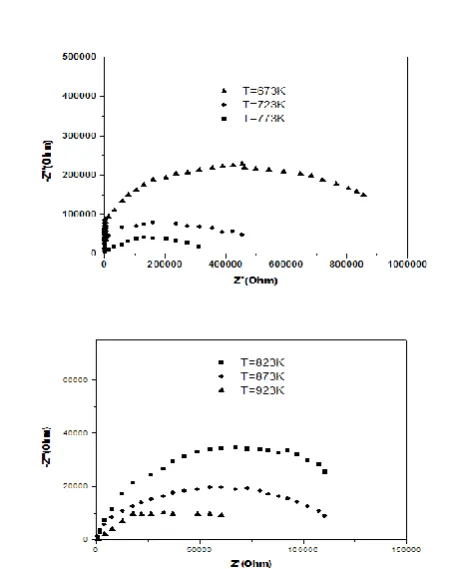
The bulk materials can be analysed by an equivalent circuit of one parallel resistance–capacitance (RC) element giving rise to arcs in complex plane. The impedance Z″ vs. Z′ plots measured at (673, 723 and 773 K) and then at (823,
873 and 923 K) for SrBi2Nb2O9 ceramic are shown in Figure 2. When the temperature increases, we note that the semicircles become smaller and shift towards lower Z′
values. This phenomenon was also observed by Dhak et al .13
1
* ' '' (1)
* 0
Z Z j Z
j C r
'' '
(2) '2 ''2
0
Z
r C Z Z
'
ε '' (3)
'2 ''2 0
Z r C Z Z
''
tan (4)
'
r r
Figure 2. Complex impedance plots of SrBi2Nb2O9 ceramic at different temperatures.
The temperature dependence of real εr′ and tanδ of SBN ceramic are represented on Figures 3 and 4 respectively. The different frequencies used in this study are 1 KHz, 10 KHz and 1 MHz. Dispersion in frequencies is observed with maximum values of εr′ at weak frequencies and with high temperatures (figure 3). This property appears to be a common feature in ferroelectrics materials associated with ionic type conductivity8. Moreover, for the various frequencies, the maximum of εr′ occurs at 703 K. This temperature corresponds to the Curie temperature TC which indicates that the ferroelectric undergoes paraelectric transition. It should be noted that the dielectric constant εr′ and the factor dissipation tanδ values at 10 kHz and 300 K are respectively, 148 and 0.010, while at TC, these are 1500 and 0.35.
Figure 3. Temperature dependent dielectric constant of SrBi2Nb2O9 ceramic measured at various frequencies.
Figure 4. Temperature dependent tangent loss of SrBi2Nb2O9 ceramic measured at various frequencies.
Into the bargain, the thermal evolution of the dielectric constant εr′, has to TC a discontinuity which results in a maximum of εr′. In the paraelectric region, εr′ follows a Curie - Weiss law of the following form:
where C is the Curie constant.
With an aim to examine the nature of the ferroelectric paraelectric transition in SBN ceramic, the reciprocal dielectric constant 1/εr′ is plotted at 1 kHz against temperature and is shown in Figure 5. The Curie - Weiss temperature (T0 = 692 K) is obtained by linear extrapolation on the temperature axis and the value of the Curie - Weiss constant (C= 0.45 x 10⁵ K) has been deduced from the slope. The T0 value is less than TC, this confirms that the nature of the ferroelectric - paraelectrique transition in SrBi2Nb2O9 is of first order. These results are in agreement with those reported by Kajewski et al and Vankataraman et al.8- 14
Figure 5. The inverse dielectric (1/ ε’r ) as a function of temperature at 1KHz for SBN ceramic.
The bulk conductivity σ of SBN ceramic was calculated starting from taken measurements and via the relation:
where
R is the resistance of the bulk (intersection of semicircle on the real-axis),
e is the thickness and
S is the area of the sample.
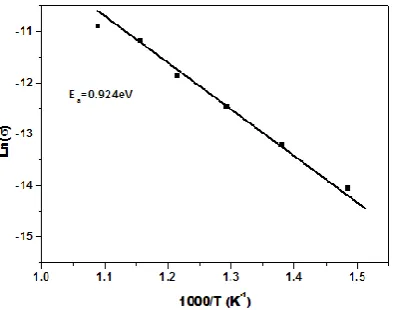
The curve ln(σ) according to the reciprocal temperature was plotted on Figure 6. The linearity of this curve is confirmed within the studied temperature range indicating that the conductivity of the ceramic followed the Arrhenius law:
exp (7)
0 a k
where
σo is a pre-exponential factor and
Ea, represents the apparent activation energy for conduction process,
'
(5) 0
C
r T T
(6)
e
S R
k is the Boltzmann constant
T is the absolute temperature.
The activation energies were deduced from the slope of the straight-line region. The value of activation energy is 0.924 eV, which corresponds to the activation energy to ionic conduction motion in perovskite materials and found to be in agreement with several reports 15- 16. It seems that the ionic nature of conductivity is related to the presence of defects and/or impurities in the network. In oxide ferroelectrics, doubly charged oxygen vacancies are the most mobile charges and play an important role in the conduction process 17. The motion of oxygen vacancies is well known to give rise to activation energy of about 1 eV 18 in perovskite oxides at high temperature. Thus, the experimental activation energy value may be related to the
presence of oxygen ion vacancy concentration 8- 19-20.
Figure 6. The inverse dielectric (1/ ε’r ) as a function of temperature at 1KHz for SBN ceramic.
Conclusions
Perovskite SrBi2Nb2O9 (SBN) materials were prepared by hydrothermal method at different temperatures and times and conventionally sintered in air. X-ray diffractograms of the samples reveal the single phase layered perovskite structure formation. The dielectric and impedance behaviour of SBN ceramics were investigated over a wide temperature and frequency ranges. The Curie temperature was determined to be equal 703 K. The nature of the ferroelectric - paraelectric transition in SBN was confirmed to be of first order. Bulk conductivity of the samples was deduced at different temperatures through impedance investigations. The value of activation energy is 0.924 eV indicating the presence of ionic conductivity could be due to the mobility of the oxygen vacancies.
References
1 Ikegami, S., Ueda, I., Jpn. J. Appl. Phys., 1974, 13, 1572.
2 Aurivillius, B., Fang, P.H., Phys. Rev., 1962, 126, 893.
3 Irie, H., Miyayama, M., Kudo, T., J. Appl. Phys.,2001, 90, 4089. 4 Forbess, M. J., Seraji, S., Wu, Y., Nguyen, C. P., Cao, G. Z., Appl.
Phys. Lett., 2000, 76, 2934.
5 Araujo, C.A., Cuchlaro, J. D., McMillan, L. D., Scott, M. C., Scott, J. F., Nature, 1995, 374, 627.
6 Jones, R. E., Maniar, P. D., Moazzami, R., Zurcher, P., Witowski, J. Z., Lii, Y. T., Chu, P., Gillespie, S. J., Thin Solid Films,
1995, 270, 584.
7 Venkataraman, H.B., Varma, K.B.R., Solid State Ionics, 2004, 167, 197.
8 Venkataraman, H.B., Varma, K.B.R., J. Phys. Chem. Solids,2003, 64, 2105.
9 Dias, A., Paniago, R. M., Buono, V. T. L., J. Mater. Chem., 1997, 7, 2441.
10 Dias, A., Buono,V.T.L., Ciminelli, V. S.T., Moreira, R. L., J. Eur. Ceram. Soc., 1999, 19, 1027.
11 Byrappa, K., Adschiri, T., Prog. Cryst. Growth Charact. Mater.,
2007, 53, 117.
12 Hennings, D., Schreinmacher, S., J. Eur. Ceram. Soc., 1992, 9, 41.
13 Prasanta, D., Debasis, D., Kausikisankar, P ., Panchanan, P., Solid State Sciences, 2008, 10, 1936.
14 Kajewski, D., Ujma, Z., Szot, K., Pawelczyk, M., Ceramics Int.,
2009, 35, 2351.
15 Coondoo, I., Jha, A.K., Agarwal, S. K., Eur. J. Ceram. Soc.,
2007, 27, 253.
16 Palanduz, A. C., Smyth, D. M., J. Electroceram., 2003, 11, 191. 17 Kim, I. W., Ahn, C.W., Kim, J.S., Bae, J.-S., Choi, B.C., Jeong,
J.-H., Lee, J.S., Appl. Phys. Lett., 2002, 80, 4006.
18 Joshi, P.C., Krupanidhi, S.B., Mansingh, A., J. Appl. Phys.,
1992 , 72, 5517.
19 Kumar, M. M., Ye, Z. G., J. Appl. Phys., 2001, 90, 934.
20 Debasis, D., Tanmay, G. K., Panchanan, P., Solid State Sci.,
2007, 9, 57.