SYNTHESIS OF
2-((5-BENZYLIDENE-4-OXO-4,5-DIHYDROTHIAZOL-2-YL)-SUBSTITUTED AMINO ACIDS AS
ANTICANCER AND ANTIMICROBIAL AGENTS
Rohini N. Shelke,
[a]Dattatraya N. Pansare,*
[b]Chandraknat D. Pawar,
[c]
Mininath C. Khade,
[a]Vrushali N. Jadhav,
[a]Satish U. Deshmukh,
[b]Aniket P. Sarkate,
[c]
Nileema S. Gore,
[e]Rajendra P. Pawar,
[b]Devanand B. Shinde,
[d]Shankar R.
Thopate
[a]Keywords:2-thioxothiazolidin-4-one; Knoevenagel condensation; anticancer activity; antimicrobial activity.
A series of Rhodanine derivatives were synthesized by Knoevenagel condensation. All the synthesized compounds were tested for their in vitro anticancer activity against MCF-7 and BT-474 human breast cancer cell lines. All the synthesized compounds were characterized and screened for their antimicrobial activity against the bacterial and fungal strain. Majority of the compounds showed good to moderate anticancer and antimicrobial activity. Among these compounds, one showed promising activity against gram-positive bacteria B. subtilis and S. aureus when compared with ampicillin. Some of the most potent compounds possessed selective antimicrobial activity.
*Corresponding Authors Fax: +91 0240-2400413
E-Mail: [email protected]
[a] Department of Chemistry, Prof. John Barnabas Post Graduate School of Biological Studies, Ahmednagar College, Ahmednagar-414001, MS, India
[b] Department of Chemistry, Deogiri college, Station road, Aurangabad-431 005, MS, India.
[c] Department of Chemical Technology, Dr. Babasaheb Ambedkar Marathwada University, Aurangabad-431 004, MS, India.
[d] Shivaji University, Vidyanagar, Kolhapur- 416 004, MS, India.
[e] MGM’s Institute of Biosciences & Technology, N-6, Cidco, Aurangabad-431003, MS, India.
INTRODUCTION
The dealing of microbial infections remains a very challenging salutary problem because of emerging infectious diseases and the increasing number of multidrug-resistant microbial pathogens. Even though the many antibiotics, drugs and chemotherapeutic available, the emergence of old and newer antibiotic-resistant bacterial strains in the last two decades created an urgent need for the discovery and development of new antimicrobials with a
broader spectrum of activity and lower toxicity.1-3
The 2-thioxothiazolidin-4-one (Rhodanine) based
molecules exhibit biological activities, such as antidiabetic,4
anticancer,5 antitubercular,6,7 anti-HIV,8-10 antiparasitic,11
anticonvulsant,12 and antiproliferative.13,14 Thiazole also has
anti-inflammatory,15 anticancer,16 anti-fungal17 and
anti-microbial18activity. The Rhodanine derivatives have been
known for over five decades, and there are various reports available on Rhodanine derivatives as antimicrobial
agents.19-24 These reports suggested that Rhodanine nuclei
were essential to the observed levels of antimicrobial activity.25-28
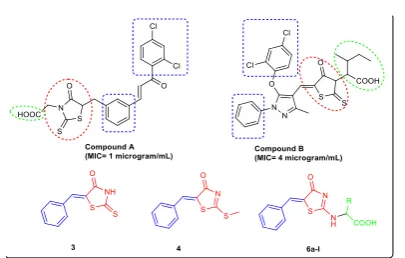
We make a plan to synthesized Rhodanine derivatives as an antimicrobial agent by preparing hybrid molecules having similar features of reported potent antimicrobial agents (Figure 1).
Figure 1. Previously reported antibacterial agents and synthesized compounds.
Because of the facts mentioned above, Rhodanine derivatives were synthesized, characterized by different spectral analysis techniques and screened for their antimicrobial activity. All the synthesized compounds were also screened for their anticancer activity against cell line MCF-7. The results suggest that the compounds could be exploited as an antimicrobial agent. In continuation of our
work,29-42 on the synthesis of heterocyclic and bioactive
compounds, we have synthesized some Rhodanine analogs.
MATERIALS AND METHODS
Rhodanine, benzaldehyde and various solvents were commercially available. The major chemicals were purchased from Sigma Aldrich and Avra labs. Reaction courses were monitored by TLC on silica gel precoated F254 Merck plates. Developed plates were examined with UV lamps (254 nm). IR spectra were recorded on an FT-IR (Bruker). Melting points were recorded on SRS Optimelt,
melting point apparatus and are uncorrected. The 13C NMR
spectra were recorded on a 400 MHz Varian NMR
spectrometer. The 1H NMR spectra were recorded on a 400
abbreviations are used; singlet (s), doublet (d), triplet (t), quartet (q), multiplet (m) and broad (br). Mass spectra were taken with Micromass-QUATTRO-II of WATER mass spectrometer.
Procedure for the synthesis of (Z)-5-benzylidene-2-thioxothiazolidin-4-one (3)
A mixture of benzaldehyde 1 (1 mmol),
2-thioxothiazolidin-4-one 2 (1 mmol), anhydrous sodium
acetate (1 mmol) and glacial acetic acid (1 ml) was refluxed for 5 h. The progress of the reaction was monitored by TLC
(20% ethyl acetate: n-hexane). After completion of the
reaction, the reaction mixture was poured into the ice-cold water. The precipitate was filtered off and washed with water (3×10 ml), dried, and purified by recrystallization in ethanol as a solvent to give 82 % yield.
Orange solid, Yield: 82%. mp 204–206 ºC; ES-MS m/z:
221.05. IR νmax/cm–1: 1670 (C=O), 1600 (C=C), 1585 (C=N),
1230 (C=S), 1192(C–N). 1H NMR: δ (ppm) = 7.40–7.55 (m,
5H, Ar–CH), 7.70 (s, 1H, =CH), 13.90 (s, 1H, NH). 13C
NMR: δ(ppm) = 125.5, 128.5, 130.7, 130.9, 131.4, 133.5, 169.4, 194.7.
Procedure for the synthesis of (Z)-5-benzylidene-2-(methylthio)thiazol-4(5H)-one (4)
In a 50 ml round bottom flask, the compound (Z
)-5-benzylidene-2-thioxothiazolidin-4-one (3) (1 mmol),
triethylamine (1.2 mmol), iodomethane (1.2 mmol), and dichloromethane (10 ml) were stirred at room temperature for 2 h. The progress of the reaction was monitored by TLC (10% methanol: chloroform). After completion of the reaction, the reaction mixture was concentrated in-vacuo. The residue was washed with water (3×15 mL) to afford the crude product and it was recrystallized from ethanol. Orange solid, Yield: 85%. M.p 145–147 ºC; ES-MS m/z: 235.00. IR
νmax/cm–1: 3026 (CH–Ar), 1694 (C=O), 1590 (C=C), 1462
(C=N),1151 (C-S), 979 (C–N). 1H NMR: δ (ppm)= 2.85 (s,
3H, S-CH3), 7.40–7.72 (m, 5H, Ar–CH), 7.90 (s, 1H, =CH).
13C NMR: δ (ppm) = 14.4, 126.5, 128.6, 131.4, 132.9, 133.5,
135.7, 152.3, 162.7, 169.2.
General procedure for the synthesis of (Z)-2-((5-benzylidene-4-oxo-4,5-dihydrothiazol-2-yl)amino) acid (6a-l)
In a 50 ml round bottom flask, the compound (4) (1
mmol), amino acids (5a-l) (1.2 mmol), potassium carbonate
(1 mmol) and ethanol (5 ml) were mixed and stirred for 20-60 min at room temperature. The progress of the reaction was monitored by TLC (10% methanol:chloroform). After completion of the reaction, the reaction mixture was concentrated in-vacuo. The residue was washed with water
(3×15 mL) to afford the crude product. The (Z
)-2-((5-benzylidene-4-oxo-4,5-dihydrothiazol-2-yl) substituted
amino acids (6a-l) were recrystallized from ethanol and
isolated as yellowish solids.
(Z)-2-((5-Benzylidene-4-oxo-4,5-dihydrothiazol-2-yl)amino)propanoic acid (6a).
Yellow solid, Yield: 92%, M.p 221–223 ºC; ES-MS m/z:
277.00. IR νmax /cm–1: 3384 (OH), 3210 (NH), 3026 (CH–
Ar), 1737 (HO–C=O), 1599 (C=O), 1553 (C=C), 1599
(C=N), 1006 (C-S), 1091 (C–N). 1H NMR: δ(ppm)= 1.40–
1.50 (d, 3H, C–CH3), 4.60–4.70 (q, 1H, CH), 7.40–7.60 (m,
5H, Ar–CH), 7.70 (s, 1H, =CH), 9.15 (s, 1H, NH), 10.20 (s,
1H, COOH). 13C NMR: δ(ppm) = 16.7, 53.4, 127.5, 128.7,
132.7, 135.7, 152.3, 158.6, 167.7, 179.2.
(Z)-2-((5-Benzylidene-4-oxo-4,5-dihydrothiazol-2-yl)amino)-3-methylbutanoic acid (6b).
Yellow solid, Yield: 90%, M.p 178–180 ºC; ES-MS m/z:
304.50. IR νmax /cm–1: 3744 (OH), 3011 (NH), 1737 (HO–
C=O), 1689 (C=O), 1553 (C=C), 1509 (C=N), 1232 (C-S),
1010 (C–N). 1H NMR: δ(ppm)= 0.90–0.92 (d, 6H, CH–
(CH3)2), 1.52–1.54 (m, 1H, CH), 4.44–4.46 (d, 1H, CH),
7.26–7.68 (m, 5H, Ar–CH), 7.76 (s, 1H, =CH), 9.18 (s, 1H,
NH), 10.26 (s, 1H, COOH). 13C NMR: δ(ppm) = 18.7, 30.4,
61.4, 127.9, 128.6, 128.9, 132.3, 135.9, 152.9, 158.1, 167.3, 178.2.
(Z)-2-((5-Benzylidene-4-oxo-4,5-dihydrothiazol-2-yl)amino)-3-methylpentanoic acid (6c).
Yellow solid, Yield: 94%, M.p 110–112 ºC; ES-MS m/z:
319. IR νmax/cm–1: 3365 (OH), 3211 (NH), 3007 (CH–Ar),
1732 (HO–C=O), 1693 (C=O), 1556 (C=C), 1583 (C=N),
1014 (C-S), 1096 (C–N). 1H NMR: δ(ppm)= 0.99–1.01 (t,
3H, CH2–CH3), 1.19–1.22 (d, 3H, CH3) 1.52–1.60 (m, 2H,
CH2), 1.81–1.92 (m, 1H, CH), 4.43–4.45 (d, 1H, CH), 7.21–
7.62 (m, 5H, Ar–CH), 7.78 (s, 1H, =CH), 9.12 (s, 1H, NH),
11.01 (s, 1H, COOH). 13C NMR: δ(ppm) = 18.7, 30.4, 61.4,
127.9, 128.6, 128.9, 132.3, 135.9, 152.9, 158.1, 167.3, 178.2.
(Z)-2-((5-Benzylidene-4-oxo-4,5-dihydrothiazol-2-yl)amino)-3-phenylpropanoic acid (6d).
Yellow solid, Yield: 92%, M.p 187–189 ºC; ES-MS m/z:
353. IR νmax /cm–1: 3395 (OH), 3213 (NH), 2990 (CH–Ar),
1737 (HO–C=O), 1691 (C=O), 1551 (C=C), 1581 (C=N),
1017 (C-S), 1098 (C–N). 1H NMR: δ(ppm)= 2.51–2.53 (d,
2H, CH2), 4.43–4.78 (q, 1H, CH), 7.21–7.72 (m, 10H, Ar–
CH), 7.79 (s, 1H, =CH), 9.14 (s, 1H, NH), 11.02 (s, 1H,
COOH). 13C NMR: δ(ppm) = 36.4, 58.4, 125.9, 127.7, 128.6,
128.9, 135.3, 136.9, 152.2, 158.5, 167.1, 175.2.
(Z)-2-((5-Benzylidene-4-oxo-4,5-dihydrothiazol-2-yl)amino)-4-(methylthio)butanoic acid (6e).
Yellow solid, Yield: 90%, M. p 122–124 ºC; ES-MS m/z:
337. IR νmax /cm–1: 3398 (OH), 3200 (NH), 2980 (CH–Ar),
1H NMR: δ(ppm)= 2.01–2.20 (q, 2H, CH
2), 2.20 (s, 3H,
CH3), 2.61–2.63 (t, 2H, CH2), 4.43–4.78 (q, 1H, CH), 7.31–
7.60 (m, 5H, Ar–CH), 7.78 (s, 1H, =CH), 9.16 (s, 1H, NH),
11.22 (s, 1H, COOH). 13C NMR: δ(ppm)=15.4, 29.8, 30.4,
56.4, 127.7, 128.6, 128.9, 132.3, 136.9, 152.2, 158.5, 167.5, 174.9.
(Z)-2-((5-Benzylidene-4-oxo-4,5-dihydrothiazol-2-yl)amino)-4-methylpentanoic acid (6f)
Yellow solid, Yield: 96%, M.p 209–211 ºC; ES-MS m/z:
319. IR νmax /cm–1: 3397 (OH), 3212 (NH), 3013 (CH–Ar),
1734 (HO–C=O), 1691 (C=O), 1555 (C=C), 1583 (C=N),
1013 (C-S), 1091 (C–N). 1H NMR: δ(ppm)= 0.92–0.94 (d,
6H, CH–(CH3)2), 1.41–1.43 (m, 1H, CH), 1.71–1.73(t, 2H,
CH2), 4.44–4.46 (q, 1H, CH), 7.29–7.69 (m, 5H, Ar–CH),
7.76 (s, 1H, =CH), 9.14 (s, 1H, NH), 10.84 (s, 1H, COOH).
13C NMR: δ(ppm) = 22.7, 24.4, 40.4, 55.2, 127.8, 128.9,
129.2, 132.1, 135.4, 152.2, 159.1, 167.1, 174.2.
(Z)-2-((5-Benzylidene-4-oxo-4,5-dihydrothiazol-2-yl)amino)-3-hydroxypropanoic acid (6g)
Yellow solid, Yield: 95%, M.p 195–197 ºC; ES-MS m/z:
293. IR νmax /cm–1: 3450 (OH), 3214 (NH), 3007 (CH–Ar),
1738 (HO–C=O), 1688 (C=O), 1553 (C=C), 1511 (C=N),
1019 (C-S), 1097 (C–N). 1H NMR: δ(ppm)= 3.60 (s, 1H,
CH), 4.01–4.03 (q, 1H, CH), 4.23–4.25 (d, 2H, CH2),7.31–
7.60 (m, 5H, Ar–CH), 7.78 (s, 1H, =CH), 9.12 (s, 1H, NH),
10.86 (s, 1H, COOH). 13C NMR: δ(ppm) = 59.2, 62.3, 127.1,
128.5, 129.2, 132.9, 135.1, 151.9, 158.1, 167.9, 173.2.
(Z)-2-((5-Benzylidene-4-oxo-4,5-dihydrothiazol-2-yl)amino)-3-mercaptopropanoic acid (6h)
Yellow solid, Yield: 92%, M.p 189–191 ºC; ES-MS m/z:
309. IR νmax /cm–1: 3455 (OH), 3201 (NH), 3017 (CH–Ar),
2500 (SH), 1739 (HO–C=O), 1698 (C=O), 1559 (C=C),
1501 (C=N), 1011 (C-S), 1099 (C–N). 1H NMR: δppm=
1.50 (s, 1H, CH), 3.11–3.29 (d, 2H, CH2), 4.13–4.38 (t, 1H,
CH), 7.22–7.59 (m, 5H, Ar–CH), 7.68 (s, 1H, =CH), 9.18 (s,
1H, NH), 11.84 (s, 1H, COOH). 13C NMR: δppm = 26.9,
60.3, 127.5, 128.8, 129.1, 132.5, 135.6, 152.9, 158.3, 167.2, 178.2.
(Z)-2-((5-Benzylidene-4-oxo-4,5-dihydrothiazol-2-yl)-amino)succinic acid (6i)
Yellow solid, Yield: 90%, M.p 169–171 ºC; ES-MS m/z:
321. IR νmax /cm–1: 3465 (OH), 3213 (NH), 3020 (CH–Ar),
1735 (HO–C=O), 1689 (C=O), 1549 (C=C), 1503 (C=N),
1030 (C-S), 1089 (C–N). 1H NMR:δ(ppm)= 2.61–2.63 (d,
2H, CH2), 3.71–3.73 (t, 1H, CH), 7.33–7.69 (m, 5H, Ar–
CH), 7.78 (s, 1H, =CH), 9.30 (s, 1H, NH), 11.74 (s, 2H,
COOH). 13C NMR: δ(ppm) = 26.9, 60.3, 127.5, 128.8, 129.1,
132.5, 135.6, 152.9, 158.3, 167.2, 178.2.
(Z)-2-((5-Benzylidene-4-oxo-4,5-dihydrothiazol-2-yl)amino)-3-(1H-imidazol-4-yl) propanoic acid (6j)
Yellow solid, Yield: 94%, M. p 162–164 ºC; ES-MS m/z:
343. IR ν /cm–1: 3435 (OH), 3215 (NH), 3021 (CH–Ar),
1736 (HO–C=O), 1681 (C=O), 1552 (C=C), 1508 (C=N),
1032 (C-S), 1091 (C–N). 1H NMR: δ(ppm)= 2.91–2.93 (d,
2H, CH2), 3.72–3.74 (t, 1H, CH), 7.30–7.60 (m, 5H, Ar–
CH), 7.64 (s, 1H, =CH), 7.78 (s, 1H, =CH), 8.74 (s, 1H, =CH), 9.30 (s, 1H, NH), 11.74 (s, 1H, COOH), 13.00 (s, 1H,
NH). 13C NMR: δ(ppm) = 28.9, 58.3, 117.9,124.7, 127.9,
128.6, 129.2, 132.1, 135.2, 136.7, 152.3, 158.2, 167.5, 176.2.
(Z)-2-((5-benzylidene-4-oxo-4,5-dihydrothiazol-2-yl)amino)-3-(4-hydroxyphenyl) propanoic acid (6k).
Yellow solid, Yield: 93%, mp 192–194 ºC; ES-MS m/z:
369. IR νmax /cm–1: 3465 (O=C-OH), 3395 (OH), 3218
(NH), 2994 (CH–Ar), 1739 (HO–C=O), 1699 (C=O), 1553
(C=C), 1591 (C=N), 1011 (C-S), 1089 (C–N). 1H NMR:
δppm= 2.81–2.99 (d, 2H, CH2), 4.43–4.45(t, 1H, CH), 5.31
(s, 1H, OH),7.30–7.60 (m, 5H, Ar–CH), 7.31–7.72 (m, 4H, Ar–CH), 7.72 (s, 1H, =CH), 9.32 (s, 1H, NH), 11.16 (s, 1H,
COOH). 13C NMR: δppm = 36.4, 58.6, 115.9, 127.7, 128.6,
128.9, 129.2, 130.2, 135.3, 136.9, 152.2, 155.7, 158.5, 167.7, 174.2.
(Z)-2-((5-Benzylidene-4-oxo-4,5-dihydrothiazol-2-yl)-amino)-3-hydroxybutanoic acid (6l).
Yellow solid, Yield: 94%, mp 209–211 ºC; ES-MS m/z:
307. IR νmax /cm–1: 3464 (OH), 3202 (NH), 3013 (CH–Ar),
1736 (HO–C=O), 1681 (C=O), 1555 (C=C), 1597 (C=N),
1046 (C-S), 1112 (C–N). 1H NMR: δ(ppm)= 1.15–1.17 (d,
3H, CH3), 3.52–3.54 (d, 1H, CH), 3.64 (s, 1H, OH), 3.93–
4.18 (m, 1H, CH), 7.26–7.68 (m, 5H, Ar–CH), 7.74 (s, 1H,
=CH), 9.68 (s, 1H, NH), 11.24 (s, 1H, COOH). 13C NMR:
δ(ppm) = 19.7, 64.4, 66.6, 127.8, 128.7, 128.9, 132.4, 135.1, 152.9, 158.2, 167.8, 175.2.
Antimicrobial activity
The antibacterial activity was evaluated against two
Gram-positive bacteria namely, Bacillus subtilis
(NCIM-2063)andStaphylococcus aureus (NCIM-2901), and one
Gram-negative bacterium Escherichia coli (NCIM-2256).
The antibacterial activity of compounds was monitored by observing their Minimum Inhibitory Concentration (MIC,
μgmL-1) as previously mentionedby the broth dilution
method using Ciprofloxacin and Ampicillin as standard drugs. The antifungal activity was evaluated against three
fungal strains; Candida albicans (NCIM-3471), Aspergillus
flavus (NCIM-539)and Aspergillus niger (NCIM-1196)using Fluconazole and Miconazole as standard drugs.
Minimum inhibitory concentration (MIC, μgmL-1) values
for antifungal were determined using standard agar dilution
method.43 Methanol was used as solvent control for both
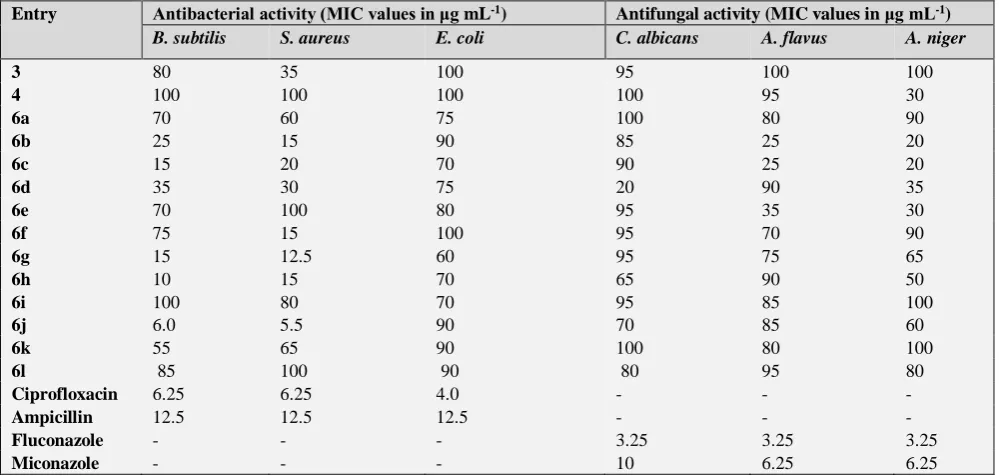
antibacterial and antifungal testing. The MIC values of the tested compounds are presented in Table 3.
Anticancer activity
All the synthesized compounds were also tested for their anticancer activity on mammalian cell lines MCF-7 and BT-474 human breast cancer cell line. This test is performed as
previously mentioned MTT colorimetric assay.44 The
anticancer activity of the compounds was determined by
required to inhibit 50% of cell growth compared to untreated
control cells. The IC50 values were presented in micromol
per milliliter (μM). The Adriamycin was used as a positive control for the comparison of the anticancer activity of synthesized compounds.
RESULTS AND DISCUSSION
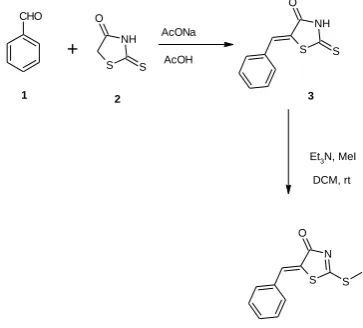
The synthetic protocols employed for the synthesis of
Rhodanine derivatives 3, 4, and 6a-l is presented in Scheme
1. The compound (3) was prepared via a Knoevenagel
condensation between and benzaldehyde (1) andRhodanine
(2). The compound (4) (Scheme 1) was obtained via
reaction of the compound (3) with iodomethane in
dichloromethane using triethylamine as a catalyst.
Scheme 1. Synthesis of (Z)-5-benzylidene-2-(methylthio)thiazol-4(5H)-one (4)
We synthesized and screening of model reaction (Z
)-2-((5-benzylidene-4-oxo-4,5-dihydrothiazol-2-yl)amino)propanoic acid (6a) (Scheme 2, Table 1). The reaction in which the
compound 4 (1 mmol) and compound5a (1.2 mmol),
catalyzed by various bases and various solvents were selected as a model reaction to optimize the reaction conditions. In terms of the effect of solvents and bases on the condensation reaction, potassium carbonate was found to be the better base and ethanol was found to be the best solvent for the reaction (Table 1, entry 11); other solvents, including methanol, acetic acid, N,N-dimethylformamide (DMF) and toluene were less efficient (Table 1, entries 2–5, 7–10 and 12–15).
Scheme 2 Screening of model reaction (Z)-2-((5-benzylidene-4-oxo-4,5-dihydrothiazol-2-yl)amino)propanoic acid (6a)aaReaction
condition (6a). Compound (4)(1 mmol), Compound (5a)(1.2 mmol), base (1 mmol), solvent 1mL, stirring at rt for 20-80 min.
Table 1. Screening of catalyst, solvents, reaction time, and yield for the synthesis 6aa.
No. Base Solvent Time,
min
Yield,b %
1 Et3N Ethanol 50 82
2 Et3N Methanol 60 65
3 Et3N Acetic acid 65 60
4 Et3N DMF 70 60
5 Et3N Toluene 80 50
6 NaOAc Ethanol 50 80
7 NaOAc Methanol 55 50
8 NaOAc Acetic acid 65 55
9 NaOAc DMF 70 45
10 NaOAc Toluene 90 55
11 K2CO3 Ethanol 20 98
12 K2CO3 Methanol 50 70
13 K2CO3 Acetic acid 55 65
14 K2CO3 DMF 70 60
15 K2CO3 Toluene 80 60
aAll the reaction was carried out in equimolar amounts of each
compound in 1 mL of solvent.bIsolated yield.
Nevertheless, all of these yields were best. Ethanol gave the corresponding product in 80–98% yield, which was the best among these solvents (Table 1, entries 1, 6 and 11). To increase the efficiency of the condensation reaction, the effects of different bases were investigated (Table 1, entries 1–15). Potassium carbonate exhibited the best performance with used solvents and gave a better yield, (Table 1, entries 11–15). Sodium acetate and triethylamine gave lower yields with other solvents but gave a better yield in combination with ethanol as a solvent (Table 1, entries 1 and 6). All the reactions were carried out in equimolar amounts of each compound in 1 mL of solvent. Among these reactions, same amounts of the solvent, namely 1 ml of ethanol turned out to be the best choice with yields of 82, 80 and 98% (Table 1, entries 1, 6 and 11). We would like to mention here that
ethanol as a solvent with K2CO3 as base was the best choice
with a yield of 98% and less time required for the completion of the reaction (Table 1, entry 11). Thus we decided to carry out the further reactions in ethanol with potassium carbonate. As a result, the reaction time was shortened; thermal decomposition was also minimized, at room temperature stirring, resulting in higher isolated yields.
Thus we decided the further series, substituted acid
derivatives 6a-l(Scheme 3, Table 2) were synthesized
reacting from
5-benzylidene-2-(methylthio)thiazol-4(5H)-one (4) with various amino acids (5a-l) in ethanol by using
K2CO3 as a catalyst. In this reaction, there was displacement
of a methyl sulfinyl group by amino acids from the C2 position of the thiazolone ring.
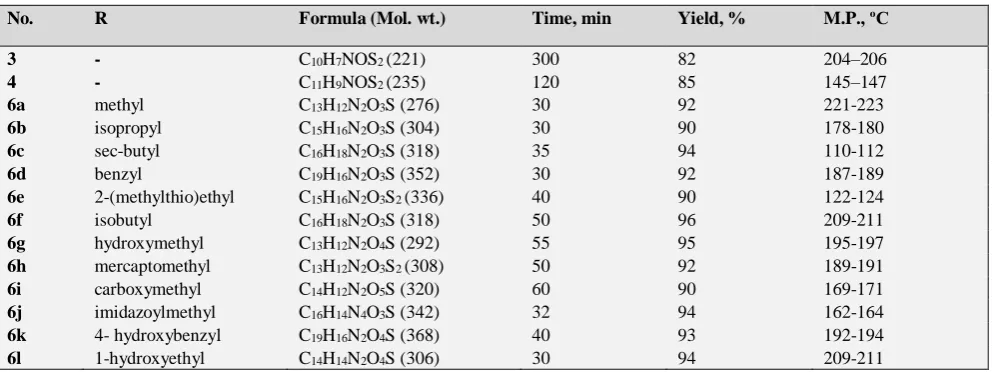
The physical data of the synthesized compounds are presented in Table 2. All the reactions proceeded well in 20-60 min to give products in very good yields (82–98%).
The purity of the synthesized compounds was checked by TLC on silica gel precoated F254 Merck plates and melting points were recorded on SRS Optimelt, melting point apparatus and are uncorrected. The structure of the
synthesized compounds was confirmed by IR, 1H NMR, 13C
NMR and mass spectral analysis. S
N O
S AcOH
AcONa
S NH O
S S
NH O
S CHO
+
Et3N, MeI
DCM, rt
3
1 2
N
H2 COOH
S N O
S
S N O
NH COOH
4 5a
6a
Base
Solvent +
Scheme 3 Synthesis of Z)-2-((5-benzylidene-4-oxo-4,5-dihydrothiazol-2-yl)amino)substituted acid (6a-l).
Antimicrobial activity
From the antibacterial activity data (Table 3), the synthesized compounds of present series showed moderate to good antibacterial activity. Amongst the synthesized
series, the compounds 6g (MIC= 15 μgmL-1 and 12.5 μg
mL-1), 6h (MIC= 10 μg mL-1and 15 μg mL-1)and 6j (MIC=
6μg mL-1and 5.5 μg mL-1)werefound to be most active
molecules and they are found to specific towards the
Gram-positive bacteria, S. aureus and B. subtilis. The compound 6j
(MIC= 6.0 and 5.5 μg mL-1against B. subtilis and S. aureus,
respectively) was more active than both standards;
Ciprofloxacin (MIC= 6.25 μg mL-1) and Ampicillin (MIC=
12.5 μg mL-1). The compounds 6g (MIC=15 and 12.5 μg
mL-1against B. subtilis and S. aureus, respectively) and 6h
(MIC= 10 and 15 μg mL-1against B. subtilis and S. aureus,
respectively) showed lower activity thanCiprofloxacin and
comparative level of activity as Ampicillin. On the other
hand, compound 6f (MIC= 15μg mL-1)was found to be
narrow spectrum molecule showing activity only against the
bacterium S. aureus. Out of these, the remaining compounds
of the series 3, 4, 6a, 6i, 6k,and 6l had very high MIC
values and therefore they are inactive as antibacterial agents. It interesting to find out that bacterium E. coli is resistance to all compounds, suggest that molecules of the series may be inactive against Gram-negative bacteria.
The results of in vitro antifungal activities showed that synthesized compounds have moderate activity. Most of the synthesized compounds were inactive against fungal strains.
Compound 6d (MIC= 20 μg mL-1) had shown significant
activity against C. albicans when compared with
Miconazole (MIC= 10 μg mL-1). The compounds 4 (MIC=
30 μg mL-1) and 6e (MIC= 30 μg mL-1) showed moderate
activity against A. niger when compared with Miconazole
(MIC= 6.25 μg mL-1). The compounds 6b and 6c (MIC= 25
and 20 μg mL-1against A. flavus and A. niger, respectively)
were most active from the synthesized series. None of thesynthesized compounds showed comparable activity with
that of Fluconazole (MIC= 3.25 μg mL-1).
Anticancer activity
The newly synthesized 14 compounds were screened for their in vitro growth inhibitory activities against two human barest cancer cells line MCF-7 and BT-474, 100 µM
(micromol mL-1) by MTT assays method, (Table 4). The
results are shown as percentage anticancer activity after 24 h.
The compounds found active in preliminary screening were further studied for their cytotoxic effect on human barest cancer cell line MCF-7 and BT-474 cell lines and the
results are expressed as IC50. Among these 14 newly
synthesized thiazole derivatives screened for their cytotoxic effect on MCF-7 and BT-474 cells, five compounds showed percentage cell death greater against cell lines used. Among the most active three compounds, two compounds exhibited cell death greater than 50% against both cell lines. The synthesized compounds 6e, 6f, 6g, 6h, 6k and 6l showed maximum percentage cytotoxicity 100 µM.The anticancer
studies of compound (6g) and (6l), against MFC-7 and
BT-474 cell lines exhibited IC50 values are 1.4, 0.7, 1.2, and 1.3
µM,respectively.
Table 2.Physical data for synthesized Rhodanine derivatives 3, 4 and 6a-l.
No. R Formula (Mol. wt.) Time, min Yield, % M.P., ºC
3 - C10H7NOS2 (221) 300 82 204–206
4 - C11H9NOS2 (235) 120 85 145–147
6a methyl C13H12N2O3S (276) 30 92 221-223
6b isopropyl C15H16N2O3S (304) 30 90 178-180
6c sec-butyl C16H18N2O3S (318) 35 94 110-112
6d benzyl C19H16N2O3S (352) 30 92 187-189
6e 2-(methylthio)ethyl C15H16N2O3S2 (336) 40 90 122-124
6f isobutyl C16H18N2O3S (318) 50 96 209-211
6g hydroxymethyl C13H12N2O4S (292) 55 95 195-197
6h mercaptomethyl C13H12N2O3S2 (308) 50 92 189-191
6i carboxymethyl C14H12N2O5S (320) 60 90 169-171
6j imidazoylmethyl C16H14N4O3S (342) 32 94 162-164
6k 4- hydroxybenzyl C19H16N2O4S (368) 40 93 192-194
6l 1-hydroxyethyl C14H14N2O4S (306) 30 94 209-211
The solvent of recrystallization was ethanol; Eluants used in TLC were chloroform: methanol (1:9) for all compounds.
NH N N
H2 COOH
R
S N O
NH COOH R S
N O
S
K2CO3
4
R = 5a = 6a = -CH3
5b = 6b = -CH(CH3)2
5c = 6c = -CH(CH3)CH2CH3
5d = 6d = -CH2C6H5
5e = 6e = -CH2CH2SCH3 5f = 6f = -CH2CH(CH3)2 5g = 6g = -CH2OH 5h = 6h = -CH2SH
5a-l
6a-l
Ethanol +
Table 3. In vitro antimicrobial evaluation of synthesizedRhodanine derivatives 3, 4, and 6a-l.
The data represents the mean values of three replicates; Standard errors were all within 10% of the mean; - denotes not tested.
While the compounds 6e, 6g, 6h, 6k and 6l against
BT-474 cell lines exhibited IC50: 6.2, 0.7, 6.8, 12.1, and 1.3 µM
mL-1,respectively. The IC
50 of reference drug Adriamycin
against MFC-7 and BT-474 cells was found to be 0.9 and
0.5 µM mL-1,respectively. The anticancer activity of all
newly synthesized thiazole derivatives mainly depends on the type of substitution on thiazole moiety. The substitution pattern of amino acids showed variation in anticancer activity.
Table 4.In vitroanticancer activity of the studied compounds against the MCF-7 and BT-474cells, after 24 h
aGI
50(Growth inhibition of 50): Concentration of drug that
decreases the growth of the cells by 50compared to a non-treated control cell. bValues are the average of three readingscMCF-7:
Human breast cancer cell lined BT-474: Human breast cancer cell
lineeAdriamycin: Positive control compound
The compounds with a substituted hydroxyl group attached to thiazole ring which contains amino acids showed the highest percentage of cell death. While the compounds having electron releasing alkyl chain, methyl-1H-imidazole ring group on thiazole rings resulted in the loss of activity.
CONCLUSIONS
We have reported at room temperature, less reaction time with good to excellent yields. All the synthesized
compounds were also tested for their in vitro anticancer
activity against MCF-7 and BT-474 human breast cancer cell lines. Among them most of the compounds show good
to excellent anticancer activity, especially 6e, 6f, 6g, 6h, 6k
and 6l are the most active compounds against tested cell line.
The compound 6g activity value is very close to standard
drug, which can be regarded as the promising drug candidate for development of anticancer drugs. The investigation has revealed that a number of Rhodanine derivatives have promising antimicrobial properties.
ACKNOWLEDGMENTS
The authors are thankful to the Head, Department of
Chemical Technology, Dr. Babasaheb Ambedkar
Marathwada University, Aurangabad 431004 (MS) India, for providing the laboratory facility.
REFERENCES
1Azam, F., Alkskas, I.A., Khokra, S.L., Prakash, O., Synthesis of
some novel N4-(naphtha[1,2-d]thiazol-2-yl)semicarbazides as potential anticonvulsants, Eur. J. Med. Chem., 2009,44, 203. https://doi.org/10.1016/j.ejmech.2008.02.007
Entry Antibacterial activity (MIC values in μg mL-1) Antifungal activity (MIC values in μg mL-1)
B. subtilis S. aureus E. coli C. albicans A. flavus A. niger
3 80 35 100 95 100 100
4 100 100 100 100 95 30
6a 70 60 75 100 80 90
6b 25 15 90 85 25 20
6c 15 20 70 90 25 20
6d 35 30 75 20 90 35
6e 70 100 80 95 35 30
6f 75 15 100 95 70 90
6g 15 12.5 60 95 75 65
6h 10 15 70 65 90 50
6i 100 80 70 95 85 100
6j 6.0 5.5 90 70 85 60
6k 55 65 90 100 80 100
6l 85 100 90 80 95 80
Ciprofloxacin 6.25 6.25 4.0 - - -
Ampicillin 12.5 12.5 12.5 - - -
Fluconazole - - - 3.25 3.25 3.25
Miconazole - - - 10 6.25 6.25
Sr. No. Compounds IC50,a µMb
MCF-7c BT-474d
1 3 68.7 61.3
2 4 65.8 62.1
3 6a 64.9 42.6
4 6b 59.4 63.7
5 6c 49.7 66.6
6 6d 80.5 42.6
7 6e 88.7 6.2
8 6f 7.1 55.8
9 6g 1.4 0.7
10 6h 7.2 6.8
11 6i 41.3 74.1
12 6j 68.7 64.5
13 6k 3.1 12.1
14 6l 1.2 1.3
2Balzarini, J., Orzeszko, B., Maurin, J. K., Orzeszko, A., Synthesis
and anti-HIV studies of 2-adamantyl-substituted thiazolidin-4-ones, Eur. J. Med. Chem.2007, 42, 993. https://doi.org/10.1016/j.ejmech.2007.01.003
3Brooke, E. W., Davies, S. G., Mulvaney, A. W., Okada, M.,
Pompeo, F., Sim, E., Vickers, R. J., Westwood, I. M., Synthesis and in vitro evaluation of novel small molecule inhibitors of bacterial arylamine N-acetyltransferases (NATs),
Bioorg. Med. Chem.,2003,13,
2527.https://doi.org/10.1016/S0960-894X(03)00484-0
4Murugan, R., Anbazhagan, S., Narayanan, S. S., Synthesis and in
vivo antidiabetic activity of novel dispiropyrrolidines through [3+2] cycloaddition reactions with thiazolidinedione and Rhodanine derivatives. Eur. J. Med. Chem.,2009, 44, 3272. https://doi.org/10.1016/j.ejmech.2009.03.035
5Chandrappa, S., Kavitha, C. V., Shahabuddin, M. S., Vinaya, K.,
Ananda, C. S., Ranganatha, S. R., Raghavan, S. C., Rangappa, K. S., Synthesis of 2-(5-((5-(4-
chlorophenyl)furan-2-yl)methylene)-4-oxo-2-thioxothiazolidin-3-yl)acetic acid derivatives and evaluation of their cytotoxicity and induction of apoptosis in human leukemia cells, Bioorg. Med. Chem., 2009, 17, 2576. https://doi.org/10.1016/j.bmc.2009.01.016
6Alegaon, S. G., Alagawadi, K. R., Sonkusare, P. V., Chaudhary, S.
M., Dadwe, D. H., Shah, A. S., Novel imidazo[2,1-b][1,3,4]thiadiazole carrying Rhodanine-3-acetic acid as potential antitubercular agents, Bioorg. Med. Chem. Lett.,2012, 22, 1917.
https://doi.org/10.1016/j.bmcl.2012.01.052
7Chauhan, K., Sharma, M., Trivedi, P., Chaturvedi, V., Chauhan, P.
M. S., New class of methyl tetrazole based hybrid of (Z)-5-benzylidene-2-(piperazin-1-yl)thiazol-4(%H)-one as potent antitubercular agents, Bioorg. Med. Chem. Lett., 2014, 24, 4166. https://doi.org/10.1016/j.bmcl.2014.07.061
8Rajamaki, S., Innitzer, A., Falciani, C., Tintori, C., Christ, F.,
Witvrouw, M., Debyser, Z., Massa, S., Botta, M., Exploration of novel thiobarbituric acid, Rhodanine and thiohydantoin-based HIV-1 integrase inhibitors, Bioorg. Med.
Chem. Lett., 2009, 19, 3615.
https://doi.org/10.1016/j.bmcl.2009.04.132
9Murugesan, V., Tiwari, V. S., Saxena, R., Tripathi, R., Paranjape,
R., Kulkarni, S., Makwana, N., Suryawanshi, R., Katti, S. B., Lead optimization at C-2 and N-3 positions of thiazolidin-4-ones as HIV-1 non-nucleoside reverse transcriptase inhibitors,
Bioorg. Med. Chem., 2011,19,
6919.https://doi.org/10.1016/j.bmc.2011.09.018
10Kamila, S., Ankati, H., Biehl, E. R., An efficient
microwave-assisted synthesis of novel class of Rhodanine derivatives as potential HIV-1 and JSP-1 inhibitors, Tet. Lett., 2011, 52, 4375. https://doi.org/10.1016/j.tetlet.2011.05.114
11Chen, Z. H., Zheng, C. J., Sun, L. P., Piao, H. R., Synthesis of
new chalcone derivatives containing a Rhodanine-3-acetic acid moiety with potential anti-bacterial activity, Eur. J. Med. Chem., 2010, 45, 5739.
https://doi.org/10.1016/j.ejmech.2010.09.031
12Senthilraja, M., Alagarsamy, V., Solomon, V. R.,
2,3-Disubstituted Thiazolidin-4-ones: Novel Class of Anticonvulsant Agents, Lett. Drug. Des. Dis. 2012, 9, 731.
13Ottana, R., Carotti, S., Maccari, R., Landini, I., Chiricosta, G.,
Caciagli, B., Vigorita, M. G., Mini, E., In vitro antiproliferative activity against human colon cancer cell lines of representative 4-thiazolidinones, Bioorg. Med. Chem.
Lett.,2005, 15,
3930.https://doi.org/10.1016/j.bmcl.2005.05.093
14Gouveia, F. L., de Oliveira, R. M. B., de Oliveira, T. B., da Silva,
I. M., do Nascimento, S. C., de Sena, K. X. F. R., de Albuquerque, J. F. C., Synthesis, antimicrobial and cytotoxic activities of some 5-arylidene-4-thioxo-thiazolidine-2-ones. Eur. J. Med. Chem.,2009, 44, 2038. https://doi.org/10.1016/j.ejmech.2008.10.006
15Sarkate, A. P., Lokwani, D. K., Karnik , K. S., Shinde, D. B.,
Novel 2-(nitrooxy)ethyl 2-(4-(substituted phenyl)-2-((substituted phenyl)amino)thiazol-5-yl)acetate as anti-inflammatory, analgesic and nitric oxide-releasing agents: Synthesis and Molecular Docking studies, Infl. Anti-Allerg. Age. Med. Chem., 2017, 16(3), 153-167
https://doi.org/10.2174/1871523016666171115125922
16Dofe, V. S., Sarkate, A. P., Azad, R., Gill, C. H., Green synthesis
and the inhibitory effect of novel quinoline-based thiazolidinones on the growth of MCF-7 human breast cancer cell line by G2/M cell cycle arrest, Res. Chem. Intermed.,2018, 44, 1149. https://doi.org/10.1007/s11164-017-3157-3
17Nikalje, A. P. G., Tiwari, S. V., Sarkate, A. P., Karnik, K. S.,
Imidazole-thiazole coupled derivatives as novel lanosterol 14-α demethylase inhibitors: Ionic liquid-mediated synthesis, biological evaluation and molecular docking study,Med. Chem. Res.,2018, 27(2), 592-606. https://doi.org/10.1007/s00044-017-2085-5
18Pawar, C. D., Sarkate, A. P., Karnik, K. S., Bahekar, S. S.,
Pansare, D. N., Shelke, R. N., Jawale, C. S., Shinde, D. B., Synthesis and antimicrobial evaluation of novel ethyl 2-(2-(4-substituted) acetamido)-4-substituted-thiazole-5-carboxylate derivatives, Bioorg. Med. Chem. Lett., 2016, 26, 3525. https://doi.org/10.1016/j.bmcl.2016.06.030
19Gualtieri, M., Bastide, L., Villain-Guillot, P.,
Michaux-Charachon, S., Latouche, J., Leonetti, J. P., In vitro activity of a new antibacterial Rhodanine derivative against Staphylococcus epidermidis biofilms, J. Antimicrob. Chemother,2006, 58, 778. https://doi.org/10.1093/jac/dkl314
20Li, H., Yang, J., Ma, S., Qiao, C., Structure-based design of
Rhodanine-based acylsulfonamide derivatives as antagonists of the anti-apoptotic Bcl-2 protein, Bioorg. Med. Chem.,2012, 20, 4194.https://doi.org/10.1016/j.bmc.2012.05.079
21Mallikarjuna, B. P., Sastry, B. S., Suresh Kumar, G. V.,
Rajendraprasad, Y., Chandrashekar, S. M., Sathisha, K., Synthesis of new 4-isopropylthiazole hydrazide analogs and some derived clubbed triazole, oxadiazole ring systems - A novel class of potential antibacterial, antifungal and antitubercular agents. Eur. J. Med. Chem., 2009, 44, 4739. https://doi.org/10.1016/j.ejmech.2009.06.008
22Mueller-Premru, M., Zidar, N., Spik, V. C., Krope, A., Kikelj, D.,
Benzoxazine, Series of Histidine Kinase Inhibitors as Potential Antimicrobial Agents with Activity against Enterococci, Chemotherapy,2009, 55, 414.
23Murugan, R., Anbazhagan, S., Lingeshwaran, S., Narayanan, S.,
Synthesis and in vivo antidiabetic activity of novel dispiropyrrolidines through [3 + 2] cycloaddition reactions with thiazolidinedione and Rhodanine derivatives, Eur. J.
Med. Chem., 2009, 44, 3272.
https://doi.org/10.1016/j.ejmech.2009.03.035
24Murugesan, V., Tiwari, V. S., Saxena, R., Tripathi, R., Paranjape,
R., Kulkarni, S., Makwana, N., Suryawanshi, R., Katti, S. B., Lead optimization at C-2 and N-3 positions of thiazolidin-4-ones as HIV-1 non-nucleoside reverse transcriptase inhibitors,
Bioorg. Med. Chem., 2011,19,
6919.https://doi.org/10.1016/j.bmc.2011.09.018
25Pansare, D. N., Mulla, N. A., Pawar, C. D., Shende, V. R., Shinde,
D. B., One pot three components microwave assisted and conventional synthesis of new 3-(4-chloro-2-hydroxyphenyl)-2-(substituted) thiazolidin-4-one as antimicrobial agents, Bioorg. Med. Chem. Lett.,2014, 24, 3569. https://doi.org/10.1016/j.bmcl.2014.05.051
26Pansare, D.N., Shelke, R.N., Khade, M. C., Jadhav, V. N., Pawar,
27Shelke, R.N.,Pansare, D.N., Pawar, C. D.,Khade, M. C., Jadhav,
V. N.,Deshmukh, S.U., Dhas, A. K., Chavan, P. N., Sarkate, A. P., Pawar, R. P., Shinde, D. B., Thopate, S.R., Synthesis and anticancer evaluation of new benzenesulfonamide derivatives. Eur. Chem. Bull. 2019, 8(1), 1. DOI: 10.17628/ecb.2019.8.1-6.
28Petrikaite, V., Tarasevicius, E., Pavilonis, A., New ethacridine
derivatives as the potential antifungal and antibacterial preparation, Medicina,2007, 43, 657.
29Pansare, D. N., Shinde, D. B. A facile synthesis of novel series
(Z)-2-((4-oxo-5-(thiophen-2-yl methylene)-4,5-dihydro thiazol-2-yl)amino) substituted acid, J. Saudi. Chem. Soc.,2017, 21, 434. https://doi.org/10.1016/j.jscs.2015.10.005
30Pansare, D. N., Shelke,R. N., Pawar, C. D., A facile synthesis of
(Z)-2-((5-(4-chlorobenzylidene)-4-oxo-4,5-dihydrothiazol-2-yl)amino)substituted acid using microwave irradiation and conventional method, Lett. Org. Chem.,2017, 14(7), 517. https://doi.org/10.2174/1570178614666170524142722
31Pansare, D. N., Shelke,R. N., Shinde, D. B., A facial synthesis
and anticancer activity of (Z)-2-((5-(4-nitrobenzylidene) -4-oxo-4,5-dihydrothiazol-2-yl)amino) substituted acid, J. Het. Chem., 2017, 54(6), 3077. https://doi.org/10.1002/jhet.2919
32Pansare, D. N., Shinde, D. B. Synthesis and Antimicrobial
Activity of new (Z)-2-((5-(4-Hydroxybenzylidene)-4-Oxo-4,5-Dihydrothiazol-2-Yl)Amino) Acid and its Derivatives, Res. Rev. J. Chem.,2015, 4(1), 1.
33Pawar, C. D., Sarkate, A. P., Karnik, K. S., Pansare, D. N.,
Shinde, D. B., Synthesis and antiproliferative evaluation of new (4-substituted-3,4-dihydro-2H-benzo[b][1,4]oxazin-2-yl)methane substituted sulfonamide derivatives Eur. J.
Chem.,2017, 8, 384.
https://doi.org/10.5155/eurjchem.8.4.384-390.1635
34Pawar, C. D., Pansare, D. N., Shinde, D. B., Synthesis of new
3-(substituted phenyl)-N-(2-hydroxy-2-(substituted phenyl)ethyl)-N-methylthiophene-2-sulfonamide derivatives as antiproliferative agents, Eur. J. Chem., 2018, 9(1), 13. https://doi.org/10.5155/eurjchem.9.1.13-21.1669
35Pawar, C. D., Pansare, D. N., Shinde, D. B., Synthesis and
antiproliferative activity of 3-(substituted)-4,5,6,7-tetrahydro-6-(substituted)-1H-pyrazolo[3,4-c]pyridine Derivatives, Eur. J. Chem.,2017, 8(4), 400‐409. https://doi.org/10.5155/eurjchem.8.4.400-409.1645
36Shelke,R. N., Pansare, D. N., Pawar, C. D., Pawar, R. P.,
Bembalkar, S. R., Synthesis of 3H‐imidazo[4,5‐b] pyridine with evaluation of their anticancer and antimicrobial activity, Eur. J. Chem.,2017, 8(1), 25. https://doi.org/10.5155/eurjchem.8.1.25-32.1522
37Shelke,R. N., Pansare, D. N., Pawar, C. D., Deshmukh, A. K.,
Pawar, R. P., Bembalkar, S. R., Synthesis of 2-((substituted)-2-chloroquinolin-3-yl)-3-((substituted) phenyl) thiazolidin-4-one with β-cyclodextrin-SO3H catalyst under solvent-free
condition, Res. Rev. J. Chem., 2017, 6(1), 24.
38Shelke,R. N., Pansare, D. N., Pawar, C. D., Shinde, D. B., Pawar,
R. P., Bembalkar, S. R., Synthesis of Novel 2H-Pyrano[2,3-D]Thiazole-6-Carbonitrile Derivatives in Aqueous Medium. Res. Rev. J. Chem.,2016, 5(2), 29.
39Sarkate, A. P., Pansare, D. N., Kale, I., Shinde, D. B., Microwave
and Conventional Method Assisted Synthesis of 2-(substituted) -3-(4-methoxybenzyl) Thiazolidin-4-ones Using ZrOCl2•8H2O as a Catalyst. Curr. Microwave Chem.,2017,
4(2), 139-145.
https://doi.org/10.2174/2213335603666160922115342
40Sarkate, A. P., Pansare, D. N., Kale, I., Bahekar, S. S., Shinde, D.
B., Microwave-assisted copper-catalyzed synthesis of substituted benzamides through decarboxylative C-N cross-coupling, Curr. Microwave Chem.2017, 4, 163.https://doi.org/10.2174/2213335603666161017120230
41Pawar, C. D., Pansare, D. N., Shinde, D. B.,
(Substituted)-benzo[b]thiophene-4-carboxamide synthesis and antiproliferative activity study. Lett. Drug. Des. Disc.,2018, https://doi.org/10.2174/1570180815666181004114125
42Pawar, C. D., Chavan, S. L., Pawar, U. D., Pansare, D. N.,
Deshmukh, S. V., Shinde, D. B., Synthesis, anti-proliferative activity, SAR and Kinase inhibition studies of thiazol-2-yl- substituted sulfonamide derivatives. J. Chin. Chem. Soc.,2018, https://doi.org/10.1002/jccs.201800312
43Jin, X., Zheng, C. J., Song, M. X., Wu, Y., Sun, L. P., Li, Y. J.,
Yu, L. J., Piao, H. R., Synthesis and antimicrobial evaluation of L-phenylalanine-derived C5-substituted Rhodanine and chalcone derivatives containing thiobarbituric acid or 2-thioxo-4-thiazolidinone, Eur. J. Med. Chem.,2012, 56, 203.https://doi.org/10.1016/j.ejmech.2012.08.026
44Denizot, F., Lang, R., Rapid colorimetric assay for cell growth
and survival: Modifications to the tetrazolium dye procedure giving improved sensitivity and reliability, J. Immunol. Met., 1986, 89, 271.