BURDEN OF ORGANOCHLORINE PESTICIDE RESIDUES IN
THE ROOT OF CRYPTOLEPIS SANGUINOLENTA,
ANTIMALARIAL PLANT USED IN TRADITIONAL MEDICINE
IN GHANA.
S. K. Agbeve
[a]*,
D. Carboo
[b], G. Duker-Eshun
[a], S. Afful
[c]and P. Ofosu
[d]Keywords: organochlorine pesticides, Cryptolepis sanguinolenta, anti-malarial plant, traditional medicine, bioaccumulation, pollution, gas chromatography.
The burden of organochlorine pesticides was determined in the roots of Cryptolepis sanguinolenta, an anti malarial plant. In all fourteen organochlorine pesticides, HCH, δ-HCH, γ-HCH, heptachlor, aldrin, γ-chlordane, α-endosulfan, p,p’-DDE, dieldrin, endrin, β-endosulfan, p,p’-DDD, p,p’-DDT and methoxychlor were identified and quantified using GC-ECD. Samples used for the investigation were collected from Abetifi and Pepease communities in the Kwahu-East and Apesokobi and Worawora in the Biakoye districts of Ghana. The effect of seasonal variations on the level of the organochlorine pesticide (OCPs) residues in the root of Cryptolepis sanguinolenta was also investigated. The mean concentrations of OCPs in the Cryptolepis sanguinolenta samples collected from Biakoye and Kwahu-East districts in the dry season were much higher compared to those of the wet season. The mean OCPs concentrations in dry season were found to range from 0.006 mg kg-1 to 0.061 mg kg-1 while the concentrations for the wet season ranged from 0.001 to 0.011 mg kg-1. The sum of OCPs mean concentrations in the root Cryptolepis sanguinolenta also ranged from 0.033 mg kg-1 to 0.354 mg kg-1, with the highest mean level of 0.354 mg kg-1 detected in samples collected from Biakoye district in the dry season. With the exception of residue levels obtained for the sum of aldrin and dieldrin in Cryptolepis sanguinolenta collected from Biakoye districts in the dry season, the mean OCP residue values obtained were generally below maximum residue limits set by the FAO/WHO Codex Alimentarius Commission and United States/European Pharmacopoeia.
*Corresponding Authors Tel.: +233243275022 E-Mail: [email protected]
[a] Centre for Scientific Research into Plant Medicine, Ghana. [b] Department of Chemistry, University of Ghana.
[c] Nuclear chemistry and Environmental Research Centre, Ghana Atomic Energy Commission.
[d] Pesticide Residue Laboratory, Ghana Standards Authority, Accra
INTRODUCTION
The increasing demand of vegetables and food crops for local consumption as well as for export has necessitated the use of various pesticides products in farming for the purpose of controlling and reducing the effect of insects in food production
.
1-2 It is estimated that 87% of farmers in Ghana use pesticides particularly in vegetable production.
3 There are different types of pesticides and these may be classified as insecticides, fungicides, herbicides and antibiotics. Insecticides are mainly organochlorines, organophosphorus, carbamates and synthetic pyrethroids. All of these groups have varying effects on the environments as well as on humans.4-5Organochlorine pesticides (OCPs) are a group of insecticides that came into widespread use in the late 1940’s
.
6 The essential structural feature about organochlorine insecticides is the present of carbon-chlorine bonds which are difficult to break.
7 They therefore persist and bioaccumulate in living systems as well as biomagnified in the food chain as a result of resistant to environmental degradation through chemical, biological, and photolyticprocesses.8-12. Organochlorines have been implicated in a broad range of adverse human effects including reproductive failures and birth defects, immune system malfunction, endocrine disruptions, and cancers
.
13-14 It must however, be stressed that their use has now been banned by the Stockholm Convention on persistent organic pollutant. Despite being banned or prohibited, they are still detectable in the environment due to their persistence nature.15 Organochlorine pesticide once applied reach destinations other than their target species, including non-target species, air, water, soil, either by atmospheric deposition, runoff or leaching.16Significant amount of these chemicals left on the field as residues are taken up by other biota including medicinal plants.
17Many studies of pesticide residues in herbal materials have been carried out in different countries. A study on marketed samples of passion flower (Passiflora spp.) from Brazil was found to contain organochlorine pesticide residues of dieldrin, lindane, α-endosulfan DDT and others at levels of 21.0 to 71.4 μg kg-1.18 A recent study by Xue and co-workers,19 also identified α-BHC, HCH, and others as the most common pesticide residues in 280 plant samples used in traditional Chinese medicine.
the present of organochlorine pesticide residues. Moreover, preparations made from this herbal plant are also administered over long periods of time especially chronic diseases requiring prolong and cheap herbal treatments
.
5 In Ghana most studies on organochlorine pesticides have focused on levels in water, sediments, fish, lean meat, breast milk, blood, fruits, vegetables and the potential health effects on farmers and consumers.20-26 However, there is paucity of data on the levels of OCP residues in medicinal plant parts used in traditional medicine in Ghana despite the wide range use of medicinal plants in Ghana.Regarding the long term effects of low dose exposure and the public health significance of organochlorine pesticide residues.27 Studies of OCP residue levels in the root of Cryptolepis sanguinolenta used in traditional medicine will therefore be useful in assessing the quality and safety of herbal medicine prepared from Cryptolepis sanguinolenta in terms of pesticide residue contamination.
The present studies therefore focused on the profile and burden of organochlorine pesticide residues in the anti-malarial plant, Cryptolepis sanguinolenta.
MATERIALS AND METHODS
Chemicals and reagents
All chemicals and reagents used in the study were of high quality and of analytical grade. Hexane (99% +), acetone (99.9% +), and ethyl acetate (99.8% +) were bought from Sigma-Aldrich. Florisil adsorbent material (60 - 100 mesh) was purchased from Hopkin and William Limited. The organochlorine pesticide standards used for the identification and quantification of OCPs residue were obtained from Dr. Ehrenstorfer GmbH of Augsburg, Germany. The internal standards used for the recovery experiment were obtained from United Nations Environmental Programme (UNEP) in sealed ampules.
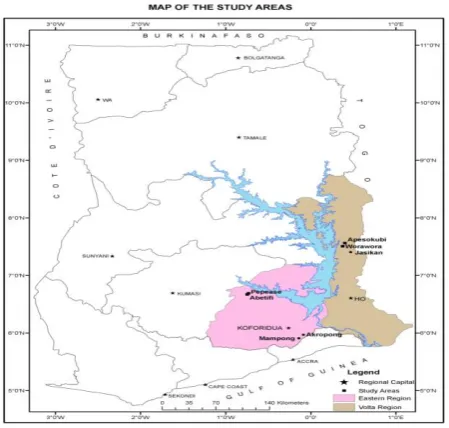
Figure 1. Map showing the study areas and sampling sites where the roots of Cryptolepis sanguinolenta plant were collected.
Study Area
The study was undertaken in two areas in Ghana, the Kwahu-East district in the Eastern region and the Biakoye district in the Volta region as shown in (Fig. 1). The criteria for the selection of the areas were the relatively high abundance and availability of the selected medicinal plant. The selected areas are also well known for the cultivation of vegetables, food and cash crops and therefore possible use of restricted or banned pesticides.
The sampling towns, Pepease and Abetifi in the Kwahu-East District lie between longitude 1°0´W and 0°0´ and latitude 6°0´N and 7°0´N respectively as shown in (Figure 1). In terms of climate, Kwahu East lies within the west semi-equatorial region. It experiences the double maxima rainfall pattern (major and minor rainy seasons). The major rainy season starts from April and ends in July. While the minor rainy season also starts from September and end in October. Annual average rainfall is between 1580 mm and 1780 mm, with temperatures ranging between 26 °C and 30 °C. The climate in the district couple with the great irrigation potential of the Afram river favours the cultivation of food crops, fruits and vegetables. The soil belongs to the forest ochrosols. The Biakoye District with its capital Nkonya Ahenkro also forms part of the districts and municipalities created in 2008. The sampling towns, Apesokubi and Worawora lies between longitude 0°0´and 1°0´E and latitude 7°0´N and 8°0´N respectively. The district falls within the wet equatorial zone and experiences a double maxima rainfall regime in May to July and September to November with peaks in June and October. The rainfall pattern averages between 1,250 mm to 1,750 mm per annum in the mountainous areas. The dry season is mostly manifested between December and February. The vegetation supports wildlife and the major animals found are monkeys, antelopes, bush pigs, pangolins, grass-cutters, chimpanzees and reptiles
.
28Sample Collection
Sampling collection, extraction, clean up, and GC analysis of the pesticides were carried out according to the procedure described by other authors 24-29-30. A total of 100 of each root samples of the herbal plant from each sampling site were collected during each season. The samples which were randomly collected were put into ice chests, well sealed and labelled with unique identity and then transported to the Plant Development Department of the Centre for Scientific Research into Plant Medicine (CSRPM) at Mampong Akuapim in Ghana for identification and classification.
Sample extraction
The Soxhlet was also monitored occasionally during the extraction period to ensure satisfactory recycling. Extracts as well as the blank were concentrated to about 20 ml using a rotary evaporator at 40°C.
Sample cleanup
The florisilpacked column which was ticked to allow the florisil to settle was conditioned by passing 12 ml n-hexane through the packed column. The sample was then transferred onto the florisil column, and eluted three times each with 10 ml portions of n-hexane using Pasteur pipette. The eluate was collected into a round bottom flask with a ground-glass stopper and evaporated to dryness using a rotary evaporator fitted to a vacuum pump. The extract was recovered with 1 ml of ethyl acetate using Pasteur pipette and then transferred into glass vials for gas chromatograph analysis.
Gas chromatographic analysis
A Varian CP-3800 Gas Chromatograph (Varian Associates Inc. USA) equipped with 63Ni electron capture detector was used for the analysis. A volume of 1 μl of the extracts was injected and the separation was achieved on a 40m VF- 5ms capillary with internal diameter 0.25mm and film thickness of 0.25μm. The oven temperature was programmed as 80°C (2min) to 180°C (1min) at 25°C min-1 to 300°C at 5°C min-1. The carrier gas and make up gas was nitrogen at a flow rate of 1.0 and 29ml min-1 respectively. The injector and detector temperatures were 270°C and 300°C respectively. Sample peaks were identified by their retention times compared to the corresponding retention times of the pesticide standards.
RESULTS AND DISCUSSION
General organochlorine pesticide residues contamination
Table 1 shows the individual organochlorines, their respective mean concentrations and percentage occurrences. Margin of errors as standard deviation based on replicates determination of each organochlorine pesticide. Table 1 also shows the total residue load in the roots of Cryptolepis sanguinolenta. As indicated in Table 1, analysis of the samples revealed the presence of fourteen organochlorine pesticides in the roots of Cryptolepis sanguinolenta. The detectable compounds were β-HCH, δ-HCH, γ-HCH, heptachlor, aldrin, γ-chlordane, α-endosulfan, p,p’-DDE, dieldrin, endrin, β-endosulfan, p,p’-DDD, P,P’-DDT and methoxychlor. In generally higher concentrations of OCPs were recorded in the dry season compared to the wet season. This trend could possibly be explained from the fact that during the wet season some of the residues in the soil might have been carried away through surface run-off. The mean OCP residue concentrations in the samples collected in the dry season ranged from 0.006 mg kg-1 to 0.061 mg kg-1 (Tables 1). The highest mean concentration of 0.061 mg kg-1 was obtained for β-HCH in samples collected from Kwahu-East District while the lowest mean concentration of 0.006 mg kg-1 was recorded for p’p DDT also in samples from
Kwahu-East District. In the wet season OCPs concentration ranged from not detected to 0.011mg kg-1 with the highest concentration of 0.011 mg kg-1 recorded for β-HCH in samples collected from Kwahu-East District. In the wet season heptachlor was not detected at Kwahu-East district whiles β-endosulfan and methoxychlor were also not detected at Biakoye district. Thus β-HCH was the predominant OCP in the study area with 100 % occurrences in both the dry and wet seasons. The highest total organochlorine pesticides residue load (i.e. the sum of the means of all detected organochlorine pesticides in a particular sample) ranged from 0.033 mg kg-1 to 0.354 mg kg-1 with the highest value of 0.354 mg kg-1 recorded for samples from Biakoye district in the dry season while a low total load of 0.033 mg kg-1 was obtained for samples also from the Biakoye district in the rainy season.
Variation of DDTs in the samples
Figure 2 showed the distribution of DDT and its metabolites in the samples. In Ghana DDT had been used extensively in the past for agriculture activities. However, the use of DDT in Ghana has now been limited only to malaria programs to fight the insect mosquito.31
Figure 2. Distribution of DDTs in the roots of Cryptolepis sanguinolenta used for the investigation.
Table 1. Mean concentrations in mg kg-1 of organochlorine pesticide residues in C. sanguinolenta sampled from the Kwahu-East and Biakoye Districts during the dry and rainy season and their comparison with international standards (WHO, 2007).
Pesticide Dry season, mg kg-1 Rainy season, mg kg-1 Limits in mg kg-1
Kwahu-East Biakoye Kwahu-East Biakoye Ph. Eur and USP
Codex Ali-mentarius Commission
Mean SD Mean SD Mean SD Mean SD
-HCH 0.061 0.047 0.043 0.035 0.011 0.011 0.001 0 .001 ++0.300
-HCH 0.017 0.004 0.032 0.014 0.002 0.000 0.001 0.001 ++0.300
-HCH 0.016 0.012 0.017 0.006 0.009 0.008 0.002 0.001 0.600
Heptachlor 0.027 0.008 0.023 0.008 nd 0.002 0.002 +0.050
-Chlordane 0.014 0.007 0.018 0.003 0.002 0.001 0.001 0.000 +0.050
-Endosulfan 0.027 0.006 0.026 0.008 0.005 0.006 0.002 0.001 +3.000 +0.500
-Endosulfan 0.010 0.007 0.029 0.012 0.005 0.007 nd +3.000 +0.500
Aldrin 0.012 0.009 0.020 0.012 0.003 0.003 0.001 0.001 +0.050
Dieldrin 0.032 0.027 0.046 0.026 0.009 0.009 0.006 0.007 +0.050
Endrin 0.023 0.010 0.014 0.008 0.002 0.000 0.002 0.001 +0.050
p,p‘-DDE 0.031 0.019 0.040 0.027 0.003 0.004 0.007 0.007 +1.000
p,p‘-DDD 0.015 0.007 0.012 0.006 0.001 0.001 0.004 0.006 +1.000
p,p‘-DDT 0.006 0.005 0.014 0.005 0.006 0.005 0.004 0.000 +1.000
Methoxychlor 0.019 0.006 0.020 0.010 0.005 0.004 nd
Total Level 0.31 0.354 0.063 0.033
SD = standard deviation. nd = not detected; USP = United States Pharmacopoeia: Ph.Eur = European Pharmacopoeia: + = Sum of isomers and metabolites: ++ = Sum of isomers other than -HCH
The mean values of methoxychlor (Table 1) may either be as a result of historical use of DDT of which technically methoxychlor contains about 88% of the p,p’isomer.33 These values were however, lower than mean concentration of 0.03 μg g-1 detected in pawpaw by.25 The decreased perhaps, may be due to anaerobic biodegradation of methoxychlor which results mainly in dimethoxydiphenyl-dichloroethane (DMDD) as well as mono and dihydroxy or demethylated derivatives of methoxychlor.4-26
Variation of hexachlorocyclohexane (HCHs)
1,2,3,4,5,6-hexachlorocyclohexane, the derivative of cyclohexane having one of the two hydrogen on each carbon substituted by chlorine was discovered during the Second World War to be an effective insecticides against a wide variety of insects. The pure active ingredient as well as the technical mixture has a considerable acute toxicity. Research has shown that only one of the eight isomers, the γ-isomer (the gamma isomer) has insecticidal properties and was sold as insecticide under the trade name lindane.4-6 The high value recorded in the studies especially in the dry season suggests photodecomposition and isomerization of HCHs (parent compound) during the transformation process in the soil, owing to the action by microorganisms. This further suggested that lindane (γ-HCH) is being used extensively in the Ghanaian agricultural sector on vegetable cultivation and on food crop production in Ghana.25 This mean value of lindane also supports the findings of pesticide use in Ghana by Awumbila and Bokuma.34 These pesticides were used on cocoa plantations, on vegetables farms and for the control of maize stemborers. Lindane was marketed in Ghana as Gammalin 20 and until 2007 when its use was discontinued.
Distribution of HCHs in the samples is presented in Figure 3. Three of the isomers, β, δ, γ were detected with 100 % occurrence. The α-isomeric form was not detected.
Despite the fact that γ-HCH is the main active ingredient in lindane, which had enjoyed wide application in Ghana,25 the sum of β and δ- isomers far dominate the samples in terms of HCHs contamination compared to γ-HCH except in the wet season at Biakoye where percentage composition of the sum (β + δ) is the same as that of γ-HCH. The high composition of (β + δ) forms in the samples suggests wide historical used of technical mixtures of HCH in the study areas.
Figure 3. Profile of β, δ, γ-HCHs in the roots of Cryptolepis san-guinolenta sampled from Kwahu-East and Biakoye Districts in Ghana
Variation of drins
chemical breakdown processes in the environment.35 Endrin had been used primarily as an insecticide on cotton as well as a rodenticide and avicide.36 Figure 4 shows the profile of
the drins in the roots of C. sanguinolenta investigated.
Figure 4. Profile of drins in the roots of Cryptolepis sanguinolenta from Kwahu-East and Biakoye Districts in Ghana
It is obvious from the Figure 4 that dieldrin is the predominant drin in the samples with the highest concentration detected in samples from Kwahu-East district in the dry season. The dominancy of dieldrin is not surprise at all since in the environment aldrin thus break down to dieldrin and the compound is also able to resist environmental degradation. 35 Aldrin on the other hand is the least significant drin in the samples. The use of aldrin in Ghana was marketed under the trade name Aldrex 40.4 Thus, the order of the drins in the root of Cryptolepis sanguinolenta was dieldrin › endrin › aldrin. In the environment endrin ketone and endin aldehyde are the degradation products of endrin through photodecomposition and microbial degradation. 25The fact that endrin ketone and endrin aldehyde were not detected suggests less photodecomposition and microbial degradation of endrin in the study areas.
The study also had a high heptachlor mean concentrations of 0.023 mg kg-1 and 0.027 mg kg-1 as shown in (Table 1). These values were however, higher than mean concentration of 0.01 μg g-1 detected in pawpaw by 25. Comparing the study with a similar one carried out in Romania where heptachlor concentrations in coffee samples ranged from not detected to 0.011 mg kg-1,37 then the medicinal plants in Ghana were highly contaminated.
Technical grade endosulfan products which consist of a mixture of two isomers, α and β-endosulfan and present in a 7:3 ratio is not on the UN list but is still in extensive use throughout the world for both domestic and agricultural applications, although its bioconcentration and environmental persistence is much lower than those of other cyclodienes. α-Endosulfan is the more thermodynamically stable of the two, thus β-endosulfan irreversibly converts to form α-endosulfan. But in this study the result suggests slow conversion (Table 1). Endosulfan was considered for restriction in December 2008 from the registered pesticides in Ghana.17 This might have accounted for relatively high concentrations of β-endosulfan and α-endosulfan detected in the study.
Comparison of pesticide residue levels to International standards
Table 1 also compares pesticide residue levels in the root of Cryptolepis sanguinolenta to maximum residue limit set by Codex Alimentarius Commission and United States Pharmacopoeia/European Pharmacopoeia.38 Generally, the mean levels of the OCP residues in the plant species were below maximum residue limits set by FAO/WHO Codex Alimentarius Commission and United States/European Pharmacopoeia as shown in (Table 1). However, in the dry season, residue levels obtained for the sum of aldrin and dieldrin in C. sanguinolenta from Biakoye district were higher than WHO and FAO set limits as shown in (Table 1) below. As these chemicals are persistent and toxic and have the potential to bioaccumulate, their presence in the medicinal herbs is of great concern since increased accumulation in the food chain would pose serious health hazards to the general population.
CONCLUSIONS
The results of this study indicate that organochlorine pesticide residues are present in the roots of Cryptolepis sanguinolenta sampled from Kwahu-East and Biakoye Districts of Ghana. The detection of fourteen organochlorine pesticides indicates either wide use of these chemicals or environmental transport of these chemicals from other places to the study areas. The total organochlorine pesticide residues in the roots of the plant ranged from 0.033 to 0.354 mg kg-1, with the highest mean level of 0.354 mg kg–1 detected in the sample collected from Biakoye district during the dry season. . The present investigation also gives an indication of the restricted use of DDT in Ghana. Long term persistence in the environment of this pesticide has been reported in various publications.
In the exception of the sum of aldrin and dieldrin in Cryptolepis sanguinolenta from Biakoye district during the dry season, the mean values obtained were generally below maximum residue limits set forth by the FAO/WHO Codex Alimentarius Commission and United States/European Pharmacopoeia. This means that traditional medicine prepared from the roots of Cryptolepis sanguinolenta as anti-malarial drugs may not pose health hazards in terms of organochlorine pesticide pollution. But as these chemicals are toxic and have the potential to bioaccumulate, their presence in medicinal herbs is of great concern since increased accumulation in the food chain would pose serious health hazards to the general population.
ACKNOWLEDGEMENT
REFERENCES
1Clarke, E. E. K., Levy, L. S., Spurgeon, A., and Calvert, I. A.,
Occup. Med., 1997, 47(5), 301-308.
2Taylor, M. D., Klaine, S. J., Carvalho, F. P., Barcelo, D. and Everaarts J., Pesticide Residues in Coastal Tropical Ecosystems: Distribution, Fate and Effects (1st edition) CRC Publishers, 2002, 576 pp.
3Dinham, B., Pest Manage. Sci.,2003,.59, 575-582.
4Nollet, L. M. L., Handbook of Water Analysis Food Science and
Technology (1st edition). CRC, 2000, pp. 920.
5Mukherjee, P. K., “Quality Control of Herbal Drugs ", 2002, 219-245.
6Baird, C., Environmental Chemistry. W. H. Freeman Company, New York, USA, 1997, 293–379.
7Stimman, M.W. Bailey, J. S. and Deal, A. S., Study guide for
agricultural pest control advisers on insects, mites and other invertebrates and their control in California, New York Pergamon Press, 1985.
8Lars, H., Environmental Exposure to Persistent Organohalogen
and Health Risks. In: Lennart M., (ed), Environmental Medicine. Ch: 12, Retrieved from: www. Envimed.com.
2000.
9Fattore, E., Fanelli, R., and Vecchia, C. L., J. Epidemiol. Comm.
Health 2002,56, 831-832.
10Schafer, K. S. and Kegley, S. E., J. Epidemiol. Comm. Health.
2002, 56, 813-17.
11Kawano M., Persistent organohalogens in environmental
materials. Analytical Applications of Nuclear Techniques, IAEA, 2004.
12Ritter, L., Solomon K. R.., Forget J., Stemeroff, M., O'Leary, C.,
"Persistent organic pollutants". United Nations Environment Programme, 2007.
13Garabrant, D. H., Held, J., Langholz, B., Peter, J. M., and Mark, T. M., J. Natl. Cancer Inst., 1992, 84(10), 764-771.
14Mckinney, J. D. and Waller, C. L., Environ. Health Perspect.,
1994, 102, 290 – 297.
15Manirakiza, P., Akimbamijo, O., Adediran, S. A., Cisse, I., Fall, S. T and Schepems, P., J. Environ. Monitor, 2002, 4, 609-617.
16Doong, R. A., Sun, Y. C., Liao, P. L., Peng, C. K. and Wu, S. C.,
Chemosphere, 2002, 48, 237 - 246.
17Afful, S., Anim, A. K. and Serfor-Armah, Y., J. Environ. Earth
Sci., 2010, 2(3), 133-139.
18Zuina, V. G, Yariwakea, J. H, Bicchi, C., J. Chromatogr., 2003,
985, 159-66.19Xue, J., Liu, D., Chen, S., Liao, Y., Zou, Z.,
Modern Tradit. Chin. Med. Mater. Med., 2008, 10, 91-6.
20Ntow, W. J., Res. Manag.,2005, 10, 243-248.
21Ntow, W. J., Gijzen, H. J., Drechsel, P., Pest Manage. Sci.
2006,62(4), 356-365.
22Darko, G., and Acquaah, S. O., Int. J. Environ. Sci. Tech.,
2007, 4(4), 521-567.
23Darko, G., and Acquaah, S. O., Chemosphere, 2008, 71, 294-308
24Darko, G., Akoto, O. and Oppong, C., Chemosphere, 2008,
72, 21-24.
25Bempah, C. K. and Donkor, A. K., Environ. Monit. Assess.,
2011, 175(1-4), 551-61
26Kuranchie-Mensah, H., Studies of Organochlorine Pesticide
Residues in Fish, Water and Sediment from the Densu River Basin. M.Phil Thesis. Environmental Science Programme, University of Ghana, 2009.
27Lobe, J., 2006. "WHO urges DDT for malaria control
Strategies," Inter Press Service. WHO. Geneva
www.Commondreams.org. 28www.ghanadistricts.com 13/02/2011
29Ansah, C. and Gooderham, N. J., Life Sci. Med. Toxicol. Sci.,
2002, 70(2), 245-251.
30Therdteppitak, A. and Yammeng, K.,. Sci. Asia, 2003, 29, 127-134.
31Environmental Protection Agency (EPA) Ghana, National Profile for Chemicals Management in Ghana, 1999.
32Barriada-Pereira, M., Gonzalez-Castro, M. J., Muniategue-Lorenzo, S., Lopez-Mahia, P., Prada-Rodriguez, D. and Fernandez-Fernandez, E., Chemosphere, 2005, 58, 1571-1578.
33WHO, Health criteria and other supporting information.
guidelines for drinking-water quality. (Vol. 2.) 2nd ed. Geneva, 1996.
34Awumbila, B., Bokuma, E., Trop. Anim. Health Prod., 1994,
26, 7-12.
35Orris, P. L., Kaatz, C., Perry, K., and Asbury, J., Persistent
organic pollutants (POPs) and human health. World Federation of Public Health Associations (WFPHA). Washington, DC. 2000, 45.
36Metcalf, R. L., “Insect Control” in “Ullmann’s Encyclopedia
of Industrial Chemistry” Wiley-VCH, Weinheim, 2002. 37Stanciu, G., Dobrinas, S., Birghila, S., Popescu, M.,
Environment. Eng. Manag. J., 2008, 7(6), 661-666. 38World Health Organization (WHO), WHO guidelines for
assessing quality of herbal medicines with reference to contaminants and residue, Geneva,2007.