EFFECTS OF COMPRESSION SOCKS ON POSTURAL BALANCE
USING BIODEX STABILITY SYSTEM AMONG UNIVERSITY
NETBALL PLAYERS
Hosni Hasan1*, Nor Arissa Md Aris1, Nor Alissa Kamarul Bahari1, Fatin Razak2, and Syahrial Bakhtiar3
1Faculty of Sports Science and Recreation, Universiti Teknologi MARA,
Shah Alam, Malaysia
2Faculty of Sports Science and Recreation, Universiti Teknologi MARA,
Cawangan Jengka, Malaysia
3Universitas Negeri Padang, Padang, Indonesia
*Email: [email protected]
(Received 15 November 2019; accepted 4 March 2020; published online 30 July 2020)
To cite this article: Hasan, H., Md Aris, N. A., Kamarul Bahari, N. A., Razak, F., & Bakhtiar, S. (2020). Effects of compression socks on postural balance using Biodex Stability System among
university netball players. Malaysian Journal of Movement, Health & Exercise, 9(2), 1-7.
https://doi.org/10.15282/mohe.v9i2.428
Link to this article: https://doi.org/10.15282/mohe.v9i2.428
Abstract
The purpose of this study was to observe the effects of wearing compression socks on postural balance in university netball players. Fourteen advanced learner netball players performed three trials of 20 seconds each of dynamic postural balance test on Biodex Stability System, while wearing two socks, (a) Normal Socks and (b) Compression Socks. Data on overall, anterior/posterior and medial/lateral stability indexes were analyzed using Paired Sample T-tests. The results revealed that wearing compression materials significantly enhanced static and dynamic postural balance among the university netball players. The improvements in these key variables are likely due to enhanced somatosensory feedback information which allowed the lower limbs to better regulate postural stability. It is suggested that compression socks can be used by university netball players to improve their postural stability.
Introduction
Balance is associated with risk of injury and those with poor balance tend to suffer more injury (Hrysomallis, 2007; McGuine & Keene, 2006). Balance should be maintained while performing sport-specific movements, and deficiencies in balance have been shown to have a detrimental effect on the performance of these movements (Wikstrom, Powers, & Tillman, 2004). In some cases, strategies used to maintain equilibrium are more important than maintaining the degree of balance. Most equilibrium assessments tended to measure overall equilibrium performance, but not individual segment kinematics. Because of the risk of injury and performance implications associated with faulty movement biomechanics, it may be harmful to neglect to observe movement strategy. It is possible to achieve balance through three main strategies: ankle, hip and stepping (Emery, 2003). The ankle strategy restores equilibrium through movement created primarily at the ankle joint. Under dynamic conditions, this strategy plays a primary role in restoring stability under static conditions (King & Zatsiorsky, 2002), but its main function is to restore anterior-posterior stability due to the limited medial-lateral movement at this joint. The hip strategy restores equilibrium through movement created primarily at the hip complex. This strategy is commonly used in both mediolateral and anteroposterior instability when balance disturbances are large and rapid or when the surface is unstable or smaller than the support base (Horak & Nashner, 1986; Shumway-Cook, Brauer, & Woollacott, 2000; Tropp, Odenrick, & Gillquist, 1985).
Procedures
The Postural Stability Test was conducted using the Biodex Stability System (BSS). It emphasizes the subject's ability to maintain the center of balance under controlled lab conditions. The participants were asked to stand on the platform; the tests began with level 12 platform stability (for static balance test). For the dynamic balance test, level 12 (no movement at all on the platform) was set on the platform stability until it reached level 1 (highest dynamic movement on the platform). The test duration was set for 20 seconds each trial. The participants were given three trials each for each variable and each sock condition in a randomized order. There were two socks conditions in this study, namely (a) Normal Socks (NS) and (b) Compression Socks (CS). The clinical compression socks (Zero Point, Finland) were constructed from nylon (72%) and lycra (28%), with a clinical compression level of 20–30 mm Hg (Hasan, Davids, Chow, & Kerr, 2016). The control socks were normal socks of similar thickness to the compression socks.
Data Analysis
Data on overall, anterior/posterior and medial/lateral stability index were collected during the postural stability tests in each sock condition. Paired sample t-tests were used to compare postural stability performance with the alpha values were set at p < 0.05. All data were analyzed using the Statistical Package for Social Sciences (SPSS V21.0, Chicago, IL, USA).
Findings and discussion
Findings
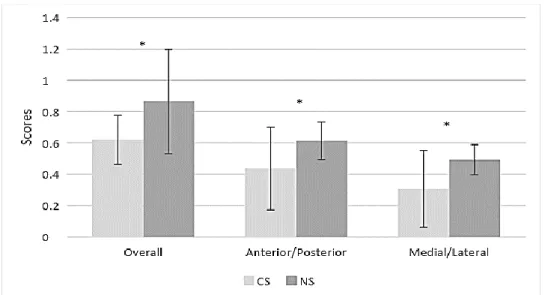
Figure 1: Mean (SD) overall, anterior/posterior and medial/lateral stability index during dynamic balance for netball players under two socks conditions. Notes: * denotes significant difference.
Discussions
This study was conducted to determine the effects of compression sock on postural balance among university netball players. To achieve this aim, we investigated the effects of using two different socks interactions in performing static and dynamic postural balance abilities. Added compression was introduced to the participants in the CS condition and the performance was being compared to the NS condition. Based on our observations, the use of CS provided a significant main effect on enhanced postural stability among the participants. A similar study (Michael, Dogramaci, Steel, & Graham, 2014) also found similar findings when their participants (female athletes) had significantly improved balance task performance when wearing compression materials. The reason behind improved postural stability among the participants was the enhanced somatosensory feedback information received by the legs when wearing the compression materials (Espeit, Pavailler, & Lapole, 2017). This may provide additional beneficial effects because of the textured parts of the socks; the coarse surfaces located at the soles of the feet, medial-lateral and posterior sides of the ankles, anterior and proximal to the tibia bones would increase proprioception. Thus, the compression feature with the length of the socks level the knee would provide greater stimulation to the lower leg mechanoreceptors where it helps the participants achieve better balance control and enhance the afferent of sensory inputs from the feet (Hasan et al., 2016). However, a previous study by Jaakkola et al. (2017) on healthy participants did not find significant differences in the performance of static and dynamic balance after eight weeks’ intervention program. In their study, the participants were grouped into clinical compression socks, sub-clinical and control socks group.
Anterior/posterior and medial/lateral movements require large involvement of the lower limbs muscles activities. Netball play involves static (i.e. standing) and dynamic (i.e. turning, twisting and jumping) movements, and these maneuvers produce high load, especially on the lower limb muscles to maintain the postural stability of the body. The use of CS with an enhanced somatosensory feedback may help university netball players to enhance their postural stability during these task maneuvers (Waddington & Adams, 2000). In addition, Espeit et al. (2017) suggested that wearing compression materials may reduce spinal motor neuron excitability of the lower limb muscles (i.e. tibialis anterior) which can lead to enhance postural stability. However, in this study, the participants were only required to maintain their postural balance on the machine without any involvement of implement (i.e. ball) and netball task maneuvers and thus limit its task representative design. It would be interesting for future research to investigate the use of compression materials during dynamic tasks in netball performance, such as passing and shooting.
Conclusions
investigations would be to require participants to wear compression socks on either the preferred or non-preferred foot to permit identification of specific effects on separate limbs during postural stability performance.
References
Emery, C. A. (2003). Is there a clinical standing balance measurement appropriate for use in sports medicine? A review of the literature. Journal of Science and Medicine
in Sport, 6(4), 492-504. https://doi.org/10.1016/S1440-2440(03)80274-8
Espeit, L., Pavailler, S., & Lapole, T. (2017). Effects of compression stockings on ankle muscle H‐reflexes during standing. Muscle & Nerve, 55(4), 596-598. https://doi.org/10.1002/mus.25455
Hasan, H., Davids, K., Chow, J. Y., & Kerr, G. (2016). Compression and texture in socks enhance football kicking performance. Human Movement Science, 48, 102-111. https://doi.org/10.1016/j.humov.2016.04.008
Horak, F. B., & Nashner, L. M. (1986). Central programming of postural movements: adaptation to altered support-surface configurations. Journal of Neurophysiology, 55(6), 1369-1381. https://doi.org/10.1152/jn.1986.55.6.1369
Hrysomallis, C. (2007). Relationship between balance ability, training, and sports injury risk. Sports Medicine, 37(6), 547-556. https://doi.org/10.2165/00007256-200737060-00007
Jaakkola, T., Linnamo, V., Woo, M. T., Davids, K., Piirainen, J. M., & Gråstén, A. (2017). Effects of training on postural control and agility when wearing socks of different compression levels. Biomedical Human Kinetics, 9(1), 107-114. https://doi.org/10.1515/bhk-2017-0016
Michael, J. S., Dogramaci, S. N., Steel, K. A., & Graham, K. S. (2014). What is the effect of compression garments on a balance task in female athletes? Gait & Posture, 39(2), 804-809. https://doi.org/10.1016/j.gaitpost.2013.11.001
Shumway-Cook, A., Brauer, S., & Woollacott, M. (2000). Predicting the probability for falls in community-dwelling older adults using the Timed Up & Go Test. Physical
Therapy, 80(9), 896-903. https://doi.org/10.1093/ptj/80.9.896
Tropp, H., Odenrick, P., & Gillquist, J. (1985). Stabilometry recordings in functional and mechanical instability of the ankle joint. International Journal of Sports
Medicine, 6(03), 180-182. https://doi.org/10.1055/s-2008-1025836
Waddington, G., & Adams, R. (2000). Textured insole effects on ankle movement discrimination while wearing athletic shoes. Physical Therapy in Sport, 1(4), 119-128. https://doi.org/10.1054/ptsp.2000.0020
Wikstrom, E. A., Powers, M. E., & Tillman, M. D. (2004). Dynamic stabilization time after isokinetic and functional fatigue. Journal of Athletic Training, 39(3), 247.
Yoo, W. -G. (2015). Effects of socks which improved foot sensation on velocity and stride length of elderly subjects crossing obstacles. Journal of Physical Therapy