Cascaded Regression Analysis Based Temporal Multi-document
Summarization
Ruifang He, Bing Qin, Ting Liu, Sheng Li
Information Retrieval Lab, Harbin Institute of Technology P.O.Box 321, HIT,P.R.China 150001 E-mail: [email protected], http://ir.hit.edu.cn/
Keywords:temporal multi-document summarization, temporal semantic labeling, macro importance discriminative model, micro importance discriminative model
Received:February 5, 2009
Temporal multi-document summarization (TMDS) aims to capture evolving information of a single topic over time and produce a summary delivering the main information content. This paper presents a cas-caded regression analysis based macro-micro importance discriminative model for the content selection of TMDS, which mines the temporal characteristics at different levels of topical detail in order to provide the cue for extracting the important content. Temporally evolving data can be treated as dynamic objects that have changing content over time. Firstly, we extract important time points with macro importance discrim-inative model, then extract important sentences in these time points with micro importance discrimdiscrim-inative model. Macro and micro importance discriminative models are combined to form a cascaded regression analysis approach. The summary is made up of the important sentences evolving over time. Experiments on five Chinese datasets demonstrate the encouraging performance of the proposed approach, but the prob-lem is far from solved.
Povzetek: Metoda kaskadne regresije je uporabljena za izdelavo zbirnega besedila.
1 Introduction
Multi-document summarization is a technology of informa-tion compression, which is largely an outgrowth of the late twentieth-century ability to gather large collections of un-structured information on-line. The explosion of the World Wide Web has brought a vast amount of information, and thus created a demand for new ways of managing changing information. Multi-document summarization is the process of automatically producing a summary delivering the main information content from a set of documents about an ex-plicit or imex-plicit topic, which helps to acquire information efficiently. It has drawn much attention in recent years and is valuable in many applications, such as intelligence gath-ering, hand-held devices and aids for the handicapped.
Temporal multi-document summarization (TMDS) is the natural extension of multi-document summarization, which captures evolving information of a single topic over time. The greatest difference from traditional multi-document summarization is that it deals with the dynamic collection about a topic changing over time. It is assumed that a user has access to a stream of news stories that are on the same topic, but that the stream flows rapidly enough that no one has the time to look at every story. In this situation, a person would prefer to dive into the details that include the most important, evolving concepts within the topic and have a trend analysis.
The key problem of summarization is how to identify important content and remove redundant content. The
common problem for summarization is that the informa-tion in different documents inevitably overlaps with each other, and therefore effective summarization methods are needed to contrast their similarities and differences. How-ever, the above application scenarios, where the objects to be summarized face to some special topics and evolve with time, raise new challenges to traditional summarization al-gorithms. One challenge for TMDS is that the informa-tion in summary must contain the evolving content. So we need to effectively take into account this temporally evolv-ing characteristics durevolv-ing the summarization process. Thus a good TMDS must include information as much as possi-ble, keeping information as novel as possible. In this paper, we focus on how to summarize the series news reports by the generic and extractive way.
the important sentences evolving over time. Experiments on five Chinese datasets demonstrate the encouraging per-formance of the proposed approach, but the problem is far from solved.
The rest of this paper is organized as follows: Section 2 introduces related work. The details of the proposed ap-proach are described in Section 3. Section 4 presents and discusses the evaluation results. We conclude this paper and discuss future work in Section 5.
2 Related work
Temporal summary is a relatively new research direction, which originates from text summarization and topic de-tection and tracking (TDT). It is also related to time line construction techniques. Alan et al.[1] firstly put forward the concept of temporal summary inspired by TDT in SI-GIR2001. Given a sequence of news reports on certain topic, they extract useful and novel sentences to monitor the changes over time. Usefulness is captured by considering whether a sentence can be generated by a language model created from the sentences seen to date. Novelty is captured by comparing a sentence with prior sentences. They report that it is difficult to combine the two factors successfully. Other researchers exploit distribution of events and extract the hot topics on time line by statistical measures. Swan and Allan[8] employχ2statistics to measure the strength
that a term is associated with a specified date, and then ex-tract and group important terms to generate “topics" de-fined by TDT. In [3], Chen et al. import the aging theory to measure the “hotness" of a topic by analyzing the tem-poral characteristic of news report. The aging theory im-plies that a news event can be considered as a life form that goes through a life cycle of birth, growth, decay, and death, reflecting its popularity over time. Then hot topics are selected according to energy function defined by ag-ing theory. Lim et al.[5] anchor documents on time line by the publication dates, and then extract sentences from each document based on surface features. Sentence weight is adjusted by local high frequency words in each time slot and global high frequency words from all topic sentences. They evaluate the system on Korean documents and report that time can help to raise the percentage of model sen-tences contained in machine generated summaries. Jatowt and Ishizuka[2] investigate the approaches to monitor the trends of dynamic web documents. They employ a simple regression analysis on word frequency and time to iden-tify whether terms are popular and active. The importance of a term is measured by its slope, intercept and variance. The weight of a sentence is measured by the sum of the weights of the terms inside the sentence. The sentences with highest scores are extracted into a summary. How-ever, they do not report any quantitative evaluation results. In [7], Mani is devoted to temporal information extraction, knowledge representation and reasoning, and try to apply them to multi-document summarization. In [4], Li et al.
ex-plore whether the temporal distribution information helps to enhance event-based summarization based on corpus of DUC2001.
Due to different tasks, the above researches do not uni-formly incorporate the temporal characteristics. While macro and micro importance discriminative models based on cascaded regression analysis approach can mine the temporal characteristics at different levels of topic detail and produce summary.
3 Cascaded regression analysis
approach
We know news has strong temporal characteristic. If there is a novel happening, many websites will concern it, and naturally produce vast relevant news reports, this time point would be very important at the moment. If happening is gradually disappearing, the relevant new reports will also decrease accordingly, whose importance would re-duce. From macro view, redundancy implies the whole trends of the happening, which also hints the more finer progress from micro view. We model the temporal redun-dancy from macro and micro view, and integrate macro and micro importance discriminative models into a cascaded re-gression analysis framework for the content selection for TMDS. Algorithm 1 shows the basic steps.
Algorithm 1 Framework for Temporal Multi-document Summarization based on Cascaded Regression Analysis
Input: Stream of Chinese series news stories within the same topic; Output: Sentences containing important events evolving over time;
1: Parse the documents into the set of the sentences, and recognize and resolve the time expressions contained in sentences;
2: Construct the article/sentence count-time distribution
curve;
3: Convert the curve given by step 2 to be the relative
importance curve of the time points;
4: Extract the important time points with macro
impor-tance discriminative model;
5: Extract important events with micro importance
dis-criminative model in each important time point;
6: Rank sentences according to the publication time and the real time;
3.1 Selection of content unit
Since series news reports are made up of time points, each time point consists of articles/sentences. Here, theith time pointti, thejth sentencesjis formalized as the following,
respectively:ti={sj},
sj = {Tp, Tr, T rigger, Scope}, i, j = 1...n, T pis
T riggeris the set of trigger words, andScopeis the sen-tence description containing events. Reference to the def-inition of event in ACE evaluation1, a trigger word
indi-cates the existence of an event. However, Chinese event extraction technology is not mature, we ignore the relevant attributes of event, including type, subtype, modality, po-larity, genericity and tense. Generally, trigger word is verb or action noun. We just consider the situation of verb so as to simplify the question. Thus, thej th sentence can also be simply formalized as follows:sj ={vk}, j, k= 1...n.
The importance of a sentence depends on the importance of the verbs contained in a sentence. Based on the above analysis, we choose the time point and verb as the content unit of importance discrimination from macro and micro view, respectively.
3.2 Macro importance discriminative model
In the new World Wide Web environment, the number of news articles is increasing dramatically, and we can con-veniently and instantaneously get the rich data. Usually, the reports about the same story from the different web-sites are mostly similar, especially the start and end time points and the important time points. With the evolution of an abrupt news story, the number of the news articles or events will form a distribution curve along the time axis. From the intuitive observation of macro view, this temporal characteristic of news articles gives us a good illumination on TMDS.
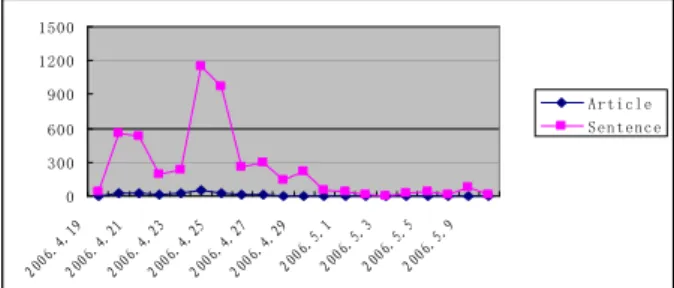
For example, figure 1 shows the temporal trends about the number of the news reports on the topicSolomon tur-bulencefrom the Sina. The horizontal axis is time, and the vertical axis is the number of articles or sentences. For the benefit of clearly observing the temporal characteristics of the curve and comparing the difference in extracting the important time points between articles and sentence count-time distribution curve, we convert it into the relative im-portance curve of time point and enlarge 100 times. This transformation can further help us modify the choice of the important time points. The concrete method is as follows: the relative importance value of time point is computed by the ratio of the article/sentence count in each time point to the article/sentence count in the highest peak. Figure 2 shows the curve through transformation.
According to this kind of distribution curve and our intu-ition, we give the macro importance discriminative model, including one assumption and one definition.
Assumption 1: The start and end time points, and the time points having more documents contain important in-formation with a high probability. Valleys and slowly changing time points contain unimportant information with a high probability.
Definition of Slowly changing time point: If the left slope and right slope of the current time point are both lower than (we empirically assign 2 toλ), we say this time
1ACE2007 evaluation plan:
http://projects.ldc.upenn.edu/ace/intro.html $UWLFOH 6HQWHQFH
Figure 1: Article/Sentence count-time distribution about the Solomon turbulence news report.
$ U W L F O H 6 H Q W H Q F H
Figure 2: Relative importance distribution curve of time points.
point changes slowly. They are defined as follows:
left_Slope(ti) =
RI(left)
Td(left) (1)
right_Slope(ti) = RI(right)
Td(right) (2)
RIleft = I(ti) − I(ti−1), RI(right) = I(ti+1) −
I(ti),Td(left) = date(ti) − date(ti−1), Td(right) =
date(ti+1) − date(ti), i = 2...n, right_Slope(ti),
right_Slope(ti)are formed by the current time point, the
left adjacent one, and the right adjacent one. RI(left),
RI(right)is the relative importance difference value com-puted by the current time point, the left adjacent one, and right adjacent one, respectively.I(ti)is the relative
impor-tance value of theith time point. Td(left),Td(right)is the duration that the left one, the right one deviates from the current one, respectively.date(ti)is the date of theith
time point.
Based on the above description, we give the algorithm of detecting the important time points with importance dis-criminative model.
3.3 Micro importance discriminative model
Algorithm 2Detecting the important time points
Input: all time points; Output: the importance points;
1: Use climbing algorithm to find all the peaks and val-leys, and keep the start and end time points;
2: Remove the valleys and the slowly changing time points, and get four time point sets figured out by the two kinds of relative importance distribution curve of time points;
3: Compute the intersection of four time point sets, then
get the important time point set;
TFIOF based scoring schemeDepending on the basic idea of the feature weight about TFIDF, TFIOF is proposed to compute the importance of a trigger.∀ti,i, k= 1...n,
tf iof(vk) =tfi(vk)×log n
of(vk) (3)
tfi(vk)is the occurrence number ofvk in the current time
point. n is the number of all time points, of(vk) is the
number of time points containingvk.
Slope based scoring scheme∀ti,ti−1,i= 2...n,k =
1...n,
lef t_Slope(vk) =tfi(vk)−tfi−1(vk)
T d(lef t) (4)
tfi−1(vk)denotes the occurrence number ofvkin the left
adjacent time point. lef t_Slope(vk)is the instantaneous
left slope of the event on behalf ofvk, which adopts the
linear regression method to express the consequent relation between time and event variables. If it is a positive value, it means that the event triggered byvkis emerging, or the
past event triggered by vk is disappearing. It also shows
whether this trigger word is active in the local scope.
Variance analysis based scoring schemeThe model for the arrival of trigger words can be considered as a ran-dom process, and the arrival of every trigger word is a random variable. The variance value of the random vari-ableX on behalf ofvk is represented asV ariance(X) =
E{(X −E(X))2}It represents the average magnitude of
X in term of importance for a period of time, which helps us to detect the important trigger words in the global scope. The larger theV ariance(X)is, the more precious the trig-ger word. Every trigtrig-ger word has a variance value. In order to compare the importance of trigger words in each time point, we normalize every random variable asX∗:
X∗=pX−E(X)
V ariance(X) (5)
Based on the importance scoring schemes, we give the algorithm of the important sentences extraction and rank-ing, see algorithm 3.
Algorithm 3Selection and ranking of sentences
Input: Stream of series news reports through preprocess-ing; Output: Assumesi to be the set of final summary in
ti, initiallysi=φ;
1: Extract the trigger words;
2: Compute the importance weight of each trigger word according to three scoring schemes;
3: Rank the trigger words according to the weight from step 2, respectively;
4: repeat
5: For each time point, according to each rankedvk,
se-lect the most important, but not redundant sentence includingvkwith highest weight sum to add intosi
6: ifvk ⊂sithen
7: Compute the value of the goal function:f(vk) =
|si|∪|sj|
N −
|si|
N
8: end if
9: iff(vk)≤λ(λ= 2/N)then
10: sjis the redundant sentence, where N is the
num-ber of trigger words in theith time point
11: end if
12: untilSummary length is satisfied
13: Rank the sentences within different time points by their
publication date, and rank the sentences within the time points by their real date; If the two sentences have the same real date, we donot care their relative rank;
4 Experiments
4.1 Corpus and evaluation metrics
TMDS is a new research, and there is no public corpus and evaluation metric. Therefore we have to build the corpus and the evaluation metric.
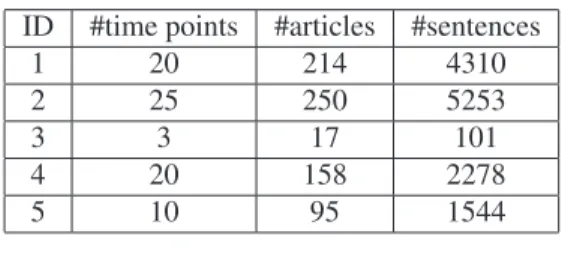
Corpus Our Chinese corpus construction includes two parts, one is the construction of raw corpus, another is the construction of reference summary. Five groups of Chinese data set are chosen from Sina’s2international news topics
between 2005 and 2006. Table1 illustrates the settings of the corpus, where there are five topics, 78 time points, 734 articles, 13486 sentences. Simultaneously, for each date set, we let experts annotate three groups of reference sum-mary in term of the compression rate 10% and 20%.
ID #time points #articles #sentences
1 20 214 4310
2 25 250 5253
3 3 17 101
4 20 158 2278
5 10 95 1544
Table 1: Corpus settings
Evaluation Metrics ROUGE[6] is used as the
tion metric, which has been widely adopted by DUC for automatic summarization evaluation. It measured summary quality by counting overlapping units such as the n-gram, word sequences and word pairs between the candidate sum-mary and the reference sumsum-mary. ROUGE toolkit reported separate scores for 1, 2, 3 and 4-gram, and also for longest common subsequence co-occurrences and so on. How-ever, this evaluation metrics faces to English. Based on it, we develop a Chinese-style ROUGE-N evaluation tool ’CROUGE-N’. The evaluation measure is F score:
F =
iP=n
i=1
Fi
n , Fi = 2PiRi
Pi+Ri (6)
i = 1...n, i denotes the number of reference summary.
Pi, Ri, Fiis Precision, Recall and F score, respectively.
4.2 Experiment results and analysis
Two groups of experiments are designed to validate the per-formance of hierarchical regression analysis approach for TMDS.
Experiment1: Micro importance discriminative model In the first experiment, we use the micro importance dis-criminative model to produce the summaries under com-pression rate (CRate)10%and20%.
CRate TFIOF Slope Variance 10% 17.29% 19.11% 14.81% 20% 27.18% 27.56% 27.02%
Table 2: Performance of content selection from micro view with CROUGE-4
The goal of Experiment 1 is to evaluate the perfor-mance of different micro importance discriminative model-sˇcˇnwhich extracts the important content from the fine par-ticle scale. Table 2 shows that slope based micro model has the best performance whatever compression rate is10%or
20%. It is because that this model can better represent the instantaneously temporal characteristics of series news re-ports. The performance of variance based micro model is the lowest, however, it is still meaningful. Variance of ran-dom variable indicates the average changing magnitude of its importance. It can capture the importance information from the global scope. While TFIOF based micro model is easy to be implemented and can extract important infor-mation from local and global scope. Three models observe micro information from different views, respectively. We can adopt the different micro models according to different practical applications. The more effective model incorpo-rating their merits will be explored in the future. When the compression rate is 20%, the performance difference be-tween three models is little. It shows that more ordinary sentences are added into the summary, while our models is apt to capture the particular sentences.
Experiment2: Macro and micro importance discrimina-tive model
Based on the best micro importance discriminative model adopting slope scoring scheme, we further validated the performance of hierarchically extracting important in-formation with macro and micro importance discriminative model.
The experiment results from Table 3 validated that macro and micro importance discriminative model displays the better system performance than the single micro model. The linear regression based macro and micro importance discriminative model that we adopted receives the best per-formance. Macro model is used to extract the important time points, which helps to have a coarse content selection. In the whole process, we try to mine the temporal char-acteristic of the articles, events and terms from the macro and micro view, and use the regression analysis to summa-rize the relationship between the time and the frequency of articles, sentences and terms. Macro importance discrim-inative model and micro importance discrimdiscrim-inative model have the recursive properties to some extent. No matter what the slope used to select important time points or the slope used to extract important trigger words, their slope value from the regression different from zero represents the evolving trends of the series news. If it has a positive value, it means that the event abruptly happens, or the event is dis-appearing.
Though our system performance cannot directly be com-pared with that of Document Understanding Conference (DUC), it still has the similar performance trend. Our CROUGE-2 score is higher than CROUGE-4 score, and it is reasonable. Because of the limitation of space, our approach ’s CROUGE-2 score wasn’t listed here.
CRate Micro Macro+Micro
10% 19.11% 20.46%
20% 27.56% 29.13%
Table 3: Performance of content selection from macro and micro view with CROUGE-4
5 Conclusion and future work
multi-document summarization, our approach cannot com-pare with others.
In the future, we will explore the more effective model from information fusion view. Considering series news re-port has the strong temporal characteristic, we will further use the techniques of temporal text mining and temporal information extraction to improve the system performance. We also hope to do some contributions for Chinese tempo-ral multi-document summarization evaluation.
References
[1] J. Allan, R. Gupta, and V. Khandelwal. Tempo-ral summaries of new topics. Proceedings of the 24th annual international ACM SIGIR conference on Research and development in information retrieval, pages 10-18, 2001.
[2] A. Jatowt and M. Ishizuka. Temporal Web Page Sum-marization. 5th International Conference On Web In-formation Systems Engineering, Brisbane, Australia, November 22-24, 2004.
[3] C. Kuan-Yu, L. LUESUKPRASERT, and T. Seng-cho. Hot Topic Extraction Based on Timeline Anal-ysis and Multidimensional Sentence Modeling. IEEE Transactions on Knowledge and Data Engineering, pages 1016-1025, 2007.
[4] M. L. Q. W. K. Li, W.J.and Wu. Integrating temporal distribution information into event-based summariza-tion. International Journal of Computer Processing of Oriental Languages, 19:201-222, 2006.
[5] J. Lim, I. Kang, J. J.Bae, and J. Lee. Sentence ex-traction using time features in multi-document sum-marization. In Proceedings of the Asia Information Retrieval Symposium, pages 82-932, 2004.
[6] C. Lin. ROU2GE: A Package for Automatic Eval-uation of Summaries. Proceedings of the Workshop on Text Summarization Branches Out, pages 25-26, 2004.
[7] I. Mani. Recent Developments in Temporal Informa-tion ExtracInforma-tion. Nicolov, N., and Mitkov, R. Proceed-ings of RANLP, 3, 2004.