Hungarian Association of Agricultural Informatics European Federation for Information Technology in Agriculture, Food and the Environment
Journal of Agricultural Informatics. Vol. 11, No. 1 journal.magisz.org
Agriculture 4.0 and the role of education
Ilsiiar Pogorelskaia1, László Várallyai2
I N F O
Received 06-06-2020 Accepted 14-07-2020 Available on-line 17-07-2020 Responsible Editor: R. Szilágyi
Keywords:
Agriculture 4.0, Digital education, ICT, automation.
A B S T R A C T
The fast development of information and communication technologies gave impetus to the emergence of a new turn in the revolutionary development of the Agriculture industry. The main goal of Agriculture 4.0 is to produce more and better with fewer tools (sensors), for which more tools and technologies already exist today. Use of robots and drones is being introduced in agriculture and various targeted software is being developed to process data. Deploying IoT devices in agricultural areas that can send us plant-related data remotely opens up a whole new opportunity for us in several areas. Agriculture, or the food industry in general, cannot be an exception when it comes to Agriculture 4.0. There are also some ideas and initiatives around the use of Blockchain technology. So, farmers extremely need to get ready to embrace the upcoming digital change and they have to increase or acquire new ICT skills and capabilities.
Nowadays digital education makes it easier to acquire new knowledge and skills in ICT. Information and communication technologies tools open new potentials for on-the-job, individual workplace learning, using new methods and models of education such as personal learning clouds or set up personal learning environments. All of these helps to solve one of the main challenges - reducing existing skill gaps.
1. Introduction
The development of Industry 4.0 has almost brought with it developments in other areas as well, such as agriculture. The development and application of digital technologies in the early 2010s also brought significant advances in agriculture (Bronson and Knezevic, 2016). Examples include low-cost sensors and microprocessors, cloud-based ICT systems, and Big Data analytics (Gacar, Aktas, & Ozdogan, 2017). These technologies have led to the emergence of two new phenomena. On the one hand, the emergence of agricultural ecosystems with platforms that combine data from sensors or other equipment in the field (FAO, 2017) immediately allows the farmer to be provided with real-time information and thus be able to make immediate decisions to increase productivity ( Janssen et al., 2017; Shepherd et al., 2018). On the other hand, there is scope for cooperation between different actors in the agricultural and food value chains. Digital data connect ecosystem actors to ensure the flow of data and information between actors in the food supply chain (Verdouw et al., 2016; Bilali and Allahyari, 2018). As a result of the above, the term Agriculture 4.0 currently describes these processes. Thereby the key purpose of the study is to identify the term Agriculture 4.0, to determine the potential of automation and the main required skills and modern learning methods that farmers can use for developing and transformation in the framework of Agriculture 4.0. The main method was the analysis of statistical data characterizing the level of development of the digital Industry, index method, and rating assessment method.
2. Agriculture 4.0 and its components
European Agricultural Machinery Association (CEMA) combined different terms frequently used to refer to Agriculture 4.0, such as ”Smart Agriculture”, ”Intelligent Agriculture” and ”Digital Farming”, or ”Digital Agriculture” (CEMA, 2017). Some authors explain the concept of Agriculture
1 Ilsiiar Pogorelskaia
Ihrig Károly Doctoral School, Faculty of Economy and Business, University of Debrecen [email protected]
2 László Várallyai
University of Debrecen
4.0 in a similar way as the application of Industry 4.0 methods in agriculture (Andritoiu, Bazavan, Besnea, Roibu, & Bizdoaca, 2018; Huh and Kim, 2018; Zambon, Cecchini, Egidi, Saporito and Colantoni, 2019; Braun, Colangelo and Steckel, 2018; CEMA, 2017; Perez-bedmar, 2018; Gacar, Aktas, & Ozdogan, 2017): Similar to the concept of Industry 4.0, the transformation of Agriculture 4.0 aims to increase its competitiveness. primarily using modern information technology tools (Piwowar, 2018). As defined by Piwowar (2018), the basis of the current agricultural phase is none other than smart and digital technologies, which consist of sensors, digital devices, and information and communication technologies (CEMA, 2017; Gacar, Aktas, & Ozdogan, 2017). Through digital technologies, the system allows the processing and utilization of large amounts of signals and data from the field and the sensors of the equipment (Jayaraman et al., 2014). Therefore, Agriculture 4.0 also uses precision agricultural technologies and other resources for intelligent data management.
After analyzing and summarizing all definitions, Sponchioni G., Vezzoni M., Bacchetti A., Pavesi M., Renga F. The authors created the following comprehensive definition for Agriculture 4.0. Agriculture 4.0 can be seen as an evolution of precision farming while implementing the integration of automated equipment and sensors and the analysis of data derived from them, modelled on the intelligent and digital technologies of Industry 4.0. At the same time, it enables the creation of new knowledge in the decision-making processes of agricultural enterprises, as well as the implementation of contracts with various actors in the food value chain, eliminating the former rigid boundaries. The ultimate goal is to improve the profitability and economic-environmental-social sustainability of agriculture. (Sponchioni G. et al., 2019)
So the main goal of Agriculture 4.0 is to produce more and better with fewer tools (sensors), for which more tools and technologies already exist today, such as:
the use of robots and drones is being introduced in agriculture and various targeted software is being developed to process data, even maps. One of the most common uses is to capture images of plants. These images are later analyzed with programs that provide information on, for example, plant development. In this way, the farmer can know which areas need to be irrigated more intensively, where more weeds need to be removed, or how to protect against different plant pests. In rare cases, drones may also be used by different agricultural companies as fertilizer vehicles;
Internet of Things (IoT). Deploying IoT devices in agricultural areas that can send us plant-related data remotely opens up a whole new opportunity for us in several areas. These devices can consist of several sensors that, for example, examine in parallel several parameters influencing plant development (soil moisture content, temperature or soil electrical conductivity). This is also useful for those working in agriculture, as these data allow real-time monitoring of plant conditions and predict, through statistical models, when irrigation or fertilization or the use of a pesticide will be needed in certain areas, even for prevention purposes.
Blockchain technology. Agriculture, or the food industry in general, cannot be an exception when it comes to Agriculture 4.0. There are also some ideas and initiatives around the use of Blockchain technology. One of these initiatives is to ensure the origin of food. Concerning supply chains, it can be observed that they are getting longer. From the moment the fruit (cereals, cereals, etc.) is planted in the field until it is harvested. In some cases, the supply chain lasts until the consumer buys the goods. There may also be a degree of unreliability between multi-actor chains, and Blockchain technology may play a role in this case. Using solutions based on smart contracts, each transaction can be written in a blockchain, thus ensuring the legitimacy and origin of each transaction. This will avoid possible product quality fraud. These and any new technologies that may emerge in the future are gradually becoming part of our lives, and there are even those that have already become and made our Agricultural measurements more accurate.
And finally, these transformations require advanced digital skills - training and networking of clients and advisors.
2.1.
Predictions of automation and digital skill gaps in the Agriculture Industry
(MGI) report, current advances in automation have the potential to catalyze a new era of global economic growth by raising productivity and helping to offset the effect of ageing populations in developed countries.
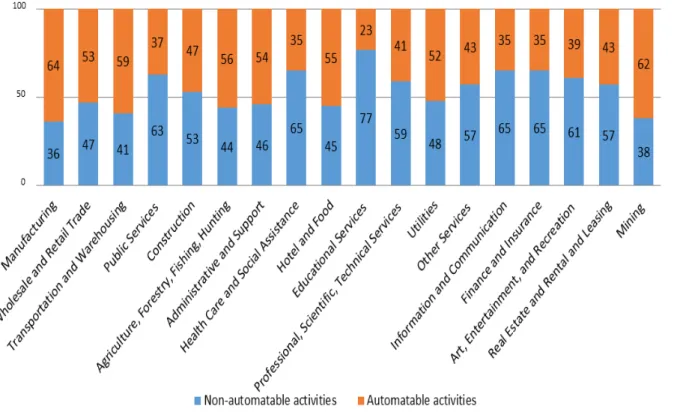
To calculate automation potential, MGI broke down all occupations into tasks and activities and estimated what ratio of those activities per different occupations could be automated. Based on this breakdown and the distribution of occupations in various sectors, MGI determined a sector's automation potential for Hungary (Figure 1).
Figure 1. Technically automated activity by industry In Hungary, % in 2016
MGI's assessing automation potential according to employment numbers indicates that such industries as agriculture (56%), manufacturing (64%), transportation (59%), mining (62%) experience the greatest impact from automation. MGI's analysis also estimates that globally, as much as 49 percent of current work hours could be technically automated. (Figure 2.) However, the findings do not mean automated machines will replace 49 percent of jobs. MGI's research indicates that less than 5 percent of occupations can be fully automated with current automation technologies, while third of the activities in 60 percent of the occupations can be automated. (David Fine, 2018).
Estimates based on Eurostat data support that the demand for e-skills in the labour market is growing and this can be considered as a fundamental trend. As Figure 3 shows, the employment of ICT professionals in Europe increased by 49% between 2010 and 2019, which is approx. was seven times the increase in total employment in the EU-28 (7%) (Eurostat, 2019).
Figure 3. Index of the number of persons employed as ICT specialists and total employment, EU-28, 2010-2019
So, we can conclude that the widespread adoption of Industry 4.0 technologies has led to the fact that the level of agricultural automation potential is quite high. Farmers need to get ready to embrace the upcoming digital change. For the agriculture industry workers will be able to effectively operate and interact with sophisticated modern technology and equipment, robots and related software products in their work, workers need to increase or acquire new ICT skills and capabilities. The vital thing is to ensure that the necessary digital skills are developed and that there is an openness about potential new business opportunities and models that may be unfolding with the digital transformation. The number of businesses is growing and they are working to reduce skills shortages and develop employee skills, which can improve their financial and production results as well as reduce costs and help businesses maintain a competitive advantage. Current educational technologies can help overcome existing skills gaps. Businesses also seek to exploit the potential of innovation (digital education), which can help increase market and customer engagement at local, regional and global levels. Businesses can only take advantage of digital education if they can reduce their costs or increase their revenues. This, of course, includes further training of employees, infrastructure (Grand-Clement S., 2017). Another challenge related to the current skills gap is that businesses often do not have enough information about the skills gap and may not be able to take action to address it. An important question in the future is how these can be mapped to get images of the shortcomings.
2.3 Digital education as an opportunity to acquire the required skills
As it was mentioned above, the uptake of digital technologies in Agriculture requires new skills and knowledge for farmers. Raising awareness and organizing a training on a regional and local level is essential, especially to reach small and medium-sized farms where the use of digital technologies is not always thought of as profitable. Agricultural Knowledge and Innovation Systems can play an important role in promoting mutual learning, to generate, share, and use knowledge and information related to digitization in agriculture.
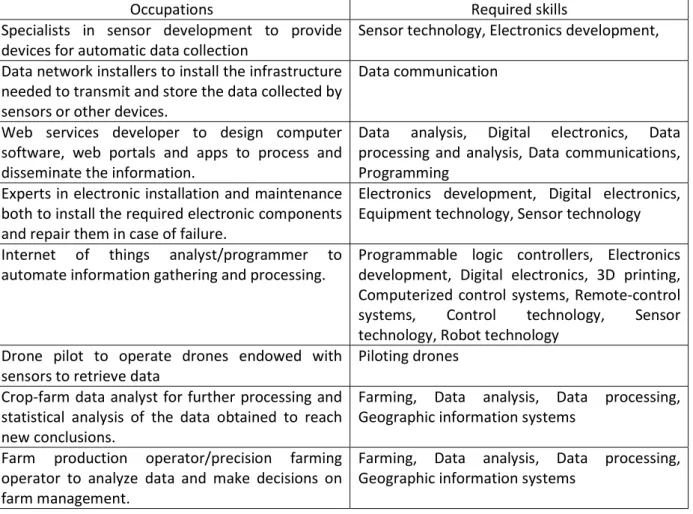
Smart Farm Training for Employment project reports that the implementation of digital technologies in Agriculture will create the need for the following jobs presented in Table 1 (SFATE, Erasmus, 2019).
knowledge and skills. These new learning opportunities are key aspects of lifelong learning and for acquiring the multidisciplinary knowledge that new job opportunities will require. Regulated training programs should be flexible enough to take advantage of these new learning schemes, also the development of multidisciplinary skills should be fostered. Infusing the curricula with digital learning from the earliest stages of formalized schooling throughout higher education also is key to address the digital divide.
Although traditional training continues to play an important role in the acquisition of new skills, the complementary role of self-directed learning in the acquisition of digital skills is also becoming increasingly important: for European workers aged 16-29. Approximately 72% of employees say they have acquired ICT skills through independent learning in practice, according to the latest Eurostat data. Similarly, nearly 40 percent of respondents in the 2015 Harvard Business Review said self-study was the preferred method of learning about new digital technology (Harvard Business Review, 2015).
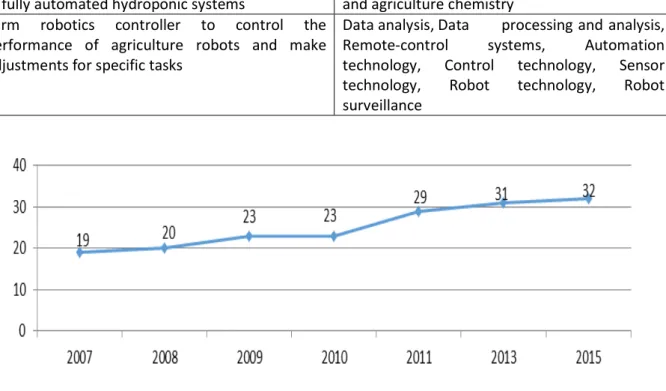
These estimates are supported also by the official Eurostat's database, which is presented in Figure 4. So, in 2015 about 32 percent of European Internet users aged from 16 to 74 have used online resources to obtain information about education, training, or course offers and this figure increased by 13 percentage from 2007 (19%) to 2015 (32%). (Eurostat Database, 2015) This data can confirm the increasing role and importance of digital education and life-long learning.
Digital technology alone can provide an opportunity to transform education as games become more available in education. Mention should also be made of the use of personal learning clouds, lecture videos, huge open online courses (MOOCs), and interactive problem set with automatic feedback and classification. Finally, the MOOC can also contribute to providing a kind of modulated approach to lifelong learning and education. This, in turn, allows workers to acquire specific skills and competencies at any point in their careers without enrolling in any training.
Table 1. ICT connected occupations in the Agriculture Industry
Occupations Required skills
Specialists in sensor development to provide
devices for automatic data collection Sensor technology, Electronics development, Data network installers to install the infrastructure
needed to transmit and store the data collected by sensors or other devices.
Data communication
Web services developer to design computer software, web portals and apps to process and disseminate the information.
Data analysis, Digital electronics, Data processing and analysis, Data communications, Programming
Experts in electronic installation and maintenance both to install the required electronic components and repair them in case of failure.
Electronics development, Digital electronics, Equipment technology, Sensor technology
Internet of things analyst/programmer to automate information gathering and processing.
Programmable logic controllers, Electronics development, Digital electronics, 3D printing, Computerized control systems, Remote-control systems, Control technology, Sensor technology, Robot technology
Drone pilot to operate drones endowed with
sensors to retrieve data Piloting drones
Crop-farm data analyst for further processing and statistical analysis of the data obtained to reach new conclusions.
Farming, Data analysis, Data processing, Geographic information systems
Farm production operator/precision farming operator to analyze data and make decisions on farm management.
Hydroponics technician to control the parameters
in fully automated hydroponic systems Specific skills and knowledge in plant physiology and agriculture chemistry Farm robotics controller to control the
performance of agriculture robots and make adjustments for specific tasks
Data analysis, Data processing and analysis, Remote-control systems, Automation technology, Control technology, Sensor technology, Robot technology, Robot surveillance
Figure 4. Individuals using the internet for looking for information about education, training or course offers in EU-28, % of individuals aged 16 to 74
3. Conclusions
In conclusion, we can mention the development of Agriculture 4.0 contributes to the extensive automation of agriculture production and jobs. For example, MGI's experts assessed the automation potential of agriculture, foresting, fishing, hunting in Hungary as 56% of automatable activities. MGI's analysis also estimates that globally, as much as 49 percent of current work hours could be technically automated according to existing technologies. Consequently available estimates have proved that the growing demand for e-skills is a core trend in the labour market, and the agriculture labour market is no exception. That is why most of the contemporary occupations in agriculture are connected with developed ICT skills. Nowadays digital education makes it easier to acquire new knowledge and skills in ICT. These new learning opportunities are key aspects of lifelong learning by providing modularized approaches to education and for acquiring the multidisciplinary knowledge that new job opportunities will require.
References
Andritoiu, D. et al. (2018) Agriculture autonomous monitoring and decisional mechatronic system, Proceedings of the 2018 19th International Carpathian Control Conference, ICCC 2018. IEEE, pp. 241–246.
Bilali, H. El and Allahyari, M. S. (2018) Transition towards sustainability in agriculture and food systems: role of information and communication technologies, Information Processing in Agriculture. China Agricultural University.
Braun, A. T., Colangelo, E. and Steckel, T. (2018) Farming in the Era of Industrie 4.0, Procedia CIRP., 72, pp. 979–984.
Bronson, K. and Knezevic, I. (2016) Big Data in food and agriculture, Big Data & Society, 3(1).
CEMA (2017) Digital Farming: what does it really mean? https://cema-agri.org/images/publications/position-papers/CEMA_Digital_Farming_-_Agriculture_4.0__13_02_2017_0.pdf ((08.07.2020))
Eurostat Database, 2019. Employed ICT specialists-total, proceedings from Eurostat https://appsso.eurostat.ec.europa.eu/nui/show.do?dataset=isoc_sks_itspt&lang=en
Eurostat Database, 2015 Individuals using the internet for looking for information about education, training or course offers, proceedings from Eurostat,
https://ec.europa.eu/eurostat/tgm/table.do?tab=table&plugin=1&language=en&pcode=tin00034 FAO (2017) Success stories on information and communication technologies for agriculture and rural
development. http://www.fao.org/3/a-i6733e.pdf (08.07.2020) (Gerard Sylvester, Regional Office for Asia and the Pacific Food and Agriculture Organization of the United Nations Bangkok, 2017)
Grand-Clement S. (2017) Digital learning. Education and skills in the digital age.
https://www.rand.org/content/dam/rand/pubs/conf_proceedings/CF300/CF369/RAND_CF369.pdf [28 Aug 2019]
Gacar, A., Aktas, H. and Ozdogan, B. (2017) Digital agriculture practices in the context of agriculture 4.0, Journal of Economics, Finance and Accounting, 4(2), pp. 184– 191.
Harvard Business Review, 2015. Driving digital transformation: New skills for leaders, new role for the CIO. Harvard Business Review Analytic Services Report.
https://hbr.org/resources/pdfs/comm/RedHat/RedHatReportMay2015.pdf
Huh, J. H. and Kim, K. Y. (2018) Time-based trend of carbon emissions in the composting process of swine manure in the context of agriculture 4.0, Processes, 6(9), pp. 1–18.
Janssen, S. J. C. et al. (2017) Towards a new generation of agricultural system data, models and knowledge products: Information and communication technology, Agricultural Systems.155, pp. 200–212
Jayaraman, P. P. et al. (2014) Addressing Information Processing Needs of Digital Agriculture with OpenIoT Platform, FP7 OpenIoT Project Workshop 2014, LNCS 9001, pp. 137–152
Perez-bedmar, J. (2018) Agriculture 4. 0, What Is It ?, IoT Security Review, pp. 9–12.
Piwowar, A. (2018) Opportunities and barriers to the development of Agriculture 4. 0 in the context of low carbon agriculture in Poland, National Science Centre in Poland, program SONATA.
Shepherd, M. et al. (2018) Priorities for science to overcome hurdles thwarting the full promise of the digital agriculture revolution, Journal of the Science of Food and Agriculture
Smart Farm Training for Employment (SFATE) report, 2019. Adapting curricula to smart farming technologies and new job opportunities.
Sponchioni G., Vezzoni M., Bacchetti A., Pavesi M., Renga F., 2019. The 4.0 revolution in agriculture: a multi-perspective definition. XXIV Summer School “Francesco Turco – Industrial Systems Engineering.
https://www.summerschool-aidi.it/cms/extra/papers/591.pdf
Verdouw, C. N. et al. (2016) Virtualization of food supply chains with the internet of things, Journal of Food Engineering. Elsevier Ltd, 176, pp. 128–136.