Magyar Agrárinformatikai Szövetség
Hungarian Association of Agricultural Informatics
Journal of Agricultural Informatics 2013 Vol. 4, No. 1 Special Issue - ICT & E-learning: The case of Organic Agriculture
Readiness to use e-learning for agricultural higher education in Sub-Saharan
Africa. Results from a survey of faculty members
Zschocke T.1, Beniest J.2, Yayé A. D.3, Chakeredza S.4
I N F O
Received 16 Sept. 2010 Accepted 10 Dec. 2010 Available on-line 3 Apr. 2013 Responsible Editor: A. B. Sideridis
Keywords:
e-learning attitude, technology acceptance, faculty readiness, agricultural higher education, Sub-Saharan Africa..
A B S T R A C T
E-learning is likely to be an increasingly important element in teaching agriculture and related subjects at universities in Sub-Saharan Africa. The purpose of this study was to explore the factors involved in determining the readiness and intention to adopt e-learning by faculty members at member institutions of the African Network for Agriculture, Agroforestry and Natural Resources Education (ANAFE). The study was based on the decomposed theory of planned behavior (DTPB) to predict intentions on the use of e-learning. DTPB draws on constructs influencing the attitude to use technology from two frequently investigated models in this area, that is, the theory of planned behavior (TPB) and the technology acceptance model (TAM). Valid responses were collected from 70 faculty members with a survey questionnaire. Validated scales from previous research were used to measure the variables of interest. The results revealed that the majority of the respondents have only limited access to ICT infrastructure and support services. However, they perceived e-learning to be very useful in general and to have the potential to enhance their teaching-related activities.
1. Introduction
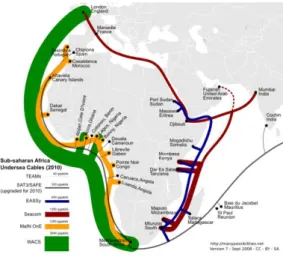
The New Partnership for Africa’s Development (NEPAD), a program of the African Union (AU, 2001), recognizes the critical role of information and communication technology (ICT) in accelerating economic growth and development. One of NEPAD’s sectoral priorities is to bridge the digital divide by investing in ICTs by improving the poor ICT infrastructure, strengthening policy and regulatory frameworks, and developing human resources. In particular, NEPAD intends not only to boost the broadband infrastructure in Africa, but also to foster distance learning and the development of local-content software as capacity building is a crosscutting area for all the four pillars of the Comprehensive Africa Agriculture Development Programme (CAADP). Figure 1 illustrates the current status of the improvement of ICT infrastructure through various undersea cables connecting the African continent with the rest of the world.
The NEPAD Council has also organized two ICT Africa Summits in 2008 and 2010, which also addressed the need of institutions of higher learning for improved ICT infrastructure and access. While investments in ICTs and additional bandwidth are certainly needed to provide the physical facilities
1 ZSCHOCKE, Thomas
United Nations University Insitute for Environment and Human Security (UNU-EHS), UN Campus, UN Campus, Hermann-Ehlers-Str. 10, 53113 Bonn, Germany
2 BENIEST, Jan
World Agroforestry Centre (ICRAF), POBox 30677, Nairobi, Kenya [email protected]
3 YAYÉ, Aissétou Dramé
African Network for Agriculture, Agroforestry and Natural Resources Education (ANAFE), P.O. Box 30677-00100, Nairobi, Kenya
4 CHAKEREDZA, Sebastian
African Network for Agriculture, Agroforestry and Natural Resources Education (ANAFE), P.O. Box 30677-00100, Nairobi, Kenya
for advancing science, technology, and innovation, but special attention has also been given to developing the capacity to acquire, adapt, and adopt knowledge by using ICTs as a key enabler to a knowledge-based economy (Watkins & Ehst, 2008).
Figure 1. African undersea cables (Song, 2008)
According to the recent economic outlook of Africa (OECD & AfDB, 2009) the use of ICT in education has moved from small projects to national government and regional programs. Although this transitional process of adoption and diffusion of ICT in education in Africa constitutes a more systematic integration by policymakers, there still exist great differences between countries across Africa (Farrell & Isaacs, 2007; Farrell et al., 2007). The authors note a growing need for more contextualized digital learning materials that is relevant to local curricula as ICT becomes more integrated into the teaching and learning process across the curriculum. This issue, for instance, has been adressed in a recent project on improving the availability and relevance of agricultural learning resources in Africa, coordinated by the African Network for Agriculture, Agroforestry and Natural Resources Education (ANAFE) with joint funding from the Association of African Universities (AAU) as part of its Mobilisation for Regional Capacity Initiative (MRCI) through a grant of the Department for International Development (DfID) of the United Kingdom, and the World Agroforestry Centre (ICRAF)'s AGROLOR project funded by the Flemish Government.
Despite rapid improvements in ICT infrastructure (e.g., increased availability of mobile phone technology, number of wireless networks, undersea cable project, etc.), the ICT infrastructure at universities remains seriously constrained, primarily due to the lack of computer stations and limited access to affordable high-speed Internet connectivity. These findings confirm the results from the Survey of African University Connectivity (ATICS) from 2006 (Gakio, 2006) that was commissioned by the International Development Research Centre of Canada (IDRC) based on the initial 2004 ATICS study that was sponsored by the World Bank. The main results of the ATICS study show that the Internet connectivity in tertiary institutions in Africa is too limited in terms of type and availability of bandwidth, relatively high bandwidth costs, and a lack of proper bandwidth management and ICT skills training for educational purposes.
An earlier study on accessing knowledge online in Africa (Ondari-Okemwa, 2004) also shows that countries in Sub-Saharan Africa lag behind in generating, accumulating and accessing knowledge due to an inappropriate ICT infrastructure, inadequate policy support to increased access to global knowledge. Even studies in an area such as library and information science education in Africa that would have the greatest interest in extending the use of ICT to advance its education, show that the situation in higher education remains a challenge (Ocholla, 2003; Minishi-Majanja & Ocholla, 2004; Ocholla & Bothma, 2007). These studies also confirm that there is great interest among faculty and students to use ICT in the teaching and learning process, but the underdeveloped infrastructure, inadequate resources, and lack of properly trained users remain an obstacle on exploiting ICT more effectively. The importance of training instructors as well as students in the use of ICT in education is also documented (Unwin, 2005; Mutula et al., 2006). These authors confirm that such interventions help to increase computer literacy, especially when offered using a blended approach, but issues such as infrastructure and online support remain resolved. Although university libraries play an important role in assisting e-learning and promoting scholarship, the challenge remains to overcome the digital divide with increasingly high costs of accessing online research databases and the procurement of digital information (Mutula, 2008).
A prominent example of using technology-mediated instruction in higher education is the African Virtual University (AVU), which was established in 1998 with funding from the World Bank, CIDA, DfID, and AusAID (Hicks, 2007; Ondari-Okemwa, 2002). E-learning has also been increasingly implemented in traditional universities throughout Africa, for instance, the University of the Francophone Digital Campus at the University Abdou Moumouni (UAM) of Niamey in Niger (Dramé Yayé, 2010). The importance of e-learning for higher agricultural education in Africa has also been highlighted (Beniest et al., 2008).
The purpose of the present study is to examine the relationship between teaching online and the readiness and willingness of faculty members in higher agricultural education in Sub-Saharan Africa. The paper is structured as follows: First, the methodology based on the decomposed version of the theory of planned behavior (DTPB) is briefly reviewed. Next, the research model and hypotheses are presented, followed by a presentation of the findings from the data analysis. Finally, a discussion of the meaning of the results and their implications concludes the paper.
2. Methodology used for the Study
With the increasing implementation of e-learning in educational settings, one important aspect to understand is the user acceptance of instructional technology, which is influenced by the attitude of end-users towards computers. Since computers have become an integral part of teaching and learning at all levels of education, it becomes important for both educators as well as policy makers to understand the different factors that influence the interaction of learners and instructors with computers by adapting the decomposed theory of planned behavior (DTPB) (e.g., Teo, 2009; Teo and Noyes, 2008). The present study was based on the DTPB to predict intentions to use e-learning. DTPB draws on constructs influencing the attitude to use technology from two frequently investigated models in this area, that is, the theory of planned behavior (TPB) and the technology acceptance model (TAM).
TAM was developed by Davis (1993) to specify the causal relationships between system design features, perceived usefulness, perceived ease of use, attitude toward using, and actual usage behavior. TAM focuses on explaining the attitude behind the intention to use a specific technology or service. In the context of e-learning, attitude towards this approach will be positively influenced by the perceived usefulness of the system and its ease of use. Perceived usefulness is defined as the extent to which an individual believes that using a particular technology will enhance her/his job performance.
subjective norm relates to the influence of an individual’s perception that most people who are important to him/her think whether s/he should or should not perform the intended behaviour.
The DTPB incorporates the attitude dimensions from TAM, that is, perceived usefulness and perceived ease of use, and the behavioral dimensions from TPB, that is, subjective norm (i.e., social influence) and perceived behavioral control by decomposing them into more specific salient belief dimensions, for example, peer influence, supervisor’s influence, self-efficacy, resource facilitating conditions, and technology facilitating conditions.
3. Research model
In general, readiness to undertake ICT-related activities comprises indicators such as access to and use of the basic ICT infrastructure, instructors and support personnel trained in ICT, the availability of radio and television instruction, educational software, e-mail, etc. (OECD, 2005; UNCTAD, 2009; UNESCO, 2009). The purpose of the survey conducted as part of the Flemish Government funded AGROLOR project was to examine the readiness and willingness of faculty members in agricultural higher education in Sub-Saharan Africa to teach on-line. A questionnaire with a five-point scale was used to collect the data for the survey. Items from related studies were modified for adaptation to the context of teaching on-line.
The survey addressed this dimension by asking questions about how useful teaching online is to the individual. Perceived ease of use is the degree to which using information technology is free of effort for the end-user. The survey covered this aspect by asking questions on how easy an individual thought teaching online was to him/her. In addition to these two aspects, the survey included questions about an additional dimension concerning how well teaching online fits with an individual’s job.
The dimension for subjective norm in this study included questions concerning the support, approval, and relevance of supervisors, colleagues, and students concerning an individual’s perception of and intention towards teaching online. The control belief of an individual refers to the efficacy of the individual’s control in either inhibiting or facilitating the behaviour. Control beliefs reflect the perceived difficulty (or ease) with which the behaviour may be affected. In the current study on the readiness and willingness to teach on-line, the control belief refers to knowing how to use learning technology (self-efficacy), and facility refers to externally based resources constraints. Questions addressing the dimensions of perceived behavioural control in this study included:
• Usefulness;
• Ease of use;
• Fitness for job;
• Computer use;
• Computer training and support to teach online;
• Self-efficacy defined as an individual’s self-confidence in his or her ability in using computers and the Internet;
• Computer anxiety defined as an individual’s apprehension when s/he is faced with the possibility of using computers and/or the Internet.
Therefore, the following hypotheses were studied:
H1. The higher the perceived fitness of teaching online is to the job, the more likely the system is perceived to be useful.
H2. The higher the perceived fitness of teaching online is to the job, the more likely the system is perceived to be easy to use.
H3. The higher the perceived fitness of teaching online is to the job, the more likely the intention to teach online.
H5. The higher the support from superiors and fellow faculty members, the more likely the intention to teach online.
4. Data analysis
A total of 70 usable, complete responses were obtained from respondents in 22 countries (see Figure 2). The gender breakdown was 57 (83%) male and 12 (17%) female, the majority either associate or assistant professor, and most of them in their forties or fifties.
Figure 2. Map of Africa with number of responses by respondents' country of residence
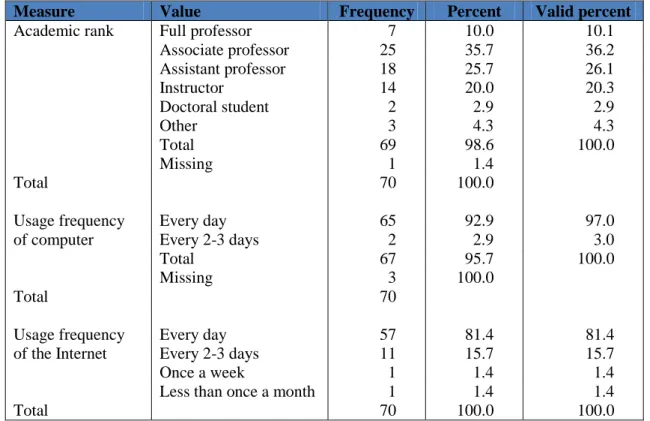
Almost all respondents had experience with both the computer and the Internet, and used them at least every other day. Most of the respondents (74%) had no experience teaching online nor had they offer any online education at the time of the survey; 15% had experience for one year or less, while only a minority of around 3% had experience teaching online for more than 2-3 years. Of those teaching online (about 24%), almost all use the Web for blended learning; only a fraction offered fully online courses (1%). Table 1 gives a detailed description of the main demographic statistics for the respondents
Table 1. Descriptive Statistics of Respondents' Characteristics
Measure Value Frequency Percent Valid percent
Gender Male 57 81.4 82.6
Female 12 17.1 17.4
Total 69 98.6 98.6
Missing 1 1.4 100.0
Total 70 100.0
Age < 30 1 1.4 1.4
30-39 12 17.1 17.4
40-49 28 40.0 40.6
50-59 26 37.1 37.7
> 60 2 2.9 2.9
Total 69 98.6 100.0
Missing 1 1.4
Total 70 100.0
Type of institution University 57 81.4 82.6
Technical college 9 12.9 13.0
Training centre 2 2.9 2.9
Other 1 1.4 1.4
Total 69 98.6 100.0
Missing 1 1.4
Measure Value Frequency Percent Valid percent
Academic rank Full professor 7 10.0 10.1
Associate professor 25 35.7 36.2
Assistant professor 18 25.7 26.1
Instructor 14 20.0 20.3
Doctoral student 2 2.9 2.9
Other 3 4.3 4.3
Total 69 98.6 100.0
Missing 1 1.4
Total 70 100.0
Usage frequency Every day 65 92.9 97.0
of computer Every 2-3 days 2 2.9 3.0
Total 67 95.7 100.0
Missing 3 100.0
Total 70
Usage frequency Every day 57 81.4 81.4
of the Internet Every 2-3 days 11 15.7 15.7
Once a week 1 1.4 1.4
Less than once a month 1 1.4 1.4
Total 70 100.0 100.0
When asked to respond to the general infrastructure to support online education, less than 75% had the necessary assistance at their institutions to engage in online education. The lack of training, access, and other support mechanism confirms results from other studies. Table 2 provides a summary of the results.
Table 2. Summary Statistics of Responses About the E-learning Infrastructure at the Respondents' Institution
Frequency Percent
My institution maintains a specialized eLearning support unit Yes 14 20.0
No 56 80.0
Total 70 100.0
My institution has implemented a strategic framework for eLearning
Yes 19 27.1
No 51 72.9
Total 70 100.0
My institution provides regular training on eLearning for faculty, students, and staff
Yes 16 22.9
No 54 77.1
Total 70 100.0
My institution maintains a network infrastructure Yes 37 52.9
No 33 47.1
Total 100.0
All faculty members at my institution are equipped with computers
Yes 39 55.7
No 31 44.3
Total 70 100.0
All faculty members and students at my institution have their own e-mail account
Yes 39 55.7
No 31 44.3
Total 70 100.0
Frequency Percent
protected No 44 62.9
Total 70 100.0
My institution maintains a virtual learning environment Yes 18 25.7
No 52 74.3
Total 70 100.0
The measures of actual use, behavioural intention to use, attitude toward using, subjective norm, and perceived behavioural control were adapted from various studies related to TAM and TPB. The alpha values of the constructs were calculated to assess the internal consistency reliabilities of the survey instrument. The results in Table 3 show that the alpha coefficients are relatively high, indicating that the items are in general reliable. Nevertheless, it is important to bear in mind the low values of the some of the items when applying the findings of the study, that is, those measuring student’s influence and those measuring perceived behavioural control, e.g., efficacy in using computers and the Internet, computer anxiety.
Table 3. Reliability Analysis for Each Construct
Construct Items α-value
Behavioral intention
Intend to use when having access
0.750 Predict to use when having access
Intend to use next semester Given the choice to use Recommend to use
Actual usage
Computer usage frequency
N/A* Internet usage frequency
Attitude
Usefulness Online education technology is useful for teaching
0.832 Online education increases effectiveness of teaching
Teaching online makes the job easier
Online education is effective for student learning Online education increases productiveness Online education is appropriate for teaching Students are well prepared for online education
Ease of use Learning to teach online is easy
0.821 Easy to become skilful in teaching online
Online education helps to achieve the same as regular teaching
Online education is flexible
Online education does not require a lot mental effort to become skilful
Teaching online is easy to accomplish
Fitness for job Online education has positive effect on job performance
0.863 Online education decreases time needed for our job
responsibilities
Construct Items α-value
Online education assist in teaching tasks
Subjective norms
Superiors Superiors expect to teach online
0.755 Superiors approve to teach online
Superiors’ support to teach online is important Colleagues Fellow faculty members expect to teach online
0.755 Fellow faculty members approve to teach online
Fellow faculty members’ attitude to teach online is important
Students Students expect to teach online
0.578 Students approve to teach online
Students‘ approval to teach online is important
Perceived behavioral control
Efficacy - computers Working with computers is easy
0.586 Diffucult to learn new applications
Applications make it easier to prepare for teaching tasks
Computers rarely enjoyed
Computers are good teaching aids Computers save time
Efficacy - Internet Know about latest IT developments
0.674 Confident navigating the Web
No problems finding things on the Internet
Confident retrieving teaching materials from the Web Confident using discussion forums
Confident downloading files and software from the Internet
Confident maintaing course website Solve problems with Internet access Not sure what a Web server does
Computer anxiety Hesitate using computers because of making mistakes that cannot be corrected
0.186 Avoid computers because of unfamiliarity and
intimidation
Excited to learn about computes Confident to learn computer skills Computers are necessary tools Avoid using computers
One of the first using new / updates software applications
Computer use Access to computer at the office
0.531 Access to computer at home
Rely on computer support from others Use computer for basic tasks
Use computer for digital materials development
Computer support Institution has network infrastructure
Construct Items α-value
Institution has learning management system to teach online
Institution has framework to teach online Institution offers incentives to teach online Specialized training to teacih online is available Institution has specialized support unit for online education
Specific person / group is available for technical support in teaching online
Guidance available for online teacing methodology
* N/A = not applicable. Computer and Internet usage are single items measuring the frequency of use.
Lack of a support infrastructure and perceived behavioural control (that is, superiors and fellow faculty members) increase behavioural uncertainty and reduce the behavioural intention to teach online. However, individuals are more likely to teach online if their perceived behavioural control and system support are alleviated so that they have control over its usage. The results of the regression analysis used in examining the construct relationships are summarized in Table 4.
Table 4. Regression Results of Direct Relationships
Hypothesis Statement
beta-coefficient
t-value F-value R2
H1 The higher the perceived fitness of teaching online is to the job, the more likely the system is perceived to be useful.
.580 5.778 33.387 .326
H2 The higher the perceived fitness of teaching online is to the job, the more likely the system is perceived to be easy to use.
.652 7.029 49.412 .416
H3 The higher the perceived fitness of teaching online is to the job, the more likely the intention to teach online.
.433 3.934 15.480 .176
H4 The higher the system support towards online education, the more likely the intention to teach online.
.390 3.488 12.163 .139
H5 The higher the support from superiors and fellow faculty members, the more likely the intention to teach online.
.485 4.539 20.603 .224
5. Conclusion
Analysis of the data indicated that beliefs about the usefulness, ease of use of e-learning and user experience positively affect attitudes toward teaching on-line. Beliefs about self-efficacy regarding teaching on-line positively affect perceived behavioral control, which in turn affects on-line teaching behavior. In sum, respondents who believed in the usefulness of e-learning and in their own abilities to teach on-line were more likely to make use of e-learning in their teaching than were those without such beliefs.
The initial observations showed that there is a strong correlation between usefulness and ease of use to encourage faculty members to teach on-line. Establishing a system infrastructure that is useful and easy to use would help to increase teaching online. The significance of fitness to job suggested that teaching online should be clearly embedded into the work environment of an individual to increase his/her intention to teach online. This positively correlates with the influence of superiors and fellow faculty members on the intention to teach online. Although less obvious in this study, providing faculty members with the necessary supporting infrastructure will certainly increase the lecturers' intention to engage in online education. This does not only involve the technical infrastructure of network access, hardware and software, but also the technical assistance in instructional design as well as incentives. Overall, the results of this survey indicated that ANAFE higher education institutions showed a clear interest in the use of ICT to enhance their teaching and learning about agroforestry, agriculture and natural resources management.
One limitation of the study, though, was the relatively small sample size. Thus, the findings may not be representative for Sub-Saharan Africa or any developing country in particular. In addition, the analysis of the findings needs to be further enhanced through structured equation modeling in order to better verify the constructs and their relationship.
Acknowledgements
This work was funded in part by a grant from the Flemish Government, Department of Agriculture and Fisheries, Belgium.
References
AU. 2001. The New Partnership for Africa's Development (NEPAD). Johannesburg, South Africa: Organization for African Unity (OAU).
Ajzen, I. 1985. Chapter 2: From intentions to actions: a theory of planned behavior. In Action Control: From Cognition to Behavior, 11-39. J. Kuhl and J. Beckmann, eds. Berlin: Springer.
Ajzen, I. 1991. The theory of planned behavior. Organizational Behavior and Human Decision Processes, 50(2): 179-211.
Beniest, J., T. Vandenbosch, and A. Dramé Yayé. 2008. eLearning for agriculture and natural resources
management education - Some experiences and future directions. In Proc. 2nd ANAFE International Symposium on Mainstreaming Climate Change Into Agricultural Education: Tools, Experiences and Challenges, 27 p. Lilongwe, Malawi: African Network for Agriculture, Agroforestry and Natural Resources Education (ANAFE). Davis, F. D. 1993. User acceptance of information technology: system characteristics, user perceptions and behavioral impacts. International Journal of Man-Machine Studies, 38(3): 475-487.
Dramé Yayé, A. 2010. Development of e-learning in Niger: opportunities, challenges and perspectives. In Cases on Interactive Technology Environments and Transnational Collaboration: Concerns and Perspectives, 114-125. S. Mukerji and P. Tripathi, eds. Hershey, PA: ICI Global.
Farrell, G., and S. Isaacs. 2007. Survey of ICT and education in Africa: a summary report, Based on 53 Country Surveys (Vol. 1). Washington, DC: World Bank.
Farrell, G., S. Isaacs, and M. Trucano (Eds.) .2007. Survey of ICT and Education in Africa: country reports 53(2). Washington, DC: World Bank.
Hicks, E. K. 2007. Can the African virtual university transform higher education in Sub-Saharan Africa? Comparative Technology Transfer and Society, 5(3): 156-175.
Minishi-Majanja, M. K., and D. N. Ocholla. 2004. Auditing of information and communication technologies in library and information science education in Africa. Education for Information, 22(3-4): 187-221.
Mutula, S. M. 2008. Evolving paradigms in the networked world and their implications for information management in African libraries. African Journal of Library, Archives and Information Science, 18(2): 89-102. Mutula, S. M., T. Kalusopa, K. Moahi, and J. Wamukoya. 2006. Design and implementation of an online information literacy module: experience of the Department of Library and Information Studies, University of Botswana. Online Information Review, 30(2): 168-187.
Ocholla, D. N. 2003. An overview of Information and Communication Technologies (ICT) in the LIS schools of Eastern and Southern Africa. Education for Information, 21(2/3): 181-194.
Ocholla, D. N., and T. Bothma. 2007. Trends, challenges and opportunities for LIS education and training in Eastern and Southern Africa. New Library World, 108(1/2): 55-78.
OECD. 2005. Guide to measuring the Information Society. Paris, France: Organisation for Economic Co-operation and Development (OECD).
OECD, and AfDB. 2009. African Economic Outlook 2009. Paris, France: Organisation for Economic Co-operation and Development (OECD); Tunis, Tunesia: African Development Bank (AfDB).
Ondari-Okemwa, E. 2002. Challenges of harnessing virtual information resources in Kenya: the case of the African Virtual University. Journal of Information Science, 28(4): 321-329.
Ondari-Okemwa, E. 2004. Impediments to promoting access to global knowledge in Sub-Saharan Africa. Library Management, 25(8/9): 361-375.
Song, S. 2008. Sub-Saharan Africa undersea cables in 2010 – take 7. Available at: http://manypossibilities.net/2008/09/sub-saharan-africa-undersea-cables-in-2010-2.
Taylor, S. and P. Todd. 1995a. Assessing IT usage: the role of prior experience. MIS Quarterly, 19(4): 561-570. Taylor, S., and P. Todd. 1995b. Understanding information technology usage: a test of competing models. Information Systems Research, 6(2): 144-176.
Teo, T. 2009. Modelling technology acceptance in education: a study of pre-service teachers. Computers & Education, 52(2): 302-312.
Teo, T., and J. Noyes. 2008. Development and validation of a computer attitude measure for young students (CAMYS). Computers in Human Behavior, 24(6): 2659-2667.
UNCTAD. 2009. Manual for the production of statistics on the information economy. New York, NY & Geneva, Switzerland: United Nations Conference on Trade and Development (UNCTAD).
UNESCO. 2009. Guide to measuring information and communication technologies (ICT) in education: United Nations Educational, Scientific and Cultural Organization (UNESCO) Institute for Statistics (UIS).
Unwin, T. 2005. Towards a framework for the use of ICT in teacher training in Africa. Open Learning, 20(2): 113-129.
Unwin, T. 2008. Survey of e-learning in Africa. Paris, France: United Nations Educational, Scientific and Cultural Organization (UNESCO).
Unwin, T., B. Kleessen, D. Hollow, J. B. Williams, L. M. Oloo, J. Alwala, et al. 2010. Digital learning management systems in Africa: Myths and Realities. Open Learning, 25(1): 5-23.
Van Brakel, P. A., and J. Chisenga. 2003. Impact of ICT-based distance learning: the African story. The Electronic Library, 21(5): 476-486.