A Multilingual Chat System
with Image Presentation
for Detecting Mistranslation
Eri Hosogai
1, Tsubasa Mukai
1, Sinyu Jung
1, Yasufumi Kowase
1,
Antoine Bossard
1, Yong Xu
1, Masatoshi Ishikawa
2and Keiichi Kaneko
1 1Department of Computer and Information Sciences, Tokyo University of Agriculture and Technology, Japan2Department of Business Administration, Tokyo Seitoku University, Japan
We have designed and developed a multilingual chat system, MCHI (Multilingual Chat with Hint Images), which is based on machine translation and equipped with a presentation function of images related to the contents of the messages by utterers so that listeners are able to notice mistranslation. MCHI accepts English, French, Chinese, Japanese, Korean and Vietnamese languages. It uses the Google API to retrieve related images from the image posting site Flickr. As a result of evaluation experiment, we have observed that participants detected the mismatch of a translated message with its related image. According to the answers of participants for a questionnaire, it turned out that the usability of the MCHI system is good enough though the related images are not satisfactory.
Keywords: machine translation, image retrieval, key-words, morphological analysis
1. Introduction
Recently, importance of collaborative learning is reacknowledged, and it is realized that ex-plaining and practicing among others inside a group enhance learners’ understanding. There are many researches related to collaborative learning with chat systems [3, 4, 5, 7]. In ad-dition, acquiring multicultural competency is very important in the globalized society. There-fore, multilingual chat systems based on auto-matic translation play an important role to ac-quire multicultural competency by collaborative learning. However, chat systems based on ma-chine translation have the drawback that users ask less questions about the contents of con-versations, and they cannot recognize
mistrans-lation though the systems generate quite a few mistranslated parts. Hence, in this study, we de-velop a multilingual chat system, MCHI( Mul-tilingual Chat with Helpful Images), which is based on machine translation and equipped with a presentation function of images related to the contents of the messages by utterers so that lis-teners are able to notice mistranslations.
2. Related Works
In this section, we survey the related works con-cerning automatic translation systems and mul-tilingual communication systems.
There are many reports pointing out the impor-tance of automatic or machine translation sys-tems. For example, Aiken insists that in elec-tronic meetings, a GSS(Group Support System) combined with automatic translation can yield an order of magnitude increase in the produc-tivity of multilingual groups[1].
Many successful case studies are also reported. For instance, Meng et al. [6] report on ISIS
(Intelligent Speech for Information Systems), which is a trilingual spoken dialog system(SDS)
However, ISIS addresses man-machine interac-tion in a specific domain. Hence, it is not clear whether we can obtain the same results when it is applied to human interaction in the generic domain.
Unfortunately, there is a research that specifies the limit of state-of-the-art machine translation. Yamashita and Ishida[8]have investigated and reported the effects of machine translation on collaborative work. In their study, eight pairs from China, Korea, and Japan worked on refer-ential tasks in English and in their native lan-guages using a machine translation embedded chat system. The results showed that lexical en-trainment was disrupted in machine translation-mediated communication. In addition, the pro-cess of shortening referring expressions was also disrupted because the translations did not use the same terms consistently throughout the conversation.
Aiken and Park [2] used a method called RTT
(round-trip translation)and implemented a sys-tem where speakers can preview their speech to check their correctness. As a result, those who used RTT estimated the accuracy of the Ger-man translations better than those who did not use it. There was a significant, positive correla-tion between the forward translacorrela-tions to German and the back translations to English, indicating that the accuracy can be predicted and compre-hension can be enhanced in a bilingual meet-ing. However, in a multilingual environment, the time response by RTT increases linearly de-pending on the number of languages involved. Hence, a drawback of this approach is that RTT takes too much response time so that the users cannot chat smoothly since waiting for all of the RTT results for preview becomes a considerable cognitive load for speakers.
3. Design of MCHI System
3.1. Conditions
Based on the survey of related works, we show three conditions that our system MCHI must satisfy:
• Multilingual communication is supported. • Response time is short enough.
• Users’ cognitive load is small.
Taking these conditions into consideration, the MCHI system automatically generates a hint re-lated to the content of a message by an utterer and sends it to listeners. Because the hint is automatically generated, there is no cognitive load for the utterer and the response time is short. The listeners are allowed to ignore the hint if they want to concentrate on the messages generated by machine translation and they do not have any additional load. In case they feel the translated message is ambiguous or strange, they check the hint to detect mistranslation, if any.
We decided to use images as hints because im-ages can be understood at a glance, and load for listeners is small. There are several image retrieval sites and they provide quick searching reaction.
3.2. User Interface
In this section, we explain the user interface of the MCHI system along the flow of system usage.
When MCHI is invoked, the login interface shown in Figure 1 appears. The user inputs his/her nickname, selects the language to use, and, with or without images, enters the sys-tem. The current implementation of MCHI supports six languages – English, Japanese, Ko-rean, French, Vietnamese, and Chinese. In the case of Chinese, two types of characters – sim-plified and traditional – are allowed.
Figure 1.Login Interface for MCHI System
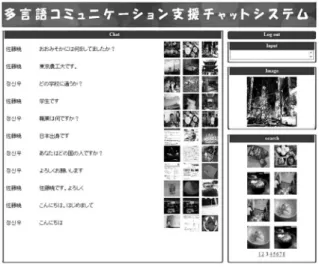
If the user logs in the system correctly, the win-dow shown in Figure 2 appears.
This window consists of five regions from (1)
to(5), and they have the following functions:
(1)If the user clicks on this bar, the system terminates and the login session restarts.
Figure 2.Initial chat interface in MCHI system
Figure 3.Overview of MCHI system
(3)This region displays each of the messages transmitted by all of the users as well as the thumbnails of images corresponding to at most three keywords extracted from the message.
(4)This region is for viewing an enlarged im-age of a thumbnail. If the user clicks on one of the thumbnails displayed in the regions
(3) or (5), a larger version is displayed in this region.
(5)This region is for browsing additional nails. If the user clicks on one of the thumb-nails displayed in the region (3), the key-word in the original language correspond-ing to the thumbnail is retrieved. Then the images related to that keyword are searched and at most 64 of them are displayed as thumbnails in this region.
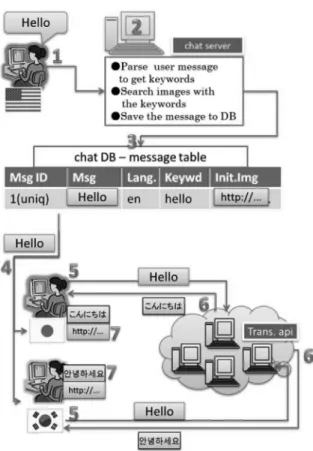
Figure 3 shows an overview of the MCHI sys-tem. If the system cannot find three keywords in the message, three thumbnails are displayed by retrieving multiple images for a single keyword.
4. Implementation
In this section, we explain the implementa-tion of the MCHI system. The development language of the system is php combined with Ajax(prototype.js). The development environ-ment is XAMPP for Windows version 1.7.1, mysql 5.1.33-community, php 5.2.9, and apache 2.2.11.
4.1. Entering the System
As described in Subsection 3.2, a user can enter the MCHI system in the following manner: 1. Input of a nickname: First, to identify the
user, it is necessary to assign him/her a nick-name.
2. Selection of a language: Next, the system must know the language of the user to start multilingual communication.
3. Selection of the option with/without images: Then the user can turn on/off the function of presenting related images for each mes-sage to support him/her to comprehend the message.
4. Clicking on the ‘log in’ button: Finally, MCHI must find the latest message number so that the user should start his/her chatting after entering the system.
The above four values are processed in the login session. These values are passed to the system by the pseudo code shown in Figure 4.
4.2. Multilingual Communication
A message emitted by a user is processed as shown in Figure 5.
1. The message input by the user is transmitted to the chat server by using php.
<form action="chat.php" method="post"> //Input of a nickname
<th>Nickname :</th>
<td><input type="text" name="nickname"> <input type="submit" value="Login"> </td>
//Selection of a language <th>Language :</th><td>
<input type="radio" name="lang" value="en" checked> English <input type="radio" name="lang"
value="ja"> . . . </td>
// Selection of images: <th>Images :</th><td>
<input type="radio" name="show image" value="true">with <input type="radio" name="show image"
value="false" checked>without </td>
// Number of latest message // $max id[’MAX(message id)’] has
// the latest message number
<input type="hidden" name="message id" value="<?php echo
($max id[’MAX(message id)’]);?>"> </form>
Figure 4.Pseudo code for login session
to these keywords are retrieved by using the Google API.
3. The message, language code, keywords, and the URL’s of images are registered to a database.
4. Each client checks whether a new message is registered to the database every second. If there is a new message, the message, lan-guage code, keywords, and the URL’s of im-ages are obtained.
5. By making use of the Google API, the ob-tained message is translated into the mother language of the client user.
6. A translation result is received from Google in the JSON format.
7. The translated message and the related im-ages are displayed in the window.
Figure 5.Flow of MCHI system
4.3. Image Retrieval
The MCHI system presents images in three re-gions. In Region (3) of Figure 2, the images related to at most three keywords obtained from a message are displayed at the right-hand side of the translated message. Region (4) in Fig-ure 2 is a region to display an enlarged image when a thumbnail is clicked by the user. If the thumbnails presented in Region(3)in Figure 2 are not matching for the message, the user can click one of the thumbnails in Region (3) to allow Region (5) in Figure 2 to display other related images to the corresponding keyword. The user can judge if the mismatch is caused by mistranslation or retrieval of an unsuitable image by looking at the new images. At most 64 images appear in Region(5).
All of the images presented in Region (3)and
//use of google library
<script type="text/javascript"
src="http://www.google.com/jsapi?key=xx"> </script>
// inclusion of search module google.load(’search’, ’1’);
//find images related to keyword
function OnLoad(keyword) {
//google image retrieval object imageSearch = new
google.search.ImageSearch(); //restrict the domain to flickr.com imageSearch.setSiteRestriction(
"flickr.com");
imageSearch.execute(keyword);
}
Figure 6.Pseudo code for image retrieval
function show bigsize(this)
{
source = this.getAttribute("src"); <img src = source>;
}
<img src ="http://..." onclick:
"javascript:show bigsize(this)">
Figure 7.Pseudo code for image enlarge
5. Experiment
To measure performance of the MCHI system, we conducted an evaluation experiment. Five participants joined the experiment. Each of the languages French, Vietnamese, and English was used by one participant while Chinese was used by two participants. We prepared a Japanese-Korean conversation in the experiment with re-spect to monsters in Japan. In the conversation, the word ‘Kappa’, which is used to specify a monster in Japan is used. However, ‘Kappa’ also has the meaning of cucumber, and it caused mistranslation. Each participant observed the conversation translated into his/her language, and specified mismatches of translated mes-sages and corresponding images shown in Fig-ure 8. As a result, four out of five participants pointed out the mismatch at the mistranslated
(a)First image of Kappa
(b)Second image of Kappa
Figure 8.Images presented for ‘Kappa’
values of the eight answers for questions(Q1),
(Q2), and (Q3)were 4.50, 3.88, and 3.38, re-spectively. From these values, we can conclude that the function for message input was good enough while retrieved images were not satis-factory.
(a)Free talk in Japanese Language
(b)Free talk in English Language
Figure 9.Free talk by MCHI system
6. Conclusion
In this study, we have designed and developed a multilingual chat system, MCHI. The MCHI system is based on machine translation and it also presents images related to the contents of the messages by utterers so that listeners are able to notice mistranslations. As a result of an evaluation experiment, it is reported that mis-translation is detected by the users. A drawback of the system is that retrieved images were not satisfactory.
A comparative experiment with a larger num-ber of participants should be conducted to verify
the ability of the MCHI system. Improvement of the image retrieval mechanism and increas-ing the number of languages supported by the system are also included in the future works. We are also interested in finding out differences of effects of mistranslations between nouns and other words.
References
[1] M. AIKEN, Multilingual communication in
elec-tronic meetings. ACM SIGGROUP Bulletin, Vol. 23, No. 1, pp. 18–19, Apr. 2002.
[2] M. AIKEN, M. PARK, Enhancing bilingual electronic
group meeting comprehension with round-trip trans-lations.International Journal of Information Sys-tems and Change Management, Vol. 4, No. 2, pp. 103–116, Apr. 2009.
[3] Y. S. CHEE, C. M. HOOI, C-VISions: socialized
learning through collaborative, virtual, interactive simulations. Proc. of the Int’l Conf. Computer Support for Collaborative Learning, pp. 687–696, 2002.
[4] J. FAVELA, F. PEA˜-MORA, An experience in
col-laborative software engineering education. IEEE Software, Vol. 18, No. 1, pp. 47–53, Mar./Apr. 2001.
[5] M. LEA, P. ROGERS, T. POSTMES, SIDE-VIEW:
eval-uation of a system to develop team players and im-prove productivity in Internet collaborative learning groups.British Journal of Educational Technology, Vol. 33, No. 1, pp. 53–63, 2002.
[6] H. MENG, P. C. CHING, S. F. CHAN, Y. F. WONG, C. C. CHAN, ISIS: an adaptive, trilingual conversational system with interleaving interaction and delegation dialogs. ACM Transactions on Computer-Human Interaction, Vol. 11, No. 3, pp. 268–299, Sept. 2004.
[7] A. L. SOLLER, Supporting social interaction in an
intelligent collaborative learning system. Interna-tional Journal of Artificial Intelligence in Education, Vol. 12, pp. 40–62, 2001.
[8] N. YAMASHITA, T. ISHIDA, Effects of machine trans-lation on collaborative work. Proc. of the Int’l Conf. Computer Supported Cooperative Work, pp. 515–523, 2006.
Received:June, 2011 Accepted:November 2011
Tsubasa Mukai Dept. Computer and Inf. Sciences Tokyo Univ. of Agriculture and Technology Nakacho 2-24-16, Koganei-shi Tokyo 184-8588, Japan
Sinyu Jung Dept. Computer and Inf. Sciences Tokyo Univ. of Agriculture and Technology Nakacho 2-24-16, Koganei-shi Tokyo 184-8588, Japan
Yasufumi Kowase Dept. Computer and Inf. Sciences Tokyo Univ. of Agriculture and Technology Nakacho 2-24-16, Koganei-shi Tokyo 184-8588, Japan
Antoine Bossard Dept. Computer and Inf. Sciences Tokyo Univ. of Agriculture and Technology Nakacho 2-24-16, Koganei-shi Tokyo 184-8588, Japan e-mail:[email protected]
Yong Xu Dept. Computer and Inf. Sciences Tokyo Univ. of Agriculture and Technology Nakacho 2-24-16, Koganei-shi Tokyo 184-8588, Japan
Masatoshi Ishikawa Dept. Business Administration Tokyo Seitoku University Jujodai 1-7-13, Kita-ku Tokyo 114-0033, Japan e-mail:[email protected]
Keiichi Kaneko Dept. Computer and Inf. Sciences Tokyo Univ. of Agriculture and Technology Nakacho 2-24-16, Koganei-shi Tokyo 184-8588, Japan e-mail:[email protected]
ERIHOSOGAIis an undergraduate student at Tokyo University of Agri-culture and Technology. Her main research areas include supporting systems for international communication.
TSUBASAMUKAIis an undergraduate student at Tokyo University of Agriculture and Technology. His research interests include foreign lan-guage learning systems and supporting systems for foreign lanlan-guage writing.
SINYUJUNGis a PhD program student at Tokyo University of Agricul-ture and Technology. His main research areas are routing algorithms in interconnection networks and interactive systems. He received the B.E. and M.E. degrees from Tokyo University of Agriculture and Technology in 2010 and 2011, respectively.
YASUFUMIKOWASEis a master program student at Tokyo University of Agriculture and Technology. His research interests include education systems for foreign language learning. He received the B.E. degrees from Tokyo University of Agriculture and Technology in 2010.
ANTOINEBOSSARDis an assistant professor at Tokyo University of Agriculture and Technology. His research is focused on graph theory, interconnection networks and routing algorithms. He received the B.E. and M.E. degrees from Universit´e de Caen Basse-Normandie in 2005 and 2007, respectively, and the Ph.D. degree from the Tokyo University of Agriculture and Technology in 2011.
YONGXUis an assistant professor at Tokyo University of Agriculture
and Technology. His research interests include human agent interac-tion, human agent interfaces, and educational systems. He received the B.E. degree from Suzhou Vocational University in 1993, the M.E. degree from University of Science and Technology of China in 2001, and the Ph.D. degree from Kyoto University in 2010. He is a member of JSAI. Now, he has joined Huawei Technologies Japan K.K.
MASATOSHIISHIKAWAis an assistant professor at Tokyo Seitoku Uni-versity. His main research areas are database systems, area informatics, and ubiquitous-learning systems. He received the B.E. degree from Tokyo University of Agriculture and Technology in 1995. He also re-ceived the M.E. and Ph.D. degrees from Nara Institute of Science and Technology in 1997 and 2004, respectively. He is a member of ACM, IEEE-CS, IPSJ, IEICE and JSiSE.