www.rsisinternational.org
Page 155
Thermodynamic Properties of Liquid Na-Tl and
Pb-Tl Systems Using Four-Atom Cluster Model
Vincent. O. Ogunrinde
1*, Yisau. A. Odusote
21&2Condensed Matter Research Group,
Department of Physics, The Federal University of Technology, Akure, Ondo State, Nigeria
Abstract--The concentration dependent thermodynamic properties of liquid Sodium (𝑵𝒂 − 𝑻𝑰) and Lead (𝑷𝒃 − 𝑻𝑰)
alloys have been explained theoretically using a simple statistical mechanical model: Four Atom Cluster Model (FACM), to obtain higher order conditional probabilities of chemical ordering in liquid binary alloys. The study of free energy of mixing, GM,
activity,𝜶𝟏, concentration-concentration fluctuations in long
wavelength limits, Scc(o), the Warren-Cowley chemical short-range order parameter, (CSRO), heat of mixing, 𝑯𝒎, and
entropy of mixing. 𝑺𝒎, using the optimized values of order
energy, w, obtained were used to describe the thermodynamic properties at different concentration and temperature of 𝟔𝟕𝟑𝑲
and 𝟕𝟕𝟑𝑲, respectively. From the study, it is observed that the thermodynamic properties of 𝑵𝒂 − 𝑻𝑰 and 𝑷𝒃 − 𝑻𝑰 exhibit negative deviations hence; this study reveals that both Na-TI and Pb-TI are short ranged ordered alloys.
Keywords: Concentration, Short range, Liquid alloys, Hetero-coordination, Homo-coordination.
I. INTRODUCTION
n recent times, calculations of the concentration-concentration fluctuations in the long-wavelength limits and local ordering measured in terms of the Warren-Cowley short-range order parameter for the nearest neighbour sites for binary alloys have attracted the attention of many researchers as opined by [1] and[2].
One of the major reasons for this is the fact that, knowledge of these two important quantities may shed light on the phenomenon of easy glass formation in many binary liquid alloys. Thus, enormous works have been done by diverse theoreticians to include [3], [4], [5], [6], [7], [8], [9], and [10] which led to the development of different theoretical models of [11], [12]and[13].
The calculation of local ordering measured in terms of Warren-Cowley short-range order (CSRO) parameter of liquid binary alloys has been improved upon in such a way that we now have (by way of the four atom cluster model (FACM)) a more reliable means of calculating the ordering energy, w and the CSRO parameter, 𝛼1, and hence a proper understanding of
the degree of order in binary liquid alloys. Essentially, in FACM a simple scheme is used to connect conditional probabilities enlisting the occupation of neighbouring sites by the atoms of the constituent elements in liquid alloys.
One important advantage of the FACM over other available methods of calculating CSRO parameter is the fact that, in
obtaining this parameter, the model formulation does not require the assumption of any preferred complexes [1] and [14]. The implication of this is that, we can obtain information on the properties of liquid alloys without having to necessarily look for information on such features like the phase diagram which normally provides information on the possible complexes.
In this work, the concentration dependence of thermodynamic properties as well as the micCSROopic functions of liquid Na-Tl and Pb-Na-Tl alloys have been investigated using the Four Atom Cluster Model (FACM). However, in using the FACM a knowledge of the activity ratio,𝑎𝐴
𝑏𝐵, where A and B are the individual component of the alloy A-B of interest is require as the only input data. For the present study, we have chosen Na-Tl and Pb-Tl at temperatures 673K and 773K, respectively.
Apart from a high-academic interest, Na-TI and Pb-TI alloys have been chosen for investigation because of their great commercial significant and wide diversity of their physical and chemical properties. In addition, the experimental data required for the thermodynamic calculations are available at the working temperatures. Sodium belongs to group IA of the periodic table and is referred to as Alkali metals. This group of metals is used primarily as reducing agent in pharrmaceutical perfumery and general chemical industries. They are volatile and can be distilled out of the reaction mixtures. Na is used as coolant in the valves of internal combustion engines and in nuclear reactors. Na is also known as salts which are used to balance diet in meals. Thallium on the other hand, has limited uses due to its toxic nature. Thallium sulfate was employed as a rodent and ant killer. Because it is odourless and tasteless, its household use has been prohibited by most countries. Thallium oxide is used in the production of special glass with a high refractive index and also low melting glass that becomes fluid at about 125 K. Little amount is used while visualizing the cardiac function and tumors in human.
In electronic industry, it is found useful in photo-resistors, manufacturing of switches, infrared optical equipment etc. [2], [15] and [16]. It forms a eutectic alloys with magnesium, lead tin etc, which are resistance to tear and wear when used in ball bearing for steel shafts. When thallium is alloyed with tin and lead, the mechanical strain of the material is increased thereby improving the resistance against
I
www.rsisinternational.org
Page 156
deformation, hardness and breaking strength which makes itpreferable to use in bearings of machine parts [1]. Thallium salts is good in the treatment of skin diseases and other dermatological infections but the high rate of toxicity compared to the therapeutic benefits limited its medicinal applications. It is a member of the heavy metals with which lead, Pb, is among. Lead, a group 14 metal, with atomic number 82 is highly soft malleable and resistance to corrosion which made it suitable for pipe making, cables and pipelines. Lead originates from the combustion of gasoline in car engine. It is one of the toxic elements, which acts as a neurotoxin, damaging the central nervous system after stored in the skeletal system. It is a major constituent of lead-acid batteries, base metal for organ pipes, electrodes in the process of electrolysis, glass of television and computer screens, where it shield the viewer from radiation, ammunitions, bearings and as weight in sport equipment. Lead enters the human body through uptake of food, (65%), water (20%), air (15%). Wine, soft-drink and cigarette also contain significant amount of lead.
Thallium, when alloyed with lead increases the mechanical strains of the materials by improving the resistance against deformation, breaking strength and hardness leading to preferable uses in bearings of machines parts [1].
In this work, the FACM which has proved to be effective in understanding the alloying behavior in binary liquid alloys [17] and [14] has been applied to compute the CSRO parameter and other thermodynamic properties such as the free energy of mixing and the concentration– concentration fluctuations in the long- wavelength limit, Scc(0) for Na-Tl and Pb-Tl liquid alloys.
In the microscopic structural functions, the concentration-concentration fluctuations in long wavelength limit (𝑺𝒄𝒄(𝒐)) has become a necessary guideline to project the structure of the liquid alloys. The theoretical expressions for (𝑺𝒄𝒄(𝒐)) and the thermodynamic functions of compound forming liquid binary alloys were later derived by Bhatia and Hargrove[13]. The phase diagrams of Pb-Tl alloy shows that there are presence of three different phases such as , Pb𝑻𝒍𝟐 , Pb𝑻𝒍𝟑, and Pb𝑻𝒍𝟕. The existence of Pb𝑻𝒍𝟑 has been assumedand its thermodynamic and structural properties have therefore been calculated.
II. FORMALISM OF FOUR ATOM CLUSTER MODEL The generalized mathematical expression for the grand partition Ξ of a binary alloy 𝐴𝐵 consisting of 𝑁 atoms of which 𝑁𝐴= 𝑁𝐶 are 𝐴 atoms, and𝑁𝐵= 𝑁(1 − 𝐶) are
B
atoms, can be expressed as :
Ξ= qANA T qBNB T eβ(μANA +μBNB−E, 𝛽 = 1
𝐾𝐵𝑇 (1)
where 𝑞𝑖𝑇 are the partition functions of atoms 𝑖(𝐴 𝑜𝑟 𝐵) associated with inner vibrational degrees of freedom, 𝜇𝐴and 𝜇𝐵 are the chemical potentials and
E
is the configurationally energy at temperatureT
. 𝐾𝐵is the Boltzman’s constant. In solving (1), some simplifying assumptions are essential [2]. These are;I. That the interaction between the atoms is short-ranged and effective only between nearest neighbours.
II. That the atoms are located on lattice sites such that each site has 𝑍 nearest neighbours. The lattice sites are further subdivided into a small cluster of just a few lattice sites in domain I and the remainder in domain II.
With respect to the aforementioned assumptions, we could define parameters 𝑃𝑦 and∈𝑦 (i.e. the bond energies for 𝑖 − 𝑗 nearest neighbours) such that:
𝑝𝑦 = 𝑒−𝛽 ∈𝑦(𝑖 , 𝑗 = 𝐴, 𝐵) (2)
Further simplifications of (2) lead to an expression of the form, 𝜎12− 𝐵 2𝜎6− 𝐵3𝜎3− 𝐵4= 0 (3) 𝜎 = ∅𝐵 ∅𝐴 𝑃𝐴𝐴 𝑃𝐵𝐵 (4) 𝐵1= 1−3𝑥 ɳ3 (5) 𝐵2 = 3𝑥(1−𝑥) ɳ4 (6) 𝐵4= 3𝑥2(1−𝑥/3 ɳ3 (7) 𝐵4= 𝑥3 (8) 𝑥 =1−𝑐 𝑐 , ɳ = exp( 𝛽𝜔 𝑍) (9) 𝜔 = 𝑍(∈𝐴𝐵− ( ∈𝐴𝐴+∈𝐵𝐵 2 ) (10) In equation (4), ∅ = ∅𝐵/∅𝐴 and is a constant which has to be eliminated from the final result; the 𝜔in (10) is the interchange energy or order energy for the alloy.
Activity can be connected to 𝜎 by way of the expression given by
cƒ1 𝑎, 𝜎 = (1 − 𝑐)ƒ2(𝑎, 𝜎) (11) Where ƒ1(𝑎, 𝜎) and ƒ2(𝑎, 𝜎) are defined as
ƒ1(𝑎, 𝜎)=𝑎4𝜎4𝑦+3𝑎3𝜎3𝑦 ɳ3 + 3𝑎2𝜎2𝑦 ɳ4 + 𝑎𝜎𝑦 ɳ5 (12) and ƒ2 𝑎, 𝜎 = 𝑎3𝜎3𝑦 ɳ3 + 3𝑎2𝜎2𝑦 ɳ4 + 3𝑎𝜎𝑦 ɳ5 + 1 (13) In (12) and (13) 𝛾 = 𝑍 − 3.
www.rsisinternational.org
Page 157
A solution of (11) based on the knowledge of 𝜎 obtained fromthe numerical solution of (3) will give us the value of the activity ratio for a given binary alloy. The value of𝜎 needed in the calculations should be optimized in such a way that it gives a good overall representation of activity at all concentration [17].
The aim of four atom cluster model (FACM) is to be able to express the degree of chemical short-range order (CSRO) in terms of probabilities. In order to achieve this main objective, we observe that in the framework of the model, the probability of finding an A atom or B atom on any lattice site depends on the nature of the atoms already present in the neighbouring sites [1] and[18]. One starts by stating (𝐴1,𝐴2, 𝐴3, 𝐴4) as the probability that all four lattice sites are all occupied by atoms a, similar probabilities,(𝑖, 𝑗, 𝑘, 𝑙), say, can readily be reduced to higher order conditional probabilities such as 𝑖
𝑖𝑗𝑘 (the probability of finding 𝑖 atoms on a given site, while the other three sites in the cluster are occupied by 𝑖, 𝑗 and 𝑖 atoms) and similar others, conclusively, we can write the expression for the pair wise conditional probability 𝑃𝐴𝐵 as;
𝑃𝐴𝐵 = (𝐵𝐵𝐴) 𝐵 𝐴𝐵 + 𝐴 𝐵𝐵 (14) In terms of higher-order conditional probability (HOCP), we can write the terms in (14) as
𝐴 𝐵𝐵 = (𝐵𝐵𝐵𝐴 ) 𝐵 𝐴𝐵𝐵 + 𝐴 𝐵𝐵𝐵 (15) 𝐵 𝐴𝐵 = ( 𝐵 𝐴𝐴𝐵) 𝐵 𝐴𝐴𝐵 + 𝐴 𝐴𝐵𝐵 (16) The term (𝐵/𝐴𝐵𝐵) in the denominator of (15) can be written as:
𝐵
𝐴𝐵𝐵 = 1 − 𝐴 𝐴𝐵𝐵
Equations (14)-(16) are relevant to this model because they can be expressed in terms of
a
and
. Nonetheless, the results to be obtained are[2].( 𝐴 𝐵𝐵𝐵) = 1 1+𝛼 𝜎2𝐿 𝑒𝑥𝑝 (3𝛽𝜔 /𝑍 (17) 𝐴 𝐴𝐵𝐵 = 1 1+𝛼 𝜎𝑍𝐿𝑒𝑥𝑝 (𝛽𝜔 /𝑍 (18) and 𝐵 𝐴𝐴𝐵 = 𝛼 𝜎𝑍𝐿𝑒𝑥𝑝 (−𝛽𝜔 /𝑍) 1+𝛼 𝜎𝑍𝐿𝑒𝑥𝑝 (−𝛽𝜔 /𝑍 (19)
The value of 𝑃𝐴𝐵 defined by (14) can then be obtained by solving (17) through (19).A useful quantity which can be obtained from the knowledge of 𝑃𝐴𝐵 is the Warren-Cowley short-range ordered parameter 𝛼1. To obtain this parameter, we shall recall that for nearest neighbor sites, 𝛼1 can be defined as:
𝛼1= 1 − 𝑃𝐴𝐵 /∁ (20)
From a probabilistic approach, the limiting values of 𝛼1 lie in the range
−𝐶 1−𝐶 ≤ 𝛼1 ≤ 1 , 𝑐 ≤ 1 2 (21) −(1−𝑐) 𝑐 ≤ 𝛼1 ≤ 1 , 𝑐 ≥ 1 2 (22) At equiatomic composition, one has−1 ≤ 𝛼1≤ 1.The minimum possible value 𝛼1𝑚𝑖𝑛 = −1 means complete ordering of A-B pairs in the melts. Whereas the maximum value 𝛼1𝑚𝑎𝑥 = +1 suggests that the A-A and B-B pairs in the melts are totally segregated. A situation in which 𝛼1 = 0 implies a random alloy. Having gotten all the relevant equations above, we finally have all it takes to use Four Atom Cluster Model (FACM).
The values of 𝜔 obtained as indicated above is a major factor needed to compute the thermodynamic quantities such as the Gibbs free energy of mixing, 𝐺𝑀 and the concentration-concentration fluctuation in the long-wavelength limit,
𝑆𝑐𝑐 (0).In obtaining these we have use
𝐺𝑀 = 𝐺𝑀𝑖𝑑 + 𝐺𝑀𝑋𝑆 (23) 𝐺𝑀𝑖𝑑 = 𝑅𝑇[∁ ln 𝑐 + (1 − 𝑐) ln( 1 − 𝑐)] (24) 𝐺𝑀𝑋𝑆 = 𝑅𝑇[∁ ln 𝛾𝐴 +(1 − ∁) ln 𝛾𝐵] (25) where
A and
B are the activity coefficients and are related to the activitya
by the standard equations:𝑎𝐴 =𝐶 𝛾𝐴; 𝑎𝐵=(1−𝐶)𝛾𝐵 (26) 𝛾𝐴= 𝛽 −1+2𝑐 𝑐(𝛽 +1)) 𝑍 2 (27) 𝛾В= ( 𝛽 +1−2𝑐 (1−𝑐)(𝛽 +1) 𝑧 2 (28) with 𝛽 = (1 + 4𝑐 1 − 𝑐 (ɳ2− 1))1/2 (29) The concentration-concentration fluctuations in the long-wavelength limit
Scc
(
0
)
can be determined using (23) and the thermodynamic relations suggested by [13] as:𝑆𝑐𝑐 0 = 𝑅𝑇〔 𝜕2𝐺𝑀 𝜕𝑐2 〕𝑇,𝑃,𝑁 −1 = (1 − 𝑐)𝛼〔 𝜕𝑎𝐴 𝜕𝑐〕𝑇𝑃𝑁 −1 = 𝑐𝑎𝐵〔 𝜕𝑎𝐵 𝜕(1−𝑐)〕𝑇𝑃𝑁 −1 (30) A substitution of eqn.(23) in eqn.(30) gives
𝑆𝑐𝑐 0 = 𝑐(1−𝑐) 1+𝑍 2 1 𝛽−1 (31) We have used (23) and (31) to compute
G
MandScc
(
0
)
using an appropriate optimized value of 𝜔 obtained. It should be noted that when 𝜔 approaches zero and 𝛽 approaches 1 as a result, the value of 𝑆𝑐𝑐(0) approaches the ideal value of c(1-c).www.rsisinternational.org
Page 158
The heat of mixing, 𝐻𝑀, within the framework of the modelused in this present study is obtained from the thermodynamic relations:
𝐻𝑀= 𝐺𝑀− 𝑇
𝜕𝐺𝑀
𝜕𝑇 (32) On using (22) for 𝐺𝑀in (32), one gets
𝐻𝑀= 8𝑅𝑇𝑐2(1−𝑐)^2exp ( 2𝜔 𝑍 𝐾 𝐵 𝑇) (𝛽 −1+2𝑐)(1+𝛽 )(𝛽 +1−2𝑐) 1𝑑𝜔 𝐾𝐵𝑑𝑇− 𝜔 𝑇 (33) And the entropy of mixing is expressed as
Sm = HM−GM
T (34) Based on the above formalism, all the essential equations required for the study of ordering of the binary alloys using FACM have been obtained.
III. RESULTS AND DISCUSSION
The theory discussed in chapter 2 has been used to determine the free energy of mixing GM, the
concentration-concentration fluctuations in the long-wave length limit 𝑺𝒄𝒄(𝟎),Warren-Cowley short range order α1, enthalpy of heat
HM and entropy of heat SM for Na-TI and Pb-TI at 673 K and
773 K, respectively.
Equation (30) is usually used to obtain the experimental values of 𝑺𝒄𝒄(𝟎) from the measured activity or free energy of mixing data. Experimental data were taken from [19]. The values of the temperatures and fitted interaction parameters used for all calculations are shown in table
Table 3.1: Values of fitted interaction parameters Systems T (K) Z W (eV) 𝝏𝑾/𝝏𝑻
Na –T1 673 10 -0.31 0.02 Pb-T1 773 10 -0.02 0.0008
The optimized values of order energy W, obtained in the calculations of CSRO parameters α1, from (9) for the alloys
were used to compute other thermodynamic qualities using (22), (30), (31), (33) and (34). Z, the coordination number was taken as 10 in the liquid form. The coordination number, Z, in the liquid phase was taken as 10. When the values of the interaction energy parameters are well defined, the value of z does not have any significant effect on the results obtained. The negative value of W indicates that there exists attraction between the monomers T1, Pb and Na. The theoretical values of the free energy of mixing GM/RT are calculated using (22).
The result of the investigation in Fig.1 shows that the minimum calculated value of GM/RT is found to be = -
0.76878 and experimental value= - 0.79464 at concentration or equiatomic value of 0.5. Both the calculated and the experimental values of GM/RT are in agreement. The
theoretical values of the enthalpy of mixing HM/RT are
obtained from (33). Both the theoretical and experimental
values of the enthalpy have small negative values, revealing the fact that the system under consideration is a weakly interacting system. The minimum calculated value of HM/RTis
found to be = - 0.15488 and the experimental value = - 0.16467 at c = 0.5. Fig.2 shows that both the calculated and the experimental values are well in agreement.
The theoretical values of the entropy of mixing SM/R are
obtained using (34).
Both the experimental and the theoretical values of entropy of mixing are well in agreement Fig. 3.
To take a look at the micCSROopic behaviour of the liquid alloy, the concentration concentration fluctuation in the long-wave length limit Scc(0) was calculated. Both the theoretical and the experimental values are less than the ideal at all concentrations thereby predicting the ordering (hetero-coordinating) nature of the Pb-T1 melt at 773K.
There is reasonable match between the theoretical and the experimental values of the concentration concentration fluctuation in the long wave length limit fig.4. The nature and the strength of ordering of the melt can be better known by estimating the short-range order parameter
𝜶
𝟏.At equiatomic composition, the values of α1 lies between – 𝟏to
+𝟏. If 𝜶𝟏= −𝟏 it indicates total ordering of unlike atoms at nearest neighbours, if 𝜶𝟏= +𝟏, it indicates the total segregation or pairing of like atoms in the nearest neighbours, and if 𝜶𝟏= 𝟎, it indicates total randomness of the atoms in the liquid state. The calculated values of 𝜶𝟏 are obtained from (19).
It can be shown in table 3.3 that the values of 𝜶𝟏 are seen to be negative at all compositions. This further clarifies the nature of ordering in Pb-T1 liquid alloy at 773 K as an ordered liquid alloy.
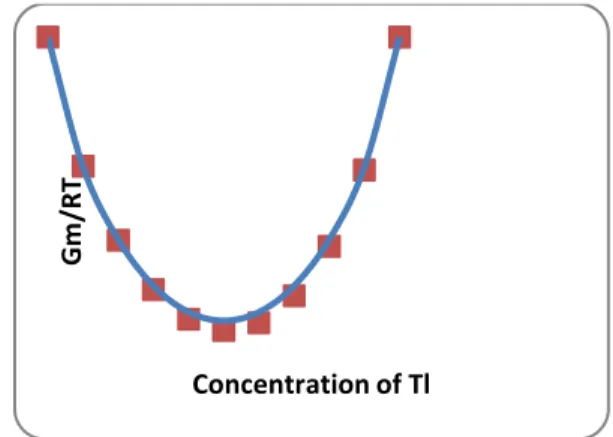
The theoretical investigation in Fig.5 shows that on the free energy of mixing GM/RT, the minimum calculated value is
found to be = - 2.20603 while the experimental values of GM/RT = -2.21123. Due to higher negative deviation, it
exhibits a tendency for compound formation. Both the theoretical and the experimental values of GM/RT are well in
agreement. The theoretical and the experimental values of the enthalpy of mixing HM/RT are –𝟐.𝟎𝟏𝟕𝟎𝟕 and
–𝟐.𝟎𝟓𝟐𝟖𝟔 , respectively at the equiatomic composition c = 0.5. This reveals that in Fig.6, the calculated and the experimental values are very well in agreement. The micCSROopic behaviour of the liquid alloy was investigated and the concentration fluctuation in long wave length limit Scc(0) was calculated. The calculated Scc(0) values are less than the ideal Sccid(0) at all concentrations, showing that the
ordering nature of Na-T1 melt at 673K is hetero-coordinating. The positive deviation from ideal values implies a tendency for self coordination or homo- coordination i.e like atoms Na-Na and T1-T1 tend to pair as nearest neighbours. The Scc(0)
www.rsisinternational.org
Page 159
curve exhibits the maximum value of about 0.25 at CTl = 0.5.Fig. 7.
The negative values of CSRO parameter 𝛼1, over the concentration range of Na-TI, table 3.2, further support a tendency towards ordering (like atoms pairing) or presence of chemical order in the melt, substantiating the negative values of CSRO parameter 𝛼1as shown in table 3.2.
Figure.1: Free energy of mixing GM/RT against concentrations of Tl in Pb-Tl
binary liquid alloy at 773 K.
The blue line represents calculated values while the boxes represent the experimental data taken from[19]
Figure2: Heat of mixing HM/RT against concentrations of Tl in Pb-Tl binary
liquid alloy at 773 K.
The blue line represents calculated values while the boxes represent experimental data taken from[19]
Figure3: Entropy of mixing Sm/RT against concentrations of Tl in Pb-Tl binary liquid alloy at 773 K.
The blue line represents calculated values while the boxes represent experimental data taken from[19]
Figure4: Concentration-concentration fluctuations in long-wavelenth limits, Scc(0) against concentrations of Tl in Pb-Tl binary liquid alloy at 773 K.
The red line represents the ideal values, blue the calculated values and the boxes represent experimental data taken from[19]
Figure 5 : Free energy of mixing Gm/RT against concentrations of Tl in Na-Tl binary liquid alloy at 673 K. The blue line represents calculated values
while the boxes represent experimental data taken from [19]
Gm /R T Concentration of Tl H m /R T Concentration of Tl Sm /R T Concentration of Tl Sc c(0) Concentration of Tl Gm /R T Concentration of Tl H m /R T Concentration of Tl
www.rsisinternational.org
Page 160
Figure 6: Heat of mixing Hm/RT against concentrations of Tl in Na-Tlbinary liquid alloy at 673 K. The blue line represents calculated values while the boxes represent ex-perimental data taken from[19]
Figure 7: Concentration concentration fluctuations in long-wavelength limit Scc(0) against concentrations of Tl in Na-Tl binary liquid alloy at 673 K.The
red line represents the ideal, blue the calculated values and the boxes experimental data taken from[19]
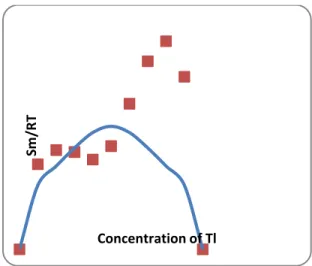
Figure .8: Entropy of mixing Sm/RT against concen-trations of Tl in Na-Tl binary liquid alloy at 673 K.
The blue line represents calculated values while the boxes represent experimental data taken from[19]
TABLE 2: Calculated Values of Short Range Order Parameter Α1ForNa-TI Binary Liquid Alloy At 673 K
Concentration Calculated Value
0 0 0.1 -2.71113 0.2 -0.3718 0.3 -0.1432 0.4 -0.15704 0.5 -0.16152 0.6 -0.15704 0.7 -0.1432 0.8 -0.11356 0.9 -0.06315 1 0
Table 3: Calculated values of Short range order parameter α1for Pb-TI
binary liquid alloy at 773K
Concentration Calculated Values
0 0 0.1 -0.00525 0.2 -0.00933 0.3 -0.01224 0.4 -0.01399 0.5 -0.01457 0.6 -0.01399 0.7 -0.01224 0.8 -0.00933 0.9 -0.00525 1 0 IV. CONCLUSIONS
The four –atom-cluster model (FACM) has been used in explaining and prediction of the thermodynamic as well as the micCSROopic structural properties of Na-T1 and Pb-T1 liquid alloys at 673 K and 773 K, respectively. The study shows that both Na-T1 and Pb-Tl liquid alloys investigated are hetero-coordinated liquid alloys. The comparison of results reveals that calculated values of the thermodynamics properties are generally in good agreement with the experimental results except in the entropy of mixing of Na-Tl binary liquid alloy which may be due to the experimental data used. The theoretical analysis reveals that both the Pb-T1 and the Na-T1 melts exhibit ordering (preference for unlike atoms pairing as nearest-neighbour) in nature. The Pb-TI liquid system is found to be weakly interacting and the interaction energy parameters are found to be temperature dependent.
ACKNOWLEDGEMENT
The authors are grateful to the Almighty God for making this research work achievable. Dr. Kayode (Department of Mathematics Sciences, Ekiti State University, Ado Ekiti, for their contributions towards making the research a success.
REFERENCES
[1]. Yadav, S. K., Jha, L.K., Adhikari, D.,(2015). Segregation to Ordering Transformation in In-Sn Melt Phys. Chem. Liq., v. 53 (4) pp.443-454.
[2]. Turner, A., Furniss, O., (2012). An Evaluation of the Toxicology and Bioaccumulation of Thallium in the Coastal Marine Environment Using the Macroalga Ulva Lactusa, Science Direct vol. 64, 2720-2724.
[3]. Hoshino, K., (1983). Structure of Multicomponent Hard-Sphere Mixtures-Application to the Liquid Li-Pb Alloy J. Phys.F: Met. Phys. V. 13, 1891. Sc c(0) Concentration of Tl Sm /R T Concentration of Tl
www.rsisinternational.org
Page 161
[4]. Singh, R. N., Sommer, F., (1992). Temperature Dependence of theThermodynamic Functions of Strongly Interacting Liquid Alloys. J. phys. Condens. Matter: 4, 5345.
[5]. Adhikari, D., (2010).Disorder in Liquid Cu-Pb Alloys. Phase Transitions, 84, 308.
[6]. Young, W., (1992). Structural and Thermodynamic Properties of NFE Liquid Metals and Binary Alloys Rep. Prog.Phys. 55, 1769. [7]. Adhikary, D., Singh, B. P., Jha, I. S., (2010). Structural and
Energetic Asymmetry in Liquid Ag-Al Alloys.Phys. Chem. Liq., 48, 787.
[8]. Ruppersberg, H., Reiter, H., (1982). Chemical Short-range Order in Liquid Li-Pb Alloys. J. Phys. F: Met. Phys. v. 12, 1311. [9]. Flory, P. J.,( 1942). Thermodynamics of High Polymer Solutions
J. Chem. Phys. 10, 51.
[10].Bhatia, B., Singh, R., (1984). A Quasi-lattice Theory for Compound Forming Molten Alloys .Phys. Chem. Liq., 13, 77. [11].Albas, B., Vander, L. W.,Dijkstra, J.,Geertsma, W., and VanDijik,
C, (1983). Structure of Liquid Na-Sn Alloys J. Phys. F: Metal Phys., 13, 2465.
[12].Godbole, R. P.,Jha, S.,Milanarum, M., and Mishra, A., (2004).Thermodynamics of Liquid Cu-Mg Alloys J. Alloys Compd., 363, 182.
[13].Lele, S., Ramchandrarao, P., (1981).Estimation of Complex Concentration in a Regular Associated Solution. Metall. Trans., 12B, 659-666.
[14].Singh, R. N., J. Phys. Chem. 25 (1993). Higher Order Conditional Probabilities And Short Range Order in Molten Alloys vol. 25, (4) 251.
[15].La Dou, J.,Metals. In., Occupational and EnvironmentalMedicine (1997). 2ed. p.429.
[16].Wang, C., Chen, Y., Liu, J., Wang, J., Li, X.,and Zhang, Y., Health Risk of Thallium in Contaminated Arable Soils and Food Crops Irrigated With Wastewater From a Sulfuric Acid Plant in Western. EcotoxicolEnviron Saf.; 90 (2013) p.76-81.
[17].Akinlade, O., (1995).Ordering Phenomenon in Na-Ga and Na-Sn Molten Alloys Phys. Chem. Liq. 29, p.9-21.
[18].Anusionwu, B. C., Adebayo, G. A., (2001). Quasi-chemical Studies of Ordering in the Cu-Zr and Cu-Si Melts. J, alloys, comp. 329 (1-2), 162-167.
[19].Hultgren, R., Desai, P. D., Hawkins, D. T.,Gleiser, M. and Kelly, K. K., (1973). Selected Values of the Thermodynamic Properties of Binary Alloys, American Society for Metals, Material park. Ohio.