Productization:
The process of transforming from
customer-specific software development
to product software development
Peter Artz
Inge van de Weerd
Sjaak Brinkkemper
Technical Report UU-CS-2010-003
January 2010
Department of Information and Computing Sciences
Utrecht University, Utrecht, The Netherlands
ISSN: 0924-3275
Department of Information and Computing Sciences
Utrecht University
P.O. Box 80.089
3508 TB Utrecht
2
Table of contents
Abstract ...5 1 Introduction ...6 1.1 Problem statement ...7 1.2 Terminology ...7 1.3 Structure ...8 2 Research approach ... 10 2.1 Research questions ... 10 2.2 Research method ... 10 2.2.1 Design-science ... 102.2.2 Combined Design Science Model ... 12
2.3 Contribution ... 14
2.4 Validity ... 14
3 Related Literature ... 16
3.1 Software product ... 16
3.2 Software Product Management ... 17
3.2.1 SPM process model vs. SPM reference framework ... 17
3.2.2 Reference framework ... 19 3.2.2.1 Portfolio Management ... 19 3.2.2.2 Product Roadmapping ... 20 3.2.2.3 Release Planning ... 20 3.2.2.4 Requirements Management ... 21 3.2.3 SPM Maturity Matrix ... 21 3.3 Productization ... 22 3.3.1 Customer focus ... 22 3.3.2 Requirements Engineering ... 23 3.4 Implications on SPM productization ... 24 3.4.1 Portfolio management ... 24 3.4.2 Product Roadmapping ... 25 3.4.3 Release planning ... 25 3.4.4 Requirement Management ... 26 3.4.5 Summary ... 26 4 Productization process ... 29 4.1 Productization stages ... 29 4.1.1 Introduction ... 29
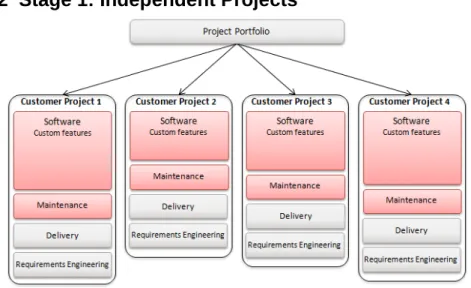
4.1.2 Stage 1: Independent Projects ... 31
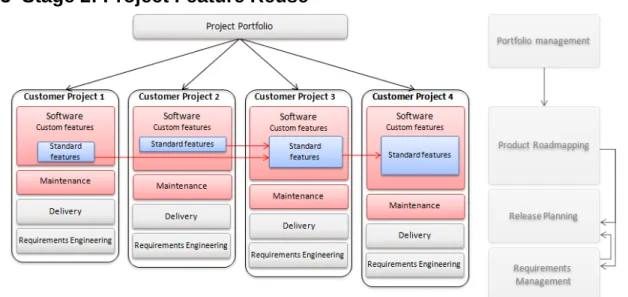
4.1.3 Stage 2: Project Feature Reuse ... 32
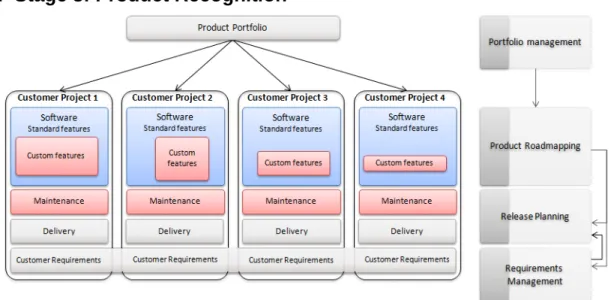
4.1.4 Stage 3: Product Recognition ... 33
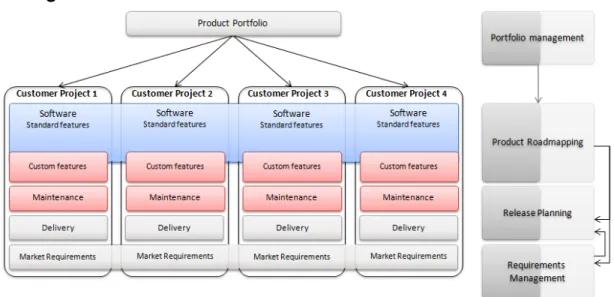
4.1.5 Stage 4: Product Platform ... 35
4.1.6 Stage 5: Standardizing Product Platform ... 36
4.1.7 Stage 6 ... 38
4.1.7.1 Stage 6a: Customizable Software Product ... 39
4.1.7.2 Stage 6b: Standard Software Product ... 40
4.2 Validation ... 41 4.2.1 Objective ... 41 4.2.2 Expert panel ... 41 4.2.2.1 Clarification ... 41 4.2.2.2 End stages ... 42 4.2.2.3 Applicability ... 43 4.2.2.4 Merging stages ... 43
4.2.2.5 Integration of the reference framework ... 44
4.2.3 Survey ... 44
5 Productization approach ... 46
5.1 Initial position ... 47
5.1.1 Assessment ... 47
5.1.2 Process Deliverable Diagram ... 48
5.2 Gap analysis ... 48
5.2.1 Situational Factors ... 48
5.2.2 Maturity Matrix ... 49
5.2.3 Process Deliverable Diagram ... 50
5.3 Recommendations ... 50 6 Guidelines ... 51 6.1 General ... 51 6.2 Requirements Management ... 53 6.3 Release planning ... 54 6.4 Product Roadmapping ... 56 6.5 Portfolio Management ... 57
6.6 Overview of the guidelines ... 59
6.7 Validation ... 59 6.7.1 Objective ... 59 6.7.2 Expert panel ... 60 7 Business Case ... 62 7.1 Objective ... 62 7.2 Company description ... 62 7.3 Initial Position ... 62
7.3.1 Software Product Management Assessment ... 62
7.3.2 Process Deliverable Diagram ... 63
7.4 Gap analysis ... 66
7.4.1 Situational Factors ... 66
7.4.2 Maturity matrix ... 68
7.4.3 Process Deliverable Diagram ... 69
7.4.4 Conclusion... 70 7.5 Recommendations ... 71 7.5.1 General suggestions ... 71 7.5.2 Portfolio Management ... 72 7.5.3 Product Roadmapping ... 72 7.5.4 Release planning ... 74 7.5.5 Requirements Management ... 77 7.5.6 Final remarks ... 78 7.6 Validation results ... 79
8 Conclusions, Discussion & Future Research ... 81
8.1 Conclusion ... 81
8.2 Discussion & future research ... 83
Abbreviations ... 85
References ... 86
Appendix A: Differences ... 91
Appendix B: Situational factors ... 93
Appendix C: Guidelines from literature ... 95
4
V. Portfolio Management ... 98
Appendix D: Assessment ... 99
I. General questions ... 99
II. Situational factors ... 99
III. Maturity questions ... 100
IV. SPM Productization ... 100
Appendix E: Process Delivery Diagram ... 101
I. Activity Descriptions ... 101
Abstract
Developing a software product is getting increasing attention in the scientific field and societal field. Organizations are recognizing the potential benefits and importance of developing a product for a market. Product software is defined as a packaged configuration which consists of software
components or a software-based service, with auxiliary materials, which is released for and traded in a specific market (Xu & Brinkkemper, 2005). Also organizations which develop software specifically for one customer have identified a need to change their software into a standard product. But how can these organizations transform their software and create a standard software product? Yet, there are few scientific studies reported on such transformation. This study stipulates the need for more exploratory research on the transformation by identifying a productization process.
This research presents several concepts and models, which are developed and validated within this research. The first result which we present in this study is an overview of twenty differences between customized software development and standardized development. The second result is the productization process, which we created as a result of the identified differences and a literature study. The productization process describes the transformation from a customer-specific software development to a standard software product for an entire market. Also a complete graphical and textual description of the entire process is provided, in which the characteristics of each stage are described. The third result of this research is an approach to actually apply the productization process within an organization. The productization approach is a method which consists of three steps in order to define a custom advice how an organization should continue to become a software product business. Finally, the last result is a list with guideline for the implementation of the product management functions from a reference framework for Software Product Management (Weerd et al., 2006a).
Keywords: Productization, software product management, customer-specific software, customizable software product, standard software product, transformation.
6
1
Introduction
A product manager is a relatively new function within a product software company; this is the result of a transformation of focusing on customized software to developing software as a standard product (Weerd et al., 2006a). Within a small and midsized company a product manager is highly involved in managing the product strategy and the overall delivery process (Dver, 2003). Especially within small product software companies Software Product Management (SPM) is essential. Usually these companies base their whole business on one or two products (Kilpi, 1997). One of the first signs of a failure of product management is insufficient requirements engineering. The main reasons for this failure are the difficulties with misinterpreted needs, changing and creeping requirements, missed deadlines and budgetary commitments and, more globally speaking, failing business opportunities (Ebert, 2007).The result of the study performed by Ebert (2007) showed that the strengthening of a coherent product management role improved the time to market, schedule adherence and handover quality. Ebert also defined guidelines towards successful product management:
• Business objectives and accountability
• Mastering requirements
• Managing risks and uncertainty
• Leadership and teamwork
In order to be able to improve the product management processes, a specific approach is required. The best known maturity models are Capability Maturity Model (CMM) (Paulk et al., 1993), and its follow-up CMMI for implementing the capability maturity model (CMMI Product Team, 2002). However, a number of organizations find it too heavy and difficult to use CMMI (Nawrocki, 2002). In addition, Staples et al. (2007) found several other reasons why CMMI is not adopted: the
organization was too small, the services were too costly, and the organization had no time to implement the process improvements. In addition, Brinkkemper et al. (2008) also elaborated on the fact that these methods are too superficial for the specific nature of product software companies. They introduced the Product Software Knowledge Infrastructure (PSKI), which helps product software companies by obtaining a custom-made advice for improving development processes (Weerd et al., 2006b). This infrastructure consists of an online systematic collection of methodical knowledge which can be used for improving the maturity of specific processes within an organization.
A model that describes the product management processes is the Software Product Management (SPM) reference framework, as illustrated in
Figure 1
. This framework is developed by Weerd et al. (2006a) and is specially designed to give product managers and organizations more insightinformation about the product management processes and the related stakeholders. The reference framework is a model in which key process areas, stakeholders and their relations are modeled. The four main product management functions are: 1) ‘Portfolio management’; 2) ‘Product roadmapping’; 3) ‘Requirements management’; and 4) ‘Release planning’. Additionally, the internal stakeholders (company board, research & innovation, development, support, services, and sales & marketing) and external stakeholders (market, partner companies, and customers) are also included. In this research we adopt the SPM reference framework in order to support and develop the transformation process to change from a customer-driven software development to a standard software product. We also adopted the SPM Maturity Matrix in order to determine the current maturity levels of specific processes (Weerd et al., 2009).
Figure 1: Software Product Management reference framework
1.1 Problem statement
More and more customer-driven organizations recognize a need to create a standard software product. However, main question for such organizations is how they should change their organizational processes in order to create a standard product.
Consequently, the main research question of this research project is: How can the Software Product Management reference framework support the transformation from developing customized software to a standard software product?
1.2 Terminology
In conducting this research, we use the reference framework for Software Product Management. For that reason, we first elaborate on the definition of software product management we used during this research. Software product management is: “the process of managing software that is built and implemented as a product, taking into account lifecycle considerations and generally with a wide audience. It is the discipline and business process which governs a product from its inception to the market or customer delivery and service in order to generate biggest possible value to the business” (Ebert, 2009).
Additionally, the definition we use for a software product is: “defined as a packaged configuration of software components or a software-based service, with auxiliary materials, which is released for and traded in a specific market” (Xu & Brinkkemper, 2005).
We identified the definition of the productization process to this approach. The exact definition we define for this process is: the process of transforming from customer specific software development to a standard software product. The terminology productization is not widely used in the literature. Hoch et al. (1999) identified it as: “Productization means standardization of the elements in the offering”. In addition, Hietala et al. (2004) also stated that the term productization includes several technological elements from the very early stages of designing a product to the commercial elements
8
Initially, we planned to apply the differentiation between ‘Project’ and a ‘Product’ within this research. However, a ‘Project’ can be understood in multiple ways, firstly a project for creating product software, and secondly a project in order to create a customer-based information system. This same issue emerges when we look at the terminology ‘Product’; a product can be the result of a customer-driven project. On the other hand, it can also be related to a product designed for a specific market. In order to prevent this misunderstanding, we use the notation of ‘customized software development’ or ‘customer driven’ and ‘standardized software development’ or ‘market driven’. In addition, we also provide a list with the used abbreviations on page 85.
1.3 Structure
The structure of this study is divided into three main parts. Within the first part we elaborate on the used research approach and related literature regarding software product management. This is extended by a section which describes the differences between developing customized software (customer-driven) and developing standardized (market-driven) software. Finally, this part also elaborates on the available literature related to the transformation from developing software for a specific customer to a standard software product.
The second part consists of the development and the validation of the main artifacts of this research. Three main artifacts are developed:
1) The entire productization process which consists of seven stages and the description stage; 2) An approach to apply the productization process within an organization; and
3) The guidelines for the implementation of the SPM reference framework. Additionally, the second part also consists of the validation of both artifacts. The validation of the application of the
productization can be found in the third part of this study.
The third part of this study is a business cases at MP Objects which describes the adoption of the productization process. The business case consists of three major processes:
1) The identification of the initial position;
2) A gap analysis is carried out which results into several recommendations;
3) The last process is that MP Objects decides which recommendations they plan to execute in order to become fully software product management oriented.
Finally, the last part we present our conclusions of this research project. We also discuss on the results of this research approach and we determined specific topics for future research.
10
2
Research approach
The used the research questions, research method, the research contribution, the validity threats and the related literature are presented within this section.
2.1 Research questions
An increasing number of organizations which develop customer-specific software have a desire to transform, and start developing a standard software product. Weerd et al. (2006a) presented a reference framework for Software Product Management (SPM) which support an organization in managing their product(s) and in which the key process areas, stakeholders and their relations are modeled. As a result, the main research question of this research is:
How can the Software Product Management reference framework support the transformation from developing customized software to a standard software product?
In order to answer our main research question, we defined the following sub-questions which are answered within the upcoming sections of this research project:
1) What are the specific differences of developing software for a specific customer compared with developing software for a market?
2) What kind of characteristics describe the stages of the transformation?
3) What are major guidelines that are important for the implementation of the SPM reference framework during the transformation?
4) How can an iterative and incremental implementation and the maturity matrix support the adoption of the SPM reference framework?
5) To what extent is the implementation of SPM useful and interesting for a small sized organization?
2.2 Research method
In conducting this research, we apply the design-science research guidelines identified by Hevner et al. (2004). The design-science guidelines “seek to extend the boundaries of human and organizational capabilities by developing new innovative artifacts”. A drawback of these guidelines is that no logical hierarchy for applying the guidelines is given; therefore we combined the graphical notation of Vaishnavi & Kuechler (2007) with the guidelines from Hevner et al. (2004).
2.2.1 Design-science
The design-science research method consists of the analysis of the use and performance of designed artifacts to improve on the behavior of aspects of Information Systems (Vaishnavi & Kuechler, 2007). Hevner’s objective is to describe the performance of design-science research in information systems via a conceptual framework and clear guidelines for understanding, executing, and evaluating the research. We applied these guidelines in order to describe the problem solving process of this research:
Problem Relevance
Guideline: “The objective of design-science research is to develop technology-based solutions to important and relevant business problems”.
The first guideline consists of all initial activities such as the determination of the research question / sub-questions, clarification of the used research methods, and the used approach for maintaining the validity. The problem within this research is related to the transformation from a customer-specific software development to a standard software product. At this moment there is barely any literature available on how companies should transform and which processes should change or how they
should change in order to create product software. Within this research we adopted the Software Product Management reference framework (Weerd et al., 2006a) in order to create product software and become market driven. Additionally, this creates a second difficulty, namely how to implement the processes and product management functions from the reference framework. Currently, no concrete guidelines or references are available for the implementation of the framework.
Research Contributions
Guideline: “Effective design-science research must provide clear and verifiable contributions in the areas of the design artifact, design foundations, and/or design methodologies”.
This research contributes scientifically and socially on several areas. The process of ‘How’ a company should transform and which actions should be carried out is not yet widely studied in the literature. Furthermore, this research is also another validation of the reference framework for SPM, the SPM maturity matrix, and the situational factors. Finally, the guidelines for the implementation are also part of the scientific contributes. On the other hand, the main social contributions of this study are the recommendations for MP Objects, so that they can continue with their productization process in order to become a software product business. More information about the scientifically and socially contribution can be found in section 2.3.
Design as a Search Process
Guideline: “The search for an effective artifact requires utilizing available means to reach desired ends while satisfying laws in the problem environment”.
Before we are able to determine the transformation from customized software development to a standard software product, we first studied the differences between these two approaches. By applying this approach we were aware of the characteristics for customer-driven software
development and market-driven software development before we started with defining the entire process. Additionally, for the generation of the implementation guidelines we tried to combine several sources of evidence so that reliable guidelines were developed.
Design as an Artifact
Guideline: “Design-science research must produce a viable artifact in the form of a construct, a model, a method, or an instantiation”.
Focus of this guideline is primarily on the identification and the development of the productization process, a method in order to apply this process, and the guidelines for the implementation of SPM processes within an organization. The design of the productization process is based on a literature study and some exploratory interviews. The application approach is essentially a combination of a number of available methods, such as the maturity matrix (Weerd et al., 2009), situational factors (Bekkers et al., 2008a), and process deliverable diagram (Weerd & Brinkkemper, 2007). The implementation guidelines for the SPM framework are the result of a broad literature study on the different product management areas.
Research Rigor
Guideline: “Design-science research relies upon the application of rigorous methods in both the construction and evaluation of the design artifact”.
For the development of the artifacts we used several different methods to gain the required information. Main information sources for the generation of the productization process were some exploratory interviews and an extensive literature study. The most important method we used from the literature is the reference framework for Software Product Management (Weerd et al., 2006a). The development of the guidelines for the SPM framework is based on a literature study performed for each of the product management functions.
12
artifacts are expert interviews, a survey, and a business case. We used an expert panel, because the interviewed experts provide an informed, objective, and unbiased opinion as well as suggestions about the developed artifact (Sandelowski, 1999). Secondly, we created a survey in order to retrieve the opinions of several product managers which participated on a SPM course. The survey was designed in such a way, that we were able to examine the structure of artifact for static qualities (e.g. complexity or readability) (Hevner et al., 2004). Finally, the last method we used is the business case study. By performing a case study, the validation process provides an in depth evaluation in a business environment (Zelkowitz & Wallace, 1998).
Methods applied while carrying out the business case are the maturity matrix for determining the maturity of the (present) SPM processes (Weerd et al., 2009), situational factors for the
determination of the best suitable maturity levels (Bekkers et al., 2008a), and the process deliverable diagram for the visualization of the initial situation (Weerd & Brinkkemper, 2007).
Design Evaluation
Guideline: “The utility, quality, and efficacy of a design artifact must be rigorously demonstrated via well-executed evaluation methods”.
The validation of the productization process is performed multifold; firstly we created a survey for the participants of a Software Product Management course. Secondly, we also interviewed several experts and product managers from the scientific field and practical field. In order to validate the applicability of the identified productization process, a specific case study is carried out at MP Objects. As a result, all three steps of the designed productization approach are executed and presented within section 7. Finally, for the validation of the implementation guidelines we interviewed several experts in the field of SPM. These guidelines are specifically designed for the framework and therefore knowledge of the reference framework is crucial.
Communication of Research
Guideline: “Design-science research must be presented effectively both to technology-oriented as well as management-oriented audiences”.
Based on the results of this research we should be able to deduce answers to the research questions. In addition, we elaborated on the validity of the SPM reference framework, situational factors, and maturity matrix. We also generated future recommendations for MP Objects as a result of the business case which we carried out. At the end of this research we presented the final results and future recommendations to the board of MP Objects. Additionally, for the Utrecht University we created this study document and we defended the results at the end of the project. Finally, we are planning to submit a paper to present our main artifacts at ‘The First International Conference on Software Business’ in Finland.
2.2.2 Combined Design Science Model
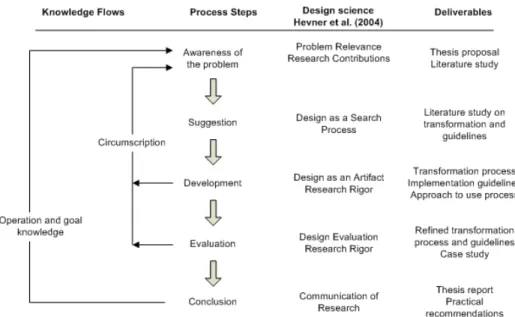
Due to the lack of structure of the guidelines from Hevner et al. (2004), we combined the guidelines with the design science model (Vaishnavi & Kuechler, 2007). This combination gives a more clear organization to the research method. The combination of these two approaches can be found in Figure 2.
Figure 2: Composed design science method model
The two main knowledge creation flows are ‘Circumscription’ and ‘Operation and goal knowledge’. The circumscription flow is important because it generates a certain understanding that only can be gained from the specific act of construction (Vaishnavi & Kuechler, 2007). Both the development and the evaluation phase are able to send the researcher back to the awareness of the problem phase and then the entire process restarts. The second flow (operation and goal knowledge) is related to the possibility that the conclusion can result into the awareness of a new problem (Vaishnavi & Kuechler, 2007).
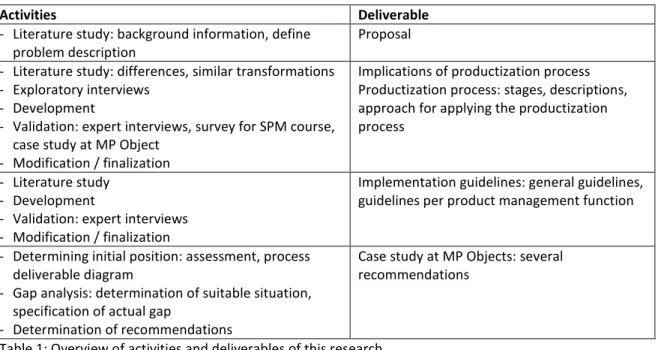
The activities we carried out during this study resulted into several deliverables (right column of Figure 2). These deliverables are the outcomes of the following completed activities (an overview is provided in Table 1): Initially, we started with creating a proposal. By performing an extensive literature study we were able to define the exact research question and sub questions of this research. The data collection for answering the research questions was carried out multifold: An additional literature study is performed to retrieve available information related to the differences between customized and standardized software development and available transformations described in the literature. With the gathered information we were able to create an initial concept which graphically and textually described the productization process. During literature study we also carried out an assessment for MP Objects. With the results of this assessment we were able to determine the initial condition of SPM within MP Objects. As a result, we created a conceptual Process Deliverable Diagram (PDD) to visualize the organizational structure. After performing the literature study, we started with definition of the implementation guidelines for the SPM reference framework. By combining results from several different studies regarding software product
management, we were able to define conceptual implementation guidelines. Exploratory interviews with experts in the field of software product management and with several employees of MP Objects were carried out to further develop and improve the artifacts. Consequently, this resulted into the final models and descriptions of the productization process and the final implementation guidelines. Additionally, for the validation, we also created a survey for a SPM course and we carried out a case study at MP Objects. The results of the case study are recommendations specifically for MP Objects and these recommendations can be used in order to continue becoming a product software
14
Activities Deliverable
- Literature study: background information, define problem description
Proposal - Literature study: differences, similar transformations
- Exploratory interviews - Development
- Validation: expert interviews, survey for SPM course, case study at MP Object
- Modification / finalization
Implications of productization process Productization process: stages, descriptions, approach for applying the productization process
- Literature study - Development
- Validation: expert interviews - Modification / finalization
Implementation guidelines: general guidelines, guidelines per product management function - Determining initial position: assessment, process
deliverable diagram
- Gap analysis: determination of suitable situation, specification of actual gap
- Determination of recommendations
Case study at MP Objects: several recommendations
Table 1: Overview of activities and deliverables of this research.
2.3 Contribution
In this section, we elaborate to what extent this study contributes to the scientific field and societal field.
Scientific Contribution
The main scientific contribution of this research is the identification of a specific process in order to change from customized software development to standard software development in combination with the adoption of the SPM reference framework. The entire process of becoming a product software business is currently not widely studied and therefore a very interesting scientific topic. In addition, a graphical and textual description for each of the stages of this productization process is designed and validated during this study. Secondly, this research produced implementation
guidelines which can be used when specific processes of the framework are put into practice within an organization. Thirdly, this research project is another validation of the SPM framework (Weerd et al., 2006a), the SPM Maturity Matrix (Weerd et al., 2009), and the Situational factors (Bekkers et al., 2008a).
Societal Contribution
The main societal contribution of this research project are the recommendations for the
transformation from developing customized software to developing software as a standard product specifically for MP Objects. Additionally, this study provides a textual as well as a graphical
description of the entire process which can support organizations while becoming market-driven. Finally, a list of guidelines for implementing the SPM reference framework is provided which organizations can use when they want to adopt the reference framework for software product management.
2.4 Validity
In conducting this research, we considered the four validity threats as described by Yin (2003). We applied these threats especially for the case study at MP Objects and we also considered them while creating the artifacts. The case study we performed is “an empirical inquiry that investigates a contemporary phenomenon within its real-life context, especially when the boundaries between phenomenon and context are not clearly evident” (Yin, 2003). Within this section we elaborate more on three of the validity threats from Yin. The fourth threat is not used because it is not applicable for
this research project. The internal validity threat is not relevant because it involves pattern matching, explanation building, and performing time-series analysis. In order to cover this threat, multiple case studies should be carried out.
Firstly, the construct validity is covered by using multiple sources of evidence for the data collection of specific information. For example for the determination of the initial position of MP Objects (section 7.3) we applied the viewpoints of a consultant and a developer in order to get a better representative result. Additionally, the assessment was carried out during a session where three employees of MP Objects were present.
Secondly, the external validity refers to the approximate truth of conclusions that involve generalizations. As for the exploratory interviews and validation interviews we combined the gathered results of the scientific field with the gathered results of the practical field. Also for the survey we tried to involve organizations which differ in several areas (by using the situational factors). As a result of the validation, we also tried to verify the results of the validation process with references from the literature before we applied them.
Finally, the reliability concerns the demonstration that the results of the study can be replicated. For the business case we covered this by creating an approach for the implementation of the
productization process (section 7). Additionally, all other relevant information is documented so that the results can be replicated. However, when the productization process will be reused within another business case, it is better when a company is not already at almost the last stage of the productization process. Then the applicability and usability can be validated better.
16
3
Related Literature
Within this section we elaborate more on the related literature from several topics. The context of this section is designed in such a way that we first present a more or less top-down view of the results. Firstly, we present the terminologies of customized software and standardized software. Secondly, a process model and a reference framework for software product management are studied. Finally, we present an overview of differences which implicate on the productization process.
3.1 Software product
In order to understand the transformation from customized software development to a standard software product, we first identified the differences between these two development approaches. Currently, there is quite some literature available which elaborates on these differences. However, as a result of the literature study, we noticed that several different terminologies for customized
software development and standardized software development are used (Table 2).
In terms of Customized software Standardized software
Stakeholder Customer-driven Market-driven Software Custom information systems
Tailor-made software
Software product Packaged software
Commercial-off-the-shelf (COTS) software Development Bespoke development
Custom development
Market-driven development Packaged development Management Project Management Product Management Table 2: Varying terminologies used to identify the differences.
When we look at the different terminologies used in the literature, we identified the following definitions:
• Software product: “defined as a packaged configuration of software components or a software-based service, with auxiliary materials, which is released for and traded in a specific market” (Xu & Brinkkemper, 2005);
• Packaged software: “software sold as a tradable product (purchased from a vendor, distributor or store) for all computer platforms including mainframes, work-stations and microcomputers. Typically, packaged software is licensed for use, not sold” (Sawyer, 2000);
• Bespoke software development: “is also known as developing software based on a contract with a specific customer” (Natt och Dag, 2005);
• Tailor-made software: “is customized software that is developed according to the needs and specifications of individual customers” (Hietala et al., 2004);
• Commercial-off-the-shelf (COTS): “is based on a market driven development and products usually offer more functionalities than customers actually need” (Alves & Castro, 2006).
3.2 Software Product Management
Product management is getting more attention within software organizations (Weerd et al., 2006b). Within this section we elaborate more on particularly software product management and other models or frameworks related to product management.
Software Product Management (SPM) consists of the development of software for a relatively anonymous market, instead of developing custom fit information systems. Processes which differ the most from project oriented software development are especially requirements engineering, release management, and marketing & sales (Helferich et al., 2006). In order to have successful product management, it is essential to deliver the right product at the right time for the right market(s). In addition to that, the success depends on many factors and stakeholders. Companies need to have an optimal combination so that software meets customers’ needs together with being on time and on budget (Ebert, 2009).
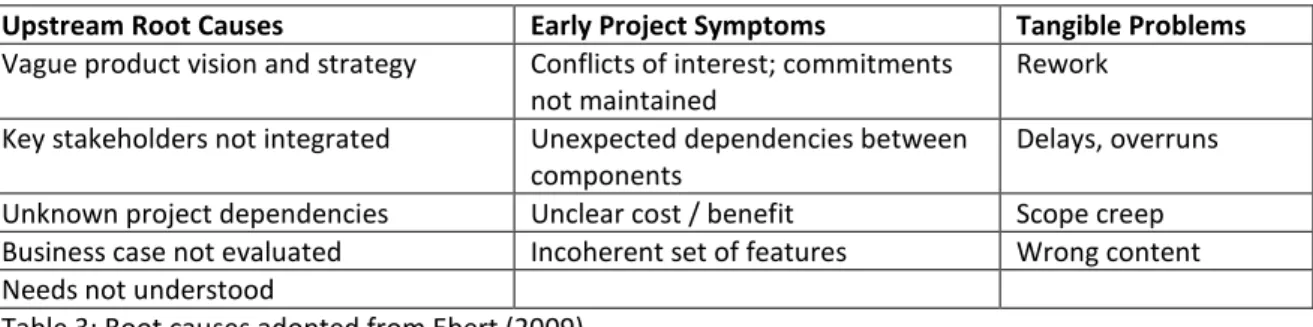
The quality of products can decrease when product management activities do not get enough attention. Ebert (2009) studied the upstream root causes of insufficient product management and identified several early symptoms. These symptoms resulted into tangible problems, which can be found in Table 3.
Upstream Root Causes Early Project Symptoms Tangible Problems
Vague product vision and strategy Conflicts of interest; commitments not maintained
Rework Key stakeholders not integrated Unexpected dependencies between
components
Delays, overruns Unknown project dependencies Unclear cost / benefit Scope creep Business case not evaluated Incoherent set of features Wrong content Needs not understood
Table 3: Root causes adopted from Ebert (2009).
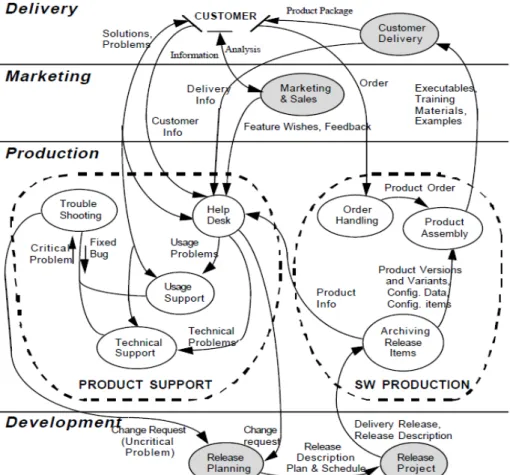
SPM has become an essential key-process for small companies which base their whole business on one or two product(s) which they develop and sell (Kilpi, 1997). It often occurs that small companies forget the importance of marketing and delivery of software. Kilpi (1998) therefore created the Software Product Management process model (SPM-process model, Figure 3). This model is an extension of the Software Configuration Management with the addition of the areas marketing and delivery. Additionally, the process model consists also of the production and development areas. The four used areas are based on research done by Pine (1993) and the association is designed in such a way that they complete each other in order to reach the company objectives (Kilpi, 1998).
Another model is the Software Product Management (SPM) reference framework. This is based on the results of a performed literature study and field studies with product managers. The structure of this reference framework consists of the key process areas, stakeholders and their relations, as is denoted in Figure 1 (Weerd et al., 2006a).
3.2.1 SPM process model vs. SPM reference framework
When we compare the process model (Figure 3) and the reference framework, we noticed one significant difference. The readability of the reference framework is much more clear compared with the process model. The process model consists of four activity areas with in-between a number of curved arrows which affect the readability and there is not really a logical structure. On the other
18
Figure 3: Software Product Management process model adopted from Kilpi (1998).
Secondly, if we evaluate the functional part of the process model we notice that other areas like delivery, marketing and support are also involved within the process model. The reason why these activity areas are involved is because the process model is an extension of Software Configuration Management that includes aspects related to marketing and delivery of software (Kilpi, 1998). Firstly, the ‘Delivery’ activity manages the customer deliveries. Secondly, the ‘Marketing’ activity collects and analyses the market and the customer information. It also informs the market and customers of the products and the new product releases. Thirdly, the ‘Production’ activity supports the customers’ problems and hands the orders and deliverables. Finally, the ‘Development’ activity manages the product change process and plans the release projects. Kilpi states that the activity areas delivery and marketing are vital parts of a business and sometimes easily forgotten in small companies.
The reference framework is not direct related to marketing and delivery of the product software; it focuses on managing the products, releases, and the requirements (Weerd et al., 2006a). It consists of all the involved stakeholders and their relation with product management. If we look at the process model we see that it is hard to determine the involved stakeholders. Take for example the process of gathering requirements; it is not clear from which stakeholder the requirements are gathered. Finally, the product manager plays a central role in the reference framework and he/she interacts and collaborates with the other stakeholders. The process model on the other hand doesn’t mention the product manager function at all.
Finally, when we look at the research activities on Software Product Management, we see that Weerd is actively improving and performing further research on this field. Weerd et al. (2009) for example recently developed a method in order to determine the maturity of each of the processes within the SPM reference framework. Kilpi (1998), on the other hand, stopped with studying the SPM process model and other relevant research areas in the field of product management.
3.2.2 Reference framework
The structure of this reference framework is based on its core, the software product itself, and it is structured in a hierarchical way (illustrated in Figure 4). On top of this model is the ‘Product portfolio’ and this is the complete set of products of a company. The portfolio of a small company usually consists of one product and the activity of managing the portfolio therefore often forgotten or left out. Furthermore, each product has several ‘Releases’ and each release has its own list of
‘Requirements’. Each of the requirements implies the addition of a technical, functional feature or non-functional feature (performance constraints or availability requirement) (Weerd et al., 2006a).
Figure 4: Artifact hierarchy of product management
The SPM reference framework (Figure 1) consists of internal and external stakeholders. The
external stakeholders are: the market, the customers, and partner companies. On the other hand the company board, sales & marketing, research & innovation, development, support, and services are the internal stakeholder (Weerd et al., 2006a). Product management consists of the following four functions: ‘Portfolio management’, ‘Product roadmapping’, ‘Requirements management’, and ‘Release planning’. We elaborate more on each of these functions in the following sections.
3.2.2.1 Portfolio Management
Research performed by Bekkers et al. (2008b) showed that a remarkable 42% of the interviewees had no processes for handling the high-level management activities (Portfolio Management and Product Roadmapping). Also Vähäniitty (2004) concluded that Portfolio Management (PM) is largely
overlooked by many (small) product-oriented software companies. In addition, Vähäniitty mentions that portfolio management within a small company emphasizes the content of upcoming releases for relatively few products. However, management of product development activities as an explicit portfolio is crucial to the long-term success of product software companies (Vähäniitty, 2005). Therefore, Vähäniitty presents an approach for implementing portfolio management in (small) product oriented software companies along with initial experiences. The approach is an integration of portfolio management basics with modern, time-paced software development processes for the small company context.
The PM area of the SPM reference framework consists of the decision making about the set of existing products. Processes of PM are: monitoring market trends, deploying a product development strategy, making decisions about the product lifecycle, and establishing partnerships and contracts (Weerd et al., 2006a). An important key decision making process of the portfolio management function is Product Lifecycle Management (PLM). PLM includes planning and controlling of processes that are required for managing data, documents, and enterprise resources during the entire product lifecycle (Abramovici & Sieg, 2002). Research done by Abramovici & Sieg verified that most of the small and medium sized enterprises (SMEs) are not focusing on PLM. They mention also that it is important to adopt PLM because this could enable an organization to improve operational
20
which reduces the development costs, increases the quality of products, and it reduces the time-to-market (Pohl et al., 2005).
3.2.2.2 Product Roadmapping
Vähäniitty et al. (2002) studied the need for Product Roadmapping (PR) by stressing that success requires the release of new products and product upgrades with the right amount of features and quality within an open market window. They present an approach based on PR that is able to support small companies in their product planning function. In practice, PR is often missing due to
inexperience, unclear priorities, time-to-market pressures or the lack of suitable process infrastructure (Bosch, 2000). Furthermore Vähäniitty et al. (2002) concluded that product
roadmapping can play an important role in bridging the gap between management, marketing and product development. Management should consider both product positioning and development aspects at the same time. Roadmaps can be designed in several forms ranging between the two boundaries technology push (divergent and looking for opportunities) and market pull (aiming for a customer defined product) (Phaal et al., 2004). The roadmap should find a balance and combine these two boundaries, so that a time-based graphical framework for future development and strategic plans can be created. A technology roadmap is a powerful technique to support technology management and planning. Additionally, it is especially useful for exploring the dynamic linkage between technological resources, organizational objectives, and the changing environment (Phaal et al., 2004).
The processes within the Product roadmapping area of the SPM reference framework are related to theme identification and core asset identification. The process theme identification is related to all forecasts concerning technology or market trends. Core assets are components that are shared within multiple products (Weerd et al., 2006a). An important factor for designing the product roadmap is the identification of the market and technology trends (from the portfolio management function). The result of this process is used in order to create an expectation of the content of the future releases.
3.2.2.3 Release Planning
Within market-driven software product development release planning is an essential and complex process (Carlshamre, 2002a). Selecting the requirements for the next release is an inherently complex task due to the varied interests of the stakeholders which are involved. Each of the
stakeholders may have their own preferences for the implementation of specific requirements within the next release (Akker et al., 2005). Akker developed an optimization technique to support software vendors in determining the next release of product software. The technique is based on Integer Linear Programming (ILP) which is a method that looks at the required development time / effort and the estimation of the revenue. As a result of that it will generate an optimized list of requirements that should be developed for the next release. Akker et al. (2007) extended this research by also taking different aspects and managerial steering mechanisms into account. They considered: 1) One pool of developers, when for example no different development teams are used; 2) different teams without team transfers, each with its own capacity constraint; 3) different teams with team transfers allowed; 4) hiring external team capacity; 5) extension of the development project deadline; 6) requirement dependency (functional, revenue and cost related). The identified aspects and mechanisms can be easily combined with an integer linear programming model. Another release planning technique is the feature prioritization matrix (Wiegers, 1999), which prioritized
requirements based on value, cost and risk. Finally, there is also the cost-value approach which is a technique designed to maximize stakeholder satisfaction (Karlsson & Ryan, 1997).
The Release Planning (RP) area of the SPM reference framework consists of the processes related to the development of a new release. Before developing a release the stakeholder starts with prioritizing and selecting the product requirements. After the selection of the requirements, the
release definition is written. After that the release definition is validated by all the involved
stakeholders. Finally when this is approved by the board, a launch preparation is created and sent to the stakeholders (Weerd et al., 2006a).
3.2.2.4 Requirements Management
When creating software for a market, rather than for one specific customer, the pressure on short time-to-market is evident. In order to be able to meet the market demands effective engineering of software requirements is essential (Höst et al., 2001). During the elicitation and analysis of
requirements information it often occurs that customers’ requirements are poorly understood and inaccurate assumptions are made. This has significant negative implications on the design and development of the product in terms of quality, lead time and costs (Jiao & Chen, 2006). Jiao & Chen also identified that engineers find it difficult to translate the gathered customer requirements into concrete product and engineering specifications. Furthermore, they identified three main processes within RM, ‘Requirement Elicitation’, ‘Requirement Analysis’ and ‘Requirement Specification’. The Requirements Management (RM) business function consists of gathering, identifying and the organizing the requirements for product software.
When we compare the processes used by Weerd et al. (2006a) and by Jiao & Chen (2006), we see that there is a big similarity between the defined processes. Requirement elicitation is related to the ‘Requirements gathering’, they both consist of the process of getting requirements of customers and other stakeholders (Jiao & Chen, 2006). However, the main difference between these two
approaches is that eliciting requirements is performed before a project starts and gathering
requirements is an ongoing process. Furthermore, the requirement analysis phase of Jiao & Chen is related to the derivation of explicit requirements that can be understood by marketing and
engineering. This process is roughly similar to Weerd’s ‘Requirement Identification’ process. In addition, Weerd’s requirements identification process describes the requirements in a company’s perspective and context. Finally, the last process of the RM shows the biggest difference. The ‘Requirement Specification’ process defined by Jiao & Chen is about the definition of concrete product specification in the functional domain. Additionally it involves continuous interchange and negotiation within a project team regarding conflicting and changing objectives. Weerd’s
‘Requirements Organization’ process on the other hand is related to the association of the requirements per theme and core asset.
3.2.3 SPM Maturity Matrix
The first conceptual method for determining the maturity of processes within a product software company is the Product Software Knowledge Infrastructure (PSKI). The PSKI is an online systematic collection of methodical knowledge which allows product software companies to obtain a custom-made advice for improving specific processes. A fully developed PSKI can offer companies a solution to help mature their processes in an easy comprehensive, incremental way (Weerd et al., 2006b). The PSKI method exists of four different steps: 1) the determination of the current situation; 2) the selection of process alternatives, by selecting the right method fragments for process improvement based on situational factors; 3) putting the method fragments together and implement the advice; 4) give feedback from the company in the PSKI, in order to improve the PSKI (Bekkers et al., 2008b). To identify the initial situation and maturity of the SPM processes within a company, Weerd et al. (2006b) created the capability maturity matrix. This capability matrix is a maturity model in which method fragments are linked with a certain maturity level, in order to be able to provide companies with advice to fix their process need and to mature their processes.
22
different processes of the SPM reference framework and their related maturity levels. However, the maturity matrix is applicable for all kind of product software companies. In order to determine to what extent certain processes need to be improved, Bekkers et al. (2008a) created a list of situational factors to improve SPM processes in a more optimal manner. With the situational factors a small or medium sized organization is able to determine to what extent they should improve specific processes. The list of situational factors gives the influence weight of each factor on the SPM processes so that it is possible to determine which method is best suited. The factors are initially based on a broad literature study and are validated by fourteen interviews with experts from both the scientific and practical communities. With the factor weights it is possible to determine the desired / best suitable maturity levels 1) of product management in general; 2) for each of the four product management areas; 3) for each of the processes within each product management function. With the calculated maturity levels it is possible to select the best fitting SPM method from the PSKI in order to increase software product management processes.
3.3 Productization
Currently, there is barely any literature available on the explicit transformation from developing software for one specific customer to the development of software product for an entire market. Within this section we elaborate more on the retrieved results from the literature study.
3.3.1 Customer focus
Research done by Codenie et al. (1997) identified the essence of creating software as product, but software should be highly customizable so that the customers can still modify it to their specific needs. Codenie et al. described the transformation to framework-based development so that there is a possibility to respond to new and rapidly changing market opportunities and still customize the software for specific customers. This transformation combines two development process models: Firstly product development, because a product (the framework) is offered and secondly project development, because customers are involved in customizing the product to their specific needs. The transformation described by Codenie et al. is based on a stepwise and iterative construction and it started when the original application (of their first customer) was adapted towards the specific needs and infrastructure of the second customer. However, by reusing and adapting previous projects the overall maintainability decreased and therefore they decided to look into framework technology. Eventually, after a number of iterations the result of this approach is a standardized framework for all customers, with for each customer a customized part.
During the transformation, the following additional problems occurred and the following challenges can be used when the transformation process is carried out:
• Reuse documentation: The long life span and the strategic role of frameworks means that good design documentation is essential.
• Version proliferation: Important when maintaining solutions is to keep tracking the changes for specific customized solutions. Without reusing information on how a customization relies on the framework, it is very difficult to estimate the effort what is needed to update a customization with a new version of the framework.
• Delta analysis and effort estimation:A delta analysis is performed by browsing through a
prototype with a new customer and identifies the customers’ needs. However, when performing a delta analysis with a new customer, it is difficult to assess what parts of the product (in terms of programming code) can be reused, what parts need to be adapted before reuse, and how much effort is required by the adaptation.
• Architectural drift: Due to ignorance, deadline pressure, and the not-invented-here syndrome often solutions that are created are either reinvention of designs already present in the framework or solutions that unnecessarily break the framework architecture. It is necessary to enforce the architecture of the framework without over constraining the customizer.
• Over featuring: Migrating features in order to reduce customization might result in over featuring, so applications containing features not relevant for all involved customers. Over featuring makes the framework more expensive, more complicated, and less reusable for future customers.
Transformation described by Codenie et al. (1997) is useful for the initial stages of the
transformation process because at a certain moment a company is able to identify the relevance of creating a standardized product. In order to become a product software company, it is essential to change by using a stepwise iterative construction. Keeping the customer satisfied during the
transformation is also an important challenge. This challenge is also studied by Vandermerwe (1995) and this study describes briefly the transformation of IBM. The main problem which occurred during this transformation is the fact that IBM failed to recognize environmental changes and customers preferences. As a result of that other companies filled in the empty space left by IBM. IBM had lost sight of its customers and marketplace because their strategy for dominance replaced customer responsiveness with arrogance and total lack of concern. When the new CEO took over the
management function they changed this by asking the top 100 customers what IBM was doing right and wrong (Vandermerwe, 1995). So keeping focus on the customers while transforming is very important, otherwise a company might lose their customers.
3.3.2 Requirements Engineering
Another transformation process described in the literature is the transformation of the requirements engineering process from BESpoke software development to MARkeT software development, also identified asBESMART (Bergström & Dahlqvist, 2007). This framework especially focuses on changing the requirements engineering process with a three step framework:
1) Evaluate the organization’s potential to become more Market-Driven.
This first step is considering how much more Market-Driven an organization actually can and wants to become. This decision should be based on unique opportunities and threats faced by the individual organization. Bergström & Dahlqvist identified ten issues which must be
considered before the transformation takes place. A SWOT (Strengths, Weaknesses,
Opportunities, and Threats) analysis must be used in order to determine the opportunities and threats. By specifying the opportunities and threats an organization is able to conclude whether or not a more market-driven approach is the best solution.
2) Assess the organization’s current RE process to determine what inhibits the organization from becoming more Market-Driven.
Secondly, an organization should carry out an assessment in order to resolve what areas need to be changed for the organization to become more Market-Driven. The assessment consists of four main areas: Analysis, motivation, transformation, and education.
3) Recommend practices for becoming more Market-Driven based on the assessment results. The third and final step is to recommended practices for process improvement. These are selected by comparing the results from the previous step with several good practices listed in BESMART.
As a result Bergström & Dahlqvist also identified a number of challenges for the transformation of the requirements engineering process from bespoke to market-driven. These challenges are related with: stakeholding (remote customers, internal stakeholding, different levels of abstraction), gap between the departments, requirement volatility, release planning (prioritization, requirements dependencies, time-to-market, resource allocation), and continuous flow (requirements overload, internal traceability, duplicate requirements).
24
3.4 Implications on SPM productization
Within this section we elaborate more on how specific differences between customized software development and standardized software development effect on the productization process. In addition, we also identified the specific differences per SPM area (product management function).
Sawyer (2000) performed a study on the difference between packaged software and custom information system development. Compared with software products, packaged software refers more to upscale enterprise software suites which are usually ready-made and rarely come ready-to-run. Furthermore, large package software usually also requires a relative large deployment and
implementation period in order to fulfill specific needs of each individual business. Packaged
software also involves the instructional materials (such as handbooks, manuals, update information, and support services) for the implementation (Xu & Brinkkemper, 2005). More details on the differences between packaged software and custom information systems adopted from Sawyer (2000) can be found in Appendix A: Differences, Table 15. But according to Sawyer, the two major differences between bespoke (customer specific) software development and market-driven software development are:
• Difference between stakeholders. Compared with bespoke software development, within a market driven development approach, the developer decides about the requirements and the developer selects the stakeholder representatives.
• Major pressure on time-to-market and the software product is often offered to a market by regularly releasing new releases require a careful release planning and requirements prioritization.
In addition to Sawyer, also Keil & Carmel (1995) identified relevant differences between custom software development and packaged software development (Appendix A: Differences, Table 16). This research looked at the explicit link and communication between customers and developers of
packaged and custom development environment. The differences are used in order to provide an advice how companies can improve the exchange of information between customers and developers. Keil & Carmel identified three lessons out of an exploratory study of 31 software development projects. First, they found that more successful projects had more links between customers and developers compared with less successful projects. Secondly, they observed a great quantity of indirect links among many of the projects in their sample. However, the use of indirect links is less desirable to use because a customer and developer do not deal directly with one another. This can result in information filtering and distortion. Finally, the third lesson is related to the different types of links used in custom and packaged software environments. Both approaches had one link that was widely used and highly rated, but rarely used in the other environment.
Finally, Natt och Dag (2005) identified that market-driven software development has gained importance because software development companies turn to new and larger markets. They provide a summary of the differences between market-driven and bespoke management (Appendix A: Differences, Table 17) adopted from Carlshamre (2002a) with additions of Lubars et al. (1993) and Robertson & Robertson (1999). These differences are adopted from the results of the PhD which Natt och Dag carried out. The subject of his PhD is related to the area of requirements management in a market-driven environment. Studied were the bottlenecks in market-driven requirements
management processes and linking customer wishes to product requirements through linguistic engineering.
3.4.1 Portfolio management
According to Cleland & Ireland (2002), portfolio management for customized software development consists of a strategy that moves the selection and implementation of projects from a random process to one with structure and discipline. Project portfolio management is used in order to align
projects with strategic goals and objectives so that an organization is working more effective and efficient. Furthermore, project portfolio management adds a dimension to an organization’s capability and plan for growth. On the other hand, the product portfolio management function is about how an organization spends its capital and resources, and which development projects it should invest in (balancing available resources, making new product and technology choices, allocating resources for R&D operations). Additionally, portfolio management is a method by which an organization is able to operationalize their business strategy (Cooper et al., 2000).
3.4.2 Product Roadmapping
One of the main differences between customer driven and market driven software development, is that a market-driven software development consists of a larger amount of involved internal and external stakeholders. Roadmapping is a technique that software companies use in order to manage the high-level view and to link aspects of business to requirements engineering (Lehtola et al., 2005). Vähäniitty et al. (2002) studied the implementation of a roadmap for a small software company. As a result of this, they found that it sometimes seems ‘too much’ to establish a solid roadmapping process. However, using roadmaps from an early stage can prove valuable as a company grows and help to maintaining the focus in development. Vähäniitty identified three important values:
• Help in coordinating a complex set of activities;
• Explication of the direction of intent;
• Help in making short-term decisions, long-term decisions and trade-offs.
As a result of the found literature we concluded that the main difference between customer-driven and market-driven software product development is the fact that developing customized software is not based on any form of roadmapping. This process is specially designed for product software development with frequent releases. Developing customized software is based on a fixed (build-to-order) time schedule and has a usually a lifecycle of one release with additional maintenance updates.
3.4.3 Release planning
Release planning is the phase “where requirements engineering for market-driven product software meets the market perspective” (Carlshamre, 2002a). It is a specific process for market-driven development because customer-driven software development is not focusing on releases at all. The release planning function is highly related with the lifecycle of software. Where a customized software solution is based on one release, a standardized software product is based on more
(frequent) releases. Research done by Carlshamre (2002a), exposed that the basic planning problems differ significantly between traditional customer-driven software development and market-driven (product oriented) development:
• Delivery of market-driven software is based on a fixed delivery date, frequent releases are planned ahead. On the other hand, customer-driven software development estimates the delivery date based on a set of requirements. Together with the customers the developed software is validated before it is delivered.
• The resources necessary for the development of the software in a market-driven organization is based on a more or less fixed set of available resources. Customer-driven software companies estimate the necessary resources demand based on a set of requirements.
• Requirements selection in a market-driven organization is performed by selecting an optimal subset of requirements for implementation. While selecting the requirements the available resources must be taken into account. In contrast, in a customer-driven organization this process is based on a more or less fixed set of requirements.
26
3.4.4 Requirement Management
The biggest difference between market-driven and customer specific software development is believed to lie in the Requirements Engineering (RE) process area (Gorschek, 2006). RE involves activities like eliciting requirements, analyzing requirements, prioritizing requirements, and
maintaining a database of requirements. It traditionally focuses on bespoke software development where a specific system is developed based on a contract with usually one customer (Höst et al., 2001). On the other hand, market-driven software development is not specific for one customer but for an entire market. This requires proper requirements management so that all customers’ wishes can be managed easily. In addition to the regular differences between market driven and customer specific software development, Alves et al. also looked at particularly the differences between the requirement elicitation phase, specification phase, prioritization and negotiation phase, and the validation phase (Appendix A: Differences, Table 18).
BESMART is a framework for shifting from BESpoke to MARkeT-driven RE. Bergström & Dahlqvist identified the general differences between the bespoke (customer-driven) RE and market-driven RE. The result is a list with general differences related to the different areas of the RE processes, which are summarized in Appendix A: Differences, Table 19. In order to cover these differences and become market-driven, Bergström & Dahlqvist created a framework for adopting a more market-driven requirement engineering processes. This framework is designed by using a SWOT (Strengths, Weaknesses, Opportunities, and Threats) analysis and the identified differences.
3.4.5 Summary
Within this section we give an overview of all the identified differences between customized software development and standardized software development. The results are summarized within Table 4 (illustrated on the next page).