Team Composition and
Conflict
The Role of Individual Differences
Proefschrift ter verkrijging van
de graad van Doctor aan de Universiteit Leiden,
op gezag van de Rector Magnificus prof.mr. P.F. van der Heijden volgens besluit van het College voor Promoties
te verdedigen op donderdag 02 oktober 2008 klokke 15.00 uur
door
Lindred Leura Greer geboren te Monte Vista
Promotiecommissie:
Promotor: Prof. Dr. K. A. Jehn
Referent: Prof. Dr. R. J. Ely (Harvard University) Overige leden: Prof. Dr. C. K. W. De Dreu (Universiteit van Amsterdam)
Prof. Dr. E. van Dijk Prof. Dr. N. Ellemers
Prof. Dr. J. K. Murnighan (Northwestern University)
Print: Ridderprint B.V. Cover: Mirjam Ouwehand
Contents
1 Team Composition and Conflict: An Introduction 4 A Historical Perspective
New Pathways in Research
Towards a New Framework
2 Overview of the Present Dissertation 16 3 Individual Conflict Engagement 21
Methods Results Discussion
4 The Effect of Team Composition on Conflict Engagement 58 Study 1
Study 2 Study 3
5 Perceptions and Realities of Team Composition and Conflict 102 Methods
Results Discussion
6 Power as a Determinant of Team Composition and Conflict 134 Study 1
Study 2
7 General Discussion 162
References 184
Nederlandse Samenvatting 220
Acknowledgements 225
Curriculum Vitae 226
Chapter 1
Team Composition and Conflict:
An Introduction
Teams are a fundamental component of modern organizational structures (Devine, Clayton, Phillips, Dunford, & Melner, 1999; Mathieu, Marks, & Zaccaro, 2001). As such, understanding their dynamics is imperative for organizational performance. However, despite more than 50 years of research on teams, much still remains to be known (cf. Kozlowski & Ilgen, 2006). Two topics central to teams which have revealed some of the most contradictory findings are team composition and conflict. While researchers have long extolled the potential value for teams of diverse compositions and associated cognitive conflicts (e.g., Hoffman, 1959; Hoffman & Maier, 1961; Levine & Resnick, 1993; Triandis, Hall, & Ewan, 1965), findings on the actual effects of diversity and conflict have been decidedly mixed (for reviews, see Harrison & Klein, 2007; Jehn & Bendersky, 2003; Jehn, Greer & Rupert, 2008; Mannix & Neale, 2005; Kochan et al., 2003; Van Knippenberg & Schippers, 2007; Williams & O’Reilly, 1998). Therefore, the aim of this dissertation is to provide a more nuanced view of our understanding of these concepts – specifically, by focusing on individual differences in perceptions of team composition and conflict and by bringing more attention to the effects of traditionally understudied forms of team composition – status and power differences in teams.
In this chapter, I will provide an overview of the state of the field for both team composition and intragroup conflict and use this to lay the
the key to understanding these two concepts – namely, the role of individual differences in teams. Teams are defined as groups of more than two members in which members recognize themselves as a group (and are recognized as such by others), have measurable tasks, and function within an organization (Hackman, 1987). In my dissertation, I investigate the effects of team composition and conflict for team and individual outcomes, such as
performance and the quality of the team environment. These outcomes are in line with classic definitions of team effectiveness – team effectiveness can be defined as consisting of team-produced outputs (i.e. team performance), the consequences a team has for its members (i.e. individual performance or satisfaction), and the ability of the team to continue working together in the future (Guzzo & Dickson, 1996; Hackman, 1987). In the ensuing sections, I will provide an overview of existing theory and research on team composition and conflict and their effects on team outcomes. I will then highlight both theoretical and methodological shortcomings in these fields that may have contributed to past contradictory findings and underspecified theories. Finally, I will discuss how by viewing teams as consisting of individuals with
potentially divergent cognitions and behaviors we may gain a more accurate understanding of the effects and dynamics of team composition and conflict.
The primary purpose of this chapter is to show how many
inconsistencies in past theory and research on group composition and conflict can be resolved and understood through this focus on the role of individual differences within teams. I argue that by taking a more multi-level theoretical perspective in examinations of team composition and conflict, researchers may better understand the processes and outcomes associated with these constructs. I believe that by taking into account how individuals differ, we may be able to come to a better understanding of how individuals are similar, and thus how team-level constructs, such as team composition or conflict, may come to exist and shape team processes and outcome.
A Historical Perspective of Research on Team Composition and Conflict
O’Reilly, 1998). When examining diversity as a team-level construct, most past research has focused on diversity as a form of heterogeneity, or variety (cf. Harrison & Klein, 2007). In predicting the effects of team diversity, or specifically team heterogeneity, on team outcomes, scholars have drawn on two competing lines of theories. On the one hand, scholars have proposed that diversity can benefit team outcomes through increased information processing – i.e. the “value in diversity” hypothesis (Cox, Lobel, & McLeod, 1991). Scholars in this line of thought believe that diversity brings with it an
associated diversity of thought and opinion that can lead to more creative and innovative solutions to group problems than possible in homogenous groups (e.g., Levine & Resnick, 1993; Triandis, Hall, & Ewan, 1965). On the other hand, another line of thought exists when explaining the effects of diversity on team outcomes. This line of thought, which draws on the similarity-attraction paradigm (Byrne, 1971), suggests that because people are attracted to similar others, diversity in a team may undermine group cohesion. When team members also perceive other members as being diverse and representative of different groups or categories than themselves, theories of self-categorization and social identity (Tajfel, 1978; Tajfel & Turner, 1979; Tajfel & Turner, 1986; Turner, 1985; for reviews, see Ellemers, Haslam, Platow, & Van
Knippenberg, 2003; Ellemers, Spears, & Doosje, 2002; Haslam, 2001) suggest that diversity in teams may elicit hostilities and intergroup competition, which may detract from team performance. However, the degree to which these effects emerge is heavily contingent on the situational context.
consistent effect on team outcomes (Horwitz & Horwitz, 2007; Stewart, 2006; Webber & Donahue, 2001).
In an effort to better understand the effects of diversity on team outcomes, researchers suggested that the type of diversity might determine its effects on team outcomes. Scholars suggested that informational diversity, such as diversity stemming from educational background or work function, might give rise to increased work-related information processing without negative categorizations, whereas social category diversity (or ‘visible’ diversity, such as diversity in gender, race, or age) might by more likely to give rise to in-group/out-group hostilities (cf. Jehn, Northcraft, & Neale, 1999; Pelled, 1996; Pelled, Eisenhard, & Xin, 1999). Therefore, informational diversity was expected to have positive effects on team outcomes, whereas social category diversity was expected to have negative effects on team outcomes. However, research has yet to support these predictions – results continue to be contradictory (for reviews, see Jackson, Joshi, & Erhardt, 2003; Mannix & Neale, 2005; Van Knippenberg & Schippers, 2007; Williams & O’Reilly, 1998)
In another, related, line of research which has also sought to better understand the effects of diversity on team outcomes, scholars have proposed that diversity may be best understood through its effects on different team processes – i.e. by opening the ‘black box’ (e.g., Hoffman, 1959; Jehn, Northcraft, & Neale, 1999; Lawrence, 1997; Pelled, 1996; Pelled, Eisenhardt, & Xin, 1999). One of the most commonly examined processes in teams is conflict. Conflict is defined as the process arising from perceived
incompatibilities or differences between team members (Boulding, 1962; De Dreu, Harinck, & Van Vianen, 1999; Thomas, 1992; Wall & Callister, 1995). In the team context, three primary types of conflict have been identified – task, relationship, and process conflicts (Jehn, 1997). Task conflict concerns
allocation of resources (e.g., Greer & Jehn, 2007; Jehn, 1997; Jehn et al., 1999). Theoretically, task-related conflicts have been suggested to improve team performance through an increased cognitive processing of task-related information, while process and relationship conflicts have been suggested to detract from team performance because of increased emotionality and distraction from the task at hand (e.g., Jehn, 1997; Jehn et al., 1999; Pelled et al., 1999). A meta-analysis in 2003 (De Dreu & Weingart, 2003) put a damper on this debate by showing that all forms of conflict were negative for team performance. However, in the seven years since the data collection for this meta-analysis ended, numerous studies have come out showing that task conflict may have a positive effect on team outcomes (e.g., Ensley & Hmieleski, 2005; Ensley, Pearson, & Sardeshmukh, 2007; Greer, Jehn, Thatcher, & Mannix, 2008; Leslie, 2007; Liang, Liu, Lin, & Lin, 2007; Matsuo, 2006; Olson, Parayitam & Dooley, 2007; Van der Vegt & Bunderson, 2005). Indeed, a recent meta-analysis including these new works shows that task conflicts may indeed be beneficial to team performance under certain conditions, whereas relationship and process conflicts are generally always negative for team performance (De Wit, Greer, & Jehn, 2007). The contexts conducive for positive task conflicts include highly complex tasks as well as teams who can experience task conflict without experiencing relationship conflicts. This latter finding has long been theoretically supported by a stream of literature which has suggested that the benefits of task conflict may be best gained from understanding how to de-couple relationship conflicts from task conflicts (e.g., Greer, Jehn, & Mannix, 2008; Peterson & Behfar, 2003; Simons & Peterson, 2000).
research has not found conflict to mediate the relationship between certain types of team diversity and outcomes (e.g., O’Reilly, Williams, & Barsade, 1997), and other research has even shown theoretically unexpected effects, such as finding functional forms of diversity to be positively related to
relationship conflict (e.g., Knight et al., 1999). Therefore, while there seems to be some support for the role of conflict in helping to explain the effects of team composition on team outcomes, the relationship needs to be further examined and new theoretical explanations developed. In the next section, I will discuss new pathways researchers are taking to understand the
relationships between team composition, conflict, and team outcomes, and then I will conclude by focusing on the specific new pathway introduced and investigated in the present dissertation.
New Pathways in Research on Team Composition and Conflict
2007; Sawyer, Houlette, & Yeagley, 2006). In explaining how demographic faultlines impact team dynamics and performance, social identity and self-categorization theories (Tajfel, 1978; Tajfel & Turner, 1979; Tajfel & Turner, 1986; Turner, 1985; for reviews, see Ellemers, Haslam, Platow, & Van Knippenberg, 2003; Ellemers, Spears, & Doosje, 2002; Haslam, 2001) are often employed (cf. Mannix & Neale, 2005). Social categorization theory posits that individuals classify themselves and others into social categories. This process may lead to in-group favoritism and out-group hostility (Turner, 1987), including such behaviors as out-group derogation. However, given the contradictory results thus far in faultline research, there is not yet a clear answer as to when faultlines incite negative categorizations and behaviors that detract from performance or competitive, task-oriented subgroups who improve team learning and performance.
Another promising new pathway in understanding the relationships between team composition, conflict, and team outcomes is research on the perceptions relating to team composition and conflict. As discussed, research which has looked at group-level conceptualizations of diversity and conflict has often assumed that every member in the team has the same perceptions about the team’s composition and conflict. This is in spite of the fact that many of the theories used to explain the relationship between team
salient to team members or not may provide a more reliable means of
understanding the effects of team heterogeneity (Harrison, Price, & Bell, 1998; Randel, 2002) and faultlines (Jehn, Bezrukova, & Thatcher, 2007). For
example, in a team containing two black engineers and two white consultants, when members perceive the differences between themselves to be stemming from job function, this may lead to fundamentally different dynamics than when the members perceive a divide in the team based on race.
These same aspects of perception may also apply to the effects of team conflicts. Research on team conflict has often assumed that all members in the team find the conflict to be equally salient and overlooked the fact that different members in the team may perceive the conflict differently (c.f. Jehn & Chatman, 2000; Jehn, Rupert, & Nauta, 2006). This is in spite of the fact that the classic study by Murnighan and Conlon (1991) noted that the more dysfunctional string quartets in their sample had divergent views about the nature of the conflict in their groups. New research on the idea of asymmetric conflict perceptions is indeed showing that understanding individual
differences in perception (and associated feelings and behaviors) regarding conflict situations may shed more light on the effects of intragroup conflict on team outcomes (Jehn & Chatman, 2000; Jehn & Rispens, 2007). Therefore, better understanding how individuals in a team view the composition of the team and team conflicts may offer much insight into the effects of team composition, conflict, and performance.
Towards a New Framework for Understanding Team Composition and Conflict
Rink & Ellemers, 2007; Van der Vegt & Van de Vliert, 2005). Relatedly, research on intragroup conflict has also often ignored the possibility that not all members in the team may perceive or engage in the conflict equally. This has occurred in spite of the fact that research has shown individuals even in the same team may have very different perceptions and behaviors (e.g., Chatman & O’Reilly, 2004; Jehn & Chatman, 2000; Jehn, Rupert, & Nauta, 2006; Klein & House, 1995). Imagine, for example, a team composed of two female engineers and two male consultants. The team members are
experiencing a conflict over their project; they are having trouble agreeing on which member should be responsible for which task. Past research on diversity (heterogeneity), faultlines, and conflict would view this team as being a moderately diverse team with a strong demographic faultline and high level of process conflict. However, what if all the team members are Chinese and working on a project in the United States? In such a situation, their national identity (and thus similarity) may be more salient than their functional differences, implying that their functional differences may not be affecting team functioning. Furthermore, in terms of the conflict, perhaps only a few of the members perceive their assignments as unfair or inappropriate. If only two of the members perceive a conflict, would this be a different dynamic than a team where all four members were equally embroiled in the conflict? In this dissertation, I propose that the answer to this question is, “Yes”. Differences in individual perceptions and behaviors may dramatically alter the relationships between team composition, conflict, and team outcomes.
one of the primary aims of this dissertation is to identify how individuals perceive team composition and conflict, how these perceptions and related behaviors may vary within the same team, and what this means for team and individual outcomes.
A second focus of this dissertation, in addition to the focus on individual differences in perceptions and behaviors, is in incorporating understudied but theoretically relevant factors affecting team composition in developing theory to explain the effects of team composition on conflict and team outcomes. I specifically focus on power structures as being important factors shaping team composition. Power in the team setting – social power – is defined as the ability to influence others through the allocation of resources and punishments (French & Raven, 1959; Keltner, Gruenfeld, & Anderson, 2003; Keltner, Van Kleef, Chen & Kraus, 2008; Lewin, 1951). A closely related construct is status, or the social value of a person or group (Boldry & Gaertner, 2006). Status is determined by the evaluation of attributes which produce differences in respect, prominence, and influence (Keltner et al., 2003; Anderson et al., 2006). Status is often a primary determinant of resource allocations in groups, and therefore power in groups (French & Raven, 1959). Indeed, past research has shown that power and status are often closely intertwined, such that those high in status are also high in power (e.g.,
(Guinote et al., 2002). As a result, many scholars often use these concepts, especially the concepts of power and status interchangeably, as both concepts result in influence (Anderson & Spataro, 2005), especially in existing groups and hierarchies (Boldry & Gaertner, 2006) such as those examined in this dissertation. Therefore, in this dissertation, to avoid using multiple terms for the same phenomenon, I will only use the term ‘power’ to refer to the ability to influence others. In my dissertation, I will examine power as stemming from each of these potential antecedents - social power, status, and group size - and in the general discussion of this dissertation, I will discuss the
implications of my findings for future research on power. A last, related concept to this discussion is influence. The ways in which those with power influence others has been investigated in the literature on influence tactics (e.g., Kipnis, Schmidt, & Wilkinson, 1980; Yukl & Falbe, 1990; Yukl & Tracey, 1992). This literature has looked at the different tactics that
individuals may take when influencing others, such as tactics which rely on coercion or tactics which rely on ingratiation. In my dissertation, I will look not only at the effects of power, but at the effects of the exertion of power - i.e. the use of influence - on team composition, conflict, and team performance.
As a recent review of the team composition literature points out, the role of power differences in affecting team composition has been dramatically understudied, especially compared to the vast amount of attention which has been given to other differences in team composition such as gender or race (cf. Mannix & Neale, 2005). While Ely (1995) found that the balance of power was critical in understanding the effects of team gender composition, scant other research has incorporated power in theories of team composition and conflict. This in spite of the fact that evidence suggests that power hierarchies are inevitable – no society, organization, or team can exist over time without one (Sidanius, 1993). Indeed, classic work in social psychology suggests that power is an element of virtually all social interactions (Fiske, 1993).
understanding the effects of power dynamics in the team is critical.
The central goal of this dissertation is thus to tie together these two key themes – the role of differences in individual perceptions and behaviors and the role of power differences in teams – to create a framework which will allow for a better understanding of the relationships between team
composition, conflict, and team outcomes. I will explore these relationships using multiple methods, including field (survey, quasi-experiment, interviews, and observation), laboratory, and archival methods of research. In the
following chapter, I will outline the different studies of this dissertation which each advance new theories and frameworks to incorporate the role of
Chapter 2
Overview of the Present Dissertation
The effects of team composition and conflict on team outcomes have been largely contradictory (for reviews, see Jackson, Joshi, & Erhardt, 2003; Jehn & Bendersky, 2003; Mannix & Neale, 2005; Van Knippenberg & Schippers, 2007; Williams & O’Reilly, 1998). I suggest that this may be due to a lack of attention to two key factors. First of all, I address the issue in this dissertation that within teams, individual members may have very different cognitions and behaviors. I look at the implications of this for research on team composition and conflict, including identifying reasons why individual cognitions and behaviors relating to team composition and conflict may differ, and examining the effects of individual differences in cognitions and performance on
individual and team processes and performance. A second main focus, and contribution, of this dissertation is incorporating the role of power differences in theory and research on team composition and conflict. I will describe below how each of the studies in this dissertation serves these two primary goals and how this will help our understanding of the effects of team composition and conflict.
Chapter 3: Individual Conflict Engagement
in which the individual engages, the conflict tactics the individual uses, and the individual’s verbal style. I incorporate the literatures on power and influence by developing a new framework of conflict tactics that specifically looks at how individuals utilize power and influence in conflict situations to achieve desired outcomes. I draw upon the influence tactic framework developed by Kipnis and Schmidt (1985, 1988) and apply it to conflict behaviors. I suggest that certain influence tactics may be more effective than others in certain conflict situations, such as in conflicts about the task versus conflicts about relationships. I examine these hypotheses utilizing an archival sample of 3000+ emails from activist organizations collected over a period of three years.
Chapter 4: Effects of Team Composition on Conflict Engagement
In the previous chapter, I introduced the concept of conflict
engagement and examined its effects on individual outcomes. In the current chapter, I examine the antecedents of team and individual conflict
Chapter 5: Perceptions and Realities Surrounding Team Composition
In this chapter, I examine the role of cognition in team composition and diversity research. While the commonly used theories in this field, such as social identity theory or self-categorization theory (Tajfel, 1978; Tajfel & Turner, 1979; Tajfel & Turner, 1986; Turner, 1985; for reviews, see Ellemers et al., 2003; Ellemers et al., 2002; Haslam, 2001), are specified to be
contingent on the perception of diversity, most research on team composition has overlooked the role of perception. Therefore, in a multi-method field study, using surveys with both quantitative and qualitative questions,
interviews, and observation, I investigate the most commonly perceived forms of faultlines, or subgroup divides, within teams, and then look at the
consequences of these perceptions for team conflict and performance. I utilize both qualitative and quantitative data to investigate whether the perception of team composition may be what ‘drives’ the primary effects of diversity on team process and outcomes. In addition to looking at the degree to which members perceive themselves to be divided into subgroups, I suggest that the basis on which members perceive these faultlines to exist may also be of impact. In doing so, I provide one of the first investigations of the bases on which work team members perceive faultlines to exist. I employ the concept mapping technique of Jackson and Trochim (2002) to identify the most common bases that people perceive faultlines to exist on within their
workgroup (e.g., job function, status, or nationality). One of the advantages of this technique is that it allowed me to utilize open-ended questions to test the degree to which organizational team members cite traditionally studied demographic characteristics (e.g., race, gender) or other forms of team differences (e.g., status or power differences) as factors they perceive as most salient in shaping their team composition. I then examine how the base on which members perceive a faultline to exist can further exacerbate or
ameliorate the effects of faultline strength on intersubgroup conflict and team dynamics. In addition to identifying the type and strength of faultline
Chapter 6: Power as a Determinant of Team Composition
After finding support in the previous chapters for my initial
proposition at the start of this dissertation that differences in social power may play an important role in defining team composition, I examine in-depth in Chapter 6 the dynamics associated with power hierarchies in teams. I investigate how team power composition affects team conflict and performance across two field studies. In the first study, I examine the
differences between high and low power teams in conflict and performance in the organization. In a second, quasi-experimental field study, I then
systematically compare existing high-power to low-power organizational teams on a decision-making task. Additionally, in this study, in line with the central proposition of this dissertation that individual differences in perception of composition matter, I also incorporate theory which suggests that the effects of team power may be dependent on differences between individual members’ perceptions of the power hierarchy within the team. Specifically, I examine whether the negative effects of high power are attenuated when members’ perceptions of the power balance within the high power team are congruent with each other – i.e. when individuals share the same cognitions regarding the relative power of the members within their team.
Chapter 7: Summary and General Discussion
Chapter 7 entails a summary and overview of the empirical chapters in this dissertation. The chapter also outlines a theory for the future study of perceptual and behavioral differences in teams over time.
To conclude, the central goal of this dissertation is to demonstrate how by taking into account a) individual differences in perceptions and behaviors and b) power differences, we may gain a more complete understanding of the relationships between team composition, conflict, and performance. I develop theory in each of these chapters to explain how individual differences and power differences may impact team composition, conflict, and performance, and investigate these relationships using a variety of methods. I hope with this dissertation to therefore provide a new framework to understand the
Chapter 3
Individual Conflict Engagement:
Can Verbal Style and Influence Tactic
Usage Improve the Performance of
Individuals Engaging in Conflicts in
Large Online Teams?
Based on Greer & Jehn (2008a)
Conflict is a fundamental aspect of organization life. To assess its
consequences for teams and organizations, researchers have accumulated a wealth of knowledge on the group-level dynamics and effects of conflict in the organizational setting (for reviews, see De Dreu & Weingart, 2003; Jehn & Bendersky, 2003). However, recent work suggests that not all group members may experience, or engage in, group processes equally (Bliese & Halverson, 1998; Jehn & Chatman, 2000; Jehn, Rupert, & Nauta, 2006; Jehn & Rispens, 2007; Klein & House, 1995). Conflict therefore may not be an entirely group-level phenomenon. Rather, certain individuals may more actively engage in conflict than others. However, research has yet to assess the repercussions of differences in individual levels of engagement in conflict. Therefore, in this study, we examine how an individual’s
engagement in conflict affects the individual’s performance in the group, and we also examine how this relationship may differ depending on how the individual communicates in the conflict situation, the tactics the individual chooses to use, and the type of conflict in which the individual engages.
can be viewed as the opposite end of the spectrum from conflict avoidance. While this dichotomy has long existed in the literature on close relationships (e.g., Canary, Cupach, & Messman, 1995; Fincham, 2003; Gottman, 1993) and often been implied to exist in the conflict management literature (e.g., De Dreu, Evers, Beersma, Kluwer, & Nauta, 2001; Desivilya & Eizen, 2005; Pruitt & Rubin, 1986), scant research has examined the specific effects of individual conflict engagement on individual performance. Furthermore, individual conflict engagement is distinct from past conflict research which has examined perceptions of intragroup conflict (for a meta-analysis of this literature, see De Dreu & Weingart, 2003) in that individual conflict engagement focuses on individual conflict behaviors in team settings. Our examination of individual conflict engagement in the group setting is one of the first such investigations, despite the fact that the distinction between conflict perception and conflict engagement has been theoretically proposed in classic theories on conflict (e.g., Pondy, 1967). Pondy (1967) suggested that conflict engagement, or ‘manifest’ conflict as termed by Pondy, is a stage in the conflict process, which follows the perception of a conflict. To illustrate, a member may perceive that others’ opinions are in disagreement to the
member’s own opinion. The member then may choose whether or not to verbally contradict the opinions of the others. If the member does choose to express a contradictory opinion, this would be defined as conflict engagement. In this chapter, our focus is on the consequences of this particular choice and phase of the conflict process – conflict engagement.
which has examined differences in conflict management styles by
investigating whether an individual’s basic decision to engage in conflict, or not, may impact the individual’s performance.
Secondly, we identify specific actions individuals may take when engaging in conflict to improve their own performance. Specifically, we examine different strategies individuals may take to assert their opinion to others and influence them to agree. We draw on and extend the influence tactic literature (e.g., Farmer, Maslyn, Fedor, & Goodman, 1997; Kipnis & Schmidt, 1985; Yukl & Tracey, 1992) by examining the different influence strategies an individual might employ specifically in conflict situations. In addition to what individuals say in a conflict, we also propose that how they say it may determine how engaging in conflict affects their performance. Therefore, we also look at the role of verbal style in affecting the relationship between engagement in conflict and individual performance.
Thirdly, we suggest that the type of conflict (e.g., relationship or task; Jehn, 1995; De Dreu & Weingart, 2003) in which an individual engages may have different dynamics and call for the usage of different types of conflict tactics (i.e. different influence tactics or different levels of verbal style). For example, an individual might engage in a task conflict by verbally
disagreeing with another member’s work-related opinion. When engaging in such a conflict over a work-related issue, it may be more important to remain very task-focused and rational. In contrast, when an individual engages in relationship conflict, such as verbally telling someone that they dislike a certain aspect of a person’s behavior, it might be more important to express this opinion in a kind manner that communicates that the individual still values the relationship. This contributes to the existing conflict literature (e.g., De Dreu & Weingart, 2003; Jehn & Bendersky, 2003) by providing one of the first linkages between specific conflict tactics and different conflict types (relationship and task). We extend past research which has suggested that different types of conflict may call for different conflict management strategies (Weingart & Jehn, 2000) by providing a set of tactics of which some may be more or less appropriate for the different types of conflict that an individual may engage in.
ideas in the context of large online listserve groups, drawing upon e-mail and interview data collected over a period of three years from political organizing groups located in the United States. The particular form of
computer-mediated communication utilized by these large listserve groups is electronic mail, or e-mail. E-mail is a type of interpersonal message service that allows the transmission of written messages from one point to another electronically, rather than by physical delivery (Loperfido, 1993). E-mail has become an important communication tool for millions of people world-wide (Friedman & Currall, 2003). With this sample, we therefore investigate how differences in individual conflict engagement may affect individual performance.
Theoretical Background
In this chapter, we test the proposition that the degree to which individuals engage in conflict may affect their performance. We also investigate whether the manner in which individuals choose to conduct themselves while engaging in the conflict may help determine whether their engagement in conflict helps or hurts their performance. Past work has defined individual performance as “the degree to which the member meets the standards of the group and organization as rated by the group’s superior, company performance evaluations, and individual productivity records” (Jehn, 1995: 257). We adapt this definition to assess the performance of members in large e-mail listserve groups, such as the listserves associated with, for example, political organizing groups. We therefore define individual performance in large online groups as the degree to which the member meets the standards of the group, enabling the achievement of both group goals and individual development as a contributing member in ideas and actions. A successful member, for example, would be actively involved in planning a group action, coordinating media coverage for a group protest, and contacting public officials about policy change.
Performance Effects of Individual Engagement in Relationship and Task Conflict
disagreements between members that are about personal issues and
incompatibilities. Relationship conflicts tend to be characterized by negative feelings such as anger, distrust, and frustration, and can lead to reduced satisfaction and performance (e.g., Jehn, 1995) because of distraction, misspent time and effort, and decreased cognitive processes (Jehn &
Bendersky, 2003). Task conflicts are disagreements over values and opinions related to the task at hand. A moderate amount of task conflict may positively affect individual performance, as being challenged on a work-related issue may increase effort, cognitive processing, and task focus (e.g., Jehn & Bendersky, 2003). While a recent meta-analysis by De Dreu and Weingart (2003) found that both relationship and task conflict were detrimental to
group performance, we propose in the following sections that the effects of
individual engagement in conflict may differ per type of conflict. We thus extend the work by both De Dreu and Weingart (2003) and Jehn (1995) by examining the effects of individual engagement in these conflict types on individual performance.
Individual Engagement in Relationship Conflict
an increasing amount of time on non-work related issues, and therefore may become less likely to be able to successfully accomplish organizational tasks and perform well in the organization.
Furthermore, an individual who feels compelled to engage in relationship conflict is likely to be highly emotional. For example, past qualitative research has suggested a high degree of emotionality to exist around the verbal confrontation of interpersonal issues (e.g., Jehn, 1997). Members engaging in relationship conflict may experience anger, frustration, strain and uneasiness (e.g., Walton & Dutton, 1969), which may reduce an individual’s cognitive processing (Brief & Weiss, 2002). Indeed, research has suggested that engagement in relationship conflict may limit the cognitive processing of members and thus hinder their ability to assess new information (e.g., Pelled, 1996). Additionally, by engaging in a relationship conflict, these negative emotions are more likely to become visible to other members and may then spread to other members through a process of emotional contagion (e.g., Barsade, 2002; Hatfield, Cacioppo, & Rapson, 1994). The resulting negative environment in the group may serve to even further accentuate the emotionality of the member who engaged in the relationship conflict and may further limit the member’s cognitive processing and ability to perform well in the organization. Therefore, we propose that:
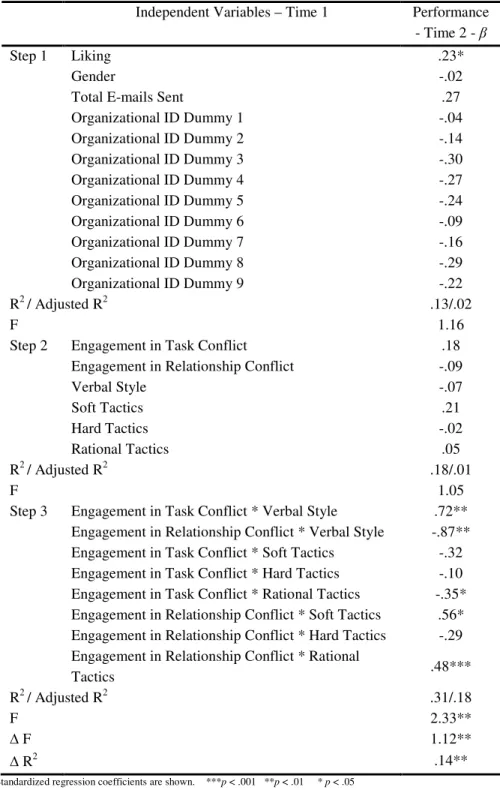
Hypothesis 1. The degree to which an individual engages in
relationship conflict will be negatively related to that individual’s performance.
Individual Engagement in Task Conflict
feel that such ‘process control’ (Lind & Tyler, 1988) can enable them to obtain favorable outcomes (c.f. Houlden, Latour, Walker, & Thibatu, 1978; van Prooijen, Karremans, & van Beest, 2006). For example, imagine an individual who engages in task conflict and disagrees with how other members want to proceed with an organizational task (such as by saying a better strategy would be to picket in front of building x rather than building y). If the organization still decides to picket in front of the other building – building y, but says at the next event, they can picket building x, the individual may be more accepting of this decision and be able to act in a more constructive, performance-enhancing way than if the individual had not engaged in task conflict and voiced the dissenting opinion. Even if the individual does not obtain favorable outcomes, an individual is still likely to enjoy performance benefits. For example, even if the organization only chooses to picket the building to which the member was opposed, research has shown that individuals experience performance benefits when important others understand them, even if that understanding is not acted upon (Thatcher & Greer, 2008). Even if the individual did not get the option the individual wanted, others in the group may now better understand the individual. This means that they may be more empathetic towards the individual as well as possess more accurate knowledge of the individual’s opinions. This may create a more positive, supportive environment which will allow the individual to perform better. Therefore, engagement in task conflict may help improve individual’s performance in the organization.
The knowledge gained from this may enable the individual to better target task-related efforts and thus improve the individual’s performance. Indeed, a successful understanding of the task at hand has been shown to be critical for organizational members to implement organizational strategies (Woolridge & Floyd, 1990). As an additional benefit, when a member expresses an opinion, the opinion may be discussed and debated by other team members. This dissection by other group members of the member’s ideas about the task may help improve the focal member’s understanding of the task and ability to perform well. In line with this, past research has also suggested that engaging in task conflict may improve an individuals’ understanding of the issues involved (e.g., Olson et al., 2007; Putnam, 1994) as well as individual effort and task focus (Jehn & Bendersky, 2003). Therefore, we propose that:
Hypothesis 2. The degree to which an individual engages in task
conflict will be positively related to that individual’s performance.
The Role of Conflict Tactics
Researchers who believe that some sorts of conflict can be positive have investigated ways to harvest the positive side of conflict while
minimizing the negative side (e.g., De Church & Marks, 2001). The resulting area of study, conflict management, focuses on directing conflict towards potentially productive task conflict, such as improved dialogue, rather than destructive relationship conflict, such as personal attacks (Deutsch, 1973). Conflicts that are effectively managed can improve individual performance through constructive debate and a better exploration of alternatives (Jehn & Bendersky, 2003). In this study, we propose a set of conflict tactics that can be used by individuals to improve their performance when engaging in conflict. We propose verbal style and influence tactics as moderators that can be strategically used to manage conflicts, so that individuals can engage in conflicts in a way that maximizes their own performance in the organization. Verbal Style
perhaps, would, could, might”), and indefiniteness (“this, that, those, some, stuff, it, sometimes, someone, something, somewhere, interesting”). An example of a statement with strong verbal style is “The point of this
discussion is to decide upon the next political action of our group.” while in contrast, an example of weak verbal style is “well, uh, i think maybee that the point of this disscusion is…”. When verbal style is strong, recipients are able to easily understand the point of the message, increasing the credibility of the sender. This increased credibility of the member can improve the member’s ability to engage in both task and relationship conflicts, as the member’s points are given more credence. In contrast, a member that uses weak verbal style (such as grammatical errors or indefinite language in the
communication) may be taken less seriously in his or her attempt to manage a conflict.
We propose that strong verbal style can help reduce the negative effect of engagement in relationship conflict on individual performance. When verbal style is strong, the likelihood of misunderstandings resulting from the message is decreased. This can help benefit individuals engaging in relationship conflict by keeping the conflict focused on the single issue it should be about, and preventing misunderstandings and further conflicts that could lead to performance-reducing conflict cycles (e.g., Brett, Shapiro & Lytle, 1998). This is in line with the point made by Griffith et al. (2003) who suggest that the misinterpretation of communications may lead to greater relationship conflict. Relatedly, strong verbal style can communicate that the member has carefully thought through the argument the member is airing, and can therefore communicate that the member cares deeply about the
relationship. This may reduce the likelihood of the relationship conflict engagement being interpreted as interpersonal abuse and resulting
performance-reducing conflict spirals (Aquino et al., 2001). Therefore, we propose that strong verbal style will reduce the negative effects of individual engagement in relationship conflict on individual performance.
thinks about the opinions of others compared to his or her own opinion, thereby increasing the cognitive processing and performance benefits associated with task conflict engagement (Olson et al., 2007). Additionally, when the individual uses strong verbal style, the argument by the individual may be clearer and easier for the other members to discuss and give
comments on. This may further improve the quality of feedback the individual can get on the idea, which may increase the individual’s understanding of the task at hand (c.f. Jehn & Bendersky, 2003; Putnam, 1994). This in turn may help the individual to better implement organizational strategies (Woolridge & Floyd, 1990) and perform well in the organization. Therefore, strong verbal style can thus moderate the way in which the member’s message is perceived, increasing the positive effects of task conflict on individual performance.
Hypothesis 3a. Verbal style moderates the relationship between
individual engagement in relationship conflict and individual performance, such that the use of strong verbal style during
engagement in relationship conflict decreases the negative effect of engagement in relationship conflict on individual performance.
Hypothesis 3b. Verbal style moderates the relationship between
individual engagement in task conflict and individual performance, such that the use of strong verbal style during engagement in task conflict increases the positive effect of engagement in task conflict on individual performance.
Influence Tactic Usage
application of logic to convince a target to comply with a request (Kipnis & Schmidt, 1985; Yukl & Tracey, 1992).
We propose that use of soft or rational tactics by an individual engaging in conflict will increase the positive effect of engagement in task conflict and decrease the negative effect of engagement in relationship conflict on
individual performance while the use of hard tactics will have the opposite effects. For example, the use of soft tactics (such as the use of flattery or ingratiation to reach a goal) could be used to manage conflicts (“Everyone has great ideas. However, it is important for the group goals that we make a decision for our next action.”) in a way that will promote the individual’s performance in the group through allowing the individual to engage in the conflict but still communicate a concern for the relationships in the group. We therefore propose new conflict management tools that can be used to optimize the potentially positive effects of engagement in task conflict while
minimizing the negative effects of engagement in relationship conflict. Soft tactics, or ingratiation as they are often simply called, involve the use of friendliness or flattery to gain compliance with a request. Ingratiation is a process whereby a person tries to improve his/her attractiveness in the eyes of others (Jones, 1964). Ingratiation and flattery may prove useful during a conflict. In this chapter, we propose that the usage of soft tactics will increase the performance of an individual engaging in a relationship conflict.
2001). This may then reduce the likelihood of the relationship conflict engagement continuing to distract the member from the task at hand. We therefore propose that the usage of soft tactics during a relationship conflict will help improve the performance of the individual member engaging in the relationship conflict.
Soft tactics may also improve the performance of individuals engaging in task conflict. For example, negotiation research has shown that the
development of rapport may help increase the likelihood of more mutually beneficial settlements (Moore, Kurtzberg, Thompson, & Morris, 1999). This is consistent with traditional conflict management research, which has found agreeable behavior to be a successful conflict management technique in increasing the positive effects of task conflict (De Church & Marks, 2001). Developing rapport through the use of soft tactics may help improve the performance of individuals engaging in task conflict by allowing members to express conflicting opinions in a way that other members are more receptive to because the importance of the relationship has been acknowledged.
Additionally, the use of soft tactics by a member engaging in a task conflict may also make other members more willing to offer constructive feedback on the member’s opinion. This may further increase the positive effects of engagement in task conflict on individual understanding (e.g., Olson et al., 2007; Putnam, 1994), and thus on individual performance. We therefore propose that:
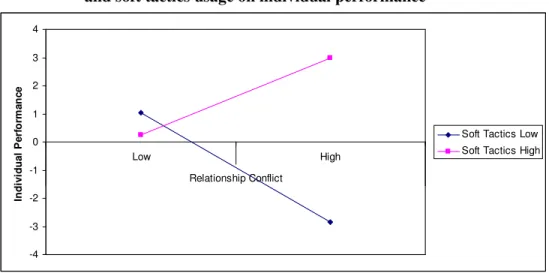
Hypothesis 4a. Soft tactics moderate the relationship between
individual engagement in relationship conflict and individual performance, such that the use of soft tactics during engagement in relationship conflict decreases the negative effect of engagement in relationship conflict on individual performance.
Hypothesis 4b. Soft tactics moderate the relationship between
individual engagement in task conflict and individual performance, such that the use of soft tactics during engagement in an task conflict increases the positive effect of engagement in task conflict on individual performance.
tactics to be the most commonly used influence tactic (e.g., Farmer et al., 1997). We propose rational tactics as also being a successful conflict management technique because they are devoid of emotional elements that could incite or escalate a relationship conflict and because they can help increase understanding of task-related issues. Specifically, we propose that the use of rational tactics may increase the positive effects of task conflict on performance and decrease the negative effects of relationship conflict on individual performance. For example, a member could use rational tactics by calmly explaining his reasoning for a stated position (e.g., “I think we should pursue this goal for reasons x, y, and z”).
The use of rational tactics may help decrease the negative effects of engaging in relationship conflict on individual performance by bringing a voice of reason into emotionally charged interpersonal issues (Jehn, 1997). By focusing on the facts of a personal confrontation in a logical manner, the use of rational tactics may exert a calming influence on relationship conflicts. For example, if a member focuses on the facts in a rational matter (‘in the e-mail you sent on November 30th, I felt that your statement about our
fundraising efforts made me look bad’ as opposed to just ‘you are making me look bad’), this may help clarify the issue to other members, inject a tone of rationality into the matter, and prevent further misunderstandings. Together, this may reduce the negative emotionality associated with relationship conflicts and the associated cognitive processing detriments (Brief & Weiss, 2002). Furthermore, if members are able to rationally discuss the personal issue in contention without inciting negative emotions, the member engaging in the conflict may be able to help other members better understand what is important to the member. Having other team members understand a focal member better, even on non-work-related matters, has been shown to increase the performance of the focal member through enabling other team members to better adapt to and work with the member interpersonally (Thatcher & Greer, 2008). Therefore, the use of clear, logical reasoning while engaging in a relationship conflict may help reduce the negative effects of an individual’s engagement in relationship conflict.
one’s arguments in an especially rational way may force the individual to even more deeply process the issues at hand in the group. The improved understanding the member gains from this may help the member better meet organizational goals (Woolridge & Floyd, 1990). Additionally, by using rational persuasion to guide task debates, the member engaging in task conflict may improve the ability of others to understand the opinions offered by the member. This will improve the ability of other members to listen to, understand, and acknowledge the member’s opinion, which can increase the likelihood of a member feeling a sense of voice (Lind & Tyler, 1988) after engaging in task conflict. Additionally, this may improve the feedback the member is able to get on the opinion from other members. By improving this feedback, this in turn may increase the likelihood of the member’s
engagement in task conflict resulting in the member’s increased
understanding of the issues at hand (e.g., Olson et al., 2007; Putnam, 1994) and ability to perform well in the group. Therefore, we propose that:
Hypothesis 5a. Rational tactics moderate the relationship between
individual engagement in relationship conflict and individual performance, such that the use of rational tactics during engagement in a relationship conflict decreases the negative effect of engagement in relationship conflict on individual performance.
Hypothesis 5b.Rational tactics moderate the relationship between
individual engagement in task conflict and individual performance, such that the use of rational tactics during engagement in task conflict increases the positive effect of engagement in task conflict on
individual performance.
the negative effects of engaging in relationship conflict on performance and decreasing the positive effects of engaging in task conflict on performance. Negotiation research even suggests that in egalitarian cultures, such as those often found in large online listserve groups, the use of hard tactics may be interpreted by other members as contentious behavior (Adair, Okumura, & Brett, 2001), leading to a conflict spiral that may negatively impact negotiation outcomes for all parties involved (e.g., Brett et al., 1998). Additionally, hard tactics are by nature considered unfriendly (van Knippenberg & Steensma, 2003). For this reason as well, hard tactics are likely to further increase the likelihood of relationship conflict engagement being interpreted as interpersonal abuse and causing retaliatory conflict spirals (Aquino et al., 2001). For example, if a member makes a threatening order (“Stop fighting, or you have to leave our group”), the member might actually escalate the fight as other members may now also have a personal problem with the member attempting to stop the conflict because of his unfriendly statement. This would exacerbate the negative effects of
engagement in relationship conflict, reducing an individual’s ability to work towards group goals and therefore reducing individual performance.
Task conflict engagement is also likely to have its potential positive effects reduced by the use of hard tactics. The general unfriendliness of hard tactics (e.g., van Knippenberg & Steensma, 2003) could decrease the willingness of other members to provide constructive feedback on the member’s opinion. This would reduce the information provided to the
member based on the member’s task conflict engagement, and thereby reduce one of the primary benefits of task conflict engagement for individual
also introduce negative aspects, such as retaliatory conflict spirals (e.g., Aquino et al., 2001) which could distract the member from the task at hand. We therefore propose that:
Hypothesis 6a. Hard tactics moderate the relationship between
individual engagement in relationship conflict and individual performance, such that the use of hard tactics during engagement in relationship conflict increases the negative effect of engagement in relationship conflict on individual performance.
Hypothesis 6b. Hard tactics moderate the relationship between
individual engagement in task conflict and individual performance, such that the use of hard tactics during engagement in task conflict decreases the positive effect of engagement in task conflict on individual performance.
Methods
Data and Sample
We conducted a three-year longitudinal multi-method field study of political-organizing organizations located in the United States that used e-mail listserves extensively for their communications. These organizations included, for instance, an international women’s organization, a university peace organization, an environmental organization, and a community
improvement organization. We collected e-mail data from these organizations over a period of 36 months by becoming a member of the general list serves for the organizations, conducting interviews with members, taking field notes at meetings, and collecting hard copies of handouts from organizational meetings and other ideological materials, similar to the methods employed by Phillips and Eisenberg (1993). Given the complexity of influence attempts, as well as conflict, the use of qualitative research methods in conjunction with traditional quantitative methods is an especially useful way to study the relationships between influence, conflict, and performance (c.f. Barry & Fulmer, 2004; Jehn, 1997; Lee, 1999).
organizations. Fifty-four percent of the members were female, and the average member age was 33. All e-mails in our sample were sent to the entire organization via the group listserve, and the vast majority of organizational members participated on the e-mail listserve. For example, in an interview, one member stated: “E-mail is, like, very useful. I would say it is much more useful than, like, hanging flyers but does that make sense? It is just a mass mobilization.” No significant differences were found across the organizations on our variables of interest.
On average, members communicated with each other over the e-mail listserve five times per week (and around actions every day), attended
meetings once a month, and political action events (e.g., protests) two or three times in the year. We did have two organizations in which members only interacted online, which allowed us to compare conflict engagement between members who interacted only online and who interacted both online and face-to-face. In a multivariate analysis of the variables in our study, we did not find any significant differences to exist between members in organizations who only interacted online and members in organizations who interacted both online and face-to-face.
Measures
Our study includes three separate quantitative measures (text
analysis, coder ratings, and expert ethnographic ratings) as well as qualitative data from interviews. For the purposes of this study, we chose to focus only on active members of the organization - specifically, members who sent more than 1% of an organization’s e-mails, as done in past research by Finholt, Sproull, and Kiesler (2002). This reduced our sample size to 165 members who sent in total 7,501 emails. In the following sections, we will first discuss the procedures by which the text analyses, coder ratings, and interviews were obtained, then discuss the existing literature we drew on for the operationalizations of each construct. Following that, we will discuss our performance variable and the two methods we utilized for that – coder ratings and expert ethnographic ratings.
Appendix. We first sorted the e-mails into individual text files for each member. These files were subsequently searched for the keywords using the text-analysis engine MonoConc Pro 2.0 (Barlow, 2000). From this, we were able to obtain the frequencies of keywords for each construct. For several keywords, some occurrences in the initial keyword count were actually misleading because they were preceded by a negation phrase, such as “not good”. To account for this, we used a Boolean search in Monoconc to count the number of occurrences a word occurred in conjunction with a negation term. This total was then subtracted from the first overall total of the keyword to give an appropriate measure of keyword use.
information contributed to group’s goals, it would receive a higher
performance score than if the information did not contribute to group’s goals) or how much conflictual behavior needed to be present to ascertain the degree to which an individual was engaging in task conflict (the decision was that task conflict means disagreement, and that signs of disagreement, such as “I oppose Member X on that point” were indicative of higher levels of
individual engagement in task conflict).
We will next discuss the interviews conducted, and then, in the ensuing sections, we will detail how our coder questions and keywords were chosen. Additionally, we will discuss how our coder ratings relate to our qualitative data, and we will provide more detailed information on the reliabilities of the specific constructs.
Individual engagement in relationship and task conflict. After an initial pretest of the Jehn (1995) relationship and task conflict items for use in coding (adapted to the individual level), we utilized the questions on which our e-mail coders responded in the most consistent way to the individual level of the Jehn (1995) construct. For example, the relationship conflict item used for the coder ratings was framed very directly to improve construct validity (see Appendix 1). Coders rated each question in the Appendix for each e-mail, implying that each e-mail was given a unique score for the degree to which the individual sending the e-mail was engaging in task and relationship conflict. While e-mails thus could potentially have individuals engaging in both task and relationship conflict in the same e-mail, the correlation between the two constructs (r=.54at time 1; r=.61 at time 2)is not exceptionally higher than is normal in past research on group-level task and relationship conflict (De Dreu & Weingart, 2003).
We used our interviews with several members of the activist groups to validate instances coders identified as showing an individual engaging in conflict. For example, a member who stated in an interview, “I became convinced that activism can be a vehicle for change because I saw it, I saw it happen, at least at a small scale here at University X. So it made me more inclined to speak up and use my voice and resources and talents to make my voice heard and challenge the structures of Group X” received a high
individual engagement in task and relationship conflict occurring in the e-mails. To measure individual engagement in conflict via text analysis, we adapted Jehn’s (1997) keyword lists to code for individual behavioral engagement in relationship conflict and task conflict. For optimal reliability, we excluded a few words from Jehn’s (1997) lists – for our final list of words used as well as their reliability, please see the Appendix. These two measures – text analysis and coder ratings – exhibited high inter-method agreement and thus were standardized and then averaged together to form our final
constructs used in analyses. For example, for engagement in relationship conflict, Cohen’s kappa was .94 for the agreement between the two rating types. For full reliability details for both conflict types, please refer to the Appendix at the end of this chapter.
Conflict tactics. The operationalization of our influence tactic measures was guided by both existing literature and an initial pretest of the coder questions. While more traditional influence tactic scale items convey a more overt influence attempt (e.g, Kipnis, Schmidt, & Wilkinson, 1980), we found in our prtest that coders’ identification of influence tactic usage in e-mail was very heavily influenced by the e-e-mail context. Because the
subtleness underlying influence tactics may not be as visible in e-mail
also sufficiently high (see Appendix), thus we standardized and then averaged together the two ratings – text analysis and coder ratings – to form our final conflict management constructs.
Individual performance. Because our sample included large, online political-organizing organizations, rather than corporate organizations, we had to adapt our definition of individual performance to the context of such organizations. Therefore, we defined individual performance as the degree to which the member meets the standards of the group, enabling the
achievement of both group goals and individual development as a
contributing member in ideas and actions. For our measure of this construct, we used two measures – coding and text analysis. In both of these measures, we tried to capture actual role behaviors which reflect our definition of performance. Role behaviors in political-organizing organizations include such things as “getting the organization mentioned in the local newspaper”, “obtaining access for a press release about the organization”, “helping bring about legal change”, “garnering media attention for a specific action”, “participating in rallies or demonstrations”, “being successful in rallies or demonstrations (getting arrested, getting noticed by public, photos in newspaper, mentioned in internet listserves/newspapers, etc.)”, “writing, calling, or visiting a public official”, “making products (flyers, banners, etc)”, “coordinating actions”, “taking on organizational work”, and “helping out with the leadership of the organizations”. The common theme across all of these examples of the different types of role behaviors typifying individual performance in our sample is that they show, as in our definition, that the individual is contributing to organizational goals. In activist organizations, common goals include garnering media attention, as media coverage is a means of making political actions more meaningful (e.g., Oliver & Myers, 1999). Therefore, individual role behaviors such as “obtaining a press release about the organization” or “helping the organization to get in the paper” can be clearly seen as contributing to organizational goals. Measurement of such role behaviors has been considered a reliable way to measure performance in the team or organizational context (e.g., Chen et al., 2007; Welbourne, Johnson, & Erez, 1998).
expert rater. This rater was a consultant to activist groups and had in-depth personal knowledge of each of the groups included in our study, having done consulting work for each of the organizations in the study over a period of three years. The expert, who was blind to our hypotheses, based the performance ratings upon the definition we adapted for individual performance in activist groups as being the degree to which the member meets the standards of the group, enabling the achievement of both group goals and individual development as a contributing member in ideas and actions. Such ratings of individual performance are similar to supervisor ratings, which are found more commonly in studies of traditional organizations (e.g., Jehn, 1995).
To ensure the reliability of this measure, we also used a second measure of performance. The second measure we used to assess individual performance was, as described above, obtained from coding done by two raters blind to the hypotheses and the groups who rated the sample of e-mails described above based on to what degree on a scale of 1-7 (7 being high) the individual sending the e-mails met our definition of individual performance. Coders rated the e-mail based on how much they felt the member was contributing to the group. For example, a member offering to help the group accomplish its goals (e.g.,. to help hang flyers over the weekend for an upcoming rally; to contact the press about the group activities; to organize the collection of signatures for a petition to give to a public official; or to take on some of the organizational work of the organization) would be rated toward the higher end of the performance scale. The ratings of our independent coders of the e-mails showed substantial interrater agreement with a Cohen’s kappa of .73 (Landis & Koch, 1971) and an inter-class correlation coefficient (ICC[1]) of .19 with significant F-test (p<.001), thus showing sufficient justification to average these two ratings together (Klein & Kozlowski, 2000). The variables used in the analyses reflect this averaged number.
employed in these semi-structured interviews specifically relevant to this study include “What does your group do?” and “Have any conflicts arisen in this group?”. Examples of other questions used in the interviews for the purpose of the larger data collection include “What is the group trying to accomplish (their mission/ goals)?”, “How did you first become interested in being politically active?”, and “What is the extent / nature of your group’s
involvement with other political groups (do you work with other groups, what groups, doing what, how often)?”. We used the information obtained in response to these questions to assist in both our operationalization of the variables in this study as well as in the interpretation of our results.
Controls. We included four control variables in our study:
organizational identification number, total e-mails sent by the member, liking, and gender. We included liking as a control variable because past studies in traditional settings have found that friendship among group members can influence performance outcomes in unstructured groups (Shah & Jehn, 1993), such as in some of the organizational groups in our study. Our measure for liking was obtained with the coder item “Do people in this group seem to like each other?”. Our coders exhibited high reliability for this measure (Cohen’s kappa=.85). We also controlled for gender (this information was obtained from the expert coder members from the groups), total e-mails sent by the member, and organizational identification number (using a dummy variable).
Causality. As our data was acquired over three years, we were able to create a time 1 and time 2 variable for each construct in our study, creating two 1.5 year time periods (Koys, 2001; Tekleab, Takeuchi, & Taylor, 2005). Such time periods are commonly used to examine potential causal
determinants of individual outcomes in organizations over time (e.g., Chatman, 1991; Tekleab et al., 2005) to assess the effects over time of processes on outcomes. To test our hypotheses, we examined the presence of e-mail conflict, influence tactic usage, and verbal style at time 1 on individual performance at time 2.