The Sensitivity of Econometric Model Fit under Different
Distributional Shapes
Manasigan Kanchanachitra
A dissertation submitted to the faculty of the University of North Carolina at Chapel Hill in partial fulfillment of the requirements for the degree of Doctor of Philosophy in the Department of Economics.
Chapel Hill 2011
Approved by:
Donna Gilleskie, Advisor
Helen Tauchen
David K. Guilkey
Sang Soo Park
c � 2011
Manasigan Kanchanachitra ALL RIGHTS RESERVED
Abstract
MANASIGAN KANCHANACHITRA: The Sensitivity of Econometric Model Fit under Different Distributional Shapes.
(Under the direction of Donna Gilleskie.)
Answers to many empirical economic questions typically involve quantifying the
relation-ship between a set of explanatory variables and an outcome of interest. Such analyses provide
useful statistics (e.g., marginal effects, treatment effects) or allow for meaningful predictions.
Depending on the question, economists may rely on econometric models to provide additional
information, namely the entire density of a random variable, in order to use different moments
of the distribution or accurately capture tails of the distribution. This study examines the
ability of several different econometric models to explain the distribution of an outcome.
Us-ing a Monte Carlo experiment, I evaluate different economic approaches that are frequently
used by economists to deal with distributions that are positive, skewed and long tailed. Each
econometric model is then evaluated for its performance in estimating the expected outcome
and fitting the distribution particularly in the tails. The distribution of future medical care
expenditure is used throughout the paper to exemplify how the shape of the distribution can
affect optimal behavior, such as the purchase of health insurance, when future medical care
To Mom, Dad, and Pong
Acknowledgments
The completion of my dissertation was made possible through the support of many individuals.
First and foremost, I am deeply grateful for the my advisor, Donna Gilleskie, for her continued
guidance throughout the entire process. I truly appreciate her advice, patience, and time. I
would also like to thank my committee members, David Guilkey, Helen Tauchen, Sang Soo
Park, and Sally Stearns, for their invaluable guidance, comments and suggestions.
I am also grateful for my family and friends. I would like to thank my friends in the Thai
Student Association at UNC for making Chapel Hill a home away from home. Thank you,
pAdd, pToon, Teau, and Mink for all your help in my dissertation, but more importantly, for
being great friends. Also, thank you to Michael Darden for your support and encouragement
throughout this journey together. My time in Chapel Hill would not have been the same
without you.
Finally, I wish to express my special gratitude to my Mom, Dad, and sister. Thank you for
believing in me and always being there for me. I would not have come this far without your
Table of Contents
Abstract . . . iii
List of Tables . . . viii
List of Figures . . . xi
1 Introduction . . . 1
2 Background . . . 5
2.1 Optimal Behavior under Uncertainty: A Theoretical Example . . . 5
2.2 Literature Review of Relevant Econometric Approaches . . . 8
2.3 Empirical Model Description . . . 10
2.3.1 Two-Part Model . . . 11
2.3.2 Sample Selection Model . . . 11
2.3.3 Ordinary least squares on log-transformed dependent variable . . . 13
2.3.4 Generalized Linear Model . . . 15
2.3.5 Three Parameter Generalized Gamma . . . 16
2.3.6 Singh Maddala . . . 17
2.3.7 Conditional Density Estimation . . . 17
2.3.8 Kernel Regression . . . 19
2.3.9 Finite Mixture Model . . . 20
3 Monte Carlo Experiment . . . 21
3.1 Data Generating Processes . . . 21
3.2 Experiment Design . . . 24
3.3 Evaluation Criteria . . . 24
4 Results . . . 28
4.1 Lognormal Data Generating Process . . . 28
4.2 Heteroscedastic Data Generating Process . . . 41
4.3 Random Coefficients Data Generating Process . . . 54
4.4 Mixture Model Data Generating Process . . . 66
4.5 Small Sample Data Generating Process with Heteroscedasticity . . . 77
4.6 The Medical Expenditure Panel Survey . . . 87
5 Discussion . . . 98
A Obtaining the Simulated y . . . 102
List of Tables
2.1 Alternative Distributional Shapes . . . 6
4.1 Predicted y given x: Log Normal DGP . . . 30
4.2 Summary Statistics of y: Log Normal DGP . . . 31
4.3 Comparing the Tails of the Distribution: Log Normal DGP . . . 33
4.4 Off by at least 5%: Log Normal DGP . . . 35
4.5 Off by at least 10%: Log Normal DGP . . . 36
4.6 Off by at least 15%: Log Normal DGP . . . 37
4.7 Off by at least 20%: Log Normal DGP . . . 38
4.8 Mean Signed Difference by Decile: Log Normal DGP . . . 39
4.9 Kolmogorov Smirnov: Log Normal DGP . . . 40
4.10 Optimal Choice: Log Normal DGP . . . 40
4.11 Predictedy given x: Heteroscedastic DGP . . . 44
4.12 Summary Statistics ofy: Heteroscedastic DGP . . . 45
4.13 Comparing the Tails of the Distribution: Heteroscedastic DGP . . . 46
4.14 Off by at least 5%: Heteroscedastic DGP . . . 47
4.15 Off by at least 10%: Heteroscedastic DGP . . . 48
4.16 Off by at least15%: Heteroscedastic DGP . . . 49
4.17 Off by at least 20%: Heteroscedastic DGP . . . 51
4.18 Mean Signed Difference by Decile: Heteroscedastic DGP . . . 52
4.19 Kolmogorov Smirnov: Heteroscedastic DGP . . . 53
4.20 Optimal Choice: Heteroscedastic DGP . . . 53
4.21 Predictedy given x: Random Coefficients DGP . . . 57
4.22 Summary Statistics ofy: Random Coefficients DGP . . . 58
4.23 Comparing the Tails of the Distribution: Random Coefficients DGP . . . 59
4.24 Off by at least 5%: Random Coefficients DGP . . . 60
4.25 Off by at least 10%: Random Coefficients DGP . . . 61
4.26 Off by at least 15%: Random Coefficients DGP . . . 62
4.27 Off by at least 20%: Random Coefficients DGP . . . 63
4.28 Mean Signed Difference by Decile: Random Coefficients DGP . . . 64
4.29 Kolmogorov Smirnov: Random Coefficients DGP . . . 65
4.30 Optimal Choice: Random Coefficients DGP . . . 65
4.31 Predictedy given x: Mixture Model DGP . . . 68
4.32 Summary Statistics ofy: Mixture Model DGP . . . 69
4.33 Comparing the Tails of the Distribution: Mixture Model DGP . . . 70
4.34 Off by at least 5%: Mixture Model DGP . . . 71
4.35 Off by at least 10%: Mixture Model DGP . . . 72
4.36 Off by at least 15%: Mixture Model DGP . . . 73
4.37 Off by at least 20%: Mixture Model DGP . . . 74
4.38 Mean Signed Difference by Decile: Mixture Model DGP . . . 75
4.39 Kolmogorov Smirnov: Mixture Model DGP . . . 76
4.40 Optimal Choice: Mixture Model DGP . . . 76
4.41 Predictedy given x: Small Sample DGP . . . 78
4.42 Summary Statistics ofy: Small Sample DGP . . . 79
4.43 Comparing the Tails of the Distribution: Small Sample DGP . . . 80
4.44 Off by at least 5%: Small Sample DGP . . . 81
4.45 Off by at least 10%: Small Sample DGP . . . 82
4.46 Off by at least 15%: Small Sample DGP . . . 83
4.47 Off by at least 20%: Small Sample DGP . . . 84
4.48 Mean Signed Difference by Decile: Small Sample DGP . . . 85
4.49 Kolmogorov Smirnov: Small Sample DGP . . . 86
4.51 Predictedy given x: MEPS 2005 . . . 89
4.52 Summary Statistics ofy: MEPS 2005 . . . 90
4.53 Comparing the Tails of the Distribution: MEPS 2005 . . . 91
4.54 Off by at least 5%: MEPS 2005 . . . 92
4.55 Off by at least 10%: MEPS 2005 . . . 93
4.56 Off by at least 15%: MEPS 2005 . . . 94
4.57 Off by at least 20%: MEPS 2005 . . . 95
4.58 Mean Signed Difference by Decile: MEPS 2005 . . . 96
4.59 Kolmogorov Smirnov: MEPS 2005 . . . 97
4.60 Optimal Choice: MEPS 2005 . . . 97
List of Figures
2.1 Alternative Distributional Shapes . . . 7
4.1 QQ-Plot: Lognormal DGP . . . 32
4.2 QQ-Plot: Heteroscedastic DGP . . . 42
4.3 QQ-Plot: Random Coefficients DGP . . . 55
Chapter 1
Introduction
Analyses of many economic behaviors require that economists quantify the relationship
between a set of explanatory variables and an outcome of interest. The answer to many
questions posed by health economists depend on assumptions about both the determinants and
the distribution of uncertain outcomes such as medical care expenditure. A common question
in health economics might be to understand how an individual’s health affects his medical care
expenditure. While it may be enough to quantify the effects of particular covariates on the
expected or mean outcome, significant insight may be gained if the effects of covariates on the
entire distribution of an outcome can be ascertained.
The answer to many economic questions oftentimes requires information about the
distri-bution of an outcome of interest. Consider an economic decision making problem that involves
uncertainty. A model of optimal health insurance purchase, for example, states that an
in-dividual chooses a health insurance plan to maximize her expected utility. Health insurance
is chosen without knowledge of one’s medical care expenditures which depend on uncertain
future health (and price and utilization).1 The uncertainty of health requires an individual to forecast at the time of the insurance decision the distribution of medical care expenditures.
The decision of an individual to purchase health insurance depends not only on the
individ-ual’s expected medical care expenditure, but also on the distribution of medical care expenses,
particularly in the far right tail. Health insurance is purchased to protect against the low
1While future prices of medical care and future shocks to preferences are also unknown, we focus here on
probability of (a disastrous health event that requires) high medical care expenditures.
There-fore, correct modeling of the tail of the medical care expenditure distribution is important for
accurately understanding observed health insurance decisions.
Another example of economic decision making where uncertainty plays a role is the
vaccina-tion decision. Whether or not an individual gets a vaccinavaccina-tion for a particular disease depends
on, among other things, the probability of contracting the disease. An individual may choose
to not get vaccinated if she underestimates her probability of contracting the illness, as she
believes that the costs of getting vaccinated exceed the benefits, or, put differently, the value
of the expected lifetime utility associated with not vaccinating exceeds that of vaccinating.
Again, the implications from incorrectly forecasting the tails of a distribution may lead to
socially suboptimal vaccination decisions.
Even when the entire distribution is not of specific interest to an economist, calculation of
an outcome’s expected value may depend on assumptions about the entire distribution. Policy
makers may care about predicting average expenditures conditional on covariates, and
estima-tion of the marginal effects often requires some assumpestima-tions about the underlying distribuestima-tion
of the outcome. Incorrect assumptions of the underlying distribution may result in inaccurate
estimates.
Approximation of the entire distribution of an outcome variable, however, is often
com-plicated by particular characteristics of the distributional shape. Many variables of interest
to health economists are characterized by nonnegative outcomes, a nontrivial fraction of zero
outcomes, and a positively skewed distribution with a long heavy right tail. Economists have
many ways to deal with these empirical challenges. In the health economics literature,
skew-ness is frequently addressed by two main approaches when estimating the marginal effects of
covariates on an expected outcome or predicting the outcome itself. The most widely used
model is to take a logarithmic transformation of the dependent variable and apply ordinary
least squares (OLS). The estimated results are then transformed back to the original scale to
achieve interpretable results. A second technique is to use generalized linear models (GLM)
that assume a family distribution for the dependent variable. These approaches, among others,
While taking skewness into consideration, both of these widely used approaches are limited
to estimating the effect of variation in covariates on variation in the shape and location
pa-rameters of an assumed distribution.2 These models do not let the data fully dictate the shape of the distribution (or capture the tail per se), but rather allow the data to fit an imposed
distribution.
To allow the data to influence the outcome’s distributional shape, one may consider less
parametric models that impose minimal distributional assumptions. These models include
con-ditional density estimation and kernel regression, among others. The use of these approaches
in empirical applications is still quite limited mainly due to their current unavailability in
commonly used statistical software packages.
This dissertation explores different econometric approaches3 in their ability to fit skewed and heavy tailed positive outcome distributions while also taking into consideration the
tradi-tional concerns of health economists such as the nontrivial fraction of zeros and the
retrans-formation issue. The goals of this paper are threefold. First, I explore how well each model
performs in estimating the first moment. In particular, I evaluate the sensitivity of these
econometric models to outliers. Second, I evaluate how well each model approximates the
true distribution of outcomes, specifically focusing on the tails of the distribution. Third, I
explore the welfare implications of incorrectly modeling the true distribution. The scope of the
alternative models I consider include parametric, semiparametric and nonparametric models
that extend beyond the frequently used tools. These models are evaluated under different
data generating processes using Monte Carlo experiments. The findings of this paper inform
researchers on the optimal choice of estimation tool when faced with different types of data
distributions and enable a more thorough interpretation of estimation results.
The rest of this dissertation proceeds as follows: Chapter 2 presents relevant background
information and includes a theoretical example, literature review, and econometric model
2The OLS method explains the mean, µ, and variance, σ2, of an outcome by variations in explanatory
variables. GLM specifies that the data follow an assumed exponential family density such as gamma and allows variation in the explanatory variable to explain the shape parameter of the assumed distribution.
3Throughout the paper, I use the terms econometric approach and econometric model interchangeably to
refer to all the alternative approaches considered.
descriptions. Chapter 3 describes the data generating mechanisms and the Monte Carlo
ex-periment process. Chapter 4 reports the results under different data generating processes, and
Chapter 2
Background
In this chapter, I describe an individual’s optimization problem under uncertainty to
il-lustrate how specification of the distribution of an uncertain outcome is an integral part of
economic analysis. I then provide examples from the empirical economics literature that
demonstrate attempts to capture distributions that affect decision making. Lastly, I describe
the econometric tools that I evaluate in this paper in detail.
2.1
Optimal Behavior under Uncertainty: A Theoretical
Ex-ample
An example of an individual’s optimization problem that I use throughout this paper is the
health insurance selection model. Consider an individual who is uncertain about the state
of his future health, and therefore the associated medical care expenditure he is to incur.
Suppose an insurance company offers the individual the option to purchase insurance where
he may select the level of financial coverage which ranges from 0-100%. That is, if an individual
chooses a 70% plan, the insurance company pays 70% of any future medical care expenditures,
while the individual is responsible for the remaining 30%. The premium for the insurance
increases with the level of coverage. Once the individual chooses the reimbursement level, the
insurance company is responsible for that proportion of the realized medical care expenditure.
Assuming utility is a function of wealth, the individual decides on the optimal level of insurance
Specifically,
max �
U(w−D−αp+αD)dF(D) (2.1)
where w is the individual’s initial wealth, D is the medical care expenditure that is drawn
from a known distribution,F(·), andpis the insurance premium per percentage of payout. In this simplified model, the individual maximizes his expected utility by choosing the optimal
level of coverage, α, which takes on a value between 0 and 1. Therefore, the optimal level
of coverage, α, depends on his initial wealth, the rate of insurance premium, his level of risk
aversion, and finally, the distribution of medical care expenditure.
The individual purchases health insurance to insure against the low probability of having
a catastrophic health outcome and hence expenditure. Therefore, it should follow that
differ-ent distributional shapes (particularly in the tails) of medical care expenditure, F(D), may
lead to different optimal levels of insurance consumption, α. Suppose we have a risk averse
individual who has an annual income of $36,000. He does not know what his annual medical
care expenditure is going to be, but he does know the distribution from which it is drawn
and that the expected expenditure is $2,500.1 To demonstrate the implications of different distributional shapes on an individual’s optimal choice, I hold the expected annual medical
care expenditure constant at $2,500, and vary the degree of skewness and kurtosis. I specify
four separate distributional shapes, all following a gamma distribution to restrict the support
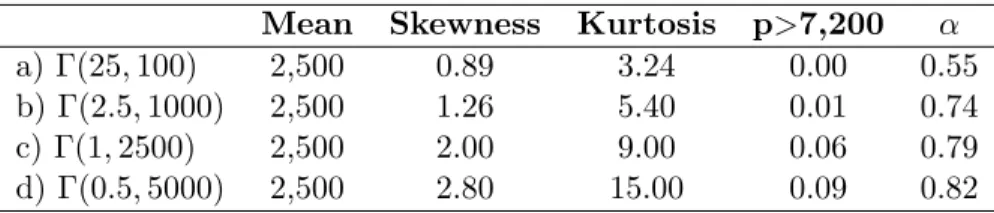
to [0, ∞). All four distributions are positively skewed, as is observed in all empirical data on medical care expenditure, but differ in the degree of skewness and kurtosis. Table 2.1 details
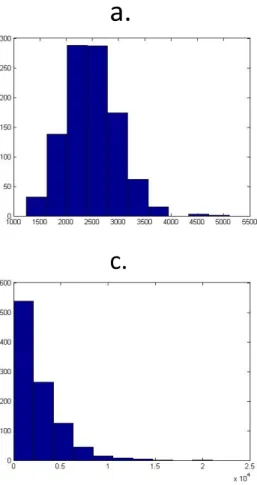
each of the distributions and Figure 2.1 provides the distribution plots.
Table 2.1: Alternative Distributional Shapes
Mean Skewness Kurtosis p>7,200 α
a) Γ(25,100) 2,500 0.89 3.24 0.00 0.55
b) Γ(2.5,1000) 2,500 1.26 5.40 0.01 0.74
c) Γ(1,2500) 2,500 2.00 9.00 0.06 0.79
d) Γ(0.5,5000) 2,500 2.80 15.00 0.09 0.82
1The annual income and expected medical care expenditure are based on the 2005 MEPS data for prime age
Figure 2.1: Alternative Distributional Shapes
The four distributions are specified such that they are increasing in the degree of skewness
and kurtosis. When the utility function is specified as u(z) = z0.3, the individual’s optimal choice of insurance coverage is 55% under the first distributional assumption. Increasing
the level of skewness and kurtosis to the second and third distributional assumption, holding
everything else constant, the optimal choice of insurance coverage is 74% and 79% respectively.
Finally, when the distribution is the most positively skewed, the optimal choice of coverage is
highest at 82%.2
The higher degree of kurtosis implies a higher probability that an individual will have a
disastrous health outcome and therefore expenditure. Suppose for the moment that a medical
care expenditure of over 20% of an individual’s income is considered high (in this case, a
medical care expenditure of $7,200 or over). The probabilities of this individual having this
high level of expenditure under the four different distributional shapes are 0, 0.01, 0.06, and
0.09 respectively. In other words, if the individual knows that medical care expenditure is
drawn from the first distribution, he knows that he will never receive an extremely high draw
of over $7,200. On the contrary, if his expenditure is drawn from the last distribution with the
highest level of skewness and kurtosis, he has almost a 10% chance of drawing an expenditure
exceeding $7,200. Therefore, the more skewed the distribution (the longer the tail), the more
likely the individual will purchase greater coverage to insure against that increased probability
of facing a disastrous outcome.
2.2
Literature Review of Relevant Econometric Approaches
In this section, I discuss the models and assumptions of three published papers addressing issues
in health economics. Solution of each model requires the econometrician to approximate the
entire distribution of an uncertain variable. I focus on how the researchers attempt to capture
the distribution of a variable of interest, particularly when these distributions are positively
skewed. A review of studies that directly evaluate the performance of particular models is
2A less risk averse person would choose a lower level of insurance coverage. For example, if the individual
provided in the Model Description section.
I begin with an application to health insurance coverage and employment decisions. Rust
and Phelan (1997) study whether Social Security and Medicare affect an individual’s decision
to retire, when the loans, annuities, and health insurance markets are incomplete. Individuals
realize that there is a positive probability of incurring high medical care expenditures, and there
may be some security value to remaining employed until they are eligible for Medicare. In order
to capture the distribution of medical care expenditures, the authors treat the expenditures
as a mixture of a mass point of $500 or less (to represent the high probability of incurring
some health expenses), and a continuous long tail distribution of the medical care expenditure
over $500. They find that the continuous part is well described by the Pareto distribution,
which has one parameter that characterizes the size of the tail. Their estimates yield a small
parameter value for the Pareto distribution, implying a rather large and long tail translating
to a relatively high probability of having a catastrophic medical care expenditure. Taking
into consideration the uncertainty of medical care expenses, the paper finds that employed
individuals entitled to Social Security benefits are significantly less likely to continue working
as compared to those not entitled to the benefits.
Another study on health insurance and employment decisions examines the employment
behavior of married couples who face uncertainty about future medical expenses (Blau and
Gilleskie, 2006). Again, having health insurance helps couples smooth out their future utility
of consumption across all possible scenarios. The medical care expenditure for each spouse is
assumed to be a random draw from a known distribution. The authors model this underlying
continuous distribution by using a discrete approximation. Specifically, they discretize the
medical care expenditure into three categories (in 1992 dollars): $0-1999, $2000-14,999, and
$15,000 and above, and use multinomial logit models to estimate the probability of being in
each category separately by sex and health status, with an intercept and a linear age term.
The findings suggest a relatively modest impact of health insurance on employment behavior,
given the uncertainty of medical care expenses.
A final example of decision making under uncertainty involves fertility behavior. Infant
mortality is a source of uncertainty that may affect a woman’s fertility decisions. Mira (2007)
studies the links between infant mortality and fertility decisions when there exists unobserved
heterogeneity in infant mortality risks across mothers. In this dynamic stochastic model of
life-cycle marital fertility behavior, the author focuses on mothers’ learning about their own infant
mortality probability after experiencing child deaths. The paper assumes infant deaths
condi-tional on birth are independent Bernoulli trials with a time-varying, mother-specific probability
of death. Using this framework, the findings suggest that women who experienced higher
in-fant mortality have a higher probability of having additional births as an attempt to replace
the children lost.
These are just a few examples where information about a distribution is necessary for
solution to the optimization problem. The assumptions made by a researcher in estimating
the distribution is likely to impact optimal decisions. In order to evaluate the importance of
distributional assumptions, I consider alternative models that capture the distribution of an
outcome, as well as those that applied economists use to estimate the expected value of the
outcome. I describe these models below.
2.3
Empirical Model Description
Throughout this section, consider an example where the outcome of interest (y) is medical
care expenditures. Possible right hand side variables include sex, age, health status, marital
status, education level, income, etc. I first describe models that deal with the nontrivial
proportion of observations with zero medical care expenditures. In the econometrics literature,
the zero observations are typically handled using one of these models: the two-part model
(2PM) or the sample selection model (SSM). Then I discuss the ongoing debate on choice
between 2PM and SSM. Lastly, I describe models that deal specifically with positively skewed
distributions. These are the econometric models that I implement and evaluate in the Monte
2.3.1 Two-Part Model
A two-part (or multi-part) model separates the observed positive outcome into two observed
parts: y >0 andy|y >0. There are two separate equations to directly model these two parts. The first part estimates the probability of observing positive medical care expenditures,y >0,
on the entire example. The first equation is typically estimated using a standard probit model
I =α0+xα1+e1, where e1∼N(0,1) (2.2)
and wherey >0 ifI >0 and y= 0 otherwise.
The second part of the model is estimated on those with any medical care expenditures,
y|y > 0. Typically, the positive outcomes are estimated using OLS on the log transformed variable or GLM. These techniques are discussed separately in subsequent sections.
2.3.2 Sample Selection Model
Following Leung and Yu (1996), I focus on van de Ven and van Praag’s (1981) version of
the adjusted Tobit model. Again, there is a binary variable indicating positive medical care
expenditure commonly modeled using a standard probit. However, the adjusted Tobit model
takes into account the correlation between the probability of any medical care expenditure and
the level of expenditure. There are two equations where the first governs whether y >0 or y
= 0 is observed, and the second governs the level. Specifically,
I =α0+x1α1+e1 (2.3)
m=β0+x2β1+e2 (2.4)
where ln(y) =m ifI >0 and -∞otherwise, and
(e1, e2)∼N
0
0
,
1 ρσ
ρσ σ2
.
The estimation methods that are most widely used are Heckman’s two-step estimator and
maximum likelihood. The first method augments the OLS regression with an omitted regressor
ˆ
λ=λ(x1βˆ1). Therefore, using all observations withI >0, the OLS equation becomes
ln(y) =β0+x1β1+ρσλˆ+� (2.5)
where ˆλ=φ(x1αˆ)/Φ(x1αˆ) is the estimated inverse Mills’ ratio. φ(·) and Φ(·) are the p.d.f. and
c.d.f. of the standard normal distribution respectively, andE(�|I >0)=0. For the maximum likelihood method, the likelihood function is given byL= Π0[1−Φ(x1β1)]∗Π1Φ((x1β1+ρ(m−
x2β2)/σ)(1−ρ2)−1/2)φ((m−2β2)/σ)/σ, where Π0 and Π1 are the products over the censored
and uncensored respectively. The method I use in this paper is Heckman’s two-step estimator.
Note that in the 2PM, the decision to have any medical care expenditure (e.g., whether
to see a physician) is independent from the level of expenditure incurred (e.g., how often to
see a physician). Therefore, the estimated level of expenditure is conditional on having any
expenditures. On the contrary, the estimate from the level equation is an unconditional one.
This fundamental difference between these two models lead to different interpretations of the
estimated coefficientsβ.
There has been an ongoing debate on the choice between a two-part model (2PM) and
sample selection models (SSM). A fundamental question involves how one should treat the
nontrivial fraction of zero outcomes. Specifically, are the zeros a result of a random process
or a sample selection process? If the zeros appear random, then the use of a 2PM may be
appropriate. On the other hand, if the observed zero outcomes are likely to be based on
individual choice, then the use of SSM may be more appropriate in correcting for the selection
bias.
The debate started when Hay and Olsen (1984) criticized Duan et al. (1983)’s paper that
compared alternative models for the demand for medical care. In the paper, Duan et al. (1983)
evaluate the performance of a simple one part model, a two-part model, and a four-part model.
Their results suggest that the multi-part models significantly outperform the simple one-part
model in terms of mean squared forecast errors with the four-part model being the most
the model joint distribution and functional form. Moreover, the multipart model is nested in
the more general selection model.
Duan et al. (1984) respond to the criticism claiming Hay and Olsen (1984)’s proof relies on
an unmentioned restrictive assumption that cannot be satisfied. The authors demonstrated
their point by offering a counterexample to prove that the 2PM is not nested within the SSM.
Duan et al. (1984) further argue that the SSMs are intrinsically flawed since they rely on
untestable assumptions.
Manning et al. (1987) attempt to settle the discussion by using Monte Carlo simulations
to compare these two approaches. Using SSM as their theoretical benchmark, they find that
2PM outperforms SSM on statistical grounds. However, the Monte Carlo design of Manning
et al. (1987) may have created collinearity problems that bias the results against SSM (Leung
and Yu, 1996). The authors argue that if there is no collinearity, SSM would perform much
better than 2PM. Leung and Yu (1996) conduct a different set of Monte Carlo experiments to
compare the performance of sample selection and two-part models. They hypothesize that the
reason that the 2PM performs well even when SSM is the true model is due to a subtle design
problem in the simulation experiments. The authors believe that the range of a distribution
which the regressors are drawn from in Manning et al. (1987) are far too narrow. SSM includes
the inverse Mill’s ratio, which is a function of the regressors. Therefore, when the range of
the regressors is not wide enough, the SSM will be burdened with collinearity problems. The
findings from Leung and Yu (1996) suggest that no model outperforms the other under all
conditions.
I now describe models that deal with outcomes that are positively skewed.
2.3.3 Ordinary least squares on log-transformed dependent variable
The ordinary least squares (OLS) on a log-transformed dependent variable is by far the most
prevalent modeling approach used in labor and health economics. The method is simply to log
transform the positively skewed medical care expenditures to ln(y) before applying ordinary
least squares. If ln(y) has a normal distribution with mean µ = xβ and variance σ2, the
regression model is simply:
ln(y) =xβ+e (2.6)
wherexis a matrix of observed covariates,βis a column vector of coefficients to be estimated,
and eis the error term (Norton, 2007). Note that the error term need not be i.i.d.
The expected value of the logged expenditure is
E(ln(y)) = E(xβ+e)
= xβ.ˆ (2.7)
The log medical care expenditures need to be retransformed back to its original scale to get
interpretable results. If homoskedasticity and normal error terms are assumed, the predicted
retransformed medical care expenditure given the explanatory variables is
E(y) = exp(xβˆ+.5ˆσ2). (2.8)
However, the assumption of normality is quite strong and may lead to inaccurate estimates
ofy. Duan (1983) developed a way to estimate the retransformed dependent variable without
imposing the normality assumption by using a smearing factor, which is the average of the
exponentiated estimated error terms. The predicted medical care expenditure without the
normality assumption is
E(y) = exp(xβˆ)(1 N
n �
i=1
exp(ˆe)). (2.9)
To obtain the marginal effect of xon the raw-scale medical care expenditure y, the
calcu-lation depends on the characteristics of the error terms. The estimated marginal effect of x
is
∂E(y)
∂x = ˆβE(y) (2.10)
where E(y) is from Equation (2.8) or (2.9), depending on whether or not the error term is
assumed to be normal.
Mullahy, 2001). However, if the log-scale error term is heteroscedastic, then the estimates can
be appreciably biased. To solve for this potential bias, a heteroscedastic retransformation can
be employed (Duan, 1983).
2.3.4 Generalized Linear Model
In generalized linear models (GLM), one directly specifies the mean and variance functions for
the observed medical care expenditure conditional on the covariates. The mean function for
medical care expenditure is represented as
E(y|x) =µ(x�β) (2.11)
where µ is the inverse link between the expectation of the medical care expenditure and the
linear predictorx�β. The log-link relationship is often chosen in health economics for the mean
function such that
ln(E(y)) = x�β
E(y|x) = exp(x�β). (2.12)
One also specifies the variance function in GLM. The general form of the variance function
is specified as
ν(x) =κ(µ(x�β))λ (2.13)
whereλmust be nonnegative. The variance is constant whenλ= 0, proportional to the mean
(Poisson-like) if λ= 1, and proportional to the mean squared (gamma-like) if λ= 2.
GLM’s main advantage is that one can directly specify how the expectation of medical care
expenditure in its original scale is related to the covariates. If the link function is correctly
specified, then the choice of the variance function will only affect the efficiency. However, if
the link function is misspecified, which may likely be the case, then the model may not fit
the data well across the entire range of the distribution. In this case, the specification of the
variance function will determine the goodness of fit in the different parts of the distribution.
Manning and Mullahy (2001) compare log normal models and gamma models under
dif-ferent data generating specifications based on a Monte Carlo simulation. OLS with a
ho-moskedastic retransformation was more robust than GLM alternatives to heavy-tail data and
large log-scale error term variance. However, the estimates from OLS with a
homoskedas-tic retransformation can be substantially biased if the log-scale error term is heteroscedashomoskedas-tic.
GLM methods also perform better than OLS in terms of precision when the distribution of
the dependent variable is not bell-shaped or skewed bell-shaped.
2.3.5 Three Parameter Generalized Gamma
The three parameter generalized gamma (GG) has one scale parameter and two shape
param-eters. Following Manning et al. (2005), the probability density function for the generalized
gamma is
f(y;κ, µ, σ) = σy√γγγΓ(γ)exp[z√γ−u] y≥0 (2.14)
where γ = |κ|−2, z = sign(κ)[ln(y)−µ]/σ, and u = γexp(|κ|z). The parameter µ is set to equal x�β. Estimation is done using maximum likelihood methods. The expected value of y
conditional onx for the generalized gamma is
E(y|x) =exp[xβˆ+ (ˆσ/ˆκln(ˆκ2) +ln(Γ[(1/κˆ2) + (ˆσ/κˆ)])−ln(Γ[1/ˆκ2])) (2.15)
where ˆσ = (1/n)�exp[α0+α1ln(f(xi))] ifln(σ) is parameterized asα0+α1ln(f(x)).
Manning et al. (2005) extend the Manning and Mullahy (2001) paper by including the
generalized gamma. The Monte Carlo experiment in the paper suggests that the generalized
gamma yields estimates that are close to the true value on the log scale, except for when the
error term is heteroscedastic. The precision loss associated with the generalized gamma is also
smaller compared to GLM of gamma with a log link, which is a special case of the generalized
gamma, when estimating a distribution with heavy tails. However, generalized gamma tends
2.3.6 Singh Maddala
The Singh Maddala (SM) distribution is also designed to handle heavy tail data distribution.
The density function for the Singh Maddala distribution is
f(y;τ, θ, λ) = λθ λτ yτ−1
(θ+yτ)λ+1. (2.16)
One can allow either the shape parameter and/or location parameter to vary with covariates.3
The parameters are estimated via maximum likelihood.
McDonald (1984) finds that the Singh-Maddala distribution provides a better fit for the
income distribution than the gamma, while the gamma outperforms the lognormal. The
paper considers two generalized beta distributions. In particular, the generalized gamma and
generalized beta of the first and second kinds and their special cases were fit to U.S. family
nominal income for 1970-1980. The author finds that the generalized beta of the second kind
provides a better fit than the generalized gamma in terms of sum of squares or absolute errors,
chi-square and log-likelihood criteria. The second best distribution function is Singh-Maddala,
which performs better than the generalized beta of the first kind with four parameters.
2.3.7 Conditional Density Estimation
The conditional density estimation (CDE) approach is based on Gilleskie and Mroz (2004).
Suppose we have some unknown distribution function for medical care expenditures y
condi-tional on a set of covariates x. Let the density of this distribution be f(y|X). We can break the range of the observed medical care expenditures intoK intervals, where the kth interval is
defined by [yk−1, yk), foryk−1≤yk,y0 =−∞ and yK =∞.
The conditional probability that an observed value of medical care expenditure falls in the
kth interval given that it did not fall in one of the first (k-1) intervals is
λ(k, x) =p[yk−1 ≤ y < yk−1] =
�yk
yk−1f(y|x)dy
1−�yk−1
y0 f(y|x)dy
. (2.17)
3The SM density function from Stata isf(x;a, b, q) = (aq/b)z−(q+1)[(x/b)(a−1)]
Therefore, the probability that the random variable y falls in the kth interval is given by
p[yk−1 ≤ y < yk|x] =λ(k, X)
k�−1
j=1
[1−λ(j, x)]. (2.18)
The true expectation of any functionh(·) of the random variabley given x, is
E(h(y)|x) =
� ∞
−∞
h(y)f(y|x)dy (2.19)
whereh(·) is any smooth and continuous function ofy.
The discrete approximation of the expected function using a partition of the support of y
withK intervals is given by,
˜
E(h(y)|x) = K �
k=1
h∗(k|K)λ(k, x) k�−1
j=1
[1−λ(j, x)], (2.20)
where each h∗(k|K) is an approximation to h(y) in the kth interval. Gilleskie and Mroz are interested in the mean of y and therefore let h∗(k|K) be the mean or the arithmetic average function, which does not vary with the x’s. This implies that, conditional on being in that
interval, the x’s do not explain the mean value within their interval. That is, conditional on
being in a particular interval, the value of y is random. The derivative of the conditional
expected value in this case is
∂E˜(h(y)|x)
∂x =
K �
k=1
h∗(k|K)∂[λ(k, x)
�k−1
j=1(1−λ(j, x))]
∂x (2.21)
One could also allow the mean to depend onx’s. Ifh∗(k|K) varied withx, the derivative of the conditional expected value would have an additional term that reflects the fact thath∗(·) is also a function of x. Their paper suggests however, that the proposed conditional density
estimator performs quite well under various data generating processes. More importantly, this
estimation method allows effects of covariates to be different at different points of support in
2.3.8 Kernel Regression
Kernel regression is a nonparametric technique that is less dependent on functional form
as-sumptions than parametric models (Yatchew, 1998). Consider a modely=f(x) +e, where e
is i.i.d. with mean 0 and variance σ2
e given x, whichx is assumed to be a scalar for the time
being. The functionf is unknown. A general formulation of local averaging estimator can be
defined as
ˆ f(x0) =
�
wt(x0)yt. (2.22)
Several local averaging estimators can be used including kernel and nearest neighbor. Higher
weights are assigned to observations closer tox0.
I focus on the kernel estimators. The weight function is specified as
wt(x0) = 1
λTK(
xt−x0
λ )
1
λT �
K(xt−x0
λ )
(2.23)
whereKis assumed to be a bounded function that sums to one and is symmetric around zero.
It determines the shape of the weights and the magnitude is determined by the bandwidth,λ.
The larger the bandwidth, λ, the more weight is being put on observations that are far from
x0. The kernel regression function estimator is therefore
ˆ f(x0) =
1
λTK(xt−λx0)yt
1
λT �
K(xt−x0
λ )
(2.24)
There are several types of kernels. The simplest form is the uniform kernel which gives
the weight of 1 on [-1/2, 1/2] and 0 otherwise. The kernel that I use in this paper is the
Epanechnikov function which takes the value of 32(1−4u2) whereu∈[−1/2,1/2]. The choice of kernel is not as important as the choice of bandwidth size. The mean squared error can be
minimized by increasing the bandwidth of the neighborhood until the increase in bias squared
is offset but the decrease in variance.
Nonparametric regressions are not as widely used as one might expect. The main reasons
are that the nonparametric techniques are more complex than procedures available in
stan-dard statistical software packages, they are computationally intensive, and they require large
datasets.4
2.3.9 Finite Mixture Model
The finite mixture model (FMM) uses a mixture of distributions to approximate the true
un-known distribution. The FMM can accommodate heterogeneity between different subgroups
of individuals such as heavy users and light users of medical care. With the FMM, the
distri-bution ofyis assumed to be drawn from a population that is an additive mixture ofC distinct
subpopulations in proportions π1,...,πC, where �Cj=1πj = 1, and πj >0. The density of y is given as
f(y|Θ) =π1f1(y|θ1) +...+πCfC(y|θC) (2.25)
where fj(y|θj)’s are specified to follow a distribution such as normal or Gamma. The mixing probability parameters, πj, are estimated along with other parameters of the distribution,
θj via maximum likelihood. In this paper, I specify the distribution to be a mixture of two
Gamma distributions.
Deb and Holmes (2000) compare the performance of FMM to the two-part count model in
estimating visits, and to the two-part model with OLS on log transformed dependent variable
in estimating medical care expenditures. Using data from the National Medical Expenditure
Survey, the authors conclude that the FMM provides a better fit of both visits and expenditures
than the standard models. Their results indicate that there is heterogeneity in the population
that can be classified into at least two different subgroups with different density parameters.
The FMM is able to capture this difference between the subgroups, categorizing users into high
intensity user group, and low intensity user group. The high intensity user group is found not
only to have a higher expected expenditures, but also a higher variance than the low intensity
user group.
4The more regressors there are in the model, the larger number of observations is needed as Kernel regression
Chapter 3
Monte Carlo Experiment
To evaluate the performance of alternative econometrics models, I implement a Monte Carlo
experiment. I generate datasets such that there exists a nontrivial proportion of the sample
with zero observed outcomes and for those with positive outcomes, the data are right skewed.
I consider different data generating processes to reflect common features in health economics
data. Specifically, I start with a basic dataset where the positive part of the dependent variable
yfollows a log normal distribution. I then add in heteroscedasticity in the log-scale error term
for the second data generating process. The third data generating process I consider is specified
to have random coefficients, while the last data generating process is based on a mixture of
distributions. In addition, I also consider a small sample dataset. The specifications of each
of the data generating processes are detailed below.
3.1
Data Generating Processes
The first data generating process (DGP) is a two-part model where the positive part of the
distribution is based on a lognormal. The first part dictates the probability of an individual
having any positive medical care expenditure and is specified as
wheree1 ∼N(0,1). IfI ≤0, then the individual has no medical care expenditure and y= 0.
IfI >0, then the individual has a positive expenditure which is determined by
ln(y) =β0+β1x+e2, (3.2)
where x∼ Γ(3.4,0.24), e2 ∼N(0,1), and e2 is uncorrelated with e1. In this data generating
process, α0, α1, β0, andβ1 are specified to be 0.06, 1.00, 5.85, and 1.74 respectively.1 I is the
indicator function for having any positive expenditure,yis the medical care expenditure given
I >0, andx is an explanatory variable such as health status, and therefore x is positive and
its distribution is skewed right. In this example, higher values ofx indicate worse health. The
summary statistics for this lognormal DGP are provided in Chapter 4 in Table 4.2.
The second data generating process incorporates heteroscedasticity in the error term, which
is a common feature in health economics data. This DGP is similar to the baseline lognormal
DGP in that it is also a two-part model, andx∼Γ(3.4,0.24). Similarly, the error terms from the first part and the second part of the model are not correlated. However, the second part
of the model that predicts the level of expenditures conditional on having any expenditures is
heteroscedastic in the error term. The variance of the error term is specified to be a function
of x. Specifically, e2 ∼ N(0,1 +x/5). Under this DGP, the values for α0, α1, β0, and β1 are
-0.01, 1.00, 5.48, and 1.74 respectively. The summary statistics for this heteroscedastic DGP
are in Table 4.12.
The third data generating process is also similar to the first DGP but the coefficient in
the second regression function, β1, is random. In particular, β1 is drawn from a N(1.74,0.5)
distribution. Other parameters, α0, α1, and β0 are set to be -0.025, 1, and 5.28. Table 4.22
provides the summary statistics of this heterogeneous DGP.
To reflect the fact that most data do not follow any one particular distribution, the next
1In all my data generating processes, I adjust the coefficients so that the mean medical care expenditure is
case I consider is when the distribution of the outcomes is a mixture of models. Specifically,
the DGP is a mixture of two lognormal distributions. Individuals are randomly assigned to
be one of two possible types. The two types have different probabilities of incurring any
positive expenditures, and upon having any expenditures, the mean levels of expenditures are
different. One can typically think of these “unobserved” types as relatively healthy individuals
versus relatively unhealthy individuals. The relatively healthy individuals, on average, have
a lower chance of having any expenditures than their relatively unhealthy counterpart, and
conditional on having any expenditures, the relatively healthy individuals can expect to have a
lower expenditure. In my specification, I have approximately 70% of the population being the
relatively healthy type, and the remaining 30% being the relatively unhealthy type. Within
each type, the error terms in the first and second part of the model are correlated. For the
relatively healthy individuals, the parameters α0, α1, β0, and β1 are set to be -0.009, 1.00,
5.2, and 1.4 respectively, while the relatively unhealthy individuals, the parameters are set as
0.15, 1.00, 6.2, and 1.74. Under this specification, the average probability of having positive
expenditures for the relatively healthy individuals is 0.77 and conditional of having positive
expenditures, the expected expenditure is $2,583.08. A relatively unhealthy individual, on the
other hand, has a higher probability of having any positive expenditures of 0.82, and upon
incurring any expenditures, the expected expenditure is also higher at $6,717.44. The details
of the entire distribution are shown in Table 4.31.
Finally, I consider a small sample DGP. Specifically, the DGP is the same as the one with
a heteroscedastic error term but with a considerably smaller sample size. The sample size in
all other DGP is 10,000, while the small sample DGP, the sample size is 1,000.
After evaluating the various econometric approaches under different DGP’s, I implement
these models using a real dataset. The dataset that I use is the 2005 Medical Expenditure
Panel Survey. I discuss the details of the data in Section 4.6.
3.2
Experiment Design
To begin the Monte Carlo experiment, I generate 10,000 observations following the data
gen-erating processes described above. For each DGP, I use each of the considered estimating
approaches to attain the predictedy given the values ofx.
The main goal of this paper is to evaluate the performance of each of the econometric
models in terms of distributional fit, in addition to the predicted value of y given x. In order
to fulfill this goal, I need to recover the simulated distribution of y as implied by each of the
econometric models, and compare this simulated y to the actual data that I have generated.
Suppose yi =f(xi) +ei is the observed yi from the DGP. The simulated outcome, ˜y, is then
defined as ˜y= ˆf(xi) + ˜ei where ˆf(xi) incorporates estimates from the model and ˜ei is obtained
from simulating the error terms. For example, after using OLS on log-transformed y, I have
ˆ
f(xi) asxiβˆ. I then generate ˜yi by adding an error term, ˜ei, that is drawn fromN(ˆµ,ˆσ2) where ˆ
µ and ˆσ2 are found in estimation. I then transform the distribution back to its original (not log) scale. Note that I assume that the error term from OLS follows a normal distribution.
However, I am not able to simulate the error terms for all models, particularly those that
are nonparametric. I describe the process by which I generate the simulated y from each
econometric model in detail in Appendix A.
The simulation process is repeated 50,000 times to achieve 50,000 sets of ˜y for each
econo-metric model under each DGP. Each set of ˜y’s from each round of simulation is then sorted in
ascending order. Then I take the average of the ˜y(i) (where ˜y(i) is theith order statistic of the sample) across simulations to obtain the final set of ˜y’s that I use in my evaluations.
3.3
Evaluation Criteria
The performance of each econometric model is evaluated in three main aspects:
• Predicted y given x. Each model is compared in how well it predicts the mean.
– qq-plot. The first criterion to evaluate the overall fit of the models is to plot the
simulated outcome, ˜y, against the true data that are generated,y, at each quantile.
The qq-plot is useful particularly in examining the model fit in the extreme right
tail. The simulated and actual values are first sorted from the lowest to the highest,
then are plotted against one another. If a model fits the data perfectly, the qq-plot
should be a 45 degree line. That is, the simulated values are equal to the actual
values. The more the qq-plot deviates from the 45 degree line, the worse the fit.
If the qq-plot is above the 45 degree line, the model underpredicts the data, and
overpredicts if the qq-plot is below the 45 degree line. Therefore, the qq-plot is a
good gauge for each model’s performance across different values of y.
– Percentage off by decile. This criterion is used in conjunction with the qq-plot.
Once both the simulated and actual values are sorted from lowest to highest, they
are compared to one another. I calculate the percentage that the simulated values
differ from the true values. That is, for eachy(i)and ˜y(i), I calculate (˜y(i)−y(i))/y(i). I report the percentage of observations that are off by at least 5%, 10%, 15%, and
20%. Note that I calculate the percentage for positive values ofy. That is, I report
the percentage conditional ony >0.
– Mean Signed Difference (MSD) by decile. The MSD is also to be used in conjunction
with the qq-plot. The MSD is defined as MSD = �Ni=1(˜y(i)−y(i))/N, and it is intended to assess the direction of the fit on average in each part of a distribution.
In other words, the MSD reports whether the simulated distribution on average
under- or overpredicts the true distribution. The closer the MSD to zero, the
better the fit. If the MSD is negative, that means on average the values of the
simulatedy in that decile are smaller than the true values. A positive MSD means
that on average, the simulated y’s are above the true y’s. I report MSD1-MSD10
corresponding to the first to the tenth deciles. Note that these deciles are based on
the positive values ofy to be consistent with the percentage off by decile criterion.
I also include MSD0 for the case where y is equal to zero.
– Percent greater than cutoff point. This criterion is used as a rough gauge in how well
the simulated distribution fits the right tail of the true distribution. I choose a y
cutoff point in the true distribution, and calculate the percentage of the observations
that lie above that cutoff point. I then calculate the percentage of observations that
lie above this same cutoff point in the simulated data. The percentages are then
compared.
– Kolmogorov-Smirnov Statistic. The KS test is a fully nonparametric test that
com-pares the distribution of the simulated outcomes to the distribution of the
ob-served data. It determines whether the two underlying distributions differ. The
KS test statistic is D = max(|D+|,|D−|), where D+ = max(F(˜y)−F(y)) and D− = min(F(˜y)−F(y)). The KS test measures the vertical distance between the cumulative distribution of the simulated outcome, ˜y, and the cumulative
distribu-tion of the observed outcome,y. The KS test can evaluate the distributional fit of
each model without imposing any distributional assumptions.
• Welfare implications. The distributional shape as implied by each of the models may have welfare implications in models of decision making under uncertainty. To analyze
the implications of a model’s performance in fitting a distribution, recall the health
insurance optimization problem in Equation 2.1 of Chapter 2. The simplified model
states that an individual, uncertain of future health and therefore medical care expense
(D), chooses a level of insurance coverage (αfrom 0-1, where α is the proportion of any
future medical care expenditures that the insurance company is responsible for, and 1-α
is the proportion that the individual is responsible for) to maximize his utility which is
a function of wealth, w. I create a scenario where the individual has an initial wealth
of $18,0002; the premium per unit of coverage, p, is $10; and the individual’s utility
function is specified as U(z) =zr, where z =w−D−αp+αD, and r is set to 0.8 to reflect risk aversion. The optimization problem is solved by discretizing the simulated
outcome distribution and it is solved by using Mata in Stata. The optimal choices
under uncertainty, where the distribution of medical care expenditures is estimated using
each econometric approaches, are then compared to the optimal choice under the true
distribution.
Chapter 4
Results
In this Chapter, I discuss the performance of each econometric models under different data
generating processes using the evaluation criteria as described in Chapter 3.
4.1
Lognormal Data Generating Process
I begin with the performance of each econometric model under the lognormal DGP. Most
models perform quite well in predicting the mean under this simple lognormal DGP. SM and
the FMM are the only models that are inaccurate in predicting the mean. See Table 4.1 for
each model’s predicted mean.1
To evaluate the distributional fit of each model, let us begin by looking at the summary
statistics of the true distribution and the simulated distributions. Table 4.2 provides the
summary statistics of the true y and the simulated y from each of the models. In general, all
models fit the mean of the true distribution quite well. The simulated distribution generated
by both OLS models and the GG are very similar. The simulated distributions from these
models are much more skewed and have a higher level of kurtosis than the true distribution,
implying a fatter tail than the true distribution. The GLM’s simulated distribution has similar
skewness and kurtosis to the true distribution, but a lower standard deviation and variance.
1Note that the predicted probability of having any positive expenditures (Proby >0) for OLS TP, SSM,
The summary statistics suggest that the simulated distribution from GLM has a similar shape
to the true data, but smaller in scale.
The simulated distribution from Kernel regression compared to the true distribution of
the outcomes is much less skewed and has a much lower kurtosis. The tail of the simulated
distribution from Kernel regression is much shorter compared to the true distribution and the
simulated distributions from other models. It may seem at first that the simulated distribution
from the Kernel regression fits the true distribution quite poorly. However as we will later see,
the simulated distribution from the Kernel regression fits the overall true distribution rather
well, and only in the extreme right tail that the fit is very poor. The maximum simulated
y from the Kernel is 62,098.48, which may seem much lower than the maximum of 309,337.9
from the true distribution, but it corresponds to approximately the 0.996 quantile of the true
distribution. It is the outliers of the true distribution that the simulated distribution cannot
capture, resulting in a simulated distribution with a much shorter right tail.2
SM and FMM both underpredict the mean. Both models have lower standard deviations
and variances, but FMM has a higher level of skewness and kurtosis than the true distribution,
suggesting that the simulated distribution from the FMM has a higher mass in the lower values
of the distribution than the true data. The reason SM and FMM perform poorly in fitting the
true distribution may be due to their underlying distributional assumptions. Both the
Singh-Maddala distribution and the Gamma distribution that the SM and FMM rely on respectively,
have shorter right tails than the lognormal distribution that the true distribution is based
on. This shorter right tail may be the reason in the observed lower standard deviations and
variances in both SM and FMM simulated distributions.
The simulated distribution from the CDE is close to the true distribution, with the
simu-lated distribution being slightly less skewed and has less kurtosis.
Overall, both OLS models and the GG model do well in fitting the entire distribution.
2The simulated distribution from the Kernel regression is based on calculating the estimated conditional
CDF of yand inverting this conditional CDF to obtain the simulatedy. The choice of the bandwidth plays
an important role in how well the simulated distribution fits the true distribution. I use the rule-of-thumb in calculating the size of the bandwidth. If I use a larger bandwidth than the optimal bandwidth that the rule-of-thumb suggests, I would be able to capture the outliers better, but at the expense of over-smoothing the distribution. See Appendix A for further detail.
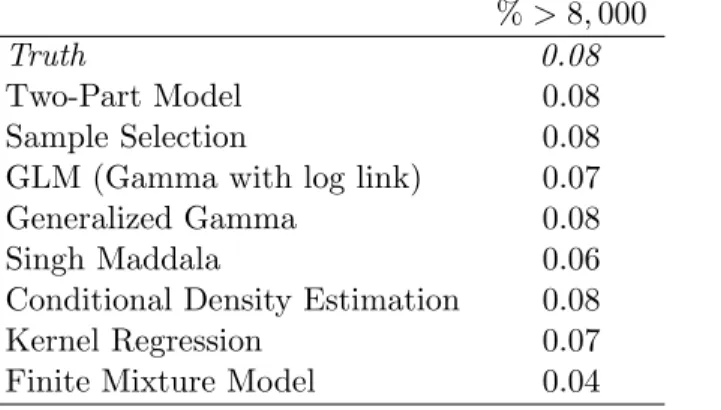
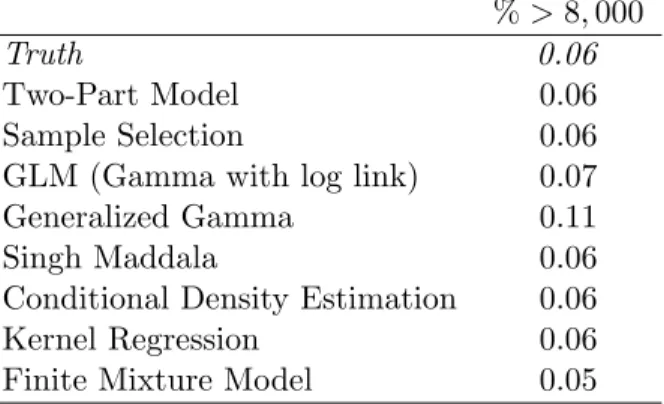
Table 4.3: Comparing the Tails of the Distribution: Log Normal DGP %>8,000
Truth 0.08
Two-Part Model 0.08
Sample Selection 0.08
GLM (Gamma with log link) 0.07
Generalized Gamma 0.08
Singh Maddala 0.06
Conditional Density Estimation 0.08
Kernel Regression 0.07
Finite Mixture Model 0.04
Table 4.4 reports the percentage of the observations in the simulated distribution that are
different than the true distribution by at least 5%. For both OLS models and the GG models,
only 2.26%, 3.31%, and 1.19% of the entire simulated distributions respectively, are different
from the true distribution by 5% or more. The tail of the distribution, in the tenth decile, is
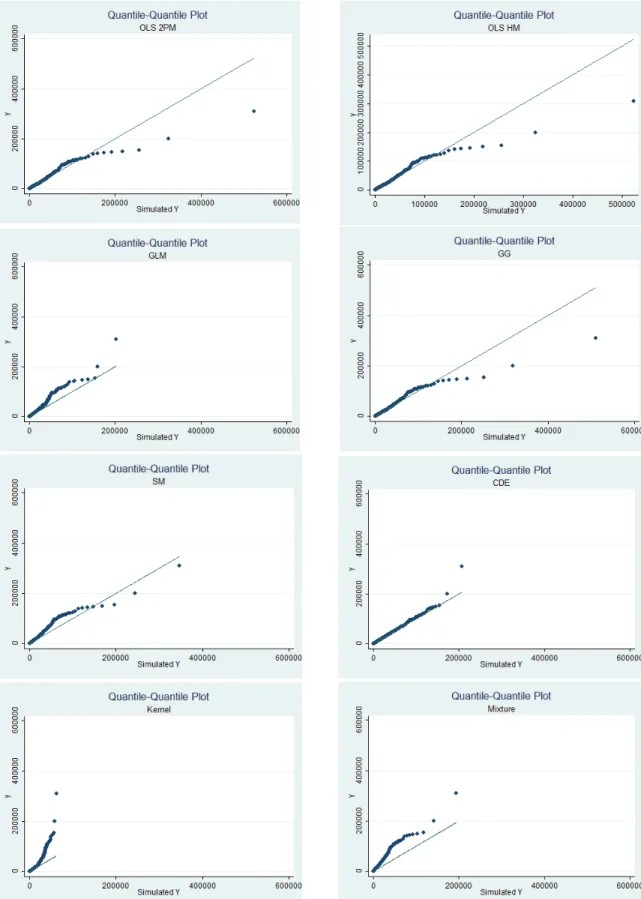
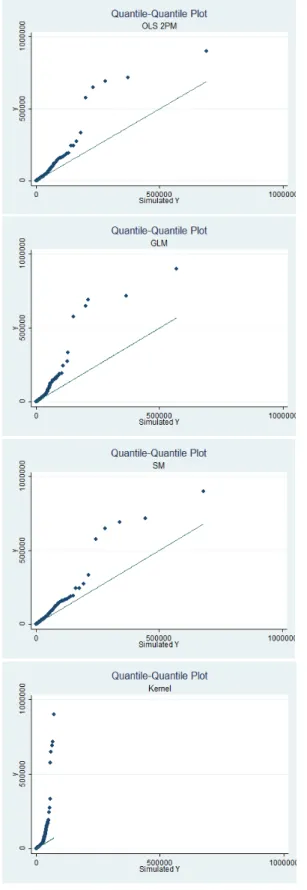
where most of the differences come from. From the qq-plots in Figure 4.1 and Table 4.8, it
seems that these three models overpredict the right tail of the distribution.
GLM performs well in predicting the mean. However, its performance in fitting the
distri-bution is not as good. From Table 4.7, 71% of the overall simulated distridistri-bution from GLM
is different from the actual distribution by at least 20%. Interestingly, under this DGP the
GLM does not do as poorly in the higher deciles (9th-10th) compared to the lower deciles.
However, compared to both OLS models and the generalized gamma, the GLM still performs
worse. From the qq-plot in Figure 4.1 and the MSD in Table 4.8, it shows that the GLM
underpredicts the far right tail, while consistently overpredicting the rest of the distribution.
Compared to both OLS models and the generalized gamma model, GLM has a much shorter
right tail.
SM does moderately well in terms of its distributional fit compared to other models. The
simulated distribution is generated based on a SM distribution and it should be expected that
it does not fit the true distribution as well as OLS models and GG. From Tables 4.4, 4.5, 4.6,
and 4.7, SM seems to be performing best around the mean. In terms of the right tail, SM
underpredicts the true values. There are also less observations in the distribution of ˜y above
the cutoff point at 8,000 than in the true distribution ofy (see Table 4.3).
Kernel regression performs well in fitting the true distribution everywhere except for the
right tail. Note that the simulated y’s from Kernel regression is lower than the true y’s
everywhere in the distribution and the magnitude of the difference is one of the highest (see
Table 4.8). The poor fit in the far right tail of the Kernel simulated distribution also shows
quite clearly in the qq-plot in Figure 4.1. The plot shows how much shorter-tailed the simulated
distribution is compared to the true one.
Examining the qq-plot in Figure 4.1, CDE appears to do quite well. It seems to slightly
underpredict the far right tail of the true distribution. However, upon closer inspection, CDE
fits quite well in the right tail, but most of its poor fit occurs in the left tail as suggested by
Tables 4.4, 4.5, 4.6, and 4.7. The poor fit in the left tail is not clear in the qq-plot.
The model that does consistently poorly is the FMM. It does poorly in predicting the mean
and fitting the distribution. Note, however, that the FMM assumes a mixture of two Gamma
distributions when the true distribution is a lognormal, so the Gamma can fit a lognormal only
to a certain extent. Also note that by construction of this DGP, there is no mixture of models
while I specify the FMM to be a two component model. One should expect a two component
model fitting a one component model to not work as well.
Another evaluation criterion I use to determine the overall fit is the Kolmogorov Smirnov
statistic (KS). Table 4.9 reports the statistics from different estimation models. The first
column is the D statistics as explained in Section 3.3. The higher theD statistic, the bigger
the largest vertical distance between the true distribution and the simulated one. The second
column is the p-value of the combined test, and the third column is the corrected. Based on
the KS, the correctedp-value is significant for GG.
Finally, I examine how the simulated data from each model may affect an individual’s
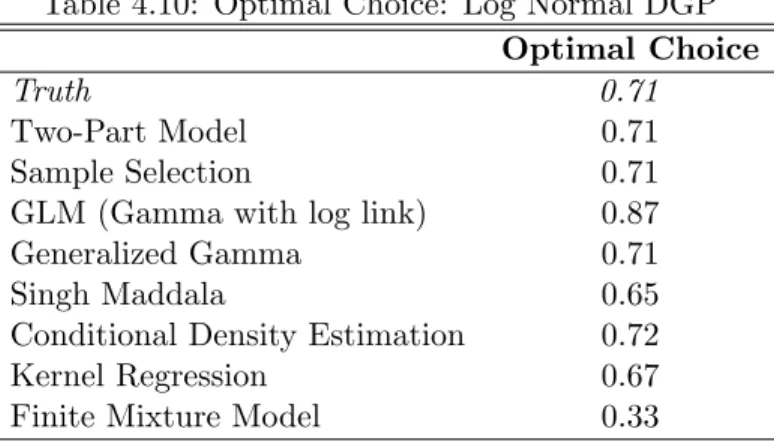
op-timal behavior. Under the true distribution of medical care expenditures, the opop-timal amount
of coverage for the individual is 0.71 as shown in Table 4.10. That is, the individual chooses
coverage such that the insurance company pays for 71% of any future medical expenses while
he is responsible for the remaining 29%. Both OLS models, GG, and CDE, which perform
well in fitting the distribution, all result in the same optimal behavior. GLM which does
Table 4.9: Kolmogorov Smirnov: Log Normal DGP D P-value Corrected
Two-Part Model 0.017 0.123 0.119
Sample Selection 0.017 0.123 0.119
GLM (Gamma with log link) 0.229 0.000 0.000
Generalized Gamma 0.004 1.000 1.000
Singh Maddala 0.026 0.003 0.003
Conditional Density Estimation 0.099 0.000 0.000
Kernel Regression 0.013 0.415 0.408
Finite Mixture Model 0.112 0.000 0.000
of 0.87. The Kernel regression which fits the overall distribution well except for the far right
tail predicts the optimal behavior at 67%, which is lower than the true optimal choice. In
most part, the tail of the distribution is a good indicator of the optimal choice. If a simulated
distribution underpredicts the tail, then the resulting optimal choice is typically lower than
the true optimum, and vice versa. This relationship between the tail and the optimal behavior
is seen in the SM, Kernel, and FMM models.
Table 4.10: Optimal Choice: Log Normal DGP Optimal Choice
Truth 0.71
Two-Part Model 0.71
Sample Selection 0.71
GLM (Gamma with log link) 0.87
Generalized Gamma 0.71
Singh Maddala 0.65
Conditional Density Estimation 0.72
Kernel Regression 0.67