DYNAMIC STEP-GROWTH POLYMER MATERIALS
Sara A. Turner
A dissertation submitted to the faculty at the University of North Carolina at Chapel Hill in partial fulfillment of the requirements for the degree of Doctor of Philosophy in the Department
of Chemistry in the College of Arts and Sciences.
Chapel Hill 2015
Approved by:
Valerie Sheares Ashby
Sergei S. Sheiko
Alexander J. M. Miller
Cynthia Schauer
ABSTRACT
Sara A. Turner: Dynamic Step-Growth Polymer Materials (Under the direction of Valerie Sheares Ashby and Sergei S. Sheiko)
Over the past hundred years, polymers and plastics have become increasingly common
materials for use in construction, transportation and personal objects, in many cases replacing
materials such as wood, stone and metal. In recent decades, attention has turned towards the use
of polymers as active, dynamic materials capable of responding to their environment and
performing useful work.
The present work describes the synthesis and application of three unique dynamic
step-growth polymer materials. A copolyester poly(octylene adipate)-co-poly(octylene diazoadipate)
was fabricated into micropatterned surfaces capable of reversible shape memory. An amorphous
polyester with a low glass transition temperature was endfunctaionalized with
ureidopyrimidinone moieties and functioned as a degradable supramolecular adhesive capable of
bonding and debonding on demand. Lastly, a liquid crystalline aramid
poly(2,2’-disulfonylbenzidene terephthalamide) was investigated for use in solid polymer electrolyte
TABLE OF CONTENTS
LIST OF TABLES...xiii
LIST OF FIGURES...ix
CHAPTER 1: INTRODUCTION TO DYNAMIC MATERIALS...1
1.1 Shape Memory Materials...1
1.1.a Introduction to Shape Memory...1
1.1.b Shape Memory Miniaturization...3
1.1.c Shape Memory Surfaces...6
1.1.d Reversible Shape Shifting...11
1.1.e Reversible Shape Memory...15
1.2 Dynamic Supramolecular Adhesives...17
1.2.a Introduction to Supramolecular Polymers...17
1.2.b Introduction to Adhesion...24
1.2.c Reversible Adhesion...28
1.3 Anisotropic Liquid Crystalline Polymer Electrolytes...29
1.3.a Electrolytes: Structure and Function...29
1.3.b Liquid Crystalline Polymers...32
1.3.c Anisotropic Liquid Crystalline Polymer Electrolytes...33
CHAPTER 2: SWITCHABLE MICROPATTERNED SURFACE
TOPOGRAPHIES MEDIATED BY REVERSIBLE SHAPE MEMORY...44
2.1 Introduction...44
2.2 Experimental Methods...45
2.2.a Materials...45
2.2.b Polymer Synthesis...46
2.2.c Polymer Characterization...47
2.2.d Surface Fabrication...47
2.2.e Surface Characterization...48
2.3 Results and Discussion...49
2.4 Conclusions...59
2.5 References...61
CHAPTER 3: A REUSABLE POLYESTER ADHESIVE WITH TUNABLE MECHANICAL PROPERTIES CAPABLE OF CONTROLLED DEGRADATION...64
3.1 Introduction...64
3.2 Experimental Methods...65
3.2.a Materials...65
3.2.b Methods...66
3.2.c Synthesis...66
3.3 Results and Discussion...69
3.4 Conclusions...78
3.5 References...79
CHAPTER 4: AN ANISOTROPIC LIQUID CRYSTALLINE POLYMER ELECTROLYTE COMPOSITE...82
4.2 Experimental Methods...83
4.2.a Materials...83
4.2.b Aramid Synthesis...83
4.2.c Composite Fabrication...84
4.2.d Characterization...84
4.3 Results and Discussion...86
4.4 Conclusions...96
4.5 References...97
CHAPTER 5: FUTURE RESEARCH DIRECTIONS 5.1 Switchable Micropatterned Surface Topographies and Reversible Shape Memory...99
5.2 Reusable Polyester Adhesives Capable of Controlled Degradation...100
5.3 An Anisotropic Liquid Crystalline Polymer Electrolyte Composite...101
5.4 References...102
APPENDIX A: SUPPLEMENTAL MATERIALS FOR CHAPTER 2...103
APPENDIX B: SUPPLEMENTAL MATERIALS FOR CHAPTER 3...107
LIST OF TABLES
Table 1.1 - Selected interactions and bond strengths...21
Table 2.1 - Roughness profile parameters (Ra) for each equilibrium topography...57
Table 3.1 - Thermal Properties of PBM and UPy-BPM polymers...70
Table 3.2 - Mechanical data of bulk UPy-PBM samples...75
Table 4.1 - Inherent viscosity and gel permeation chromatography data for the sulfonated aramids...88
Table 4.2 - Energy dispersive spectroscopy data for sulfonated aramid samples...89
Table 4.3 - 1H diffusion in Na-PBDT films with varying concentrations of Na-PBDT with respect to PEG 300...94
Table 4.4 - 23Na diffusion in Na-PBDT solutions with varying concentrations of Na-PBDT with respect to PEG 300...95
LIST OF FIGURES
Figure 1.1 - Shape memory polymers have potential use in biomedical applications. (a) A shape memory stent transitions from a compact state to a deployed
state. (b) Self-tying sutures at varying stages in a shape memory transition...2
Figure 1.2 - Shape memory programming and activation of a semi-crystalline thermoset. The original sample is heated to melt all crystallites, deformed, and cooled to produce crystallites that secure the temporary shape. Upon heating above the Tm the crystallites melt and the sample returns to the
original shape...3
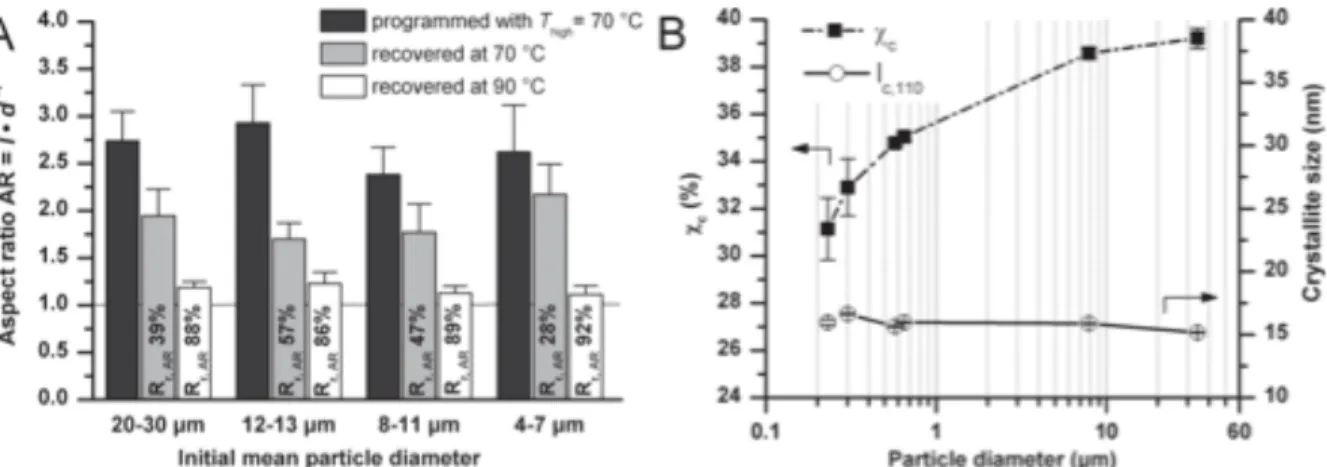
Figure 1.3 - Limits of miniaturization. (a) Full shape memory functionality of shape memory particles > 4 – 7 µm with excellent shape fixity and recovery. (b) Impact of particle size on crystallinity (Χc) and crystallite sizes, as
measured by wide-angle x-ray spectroscopy...4
Figure 1.4 - Micro- and nanoscale shape memory particle transformations. Fluorescent microscope images are shown with corresponding scanning electron microscopy images as insets. The bottom image demonstrates the ability to make nanoscale
shape memory particles...5
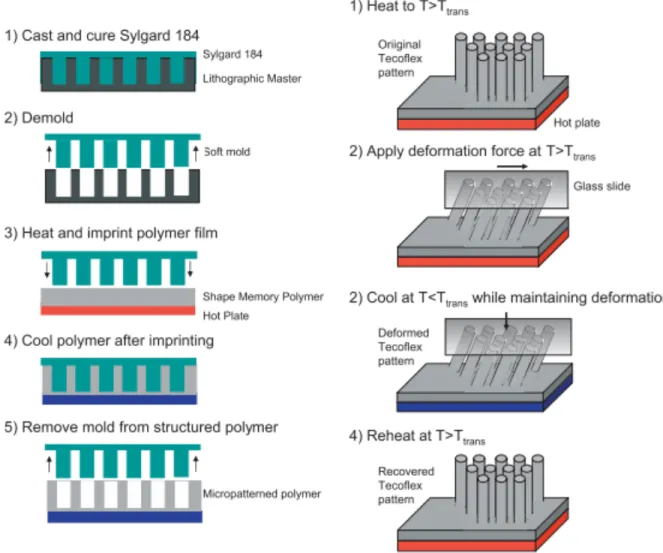
Figure 1.5 - (Left) Micropillars are embossed using imprint lithography. (Right) Shape
memory programming of micropillars...7
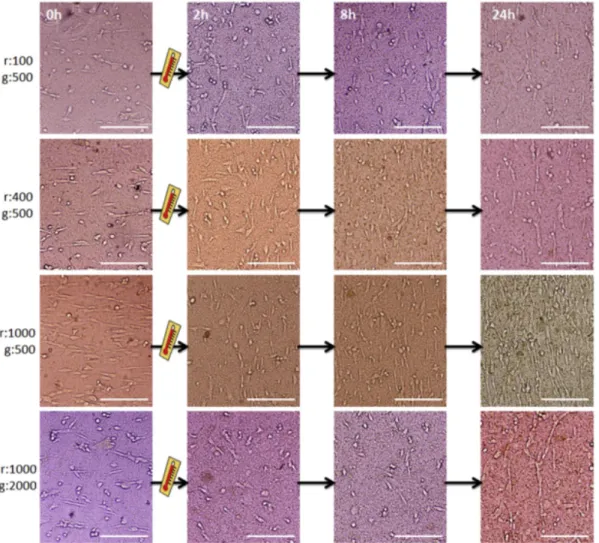
Figure 1.6 - Human mesenchymal stem cells on PCL films. (e) Cells cultured on PCL programmed with arrays of 3 µm x 5 µm channels align significantly along the channel axis. (f) Upon return to the equilbirum topography, cell
alignment dissipates in response to surface transformations...8
Figure 1.7 - Cell alignment over time on nanostructured PCL surfaces. Groove
alignment changes by 90° upon shape memory actuation...8
Figure 1.8 - Macro-, micro-, and nanoscale shape memory programming and actuation. (a) A curly equilibrium film (3 cm in length) that has been programmed in a straight temporary shape is able to recover to the curly shape upon heating above its Tm. The micro- and nanoscopic shape transitions show (b) 10 × 1 µm boomerang shapes to 3 × 3 × 3 µm cubes and then back to boomerangs, (c) flat to 3 × 1 µm hexnuts and then return to the flat film, and (d) SEM of transition from 200 nm posts to 3 × 3 × 3 µm and then back to 200 nm posts. The residual cube shape is less than hundreds of nanometers
Figure 1.10 - Thermoresponsive wettability for a flat PNIPAAm-modified surface. (a) Change of water drop profile when temperature was elevated from 25 °C (left) to 40 °C (right) with water contact angles of 63.5 ± 2.6° and 93.2 ± 2°, respectively. (b) Diagram of reversible formation of intermolecular hydrogen bonding between PNIPAAm chains and water molecules (left) and intramolecular hydrogen bonding between C=O and N-H groups in PNIPAAm chains (right) below and above the LCST, which is considered to be the molecular mechanism of the thermally responsive
wettability of a PNIPAAm thin film...12
Figure 1.11 - (a) The photoisomerizing polymer poly{2-hydroxyethyl methacrylate}y- co-{6-[3-((trifluoromethyl)phenyl)azo]phenoxylhexyl methacrylate}x.
(b) Reversible wettability as measured by contact angle goniometry for a 11 layer LB film of the photoisomerizing polymer. (c) Schematic
representation of cis-trans isomerization of the LB films...13
Figure 1.12 - Schematic of the transition of a perfluorinated side-chain LCP
between the smectic and the isotropic phase...14
Figure 1.13 - Schematic of a microstructured LC elastomer with switchable
wettability around the nematic-isotropic transition...14
Figure 1.14 - Covalent chemical crosslinks (purple squares) and physical crosslinks (crystallites) are both present in semi-crystalline elastomers, and each is responsible for encoding a unique shape. It is possible to reversibly switch
between these two shapes by partial melting and subsequent cooling...16
Figure 1.15 - Schematic of equilibrium considerations in supramolecular polymer materials. a) An equilibrium between two states “A” and “B” serves as a
model for the reversible supramolecular interactions discussed here. k1 governs the formation of B, and k-1 governs the formation of A, and the equilibrium constant K is the ratio of k1 and k-1. (b) Schematic of the equilibrium between disassociated supramolecular units and a supramolecular polymer, governed by the rate of association (ka) and the rate of dissociation (kd). (c) Schematic
of the equilibrium between an alternative set of supramolecular monomers...18
Figure 1.16 - (a) The polymer bearing triethylenedioxy-diimide electron acceptors and (b) the polymer bearing pyrenyl electron donors together form (c) a
supramolecular network under appropriate conditions...19
Figure 1.17 - Partially neutralized poly(ethylene-co-methacrylic acid), an ionomer
with self-healing capabilities...20
Figure 1.18 - Structure of the metal-ligand binding interaction of 2,6-bis(benzimidazolyl)- 4-oxypyridine with Zn2+, and a schematic representation of the chain extension
Figure 1.19 - Schematic of UPy structure and binding mode...21 Figure 1.20 - Schematic of hydrogen bonding between an adenine-functionalized
silicon surface and thymine-functionalized polystyrene...22 Figure 1.21 - (a) Schematic representing the improved adhesion between polystyrene
and a glass or silicon surface due to hydrogen bonding across the interface (b) structures and binding mode of the ureido-7-deazaguanine (DeUG) and
2,7-diamidonaphthyridine (DAN) units...22 Figure 1.22 - (a) Schematic illustrating that scission in conventional polystyrene-b-
poly(butyl acrylate)-b-polystyene triblock copolymers cannot be healed with a stimulus such as heat or light. (b) Schematic illustrating that supramolecular triblock copolymers can be healed due to the dimerization of UPy-like units in
the soft poly(butyl acrylate) phase...23 Figure 1.23 - UPy-functionalized poly(ethylene-co-butylene) was used to make
adhesives capable of bonding and debonding on demand due to association
or dissociation of the UPy dimers...24 Figure 1.24 - Schematic of a lap shear joint, consisting of two adherands joined by an
adhesive, which is composed of a bulk region and two small interphase regions
< 10 nm in thickness between the bulk adhesive and the adherands...25 Figure 1.25 - Structures of (a) poly(vinyl alcohol) and (b) poly(ethylene-co-vinyl
acetate) adhesives...26 Figure 1.26 - Structures of common AICP glues including (a) epoxies (b) cyanoacrylates
and (c) polyurethanes...26 Figure 1.27 - Schematic illustrating the adhesion and degradation of an adhesive
consisting of poly(ethylene glycol) endfunctionalized with dopamine mimics via dipeptide linkers. The polymer crosslinks oxidatively and binds to a tissue substrate to form an adhesive hydrogel. Neutrophil elastase cleaves the dipeptide
bond and degrades the network...27 Figure 1.28 - Structure of the poly(ester urea)-based adhesive bearing pendant
catechol moieties developed by Becker...28 Figure 1.29 - Switchable structural adhesives inspired by the texture of gecko feet.
Figure 1.31 - Common cations incorporated into ionic liquids...31 Figure 1.32 - An assortment of battery architectures. The thinness, flexibility and
lightness of the plastic electrolyte shown in (d) is unique and opens up
possibilities for miniaturization in technology...32 Figure 1.33 - Schematic of molecular ordering in liquids, nematic liquid crystals,
and smectic liquid crystals...33 Figure 1.34 - A poly(ethylene oxide-b-6-(4’-cyanobiphenyl-4-yloxy)-hexyl
methacrylate) polymer electrolyte developed by Majewski et al. aligns
with cylindrical PEG domains in the current flow direction...34 Figure 1.35 - Processing conditions determined the domain orientation of
poly(styrenesulfonate-b-methylbutylene), with consequences for
conduction anisotropy...34 Figure 1.36 - (a) Schematic of the nematic self-assembly of PBDT in water, forming
an aligned hydrophilic phase for water and Na+ transport. (b) The hexagonal
lattice model for the PBDT phase...35 Figure 2.1 - Synthesis and structure of poly(octylene adipate)-co-poly
(octylene diazoadipate)...49 Figure 2.2 - Endfunctionalizion of POAOD to yield methacrylate-functionalized oligomers...50 Figure 2.3 - Shape programming process consisting of two steps: (i) embossing of
a substrate with equilibrium surface topography and (ii) uniaxial compression
at an elevated temperature followed by quenching to a metastable shape...51 Figure 2.4 - SEM images of surfaces embossed with (a) boomerangs, (b) elbows,
and (c) cubes in their equilibrium states, and (d-f) the same surfaces after programming into their metastable states. Surfaces viewed at a 45° tilt.
Scale bars are 10 µm...52 Figure 2.5 - AFM images of boomerang substrates in their (a) equilibrium textured
and (b) metastable flat topographies. Height scale is in nanometers.
(c) For a given Ti = 45 °C, elongation and compression of boomerang features
is shown to be reversible over multiple heating and cooling cycles...53 Figure 2.6 - The surface RSM process is dependent on the partial melting temperature
at intermediate values of Ti...55 Figure 2.7 - GCAs of the embossed substrates (POAOD10:90, Tm = 53 °C) are
reversibly modulated by repeated heating and cooling between T = 25 °C
and T = 50 °C. All GCAs are measured at t = 15 s after deposition...56 Figure 2.8 - (a) Schematic illustrating the dimensions and bending mechanism of
7 x 14 µm pillar equilibrium and metastable topographies programmed for
RSM. (b) SEM images of the pillar substrates in equilibrium and metastable states...58 Figure 2.9 - Light microscopy images confirm the reversible bending and unbending
of the pillar topography with partial melting and subsequent cooling over
multiple cycles...59 Figure 3.1 - Synthesis, fabrication, and utility of UPy-functionalized poly(butylene
malonate) adhesives capable of bonding and debonding on demand. (a) Synthesis of poly(butylene malonate) (PBM) and image of the viscous liquid product (b) endfunctionalization of PBM with ureidopyrimidinone moieties (UPy-PBM) and image of the solid product. (c) Fabrication of adhesive joints utilizing UPy-PBM adhesive. A melt-pressed film of UPy-PBM is first secured between two glass slides before heating at 150 °C for 30 - 90 seconds. (d) Still images from video showing the de-bonding of the supramolecular UPy-PBM adhesive
with applied heat. (e) Schematic indicating the key features of a single-lap joint...69 Figure 3.2 - Adhesive thickness and joint maximum shear stress are inversely
related. (a) Representative stress-strain plots of UPy-PBM 1k adhesive joints of varying thicknesses. Strain rate = 1 mm/min. (b) Maximum shear stress of UPy-PBM 1k adhesive joints after the initial cure (black squares), the second cure (striped squares) and third cure (white squares) plotted with
respect to adhesive thickness...73 Figure 3.3 - DSC data (second heat) for PBM 1k and UPy-PBM 1k (light grey),
PBM 5.2k and UPy-PBM 5.2k (dark grey), and PBM 7.6k and UPy-PBM 7.6k (black). PBM data is shown as a dashed line, and UPy-PBM data is
shown as a solid line...74 Figure 3.4 - Representative stress-strain curves for bulk UPy-PBM 1k (light grey),
UPy-PBM 5.2k (dark grey), UPy-PBM 7.6k (black)...76 Figure 3.5 - Effect of UPy-PBM molecular weight and adhesive thickness on maximum
shear stress for adhesive joints utilizing UPy-PBM 1k (light grey), UPy-PBM
Figure 4.1 - Synthesis of sulfonated aramid electrolytes (a) Na-PBDT and (b) Na-PBDI through interfacial polymerization, and (c) Li-PBDT
via dialysis of Na-PBDT...87 Figure 4.2 - Polarized optical microscopy images of a) Na-PBDT, b) Na-PBDI and
c) Li-PBDT...87 Figure 4.3 - (a) Schematic illustrating dialysis of PBDT in DI H2O. (b) The wt% of
chloride ions present with respect to PDBT decreases with successive exchanges of the DI H2O reservoir. After five washing steps, the concentration of chloride ions is too small to detect using Mohr’s titration method, so wt% Cl is not
calculated for the final two washing steps...89 Figure 4.4 - Energy dispersive spectroscopy data for (a) Na-PBDT and (b) Li-PBDT,
as isolated via dialysis of Na-PBDT with an excess of LiCl...90 Figure 4.5 - Gel permeation chromatography trace of Na-PBDT (blue) and Li-PBDT
(red). Li-PBDT was obtained by dialysis of Na-PBDT, and the similarities in the molecular weight distributions of the two species indicate that there is no
major change in the hydrodynamic volume of PBDT after ion exchange...91 Figure 4.6 - Differential scanning calorimetry data for sulfonated polymaramid
samples do not exhibit any thermal transitions...92 Figure 4.7 - Polarizing optical microscopy images of composites of Na-PBDT
with PEG 300. The images of a) 40 wt% Na-PBDT, b) 33 wt% Na-PBDT, c) 25 wt% Na-PBDT and d) 20 wt% Na-PBDT show that anisotropy decreases
with increasing PEG 300 content...93 Figure 4.8 - Images of composite films of Na-PBDT and PEG 300 including
a) 10 wt% Na-PBDT in PEG 300, b) 20 wt% Na-PBDT in PEG 300, c) 30 wt% Na-PBDT in PEG 300 and d) 40 wt% Na-PBDT in PEG 300. As the concentration of Na-PBDT increases, the films become more brittle
and opaque...94 Figure 4.9 - Solutions of Li-PBDT and PEG 300 in DI H2O. Samples (1) and (2)
contain only 10 wt% Li-PBDT with various amounts of Li(NTf2) in DI H2O, and are liquids. Sample (3) contains a higher amount of Li-PBDT with 30 mol% Li(NTf2) and flows slowly. Sample (4) also contains 20 wt% Li-PBDT, but with
CHAPTER 1: INTRODUCTION TO DYNAMIC MATERIALS 1.1 Shape Memory Materials
1.1.a. Introduction to Shape Memory
In the past few decades, scientists have developed sophisticated dynamic materials capable of changing shape in response to a stimulus, including liquid crystalline polymers,1 azobenzene-based polymers,2 lower critical solution temperature materials,3 and shape memory polymers. Shape memory polymers (SMPs) are a class of dynamic materials that can be programmed to transition from one encoded shape to a second encoded shape upon the application of a stimulus such as heat,4 light,5 or magnetic fields.6 SMPs are often the most viable option as biological mimics and for engineering applications, since they are the only stimuli-responsive material in which both material shapes may be programmed. Therefore, shape transitions in SMPs are wholly programmable, and not an intrinsic result of motions at the molecular scale.
each programmable transformation may only occur once. Such inherent irreversibility obstructs truly dynamic, responsive behavior in shape memory polymers.
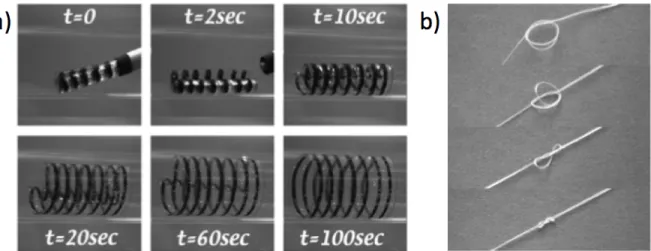
Figure 1. Shape memory polymers have potential use in biomedical applications. (a) A shape memory stent transitions from a compact state to a deployed state.8 (b) Self-tying sutures at varying stages in a shape memory transition.4
crystalline regions within the sample melt and the polymer relaxes to its entropically preferred equilibrium shape encoded by chemical crosslinks. This process results in irreversible, one-way actuation; once the crystallites are removed by melting, all memory of the temporary shape is lost.
The ability of a shape memory material to fix its metastable shape is quantified by shape fixity, Rf(%)=(εu/εm)x100, where εu is strain after unloading and εm is temporal strain after deformation. The subsequent application of a certain external stimulus restores the original shape. The ability to restore the permanent shape is quantified by shape recovery, Rr(%) = (εu- εp)/(εm- εp), where εp is the permanent strain after heat induced recovery.9
Figure 2. Shape memory programming and activation of a semi-crystalline thermoset. The original sample is heated to melt all crystallites, deformed, and cooled to produce crystallites that secure the temporary shape. Upon heating above the Tm the crystallites melt and the sample returns to the original shape.
1.1.b. Shape Memory Miniaturization
the mold used and the deformations applied. The current interest in miniaturization, however, has prompted the quest for smaller shape shifters.13,14 The mechanism for shape memory in semi-crystalline elastomers requires two types of crosslinks in order to function: chemical crosslinks to encode the equilibrium shape, and crystallites (physical crosslinks) to encode the temporary shape. The size of these crosslinks therefore determines the resolution possible with shape memory programming; programmed shapes must be larger than the crosslinks used to encode them. The crystallites are larger than the chemical crosslinks and therefore the limiting factor in determining shape resolution.
Lendlein and coworkers recently reported a thorough investigation into the resolution limitations for shape memory materials.15 According to their results, miniaturization is a viable option for shape memory polymer actuators. The group reported that crystallite size and overall polymer crystallinity in micron-sized polymer materials is sufficient for shape memory behavior, and they successfully programmed and actuated spherical particles as small as 4 – 7 µm in diameter (Figure 3).
Lendlein and coworkers were unable to prove the functionality of shape memory nanoparticles, but researchers in the Ashby lab have recently reported the first example of shape
memory micro- and nanoparticles fabricated from aliphatic polyesters in a variety of shapes utilizing Polymer Replication in Nonwetting Templates (PRINTTM) technology developed in the DeSimone laboratory.16,17 Their work mostly focused on the many shape memory transformations possible for microparticles, but they also included a proof-of-concept showing that nanoscale shape memory actuators are accessible as well (Figure 4).
1.1.c. Shape Memory Surfaces
The miniaturization of shape memory discussed previously can be applied to micropatterned surfaces as well. A surface serves as an interface between bulk material and the surrounding environment, and properties inherent to the surface such as topography and surface energy have a large influence on function. Dynamic surfaces capable of switching from one state to another are of interest for applications including switchable adhesion,18 optics,19-21 and cell signaling.22-24 Micropatterned shape memory surfaces can be fabricated with procedures similar to those discussed previously—equilibrium and temporary micropatterned topographies are programmed by distinct crosslinking networks, and actuation results in a switch from one surface topopraphy to another.
Micropatterned shape memory surfaces have proved particularly useful in a few key applications. Reddy et al. developed shape memory surfaces capable of switchable adhesion inspired by the unique topography of gecko footpads.18 The team utilized imprint lithography to emboss micropillars on a shape memory polymer (Figure 5), and saw significant changes in adhesion as quantified by indentation measurements.
growth and differentiation, are significantly affected by the surface topography of their extracellular matrix. Much work has gone towards understanding the mechanism behind this effect and developing patterned materials that can reliably dictate cellular processes.
Figure 5. (Left) Micropillars are embossed using imprint lithography. (Right) Shape memory programming of micropillars.18
Figure 6. Human mesenchymal stem cells on PCL films. (e) Cells cultured on PCL programmed with arrays of 3 µm x 5 µm channels align significantly along the channel axis. (f) Upon return to the equilbirum topography, cell alignment dissipates in response to surface transformations.22
According to a recent report in Polymer, nanostructured shape memory topographies can
dictate cellular alignment as well.24 Ebara et al. fabricated poly(ε-caprolactone) surfaces featuring nano-grooves that changed their orientation by 90° upon shape memory actuation
(Figure 7), and reported that the alignment of NIH 3T3 fibroblasts followed the alignment of
these nano-features.
Figure 8. Macro-, micro-, and nanoscale shape memory programming and actuation. (a) A curly equilibrium film (3 cm in length) that has been programmed in a straight temporary shape is able to recover to the curly shape upon heating above its Tm. The micro- and nanoscopic shape transitions show (b) 10 × 1 µm boomerang shapes to 3 × 3 × 3 µm cubes and then back to boomerangs, (c) flat to 3 × 1 µm hexnuts and then return to the flat film, and (D) SEM of transition from 200 nm posts to 3 × 3 × 3 µm and then back to 200 nm posts. The redidual cube shape is less than hundreds of nanometers in height, demonstrating a near complete transition.27
mm to 100 nm) was easily achieved, and the surface of the material was easily functionalized with a variety of alkynes (e.g., hydrophilic to hydrophobic and reactive to nonreactive) using copper-assisted Huisgen [3 + 2]-cycloaddition chemistry. The combination of micro- and nanoscopic shape memory with surface functionalization produced materials that could tunably switch both their surface chemistry and topography as they transitioned through the shape memory cycle. These materials are therefore ideal substrates for scenarios in which control of the surface chemistry and topography is critical.
Most recently, temperature memory surfaces have been investigated for dynamic signaling applications—researchers in Germany have imprinted quick response (QR) codes on semi-crystalline polyurethane elastomers and programmed them for temperature memory actuation.28 Upon heating, the QR code transforms from an unreadable distorted temporary state to a readable equilibrium shape (Figure 9). The team conjectures that this result could allow for the monitoring of excessive temperature changes of food or pharmaceuticals.
1.1.d. Reversible Shape Shifting
Shape memory polymers can exhibit highly complex shape transformations including complex coiling, knotting, and folding in response to a vast array of external stimuli.5,8 However, this advantage is offset by the intrinsic irreversibility of shape memory transformations. After a shape memory has returned to its equilibrium shape in response to an actuation event, the polymer cannot return to its temporary shape without a subsequent reprogramming step. Reversible switching between one shape and another can be advantageous for many applications which require multiple shape switching events between programming, including minimally invasive surgery8,29 and hands-free packaging.30,31
Figure 10. Thermoresponsive wettability for a flat PNIPAAm-modified surface. (a) Change of water drop profile when temperature was elevated from 25 °C (left) to 40 °C (right) with water contact angles of 63.5 ± 2.6° and 93.2 ± 2°, respectively. (b) Diagram of reversible formation of intermolecular hydrogen bonding between PNIPAAm chains and water molecules (left) and intramolecular hydrogen bonding between C=O and N-H groups in PNIPAAm chains (right) below and above the LCST, which is considered to be the molecular mechanism of the thermally responsive wettability of a PNIPAAm thin film.32
Figure 11. (a) The photoisomerizing polymer poly{2-hydroxyethyl methacrylate}y-co-{6-[3-((trifluoromethyl)phenyl)azo]phenoxylhexyl methacrylate}x. (b) Reversible wettability as measured by contact angle goniometry for a 11 layer LB film of the photoisomerizing polymer. (c) Schematic representation of cis-trans isomerization of the LB films.33
Liquid crystalline elastomeric materials are another viable source of reversible actuation.
Liquid crystalline polymers (LCPs) contain rod-like monomer units known as mesogens, which
impart long-range anisotropy to the LCP under certain conditions. The anisotropy of
thermotropic LCPs is temperature-dependent, and upon heating through the anistropic-isotropic
transition the long-range ordering disappears and macroscopic property changes occur. De
Crevoissier et al. synthesized a LC copolymer via radical polymerization from butyl acrylate and
an acrylate comonomer with a long perfluorinated sidechain. This polymer is a thermotropic
A) B)
Figure 12: Schematic of the transition of a perfluorinated side-chain LCP between the smectic and the isotropic phase.34
Probe tack testing indicated that tack energy per unit surface decreased considerably upon transitioning from the smectic to the isotropic regime. Because LC transitions are reversible, the adhesion and tack of this system can be modulated indefinitely.
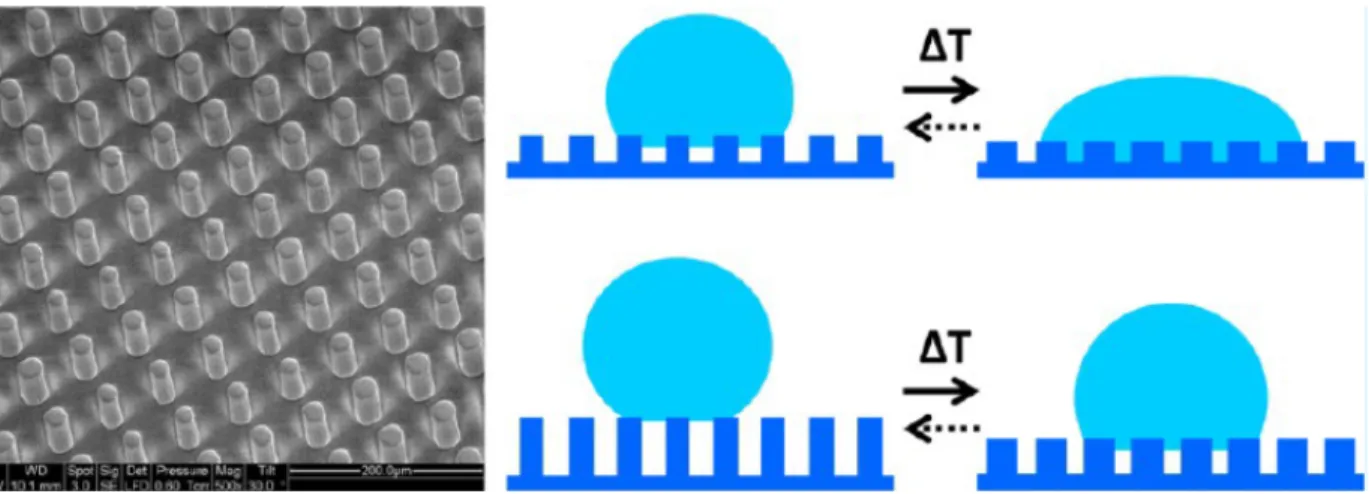
Wu et al. also utilized a thermotropic LCP to access to a surface with switchable wetting properties.35 An LC elastomer was patterned with microscale pillars, whose geometry changed when heated above the nematic-isotropic transition at 125 °C (Figure 13). The wettability of these reversibly switching surfaces was monitored via goniometry, and contact angle switches up to 40° were observed.
Figure 13: Schematic of a microstructured LC elastomer with switchable wettability around the nematic-isotropic transition.35
transitions (LCST, isomerization, liquid crystallinity) that cannot be modified, and therefore the only one of the material shapes or states can be programmed.
1.1.e Reversible Shape Memory
Biological systems have the ability to program reversible shape changes in response to cues from their environment. While a variety of adaptive and stimuli-responsive materials like hydrogels,37-42 liquid crystalline elastomers,1,43-45 and shape memory materials, 5,9,30,31,46-52, have been developed, mimicking programmable behavior in a reversible way remains elusive. Shape memory polymers (SMPs) have two distinct advantages in this domain: First, SMPs can exhibit highly complex shape transformations (coils, knots, and origami) in response to a vast array of external stimuli.5,48,53-56 Second, both initial and final shapes can be programmed and re-programmed multiple times. However, these advantages are offset by the intrinsic irreversibility of shape memory transformations.
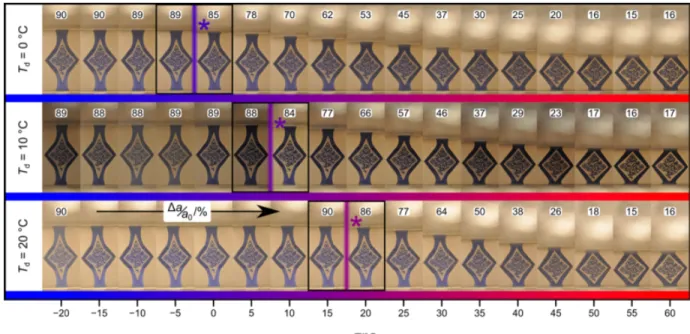
Figure 14: Covalent chemical crosslinks (purple squares) and physical crosslinks (crystallites) are both present in semi-crystalline elastomers, and each is responsible for encoding a unique shape. It is possible to reversibly switch between these two shapes by partial melting and subsequent cooling.
architectural scaffold within the semi-crystalline polymer. Reversibility of shape transformations is achieved through partial melting of this scaffold, leaving a latent template behind that in turn prompts recovery of the original shape on cooling by steering crystallization along kinetically preferred pathways to replicate the scaffold. By controlling the melting and recrystallization processes, we can shift and expand the reversibility range without the need to change the elastomer’s chemical structure. In sum, we have developed a general strategy for reversible shape memory (RSM) that can be applied to conventional semi-crystalline elastomers.
1.2 Dynamic Supramolecular Adhesives 1.2.a Introduction to Supramolecular Polymers
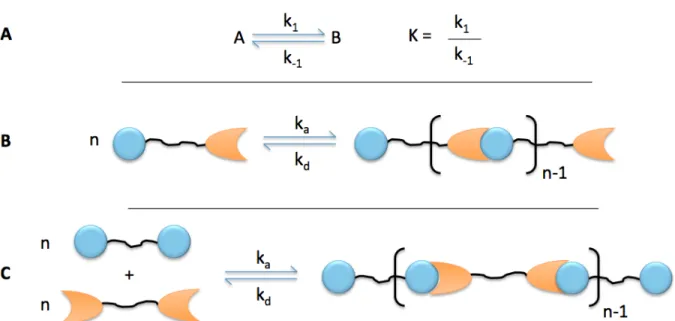
Figure 15: Schematic of equilibrium considerations in supramolecular polymer materials. (a) An equilibrium between two states “A” and “B” serves as a model for the reversible supramolecular interactions discussed here. k1 governs the formation of B, and k-1 governs the formation of A, and the equilibrium constant K is the ratio of k1 and k-1. (b) Schematic of the equilibrium between disassociated supramolecular units and a supramolecular polymer, governed by the rate of association (ka) and the rate of dissociation (kd). (c) Schematic of the equilibrium between an alternative set of supramolecular monomers.
The inherent reversibility of supramolecular interactions provides materials properties that are inaccessible with traditional covalent polymers. Many supramolecular polymers depolymerize as their temperature increases and thus have low melt viscosity at elevated temperatures, but maintain good mechanical properties at lower temperatures when the equilibrium favors polymerization.59 They are attractive candidates for applications in self-healing,60 adaptability,61 biological delivery,62 stimulus response,63 or switchable surface properties.64
A variety of secondary interactions can be utilized to generate supramolecular materials. For example, chain-folding copolymers containing donor and acceptor moieties capable of π-π stacking form supramolecular networks, as shown in Figure 16. This system consists of a mixture of two complimentary polymers bearing either pyrenyl or triethylenedioxy-diimide residues, and has the ability to self-heal damaged areas at elevated temperatures.65
Figure 16: (a) The polymer bearing triethylenedioxy-diimide electron acceptors and (b) the polymer bearing pyrenyl electron donors together form (c) a supramolecular network under appropriate conditions.65
Figure 17: Partially neutralized poly(ethylene-co-methacrylic acid), an ionomer with self-healing capabilities.66
Metal-ligand binding is another widely utilized secondary interaction used to generate supramolecular polymers. For instance, Beck et al. synthesized poly(tetrahydrofuran) endfunctionalized with the tetradentate ligand 2,6-bis(benzimidazolyl)-4-oxypyridine.67 A supramolecular network of these polyethers was formed in the presence of metal ions capable of binding in a 1:2 ratio such as Fe(II), Co(II), Zn(II), and Cd(II) (Figure 18).
Figure 18: Structure of the metal-ligand binding interaction of 2,6-bis(benzimidazolyl)-4-oxypyridine with Zn2+, and a schematic representation of the chain extension resulting from this secondary interaction.67,68
cause the molecules to form a hexagonal lattice upon crystallization, resulting in solid water (ice) that is less dense than liquid water and a planet Earth that is able to support life.70 Hydrogen bonding is a key feature in DNA as well—it is responsible for the assembly of DNA strands via the selective pairing of adenine-thymine and guanine-cytosine units.71
Figure 19: Schematic of UPy structure and binding mode.
Units bearing multiple hydrogen bonds (MHBs) are especially strong, and are therefore attractive for use in supramolecular materials. The ureidopyrimidinone (UPy) unit, for example, is a quadruple hydrogen bonding moiety with a donor-donor-acceptor-acceptor geometry (Figure 19) that has an interaction strength approaching that of covalent bonds (Table 1).72
Table 1: Selected interactions and bond strengths72 Interaction Type Strength (kJ/mol)
van der Waals 50
H-bonding 5-65
UPy 145
covalent 350
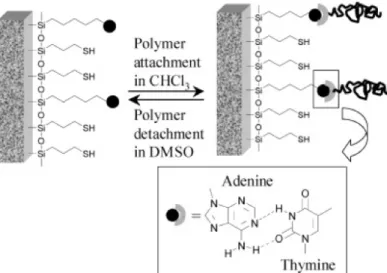
MHBs have been exploited in a variety of applications requiring reversibility. Zimmerman and Long have both found inspiration in DNA binding to develop supramolecular adhesives capable of bonding and debonding on demand.73,74 Long et al. synthesized polystyrene functionalized with thymine and showed that they could be reversibly attached and detached from a silicon surface functionalized with adenine (Figure 20).73
N NH
O N
Figure 20: Schematic of hydrogen bonding between an adenine-functionalized silicon surface and thymine-functionalized polystyrene.73
Zimmerman developed a similar system that utilized DNA base pair mimics to improve
the adhesion between a polymer and a glass or silicon surface. This work required surface
functionalization with ureido-7-deazaguanine units and polystyrene functionalization with
2,7-diamidonaphthyridine, and resulted in an improvement in the interfacial properties between the
polymer and the surface (Figure 21).74
Figure 22: (a) Schematic illustrating that scission in conventional polystyrene-b-poly(butyl acrylate)-b-polystyene triblock copolymers cannot be healed with a stimulus such as heat or light. (b) Schematic illustrating that supramolecular triblock copolymers can be healed due to the
dimerization of UPy-like units in the soft poly(butyl acrylate) phase.75
Zhibin Guan and coworkers synthesized supramolecular triblock copolymers of
polystyrene-b-poly(butyl acrylate)-b-polystrene with self-healing capabilities, due to the
presence of the modified UPy units as MHBs that dissociated upon stimulation and re-associated
to heal cracks and defects. These particular materials were an important improvement for
mechanically robust self-healing materials (Figure 22).75
UPy units are an attractive source of multiple hydrogen bonding for a number of reasons.
UPy dimerization is very strong72 as well as highly directional and reversible, which makes it an
ideal unit for accessing linear supramolecular polymerization.76 They are also
self-complementary due to their donor-donor-acceptor-acceptor type geometry, so it is not necessary
to consider endgroup stoichiometry in order to induce a large degree of supramolecular
polymerization.77 Furthermore, they are easy to synthesize and attach to a number of
Figure 23: UPy-functionalized poly(ethylene-co-butylene) was used to make adhesives capable of bonding and debonding on demand due to association or dissociation of the UPy dimers.79
Recently, Heinzmann et al. have developed the first example of a supramolecular
adhesive capable of bonding and debonding on demand in response to light as a stimulus.79 In
this report, hydroxyl-terminated poly(ethylene-co-butylene) was endfunctionalized with UPy
units via isocyanate chemistry, and then combined with a light-heat converter Tinuvin 326 in
order to fabricate supramolecular adhesives responsive to light or heat (Figure 23).
1.2.b. Introduction to Adhesion
An adhesive can be defined as a chemical substance used to join substrates together by
their surfaces, and takes a variety of forms in today’s manufacturing, biomedical, crafting, and
service sectors. The substrates, often referred to as adherands, may be identical or different, and
are often materials such as metal, wood, glass, paper, or plastic. A schematic representing the
primary components of a standard lap shear joint is shown in Figure 24. An adhesive is used to
join two adherands, making a joint structure. An interphase region < 10 nm in thickness exists
between the adherands and the bulk of the adhesive, and it is in this interphase that interactions
Figure 24: Schematic of a lap shear joint, consisting of two adherands joined by an adhesive, which is composed of a bulk region and two small interphase regions < 10 nm in thickness between the bulk adhesive and the adherands.
An adhesive is a polymeric material that must have sufficient adhesion and cohesion in
order to function well. Adhesion refers to the ability of an adhesive to establish and maintain
interaction with substrates, and is often correlated with the wetting ability of the adhesive.
Cohesion refers to an adhesive’s ability to maintain its structural integrity and thus the structural
integrity of the joint.
In order to perform its function, an adhesive must therefore be capable of flow and
wetting during application, but provide strength during use. There are three primary classes of
adhesives that are utilized in order to attain these orthogonal requirements: adhesives
implemented with physical processes (AIPPs), adhesives implemented with chemical processes
(AICPs), and pressure-sensitive adhesives.
AIPPs consist of pre-formed, usually linear, thermoplastic polymers that are deposited in
a liquid state, either as a solution, emulsion, or melt. As the solvent dissipates or the hot-melt
cools, the structural integrity of the joint increases until the cure is complete.80 Common AIPPs
Figure 25: Structure of (a) poly(vinyl alcohol) and (b) poly(ethylene-co-vinyl acetate) adhesives.
Prior to applications, AICPs consist primarily of monomers that polymerize during the
cure of the adhesive. These process results in the formation of crosslinked network thermosets,
and as such tend to have more robust mechanical properties post-cure than AIPPs.80 Many
AICPs are considered “structural adhesives” appropriate for applications requiring very strong
joints. Common AICPs include cyanoacrylates, polyurethanes and epoxies (Figure 26).
Figure 26: Structures of common AICP glues including (a) epoxies (b) cyanoacrylates and (c) polyurethanes.
PSAs are viscoelastic solids capable of establishing adhesive interactions with finger
pressure at room temperature. PSAs are often compounded with various waxes and tackifiers
and applied to substrates such as paper or polymer films for applications that require reversible
Figure 27: Schematic illustrating the adhesion and degradation of an adhesive consisting of poly(ethylene glycol) endfunctionalized with dopamine mimics via dipeptide linkers. The polymer crosslinks oxidatively and binds to a tissue substrate to form an adhesive hydrogel. Neutrophil elastase cleaves the dipeptide bond and degrades the network.81
The pervasive enthusiasm for environmentally friendly or “green” technologies has
extended to adhesives research as well. Much of this recent work has focused on adhesives
derived from renewable resources and adhesives capable of controlled degradation. Messersmith
et al. created a degradable adhesive hydrogel inspired by the byssal plaque protein in mussels
responsible for adhesion. This adhesive consisted of poly(ethylene glycol) endfunctionalized
with a catechol mimic (Figure 27). This adhesive exhibited good mechanical properties and was
degradable by neutrophil elastase, although degradation was targeted specifically to the dipeptide
linker used to join the catechol mimic to the poly(ethylene glycol) and did not result in
depolymerization of the poly(ethylene glycol).81
Becker et al. have also recently developed a mussel-inspired adhesive featuring dopamine
mimics. This adhesive is a poly(ester urea) functionalized along the backbone with pendant
dopamine-Figure 28: Structure of the poly(ester urea)-based adhesive bearing pendant catechol moieties developed by Becker.82
1.2.c. Reversible Adhesion
Certain adhesives have the ability to de-bond and re-bond reversibly on demand, a
capability that is desirable for a number of applications including modular crafting adhesives and
the painless removal of wound dressings.84 Their main utility, however, lies in the manufacturing
industry. Reversible adhesives capable of bonding and debonding on demand could find use in
repairing complex joints remotely without complete system disassembly, and could also be used
to facilitate easy materials separation during recycling processes.85
There are a number of techniques for accessing reversible adhesion, including
supramolecular techniques (discussed in Section 1.2.a.) and pressure-sensitive adhesives
(discussed in Section 1.2.b.). Structural adhesives are bio-inspired materials that mimic the
micro- and nanoscale surface textures present on gecko feet and other organisms for reversible
adhesion to smooth surfaces.86 Stimuli-responsive structural adhesives that can actuate remotely
in the presence of heat or light have been fabricated, including two shape memory substrates
patterned with fibrillar morphologies (Figure 29). These adhesive properties of these materials
Figure 29: Switchable structural adhesives inspired by the texture of gecko feet.86 (a) Shape memory actuation causes micropillars to return from a bent morphology to a straightened one, resulting in a change in the adhesive properties of the substrate.87 (b) A dual-layer structural adhesive comprising a shape memory polymer layer and an adhesive layer.88
1.3 Anisotropic Liquid Crystalline Polymer Electrolytes
1.3.a. Electrolytes: Structure and Function
Figure 30: Schematic illustration of the first lithium ion battery.91,92
One of the most prevalent liquid electrolyte systems is comprised of various alkyl
carbonates and LiPF6. Alkyl carbonates are attractive due to their stability for the 4-volt
cathodes used in lithium ion batteries as well as their high polarity (and thus good conductivity),
a large usable temperature range, and sufficiently low toxicity.93 Dimethyl carbonate is an
important component of this electrolyte system, but it is flammable and prevents the large-scale
application of lithium-ion batteries.94
Ionic liquids have the potential to be used as electrolytes in commercial applications as
well. Ionic liquids are molten salts at standard temperature and pressure, and have low vapor
pressure, high thermal stability, a wide electrochemical window, and high ionic conductivity.
The most common ionic species that are liquid at room temperature include alkylammonium,
addition, ionic liquids can be combined with polymeric systems in order to mechanical stability
and a persistent structure.96-97
Figure 31: Common cations incorporated into ionic liquids.95
Recently, attention has shifted towards developing polyelectrolytes for lithium-ion
battery applications. Polyelectrolytes are water-soluble polymers with many electrically charged
groups per molecule, 98 and they have the potential to address some of the most pressing
concerns in electrolyte stability and function. The solid electrolyte used in the Bellcore plastic
lithium ion (PLiON) electrolyte allowed for shape versatility, flexibility and lightness, and was
an important step forward in electronic miniaturization (Figure 32).99,100 There is, however,
Figure 32: An assortment of battery architectures. The thinness, flexibility and lightness of the plastic electrolyte shown in (d) is unique and opens up possibilities for miniaturization in technology.99
1.3.b. Liquid Crystalline Polymers
Liquid crystals are molecules that show crystal-like order but also flow like liquids. They
contain mesogens, which are anisotropic entities that cause anisotropy to occur in these species, and they can be either thermotropic (liquid crystalline in a given temperature range) or lyotropic
(liquid crystalline in solutions about a certain critical concentration).101 Some common liquid crystalline phases include the smectic phase, which displays directional anisotropy and coterminal molecular chain ends, and the nematic phase, which displays directional anisotropy
Figure 33: Schematic of molecular ordering in liquids, nematic liquid crystals, and smectic liquid crystals.102
Liquid crystalline polymers (LCPs) contain mesogenic repeat units, and can exhibit
analogous liquid crystalline phases (i.e. nematic, smectic, etc.) to their small molecule
counterparts. LCPs may include main-chain mesogens and/or side-chain mesogens, and these
architectures have consequences on the bulk properties of these materials. For instance, liquid
crystalline melts and solutions tend to have lower viscosities than non-liquid crystalline
polymers, and they are thus easier to process. The ordering of the polymer chains during
processing also tends to lend these materials favorable mechanical properties.102 Because the mesogens in LCPs tend to be aromatic moieties, LCPs also tend to be more thermally stable than
their aliphatic analogues.
1.3.c Anisotropic Liquid Crystalline Polyelectrolytes
The main drawback of polymer electrolytes is their inferior ion transport capabilities
compared to liquid electrolytes. In order to address this limitation, there has recently been
interest in developing anisotropic polymer electrolytes in order to improve conductivity between
the anode and cathode. Many groups have utilized the self-organization of block copolymers
incorporating liquid crystalline mesogens to address this issue. Majewski et al. have recently
Figure 34: A poly(ethylene oxide-b-6-(4’-cyanobiphenyl-4-yloxy)-hexyl methacrylate) polymer electrolyte developed by Majewski et al. aligns with cylindrical PEG domains in the current flow direction.103
Park et al. also reported that poly(styrenesulfonate-b-methylbutylene) could be aligned
through various methods to create oriented channels for ion transport. The observed domain
orientations were a direct consequence of processing conditions, and the conduction anisotropy
was quantified for each morphology (Figure 35).104
Figure 35: Processing conditions determined the domain orientation of poly(styrenesulfonate-b-methylbutylene), with consequences for conduction anisotropy.104
The synthetic sulfonated aramid polyelectrolyte poly(2,2’-disulfonylbenzidene
terephthalamide) (PBDT), though previously reported,105 has received renewed interest for ion
transport applications. This lyotropic LC polymer forms a nematic phase in water above 1.2
wt%, and exhibits promising alignment and ion transport properties. The PBDT chains can be
easily aligned in the presence of a magnetic field, and the resulting hexagonal lattice induces
aligned hydrophilic channels capable of water and Na+ transport (Figure 36).106 PBDT
membranes can also be ionically crosslinked via substitution of a multivalent cation such as
REFERENCES
1. Ohm, C.; Serra, C.; Zentel, R. A Continuous Flow Synthesis of Micrometer-Sized Actuators from Liquid Crystalline Elastomers. Adv. Mater. 2009, 21, 4859-4862.
2. Feng, C.L.; Zhang, Y.J.; Jin, J.; Song, Y.L.; Xie, L.Y.; Qu, G.R.; Jiang, L.; Zhu, D.B. Reversible Wettability of Photoresponsive Fluorine-Containing Azobenzene Polymer in Langmuir-Blodgett Films. Langmuir 2001, 17, 4593−4597.
3. Sun, T.; Feng, L.; Gao, X.; Jiang, L. Bioinspired Surfaces with Special Wettability. Acc. Chem. Res. 2005, 38, 644−652.
4. Lendlein, A.; Langer, R. Biodegradable, Elastic Shape-Memory Polymers for Potential Biomedical Applications. Science 2002, 296, 1673-1676.
5. Lendlein, A.; Jiang, H.; Jünger, O.; Langer, R. Light-Induced Shape-Memory Polymers. Nature 2005, 434, 879-882.
6. Mohr, R.; Kratz, K.; Weigel, T.; Lucka-Gabor, M.; Moneke, M.; Lendlein, A. Initiation of Shape-Memory Effect by Inductive Heating of Magnetic Nanoparticles in Thermoplastic Polymers. Proc. Natl. Acad. Sci. 2006, 103, 3540-3545.
7. Lendlein, A.; Schmidt, A.M.; Langer, R. AB-Polymer Networks Based on Oligo(ε-Caprolactone) Segments Showing Shape-Memory Properties. Proc. Natl. Acad. Sci. 2001, 98, 842-847.
8. Yakacki, C. M.; Shandas, R.; Lanning, C.; Rech, B.; Eckstein, A.; Gall, K. Unconstrained Recovery Characterization of Shape-Memory Polymer Networks for Cardiovascular Applications. Biomaterials 2007, 28, 2255−2263.
9. Mather, P.T.; Luo, X.; Rousseau, I.A. Shape Memory Polymer Research. Annu. Rev. Mater. Res. 2009, 39, 445-471.
10. Zhang, D.; Giese, M. L.; Prukop, S. L.; Grunlan, M. A. Poly(ε-caprolactone)-Based Shape Memory Polymers with Variable Polydimethylsiloxane Soft Segment Lengths. J. Polym. Sci.: Part A.: Polym. Chem. 2011, 49, 754-761.
11. Kunzelman, J.; Chung, T.; Mather, P. T.; Weder, C. Shape Memory Polymers with Built-In Threshold Temperature Sensors. J. Mater. Chem. 2008, 18, 1082-1086.
12. Changdeng, L.; Chun, S. B.; Mather, P. T.; Zheng, L.; Haley, E. S.; Coughlin, E. B. Chemically Cross-Linked Polycyclooctene: Synthesis, Characterization, and Shape Memory Behavior. Macromolecules 2002, 35, 9868-9874.
Proc. Natl. Acad. Sci. USA 2010, 107, 11205-11210.
15. Wischke, C.; Schossig, M.; Lendlein, A. Shape-Memory Effect of Micro-/Nanoparticles from Thermoplastic Multiblock Copolymers. Small 2014, 10, 83-87.
16. Brosnan, S. M.; Jackson, A. –M. S.; Wang, Y.; Ashby, V. S. Shape Memory Particles Capable of Controlled Geometric and Chemical Asymmetry Made from Aliphatic Polyesters. Macromol. Rapid Commun. 2014, 35, 1653-1660.
17. Wang, Y.; Merkel, T. J.; Chen, K.; Fromen, C. A.; Betts, D. E.; DeSimone, J. M. Generation of a Library of Particles Having Controlled Sizes and Shapes via the Mechanical Elongation of Master Templates. Langmuir 2011, 27, 524-528.
18. Reddy, S.; Arzt, E.; del Campo, A. Bioinspired Surfaces with Switchable Adhesion. Adv. Mater. 2007, 19, 3833-3837.
19. Xu, H.; Yu, C.; Wang, S.; Malyarchuk, V.; Xie, T.; Rogers, J. A. Deformable, Programmable, and Shape-Memorizing Micro-Optics. Adv. Funct. Mater. 2013, 23, 3299-3306.
20. Li, J.; Shim, J.; Deng, J.; Overvelde, J. T. B.; Zhu, X.; Bertoldi, K.; Yang, S. Switching Periodic Membranes Via Pattern Transformation and Shape Memory Effect. Soft Matter, 2012, 8, 10322-10328.
21. Tippets, C. A.; Li, Q.; Fu, Y.; Donev, E. U.; Zhou, J.; Turner, S. A.; Jackson, A. –M. S.; Ashby, V. S.; Sheiko, S. S.; Lopez, R. Dynamic Optical Gratings Accessed by Reversible Shape Memory. ACS Appl. Mater. Interfaces 2015, accepted. DOI: 10.1021/acsami.5b02688
22. Le, D. M.; Kulangara, K.; Adler, A. F.; Leong, K. W.; Ashby, V. S. Dynamic Topographical Control of Mesenchymal Stem Cells by Culture on Responsive Poly(ε-caprolactone) Surfaces. Adv. Mater. 2011, 23, 3278-3283.
23. Davis, K. A.; Burke, K. A.; Mather, P. T.; Henderson, J. H. Dynamic Cell Behavior on Shape Memory Polymer Substrates. Biomaterials 2011, 32, 2285-2293.
24. Ebara, M.; Akimoto, M.; Uto, K.; Shiba, K.; Yoshikawa, G.; Aoyagi, T. Focus on the Interlude Between Topographic Transition and Cell Response on Shape-Memory Surfaces. Polymer 2014, 55, 5961-5968.
25. Ebara, M.; Uto, K.; Idota, N.; Hoffman, J. M.; Aoyagi, T. Rewritable and Shape-Memory Soft Matter with Dynamically Tunable Microchannel Geometry in a Biological Temperature Range. Soft Matter 2013, 9, 3074-3080.
28. Fritzsche, N.; Pretsch, T. Programming of Temperature-Memory Onsets in a Semicrystalline Polyurethane Elastomer. Macromolecules 2014, 47, 5952-5959.
29. Serrano, M. C.; Ameer, G. A. Recent Insights into the Biomedical Applications of Shape-Memory Polymers. Macromol. Biosci. 2012, 12, 1156−1171
30. Behl, M.; Razzaq, M. Y.; Lendlein, A. Multifunctional Shape-Memory Polymers. Adv. Mater. 2010, 22, 3388−3410.
31. Sun, L.; Huang, W. M.; Ding, Z.; Zhao, Y.; Wang, C. C.; Purnawali, H.; Tang, C. Stimulus-Responsive Shape Memory Materials: A Review. Mater. Des. 2012, 33, 577−640.
32. Sun, T.; Wang, G.; Feng, L.; Liu, B.; Ma, Y.; Jiang, L.; Zhu, D. Reversible Switching Between Superhydrophilicity and Superhydrophobicity. Angew. Chem., Int. Ed. 2004, 43, 357−360.
33. Feng, C. L.; Zhang, Y. J.; Jin, J.; Song, Y. L.; Xie, L. Y.; Qu, G. R.; Jiang, L.; Zhu, D. B. Reversible Wettability of Photoresponsive Fluorine-Containing Azobenzene Polymer in Langmuir-Blodgett Films. Langmuir 2001, 17, 4593−4597.
34. De Crevoisier, G.; Fabre, P.; Corpart, J.-M.; Leibler, L. Switchable Tackiness and Wettability of a Liquid Crystalline Polymer. Science 1999, 285, 1246−1249.
35. Wu, Z. L.; Wei, R.; Buguin, A.; Taulemesse, J.-M.; Le Moigne, N.; Bergeret, A.; Wang, X.; Keller, P. Stimuli-Responsive Topological Change of Microstructured Surfaces and the Resultant Variations of Wetting Properties. ACS Appl. Mater. Interfaces 2013, 5, 7485−7491.
36. Natansohn, A.; Rochon, P. Photoinduced Motions in Azo-Containing Polymers. Chem. Rev. 2002, 102, 4139-4175.
37. Yoshida, R.; Uchida, K.; Kaneko, Y.; Sakai, K.; Kikuchi, A.; Sakurai, Y.; Okano, T. Comb-Type Grafted Hydrogels with Rapid De-Swelling Response to Temperature Changes. Nature 1995, 374, 240-242.
38. Osada, Y.; Matsuda, A. Shape Memory in Hydrogels. Nature, 1995, 376, 219-219.
39. Hao, J. K.; Weiss, R. A. Mechanically Tough, Thermally Activated Shape Memory Hydrogels. ACS Macro Lett. 2013, 2, 86-89.
40. Skrzeszewska, P. J.; Jong, L. N.; de Wolf, F. A.; Stuart, M. A. C.; van der Gucht, J. Shape-Memory Effects in Biopolymer Networks with Collagen-Like Transient Nodes. Biomacromolecules 2011, 12, 2285-2292.
41. Therien-Aubin, H.; Wu, Z. L.; Nie, Z. H.; Kumacheva, E. Multiple Shape Transformations of Composite Hydrogel Sheets. J. Am. Chem. Soc. 2013, 135, 4834-4839.
51, 1084-1099.
43. Camacho-Lopez, M.; Finkelmann, H.; Palffy-Muhoray, P.; Shelley, M. Fast Liquid-Crystal Elastomer Swims Into the Dark. Nat. Mater. 2004, 3, 307-310.
44.Yu, H. F.; Ikeda, T. Photocontrollable Liquid-Crystalline Actuators. Adv. Mater. 2011, 23, 2149-2180.
45. Yang, Z. Q.; Huck, W. T. S.; Clarke, S. M.; Tajbakhsh, A. R.; Terentjev, E. M. Shape-Memory Nanoparticles from Inherently Non-Spherical Polymer Colloids. Nat. Mater. 2005, 4, 486-490.
46.Koerner, H.; Price, G.; Pearce, N. A.; Alexander, M.; Vaia, R. A. Remotely Actuated Polymer Nanocomposites-Stress-Recovery of Carbon-Nanotube-Filled Thermoplastic Elastomers. Nat. Mater. 2004, 3, 115-120.
47. Hsiao, B. S.; Gardner, K. H.; Wu, D. Q.; Chu, B. Time-Resolved X-Ray Study of Poly(Aryl ether ether ketone) Crystallization and Melting Behavior. I. Crystallization. Polymer 1993, 34, 3986-3995.
48. Yu, Y. L.; Nakano, M.; Ikeda, T. Photomechanics: Directed Bending of a Polymer Film by Light. Nature 2003, 425, 145-145.
49. Xie, T. Tunable Polymer Multi-Shape Memory Effect. Nature 2010, 464, 267-270.
50. Liu, C.; Qin, H.; Mather, P. T.; Review of Progress in Shape-Memory Polymers. J. Mater. Chem. 2007, 17, 1543-1558.
51. Li, G.; Fei, G. X.; Xia, H. S.; Han, J. J.; Zhao, Y. Spatial and Temporal Control of Shape Memory Polymers and Simultaneous Drug Release Using High Intensity Focused Ultrasound. J. Mater. Chem. 2012, 22, 7692-7696.
52. Meng, H.; Li, G. Q.; A Review of Stimuli-Responsive Shape Memory Polymer Composites. Polymer 2013, 54, 2199-2221.
53. Yakacki, C. M.; Gall, K. Memory Polymers for Biomedical Applications. In Shape-Memory Polymers; Advances in Science 226; Springer: Berlin, 2010; pp 147-175.
54. Zhu, Z. C.; Senses, E.; Akcora, P.; Sukhishvili, S. A. Programmable Ligh-Controlled Shape Changes in Layered Polymer Nanocomposites. ACS Nano 2012, 6, 3152-3162.
57. Armstrong, G.; Buggy, M. Hydrogen-Bonded Supramolecular Polymers: A Review. J. Mater. Sci. 2005, 40, 547-559.
58. Heinzmann, C.; Coulibaly, S.; Roulin, A.; Fiore, G. L.; Weder, C. Light-Induced Bonding and Debonding with Supramolecular Adhesives. ACS. Appl. Mater. Interfaces 2014, 6, 4713-4719.
59. Neikirk, C. C.; Chung, J. W.; Priestley, R. D. Thermomechanical Behavior of Hydrogen-Bond Based Supramolecular Poly(ε-Caprolactone)-Silica Nanocomposites. RSC Advances 2013, 3, 16686-16696.
60. Yang, Y.; Urban, M. W. Self-Healing Polymeric Materials. Chem. Soc. Rev. 2013, 42, 7446-7667.
61. Wojtecki, R. J.; Meador, M. A.; Rowan, S. J. Using the Dyanamic Bond to Access Macroscopically Responsive Structurally Dynamic Polymers. Nat. Mater. 2010, 10, 14-27.
62. Bastings, M. M. C.; Koudstaal, S.; Kieltyka, R. E.; Nakano, Y.; Pape, A. C. H.; Feyen, D. A. M.; van Slochteren, F. J.; Doevendans, P. A.; Sluijter, J. P. G.; Meijer, E. W.; Chamuleau, S. A. J.; Dankers, P. Y. W. A Fast pH-Switchable and Self-Healing Supramolecular Hydrogel Carrier for Guided, Local Catheter Injection in the Infarcted Myocardium. Adv. Healthcare Mater. 2014, 3, 70-78.
63. Biyani, M. V.; Foster, E. V.; Weder, C. Light-Healable Supramolecular Nanocomposites Based on Modified Cellulose Nanocrystals. ACS Macro Lett. 2013, 2, 236-240.
64. Viswanathan, K.; Ozhalici, H.; Elkins, C. L.; Heisey, C.; Ward, T. C.; Long, T. E. Multiple Hydrogen Bonding for Reversible Polymer Surface Adhesion. Langmuir, 2006, 22, 1009-1105.
65. Burattini, S.; Colquhoun, H. M.; Fox, J. D.; Friedmann, D.; Greenland, B. W.; Harris, P. J. F.; Hayes, W.; Mackay, M. E.; Rowan, S. J. A Self-Repairing, Supramolecular Polymer System: Healability as a Consequence of Donor-Acceptor π- π Stacking Interactions. Chem. Commun. 2009, 6717-6719.
66. Varley, R. J.; Shen, S.; van der Zwaag, S. The Effect of Cluster Plasticization on the Self Healing Behaviour of Ionomers. Polymer 2010, 51, 679-686.
67. Beck, J. B.; Ineman, J. M.; Rowan, S. J. Metal/Ligand-Induced Formation of Metallo-Supramolecular Polymers. Macromolecules 2005, 38, 5060-5068.
68. Fox, J. D.; Rowan, S. J. Supramolecular Polymerization and Main-Chain Supramolecular Polymers. Macromolecules 2009, 42, 6823-6835.
69. Steiner, T. The Hydrogen Bond in the Solid State. Angew. Chem. Int. Ed. 2002, 41, 48-76.
71. Khakshoor, O.; Wheeler, S. E.; Houk, K. N.; Kool, E. T. Measurement and Theory of Hydrogen Bonding Contribution to Isosteric DNA Base Pairs. J. Am. Chem. Soc. 2012, 134, 3154-3163.
72. Faul, C. F. J.; Antonietti, M. Ionic Self-Assembly: Facile Synthesis of Supramolecular Materials. Adv. Mater. 2003, 15, 673-683.
73. Viswanathan, K.; Ozhalici, H.; Elkins, C. L.; Heisey, C.; Ward, T. C.; Long, T. E. Multiple Hydrogen Bonding for Reversible Polymer Surface Adhesion. Langmuir 2006, 22, 1099-1105.
74. Anderson, C. A.; Jones, A. R.; Briggs, E. M.; Novitsky, E. J.; Kuykendall, D. W.; Sottos, N. R.; Zimmerman, S. C. High-Affinity DNA Base Analogs as Supramolecular, Nanoscale Promoters of Macroscopic Adhesion.
75. Hentschel, J.; Kushner, A. M.; Ziller, J.; Guan, Z. Self-Healing Supramolecular Block Copolymers. Angew. Chem. Int. Ed. 2012, 51, 10561-10565.
76. Schnell, I.; Langer, B.; Söntjens, S. H. M.; Sijbesma, R. P.; van Genderen, M. H. P.; Spiess, H. W. Quadruple Hydrogen Bonds of Ureido-Pyrimidinone Moieties Investigated in the Solid State by 1H Double-Quantum MAS NMR Spectroscopy. Phys. Chem. Chem. Phys. 2002, 4, 3750-3758.
77. Sijbesma, R. P.; Beijer, F. H.; Brunsveld, L.; Folmer, B. J. B.; Hirschberg, J. H. K. K.; Lange, R. F. M.; Lowe, J. K. L.; Meijer, E. W. Reversible Polymers Formed from Self-Complementary Monomers Using Quadruple Hydrogen Bonding. Science, 1997, 278, 1601-1604.
78. Folmer, B. J. B.; Sijbesma, R. B.; Versteegen, R. M.; van der Rijt, J. A. J.; Meijer, E. W. Supramolcular Polymer Materials: Chain Extension of Telechelic Polymers Using a Reactive Hydrogen-Bonding Synthon. Adv. Mater. 2000, 12, 874-878.
79. Heinzmann, C.; Coulibaly, S.; Roulin, A.; Fiore, G. L.; Weder, C. Light-Induced Bonding and Debonding with Supramolecular Adhesives. ACS Appl. Mater. Interfaces 2014, 6, 4713-4719.
80. Papon, E. Adhesive Families. In Handbook of Adhesion Technology; da Silva, L. F. M.; Öchsner, A.; Adam, R. D. Springer-Verlag: Berlin, 2011, 315-339.
81. Brubaker, C. E.; Messersmith, P. B. Enzymatically Degradable Mussel-Inspired Adhesive Hydrogel. Biomacromolecules 2011, 12, 4326-4334.
84.Kawate, K.; Kanki, T. Heat Debondable Adhesive Composition and Adhesion Structure. WO0040648, 2000.
85. Allies, V. R.; Zimmermann, W. D. Debondable Cyanoacrylate Adhesive Composition. GB1529105, 1976.
86. Geim, A. K.; Dubonos, S. B.; Grigorieva, I. V.; Novoselov, K. S.; Zhukov, A. A.; Shapoval, S. Y. Microfabricated Adhesive Mimicking Gecko Foot-Hair. Nat. Mater. 2003, 2, 461-463.
87. Reddy, S.; Arzt, E.; del Campo, A. Bioinspired Surfaces with Switchable Adhesion. Adv. Mater. 2007, 19, 3833-3837.
88. Kim, S.; Sitti, M.; Xie, T.; Xiao, X. Reversible Dry Micro-Fibrillar Adhesives with Thermally Controllable Adhesion. Soft Matter 2009, 5, 3689-3693.
89. Daintith, J. Dictionary of Physics, 6th Edition; Oxford University Press: Oxford, 2009; pp 150-151.
90. Lefrou, C.; Fabry, P.; Poignet, J. –C. Electrochemistry: The Basics, with Examples; Springer: Heidelberg, 2009.
91. Goodenough, J. B.; Park, K. –S. The Li-Ion Rechargeable Battery: A Perspective. J. Am. Chem. Soc. 2013, 135, 1167-1176.
92. Yoshino, A.; Sanechika, K.; Nakajima, T. Japanese Patent 1989293, 1985.
93. Aurbach, D.; Talyosef, Y.; Markovsky, B.; Markevich, E.; Zinigrad, E.; Asraf, L.; Gnanaraj, J. S.; Kim, H. –J. Design of Electrolyte Solutions for Li and Li-Ion Batteries: A Review. Electrochimica Acta 2004, 50, 247-254.
94. Wong, D. H. C.; Thelen, J. L.; Fu, Y.; Devaux, D.; Pandaya, A. A.; Battaglia, V. S.; Balsara, N. P.; DeSimone, J. M. Nonflammable Perfluoropolyether-Based Electrolytes for Lithium Batteries. Proc. Natl. Acad. Sci. 2014, 111, 3327-3331.
95. Welton, T. Room-Temperature Ionic Liquids. Solvents for Synthesis and Catalysis. Chem. Rev. 1999, 99, 2071-2083.
96. Lodge, T. A Unique Platform for Materials Design. Science 2008, 321, 50-51.
97. Susan, M. A. B. H.; Kaneko, T.; Noda, A.; Watanabe, M. Ion Gels Prepared by In Situ Radical Polymerization of Vinyl Monomers in an Ionic Liquid and Their Characterization as Polymer Electrolytes. J. Am. Chem. Soc. 2005, 127, 4976-4983.
98. Elias, H. –G. Size and Shape of Molecules. An Introduction to Polymer Science, 1st Edition; VCH Publishers: New York, 1997; p 202.
100. Tarascon, J. –M.; Fozdz, A. S.; Schmutz, C.; Shokoohi, R.; Warren, P. C. Performance of Bellcore’s Plastic Rechargeable Li-Ion Batteries. Solid State Ionics 1996, 86, 49-54.
101. Elias, H. –G. Polymer Assemblies. An Introduction to Polymer Science, 1st Edition; VCH Publishers: New York, 1997; pp 290-294.
102. Odian, G. Step Polymerization. Principles of Polymerization, 4th Edition; John Wiley & Sons, Inc.: Hoboken, 2004; pp 157-159.
103. Majewski, P. W.; Gopinadhan, M.; Jang, W. –S.; Lutkenhaus, J. L.; Osuji, C. O. Anisotropic Ionic Conductivity in Block Copolymer Membrances by Magnetic Field Alignment. J. Am. Chem. Soc. 2010, 132, 17516-17522.
104. Park, M. J.; Balsara, N. P. Anisotropic Proton Conduction in Aligned Block Copolymer Electrolyte Membranes at Equilibrium with Humid Air. Macromolecules 2010, 43, 292-298.
105. Sarkar, N.; Kershnew, L. D. Rigid Rod Water-Soluble Polymers. J. Appl. Polym. Sci. 1996, 62, 393-408.
106. Wang, Y.; Gao, J.; Dingemans, T. J.; Madsen, L. A. Molecular Alignment and Ion Transport in Rigid Rod Polyelectrolyte Solutions. Macromolecules 2014, 47, 2984-2992.

![Figure 11. (a) The photoisomerizing polymer poly{2-hydroxyethyl methacrylate} y -co-{6-[3- -co-{6-[3-((trifluoromethyl)phenyl)azo]phenoxylhexyl methacrylate} x](https://thumb-us.123doks.com/thumbv2/123dok_us/8328213.2208661/27.918.111.751.101.608/figure-photoisomerizing-polymer-hydroxyethyl-methacrylate-trifluoromethyl-phenoxylhexyl-methacrylate.webp)