NUCLEAR RENAISSANCE? CONTEMPORARY GEOGRAPHY OF THE U.S. NUCLEAR ENERGY INDUSTRY
Lisa Maria Marshall
A thesis submitted to the faculty at the University of North Carolina at Chapel Hill in partial fulfillment of the requirements for the degree of Master of Arts in the
Department of Geography in the UNC-Chapel Hill
Chapel Hill 2017
ABSTRACT
Lisa Maria Marshall: Nuclear Renaissance? Contemporary Geography of the U.S. Nuclear Energy Industry
(Under the direction of Scott Kirsch)
The U.S. nuclear energy industry is engaged in practices and policies to invigorate the material and discursive nuclear landscape. The year 2000 marked the beginning of a
contemporary resurgence with operating license renewals for Calvert Cliffs and Oconee nuclear power plants. These actions were closely followed by legislations that underwrote research and development of an improved fuel cycle (the 2003 Advanced Fuel Cycle Initiative) and new nuclear construction (the 2005 Energy Policy Act). Industrializing nations such as China moved into a rapid development phase dominated by U.S. based technologies (two EPR Areva and four Westinghouse AP 1000 designs). Domestic construction of four Westinghouse AP 1000 reactors commenced in 2012 at the Vogtle, GA and VC Summer, SC sites. Correspondingly, counter-arguments have impacted the production of nuclear space – proliferation concerns, nuclear waste management (the 2008 halt to the Yucca Mountain National Repository) along with past and recent nuclear accidents at Chernobyl (1986) and Fukushima (2011) as well as nation states phasing out of nuclear (Germany and Italy). The last decade and a half has reintroduced the question of U.S. nuclear energy industry’s expansion, survival or exit. Thus in my thesis, I examine –
1. What is the geography of the contemporary U.S. nuclear energy industry?
3. How is the industry (re)producing space for future significance? Has it been successful and why? Is the nuclear renaissance in the U.S. alive? Is the industry expanding,
surviving, and/or on the way out?
Through a mapping project of the nuclear industrial enterprise – operating or under construction power plants, engineering firms, national laboratories, the regulatory agency, colleges, and professional organizations – this thesis will produce an original mapping of companies in the U.S. and their presence in key global markets. Then through a discursive analysis of governmental and industrial literature, my analysis examines how the U.S. nuclear industry has positioned itself in an appeal for efficient and effective energy systems and in arguments for national security/international influence and environmental protectionism. In depth interviews, representing various facets of industry and oppositional voices, provide an illustrative look into key current nuclear energy perspectives.
To my mentors, Winifred Sarjeant (maternal grandmother), Grace Marshall (mother), Pamela Neblett (maternal aunt), Dr. Rosina Wiltshire, Dr. Jill Vickers, Dr. John Bedward (spouse), Dr. Mohamed Bourham (faculty mentor) & Dr. Scott Kirsch (faculty adviser), I
ACKNOWLEDGEMENTS
I would first like to thank my thesis advisor Dr. Scott Kirsch of the Department of Geography at the University of North Carolina at Chapel Hill. Your guidance and
encouragement throughout this process was invaluable.
I would also like to acknowledge Drs. Gabriela Valdivia and John Pickles of the Department of Geography at University of North Carolina at Chapel Hill as thesis committee members. Your guidance was invaluable.
Finally, I must express my gratitude to my professional mentor, Dr. Mohamed Bourham, and to my spouse, Dr. John Curtin Bedward, for providing me with unfailing support and
PREFACE
To my maternal grandmother, Winifred Sarjeant, for whom education was paramount, she sacrificed much to give her children and grandchildren what she did not receive. My mother, Grace Marshall, and then upon her passing in my teenage years, my maternal aunt, Pamela Neblett, served as needed beacons. Academic guardians, Rosina Wiltshire and Jill Vickers, saw something in me that they encouraged and nurtured. To my husband, John Bedward, and
professional mentor, Mohamed Bourham, I want to thank you for keeping me going. And to my faculty adviser, Scott Kirsch, you provided the ultimate environment to foster graduate work and your patience was very much appreciated. I would like to sincerely thank you all for your
guidance on this life journey.
TABLE OF CONTENTS
LIST OF TABLES………. xi
LIST OF FIGURES ... xii
CHAPTER 1: U.S. NUCLEAR ENERGY INDUSTRY ... 1
1.1– Claims About Nuclear ... 1
1.2– Geography of (Nuclear) Energy ... 4
1.3– Interrogating the Contemporary U.S. Nuclear Energy Industry... 9
1.4 – Research Methods and Questions... 12
1.5 – Chapters’ Roadmap ... 20
ENDNOTES ... 22
REFERENCES ... 23
CHAPTER TWO – CURRENT GEOGRAPHY OF THE U.S. NUCLEAR ENERGY INDUSTRY ... 28
2.1 – Chapter Introduction ... 28
2.2 – Physical Landscape of the U.S. Nuclear Energy Industry ... 29
2.3 – Major U.S. Nuclear Energy Industry Stakeholders ... 35
2.4 – Legislative Writing and the U.S. Nuclear Energy Industry ... 58
2.6 – Nuclear Waste Management in the U.S. ... 73
ENDNOTES ... 88
REFERENCES ... 92
CHAPTER THREE – THE FUTURE OF NUCLEAR ... 100
3.1 – Chapter Introduction ... 100
3.2 - Organizational Messaging ... 110
3.3 – CASEnergy ... 111
3.4 – The American Nuclear Society (ANS) ... 113
3.5 – Georgia Power and Light – AP 100 at Vogtle Power Plant ... 115
3.6 – Nuclear Energy Institute ... 125
ENDNOTES ... 131
REFERENCES ... 133
CHAPTER FOUR – U.S. NUCLEAR ENERGY AT A CROSSROADS ... 137
4.1 – Chapter Introduction ... 137
4.2 – Why is Nuclear Energy Important? ... 137
4.3 – Challenges to the Nuclear Energy Enterprise ... 144
4.4 – Chapter Conclusion ... 162
REFERENCES ... 166
CHAPTER FIVE: THE GEOGRAPHY OF THE U.S. NUCLEAR INDUSTRY ... 168
5.1 – Overview ... 168
5.2 – Methods & Questions ... 170
5.3 – Nuclear Energy Industry – Its Current and Future Geography ... 172
References ... 181
LIST OF TABLES
Table 1: Energy Densities of Fuel (NA YGN, 2009)………....51 Table 2: Top Ten U.S. Reactor Sites as of 2010 (compiled from U.S. EIA Data, 2014)…..52 Table 3: Comparison of California and North Carolina………66 Table 4: Doses received from the Chernobyl accident………152 Table 5: Temperature profile of a light water reactor’s solid fuel pin,
LIST OF FIGURES
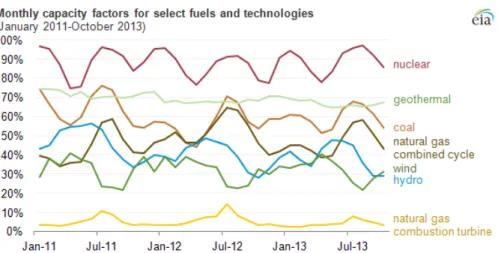
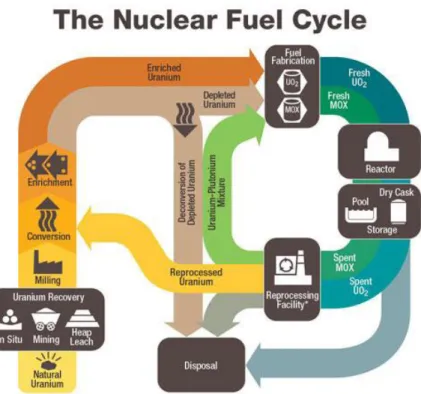
Figure 1: Capacity factor comparisons of typical energy sources (EIA, January 2014) ... 1 Figure 2: Nuclear Fuel Cycle from the U.S. Nuclear Regulatory Commission,
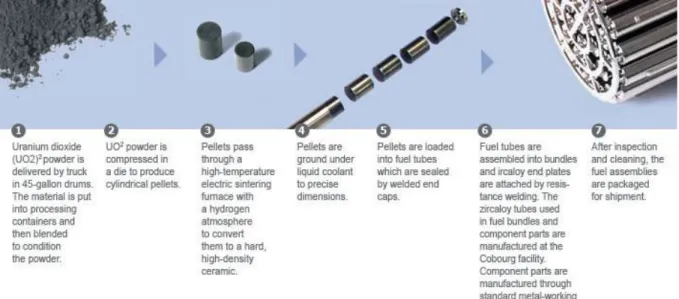
http://www.nrc.gov/materials/fuel-cycle-fac/stages-fuel-cycle.html ... 30 Figure 3: Uranium-235, http://www.cameco.com/fue_and_power/fuel_
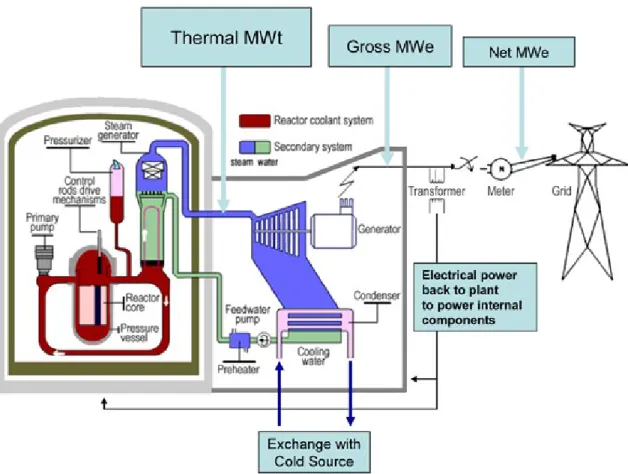
manufacturing/process ... 31 Figure 4: Typical Light Water Reactor (Pressurized Version),
http://www.world-nuclear.org/info/Nuclear-Fuel-Cycle/Power-Reactors/Nuclear-Power-Reactors/ ... 32 Figure 5: U.S. Enrichment and Fuel Fabrication Facilities, data from
http://www.nrc.gov/info-finder/materials/fuel-cycle/ ... 33 Figure 6: Spent Fuel Pool, http://www.nrc.gov/waste/spent-fuel-storage
/pools.html ... 33 Figure 7: Dry Cask Storage, http://www.nrc.gov/waste/spent-fuel-
storage/faqs.html ... 34 Figure 8: Spent Fuel Storage by State,
http://www.nei.org/Master-Document-Folder/Multimedia/Infographics-Database/Used-Nuclear-Fuel-Storage-Map ... 34 Figure 9: U.S. Operating Nuclear Reactors (with Spent Fuel), data from
http://www.nrc..gov/reactors/operating/list-power-reactor-units.html ... 35 Figure 10: Nuclear Reactors Worldwide, date from http://www.world-
nuclear.org/info/Facts-and-Figures/World-Nuclear-Power-Reactors-and
-Uranium-Requirements/ ... 36 Figure 11: Nuclear Reactor Worldwide Construction, data from
http://world-nuclear.org/NuclearDatabase/rdresults.apsx?id=27569&ExampleId=62 ... 37 Figure 12: Westinghouse AP1000, http://westinghousenuclear.com/New-Plants
/AP1000-PWR/Economic-Benefits ... 40 Figure 13: Westinghouse 1000 at Vogtle Site, http://www.southerncompany
.com/what-doing/energy-innovation/nuclear-energy/gallery/new/ ... 54 Figure 14: Westinghouse AP1000 at V.C. Summer Site,
https://www.flickr.com/photos/scegnews/14756682396/in/set-7215769244341909 ... 55 Figure 15: Westinghouse AP 1000 at China's Haiyang Site, http://www.westinghouse
Figure 16: Nuclear Reactors in Japan, data from http://world-nuclear.org
/NuclearDatabase/rdResults.aspx?id=27569 ... 56 Figure 17: AREVA's EPR Construction in Olkiluoto 3, Finland,
http://us.areva.com/EN/home-930/areva-inc-gen-iii-nuclear-reactors.html ... 57 Figure 18: Nuclear Organizations in the Southeast U.S., compiled from the
Carolina Nuclear Cluster, U.S. Department of Energy Office of Nuclear
Energy, and the Nuclear Engineering Sourcebook ... 71 Figure 19: Proposed Yucca Mountain Nuclear Repository,
http:www.mrc.gov/waste/hlw-disposal/photo-loc.html ... 82 Figure 20: Renaissance Watch column is a roundup of domestic and international
progress around nuclear energy (ANS, July 2007, 14-15)... 101 Figure 21: Fukushima Diiachi Nuclear Power Plants and Epicenter of Earthquake
(U.S. NRC 2011)... 103 Figure 22: Fukushima Diiacho Multi-Unit Reactor Site (U.S. NRC 2011)... 104 Figure 23: Fukushima Diiachi Multi-Unity Reactor Site After Explosions
(U.S. NRC 2011)... 104 Figure 24: Fukushima Daiichi reactors are GE boiling water reactors (BWR)
of an early (1960s) design supplied by GE, Toshiba and Hitachi (WNA, 2014) ... 105 Figure 25: The hydrogen explosion at Fukushima Unit 1 Reactor (WNA, 2014) ... 105 Figure 26: Nuclear Connect, Know Nuclear, http://www.nuclearconnect.org/
know-nuclear/talking-nuclear/top-10-myths-about-nuclear-energy ... 114 Figure 27: Concrete placement in the auxiliary building and Vogtle 3 cooling
tower construction, http://www.southerncompany.com/what-doing/energy-
innovation/nuclear-energy/photos.cshtml (Southern Company, 2015) ... 116 Figure 28: AP1000 construction at Haiyang, China site (May 2014),
http://www.westinghousenuclear.com/New-Plants/Photo-Galery/
emodule/333/egallery/1... 119 Figure 29: Standard Pressurized Water Reactor (left) and AP1000 (right).
Simplification of safety systems dramatically reduces building volumes.
Figure 31: Bisconti (2014).
http://www.nei.org/Master-Document-Folder/Backgrounders/Presentations/Public-Opinion-Presentation,-Oct-2014 ... 127 Figure 32: How Radiation Isn't Killing You ... 146 Figure 33: ALARA. as low as reasonably achievable ... 147 Figure 34: The ANS Nuclear Fundamentals Technology Program for Capitol
Hill Staffers ... 149 Figure 35: CO2 emissions produced by 1kWh ... 161 Figure 36: COP 21 Nuclear Energy Attendees (Nuclear For Climate, 2016) ... 162 Figure 37:Nuclear Connect, Know Nuclear, http://www.nuclearconnect.org/
CHAPTER 1: U.S. NUCLEAR ENERGY INDUSTRY
1.1– Claims About Nuclear
Nuclear power production remains a controversial energy source for the 21st century and beyond. It is part of the energy mix of the United States and 29 other nations, with 60 under constructions in 15 countries (NEI, November 2016). The top 5 nuclear generating nations include the U.S. (798.6 billion kWh), France (418 billion kWh), Russia (169.1 billion kWh), South Korea (149.2 billion kWh) and China (123.8 billion kWh) (NEI, April 2015). The energy capacity factor for nuclear (90.9%) surpasses any other fuel source, not
geothermal (67.2%), coal (58.9&), combined cycle natural gas (50.3%), hydroelectric (40.5%) or wind (32.3%) compare1 (EIA, 2014). As Figure 1 shows, in 2014, the U.S. generated approximately 4,093 billion kilowatt hours of electricity, with nuclear contributing 19% of the share. Fossil fuels generated 67% – coal [39%], natural gas [27%], and petroleum [1%]) – while hydropower stood at 6%, and other renewables at 7% (biomass 1.7%, geothermal 0.4%, solar 0.4% and wind 4.4%) (EIA, March 2015).
Amidst these noteworthy contributions of nuclear energy on the international and national stage, the U.S. stands at a crossroads and proponents of nuclear energy technology are advocating continued operation of the 104 (now 100) nuclear power plants in addition to new constructions of improved, more efficient, passively safer designs (Battelle, 2008). In 2013 the U.S. entered the domestic new nuclear build market, starting construction on four next generation reactors in the Southeast – two at the Vogtle Plant in Georgia and two at the V.C. Summer Plant in South Carolina (Williams, 2013). These designs are characterized as “simply safer, simply more advanced” and requiring no human intervention for 72 hours if a station blackout were to happen (Westinghouse, 2011). The U.S. Nuclear Regulatory
Commission is reviewing an additional 8 combined operations license (COL) applications for 12 new constructions (U.S. NRC, April 2015). And internationally, there are 450 reactors in 30 nations, including Taiwan, accounting for 11% of world electricity (Nuclear Energy Institute, 2016). “Approximately 70 further nuclear power reactors are under construction, equivalent to 20% of existing capacity, while over 160 are firmly planned, equivalent to half of present capacity” (WNA, February 2015). American-based Westinghouse (AP1000 design) and Areva (EPR design) are among the signed partners; others designs include Canada’s CANDU and Russia’s BN 800 (World Nuclear Association, November 2012). An argument has been made that U.S. competitiveness is being compromised as other international bids go to nuclear competitors, eroding international influence (CSIS, June 2013). For example, the United Arab Emirates awarded a $20.4 billion contract to a South Korean consortium to build four APR 1400 reactors by 2020; the first is currently under construction (World Nuclear Association, November 2012).
delays (between $6 billion and $9 billion for each 1,100 MW plant), safety and security concerns along with issues around the non-completion of Yucca Mountain Nuclear Waste Repository and sometimes wavering public and political support (Schlissel, 2008, 2).
Competing knowledges over this high risk technology have been fueled by such global factors as past and more current accidents, nuclear waste management questions, possible future disasters (human or natural), and proliferation concerns. The Union for Concerned Scientists, Sierra Club and Greenpeace have all called for a divestment in nuclear technology, suggesting renewable power sources – solar, wind, geothermal and hydroelectric – as alternatives. The ‘atom in service’ is seen more as an uncontrollable-destructive atom with far-reaching, long term effects – Three Mile Island (1979), Chernobyl (1986) and Fukushima Diiachi (2011) (Hibbs, 2012). Other arguments question safe operation, continued unrealistic economics, unsustainability, low uranium supply, poor mining practices, and proliferation concerns (Bulletin of the Atomic Scientists, 2008; Kessides, 2012; Hecht, 2006). Scholars have
intensified their argument to problematize this high risk technology, especially concerning the lack of long term strategies for nuclear waste storage (NCWARN, 2012). For instance, the Yucca Mountain Nuclear Waste Repository was cited as the location forthe nation’s high radioactive waste storage; as such the land went through physical and metaphoric
transformations. The mountain was revalued – journeying from little value (seen as unclaimed or claimed by marginalized Shoshone peoples) to no value (a process needed to reclaim for the larger public good) to extreme value (as a constructed national labscape and eventual
District of Columbia Circuit rule[d] the UC Nuclear Regulatory Commission could resume the licensing process using currently available funding from the Nuclear Waste Fund”2(Dotson, April 2015). Risk associated with the nuclear fuel cycle - its production, transport, usage, spent fuel storage and overall security continues to be debated as plants are operated and new constructions are underway.
1.2– Geography of (Nuclear) Energy
At one level my research aims to add to the description and analysis of how nuclear energy is co-produced in relation to other energy sectors, the environment and society. What place does nuclear energy occupy? What actions are taken by nuclear energy proponents as they face opposition to the technology? How do externalities become part of the
co-constitutive nature of energy (e.g. air quality, climate change, globalization, capital costs, waste management, public perceptions, and proliferation concerns)? I examine the 21st century reframing of nuclear energy as a resurgent industry, through a study of the making of nuclear energy as an active material and discursive process. In providing both narrative and
Geographies of nuclear energy can be understood in relation to the larger subfield of the geography of energy. A focus on fossil fuels, in particular coal, petroleum and natural gas have dominated in both descriptive and analytical ways. However, nuclear energy writings reached a peak in the 1990s and are now making a return in the 2000s alongside an increased focus on renewables. Energy transitions and environmental impacts are other major themes while there is a smaller body of literature on the imaginary geography of energy systems. The following timeline provides more detail as to energy resources and its topic areas and where nuclear energy has appeared.
production, the relation between the physical environment and energy supply and demand, and the regional effects of long- and short- distance transfer of energy” (Chapman, 1969)? “Causal analysis and applied studies [were] rare” (Chapman, 1969, 11). The shortage of writing on energy conflict areas would be later addressed by such writers as Le Billon (2005) on the geopolitics of resource wars, Watts (2006) on the scramble of Africa’s oil and Klare (2008) on state powers and the stress on energy resources.
Four research areas Chapman identified in 1969 remain relevant – energy complex of an area, phases of the energy industry (from mining to production through to consumption), regional treatment (energy-surplus and energy-deficit) and the institutional framework (company and capital control of the energy industry) (Chapman, 1969, 11). Questions asked included what are the components of the energy industry and their spatial associations? How are institutional factors significant to the energy industry? (Chapman, 1969, 13-14) My research on nuclear energy will add to this body of energy geography literature by asking such questions as – who are the industry actors? What work do they do physically and discursively? How do past, present and future institutional factors (e.g. Atoms for Peace Program, Megatons to
Megawatts, the Energy Policy Acts of 2005, Yucca Mountain Waste Nuclear Repository, to name a few), impact the boarder nexus of energy-environment-economy and play a role in the status of nuclear energy currently and into the future?
the landscape of energy sources, the issues involved in energy production, the relationships between energy and society and energy decision making. We begin to see the use of data sources produced by such organizations as the Federal Energy Administration (now the Energy Information Administration) and the World Energy Outlook. My mapping project will draw on some of these data sources to provide a visual and contextual understanding of nuclear energy within the U.S. and its networks abroad. The U.S. is the largest nuclear nation in the world with 60% nuclear capacity in the Southeast, Midwest and mid-Atlantic (U.S. NRC, 2014). How has, and more importantly, does nuclear impact energy-related growth nationally and internationally? To understand this related growth, a mapped present and future will be analyzed in the context of a socio-political environment. The OPEC’s 1973 oil
Core topics of resource development, power plant siting, land use, environmental impact assessment, energy distribution and the diffusion of conservation technologies dominate the literature (Solomon et al., 2003, 302). And by the 1980s and beyond work on risk perception and emergency behavior is done after Three Mile Island and Chernobyl nuclear accidents. But it is not until the 1990s do we see an increase in the nuclear power literature. For example, Mounfield (1991) gives a global review, Jacob (1990) on radioactive wastes, Gould (1990) on nuclear accidents, Pasqualetti (1990 & 1996) on plant
decommissioning, Kuletz (1998) on nuclear landscapes, power and cultural politics of Yucca Mountain. Coal, petroleum, gas and nuclear energy supply 95% domestic consumption and as such themes on economics and availability along with geopolitical issues focusing on the Middle East remain prominent in the energy geography literature. Energy efficiency and conservation continue in light of literature on scarcity of the resource base. Other themes include foreign crude oil supplies (Solomon, 1989) and economic/environmental costs (Cleveland and Kaufmann, 1991). Energy policy response to global warming and climate change begin to increase at the start of the 1990s (Smil, 1990) and big dam projects and removals (Sternberg, 1996) likewise emerge in the geography of energy literature. We begin to see sustainable energy sources and their differing spatial characteristics to fossil fuels and nuclear power in the literature. My research adds to the discussion and analysis of
renaissance claim?
As we move into the 2000s, research builds on the foundational work of nuclear energy in the 20th century and what some may call a renewed growth-sprit – however highly contested – that marks the beginning of the 21st century. Other continuing themes include oil, peak oil, the tar sands, environmental degradation, crises (e.g. 2006 Deepwater Horizon BP Gulf accident), and energy poverty in resource rich nations (e.g. Nigeria). Coal and oil, as well as hydroelectricity, continue to be focal points in the literature and have intensified questions around risk, environmental impact and uneven development. Issues of climate change, social/environmental justice, safety and security, and renewables role in a low carbon economy are also being researched (Pasqualetti, 2011). The question of whether fossil fuels have peaked – metaphorically and materially – has been evaluated by such scholars as Huber (2008). What does a future economic-environmental model look like? What questions need to be posed for another energy transition? Nuclear energy is part of this energy discussion and I add to an understanding of the nuclear fuel cycle in the U.S. industry; adding to recent geographical work by Eyles and Fried (2012) on rhetoric and reality of the nuclear energy sector in Ontario Canada; by Garcier (2009) on the nuclear renaissance and uranium fuel cycle supply; by Proops (2001) on the politics and language of nuclear; by Jasanoff and Kim (2009) on sociotechnical imaginaries and nuclear power in the U.S. and S. Korea; and, by Hecht (2006) on the shifting nature of the geography of nuclearity where claims of nuclear nationalism, global nuclear order and environmental stewardship are examined.
1.3– Interrogating the Contemporary U.S. Nuclear Energy Industry
nuclear energy technology, investigating how their responses to the anti-nuclear position appear in their messaging and action. I suggest that a geography of nuclear necessity has evolved and is being utilized by the nuclear energy industry through reference to its essential contribution to national security, energy independence (base-load power) and environmental stewardship (carbon-free electricity) (Nuclear Energy Institute, 2003). Necessity in that nuclear energy must be a part of the energy mix if the U.S. is to meet its obligations for electrification and its contribution to the economy. Necessity has traversed several real and imaginary boundaries, (re)making nuclear energy so that it occupies a space of resiliency and relevancy – however contentious that place may be.
I interrogate the constructed place of the U.S. nuclear energy industry. More specifically, what must be done in preparation for the construction or maintenance and
operation of nuclear energy technology? How is the continued use of nuclear energy justified, in light of risks witnessed by the most recent accident where there was a loss of coolant event and meltdown at Japan’s Fukushima Diiachi power plant station? In addition, the mitigation of risk is considered. For example, how does the nuclear energy industry sufficiently address concerns around operation and relicensing of some plants for an additional twenty years? Lastly, I address the future of nuclear energy, questioning the work that must be done for it to flourish. I suggest there is a continual reframing of ‘nuclear things’ – uranium, spent
use of nuclear energy despite it being a high risk technology.
I assess relational politics in this thesis. How do things come to matter and what are their impacts? How does the industry understand, approach and engage with society? In what ways does the technology engage with other energy technologies? And how does the nuclear space (materially and conceptually) endure? This is where Massey’s propositions can assist in understanding nuclear energy’s role in constructing a necessity. Massey asks that we –
1. Recognize space as the product of interrelations; as constituted through interactions, from the immensity of the global to the intimately tiny.
2. Understand space as the sphere of the possibility of the existence of multiplicity in the sense of contemporaneous plurality … If space is indeed the product of
interrelations, then it must be predicted upon the existence of plurality. Multiplicity and space is co- constitutive.
Administration, 2014). The claim of nuclear energy providing energy independence is questionable even though industry officials bring both countries into the “friendly” nation category and by extension part of the U.S. space. Nuclear energy is also shaped by such non-nuclear processes as cheaper electricity from natural gas, climate change and clean water legislations. These impacts are not static and are not the only processes/’things’ that work inter-relationally to (re)make nuclear. The production and narrative that is the U.S. nuclear energy industry rests on a continuum. The spaces and places of nuclear are complex, made up of dynamic relations between multiple entities – industry (for example, utilities, researchers, suppliers, regulators, professional organizations and trade organizations) and the larger public (includes willing, non-willing and non-knowing recipients of power on the electric grid system). Associations within this space, against it and across it are important points of questioning and helps us to understand why nuclear still exists. Massey asks that we see nuclear energy as a process as much as it is product, and can help us to understand how the process of nuclear power relies on the production and reproduction of material and imaginative spaces. The process is continual and crosses several boundaries within the state, across energy mixes, and legislations. Nuclear energy is as much a thing as part of a network of sociotechnical mechanisms.
1.4– Research Methods and Questions
I question the construction of a nuclear space and how nuclear necessity is created and recreated. The practices of the nuclear energy industry are examined – for example,
has many aspects to its network that must be examined – regulatory, research and
development, anti-nuclear actors, the public, suppliers, utilities, and (social) media. Each human and non-human actor intersects and impacts the construction and messaging of resilience and resurgence. I aim to improve our understanding of relational space through the politics of nuclear and the impact of places – for example, national and international
communities, power plants, fabrication facilities, labs, educational institutions, and waste storage locations.
My thesis also draws on the situated-ness of knowledge as it examines the
(re)production of nuclear energy in the 21st century (Haraway, 1988). How has the nuclear renaissance project changed in the past 15 years? How are U.S. industry insiders making a case for nuclear energy? The work being done by proponents to advance the technology is an important question in this context. Situated-ness draws on a relational understanding and it requires that the object of knowledge be pictured as an actor and agent (Haraway, 1991: 198). Scientific knowledge production is a view from somewhere (Livingstone, 2003, 81). And so, Haraway asks that we do not engage in the ‘god trick’ (Haraway, 1991, 191). It is through embodiment and partiality that knowledge is acquired. There needs to be “a fundamental insistence on the contextualized nature of all forms of knowledge, meaning and behavior” (Merrifield, 1995, 50). Haraway also insists that the researcher ‘reflect and analyze how one’s position in relation to the processes, people, and phenomena we are researching actually affects both those phenomena and our understanding of them” (Haraway, 1991). Using a situating approach means I must, as the researcher, shed light on the research process.
department and contributing through their professional organization3.This engagement allowed me to build trust, observe and participate in the knowledge production of nuclear science and technology. I interviewed a mixture of new and experienced professionals, gender and race, as well as varying industry sector members (e.g. utility, engineering firm, national lab, regulator agency, and college). To assist with the overall research project and more specifically with an understanding of the industry’s culture and before my interview selection, I employed a participation observation research approach. “Only by participating with others can [researchers] better understand lived, sensed, experienced and emotional worlds” (Crang and Cook, 2007). It allowed me to build trust, begin to learn the technical language of nuclear science and technology and provide an environment where hopefully canned responses were not given. I wanted to engage in a long standing conversation about the industry and with its proponents. A clearer understanding of the science behind nuclear fission and its application was gained through laboratory work, technical presentations and most recently technical editing and curriculum development. To also hopefully assist with the process, I volunteered within their professional organization, starting with the student chapter then the local section and then their national American Nuclear Society. My co-workers served as gate openers, introducing me to colleagues. In all instances I waited for them to ask what a geographer was doing in a nuclear engineering society. It became a conversation and longer term relationship that I hope has positively informed my situated research project.
to the subject matter and the individual interviewees themselves. For example, I observed a tendency among interviewees to assume that I knew what they meant, and hence not to fully elaborate. However, my positionality also assisted with follow-up questions to have the needed elaboration happen if not forthcoming initially. A tendency for me as a researcher to be self- selecting of materials that would shine a positive light on the industry was another concern. There was a loss of detachment that I felt at times with this approach. To attempt to reduce this likelihood I not only conducted a discursive review of industry reports but also legislative and anti-nuclear movement reports were/are being analyzed.
Overall my research methods (including interviews and discourse analysis) allow me to describe and interpret actions (textual and orally) of interviewees, industry sectors, and materials (reports, legislation, presidential directives, multimedia materials on the health of the U.S. nuclear industry. How is it reproducing itself? What challenges is it tackling? What are some of the strategies and rational behind these actions? How are discourses negotiated? The ultimate goal is to answer the question of whether the industry is in a resurgence, holding its own or in a decline from their perspective and reading of the larger society to which they belong. Interviews allow me to ask individuals their perspective on lived experiences; these responses may be biased and as such data triangulation assists in some corrective action.
and that is where my extended participant observation hopefully will meditate. Also, these interviewees may be too entrenched in the nuclear industry to see the opposition to nuclear clearly. To attempt to meditate for this possibility, data triangulation was employed along with the inclusion of scholar-critiques of the technology – a radiobiologist and the literature of the Union of Concerned Scientists. Knowledge of the industry was not only gathered through interviews, it included discourse analyses.
Discourse analysis examines the geographical imaginaries of nuclear energy (Faircloth, 2006; Phillips et. al, 2002). What is the landscape it produces and reproduces? How are key messages constructed and disseminated? An analysis of scientifically cultural texts provides another insight into the industry. How does this analysis differ
from/compliment the interviews? What is included, excluded or empowered? What kind of group identities does it promote? As part of my participant observation, I was engaged in some of these messaging productions and was able to speak to the discussions before the final message was prepared. This insight was discussed with interviewees as well. Materials that will be examined include industry reports, presidential directives, legislation, industry infographics, and industry mix media (e.g. social media).
Semi-structured interviewing and participatory observation coupled with discourse analysis, these methods will provide a geography (not the geography) of the contemporary nuclear industry and its efforts to produce a nuclear renaissance.
nuclear energy resurgence and gain a better understanding of the nuclear energy network and access its successfulness.
My key research questions are:
1. What is the contemporary geography of U.S. nuclear energy production? What spaces
does it occupy, and how have they been constructed?
What abstract and material work was and is needed to create its commercial and public space? Who were and are the stakeholders (bureaucrats, experts, the public, media, and ‘opponents’) that actively work on or influence this space? What impact has technology had on its societal standing? How have stakeholders affected operations? How have
externalities impacted the nuclear energy? To trace the historical and existing significance of the U.S. nuclear industry I will consult key industry, government, legislative and anti-nuclear documents. Multimedia pieces will also provide an understanding of the positioning of nuclear energy. Through my interview questions, representations of the work of the fuel cycle will be explored.
2. How proponents of nuclear convey meaning about the present and future of their industry?
How is the nuclear energy industry making the case for its future and garnering support from stakeholders? In what ways are expressed concerns being addressed? How is the industry mitigating risk and communicating it to officials and the public? In what ways is the construction of nuclear energy a story-so-far?
the future? In what ways will technology reduce/eliminate risk? How is risk accounted for? In what ways do energy system comparisons impact nuclear energy?
The last 15 years has been somewhat favorable to the U.S. nuclear energy industry as much as it has illuminated concerns with the technology. Japan has become the newest Achilles’ heel but there have been others including near misses. The transnational nature of the nuclear power plant and its inherent risk to the U.S. and elsewhere remains prevalent. In what ways does a Fukushima-type event impact the relevance of nuclear energy?
3. Whose scientific and technical knowledge claims and by extension
governance prevail and why? In other words, what must be done to the landscape –
abstract and material – for the nuclear necessity narrative to persist? A reading of text and outreach material (including social media) will be used to understand the (re) framing of nuclear energy. Interviews will also be insightful.
Three primary methods will be employed for this research project – mapping, semi- structured interviews, and discourse analysis.
prompts us – using Gunnar Olsson’s question – to think through “[w]hat is geography if it is not the drawing and interpreting of a line? And what is the drawing of a line if it is not also the creation of new objects?” The nuclear energy renaissance is such a drawing based off of physicality/elements of the nuclear fuel cycle and its oppositional forces.
The ‘aim of [the] interview is not to be representative (a common but mistaken
criticism of this technique) but to understand individual people experience and make sense of their own lives’ (Valentine, 2005: 111). Ten, on average hour long, semi-structured interviews were done, coinciding with a nuclear energy conference and/or an energy meeting thus
allowing interviewees to be in the context of the subject. The participants were purposely chosen from one of the industrial categories of supplier, utility, government (including
national lab), education, trade organization and regulatory agency – soliciting perspectives on the present and future of nuclear energy in a post-Fukushima environment and recent
commencement of America’s new builds. What are the narratives of the industry and how do they go about the business of entrenching the story-thus-far in light of such ‘unresolved’ issues as spent fuel storage, the fairly recent accident and public acceptance of perceived risks were probed. In all instances, advance notice and a request to tape the interview occurred.
Discourse analysis is a useful method for the written and visual texts of the nuclear energy industry and helps to show that “our words are never neutral” (Fiske, 1994). Three levels of analysis – actual text, discursive practices and the larger social context – provide ways of knowing, valuing and experiencing the world; it illuminates power relations. Discourse is thus connected to the past and the current context, and can be interpreted
policy legislation, presidential directives, industry position statements and reports along with multimedia promotional materials. Their framing of details and agency will be discussed. Together these acts may convey agentless- ness, pre-suppositive statements, insinuations, connotations and modality (Huckin, 1997). In essence what is the work of the texts, and who are its audience?
1.5– Chapters’ Roadmap
In chapter 1, I set out to contextualize my overall question – are we witnessing a nuclear renaissance and how would we know either way? I provided a literature trajectory to show that nuclear energy has been incorporated into the energy geography literature in particular ways but that there are additional questions we must pose to gain a better
understanding of its contemporary geography. These questions have as much to do with the industry itself as with externalities that are (re)shaping it. I propose that the industry does not get acted upon but is a (responsive) participant. I share with the reader my research methods – mapping, participant observation, semi-structured interviewing and discourse analysis – and the advantages and concerns of each. Data triangulation is employed to reduce bias.
In chapter 2, I focus on the current geography of the U.S. nuclear industry, providing a historical and technical trajectory for the commercial nuclear power industry. My focus is on the U.S. industry but I am not bounded by national borders as various international
In Chapter 3, I examine the future of nuclear energy. I employ discourse analysis, in light of interviews conducted, to review promotional mix media materials. How the post-Fukushima nuclear energy industry is framed is of particular interest. A U.S. nuclear necessity argument is developed and being sustained around environmental stewardship,
energy/national independence and international influence. What measures are put into place and what are the opposition’s responses to this messaging?
ENDNOTES
1. Capacity factor is ratio of the net electricity generated, for the time considered, to the energy that could have been generated at continuous full-power operation during the same period. (U.S. NRC, March 2015).
2. This led to the publication of Volume 3 (Repository Safety After Permanent Closure) in October 2014 …Volume 4 (Administrative and Programmatic Requirements) was published in December 2014, and Volumes 2 (Repository Safety Before Permanent Closure) and 5 (License Specifications) were published in January 2015.
3. I was hired into the created position of Director of Outreach for the purpose of education outreach and engagement. In this role I interact with pre-college, undergraduate, graduate students. Nuclear engineering education is also the focus of the American Nuclear
REFERENCES
Battelle. September 2008. Nuclear Energy for the Future: an Industry Perspective. Bohi, Douglas. 1996. The Economics of Energy Security. New York: Springer. Bardi, U. 2009. “Peak Oil: the Four Stages of a New Idea” in Energy, v. 34: 323-26.
Bridge, Gavin. July 2014. “Less is more: Spectres of scarcity and the politics of resource access in the upstream oil sector” in Geoforum, volume 41 (4): 565–576.
Bromley, Simon. 2005. “The United States and the Control of World Oil” in Government and Opposition, 2: 225-255.
Bulletin of the Atomic Scientists. 2008. The Future of Nuclear Energy, 64 (4): 2-60.
Center for Strategic and International Studies. CSIS, June 2013. Restoring U.S. Leadership in Nuclear Energy: A National Security Imperative. NY: Rowman & Littlefield.
Chapman, John D. 1969. “A Geography of Energy: an Emerging Field of Study” in Canadian Geographer vol. 5-6: 10.
Cleveland, Cutler J. and Robert K. Kaufmann. 1991. “Forecasting Ultimate Oil Resources and its Rate of Production: Incorporating Economic Forces in the Models of M. King Hubbert” in Energy Journal. 12(2):17-46.
Cook, Earl. 1976. Man, Energy and Society. San Francisco CA: Freeman.
Crank, Michael and Ian Cook. 2007. Doing Ethnographies. New York: Sage Pub.
Crease, Robert. 2004. “Energy in the History and Philosophy of Energy” in Cleveland, Culter (ed.), Concise Encyclopedia of the History of Energy. San Diego CA: Elsevier: 90.
Dotson, Sharryn. April 2015. Does Yucca Mountain Now Have A Chance? In Power Engineering,
http://www/power-eng.com/blogs/nuclear-matters/2015/04/does_yucca)mountain.html. (accessed April 20, 2015).
Elmes, Gregory A. and Trevor M. Harris. 1996. “Industrial Restructuring and the United States Coal-Energy System, 1972-90: Regulatory Change, Technological Fixes and Corporate Control” in Annals of the Association of American Geographers 86 (3): 507-29.
Energy Information Administration. EIA, May 2014. Uranium Marketing Annual Report. https://www.eia.gov/uranium/marketing/. (accessed April 20, 2015).
Energy Information Administration. EIA, January 2014. Monthly generator capacity factor data now available by fuel and technology, http://www.eia.gov/todayinenergy/detail.cfm?id=14611. (accessed April 20, 2015).
Fairclough, Norman. 2006. Language and Globalization. New York: Routledge. Fiske, John. 1994. Media Matters. Minneapolis IN: University of Minnesota Press.
Huckin, Thomas. 1997. “Critical Discourse Analysis” in Miller, Tom, ed. Functional Approaches to Written Text. Washington DC: United States Information Agency.
Garcier, Romain. Autumn, 2009. “The Nuclear ‘Renaissance’ and the Geography of the Uranium Fuel Cycle” in Geography, vol. 94, part 3.
Eyles, John and Fried, Jana. April 2012. “The Anatomy of a Brand: Shaping Nuclear Discourse to Create the Perception of a ‘Clean World’” in Risk, Hazards & Crisis in Public Policy, vol. 3 (1): 1–27.
George, Pierre. 1950. Géographie économique et sociale, Librairie de Médicis.
Gould, Peter. 1990. Fire in the Rain: The Democratic Consequences of Chernobyl. Oxford: Polity Press.
Haraway, Donna. Autumn 1988. “Situated Knowledges: the Science Question in Feminism and the Privilege of Partial Perspective” in Feminist Studies, vol. 14 (3): 575-99.
Haraway, Donna. 1991. "A Cyborg Manifesto Science, Technology, and Socialist-Feminism in the Late Twentieth Century," in Simians, Cyborgs and Women: The Reinvention of Nature. New York, Routledge: 149-181.
Hecht, G. 2006. “Nuclear Ontologies” in Constellations 13 (3): 320-331.
Hibbs, M. 2011. “Nuclear Energy 2011: a Watershed Year” in Bulletin of the Atomic Scientists, 68(10): 10-19.
Huber, Matthew. 2008. Energizing historical materialism: Fossil fuels, space and the capitalist mode of production in Geoforum 40(1): 105-115.
Huber, Matthew. 2009. Lifeblood: Geographies of Petro-capitalism in the United States. Worcester, MA: Clark University.
Jacob, G. 1990. Site Unseen: The Politics of Siting a Nuclear Waste Repository. Pittsburgh, PA: University of Pittsburgh Press.
Kessides, I. 2012. “The Future of the Nuclear Industry Reconsidered: Risk, Uncertainties and Continued Promise” in Energy Policy 48: 85-208.
Klare, Michael T. 2008. Rising Powers, Shrinking Planet: the New Geopolitics of Energy. New York: Holt.
Kuletz, Valerie L. 1998. The Tainted Desert: Environmental and Social Ruin in the American West. NY: Routledge.
Le Billon, Philippe. 2005. Geopolitics of Resource Wars: Resource Dependence, Governance and Violence. London: Frank Cass Publishers.
Livingstone, David N. 2003. Putting Science in Its Place Geographies of Scientific Knowledge. Chicago IL, University of Chicago: 81.
Manners, G.M. 1964. The Geography of Energy. New York: Hilary House Publishers. Massey, Doreen. 2005. For Space. New York: Sage.
McDowell, Linda. 1993. “Space, place and gender relations: Part II. Identity, difference, feminist geometries and geographies” in Progress in Human Geography, vol. 17 (3): 305-18.
Merrifield, A. 1995. "Situated Knowledge Through Exploration: Reflections on Bunge's 'Geographical Expeditions,' " Antipode 27: 49-70.
Mounfield, Peter. 1991. World Nuclear Power. London: Routledge.
NCWARN. Nuclear Waste. http://www.ncwarn.org/category/projects/4-nuclear-power/nuclear-waste/. (accessed December 2012).
NexStartAlliance. Why Nuclear? http://www.nexstartalliance.com/NuclearBenefits.aspx. (accessed April 20, 2015).
Nuclear Energy Institute. NEI, July 2013. Nuclear Industry Sees CSIS Report as Important Guide to Energy Policy Decisions.
Nuclear Energy Institute. NEI, November 2016. World Statistics,
http://www.nei.org/Knowledge-Center/Nuclear-Statistics/World-Statistics. (accessed November 20, 2016).
Pasqualetti, Martin J. 2011. “The Competing Dimensions of Energy Security” in Sovacool, Benjamin, ed., The Routledge Energy Security Handbook, London, Routledge. Chapter 14: 275-290.
Nuclear Power: Assessing and Managing Nuclear Technology, Boulder CO, Westview Press: 121-136.
Pasqualetti, Martin J. ed. 1990, Nuclear Decommissioning & Society: Public Links to New Technology. Routledge: London.
Pasqualetti, Martin and & Pijawkab, David K. 1996) “Unsiting Nuclear Power Plants:
Decommissioning Risks and Their Land Use Context” in The Professional Geographer, Vol. 48 (1): 57-69.
Phillips, Louise and Jorgensen, Marianne W. 2002. Discourse Analysis as Theory and Method. London: Sage Pub.
Plummer, James, ed. 1982. Energy Vulnerability. Cambridge MA: Ballinger.
Pickles, John 2004. “Maps and Worlds” in A History of Spaces. London, Routledge: 3-23. Proops, J. 2001. The (Non-) Economics of the Nuclear Fuel Cycle: an Historical and Discourse Analysis. Ecological Economics, vol. 39 (1): 13–19.
Schlissel, David and Bruce Biewald. July 2008. Nuclear Power Plant Construction Costs. Cambridge MA, Synapse Energy Economics Inc: 2.
Solomon, Barru D. 1989. “The Search for Oil: Factors Influencing U.S. Investment in Foreign Petroleum Exploration and Development” in Professional Geographer, 41(1): 39-50.
Smil, V. 1990. “Planetary warming: realities and responses” in Population and Development Review, vol. 16: 1-29.
Solomon, Barry D., Pasqualetti, Martin J. and Luchsinger, Deborah A. 2003. “Energy Geography” in Geography in America at the Dawn of the 21st Century: 302.
Spooner, D. 1999. “Landscapes of power; the shaping of the UK's new energy geography” in Geography, vol. 84 (1): 66–79.
Sternberg R. 1996. “Reservoir functions in changing social systems” in Rao K.V., ed.,
Proceedings of the International Conference on Aspects of Conflicts in Reservoir Development & Management. London, City University: 221–34.
Todd, D. 1997. “China’s energy needs, coal transfers and the ports sector” in Geoforum, 28(1): 39-53.
U.S. Nuclear Regulatory Commission. NRC, May 2014. List of Power Reactor Units,
http://www.nrc.gov/reactors/operating/list-power-reactor-units.html. (accessed April 20, 2015).
U.S. Nuclear Regulatory Commission. NRC, March 2015. Capacity Factor,
2015).
U.S. Nuclear Regulatory Commission. NRC, April 2015. Combined License Applications for New Reactors. http://www.nrc.gov/reactors/new-reactors/col.html. (accessed April 30, 2015). Watts, M.J. 2006. “Empire of oil: Capitalist Dispossession and the r Africa” in Monthly Review, vol. 58(4): 1-17.
Westinghouse. 2011. AP1000 – Passive Safety Systems and Timeline to Station Blackout. Williams, Mark. March 14, 2013. First nuclear concrete placed at Plant Vogtle expansion in Georgia Power. http://southerncompany.mediaroom.com/index.php?s=43&item=2790. (accessed April 30, 2015).
Woods, Denis and Fels, John. 1992. Power of Maps. New York, Guildford Press: 1. World Nuclear Association. Nuclear Power in the World Today. http://www.world-nuclear.org/info/inf01.html. (accessed summer 2012).
CHAPTER TWO – CURRENT GEOGRAPHY OF THE U.S. NUCLEAR ENERGY INDUSTRY
2.1– Chapter Introduction
The United States has a long tradition of grand technological challenges – completion of the Panama Canal (1904-1914); the Manhattan Project (1942-1946); Project Mercury, the early space race (1959-1963); and, the Apollo program to send humanity safely to the moon and back (1961-1972) (Constable, 2003). To this list must be added the Atoms for Peace program. President Eisenhower’s 1953 United Nations speech challenged the scientific and engineering communities to tame the atom and harness it for peaceful purposes. Stakeholders were tasked with creating new nuclear innovations.
In this chapter I will examine the current geography of the US nuclear energy industry. What is its structure? How have commercial practices, legislation and societal concern
influenced, and continue to affect, the industry? I assert that the recurring question of nuclear energy’s relevance is linked to understanding various practices, policies and debates. And, this is where Massey’s propositions can assist in understanding nuclear energy’s contested role –
• [Recognizing nuclear] space as the product of interrelations; as
constituted through interactions, from the immensity of the global to the intimately tiny.
• [Understanding nuclear] space as the sphere of the possibility of the existence of multiplicity in the sense of contemporaneous plurality … If space is indeed the product of interrelations, then it must be predicted upon the existence of plurality. Multiplicity and space as co-constitutive.
• could imagine space as a simultaneity of stories-so-far (Massey, 2005, 9). The spaces of nuclear energy are risky junctures of dynamic relations between multiple entities – industry (for example, utilities, researchers, suppliers, regulators) and other
stakeholders (for example, oppositional and watchdog groups, political figures and the larger public). Associations within this created space, against it and across it are important areas of concern and help us to understand why nuclear energy exists as part of, as addition to, or declining parts of contemporary energy portfolios.
2.2 – Physical Landscape of the U.S. Nuclear Energy Industry
The land use of an average 1000 megawatt (MW) U.S. commercial nuclear reactor is 1200 m2/GWh/year; this figure includes the plant and cooling water (Nicholson, September 20, 2013).1 In comparison, land use for a hydropower station would be 200,000 m2/GWh/year, coal would be 5700 m2/GWh/year and on-shore wind would be 1100 m2/GWh/year
((Nicholson, September 20, 2013). Other physical indicators include fuel footprint – a light water reactor (U.S. model currently in operation) has 950,000,000 mega joules per meters cubed (MJ/m3) in stored energy density, 80,000,000 in electrical energy density with a conversion efficiency of 30%.2 To provide context, black coal has 24,000 MJ/m3 in stored energy density, 2,300 MJ/m3 in electrical energy density with a conversion efficiency of 35%
whereas natural gas has 38 MJ/m3 in stored energy density, 5 MJ/m3 in electrical energy density with a conversion efficiency of 45% (Nicholson, September 20, 2013).
to 4-5% for use in the U.S. light water reactors (LWR). Enriched uranium pellets are then positioned in fuel assemblies, Figure 2. A typical LWR utilizes 75 tons of enriched uranium to make its reactor core, Figure 3 and 4 (World Nuclear Association, 2014).
Figure 4: Typical Light Water Reactor (Pressurized Version),
http://www.world-nuclear.org/info/Nuclear-Fuel-Cycle/Power-Reactors/Nuclear-Power-Reactors/
Figure 5: U.S. Enrichment and Fuel Fabrication Facilities, data from http://www.nrc.gov/info-finder/materials/fuel-cycle/
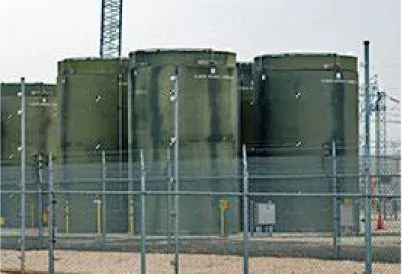
Fuel outages are scheduled every 18 or 24 months where spent fuel assemblies are removed, other assemblies are repositioned, new fuel added and any maintenance/repairs completed (NEI, 2012). The spent fuel is then stored on reactor sites in spent fuel pools or dry casks, Figures 5 and 6 respectively.
.
Figure 7: Dry Cask Storage, http://www.nrc.gov/waste/spent-fuel-storage/faqs.html
In total there are 71,780 metric tons of spent fuel across the U.S. (figure 7) with an additional average 2000-2300 metric tons per year added (Nuclear Energy Institute, 2014). The states with the largest stored spent fuel include Illinois (9290 metric tons), Pennsylvania (6220), South Carolina (4270), New York (3790) and North Carolina (3470).
Figure 8: Spent Fuel Storage by State,
U.S. nuclear reactors were initially licensed for 40 years of operation. As of 2013, 73 of the 100 operating reactors have had their license extended for an additional 20 years (NEI, April 2013). Collectively, the current fleet of nuclear reactors, Figure 8, generated 713 billion kilowatt hours for 2013 accounting for 19.4% of America’s electricity (NEI, 2014).
Figure 9: U.S. Operating Nuclear Reactors (with Spent Fuel), data from http://www.nrc..gov/reactors/operating/list-power-reactor-units.html
2.3– Major U.S. Nuclear Energy Industry Stakeholders
President’s Eisenhower’s UN General Assembly Speech of 1953 challenged the global community to make a reality the Atoms for Peace Program3 –
“It is not enough to take this [atomic] weapon out of the hands of soldiers. It must be put into the hands of those who will know how to strip its military casing and adapt it to the arts of peace” (Nuclear News, 2003, 40).
nuclear power, and encouraging the participation of industry in the general development and use of nuclear energy. Fast forward to the 50th anniversary of Eisenhower’s speech (2003) and Joe Colvin, president of the American Nuclear Society, reiterates from Eisenhower’s speech –
“The United States knows that peaceful power from atomic energy is no dream of the future. That capacity, already proved, is here – now – today. Who can doubt, if the entire body of the world’s scientists and engineers had adequate amounts of fissionable material with which to test and develop ideas, that this capacity would rapidly be transformed into universal, efficient, and economic usage?” (Nuclear News, 2003, 45) Currently, commercial nuclear power is entrenched in the energy portfolios of 29 nations with another 13 nations in the planning phase (World Nuclear Association, 2013). Four hundred and thirty seven nuclear reactors account for 13.5 percent of the world’s electricity, Figure 9 (WNA, 2014).
Figure 10: Nuclear Reactors Worldwide, date from
Seventy one new reactors are under construction in 15 nations with China leading the way, Figure 10 (PRIS, 2014). They have 14 reactors in operation and 26 under construction or planned (WNA, 2014).
Figure 11: Nuclear Reactor Worldwide Construction, data from http://world-nuclear.org/NuclearDatabase/rdresults.apsx?id=27569&ExampleId=62
And when compared with other fuels, Table 1, the energy density of nuclear fission is greatest4 –
Material Energy Density (MJ/1 kg)
Solar* 0.2-1.0
Wood 10.0
Ethanol 26.8
Coal 32.5
Crude Oil 41.9
Diesel 45.8
Natural Gas 55.6
Natural Uranium 570,000
Reactor-grade Uranium 3,700,000
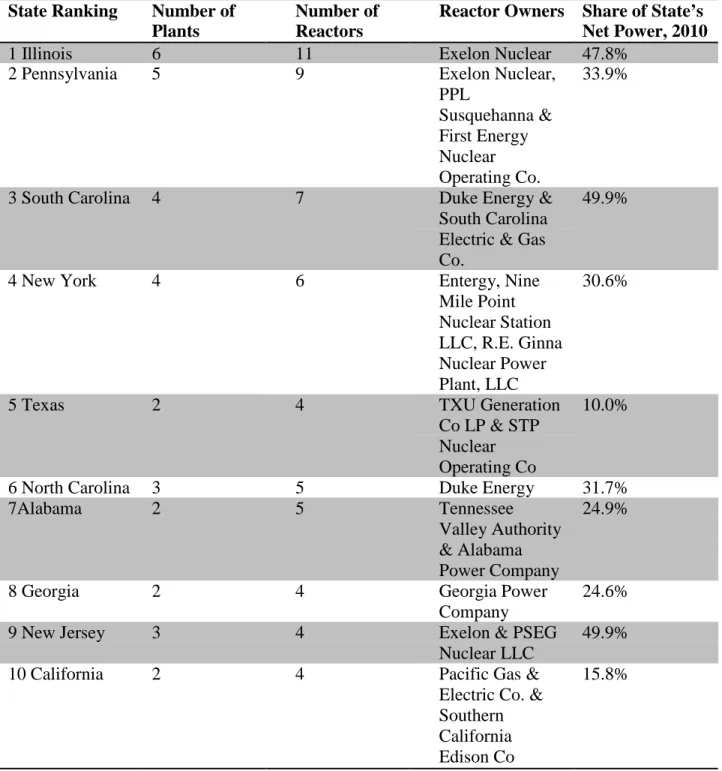
The top ten reactor locations and net nuclear generation are primarily in the South and Midwest.
State Ranking Number of Number of Reactor Owners Share of State’s
Plants Reactors Net Power, 2010
1 Illinois 6 11 Exelon Nuclear 47.8%
2 Pennsylvania 5 9 Exelon Nuclear, 33.9%
PPL
Susquehanna & First Energy Nuclear Operating Co.
3 South Carolina 4 7 Duke Energy & 49.9%
South Carolina Electric & Gas Co.
4 New York 4 6 Entergy, Nine 30.6%
Mile Point Nuclear Station LLC, R.E. Ginna Nuclear Power Plant, LLC
5 Texas 2 4 TXU Generation 10.0%
Co LP & STP Nuclear Operating Co
6 North Carolina 3 5 Duke Energy 31.7%
7Alabama 2 5 Tennessee 24.9%
Valley Authority & Alabama
Power Company
8 Georgia 2 4 Georgia Power 24.6%
Company
9 New Jersey 3 4 Exelon & PSEG 49.9%
Nuclear LLC
10 California 2 4 Pacific Gas & 15.8%
Electric Co. & Southern California Edison Co
The top utilities with reactors in their fleet include “Duke Energy who in 2011 purchased Progress Energy, making it the largest regulated nuclear fleet in the USA with 11 reactors. The $32 billion merger of Unicom and PEPCO in 2000 to form Exelon created the largest nuclear power producer in the USA, and the third largest in the world” (World Nuclear Association, 2014). The top U.S.-affiliated nuclear vendors are Westinghouse, General Electric-Hitachi and Areva. They currently service the existing civilian nuclear energy fleet and are constructing the next generation of reactors globally. As of 2014, Westinghouse operates or builds nearly 50% of the world’s nuclear power plants, with its world
headquarters located in Cranberry Township, Pennsylvania (Westinghouse, 2014). Toshiba, as of 2011, owns 87% of Westinghouse, along with Ishikawajima-Harima Heavy Industries (IHHI) – an acquisition that stemmed from a 2006 sale of Westinghouse from British Nuclear Fuels (BNFL) (American Nuclear Society, 2006). Westinghouse’s AP 1000, in Figure 11, is the first Generation III+ reactor to receive design certification from the U.S. Nuclear
Regulatory Commission (Westinghouse, 2014).
And it has been the most successful next generation nuclear reactor; currently being
constructed by Georgia Power and Light in association with the Shaw Group. Vogtle reactors 3 and 4, in Waynesboro Georgia, are expected to be operational in 2017 and 2018
respectively, Figure 12 and 13.
Figure 13: Westinghouse 1000 at Vogtle Site,
http://www.southerncompany.com/what-doing/energy-innovation/nuclear-energy/gallery/new/
Figure 14: Westinghouse AP1000 at V.C. Summer Site,
https://www.flickr.com/photos/scegnews/14756682396/in/set-7215769244341909
The non-U.S. current AP1000 constructions are in China at the Haiyang, Figure 14, and Sanmen sites – two reactors each with a completion date of 2016 (WNA, 2012).
Figure 15: Westinghouse AP 1000 at China's Haiyang Site,
In 2000, Global Nuclear Fuel (GNF) was formed between General Electric Energy, Hitachi and Toshiba; and, is located in Wilmington, NC (GE Hitachi Nuclear Energy, 2007). Then a global nuclear alliance was established in June 2007 – General Electric Hitachi Nuclear Energy – also with headquarters in Wilmington, NC. In 1997 their next generation reactor, the ABWR, was design certified by the U.S. Nuclear Regulatory Commission (NRC); while in 2005, their ESBWR design certification paperwork was approved this fall 2014 by the U.S. NRC (U.S. NRC, 2014). Internationally, GEH has built the first of four ABWRs in Japan (1996), and four additional units were being built, Figure 15. However, due to the Fukushima-Diiachi accident their construction has been placed on hold (WNA, 2014).
Figure 16: Nuclear Reactors in Japan, data from http://world-nuclear.org/NuclearDatabase/rdResults.aspx?id=27569
Areva is the third nuclear vendor with a presence in the United States and abroad. It operates in the U.S. as Areva Inc. North America and its headquarters is in Charlotte NC. It was established in 2001 through a merger with Framatome (formally Franco-Americaine de Constructions Atomiques, now known as Areva NP), Cogema (now Areva NC) and
Technicatome (now Areva TA). Currently, Areva is a French public multinational industrial conglomerate whose headquarters is in Courbevoie, Paris; and, the French state maintains 90% ownership. Areva NP’s next generation reactor, the U.S. EPR, is under design review by the U.S. NRC (U.S. NRC, 2014). International construction projects include – the first nuclear power plant ordered anywhere in Western Europe in over fifteen (15) years – at the Olkiluoto site in Finland, Framatome ANP is constructing a 1600 MWe European Pressurized Water Reactor (EPR) as the nation’s fifth nuclear reactor, Figure 16. This project started in 2003 with an estimated electric grid connection of 2014 or 2015 but as of September 2014 it has a connection date in 2018 (WNN, 2014).
Figure 17: AREVA's EPR Construction in Olkiluoto 3, Finland, http://us.areva.com/EN/home-930/areva-inc-gen-iii-nuclear-reactors.html
The U.S. nuclear industry is multifaceted, a combination of collaborations, mergers and associations. It accounts for a substantial portion of several energy portfolios, nationally and internationally. Yet the future of nuclear energy is a work in progress, assisted by legislations especially the Energy Policy Act of 2005 (as well as beset by internal challenges and
opposition).
2.4– Legislative Writing and the U.S. Nuclear Energy Industry
In 2000, under then Vice President Dick Cheney, the national energy development group was formed. Its main tenet, safe expansion of nuclear energy by establishing the Yucca National Waste Repository, coincided with possible signs of a nuclear energy revival. For example, Calvert Cliffs nuclear power plant units 1 and 2, in Lusby MD, were the first to receive the U.S. NRC renewed operation licenses for an additional twenty years in 20005 (U.S. NRC, 2013). Seventy five (75) of the current 100 operating nuclear power plants have gone on to receive license renewals and an additional 18 applications are under review with a future 11 applications expected (U.S. NRC, 2014). The energy development plan became a precursor to the industry- favored 2005 Energy Policy Act (EPAct). This legislation was passed into law as the nation’s first comprehensive energy legislation in thirteen years6. Research and development, scientific advancement for commercial application,
environmental stewardship, international collaborations, and economic responsibility are key themes within the Act. An examination specifically of Title IX subtitle E – Nuclear Energy provides additional insight into the nuclear energy network.
science and engineering initiatives between universities and national laboratories; streamlining of efforts; safety and security of nuclear facilities; and, a survey of industrial applications of large radioactive sources (EPAct, 2005). Actions of the nuclear energy community are reinforced by this Act and directives are given to various stakeholders as to their role in scientific education, research, and commercial adaptation of technology. Capital, science and technology are explicitly linked in this body of law.
Section 951, entitled Nuclear Energy, speaks of a program for the development of civilian nuclear energy research, development and commercial application. Specific
objectives include nuclear power viability in the nation’s energy portfolio, technical support to reduce the likelihood of proliferation, maintenance of university along with national laboratories programs and infrastructure, support of researchers (individual and team based), development and acquisition of special equipment for researchers, support of technology transfer to industry and other users, and minimizing the environmental impact of nuclear energy related activities. In the pursuit of these activities, Congress authorized the Secretary of Energy to financially support these initiatives, $330,000,000 in 2007, $355,000,000 in 2008, and $495,000,000 in 2009 (EPAct, 2005). Section 952 speaks specifically to research programs, especially the Nuclear Energy Research Initiative (NERI), Nuclear Energy Systems Support Program (NESSP), Nuclear Power 2010 Program, Generation IV Nuclear Energy Systems Initiative (Gen IV), and the reactor production of hydrogen. Research and
generation reactors. This twinning provides for satisfaction of the Act’s commercial application directive (EPAct, 2005).
Section 953 speaks to the advanced fuel cycle, allowing for proliferation resistant fuel recycling and transmutation technologies. It is in this section that care for the
environment and the public is explicit. There is a concern with safety and security – safety against natural phenomena and security against man-made incidents. The financial
commitment for these activities is set at $150,000,000 in 2007, $155,000,000 in 2008, and $275,000,000 in 2009. The public is situated as the benefactor within this scheme (EPAct, 2005).
Section 954 explicitly addresses the need for educational commitments in health physics, nuclear engineering and radiochemistry. It also explicitly identifies areas of human resource support. The human resource pipeline is identified and supported through
undergraduate and graduate fellowships, young faculty research initiation grants, nuclear engineering research and development, collaboration amongst industry, national laboratories and universities, communication and outreach in these areas of specialties, and university-national laboratory interactions (for example, professor fellowship programs and visiting
scientist programs). This section goes on to identify the need to strengthen research and training reactor programs and their infrastructure through the Innovations in Nuclear Infrastructure and Education Program (INIE). Monies associated with these activities include $43,600,000 in 2007, $50,100,000 in 2008, and $56,000,000 in 2009 (EPAct, 2005). The educational structure is valued as key to the civilian nuclear energy program – its personnel, students and
next generation of professionals to take the position at current facilities and those under construction.
Section 955 addresses the nuclear industry infrastructure through inventory, equipment prioritization and improvements, and streamlining. User facilities for nuclear waste research, fast neutron source, and hot cells are also to be developed. The monies associated with these tasks are $135,000,000 in 2007, $140,000,000 in 2008, and $145,000,000 in 2009 (EPAct, 2005).These areas of research speak to issues of nuclear waste management, future
reprocessing and recycling to close the currently one-through fuel cycle.
Section 956 specifically requests a research and development program on cost-effective technologies to increase safety from natural phenomena and security from deliberate attacks on nuclear facilities (EPAct, 2005).
And the last section of subtitle E, 957, requires a survey of industrial applications of large radioactive sources. The scope of the survey includes nuclear well-logging, and federal departments who use radioactive sources. The objective is to analyze present disposal options and recommend legislative options to Congress (EPAct, 2005).
These seven sections provide a framework for the nuclear energy enterprise, serving an integral role in industrial development. This next section provides an example of such an expansion by General Electric-Hitachi; its relocation for national and international business interests, assisted by the U.S. EPAct of 2005 and state level incentives.
2.5– General Electric-Hitachi and the Southern Appeal