Single-Molecule Force Spectroscopy Studies of Fibrin ‘A-a’ Polymerization Interactions via the Atomic Force Microscope
by Laurel E. Averett
A dissertation submitted to the faculty of the University of North Carolina at Chapel Hill in partial fulfillment of the requirements for the degree of Doctor of Philosophy in the
Department of Physics and Astronomy with Emphasis in Biophysics
Chapel Hill 2009
Approved by:
ABSTRACT
Laurel E. Averett: Single-Molecule Force Spectroscopy Studies of Fibrin ‘A–a’ Polymerization Interactions via the Atomic Force Microscope
(Under the direction of Professor Mark H. Schoenfisch)
ACKNOWLEDGEMENTS
This work would not have been possible without the help and support of a great number of people. My advisor, Professor Mark Schoenfisch, was critical to my growth as a scientist and researcher, and I appreciate the freedom, advice, and opportunities he has given me to find my way in science. I am indebted to Professor Oleg Gorkun for his help and guidance; this thesis would be a very different document without his aid. I thank Professor Boris Akhremitchev for his advice, collaboration, and valuable time. I am also grateful for all of the insightful conversations I’ve had the pleasure of participating in with the fibrinogen research group (including, among others, Professor Susan Lord, Professor Richard Superfine, Professor Mike Falvo, Professor Timothy O’Brien, Ricky Spero, and Nathan Hudson). I am also grateful for my training from Dr. Carri Geer, and the help of Kellie Beicker in conducting some of the solution condition experiments. Lastly, I’d like to thank Dr. Ryan Fuierer and the rest of the people at Asylum Research who helped me with every technical question I had, and were extremely generous with loaning us equipment and supplies.
every ignorant question of mine with endless patience. I am also constantly amused by the questions they think are only appropriate to ask a physicist. I have had the opportunity to work with many of the smartest, most driven, and funniest people I’ve known, and I’ll always be thankful for that.
Table of Contents
List of Tables xi
List of Figures xii
List of Abbreviations and Symbols xx
Chapter 1. Introduction 1
1.1 Fibrinogen and fibrin 1
1.1.1 Fibrin(ogen) structure 2
1.1.2 Fibrin polymerization 4
1.1.3 Fibrin mechanical properties 5
1.2 Single-molecule force spectroscopy 8
1.2.1 Experimental requirements 12
1.2.2 Interactions between molecules 14
1.2.3 Forced unfolding of protein structure 15 1.3 Single-molecule force spectroscopy analysis 18
1.3.1 Polymer-like behavior 18
1.3.2 Kinetic parameters 21
1.4 Fibrin(ogen) and the AFM 24
1.4.1 Imaging 25
1.6 References 43
Chapter 2. Experimental methods 57
2.1 Materials 57
2.2 Protein generation and preparation 57
2.3 Surface modification 58
2.3.1 Generation of carboxylic-acid-modified surfaces 58
2.3.2 Protein modification 61
2.4 AFM data acquisition and analysis 63
2.4.1 Atomic force microscopy 63
2.4.2 Data analysis 63
2.5 References 65
Chapter 3. Complexity of fibrin ‘A–a’ interaction revealed by AFM 66
3.1 Introduction 66
3.2 Materials and methods 70
3.2.1 Materials 70
3.2.2 Substrate surface preparation 70
3.2.3 Atomic force microscopy 70
3.2.4 Data analysis 71
3.3 Results 72
3.3.1 Substrate modification 72
3.3.2 Fibrin-fibrin rupture pattern 72
3.3.3 Specificity of observed interactions 79
3.3.5 Influence of multiple interaction molecules 84 3.3.6 Influence of multiple interactions between a single pair of molecules 88
3.3.7 Influence of structural deformation 89
3.4 Discussion 93
3.5 References 97
Chapter 4. Kinetics of multi-step fibrin(ogen) ‘A–a’ interaction
measured using AFM 101
4.1 Introduction 101
4.2 Materials and methods 102
4.2.1 AFM experiments 104
4.2.2 Data analysis 104
4.3 Results 110
4.3.1 Force probability distribution 110
4.3.2 Polymer modeling 112
4.3.3 Kinetic parameters 114
4.4 Discussion 124
4.5 References 130
Chapter 5. Calcium dependence of the unfolding of fibrinogen induced
by force applied to the ‘A–a’ bond 133
5.1 Introduction 133
5.2 Materials and methods 135
5.2.1 Inductively-coupled plasma optical emission spectroscopy 135
5.2.2 AFM experiments 136
5.3 Results 138
5.3.1 Effect of divalent ions 138
5.3.2 Calcium-binding sites 142
5.3.3 Single-rupture curves 145
5.4 Discussion 147
5.5 References 151
Chapter 6. Effect of solution chemistry on the unfolding of fibrinogen
induced by force applied to the ‘A–a’ bond 154
6.1 Introduction 154
6.2 Materials and methods 157
6.2.1 Effect of NaCl concentration 157
6.2.2 Effect of pH 158
6.2.3 Effect of temperature 158
6.2.4 Fibrin polymerization experiments 159
6.2.5 Data analysis 159
6.3 Results 160
6.3.1 Effect of NaCl concentration 160
6.3.2 Effect of pH 161
6.3.3 Effect of temperature 161
6.4 Discussion 165
6.5 References 174
Chapter 7. Summary and future directions 177
7.3 Conclusion 187
List of Tables
Table 3.1. Summary of the force magnitude (F, in pN) and separation relative to event 2 (ΔS, in nm) (average ± standard deviation) for each
event in the characteristic pattern for every pair of fibrin(ogen) fragments and variants. Tip proteins were NDSK fragment unless otherwise noted. Substrate proteins are diluted 50% by mass with BSA unless otherwise noted. The number of curves with characteristic events, which are the only interactions subject to this
analysis, is included under the “n” column. 81
Table 3.2. Percentage of interactions that were characteristic (# characteristic
/ total # of curves with events * 100) 92
Table 4.1. Increases in contour lengths obtained with events 1 and 2 in parallel (Par) and series (Ser). Values represent averages of all curve types, weighted by the associated standard deviation. Errors represent the propagated standard deviation of each fitted parameter over n > 1000 force curves. Two values are given for populations that could not be fit with one Gaussian distribution
centered at a positive value. 116
Table 4.2. Kuhn lengths (in nm) obtained from fitting the force curves with the FJC model with events 1 and 2 in parallel (Par) and series (Ser). Values represent averages of all curve types, weighted by the associated standard deviation. Errors represent the propagated standard deviation of each fitted parameter over n > 1000 force
curves. 119
Table 4.3. Kinetic parameters for the forced dissociation of the ‘A–a’
interaction. 123
Table 6.1. Parameters of fibrin polymerization as a function of temperature
List of Figures
Figure 1.1. (A) Schematic (top) and crystal structure (bottom) of fibrinogen colored by chain. The D and E regions are indicated. In the schematic, the αC domains are shown interacting with the
N-termini of the Bβ chains. In the crystal structure, created using
Protein Data Bank entry 3GHG, neither the αC domains nor the
N-termini of the Aα and Bβ chains are resolved, and are therefore not
shown. (B) Ribbon depiction of two fibrinogen D fragments with bound knob ‘A’ and ‘B’ mimics, peptides GPRP and GHRP, respectively (spheres). C-terminal γ chain insert into β-sheet
colored orange. Constructed from Protein Data Bank entry 1LTJ. 3 Figure 1.2. Schematic of fibrin polymerization. (A) Fibrinogen monomer,
with both FpA and FpB in tact, and αC domains interacting with
FpB. (B) Thrombin cleaves FpA and FpB from the center of the molecule, exposing knobs ‘A’ and ‘B’. (C) Interactions between holes ‘a’ and knobs ‘A’ form double stranded, half-staggered protofibrils (αC domains and knobs ‘B’ not shown for C-E). (D)
Protofibrils grow and laterally aggregate to form fibers. (E) Fibers
grow, branch, and merge to form the complex fibrin network. 5
Figure 1.3. Schematic of the AFM. 10
Figure 1.4. Idealized force curve (A) and corresponding motions of the AFM probe (B). The tip approaches the substrate with zero deflection (1), making contact (2) and pressing into the substrate to a pre-determined set point (3). If a bond exists between the tip and substrate, the cantilever will deflect as it retracts (4) until the restoring force of the cantilever exceeds the strength of the bond,
which ruptures and the cantilever continues to retract (5). 11
Figure 1.5. (A) Schematic of unfolding multi-domain proteins and (B) ‘saw tooth’ appearance of the associated force curve. Force applied to the multi-domain protein (1) ruptures a critical bond in one of the domains, allowing it to become unstructured (2). The ‘slack’ then extends in a manner well modeled as an ideal polymer (3) until the
critical bond in the next domain ruptures (4). 17 Figure 1.6. Schematic of energy landscape (with distance being the reaction
coordinate x) of a bond at equilibrium (left) and under force (right). The characteristic distance x‡, transition energy ΔG‡, and off-rate are indicated. Applied force F distorts the landscape in a distance-dependent manner so that the bound state is no longer the lowest
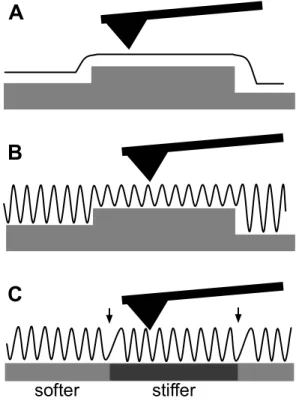
Figure 1.7. Schematic of (A) contact and (B, C) intermittent contact or tapping mode imaging with the AFM. In tapping mode, (B) changes in topology are represented by changes in the amplitude of the oscillation, (C) while changes in sample stiffness are represented by changes in the oscillation’s phase lag, indicated by
arrows. 27
Figure 2.1 Schematic of covalently immobilizing protein to a carboxylic
acid-terminated SAM through NHS/EDC chemistry. 60
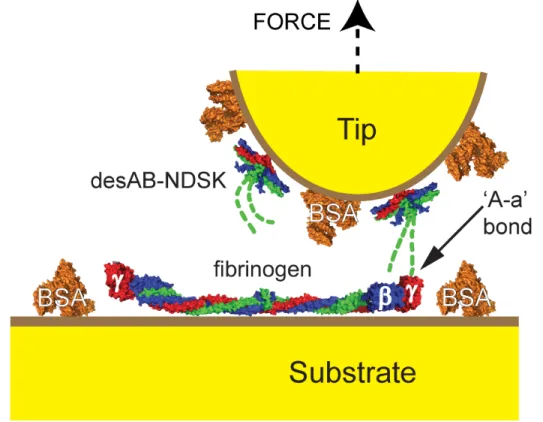
Figure 2.2 Schematic of AFM experimental configuration. Space-filling models of fibrin fragment desAB-NDSK and fibrinogen colored by polypeptide chains: α (green), β (blue), and γ (red). The formation
of ‘A–a’ bond is shown. The N-termini of the α chains do not
appear in crystal structures, therefore the knobs ‘A’ are approximated (dashed line). N-termini of β chains and αC domains
not shown. 62
Figure 3.1 Schematic representation of all proteins used in AFM measurements, not to scale. (A) Fibrinogen molecule depicted with
αC domains interacting with fibrinopeptide A and fibrinopeptide
B. Disulfide bond connecting the N terminus of the Aα chains
denoted as S-S. Locations of polymerization holes ‘A’ in γ module
and ‘B’ in β module indicated by arrows. (B) Fragments consisting
of the central part of fibrinogen (NDSK) and fibrin (desA- and desAB-NDSK) shown with both fibrinopeptides present (NDSK), FpA cleaved (desA-NDSK), and both fibrinopeptides cleaved (desAB-NDSK). (C) Polymerization holes-containing fragments D and DD. The location of DD interface containing interacting surfaces inaccessible to solvent is depicted by X in DD fragment. (D) Schematic representation of ‘A–a’ knob–hole interaction between desAB-NDSK (knob-containing molecule) and fibrinogen
(hole-containing molecule). 67
Figure 3.2 Force map showing interactions between 4A5 immobilized on the AFM tip and fibrinogen immobilized on the substrate in a 1 × 1
µm square with force curves taken every 31 nm. The black squares represent contacts resulting in an interaction while the white squares represent contacts without interaction. Interactions are defined as an abrupt change in force >5 standard deviations of the
baseline noise. 73
Figure 3.3 Distribution of observed forces between 4A5 and fibrinogen. Bin
Figure 3.4 Distribution of forces observed between desAB-NDSK immobilized on the AFM tip and fibrinogen immobilized on the substrate. The uncertainties represent widths at the
half-maximum of the Gaussian fits. Bin size = 20 pN. 75 Figure 3.5 Representative force curves showing prevalent patterns of rupture
of interactions between desAB-NDSK (tip) and fibrinogen (substrate). (A) Single event, (B) discarded force curve, and (C) four types of curves identified as the characteristic pattern of rupture. All characteristic curves include the doublet of events
above 200 pN. Event number is identified on each curve. 77 Figure 3.6 Plot of force versus separation relative to event 2 for all force
curves showing the characteristic pattern of rupture between
desAB-NDSK (tip) and fibrinogen (substrate). 78 Figure 3.7 (A) Distribution of forces (bin size = 20 pN) and (B) plot of force
versus separation relative to event 2 for characteristic interactions
between fibrin monomers on the tip and substrate. 80 Figure 3.8 Distribution of forces showing specificity of interactions between
tip and substrate modifications. Top: stepwise increase in number of interactions as fibrinogen knobs on each available surface are exposed. Bottom: interactions between desAB-NDSK and fibrinogen (left) are entirely inhibited upon incubation with GPRP (middle), and no interactions are found between desAB-NDSK and
γD364H (right). Each plot represents results from 3072
tip-substrate contacts. Bin size = 20 pN. 83
Figure 3.9 (top) Distribution of forces (bin size = 20 pN) and (bottom) plot of force versus separation relative to event 2 for characteristic interactions between (A) desAB-NDSK on the tip and fibrinogen nonspecifically adsorbed to the substrate, (B) desAB-NDSK on the tip and BβD432A fibrinogen on the substrate, (C) desA-NDSK on
the tip and fibrinogen on the substrate, (D) desAB-NDSK on the tip and D-fragment on the substrate, and (E) α chain on the tip and
fibrinogen on the substrate. 85
Figure 3.10 Force maps with contacts made every 156 nm along a 5 × 5 µm
area with desAB-NDSK on the tip and (A) 5%, (B) 10%, (C) 25%, and (D) 50% fibrinogen by mass in solution on the substrate. The black squares represent contacts resulting in an interaction, and the
white squares represent contacts without an interaction. 86 Figure 3.11 (A) Distribution of forces and (B) plot of force versus separation
between desAB-NDSK (tip) and the DD fragment (substrate). Note the histogram is not biphasic, but rather has a wide distribution of forces. The characteristic patterns seen with the DD fragment
exhibit events 1 and 4 less commonly than any other protein pair. 91 Figure 4.1 Force curves (restoring force in pN versus tip-substrate separation
in nm) containing characteristic pattern of fibrin ‘A–a’ knob–hole forced dissociation. Four types of characteristic patterns were identified: doublet (A), doublet with preceding event (B), doublet with following event (C), and doublet with both preceding and following events (D). Event numbers are indicated. Linear approximation of slope prior to one event as used for loading rate calculation is shown as dashed grey line (the line is slightly offset
for clarity). 103
Figure 4.2 Representative force curves not containing the characteristic pattern that were eliminated (A) automatically and (B) manually as described above. The automatic filter excludes curves with an overabundance of events (top), single events (middle), and curves that don’t fit the above definitions (bottom). The manual filter identified non-characteristic curves that passed the automatic filter but had events that were too far apart to be characteristic. These
often include a doublet of events. 107
Figure 4.3 (Left) Schematic of parallel, series, and zipper bond configurations. The force experienced by each interaction (F1
represents the first bond to rupture, while F2 represents the second
bond to rupture), relative to total applied force (F), is indicated. (Right) Hypothetical force curves for each configuration are illustrated. The total applied force (–), F1 (··) and F2 (--) are shown.
Select changes in restoring force in the force curves that correlate
with the changes in force applied to each bond are indicated. 111 Figure 4.4 Probability distributions of the rupture forces of a representative
experiment with tip retraction velocity of 1 µm/s and cantilever
stiffness of 55 pN/nm. 113
Figure 4.5 Representative four-event characteristic pattern force curve (circles) fit with the freely jointed chain model (lines). Least-squares fits with event 1 in parallel (grey) and in series (black) with event 2 are shown. Events 2–4 were always fit as in a series
configuration. 115
Bin size = 5 nm. Each row corresponds to a curve type: curves with events 2–3 (top row), curves with events 1–3 (second row), curves with events 2–4 (third row), and curves with all four events (last row). Since there were not large differences in the increase in contour length based on curve type, the values presented in Table 1 represent the averaged position and standard deviation of each fit for the increases in contour length after each event, weighted by the standard deviation. Since they aren’t characterized by an identifiable pattern, the initial contour lengths are omitted from
Table 4.1. 117
Figure 4.7 Probability distributions and Gaussian fits of Kuhn length for each event in each curve type as modeled with events 1 and 2 in (A) parallel and (B) series. Bin size = 0.05 nm. Each row corresponds to a curve type; the curve type corresponds to the events included in that row (e.g., the top row includes all curves that just exhibited events 2 and 3). Since there were no large differences in the values gained for each curve type, the values presented in Table 4.2 represent the averaged position and standard deviation of each fit for the Kuhn length of each event, weighted by the standard
deviation. 118
Figure 4.8 Characteristic force patterns of the rupture of interaction between fibrinogen and desAB-NDSK, where the rupture force is plotted versus (A) relative separation; relative contour length extracted from FJC fitted curves with events 1 and 2 modeled (B) in parallel
(C) in series or zipper. 120
Figure 4.9 Dissociation rates as a function of force for (A) each event as they occur in curves with just events 2 and 3 (), events 1–3 (), events 2–4 (*), and all four events () as identified in Figure 4.1, error bars represent error of the mean between experiments; and (B) each event with curve types averaged and weighted by error
(circles) and fit with Equation 4.3 (line). 121 Figure 4.10 Probability distributions and Gaussian fits of the elastic energy
stored the protein at time of rupture. The fit values for each event are — event 1: 130 ± 770 kBT; event 2: 1850 ± 1390 kBT; event 3:
2340 ± 1390 kBT; event 4: 970 ± 710 kBT. 126
Figure 5.1 Crystal structure of fibrinogen D fragment. GPRP (green spheres) and the γ1 calcium (orange sphere) are shown. Approximate
placement of β2 calcium is indicated. The following PDB entries
(DeLano Scientific, Palo Alto, CA). 134 Figure 5.2 Force versus separation aligned relative to the second event for
curves representative of each phenotype of the characteristic force curve. (Top to bottom) curves with just the doublet (events 2–3), curves with the doublet and a preceding event (events 1–3), curves with the doublet and a following event (events 2–4), and curves with all four events. Event numbers are indicated. Curves are aligned to event 2 to show consistent spacing between events, and
offset for clarity. Ticks on y-axis represent 100 pN. 137 Figure 5.3 Force versus separation relative to event 2 of all events in the
characteristic pattern of interactions between desAB-NDSK and fibrinogen in (A) HBS, (B) HBS + 3 mM CaCl2, (C) HBS + 1 mM
EDTA, (D) HBS + 1 mM EDTA + 2 mM CaCl2, (E) HBS + 0.1
mM EGTA, (F) HBS + 0.1 mM EGTA + 2 mM CaCl2, (G) HBS +
1 mM EDTA + 2 mM MgCl2, (H) HBS + 0.1 mM EgTA + 2 mM
MgCl2. Event numbers are indicated in (A). 139
Figure 5.4 Incidence of the characteristic pattern of fibrin ‘A-a’ bond rupture as a function of divalent ion concentration. Probability that an interaction was characteristic (i.e., contained the characteristic pattern, dark grey) and that a characteristic force curve contained event 4 (light grey) for interactions between desAB-NDSK and
fibrinogen in buffers with different divalent ion salt concentrations. 140 Figure 5.5 Characteristic pattern of forced rupture of fibrin ‘A-a’ interaction
with fibrinogen variants. Force versus relative separation for desAB-NDSK interacting with (A) γE132A fibrinogen, (B)
γD320A fibrinogen. 144
Figure 5.6 Normalized force probability distribution for (A) single event interactions between desAB-NDSK and wild-type fibrinogen, (B) single event interactions between desAB-NDSK and γD320A
fibrinogen, (C) events 3 (light grey) and 4 (dark grey) in characteristic interactions between desAB-NDSK and wild-type fibrinogen, and (D) event 3 in characteristic interactions between desAB-NDSK and γD320A fibrinogen. The center and standard
deviation of Gaussian fits (black lines) are indicated. The probability is normalized such that the area under the histogram
equals one. 146
Figure 6.1. Probability that (A) an interaction is characteristic and (B) a characteristic interaction includes event 4 as a function of NaCl concentration. The 0.15 M concentration represents the standard
Figure 6.2. Probability that (A) an interaction is characteristic and (B) a characteristic interaction includes event 4 as a function of pH. A pH 7.4 represents the standard operating conditions. Asterisks indicate statistical significance (i.e., p-value > 0.05) against the
standard conditions. 163
Figure 6.3. Probability that (A) an interaction is characteristic and (B) a characteristic interaction includes event 4 as a function of temperature. The temperature at 27 ºC represents the standard operating conditions. Asterisks indicate statistical significance (i.e.,
p-value > 0.05) against the standard conditions. 164
Figure 6.4. Absorbance at 350 nm as a function of time and temperature for fibrin polymerization. Fibrin polymerization was catalyzed by (A) thrombin and (B) batroxobin. The polymerization was investigated at three temperatures: 27 ºC (dashed line), 37 ºC (solid line), and
47 ºC (dotted line). 167
Figure 6.5. (A) Structure of γ module (ribbon) with bound GPRP peptide
(spheres). Location of all histidine residues in γ module are shown
with blue sticks. (B) Magnification of GPRP peptide (center) and residues in hole ‘a’ with which it has polar contacts (dashed lines). Note that the N-terminus of knob ‘A’ hydrogen-bonds with the His 340 (labeled). Created from PDB-ID 1LTJ using Pymol. (C)
Schematic of the protonation of histidine. 169
Figure 7.1 (A) Hypothetical force clamp separation versus time traces of fibrin ‘A-a’ knob-hole bonds. Inset is associated force ramp force versus separation trace. Each plateau represents a mechanically stable conformation associated with an event in the characteristic pattern (as indicated by color), and the rise between plateaus represents the increase in molecular length between the mechanically stable conformations. (B) Schematic of force quench experiment to examine protein refolding. Force is initially high, as in force clamp experiments (solid line), but is quenched to a much lower value (dotted line) and the separation is examined as a function of time. Integrity of refolded structure may then be tested
by a second unfolding cycle. 183
Figure 7.2 Schematics of unfold – refold cycles of three model biological systems. There is little to no hysteresis between the unfolding and refolding traces of myosin, an extracellular matrix protein comprised of α helix bundles. This lack of hysteresis suggests that
AFM. On the other extreme, the large hysteresis of the unfolding and refolding traces of multi-domain proteins like titin indicates that such proteins do not refold along the same energetic pathway they follow during unfolding. Schematics based on a figure from
List of Abbreviations and Symbols
~ approximately
° degree(s)
> greater than
< less than
% percentage(s)
# number
- negative
% percent
+ positive
± statistical margin of error
∞ infinity
αC C-terminus of the fibrin(ogen) α chain
β inverse thermal energy ∆ change
ΔG‡ transition energy
µg microgram(s)
µL microliter(s)
µm micrometer(s)
µM micromolar
µmol micromole(s)
τ bond lifetime
a persistence or Kuhn length
Å angstrom(s)
A350 absorbance at 350 nm
AFM atomic force microscope/microscopy
Ar argon gas
atm atmosphere
Au gold
BSA bovine serum albumin
C Centigrade
Ca2+ calcium ion
CaCl2 calcium chloride
CNBr cyanogen bromide
cm centimeter(s)
cos cosine
coth hyperbolic cosine
Cr chromium
desA without fibrinopeptide A
desAB without fibrinopeptides A and B
DNA dioxyribonucleic acid
E energy
EDC 1-ethyl-3-[3-dimethylaminopropyl]carbodiimide hydrochloride
e.g. for example
EGTA ethylene glycol tetraacetic acid
Eq. equation
et al. and others
EtOH ethanol
exp exponential function
F force
€
˙
F loading rate
Fc critical force
FJC freely-jointed chain
Fp fibrinopeptide
g gram(s)
G Gibb’s free energy
GHRP tetrapeptide glycine – histidine – arginine – proline (knob ‘B’ mimic)
GPRP tetrapeptide glycine – proline – arginine – proline (knob ‘A’ mimic)
h hour(s)
HBS HEPES-buffered saline
HBSC HEPES-buffered saline with calcium
HEPES hydroxyethyl piperazine sulfonic acid
HOPG highly-oriented pyrolytic graphite
ICP-OES inductively-coupled plasma optical emission spectroscopy
i.e. in essence
in inch(es)
k spring constant
kB Boltzmann’s constant
kBT thermal energy
koff off or dissociation rate
kon on or association rate
kDa kilodalton
kHz kilohertz
L contour length
L*(R) inverse Langevin equation
log logarithm
ln natural logarithm
m meter(s)
M molar
MΩ megaohm(s) min minute(s)
mg milligram(s)
Mg2+ magnesium ion
MgCl2 magnesium cloride
mL milliliter(s)
mm millimeter(s)
n number of samples
NaCl sodium chloride
NaF sodium fluoride
NaOAc sodium acetate
NDSK fibrin(ogen) N-terminal disulfide knot
NHS n-hydroxy succinimide
nm nanometer(s)
nmol nanomole(s)
nN nanonewton(s)
OM optical microscopy
OT optical tweezers
p probability
par parallel
PDB ID protein database identifier
PDMS polydimetyl siloxane
PEG polyethylene glycol
pH -log of proton concentration
pKa -log of acid dissociation constant
pmol picomole(s)
pN piconewton(s)
PU polyurethane
PVC polyvinylchloride
QCM quartz crystal microbalance
RMS root-mean-square
s second(s)
s-1 inverse second(s)
SAM self-assembled monolayer(s)
SEM scanning electron microscope/microscopy
ser series
sin sine
sinh hyperbolic sine
SMFS single-molecule force spectroscopy
SPR surface plasmon resonance
t time
T temperature
QCM quartz crystal microbalance
UV ultraviolet
V volt(s)
vmax maximum rate of change of A350
v/v ratio of volumes
vs. versus
WLC worm-like chain
× by
x distance
Chapter 1:
Introduction
1.1Fibrinogen and fibrin
Fibrin, the polymerized form of fibrinogen, the third most prevalent plasma protein, is
responsible for the structural stability of blood clots.1-6 Though the fibrin network
consists of only 0.25% of the volume of a clot, it is responsible for the structural integrity
of the clot under the flow of blood.7 Upon injury to a blood vessel, the coagulation
cascade generates thrombin, a serine protease, which converts soluble fibrinogen to
insoluble fibrin. Fibrin spontaneously polymerizes through non-covalent interactions and
forms a complex network of fibers that holds platelets, red blood cells, and other proteins
at the site of injury. Since fibrin is active in the flowing environment of blood, its
mechanical characteristics are critical for proper assembly, function, and eventual lysis.
Inappropriate mechanical properties of fibrin clots cause bleeding and clotting disorders
such as insufficient clotting and excessive bleeding (hemophilia), excessive clotting with
prolonged duration and vessel blockage (thrombosis), and dislodged clots that block
vessels away from the site of injury (thromboembolism). Furthermore, the biological
roles and physical properties of fibrin have made it an attractive biomaterial for tissue
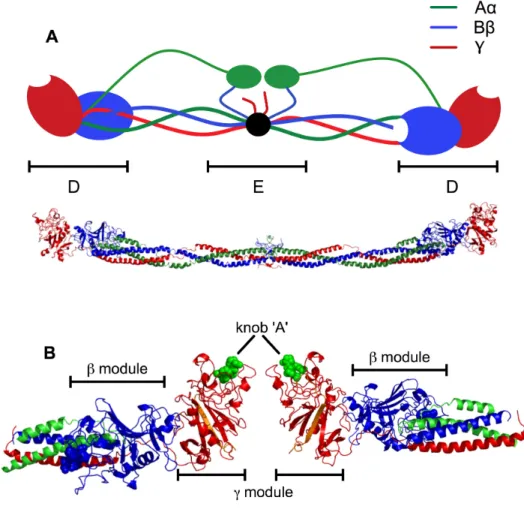
1.1.1 Fibrin(ogen) structure. Fibrinogen, a 340 kDa protein, is a symmetric,
hexameric protein, consisting of three pairs of identical chains: the Aα, Bβ, and γ (Figure
1.1A).3, 5, 10-13 The N-termini of all six chains meet in the disulfide-rich central E region
of the molecule. The Aα and Bβ chains have disordered structures extending outwards
from the molecule with lengths of 27 and 64 peptides upstream of the first disulfide,
respectively. Each chain extends outwards in a coiled-coil towards the distal D regions.
The D regions contain the individually folded globule, largely homologous γ and β
modules. The γ module contains a high-affinity polymerization site known as hole ‘a’
with a critical calcium-stabilized loop, known as the γ1 calcium.14 The β module contains
a proposed polymerization site known as hole ‘b’, which also includes a
calcium-stabilized loop, β1.12 A second calcium binding site in the β module, β2, serves as a
bridge between the β and the coiled-coils, such that β module is held against the
coiled-coil with hole ‘b’ facing the center of the molecule.12 Both the modules comprising the D
region consist of mostly loops with short segments of coiled-coil, and a four-strand β
-sheet (Figure 1.2B). An unusual structural characteristic of the fibrinogen γ module is that
after forming the region around the hole, the C-terminus of the chain inserts into the
antiparallel β-sheet in its module, forming the second strand. Yakovlev et al. reported that
the γ module is functional (i.e., binds knob ‘A’) in the absence of this inserted strand.15 A
small interface is present between the γ and β modules that holds the γ module at a 30º
angle with respect to the coiled-coil. The C-terminus of the Aα chain folds back towards
the center of the molecule, interacting with the N-terminus of the Bβ chain.
To transform fibrinogen to active fibrin, thrombin cleaves fibrinopeptides A and B
Figure 1.1. (A) Schematic (top) and crystal structure (bottom) of fibrinogen colored by chain. The D and E regions are indicated. In the schematic, the αC domains are shown
interacting with the N-termini of the Bβ chains. In the crystal structure, created using
Protein Data Bank entry 3GHG, neither the αC domains nor the N-termini of the Aα and
Bβ chains are resolved, and are therefore not shown. (B) Ribbon depiction of two
fibrinogen D fragments with bound knob ‘A’ and ‘B’ mimics, peptides GPRP and GHRP, respectively (spheres). C-terminal γ chain insert into β-sheet colored orange. Constructed
them to the α and β chains and exposing polymerization sites known as knobs ‘A’ and
‘B’, respectively (Figure 1.2B).16 Thrombin preferentially cleaves FpA such that the
release of FpB is delayed in normal polymerization.17 The release of FpB frees the
fibrinogen αC domains from their interactions with the E region.18, 19 The ‘A’ and ‘B’
knobs noncovalently interact with preexisting polymerization sites, known as holes ‘a’
and ‘b’, in the γ and β modules, respectively, of other fibrin monomers (Figure 1.2C).16
Thus, half-staggered protofibrils are generated, and laterally aggregate to form fibers
(Figure 1.2D). The forces and interactions responsible for lateral aggregation are unclear,
but may involve ‘B-b’ knob-hole, αC–αC, and D–D interactions.3 The fibers grow,
branch, and fuse to form the complex fibrin network that serves as the structural scaffold
of a blood clot (Figure 1.2E). Finally, Factor XIII ligates the fibrin fibers in both the αC
and γ modules. Some controversy over whether γ ligation is longitudinal or lateral exists,
though for the purposes of the studies herein we will assume it longitudinal.4, 20-22
The difference between fibrinogen and fibrin is simply that fibrinogen retains the
N-terminal fibrinopeptides, FpA and FpB, which thrombin cleaves to transform fibrinogen
into fibrin. Due to the high affinity of knob ‘A’ for hole ‘a’, fibrin is rarely observed in its
monomeric form. Herein, the term fibrin(ogen) is used when either or both fibrin and
fibrinogen are meant. For example, the ‘A–a’ knob–hole interactions we study are
fibrin(ogen) interactions, since only fibrin has knob ‘A’, and fibrinogen is used as the
source of hole ‘a’.
1.1.2 Fibrin polymerization. Fibrin polymerization has mostly been characterized
Figure 1.2. Schematic of fibrin polymerization. (A) Fibrinogen monomer, with both FpA and FpB in tact, and αC domains interacting with FpB. (B) Thrombin cleaves FpA and
FpB from the center of the molecule, exposing knobs ‘A’ and ‘B’. (C) Interactions between holes ‘a’ and knobs ‘A’ form double stranded, half-staggered protofibrils (αC
domains and knobs ‘B’ not shown for C-E). (D) Protofibrils grow and laterally aggregate to form fibers. (E) Fibers grow, branch, and merge to form the complex fibrin network.
A
C
B
D
turbidity are the key parameters.21 Lag time is usually associated with FpA cleavage and
protofibril formation when the strands are not large enough to scatter light. Lateral
aggregation of protofibrils causes the turbidity to increase, so the rate of turbidity
increase is associated with the rate of polymerization. The final turbidity of the fibrin
network is proportional to the size of the fibers and the density of the network.23
Supplemental clot morphology characterization is often performed via scanning
electron or confocal microscopy.24 Final fibrin network structure is commonly reported in
terms of fiber thickness, pore size, and the number of branch points. The effects of the
concentrations of thrombin, fibrinogen, and calcium as well as pH, ionic strength, and
temperature on fibrin polymerization and structure have been studied previously, and will
be discussed in greater detail in Chapter 6.21, 24 While it may be intuitive to perform all
experiments in conditions that are physiologically relevant, the dynamic environment of
blood ensures that at least fibrinogen and thrombin concentrations are not static. To
understand fibrin polymerization in the diverse conditions of the vasculature, it is
necessary to examine fibrin in solution conditions over the physiologically relevant
range.
1.1.3 Fibrin mechanical properties. Since fibrin provides the structural support for
blood clots that must mitigate the shear forces of blood flow, it has an inherently
mechanical function. The straight appearance of fibers in fully polymerized fibrin
networks indicates that they are under strain even in static environments.6 The
mechanical properties of fibrin have been studied on multiple levels including the
structure under force. Viscoelastic and rheology studies of whole clots have focused on
the correlation between clot structure (i.e., thickness of fibers and porosity) and
mechanics.2, 25, 26 Other studies have examined the mechanics of fibrin fibers and
monomers. Individual fibers have been probed by both optical tweezers (OT)27 and
atomic force microscopy (AFM).28, 29 The use of the OT technique allowed individual
fibers to be manipulated in the context of a whole clot. Collet et al. reported that fibrin
fibers were relatively stiff compared to other biopolymers and exhibit strain-stiffening
behavior.27 The authors hypothesized that such behavior allows clots to both bend out of
the flow of blood, preventing vessel occlusion and resisting premature rupture. The AFM
experiments, where single fibrin fibers suspended over a polymeric microchannel were
mechanically extended, found that fibrin fibers are among the most extensible
biopolymers and that much of this extensibility is reversible.28-30
The discovery of the exceptional extensibility of fibrin fibers led to several
investigations into its source. At this juncture, two dominant hypotheses of the
mechanism responsible for fiber extensibility exist: protofibrils sliding with respect to
each other, and unfolding of structural domains within the monomers that comprise
protofibrils. These hypotheses are not mutually exclusive, and may each play a role in
fibrin extension at different strains. Falvo et al. reported that the extensibility of fibrin
fibers is correlated with the length of a natively disordered proline-rich section of the αC
region.29 Since there is evidence that lateral aggregation of protofibrils is at least partially
due to αC–αC interactions,6 this correlation points to protofibril sliding as the source of
fibrin extensibility. Others have used smaller fibrin oligomers to demonstrate that the
lends credence to intraprotofibril contributions to fibrin extensibility.31-33 Furthermore, a
recent study of the mechanical behavior of clots by small angle x-ray scattering suggests
that monomeric unfolding must occur in stretched fibers.33 In addition, the forced
unfolding of the γ module of fibrinogen may contribute to fibrin extensibility at high
strains.34, 35 It is unclear how each of these inter- and intraprotofibril mechanisms
contribute to the reversibility of fibrin fiber extension.
1.2Single molecule force spectroscopy
Recent technical advances in analytical tools commonly used to probe proteins such
as fluorescence resonance energy transfer, two-photon microscopy, electron microscopy,
molecular modeling, AFM, and OT, have enabled the examination of biological systems
at the single molecule level. By observing the behavior of single proteins (versus large
ensembles of biomolecules), previously ambiguous questions have been resolved. Due to
the advent of techniques that use force as the means to probe single molecule systems
(i.e., AFM36 and OT37), biophysics in particular has benefited from the expanding field of
single molecule force spectroscopy (SMFS). Force studies have shed light on mysteries
surrounding protein folding and structural stability.38 While both OT and AFM probe the
mechanical properties of single molecules, each has unique attributes that qualify it for
different applications. The OT technique typically has a low force regime capable of
measuring sub-piconewton forces with high temporal resolution, which make it
appropriate for force-clamp studies and examining many biological systems. However,
the spatial resolution of most OT systems prevents its use for examining protein folding.
range, has a lower-force limit of several piconewtons, restricting its use for some
biological systems. On the other hand, the sub-nanometer spatial resolution of the AFM
makes it the tool of choice for mechanical studies of protein folding and stability. Below,
the requirements for and typical applications of SMFS are outlined.
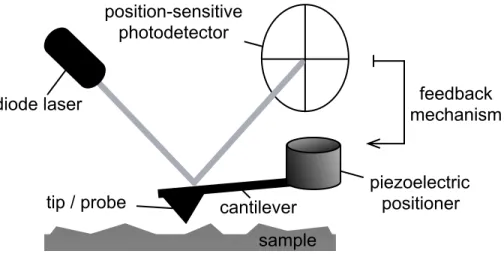
Despite the complexity of the data gathered, the AFM as a force sensor is both
requires only the most basic physical principles to describe, as shown in Figure 1.3 shows
and Figure 1.4 with a basic schematic and force curve, respectively. The AFM probe,
typically a silicon nitride pyramid, is affixed to the end of a micron-scale cantilever, and
moved towards and away from the substrate with sub-nanometer precision. The
cantilever’s deflections, detected with an optical lever comprised of a beam of light
reflected off of the back of the cantilever onto a position-sensitive photodetector, may be
translated into forces applied to the probe with Hooke’s law (i.e., F=-kx, where F is force,
x is deflection, and k is the empirically determined spring constant of the cantilever).36, 39
As the probe encounters the substrate, the cantilever is bent upwards until a
pre-determined deflection trigger is reached. The cantilever may then retracted from the
substrate at a constant velocity. If an interaction between the substrate and probe was
formed, the cantilever is bent downwards until the restoring force of the cantilever’s bend
exceeds the strength of the interaction, which breaks. The cantilever then continues to
retract at zero-deflection. The data collected from force spectroscopy experiments are
force versus separation traces, or ‘force curves’. The ‘strength’ of the interaction between
the tip and the substrate is the maximum force achieved, and the shape of the force curve
prior to rupture may be analyzed for clues about the behavior under force of the
Figure 1.3. Schematic of the AFM.
diode laser
piezoelectric positioner cantilever
tip / probe
position-sensitive photodetector
feedback mechanism
Figure 1.4. Idealized force curve (A) and corresponding motions of the AFM probe (B). The tip approaches the substrate with zero deflection (1), making contact (2) and pressing into the substrate to a pre-determined set point (3). If a bond exists between the tip and substrate, the cantilever will deflect as it retracts (4) until the restoring force of the cantilever exceeds the strength of the bond, which ruptures and the cantilever continues to retract (5).
1
2
3
4
5 1
2
3
4
5
A
B
force
Two primary goals exist for SMFS studies: forced unbinding of interactions between
molecules and forced unfolding of protein structures. For both aims, it is necessary to
take precautions to ensure that the phenomena observed are indeed single molecules, and
specific to the molecules of interest.
1.2.1 Experimental requirements for SMFS. Force spectroscopy may be, and often is,
performed on systems that are not single molecules. For example, the interactions of
bacterial cells with protein-coated substrates have been examined with the OT technique,
and correlations between binding forces and strain virulence found.40 Due to the
complexity of the force-separation traces, it is nearly impossible to draw anything but
qualitative conclusions from interactions between multiple pairs of molecules. In
addition, force spectroscopy is plagued by nonspecific interactions, which limits the
conclusions drawn from data. It is thus necessary to optimize methodology and perform
standard tests to ensure that the interactions measured are specific and between a single
pair of molecules.
The method of probe and substrate modification with proteins is a key element for
SMFS experiments. It is desirable to form a strong link between the protein and the
surface to reduce artifacts in the force data due to protein dislodging, while at the same
time preventing surface-related denaturation of the proteins so that the interactions of
interest remain intact throughout the experiment. The most common method for
immobilizing fibrinogen for force spectroscopy is nonspecific adsorption directly onto
the AFM probe. The primary drawback of this method is that adsorbed proteins are often
Since the interactions between the protein and the surface are not covalent, it is also
possible for the protein to become dislodged from the surface during the course of the
experiments, adding artifacts to the data. To account for these issues, crosslinkers
including glutaraldehyde, or self-assembled monolayers in combination with standard
NHS/EDC chemistry have been used to covalently attach fibrinogen to surfaces.41, 42
While polyethylene glycol (PEG) linkers for protein immobilization are more laborious
and costly, the known length and extension profile of PEG polymers facilitates data
analysis and filtering.43 Immunochemistry has also been used to immobilize proteins in
an oriented manner for probing the interactions between the substrate and specific sites
on the protein.44-46 To maximize the probability of single-molecule interactions, a
common strategy is to co-immobilize the protein of interest with a blocking protein such
as bovine serum albumin (BSA).47-49 Regardless of immobilization strategy, rinsing with
high-ionic strength and low-pH buffers is important to remove aggregates and loosely
adhered protein. Surfactants and excess blocking proteins have been included in the
buffers to reduce the likelihood of nonspecific interactions between the tip and
substrate.45, 49
To ensure that the interactions are specific, a series of controls involving
non-functional surfaces and interaction inhibitors are commonly performed.50-53 Since
nonspecific adhesion events often occur regardless of preventative measures, measures to
subtract the background that the nonspecific interactions cause have been taken.48, 54
Filters have also been employed to exclude low-force interactions at small tip-substrate
While there exist no standard procedures for ensuring the single-molecule nature of
interactions, a combination of several strategies have been employed to prove this
characteristic.38, 49 Since Poisson statistics indicate that an interaction frequency of
roughly 10–20% implies that the majority of interactions are between single molecules,
protein immobilization procedure is often optimized so that the interaction probability is
in this range.55 In addition, a method to check the single-molecule nature of interactions
has been utilized whereby the relationship between concentration of protein immobilized
and both the frequency and magnitude is determined.48, 56 If the interactions are between
single pairs of molecules, the frequency of the interaction should vary directly with
surface coverage, while the force magnitude should remain constant. A last method to
identify single-molecule interactions has involved examining the shape of the force
probability distributions. Single-molecule interactions should both result in a
characteristic shape with a long low-force tail and drop off quickly at high forces, while a
high-force tail is indicative of interactions between multiple molecules.51
1.2.2 Interactions between molecules. While interactions between single pairs of
molecules have been studied with the AFM since the inception of force spectroscopy, the
difficulties associated with the methodology required to eliminate non-specific
interactions and interactions between multiple pairs of molecules has limited the
conclusions drawn from such experiments. Reviews of the breadth of these experiments
can be found elsewhere,38, 49, 57 and only a few notable cases will be described below.
Perhaps unsurprisingly, the first and most widely characterized model system of
experiments by Lee et al. used BSA to covalently link biotin to a microsphere
immobilized on the AFM probe, and streptavidin to a mica substrate, detecting unbinding
forces of ~350 pN.58 Since then the multiple-valence nature, strength, and ubiquity of the
streptavidin–biotin interaction has made it an attractive target for more recent
examination of force-mapping,59 the effects of multiple parallel bonds in force
spectroscopy,51 and association kinetics.53 Other biological interactions commonly
examined with the AFM include protein–receptor,60-62 antibody–antigen,41, 46, 63 and
peptide–DNA.64
One particularly interesting class of interactions recently investigated with SMFS is
catch bonds.65 Discovered in studies of the flow-rate dependence of bacterial adhesion to
protein-coated surfaces, catch bonds become stronger when force is applied. Among the
protein systems that have demonstrated catch bond behavior are interactions responsible
for Escherichia coli binding to red blood cells, interactions involved in cellular motion,
and interactions critical to leukocyte adhesion to blood vessel walls.66 Such bonds have
been identified using two methods for plotting the force data: off-rate versus force, and
force versus loading rate. In plots of bond off-rate versus applied force for catch bonds,
the off-rate decreases with increased force (a situation opposite to normal interactions). If
the data is instead plotted as bond strength versus loading rate, catch bonds will exhibit a
dramatic increase in bond strength above some critical loading rate, as opposed to
monotonically increasing bond strength seen for other bonds.61, 67
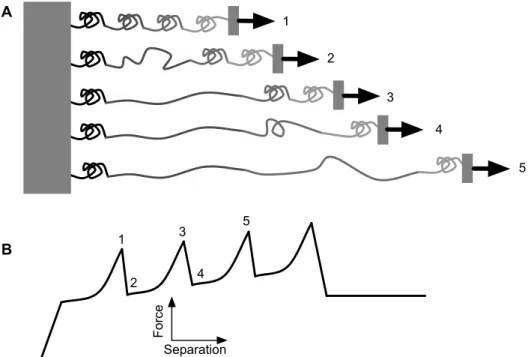
1.2.3 Forced unfolding of protein structure. Studies of protein (un)folding and
The breadth of such studies may be found in thorough reviews elsewhere.38, 68-71 In 1997,
Rief et al. discovered that the multidomain-repeat muscle protein titin could be unfolded
with the AFM.72 In these experiments, titin was nonspecifically adsorbed to mica, and
force curves were acquired with nonfunctionalized probes. The resulting force curves
exhibited a characteristic sawtooth appearance, with the peak of each ‘tooth’ representing
the rupture of a critical bond that allowed the extension of an unstructured domain,
represented by the drop and following rise in force (Figure 1.5). The sawtooth curves
have been fit with ideal polymer models to extract information regarding the length of the
fully unfolded peptide chain, as well as its remaining structure, as is described below.50,
71, 73, 74 Since these seminal experiments, the behavior of titin under force has been
characterized by several groups.75 Recombinant titin variants have been constructed to
examine the effect of calcium ions on mechanics,76 engineer differences in mechanical
strength,77 and create disulfides.78 Titin has been used as a model protein system to
demonstrate molecular dynamics simulation of AFM techniques,79 force clamp
methodology,80 and examine the importance of pulling direction in forced unfolding of
proteins81 and protein refolding under tension.82
The extension of other proteins has also been initiated using AFM. Myosin, a long
double-stranded coiled-coil structure has been probed and found to be an elastic structure
with no hysteresis between the folding and unfolding force traces.83 In contrast, each of
the short double-stranded coiled-coil domains of spectrin has been shown to
cooperatively unfold.84 Other multi-domain repeat proteins such as fibronectin have
proven to have similar mechanics to titin.81, 85 Likewise, other engineered proteins
Figure 1.5. (A) Schematic of unfolding multi-domain proteins and (B) ‘saw tooth’ appearance of the associated force curve. Force applied to the multi-domain protein (1) ruptures a critical bond in one of the domains, allowing it to become unstructured (2). The ‘slack’ then extends in a manner well modeled as an ideal polymer (3) until the critical bond in the next domain ruptures (4).
5
Force
Separation
1
2
3
4
1
2 3
4 5 A
been mechanically probed. Each of these studies has provided insight into the mechanics
and stability of protein structure and the mechanisms involved in protein folding.
1.3Single molecule force spectroscopy analysis
Several types of information have been gained from SMFS studies by careful analysis
of the information acquired. First, the elasticity of the tether (i.e., the mechanical
properties of the intact molecular construct) has been examined by analyzing the force
curve prior to final bond rupture.38, 90 In addition, kinetic parameters such as the rates of
bond association and dissociation have been deciphered.57, 61, 70, 91 The association rate
(i.e., on-rate) dictates how quickly a bond is formed, and is commonly limited only by the
rate of diffusion of the molecules associated with the bond, though structural changes or
other energetic barriers to bond formation slow the association rate.53 The dissociation
rate (i.e., off-rate) depends on the depth of the energy well of the bound species, and is
the inverse of the half-life of the bond. These parameters have provided insight about the
relationship of the mechanical energy landscape to that of thermal or chemical
denaturation and bond rupture.74, 92, 93
1.3.1 Polymer-like behavior. Force spectroscopy experiments have traditionally been
designed to examine forced unfolding of proteins. This is exceptionally useful to study
mechanical proteins comprised of multiple, identical domains, including titin,72, 76, 94
chromatin,95 myosin,83 spectrin,84 fibronectin.94, 96 and nebulin.97 Unfolding these proteins
is characterized by a saw-tooth pattern in the force curve, with each ‘tooth’ representing
To best understand the unfolding structures, the unraveling portions of the curve may be
fit with models describing an ideal polymer chain.73 These polymer chain models,
notably the worm-like chain (WLC) and freely jointed chain (FJC), use two parameters:
the contour length (i.e., end-to-end distance of a fully extended chain), and a shorter
length describing the stiffness of the chain (i.e., the persistence or Kuhn length for the
WLC or FJC, respectively).98 With the aid of these parameters, the unfolding structures
may be estimated. The most common information sought is the increase in contour
length, ΔL, between ruptures, which elucidates the structural regions unfolded.
The earliest and most commonly used model is the WLC model for its analytical
simplicity.72 A WLC is a homogeneous chain that may bend with a limited radius of
curvature, much like a garden hose without kinks. These chains are characterized by their
persistence length, which is the minimum distance between monomers required to
eliminate communication between the monomers.98 In other words, if the orientation of
one monomer is perturbed, monomers over a persistence length away will not be affected
by the perturbation. The longer the persistence length, the less stiff the polymer (i.e., the
polymer may be extended such that its end-to-end length nears its contour length with a
minimum application of force). For unfolding proteins, persistence lengths ~0.4 nm, the
approximate size of a single amino acid, are common.69 The relationship between force F
and end-to-end length x of such a chain is:
€
F = kBT
a
1
4 1
(
−xL)
2 −1 4+ x L , (1.1)
Methods have been developed to employ the FJC model for unfolding proteins.73, 99
An FJC is a chain of rigid, volumeless monomers that may flex in any direction at their
joints. The Kuhn length, is similar to the persistence length in that it describes the
minimum unit of length of the FJC that acts as an ideal polymer. However, polymers
described as an FJC will have a Kuhn length approximately twice the persistence length
of the same polymer described as a WLC.73 The relationship between force and the
end-to-end length of a FJC is:
€
F = kBT a
(
)
L*(R), (1.2)where a is the Kuhn length, kBT is the thermal energy, R is the extension ratio (end-to-end
distance / contour length), and L*(R) = y is the inverse Langevin function, where L(y) =
coth(y)-1/y. Since the inverse Langevin function is not an analytic function, several
approximations have been developed to approximate the FJC at different extension ratios.
Most recently, a simple closed-form function L*(R) = (1-R)-1+(1-R)2, has been used to
great success.53
Despite the success of these models, caution must be used in applying either of them
to a real system such as protein unfolding.73 Since they are both ideal polymers, by
definition they ignore interactions between monomers. This is an especially egregious
mistake when modeling proteins that are comprised of monomers capable of
experiencing hydrophobic effects, hydrogen bonding, electrostatic interactions, and steric
hindrance. Information gained from using these models may thus be inaccurate in several
ways. Nevertheless, as a first approximation, the WLC and FJC are adequate for most
1.3.2 Kinetic Parameters. In 1997, Evans and Ritchie developed a method of gaining
kinetic information from single molecule force spectroscopy experiments based on an
earlier paper by Bell100 (appropriately called the Bell-Evans model).101 This model
suggests that the force of rupture is dependent on the loading rate (i.e., rate at which the
force applied to a bond increases) in a manner determined by the off rate at zero applied
force and the characteristic distance (i.e., distance between bound and transition states).
The equation defining this dependence is
€
F = kBT
x ln ˙ F x koff
( )
0 kBT
, (1.3)
where x‡ is the characteristic distance, koff(0) is the zero-force off rate, and
€
˙
F is the
loading rate (Figure 1.6). Of note, this model assumes that both the zero-force off rate
and characteristic distance are loading rate-invariant. By finding the force at which the
bond ruptures under a range of loading rates (usually varied by changing the probe retract
velocity), these kinetic parameters may be obtained. This simple model has been
successfully applied to many systems within experimental error.70 Furthermore, studies
have reported the results of such analysis to be close to the corresponding kinetic
parameters gained from traditional equilibrium biochemical assays.
Significant attention has been given to the non-linear behavior of force versus loading
rate. Deviations from linear behavior have been attributed to multiple barriers between
the bound and unbound state.102, 103 Using the Bell-Evans formalism, complexity in the
energetic landscape correlates with a change in slope of the force-loading rate curve at
high loading rates.104 Akhremitchev and colleagues have demonstrated that such changes
Figure 1.6. Schematic of energy landscape (with distance being the reaction coordinate
x) of a bond at equilibrium (left) and under force (right). The characteristic distance x‡,
transition energy ΔG‡, and off-rate are indicated. Applied force F distorts the landscape
Others have explained non-linearity in trends of F versus ln(
€
˙
F ) by accounting for
assumptions made in the Bell-Evans model.105 For example, models have been used to
include possible changes in the characteristic distance with loading rate. Schlierf and Rief
included a term in the most-probable force function explicitly describing the shape of the
energy well (in an experiment using the immunoglobulin-like domain ddFLN4, the
energy well was found to be funnel-shaped).105 However, execution of this model is
difficult and is highly dependent on the shape of the well. Dudko, Hummer, and Szabo
have developed a more robust method of modeling forced unbinding experiments using
only two additional variables that describe the shape of the well: ΔG‡ and ν, the energy
difference between bound and transition states and a term giving the approximate shape
of the well, respectively.93 Their method suggests transforming the data into off-rate as a
function of force (see below), and then fitting the trend with
€
koff(F)=koff(0) 1−νFx ΔG 1
ν−1
exp ΔG1− 1−νFx ΔG 1 ν
, (1.4)
where the most common values of ν are 2/3 and 1/2, corresponding to the linear-cubic
and cusp shapes of the energy wells. In the case of ν = 1, this model reduces to the
Bell-Evans approximation. One drawback of this technique is that it is only applicable below
the critical force (Fc = ΔG‡/νx‡), above which the barrier disappears. As this is an artifact
of the model, other models may be used at high forces to extend the
Dudko-Hummer-Szabo model past this limit.
It may be desirable to use the off-rate as a function of force trend rather than force as
a function of loading rate since loading rates may vary considerably within and between
constant of the probe and the compliance of the tether. Further, this transformation allows
velocity-clamp experiments to be directly compared to force-clamp experiments, in
which the lifetime of a bond (τ = 1/koff) is investigated as a function of force. To perform
the transformation from (F) to koff(F), the relationship
€
koff(F)= p(F) ˙ F (F)
p(F')dF' F
∞
∫
(1.5)
is used. The trends for several different experiments at different loading rates may be
averaged to sample a wider range of forces than would be accessible with a single
loading rate.
The kinetic parameters extracted from force spectroscopy techniques have been
compared to those obtained from other techniques (i.e., chemical and thermal
denaturation).74, 92, 93 In particular, the zero-force off-rate may be investigated via surface
plasmon resonance and other non-equilibrium techniques.106 The free energy difference
between the bound and free states, as established by the Hummer-Dudko-Szabo model,
have been compared to results from techniques such as isothermal calorimetry.57 Indeed,
several studies have compared the energy landscapes of a few model systems as
investigated by both force spectroscopy and other techniques.107 Such comparisons have
revealed that the reaction coordinate dictates the agreement between techniques, as the
pulling direction affects the kinetic parameters of proteins unfolded by force.81, 108 Some
directions are ‘good’ parameters for unfolding or unbinding studies, as they closely
mimic thermal denaturation or unbinding.
1.4 Fibrin(ogen) and the AFM
!