ELECTROPHYSIOLOGICAL AND PSYCHOPHYSICAL MEASURES OF AUDITORY TEMPORAL PROCESSING
Sara Kathryn Mamo
A dissertation submitted to the faculty at the University of North Carolina at Chapel Hill in partial fulfillment of the requirements for the degree of Doctor of Philosophy in Speech and
Hearing Sciences in the Department of Allied Health Sciences.
Chapel Hill 2014
Approved by: John H. Grose Emily Buss Lori J. Leibold
ABSTRACT
Sara Kathryn Mamo: Electrophysiological and Psychophysical Measures of Auditory Temporal Processing
(Under the direction of John H. Grose)
Older adults experience greater difficulty than younger adults understanding speech in noisy, complex backgrounds. This deficit remains even when the older adults have nearly normal hearing on standard audiometric testing. Independent of hearing loss, there is
evidence of age-related declines in auditory temporal processing. These suprathreshold processing deficits have been implicated as contributing factors to reduced speech perception in noise. This project uses a combination of electrophysiology, psychophysics, and speech-in-noise measures to consider temporal processing in terms of sensory and perceptual coding of complex, periodic sounds. The use of combined methods is an important approach for parsing auditory and non-auditory factors underlying speech perception abilities in older adult listeners. The hypotheses are that (1) older adults exhibit reduced amplitudes for encoding sustained stimulus components on a speech-evoked auditory brainstem measure (sABR), (2) older adults have higher thresholds for the detection of a change in the
ACKNOWLEDGEMENTS
I cannot give enough thanks for my advisor, Dr. John H. Grose, for his mentorship over the past eight years. I asked for a job in his lab after the second year of my Au.D. training and have been a part of the research group ever since. I will always be thankful for the opportunity to learn from such a gifted and gracious mentor. I have been so lucky to begin my career working with Dr. Grose and his close collaborators, Drs. Emily Buss and Joseph W. Hall, III. I would also like to thank the other members of the Auditory Research Laboratory that have supported me through this process: Madhu Dev, Tara Steplowski, Drs. Heather Porter, Erol Ozmeral, and Angela Bonino.
I would like to thank all the members of my committee: Drs. John Grose, Emily Buss, Lori Leibold, Doug Fitzpatrick, and Adam Jacks. All have been generous with their time and expertise. Dr. Buss, especially, has been extremely generous in her MATLAB support, without which these experiments would not have been possible. I would also like to thank the Auditory Neuroscience and Auditory Junior Journal Groups for enduring many presentations and providing feedback as these experiments evolved over the years. Thanks to Drs. Porter and Bonino for peer-guidance through this process.
Although I finished my Au.D. six years ago, the clinical faculty in the Division of Speech and Hearing Sciences have continued to be a strong support network as I pursued my research training. Especially Drs. Roush and Mundy have always been available for career counseling and encouragement.
Clearly, I would not have made it to this point with my incredibly supportive husband Jared Butlin. Jared has carried me through almost 10 years of graduate school. And now, he is kindly picking up the whole family and moving to help my career to its next stage. Jared, I will never be able to repay you for the patience and support you have given me for the past decade, but I will try. Thanks also to my parents, Mark and Eileen Mamo, who apparently instilled a love of education that I may have taken a bit too seriously! Thank you for all the childcare, cleaning, laundry, food, and the list goes on. And, finally, thanks to my incredibly darling children, Brooks and Eloise—you make waking up every day exciting and
wonderful!
TABLE OF CONTENTS
LIST OF TABLES ... x
LIST OF FIGURES ... xi
CHAPTER 1. INTRODUCTION ... 1
CHAPTER 2. LITERATURE REVIEW ... 3
2.1. Central Processing, Cognitive Aging, and Auditory Performance ... 3
2.2. Age-Related Hearing Loss and Auditory Processing ... 5
2.3. Speech Perception in Noise ... 7
2.4. Auditory Temporal Processing ... 12
2.4.1. Physiology ... 12
2.4.2. Psychophysics ... 14
2.4.3. Electrophysiology ... 16
2.5. Summary ... 19
CHAPTER 3. PERIODICITY CODING IN OLDER ADULTS ... 20
3.1. Introduction ... 20
3.2. Methods... 25
3.2.1. Participants ... 25
3.2.2. Speech-Evoked Auditory Brainstem Response ... 26
3.2.3. Mistuned Harmonic Detection ... 28
3.2.4. Speech Perception in Noise ... 30
3.3. Results ... 31
3.3.2. Speech-Evoked Auditory Brainstem Response ... 32
3.3.3. Mistuned Harmonic Detection ... 32
3.3.4. Speech Perception in Noise ... 33
3.3.5. Associations ... 34
3.4. Discussion ... 35
3.5. Conclusion ... 38
3.6. Tables ... 39
3.7. Figures... 40
CHAPTER 4. SPEECH-EVOKED ABR IN YOUNGER AND OLDER ADULTS AND A SIMULATION OF NEURAL TEMPORAL JITTER ... 48
4.1. Introduction ... 48
4.1.1. Temporal Processing ... 48
4.1.2. Psychophysics ... 49
4.1.3. Speech Perception in Noise ... 51
4.1.4. Electrophysiology ... 52
4.1.5. Purpose ... 53
4.2. Methods... 55
4.2.1. Experiment 1: Periodicity Encoding in the sABR: Effects of Age ... 55
4.2.2. Experiment 2: An Aging Simulation: sABR and Temporally Jittered Stimuli ... 58
4.3. Results ... 60
4.3.1. Hearing Sensitivity ... 60
4.3.2. Experiment 1 ... 60
4.3.3. Experiment 2 ... 62
4.4.1. Envelope Following Response ... 64
4.4.2. Fine Structure Coding ... 67
4.4.3. Temporal Jitter Model ... 67
4.5. Conclusion ... 69
4.6. Tables ... 70
4.7. Figures... 70
CHAPTER 5. CONCLUSION ... 78
5.1. Introduction ... 78
5.2. Behavioral and Objective Measures of Temporal Envelope Coding ... 79
5.3. Periodicity Coding and Neural Temporal Jitter ... 80
5.4. Speech-Evoked Auditory Brainstem Response ... 81
5.5. Other Electrophysiological Options ... 84
5.6. Summary ... 84
5.7. Tables ... 86
APPENDIX ... 90
A.1. Short Duration sABR ... 90
A.1.1. Methods ... 90
A.1.2. Results ... 91
A.1.3. Discussion ... 91
A.2. sABR Transition Response ... 92
A.3. Test-Retest Reliability ... 93
A.4. Tables ... 94
A.5. Figures ... 95
REFERENCES ... 99
LIST OF TABLES
Table 3-1. Age and Audiometric Thresholds ... 39! Table 3-2. Thresholds from Exemplar Subjects ... 39! Table 4-1. Age and Audiometric Thresholds ... 70! Table 5-1. sABR Studies That Have Used the 40-ms /da/
Stimulus in Older Adults ... 86! Table 5-2. sABR Studies That Have Used the 170-ms /da/
LIST OF FIGURES
Figure 3-1. Group mean audiograms ... 40!
Figure 3-2. Stimulus example ... 41!
Figure 3-3. sABR spectra ... 42!
Figure 3-4. Group mean thresholds for detection of the mistuned harmonic ... 43!
Figure 3-5. MR plotted for younger and older adults ... 44!
Figure 3-6. Association between sABR and mistuned harmonic thresholds ... 45!
Figure 3-7. Association between sABR and MR ... 46!
Figure 3-8. Time domain sABR waveforms ... 47!
Figure 4-1. Mean audiograms ... 70!
Figure 4-2. Grand mean magnitude spectra for the FFRenv ... 71!
Figure 4-3. Grand mean magnitude spectra for the FFRtfs ... 72!
Figure 4-4. Jittered FFRenv spectra for younger adults ... 73!
Figure 4-5. Jittered FFRenv spectra from older adults ... 74!
Figure 4-6. Jittered FFRtfs spectra for younger adults ... 75!
Figure 4-7. Jittered FFRtfs spectra for older adults ... 76!
Figure 4-8. Time domain sABR waveforms ... 77!
Figure A-1. Time domain waveforms ... 95!
Figure A-2. Grand mean transition waveforms ... 96!
Figure A-3. Transition spectra ... 97!
CHAPTER 1. INTRODUCTION
Older adults often experience difficulty with understanding speech in noisy backgrounds, independent of hearing loss. This project focuses on underlying auditory processing changes that may contribute to this age-related decline in speech perception abilities, particularly in the temporal domain. The objective of this project is to assess the brainstem encoding of complex stimuli using speech-evoked auditory brainstem response (sABR) measures and to relate these findings to a psychophysical measure of temporal processing, as well as to a measure of speech perception in noise. The central hypothesis is that auditory temporal processing deficits among older adults with normal hearing are reflected in both electrophysiological and psychophysical measures. Understanding the associations among objective and subjective measures will help differentiate among auditory deficits and age-related cognitive declines as contributors to reduced speech perception abilities in older listeners. The combination of these methods is an important approach for building a foundation on which to address translational research questions that could improve aural rehabilitation for older adults.
This project addresses the following specific aims to investigate the objective and central hypothesis:
Aim 1. To test the hypothesis that evoked potentials elicited with complex stimuli
reflect age-related temporal processing deficits for sustained, periodic components. It is
Aim 2. To test the hypothesis that age-related neural synchrony deficits can be
modeled as increased temporal jitter in an electrophysiological response. It is expected
that applying a temporal jitter algorithm to the stimulus and measuring the sABR to that jittered stimulus in young listeners will model the decreased neural synchrony that is presumed to be the cause of the poorer sABR response in older adults.
Aim 3. To test the hypothesis that electrophysiological measures of temporal
deficits are associated with poorer performance on psychophysical and speech
perception tasks. Experiments for this project are designed to identify associations among
electrophysiological indices and psychophysical and speech measures in younger and older adults with clinically normal hearing. It is expected that correlated age effects will be identified due to similar auditory processing underlying the objective and behavioral measures.
This dissertation addresses these specific aims within the framework of the following four chapters. Chapter 2 provides the background and significance of the project by
CHAPTER 2. LITERATURE REVIEW
Many studies that focus on the aging auditory system are motivated by the premise that older adults experience more difficulty understanding speech in a noisy, complex background than do young adults. This increased difficulty is often present even when the older adults have normal to near-normal audiometric thresholds. Whereas there is general consensus on this age-related deficit throughout the literature, there is less agreement on what types of processing deficits contribute most to poorer speech understanding. Speech
perception requires high fidelity encoding of complex acoustic cues at the auditory periphery prior to the cognitive processing necessary to interpret the sensory signal. Parsing the sensory and cognitive processing deficits that contribute to speech perception difficulties is an
inherent challenge in the interpretation of aging auditory research. This project is focused on auditory processing factors that underlie speech perception in noise with the goal of better understanding the underpinnings of age-related differences between younger and older adults. Although some issues pertinent to the study of auditory aging such as high prevalence of hearing loss and confounding effects of cognitive decline must be addressed, the design of this project seeks to minimize these aspects of age-related changes in its focus on the
processing of the complex acoustic features of speech sounds.
2.1. Central Processing, Cognitive Aging, and Auditory Performance
general sensory processing across modalities and “cognitive aging” refers to executive function factors related to speech perception such as working memory. The American Academy of Audiology (AAA) Task Force on Central Presbycusis (Humes et al., 2012) recently defined “central presbycusis” broadly as the processes affecting speech
communication in older adults that extend beyond modality-specific changes in the auditory system and include amodal central processing and cognitive declines. Studies that have included modalities beyond audition in measures of temporal processing, such as touch and/or vision, suggest that there are global sensory and temporal processing deficits associated with age (Humes et al., 2009; Humes et al., 2013; George et al., 2007). For example, in a large cross-sectional study (n = 245, 18–87 years old), Humes et al. (2013) collected sensitivity and temporal processing thresholds across the modalities of hearing, vision, and touch. The researchers concluded that age and global sensory processing were significantly correlated and that sensory processing deficits mediated cognitive decline. In addition to sensory deficits, Craik (2007) highlighted general slowing, poor working memory, and inefficient selective attention as major aspects of cognitive decline that contribute to hearing and comprehension deficits.
concentration, working memory, and language abilities. In addition to the cognitive screener, this experiment used passive electrophysiological measures to evaluate auditory sensory encoding while limiting the influences of cognitive aging. The interwoven effects of sensory, central, and cognitive processing make investigation of underlying mechanisms contributing to speech perception difficulties both pertinent and challenging.
2.2. Age-Related Hearing Loss and Auditory Processing
Hearing loss is a hallmark of the aging process. The prevalence of bilateral hearing loss among older adults is estimated to be 27% of adults aged 60–69 years and 55% of adults aged 70–79 years (Lin et al., 2011). If unilateral hearing loss is included, these prevalence estimates rise to 45% and 68%, respectively. Hearing loss is a chronic impairment that negatively affects psychosocial status, including high rates of loneliness and depression, as well as a reduced social network (Kramer et al., 2002). In addition, hearing loss in older adults is associated with faster rates of cognitive decline (Lin et al., 2013). Given the impacts of hearing loss with regards to healthy aging and well-being, it is important to understand the aging auditory system and its effects on communication abilities.
To better characterize the etiology of hearing loss in older adults, Dubno and
profile that is characterized by a steeply sloping high frequency hearing loss. Regardless of the audiometric phenotype, cochlear hearing loss is associated with the loss of cochlear nonlinearities, which gives rise to a number of effects such as loss of the compressive input-output function of the basilar membrane, reduced dynamic range, poor frequency resolution, and, in part, poor temporal processing (for review see, Oxenham & Bacon, 2003).
In this project, all participants had normal to near-normal hearing sensitivity based on audiometric thresholds. Thus, the auditory processing changes associated with age-related cochlear hearing loss, particularly reduced frequency resolution (e.g., Sommers & Humes, 1993), have been minimized in these experiments. This facilitates the primary focus of this investigation: age-related changes in auditory temporal processing that are independent of hearing loss as measured by the audiogram. Although current research recognizes “hidden hearing loss” (Schaette & McAlpine, 2011) that is not defined by elevated sensitivity thresholds, such subclinical hearing losses are not yet well defined. For the purposes of this age-related investigation of auditory processing abilities, “normal hearing” will be defined as clinically normal audiograms (i.e., ≤ 20 dB HL across octave frequencies from 250–8000 Hz). Auditory aging in the absence of elevated audiometric thresholds has been associated with normal performance by older adults for measures associated with nonlinear cochlear processing (Gifford et al., 2005), as well as normal auditory filter bandwidths (Moore & Peters, 1992). In contrast, several investigations of older adults with normal hearing
recovery (e.g., forward masking; Dubno et al., 2003), poorer acuity to interaural timing differences (ITDs; Grose & Mamo, 2010), and deficiencies in the temporal processing of ongoing signals (e.g., temporal modulation transfer function (TMTF); He et al., 2008). The topic of age-related temporal deficits is expanded on in Section 2.4. All of these measures show age-related declines, although their relative contribution to speech perception in noise remains an active area of investigation. The current project builds on the literature of age-related temporal processing changes as a contributing factor to poor speech perception in noise and aims to use combined methodology to parse age-related changes in auditory and cognitive processing.
2.3. Speech Perception in Noise
Speech understanding in everyday environments requires complex sensory encoding of the acoustic features of the target speech as well as the environment, which likely includes fluctuating noises, other speech signals, and reverberation. As noted earlier, it is commonly observed that older listeners—even those with relatively normal audiograms—find speech recognition in such backgrounds challenging. To set this project within that wider context, a speech-in-noise measure was collected as a benchmark to verify that the older participants included in this study did indeed perform more poorly on speech perception in a complex background. As such, the inclusion of the speech-in-noise measure was not intended to test new experimental hypotheses but rather to have a reference for expected performance for the older adults. A brief review of age-related assessments of speech-in-noise abilities is
In the review undertaken by the AAA Task Force on Central Presbycusis, it was found that speech perception in the context of a speech background is one of the most common laboratory methods for investigating age-related declines in masked speech
perception (Humes et al., 2012). A background of meaningful speech can increase cognitive demands when compared to speech perception in non-meaningful speech maskers, especially for older adults (Tun et al., 2002). In the interest of reducing the influence of cognitive aging factors in the present project, the speech-in-noise measure was designed to have low
cognitive load. Specifically, a speech-shaped noise (SSN) was used as the masker because it was expected to cause little or no informational masking, which is often associated with other talkers in the background. This study employed a classic laboratory method of assessing speech-in-noise perception in both steady-state and amplitude-modulated (AM) background noise as a measure that captures temporal processing abilities while minimizing the effects of cognitive declines. This method provides a derived measure of benefit due to noise
fluctuations, i.e., the difference in masking level needed to achieve equal performance in each condition, known as masking release (MR). Although this type of masker manipulation is artificial and presumably simpler in terms of required auditory processing in comparison to the randomly fluctuating sounds characteristic of everyday environments, it nevertheless results in an age-related difference in performance for speech perception as well as an increased performance range among older adults (Grose et al., 2009).
to performance in modulated masking noise. Extrinsic factors that influence performance include but are not limited to speech material (e.g., syllables vs. sentences), rate and depth of masker fluctuation, and signal-to-noise ratio (Fullgrabe et al., 2006; Buss et al., 2009;
Bernstein & Grant, 2009). A review of these extrinsic factors is beyond the scope of this discussion. However, pertinent to the current experiment are intrinsic factors, such as pitch perception and auditory grouping, that affect the extent of benefit a listener experiences from masker modulations (Oxenham & Simonson, 2009). For example, tracking the fundamental frequency of the target speech allows the listener to create different auditory streams or group the various acoustic signals. These intrinsic factors rely on sufficient audibility and temporal resolution of the masker envelope to make use of the dips in the noise. The focus of this discussion will be on age-related subject factors that contribute to reduced release from masking in modulated noise.
The increased incidence of hearing loss with advanced age makes it challenging to differentiate the contributions of these two listener factors to the reduced MR in older adults. A study of cochlear hearing loss and MR by Bacon and colleagues (1998) compared normal-hearing subjects with age-matched (age range = 38–76 years) subjects with cochlear normal-hearing impairment (HI). Speech perception of sentences was tested in four different masker
hearing loss in both age-matched and non–age-matched listeners yielded similar MR results to the individual with hearing loss. Although this finding supports the notion that hearing loss reduces benefit of noise fluctuation, it does not rule out reduced benefit due to other factors such as temporal processing deficits and/or aging. The focus of this project is on these latter factors.
Older listeners with normal audiograms typically exhibit a reduced MR for speech, suggestive of independent temporal processing and/or aging factors not associated with age-related hearing loss (Dubno et al., 2002; Dubno et al., 2003; Gifford et al., 2007). Moreover, Grose et al. (2009) demonstrated that older adults with normal hearing performed the same as younger adults on sentence recognition in steady speech-shaped noise but achieved
significantly less benefit in an AM noise condition. To understand reduced benefit in AM noise, studies have sought to correlate MR magnitude with temporal processing measures and have found increased susceptibility to forward masking to be the most closely associated suprathreshold deficit (Dubno et al., 2002; Dubno et al., 2003; Gifford et al., 2007). It is thought that the slower neural recovery evidenced by the poorer performance on forward masking tasks results in poorer resolution of the temporal dips during which the listener takes advantage of the improved signal-to-noise ratio.
accounted for a majority of the variance in SRT in AM thresholds. Age was not a significant contributor to the variance accounted for, unless TRT was partialed out of the model. Results from this study suggest that inclusion of a non-auditory processing task (like TRT) helps differentiate contributions of auditory factors associated with reduced benefit in AM noise from other age-related processing changes.
An alternative speech-in-noise measure that taps into temporal processing is spatial release from masking. This method also has shown an age effect that is independent of hearing loss (Gallun et al., 2013). The task relies on the listener’s ability to benefit from a spatial separation of the target from the noise. To obtain a spatial release from masking, the auditory system must be able to accurately encode different voice pitches and locations. Accurately encoding this information relies on precise binaural neural timing, which has been shown to be poor in older adults with psychophysical and electrophysiological measures (Ross et al., 2007; Grose & Mamo, 2010; Grose & Mamo, 2012). Gallun and colleagues (2013) argued that the behavioral deficits observed for spatial release from masking, independent of hearing loss, support the research from animal models that have shown age-related reduced temporal coding in brainstem nuclei (Walton et al., 2010). Although these findings point to auditory temporal processing as a limiting factor for speech-in-noise
performance, they do not differentiate effects of poor sensory processing from poor cognitive processing.
multiple speakers. Vongpaisal and Pichora-Fuller (2007) demonstrated poorer F0 difference limens (DL) and identification of concurrent vowels in older adults as compared to younger adults. These results suggest reduced synchrony or periodicity coding as an underlying mechanism for poor speech-in-noise performance. Moreover, application of the temporal jitter algorithm to the speech stimulus resulted in performance for word identification in noise among young adults that matched that of older adults listening to intact speech (Pichora-Fuller et al., 2007). Across these various approaches to investigating speech perception in noise abilities, findings consistently point toward age-related differences in temporal processing abilities.
2.4. Auditory Temporal Processing
Within the realm of auditory temporal processing, there are a variety of facets important to the processing of the acoustic waveform of speech, such as the coding of its transient and sustained components. To support the notion that older adults have reduced processing of these features, in part because of poorer neural phase locking to periodic signals, this project focuses on converging evidence from the auditory aging literature in physiology, psychophysics, and electrophysiology.
2.4.1. Physiology
old mice. For low modulation frequencies (< 100 Hz), overall spike counts were higher for older mice. As the modulation frequency increased, the periodic spike rate
(spikes/second/modulation cycle) declined in a linear fashion in older mice while the periodic spike rate of young mice remained stable. As such, the main age-related findings included an increased overall response to SAM noise and a decreased upper frequency for envelope periodicity coding in the older mice. The researchers suggested that these findings are due to an imbalance in the excitatory and inhibitory mechanisms responsible for shaping temporal envelope encoding at the IC. Altered inhibitory function at the level of the IC as a basis for age-related changes in temporal processing also is supported by the work of Bartlett and Parthasarathy (2014) in rats. They showed that when single unit and local field potentials were measured in response to temporally modulated stimuli, age-related reduction in the response to rapid temporal modulations was correlated with reduction in GABAergic markers.
A less direct but nevertheless compelling line of investigation regarding reduced neural encoding in the presence of normal hearing sensitivity comes from work by Kujawa and Liberman (2009) with noise-exposed animals. This work has found permanent neural damage at the level of the 8th nerve subsequent to noise exposure that resulted in only
addition, reduced spiral ganglion cell counts were found in the presence of normal cochlear hair cell counts in human temporal bones (Makary et al., 2011). These findings do not
necessarily address reduced temporal encoding of periodic signals per se, but they do support the idea of reduced neural synchrony independent of hearing loss. For example, loss of the low spontaneous rate-high threshold fibers would result in the remaining fibers functioning in a saturated state at lower stimulation levels. As a result, phase locking to temporal envelopes at suprathreshold levels would be compromised (Dreyer & Delgutte, 2006). These temporal processing deficits would occur in the presence of normal audiometric sensitivity (because the high spontaneous rate-low threshold fibers are intact), which is important to note because temporal coding in the auditory nerve also is affected by elevated thresholds, particularly in the presence of background noise (Henry & Heinz, 2012).
2.4.2. Psychophysics
Age-related changes in temporal resolution as a function of age have been widely investigated using behavioral techniques. Of particular relevance to this project are
psychophysical studies that require the listener to encode periodic signals. Psychophysical tasks related to changes in stimulus periodicity are thought to rely on neural phase locking to the ongoing signal. Age-related studies reliant on periodic coding of the temporal envelope and/or temporal fine structure of tonal stimuli are discussed next.
hearing adults, He and colleagues (2008) found an age-related decline in the ability to detect AM as the rate of modulation increased. A second finding was that although the transition frequency was similar between the two groups, the shapes of the functions differed for younger and older adults. Most notably, the older adults showed deficits for modulation detection after the transition frequency for the low frequency carrier. The researchers suggested that beyond the transition frequency for the 500-Hz carrier tone, younger adults make use of both spectral and temporal cues in their detection criteria. In contrast, older adults are unable to phase lock to the available temporal cue. They suggested that the higher thresholds as a function of modulation rate and poorer performance beyond the transition frequency for the low-frequency carrier tone indicate that the older adults show reduced phase locking for both the temporal envelope and temporal fine structure (TFS) of the stimuli.
Another example of poor TFS encoding comes from studies of low-rate frequency modulation (FM) detection (He et al., 2007; Grose & Mamo, 2012). When low-rate FM is applied to a carrier, the detection of the instantaneous frequency presumably relies on
findings from this dichotic FM task, an investigation of interaural phase difference (IPD) in younger, middle-aged, and older adults by Grose and Mamo (2010) found a reduced upper frequency limit for IPD detection as a function of increasing age.
In summary, psychophysical evidence points to age-related deficits in the encoding of both the temporal envelope and temporal fine structure for tonal stimuli. As reviewed in the speech perception discussion (Section 2.3), both of these temporal aspects of speech have been proposed as important for understanding speech in complex backgrounds.
2.4.3. Electrophysiology
Auditory evoked potentials provide an objective method to assess suprathreshold sensory encoding of the temporal aspects of the stimulus. One advantage of using these passive measurements is the elimination of cognitive aging attributes that can impact behavioral and speech perception measures. In the aging literature, electrophysiological measures commonly used include the onset ABR (Poth et al., 2001; Walton et al., 1999), envelope following responses (EFR; Purcell et al., 2004; Leigh-Paffenroth & Fowler, 2006; Grose et al., 2009), frequency (fine structure) following response (FFR; Ross et al., 2007; Clinard et al., 2010; Grose & Mamo, 2012), and speech-evoked ABR (sABR; Vander Werff & Burns, 2011; Anderson et al., 2012; Ruggles et al., 2012; Clinard & Tremblay, 2013).
Studies of EFR in younger and older adults point to a consensus finding that older adults exhibit less neural synchrony for encoding rapid temporal envelopes. Specifically, older adults exhibit deficits at modulation rates exceeding about 80 Hz (Purcell et al., 2004; Leigh-Paffenroth & Fowler, 2006; Grose et al., 2009). Purcell and colleagues (2004)
maximum modulation frequency at which the EFR could be elicited was highly correlated with the maximum perceptible modulation frequency.
Similar combined-methods approaches have been used to assess fine structure coding in older adults. Ross and colleagues (2007) compared IPD detection via
magnetoencephalography (MEG) recordings and behavioral responses. A decreasing upper frequency limit for IPD was found with increasing age beginning with middle-aged listeners for both the MEG and behavioral data. In an FFR study of aging, Clinard and colleagues (2010) compared behavioral frequency DLs and FFR to pure tone stimuli. Although there were significant age effects for each part of the study, the two measures were not predictive of each other. The authors suggest several interpretations, including the possibility that the behavioral task provided a combination of place and timing cues to discriminate the F0 while the FFR relied entirely on temporal phase locking. Although a mismatch in findings may provide insights into differences in sensory encoding versus perceptual abilities, this pattern highlights a challenge of comparing electrophysiological and psychophysical findings when stimuli are not perfectly parallel across tasks, which hinders interpretation of incongruent results. In contrast to the incongruent results of Clinard et al. (2010), Marmel et al. (2012) did find a predictive relationship between FFR and F0 DL measures and suggested that the inclusion of a wide range of ages and audiometric thresholds provided a greater range in performance, which was conducive to correlation analyses.
Recent efforts in the electrophysiology literature have focused on sABR as an
groups found age-related differences in latency and/or amplitudes of the waveform peaks as well as reduced encoding in the spectral domain (via spectral amplitude or phase coherence metrics), there is no clear consistency in terms of which response metric uniformly
demonstrates a deficit across studies. These differences make interpretation of the
comparative findings difficult. For example, Vander Werff and Burns (2011) reported no differences in the sustained portion of the response when hearing sensitivity was statistically controlled. However, Clinard and Tremblay (2013) reported declines in amplitude and latency of the first two peaks of the sustained portion and suggested poorer
onset-of-periodicity encoding. In addition, Anderson and colleagues (2013a) investigated the response to the 40-ms /da/ in older adults as part of a regression model and found that the offset latency and the stimulus-to-response correlation metrics were the only significant predictors of self-reported speech in noise performance. These results highlight the variety of metrics that can be chosen for analysis and the challenge of interpreting findings across studies. The current project was motivated by the disparate findings in terms of periodicity coding, especially in light of previous evidence of reduced response amplitudes to rapid temporal envelopes (Purcell et al., 2004; Leigh-Paffenroth & Fowler, 2006; Grose et al., 2009).
In studies that have specifically compared young and older adults using the 170-ms /da/ stimulus, older listeners consistently had poorer phase locking to temporal envelope and fine structure components of the stimulus compared to younger listeners (Anderson et al., 2012; Ruggles et al., 2012).
2.5. Summary
As reviewed, many studies have focused on temporal processing deficits as a basis for understanding the increased difficulty older listeners exhibit with speech perception in
CHAPTER 3. PERIODICITY CODING IN OLDER ADULTS
3.1. Introduction
Much of the literature on the aging auditory system focuses on understanding why older adults have more difficulty than younger adults understanding speech in noisy,
complex backgrounds. When considering speech-in-noise difficulties, one must be cognizant of both auditory and non-auditory factors. Examples of auditory factors include audibility, temporal processing, and spectral resolution. Non-auditory factors include central processing factors, such as processing speed, attention, working memory, and cognitive load. These examples are certainly not exhaustive, but they hint at the complex interplay among factors contributing to speech perception challenges of older listeners. Differentiating among these factors is necessary to improve our understanding of the specific mechanisms underlying poor speech perception in noise in this population. The use of combined psychophysical and electrophysiological measures of auditory processing can help isolate factors associated with the perceptual and sensory encoding of the acoustic features of speech. In particular, within-subject investigation of objective and behavioral measures can improve understanding of the mechanisms underlying the auditory processing of complex stimuli.
Temporal processing has been evaluated with psychophysical and electrophysiological methodologies, and both demonstrate deficits in the coding of transient and sustained stimuli. Although age-related deficits for temporal onset coding have been shown across a variety of measures, such as gap detection (Schneider & Hamstra, 1999; Harris et al., 2010; Poth et al., 2001) and auditory brainstem responses (ABRs) elicited by transient stimuli (Walton et al., 1999), the focus of this investigation is the ongoing temporal envelope. Encoding the temporal envelope can provide intelligible speech information even in the presence of impoverished temporal fine structure and spectral cues (Shannon et al., 1995).
Reduced temporal envelope processing in older adults has been demonstrated in both behavioral and electrophysiological studies. Psychophysical studies of sensitivity to temporal envelopes have shown deficits in the temporal modulation transfer function (TMTF),
indicating that older adults perform more poorly than younger adults as a function of envelope modulation rate (He et al., 2008; Takahashi & Bacon, 1992). Likewise, electrophysiological studies of the envelope following response (EFR), including the clinically familiar auditory steady state response (ASSR), show that older adults have
reduced EFR as a function of the modulation rate, especially for rates exceeding about 80 Hz (Grose et al, 2009; Leigh-Paffenroth & Fowler, 2006; Purcell et al., 2004). These findings are thought to reflect reduced neural phase locking to the temporal envelope.
between stimulus and processing factors in interpreting incongruent patterns of results. For example, Clinard and colleagues (2010) compared frequency following response (FFR) and frequency discrimination measures and suggested that the absence of correlation between the two measures was due to the incongruence of the stimuli and task (i.e., detection vs.
discrimination). Specifically, the authors suggested that the stimulus context required for a discrimination task, i.e., the sequential presentation of two tones differing in frequency, is inherently different than coding a repeated tone, as in the FFR. However, a similar study of FFR and frequency discrimination by Marmel and colleagues (2012) did find a predictive relationship between FFR and frequency discrimination. Despite age-related deficits in both measures, the factor of age statistically accounted for very little variance, leading the authors to suggest that the age-related deficits in neural synchrony associated with the two measures did not reflect the same underlying mechanisms.
direct comparison between sensory encoding and perception than does one that only includes sABR and a speech perception measure.
The purpose of this study is to combine the sABR approach with a psychophysical task of temporal envelope encoding to examine periodicity coding in older adults. For the sABR, analysis will focus on the amplitude of the spectral components of the response to the periodic complex envelope of the stimulus. The stimulus for the behavioral task is designed to have a comparable temporal envelope to the steady-state portion of the synthetic speech token (i.e., /da/) used to elicit the sABR. Both stimuli have the same periodicity, but instead of a synthetic speech token, a complex tone comprising unresolved harmonic components is used in the psychophysical task. The complex tone was created with only unresolved
harmonics to limit place cues and create a task that relies on temporal envelope periodicity cues. The discrimination task applies a frequency shift to a single tone within the complex tone to disrupt the periodicity.
sABR to a behavioral response where the task is thought to rely on encoding the temporal envelope of a complex tone made up of unresolved harmonics.
In addition, participants will undertake the Hearing in Noise Test (HINT; Nilsson et al., 1994) in the presence of steady and amplitude modulated (AM) speech-shaped noise. This speech measure will serve as a reference to confirm that older adults indeed perform more poorly than the younger adults on a speech-in-noise measure, as well as provide an opportunity to assess whether individuals with better temporal processing abilities as measured by electrophysiological and/or psychophysical responses exhibit better speech in noise performance. The metric used to assess speech-in-noise performance is the derived measure of masking release (MR). Specifically, the MR is the difference between the threshold in steady noise and the threshold in AM noise, which reflects the listener’s ability to benefit from fluctuations or dips in the background noise. Benefit in AM noise (i.e., MR) provides a more sensitive assessment of speech perception in complex environments than speech perception in steady-state masking noise. This was evident in a previous study by Grose and colleagues (2009) in which older adults with normal hearing performed as well as younger adults in the steady-state background noise but achieved less release from masking for AM noise.
complex backgrounds, then individuals with more robust sABR amplitudes and better
performance on psychophysical tasks should have greater MR for the HINT sentences in AM noise.
3.2. Methods
3.2.1. Participants
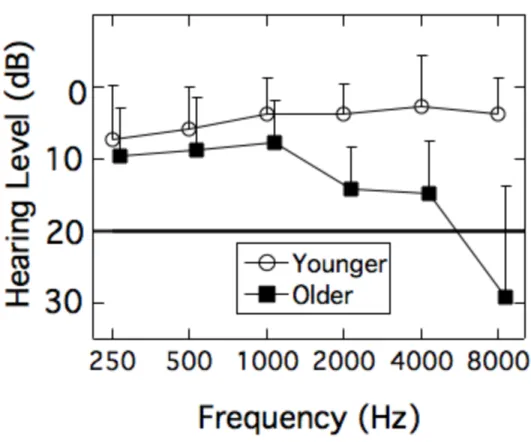
Two groups of listeners participated in this study: (1) younger adults (n = 20; 17 women; age range = 18–30 yrs; mean = 23.4 yrs (s.d. = 3.3 yrs)) and (2) older adults (n = 20; 13 women; age range = 65–80 yrs; mean = 70.0 yrs (s.d. = 4.7 yrs)). All listeners had normal audiometric thresholds (≤ 20 dB HL) from 250–4000 Hz, with four exceptions in the older adult group. Specifically, one listener had a threshold of 25 dB HL at 2000 Hz, two listeners had thresholds of 25 dB HL at 4000 Hz, and one listener had a threshold of 30 dB HL at 4000 Hz. Figure 3-1 provides the group mean thresholds in the test ear for each group. For the older adult group, the ear with better hearing thresholds was tested (right = 10); for the younger adults, a test ear was assigned to balance the number of right and left ears tested (right = 11). All older adults scored ≥ 24 on the Montreal Cognitive Assessment (MoCA; Nasreddine et al., 2005), which uses a screening cutoff score of 26 out of a maximum of 30 as a clinical indication of possible mild cognitive impairment.1 There was no association between MoCA score and any of the test measures in this project (see Section 3.3.5). Thus, all older listeners were considered cognitively healthy for the purposes of this study.
3.2.2. Speech-Evoked Auditory Brainstem Response
Stimulus. A synthetic speech stimulus provided by the Auditory Neuroscience
Laboratory at the Northwestern University School of Communication was employed in this study. The 170-ms /da/ contains a stop burst, a 50-ms formant transition region, and a 120-ms steady vowel. The F0 is 100 Hz throughout the stimulus. The first three formants shift during the 50-ms transition portion of the stimulus. Formant 1 ramps up from 400 to 720 Hz,
formant 2 falls from 1700 to 1240 Hz, and formant 3 falls from 2580 to 2500 Hz;
subsequently, formants 1-3 remain constant during the steady vowel. Formants 4–6 are fixed throughout the stimulus at 3300, 3750, and 4900, respectively (Anderson et al., 2012). Presentation level was 80 dB peak equivalent SPL. Stimuli were presented with alternating polarity at a rate of 3.9/second. The stimulus was presented through a shielded insert earphone (ER2; Etymotic Research, Inc., Elk Grove Village, IL). Mu-metal enclosures and electrical shielding tape (3M; Moncure, NC) were used to shield the transducers, as well as the cables within the sound booth (Campbell et al., 2012). The stimulus was controlled via a custom MATLAB (Mathworks, Natick, MA) program and output through a Tucker-Davis-Technologies (TDT; Alachua, FL) digital signal processor, which also sent a time-locked trigger to a Neuroscan 4.3 recording system (Compumedics; Charlotte, NC).
Recording. Electrophysiological recordings were collected using a Neuroscan 4.3
applied to any epoch exceeding ±35 µV. Approximately 3000 sweeps per stimulus polarity were collected. To reduce effects based on changes in the participant’s resting state, the total 6000 sweeps were collected in blocks of 2000 sweeps and then combined using the weighted average transform in the Neuroscan editing software. The weighted average transform accounts for the number of sweeps contributing to each averaged response. Responses to alternating polarities were added together to emphasize the response to the temporal envelope of the stimulus (Aiken & Picton, 2008). The participant rested in a recliner in a
sound-attenuated booth and watched a silent movie of choice with subtitles. The participant was allowed to sleep and was provided with breaks per request. Recordings were made during one or two sessions lasting no more than 2 hours each. Stimulus presentation and recording parameters were largely based on the cABR tutorial by Skoe and Kraus (2010).
Analysis. All analyses were done offline. The steady-state portion of the averaged
waveform response (60–180 ms post-stimulus onset) for each individual was submitted to a Fast Fourier Transform (FFT). After zero-padding, the resulting bin width in the frequency domain was 8.3 Hz. Results were analyzed using a signal-to-noise ratio (SNR) for each harmonic component. The SNR (dB) was calculated based on the amplitude of the respective response component compared to the surrounding noise floor. A noise floor value was
calculated for each response component by averaging the amplitude from four frequency bins over a +/- 25 Hz range, excluding the frequency bins immediately adjacent to that containing the component of interest. A criterion SNR of 3 dB was used to determine whether a
Responses were analyzed using a repeated-measures analysis of variance (ANOVA) with harmonic component as a within-subjects factor and age group as a between-subjects factor. There were six levels for the within-subjects factor: F0 and harmonic components two through six. There were two levels for the between-subjects age group factor. Interactions were probed with pairwise comparisons and Bonferroni corrections for multiple
comparisons. In cases of unequal variance among independent variables, Greenhouse-Geisser corrections for violations of sphericity were applied.
3.2.3. Mistuned Harmonic Detection
Stimuli. The stimulus was a five-component complex tone comprising harmonic
numbers 12–16 for each of two different F0s: 100 and 200 Hz. Three different stimulus durations were tested: 170, 340, and 680 ms. The complex tone had an overall level of 70 dB SPL, and was presented to the test ear through a Sennheiser HD 580 headphone (Old Lyme, CT). A continuous low-pass noise with a spectrum level of 50 dB/Hz at the cutoff frequency of 100 Hz with a roll-off of 15-dB/octave was presented to mask distortion products
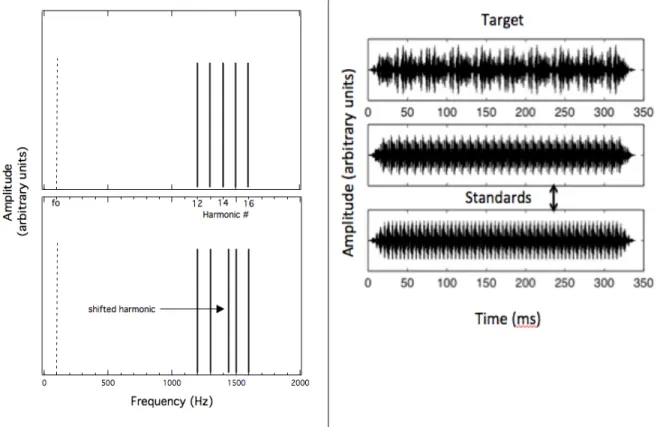
(Pressnitzer & Patterson, 2001). Each harmonic component was generated with a random starting phase for each presentation. Because of the random starting phase, the stimuli presented in the two standard intervals of the three-alternative, forced choice (3AFC) procedure (described in detail below) were not identical but did have uniform periodicity at the rate of the F0. In the target interval, an upward frequency shift was applied to the central, 14th harmonic component. The intended effect of shifting only the center component of the complex tone was to disrupt the periodic temporal envelope while minimizing spectral cues. A schematic of the stimulus spectrum and an example of a target and two standard
the center harmonic component (#14) is shifted in the target stimulus. The F0 is shown as a dashed line but is not present in the complex tone. In the time domain example (right panel of Figure 3-2), the envelope periodicity of the target stimulus is perturbed as a result of the mistuning of the 14th harmonic by 5%. All stimuli were digitally generated at a sampling rate of 24,414 Hz using a TDT digital signal-processing platform interfaced with custom
MATLAB code.
Procedure. The 3AFC procedure incorporated a three-down, one-up adaptive rule
that converged on 79.4% correct. Lights on a response box marked intervals, and the listener selected the target interval with a button press. Visual feedback was provided after each response. The step size for mistuning the 14th harmonic component was initially a factor of two; following two reversals, the step size reduced to √2. A threshold estimation track was terminated after eight reversals and the resulting threshold estimation was taken as the geometric mean of the final six reversal frequencies. The adaptive track was not allowed to exceed 7.14% mistuning because beyond that point, the mistuned component would have a frequency higher than the highest component of the complex tone. When the mistuned component exceeded the frequency range of the complex tone, the detection cue changed from a perception of “roughness” to the presence of an added tone “popping out” of the complex tone.
become familiar with the perceptual distinction between signal and standard before initiating the adaptive track. There were five younger and six older adults who had a substantial improvement in thresholds during data collection (i.e., beyond the practice conditions); for these subjects, blocks of three to five additional threshold estimates were collected, with final threshold based on these latter estimates, to ensure that analyses were based on stable
thresholds. Testing was typically completed over two or three one-hour sessions.
Analysis. Responses were analyzed using a repeated-measures analysis of variance
(ANOVA) with two within-subjects factors (F0 and duration) and a between-subjects factor of age group. There were two levels for the within-subjects factor of F0—100 and 200 Hz— and three levels of duration—170, 340, and 680 ms. There were two levels for the between-subjects age group factor. Interactions were probed with pairwise comparisons and
Bonferroni corrections for multiple comparisons. Greenhouse-Geisser corrections for violations of sphericity were applied where appropriate.
3.2.4. Speech Perception in Noise
Stimuli. The speech test comprised HINT sentences presented in steady and AM
speech-shaped noise. The HINT is a common clinical measure that has 12 lists with 20 sentences per list (Nilsson et al., 1994). The sentences are syntactically correct and
Procedure. Sentence-level scoring was implemented, such that each word in the
sentence had to be repeated back correctly for the sentence to be scored as correct. The presentation level of the sentence adaptively varied with a two-down, one-up stepping rule to approximate 70.7% correct performance. One practice trial in AM noise was presented. Two threshold estimates per condition were collected first, and then each condition was repeated once. If these three threshold estimates differed by more than 3 dB, a fourth threshold was collected. Final threshold was the average of these three or four threshold estimates..
Analysis. Group data were compared via t-tests for absolute thresholds in steady-state
noise and for the derived MR. The MR was calculated by subtracting the threshold in the AM condition from the threshold in the steady-state noise condition. The association between MR and the other experimental results—sABR amplitude and threshold for mistuned
harmonics—was assessed using a Pearson correlation (described in Results 3.3.5). 3.3. Results
3.3.1. Hearing Sensitivity
HL) for 1000–4000 Hz (Table 3-1). Given the presentation level of all the stimuli, audibility was not likely to be a limiting factor in performance.
3.3.2. Speech-Evoked Auditory Brainstem Response
For the sABR, the younger adults had more robust harmonic components than the older adults in the magnitude spectrum for the steady, periodic portion of the response
(Figure 3-3). A repeated-measures ANOVA analysis confirmed a within-subjects main effect of frequency (F(3.59,136.29) = 7.04, p < 0.001) and a between-subjects main effect of age group (F(1,38) = 58.12, p < 0.001). There was no significant interaction of frequency and age (F(3.59,136.29) = 1.63, p = 0.17). These findings suggest that older adults had less robust encoding of the periodic portion of the sABR and that this effect was not frequency dependent.
Analysis of the noise floor revealed no effect of age on the residual noise floor (F(1,38) = 0.39, p = 0.54). There was a significant effect of frequency (F(3.42,130.01) = 100.48, p < 0.001), which was expected due to the rising noise floor with decreasing frequency in EEG recordings. There was no interaction between frequency and age (F(3.42,130.01), p = 0.08).
3.3.3. Mistuned Harmonic Detection
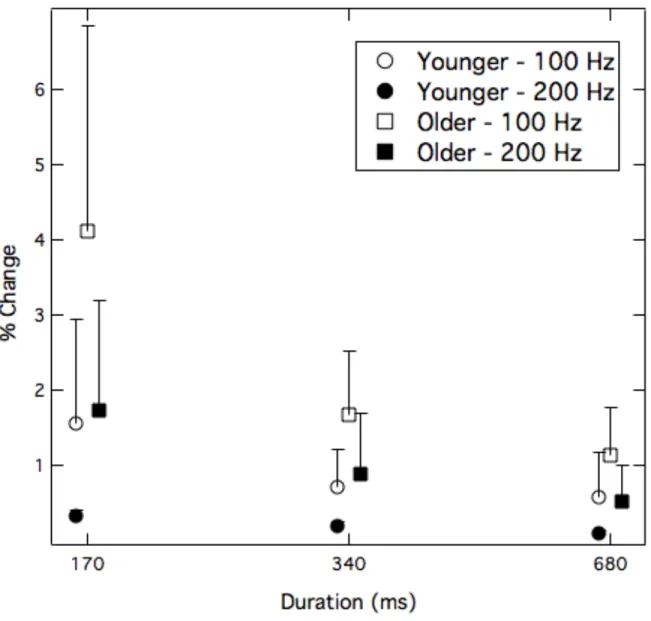
increased, and both groups performed better for the fundamental frequency of 200 Hz as compared to 100 Hz. A repeated-measures ANOVA included two within-subjects factors of F0 and duration as well as the between-subjects factor of age. There were significant within subject main effects of F0 (F(1,38) = 42.68, p < 0.001) and duration (F(1.08,41.18) = 48.60, p < 0.001) and a between-subjects main effect of age group (F(1,38) = 26.52, p < 0.001).
There were significant interactions for duration by age (F(1.08,41.18) = 15.79, p < 0.001), F0 by duration (F(1.14,43.45) = 22.63, p < 0.001), and the three-way interaction of F0 by
duration by age (F(1.14,43.45) = 4.58, p = 0.03). Probing comparisons of all the interactions suggested that: 1) there was an age effect at all three durations (p < 0.001), 2) there is a difference between the two fundamental frequencies for all three durations (p < 0.01), and 3) the age effect is present for both fundamental frequency conditions at all three durations (p < 0.01).
3.3.4. Speech Perception in Noise
As a reference measure, 16 of the younger and 19 of the older adults completed the HINT sentences in steady and AM noise. Figure 3-5 shows the group mean and individual MR values. Threshold values for 70.7% correct sentence repetition in 65-dB-SPL noise were 62.3 and 62.8 dB SPL for the younger and older adults, respectively. There was no
significant difference between age groups for the speech perception thresholds in steady-state noise (t(33) = -1.94, p = 0.06). However older listeners had less masking release than
3.3.5. Associations
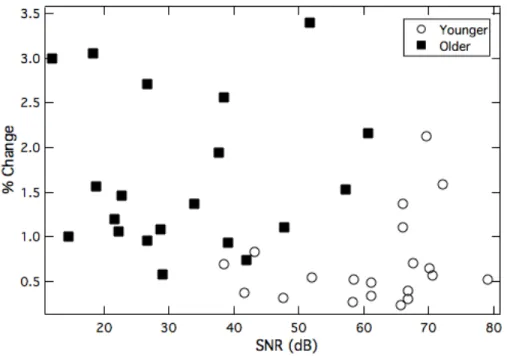
A primary interest of this investigation was whether individuals with a robust sABR response would exhibit superior performance on a psychophysical task of mistuned harmonic detection. It was also of interest to know if either or both of these measures related to the individual’s speech-in-noise capabilities. To limit the number of comparisons, one measure was selected for each task for the correlation analyses. A summed SNR value for the first five components (F0-H5) of the sABR was chosen with the intention of capturing the overall response to the complex temporal envelope. Moreover, visual inspection of the sABR data plotted in the frequency domain showed that, particularly for the younger adults, there was a substantial drop in response magnitude after the 5th harmonic component. For the behavioral task, the 100-Hz F0/170-ms duration condition was most closely matched to the /da/ stimulus in terms of F0 and duration. However, thresholds could not be obtained in this condition for 1 of 20 younger adults and 10 of 20 older adults. Because all subjects yielded a behavioral threshold for the 100-Hz F0/340-ms duration condition, this threshold was chosen for correlation analyses. Pearson correlations (two-tailed) indicated significant associations between the summed SNR of the sABR and the mistuned harmonic threshold (r(38) = -0.38, p = 0.02; Figure 3-6), as well as between the summed SNR of the sABR and the MR for the
HINT sentences (r(33) = 0.47, p < 0.01; Figure 3-7). There was no correlation between the harmonic mistuning threshold and MR (r(33) = -0.24, p = 0.16).
significant correlation for the sABR compared to the mistuned harmonic threshold (r(18) = 0.05, p = 0.83) or to the MR value (r(17) = 0.02, p = 0.93). Despite positive correlations when all participants are included, the variability of the older adults does not suggest any inherent associations. Other measures thought to potentially contribute to the summed SNR of the sABR and MR for the HINT sentences were considered for the older group only (i.e., threshold at 8000 Hz, pure-tone average (PTA) for 1000–4000 Hz or 4000–8000 Hz, age, and MoCA score), but none of these yielded significant correlations.
3.4. Discussion
The results of this study indicated that the younger adults performed better on all test measures. For the sABR measure it was hypothesized that the older adults would exhibit less robust encoding of the components of the complex temporal envelope, and this was
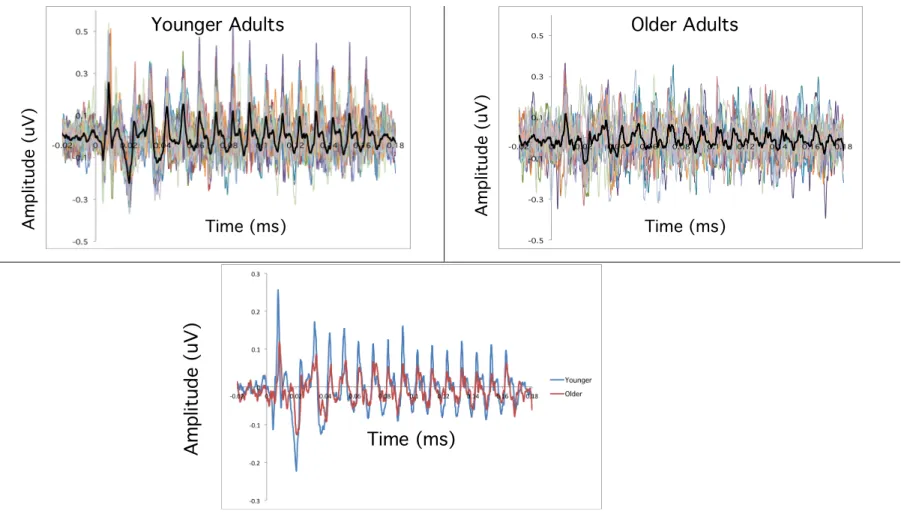
peak latency metric. Visually, peaks for the younger adults replicate well, but the blurring of the individual lines for the older adults shows that analyzing time latencies in this group would be more subject to error.
In the behavioral task, the hypothesis was that the detection of a change in the temporal envelope periodicity of a complex tone would be poorer for the older adults.
Indeed, the older adults had higher (i.e., poorer) thresholds for detecting the target stimuli for all test conditions. These findings are consistent with studies that have shown poorer
temporal resolution for older adults with normal or near-normal hearing sensitivity (He et al., 2008; Schneider & Hamstra, 1999; Strouse et al., 1998). In addition to poor temporal
envelope processing, the interaction between age and duration indicated that older adults are more affected by shorter duration stimuli than younger adults, suggesting poorer temporal integration for the periodic envelope.
(Alain et al., 2012). The authors suggested that this indicated a general slowing of auditory processing and/or longer temporal integration windows for older adults.
The intention of the combined-method design is to have an opportunity to uncover whether listeners with robust sensory encoding also have superior perception of the same complex acoustic signal. In the current experiment, the acoustic cue of interest was temporal envelope periodicity. Although a lack of correlation between the two measures could indicate that someone with good sensory encoding was, nevertheless, poor at the perceptual task and thus affected by more central or cognitive processes, there are many other factors to consider as well. For example, the lack of association between the sABR and either behavioral
measure for the older adult group raises questions as to the complementary nature of the different stimuli used in each measure. The stimulus created for the behavioral task was designed to have the same envelope periodicity as the synthetic speech token (/da/) used to elicit the sABR. However, the spectra of the two stimuli are substantially different in that the sABR token (when considering only the steady portion of the stimulus) is dominated by harmonic energy from approximately 100–1500 Hz, while the behavioral stimulus is comprised for the harmonics between 1200–1600 Hz for the 100 Hz F0 condition.
The behavioral stimulus was limited to unresolved harmonic frequencies in order to enhance reliance on temporal envelope cues. Although the dominant cue in the target stimulus of the psychophysical task was a change in perceptible roughness, typically
To further consider the lack of association between physiological and behavioral measures of temporal processing, it is interesting to consider a few individual participants. A closer look at the three older adults with absent F0 for the sABR suggests that they do not behave similarly on other measures (Table 3-2). Also included in Table 3-2 are the mean responses from the older adult group, as well as thresholds from the older individual with the most robust F0 encoding. There is no dependent variable (e.g., mistuned harmonic threshold or masking release), nor any particular subject characteristic (e.g., PTA, age, cognitive score), that differentiates these participants. In fact, the individual with the best F0 SNR also had the worst threshold for the harmonic mistuning task within the older adult group.
3.5. Conclusion
nerve, brainstem, and cortex) would allow for a wider range of within-subject comparisons to improve understanding of what generators are dominating the response and what metrics are best associated with functional communication.
3.6. Tables
Table 3-1.
Age (years) and Audiometric Thresholds. Distributions (dB HL) for the two age groups showing means and standard deviations
250 Hz 500 Hz 1000 Hz 2000 Hz 4000 Hz 8000 Hz Younger
Mean Age = 23.4 (s.d. = 3.3)
7.3 (7.5) 5.8 (5.9) 3.8 (5.1) 3.8 (4.3) 2.8 (7.2) 3.8 (5.1) Older
Mean Age = 70.0 (s.d. = 4.7)
9.5 (6.7) 8.8 (7.2) 7.8 (5.7) 14.3 (5.9) 14.8 (7.3) 29.3 (15.3) Table 3-2.
Thresholds from Exemplar Subjects. All measures collected on three subjects with absent F0 in the sABR (O-1 to O-3) as well as the older adult with the strongest F0 (O-4) and the group means and standard deviations.
Subject F0 SNR Mistuned Harmonic Masking Release PTA (1-4 kHz) 8000 Hz Threshold
Age Cognitive Screen
O-1 0 3.00 7.95 16.7 35 69 25
O-2 0 1.00 10.17 13.3 35 71 29
O-3 0 1.08 9.43 11.7 15 67 30
O-4 17.38 3.40 12.13 6.7 30 66 27
3.7. Figures
Figure 3-2. Stimulus example. Left Panel—Schematic of the stimulus spectrum for the standard (top panel) and target (bottom panel) stimuli. Right Panel—Example time
Figure 3-3. sABR spectra. Grand mean magnitude spectra for the sABR response to the steady-state segment (60–180 ms) for younger (top panel) and older (bottom panel) adults. The red asterisks mark the F0, and the green asterisks mark the expected harmonic
components. The gray shading depicts the average noise floor.
100 200 300 400 500 600 700 800 900 1000
0 0.02 0.04 0.06 0.08
Frequency (Hz)
Amplitude (uV)
Younger Adults Envelope Spectrum
100 200 300 400 500 600 700 800 900 1000 0
0.02 0.04 0.06 0.08
Frequency (Hz)
Amplitude (uV)
Figure 3-5. MR plotted for younger and older adults. Small filled symbols represent
Figure 3-6. Association between sABR and mistuned harmonic thresholds. Scatter plot of the F0-H5 summed SNR dB data plotted against the % Change thresholds for the 100 Hz
Figure 3-8. Time domain sABR waveforms. Top panels: Color waveforms represent individual averaged responses to the /da/
stimulus, and bolded black lines show the grand mean average per age group. Responses from the younger adults are on the left and
older adults are in the right panel. Bottom panel: The grand mean responses from the younger and older adults are overlaid for Time (ms)
Am
pl
it
ud
e
(u
V)
Time (ms) Time (ms)
Am
pl
it
ud
e
(u
V)
Am
pl
it
ud
e
(u
V)
Younger Adults Older Adults
CHAPTER 4. SPEECH-EVOKED ABR IN YOUNGER AND OLDER ADULTS AND A SIMULATION OF NEURAL TEMPORAL JITTER
4.1. Introduction
Older adults who have clinically normal audiometric hearing sensitivity nevertheless experience difficulty with speech recognition, especially in noise. Given the ubiquity of this observation, it is generally understood that speech perception abilities can change as a function of age independently of hearing loss as determined by an audiogram. Many studies of older adults with normal hearing sensitivity point to auditory temporal processing deficits as a contributing factor to decreased speech perception performance (Strouse et al., 1998; Gordon-Salant & Fitzgibbons, 2001; Dubno et al., 2002; Dubno et al., 2003; Pichora-Fuller et al., 2007; Grose et al., 2009). However, older adults with normal hearing sensitivity tend to perform on par with younger adults on other measures associated with normal cochlear function, such as frequency selectivity (Gifford & Bacon, 2005). Processing deficits have been measured across a range of temporal measures, including transient and sustained encoding of complex signals.
4.1.1. Temporal Processing
temporal envelope is preserved (Shannon et al., 1995). In addition to the slower amplitude modulations of the overall speech stimulus, there is periodicity coding to the fine structure, or rapid pressure oscillations, of the speech. Some argue that it is the fine structure coding that is necessary for speech intelligibility in noisy, complex backgrounds because this is what the listener “glimpses” during fluctuations in the background noise (Hopkins & Moore, 2009). Differentiating these two characteristics of the speech signal in order to parse the source(s) of speech perception is difficult without disrupting other spectro-temporal cues (Apoux et al., 2013). Given that both temporal envelope and fine structure components contribute to speech perception in complex backgrounds, further understanding of the mechanisms underlying the processing of these cues can help shed light on speech perception deficits in older adults. Evidence of reduced periodicity coding for temporal envelope and fine structure cues in older adults can be found in psychophysical, speech perception, and electrophysiological research. 4.1.2. Psychophysics
One classic measure of envelope periodicity coding is the temporal modulation transfer function (TMTF). He and colleagues (2008) found age-related differences in
sensitivity to the detection of amplitude modulation (AM) of pure tone carriers. Specifically, older adults were less sensitive to the detection of AM as the modulation rate increased, indicating a deficit in coding of rapid temporal envelopes. In addition, even though
Overall, these findings support poor periodicity coding in older adults for both the temporal envelope and the fine structure cues. Another periodicity coding measure that focuses on temporal fine structure coding is frequency modulation (FM) detection for low-rate FM. Older adults are less sensitive to low-rate FM at low carrier frequencies than younger adults (He et al., 2007), and these differences are enhanced by introducing binaural processing cues, such that even middle-aged adults show a decline in temporal fine structure processing (Grose & Mamo, 2012). Further support for the hypothesis that binaural periodicity coding deficits emerge in the middle-aged auditory system comes from the demonstration of decreased upper frequency limits for the detection of interaural phase differences (Grose & Mamo, 2010).
This model of temporal jitter has been further explored in studies of speech perception (Pichora-Fuller et al., 2007; MacDonald et al., 2010; Smith et al., 2012).
4.1.3. Speech Perception in Noise
When considering periodicity coding in terms of speech signals, fundamental frequency (F0) is an important cue. Specifically, pitch tracking allows a listener to use a speaker’s F0 to segregate target speech from the competing background. Pitch tracking relies, in part, on faithful representation of the temporal fine structure of the speech signal. This gives rise to the expectation that reduced neural phase locking should impair precise
representation of each harmonic frequency. Vongpaisal and Pichora-Fuller (2007) found age-related elevations in F0 difference limens (DLs) and argued that temporal synchrony deficits might explain poor F0 and harmonicity coding, with subsequent difficulty in vowel
segregation. Although not tested, Vongpaisal and Pichora-Fuller suggested an approach of testing younger adults on harmonicity-coding tasks using stimuli degraded to simulate increased neural jitter in order to determine whether poor temporal processing does contribute to age-related deficits in F0 and harmonic discrimination.
Pichora-Fuller and colleagues (2007) formalized the simulation of increased neural jitter in an algorithm that manipulated the lower frequency region of a complex signal (where phase-locking is likely to play a role). The jitter algorithm systematically corrupts the