Association of HIV diversity and virologic
outcomes in early antiretroviral treatment:
HPTN 052
Philip J. Palumbo1, Ethan A. Wilson2, Estelle Piwowar-Manning1, Marybeth McCauley3, Theresa Gamble4, Newton Kumwenda5, Joseph Makhema6,
Nagalingeswaran Kumarasamy7, Suwat Chariyalertsak8, James G. Hakim9, Mina C. Hosseinipour10,11, Marineide G. Melo12, Sheela V. Godbole13, Jose H. Pilotto14, Beatriz Grinsztejn15, Ravindre Panchia16, Ying Q. Chen17, Myron S. Cohen18, Susan H. Eshleman1*, Jessica M. Fogel1
1 Dept. of Pathology, Johns Hopkins Univ. School of Medicine, Baltimore, Maryland, United States of America, 2 Vaccine and Infectious Disease Division, Fred Hutchinson Cancer Research Center, Seattle, Washington, United States of America, 3 Science Facilitation Department, FHI 360, Washington DC, United States of America, 4 Science Facilitation Department, FHI 360, Durham, North Carolina, United States of America, 5 College of Medicine-Johns Hopkins Project, Blantyre, Malawi, 6 Botswana-Harvard AIDS Institute Partnership, Gaborone, Botswana, 7 CART CRS, YRGCARE Medical Centre, VHS, Chennai, India, 8 Research Institute for Health Sciences, Chiang Mai University, Chiang Mai, Thailand, 9 Dept. of Medicine, Univ. of Zimbabwe, Harare, Zimbabwe, 10 Division of Infectious Diseases, Univ. of North Carolina at Chapel Hill, Chapel Hill, North Carolina, United States of America, 11 UNC Project-Malawi, Institute for Global Health and Infectious Diseases, Lilongwe, Malawi, 12 Hospital Nossa Senhora da Conceic¸ão, Servic¸o de Infectologia, Porto Alegre, Brazil, 13 National AIDS Research Institute (ICMR), Pune, India, 14 Hospital Geral de Nova Iguacu and Laboratorio de AIDS e Imunologia Molecular-IOC/Fiocruz, Rio de Janeiro, Brazil, 15 Instituto Nacional de Infectologia Evandro Chagas-INI-Fiocruz, Rio de Janeiro, Brazil, 16 Univ. of the Witwatersrand, Perinatal HIV Research Unit, Soweto HPTN CRS, Soweto, South Africa, 17 Vaccine and Infectious Disease Division, Fred Hutchinson Cancer Research Center, Seattle, Washington, United States of America, 18 Dept. of Medicine, Univ. of North Carolina at Chapel Hill, Chapel Hill, North Carolina, United States of America
Abstract
Higher HIV diversity has been associated with virologic outcomes in children on antiretrovi-ral treatment (ART). We examined the association of HIV diversity with virologic outcomes in adults from the HPTN 052 trial who initiated ART at CD4 cell counts of 350–550 cells/ mm3. A high resolution melting (HRM) assay was used to analyze baseline (pre-treatment) HIV diversity in six regions in the HIV genome (two in gag, one in pol, and three in env) from 95 participants who failed ART. We analyzed the association of HIV diversity in each geno-mic region with baseline (pre-treatment) factors and three clinical outcomes: time to virologic suppression after ART initiation, time to ART failure, and emergence of HIV drug resistance at ART failure. After correcting for multiple comparisons, we did not find any association of baseline HIV diversity with demographic, laboratory, or clinical characteristics. For the 18 analyses performed for clinical outcomes evaluated, there was only one significant associa-tion: higher baseline HIV diversity in one of the three HIV env regions was associated with longer time to ART failure (p = 0.008). The HRM diversity assay may be useful in future stud-ies exploring the relationship between HIV diversity and clinical outcomes in individuals with HIV infection. a1111111111 a1111111111 a1111111111 a1111111111 a1111111111 OPEN ACCESS
Citation: Palumbo PJ, Wilson EA, Piwowar-Manning E, McCauley M, Gamble T, Kumwenda N, et al. (2017) Association of HIV diversity and virologic outcomes in early antiretroviral treatment: HPTN 052. PLoS ONE 12(5): e0177281.https:// doi.org/10.1371/journal.pone.0177281
Editor: Alan Landay, Rush University, UNITED STATES
Received: December 8, 2016
Accepted: April 24, 2017
Published: May 8, 2017
Copyright:©2017 Palumbo et al. This is an open access article distributed under the terms of the
Creative Commons Attribution License, which permits unrestricted use, distribution, and reproduction in any medium, provided the original author and source are credited.
Data Availability Statement: The data generated from this study are available in the Supplemental files.
Introduction
HIV genetic diversity generally increases with duration of infection [1,2] and is influenced by viral factors and the host immune response [3,4]. Antiretroviral treatment (ART) may decrease viral diversity [5]. Higher pre-treatment HIV diversity has been associated with high viral load [6], less effective control of viremia after strategic treatment interruption [7], and more rapid disease progression [8].
We developed a high resolution melting (HRM) assay for quantifying HIV diversity with-out sequencing [9,10]. The HRM diversity assay measures the melting range of DNA ampli-cons generated from viral RNA and generates a single numeric HRM score that reflects the level of diversity in the genomic region analyzed [9]. Higher HRM scores are associated with higher viral diversity [10] and are highly correlated with diversity measures obtained using next-generation sequencing [10]. HRM scores were shown to be highly reproducible in a vali-dation study that described the performance characteristics of the HRM diversity assay [11]. Furthermore, the following factors did not have a significant impact on results obtained with the HRM assay: HIV viral load, plasma sample volume, and number of HIV RNA copies used for DNA template preparation [11].
The HRM diversity assay has been used to quantify diversity in multiple regions in the HIV genome in large sample sets [1,12–14]. Using this assay, we previously observed that higher pre-treatmentpoldiversity was associated with better treatment outcomes in children, includ-ing shorter time to viral suppression and longer time to ART failure [13]. The association between pre-treatment HIV diversity and treatment outcomes may vary in different patient populations and settings, reflecting viral factors (e.g., HIV subtype; viral replication mutation rates; pre-treatment HIV drug resistance), host factors (e.g., duration of infection; pre-treat-ment CD4 cell count and HIV viral load; serologic or cell-mediated immune responses to HIV infection), or clinical factors (e.g., treatment regimens; adherence to treatment). The associa-tion between pre-treatment HIV diversity and treatment outcomes is also likely to vary in dif-ferent regions of the HIV genome, since the degree of viral diversity and the rate of viral diversification vary across the HIV genome, and since different regions of the HIV genome (e.g.,env,gag,pol) are subjected to different selective pressures, both before and after treatment initiation [15]. The relationship between pre-treatment viral diversity and treatment outcomes are likely to be complex. For example, higher viral replication and/or mutation rates could be associated with higher pre-treatment diversity and could also favor emergence of resistant var-iants after treatment initiation, leading to worse treatment outcomes. Alternatively, high pre-treatment diversity could reflect a more robust immune response to HIV infection, which could enhance viral suppression after treatment initiation, leading to better treatment out-comes. In this report, we evaluated factors associated with pre-treatment HIV diversity and the relationship between pre-treatment HIV diversity and treatment outcomes in HIV-infected adults who initiated ART at higher CD4 cell counts.
Methods
Study cohort
Samples were obtained from the HIV Prevention Trials Network (HPTN) 052 trial, a Phase 3, randomized controlled trial, that enrolled HIV-1 serodiscordant couples at 13 sites in Africa, Asia, and the Americas (NCT00074581) [16,17]. HIV-infected index participants had a CD4 cell count between 350–550 cells/mm3at enrollment and were randomized to start ART immediately (early ART arm) or once their CD4 cell count fell below 250 cells/mm3on two consecutive visits or upon development of an AIDS-defining condition (delayed ART arm). Participants reported that they were ART naïve prior to enrollment; prior short-term ARV use
Boehringer-Ingelheim Pharmaceuticals, Inc, Bristol-Myers Squibb, Gilead Sciences, Inc., GlaxoSmithKline/ViiV Healthcare, and Merck & Co., Inc. The funders had no role in study design, data collection and analysis, decision to publish, or preparation of the manuscript.
for prevention of mother-to-child transmission was permitted [16,17]. In this study, we ana-lyzed enrollment (baseline/pre-treatment) samples from index participants in the early ART arm who failed ART by May 2011; after May 2011, all index participants were offered ART at any CD4 cell count based on interim study findings.
Laboratory methods
HIV viral load and CD4 cell count testing were performed at study sites. HIV genotyping was performed at four study sites (Pune and Chennai, India; Johannesburg, South Africa; Rio de Janeiro, Brazil) and at the HPTN Laboratory Center (Baltimore, MD); this testing was per-formed using the ViroSeq HIV-1 Genotyping System (Abbott Molecular, Des Plaines, IL). HIV subtypes were determined by phylogenetic methods, as previously described [18].
Plasma samples from index participants with baseline viral loads>400 copies/mm3were analyzed with the HRM diversity assay, as previously described [1,9]. In short, HIV diversity was quantified in six regions of the HIV genome: GAG1 (HXB2:1998–2097), GAG2
(HXB2:2068–2278), POL (HXB2:2373–2597), ENV1 (HXB2:7798–8036), ENV2 (HXB2:7950– 8119), and ENV3 (HXB2:8016–8299). Region-specific amplification of template DNA was per-formed in the presence of a fluorescent, duplex-dependent, intercalating dye. The amplicons were melted using a LightScanner instrument (Model HR 96, BioFire Diagnostics Inc., Salt Lake City, UT) and the release of dye during melting was quantified. An automated software tool (DivMelt, version 1.0.2) was used to calculate the HRM score for each region in each sam-ple; HRM scores are defined as the temperature range over which DNA melting occurred [10].
Statistical analysis
Viral suppression was defined as occurring at the first of two study visits after ART initiation where the viral load was400 copies/mL. ART failure was defined as occurring at the first of two study visits after 24 weeks on ART where the viral load was>1,000 copies/mL. Chi-square and Wilcoxon rank sum tests were used for categorical and continuous variables, respectively. Median regression analyses were used to evaluate associations between HRM scores and base-line demographic and clinical characteristics for each region. Cox proportional hazards regres-sion was used to assess associations between each region and time to virologic suppresregres-sion or time to ART failure; logistic regression was used to assess associations between each region and ARV resistance at failure. The Benjamini-Hochberg correction [19] was used to adjust for multiple comparisons, using a false discovery rate of 0.20. All statistical analyses were per-formed using SAS version 9.4.
Ethical considerations
Institutional Review Boards/Ethics Committees at each participating institution approved the HPTN 052 trial (S1 Table). Written informed consent was obtained from all study participants.
Results
Samples used for analysis
differences in baseline demographic, laboratory, or clinical characteristics were observed between those who were vs. were not included in the study (S3 Table). HIV subtypes were determined for 85/86 samples. The majority of the samples were subtype C (n = 66). The HIV subtypes of the other 19 samples were: B (n = 9), F1 (n = 4), A1 (n = 3), A2 (n = 1), CRF1_AE (n = 1), and unique recombinant (n = 1).
Factors associated with baseline HIV diversity
Associations between baseline HIV diversity and demographic, laboratory and clinical charac-teristics were evaluated using HRM scores generated for each region (Table 1).
In univariate analysis, HRM scores for ENV2 were associated with geographical region (p = 0.017); this difference was not statistically significant when the data were corrected for multiple comparisons. The median (interquartile range [IQR]) ENV2 HRM scores were 5.4 (4.5, 6.0) for South America, 5.1 (4.4, 5.6) for Asia, and 4.4 (4.1, 5.4) for Africa (S1 Fig). ENV2 HRM scores were lower for subtype C than non-subtype C HIV (median [IQR]: 4.73 [4.15– 5.54] vs. 5.21 [4.61–5.94]), but this difference was not statistically significant (p = 0.39). There was a trend of lower ENV3 diversity and baseline drug resistance (p = 0.049). However, this association was not statistically significant when the data were corrected for multiple comparisons.
Association of baseline HIV diversity and treatment outcomes
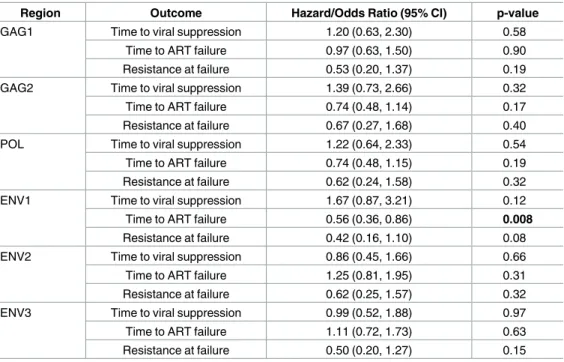
Overall, 39.5% of the 86 participants were virally suppressed by 6 months, the median time to ART failure was 8.8 months (IQR: 6.0–11.9), and 33.7% had ARV drug resistance at ART failure. The associations of baseline diversity with time to viral suppression, time to ART fail-ure, and ARV drug resistance at ART failure were evaluated using a dichotomous measure (>median HRM score vs.median HRM score for each region,Table 2).
Higher baseline ENV1 HRM scores were associated with longer time to ART failure (hazard ratio [HR]: 0.56, 95% confidence intervals [CI]: 0.36–0.89, p = 0.008); this association was still statistically significant when the data were corrected for multiple comparisons. The association of ENV1 diversity and time to ART failure was further supported by Kaplan-Meier analysis (S2 Fig). Diversity in GAG1, GAG2, POL, ENV2, and ENV3 was not associated with any of the three treatment outcomes. Other factors, such as baseline viral load, baseline CD4 cell count, and age were not associated with time to viral suppression or time to ART failure (data not shown). ENV1 HRM scores were similar for subtype C vs. non-subtype C HIV (median
Table 1. Association of baseline HIV diversity with baseline demographic, laboratory, and clinical characteristics*.
Variable GAG1 GAG2 POL ENV1 ENV2 ENV3
Sex 0.53 0.66 0.31 0.39 0.13 0.51
Age category 0.75 0.87 1.00 0.53 0.89 0.46
Education level 0.88 0.17 0.67 0.61 0.99 1.00
Geographical region 0.19 0.28 0.52 0.78 0.017 0.50
CD4 (per 100 CD4 increment) 1.00 0.58 0.39 0.15 0.38 0.30
VL (per unit log10VL increment) 0.74 0.78 0.52 0.28 0.51 0.32
ARV resistance 0.19 0.84 0.39 0.07 1.00 0.049
Previous ARV for PMTCT 0.47 0.10 0.28 0.33 0.58 0.58
Abbreviations: VL: viral load; ARV: antiretroviral; PMTCT: prevention of mother-to-child transmission.
*Univariate quantile (median) regression analysis was used for all variables. None of the p-values was considered significant after adjusting for multiple comparisons using the Benjamini-Hochberg correction.
[IQR]: 4.65 [4.10–5.23]) vs. 4.50 [4.01–4.91]), but this difference was not statistically significant (P = 1.00).
Discussion
In this study, we analyzed baseline HIV diversity among HIV-infected participants from the HPTN 052 trial who initiated early ART and subsequently failed treatment. We measured HIV diversity in two regions ingag(GAG1, GAG2), one region inpol(POL), and three regions in
env(ENV1, ENV2, ENV3) using the HRM diversity assay. After correcting for multiple com-parisons, we did not observe any association between baseline (pre-treatment) HIV diversity and any of the demographic, laboratory, or clinical characteristics evaluated. We also did not observe any associations between HIV diversity and time to viral suppression or ARV resis-tance at ART failure. A significant association was observed for higher baseline diversity in one of the threeenvregions (ENV1) and longer time to ART failure; diversity in the other five regions analyzed, including two other regions inenv, was not associated with this outcome. The association between ENV1 and time to ART failure was not confounded by other factors, such as viral load, CD4 cell count, or age. In another study of participants in HPTN 052, those factors were associated with treatment outcomes [20]. Previous studies have examined the relationship between HIV diversity and viral load. One study found an association between higherenvdiversity and higher viral load [21]. Another study found an association between highergagdiversity and higher viral load, with no association betweenenvdiversity and viral
Table 2. Associations of baseline HIV diversity and treatment outcomes*.
Region Outcome Hazard/Odds Ratio (95% CI) p-value
GAG1 Time to viral suppression 1.20 (0.63, 2.30) 0.58
Time to ART failure 0.97 (0.63, 1.50) 0.90
Resistance at failure 0.53 (0.20, 1.37) 0.19
GAG2 Time to viral suppression 1.39 (0.73, 2.66) 0.32
Time to ART failure 0.74 (0.48, 1.14) 0.17
Resistance at failure 0.67 (0.27, 1.68) 0.40
POL Time to viral suppression 1.22 (0.64, 2.33) 0.54
Time to ART failure 0.74 (0.48, 1.15) 0.19
Resistance at failure 0.62 (0.24, 1.58) 0.32
ENV1 Time to viral suppression 1.67 (0.87, 3.21) 0.12
Time to ART failure 0.56 (0.36, 0.86) 0.008
Resistance at failure 0.42 (0.16, 1.10) 0.08
ENV2 Time to viral suppression 0.86 (0.45, 1.66) 0.66
Time to ART failure 1.25 (0.81, 1.95) 0.31
Resistance at failure 0.62 (0.25, 1.57) 0.32
ENV3 Time to viral suppression 0.99 (0.52, 1.88) 0.97
Time to ART failure 1.11 (0.72, 1.73) 0.63
Resistance at failure 0.50 (0.20, 1.27) 0.15
Abbreviations: CI: confidence interval; ART: antiretroviral therapy.
*Hazard ratios for both time to viral suppression (censored at 12 months after ART initiation) and time to ART failure were estimated using Cox proportional hazards regression. Odds ratios for antiretroviral drug resistance at failure were estimated using logistic regression. In all analyses, viral regions were modelled using binary indicators based on median HRM score, with the reference as the group at or below the median HRM score. The Benjamini-Hochberg correction was used to adjust for multiple comparisons; a single p-value was statistically significant (shown in bold text).
load [15]. In our previous study of HIV-infected children, we found no association between viral load and diversity ingagorpoland with a borderline association inenv[13].
Higher levels ofenvdiversity prior to ART initiation might reflect a higher baseline viral replication rate and/or a higher viral mutation rate; either of these factors could make it more difficult to suppress viral replication with ART. The association of higher pre-treatment ENV1 diversity and longer time to ART failure that we observed in this study differs from our find-ings in a pediatric cohort. In that study, higher pre-treatment ENV2 diversity was associated with a worse treatment outcome (shorter time to ART failure) [13]; ENV1 diversity was not associated with any treatment outcomes in that study [13]. In another pediatric study, we found that higher pre-treatment ENV1 and ENV2 diversity was associated with lack of viral suppression, another bad outcome [14]. It is difficult to compare results from HPTN 052 and these pediatric cohorts, since the treatment regimens were different and many other factors could have impacted treatment outcomes.
The different associations that we observed for HIV diversity in the ENV1 region and other regions analyzed (ENV2, ENV3, GAG1, GAG2, POL) could reflect differences in the mutation rates in these regions of the HIV genome. Alternatively, the different associations could reflect differences at the protein level. For example, anti-HIV antibodies and cytotoxic T lymphocytes (CTLs) target different regions of the HIV genome; this could impact diversification in these regions if selective pressures varied from one region to another. Different domains of HIV pro-teins encoded by each HRM region may also vary in the degree of structural constraint; this could hinder or facilitate diversification in the respective coding regions of the HIV genome. In this study, higher diversity in the ENV1 region was associated with a longer time to viro-logic failure. ENV1 encodes the heptad repeat 1 (HR1) region of gp41 and regions to either side of that domain. ENV2 encodes the immunodominant region (IDR) cluster 1 of gp41 and portions of HR1 and heptad repeat 2 (HR2). ENV3 encodes HR2 and regions to either side of that domain [22]. It is not clear why diversity in these regions would have different associa-tions with clinical outcomes in this study and previous reports. It is also possible that the statis-tically significant association observed in this study did not reflect a biologic association, but was due to chance.
This study was also limited to participants in the early ART arm of HPTN 052, who started and failed ART before interim study results were released (before May 2011). In this group, participants initiated ART at higher CD4 cell counts; they did not know if ART would prevent HIV transmission to their partners, or if there were any health benefits or risks associated with early ART. This may have impacted adherence to treatment. Another limitation is that treat-ment adherence was not evaluated in this study. Of note, we did not find an association of HIV diversity and treatment outcomes when we examined different regions ofenv. Variation in genetic diversity in different sub-regions of HIVenvmay reflect variations in targeting of antibodies or cytotoxic T lymphocyte (CTL) responses to different epitopes on envelope pro-teins; however, serologic data was not available in this study. Variations in the mutation rate in different regions of theenvgene, or other factors may also impactenvdiversity. These results highlight the complexity of the relationship between HIV diversity and treatment outcomes.
Envdiversity has also been associated with differences in disease progression, which was not examined in this report. Those studies have produced conflicting results. Studies using sequencing methods to quantify diversity have observed associations between higherenv
diversity and either more rapid disease progression [7,8,23,24] or slower disease progression [25–27]. The different methods for testing and different HIV genomic regions analyzed in those studies make it difficult to compare results across the studies.
The HRM diversity assay is a high-throughput assay that can be used to analyze multiple genomic regions in large sample sets. For example, this study included six diversity measures in 86 samples (516 diversity measures). This approach for quantifying HIV diversity may be useful in future studies evaluating the complex relationship between HIV diversity, ART out-comes, and other clinical outcomes in HIV infection.
Supporting information
S1 Fig. Distribution of baseline ENV2 HRM scores by geographical region. The box plot
shows the distribution of ENV2 HRM scores by geographical region (South America [n = 17], Asia [n = 26], and Africa [n = 43]). Median (interquartile range [IQR]) ENV2 HRM scores were 5.4 (4.5, 6.0) for South America, 5.1 (4.4, 5.6) for Asia, and 4.4 (4.1, 5.4) for Africa. Abbreviations: HRM: high resolution melting.
(PDF)
S2 Fig. Kaplan-Meier plot showing the probability of ART failure as a function of time for participants with ENV1 HRM scores above vs. below the median. Kaplan-Meier plot
show-ing the association of higher ENV1 HRM score (>median) with longer time to antiretroviral (ART) failure. The numbers below the graph indicate the number (N) of participants failing ART per time point.
(PDF)
S1 Table. Affiliated IRBs/ECs and regulatory bodies by site.
(PDF)
S2 Table. High resolution melting (HRM) scores, geographical region, and HIV subtype of HIV-infected adults analyzed using the HRM diversity assay in HPTN 052.
(PDF)
S3 Table. Enrollment (baseline) characteristics of the study cohort (N = 95).
(PDF)
Acknowledgments
The authors thank the HPTN 052 study team and participants for providing the samples and data used in this study. We also thank the laboratory staff who helped with sample manage-ment and testing.
Author Contributions
Conceptualization: PJP SHE JMF.
Data curation: PJP MM TG N. Kumwenda JM N. Kumarasamy SC JGH MCH MGM SVG
JHP BG RP MSC.
Formal analysis: PJP EAW YQC SHE JMF.
Investigation: PJP SHE JMF.
Methodology: PJP EAW YQC SHE JMF.
Project administration: PJP EPM SHE JMF.
Resources: PJP SHE JMF.
Supervision: SHE.
Validation: SHE.
Visualization: PJP SHE JMF.
Writing – original draft: PJP SHE JMF.
Writing – review & editing: PJP EAW EPM MM TG N. Kumwenda JM N. Kumarasamy SC
JGH MCH MGM SVG JHP BG RP YQC MSC SHE JMF.
References
1. Cousins MM, Laeyendecker O, Beauchamp G, Brookmeyer R, Towler WI, Hudelson SE, et al. Use of a high resolution melting (HRM) assay to compare gag, pol, and env diversity in adults with different stages of HIV infection. PLoS One. 2011; 6(11):e27211.https://doi.org/10.1371/journal.pone.0027211
PMID:22073290
2. Shankarappa R, Margolick JB, Gange SJ, Rodrigo AG, Upchurch D, Farzadegan H, et al. Consistent viral evolutionary changes associated with the progression of human immunodeficiency virus type 1 infection. J Virol. 1999; 73(12):10489–10502. PMID:10559367
3. Keele BF. Identifying and characterizing recently transmitted viruses. Curr Opin HIV AIDS. 2010; 5 (4):327–334.https://doi.org/10.1097/COH.0b013e32833a0b9bPMID:20543609
4. Rambaut A, Posada D, Crandall KA, Holmes EC. The causes and consequences of HIV evolution. Nat Rev Genet. 2004; 5(1):52–61.https://doi.org/10.1038/nrg1246PMID:14708016
5. Kitrinos KM, Nelson JA, Resch W, Swanstrom R. Effect of a protease inhibitor-induced genetic bottle-neck on human immunodeficiency virus type 1 env gene populations. J Virol. 2005; 79(16):10627– 10637.https://doi.org/10.1128/JVI.79.16.10627-10637.2005PMID:16051855
6. Mani I, Gilbert P, Sankale JL, Eisen G, Mboup S, Kanki PJ. Intrapatient diversity and its correlation with viral setpoint in human immunodeficiency virus type 1 CRF02_A/G-IbNG infection. J Virol. 2002; 76 (21):10745–10755.https://doi.org/10.1128/JVI.76.21.10745-10755.2002PMID:12368317
7. Joos B, Trkola A, Fischer M, Kuster H, Rusert P, Leemann C, et al. Low human immunodeficiency virus envelope diversity correlates with low in vitro replication capacity and predicts spontaneous control of plasma viremia after treatment interruptions. J Virol. 2005; 79(14):9026–9037.https://doi.org/10.1128/ JVI.79.14.9026-9037.2005PMID:15994796
8. Sagar M, Lavreys L, Baeten JM, Richardson BA, Mandaliya K, Chohan BH, et al. Infection with multiple human immunodeficiency virus type 1 variants is associated with faster disease progression. J Virol. 2003; 77(23):12921–12926.https://doi.org/10.1128/JVI.77.23.12921-12926.2003PMID:14610215
9. Towler WI, James MM, Ray SC, Wang L, Donnell D, Mwatha A, et al. Analysis of HIV diversity using a high-resolution melting assay. AIDS Res and Hum Retroviruses. 2010; 26(8):913–918.
10. Cousins MM, Ou SS, Wawer MJ, Munshaw S, Swan D, Magaret CA, et al. Comparison of a high-resolu-tion melting assay to next-generahigh-resolu-tion sequencing for analysis of HIV diversity. J Clin Microbiol. 2012; 50 (9):3054–3059.https://doi.org/10.1128/JCM.01460-12PMID:22785188
11. James MM, Wang L, Musoke P, Donnell D, Fogel J, Towler WI, et al. Association of HIV diversity and survival in HIV-infected Ugandan infants. PLoS One. 2011; 6(4):e18642.https://doi.org/10.1371/ journal.pone.0018642PMID:21533179
12. James MM, Laeyendecker O, Sun J, Hoover DR, Mullis CE, Cousins MM, et al. Antibody maturation and viral diversification in HIV-infected women. PLoS One. 2013; 8(2):e57350.https://doi.org/10.1371/ journal.pone.0057350PMID:23460842
14. James MM, Wang L, Donnell D, Cousins MM, Barlow-Mosha L, Fogel JM, et al. Use of a high resolution melting assay to analyze HIV diversity in HIV-infected Ugandan children. Pediatr Infect Dis J. 2012; 31(11):e222–228.https://doi.org/10.1097/INF.0b013e3182678c3fPMID:22785048
15. Piantadosi A, Chohan B, Panteleeff D, Baeten JM, Mandaliya K, Ndinya-Achola JO, et al. HIV-1 evolu-tion in gag and env is highly correlated but exhibits different relaevolu-tionships with viral load and the immune response. AIDS. 2009; 23(5):579–587.https://doi.org/10.1097/QAD.0b013e328328f76ePMID:
19516110
16. Cohen M, Chen Y, McCauley M, Gamble T, Hosseinipour M, Kumarasamy N, et al. Antiretroviral ther-apy for the prevention of HIV-1 transmission. N Engl J Med. 2016; 375:830–839.https://doi.org/10. 1056/NEJMoa1600693PMID:27424812
17. Cohen MS, Chen YQ, McCauley M, Gamble T, Hosseinipour MC, Kumarasamy N, et al. Prevention of HIV-1 infection with early antiretroviral therapy. N Engl J Med. 2011; 365(6):493–505.https://doi.org/10. 1056/NEJMoa1105243PMID:21767103
18. Eshleman SH, Husnik M, Hudelson S, Donnell D, Huang Y, Huang W, et al. Antiretroviral drug resis-tance, HIV-1 tropism, and HIV-1 subtype among men who have sex with men with recent HIV-1 infec-tion. AIDS. 2007; 21(9):1165–1174.https://doi.org/10.1097/QAD.0b013e32810fd72ePMID:17502727
19. Benjamini Y, Hochberg Y. Controlling the False Discovery Rate—a Practical and Powerful Approach to Multiple Testing. J Roy Stat Soc B Met. 1995; 57(1):289–300.
20. Fogel JM, Zhang XC, Ou SS, Piwowar-Manning E, Eron JJ, McCauley M, et al. Virologic outcomes in early antiretroviral treatment: HPTN 052. Submitted.
21. Lemey P, Kosakovsky Pond SL, Drummond AJ, Pybus OG, Shapiro B, Barroso H, et al. Synonymous substitution rates predict HIV disease progression as a result of underlying replication dynamics. PLoS Comput Biol. 2007; 3(2):e29.https://doi.org/10.1371/journal.pcbi.0030029PMID:17305421
22. Cousins MM, Donnell D, Eshleman SH. Impact of mutation type and amplicon characteristics on genetic diversity measures generated using a high-resolution melting diversity assay. J Mol Diagn. 2013; 15 (1):130–137.https://doi.org/10.1016/j.jmoldx.2012.08.008PMID:23178437
23. Markham RB, Wang WC, Weisstein AE, Wang Z, Munoz A, Templeton A, et al. Patterns of HIV-1 evolu-tion in individuals with differing rates of CD4 T cell decline. Proc Natl Acad Sci U S A. 1998; 95
(21):12568–12573. PMID:9770526
24. Rachinger A, Kootstra NA, Gijsbers EF, van den Kerkhof TL, Schuitemaker H, van ’t Wout AB. HIV-1 envelope diversity 1 year after seroconversion predicts subsequent disease progression. AIDS. 2012; 26(12):1517–1522.https://doi.org/10.1097/QAD.0b013e328354f539PMID:22555160
25. Williamson S. Adaptation in the env gene of HIV-1 and evolutionary theories of disease progression. Mol Biol Evol. 2003; 20(8):1318–1325.https://doi.org/10.1093/molbev/msg144PMID:12777505
26. Ganeshan S, Dickover RE, Korber BT, Bryson YJ, Wolinsky SM. Human immunodeficiency virus type 1 genetic evolution in children with different rates of development of disease. J Virol. 1997; 71(1):663– 677. PMID:8985398